
THE BROWN DAILY HER ALD
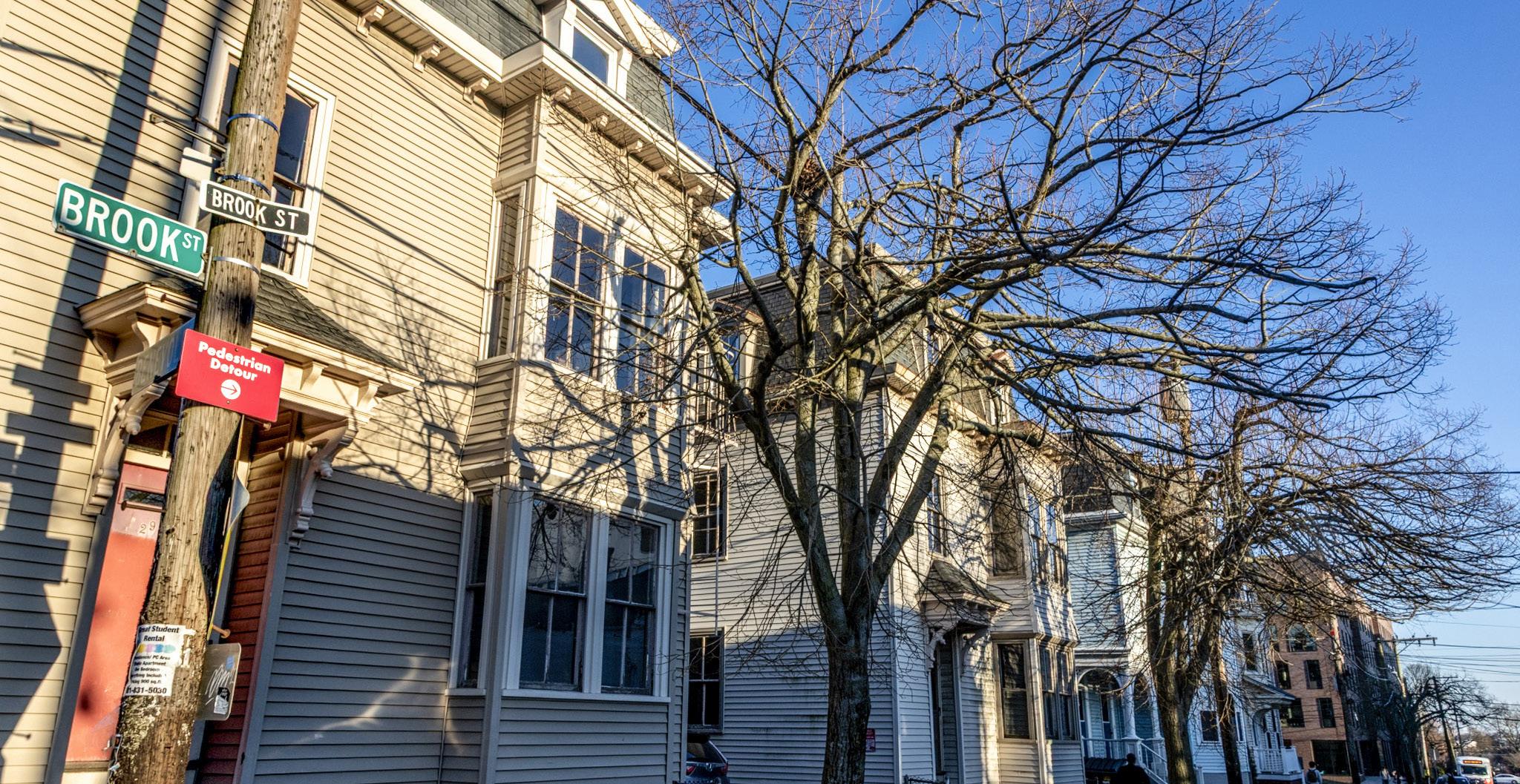
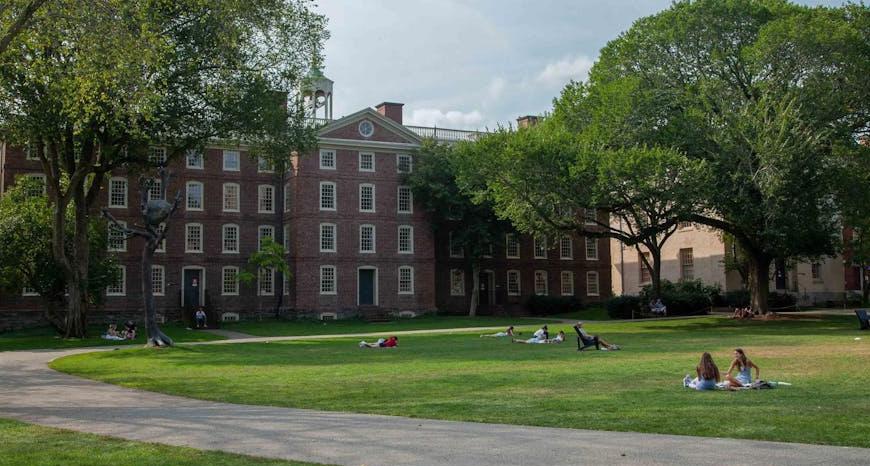
Four residential structures stand on the proposed development site
BY ROMA SHAH AND JEREMIAH FARR
UNIVERSITY NEWS EDITOR AND SENIOR STAFF WRITER
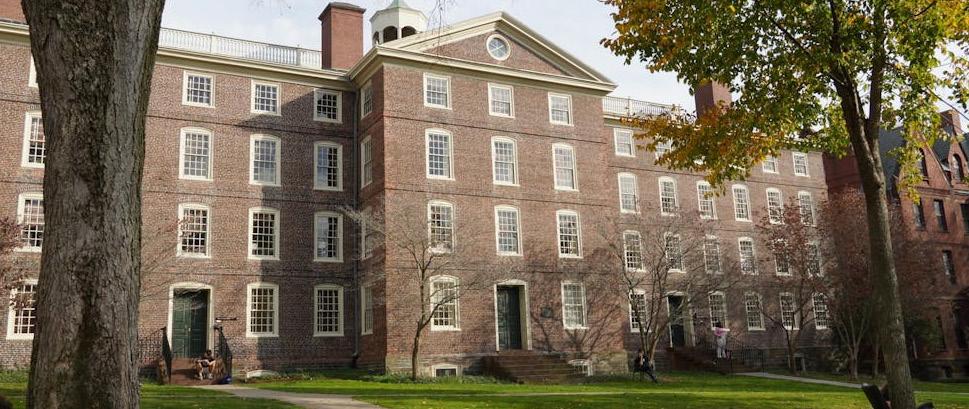
Brown is planning to construct a new economics building on Brook Street between Benevolent and Charlesfield
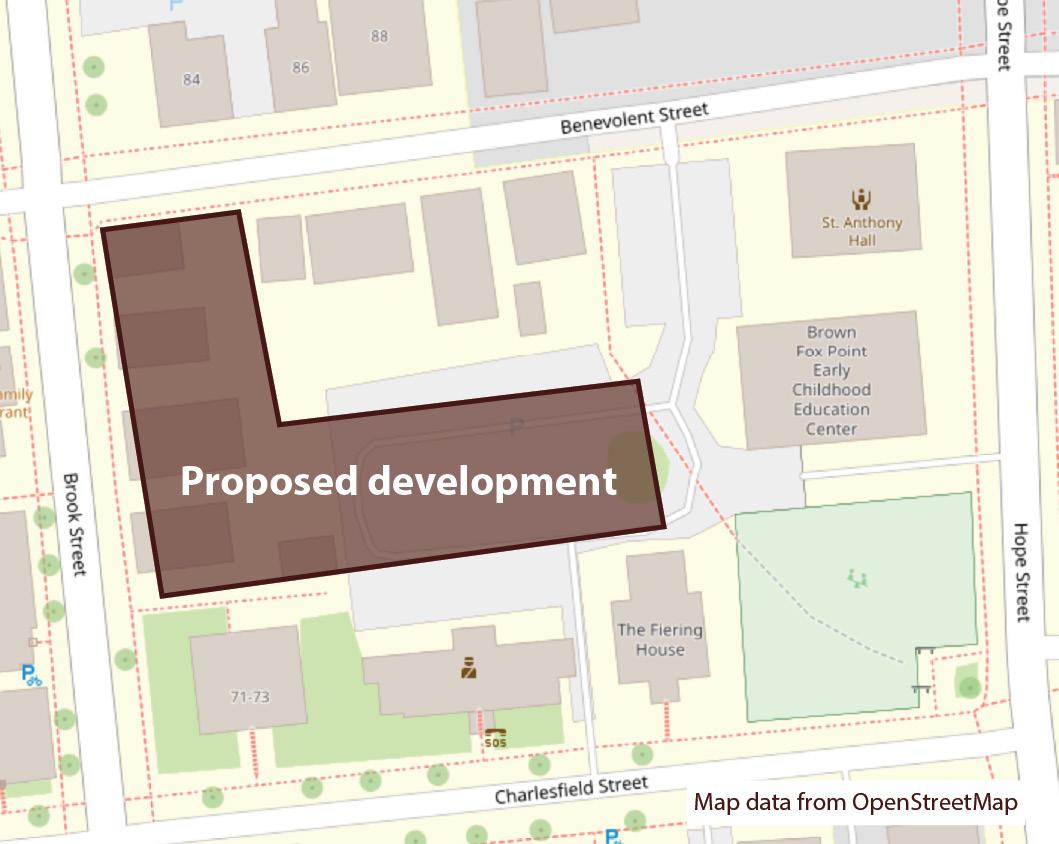
streets. The University is looking to develop on a Brown-owned lot that currently holds four residential structures and a parking lot, according to University spokesperson Brian Clark.
In March and April, meetings were held with neighboring residents and the Providence Preservation Society, during which University administrators discussed plans for the development.
But community members and PPS leaders have said there has been a lack of transparency in the process and criti -
The University plans to construct a new economics building on Brook Street.
cized the development plans. They have expressed concerns with the new building’s height, the future of the buildings currently on the lot and the loss of residential buildings amid a housing crisis in Providence.
The development — which is expected to be “a fully donor-funded project,” Clark wrote in an email to The Herald — is currently “in its early planning stages,” and a feasibility study has been completed. The University has begun a search for an architect “to help develop
Some nearby residents aren’t happy.
the vision for the project,” Clark wrote in an email to The Herald. The lot contains properties that were included in the University’s request for proposals last summer.
Faculty, staff and students in the Department of Economics are currently located across five separate buildings. “A dedicated building in the heart of campus near similar academic units,” such as the Watson School of International and Public Affairs, “would unify (the department’s) people and activities,” Clark wrote.
According to slides shared at a March meeting between University administrators and community members obtained by The Herald, the building is expected to be taller than all other neighboring University buildings, including Stephen Robert ’62 Hall, the Danoff and Chen Family Halls and the Watson School of International and Public Affairs.
Brown will “initiate a formal community engagement process to collect and
SEE LAWSUIT PAGE 5 METRO
SPORTS
ACLU, University spar in court over public access to DPS arrest records
Baseball crushes Merrimack in mercy-rule shutout win
SEE BASEBALL PAGE 6
CLEMENTS
UNIVERSITY NEWS
Meet the alums in the running to be on the Brown Corporation
SEE CORPORATION PAGE 9
Interim chief Hugh Clements named DPS chief of police, VP for public safety
Clements was appointed to the interim role in December after Chatman was placed on leave
BY EMILY FEIL UNIVERSITY NEWS AND METRO EDITOR
Hugh Clements has been appointed to the role of vice president for public safety and emergency management and chief of police effective immediately, President Christina Paxson P’19 P’MD’20 announced in a Wednesday morning email to the Brown community. Clements has served as interim vice president and chief since December.
The day before the announcement, former vice president for public safety and police chief Rodney Chatman officially ended his tenure at Brown as part of an approved workers’ compensation settlement proposal, The Herald previously reported. According to Wednesday’s announcement, Chatman’s employment with the University ended this month.
Clements was appointed to the interim role on Dec. 22, 2025, replacing Chatman after he was placed on administrative leave following the Dec. 13 mass shooting.
Since arriving at Brown, “Clements has helped guide Brown toward becoming a secure campus defined by preparedness, vigilance and mutual care,” Paxson wrote.
Clements's responsibilities as vice president and chief of police include leading Brown’s police department, overseeing coordinated emergency response and leading campus-wide safety initiatives, Paxson wrote.
“Clements is well positioned to serve as a critical leadership voice as we work collectively to determine what it means to be a campus that effectively balances robust security measures with sustaining a welcoming community,” Paxson wrote.
This article originally appeared online at browndailyherald.com on April 8, 2026.
SCIENCE & RESEARCH
Physicist receives Grant to solve fundamental question of the universe
SEE PHYSICS PAGE 15
DPS Chief Chatman to
The separation comes as part of a settlement proposal approved in court Tuesday morning
BY JAMES LIBRESCO AND EMILY FEIL SENIOR STAFF WRITER AND UNIVERSITY NEWS AND METRO EDITOR
Brown Police Chief Rodney Chatman will officially separate from the University as part of an approved settlement proposal, Chief Judge Robert Ferrieri announced in Rhode Island Workers’ Compensation Court Tuesday morning.
Chatman, who has also served as Brown’s vice president for public safety, was on administrative leave following the Dec. 13 shooting. He was replaced in the interim by Hugh Clements, the former chief of the Providence Police Department.
Ferrieri described the agreement as an “amicable separation.” Testifying in court at around 10:55 a.m., Chatman affirmed that the settlement means he has no job to return to at Brown.
The news of Chatman’s permanent departure comes after his tenure was marked by votes of no
ARTS & CULTURE
Daebak’s 10th annual spring show ‘Hello World’ captivates audiences
SEE DANCE PAGE 16
leave University
confidence from two separate police unions. A Herald investigation also revealed allegations of a toxic work environment in the Department of Public Safety under Chatman’s leadership. A subsequent investigation unearthed further allegations that department leaders mishandled responses to bomb and shooting threats.
When reached after the hearing, Chatman declined to comment on the approved settlement proposal. In a phone call, a representative for Gregory Boyer, Chatman’s lawyer, declined to comment.
The University declined to comment on the settlement. In a Tuesday afternoon email, University spokesperson Brian Clark noted that updates about DPS leadership would be shared directly with the Brown community.
In a statement sent to The Herald shortly after 9 a.m., Clark wrote that the University did “not consider it appropriate to share details on personnel matters and have no further details to provide.”
He confirmed that, at that time, Chatman was still employed by Brown and was on administrative leave.
on April 7, 2026.
ANNAMARIA LUECHT / HERALD
The
UNIVERSITY NEWS
DEVELOPMENT FROM PAGE 1
consider feedback from local residents and community leaders,” before submitting an amendment to Brown’s Institutional Master Plan for approval by the Providence City Plan Commission, Clark wrote.
Erika Lamb and Tom Lamb, nearby residents who hosted a neighborhood meeting about the proposed building on Tuesday, first learned about the possibility of a development in their neighborhood in August when University leaders invited them to a meeting about Brown’s plans to sell several properties in the area.
“We were all really surprised,” Erika Lamb said in an interview with The Herald.
The University later invited residents to a March 31 meeting to discuss “a new academic building we are planning in your neighborhood,” according to emails obtained by The Herald.
Attendees of the March meeting were “outraged, and people spoke very harshly
and very vociferously,” according to Erika Lamb. Tom Lamb described the communication between the University and residents of the neighborhood as “very poor.”
Tom Lamb said that the meeting did not feel like a forum for resident input but rather entailed “Brown presenting to us what they are proposing.” He noted that the University was clear that the proposals were not yet the final plan.
“The public process should shape a project like this, not come after the fact,” Erika Lamb said.
Associate Vice President for Government Relations Al Dahlberg, a University administrator who helped run the meetings, did not respond to a request for comment.
Tom Lamb called the development “institutional creep,” saying that future University projects could happen nearly anywhere on College Hill as Brown build-
ings are located near residences.
Erika Lamb noted that she is also against the development because she is “specifically against demolishing houses,” highlighting Providence’s current housing crisis.
Clark noted that the buildings on the lot are located within an I-2 Educational Institutional District Zone. The EI zoning district regulates the size of new developments and “permits higher education institutions and their expansion in a planned manner, while protecting the surrounding neighborhoods,” according to the City of Providence’s zoning ordinance manual.
Marisa Angell Brown, executive director of the PPS, said the society has met with the University about the development. Angell Brown has been talking with neighboring residents about pathways to contest the construction, including an appeal to sustainability and history.
Angell Brown said that the PPS plans to publish an open letter next week calling for the University to publicly share “whether there has been a rigorous examination or feasibility study about the reuse of the existing buildings.”
If the buildings cannot be repurposed or moved — after studies on the development are conducted and published — Angell Brown hopes the University will handle the demolition of the buildings responsibly by manually deconstructing them and saving items that can be reused.
“We would really expect that an institution like Brown, with its sustainability goals, would have a serious deconstruction and salvage plan at the very least,” she added.
On behalf of University Architect Craig Barton, Clark wrote that the University does not yet have specifics on “any potential impacts to existing buildings on the site” due to “the very early nature of the planning process.” He added that for any new building or renovation project, the University considers “environmental impact and sustainability.”
Jeff Tingley — an attendee at Tuesday’s neighborhood meeting — currently lives on Benevolent Street, where he grew up. “A lot of Brown’s development is very good for Providence,” he said in an interview with the Herald. “Providence needs Brown. Brown needs Providence.”
“So we have to work together,” he said. Tingley also said he hopes Brown students will bring up the issue with University administration.
Tingley said that Brown’s presence in the neighborhood has been positive overall, but there have been issues. “From a resident’s perspective, many of us have felt that we’re not listened to, and that Brown really does what Brown wants,” he said.
In response to concerns about transparency with local residents, Clark wrote that the University began the “multi-year” process by meeting with “local stakeholders,” adding that “a robust community engagement process” will follow the selection of an architect.
Providence city councilmember John Goncalves ’13 MAT’15 (Ward-1) has attended community meetings about the potential new construction, and he wrote in an April 3 letter to President Christina Paxson P’19 P’MD’20, Executive Vice President Russell Carey and Dahlberg that he urges “reconsideration of the current proposal.”
“Accumulated holdings position the University to reshape the neighborhood in ways that do not seem to reflect the needs, character or voices of long-standing Providence residents,” the letter reads. The letter also raised concerns about the new building’s height blocking light from neighboring houses.
In an interview with the Herald, Goncalves said that in the coming weeks, he plans to publish the letter to a 20,000-person email list and ask people to sign onto it.
“If our neighborhood is very clear about its stance and what they see as a looming concern, my job is to make sure that those constituents’ concerns are being elevated, and we’re using our voice to hold the institution accountable,” Goncalves said.
In a Wednesday evening email obtained by The Herald, which was sent from Carey to neighboring residents, he wrote that the University is “deeply committed to community engagement.”
“The University has an extensive history of carrying out the design of new and renovated academic buildings in a manner that embraces and positively impacts both the campus and the College Hill neighborhood,” he wrote, “and we will do so again with this project.”
“We do not expect to propose anything other than what is allowed by right within an I-2 zone, and no variances or waivers will be necessary,” Carey wrote. “While we are sensitive to the questions and concerns raised in the meeting, we are seeking to develop a site that for forty years has been designated by the City for exactly this academic and mission purpose.”
This article originally appeared online at browndailyherald.com on April 9, 2026.
Employees who worked following Dec. 13 eligible for compensatory time
Employees will also be eligible for one-time payments
BY IAN RITTER UNIVERSITY NEWS AND SCIENCE & RESEARCH EDITOR
Employees who worked the weekend of the Dec. 13 mass shooting are eligible for compensatory time, and those who worked over winter break are eligible for one-time payments, Vice President for Human Resources Marie Williams and Vice President for Diversity and Inclusion Matthew Guterl shared in a Friday Today@Brown announcement.
“Beginning in the most immediate moments of the shooting, hundreds of Brown staff … made crucial contributions to helping the University respond and begin to recover,” the announcement reads.
For each day employees worked during the weekend of the shooting, they will receive an extra day off to be used before the 2026 winter break.
While union employees have already been compensated for their time worked
during winter break according to the terms in their collective bargaining agreements, non-union employees are now also eligible for one-time payments, the announcement says. Hourly and salaried employees will receive tiered compensation based on the number of days worked.
“This measure is just one way to acknowledge the contributions staff have made above and beyond their regular duties,” the announcement reads.
Employees will also be recognized at the women’s lacrosse game against Dartmouth this Saturday, the announcement adds. A “representative group of staff from many units across the University” will be honored at midfield at the game’s halftime. Additionally, four complementary tickets can be claimed by all Brown faculty and staff, and Brown Ever True hats will be given to the first 100 employees in attendance.
“These two measures are among many ongoing efforts to demonstrate our gratitude and celebrate the resilience of the remarkable staff who are integral parts of what makes Brown, ‘Brown,’” according to the announcement.
KAIOLENA TACAZON / HERALD
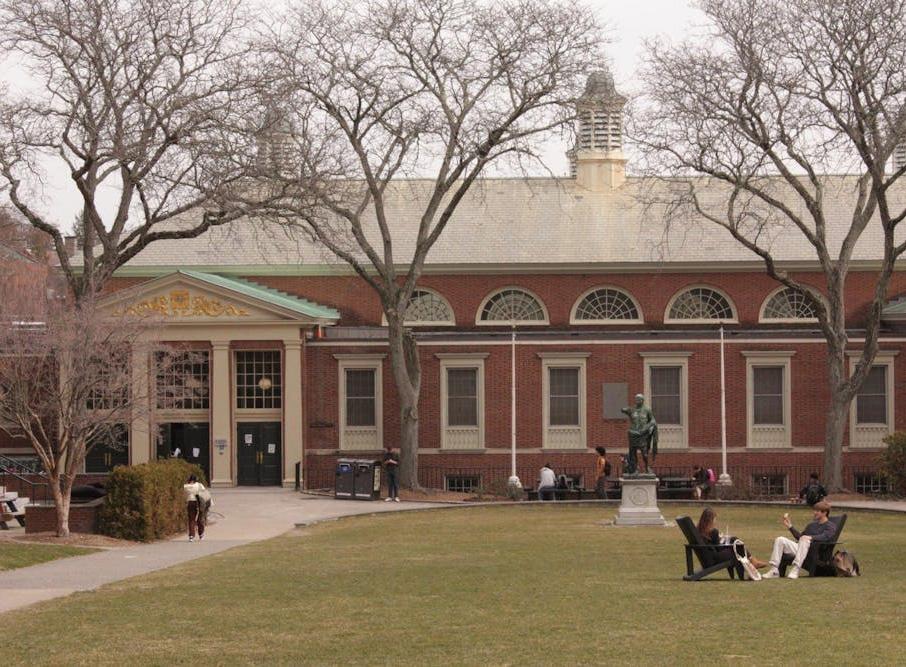
For each day employees worked during the weekend of the shooting, they will receive an extra day off to be used before the 2026 winter break.
CIARA MEYER / HERALD
Graduate fellows push for unionization at Friday rally
Organizers delivered a letter to an administrator in University Hall
BY JAMES LIBRESCO SENIOR STAFF WRITER
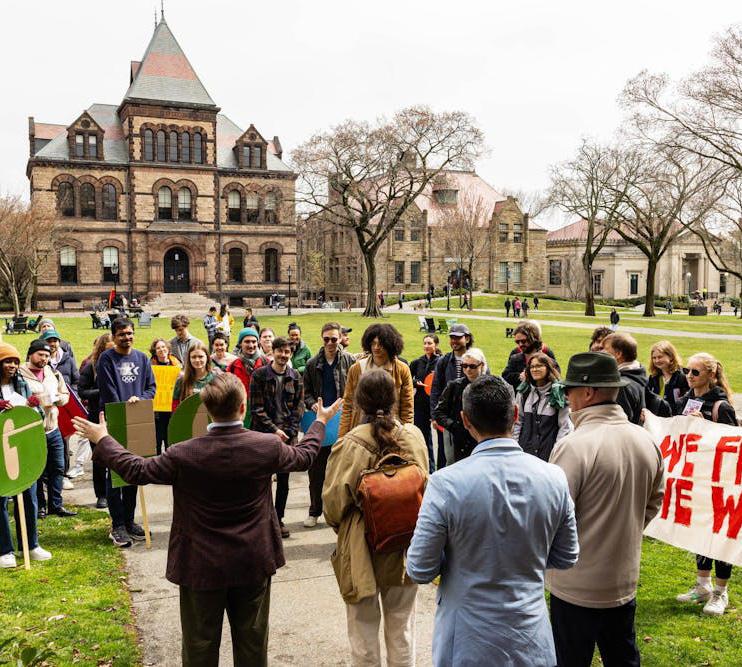
Graduate fellows rallied on Ruth J. Simmons Quadrangle Friday after announcing last Monday that they were prepared to unionize in a move that could alter the landscape of graduate student organizing nationwide.
Roughly 45 people attended Friday’s demonstration, including City Councilor Sue AnderBois (Ward 3) and Rep. David Morales MPA’19 (D-Mount Pleasant, Valley, Elmhurst). President of the Rhode Island AFL-CIO Patrick Crowley was also in attendance, along with other R.I. union leaders.
After a series of speeches and chants, the group walked to the Main Green, where they presented a letter to an administrative assistant inside University Hall arguing that Brown should voluntarily recognize the fellows as part of the Graduate Labor Organization.
Last Monday, leaders from RIFT-AFT Local 6516 — GLO’s parent group — sent an email to University administrators stating that more than 70% of fellows had indicated they wished to be represented by GLO. Friday’s letter reiterated the union’s request for voluntary recognition.
University spokesperson Brian Clark did not immediately respond to The Herald’s request for comment. He wrote last week, after Brown received the union’s email, that the University “will review the request, determine next steps and respond directly to the organizers,” The Herald previously reported.
Although the National Labor Relations Board does not allow graduate fellows to unionize at the federal level, a novel Rhode
Island law passed in August codifies their right to do so under the Rhode Island State Labor Relations Board. There appears to be no U.S. university where graduate fellows have successfully unionized.
“Our campaign operated in secret for over seven months,” said Maria Arievitch GS, GLO’s organizing director, in a speech at the rally. “Slowly but surely, we built up a majority” of fellows who wished to unionize, she said.
Lex Schultz GS, a first-year Ph.D. student and a fellow in the Department of Earth, Environmental and Planetary Sciences, said in a speech that one of the reasons they chose to attend Brown was its robust graduate union.
“I came here because I wanted to be a part of a community where graduate workers have a voice, have a seat at the table and where our labor is respected,” Schultz said.
On the University website, Schultz pointed to the use of “words like ‘devote’ instead of ‘work’ to make it sound like we don’t have a real job, like TAs or RAs,” they said, referring to teaching and research assistants.
Schultz said that they worked around 70 hours per week last semester, including attending classes and completing lab work.
“That’s two full-time jobs in any other industry,” they said. “If your boss expects you and requires you to take a specialized class to do your job better, that’s called mandatory professional development, and you get paid for it.”
Graduate fellows currently receive the same compensation and benefits as their unionized peers, but they are not able to file grievances against the University, which would give them a formal process to allege “inappropriate treatment.”
“The most dangerous part is that fellows do not have access to our union grievance procedure,” Schultz said. “The procedure is basically the heart of the Union.
It’s what protects you from harassment and exploitation.”
Victoria Antonetti GS, the vice president of Local 6516 and a fifth-year fellow in applied math, said in an interview with The Herald that the union is prepared to fight for fellows’ unionization whether or not the University recognizes them voluntarily.
The process of fellow unionization will
happen alongside GLO’s ongoing contract negotiations, according to Michael Ziegler GS, the president of Local 6516.
“For the University to be able to have as much success as they have” in terms of research and revenue, Morales said in an interview with The Herald, “there’s something to be said about basic fairness in place, and the basic fairness here is recognizing our fellows as being part of a union.”
THE BROWN DAILY HERALD
Editor-in-Chief
Cate Latimer
Managing Editors
Ciara Meyer Elise Haulund
Claire Song
Senior Editors
Hadley Carr
Paul Hudes
Max Robinson
POST- MAGAZINE
Editor-in-Chief
Elaina Bayard
NEWS
Megan Chan
Pavani Durbhakula
Talia Egnal
Emily Feil
Annika Singh
Ava Stryker-Robbins
Science & Research
Ritter
Opinions Editors Benjamin Aizenberg Ethan Canfield
Isabella Gardiner
Lucas Guan
CJ Lair Batisse Manhardt Tas Rahman Camila Valdes


PRODUCTION
Design Editors
MULTIMEDIA
Photo Chiefs Annamaria Luecht
Kaia Yalamanchili
Illustration Chiefs Kendra Eastep Isabela Guillen
Video Chiefs
Cienna Cheng
Cody Cheng
Social Media Chiefs
Nate Barkow
Annika Melwani
Technology Chief Annika Singh
Data Desk Chief Caleb Ellenberg
Multimedia Editors
Sophia Basaldua
Marat Basaria
Harry Guo
Horatio Hamilton
Selina Kao
Ella Le
Kenna Lee
JJ Li
Jake Parker
Jascha Silberstein
Rassul Toleugazy
BUSINESS
General Managers
Arjun Deshpande
Anum Azhar
Sales Directors
Arjun Ray
Hannah Han
Finance Director
Sydney Wright
Office Manager
Cary Warner
“Brown works because we do,” Schultz said at the end of their speech. “The research happens because we do. The teaching happens because we do the teaching.”
“And it’s time for a contract that recognizes that fact,” they said.
This article originally appeared online at browndailyherald.com on April 6, 2026.
Submissions: The Brown Daily Herald publishes submissions in the form of op-eds and letters to the Op-eds are typically between 600 and 900 words and advance a clear argument related to a topic of campus discourse. You can submit op-eds to opinions@browndailyherald.com.
Letters to the editor should be around 250 words and respond to an article or column that has appeared in The Herald, or critique or commend The Herald’s editorial decisions. You can submit letters to the editor to letters@browndailyherald.com.
Submissions undergo multiple rounds of editing. These rounds of editing generally take place over the course of one evening, and you may have to respond to edits late in the evening. If you know you will be unable to do so, please mention that in your email, and we will do our best to work with you.
Submissions can build on reporting from The Herald, reporting elsewhere, official statements from the University or other groups and other reputable sources, but they cannot break news or contain information that The Herald cannot verify. Because we cannot publish unsubstantiated information, failure to provide appropriate sources may mean we have to modify or remove unverified claims.
The Herald will not publish anonymous submissions or submissions authored by organizations. Leaders of student organizations can be identified as such but cannot write under the byline of their organization. The Herald cannot publish all submissions it receives and reserves the right
Commentary:
The Brown Daily Herald, Inc. is a financially independent, nonprofit media organization bringing you The Brown Daily Herald and Post- Magazine. The Brown Daily Herald has served the Brown University community daily since 1891. It is published Monday through Friday during the academic year, excluding vacations, once during Commencement and once during Orientation by
Copyright 2023 by The Brown Daily Herald, Inc. All rights reserved.
JAKE PARKER / HERALD
A novel Rhode Island law codifies graduate fellows’ rights to unionize under the state labor relations board.
VOTING
State legislators introduce act codifying voter protections
The proposal comes amid federal push to tighten ID requirements
BY ANNIKA MELWANI SENIOR STAFF WRITER
On March 31, legislators and advocates
held a bill launch at the Rhode Island State House for the R.I. Voting Rights Act, which aims to protect Rhode Islanders against voter suppression and vote dilution. The proposed legislation comes in the face of the Safeguard American Voter Eligibility Act, which entered consideration in the U.S. Senate on March 17 — a week before the RIVRA was referred to the R.I. Senate Judiciary Committee.
The RIVRA was introduced “at the request of the Secretary of State Gregg M. Amore,” Faith Chybowski, director of communications and public affairs for the R.I. Department of State, wrote in an email to The Herald.
Chybowski wrote that Amore has “serious concerns” about the SAVE Act’s “impact on the accessibility of elections for Rhode Island voters, especially married individuals who have changed their name.” A proposed SAVE ACT clause would require these voters to provide an explanation for why the name on their birth certificate does not match the name on their other identifying documents.

en or cancel out the voting strength of racial minorities.”
The RIVRA also allows individuals, groups and the attorney general “to bring legal action against any jurisdiction that subjects voters to suppressive voting tactics or dilutes the power of their vote,” Chybowski added.
The act also “codifies and expands” a federal requirement mandating select municipalities with high percentages of non-English-speaking voters provide bilingual ballots, Chybowski wrote. Additionally, the act ensures “assistance with voting or at any stage in the process” for people with disabilities, she wrote.
Marion told The Herald that while
“Since women are more likely than men to change their names after marriage, they are disproportionately impacted by these requirements,” Angela Lima, chief of government relations at the Women’s Fund of Rhode Island, wrote in an email to The Herald.
She added that “women in this situation may need to provide additional documentation, such as a marriage certificate, to verify their identity” which “can be especially difficult for those who were married many years ago or who
John Marion, executive director of Common Cause R.I., told The Herald that the organization finds the SAVE Act and previous iterations passed by the House of Representatives “both unnecessary” and “potentially devastating for eligible voters, particularly married women.”
no longer have easy access to official records.”
The SAVE Act would also introduce a proof-of-citizenship requirement — but not all voters hold documents that would fulfill this requirement, such as passports and Enhanced Driver’s Licenses.
Marion stated that about half of Americans are not in possession of passports. In Rhode Island, over 400,000 citizens are estimated to not have valid passports. Additionally, EDLs are only offered in New York, Vermont, Michigan, Minnesota and Washington.
“If the federal Voting Rights Act and our long-held rights are going to face
attacks in Washington, D.C., it’s up to us to enshrine Rhode Islanders’ rights in State law,” Amore wrote in a statement shared with The Herald.
According to Chybowski, the purpose of the R.I. Voting Rights Act is “to codify the protections in the federal Voting Rights Act to ensure Rhode Island’s elections are fair and accessible.”
She added that the act protects against both voter suppression, which she defined as discrimination “that limits a voter’s access to voting opportunities or participation in any part of the political process,” and vote dilution, a practice that she said involves “the drawing of voting districts that weak-
“The Rhode Island Voting Rights Act could not prevent the SAFE Act from preempting Rhode Island State law” codifying protections in state law would reduce a reliance on federal courts to enforce voting rights.
Lima wrote that the act’s addition of “marital status” as a protected category “strengthens protections against discrimination by making it illegal for voting practices or procedures to disadvantage someone because they are single, married, divorced or widowed.”
“We are committed to showing up in communities, attending local events and helping people understand what the legislation does and why it matters,” Lima wrote.
This article originally appeared online at browndailyherald.com on April 5, 2026.
How Providence eighth graders receive their high school placements
All but two PPSD high schools select students using a lottery system
BY NATE BARKOW SENIOR STAFF WRITER
In late March, eighth graders across the Providence Public School District found out where they would be spending their next four years in high school.
To be placed into public high schools in Providence, eighth graders complete a general school choice form in early January, where they rank their top four preferences for high school. From there, students are placed into their top choice school unless there is more demand for a school than there are seats available.
A lottery is then conducted to determine student placement, with preference given to students who live in the neighborhood and those with siblings enrolled.
“We want to make sure that families have the choice to pick what’s best for their kids,” PPSD spokesperson Alex Torres-Perez said in an interview with The Herald. “Each of our schools are kind of unique, and they have their own separate culture.”
“Families have the power to choose where they want their kids to go, where they think their kids are going to succeed,” Torres-Perez added.
All PPSD schools, with the exception of Providence Career and Technical Academy and Classical High School, use the lottery system, according to Torres-Perez.
PCTA offers career and technical edu-
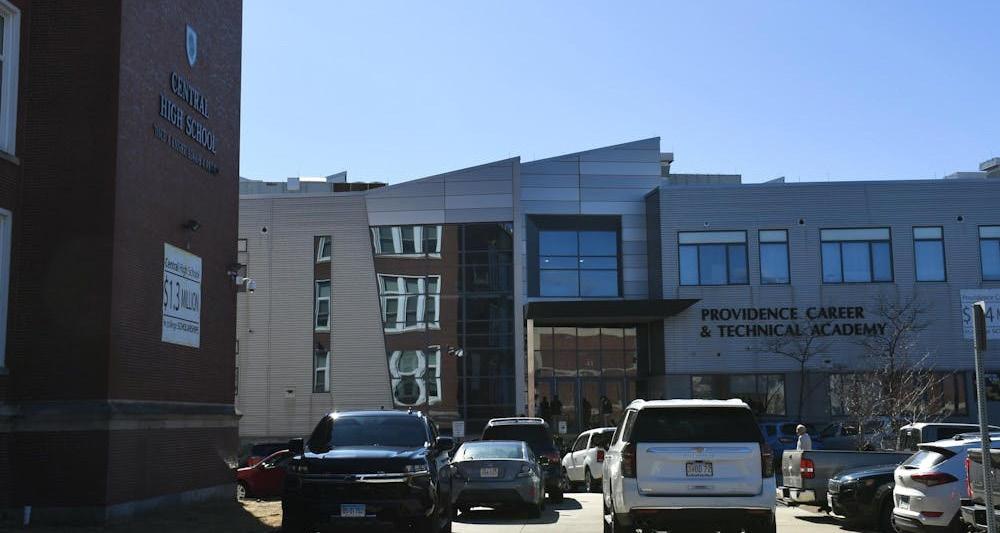
Central High School and Providence Career and Technical Academy in March of last year. At most public high schools in Providence, a lottery is conducted
determine student placement.
cation programs, for which students must complete a separate application. To get into Classical, students need to take an admissions test, which is considered alongside other application materials.
Classical accepted 300 of 841 tested applicants for the 2025-26 school year, according to Torres-Perez. Decisions for Classical were released from Feb. 3 to Feb. 7.
Many students find the lottery system to be “really effective,” said Classical junior
Alisson Aviles. But Aviles believes that at some competitive middle schools or elementary schools, the system can cause stress among some students.
According to Aviles, many of her friends were able to get into the school that they wanted to. “I think it’s a good process because you can pick where you want to go,” she said, adding she had not heard of students getting their last choice school.
“(PPSD) has made meaningful progress
to accommodate preferences in 2025 with 95% of students receiving either their first or second choice and more students receiving their top choice than in 2024,” Torres-Perez wrote in an email to The Herald.
She attributed this progress to improvements in the accuracy of their “enrollment projections,” which has helped the district better “align school capacities with students’ school choices.” Changes in waitlist management have also allowed
the district to ensure “students were being moved off the list into their first or second choice schools.”
In 2025, 77% of eighth graders were placed in their first choice high school, an increase from 65% in 2024. In 2025, around 97% of students received at least one of their school choices.
This article originally appeared online at browndailyherald.com on April 6, 2026.
MAX ROBINSON / HERALD
The proposed legislation aims to protect Rhode Islanders against voter suppression and vote dilution.
SOPHIA LENG / HERALD
to
LAWSUIT
ACLU, University spar in court over public access to DPS arrest records
The lawsuit was filed by the ACLU of R.I. on behalf of two journalists
BY MICHELLE BI METRO EDITOR
On March 24, a Rhode Island Superior Court judge denied the University’s request to dismiss a June 2025 lawsuit which aims to increase public access to Brown Department of Public Safety arrest records.
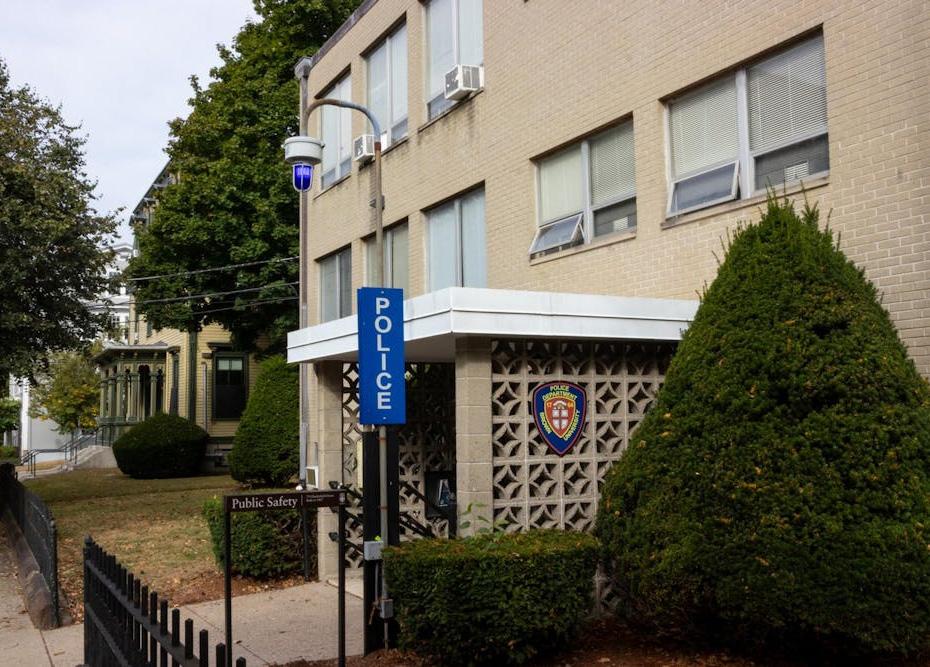
The lawsuit was filed by the American Civil Liberties Union of Rhode Island on behalf of two journalists who individually requested records — via the R.I. Access to Public Records Act — from unrelated DPS arrests and were both denied.
Under the APRA, a public body has 10 business days to respond to a records request, which can be extended to 20 for a “good cause,” the act reads. The APRA also states that records or reports of an initial arrest or charges brought against an adult are considered public.
Noble Brigham ’24, a former Herald staff writer, was one of the journalists in the lawsuit. In December 2022, Brigham requested DPS arrest reports for Thony Greene, who was charged for breaking into Wayland House after a near ten-year history of run-ins with DPS.
Brigham told The Herald in an interview that his APRA request was initially “ignored” by the University after sending at least one follow-up email.
DPS later declined Brigham’s request, stating that the APRA does not apply to DPS because Brown is a private university. Brigham then filed an APRA complaint in January 2023.
The other plaintiff in the case, Mi -
WILDLIFE
chael Bilow — a journalist for Motif Magazine — filed an APRA request with the City of Providence for copies of the arrest reports in connection with a Dec. 2023 protest in University Hall, the lawsuit states. The City responded that it had no “responsive records,” and Bilow filed an APRA request with DPS. When DPS did not respond to his request within 10 days, Bilow filed an APRA complaint.
R.I. Attorney General Peter Neronha’s response to the two APRA complaints held that DPS did not violate APRA because it is a private body and “a unit of Brown.”
“This has long been the case, and we are prepared to mount a strong effort to make clear the many reasons why,” University spokesperson Brian Clark wrote in an email to The Herald. He added that DPS’s jurisdiction is “limited to university buildings, adjacent streets and the protection of university students, faculty, staff and property.”
But the ACLU of R.I. asserts that DPS does fall under the jurisdiction of APRA. Steven Brown, the organization’s executive director, noted that the APRA’s
definition of a “public body” also includes “any other public or private agency, person, partnership, corporation or business entity acting on behalf of and/or in place of any public agency.”
DPS is “clearly acting on behalf of and in place of a regular governmental police department,” Steven Brown told The Herald. “The idea that these individuals, who have arrest powers (and) the power to use deadly force, somehow are not subject to the key provisions of the open records law just seems outrageous to us.”
After the ACLU of R.I. filed its June
2025 lawsuit, attorneys representing the University filed a motion to dismiss the case in August. In addition to arguing that DPS is a private body, they also contended that the plaintiffs’ claim is moot because DPS arrest records can be obtained from the City of Providence.
Under state law, all DPS arrest records must be “transmitted” to the Providence Police Department “for inclusion in the City’s official records system,” Kristy dosReis — Providence’s chief public information officer for public safety — wrote in an email to The Herald. As a public body, the Providence Police Department is subject to APRA.
But according to Steven Brown, the arrest records in question in Bilow’s case were submitted to the City Solicitor’s office instead. DosReis confirmed that “PPD did not have the records at the time of the request.”
“After the initial request, it was discovered that the arrest reports had been received by the Law Department in paper form for prosecutorial purposes, rather than being routed through the PPD Records Division,” she wrote.
This occurrence “appears to be an unusual situation, and there is no indication that this is a regular alternative pathway for DPS records,” she added.
The R.I. Superior Court declined The Herald’s comment request due to the ongoing nature of the litigation.
“This court’s decision appears to reflect its interest in hearing further arguments, and Brown looks forward to presenting its case as this matter proceeds in the months ahead,” Clark wrote.
This article originally appeared online at browndailyherald.com on April 9, 2026.
Meet Gravy: The turkey that keeps trying to cross the road
BY MAXWELL SILVER SENIOR STAFF WRITER
Gravy, an infamous Middletown turkey known for chasing cars through busy intersections, has been relocated for the second time this year.
After Gravy was hit by a car in January, he spent a few weeks in recovery at Congress of the Birds, a wildlife rehabilitation center and clinic. But after being rehabilitated and released, Gravy went right back to approaching vehicles.
Car accidents are some of the most common injuries for large ground birds, Sheida Soleimani, founder and executive director of the Congress of the Birds, wrote in an email to The Herald. After his January accident, Gravy was brought into their clinic and fully rehabilitated before the center deemed him strong enough to return to the streets, Soleimani explained.
Gravy was then reintroduced “within its home range in (a) suitable habitat with established flocks, roosting trees, water and food, consistent with our policy,” Evan LaCross, a spokesperson for Rhode Island Department of Environmental Management, wrote in an email to The Herald.
LaCross attributed Gravy’s car-seeking habit to “dominance behavior.” Because

Gravy can see his own reflection in cars, he likely perceives himself as a rival mate, LaCross noted.
During their mating season in the spring, males can become “more assertive,” Solemani explained. “This is normal and is ‘display’ behavior, not aggression in the way people think.”
After Gravy decided to return to the roads following his release, RIDEM recaptured him on Friday “to protect both the bird and public safety,” LaCross wrote.
Gravy has also become a social media celebrity after videos of him chasing approaching vehicles went viral last summer, which further complicated release efforts.
“Because the bird attracts significant public attention, DEM staff conducted the release to protect the turkey and to respect nearby residents’ privacy,” LaCross wrote.
“People are just drawn to something that feels fun and harmless,” Middletown resident Carrie Oakey, who grew up near where Gravy has roamed, wrote in a mes-
sage to The Herald about why Gravy has garnered so much attention.
Oakey runs an Instagram account that posts Gravy updates — she was also the person who originally gave Gravy his name in a Middletown Facebook group chat.
“I feel bad because obviously Gravy is extremely confused,” Oakey wrote. “All he’s ever really known is the street.”
According to Soleimani, it is common for animals like wild turkeys to live in cities.
When it comes to the College Hill Turkey — a separate juvenile male who often can be found near the John D. Rockefeller Library or the Providence Athenaeum — Soleimani added that residents should avoid feeding or approaching him. But she emphasized that relocation from College Hill
“doesn’t ‘solve’ the problem” and would create “stress, disorientation, and risk for the bird.”
“The work is less about pushing them out, and more about learning how to share space responsibly — reducing harm while allowing them to remain wild,” Soleimani wrote.
“I think Gravy blew up because he brings people together,” Oakey wrote.
“Everyone can laugh at the same thing, and in a world that feels heavy sometimes, that kind of simple, funny moment really goes a long way.”
This article originally appeared online at browndailyherald.com on April 8, 2026.
AARON SETO / HERALD
After the ACLU of R.I. filed its June 2025 lawsuit, attorneys representing the University filed a motion to dismiss the case in August.
The Middletown turkey has been recaptured by RIDEM
KENDRA EASTEP / HERALD
SOFTBALL
Softball falls 12-4 in final series game against Princeton, giving Tigers three-game sweep
The Bears slid to No. 6 in the Ivy League
This past Saturday, the softball team (10-17, 3-6 Ivy) played their final game of a three-game series against Princeton (19-10, 9-0) at the Tigers’ home field. After losing to Princeton 6-2 on Friday and 2-1 earlier on Saturday, the latter half of the weekend doubleheader was Bruno’s only chance to get on the board.
eton nabbed a third straight win with a 12-4 victory to sweep the series. With the latest loss, Brown sits at No. 6 in the Ivy League standings.
score one run in the first five innings to Princeton’s sev en. Though Bruno’s bats came alive for the top of the sixth inning, Princeton racked up five of their own in the bot tom of the sixth to grow their lead to eight and invoke a mercy rule early finish.
the game, infielder Maya Choksi ’27 stepped up to the plate. But sharp pitching from
BASEBALL
’28 sent a fly ball sailing to right field into the hands of a Princeton fielder, Bruno’s
Princeton quickly loaded the bases in the bottom of the first. When the Tigers’ Karis Ford’s shot streaked to left field, utility player Jasmine Hsiao ’26 flung the ball to second base — holding Princeton’s Graciela Dominguez at third and nearly catching Tigers’ Julia Dumais at second. But a skillful slide from Dumais saved her from being taken off the
Moments later, a wild pitch from Bruno starter Edie Cobb ’28 caught catcher Lilly Burns off-guard. As Burns fumbled with the ball, Dominguez secured the first run of the game for the Tigers.
Princeton’s Jessica Phelps sent the ball to right field, allowing Dumais to sprint home and bring Princeton a 2-0
Brown looked to the second inning as a chance to match Princeton’s slight lead. But Shaw took three of Brown’s players off the field before the Bears could get
With another chance at the plate,
Princeton swiftly loaded their bases again. Dominguez walked to first base, and after yielding an out, the Tigers looked to Dumais to extend their lead. On a batter-friendly 3-1 count, Dumais sent the ball hurtling left. When Hsiao fumbled and dropped the ball, Dumais clinched a single.
As Hsiao struggled in left field, Princeton’s Abby Hornberger and Maddie Ratcheson — stationed at second and third base, respectively — made mad dashes for home, adding two more runs to Princeton’s total. The Tigers notched a fifth consecutive run to their tally as Dominguez reached home base, ending the second inning with a 5-0 lead.
Brown approached the third inning desperate to get on the board. After a single, outfielder Lily Berlinger ’26 reached third, tagging up after two consecutive flyouts.
Deng, who was next to bat, catapulted the ball to left field, barely evading Dumais’s outstretched hands. Brown used this opening to send Berlinger home, marking Bruno’s first run of the game.
Unfortunately for Bruno, Foxx struck out swinging just moments later and ended any hopes of a comeback in the inning.
To make matters worse, Princeton nabbed two more runs in the bottom of the inning, putting Brown at a six-point deficit going into the fourth.
Both teams’ scores remained unchanged in the fourth and fifth innings. But in the sixth, Brown looked momentarily posed for success.
Bettencourt started Brown off strong with a double headed right field. Cameron
The “mercy rule” — which ends a game after a team faces an eight run or more deficit in the fifth inning or later — was invoked during Saturday’s game.
Zytkewicz Ray ’26 slammed the ball into right field and it headed for the warning track. With Zytkewicz Ray earning a triple, Bettencourt was able to reach home base — earning a second run for Bruno. But Brown didn’t stop there. With Torii Ramirez ’29 on first as a pinch runner for Burns after a walk, Alyssa Villarde ’27 knocked the ball to left field. Zytkewicz Ray went from third base to home and added a run to Brown’s total, bringing the total to 7-3 as Ramirez advanced to second.
Ramirez reached third after Berlinger grounded out before being brought home by Hsiao, reducing the Bears deficit to 3 runs.
Elli Thompson ’28 stepped up to the plate next and Brown, with two outs already, looked to her to continue bringing in runs. Though her hit reached the outfield, Princeton’s defense brought the ball rapidly to second base and created what would become Brown’s final out.
Though victory was already within reach for the Tigers, in the bottom of the sixth inning, Princeton elevated their offensive dominance, securing five runs to push their lead to 12-4. The Tigers’ barrage invoked the mercy rule — which ends a game when a team faces a deficit of at least eight runs in the fifth inning or later.
Despite the loss, Berlinger wrote in an email to The Herald that the team is “just going to get back to work.”
The Bears will face Harvard (14-14-1, 6-3) this Saturday at 12:30 p.m. at home in another conference matchup.
This article originally appeared online at browndailyherald.com on April 6, 2026.
Baseball crushes Merrimack in mercy-rule shutout win
The Bears blanked the Warriors 10-0 in eight innings on Wednesday
BY HARRY GUO SENIOR STAFF WRITER
On Wednesday afternoon, the baseball team (13-12, 6-2 Ivy) dominated Merrimack (1316, 8-7 MAAC) in a 10-0 victory. The Bears have won six of their last seven games and stand second in the Ivy League.
Just days after splitting a weekend doubleheader against Harvard (5-17, 4-4 Ivy), the team entered the Merrimack matchup hungry for a win. On the other side of the pitch, Merrimack entered the game ready to dethrone the Bears on their home grass following a series loss against Fairfield (1412, 9-3 MAAC) this past weekend.
Brown set the tone early when pitcher Dylan Reid ’26 retired all three batters he faced in the first inning with one strikeout.
The Bears’s offense did not waste any time taking advantage of Merrimack’s shaky pitching.
“Overall (the pitching team) have been throwing strikes. They’ve been letting the defense work and not giving too many freebies to the other team,” said Head Coaching Chair Frank Holbrook after the game. “I think that’s been the biggest key to success.”
To open the top of the inning, infielder Mark Henshon ’26 drew a walk and immediately began pressuring the Warriors on the base paths, toying with the pitcher with
steal attempts from first base. As Henshon danced off of the bag, outfielder Alex Benevento ’28 launched a ball deep into the left-center gap. As the ball rolled into the outfield, Henshon raced all the way home to give Brown an early 1-0 lead.
Benevento kept up the offensive pressure, sneaking his way to third base after another off-target Merrimack pitch skipped past the catcher. Outfielder Mika Petersen ’26 lined a ball into shallow right field to bring Benevento home and bring the
Bears’s lead to 2-0.
Following Brown’s two-run first inning, both teams remained quiet for two innings.
At the top of the fourth, pitcher Bryan Yang ’28 took to the mound and delivered a clean inning. He struck out Merrimack hitters and forced a harmless pop-up that was easily handled for another quick defensive outing.
Brown’s offense then broke the game open in the bottom of the fourth.
A hit brought outfielder Logan Meusy ’26 to first base, and he advanced all the
way to third after Merrimack mishandled the ball during a steal attempt. With a runner just one base away from glory, Bruno capitalized. Catcher Andrew Hanlon ’27 drilled a ball to the right side that bounced off of a Merrimack player’s glove, allowing Meusy to waltz home. Bruno’s offensive onslaught did not stop there. With one out on the board, Henshon grounded a ball to the right side to bring Hanlon home.
Benevento then followed with a grounder to the left side, allowing infield-

er Matt Luigs ’29 to score and close the inning with a 5-0 lead.
The Warriors’s hits remained few and far between, but in the eight inning they posed one of their first real scoring threats. Two singles helped Merrimack load the bases with one out. But the Warriors’s rally was swiftly halted when pitcher Camren Piwnicki ’29 forced a ground ball that Luigs fielded cleanly, firing to first for an out.
Brown again proved their offensive superiority with a five-run scoring series in the bottom of the eighth inning.
Luigs drew a walk and later stole second base — his 13th stolen base of the season. Henshon walked after, and Benevento was hit in the shoulder by a pitch to load the bases. After a pitch flew past the Merrimack catcher, Luigs ran home. Petersen then ripped a single into center field to help both Henshon and Benevento score.
Infielder Christian Butera ’28 delivered the final blow. With Dillehay on third and Petersen on second, Butera lined a hit into right field to bring both runners home. The runs brought the score to 10-0, invoking the mercy rule and ending the game one inning early.
“I think (we have) a lot of confidence in each other, just knowing that, if you don’t get it done, someone else is going to pick you up,” Meusy said after the game. “(It) allows us to be relaxed and come through in those moments.”
on April 9, 2026.
NORA EDOUARZIN / HERALD
Outfielder Alex Benevento ’28. The Bears have won six of their last seven games and stand second in the Ivy League.
COURTESY OF BROWN ATHLETICS
LACROSSE
Women’s lacrosse triumphs over Columbia 13-12 in final seconds of Saturday matchup
Brown secured a goal with six seconds left to seal victory
BY CODY CHENG CONTRIBUTING WRITER
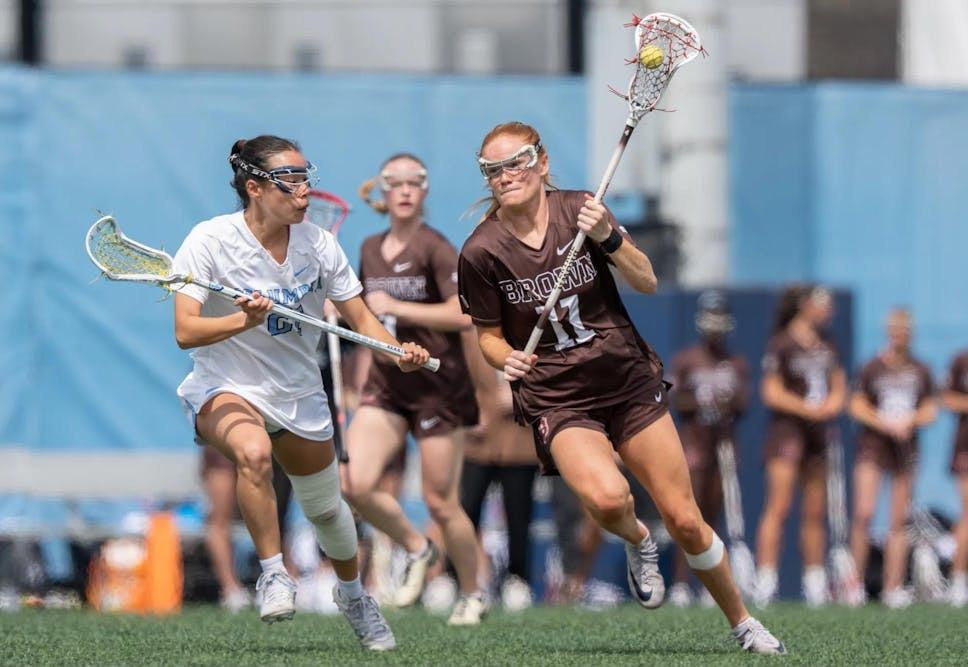
In a hard-fought game on Saturday, the women’s lacrosse team (6-5, 2-2 Ivy) delivered a strong showing against Columbia (6-6, 0-4) on the Lions’ home field. Tied 12-12 with six seconds left, midfielder Ruby Sliwkowski ’27 scored a game-winning goal for the Bears.
Saturday’s triumph — the Bears’ second Ivy win — leaves Brown No. 5 in the Ivy League. Columbia, on the other hand, remains winless in the league this season at 0-4 — another tough start for a team that has not secured an Ivy League win since 2019.
The teams opened the game by trading goals. With a little over five minutes to go in the first quarter, midfielder Mackenzie Farley ’29 spun around the Lions’ Katelyn Lee of the Lions and passed out to attacker Kiki Tormey ’26, who then drove down the middle and sent the ball soaring into the goal to bring the Bears up 3-1.
But Columbia fought back less than a minute later with back-to-back goals by Maddie Brogan and Lilah Kirch to tie the score 3-3, despite strong defense from the Bears.
Columbia’s barrage didn’t stop in the second quarter. Following a well-executed free position goal from Tormey, the Lions’ Cordelia Flemming caught the ball from
WATER POLO
teammate Cecelia Messner and confidently shot it over Brown’s defense to once again tie the score.
The Lions extended their run with two quick goals by Messner and Emma Row, leading to a 3-0 Lions run in less than five minutes. Sliwkowski ended their scoring run with a free position shot, but the Lions returned the favor with another free position shot from Flemming, bringing Columbia up 7-5 at halftime.
In the second half, the Bears came out
ready to make up the deficit. After winning the initial draw, the Bears pushed up the field, and attacker Tessie Batchelder ’29 scored off an assist from Sliwkowski. A violation on the next draw by Messner resulted in a green card, giving Brown possession. With an extra player on the field, the Bears capitalized on their advantage and defender Riley Peterson ’28 ripped a laser over the Lions’ goalkeeper to tie the game at 7-7. From here, Columbia’s defense started
Becker kept the momentum going for the Lions in the fourth quarter, leading a late-game resurgence for the team. The Bears responded with Becker’s goal with a goal by midfielder Marley Wright ’26, but Beckers one-upped the Bears with her fourth and fifth goals of the day, tying the score 12-12 with a little less than nine minutes remaining.
In the final stretch, the two teams traded possessions, but both sides kept up stalwart defenses. Neither team could find the net until the final possession.
With just over thirty seconds left, Farley threw a grounder that was deftly picked up by Kiki Tormey. The Bears probed the Lions’ defense, looking for an opening — until Sliwkowski found a gap between two defenders, charged and rattled it home, putting the Bears up 13-12 with six seconds left. The Lions were unable to respond in time, sealing the game for Brown.
Many of the Bears had strong showings on Saturday. Sliwkowski notched a teamhigh four goals, including the game-winning shot, and dished out two more assists. Farley had a game-high three assists, and Tormey put up a hat trick. Goalkeeper Mackenzie Conway ’29 had an impressive 12 saves as the team’s defensive anchor.
The Bears look to extend their twogame winning streak against Dartmouth (6-5, 1-3) this upcoming Saturday.
This article originally appeared online at browndailyherald.com on April 8, 2026.
to collapse, and the momentum swung in the Bears’ favor. Brown went on to score three more goals, bringing the Bears’ lead to 10-7. Over the 5-0 stretch, Sliwkowski and Tormey each completed hat tricks. With the tide swinging against them, the Lions refused to back down. In the next possession, Columbia’s Anna Becker quickly responded with a quick shot to the top-left corner of the net, ending the Lions’ scoreless run. After that, each team notched an additional goal, bringing it to 11-9 in the Bears’ favor by the end of the third quarter.
Women’s water polo falters to No. 11 Harvard in regular-season finale
The Bears now look to the Collegiate Water Polo Association Tournament
BY CHIUPONG HUANG SENIOR STAFF WRITER
In their last regular season game, the women’s water polo team (13-11, 3-3 Collegiate Water Polo Association) fell 15-7 to No. 11 Harvard (24-3, 5-1 CWPA) in a home match this past Saturday. Brown’s defensive pressure kept the game within reach for Bruno throughout the first two
quarters, but the Bears were outplayed in the latter half, dashing any hopes of a comeback against the Crimson.
“We had practiced a lot ... especially for Harvard, so I feel we had a little bit more confidence going in,” said utility player Samantha Kim ’28. Throughout the game’s back-and-forth play, “we still kept the energy and the hype and the effort going,” she added.
“The fact that the seniors have stayed so strong and also have held leadership roles on this team — it means a lot to us,” Kim said. “We wanted to celebrate the fact that they’re still here and that they’ve made such a big contribution to this team.”
Early in the match, Bruno found ways to keep the Crimson’s scrappy aggression
Saturday’s match was also Bruno’s senior night, during which the team honored its graduating class: attacker Margot Gibbons ’26, attacker Hana Homma ’26, attacker Alexandra Love ’26, center Ella Palmer ’26, defender Madeleine Poissonnier ’26 and attacker Sabrina Shipley ’26. With raucous cheering and smiles radiating from the bench, Bruno’s high spirits were a victory in and of themselves.

Though they were missing their primary goalkeeper, the Bears showed off a proactive defensive.
at bay. Although the Bears were missing their primary goalkeeper, they showed off an ironclad defensive front. Backup Skye Andros ’28 — who stepped up to the goal on a week’s notice on behalf of Bruno’s injured goalie — had seven blocks throughout the game and proved instrumental for keeping the Bears in the fight.
“Skye stepped in and played incredibly well, making some amazing saves,” Palmer wrote. “We are so grateful to have a teammate like her who is willing to step up, and we are all so proud of her.”
Over the course of the match, Brown capitalized on man-up opportunities to slow Harvard’s snowballing offensive stride, drawing penalties on Harvard to create multiple 6-on-5 opportunities for the Bears.
Love kick-started the match with two goals during the first quarter, paving the way for Bruno’s early offensive strides. Kim and Poissonier would each add a goal to keep Bruno alive going into halftime at 7-4.
“Going into the game, our energy was unmatched,” Palmer wrote in an email to The Herald. “We were playing for each other, and that sense of togetherness really carried through.”
In the second half, the Crimson widened their lead significantly to make a Bruno comeback insurmountable. Harvard’s offense upped their urgency as they assertively kept the ball on Bruno’s side of the half-distance line. The team found success in their long-distance shots, which caught the Bears off guard and left them with a 10-5 score at the third quarter’s close.
The Crimson continued to stretch
their winning margin, scoring five goals in the contest’s final period and pushing the final tally to 15-7.
Although the team faced defeat, the atmosphere on Brown’s bench remained spirited. “We were playing for our seniors,” Kim said. “We didn’t care at the end of the day what the scoreboard looked like, because it really did feel like we played our best in that game. And honestly, we were having our fun.”
“Despite the loss, I couldn’t have been more proud to share that moment with my fellow seniors and teammates,” Palmer wrote.
Over the course of the spring season, the team had its fair share of ups and downs. Their defeat by Harvard marked Bruno’s fifth consecutive loss of the season. But those losses were preceded by four straight victories. After the Bears’ rollercoaster campaign, the team ended the season tied at No. 23 in the Collegiate Water Polo Association’s 2026 Women’s Varsity Top 25.
The Bears will be looking to earn a fresh start this weekend as they head to the University of Michigan for the CWPA Tournament. The Bears — seeded at No. 4 for the tournament — will take on No. 5-seeded Bucknell (12-10, 2-4 CWPA) on Friday at 7:30 p.m.
If Brown advances, they will play on Saturday for a chance at a first-place game on Sunday. The CWPA Champion will secure a berth to the 2026 NCAA Women’s Water Polo Championship at UCSD from April 24 to 26.
article originally appeared online at browndailyherald.com on April 7, 2026.
KARINA SHAH / HERALD
The Bears look to extend their two-game winning streak against Dartmouth on Saturday.
COURTESY OF BROWN ATHLETICS
METRO
Providence residents rally in support of rent stabilization ordinance
Last week’s vote fell one short of the votes needed to override Smiley’s veto
BY PAVANI DURBHAKULA METRO EDITOR
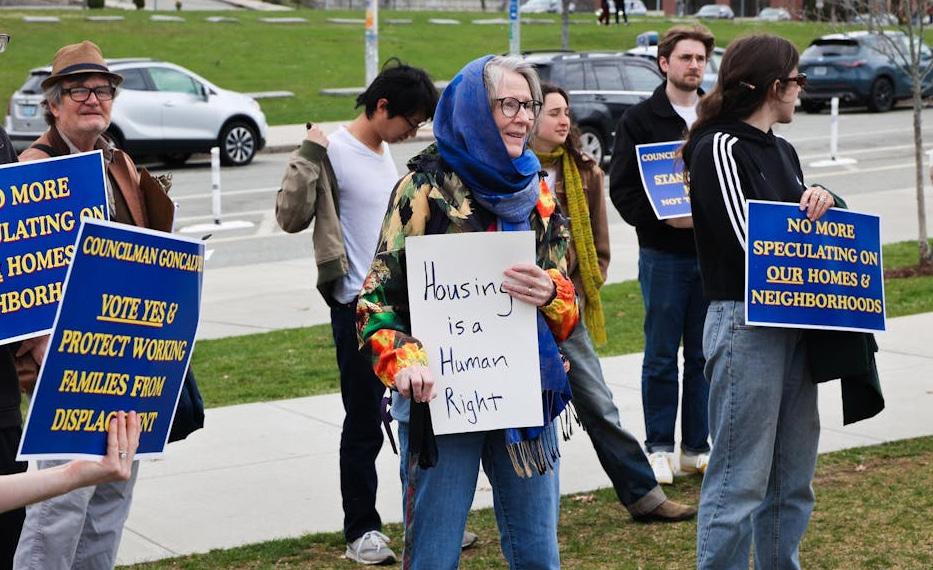
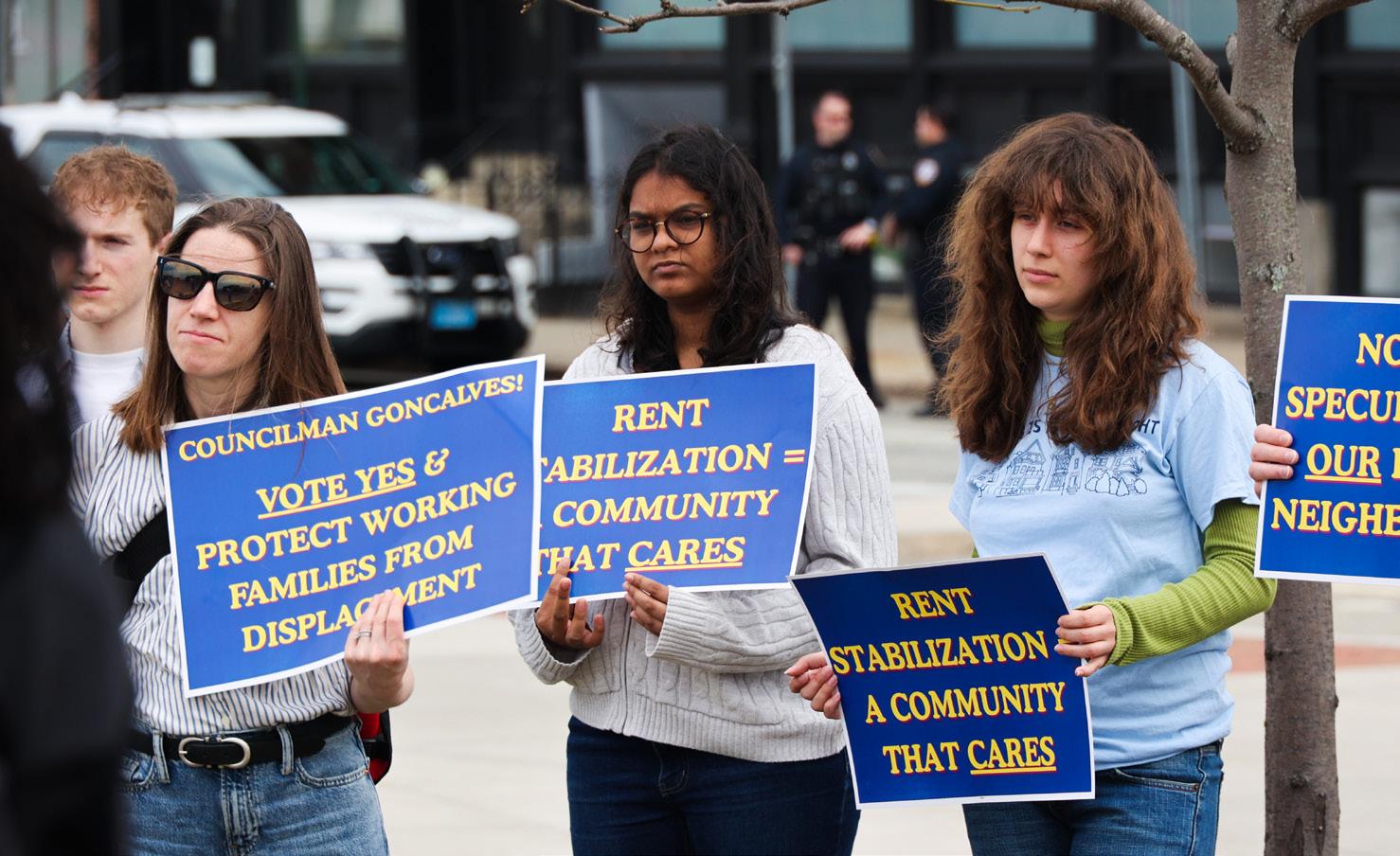
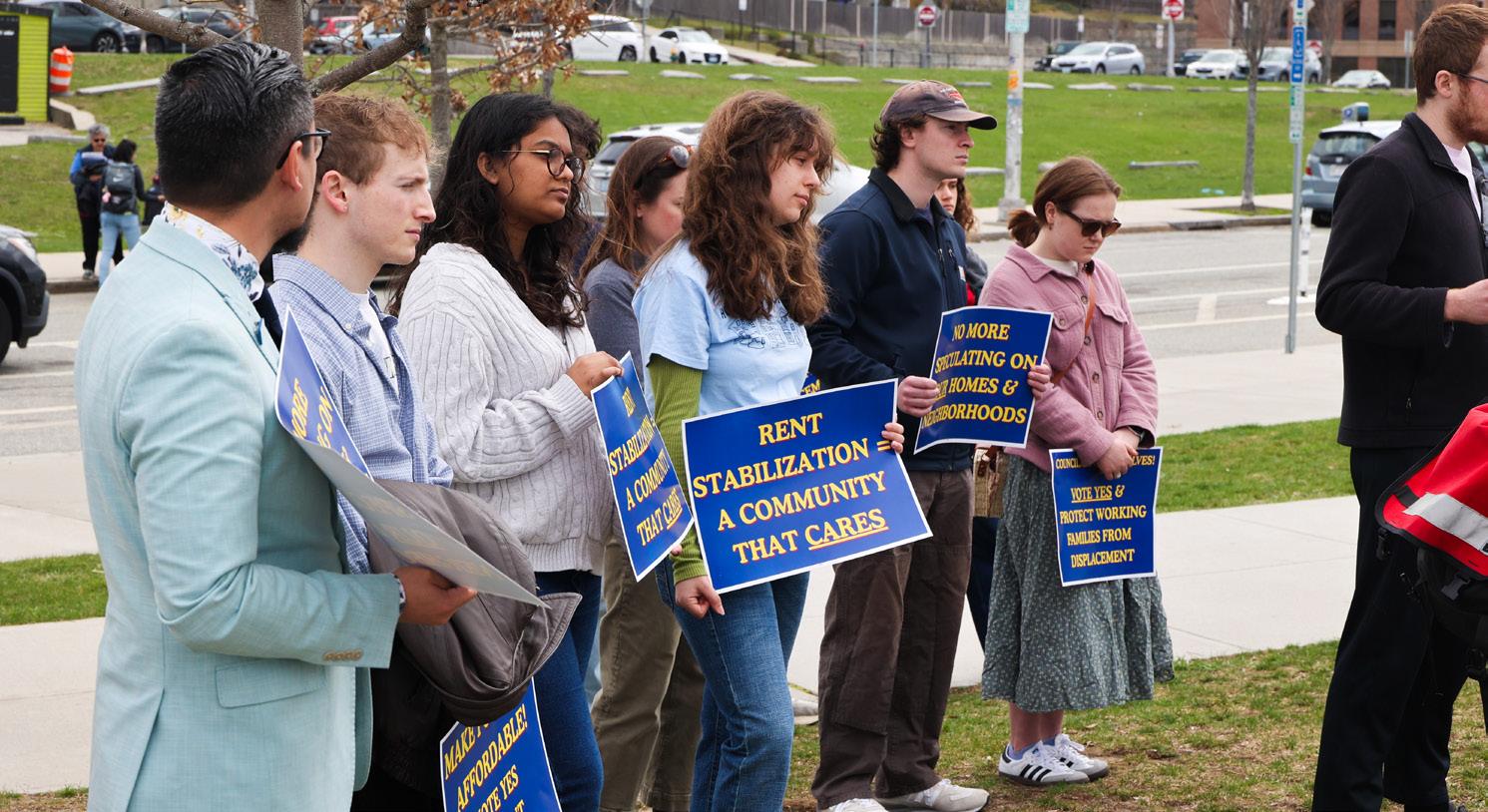
On Saturday morning, around 50 Providence community members and organizers gathered at the Providence Pedestrian Bridge to advocate for a rent stabilization ordinance that would enforce a 4% annual cap on rent increases.
The ordinance, announced in January by City Council President Rachel Miller (Ward-13) and President Pro Tempore Juan Pichardo (Ward-9), was approved by the City Council in a 9-6 vote on Thursday.
But Providence Mayor Brett Smiley has promised to veto the ordinance, and at Thursday’s vote, the ordinance fell just one vote short of the supermajority needed to override his veto.
According to Siraj Sindhu — executive director of Reclaim Rhode Island, the housing justice group that organized the rally — planning for Saturday’s event began ahead of last week’s vote. “We wanted to make sure that we were ready to put some pressure on city councilors who did not vote in support of the ordinance,” Sindhu told The Herald.
“Say it loud and say it clear, rent should
be affordable here!” the community members shouted at the rally.
The rally specifically aimed to sway Councilman John Goncalves (Ward-1), who represents the area where the demonstration was held. Goncalves “has demonstrated that he’s on the fence” about rent stabilization, said Callie MacDonald, volunteer and organizing director at Reclaim RI.
“The immediate goal of this rally is just to let him know that the people of his district, his ward, want this,” she added.
State Rep. David Morales MPA’19 (D-Mount Pleasant, Valley, Elmhurst), who is also a mayoral candidate, echoed this goal in his address, noting that the crowd was gathered to “put pressure on Councilman John Goncalves ’13 MAT’15 to stand for the working people in his community and vote yes on rent stabilization.”
If Goncalves votes yes, he will be the tenth vote needed to override Smiley’s veto.
“There are legitimate concerns about this ordinance which should be discussed,” Goncalves wrote in an email to The Herald.
The councilman added that in addition to the other five city council members who voted against the ordinance, executives at multiple Rhode Island nonprofits have also expressed their own concerns about the ordinance.
“There appears to be little interest among some members of the council in
pursuing a reasonable, objective, third-party independent study,” he added.
Over the past few months, committee hearings have been held to receive public input on the rent stabilization ordinance. In February, the first public hearing on the ordinance drew over five hours of testimony.
“From what we saw in the committee hearings, it was clear that public support to pass rent stabilization is there,” Morales told The Herald.
Morales referenced a recent poll conducted by Data for Progress, which found that 74% of Providence Democratic voters support the capping annual rent increases at 4%.
In his speech to the crowd, Morales said that rent in Providence has increased by 40% since 2020.
“What we need is action,” Morales said, adding that Smiley has expressed widespread opposition to rent stabilization.
“While Mayor Smiley and the Providence City Council have a shared goal of making housing more affordable, rent control does not actually lower rents,” spokesperson for the City of Providence Josh Estrella wrote in an email to The Herald. “Mayor Smiley remains concerned that this policy will worsen the housing affordability crisis, not relieve it.”

Smiley recently announced the RENT Fund, a proposed ordinance that would provide emergency financial relief to Providence renters in need. But for some, including Grace Harvey, an organizer with Reclaim RI, rent stabilization is a necessity.
“Rent stabilization is just the beginning in protecting our community and neighbors from being priced out of Providence,” Harvey said at the rally. “We don’t have time for more independent studies to be conducted. We are seeing rents go up all around us now, in real time.”
Chris Ellis, who came to the rally with fellow Providence resident Yen Chow, said that the two of them had previously lived in Boston but were “priced out of Boston pretty quickly.” As a result, the two moved to Providence, which they hoped would be less expensive. “But without rent stabilization, we’re not going to be able to stay here for much longer,” Ellis said.
“I have sat with people who have to decide between paying rent and buying food, between paying rent and filling a prescription,” said Kavita Doobay ’27, leadership and outreach coordinator for Housing Opportunities for People Everywhere, a student housing advocacy group at Brown. “We cannot keep telling people to work harder, budget better, try harder when the math simply does not work,” she said to Saturday’s crowd.
During the rally, Sindhu said that “wherever it’s been implemented, rent stabilization consistently does exactly what it is intended to do.” In cities like Los Angeles and New York City, rent stabilization policies yielded thousands of dollars for tenants, he added.
“We are so close,” said Providence resident Anna Kastner, who is involved with Reclaim RI, in an interview with The Herald after the rally. “Rent stabilization is overwhelmingly popular among the voters, a majority of city councilors have voted to support rent stabilization and now we just need one more vote to override the mayor.”
“Our city is at a really pivotal moment where we have the power to keep people in their homes (and) keep Providence affordable,” she said.
Even if rent stabilization passes, it “is not a silver bullet policy,” said Izzy Irizarry, a Providence resident who is involved with the rent stabilization movement. Providence needs to have “more building of affordable housing” and stronger permanent supportive housing, she said. But if high unstabilized rents drive people out of the city, “we’re not going to have anybody remaining to fight for,” she added.
This article originally appeared online at browndailyherald.com on April 7, 2026.


CHRISTINE CHANG / HERALD
UNIVERSITY NEWS
FACULTY
Faculty vote to change language on ‘course bunching,’ create graduate microcertificates
A motion to reinstate Paxson as presiding officer was not on the agenda
BY SEYLA FERNANDEZ SENIOR STAFF WRITER
Two motions passed at Tuesday's faculty meeting: one to establish graduate microcertificates and one to add to the section of the Faculty Rules and Regulations on “course bunching” — the act of consolidating yearly teaching load into one semester instead of distributing it across two.
A motion that was not included on the agenda was one to reinstate President Christina Paxson P’19 P’MD’20 as the monthly meeting’s presiding officer. Last month, faculty voted to replace Paxson with the Faculty Executive Committee chair — currently Anna Lysyanskaya, professor of computer science.
In the last minutes of the meeting’s open session, Professor and Chair of Anthropology Jessaca Leinaweaver gave notice that in the next faculty meeting, she will propose a vote to reinstate the University president as the presiding officer at faculty meetings.
Leinaweaver and Emily Dolan, professor and chair of music, submitted a motion to the FEC on March 24 to be included in April’s agenda. The motion was cosigned by over 60 faculty, she said, and it was ultimately not included.
“Unfortunately, the FEC chose not to put our motion on the agenda, even though we submitted it in sufficient time for them to consider it,” Leinaweaver said.
Paxson had left the faculty meeting prior to Leinaweaver’s notice.
Lysyanskaya introduced the motions on graduate microcertificates and course bunching.
The faculty in attendance passed the motion, presented by Dean of the School
of Professional Studies Sandra Smith, to establish graduate microcertificates, which peer institutions, such as Harvard and Northwestern University, offer.
“The main goal for this initiative motion is to extend Brown’s educational impact and open access to a new population of students who want to acquire knowledge or skills in a targeted sub field to better their lives or advance their careers,” Smith said.
Smith noted that students in the microcertificate programs would still need to submit an application and be admitted to Brown.
“The microcertificate is not a degree,” Smith said, but students may be able to use the course credits from the microcertificate toward a degree later.
“It can be the first step or the final step in an academic journey for a student,”
Smith said.
Multiple faculty spoke in favor of the microcertificates, including Interim Dean of School of Public Health Francesca Beaudoin, who endorsed the public health mi-
crocertificate program.
“Because of the cost of pursuing a graduate degree, this meets kind of a real world need to pursue additional skills and credentials at potentially a lower entry cost,” Beaudoin said.
The motion passed with 87% of faculty members voting in its favor.
Earlier in the meeting, the course bunching motion passed with 51% of faculty in favor.
According to Lysyanskaysa, one example of course bunching is when a faculty member who typically teaches one course in the fall and one in the spring instead teaches two courses in one semester and none in the other. The pre-existing rules and regulations already allow faculty to bunch their courses “in exceptional circumstances,” such as when undertaking large projects or grant proposals. Now, faculty will be able to course-bunch for University service or curricular need — a modification that “makes our rules more consistent with our practice,” Lysyanskaya said.
The proposed language in the motion states that when course bunching, faculty still must be “in residence” for both semesters, requiring “full participation in departmental and University activities … regardless of teaching responsibilities.”
Roberto Tamassia, professor and chair of computer science, was “strongly in favor,” of the motion, stating that course bunching is “one of a significant improvements to our productivity” that also “essentially comes at zero financial cost.”
Several faculty members raised questions about the meaning of “in residence.” David Williams — associate dean of faculty affairs, as well as a professor of behavioral and social sciences and of psychiatry and human behavior — was concerned that he could not find a clear definition of the terminology in the Faculty Rules and Regulations.
Prudence Carter, professor of sociology and director of the Center for the Study of Race and Ethnicity in America, felt that it was important to discuss data on the current practice of course bunching. “Is this particularistic? Does it affect some departments more than others?” she asked.
Several faculty also stated that they were unaware of the existing policy on course bunching. “I didn’t know that this policy existed at Brown, and I don’t know how many of my colleagues knew about it before,” said Elias Muhanna, associate professor of comparative literature and of history and director of Middle East studies.
After multiple faculty members expressed a desire to postpone the motion, a second motion was proposed to determine whether or not voting on the language change should take place at that particular meeting.
Ninety three participants voted not to postpone the motion, 86 participants voted to table the motion and 22 voting faculty members chose to abstain.
“Not voting for this motion is not going to make it go away. It’s just going to leave it in its previous, more ambiguous state,” said Nancy Khalek, associate professor of religious studies and of history.
“It’s just a slight amendment to an existing policy that will have the same guard rails on it as the old policy,” she noted. “I don’t think people are going to start willy-nilly bunching their courses without any kind of oversight.”
98 faculty members voted in favor of changing the language around course bunching, 70 voted against it and 26 abstained.
This article originally appeared online at browndailyherald.com on April 8, 2026.
“I do think that’s an important thing to define what it means to be in residence, particularly in an age of Zoom,” Williams said. He added that he planned on voting against the motion because he felt it required “more discussion.”
Meet the alums in the running to be on the Brown Corporation
BY JEREMIAH FARR SENIOR STAFF WRITER
The Corporation, the University’s highest governing body, is currently holding elections for a New Alumni Trustee position opening. Any student in their final year of study or who has graduated within three years is eligible to run for the role, for which they serve three-year terms.
The corporation established the New Alumni Trustee position in 2009 and reserves two spots for the role. All undergraduate, graduate and medical students in their final year of study or within five years of graduation are eligible to vote.
New Alumni Trustees have the same responsibilities as other Corporation members, but are meant to provide a “perspective more closely grounded to the student experience,” according to the Corporation’s website.
“Alumni who have graduated recently have a unique and invaluable perspective to offer the University’s governance,” Vice President for Alumni Relations Zack Langway ’09 wrote in an email announcing the election.
who benefit from Brown’s research, to our Providence friends and neighbors. I want to serve on the Corporation so the Corporation can serve them.”
Logan Tullai ’25
Logan Tullai ’25 double-concentrated in political science and economics at Brown. He co-founded the Brown Political Union and led free art workshops at the Community Libraries of Providence during his time on College Hill.
For the last year, he has served as Mayoral Advance for the City of Providence — writing speeches, managing relationships and coordinating logistics. He is also a board member and the communications chair for the Brown Club of Rhode Island.
Selia Jindal ’23
Selia Jindal ’23 is from Baton Rouge, Louisiana and studied international and public affairs at Brown. Jindal researched technologies such as low Earth orbit satellites and co-founded a team that designed and launched Brown’s second LEO-satellite.
After graduating, she worked for the legal team of the United Nations Office of Outer Space Affairs in Vienna. She then
The Herald obtained a copy of the candidates’ biographies and personal statements shared with eligible voters. These are the candidates for the New Alumni Trustee election:
transitioned to McKinsey and Company, where she works as a consultant.
“This role would enable me to give back to the university that provided me with unmatched opportunities to take on leadership roles, explore diverse subject matters and engage with the community,” Jindal wrote in her personal statement.
Isabelle Sharon ’23.5
Isabelle Sharon ’23.5 is the young alumni co-chair for the Brown Club of D.C., where she grew up. At Brown, she served on the Campus Life Student Advisory Board and worked with BWell Health Promotion to “build a cross-campus coalition for stream-
lining student support,” according to her candidate profile.
She has since researched political misinformation for the Brookings Institution, a think tank based in Washington, D.C., and worked on artificial intelligence in public sector consulting. Now, she works at the legal advisory firm Global Data Innovation.
“At Brown, I internalized the belief that progress is always possible and we have a responsibility to work towards it,”
Sharon wrote in her personal statement.
“Brown has so much to offer to so many: to the young woman first in her family to go to college, to the countless lives
“Through my work for the city and the free art workshops I’ve run, I am engaged with the community’s key stakeholders and understand Brown’s responsibility to Providence,” Tullai wrote in his personal statement. “Seeing the power of alumni connections after graduation through my work with the BCRI, I will advocate for new ways to integrate alumni advising and career support earlier in the Brown experience.”
This article originally appeared online at browndailyherald.com on April 8, 2026.
NAT HARDY / HERALD
A motion to establish graduate microcertificates passed with 87% of faculty attendees voting in its favor.
Three alums are in contention to be a New Alumni Trustee
KAIA YALAMANCHILI / HERALD
The candidates for the New Alumni Trustee elections include Selia Jindal ’23, Isabelle Sharon ’23.5 and Logan Tullai ’25.
OPINIONS
Kaak ’29: Course titles at Brown should be self-explanatory
With pre-registration around the corner, I’ve turned to Courses@Brown to plan my schedule for the fall. While many courses have clear, precise and direct names, there are plenty of others with odd titles. While these unclearly titled courses are a minority, they matter. Brown challenges students to be the architects of their education but course titles with specific references that only make sense to concentrators can make it easy to stick with what is comfortable. Further, students might not take unclearly named courses out of a fear of how they may appear on transcripts or resumes. To help alleviate these issues, Brown should implement stricter guidelines for course titles.
These guidelines should not be overbearing. After all, good course titles are interesting. Instead, the guidelines should require that course titles accurately reflect the contents of the class and are readable even to someone without extensive background knowledge of the topic. Ideally, this is a list of major themes, a period of study or even a few of the writers being studied. For a good example of this style of title, I turn to ASYR 1020: “Alien Writing: Invented Scripts from Demons to Dune.” In this example, the course starts with a vague phrase — Alien Writing — and then immediately explains what it means in the context of the course. Before this clarification, the phrase could be interpreted in many differing ways — perhaps the class focused on texts which feel alien to the reader, or on science fiction as a genre. After the clarification, potential students understand that it is an analysis of alien languages within their respective fictional works, and they even have an idea of some of the assigned readings too!
On the other hand, ENGL 0202X: “‘I’m not hysterical, I’m homicidal!’: The Monstrous Feminine” fails to communicate much to a potential student. After reading this, I am left with more questions than answers. What exactly is the di-
chotomy in the exclamation? And in what sense is femininity being positioned as monstrous? The class title fails to answer these questions. Ultimately, the only way to resolve this was to consult the course description, which informed me that the course is focused on literal monsters.
When a course title necessitates that a student check the course description to understand what it is about, the Open Curriculum becomes much less
titles makes it harder to uphold the spirit of free inquiry that Brown seeks to encourage. Furthermore, courses with unclear titles make it difficult for students to reference them when searching for jobs. When evaluating relevant coursework on a resume, employers are attempting to gauge how courses might prepare a candidate for success. When courses are so vague that potential students — who are already immersed
On the other hand, ENGL 0202X: ‘I’m not hysterical, I’m homicidal!’: The Monstrous Feminine” fails to communicate much to a potential student. After reading this, I am left with more questions than answers. “ “
accessible. With over 1,400 courses to explore, it is infeasible to expect students to read the course description for every class they might think about taking. In increasing the amount of effort required to find classes, professors are indirectly discouraging students from exploring their courses, which may lie outside of prospective students’ comfort zones. Someone who has already taken many classes in the Department of English — and as such might already be familiar with Barbara Creed’s “The Monstrous-Feminine” — might intuitively have a better understanding of what ENGL 0202X is about from the title but a student studying engineering might be confused. Imprecision in course
in Brown’s academic environment — cannot decipher their relevance, future employers will surely struggle too.
Course titles should also be serious. This would not, however, necessitate that all courses sound bland. Many current courses on C@B strike the right balance between being interesting, serious and descriptive. For example, GRMN 1321E: “Classicism and its Discontents: Goethe and Kleist” contains a fun allusion to Freud’s famous “Civilization and its Discontents” but still manages to remain firmly grounded within its themes. Further, courses should avoid including explicit jokes, actively provocative statements or
unserious-sounding hypotheticals in their titles. For an example of this latter offense, I present EEPS 0100: “Surviving the Apocalypse: Earth’s Journey Through Natural Disasters Past and Present.” While the information after the colon does a somewhat decent job of outlining what will be studied in the course, the phrase “Surviving the Apocalypse” adds an air of levity to an otherwise rigorous course. It brings to mind images of zombie outbreaks and action movies, not a rigorous course on natural disasters throughout earthly history.
A rigorous course title is especially necessary for courses that are important for the graduate school application process. Unserious titles do not convey the rigor or content of the courses students take, and do not provide an accurate representation of what students have actually learned. When reading the title of a course such as EEPS 0100, it doesn’t seem to be particularly challenging. This could be particularly disadvantageous if a student were applying to an environmental science Ph.D. program or any other science-heavy field. Those reading their application may feel as though the student was not fully challenging themselves through their studies. In a situation like this, students might feel that taking these courses is a waste of credit.
For the sake of both the spirit of the Open Curriculum and the students taking advantage of it, Brown should institute a stronger set of requirements and guidelines for course title creation. Professors and students at Brown take their pursuits seriously, so the names of our courses should be held to a similar standard of excellence.
Avery Kaak ’29 can be reached at avery_kaak@brown. edu. Please send responses to this column to letters@ browndailyherald.com and other opinions to opinions@ browndailyherald.com.
Gupta ’29, Kalu ’27, Theodoropoulos ’27: In our hour of need, Providence kept us safe. We must include the city in our vision of security.
Before Dec. 13, Coffee Exchange was just another busy cafe near Brown’s campus. But when an active shooter sent the University into a 13-hour lockdown, what used to be the place where students grabbed their lattes turned into a site of refuge. Thirty students sheltered there for hours, welcomed by employees who kept the shop’s doors open long after closing. That image of students huddled together, protected by a community beyond Brown’s gates, remains with many of us. Like so many other Providence businesses, Coffee Exchange kept us safe.
When the Undergraduate Council of Students opened a mutual aid form, thousands of offers to help with rides, places to stay and funding poured in from alums and Providence community members. As UCS leaders and volunteers, we watched those offers come in, since we were part of a group of students responsible for matching those who needed help with those who were offering it. It gave us so much hope to see how many people in our community were there to support us. In our hour of need, Providence kept us safe. Despite the University’s extractive history within the city, Providence backed Brown students when they were hurting. And yet, in the rush to secure campus, Brown sidelined the community bonds that kept students safe by implementing security measures that make campus inaccessible for our Providence neighbors. As Brown tightens its security policy, we cannot forget the importance of supportive community ties, both within and outside the Van Wickle Gates. Before the start of the spring semester, Brown
increased both security personnel and video surveillance on campus. When we walk across campus, it feels like a fortress that has sealed itself shut — every building now requires a Brown ID for entry. There are security personnel on every corner. Every cop car and locked building is a reminder of how our campus was torn apart.
Before these changes, Brown’s campus functioned as a semi-public space: Providence residents could use Brown University Library spaces for in-person research access and access spaces like the Brown Design Workshop. Many of these opportunities were explicitly open to the public, reflecting Brown’s long-standing framing of itself as a hub for public scholarship and community engagement. But the increased security measures have created an additional barrier for the public to access University resources. Our University’s mission statement begins with “to serve the community, the nation and the world.” Yet, we betray this mission when we create barriers for the public to be physically integrated with the campus community.
In a 2024 Herald article, former BDW monitor Angela Baek ’24 emphasized how the BDW “welcome(s) everyone and really want(s) to build a community of makers.” The article emphasizes that the community was central to the BDW’s very ethos, as one of their primary aims was “to increase engagement with the greater Providence community.”
This commitment is reflective of a broader institutional posture, where Brown is positioned as a porous campus embedded within Providence.
Brown wants knowledge-making and community engagement to be mutually constitutive rather than bounded by gates or credentials. Yet, in the current moment, this vision of expanding access has eviscerated, and those same community members have since been walled out. When spaces like the BDW become inaccessible, they signal a contraction of that larger civic relationship and foreclose trust between the University and the communities it claims to serve.
Matthew Kraft, professor of education and economics, told the New York Times that the University’s increased security measures “come with real costs” to community “relationships and openness.” Research conducted by Cheryl Lero Jonson, the chair of and a professor in the department of criminal justice at Xavier University, on these measures further validates these concerns. Her work concluded that access control policies — such as limiting building entry by requiring ID swipes — do not reliably prevent shooters from entering. Intruders may possess valid access or force their way in. The former was the case in shootings at Virginia Tech and Columbine; the latter at Sandy Hook. The research also notes that an increased law enforcement presence can heighten fear rather than alleviate it. If these measures neither guarantee safety nor foster a sense of security, then their tradeoffs become even more costly — especially when they come at the expense of the community networks that have already proven to be necessary to our safety.
We are not arguing that the University should not provide measures to protect its students.
We do not dispute that visible security measures make some people feel safe. But we believe that the measures Brown is implementing cannot guarantee us protection from gun violence. Instead, they color the semester with a rouge of fear and suspicion. As the University works towards strengthening campus safety through its ongoing review, it must ensure that the voices it gathers are representative of local community members, capturing the sense of care that has long defined what Brown hopes to be.
For us, the shooting redefined our understanding of safety. More than just the absence of harm, safety means community care, mutual aid, accessibility and trust. It means warm lattes, open cafes and neighbors who open their doors to those in need. It means the presence of people who refuse to leave one another behind.
Brown must continue to welcome all members of its broader community. This includes the Providence residents who consistently remain Ever True to the beautiful Brown we know and love. These people keep us safe, and we can’t imagine our Brown without them.
Raya Gupta ’29 and Kenneth Kalu ’27 were volunteers for the Undergraduate Council of Students mutual aid form and serve as leaders of Brown Rise Up. Alexa Theodoropoulos ’27 is the UCS Treasurer and worked on the UCS mutual aid form and ran other UCS initiatives following Dec. 13. They can be reached at raya_gupta@ brown.edu, kenneth_kalu@brown.edu and alexa_theodoropoulos@brown.edu.
Editorial: The recent UCS referendum epitomizes the council’s pitfalls
On March 20, the Undergraduate Council of Students sent an email to all undergraduates asking them to vote in a referendum on proposed changes to the UCS constitution. The email stated that the referendum’s amendments included “the removal of gendered language, the adoption of required language on member removal, changes to UCS positions, the codification of appointed positions and the removal of language redundant with the UCS code of operations.” Students were then given 10 days to vote on the amended constitution. While we see no issue with the proposed changes, the referendum process itself was convoluted and inconvenient for students, exemplifying a student government built on the apathy of the student body rather than participation.
In its March 20 email, the UCS vaguely describes the proposed amendments in one sentence, but does not do enough to help students understand what they are actually voting on. We recognize that the updated constitution has many small, sentence-level changes that may be difficult to summarize in an email. However, the UCS could have easily included an annotated version of the proposed constitution, highlighting and explaining the reasoning behind the changes. While they link both the current and the proposed new version of the document, they do not nearly explain the extent of the changes.
The implication, then, is that the UCS wishes
students to read through both copies to find the changes for themselves — a lengthy and, frankly, unexciting endeavor. The alternative is that students are to either vote ignorantly or ignore the referendum altogether and not vote. Given the low turnout of previous elections, we assume that most students chose the latter of these two options. Additionally, voting was inconveniently held almost entirely over spring break — a move that is negligent at best and intentionally disenfranchising at worst.
While the March 20 referendum includes mostly stylistic changes or updates that align with current UCS policy, the practice of not clearly disclosing constitutional amendments could theoretically allow the UCS to bury substantive changes in long documents to avoid accountability. We worry that this is a dangerous precedent that could be abused by future administrations. While it may have been easier for the UCS to simply send the semantic amendments without explanation to the student body, taking the lazy route erodes the council’s credibility as a campus institution.
The UCS administers referendums both to amend its constitution and to seek students’ opinions on campus policy. Per the UCS’s constitution, referendums related to constitutional amendments must receive a two-thirds majority of undergraduate student votes to be enacted.
Other referendums serve as a non-binding student poll for the UCS to determine what policies are popular among undergraduates. If properly conducted, referendums would be a commendable way to ensure that the council remains informed by student opinion. Yet, there is currently no requirement within the UCS constitution that dictates how many students must vote in a referendum for its results to be codified, for polling and amendments. Recent referendums have had turnout rates of roughly 9%, 26% and 28%.
After a referendum has been conducted, the council’s Code of Operations states that the UCS is “responsible to represent those majority sentiments in its future actions.” Yet, how can these sentiments be faithfully represented if they only constitute a small minority of students who choose to vote? The UCS has done little to effectively rectify the problem of low voter turnout for referendums. In fact, turnout has only decreased in the last few years. These referendums allow our student government to claim that its policies are popular without actually engaging with a majority of students.
Finally, there is the issue of the level of attention that the UCS committed to the referendum. One of the goals of the amendments was to remove gendered language from the constitution, yet we found two examples of gendered language in the revised version. Article XII.4 of the newly
proposed constitution includes the words “himself or herself,” and Article XII.5 includes “him or her.” Such oversights are deeply discouraging. How can the UCS expect students to trust their leadership if the council cannot be bothered to merely double-check its own work?
We believe that referendums are essential for the UCS to receive student feedback, but their current state is in dire need of revitalization.
Previous UCS efforts to increase voter turnout, such as candidate forums and collaborations with Brown Votes, have failed. As the editorial page board has previously argued, council members who are voted into office by a small portion of undergraduates can mislead the public when they speak on behalf of the entire student body. In a few days, students will have new leaders after the UCS elections. We urge the new council to return to the drawing board to effectively engage the community and restore confidence in the democratic process.
Editorials are written by The Herald’s editorial page board, and its views are separate from those of The Herald’s newsroom and the 136th Editorial Board, which leads the paper. A majority of the editorial page board voted in favor of this piece. Please send responses to this column to letters@browndailyherald.com and other opinions to opinions@browndailyherald.com.
Murray ’29: Hop on the bus — the importance of the field trip
On top of my four classes, recently I feel as though I am enrolled in an invisible fifth class, BRWN 0010: “Scrolling Through Courses@Brown.” The only assignment in this class is to pick the most exciting, perhaps concentration-fulfilling fall courses available. To complete this assignment, I consider the required readings, the number of problem sets assigned and whether I want to drag myself to an 8:30 a.m. lecture three days a week. But, during this pre-registration period, I have adopted another metric to evaluate courses: whether or not they offer field trips.
In my two semesters on College Hill, some of my most enriching learning experiences have occurred outside of the classroom. Though field trips are often associated with the natural sciences, K-12 curricula and the cartoon “The Magic School Bus,” they offer unique opportunities for academic engagement that can benefit students across departments and courses. To supplement in-class learning, more courses at Brown should integrate field trips into their curricula.
Courses in the Department of Earth, Environmental and Planetary Sciences provide a great model for this kind of education. “Hands-on learning” is central to the department’s ethos, and field trips are common within its courses. I took the depart-
ment’s introductory course, EEPS 0220: “Earth and Environmental Processes,” last fall, and found myself scrambling over rock formations with my classmates on a pleasantly warm fall day in Newport, Rhode Island. With my clipboard in hand, I began to make connections to concepts that I learned in class. Before the trip, I struggled to understand sediment deposition and quartz formation within a textbook or lecture, but these concepts made much more sense when I could see quartz layered within the rocky outcroppings across from the Cliff Walk’s famous mansions.
This expedition is a perfect illustration of how field trips can help students practice class content in the real world. On this trip, every student was expected to take notes and draw on weeks of lecture learning to explain how the various rock groups may have formed. Beyond just learning class subject matter, taking students beyond campus builds collaborative skills that cannot be practiced when students have to quietly sit in rows listening to lectures.
Many other academic departments also integrate exciting fieldwork into their curricula, but these experiences are often few and far between. Still, classes like URBN 0230: “Urban Life in Providence: An Introduction”— which uses Providence
If the University is able to supply funding for global trips through Global Experiential Learning and Teaching grants, they should also fund grants for courses that want to incorporate local field trips.

as a “first-hand case study” — and BIOL 0940D: “Rhode Island Flora: Understanding and Documenting Local Plant Diversity” — where students learn how to identify local flora — offer examples of how field trips can be successfully interwoven across class curricula. Expanding their implementation in more classes would offer students a richer education.
When it comes to these traditional field trips, the University ought to ensure that professors have adequate funding to provide such opportunities for students. While DEEPS sponsors an annual fall camping trip and a weeklong spring break field trip, departments that may not have access to the same funds shouldn’t be limited from planning similar excursions. Currently, the University offers Salomon Curricular Mini-Grants and Community-Based Learning and Research Course Mini-Grants of up to $500 to support class expenses for an engaged course, but this may also include honoraria for guest speakers, class supplies and even printing, leaving less room to budget in field trips. If the University is able to supply funding for global trips through Global Experiential Learning and Teaching grants, they should also fund grants for courses that want to
incorporate local field trips.
Certainly, not every field trip needs funding. Courses can offer solo experiential learning options that not only provide a cost effective alternative, but also allow large classes to participate in this development. A student might, for instance, be required to visit the Rhode Island School of Design museum and write about an artifact on display or collect survey data at the Providence Place Mall. These kinds of learning experiences are currently underutilized by professors at Brown.
There is fieldwork for every area of study. If Brown truly wishes to prepare students to “discharge the offices of life with usefulness and reputation,” then more classes should offer experiences that allow students to apply their learning to the real world. In this way, field trips offer students a more well-rounded, robust education — sending students on a yellow bus and packing a sandwich is encouraged, but not required.
Clara Murray ’29 can be reached at clara_murray@ brown.edu. Please send responses to this op-ed to letters@ browndailyherald.com and other opinions to opinions@ browndailyherald.com.
EMILY WANG / HERALD
ARTS & CULTURE
REVIEW
‘Peaky Blinders: The Immortal Man’ offers fitting ending for Tommy Shelby
The film returns viewers to the universe of the hit British television series
BY ALYSSIA OUHOCINE SENIOR STAFF WRITER
Tommy Shelby (Cillian Murphy) — the central character in the hit British series “Peaky Blinders” — is one of the most iconic television characters of the 2010s. After the BAFTA-award winning series ended its six-season run in 2022, his fate remained unclear.
But on March 20, the release of “Peaky Blinders: The Immortal Man” on Netflix brought Shelby’s story to a close.
Despite a runtime of just under two hours, the film has a slow start. With dense, expository dialogue and cringeworthy quips to remind the audience of Tommy’s magnificence, the opening is anything but enjoyable to watch. Set several years after the final series of “Peaky Blinders,” the former street gang kingpin has become a recluse in an old, English manor as World War II rages on. His son, Duke Shelby (Barry Keoghan), has taken over leadership of the Peaky Blinders in Birmingham, where his leadership is more chaotic than his father’s reign ever was. When Duke becomes embroiled in a plot that would destroy the British war effort, Tommy is forced to return to Birmingham and make things right.
Throughout its television run,

“Peaky Blinders” was distinguished for its fast-paced action, complex storylines and morally gray heroes. While the film is not without jaw-dropping moments, the movie’s condensed format weakens its potential for depth. Instead, it’s rife with cliches — in one scene, Tommy is featured in an outfit-change better suited for a Disney movie — that render
much of the story superficial.
Murphy, who won an Academy Award in 2024 for his role in “Oppenheimer,” offers a heartbreaking final performance as Shelby. He captures the heartbreak that has plagued Shelby’s life with a depth that can only come from years of embodying the character. Keoghan, on the other hand, is less
impressive as Shelby’s prodigal son. Lacking subtlety, his conversations are awkward and his reactions are excessive.
Rebecca Ferguson plays Kaulo Chiriklo, a Romani woman who guides Shelby over the course of the film. Perhaps typecast, Ferguson is cunning and sensual on screen, akin to her role as Lady Jessica Atreides in the “Dune” saga.
‘The Drama’ is starting drama, and rightfully so
BY KENDRA EASTEP SENIOR STAFF WRITER
Content Warning: This article includes mentions of school shootings.
Movie-goers have flocked to theaters worldwide to watch Emmy- and Golden Globe-winning actress Zendaya walk down the aisle toward “Twilight” star Robert Pattinson. Kristoffer Borgli’s latest blockbuster, “The Drama,” stars two of Hollywood’s most charismatic actors as they navigate the tumultuous lead-up to a wedding — one that ultimately ends in a bloody tuxedo, a soggy corsage and a black eye.
Although full of enticing tension, “The Drama” is stuck in a tonal paradox — while the film wants to be a romantic comedy about “cancel culture,” it winds up reducing trauma to a plot device.
The movie opens with Charlie Thompson (Robert Pattinson) approaching Emma Harwood (Zendaya) in a cafe and asking her out on a date. Just two years later, the two are drafting their wedding vows.
Days before the wedding, Emma’s friend Rachel (Alana Haim) asks the pair to share the worst things they’ve ever done. Between sips of wine, Emma reluctantly confesses that she plotted a school shooting when she was fifteen. Charlie is appalled, and the rest of the film follows him as he frantically reevaluates his rela-
tionship with his newly unfamiliar fiancee. Though the subject of gun violence drives the film’s central conflict, Borgli is disinterested in politics. Rather than offering a commentary on modern-day issues, “The Drama” uses the topic of school shootings merely as a prop for moral discourse, asking viewers what would it take for them to leave the love of their life.
The movie is as intentionally inflammatory as its title suggests. While the plot certainly succeeds in being divisive, the story inevitably undermines the gravity of gun violence as a result of its romantic-comedy writing. Using gunshots merely as jump scares, “The Drama” reduces school shootings to a punchline and an accessory.
The film bears a slow start, but it quickly picks up pace. The brisk way in which the plot unfolds is a double-edged sword. On one hand, it offers fans a chance to see Shelby in action for the last time. On the other hand, the texture that characterized his missions in the original series is lost. Moments of betrayal during the film are over before they truly have a chance to develop.
Still, there is something captivating about “Peaky Blinders: The Immortal Man.” While the film’s plot largely falls flat, it does provide the landscape for familiar faces and storylines to reemerge. Family is a powerful motif throughout the franchise, and it remains important to the film. With the backdrop of an unremarkable action film, the characters’ relationships carry the emotional weight of the film and force viewers to confront the question: How much of our lives are shaped in the shadows of our loved ones?
With stunning visuals and a characteristically metal soundtrack, “Peaky Blinders: The Immortal Man” is a fitting end for the franchise. No question goes unanswered by the movie’s end, and Shelby is offered one final moment of glory. In a way, the movie brings fans something that the television show was unable to — peace for a character who was always denied it.
This article originally appeared online at browndailyherald.com on April 9, 2026.
Flashbacks to Emma’s childhood embody the movie’s tonal disarray. While Emma cites poor mental health as her motivation for planning the shooting, the film repeatedly shows the character aestheticizing firearms and romanticizing digital “incel” culture. The film, too, seems to revel in the aesthetics of subverting the white male shooter archetype, in one shot showing Zendaya sitting on a bed, dressed in lingerie, stroking a rifle.

While the film addresses Emma’s positionality as a woman — briefly eroticizing her dark past — the storyline fails to address the racial implications of casting the character as a Black woman.
The final act is a hard watch — the wedding is a socialite’s nightmare. Overwhelming audience members with second-hand embarrassment, the interpersonal conflicts between the characters ultimately culminate in a physical altercation. The last 20 minutes of the film are an anxiety-inducing blur, and the film’s ending is ambiguous, as though Borgli recognizes the film’s question may have no clear answer.
It comes as no surprise that the movie is receiving backlash, with many critics calling the film tone-deaf and insensitive. Ultimately, viewers’ enjoyment of the movie relies on their personal boundaries and whether they believe the film’s fundamental questions about human nature justify its premise.
Nevertheless, the film’s notions of redemption, accountability and intimacy are sure to spark conversation about whether or not true love is characterized by unconditional acceptance. Even though this exploration of relationships is thought-provoking, the analysis of the film’s essential question cannot be divorced from the sensationalism central to crafting its narrative.
COURTESY OF NETFLIX
Throughout its television run, “Peaky Blinders” was distinguished for its fast-paced action, complex storylines and morally gray heroes.
Zendaya and Robert Pattinson co-star in the controversial movie
KENDRA EASTEP / HERALD
ARTS & CULTURE
RESIDENCY
New BAI artist residency brings ‘your favorite artists’ favorite artists’ to campus
The Brown Arts Institute announced the residency last month
BY LIZE DENG CONTRIBUTING WRITER
Last month, the Brown Arts Institute announced its Prizma Arts and Research Residency program, which seeks to bring “your favorite artists’ favorite artists” to Brown.
The BAI has recruited magician Jeanette Andrews and Grammy-winning producer and Grammy-nominated composer William Brittelle as its inaugural Prizma residents.
BAI Director Sydney Skybetter described “your favorite artist’s favorite artists” — recognized by their peers but not yet by the general public — as a “specific and meaningful category.” The Prizma residencies last between two and six semesters, determined “flexibly in conversation with the artist,” Skybetter wrote.
“That’s who belongs at a research university,” he wrote in an email to The Herald, “artists whose influence is structural and generative but whose names aren't yet household words.” According to Skybetter, the Prizma program aims to “treat artistic practice as research.”
As an artist, Andrews applies a re-
search-based approach to her illusion-driven work.
One of Andrews’s projects, she told The Herald, has focused on a text featured in the John Hay Library: a rare edition of “The Discoverie of Witchcraft” by Reginald Scot, one of the earliest books on magic. The text, written in early modern English, is difficult for an average reader to decipher — but Andrews used Morse code to transcribe the 16th-century work into a cello solo.
On March 19, Andrews performed her rendition of Scot’s book at the Granoff Center for the Creative Arts. The performance, titled “In Plain Listen,” aimed to
explore the “open secrets” of a magic trick by translating a text describing it to musical performance.
Virginia Krause, chair and professor of French and Francophone studies, has collaborated with Andrews on “In Plain Listen.” Krause, author of the book “Witchcraft, Demonology, and Confession in Early Modern France,” told The Herald she enjoyed working with a magician to engage with Scot’s writing from the perspective of a practitioner and artist rather than a “historical and anthropological” approach.

EVENT BY JEREMIAH FARR SENIOR STAFF WRITER
Claire Luchette ’13 writes novels to navigate the questions they can’t answer on their own.
“I don’t think I come up with the questions,” they said at a Thursday lecture at Brown. “I think that I can’t escape the questions.”
Luchette returned to campus for the “Writers on Writing” series, hosted by the Department of Literary Arts. The series is built into two courses at Brown: LITR 1200: “Writers on Writing” and the first-year seminar LITR 0710: “Writers on Writing Seminar.”
During the event, Luchette spoke about their 2021 novel “Agatha of Little Neon” and their upcoming novel “Swans.” Luchette is a Whiting Award winner and was named to the National Book Foundation’s Five under 35 list. Their work has appeared in “Best American Short Stories 2022” and the “The Pushcart Prize Anthology XLIV.”
The evening began with an introduction by Alana Craib GS, an MFA candidate in fiction, who spoke about Luchette’s work and accolades.
Luchette read an excerpt from “Agatha
Fellow Prizma resident Brittelle is similarly interested in the power of performance. Growing up in a small town in North Carolina, he was initially drawn to music’s capacity for self-reinvention, he said in an interview with The Herald.
“For whatever reason, sitting down and writing music has always been a way for me to experience catharsis with my emotions,” he said. “There is something about music itself, where it’s inherently abstract and nonphysical, and so there’s something that to me just felt like magic.”
Andrews “is someone who thinks about magic in terms of attention” and “ thinks about the performative aspects of magic,” Krause said. “That was, for me, an entirely new angle.”
Although this is Prizma’s inaugural year, Britelle has been an artist-in-residence with the Brown Arts Institute since 2022. Over the last four years, he has collaborated with students and faculty on an alternate-reality project called “Eternal September,” which continues to inform his residency work.
Skybetter is gauging the Prizma’s success on whether it facilitates new teaching, questions and research collaborations. For Skybetter, a successful Prizma residency is one where the artist “makes something at Brown they couldn’t have made elsewhere,” and where students “leave with a different sense of what artistic research can look like.”
For Andrews, the Open Curriculum speaks to the way she approaches her work. As a teenager, she knew that she wanted to combine her interests in magic, history and philosophy to “recontextualise magic in the cultural sphere,” but there was no preexisting model for what that would look like.
“I’ve always just kind of done my own thing, and it’s served me so well,” she said. “I feel like that’s so resonant at Brown.”
This article originally appeared online at browndailyherald.com on April 8, 2026.
Claire Luchette ’13 shares glimpse of new novel at ‘Writers on Writing’ talk

of Little Neon,” which was assigned reading for the “Writers on Writing” seminars.
Luchette then gave audience members a preview into their upcoming novel, “Swans,” which follows a transgender teenager escaping a conversion therapy camp.
Luchette said that in their work, they focus on “things that (they) can’t let go of” or that they “fixate on and obsess over.”
Luchette also spoke about how their Catholic upbringing informs their writing.
“I’m always trying to write from a place of authority, and determining what sorts of things I can do justice to on the page, and finding the right lens for communicating what I hope to communicate,” they said. “And so I’ve never been a nun, and I’ve never been alive in 1970, but I consider those vehicles for exploring what I want to explore,” they added, referring to the plot of “Agatha of Little Neon.”
In “Agatha of Little Neon,” protago-
nist Agatha finds purpose in the religious community but questions the decision after being tasked to run a halfway house.
For Luchette, writing about Agatha’s journey was a “way of exercising some of that empathy and exploring what would bring someone” to devote their life to the church.
Luchette said their novel began as a set of short stories, but they turned it into a novel for the sake of their writing career.
“I think I had a certain idea that if you
wanted to be a serious writer, you had to write a novel,” Luchette said. “Of course, that isn’t true, but it’s also still this bias that gets worked into our conversations.”
Luchette urged students hoping to become writers not to fall victim to this career-centered mentality and to instead focus on “their art, because that’s what’s got to matter more.”
Masha Malinkine ’29, who is currently enrolled in LITR 1200 and attended Luchette’s talk, said she appreciated hearing from an author who graduated from Brown. “You’re talking to someone who is in your shoes in a really direct and intimate way,” Malinkine said, adding that because of the shared experience of going to Brown, Luchette “understands the same culture and knows the same classes.”
Malinkine called Luchette’s book “such a fly-through” read, adding that it was “easy to sit down with and to digest and to appreciate.”
After the talk, Craib said that one of their biggest takeaways came from hearing about Luchette’s writing process and understanding “how to create empathy out of their language, without reducing somebody down to just the trope of what a reader may assume that they are.”
This article originally appeared online at browndailyherald.com on April 6, 2026.
COURTESY OF DANIEL ARAGON
The residencies last between two and six semesters, depending on how engagement with Brown’s communities continues to augment the artists’ work.
Luchette also spoke on their first novel, “Agatha of Little Neon”
SELINA KAO / HERALD
Luchette urged students hoping to become writers to focus on their art.
SCIENCE & RESEARCH
PUBLIC HEALTH
Brown-affiliated study shows importance of timely sepsis treatment
Timely antibiotics and fluids leads to higher patient discharge to home
BY ALICE XIE SCIENCE & RESEARCH EDITOR
Sepsis — the body’s dysregulated overreaction to infection — is one of the biggest causes of death in U.S. hospitals. According to the Centers for Disease Control, one in three adults who die in hospitals had sepsis during their stay.
A recent Brown-affiliated study examined how sepsis patients’ chances of being discharged from the hospital to their home can be improved when healthcare providers adhere to proper care procedures. Researchers found that timely antibiotic and fluid administration are correlated with patient discharge to their home after sepsis.
According to Hallie Prescott, first author and associate professor in pulmonary and critical care medicine at the University of Michigan, “sepsis is a time-sensitive medical emergency.” She noted the importance of quick diagnosis and treatment of the condition, as this can lead to lower mortality rates and the “increased ability to go directly home.”
Associate Professor of Surgery Sean Monaghan, who is a trauma, critical care and acute care surgeon, explained that sepsis is “organ dysfunction caused by an infection.”
“Organ dysfunction can be things like altered mental status, trouble breathing, low blood pressure (or) kidney or liver damage,” Monaghan, who was not involved with the study, wrote in an email to The
ANTIBIOTICS

Researchers analyzed a population of almost 39,000 patients hospitalized for sepsis.
Herald. “These all happen because the immune system is working so hard to fight the infection that it causes damage to the body and can lead to death.”
Prescott wrote that treatment for sepsis includes antimicrobial therapy and, in some cases, surgical procedures in the area of infection.
The most severe form of sepsis is septic shock, Prescott added, which is defined by a lack of blood flow that prevents tissues from receiving the oxygen they need.
“The longer sepsis progresses, the more difficult it is to treat, and higher the mortality,” Prescott wrote. “Thus, prompt recognition and treatment are critical.”
Researchers analyzed a population of almost 39,000 patients hospitalized for sepsis, with roughly 35,000 of those patients eligible for antibiotics and 27,000 eligible for fluid resuscitation. For those eligible, antibiotics were delivered in a timely manner for around 75% of cases, and fluids were administered in roughly 50% of cases.
The timely administration of antibiotics was associated with a 3.0 percentage point increase in patient discharge to home, while fluid resuscitation was associated with a 1.1 percentage point increase.
“This is important because the majority of patients survive sepsis, but experi-
ence difficult or incomplete recoveries,” Prescott explained. Instead of being able to return to their homes, “many patients spend time in nursing or rehabilitation facilities after hospitalization.”
According to Monaghan, the study confirmed what medical scientists already knew: “Timely appropriate antibiotics and supportive care with fluid resuscitation are the best treatment we have,” he wrote.
Prescott explained that various factors can prevent timely administration of antibiotics and fluids from occurring.
For example, “the diagnosis of sepsis can be difficult in real-time, as other conditions may present similarly, and there is
no single test to rule in or rule out sepsis,” Prescott wrote.
Additionally, sepsis is most commonly diagnosed in emergency departments, which are often very busy.
“Clinicians are stretched thin, making it difficult to rapidly (evaluate) patients and balance quick treatment of sepsis with judicious use of antibiotics,” Prescott wrote.
Furthermore, the administration of antibiotics can come with unintentional consequences, according to Monaghan.
“There are definitely risks of faster antibiotic administration, the primary one being inappropriate use that results in increased antimicrobial resistance,” he wrote. “In addition, the antibiotics chosen in the early stage are based on most likely scenarios, so if a patient had a resistant pathogen, those antibiotics would not work.”
Prescott explained that the best way to improve sepsis treatment would be to “avoid sepsis altogether,” noting vaccinations as “one of the very most effective tools we have to limit the development of sepsis.”
“Vaccines are safe and highly effective at preventing life-threatening infection and sepsis, so I would like to see renewed support for vaccination,” she added. There is not a specific vaccine for sepsis — which is not caused by any one specific pathogen. But Prescott explained that this study supports “current policy focused on tracking and improving timely treatment of sepsis.”
This article originally appeared online at browndailyherald.com on April 6, 2026.
Brown researchers develop bandages that detect infection, release antibiotics
The bandages could help reduce the overuse of antibiotics
BY AMRITA RAJPAL SENIOR STAFF WRITER
Overuse of antibiotics is contributing to the growing global health crisis of antibiotic resistance, which may render one of doctors’ most important weapons against infections ineffective.
A new wound dressing developed by Brown researchers could help fight infections without contributing to antibiotic overuse. In a recent study, researchers created a hydrogel bandage that can detect bacterial enzymes from an infected wound and release antibiotics only as needed.
Anita Shukla, a professor of engineering and the principal investigator for the study, told The Herald that this research started with the question: “How can we provide all the benefits of having a hydrogel dressing but then also try to better control the release of encapsulated antimicrobials?”
Hydrogel wound dressings that release antibiotics are already used clinically, Shukla said.
But “current wound dressings are mostly passive,” Akram Abbasi, the study’s first author and a senior research associate at the School of Engineering, wrote in an email to The Herald. “They either just cover the wound or release medicine at a constant rate regardless of whether an infection is actually present.”
Abbasi wrote in an email to The Herald that this approach “often leads to a burst of
medication that tapers off quickly, which can be inefficient and sometimes toxic to healthy tissue.” In addition, this constant release of drugs can cause antimicrobial resistance, as “unnecessary exposure of bacteria to low, non-lethal doses of antibiotics” fuels AMR, she added.
According to Abbasi, the hydrogel
developed in this study deals with this issue by encapsulating the antibiotic in tiny sac-like liposomes within the gel to avoid leaking. Only during an active infection will the drug be released, as the presence of bacterial enzymes cause the hydrogel to degrade.
“This precision targeting ensures
we use only what is necessary, reducing the chances for bacteria to adapt and develop resistance,” Abbasi wrote.
The researchers developed the hydrogel bandages to target beta-lactamase, an enzyme common in wound infections and produced by many different bacteria.

This enzyme is often produced by drug-resistant bacteria to deactivate antibiotics, Abbasi wrote.
“By choosing this specific signal, we essentially turn the bacteria’s own ‘weapon’ against them,” Abbasi wrote. “The very enzyme they produce to protect themselves is what triggers the breakdown of our hydrogel, releasing the payload that eventually kills them.”
Shukla said that the researchers would be interested in further exploring how to make a hydrogel bandage that is a more holistic healing tool. “The major focus of the formulation was (to) eradicate the infection, but it would be great to see what else we can include to really make this a well-rounded wound repair technology,” she said.
“The modular nature of this technology is very exciting,” Abbasi wrote. “This ‘sense and release’ logic can be adapted to many scenarios,” such as by making hydrogels that release antibiotics in response to other enzymes to target other bacteria or diseases.
“For example, one could design a gel that responds to enzymes overproduced by cancer cells or inflammatory markers in joints,” Abbasi wrote.
According to Camila Carvalho GS, a biomedical engineering Ph.D. candidate who was not an author on the study, the newly developed hydrogels are important since “antimicrobial resistance has been an emerging problem for years now.”
ISABELA GUILLENE / HERALD
PHYSICS
Brown physicist receives DOE grant to solve fundamental question of the universe
Assistant Professor of Physics Loukas Gouskos received the grant
BY ANGEL LOPEZ SENIOR STAFF WRITER
The Big Bang theory is the leading hypothesis for the formation of the universe and everything in it. But when the particles that make up the universe were first generated, they did not have mass. In 2012, physicists at the European

Organization for Nuclear Research — known as CERN and located in Geneva — officially discovered the Higgs boson particle, which explained why some particles today have mass. How Higgs boson particles interact with each other, though, is still an unanswered question — one that may help us understand the energy field that explains “why anything exists at all, really,” wrote Assistant Professor of Physics Loukas Gouskos in an email to The Herald.
Gouskos, an experimental particle physicist at Brown, uses artificial intelligence to study the building blocks of matter, including elementary particles like the Higgs boson. Recently, he received an $850,000 Early Career Award from the Department of Energy to bring his work to CERN’s Large Hadron Collider — the world’s largest particle accelerator, which launches protons together at almost the speed of light.
The work at CERN focuses on “the smallest building blocks of nature, what builds us, what builds our universe (and) how the universe works,” said Greg Landsberg, a professor of physics who has worked at CERN. “We are trying to answer the very fundamental existential questions about where we came from and where we are going.”
Landsberg likened particle accelerators like the LHC to powerful microscopes for biologists, allowing scientists to see very tiny things.
While physicists have studied the Higgs particle for years, how the particle interacts with itself — called self-coupling — remains unclear. Gouskos wrote to The Herald that measuring this in -
teraction would reveal insights about the universe’s stability and its evolution following the Big Bang.
With the DOE grant, Gouskos plans to build machine learning tools that filter out background noise that makes it hard to analyze LHC data.
Lazar Novakovic GS, a physics graduate student on Gouskos’s team, called the LHC the “holy grail of large datasets.” But because so much data is produced by the particle collisions, reading it is an “enormous challenge.”
Background interference makes finding Higgs particle interactions in the LHC a “needle-in-a-haystack problem,” Gouskos wrote, something that could be aided by machine learning tools.
“The challenge is that the process we need to observe, two Higgs bosons produced together, is extraordinarily rare, about a thousand times rarer than producing a single Higgs,” Gouskos wrote. “That’s where AI comes in.”
Though Gouskos hopes to find the evidence of “two Higgs bosons being produced together, which would give us our first real handle on the self-coupling,” he believes a more realistic outcome is a foundation for expanded measurement capabilities at the LHC. The AI tools developed from this project could also translate to fields with similarly “noisy” data structures, such as medical imaging and climate science, he added.
Novakovic explained that as data sets become larger, algorithms must be more robust. “I believe the methods we’re developing will play a key role in the next generation of discoveries at the LHC,” he wrote.
Professor of Physics Antal Jevicki called Gouskos “one of the leaders in introducing AI and machine learning into this data analysis.”
According to Jevicki, the development of the internet was propelled by CERN’s need to communicate over long distances, and he believes that similar innovations could happen with AI at CERN.
“It might be the most promising direction of his work,” he added.
According to Professor of Physics Ulrich Heintz, a new discovery in this field of research “could mean a paradigm shift in our understanding of the universe.”
“It is possible that we are standing on the threshold of a new era in physics,” Heintz added, calling Gouskos “one of the young rising stars in the field.”
Gouskos emphasized that science requires a team of collaborators to produce innovations.
“Particle physics is fundamentally a team sport,” he wrote. “The experiments are too big and the questions too hard for any one group to tackle alone, and a lot of what makes a project like this work is the people you get to think alongside.”
“If we succeed, we’ll have built the tools that make a measurement of one of the most fundamental numbers in physics possible, and learned something about the fate of the universe in the process,” Gouskos added.
This article originally appeared online at browndailyherald.com on April 9, 2026.
ARCHITECTURE
Brown professor to assume vice presidency of Society of Architectural Historians
Itohan Osayimwese will become the organization's president in 2028
BY ELIZABETH ROSENBAUM SENIOR STAFF WRITER
Later this month, Itohan Osayimwese, chair of the Department of History of Art and Architecture and a professor of urban studies, will begin her role as vice president of the Society of Architectural Historians. She will hold this position for two years before assuming the presidency in 2028.
The Society of Architectural Historians is a “major organization for the discipline,” Osayimwese said, noting that the society serves as a hub for collaboration between scholars and is important for training graduate students.
Osayimwese will be the society’s first president elected in a “member-driven election,” she said. Previously, the president was nominated by the organization’s board of directors.
One of Osayimwese’s goals during her tenure as president is to form a committee that will explore ways to strengthen the discipline and expand career opportunities for graduate students in the field. She also wants to reflect on architectural history curriculum and “make it more relevant to society,” she said in an interview with The Herald.
Osayimwese’s current research at
Brown is focused on the restitution of African art from European and U.S. museums. Her 2025 book, “Africa’s Buildings: Architecture and the Displacement of Cultural Heritage,” specifically explores the violent methods colonial officials and collectors employed when collecting architectural objects, and how these objects’ practical functions were erased when they were categorized as decorative.
“My contribution is to help people understand that some of what we talk about as African art are actually parts of buildings, like structural columns,” Osayimwese explained. The structural columns are “beautiful works of art,” but they also “actually hold up buildings,” she added.
These pieces of architecture were removed from Africa during the colonial period, according to Osayimwese. As the “illicit trafficking of works of art and architecture has continued right up to the present,” these valuable works are being traded outside of their countries of origin, she said. Some of these architectural elements can be found in major museums across the United States, Osayimwese added.
Osayimwese’s research also investigates “what happened to the building when these important parts were removed,” she said.
Osayimwese has taught courses at Brown related to her research, such as HIAA 0770: “Architecture and Urbanism
of Africa.” For the course’s final project, students examined museums to determine how these institutions acquired African architectural objects, she said. Some of that student work made its way into her 2025 book.
History of Art and Architecture
Ph.D. candidate Yannick Etoundi GS has worked closely with Osayimwese as an advisor since he began his Ph.D. in 2021.
Etoundi, a member of the Society of Architectural Historians, said that Osayimwese has always been very “active” in attending events and helping graduate students navigate the field.
He emphasized that Osayimwese prioritizes “professionalization,” encouraging graduate students to publish papers and think about how they can show the work they’ve done. This shapes a student to be an “expert” in the discipline, Etoundi said.
“Art history can sometimes be a bit Western-centric,” but Osayimwese looks beyond the Western perspective in her work, Etoundi said. She “definitely brings that to the work she does, and I think (she) will be good in a leadership role like this,” he added.
When Assistant Professor of History of Art and Architecture Gretel Rodríguez arrived at Brown in 2018, she and Osayimwese became close friends. “From day one, she became a mentor and someone to whom I came regularly for advice and just to share a fun conversation,” Rodríguez wrote in an email to The Herald.
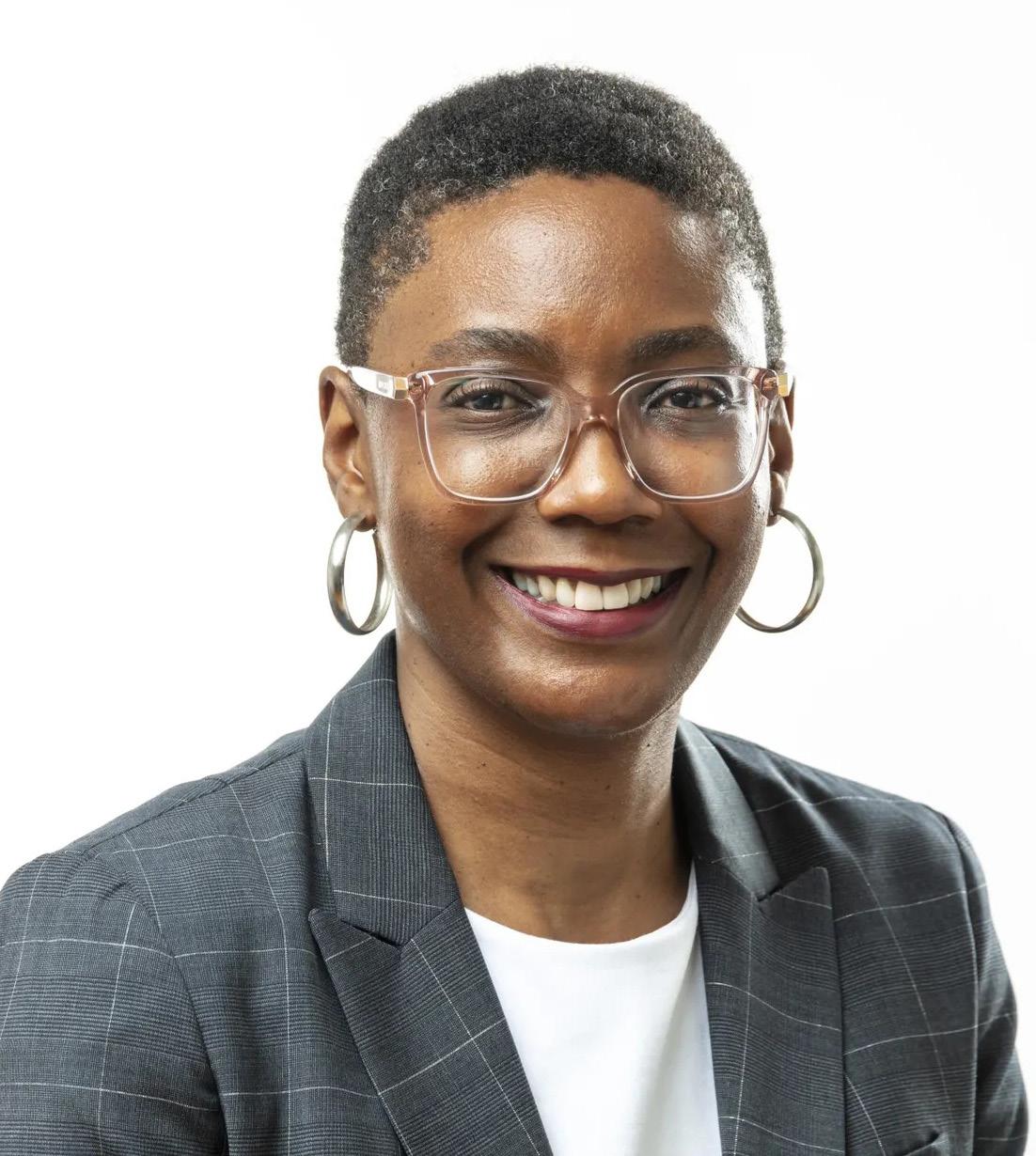
her
“I am certain that, in (Osayimwese’s) new role as vice president, she will use that platform not only to further the mission of the Society of Architectural Historians but also to increase equality and access in what can be per-
ceived as a rather exclusive corner of the academic world,” Rodríguez added.
COURTESY OF LOUKAS GOUSKOS
With the DOE grant, Gouskos hopes to build machine learning tools that filter out background noise when analyzing elementary particles.
COURTESY OF ITOHAN OSAYIMWESE / HERALD
During
tenure as president, Itohan Osayimwese aims to form a committee that will explore ways to strengthen the discipline.
ARTS & CULTURE
DANCE
Daebak’s 10th annual spring show captivates audiences with high-energy performances
The show featured music from some of the world’s biggest K-pop groups
BY TIMOTHY RO SENIOR STAFF WRITER
On Friday and Saturday night, students packed Salomon 101 as Daebak, a K-pop dance group, celebrated its 10th annual spring show, “Hello World.” Before the first track even began, the room buzzed with anticipation — a reflective prelude to a night defined by explosive smiles and constant movement.
The show opened with “Maestro,” which immediately showcased the group’s cohesion. A dancer wielding a conductor’s baton at the front of the stage guided the ensemble behind them as if orchestrating not just the music, but the performers themselves.
This clean, organized execution carried through the rest of the program. The performers moved on and off stage in rapid succession, and their coordinated transitions created a pace that rarely allowed the audience to settle.
While much of the choreography also drew from existing works rather than original compositions, this did not take away from the show. The dancers’ high energy and performance quality illustrated how reinterpretation — when done intentionally — can be just as compelling as original work. The show’s only sore spot was its length — at two and a half hours, the show felt prolonged at times.

Performances featured music from some of the world’s most popular groups, including KATSEYE, TWICE and BTS.
Performances featuring music from some of the world’s most popular groups — KATSEYE, TWICE and BLACKPINK — drew some of the loudest reactions of the night, with audience members ecstatically responding to the familiar songs and choreography.
REVIEW
At several points throughout the performance, the physical demands of the choreography became visible. But what stood out was their evident joy to just be able to perform. Each dancer went above and beyond with their facial expressions, which were reflective of genuine enjoyment. This distinct contrast — visible fatigue paired with a contagious energy — became one of the most compelling aspects of the show.
Daebak’s “Dance Camp” segment introduced an element of surprise. During the event’s planning process, several
students signed up for “Dance Camp.”
After attending a “Dance Camp” practice, these students took the stage at “Hello World,” reinforcing the message that dance and K-pop are accessible to everyone.
Collaborations with groups such as Mezcla — a Latin American dance group — and Molì Dance Company — an East Asian dance group — further expanded the show’s reach. While the groups varied in style, the collaborative performances struck a balance between the differing genres’ costumes and props. But at times, the collaborations felt
slightly disorganized — a reasonable shortcoming considering the increased number of performers on stage.
The most memorable moment of the evening was the senior set — a skit-like introduction of graduating members. Interwoven with choreography, the segment felt less like a conclusion and more like a reminiscent memory. Daebak members tearfully bid farewell to each senior while embracing the graduates’ new beginnings — a notion that echoed the show’s title, “Hello World.”
Thanking both the audience and her fellow team members, Daebak co-Direc -
tor Lily Yu ’26 said that “because of you, we have the strength and courage to say hello to the world.” Yu’s words illustrated how the performance was more than choreography — it was a tribute to a lifelong community.
Correction: A previous version of the article misrepresented the “Dance Camp” portion of the program. The Herald regrets the error.
This article originally appeared online at browndailyherald.com on April 6, 2026.
Kinan Azmeh, Brown Jazz Band showcase power of human connection at performance
BY MILO SHENN CONTRIBUTING WRITER
Last Friday, acclaimed clarinetist and composer Kinan Azmeh joined the Brown Jazz Band for a poignant eight-song performance at the 38th Eric Adam Brudner ’84 Memorial Concert in the Lindemann Performing Arts Center. The concert was directed by Timo Vollbrecht — an associate teaching professor of music and Azmeh’s longtime friend.
The concert opened strong with “139th Street,” a piece about the New York City apartment building where Azmeh and Vollbrecht once lived. Azmeh prefaced the performance with an explanation of the piece’s origins, recalling how the sounds of a neighbor’s reggae merengue music seeped into his composing process.
The piece was dynamic, beginning with the subdued sound of Azmeh’s clarinet above the rhythm section. But as the melody moved through the 25-person band, the song highlighted the collaborative nature of jazz.
Azmeh’s Syrian-inspired music style was a particularly powerful component of the performance. The concert’s sec -

ond song, “The Canteen,” was based on an artifact from Aleppo, Syria that he saw in the Smithsonian Museum. It was followed by “Jisreen,” named after a village near Damascus where Azmeh often visited his grandparents and planted trees. Although 21st century chemical attacks destroyed much of the villages’ nature, he said that he still saw some trees standing during a
recent visit. This history informs the piece, which elicits a somber yet hopeful atmosphere.
“Rituals” — one of Azmeh’s first pieces — then alternates between energetic and relaxed sounds, which highlighted the skill of guitarist Joel Fisher ’28. The band then performed “Little Red Riding Hood,” inspired by an Arabic poem by Azmeh’s friend that sub -
verts the classic fairytale. The piece is intense, with Azmeh’s clarinet echoing across the concert hall to perfectly fill the space.
The final two songs brought the concert to a striking close. “And We Are All Optimistic” began with beautiful piano playing from Triston Roberts ’26 before leading into a slightly darker sound from Azmeh and the other wind
instruments. But apt to the title, this darkness was followed by a light and energetic section led by Derrick Pennix GS on the trumpet. Azmeh closed the song from there, concluding on a sense of hopefulness that was so prominent throughout.
Azmeh described the last song, “Weddings,” as an ode to “the delusional act of optimism of falling in love.” The piece is reminiscent of the sounds and sense of community that may be found in a Syrian village wedding — a spirit that has persisted amid war.
Bassist Van Teager ’28 opened the piece, and the piece crescendoed as Azmeh and the rest of the band joined in, mirroring the style of music at village weddings.
Before the band began playing, Vollbrecht gifted Azmeh with a potted cactus and the two hugged. While their friendship was evident throughout the concert, it was especially spotlighted in that moment. The concert’s everpresent optimism left a sense of friendship and community that will long linger among audience members — at the event’s close, concertgoers reacted with a resounding standing ovation.
This article originally appeared online at browndailyherald.com on April 5, 2026.
HORATIO HAMILTON / HERALD
The concert was hosted at the Lindemann Performing Arts Center
SIA GHATAK / HERALD Azmeh’s Syrian identity was a powerful component of the performance.