SINCE 1891
THE BROWN DAILY HERALD FRIDAY, SEPTEMBER 14, 2018
VOLUME CLII, ISSUE 62
WWW.BROWNDAILYHERALD.COM
U. on track to meet sustainability goals Rhode Island bans
vaping in public spaces
University to reduce greenhouse gas emissions, combat climate change through new initiatives
Bill extends state ban of traditional cigarettes to e-cigarettes, similar vaping devices
By ALLIE REED SENIOR STAFF WRITER
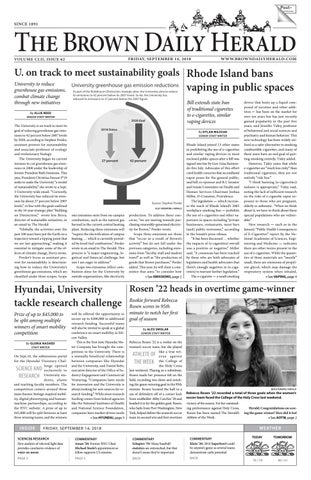
The University is on track to meet its goal of reducing greenhouse gas emissions to 42 percent below 2007 levels by 2020, according to Stephen Porder, assistant provost for sustainability and associate professor of ecology and evolutionary biology. The University began its current mission to cut greenhouse gas emissions in 2008 under the leadership of former President Ruth Simmons. This year, President Christina Paxson P’19 seeks to make the University “a model of sustainability,” she wrote in a Sept. 3 University-wide email. “Currently, the University has reduced its emission by about 27 percent below 2007 levels,” in line with the goals outlined in the 10-year strategic plan “Building on Distinction,” wrote Jess Berry, director of sustainable initiatives, in an email to The Herald. “Globally, the activities over the past 100 years have put the Earth on a trajectory toward a tipping point that we are fast approaching,” making it essential to mitigate some of the effects of climate change, Berry wrote. Porder’s focus as assistant provost for sustainability is determining how to reduce the University’s greenhouse gas emissions, which are classified under three scopes. Scope
By DYLAN MAJSIAK SENIOR STAFF WRITER
ALEX SKIDMORE / HERALD
one emissions stem from on-campus combustion, such as the natural gas burned in the current central heating plant. Reducing these emissions will “require the electrification of campus heating, … which is currently provided by fossil fuel combustion,” Porder wrote in an email to The Herald. This process is “a major engineering, logistical and financial challenge, but one I am eager to address.” Scope two emissions reflect combustion done for the University by outside organizations, like electricity
production. To address these concerns, “we are moving towards purchasing renewably-generated electricity for Brown,” Porder wrote. Scope three emissions are those that “occur as a result of Brown’s activity” but do not fall under the previous categories, including emissions from “faculty, staff and student travel” as well as “the production of goods that Brown purchases,” Porder added. This year, he will chair a committee that aims “to consider how » See EMISSIONS, page 2
Rhode Island joined 13 other states in prohibiting the use of e-cigarettes and similar vaping devices in most enclosed public spaces after a bill was signed into law by Gov. Gina Raimondo this July. Advocates of this effort cited health concerns that secondhand vapor poses for the general public, said bill co-sponsor and R.I. Senator and Senate Committee on Health and Human Services Chairman Joshua Miller, D-Cranston, Providence. The legislation — which increases the reach of Rhode Island’s 2005 workplace smoking ban — prohibits the use of e-cigarettes and other vaporizers in spaces including “private businesses, restaurants, most bars (and) public restrooms,” according to the Senate’s press release. “It has been discussed … whether the impacts of (e-cigarettes) overall was a positive or negative,” Miller said. “A consensus has been reached by those who are both advocates of legislators and health advocates that there’s enough negatives in (e-cigarettes) to warrant further legislation.” The e-cigarette — a small smoking
device that heats up a liquid composed of nicotine and other additives — has been on the market for over ten years but has just recently gained popularity in the past five years, said Jennifer Tidey, professor of behavioral and social sciences and psychiatry and human hehavior. This new technology has been widely utilized as a safer alternative to smoking combustible cigarettes, and many of these users have an end goal of quitting smoking entirely, Tidey added. However, Tidey notes that while e-cigarettes are “much less risky” than traditional cigarettes, they are not entirely “risk free.” “I think banning (e-cigarrettes) indoors is appropriate,” Tidey said, noting the lack of sufficient research on the risks of e-cigarette vapor exposure to those who are pregnant, elderly or asthmatic. “When we think about it, we have to think about these special populations who are vulnerable.” New research — such as in the January “Public Health Consequences of E-Cigarettes” report by the National Academies of Sciences, Engineering and Medicine — indicates there are other toxins present in the use of e-cigarettes. While the quantities of these materials are “mostly” small, there are emissions of propylene glycol, which may damage the respiratory system when inhaled, » See VAPING, page 4
Rosen ’22 heads in overtime game-winner Hyundai, University forward Rebecca tackle research challenge Rookie Rosen scores in 95th Prize of up to $45,000 to be split among multiple winners of smart mobility competition By GLORIA NASHED STAFF WRITER
On Sept.10, the submissions portal for the Hyundai Visionary Challenge opened exclusively to University students, alums and teaching faculty members. The competition centers around three main themes: biology-inspired mobility, digital phenotyping and humanmachine partnerships, according to the HVC website. A prize of up to $45,000 will be split between at least three winning teams, and the winners
SCIENCE AND RESEARCH
INSIDE
will be offered the opportunity to secure up to $200,000 in additional research funding. Successful teams will also be invited to speak at a global conference on smart mobility in Silicon Valley. This is the first time Hyundai Motor Company has brought the competition to the University. There is a mutually beneficial relationship between companies like Hyundai and the University, said Daniel Behr, executive director of the Office of Industry Engagement and Commercial Venturing. “Companies have needs for innovation and the University is always looking for new sources for research funding.” While most research funding comes from federal agencies like the National Institutes of Health and National Science Foundation, companies have market-driven needs » See HYUNDAI, page 3
minute to notch her first goal of season By ALEX SMOLAR SENIOR STAFF WRITER
Rebecca Rosen ’22 is a rookie on the women’s soccer team, but she played like a true veteran against the College of the Holy Cross last weekend. Playing as a substitute, Rosen made her presence felt on the field, recording two shots and notching the game-winning goal in the 95th minute. Rosen located the ball in a sea of defenders off of a corner kick from midfielder Abby Carchio ’20 and headed it in for the golden goal. Rosen, who hails from Port Washington, New York, helped deliver the women’s soccer team its second win and first overtime
ATHLETE OF THE WEEK
BENJI TURUÑO / HERALD
Rebecca Rosen ’22 recorded a total of three goals when the women’s soccer team faced the College of the Holy Cross last weekend. victory of the season. For her outstanding performance against Holy Cross, Rosen has been named The Herald’s Athlete of the Week.
Herald: Congratulations on scoring the game-winner! How did it feel » See AOTW, page 2
WEATHER
FRIDAY, SEPTEMBER 14, 2018
SCIENCE& RESEARCH New analysis of relected light data provides conclusive evidence of water on moon
COMMENTARY Aman ’20: Former RNC Chair Michael Steele’s appointment as fellow supports U.’s mission
COMMENTARY Schapiro ’19: Many baseball statistics are entrenched, but that doesn’t mean they’re important
COMMENTARY Klein ’20: 2018 Superbowl could be anyone’s game as several teams demonstrate early potential
PAGE 3
PAGE 5
BACK
BACK
TODAY
TOMORROW
78 / 59
80 / 61
NEWS
PAGE 2 • FRIDAY, SEPTEMBER 14, 2018
» EMISSIONS, from page 1 to quantify and reduce Scope three emissions,” which were not considered in the University’s 2008 goals and are difficult to quantify. Of the 27 percent reduced so far, “the largest reduction” results from the Thermal Efficiency Project, which focuses on the University’s switch “from heating oil to natural gas at the central heating plant,” Porder wrote. This Scope two project will convert the current campus central heating plant from a steam-powered system to a hot water-powered system, Berry wrote. The completion of this threeyear project will result in “annual savings of over $1 million in fuel costs and a reduction in (greenhouse gas) emissions by 5,000 tons,” she added. So far, the University has completed “the initial planning, equipment ordering and contractor staging of the first year of work,” Berry wrote. The total cost of the Thermal
THE BROWN DAILY HERALD
Efficiency Project is $24 million, according to a University press release. Beyond this expense, the University invests about $3 million annually “in projects to increase efficiency on campus, reduce utility cost and decrease our greenhouse gas emissions,” Berry wrote. Cutting greenhouse gas emissions is not just a financial challenge, but a technical one as well. Students, staff, faculty and administration are in the process of developing a sustainability master plan, said Leah VanWey, associate provost for academic space and professor of sociology and environment and society, adding that it will likely take a year to complete. Along with trying to limit greenhouse gas emissions, the University strives to practice sustainability across campus by looking into its academic operations, including transportation, parking and water use, VanWey said. VanWey wants sustainability to become a campus conversation. “I
would like to see it infused as a core value throughout all of our activities” following the example of the Diversity and Inclusion Action Plan, VanWey said. While the steps to reduce greenhouse gas emissions are clear, integrating sustainable practices on campus is a more abstract mission, she added. “We know we need to get to (net) zero emissions or we’ll have catastrophic climate change,” VanWey said. VanWey and Porder have been leading the effort to define the University’s post-2020 plans, Berry said. While the conversations are just beginning, the future goals will be based on “what is feasible and possible given our facilities and mission,” VanWey said. Climate change is widely considered the greatest danger to humanity today, Porder wrote. “In my opinion there has never been a greater challenge or a more urgent one.”
C.S. LEWIS IS COMING TO
BROWN!
“BRISTLING, PROVOCATIVE, HIGHLY ENTERTAINING!”
to make such a big play as a first-year? Rosen: It was a really exciting moment, especially for it to be my first goal, and in overtime. It was great to get that win and nice because we had been practicing those set plays earlier over and over in practice. So it was a repeat of that and made (the goal) much easier and much more likely to happen because of that practice and training. When did you first get involved with soccer? I have been playing soccer probably since I was three years old. With one of my friends, I used to watch my older sister play. Then, the next year I started and have been playing ever since. When did you start to think that it would be realistic for you to play college soccer? My sister was getting recruited for lacrosse, and she was a year older than me. So in her sophomore year, she finally got recruited. Just seeing her going to play in college, I wanted to do the same thing. I’ve always loved soccer and that’s always been my sport, so I joined a club team at the start of my junior year and that was when I started training for colleges and that process. Why did you choose to play at Brown? Obviously, part of it is just getting the looks for soccer and the offers. Compared to the other schools that I was looking at, it was the right size of campus and just open possibilities for what I want to study since I’m coming in here undecided. I think it’s just a great place to be.
Do you have any pre-game rituals? I don’t usually have any, but one of the girls on the team has started braiding my hair. So I feel like that might start as one. Although you haven’t been at Brown for a long time, what has been your favorite part of being on the team so far? Probably my favorite part so far has been preseason, when it was just soccer. Women’s soccer was the first team on campus, and you would have summer practices, team lunch, team dinner and hangouts afterward. We would just get to know each other that way. We even got to go to California and stayed in some hotels with roommate and (that) was just a great bonding experience that I think has helped us on the field as well. What are your personal and team goals for the rest of the season? Personal goals for the rest of the season are to just keep scoring and keep getting chances (and) maybe get my head on the ball one or two more times. I have not yet started a game either, so maybe to get one or two starts as well. Team goals are to work towards winning the Ivy League and get into the tournament in general. Do you have any overarching aims for your career with the soccer team? Not that I know of. I’m just taking it season by season and we’ll see how it goes from there. The Bears will return to action in a matchup against Ocean State rival University of Rhode Island at StevensonPincince Field Sunday at 1 p.m.
Are you a student in recovery or struggling with an addiction?
CHICAGO SUN-TIMES
“LEWIS’ FIERCELY CONSIDERED REASON MAKES THIS OXFORD DON INTRIGUING COMPANY!” THE NEW YORKER
ONE SHOW ONLY! FRI SEP 28 8PM
ONSTAGE THE MOST Salomon 101
RELUCTANT CONVERT FPAtheatre.com/Brown Reserve your Seats at
Max McLean as C.S. Lewis
A production of Fellowship for Performing Arts in association with Brown’s C.S. Lewis Inkling Society
Read Join
» AOTW, from page 1
Want to connect with other students in recovery from a substance use disorder? Contact: Dean Shannon O'Neill shannon_oneill1@brown.edu or 401-863-1367 Bruce E. Donovan '59 Dean for Recovery and Substance-Free Initiatives
MEAL PLAN
changes
STEP ONE:
Choose a Meal Plan.
browndailyherald.com/join herald@browndailyherald.com
T DAY THE LASEA L PLAN
TO MAKE M EDNESDAY, CHANGES IS W
SEPT. 2 !
VIEW OPTIONS AT BROWN.EDU/FOOD
• You can ADD a new Meal Plan at any time during the year • You can make one CHANGE per semester. Fall deadline is 9/2 • Meal Plan CANCELLATIONS for the whole year are due by 9/2
STEP TWO:
Let us assist you!
EMAIL DINING_SERVICES@BROWN.EDU OR CALL 863-3343 WITH QUESTIONS
• Changes can only be made in person weekdays from 9:00AM to 4:00PM at the Brown Dining office located at 144 Thayer Street (Sharpe Refectory).
The Herald
REMINDER:
brown.edu/food
Issue
Ava Rosenbaum 2
A Summer with In This Young Gurus
James Feinberg 3
World on Fire Harry Levine 4
Purple on the Palette Catherine Bai 4
Uncertain Progress Levin 5
liza Edwards-
The Rat Lap Naomi Kim 6
Schooled
postCover by Halle Krieger
SEPT 14
VOL 22 —
ISSUE 1
FEATURES
A Summer with Young Gurus A Study of a Selfless Corporate Culture
L
written By Ava Rosenbaum
ast semester I was fervently searching for internships, looking
Letter from the Editor
everywhere from media outlets in New York to law firms in Raleigh. Nothing was falling into place. My Turkish friend kept telling me, “Check out Young Guru Academy. It would be perfect for you.” After a few weeks and a few more rejection letters, I finally decided to follow her advice. Little did I know that this would be one of the best decisions I would ever make. At the time, all I knew about Young Guru Academy (YGA) was that it was an international nonprofit based in Turkey. I had visited Turkey once before on vacation, but I had never thought of living there. Nonetheless, an interview and a few months later, I found myself on a plane to Istanbul for my month-long internship. Before arriving, the international coordinator told me that YGA is a nonprofit organization dedicated to cultivating selfless leaders. YGA achieves this goal through a multifaceted approach: they host a summer camp for middleschool students and run a three-year program for selected highschool students. They believe in handson learning, allowing the students to develop their own products and work with distinguished leaders in various business, scientific, and technological fields. In this way, students become what YGA calls “double-winged” leaders who practice both competence and conscience. The first Monday morning of my internship I met with two other Brown students. Yuta and Ruban were both computer science concentrators who had just graduated from Brown. During their senior year at Brown, they had taken a computer science class called Tech for Social Good. In that course, they had coded a social media application to complement the science kits that YGA produces. They were there to present and share the app as well as to receive insights on how to improve it. We walked into YGA’s office, housed in Istanbul’s Ozyegin University. The office felt like a Google workplace, complete with petrified seaweed decorations, one large table, beanbag chairs, and the company’s motto—“The main thing is to keep the main thing the main the main thing”—on the wall. People sipped on Turkish coffee or tea while they chatted in corners or typed on their computers. We were led into a glass-walled conference room where we met with two sisters: Sezin Aydin, the Head of International Programs, and Melike Aydin, the Head of Marketing. They told us that Melike had left her job as an executive for Nestlé, where she had begun to feel purposeless and stagnant. But now, she has found a sense of fulfillment in her job at YGA. They gave us a presentation about YGA’s high-trust culture, where everyone worked and lived selflessly. They told us that YGA focuses on the symbiotic relationship between personal and community growth, on the process rather than the result. They told us that everyone shared their introspections and vulnerabilities in weekly “feedforward” sessions. Later that week, we met with Sinan Yaman, the founder of YGA. Before the meeting, Sezin told us that he was extremely excited to meet us. This surprised me—I had previously worked in companies where only my supervisor knew my name. In contrast, Sinan knew all of our names, as well as what we had been working on. He even asked us for our feedback on his performance. He further explained YGA’s philosophy of high trust and selflessness, and he told us he was moved to tears every week seeing the YGA employees truly practicing these values. We realized YGA was not just an organization—it was a mindset. Ruban, Yuta, and I thought YGA’s mindset of intrinsic motivation, selflessness, and growth aligned harmoniously with Brown’s culture. Sezin agreed—although YGA had partnered with students from Harvard, Berkeley, and Columbia, Brown Welcome to a new year of post-! We
students were the fastest in understanding the organization’s values. Sezin told us about Harvard Professor Scott Snook’s research, in which he identified three types of mindsets: dependent, independent, and self-authoring. People with a dependent mindset tend to follow directions, whereas those with an independent mindset tend not to listen to others’ critiques. A self-authoring mindset focuses on personal growth and working alongside others to constantly better oneself. Professor Snook found that 70 percent of the incoming Harvard freshmen are in the dependent mindset, and only 10 percent are in the self-authoring mindset. Even more surprisingly, those numbers do not change after four years at Harvard. Based on the average Brown student’s drive for growth and self-actualization, I would guess that more fall into the self-authorizing category. Both Brown and YGA attract a specific kind of person. Both are places full of passion, growth, and a sense of social responsibility. Both embrace big-picture thinking and cross-disciplinary innovation. However, this mindset stands in contrast to today’s typical corporate culture. This culture often focuses on external, quantifiable measures of success: the name on the degree, the number on the paycheck, the title on the door. It is easy to see why this is the case—these tangible figures are comprehensible, comparable, and concrete. And this feedback happens quickly—every three months, a person’s merit changes depending on their revenue or sales. It is common for leaders to derive their selfworth and motivation from external measures, to constantly strive for a quantifiable success. But this success is often elusive. People at YGA often came from high-powered positions in multinational corporations like Microsoft, Unilever and Nestlé. They told me that they felt like they were on a climb for elusive success in those companies. Just as they reached one goal, one number, one benchmark, there is another one just out of reach. So, they continued to climb and climb, lone hikers on an upward trek. Nevertheless, when they reached the top of the mountain and looked around, instead of feeling content with their accomplishment, they felt hollow. They felt like something was missing. For them, YGA had that missing piece: selflessness. This deep belief in selflessness drives every aspect of YGA: it shapes its workplace culture, it fosters innovation, and it cultivates leadership. At YGA, selflessness does not mean a lack of a sense of self—it means going beyond yourself. A selfless mindset allows people to prioritize shared values and goals above individual desires. Selflessness promotes collaboration but not competition. Selflessness fosters confidence but not cockiness, self-reliance but not self-importance. A selfless mindset engenders growth and unconditional appreciation. It is like trying to plant a garden—even with all of the right seeds, they will not grow if the soil is contaminated. The mindset is the soil; with a selfish mindset, the seeds—challenge, evaluation, and appreciation—will die. In a selfish mindset, challenges become obstacles, evaluations become criticism, and appreciation becomes flattery. However, with a selfless mindset, these same seeds can flourish. Challenges become essential, evaluations become constructive, and appreciation becomes genuine. This one change—from selfish to selfless—entirely transforms the culture of an organization. This may seem unbelievable, idealistic, only theoretical. Yes, it seems good on paper, but how can people actually practice this? Can a company be selfless and successful? That is the key: YGA is successful because it is selfless. It may seem counterintuitive at first. Nonetheless, YGA and its members have won numerous
A&C will strive to create a guide for what
are excited to welcome new writers, editors,
you should read, watch, see, eat, and listen to
illustrators, designers (and of course readers)
throughout the semester—falling short of that
to our team. Here’s a quick introduction (or
lofty goal, we will at least alert you to what is
reintroduction) to post- as it currently stands:
not worth your all-too-limited time.
1.
post- (duh)
2.
postmodernism
week. This first issue marks a transition into a
3.
post-its
new semester—our writers glance back on their
4.
postpone (a gentler form of “procrastinate”)
5.
post malone
and try to revel in having returned to Brown for
6.
postpone MaStudentLoans
just a little bit longer. We hope you do, too.
7.
lamp post
8.
postgraduate (yikes)
9.
compost (go green!)
10.
p.s.
You will learn something from our
Most importantly, we want to bring you
Features. At times, you will get student and
something enjoyable to browse as you end your
local perspectives on Brown- or Providencerelated issues; at others, we may offer you a 2000-word analysis of numbers used in
summer jobs, look ahead to the TV shows that
English idioms or the history of the croissant.
will become a refuge during midterm weeks,
Regardless, we hope to provide insight. Narrative will bring you stories about students’ lives and how they live them—we hope these student voices entertain you, and that some weeks, when you’re struggling with going off meal plan or the aftermath of a horrible Tinder date, reading about a similar experience will bring you some comfort.
2!post–
Top Ten post-s
Sincerely,
Jennifer EDITOR - IN - CHIEF OF POST -
ARTS&CULTURE accolades, including Best Place to Work, Forbes 30 Under 30, MIT Innovators Under 35, and an Edison Award. This is because when employees are intrinsically motivated, they take on greater challenges, and they work harder for the shared goals. For example, two days before YGA was to host its week-long summer camp for over 200 students, the lead coordinator called and said that she was not going to attend the camp for personal reasons. Instead of getting angry, people at YGA were calm and understanding. Her absence meant that two other employees suddenly had the enormous task of running the camp, something they had not prepared for. They worked over 100 hours that week to make sure that the camp ran smoothly. At the end of the camp, they sent the woman a video thanking her for all of her hard work in the previous months. They told her that it was because of her prior work that the camp ran so smoothly. Instances like these are common at YGA. YGA employees are not concerned with personal gains or losses, superiority or inferiority, accolades or aspirations. No one ever demands credit for their ideas—instead, they work to make sure that others receive the recognition and appreciation they deserve. In no other company did I feel as though people valued my ideas just as much as those of the founder. Because the focus was not on personal gain, my coworkers did not feel threatened by interns working alongside leaders in the company. Instead, they embraced and encouraged our contributions, realizing that the organization’s mission came above all else. Yuta and Ruban only stayed for the week of the summer camp, but I stayed on for three more. Although the summer camp was over, the spirit and the energy did not fade. I worked with the founder on further developing YGA’s philosophy. YGA had the pieces—high-trust, introspection, role models—but they didn’t have a concrete way to explain them to the public. Sinan is a very conceptual thinker, and his ideas often flow out in a disjointed and tangential stream. We would talk through these concepts of selflessness and appreciation, and I would help organize and clarify them. I drew diagrams and made models of what he said, and we examined how the pieces fit together. I realized how much my political science studies helped me through this design process, as political science often deals with the connections between seemingly unrelated events—for example, how one event in one country can give rise to a movement in another. This big-picture thinking and ability to maneuver conceptual ideas proved very useful in helping hone YGA’s cultural model. Through our work, we designed YGA’s unique cultural model for social innovation. YGA’s cultural model naturally gives rise to social innovations and leaders with conscience. This cyclical model consists of four elements: role models, introspection, high-trust culture, and social innovation. Each element leads to the next, in an iterative and sustainable process. YGA’s socially conscious role models promote introspection in others. When people share this selfless mindset, a high-trust culture develops. This environment fosters fearlessness, which naturally produces social innovations. These social innovations transform the culture of a country, and in turn, produce more role models.
When my internship came to an end, I was shocked by how deeply I was going to miss the environment and the people. I have plans to continue working with YGA, and I strongly encourage other Brown students to do the same. I had never before been in a working environment so invigorating and purposeful. This experience made me rethink what meaningful work really is and what kinds of people I want to surround myself with. I realized that YGA's model is not only one for an office but also one for life.
World on Fire Watching Tom Clancy’s Jack Ryan on Amazon By James Feinberg illustration by Monika Hedman
You know Jason Bourne, John Wick, John McClane, and Ethan Hunt. Now, to the universe of square-jawed, untouchable American heroes whose skills in combat and approachable handsomeness allow them to leapfrog rooms of baddies in a single bound, add Jack Ryan, as played by John Krasinski in the new Amazon series Tom Clancy’s Jack Ryan, which dropped eight episodes August 31st. Jack’s a CIA analyst, a supposed desk jockey, who gets drawn into an international manhunt when he discovers the identity of a Lebanese-French terrorist mastermind named Mousa Bin Suleiman (Ali Suliman), referred to ad infinitum as “the next bin Laden,” “the new bin Laden,” and even just, simply, “he’s bin Laden.” Ooh, boogie boogie. But Jack is up to the task. After all, the character’s not only an ex-Marine and (weirdly) a stockbroker, but a veteran of 21 novels, five films, and three video games. With that kind of resume, what could go wrong? Well, that depends on whether you think the world needs another dour Middle Eastern shoot-emup, another Homeland, Fauda, The Honorable Woman, or Tyrant, to which my instinctive answer is “no.” It doesn’t help that Krasinski’s humor is smothered by creators Carlton Cuse and Graham Roland (both of Lost), who aren’t sure whether this Jack Ryan is a jock, a dreamboat, or a savant, and consequently decide to make him a complete blank. Though there are moments when Krasinski’s towering dignity as an actor shines through, the series’ ever-widening net of characters and situations largely just drives home the point that Jack Ryan himself is the least interesting one of them. Anyone looking for an adventure series with a sense of humor in the style of the Jack Ryan films will be sorely disappointed. The appeal of that character, when done right, was that he was fully unprepared for the field. In the first film, The Hunt for Red October
“I’m on the Blueno side!”
(1990), Alec Baldwin’s version, faced with a mutinous submarine crew, gulped, “I don’t react well to bullets.” Right from the pilot, Krasinski’s Jack, trapped in a room with an armed-to-the-teeth Suleiman and his brother, bests the baddies with his bare hands and a well-deployed grenade. In later episodes, he complains about his back hurting, but that doesn’t stop him from chasing terrorists down the street or carrying French policemen out of burning buildings. All in a day’s work. Not that Suleiman is anything to sneeze at. Hell, he runs an international terror finance ring, escapes from a heavily guarded US base, and at one point, thanks to some fascinating editing, manages to make love to his wife without ever removing his drawstring pants. Terrorism gets more devious every day. Hero, check, villain, double check. There’s also a dutiful love interest, Cathy Mueller, an epidemiologist, who, as played by Abbie Cornish, spends most of the series waiting around pleasantly for something to do. And don’t forget the alternately fatherly and explosively angry boss, James Greer (Wendell Pierce), a shootfirst CIA honcho who’s also—what’s this!—a Muslim. Every time his prayer beads appear on screen, they are presented in arrangements of shadow and light that make them out to be a major reveal, even though we’ve already seen them fifteen times. The ensemble is filled out with secondary protagonists and antagonists—at work and abroad—many of whose storylines verge on the bizarre. (John Magaro plays a drone pilot who at one point falls ass-backwards into a sadomasochistic semi-threesome with a couple who call themselves Blanche DuBois and Stanley Kowalski. Sure, why
the series’ ever-widening net of characters and situations largely just drives home the point that Jack Ryan himself is the least interesting one of them. not.) The best of these minor players is Nora Guerch, who has a blink-and-you-miss-it role in episode two as a Suleiman draftee who accidentally deploys her suicide vest when shot by a SWAT officer. The look of genuine terror on her face when she shouts “Please!” in the moment before the bullet flies beats the rest of the episodes combined for pathos. Jack Ryan has lots of bright ideas about what a globe-trotting action series ought to be, but not a lot of success in applying those ideas. In a genre rife with casual Islamophobia, Cuse and Roland try and fail to portray religious extremism intelligently. In an oversaturated media landscape of duds that look like duds, Amazon’s money keeps the explosions at least looking explosive, but they rarely feel that way. What the series lacks is a compelling reason to exist. It feels visually and narratively lost, a ship in search of a port, despite evident effort by high-profile directors like Morten Tyldum (who directed the pilot as well as 2014’s mordant The Imitation Game). It doesn’t lack action or ambition— it just happens to be deeply boring.
“Let’s go to B. GOOD. B. GOOD is LIT.”
“Tell your mom I’m marrying you.” “I like your slides.” SEPTEMBER 14, 2018!3
ARTS&CULTURE
Purple on the Palette
Exploring VanJess’s new album, Silk Canvas By Harry Levine illustrated by Katya Labowe-Stoll Albums aren't that long. At times, I think about certain albums and it’s hard to relate them to, say, a 50-minute lecture on 19th-century American art. Albums and musicians are in the business of packing in their artistry, of conveying their ideas, expressing their influences and pushing certain sounds forward in a tight window. What VanJess, a NigerianAmerican R&B duo, is trying to do on their debut album isn’t just to bring their many influences into one cohesive blend, but also to convey a style, a color, a texture. Silk Canvas is the name of this album, but it’s also their goal: to make something that’s smooth to the touch and easy to swallow. The cover of the album itself is helpful. It’s not the two faces of VanJess that take up the center of the photo. Instead, it’s the color purple. Purple encapsulates this album’s core: it’s soft and gentle, but it’s not fake. Purple is not a color that lies to you or fudges the truth. In this way, VanJess uses purple to convey the complexities of their own lives and music. The music is bright, but it’s also real, prickly, and quite modern. They do all this in a paltry, 52 minutes. Jessica and Ivana Nwokike (Ivana + Jessica = VanJess) got their start on YouTube. Their covers of “Bad Romance” by Lady Gaga and “Man Down” by Rihanna received a combined total of around 10 million views. They sung and beatboxed well, and the videos were cute and sweet. It was clear they had a love for the source material in each video and purely loved to sing and harmonize. The choice of songs was interesting as well. Both had lyrics that detailed complicated relationships, and each offered a different way to approach a “bad romance.” One way is to go along for the ride as Gaga does, another is to kill your abusive lover as Rihanna (theoretically) does. These were huge pop hits with themes of control, abuse, and manipulation. VanJess continues to explore these themes on Silk Canvas, but like Rihanna (less so Gaga), they do so with music that sounds deceptively like a laid-back summer’s night. In the album, one of the best examples of a sound that potentially betrays the lyrics behind it is the song “Through Enough,” which features GoldLink, who had everyone’s third favorite song of the summer last year, “Crew.” The song is incredibly bright, with an atmosphere similar to that of house
4!post–
group Disclosure of “Latch” fame. It’s supremely danceable, or at least very head-bob-able. The lyrics tell another story. “Don’t take me ransom babe / Yeah I’ve been through enough, through enough, ah yeah,” they sing on the chorus. On the pre-chorus, they hit us with more personal and affecting lines: “Ooh my heart ain’t making it through / Another break it’s been loose / I’ve got to set the rules / Before you coming at me.” It’s a plea for control and restraint in a song where letting loose is actively encouraged in the music. GoldLink helps to grease the song along with some on-brand bars about “D.C. summers” (it’s not a GoldLink song unless the District is mentioned). It’s a really exceptional track and definitely a favorite of mine on the track list. The sound VanJess is crafting has two main pillars: ’90s R&B like Zhane, SWV, and Mary J. Blige, as well as present-day SoundCloud producers who use these ’90s influences to create new, sleek soundscapes. On paper, this sounds seamless, but VanJess isn’t simply trying to make a “throwback” album. “Off My Mind” by Zhane for example, with sparse production consisting of some drums, a piano, and a bass guitar, still sounds fresh 24 years later. Similarly, VanJess asked themselves the question, “How can we make this album sound crisp now and still crisp in 25 years?” The answer lies not in the record but in the liner notes. SoundCloud is a huge place with music and reactions to that music happening constantly. The music that has made SoundCloud’s name is trap infused hip-hop—a genre where emotions are conveyed constantly and overtly. Subtlety is at a minimum at the top of the SoundCloud charts. In reaction to this, a culture of mellow rose to the surface. Producers like KAYTRANADA, IAMNOBODI, Louie Lastic, and Atu create a different setting, one where the sun sets and the twinkling lights are just coming on. With night comes fear and anxiety and grayness but at times, true freedom. These producers, all featured in some way or another on this album, create a world of varying emotions. Songs like “Touch the Floor” express the magic that happens when a connection is made through dance, and “Another Lover” bashes a soon to be ex-lover for violating her trust. These songs both exist in the same world where life is honestly lived. The sounds they have created allow for contradictions and doubt to breathe within the album. These songs don’t have to be “happy” or “sad”—they can just be. VanJess’s influences go beyond the internet. As Nigerian-Americans who have lived for extensive periods in both Nigeria and America, they convey both sides of their cultural experience on Silk Canvas. In “Control Me,” they make use of a Naija dialect and exalt the impact it has on Nigerian listeners. The music video for “Control Me” is loaded with comments congratulating the women for being able to bridge the gap between American and Nigerian music, making songs that are accessible to both sides. The song itself is par for the course on the album, meaning it’s very good, sensual, and feels like it’s both ripped from the past and a ticket to the future. The last two tracks, honestly, I don’t care too much for. The features take a little too much away, and I mean that as a compliment to the main attraction. VanJess on Silk Canvas create a real portrait that’s as complex as it is smooth. Their past as Youtube D-listers, their deep understanding of the internet and its sounds, their subtlety and their background as Nigerian-Americans—all are separate paints on the palette. Each make it onto this beautiful, soft, purple-ish canvas.
Uncertain Progress
Crazy Rich Asians from Page to Screen Written by Catherine Bai Illustrated By Ella Rosenblatt When Crazy Rich Asians came out this summer, I was determined to read the book before seeing the movie (a point of pride as a self-proclaimed booklover). A friend warned me that doing so would dampen my enjoyment of the film, and he was right—but not in the way I expected. Though I almost always believe that books are better than their movie adaptations, I still enjoy book-based films: I’m fascinated by how stories transform in their journey between mediums. For a book with as many characters and subplots as Crazy Rich Asians, I was prepared for some dramatic cuts from page to screen. The changes, however, were too detrimental, stripping away the complexities necessary for full and authentic characters—a weakness compounded by the film’s burden of being the first Hollywood movie in twenty-five years to feature a majority-Asian cast in a contemporary setting.
Watching the movie as a Chinese American, I felt a small, electric thrill every time a piece of my parents’ culture manifested on the big screen. Hearing the song “Tian Mi Mi,” playing softly in the background, felt like a voicemail from a forgotten friend. Watching the Mahjong game scene triggered a primal muscle memory, reminding me of how the large and cold tiles felt in my childhood hands. Understanding the Mandarin dialogue felt like an invitation re-extended after years of rejection. For me, these details—catering exclusively and unapologetically to a specific subset of American audience members—are the film’s biggest triumph. In a Hollywood that had the audacity to suggest reimagining the movie’s Chinese American protagonist, Rachel Chu, as white, Crazy Rich Asians is a win for mainstream Asian American representation. But despite its progressive casting (by Hollywood standards, at least), the movie has garnered controversy over its uncritical portrayal of extravagant wealth and opulence, the erasure of brown faces in its Singaporean setting, and Awkwafina’s “blaccent” in her performance as Peik Lin, Rachel’s friend from college. It’s clear that the movie was intended for an American audience: The film revolves around Rachel, its only Chinese American character, whereas the book divides its attention between characters. More importantly, while Chinese Americans make up less than two percent of the U.S. population, ethnic Chinese represent almost 75 percent of the population in
NARRATIVE Singapore. In the United States, Crazy Rich Asians champions an underrepresented group, but in Singapore, the movie would be complicit in the country’s racism towards its Malay and Indian minorities. The conversations raised by these criticisms are important; in every piece of cultural production, there is something worth interrogating. The only way for Hollywood to reconcile the issues related to Asian underrepresentation, however, is by supporting a proliferation of Asian American narratives. Asking Crazy Rich Asians (which doesn’t pretend to be anything more than a lighthearted rom-com) to provide insightful visibility for all Asians who are not crazy rich and not Chinese Singaporeans is a burden no single movie should bear, especially one that struggles with providing holistic, empathetic portrayals of its own characters to begin with. The movie’s Peik Lin (dissimilar to the book’s) gets to the heart of my biggest issue with the film: the truncation of character dimensionality as Crazy Rich Asians made its way from page to screen. Out of all the problems brought up by critics, Awkwafina’s “blaccent”—which does an alarmingly large portion of the work of characterizing Peik Lin—cannot be even partly justified by the movie’s limitations and intentions. There’s a lot to unpack about Awkwafina’s performed Blackness by a non-Black (but also non-white) American, and that unpacking requires more space and depth than the scope of this article allows. For now, though, I’ll say this: Peik Lin’s caricature sends the message that Asians (and Asian Americans) are one-dimensional characters lacking unique narratives. Awkwafina’s Peik Lin steals the show with sheer energy, yet she has no motivations, no nuance, and no inner story. Though the novel’s Peik Lin is less visible, she is inflected with a broader spectrum of emotions. She’s still the unabashed woman who, “while being filthy rich, [i]s never a snob about it,” but she is not immune to the natural vulnerabilities we endure when comparing ourselves to our peers. At one point in the novel, Peik Lin quitely acknowledges how lucky her friend is to be dating Nick Young, heir to the fortune of a powerful family clan. The envy is implicit and fleeting, its presence endears her to the reader. My greatest fear is that Crazy Rich Asians hasn’t done enough to encourage a mainstream desire for more Asian and Asian American stories. Walking out of the movie, a friend mentioned that Rachel’s character felt flat and repetitive until the majiang showdown between her and Eleanor (Nick’s mother); another friend said Astrid (Nick’s It Girl cousin) was the subject of the most boring subplot he had ever seen, a comment that both disappointed and resonated with me. Reading the book, Astrid was my favorite character: beautiful and kind, unpretentious and original, an idea existing in the imaginations of others, but also a woman struggling to find an identity that is hers alone. Her (ostensibly) cheating husband, Michael, reveals that being married to her—the daughter of one of Asia’s wealthiest families—has made him feel inferior and ornamental. In a moment met with snaps and whoops from my fellow audience members, Astrid ends the relationship (“It’s not my job to make you feel like a man”), putting on a pair of $1.2 million earrings before making her defiant exit. But, to me, this moment isn’t cause for celebration—it feels like a perversion of Astrid’s complexity. In the book, Astrid acts in ways both strong and vulnerable as she struggles to define her relationship with
LIFESTYLE
her family’s wealth, attempts to empathize with Michael, acknowledges her mistakes and thoughtlessness in their marriage, and prioritizes her son’s interests over her own emotions. However, in this applauded movie scene, she seems to, rather simplistically, embrace her extraordinary wealth as a defining aspect of her identity and use this reclamation to alienate Michael—becoming alarmingly less nuanced than the Astrid I admired in the novel. Having read the book—knowing what the adaptation could have been, recognizing the choices that were made and the choices that weren’t—I am, overall, disappointed by the movie and its portrayal of Asian and Asian American characters. I wanted Crazy Rich Asians to feature characters swathed in the kind of cultural and individual specificity that injects fictional personas with humanity, to leave the audience no choice but to feel invested in their stories. That is the great paradox of storytelling: that universality comes from a place of specificity—it’s why figurative language can be so powerful, why the details can make a story. This movie took the opposite road, paring down each individual character as if the sheer number of Asian characters could do the work of imagining Asians complexly. The rom-com genre is notorious for its predictability and reliance on character tropes, but Crazy Rich Asians deserved more. The novel deserved more. Asian Americans deserved more.
The Rat Lap
Come for Lunch Rush, Stay for Run-ins Written by liza Edwards-Levin Illustrated By Halle Krieger
My first-ever Ratty meal, I forgot how to feed myself. The dining hall’s roundabout shape confused me; after half a round, I was already lost. Meanwhile, new floormates clustered: filling booths, picking at the salad bar in search of fries. I grabbed a fistsized bowl, too small for dinner, and frantically filled it to the brim—soup, carrots, beans, raisins, seeds, something called “special chicken.” Like college itself, mastering the Ratty seemed to require a kind of adult maturity: courage, confidence, quick charm to find a good seat. And knowing what you want, how to fill your plate. I have a saying now. The Rat Lap: a full lap around the Ratty to scan for available food and tables. May include unexpected run-ins. * “How’s the Ratty?” Mom asked as we walked across campus on Family Weekend. “I don’t really eat there much,” I said. After more than a month, the Ratty still felt like a map I couldn’t read. “Oh, really?” She frowned. “Can I at least peek inside?”
We snuck in through the back and did a Rat Lap together: past the salad bar and rows of cold cuts, through the soup and bread tunnel, ending at the cereal station. There, Mom sampled Rhode Island coffee milk and crunched on a handful of Cracklin’ Oat Bran. “The Ratty is amazing,” she said. So that fall, I gave the Ratty another chance. Alongside new friends, I found my favorite Ratty meal: Seven Stars Bakery bread topped with peanut butter and apple slices. We spread homework across a rickety, wooden table but never really did it, instead swapping stories about tests, dates, and roommates. We Yelp-reviewed our lunches out loud. We walked the Ratty together—pausing to people-watch or taste-test a mysterious menu item—and together we coined the Rat Lap. Come winter, five or six of us shared daily meals, crowded into a four-seater booth if we arrived in time to claim one. On the way from class, we texted play-by-play details…The line’s so long today. THEY HAVE THE GOOD PESTO! I’m in, where are you? Some days I felt myself speed-walk, almost jog, to beat the lunch rush. Slow down, I would remind myself. It’s just the Ratty… By now I can identify my friends by their Ratty selection. Pato’s plate features the Ratty’s signature grilled chicken and a handful of saladbar pita chips. Isaac assembles a Caesar salad, then goes back for pizza. Maddie, gluten free, fills colorful to-go boxes with quinoa, protein, and the Roots and Shoots’ finest veggies. Ben meticulously peels a handful of hard-boiled eggs before tossing them with olive oil. Twenty minutes late, Oscar pours creamer into a coffee mug. For dessert, Rekha spoons her cereal without milk. Ratty food tasted better the more I ate it. I learned by imitation—to top my salad with feta and to bring a whole bottle of Sriracha to the dinner table. To eat a minimum of three courses, to always choose whole milk over skim. To grocery shop like my friend Camilla, who fills her backpack with Ratty oranges, apples, and rare avocados. I shared Rat Laps with strangers too. One day at lunch, I stood alongside a few others waiting for the peanut butter to be refilled. We stared at the overhead clock in silence until one guy pointed at the empty jars. “You guys here for the natural peanut butter?” he asked like he already knew. “Mm-hm,” I nodded. Someone else chimed in: “I always wait for the natural.” Another night, I spooned tofu-tempeh stirfry onto my plate—cherry-picking the tempeh and avoiding the tofu. “Are you actually looking for tempeh?” the guy behind me in line asked, eyebrows raised. I started to apologize for being that person— but he cut me off. “No, no it’s just funny,” he started, “because I always look for the tofu. So you’re actually doing me a huge favor.” I passed him the serving spoon, and we finished our Rat Lap together, debating tofu versus tempeh. The Ratty quieted down come summer, mostly populated by lanyard-wearing highschool students. Working on campus, I ate meals with fellow Resident Assistants, including Jeanelle—a recent Brown graduate who had been on meal plan all four years. She met her first friends over 7:30 a.m. breakfasts and pointed me to the booth where she once sat for 12 hours. As a vegan, Jeanelle’s dining hall diet is both SEPTEMBER 14, 2018!5
NARRATIVE limited and expansive. Unexpected combinations occupy her plates: Pasta mixed with hummus and marinara sauce, for instance, is garnished with raisins and cereal. But Jeanelle’s love of dining halls, like mine, isn’t really about the food. It’s something else, maybe the same thing my mom felt when she visited: a shared energy. In the same space, people notice each other. We take Rat Laps hungry—hangry even—looking for different ingredients. We try new concoctions or stick with what’s familiar. We’re all here together: hoping not to run into that one guy, fishing for tempeh, and sometimes, still not knowing what to eat. A year after that first freshman dinner, I crave the flavor of watery, smoky Ratty coffee first thing every morning. And I love my Ratty oatmeal so much—a dollop of peanut butter, extra craisins— that I try to replicate it in my kitchen at home. It just never tastes the same.
Schooled
Lessons Learned from Toddler Teachers By Naomi Kim illustrated by Molly Young "Mama! Mama! MAMA!" screams the two-yearold girl circling my legs, arms outstretched and face screwed up in the effort of crying. My hands are trembling slightly as I pull on purple gloves. I want to burst into tears like her and scream, “I AM NOT YOUR MOTHER!” But what little sanity I have left tells me that this would be unreasonable. So instead I squat down and say, desperately, to the wailing toddler, “Wait, okay? I can’t hold you right now. I have to change diapers. Your mom is going to be back, okay?” I stand back up. The two-year-old boy on the diaperchanging stand before me is content to play with his toy. For him, diaper-changing is more familiar and routine than handwashing. For me, it’s an unfamiliar and daunting challenge—made worse by the unstoppable crier at my feet. It’s only my second day of work at the daycare, one of my two part-time summer jobs. Of all the teachers here, I’m the only one who is unmarried and childless—the only one who has no idea what to do when faced with nine two-year-olds. Everything, down to the incessant wailer, would be fine if only my usual co-teacher were here. But one of her own kids has gotten sick. The substitute in her place is a girl my age and just as clueless. She, too, has never changed diapers. The unpleasant task has fallen to me. My heart is racing: is this the front of the diaper? Surely it isn’t this complicated. I can’t focus, not
with the crying toddler resolutely stuck to my side. I’ve spent all morning holding her, getting tears and spittle on my arm. She’s the biggest child in the class, and the next day, my arms are sore. I envy my peers researching bacteria in quiet, sterile labs. No diapers. No crying toddlers. No goldfish crumbs. It’s what I dream of as I wait for the toddlers to arrive in the 8:30 a.m. stillness before the storm— knowing that the chaos of the daycare day will soon begin. But as I watch the kids stringing pop beads together and crowing with laughter, I can’t help but smile. They drag the colorful rope of beads behind them on the carpet and race around the little table, pretending they’ve got a pet snake. I watch as they transform the mundane into the marvelous right before my eyes. A printout of a big yellow smiley face, taped to the floor for one of our activities, is nothing special to me, but it’s an occasion for excitement and interest for my daycare charges. A little girl with wispy white-blond hair leans forward with the breathtaking flexibility of a two-year-old and plants her hands right over the smiley face. Then, she looks up and beams at me. “Smiley face!” she announces. Then there are the moments when I’m struck by their healthy amount of indifference to what others might think. They scribble their grass red and their houses purple. They ignore the lines. They look through whichever book catches their eye without concern for whether it’s a “boys’ book” with trucks or a “girls’ book” with fairies. They babble on, even though most of it is unintelligible to me—and to everyone else. And yes, maybe it is because they don’t “know better” yet. But I can’t help but think how fearless, how free, they seem, mispronouncing words without embarrassment, putting things in their mouths,
“The show’s mix of rapid-fire, 30 Rock-style humor and the emotional resonance of Golden Age drama is beginning to wear thin.” —James Feinberg, Back in the Saddle, 9.14.17
“When ‘Look What You Made Me Do’ dropped, I became convinced that there’s a distinct part of Taylor Swift that enjoys trolling her fans.” —Joshua Lu, Character Assassination, 9.14.17
dancing without a thought for what anyone might say. I begin to think the daycare is worth it. That suffering the searing south Georgia heat on the playground is worth it. That wiping countless noses and mouths throughout the day is worth it. I’m acquiring the skill of changing diapers and steadily cultivating the virtue of patience (or trying to, anyway), but it’s interacting with the kids—learning from them—that is the true highlight of my short daycare stint. Here I am, a so-called teacher looking up to these toddlers who only come up to my knees. But it’s true. They remind me to be awake and alive. I want to be as free from self-consciousness as the toddlers are instead of hesitating every time I think I have something to say in section. I want to introduce myself with confidence to new people. And I want to emulate the toddlers’ starry-eyed outlook instead of walking from dorm to Ratty to library like a zombie lurching along. I want to be bowled over breathless by the New England foliage and by the springtime tulips on Congdon Street. (I’d also like to be super enthusiastic and excited about all my courses and assignments, but that seems like a bit of a stretch.) My daycare charges love to dance. They’ll dance to any upbeat song that plays, stopping whatever they’re doing in favor of dancing. Mostly, this dancing involves wiggling around or executing a funny sequence of hops and skips and sways. I haven’t danced in ages—actually, I have no clue how to dance, and I move with the grace of a broken robot. But I cast my awkwardness to the wind, just like they do, and take my cues from their moves. So there I am in the middle of a bunch of toddlers, as silly and unskilled as they are, as silly and unskilled as I am. It’s the greatest dance party of all time.
EDITOR-IN-CHIEF
NARRATIVE
HEAD OF MEDIA
Jennifer Osborne
Managing Editors
Samantha Haigood
a
Celina Sun
FEATURE
Section Editors
HEAD ILLUSTRATOR
Managing Editor
Divya Santhanam
Remy Poisson
Anita Sheih
Jasmine Ngai
Kathy Luo
COPY CHIEF
CHIEFS
Sydney Lo
Amanda Ngo
Jacob Lee
Assistant Copy
Nina Yuchi
ARTS & CULTURE
Editors
Layout Designers
Managing Editor
Mohima Sattar
Ella Rosenblatt
Josh Wartel
Sonya Bui
Yoobin Park
Pia Mileaf-Patel Section Editors Julian Towers Liza Edwards-Levin
6!post–
CO-LAYOUT
Section Editors
Want to be involved? Email: post@browndailyherald.com!
SPORTS
FRIDAY, SEPTEMBER 14, 2018 • PAGE 3
THE BROWN DAILY HERALD
Researchers uncover conclusive evidence of water on moon Mineralogy mapper finds presence of water ice in shadowed regions of moon’s surface By ANUVA GOEL STAFF WRITER
The existence of ice on the moon’s surface has been a source of intrigue for astronomers since the 1950s. In August, an elusive search for direct evidence finally came to an end when a team of researchers made a definitive discovery of water ice on the moon’s surface in areas known as “permanently shadowed regions,” or PSRs. “The people in the (scientific) community have tried so many times to detect ice, but they’ve not been able to definitively tell until our study,” said Shuai Li, a researcher at the University of Hawaii and lead author of the study. The study, published in Proceedings of the National Academy of Sciences, used data from the moon Mineralogy Mapper, otherwise known as M3, which was launched in 2008 and administered by Carle Pieters, professor of earth, environmental and planetary sciences. The M3 measures sunlight reflected off of materials, including water ice, on the moon’s surface, said Ralph Milliken, associate professor of earth, environmental and planetary sciences and co-author of the study. Li analyzed the M3 data in an attempt to better understand the PSRs. These regions do not receive direct sunlight throughout the year and drop to temperatures below 100 degrees Kelvin, which initially led researchers to theorize that stable water ice could form.
» HYUNDAI, from page 1 that require university-level research, he added. “Hyundai and Brown have a natural affinity,” said Tracey Dodenhoff, business development consultant of the Office of Industry Engagement and Commercial Venturing. Youngcho Chi ’82 ScM’87 PhD’90 P’13’16, executive vice president of Hyundai Motor Group, helped initialize the relationship between Hyundai and the University, Dodenhoff said. Both Dodenhoff and Behr stress that this competition is not about just cars but rather about smart mobility, hoping to attract proposals that expand beyond automobiles. The three broad themes of the competition span diverse research interests. Taking inspiration from nature is the main goal of biologically-inspired mobility, Dodenhoff said. She cited the University’s ongoing study of bat flight as an example of research that looks into both the physics of flying and the bat’s sensory abilities. “There are rich opportunities to translate wisdom found in nature into solutions that can help us as human beings.” Digital phenotyping focuses on the interaction between transportation machines and humans. “If you think about a future where humans
COURTESY OF BROWN UNIVERSITY
Evidence of water ice on the lunar surface, uncovered by University of Hawaii researcher Shuai Li and University Professor Ralph Milliken, may have future applications. The presence of hydrogen can not only be used to fuel rovers but serve as a resource for human exploration. To circumvent the problem of examining dark regions through a light-dependent tool, Li examined only the edges of the PSRs. “Here you get enough light scattered from the surrounding eliminated terrain that you can just see into the shadows a little bit,” Milliken said. “That was kind of a novel approach.” Through numerous tests, Li showed that the light reflected in wavelengths resembled that of ice spectra. Then he performed tests to eliminate the possibility of background noise interfering, he said. Supportive discoveries for the PSR ice theory have previously been
are being transported by autonomous machines, you can think about ways for those machines to interact and maybe help the human,” Behr said. For instance, the machine could sense if the human it is transporting is not feeling well or is exhibiting unfamiliar patterns, he added. The human-machine partnership emphasizes the way scientists can leverage technology to make tasks “better, safer, more pleasant and more reliable,” Dodenhoff said. Judges of the competition will hail from both the University and Hyundai, said Betsy Stubblefield Loucks, communications and business development associate of the Office of Industry Engagement and Commercial Venturing. “The judges are going to be looking for ideas that are really pushing the cutting edge of smart mobility and sustainability.” These innovative ideas are not necessarily ready for market right now but could ideally be put on the market in five years, she added. Teams have already begun entering the challenge. David Whitney GS is entering the competition with his team and hopes to focus on the human-machine partnership theme of the challenge. “What particularly interests me (about this competition) is the ability to see how research translates into production, … how it leaves the lab and enters a real company or
made on Mercury and Ceres, the biggest object in the asteroid belt, and stimulated a similar search on moon. However, a 2006 rover mission to the moon’s south pole concluded that there were no large amounts of water ice in that region, Li said. A neutron spectrometer on the Lunar Prospector mission detected traces of hydrogen, but found inconclusive evidence as to whether these traces were part of molecular water. By 2015, data from the M3 and the Lunar Orbiter Laser Altimeter showed evidence of hydrogen-containing materials in polar regions of the moon, yet did not prove that they were part of water, he said.
Li and Milliken emphasized that the water ice detected lies only on the upper half-millimeter of the moon surface that they measured, exists just in the extremely cold, polar regions and resembles frost-like icy dirt. While further research needs to be done to examine the amount of water ice present under the moon’s surface, this study has pinpointed where the surface water ice is located, providing a road map for future missions, Milliken said. Surface water ice has many potential uses, Milliken said. It could be broken apart into hydrogen and used to refuel rovers or, in the future,
even serve as a resource for humans. “The presence of water that can be used towards this exploration of the moon is a big step forward as a reason to return to the moon,” said Hannah Kaplan PhD’18, a researcher at Southwest Research Institute. It also provides ample opportunities to explore how this water came to be on the moon — whether from comet and asteroid impacts or from the moon’s early days, Milliken said. The study also showed that future instruments could be better tailored to these kinds of difficult measurements, as Li’s analysis pushed the M3 to its limits, Milliken said.
COURTESY OF HYUNDAI VISIONARY
The Hyundai Visionary Challenge invites students to submit research in an effort to promote smart mobility. The competition’s themes include biology-inspired mobility and digital phenotyping. factory like Hyundai,” he said. According to the HVC website, eligible teams must have a maximum
of five University-affiliated members, at least one of whom must be an undergraduate or graduate researcher.
The submission portal closes Oct. 15 and winners will be announced in November.
NEWS
PAGE 4 • FRIDAY, SEPTEMBER 14, 2018
THE BROWN DAILY HERALD
» VAPING, from page 1 and e-cigarette vapor contains traces of heavy metals such as nickel and chromium, which are linked to diseases such as cancer, said Professor of Behavioral and Social Sciences and Medicine Jasjit S. Ahluwalia. Preliminary research has found toxic substances in e-cigarette vapor, Ahluwalia said, adding that Rhode Islands’ e-cigarette bill follows a greater nationwide trend to legally treat ecigarettes and traditional cigarettes the same way. In addition to the health risks of e-cigarettes to the general public, there is concern among some experts that e-cigarettes are a “gateway drug” to combustible cigarettes and other drugs, Ahluwalia said. But the evidence for this is mixed, he added. The Food and Drug Administration addressed that concern Wednesday when it sent over 1,300 warning letters and fines to e-cigarette manufacturers demanding that youth sales decline within 60 days, according to a Sept. 12 FDA press release. Miller considers this growing alarm surrounding youth e-cigarette usage as another reason to keep ecigarettes out of public places.
PHOEBE AYRES / HERALD
Yet Miller admits that enforcing the ban on e-cigarettes is “a little more complicated” than regulating combustible cigarettes, since it is not as easy to identify someone smoking
an e-cigarette — which omits a vapor that quickly dissipates. He notes that formally restricting e-cigarettes is an important step nonetheless. At the Providence Place Mall, the
security procedures adhere to the bill’s guidelines. “We treat (e-cigarettes) just like cigarettes,” said Senior General Manager of Providence Place Mark Dunbar.
“We have it on our rules of conduct, and we deal with it accordingly,” adding that a patron using an e-cigarette at Providence Place would be asked to “put it out” or “leave the property” just as they would if they had been using a combustible cigarette. The use of e-cigarettes continues to be a contentious issue among researchers, Tidey said. The School of Public Health is currently conducting research on e-cigarette usage as a means of mitigating cigarette addiction — which includes a lab study on adolescent users and studies on long-term smokers with psychiatric disorders and smokers with HIV. Tidey, while a proponent of the legislation, does warn against conflating e-cigarette users with traditional cigarette smokers. In cases where public spaces may have a designated space to smoke, a user of e-cigarettes with the goal of quitting smoking could have a relapse when exposed to “all the cues” of smoking, she said. E-cigarette users should ideally have their own space, and she added that stigmatizing e-cigarettes must be avoided given their role in kicking cigarette addictions.
CORRECTION The Sept. 13 article “Graduate school task force improves advising resources” previously stated that doctoral students rated their programs’ responsiveness to student concerns in a 2015 graduate student climate survey with a score of about 4.14 out of five. In fact, students rated their programs’ responsiveness with a score of about 4.08 out of five. The Herald regrets the error.
Find us online! facebook.com/browndailyherald
browndailyherald.com
@the_herald
Location: 195 Angell St., Providence, R.I. www.browndailyherald.com
@browndailyherald
youtube.com/browndailyherald
Editorial Leadership
Sections
Multimedia & Production
Business
Editors-in-Chief Elena Renken Kasturi Pananjady
Arts & Culture Editors Connor Sullivan Ethel Renia
General Managers Michael Borrello Matilda Lynton
Managing Editor Alex Skidmore
Metro Editors Emily Davies Isabel Gensler
Design Editors Kyle Cui Eduard Muñoz-Suñé Assistants: Julie Wang, Kelvin Yang
Senior Editors Julianne Center Madison Rivlin Hattie Xu Editorial Page Editor Anuj Krishnamurthy POST- MAGAZINE Editor Jennifer Osborne
News Editors Eduard Muñoz-Suñé Priyanka Podugu Sarah Wang Science & Research Editors Jonathan Douglas Jackson Wells Sports Editors Alexandra Russell James Schapiro COMMENTARY Opinions Editors Connor Cardoso Anuj Krishnamurthy Clare Steinman Emily Miller
Photo Editors Sam Berube Anita Sheih Copy Desk Chief Kelley Tackett Illustrations Editor Daphne Zhao Video Editor Celia Hack Graphics Editors Marlis Flinn Sarah Martinez
Office Manager Diane Silvia Directors Sales: Shreya Raghunandan Finance: Ravi Betzig Strategy: Edwin Farley, Caroline Ziegler
Editorial contact: 401-351-3372 herald@browndailyherald.com
Advertising contact: 401-351-3372 advertising@browndailyherald.com
Submissions: The Brown Daily Herald publishes submissions in the form of op-eds and letters to the editor. Op-eds are typically between 750 and 1000 words, though we will consider submissions between 500 and 1200 words. Letters to the editor should be around 250 words. While letters to the editor respond to an article or column that has appeared in The Herald, op-eds usually prompt new discussions on campus or frame new arguments about current discourse. All submissions to The Herald cannot have been previously published elsewhere (in print or online — including personal blogs and social media), and they must be exclusive to The Herald. Submissions must include no more than two individual authors. If there are more than two original authors, The Herald can acknowledge the authors in a statement at the end of the letter or op-ed, but the byline can only include up to two names. The Herald will not publish submissions authored by groups. The Herald does not publish anonymous submissions. If you feel your circumstances prevent you from submitting an op-ed or letter with your name, please email herald@browndailyherald.com to explain your situation. You can submit op-eds to opinions@browndailyherald.com and letters to letters@browndailyherald.com. When you email your submission, please include (1) your full name, (2) an evening or mobile phone number in case your submission is chosen for publication and (3) any affiliation with Brown University or any institution or organization relevant to the content of your submission. Please send in submissions at least 24 hours in advance of your desired publication date. The Herald only publishes submissions while it is in print. The Herald reserves the right to edit all submissions. If your piece is considered for publication, an editor will contact you to discuss potential changes to your submission. Commentary: The editorial is the majority opinion of the editorial page board of The Brown Daily Herald. The editorial viewpoint does not necessarily reflect the views of The Brown Daily Herald, Inc. Columns, letters and comics reflect the opinions of their authors only. Corrections: The Brown Daily Herald is committed to providing the Brown University community with the most accurate information possible. Corrections may be submitted up to seven calendar days after publication. Advertising: The Brown Daily Herald, Inc. reserves the right to accept or decline any advertisement at its discretion. The Brown Daily Herald, Inc. is a financially independent, nonprofit media organization bringing you The Brown Daily Herald, BlogDailyHerald and Post- Magazine. The Brown Daily Herald has served the Brown University community daily since 1891. It is published Monday through Friday during the academic year, excluding vacations, once during Commencement and once during Orientation by The Brown Daily Herald, Inc. Single copy free for each member of the community. Subscription prices: $200 one year daily, $100 one semester daily. Copyright 2018 by The Brown Daily Herald, Inc. All rights reserved. Periodicals postage paid at Providence, R.I. Postmaster: Please send corrections to P.O. Box 2538, Providence, RI 02906.
COMMENTARY FRIDAY, SEPTEMBER 14, 2018 • PAGE 5
THE BROWN DAILY HERALD
Steele’s appointment is beneficial for U. discourse REBECCA AMAN OP-ED CONTRIBUTOR The University recently announced that Michael Steele — former chair of the Republican National Committee, former lieutenant governor of Maryland and conservative political commentator — has been named a faculty fellow at the Watson Institute of International and Public Affairs. Steele will host a not-for-credit study group throughout the semester and will also cohost two public events focused on the midterm elections with current Democratic National Committee Chair Tom Perez ’83 P ’18. Reactions to this announcement have been mixed but mostly positive, if the 155 “likes” and 10 “angry reactions” on Facebook at press time are any indication. I, for one, am extremely excited for the learning opportunities this invitation presents. Last spring, I wrote a column laying out criteria to determine the boundaries of acceptable discourse on campus. I argued that guest speakers should enhance our learning and should ultimately help us fulfill our mission of “serv(ing) the community, the nation and the world.” To fulfill this mission, students need to be exposed to a diverse array of opinions and perspectives
in order to successfully engage with those we will encounter after graduation. In addition, I argued that the University was not bringing enough conservative perspectives to campus, limiting students’ education. The appointment of Michael Steele as a faculty fellow clearly fulfills these goals. In my previous col-
Steele’s fellowship offers opportunities for in-depth study as well as more accessible public events. Having the former RNC chair and the current DNC chair on the same stage will hopefully spark thoughtful conversations and provide a positive example of engagement with opposing partisan affiliations.
al guest speaker format, the study group and co-hosted events offer significant opportunities for productive conversation and will likely limit false or hyperbolic rhetoric. It is also worth noting that Steele is no longer a leading official in the Republican Party and does not have to indulge or accept rhetoric from
If Steele’s appointment is successful, his fellowship could be a model for inviting conservative figures to campus in a way that will be productive rather than simply divisive.
umn, I argued that guest speakers should be able to “share personal experiences and new perspectives that we cannot readily find in the library, on the internet or from our professors.” As a former elected official and the leader of the RNC, Steele clearly meets this criterion. Furthermore, the structure of
Steele is not without critics — and he will probably be challenged for past commentary and policy advocacy. For example, some might take issue with Steele’s past condemnations of Barack Obama, including his assertion that the war in Afghanistan was one of “Obama’s choosing.” Yet unlike the tradition-
the fringes of his party. That is, he can serve as an independent conservative voice on this campus. (This hasn’t always been the case: In 2009, as RNC chairman, Steele criticized conservative talk radio host Rush Limbaugh, calling his rhetoric “incendiary” and “ugly,” but he almost immediately apologized when he
faced intense backlash from Limbaugh and his supporters.) In fact, in recent months, Steele has been a vocal critic of President Donald Trump. Earlier this year, during an appearance on MSNBC, he was asked if he thought Trump was racist. Steele responded, “At this point, the evidence is incontrovertible, it’s right there.” While the University cannot realistically invite every potential guest speaker to be a faculty fellow, in the future, it should strive for this kind of deep engagement when it invites political personalities to campus. If Steele’s appointment is successful, his fellowship could be a model — on this campus and on others that have had more chaotic experiences with right-wing speakers — for inviting conservative figures to campus in a way that will be productive rather than simply divisive. If the goal of inviting guest speakers to campus is enhancing students’ education and introducing us to new ideas, the University should continue to focus on quality over quantity to create meaningful learning experiences for students.
Rebecca Aman ’20 can be reached at rebecca_aman@ brown.edu. Please send responses to this opinion to letters@browndailyherald. com and op-eds to opinions@ browndailyherald.com.
Have opinions?
Tell us about them! See guidelines at browndailyherald.com/submissions
NEWS THE BROWN DAILY HERALD
FRIDAY, SEPTEMBER 14, 2018
Who will reach the Super Bowl? GEORGE KLEIN SPORTS COLUMNIST The beginning of the 2018 NFL season has been wacky. The Pittsburgh Steelers and Cleveland Browns played to a tie. Aaron Rodgers came back from what looked like a season-ending injury and led the Green Bay Packers to victory over the Chicago Bears. Sam Darnold and the New York Jets obliterated the Detroit Lions and embarrassed newly hired head coach Matt Patricia. It’s a cliche in sports to say that anything can happen, but this truly seems to be an accurate description of the NFL landscape right now. With that in mind, let’s take a look at who could be playing down the road in the Super Bowl. First off, the AFC. We have to begin with the New England Patriots. Though fans bemoaned the state of the organization in the offseason and worried about quarterback Tom Brady’s commitment to the team, the Patriots were their usual, triumphant selves in Week 1. They thoroughly outplayed the Houston Texans in a 27-20 win that wasn’t nearly as close as the final score indicated. The wide receiver corps may be a mess right now, and the team chemistry may not be perfect, but it’s difficult to see the combination of Brady, tight end Rob Gronkowski and coach Bill Belichick losing in the AFC playoffs. Thanks to the lackluster state of the AFC East, the Pats have the division title all but locked up. The path to the Super Bowl
for any AFC team goes through New England. The Kansas City Chiefs enjoyed a tremendous opening week performance, defeating the Los Angeles Chargers 38-28. Quarterback Patrick Mahomes received much of the attention, and for good reason, as he threw four touchdowns. His deep ball skills and strong arm helped Kansas City look more explosive and dangerous compared to the teams of previous years with Alex Smith at the helm. Mahomes and wide receiver Tyreek Hill beat the Chargers largely on their own thanks to Mahomes’ arm and Hill’s speed. Once running back Kareem Hunt and tight end Travis Kelce
Chargers have a balanced and dangerous offense. And their defense can get to the quarterback and make life difficult for opposing teams. No one will be able to hold off defensive ends Joey Bosa and Melvin Ingram for long once Bosa returns from injury. The Pittsburgh Steelers have been contenders in the AFC for a long time, but that run of success could be coming to an end. Quarterback Ben Roethlisberger has shown signs of slippage in recent seasons. The situation surrounding Le’Veon Bell, who has refused to report to the team in hopes of a larger contract, has poisoned the locker room, with offensive linemen speaking out against
ing from the pack. The Philadelphia Eagles won the Super Bowl last season, but they must hope quarterback Carson Wentz returns soon because Nick Foles’ magic has run out. With wide receiver Alshon Jeffery injured as well, the Eagles will rely heavily on running back Jay Ajayi. It’s hard to see a way for Philly to score many points. The defense must win the games until Wentz returns. Fortunately, between Fletcher Cox, Chris Long, Michael Bennett, Malcolm Jenkins and others, the Eagles’ defense may be the best in the entire league. Philly could look entirely different in the playoffs with Wentz back, but at this moment, they are in survival mode. Expect plenty of
It’s a cliche in sports to say that anything can happen, but this truly seems to be an accurate description of the NFL landscape right now. grow more involved, the Chiefs will be threatening in all phases of offense. But coach Andy Reid will have to manage the clock effectively in the playoffs — something that has proven difficult for the 60-year-old in years past. Even though the Chargers lost to the Chiefs, I’m still high on this team. After starting out the 2017-18 season with four consecutive losses, Los Angeles raced to a 9-3 record down the stretch, just missing out on the playoffs. Between quarterback Philip Rivers, running back Melvin Gordon and wide receiver Keenan Allen, the
the running back. The atmosphere in Pittsburgh is worsening fast. Don’t forget about the Jacksonville Jaguars though. They were only a few plays away from beating New England in the AFC Championship Game last year. Their defense, led by the trash-talking cornerback Jalen Ramsey, is fearsome. So is running back Leonard Fournette. Quarterback Blake Bortles though? Not so much. I doubt whether the Jaguars can survive a Bortles playoff stinker like they did last year against the Buffalo Bills. The NFC, meanwhile, is a jumbled heap, with no team truly separat-
low-scoring battles. The Los Angeles Rams were a preseason favorite after a breakout 201718 season and a host of offseason moves. Quarterback Jared Goff just has to play within himself and create opportunities for running back Todd Gurley, the best in the NFL at his position. Wide receiver Brandin Cooks should help Goff, who improved mightily in his second campaign. Adding cornerbacks Aqib Talib and Marcus Peters, along with defensive tackle Ndamukong Suh, made for a home run of an offseason. This team is scary.
The Minnesota Vikings upgraded their quarterback over the offseason, moving from Case Keenum to Kirk Cousins. While Keenum was great last season, Cousins has the more proven track record — we know Cousins will perform at a consistently high level. Wide receivers Adam Thielen and Stefon Diggs are back, as is running back Dalvin Cook, but a worrying sense remains that the Vikings already missed their best shot at a championship. After a miraculous game-winning touchdown as time expired, Minnesota had only a win between themselves and a home Super Bowl game. If they couldn’t get the job done last year, why should this season be any different? I fully believed the New Orleans Saints would contend for a Super Bowl as well, but they need to prove that their shocking Week 1 loss to Tampa Bay was just a fluke. Giving up 48 points to Ryan Fitzpatrick cannot be a good sign. Quarterback Drew Brees, running back Alvin Kamara and wide receiver Michael Thomas did all they could, and the Saints did score 40 points. But will they be able to stop anyone? Marshon Lattimore, Cameron Jordan and the rest of the defense have to come ready to play in Week 2. My Super Bowl pick: New England Patriots over Los Angeles Rams.
George Klein ‘20 can be reached at george_klein@brown.edu. Please send responses to this opinion to letters@browndailyherald.com and op-eds to opinions@browndailyherald.com.
Use the right stats, not the common ones JAMES SCHAPIRO SPORTS COLUMNIST For the most part, baseball writers watched and described baseball the same way from about 1860 to 2001, give or take a few years either way. This isn’t entirely a bad thing: without all the stories of early baseball that these writers recorded, which may well otherwise have been forgotten, baseball wouldn’t have half the charm and tradition that it does today. But the fact that writers went more than a century without adapting their coverage and analysis to developments in scouting and statistics has also left modern fans with a burden. Coverage of baseball has worked the same way for so long that fans are only now confronting the ultimate is/ought fallacy — what fans have been told for centuries isn’t actually how the game works. There’s the walk, for example. Early baseball writers had a flawed understanding of strategy and statistics, which meant that for more than a hundred years, writers sorted players based on batting average. On-base percentage, which includes walks as well as hits, is the vastly more important statistic, but we’d been using batting average for so long that people thought it couldn’t just be wrong. The same is true of the runs batted in, although as a statistic, RBI seems to be losing much of its undeserved clout in recent years. It’s easy to see what’s wrong with RBI: The best hitter in the world could play for a team of incompetents and might not drive in as many runs
as a mediocre hitter on a team full of superstars who are consistently on base. But RBI caught on early because it makes intuitive sense. It’s hard to argue with getting a hit that drives in a run, even though it turns out that statistically speaking, RBIs are neither predictive nor comparative. Driving in runs now doesn’t mean a player is likely to drive in runs later, and it certainly doesn’t mean that a player is a good hitter. On the defensive side, there’s the error, another statistic which must have made sense at
ally less skeptical. Pitching the ninth inning is no more valuable, statistically speaking, than pitching the seventh or the fourth; depending on the situation in any inning (which can be measured by a statistic called leverage index), any inning might be more important than the ninth. But there’s something about being able to pitch the ninth inning and nail down a win … there’s some value to being able to do that, even though the data may not show it. And that value is what the save measures, albeit imper-
So before making a point about a player, it’s essential to understand the numbers behind the point, and to know whether they actually mean anything. first, and as such went unchallenged for more than a century. But the problem with the error is that it’s completely subjective and far too limited in scope. To be assigned an error in the first place, a player has to be quick enough to get in position to field a ball. Meanwhile, a subpar defender might not rack up errors for the simple reason that they weren’t in position to make difficult plays. If you sprint for a ball and it bounces out of your glove, that’s an error — if you jog and pick it up on two bounces, it’s a clean single. And then, of course, there’s the eternal onetwo punch of misleading pitching statistics, the win and the save. As far as saves go, I’m actu-
fectly. So the save, until we find a better way to measure that intangible closer’s mentality, still has some value, although not as much as most people think. But the win — well, that’s another story. The win has been losing its stature as a defining pitching statistic since 2010, when the Baseball Writers’ Association of America, in recognition of what it could tell was a stellar season, awarded Félix Hernández the Cy Young award despite a mediocre 13-12 record. And this year, the win looks ready to die completely. As evidence, I give you New York, where Mets pitcher Jacob deGrom is having one of the best pitching seasons in recent memory. DeGrom’s ERA is
1.71; his ERA+ is 216; on average, he is allowing less than a baserunner per inning and striking out 11 batters per nine. But the Mets’ offense is a farce, a sick joke, so deGrom doesn’t look like a winning pitcher: his record is 8-9. In one of the greatest pitching seasons in a long time, deGrom, at least by win-loss record, looks like a sub-average pitcher. It’s not hard to see how much the Mets’ paltry offense has hurt deGrom. In his eight wins this season, deGrom has pitched to a 0.97 ERA; in his other 21 outings, his ERA is 2.20. Put another way, take away deGrom’s eight winning starts, and his record would be 0-9 — and his 2.20 ERA would still be the best in the National League. The win is dead. The Mets’ offense killed it. Why does all of this matter? Because awards season is coming up. And as baseball fans everywhere debate their picks for Most Valuable Player, Cy Young and Rookie of the Year, we should remember what’s actually important. It’s important not to form opinions based on numbers if we don’t know why the numbers are meaningful, or if we only think the numbers are important because they’re what we’re accustomed to using. Baseball is evolving, finally, and our understanding of the game is evolving too. So before making a point about a player, it’s essential to understand the numbers behind the point, and to know whether they actually mean anything.
James Schapiro ‘19 can be reached at james_schapiro@brown.edu. Please send responses to this opinion to letters@ browndailyherald.com and op-eds to opinions@browndailyherald.com.