SINCE 1891
THE BROWN DAILY HERALD FRIDAY, OCTOBER 27, 2017
VOLUME CLII, ISSUE 95
WWW.BROWNDAILYHERALD.COM
Two candidates make bids for mayoral race Algorithms can help in
redistricting, scientists say
Mayor Jorge Elorza, community activist Kobi Dennis confirm candidacies
Mathematic diagrams can divide states into equally populated districts, says U. researcher in paper
By BELLA ROBERTS SENIOR STAFF WRITER
Only two candidates, Mayor Jorge Elorza and community activist Kobi Dennis, have confirmed their candidacies for the 2018 Providence mayoral race. Meg Clurman, finance director for Elorza’s first campaign, confirmed to The Herald Oct. 18 that Elorza plans to run for reelection, but said the campaign has no further comments at this time. Elorza has not assembled a campaign team yet. But as the incumbent mayor, Elorza has an advantage in the mayoral race. The last time an incumbent mayor lost to a challenger was 1974 when Vincent “Buddy” Cianci Jr., a Republican, beat Democrat Joseph Doorley Jr.. Dennis, Elorza’s opponent, is a Providence native and community activist who lives with his family in the city. He wants to disprove that candidates need to be a part of “political
By JEFF DEMANCHE CONTRIBUTING WRITER
COURTESY OF WIKIMEDIA COMMONS
Kobi Dennis, who confirmed his candidacy for mayor, is a community activist who says he hopes to show that wealth is not needed for succcess. machines.” “I think running for mayor involves family values, a rich personality and honesty,” Dennis said. Elorza certainly outpaces Dennis on campaign fundraising. At the time of his interview with The Herald, Dennis reported that his campaign filed their first financial disclosure report with no funds. Elorza, on the other hand, has a head-start on fundraising with $484,502 collected thus far, according to campaign finance documents. Dennis compared beginning his mayoral race to starting his own community organizations, such as
Princes 2 Kings, Project Night Vision XL and Unified Solutions RI, which connect disadvantaged youth with after-school programming and unemployed adults with job opportunities, among other missions. Aspects of Dennis’s voter outreach method had been untraditional so far. As part of his strategy, Dennis goes to nightclubs and social events to connect with young voters as his target demographic is people ages 16-24, he said. Dennis said he hopes to reach young voters to educate them on the voting and campaign donation » See MAYOR, page 3
Gerrymandering — the redrawing of voting districts for political gain — has been a problem in the United States for over two centuries. However, with the Supreme Court’s hearing on Gill v. Whitford concerning a controversial redistricting plan in Wisconsin, the issue has once again emerged as a pertinent topic for national debate. One University professor believes that solutions to the problem can be found using computer algorithms. “I’ve been thinking for years, really, about the problem of redistricting,” said Philip Klein, professor of computer science. Klein recently co-authored a paper describing a method for dividing states into equally-populated districts
SCIENCE & RESEARCH
using so-called “balanced centroidal power diagrams.” Klein co-authored the paper along with Neal Young, professor of computer science at the University of California at Riverside, and Vincent CohenAddad, a post-doc in computer science at the University of Copenhagen. Klein and Cohen-Addad worked together on many of the principles that they later implemented in the paper. Cohen-Addad said he and Klein saw the potential for adapting their work for the purpose of dividing states into equal partitions, which led them to devise their redistricting algorithm. The algorithm Klein and his team offered first finds a center point for each proposed district, then tries to minimize the distance of people in the state to each of these centers, all while maintaining balance between the populations assigned to each center point, Klein said. By completing this process, the algorithm can give relatively simple district shapes, each containing a similar number of people. “One of the advantages of this method is it provides very little scope » See ALGORITHMS, page 3
Chipkin talks Kirchberg ’18 nets 13 goals in water polo’s 4-0 weekend turmoil, Team veteran reflects democracy in on his time at Brown, victories in Santa Clara South Africa tournament ATHLETE OF THE WEEK
been named The Herald’s Athlete of the Week.
By TESS DEMEYER SENIOR STAFF WRITER
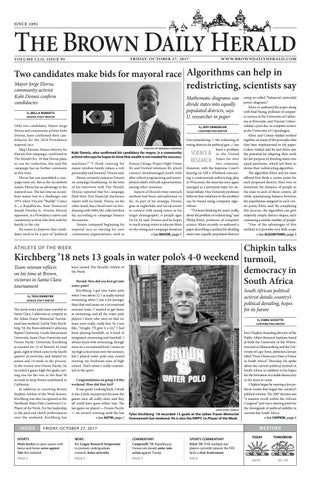
The men’s water polo team traveled to Santa Clara, California to compete in the Julian Fraser Memorial Tournament last weekend. Led by Tyler Kirchberg ’18, the Bears defeated California Baptist University, Loyola Marymount University, Santa Clara University and Fresno Pacific University. Kirchberg accounted for 13 of Brown’s 43 total goals, eight of which came in the fourth quarter of overtime, and totaled six assists and 14 steals in the process. In the victory over Fresno Pacific, he recorded a game-high five goals, netting one for the win in the final 50 seconds to keep Bruno undefeated in California. In addition to receiving Brown Student-Athlete of the Week honors, Kirchberg was also recognized as the Northeast Water Polo Conference CoPlayer of the Week. For his leadership in the pool and clutch performances over the weekend, Kirchberg has
INSIDE
Herald: How did you first get into water polo? Kirchberg: I got into water polo when I was about 12. I actually started swimming when I was a lot younger than that and swam on a recreational summer team. I wanted to get faster at swimming, and all the water polo players I knew who were on that rec team were really, really fast. So I was like, “Alright, I’ll give it a try.” I had been playing baseball, so it kind of integrated swimming and baseball. I always stuck with swimming, though more on a recreational level. I swam on my high school team over the summer, but I played water polo year round starting my freshman year of high school. That’s when I really committed to the sport.
Congratulations on going 4-0 this weekend. How did that feel? It was great! Looking back, I think it was a little unexpected because the games were all really close, and they all could have gone either way. The last game we played — Fresno Pacific — we weren’t winning until the last » See AOTW, page 2
South African political activist details country’s political derailing, hopes for its future By CHRIS SCHUTTE CONTRIBUTING WRITER
ANITA SHEIH / HERALD
Tyler Kirchberg ’18 recorded 13 goals at the Julian Fraser Memorial Tournament last weekend. He is also the NWPC Co-Player of the Week.
Ivor Chipkin, founding director of the Public Affairs Research Institute, based at both the University of the Witwatersrand in Johannesburg and the University of Cape Town, delivered a lecture titled “Does Democracy Have a Future in South Africa” Thursday. He spoke about the current political turmoil in South Africa, in addition to his hopes for the formation of a stable democracy in the years to come. Chipkin began by naming a few political events that began the country’s political erosion. The 2007 election was “a massive revolt within the African Congress” and was a starting point for the downgrade of political stability in current-day South Africa. » See CHIPKIN, page 4
WEATHER
FRIDAY, OC TOBER 27, 2017
SPORTS Men’s hockey to open season with home-and-home series against Yale this weekend
NEWS Ivy League Research Symposium to promote undergraduate research, foster networks
COMMENTARY Campenelli ’18: Republicans, Democrats should unite, take action against Trump
SPORTS COMMENTARY Klein ’20: With multiple star players currently injured, the NFL lacks a clear frontrunner
PAGE 2
PAGE 4
PAGE 7
BACK
TODAY
TOMORROW
60/42
66 / 44
SPORTS
PAGE 2 • FRIDAY, OCTOBER 27, 2017
» AOTW, from page 1 50 seconds of the game. The entire game was exciting. It was a battle. We were down the whole time, and it was pretty much like that for each individual game. Right up until the last buzzer sounded, it was pretty up in the air who would come out as the winner. I think it was really good for our team to go 4-0. It was really exciting and good for us to battle back from a lot of those games that were close, and come out victorious. Your final season of water polo at Brown is coming to a close. Do you have any personal aspirations? As a senior, my personal goals are just to keep contributing as I have but also encourage a lot of the younger guys to step into the roles
THE BROWN DAILY HERALD
I think everyone on the team knows they can fill. It’s a big step going from high school and club water polo up to the collegiate level. … Just helping to make those guys comfortable while they’re playing and giving them the confidence they need to do well while they’re in is definitely something I’m going to try to do toward the end of this season. And just enjoying it while I have my last few games of water polo left.
tournament. When I was a freshman, we ended up winning that, which gave us a berth to the NCAA tournament. The past two years, we’ve been really close. We lost in the championship last year and in the semi-finals the year before, so we’re always hovering around that first, second, third place spot. This year, I think if our team comes together like we did this past weekend, it will be a really exciting tournament.
What are the team’s goals? We have two more weekends of conference games — one this weekend and next weekend. We’d love to go 5-0 with the rest of our conference games and put us in a really good spot for our conference tournament that’s coming up in about a month. The goal is always to win the conference
Looking back, what has been your most memorable moment? There’s definitely a few that come to mind. Winning my freshman year was really incredible. That was a really fun experience and kind of unexpected. We were the underdogs, and it was a really great way to start off my water polo career at Brown.
Overall, just being with each team has been different because the team has had a different personality each year depending on who’s on it. But each year there’s different small things like dinners and bus rides that are really, really fun and fond memories that I look back on. We’ve had team success, but it’s definitely just being with the guys on the team that’s been the most memorable. I’ll miss playing, and it’s fun to compete, but what I’ll probably miss the most is the team camaraderie we have. What has been your favorite class you’ve taken so far? There have been a few. I study biology, so I really liked Genetics. It was a pretty intense class, but I liked it a lot. I also really liked The Digital World just because I have no experience with
CS, and I thought it was an awesome introduction. … Probably my favorite class I’ve taken is called Emergency Medical Systems. I’m pre-med looking to go to medical school after graduation, and this class was taught by two ER physicians who worked down at Rhode Island Hospital. Part of the class involved shadowing at the hospital, so that was a really cool experience. I got to go down there, hang out with an ER physician for about four hours two times during the semester and got to really just be thrown into the craziness of an ER and see it firsthand. That was really cool because that’s a profession that I want to end up doing. The water polo team will be back in action Saturday as they host the Ivy Club Championship and gear up for the NWPC Championship.
M. HOCKEY
Bears to open season with home-and-home series against Yale
COURTESY OF BROWN ATHLETICS
After finishing last in the Eastern College Athletic Conference in the 2016-2017 season, the men’s hockey team will start fresh with eight new players at a home-and-home series against Yale this weekend. The Bears will travel to New Haven to face the Bulldogs Friday before returning to Meehan Auditorium Saturday. Bruno will take the ice at 7 p.m. both nights.
Strong senior leadership, day-to-day approach poise Bears for success this weekend By ALEXANDRA RUSSELL SENIOR STAFF WRITER
For the first time in nearly 250 days, the men’s hockey team will bring a dormant arena to life when it skates out onto home ice this weekend. The Bears will open the season with a home-and-home series against Ivy League rival Yale, traveling to New Haven tonight before hosting the Bulldogs at Meehan Auditorium Saturday. This weekend’s duels follow a month and a half of preparation on and off the ice. The Bears first laced up their skates in early September and have been consistent in training leading up to regular season competition. “The preseason has been positive,” said Head Coach Brendan Whittet ’94. “The guys have been tremendous in
terms of focusing on the process and getting better each and every day.” Bruno seeks to improve on its last place Eastern College Athletic Conference finish in the 2016-17 season with a new host of upperclassmen leadership. The team will benefit from the return of its six top scorers from the 2016-17 season, including Charlie Corcoran ’18, who led the Bears with a team-high 15 goals. Captain Josh McArdle ’18 and assistant captains Tyler Bird ’18 and Sam Lafferty ’18 have worked to set an example and establish good habits among the younger members of the team, Whittet said. “The seniors have been unbelievable,” Whittet said. “What we stressed with the older guys is just having certain standards. As long as they exhibit them each and every day … that
trickles down to the younger guys, and they understand what Brown hockey is about.” “Everyone who’s younger than us can look up to us on any given day, and really look up and see someone that’s exuding the passion and the energy and the love for hockey,” said McArdle, who served as an assistant captain last year. Bruno also welcomes the addition of eight new first-year players, including five forwards, two defensemen and one goaltender. The freshman class has demonstrated talent and industry in the preseason and has integrated quickly with the team, Lafferty said. “From the start, they’ve been part of our family,” said Lafferty, who also donned an assistant captain badge in 2016-17. “Their performance has been very impressive and we’re going to rely on all of the guys this year to produce.” “They bring a lot to the table,
they’re really skilled, they have a lot of experience, and they’ve played in some good leagues coming in here,” Bird said. “It creates a little competition too. ... We’re a little deeper in terms of skill that we haven’t had before, so they certainly add a lot to that.” This newfound depth of talent across lines is a source of optimism for the team, particularly as it seeks to maximize offensive output. “We have very good depth across our entire team, and that’s a huge strength,” Lafferty said. “We have guys that are going to be able to pick each other up and get the job done no matter what.” The Bears are slated to play 29 games in the regular season before playoff competition opens in March. While an ECAC championship crown would prove a satisfying feat, Bruno remains focused on everyday processes of improvement.
“There’s a certain amount of effort, energy and focus that goes into that day-to-day process that will allow you to accomplish goals at the end of the year,” Whittet said. “Our goal is to be a better team when we step off the ice today after practice than when we stepped on. That’s it.” By concentrating on incremental developments in technique, the Bears seek to take the ice with presence and poise. “We don’t want to look too far ahead,” McArdle said. “We’d like to be playing at home in the playoffs, but we’re focused on day-to-day goals — trying to come to the rink every day, have a really good practice, enjoy being there and enjoy being with each other. That’s going to produce really good hockey.” The Bears face off against the Bulldogs Saturday at 7 p.m. at Meehan Auditorium.
NEWS
FRIDAY, OCTOBER 27, 2017 • PAGE 3
THE BROWN DAILY HERALD
» ALGORITHMS, from page 1 for politicians to engineer it,” Klein said. Klein’s vision for the future of political redistricting involves using data and computer models to draw boundaries. He admits, however, that there are various requirements — among them those set forth by the Voting Rights Act — which are difficult to account for in an algorithm. This is an important qualification, according to Moon Duchin, mathematician at Tufts University and orchestrator of the Tufts’ Metric Geometry and Gerrymandering Group. She points out that in addition to the racial and ethnic complexities of the Voting Rights Act, the computational approach in question does not account for laws aimed at preserving county, city and town borders or what locales referred to in the law as “communities of interest.” Such legal requirements make the process of drawing district boundaries much more complicated, said Justin Solomon, assistant professor at MIT and a member of the Metric Geometry and Gerrymandering Group. Solomon points to the example of communities of interest: “This is one of these phrases that, unfortunately, is difficult for mathematicians to work with.” According to Solomon, a “community
COURTESY OF PHILIP KLEIN
of interest” could be anything from a minority group to people who own waterfront property in Florida, making it hard to represent mathematically. “Redistricting is a famous example of what we call an NP-hard problem in the computational world,” Solomon
said, noting that it’s unreasonable to expect software to produce a single, ideal districting plan given the current list of criteria. But he doesn’t discount the idea of using computer models as part of the procedure. “Coming up with a fair redistricting process probably is a
COURTESY OF WIKIMEDIA COMMONS
Mayor Jorge Elorza has confirmed his candidacy for the mayoral election in 2018.
sort of a partnership between humans, machines and mathematical modeling.” While math can generate many possibilities for districting plans, Duchin stressed that the shaping of political districts will always be a human process. The idea that drawing
boundaries could ever be left entirely up to computers is dubious, Duchin said. But there could be value in enumerating possible districting schemes, using models like Klein’s, so that legal qualifications could be examined, she added.
» MAYOR, from page 1
to run. Adrain has thought about what his campaign would look like if he does run for mayor. His platform would focus mainly on entrepreneurship and financial restructuring for Providence, he said. “I think those are the two key things we have to do dramatically better. That would lead to more resources with the schools, neighborhoods and programs for kids. Without fundamental transformation of our economic base, none of that stuff would happen,” Adrain said. While Adrain supports the Elorza administration, he pointed to specific improvements that could be made. “From personal experience and from what I’m hearing from many people, (Elorza has) lost the confidence of too many people and too many groups in the city to be successful,” Adrain said. Other news outlets have predicted State Rep. Raymond Hull, D-Providence and North Providence, State Rep. John Lombardi, D-Pawtucket, and Councilman David Salvatore will join the race. Hull declined to comment on the speculation while Lombardi and Salvatore did not respond to multiple requests for comment.
processes. Dennis, who volunteered in Elorza’s first 2012 campaign, said he would differ from Elorza as mayor both in term of policy and outreach to the community. Dennis pointed to Elorza’s regulations on homelessness, crime and the bridge between law enforcement and the community as policies that he would like to change. Dennis also stressed the importance of community involvement and engagement through community forums and one-on-one conversations. “I just want a better outcome. If that means me losing, I’m okay with that. In no way will I take a deal with anyone. I am going to run until the end,” Dennis said. Lorne Adrain, a businessman and community activist in Providence, has not officially declared his intentions to run for mayor, though local news outlets have speculated that he will. “I am thinking seriously about it. I am thinking about the job, the city and what needs to be done,” Adrain said, adding that he is still unsure whether he would ultimately decide
STAY UP-TO-DATE. FOLLOW US ON FACEBOOK. FACEBOOK.COM/BROWNDAILYHERALD
SCIENCE & RESEARCH PAGE 4 • FRIDAY, OCTOBER 27, 2017
» CHIPKIN, from page 1 “South Africa has been appropriated by political elites. These political elites appropriate the (working class) politics to confront, break and violate the constitution,” Chipkin said. Chipkin continued by describing the radical changes to the economy. There was a push to “create a new black-owned and black-controlled, industrial economy,” Chipkin said. “Around 2010 (and) 2011, (the government) began displacing established white firms from their position in the economy and incentivizing new, large-scale black-owned firms,” he added. “The constitution upholds the principles of fair value and of black economic empowerment,” Chipkin said. Chipkin gave examples of the rampant corruption that he said plagues the political arena in South Africa. For example, the South African Revenue Services was used to “go after noncompliant tax-payers, many of whom were politically connected,” which lead to a “purge in the SARS and new politically-aligned leadership being brought in,” Chipkin said. Numerous politically driven firms and agencies were attacked using similar methods, leading to constant instability and weakening in the country.
“Decision-making (was) shifted away to these informal networks, bound by personal allegiances and away from political organs,” Chipkin added. Chipkin concluded by expressing hope for cultural change and political evolution. “What is needed is for (President Jacob) Zuma and the people around him to be arrested, tried and hopefully convicted. … (This) is going to redeem South Africa,” Chipkin said. “The political conviction that is needed requires a rallying behind democratic politics and reform that can have real benefits for ordinary and working people,” he added. Though South Africa may appear to be collapsing, Chipkin said it can be viewed as progressive, “like a phoenix rising from the ashes.” Among the many in attendance were Patrick Heller, chair and professor of sociology and professor of international and public affairs, who has worked closely with Chipkin in South Africa. “We wanted to shed light on what is occurring in South Africa and brought him, among other activists, for the discussion regarding civil society and human rights in peril,” Heller told The Herald. Harsh Mander, a prominent activist in India who gave a lecture earlier
THE BROWN DAILY HERALD
BENJI TORUNO / HERALD
Ivor Chipkin, director of the Public Affairs Research Institute at the University of the Witwatersrand in Johannesburg and the University of Cape Town, spoke Thursday about the future of democracy in South Africa. in the day, told The Herald he came to the Chipkin’s lecture to “understand the context from different points of the world.” Daniel Smith, chair and professor of anthropology, spoke on bringing
Chipkin to Brown. “We try to take advantage of when there (are) good people on campus,” Smith told The Herald, “There’s a lot of profound changes going on in South Africa, and we want to bring in scholars, activists and thinkers
who are addressing the problems in Africa and at the forefront of change.” The lecture was held at the Joukowsky Forum and was sponsored by the Watson Institute of International and Public Affairs’ Africa Initiative.
Ivy League Undergraduate Research Symposium to meet in November
COURTESY OF WIKIMEDIA COMMONS
Anuj Amin, a student at the University of Pennsylvania, created the symposium after finding it difficult to network with his undergraduate research peers. The symposium will host keynote speakers, career fairs and workshops for all attendees. The conference will take place at Penn Nov. 10 to Nov. 12, bringing together about 200 students.
Inaugural symposium will showcase undergraduate research, give networking opportunities to students By LIYAAN MASKATI STAFF WRITER
The inaugural Ivy League Undergraduate Research Symposium will take place at Penn Nov. 10 to Nov. 12, bringing together roughly 200 undergraduate students from across the eight Ivy League schools. The creation of ILURS was largely the vision of Anuj Amin, executive director of the symposium. “One of the things in my Penn experience that I wasn’t able to do was connect with other majors,” Amin said. He said he found the difficulty he had networking
with scholars at the undergraduate level to be difficult. After speaking with the Director of Undergraduate Research and Fellowship at Penn, Amin was inspired to create a platform that would connect the academics occurring at each of the Ivies, he said. “There are definitely sports circuits and different, other more specific types of conferences” which bring the Ivy League together, Amin said. But he was unaware of a single interdisciplinary platform that connects the schools, he added. With this in mind, “one thing led to another and ILURS was born,” he said. Amin outlined two main goals for the symposium: to promote undergraduate research, giving undergraduates the opportunity to present their work and speak with other researchers, and
to foster networks between scholars from multiple academic backgrounds. “What sets (ILURS) apart (from other research conferences) is that we are not solely focused on the research aspect,” said Pranay Vissa, director of internal affairs for ILURS. “Research is obviously the most important part of the symposium, but we are really keen on trying to build interdisciplinary relationships and networks between people,” he explained. To facilitate both its goals, the symposium will also feature keynote speeches and hold career fairs, crash courses and workshops for the attendees. Twenty-one students from Brown will journey to Penn this November to attend the symposium. Alexander Adia ’18 will be attending the conference and said that he is looking at ILURS as an
opportunity to present his first original research project. “The reason you present research, in general, is to make people think about the questions you are asking and the problem that you are investigating,” Adia said. Through the conference, he hopes to learn how to improve his research presentation in order to make his work salient to other people. Allen Green ’21 will also be a conference attendee and believes ILURS will offer several opportunities for him. “There’s a lot of networking there,” he said. “So I’m pretty excited for that.” Green also expressed that the workshops at the conference would help him prepare for higher level research. ILURS’s efforts to promote undergraduate research will continue even after the conference. Following the symposium,“we will be working
to establish a journal called the ‘Ivy League Undergraduate Journal of Research,’” Amin said. The journal, which will be divided into academic disciplines in accordance with the symposium, will function as “another platform for academic discussion,” he explained. Another post-conference initiative is the establishment of the Ivy League Research Fund. “Financial obligations should not be a hindrance to knowledge,” Amin said. Both Amin and Vissa anticipate that ILURS will become an annual event. “We were actually blown away by the number of abstracts that were submitted,” Vissa said. “We have a lot of support on campus,” he said. “And in terms of organizational strength, we are definitely poised to make this an annual thing.”
TODAY
FRIDAY, OCTOBER 27, 2017 • PAGE 5
THE BROWN DAILY HERALD
menu
leafing midterms behind
SATELLITE DINING ANDREWS COMMONS
Pizza: Bacon Ham and Alfredo, Buffalo Chicken, Harvest JOSIAH’S
BLUE ROOM
Chicken Pot Pie Bowl, Quesadilla Station
Sushi Night
DINING HALLS SHARPE REFECTORY LUNCH
DINNER
Shaved Steak with Mushrooms and Onions, Garden Vegetable Lasagna, Frosted Brownies
Chicken Parmesan, Braised Fennel, Five Cheese Mac and Cheese, Sugar Cookies
VERNEY-WOOLLEY LUNCH
DINNER
Breaded Chicken Fingers, Curried Chickpea and Ginger, Double Chocolate Cookies
Kareem’s Catfish, Asian Style Blend Vegetables, Boston Cream Donuts
sudoku
R
AS
DA
A
S
ACROSS 1 Infect 6 Downs 10 Derisive exclamation 13 Should have said 14 Score in a rare way 17 “I totally had you going!” 18 Drum, say 19 Luxury garb 21 Johnny Friendly portrayer in “On the Waterfront” 22 It hasn’t released a U.S. model since 1987 24 Edible pods 25 Make two cuts in, maybe 27 Literary monogram 28 Said three times, a story shortener 29 Benefit 32 “Head and Shell” artist 35 Former name of the bonobo 39 Nationality suffix 40 Night time 41 Anise-flavored apéritif 42 Some PD officers 43 Low-cost carrier owned by Southwest 46 Inflexibility 49 Irish omen of death 51 Hunks 53 Eponymous astronomer 56 Foreman’s dramatic phrase 58 Place for a crown 59 Common reimbursement requirement 60 Fights 61 Korean War pres. 62 Old draft category 63 Game with a disk operating system? DOWN 1 Rascals 2 Flat formation
c r o s s w o rDd
C
Edited by Rich Norris and Joyce Nichols Lewis 3 Structure damaged in a 1989 earthquake 4 Guy giving you a pointer? 5 Fruit-ripening gas 6 Key for backups? 7 Eniwetok, for one 8 Holding 9 Quench 10 Word in many oaths 11 Lab subject 12 “Scarborough Fair” quartet 15 Home to California’s Torrey Pines Golf Course 16 Some country folk 20 Fluid holder 23 Many a Mormon 25 Use keys 26 Beams 27 Tear 30 Skybox guest 31 Mideast capital once called Philadelphia 32 Fair color? 33 Iran’s Shah Mohammad __ Pahlavi
SIMONE ZHAO / HERALD
34 McJob holder 36 Element no. 39 37 French “these” 38 Student’s purchase 42 Night sound? 44 Nationality suffix 45 Compass points 46 Spread with hands 47 Fan faves
48 Insinuated 49 Under 50 2005 World Series player (his team’s only appearance, and they lost) 52 Smooth out lumps, in a way 54 __ fee 55 While opening 57 Vocalist Sumac
ANSW R
R
O
O S
As the leaves fall and Halloween approaches, students wrap up their midterms and look forward to a spooky weekend. Festivities include a Haunted House in Sayles Hall and a Halloween Extravaganza in the Campus Center.
Q U O T E O F T H E D AY
“I’ll miss playing and it’s fun to compete, but what I’ll probably miss the most is the team camaraderie we have.
”
— Tyler Kirchberg ’18
See AOTW on page 1. calendar FRIDAY OCTOBER MARCH
By Barry C. Silk (c)2013 Tribune Media Services, Inc.
S
M
T
W
Th
F
S
1
2
3
41
52
63
74
85
96
10 7
11 8
12 9
13 10
14 11
15 12
16 13
17 14
18 15
19 16
20 17
21 18
22 19
23 20
24 21
25 22
26 23
27 24
28 25
29 26
30 27
31 28
29
30
31
Flu Clinics 9:00 A.M. The Underground
EEB Brown Bag Seminar 12:00 P.M. Biomed Center, Room 202
SATURDAY JCA Haunted House 6:30 P.M. Sayles Hall
Halloween Extravaganza 7:00 P.M. Campus Center
SUNDAY Catholic Mass 10:30 A.M. Manning Chapel
Gospel Choir Rehearsal 5:00 P.M. Manning Chapel
COMMENTARY PAGE 6 • FRIDAY, OCTOBER 27, 2017
THE BROWN DAILY HERALD
BROWN BITES
Brown Bites: Oct. 23 – 27, 2017 New students on campus In the wake of Hurricane María, the University has offered fall semester enrollment to up to 50 students from the University of Puerto Rico. Accepted students were recommended by UPR, had a GPA of at least 3.0 and filled out the application sent by the admissions office. The University is covering all tuition and fees including housing, a meal plan and transportation. Due to limited space, faculty have offered to host students in their homes. Alums have also offered to host students and finance travel expenses. Regarding academics, the University has asked faculty members to offer “special courses so that students can come and do some intensive, credit-bearing work towards their graduation requirements,” according to Chief of Staff to the Provost Marisa Quinn. The University’s support efforts are encouraging other institutions to follow suit. Deepak Lamba-Nieves, who teaches at UPR, said “I was telling everybody, look, just follow Brown’s lead, I know that they’re organized, I know that they’re leading on this effort.” Farewell Morning Mail After a 14 year run, Morning Mail is no longer the daily reminder that you are part of the Brown community. Instead, the daily digest has been replaced with Today@Brown, created primarily by Vice President for Communications Cass Cliatt and Ravi Pendse P’17, vice president for computing and information services and chief information officer. Today@Brown includes “interactive features, analytics to track usage and performance and a hierarchy of prioritized emails.” Over a year’s worth of research demonstrated several problems with Morning Mail, which overwhelms students with the quantity and delivery of information and created “FOMO, or fear of missing out,” on events and important information, Cliatt said. Today@Brown will include “prioritization,” a feature allowing community members to receive all of their important information in one place. Change in standardized testing requirement The essay and writing portion for the SAT and ACT, respectively, is no longer optional for applying students. According to Dean of Admission Logan Powell, applicants for the class of 2022 must send scores for the SAT with essay or the ACT with writing and are recommended, but not required, to send scores for two SAT subject tests. This change in testing requirements was partly made in response to some applicants not scheduling the subject tests in time for application deadlines. This new policy now aligns with the requirements of Harvard, Princeton, Yale, Stanford and Dartmouth. Some feel that extra testing requirements can exclude students from low-income backgrounds, given that the SAT and ACT are more expensive if taken with the additional writing portions. This concern was not overlooked when making the decision; Powell said that for applicants with financial need, the College Board offers fee waivers. Early-bird special The Engineering Research Center opened Oct. 20, three months ahead of its predicted completion date. Features of this $88 million, 80,000 square-foot building include a nano-technology cleanroom, an advanced imaging suite, a multi-functional commons and open-plan laboratories. The vision was to create a building that would “to be flexible for the research that would be happening inside of this building over the course of its life,” said Michael Guglielmo, director of design and construction. Not only is the building’s design collaborative but so was the construction process. The use of the integrated project delivery method, which allows the University, architect, contractor and subcontractors to collaborate on every step, helped enable the building’s early completion. Blas Lezcano ’18, member of the Engineering Student Advisory Board says, “It’s kind of like a new beginning for the engineering department as a whole. I’m excited to see what is to come.”
Find us online! facebook.com/browndailyherald
browndailyherald.com
@the_herald
Location: 195 Angell St., Providence, R.I. www.browndailyherald.com
@browndailyherald
youtube.com/browndailyherald
Editorial Leadership
Sections
Multimedia & Production
Business
Editor-in-Chief Lauren Aratani
Arts & Culture Editors Ethel Renia Madison Rivlin
Design Editors Christy Leung Ameer Malik Jessica Yu Assistant: Eduard Muñoz-Suñé
General Managers Henry Ritter Ben Wesner
Managing Editors Matt Brownsword Rebecca Ellis Kate Talerico POST- MAGAZINE Editor Saanya Jain BLOGDAILYHERALD Editor Angelica Cotto
Metro Editor Gwen Everett News Editors Isabel Gensler Alex Skidmore Hattie Xu Science & Research Editor Elena Renken Sports Editors Ben Shumate Nicholas Wey COMMENTARY Opinions Editors Connor Cardoso Anuj Krishnamurthy Mili Mitra
Photo Editors Head: Marianna McMurdock Assistant: Lilly Nguyen Gus Reed Sara Runkel Anita Sheih Copy Desk Chief Abby Borges Multimedia Editor Roland High
Directors Sales: Erin Lueck Sales: Matilda Lynton Finance: Reena Zhan Strategy: William Nober Strategy: Caroline Ziegler Managers Sales: Michael Borello Sales: Elizabeth Doykan Sales: Ariel Shusterman Collections: Ravi Betzig
Editorial contact: 401-351-3372 herald@browndailyherald.com
Business contact: 401-351-3260 gm@browndailyherald.com
Submissions: The Brown Daily Herald publishes submissions in the form of op-eds and letters to the editor. Op-eds are typically between 750 and 1000 words, though we will consider submissions between 500 and 1200 words. Letters to the editor should be around 250 words. While letters to the editor respond to an article or column that has appeared in The Herald, op-eds usually prompt new discussions on campus or frame new arguments about current discourse. All submissions to The Herald cannot have been previously published elsewhere (in print or online — including personal blogs and social media), and they must be exclusive to The Herald. Submissions must include no more than two individual authors. If there are more than two original authors, The Herald can acknowledge the authors in a statement at the end of the letter or op-ed, but the byline can only include up to two names. The Herald will not publish submissions authored by groups. The Herald does not publish anonymous submissions. If you feel your circumstances prevent you from submitting an op-ed or letter with your name, please email herald@browndailyherald.com to explain your situation. You can submit op-eds to opinions@browndailyherald.com and letters to letters@browndailyherald.com. When you email your submission, please include (1) your full name, (2) an evening or mobile phone number in case your submission is chosen for publication and (3) any affiliation with Brown University or any institution or organization relevant to the content of your submission. Please send in submissions at least 24 hours in advance of your desired publication date. The Herald only publishes submissions while it is in print. The Herald reserves the right to edit all submissions. If your piece is considered for publication, an editor will contact you to discuss potential changes to your submission. Commentary: The editorial is the majority opinion of the editorial page board of The Brown Daily Herald. The editorial viewpoint does not necessarily reflect the views of The Brown Daily Herald, Inc. Columns, letters and comics reflect the opinions of their authors only. Corrections: The Brown Daily Herald is committed to providing the Brown University community with the most accurate information possible. Corrections may be submitted up to seven calendar days after publication.
Illustrations Editor Pia Mileaf-Patel
Advertising: The Brown Daily Herald, Inc. reserves the right to accept or decline any advertisement at its discretion.
Graphics Editor Laura Felenstein
The Brown Daily Herald, Inc. is a financially independent, nonprofit media organization bringing you The Brown Daily Herald, BlogDailyHerald and Post- Magazine. The Brown Daily Herald has served the Brown University community daily since 1891. It is published Monday through Friday during the academic year, excluding vacations, once during Commencement and once during Orientation by The Brown Daily Herald, Inc. Single copy free for each member of the community. Subscription prices: $200 one year daily, $100 one semester daily.
Directors of Web Development Eli White Ivy Wong
Copyright 2017 by The Brown Daily Herald, Inc. All rights reserved. Periodicals postage paid at Providence, R.I. Postmaster: Please send corrections to P.O. Box 2538, Providence, RI 02906.
COMMENTARY FRIDAY, OCTOBER 27, 2017 • PAGE 7
THE BROWN DAILY HERALD
We need more than just words BRYCE CAMPANELLI staff columnist On Tuesday Senator Jeff Flake from Arizona announced that he would not run for reelection in 2018. His decision comes on the heels of another prominent Republican’s, Bob Corker of Tennessee, who announced the same news last month. Flake, a frequent critic of President Trump, took to the Senate floor to announce his retirement in a speech that can only be described as an utter renunciation of the president, his demeanor and his controversial political stances. In his address, Flake stated that, “It is clear at this moment that a traditional conservative … has a narrower and narrower path to nomination in the Republican Party.” These recent announcements — and the Democrats’ response to them — highlight partisan lawmakers’ inability to present a coherent anti-Trump strategy. But, despite the dysfunction, there is still time for both parties to resist Trump’s dangerous behaviors and for the country to come out on top. As Flake and Corker come out as Trump’s strongest Republican critics, they have also retreated from the struggle over their party’s future. They have surrendered to the idea that a vigorous attack on Trump’s base will actually strengthen his hold on the Republican Party. By failing to run for reelection,
though, they have cleared the way for the nomination of pro-Trump candidates. But if Republicans who oppose what Trump stands for are actually serious about their words, they can’t just fall back on a soapbox campaign without tangible action — they must stand up, run for reelection and, even though they will likely lose in the primary, challenge Trump and give the voters an anti-Trump option. They may not win, but they can stand and fight for their beliefs. The 2018 Congressio-
repudiation of the president that is not easy for a member of the president’s own party to make. With one speech, he ended his own career and took a stand against his own party. But Democratic National Committee Chair Tom Perez ’83 P’18 failed to acknowledge any of Flake’s courage, instead releasing a statement attacking Flake for criticizing the president too late. While other Democratic senators have supported Flake, Perez — the current face of the Democratic Party and head of its po-
detente between Democrats and Republicans. Unfortunately, partisanship prevailed in Washington once again. But it doesn’t have to be this way. Trump can be rebuked and his style of politics defeated at the polls, if Democrats and Republicans dial back the high-minded rhetoric and find concrete, practical areas of common ground. Right now, politicians of both parties have the rare opportunity to engage with one another and unite around shared opposition to Trump’s more dangerous actions and
But if Democrats refuse to be charitable now, how can they expect undecided or centrist voters to support them when it matters? This is the sad state of political polarization that we live in — when politicians see a problem but are too petty to compromise. nal map does not look promising for Democrats, so it is up to senators like Flake and Corker to keep more Trumpsupporting Republicans from heading to D.C. Instead, they have given up and only added words to the conversation, not an actual challenge. The Republicans who have failed to stand up to Trump and those who are bowing out of a fight with him, however, are not the only ones to blame. Democrats haven’t been doing their fair share either. Flake stood on the Senate floor and delivered a powerful
litical strategy — made unhelpful remarks. Perez’s statement falls into the same category of political behavior that Flake specifically called out: placing party over country. In a time like this, Perez has proven that the Democratic Party would rather defend itself than recognize the valor of lawmakers on the other side of the aisle. Perez and Flake are, of course, quite different, with opposing policies and political aims — but Flake’s speech was a climactic moment, which should have resulted in some sort of
policies. For example, Flake, a stringent budget hawk, can work with Democrats to fight any tax plan that will increase the federal deficit. They may not follow the same fiscal philosophy, but they can work together to resist a tax plan that will raise the deficit and hurt average Americans. The same goes for immigration, infrastructure and trade policy — there are areas of overlap between the Democratic and Republican platforms, and it makes no sense to give up prematurely or give into pettiness. This strategic cooperation is how
real change can occur. This will expose the president’s inability to craft good policy and will benefit both Democrats and Republicans — liberals can resist Trump’s agenda, and traditional conservatives can retain control of their party’s platform. This is how we can finally close the curtain on this dark time in American politics. Perez’s statements, however, show that collaboration is not the Democrats’ real goal. They are more interested in scoring political points. A party that has continuously called for Republican lawmakers to challenge Trump now abandons those who do. But if Democrats refuse to be charitable now, how can they expect undecided or centrist voters to support them when it matters? This is the sad state of political polarization that we live in — when politicians see a problem but are too petty to compromise. I am proud of Flake for saying the words he did, but if he is serious about the threat that President Trump poses, now is the time for action, not just rhetoric. And Democrats need to join Flake to actually start to make change, not just repeat the same antiTrump talking points. It’s not easy to take down a leader like Trump, but if principled officeholders really want to make a change, they need to take action and start working together.
Bryce Campanelli ’18 can be reached at bryce_campanelli@brown.edu.
Protecting the First Amendment in the private sector JARED SAMILOW op-ed contributor Every so often, someone gets fired for political statements that their boss dislikes. Depending on whether or not you agreed with these statements, you’ll probably either bemoan the “decline of free speech” or just shrug that “no one is required to listen to speech they don’t like.” Right now, it is true that private companies can fire employees for any reason that is not prohibited by state or federal law. In a famous 2004 incident, Lynne Gobbell was dismissed from her job for putting a John Kerry bumper sticker on her car. This summer, a Google engineer learned the hard way how perilously vulnerable his position was: He was fired for publishing a memo that argued the STEM gender-gap was partially due to biology. The First Amendment is a shield only against government retaliation, and just 7 percent of Americans are employed by state, local or the federal government. The other 93 percent can be canned for pretty much anything other than attributes such as their race, religion or gender. It would be ideal for companies to refrain — out of comity and good citizenship — from firing employees for beliefs that do not substantially impact their jobs. But this is not the era of comity and good citizenship. This is the era of online outrage and hyperpartisanship. And what’s more, no business would voluntarily expose itself to public backlash by tolerating unpopular speech. Legal coercion is needed to address this collective action problem. That’s why Congress and states should prohibit large companies from terminating employees for
political expression unrelated to job performance. Why hasn’t such a right been necessary before? Well for one, it’s never been so easy to broadcast your views far and wide. And it’s never been harder to take them back once you do so. Additionally, companies all have email addresses, Twitter accounts and Facebook pages. In the old days, it took honest labor to gin up a mob: People needed to grab pitchforks and torches and pour out into the public square. Now hordes of Twitter users can just kick back
by everyone; second, public backlash would be milder and abate more quickly if people understood that the employee cannot be fired so easily. Furthermore, there are two absolutely essential qualifiers. First, that the companies be “large,” since it would be problematic to require small firms to keep an employee with whom no one gets along. At a small business, broadcasting political views often will have an impact on the workplace dynamic since everyone interacts with each other daily. This is not
Congress and states should prohibit large companies from terminating employees for political expression unrelated to job performance.
and flood a company with threatening or displeased messages until it caves. The modern dynamic of information transfer makes it easier for a lapse in judgment to carry lasting consequences and incite frenzied backlash. Critics of this proposal would likely retort that it’s unfair to force companies to ignore public pressure and keep an employee — possibly incurring boycotts and lawsuits in the process. Two answers: First, all similarly-sized companies would have to abide by these laws, so the financial harms would be borne equally
the case at a company with hundreds or thousands of employees. The second proviso is that the employee’s expression cannot impact their actual work. Certain forms of political expression can intrude upon job performance. Companies can make a convincing case that racially inflammatory speech damages the work environment and degrades amity among employees. But employers should have to offer some level of tangible and particularized evidence to a judge or jury that this is so. In the case of Lynne Gob-
bell, it’s implausible to argue that her support for Kerry impacted her job performance, and the termination would likely be found wrongful under this system. In the James Damore incident, the tech giant could certainly make a serious case that his job did not permit him to circulate a manifesto to co-workers, and that its content makes it difficult for him to work with women at Google. But Damore could also make a serious case that it was political speech that did not impair his work as a software engineer nor limit his interaction with other employees. Ultimately, it would be up to a court to hear evidence and figure out who’s right. So at bottom, this legislation wouldn’t allow employees to say anything and keep their jobs, but would simply permit courts to review the termination and decide if it was wrongful. There’s an important deterrent factor at work, too. If employers knew that their workers could successfully litigate such a dispute, they would be hesitant in the first place to fire someone unless their statements had made it absolutely untenable to continue working together. Overall, relatively few people have actually been fired simply for their political beliefs, which might make this discussion seem irrelevant or abstract. But that only means that most people either have indifferent or tolerant employers, or else are careful to keep their views private. Whatever detriments there are to this proposal — and there are many in addition to the ones I’ve pointed out — they are outweighed by the compelling public interest in promoting people’s ability to speak freely and avoid self-censorship.
Jared Samilow ’19 can be reached at jared_samilow@brown.edu.
SPORTS THE BROWN DAILY HERALD
FRIDAY, OCTOBER 27, 2017
How to fix the problem with college sports CHARLIE BLASBERG sports columnist Jayson Tatum was born in St. Louis, Missouri in March of 1998. He attended high school at Chaminade College Preperatory School in Creve Coeur, Missouri, where he excelled on the varsity basketball team. A highly touted recruit, he went on to play college basketball at Duke University, one of the most prestigious colleges in the nation. After just one year at Duke, Jayson declared for the NBA draft and was selected third overall by the Boston Celtics. Last Wednesday he played before a sellout crowd in Cleveland on national television. Jayson’s young life and basketball career beg the question: was his year at Duke necessary? The NBA and the NFL force their future athletes to masquerade as students before entering the draft. In a 2005 collective bargaining agreement, the NBA limited entrance into the league to players over 19 or those who
have finished their freshman year of college. To enter the NFL draft, players must be at least three years out of high school. As a result, many of our nation’s best basketball and football players treat college as nothing more than a mandatory stop before they can punch their ticket to the
The nation’s elite athletes should not be developing their skills in college. The United States needs a more robust framework of semi-professional sports leagues for young athletes who intend on entering the NBA or NFL to develop and showcase their skills.
distorts the mission and purpose of these schools. The goal is no longer to educate. It is to entertain. Semi-professional development leagues would give athletes the chance to focus on their craft and showcase their abilities with more freedom without worrying about staying eli-
The goal is no longer to educate. It is to entertain.
pros. Top college teams serve both as a training ground and a showcase for young athletes, but not as educational institutions. Members of elite college basketball and college football teams are essentially full-time athletes, who have neither the opportunity nor incentive to reach their full academic potential.
Do I want to abolish college sports? No. Athletics contribute enormously to school spirit and pride. By teaching physical fitness, discipline and teamwork, competitive athletics complement academic course work to provide a well-rounded education. The way many college sports in America are played now, though,
gible for NCAA competition. They also would not have to hide behind the veil of amateurism that the NCAA has set forth. They could receive a fair market wage for their labor, which college athletes do not. Baseball and hockey already have unaffiliated minor leagues that serve as intermediate steps for players leav-
ing high school seeking the chance to play at the next level. These leagues range from amateur to professional all around the country. As a result, the college experience for student athletes in these sports is much more legitimate because the players in college have made the choice to be there. In the famous words of former Ohio State quarterback, Cardale Jones, “We come here to play football, we ain’t come here to play school.” Why make the most promising young athletes “play school” past high school? The country’s top basketball and football players should not be forced to go to college. Rather, they should be able to enter a development league where they can get paid and showcase their skills to the major professional leagues. College athletics and intercollegiate games would still exist, but top prospects would not be forced to attend for just one year when they have no intention of earning a degree.
Charlie Blasberg ’18 can be reached at charles_blasberg@brown.edu
Finding a favorite in the mediocre NFL GEORGE KLEIN sports columnist
This NFL season has been filled with chaos. Injuries have hindered a number of contending teams — Aaron Rodgers, J.J. Watt, Odell Beckham Jr., Julian Edelman, Eric Berry, David Johnson, Carson Palmer, Dalvin Cook and Sam Bradford all went down with lengthy or season-ending setbacks. These injures have left a few absolutely terrible teams, a few pretty good teams and a giant glut of middle-tier teams battling one another for the honor of a quick wildcard weekend exit from the playoffs. In a year of such parity, it has been difficult for teams to separate themselves from that middle pack. The injury bug seems to hit every time a squad takes steps to reach championship contender status. With that being said, there are a few teams that appear ready for lengthy playoff runs — but is there one single “best” team in the league? The Los Angeles Rams (5-2) have been possibly the NFL’s biggest surprise so far. After years of sub-.500 finishes, including last season’s disastrous 4-12 mark, and a move from St.Louis, expectations had never been lower coming into 2017. Yet Jared Goff has emerged as a solid, if not spectacular, NFL quarterback, with nine passing touchdowns to only four interceptions through seven games. Those numbers represent significant strides from his struggle-filled rookie year, when some eager critics declared him a bust. Running back Todd Gurley, meanwhile,
has been one of the best offensive players in the league. He is on pace for 1,433 rushing yards, 11 rushing touchdowns, 670 receiving yards and seven receiving touchdowns. For the first time in quite a while, the Rams’ offense must be respected. But even with all the excitement surrounding the Rams, there are still a few weaknesses that could doom this team. The receiving core continues to
another surprising team. They currently hold the NFL’s best record (6-1), and are showing no signs of slowing down. Quarterback Carson Wentz, also in the second season of his career, is an MVP candidate — he is on pace for 4,223 passing yards, 39 touchdowns and only nine interceptions. Last week’s contest against the Washington Redskins, in which he threw for four touchdowns on 268
night’s game with serious injuries. The loss of Peters is an especially tough blow for the Eagles — the nine-time Pro Bowler was a defensive mainstay and leader. Philadelphia will have to survive the injury bug (with Darren Sproles already on injured reserve) to hold their present position in the NFC. Moving over to the AFC, the Kansas City Chiefs (5-2) were NFL dar-
In a year of such parity, it has been difficult for teams to separate themselves from that middle pack.
be a problem. Sammy Watkins has under-performed and Robert Woods falls far short of being a legitimate number one wideout. Goff, while providing effective game management, still has not proven that he can take over games and be a star. The defense is fantastic and improving — they shut out the Arizona Cardinals last week — but the offense could start to stagnate. The Philadelphia Eagles are
yards and rushed for another 63, may have been his finest performance yet. LeGarrette Blount has been terrific so far, bulldozing defenders for a 5.0 yards per carry average, and tight end Zach Ertz is a breakout performer. But the Eagles have similar issues as the Rams. For how long can they continue to exceed expectations? Left tackle Jason Peters and middle linebacker Jordan Hicks are both out for the season after leaving Monday
lings over the first couple of weeks, but have fallen back to earth since then. Rookie running back Kareem Hunt has already established himself as one of the league’s foremost talents. Through only seven games, he has already rushed for 717 yards on a brilliant 5.8 yards per carry average. Quarterback Alex Smith is on track for the best season of his career, with a sparkling 15 touchdowns and zero (that’s right, zero) interceptions. He
is another MVP candidate. At some point, though, the magic has to wear off for Smith. It would be an unprecedented achievement for a 33-year-old quarterback to have his best season by a wide margin in his 13th year. Kansas City lost to the Pittsburgh Steelers and Oakland Raiders in their past two games. They need to defeat the Denver Broncos next Monday night before we anoint them as the best of the AFC. It is no surprise, on the other hand, to see the New England Patriots (5-2) back around the top. After a few weeks of widespread panic about New England’s defense, Pats fans watched Sunday night’s demolition of the Atlanta Falcons with glee. The Falcons scored only one touchdown, which came late in the fourth quarter of the blowout. The Patriots suddenly look like themselves again. Tom Brady has been his usual self all along, throwing for 15 touchdowns and two interceptions. Wide receiver Brandin Cooks and tight end Rob Gronkowski have been as solid as expected. If Gronkowski can escape the regular season without injury, which is no small feat for him, the Patriots will enter the playoffs with a loaded offense. If the defensive improvement holds up and the injury bug does not hit Brady like it did Aaron Rodgers and Carson Palmer, we have our Super Bowl favorites in Foxborough. The path in the AFC is clear. As much as it hurts to say it, New England is well on track to yet another championship.
George Klein ’20 can be reached at george_klein@brown.edu.