SINCE 1891
THE BROWN DAILY HERALD FRIDAY, NOVEMBER 3, 2017
VOLUME CLII, ISSUE 100
WWW.BROWNDAILYHERALD.COM
Community-Police act criticized as implementation nears WBRU signal transferred to Christian nonprofit Christian contemporary nonprofit Educational Media Foundation now holds license to 95.5 FM By KYLE BOROWSKI SENIOR REPORTER
GWEN EVERETT / HERALD
The Providence Community-Police Relations Act is one of the most comprehensive pieces of legislation regulating police-community relations in the country. Implementation is set to begin Jan. 1 and falls largely under the purview of the Providence External Review Authority.
Concerns arise about future implementation, evaluation of Community-Police Relations Act By LIORA MORHAYIM SENIOR STAFF WRITER
When the Providence Community-Police Relations Act — formerly named the Community Safety Act — passed June 1 with a 13-1 vote in the Providence City Council, supporters celebrated — one of the most comprehensive pieces of legislation regulating police-community relations in the country had been signed into law. Five months later, as the act
approaches its implementation Jan. 1, questions remain regarding how that process will go. The idea to implement a set of laws regulating police-community conduct first began in 2014, but the path from inception to passage was riddled with controversy. The ordinance went through a series of revisions and drafts before passage this June. The final version included a provision banning racial, genderbased, religious or sexual-orientation
based profiling; a section that provided residents with a way to challenge being named on the city’s “gang database;” and a standard of conduct for police officers conducting traffic or pedestrian stops, Rhode Island Public Radio reported. The ordinance passed with a sweeping majority. While a host of people showed support during the legislative process by participating in marches and rallies, many are “not sticking around” for the implementation phase, said Vanessa Flores-Maldonado, the main organizer behind the Community Police Relations Act. She raised concerns over the
negative attitude of the Fraternal Order of Police, the city’s police union, toward the act and questioned the effectiveness of Providence External Review Authority. PERA is a regulatory body, established with a broad mission to “investigate allegations of misconduct” within the city’s police department, according to the city’s main website. As of Jan. 1, this will include violations related to the CPRA. PERA changes staffing every few years and it will be staffed with the new members in 2018, according to Mary Kay Harris, Providence City » See POLICE, page 2
Transfer of WBRU’s FM radio signal has been completed, according to station spokesperson Art Norwalk. The Christian contemporary non profit Educational Media Foundation now holds the license of 95.5 FM after having leased it from Brown Broadcasting, Inc. for some months. Thursday’s announcement marks an end to months of intense debate over the station’s future among both current and former WBRU staffers, as well as among board members of the Brown Broadcasting, Inc, which previously held the station’s license. The transfer comes only a week after President Christina Paxson P’19 emailed station staff urging them to consider a deal that would see the signal sold to Rhode Island Public Radio instead. That proposal was formulated at least in part by station alum Bill Lichtenstein ’78, who garnered the support of Torey Malatia, president, chief executive officer and » See WBRU, page 3
ATHLETE OF THE WEEK City Council hopes to Nieto ’20 saves 44 in season-opening win increase recycling efforts Starting goaltender’s
Providence’s 9-percent recycling rate well under Rhode Island’s 35-percent metric By LIORA MORHAYIM SENIOR STAFF WRITER
At Thursday’s Providence City Council meeting, which lasted for less than 15 minutes, the city passed resolutions to increase efforts to educate the city on recycling and to assign a crossing guard at Bradley School Providence on Broadway. Councilman David Salvatore’s resolution, which was co-sponsored by the entire council states that Providence’s recycling rate between the months of November 2016 and January 2017 was just under 9 percent. This is despite the fact Rhode Island aims to recycle
INSIDE
at least 35 percent of the solid waste generated by the state, The resolution also states that since new residents who speak different languages come to Providence annually, there should be consistent recycling education efforts that are accessible to all city residents at various points throughout the year. A resolution to authorize the city to obtain not more than $2,010,000 from the Rhode Island Health and Educational Building Corporation and to finance improvements to school facilities in the city was referred to the Committee on Finance. An ordinance amending Chapter 14, “Licenses,” of Providence’s Code of Ordinances by adding “predictable and progressive discipline for repeated violations” and a petition from attorney John Garrahy requesting to change the zoning district for the » See CITY COUNCIL, page 3
performance powers Bears to first victory over Yale since 2014 By ALEXANDRA RUSSELL SENIOR STAFF WRITER
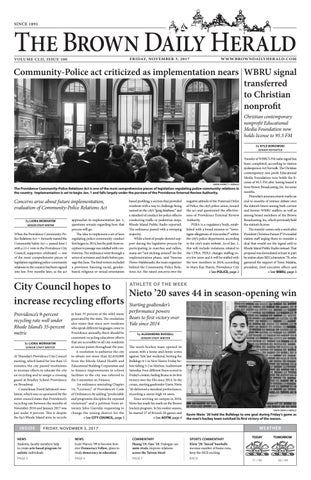
The men’s hockey team opened its season with a home-and-home series against Yale last weekend, besting the Bulldogs 4-1 in New Haven Friday before falling 5-2 at Meehan Auditorium Saturday. Four different Bears scored in Friday’s contest, fueling Bruno to its first victory over the Elis since 2014. In the crease, starting goaltender Gavin Nieto ’20 delivered a standout performance, recording a career-high 44 saves. Since arriving on campus in 2016, Nieto has made his mark on the Brown hockey program. In his rookie season, he started 27 of Bruno’s 28 games and » See AOTW, page 4
ANITA SHEIH / HERALD
Gavin Nieto ’20 held the Bulldogs to one goal during Friday’s game as the men’s hockey team notched its first victory of the season.
WEATHER
FRIDAY, NOVEMBER 3, 2017
NEWS Students, faculty members help to create arts-based program for autistic individuals
NEWS Scott Warren ’09 to become firstever Democracy Fellow, plans to study democracy in education
COMMENTARY Huang ’19, Guo ’18: Dialogue can unite rivals, improve relations across the Taiwan Strait
SPORTS COMMENTARY Klein ’20: ‘Juiced’ baseballs increase number of home runs, keep the MLB exciting
PAGE 3
PAGE 4
PAGE 7
BACK
TODAY
TOMORROW
71 / 40
56 / 44
NEWS
PAGE 2 • FRIDAY, NOVEMBER 3, 2017
» POLICE, from page 1 Councilwoman. “The City Council will choose 8 community members, from 8 different city wards, to serve on (PERA). The Mayor will choose one,” wrote Harris in an email to The Herald. Harris was on the inaugural PERA committee when it was first established in 2002. Flores-Maldonado said the resistance from the Fraternal Order of Police makes the act difficult to implement. In an interview with WPRI published two weeks ago, the police union’s new president Michael Imondi said he doesn’t think an ordinance that makes major changes to how officers do their jobs is necessary. He has been against PCPRA “since day one,” and the majority of his members share his sentiments, but the Fraternal Order of Police is not sure whether they can repeal CPRA before Jan. 1, he told WPRI. “In a perfect world, I’d like to see it repealed or taken back,” he said to WPRI. The Fraternal Order of Police did not respond to multiple requests for comment from The Herald. Steven Brown, the director of the Rhode Island chapter of the American Civil Liberties Union shares Maldonado’s concern over the Fraternal Order of Police’s attitude but thinks it is unlikely the city council will make
any major changes at the last minute. “Too many people would be extremely upset to see that happen, I don’t think they want to go in that road,” he added. Having a police chief who is vigilant and ready to take action against the officers who violate the ordinance will be crucial in the implementation process, Brown said. Lindsay Lague, a spokesperson for the Providence Police Department, said the police department is currently working diligently to ensure its policies are updated in accordance to CPRA by Jan. 1 and that training and resources are in place to ensure successful compliance. “The department worked with the community as part of a working group that helped create and review the ordinance and we are confident our department will adapt swiftly to any changes to current policies,” she added. PERA will be tasked with reviewing certain police policies to make sure they align with CPRA once it goes into effect. The regulatory body is another source of concern for Maldonado. PERA has a lot of power in the implementation process, and it will be important to ensure the board is properly staffed by unbiased members, she said. Since community members do not have a say on who gets elected to PERA, Maldonado worried the board might overrepresent police interests
THE BROWN DAILY HERALD and underrepresent community ones. But Harris says there is representation on the board because it is comprised of community members from across the city. She added that “the board can and will be neutral. Members will have to have certain skills, they will have to be committed and there will be required training to ensure the neutrality of the group.” Concern about PERA’s role in CPRA implementation stems partly from its history in the city according to Brown. “PERA mainly has been toothless in the past in terms of being really able to take any action against officers who may have violated earlier ordinances or engaged in other types of police misconduct,” Brown said. Other means of enforcing the ordinance could carry a lot of importance in successful implementation, he said. These means include supervisory police officers willing to take action within the department or community members who decide to bring lawsuits under the ordinance. In the past, “PERA was underfunded and unable to really do the work that is was intended to do,” Harris wrote. But going forward, the “City Council did not invest in this program to fail. We are committed to making this work and work well for all community members.” Outside of potential implementation challenges, Brown also expressed
DAPHNE ZHAO / HERALD
concern over the removal of a provision in an earlier version of the act that would have allowed successful plaintiffs to recover their attorney’s fees. As a matter of civil liberty, anyone who feels their rights have been violated has the prerogative to bring their complaints to court and seek legal remedy, but the cost of representation may deter people whose rights were wrongfully violated from taking legal action, he said.
But overall, the ordinance is successful in covering many different grounds — from defining the standard of conduct for police in pedestrian and traffic stops, to enumerating the rights of immigrants in the city, Brown said. “The ordinance is really pretty clear on what is allowed and what is not allowed. It is not a question of how do we enforce this provision, it is whether it actually gets enforced or not,” Brown said.
U. members help build autism therapy program Interdisciplinary course will run for 12 weeks in February contingent on sufficient funding By ANNABELLE WOODWARD CONTRIBUTING WRITER
This winter, students and faculty are collaborating with the Rhode Island Philharmonic Orchestra and Music School and the Los Angeles-based Miracle Project in hopes of launching a program that offers arts education and therapy
for individuals with autism in Rhode Island and Massachusetts. So long as it receives sufficient funding, the program will start this February and run for 12 weeks, serving students aged seven to young adults on all ranges of the autistic spectrum. The program is a continuation of Miracle Project New England, a “tremendously successful”
collaborative piloted in Providence this past summer that used “music, dance and theater to bring out the often unheard voices of those on the spectrum,” according to Miracle Project founder Elaine Hall. After receiving a grant from Bailey’s Team for Autism and an endowed grant from the Daniel Jordan Fiddle Foundation, University faculty members partnered with community organizers to create a week-long expressive arts camp with programming inspired by
the Miracle Project’s “Inclusion from Within” methodology. Unlike traditional autism therapy techniques, which try to “fix” people, Hall said the Miracle Project’s approach focuses on building self-esteem and fostering understanding, allowing neurotypical individuals to participate alongside their autistic peers to “grow in compassion and insight (toward) people who learn and experience the world differently.” “It’s very much focused on individual expression and honoring each child,
Flying
Words Saturday, 4 November 2017 at 7:30 pm Martinos Auditorium Granoff Center, 154 Angell St. Flying Words is at once imaginative, experimental, and intense. Deaf American Sign Language poet Peter Cook presents three dimensional imagery while Kenny Lerner’s spoken words allow the hearing in the audience to literally see the ASL image and become lost in the movement. Sponsored by Literary Arts with support from the Brown Arts Initiative.
young adult or aging adult for who they are and what they contribute. So much of their lives are about how they don’t measure up, how they don’t fit in, and this is a place that celebrates their uniqueness,” said Profesor of Theater Arts and Performance Studies Rachel Balaban. The upcoming project grew out of Julie Strandberg and Rachel Balaban’s “Artists and Scientists as Partners” course, which explores the impact of art on people with neurological disorders, specifically autism and Parkinson’s disease. The course is interdisciplinary, fusing theater arts, neuroscience, public health, biology and anthropology. It allows students to become “ethnographers and participant observers,” so as to better understand neurologically affected populations, Balaban said. Hall has been a guest lecturer to Strandberg and Balaban’s class for the past five years, and it was through their conversations that the idea for the Miracle Project New England program emerged. The winter program’s inception will depend on whether or not the partners receive a grant from the National Endowment for the Arts, Balaban said. “The idea is we’d do this (program) over a long period of time and develop methods to see how theater training and the expressive arts support these social skills and build confidence and reduce stress within children and young people on the spectrum. … We’re still piloting this, so it’s a little bit unknown,” Balaban said. Steven Sheinkopf, associate professor of psychiatry and human behavior, said this project will be “a wonderful opportunity for undergraduates to participate in a clinical research venture.” If they receive the necessary funding, the team will be able to form “a rather unique collaboration between the clinical research side at the hospitals and the folks like Balaban on the performance arts side,” he added.
NEWS
FRIDAY, NOVEMBER 3, 2017 • PAGE 3
THE BROWN DAILY HERALD
Warren ’09 named Swearer Center’s first democracy fellow CEO of Generation Citizen will explore role of democracy in education at Swearer Center By CORAL MURPHY CONTRIBUTING WRITER
The Swearer Center designated Scott Warren ’09 its first-ever Democracy Fellow, a position that will allow him to explore the terrain of democracy in higher education. Warren is best known for being the CEO of Generation Citizen, a non-profit that focuses on bringing the topic of civics into the classroom in an action-oriented way, he said. Along with Anna Ninan ’09, the duo expanded the Providence project to six other cities. “I’m really interested in how Brown can engage students to be more participant in our democracy, … especially when a lot of young people are questioning whether democracy can work,” Warren said. With his new role at Swearer, Warren plans to bring practitioners and scholars to campus to discuss the role of education and democracy. Last year, Warren was selected to be a Social Entrepreneur in Residence at Swearer, and toward the end of the spring, he expressed an interest in extending his time there.
If funding is available, Swearer asks their entrepreneurs-in-residence near the end of their appointment if they would like to continue their work at the center, Wright said. As a fellow, Warren will “continue to be available for student office hours, he’ll remain engaged with faculty and community members around the topic of democracy and he’ll facilitate activities and conversations regarding the topic,” said Emily Wright, assistant director of communications and public engagement at Swearer. This role of fellow is important because there needs to be more academic study on the subject of democracy and how it may or may not work in some places, said Senior Fellow at the Watson Institute for International and Public Affairs Richard Boucher.“We’ve always had this idea that democracies work better with an educated public, and that somehow people who are more able to understand the circumstances of a country, who are able to understand the ins and outs of policy and economics, make better decisions,” Boucher said. Boucher also explained that higher education generally contributes to strengthening democracy, not only by training people who may participate in governance, but by training teachers and others who are going to support the mass education of the country.
JASMINE RUIZ / HERALD
Scott Warren ‘09, CEO of Generation Citizen, is the Swearer Center’s first Democracy Fellow. Last year, Warren was a Social Entrepreneur in Residence at The Swearer Center for Public Service.
»WBRU, from page 1 general manager of RIPR, while pushing it as an alternate option. Norwalk confirmed that money from the $5.63 million deal has changed hands, giving student staffers access to funding for new initiatives and programming formulated for the station’s new online format. Station General Manager Kishanee Haththotuwegama ’19 made note of these developments in Thursday’s release. “We’d like to take this opportunity to remind the community that WBRU continues on the internet at WBRU.com,” Haththotuwegama wrote. “We invite everyone who enjoyed WBRU on the radio to join us online for 24/7 streams of both our alt-rock and 360 Degree Experience in Sound programs, plus pilots of our expanded news and podcasting activities.”
LIORA MORHAYIM / HERALD
Providence City Council’s short meeting was highlighted by the council’s decision to plan to increase recycling education. Though Rhode Island has established a 35-percent recycling rate goal, the city has only managed to reach a 9-percent recycling rate.
» CITY COUNCIL, from page 1 property located at 37 South Angell
St. was referred to the Committee on Ordinances. An ordinance establishing a tax
exemption and a stabilization plan for the Aspen Group was passed for the first time while the ordinance for
approving and adopting the Special Redevelopment Plan for Vacant Houses passed for the second time.
NEWS
PAGE 4 • FRIDAY, NOVEMBER 3, 2017
» AOTW, from page 1 posted over 30 saves in nine contests. Nieto also notched 42 saves against Quinnipiac University in the first round of the ECAC tournament in March 2017. For his outstanding play in the season opener, Nieto has been named The Herald’s Athlete of the Week. Herald: You delivered an impressive performance against Yale. What was that game like for you? Nieto: It was definitely a fun one. It was nice to get the season off on a good foot. We came out really well — we put the pressure on them early, and they were kind of on our heels. They had a lot of shots, but as a team we played really well, especially in our own zone, so it was overall just a great game. It was fun to start the year out with a win. What were your expectations going into this season? We have a very good team. Last year obviously didn’t go as we wanted it to, but our freshman class is very strong and guys really put the work in this summer to come back a better team, so
we have a lot of confidence in ourselves. We can really come in and have a good year and Friday was a good start, beating a rival in Yale. We got the split on the weekend, but it was a big first step.
ey?
When did you start playing hock-
I started skating when I was three. My dad fell in love with hockey when Wayne Gretzky came to the Los Angeles Kings. So when I was born, he threw me into hockey the first opportunity he could. I played my first hockey games around four, so I’ve been playing for a while. I decided to switch over to goalie when I was around 11. What made you choose to be a goalie? It’s a really funny story. I was actually a defenseman, and I was always kind of a chubby kid. Our goalie could not make a tournament or got hurt or something, so they needed a goalie and I was the biggest kid on the team, so they threw me in net. (laughs) At the time I was just like “okay,” and I fell in love with it. I loved that you were on the ice the entire game; I loved that the action was always coming towards you.
THE BROWN DAILY HERALD Do you have a favorite NHL team and a goalie that you like to model your style after? I am a die-hard Anaheim Ducks fan. My family’s had season tickets since their inaugural season in ’93 so I’ve been going to games — my first game was when I was like two months old. I go to as many games as I can when I’m home. My favorite goalie is Braden Holtby, he’s a great competitor and his mental game is so strong, so I really like watching him. And then along with him, Carey Price is really fun to watch just because he’s so technically sound. He’s by far the best goalie in the league. Did you play any other sports growing up? I played baseball until I got to high school, and then once I got to high school I actually played lacrosse until junior year when I moved away to go to prep school for hockey. Growing up, I was always a two or three sport athlete, but hockey was always the sport that really had my heart and was what I would train for in the offseason. Do you have any pregame routines or things that you do to get in
the zone? After we stretch as a team, I’ll usually go off by myself and either put a hat over my head or find a dark room and just kind of sit there and visualize and kind of picture myself playing well. I’m very big into the whole visualization — whatever you think will happen will happen, I’m very big into that. After we warm up, I usually go and do a lot of mental focusing and visualization, just to kind of get myself ready to go. It really helps me calm down too, because a lot of times I get really amped up and I try to play a really calm game. Do you like to listen to music when you work out? What do you like to listen to? I’m big into pregame music. Right now, my pregame mix is kind of all over the place. Probably my go to is the Hailee Steinfeld song with Florida Georgia Line — that one’s on repeat right now. Has there been a most memorable experience in your Brown career so far? Friday was pretty memorable. It was really fun to beat Yale on their home
ice and do it the way we did it, but the one that sticks out for me is last year, in my freshman year — my first start at Holy Cross, putting a Brown jersey on for the first time and walking out there was pretty special. I get goosebumps thinking about it because it was kind of a lifelong dream finally fulfilled. The team has just started its 201718 campaign. What are your individual aims for the season? Individually, I’m trying to really take the next step and be an elite goalie in this league. I want to be above a .900 save percentage and really push to be one of the elite goalies in this league, and really my goal is (for the team) to be above .500 and have a good shot at having home ice advantage in playoffs. If I can do that, we have a good shot at winning a lot of games and having a really good year. The Bears continue conference play with visits to Dartmouth and Harvard this weekend before returning home to host Clarkson Nov. 10. This interview was edited for length and clarity.
Britto MSc’96 to oversee U. health and wellness beginning January 2018 Former Wellesley College medical director hopes to integrate four offices of health and wellness By JACOB LOCKWOOD CONTRIBUTING WRITER
Vanessa Britto MSc ’96 will start as assistant vice president and executive director of health and wellness Jan. 16, 2018, wrote Vice President for Campus Life and Student Services Eric Estes in a community-wide email Oct. 12. Britto, who studied community health while at the University and completed a general medical fellowship at Rhode Island Hospital, will return to oversee Health Services, Counseling and Psychological Services, Emergency Medical Services and BWell Health Promotion. “I’m thrilled and honored” to be returning to the University, Britto said. “I couldn’t ask for a better opportunity to contribute back to my alma mater.” Britto will inherit an organizational structure built by her predecessor,
Unab Khan, who left the executive director position last June, said Lynn Dupont, the associate director of health services. Will Meek, the director of CAPS, explained that Khan brought together the four offices involved in student health — Health Services, CAPS, EMS and BWell Health Promotion — under the umbrella of a single executive director who answers to the vice president for campus life. He said the new structure, called health and wellness, “allows one person to focus all their energy on the oversight of a cluster of offices,” which in turn allows the executive director to communicate the needs of these offices to Estes “with a singular voice.” Britto said she intends to further integrate the four offices of health and wellness to expand upon the work Khan did. She described her vision for health and wellness in terms of a three-pillared “center of excellence for student health and wellbeing,” which would improve clinical service, infuse health professionals into medical curricula and aggregate data on the health of the student body to explore clinical questions. She also emphasized the importance of building on existing strengths and shared goals between the four offices of health and wellness. Dupont said she hopes Britto will “continue the work that was done by our previous director.” This would entail “a lot of campus
outreach, advocating for health and wellness for students, evaluating what the needs are and helping to improve the care we all provide.” A search committee made up of students, staff and faculty engaged in a national search to form a “diverse pool of candidates” for the executive director position, Estes said, adding that Britto was selected from “a really strong finalist pool.” Estes described Britto’s hire as “an enthusiastic choice of the search committee and of the faculty, staff and students who had an opportunity to meet with her during her on-campus interview.” Dupont and Meek were both involved in the interview process for the executive director position. Meek said Britto spoke with “professionalism, candor, humility and composure” during her interview, setting her apart from other candidates. He also praised Britto for her exceptional leadership qualities and clear vision for the future of health and wellness. “I could not be more excited” about Britto’s hire, he added. Dupont echoed Meek’s admiration for Britto. “We’re very excited to have her be joining us. … She is a really wonderful, kind person, and she’s very passionate about working with students,” Dupont said. She added that “we’re all looking forward to working with her.” Before accepting her new position, Britto worked as the medical director of health services at Wellesley College starting in 2001. Her past experience
COURTESY OF BRIAN CLARK
Vanessa Britto MSc’96 was chosen for her exceptional leadership qualities and clear vision, said director of CAPS Will Meek. allows her to bring “extensive experience in college and university health services” to her new role, Estes said. “She has professional networks and relationships that will be very valuable in addition to her years of experience,” he added. Dupont agreed that health and wellness at the University will benefit greatly from “the connections and the colleagues that (Britto) has within the college health community.” Since 2004, Britto has been deeply involved in the American College Health Association and its regional affiliate, the New England College
Health Association. “The power of this organization is in its networking opportunities,” Britto said, adding that both the ACHA and the NECHA hold annual conventions where college health professionals meet to “share best practices, understand how we can collaborate, learn from each other and explore ideas with people you might not have an opportunity to otherwise.” The NECHA awarded Britto the President’s Award in 2016 to honor her “significant impact” on college health both at Wellesley and at the regional and national level, according to its website.
TODAY
FRIDAY, NOVEMBER 3, 2017 • PAGE 5
THE BROWN DAILY HERALD
menu
downtown vie ws
SATELLITE DINING ANDREWS COMMONS
Pizza: Harvest, Pepperoni, Buffalo Chicken, Bacon Alfredo, Cheese JOSIAH’S
BLUE ROOM
Chicken Pot Pie Bowl, Thanksgiving Turkey Burger
Soup: New England Clam Chowder, Chicken Tortilla
DINING HALLS SHARPE REFECTORY LUNCH
DINNER
Zuchini, Carrot and Garlic Medley, Southwestern Grain Bowl, Ranger Joe Cookies
Southwest Turkey Chili, Rosemary Focaccia with Asiago Cheese, Cream Cheese Brownies
VERNEY-WOOLLEY LUNCH
DINNER
Spicy Pepper Pulled Chicken, Three Bean Casserole, Chocolate Frosted Eclairs
Japanese Noodle Soup, Chicken Helene, Ravioli with Pink Vodka Sauce, Banana Cream Pie
sudoku
RELEASE DATE– Monday, November 19, 2012
Los Angeles Times Daily Crossword Puzzle c rNorris o s sandwJoyce o rNichols d Lewis Edited by Rich
ACROSS 1 Part of PGA: Abbr. 5 Desert tableland 9 Character weakness 13 Chase away, as a fly 14 Plot surprise 16 “Queen of Country” McEntire 17 A psychic may read yours 18 Yemen’s capital 19 With 8-Down, really simple 20 One who can talk you to sleep 23 Pellet shooter 24 AFL partner 25 Madrid Mrs. 28 Tabula __: blank slate 31 “That’s enough out of you!” 33 Audible sign of hunger 38 Cruising on the briny 39 Org. offering motel discounts 40 Chat room “Here’s what I think ...” 41 Flappers’ decade 46 Present from birth 47 Salinger title teenager 48 Court divider 49 “Criminal Minds” network 51 Bible book of 150 poems 56 Weather event where you’d hear the starts of 20-, 33- and 41Across 59 It might begin, “Knock knock” 62 Word after maternity or shore 63 Prefix with dextrous 64 Allies’ opponents 65 City that inspired van Gogh 66 Banister 67 Old wives’ tale 68 Lions’ homes 69 “Bus Stop” dramatist William
DOWN 1 Critters’ rights gp. 2 Lewis with Lamb Chop 3 From the sun 4 Asian menu assurance 5 Where Moses received the Commandments: Abbr. 6 Actor McGregor 7 Croon a tune 8 See 19-Across 9 At no cost 10 Grazing area 11 Middle muscles 12 Method 15 Follower of Laotzu 21 Throw hard 22 __-Rooter 25 Hindu guru 26 Rolling in French euros 27 Pal of Porthos 29 Unexpected problem 30 Colorful marble 32 Neglect to include 33 __ to go: ready for action, in dialect 34 Me.-to-Fla. highway 35 Intended
36 Old-time actress Theda 37 Tree cutters 42 Restless desire 43 Cosmic cloud 44 Catherine the Great, to Russia 45 Eliot of the Untouchables 50 Wooden Mortimer 52 Pong producer 53 Fictional salesman Willy
54 Boss, slangily 55 Photographer’s request 56 New Age musician John 57 Chip’s chipmunk pal 58 Neck and neck 59 Traffic trouble 60 Natural Skin Science company 61 First-aid aid
ANSWER TO PREVIOUS PUZZLE:
GUS REED / HERALD
A modernist facade abuts a neoclassical building in downtown Providence. As the semester progresses, students have begun to wander off College Hill to find a distraction from midterms and explore the city.
Q U O T E O F T H E D AY
“I couldn’t ask for a better opportunity to contribute back to my alma mater.” — Vanessa Britto MSc ’96 , assistant vice president and executive director of health and wellness
See BRITTO on page 4.
xwordeditor@aol.com
calendar
11/19/12
FRIDAY NOVEMBER MARCH
S
By Lila Cherry (c)2012 Tribune Media Services, Inc.
11/19/12
M
T
W
Th
F
S
1
2
3
4
5
6
7
8
9
10
11
12
13
14
15
16
17
18
19
20
21
22
23
24
25
26
27
28
29
30
31
Mesa de Conversacion 12:00 P.M. Sharpe Refectory, 6
Meditation Community Sit 4:00 P.M. Manning Chapel
SATURDAY Engineering Career Fair 12:00 P.M. Sayles Hall Auditorium
History Career Day 12:00 P.M. BERT, 15
SUNDAY Catholic Mass 10:30 A.M. Manning Chapel
Bach and Friends Concert 2:00 P.M. JCB Library, Reading Room
COMMENTARY PAGE 6 • FRIDAY, NOVEMBER 3, 2017
THE BROWN DAILY HERALD
BROWN BITES
Brown Bites: Oct. 29 - Nov. 4 Student loans not out of the question despite “Brown Promise” The recently announced “Brown Promise” campaign may eliminate loans from all undergraduate financial aid packages, but peer universities have faced difficulties and received criticism from students after implementing similar policies. Yale alum Tyler Blackmon, who wrote a column about Yale’s no-loan policy, told The Herald many students still wound up taking loans in order to meet student income contributions. Similarly, Vibha Kannan, a Penn student who has covered financial aid for the Daily Pennsylvanian, said some students at Penn still had to take out loans “because they didn’t feel like Penn was meeting their full financial aid.” Dean of Financial Aid Jim Tilton said “Brown Promise” ensures that financial aid packages will not contain loans from now on but does not guarantee that students will not have to take out loans at all. Nevertheless, Mark Kantrowitz, financial aid expert, vice president of strategy and publisher for college help website Cappex expects the average amount of money students borrow and the percentage of students who borrow money to go down “fairly significantly” with the implementation of “Brown Promise.” South Street Landing’s vacancy ends Five University administrative offices moved into South Street Landing Monday. Originally home of the Narragansett Electric Lighting Company, the building has stood vacant in the Jewelry District since 1995. Six more administrative offices will move to South Street Landing in the months to come, joining the Business and Financial Services, General Counsel, Internal Audit Services, Human Resources and Environmental Health and Safety offices there now. Russell Carey ’91 MA’06, executive vice president of planning and policy, said the project is not only important for the University but will also invigorate the local economy: “Thousands of people will be in it every day. Those people will go out and get lunch, and shop and park.”
HA NA O D S O N
Lego meets women in NASA Lego has released a new 231-piece set featuring figures based off of real women who worked for NASA, like Sally Ride, the first American female astronaut, and Mae Jemison, the first black woman in space. Maia Weinstock ’99 proposed the idea, hoping to “normalize the idea that women have been in these fields for a long time and have contributed to NASA since its earliest days.” Weinstock also hopes that the set will help boys understand that women, too, belong in STEM fields. Weinstock chose five women of different cultural backgrounds who had different focuses at NASA, including both well-known and less-known figures to draw attention to the set and teach people about their respective achievements. Besides including two astronomers, the set also features engineers and scientists to illustrate other careers that women have and can pursue. Swearer Center receives $225,000 grant The Swearer Center received a three-year $225,000 grant from the Davis Educational Foundation, which will allow the Center to enhance the existing Engaged Scholars Program and give faculty and students new opportunities to promote engaged learning. More concentrations will be added to the 12 currently part of the ESP, and initiatives that promote engaged learning, like the Royce Fellowship program, will be enhanced. The grant also allows for the creation of a new Engaged Scholarship Faculty Fellows Program, which will allow five faculty members to facilitate faculty learning communities and expand their work through engaged scholarship.
Find us online! facebook.com/browndailyherald
browndailyherald.com
@the_herald
Location: 195 Angell St., Providence, R.I. www.browndailyherald.com
@browndailyherald
youtube.com/browndailyherald
Editorial Leadership
Sections
Multimedia & Production
Business
Editor-in-Chief Lauren Aratani
Arts & Culture Editors Ethel Renia Madison Rivlin
Design Editors Christy Leung Ameer Malik Jessica Yu Assistant: Eduard Muñoz-Suñé
General Managers Henry Ritter Ben Wesner
Managing Editors Matt Brownsword Rebecca Ellis Kate Talerico POST- MAGAZINE Editor Saanya Jain BLOGDAILYHERALD Editor Angelica Cotto
Metro Editor Gwen Everett News Editors Isabel Gensler Alex Skidmore Hattie Xu Science & Research Editor Elena Renken Sports Editors Ben Shumate Nicholas Wey COMMENTARY Opinions Editors Connor Cardoso Anuj Krishnamurthy Mili Mitra
Photo Editors Head: Marianna McMurdock Assistant: Lilly Nguyen Gus Reed Sara Runkel Anita Sheih Copy Desk Chief Abby Borges Multimedia Editor Roland High
Directors Sales: Erin Lueck Sales: Matilda Lynton Finance: Reena Zhan Strategy: William Nober Strategy: Caroline Ziegler Managers Sales: Michael Borello Sales: Elizabeth Doykan Sales: Shreya Raghunandan Collections: Ravi Betzig
Editorial contact: 401-351-3372 herald@browndailyherald.com
Business contact: 401-351-3260 gm@browndailyherald.com
Submissions: The Brown Daily Herald publishes submissions in the form of op-eds and letters to the editor. Op-eds are typically between 750 and 1000 words, though we will consider submissions between 500 and 1200 words. Letters to the editor should be around 250 words. While letters to the editor respond to an article or column that has appeared in The Herald, op-eds usually prompt new discussions on campus or frame new arguments about current discourse. All submissions to The Herald cannot have been previously published elsewhere (in print or online — including personal blogs and social media), and they must be exclusive to The Herald. Submissions must include no more than two individual authors. If there are more than two original authors, The Herald can acknowledge the authors in a statement at the end of the letter or op-ed, but the byline can only include up to two names. The Herald will not publish submissions authored by groups. The Herald does not publish anonymous submissions. If you feel your circumstances prevent you from submitting an op-ed or letter with your name, please email herald@browndailyherald.com to explain your situation. You can submit op-eds to opinions@browndailyherald.com and letters to letters@browndailyherald.com. When you email your submission, please include (1) your full name, (2) an evening or mobile phone number in case your submission is chosen for publication and (3) any affiliation with Brown University or any institution or organization relevant to the content of your submission. Please send in submissions at least 24 hours in advance of your desired publication date. The Herald only publishes submissions while it is in print. The Herald reserves the right to edit all submissions. If your piece is considered for publication, an editor will contact you to discuss potential changes to your submission. Commentary: The editorial is the majority opinion of the editorial page board of The Brown Daily Herald. The editorial viewpoint does not necessarily reflect the views of The Brown Daily Herald, Inc. Columns, letters and comics reflect the opinions of their authors only. Corrections: The Brown Daily Herald is committed to providing the Brown University community with the most accurate information possible. Corrections may be submitted up to seven calendar days after publication.
Illustrations Editor Pia Mileaf-Patel
Advertising: The Brown Daily Herald, Inc. reserves the right to accept or decline any advertisement at its discretion.
Graphics Editor Laura Felenstein
The Brown Daily Herald, Inc. is a financially independent, nonprofit media organization bringing you The Brown Daily Herald, BlogDailyHerald and Post- Magazine. The Brown Daily Herald has served the Brown University community daily since 1891. It is published Monday through Friday during the academic year, excluding vacations, once during Commencement and once during Orientation by The Brown Daily Herald, Inc. Single copy free for each member of the community. Subscription prices: $200 one year daily, $100 one semester daily.
Directors of Web Development Eli White Ivy Wong
Copyright 2017 by The Brown Daily Herald, Inc. All rights reserved. Periodicals postage paid at Providence, R.I. Postmaster: Please send corrections to P.O. Box 2538, Providence, RI 02906.
COMMENTARY FRIDAY, NOVEMBER 3, 2017 • PAGE 7
THE BROWN DAILY HERALD
Standing up for kneeling SAM GRIGO
op-ed contributor
Perhaps in response to my last op-ed, in which I defended the NFL players who have chosen to kneel for the national anthem to protest police brutality, a lot of people have been asking me whether I plan to kneel for the anthem during the upcoming college baseball season as a member of the team. Despite my reluctance to provide a concrete answer without the benefit of further reflection, those conversations typically end with the questioner offering two similar refrains: if I’m going to kneel, they say, I should both volunteer more of my time actually helping the black community and help out with veterans’ causes to ensure that people know I’m not disrespecting military members. While it’s certainly legitimate to ask people like me to contribute more to the community, it is hypocritical — and, even more importantly, disempowering to protestors — to expect people who choose to kneel to do more than those who stand simply because kneeling is erroneously seen as more politically charged than standing. It’s fair to ask these questions of me: I’m a white, middle-class kid from the Connecticut shoreline. By my estimation, I owe everything I have — my
soon-to-be-acquired Ivy League degree, my experience playing college baseball, my sparkling family life — to the circumstances of my birth. Given how I’ve benefitted from conditions out of my control, then, it seems like I should have a greater responsibility to help our society’s most vulnerable populations. As it is, I volunteer, I engage with my community and I actively participate in the democratic process to support fairer policies. Is this enough? I’m not sure. Maybe in-
privilege, not on whether I choose to kneel. Those who choose to stand suffer from the delusion that standing for the anthem is apolitical and uncontroversial, merely a symbol of one’s loyalty to the United States. That assessment couldn’t be further from the truth. When confronted with the prospect of me kneeling for the anthem, people have felt compelled to ask what I really do to help black Americans — as if such a refusal to be complicit in a society that is indifferent to the mur-
their time bettering the lives of America’s oppressed populations to avoid the perception they support the status quo. Nobody offers the advice that instead of merely standing, they should really help our nation’s 40,000 homeless veterans — of which 45 percent are African American or Hispanic. Nobody wonders why standing to honor our military is considered patriotic and decent at a time when the Trump administration is ramping up the Obama-era drone strikes that have
When people stand, nobody asks why they continue to salute a flag that serves as a symbol of our country’s perpetuation of racial injustice and inequality.
stead of only volunteering twice a year, I should donate a little of my time every weekend. Maybe instead of buying cases of beer for myself and my roommates, I should give that money to the Wounded Warrior Project. Whatever the case may be, it is reasonable to expect someone with my level of privilege to contribute more in terms of community service and engagement. Yet any expectation that I should contribute more is based solely on my
der of black Americans isn’t helping. They also ask what I do to honor veterans, since in their minds, my support for those who kneel shows my lack of respect for those who have served in the military. And yet when people stand, nobody asks why they continue to salute a flag that serves as a symbol of our country’s perpetuation of racial injustice and inequality. Nobody suggests those who stand should spend
brutally slaughtered thousands of civilians in Syria and Iraq. The different levels of scrutiny applied to kneelers versus standers are symptomatic of a culture that exhibits both blind deference to our military and general apathy regarding racial inequality. No matter how horrific the atrocities the United States government commits or how imperialistic its policies are, the anti-kneelers will always see the military as pure and good.
And no matter how many black Americans are jailed and unjustifiably killed, they will always see the anthem protestors as ungrateful “sons of bitches,” to quote our president. Challenging kneelers to prove the merit of their political expression through community work is the logical progression of those forces — a form of social control that seeks to erect barriers meant to dissuade citizens from engaging in unpopular speech. Demanding that kneelers have to contribute more to their communities implies that standing is a pure display of patriotism that need not be made with other acts to prove itself. That is wrong. Context matters, and given the current state of affairs, standing is to be complicit in the persistence of police brutality. Standing is to be complicit in enabling a government that, just last week, allowed Immigration and Customs Enforcement to detain a 10-year-old immigrant suffering from cerebral palsy on her way to receiving surgery. Standing is to be complicit in the existence of our country’s appallingly high degree of racial segregation in our communities and schools. Why must kneelers pay with their time for protesting that? Why can’t someone kneel just because it’s the right thing to do?
Sam Grigo ’18 is a sports columnist and can be reached at samuel_grigo@brown.edu.
Talking straight about the Taiwan Strait QUINTON HUANG & YANG GUO op-ed contributors The year 2005 was one of the key moments in the history of a tense, sometimes violent standoff between mainland China, which calls itself the People’s Republic of China, and the island of Taiwan, which calls itself the Republic of China. Since the end of the Chinese Civil War and the flight of the defeated Nationalists to Taiwan in 1949, a state of quasi-war has existed across the Taiwan Strait, as both governments vie to be recognized as the true heirs of the government of China. This geopolitical jostling has persisted into the 21st century. In 2005, faced with the possibility that “an inseparable part of China” might indeed separate, the PRC legislature passed the Anti-Secession Law, which for the first time enshrined the legality of using military means to forcibly prevent Taiwanese secession. Tensions rose to a boiling point on both sides of the Strait, and people were preparing for the tangible, real possibility of a sudden outbreak of war. It was precisely in this context of international conflict that Johnny Lin ’08, then an undergraduate student, decided to take action from where he stood in faraway Providence. If governments refused to talk to each other, he reasoned, why couldn’t youth take up the mantle and advance the conversation between people on both sides of the Strait? And thus, Strait Talk was born, its mission to identify rising young leaders from mainland China, Taiwan and the United States to engage in hon-
est discussions about the Taiwan Strait conflict during a week-long symposium. As organizers of this year’s Strait Talk symposium, held from Oct. 19 to Oct. 26, we were once again reminded that ordinary people, committed to sincere dialogue and sincere introspection, can overcome the tides of history and politics to advance the cause of peace. The symposium emphasizes sincerity, not just openness; delegates are prompted not only to express their own viewpoints honestly, but also to contend empathetically with competing opinions. And it’s been wildly successful thus
lations have made tremendous progress since 2005. Today, unlike during the first symposium, speakers from mainland China or Taiwan have not cancelled last-minute, nor have delegates been threatened by their universities or governments for attending. Indeed, every year, the dialogue between Chinese, Taiwanese and American delegates has become more profound, and the solutions they offer in the final consensus document — which all delegates draft and approve at the end of each symposium — have become increasingly creative and hopeful.
Ordinary people, committed to sincere dialogue and sincere introspection, can overcome the tides of history and politics and advance the cause of peace.
far. Since 2005, this project has been conducted at Providence, Berkeley, Hong Kong and Taipei. Constructive dialogue is more possible than the news cycle makes it out to be — and there’s a real demand for it. To be sure, the events of 2017 — including President Trump’s surprise call with Taiwanese President Tsai Ing-wen — suggest that tensions remain flammable. But though the picture seems bleak now, we know from our past experiences at Strait Talk that cross-Strait re-
In fact, some of these solutions, developed on paper, have come to fruition. In 2005, delegates floated “idealistic” suggestions about creating opportunities for tourism and educational programs across the Taiwan Strait. Not only are those “idealistic” suggestions a reality today, but tourists crossing the Taiwan Strait average around one-quarter million to half a million a year, and thousands of students now attend universities on opposite sides of the Strait, generating new opportunities for both friction
and mutual understanding. We’ve seen with our own eyes how Strait Talk has impacted young Chinese, Taiwanese and American leaders who attended the symposium, now numbering more than 200 strong. Many of the delegates this year told us that they came to the symposium ready for intense debate, laser-focused on defending their own viewpoint — only to discover that they share many attributes with their purported rivals, most importantly a common humanity. As the world continues to be filled with hate, conflict and oppression, such dialogue is important to all of us. In the coming years, Strait Talk Brown plans to continue the important work that we do with our annual symposium, and we invite all Brown students to learn more about us and consider joining our team. We also plan to create spaces on campus to learn about the Taiwan Strait issue and to promote engaged dialogue about its history, significance and future. But foremost, we want to share with the Brown community the story of how undergraduate students on this campus created a space for adversaries to earnestly discuss their histories, feelings and dreams. And we look forward to hearing more such stories in the future.
Quinton Huang ’19 and Yang Guo ’18 are the current co-presidents of Strait Talk Brown. They can be reached at quinton_huang@brown.edu and yang_ guo@brown.edu. For more information about Strait Talk, visit straittalkbrown. com or on Facebook at facebook.com/ StraitTalk.
SPORTS THE BROWN DAILY HERALD
FRIDAY, NOVEMBER 3, 2017
Embrace the era of the juiced baseball GEORGE KLEIN sports columnist This year’s World Series featured baseball at its most exhilarating — full of comebacks, drama, tension and, of course, home runs. In seven games, the Houston Astros and Los Angeles Dodgers combined for 25 homers — a World Series record — and set many other records along the way. Game 2 of the series, a 7-6 Astros win, was an offensive explosion with eight home runs in total, which was also a World Series record. But not everyone is so pleased with the offensive display. Whether or not the baseballs have been altered to enhance offense and home runs was a source of conversation and angst throughout the season. The story only picked up steam in the postseason, with one home run hit after another. The World Series baseballs have come under special fire, as they have felt markedly different according to Houston and Los Angeles’ pitchers. The New York Times published an article Sunday about the new slickness of the balls, which included a quote from Astros starter Justin Verlander, who told reporters “I know (Commissioner Rob Manfred) said the balls haven’t changed, but I think there’s enough evidence out there to say that’s not true.” Several other key figures beyond
just Verlander illustrated their concerns. Dodgers pitching coach Rick Honeycutt said “(Yu Darvish) noticed the difference … he had trouble throwing the slider because of how slick they were.” “Obviously, the balls are juiced,” said Dallas Keuchel after his Game 2 start. Lance McCullers Jr. added that “It’s 100 percent real … the balls are different.” Some refuted these claims. Dodgers starter Rich Hill said “I think (the balls) have been extremely consistent in the World Series and also in the playoff games as well.” Manfred un-
ed.
The home run spike first began in the second half of the 2015 season and only picked up in 2016. There were 40.7 at-bats per home run in 2014, compared to 34.9 in 2015, 30.5 in 2016 and 27.7 in 2017. This season alone has been witness to some of the great campaigns of this generation — Giancarlo Stanton’s 59 home runs and 132 RBI, Aaron Judge’s spectacular breakout performance of 52 home runs and 114 RBI at 25 years of age and Jose Altuve’s tremendous all-around year — a .346
Game 2? These games were memorable and generated conversations. Game 1 of the 2017 World Series, on the other hand, passed by without a second thought. The Dodgers won by a score of 3-1 and only nine hits were recorded in total. The game was a snooze and the ratings bore that out. Game 5 beat out Sunday Night Football with 18.9 million viewers. Game 1 was watched by nearly 15 million viewers. To examine World Series ratings more closely, let’s take a look at the numbers from baseball’s previous
So instead of spending our time complaining about all the home runs, we should just enjoy the ride.
surprisingly defended the baseballs, saying “I’m absolutely confident that the balls we’re using are within our established specifications … making a judgement based on seeing home runs in a single game doesn’t make a lot of sense to me.” Considering that the complaints are coming from the pitchers themselves, who spend all game with the baseballs in their hands, it certainly seems likely that the balls have been manipulated somehow. But that is not something for the fan to lament about. Juiced balls should be celebrat-
batting average, 24 home runs and 32 stolen bases. Offense is fun and a whole lot more fun than pitching or defense, as much as baseball purists love to claim otherwise. In the past two years, we have watched some of the greatest games in baseball history, and all were offense-driven battles. Who will forget the Chicago Cubs’ 8-7 triumph over the Cleveland Indians in Game 7 of the 2016 World Series? Or Houston’s 13-12 ten inning heart-pounding victory in Game 5? Or the Astros’ aforementioned extra-inning win in
deadball-esque period. The steroid era, which was similarly characterized by high scores and high viewership, ended roughly in 2005 but was definitively over by 2010. This stretch gave way to a period of low offense and dominant pitching. In 2014, hitters combined to hit 4,186 home runs, the lowest total in since 1993. That year, the World Series was a thrilling matchup between the surprising, contact-hitting Kansas City Royals and the San Francisco Giants, led by the pitching of Madison Bumgarner. The series was an even matchup and
should have garnered huge ratings — but average viewership was only 13.9 million, and that includes Game 7’s mark of 23.5 million viewers. The 2013 World Series viewership average was only slightly better at 14.98 million viewers and featured the Boston Red Sox and St. Louis Cardinals, two of baseball’s most storied franchises. Going back in time, as the offense increases, so similarly do the ratings — 16.5 million in 2011, 19.3 in 2009, 17.2 in 2007, 25.9 in 2004 — the year the Red Sox broke their curse — and a still healthy 20.1 in 2003. The 2010 and 2008 series stand as the lone outliers and both featured matchups which were severely uneven and unappealing to a national audience. So instead of spending our time complaining about all the home runs, we should just enjoy the ride. Offense has given us a bunch of historymaking and drama-filled games. The home run is the most exciting play in the sport, and I would personally rather have more excitement than less excitement. And imagine how fun it would be if, in a couple of seasons, Judge and Stanton battle to overtake Barry Bonds’ single-season home run mark. Baseball would be back in the national news every day and might, at long last, make some actual headway with the younger generations.
George Klein ’20 can be reached at george_klein@brown.edu
Red Sox go all in on coaching’s youth movement ZANDER KIM staff columnist On October 22, the Boston Red Sox announced that it hired 42-year-old Alex Cora to be the team’s next manager for the 2018 Major League Baseball season. Replacing former manager John Farrell, Cora will try to inject some youth and energy to a club that sleepwalked through its elimination in the American League Division Series for the second straight season. I love this addition for the Sox, and the news piqued my curiosity based on a trend I’ve been noticing: Is the average age of managers decreasing, and is that youth translating to success? What I found was surprising and a little head-scratching. But younger managers — I’ll say below 50, but there is no strict age limit — are more beneficial to a team’s short and long-term success. As mentioned earlier, Cora is 42 years old, which is young for a major league manager but not unheard of. The youngest manager in baseball currently is the Tampa Bay Rays’ Kevin Cash — at 39 years old, he’s still athletic enough to be a player. While hiring younger managers seems to be a trend, research proved otherwise. In 2017, the average age of MLB managers was 55.2 years old, which is about what I expected. In 2007, however, the average age of managers
was 52.8, almost three years younger. And if you go back another ten years, to 1997, the average age is 49.4 years old. MLB managers are actually getting older instead of younger. So why did the Red Sox hire a younger manager? The Red Sox’ 2017 season has ultimately been chalked up as a disappointment despite winning the American League East Division back-to-back for the first time in franchise history. Without David “Big Papi” Ortiz, the Sox’ bona fide captain and face of the franchise for
let go as the scapegoat. Their new manager, Cora, is a former player — he was on the infamous 2004 Red Sox team that broke their 108-year championship drought— and the current bench coach for the newly-crowned Astros. Cora has an outstanding reputation working with players — something Farrell lacked — and hopes to guide the Red Sox, with a very strong, young core of players, to a third consecutive AL East crown and past the pesky division series. In hiring a young, relatively inexperienced Cora, the Red
— and Stevens grew together, gathering experience and having each other’s backs year after year. Under Stevens, the Celtics have increased their win total every single year, from 25 in 2013 to an Eastern Conference-best 53 wins last year, in which the Celtics lost in the Eastern Conference Championship to the LeBron Jamesled Cleveland Cavaliers. The Celtics were a good four or five years from seriously contending before Stevens, but now the team has advanced the timeline far beyond what management could havehoped for.
Is the average age of managers decreasing, and is that youth translating to success?
years, the team lacked enthusiasm despite a winning record. The other AL division winners were much more successful: Th e Cleveland Indians won an American League-record 22 games in a row, and the Houston Astros bonded together as a team of resiliency for the city in the wake of Hurricane Harvey and went on to win the World Series. The teams had something to play for and had fun doing so, while the Red Sox were resigned in their mediocrity and lack of leadership. Something needed to change and manager John Farrell was
Sox are taking a blueprint from the Boston Celtics in a plan that began four years ago. In 2013, the Boston Celtics hired Brad Stevens, 37 at the time, away from his head coaching job at Butler University. He was tasked with guiding a young, rebuilding Celtics squad attempting to move on after the “Big 3” era of Paul Pierce, Kevin Garnett and Ray Allen. A young, hungry coach was just what the Celtics needed: Someone who wants to win. The Celtics — the players and its front office members
Stevens, at only 41 years old, is already regarded as one of the best coaches in the NBA. The Boston Red Sox are hoping that Cora, who inherits much more talent than Stevens did in 2013, can do the same. But Stevens isn’t the only example of younger coaches having success. The Houston Astros and Los Angeles Dodgers, the two teams in the World Series this year, are managed by A.J. Hinch and Dave Roberts, who are 43 and 45, respectively. Younger managers are finding success and perhaps having a little more fun, as older coaches tend
to lack enthusiasm or the spontaneity a team needs. Of course, there are exceptions. Gregg Popovich of the San Antonio Spurs is 66, and the Indians’ Terry Francona is 58, but both are regarded as a couple of the best coaches in the game. Also, younger coaches don’t always work out. Earl Watson of the Phoenix Suns is only 38 but was let go just three games into the current NBA season. Not all coaching decisions pan out, and there will be always be some coaches working for decades based on merit and reputation in which case age is not a factor. But, like the Red Sox and Celtics, we’ll see a trend toward more youthful and energetic coaches as long as they continue to succeed at the highest levels. Cora is ready and excited to manage in Boston. In a statement he released shortly after the news broke he said, “Returning to the Red Sox and the city of Boston is a dream come true for me and my family, and I look forward to working towards the ultimate goal of winning another championship for this city and its great fans.” I am curious and intrigued on how well Cora will manage in the high-expectation city of Boston. But, if nothing else, I’m already more excited for next season.
Zander Kim ’19 can be reached at alexander_kim@brown.edu.