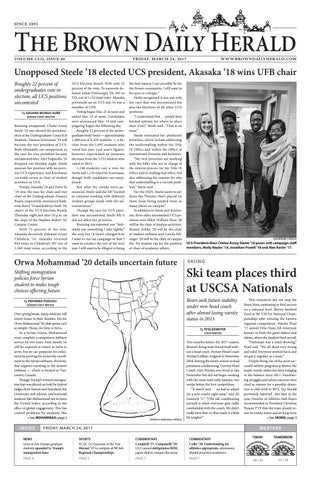
SINCE 1891
THE BROWN DAILY HERALD FRIDAY, MARCH 24, 2017
VOLUME CLII, ISSUE 40
WWW.BROWNDAILYHERALD.COM
Unopposed Steele ’18 elected UCS president, Akasaka ’18 wins UFB chair Roughly 22 percent of undergraduates vote in election, all UCS positions uncontested By EDUARD MUÑOZ-SUÑÉ SENIOR STAFF WRITER
Running unopposed, Chelse-Amoy Steele ’18 was elected the presidentelect of the Undergraduate Council of Students. Naveen Srinivasan ’19 will become the vice president of UCS. Both ultimately ran unopposed, as the race for vice president became uncontested after Alex Volpicello ’18 dropped out Monday night. Steele assumes her position with no previous UCS experience, and Srinivasan currently serves as chair of student activities on UCS. Yuzuka Akasaka ’18 and Drew To ’19 won the race for chair and vice chair of the Undergraduate Finance Board, respectively, announced Katherine Barry ’19 and Kathryn Stack ’19, chairs of the UCS Election Board, Thursday night just after 10 p.m. on the steps of the Stephen Robert ’62 Campus Center. With 74 percent of the vote, Akasaka decisively defeated Aryan Chhabria ’18. Akasaka received 943 votes to Chhabria’s 307 out of 1,269 total votes, according to the
UCS Election Board. With only 52 percent of the vote, To narrowly defeated Julian DeGeorgia ’20, 595 to 533, out of 1,152 total votes. Akasaka previously sat on UCS and To was a member of UFB. Voting began Mar. 21 at noon and ended Mar. 23 at noon. Candidates were announced Mar. 15 and campaigning began the following day. Roughly 22 percent of the undergraduate body voted — approximately 1,400 out of 6,320 students — a decline from the 1,892 students who voted last year. Last year’s figures, however, represented an immense decrease from the 3,152 student who voted in 2015. 1,148 students cast a vote for Steele and 1,118 voted for Srinivasan, though both candidates ran unopposed. Just after the results were announced, Steele said she felt “excited to continue working with different student groups (and) with the administration.” Though the race for UCS president was uncontested, Steele felt it did not affect her priorities. Running uncontested was “definitely not something I take lightly,” she said, but “it hasn’t changed how I want to run my campaign or how I want to conduct the rest of the next year. I still want to be diligent in being
the best liaison I can possibly be for the Brown community. I still want to be open to critique.” Steele recognized it was not only her race that was uncontested but also the elections of all other UCS positions. “I understand that … people have limited options for where to place their trust,” Steele said. “That is an issue.” Steele reiterated her platform’s priorities, which include addressing the understaffing within the Title IX Office and within the Office of Institutional Diversity and Inclusion. “My first priorities are working with the folks who are in charge of the interim process for the Title IX Office and re-staffing that office, but also addressing the reasons for why that understaffing is a current problem,” Steele said. For the OIDI, Steele wants to address the “burden that’s placed on them from being needed from so many places on campus.” In addition to Steele and Srinivasan, three other uncontested UCS positions were filled. William Zhou ’20 will be the chair of student activities, Sharon Zeldin ’20 will be the chair of student wellness and Camila Pelsinger ’20 will be the chair of campus life. No student ran for the position of chair of academic affairs.
Orwa Mohammad ’20 details uncertain future Shifting immigration policies force Syrian student to make tough choices affecting future
SKIING
Ski team places third at USCSA Nationals Bears seek future stability under new head coach after almost losing varsity status in 2015
By PRIYANKA PODUGU SENIOR STAFF WRITER
Over spring break, many students will return home to their families, but for Orwa Mohammad ’20, that option isn’t so simple. Home, for him, is Syria. As a Syrian citizen, Mohammad must complete a compulsory military service for two years. Next month, he will be required to return to Syria to serve, but he can postpone his enlistment by proving his university enrollment to the Syrian embassy. However, that requires traveling to the nearest embassy — which is located in Vancouver, Canada. Though Trump’s revised immigration ban was placed on hold by federal judges from Hawaii and Maryland, the University still advises international students like Mohammad not to leave the United States, according to the office of global engagement. This has created problems for students, like » See MOHAMMAD, page 2
INSIDE
SAM BERUBE / HERALD
UCS President-Elect Chelse-Amoy Steele ’18 poses with campaign staff members, Molly Naylor ’19, Jonathan Powell ’18 and Alex Karim ’17.
By TESS DEMEYER STAFF WRITER
DOROTHY WINDHAM / HERALD
Two months before the 2017 season, Brown’s skiing team found itself without a head coach. Former Head Coach Michael LeBlanc resigned in November 2016, leaving the team’s seniors to lead preseason conditioning. Current Head Coach Alex Norden was hired in late November but did not begin working with the team until early January, two weeks before the first competition. “It wasn’t easy … we had to adjust (to a new coach) right away,” said Ali Gunesch ’17. “(The fall conditioning period) is when everyone gets really comfortable with the coach. We didn’t really have that, so that made it a little bit tougher.”
That transition did not stop the Bears from continuing to find success on a national level. Brown finished third at the USCSA National Championships after winning the Eastern regional competition. Natalie Pearl ’17 earned First-Team All-American honors in both the giant slalom and slalom, where she finished third overall. “Nationals was a solid showing,” Pearl said. “We all skied very strong and solid. Everyone worked hard, and we got it together as a team.” Despite being one of the most successful athletic programs at Brown, the team’s varsity status has been hanging in the balance since 2011. Fundraising struggles and safety concerns were cited as reasons for a possible demotion to club level in 2015, The Herald previously reported . But later in the year, Director of Athletics Jack Hayes recommended to President Christina Paxson P’19 that the team should retain its varsity status and set long-term » See SKIING, page 3
WEATHER
FRIDAY, MARCH 24, 2017
NEWS Lives of two Iranian graduate students upended by Trump’s immigration bans
SPORTS ECAC Co-Gymnast of the Year Morant ’17 to compete at NCAA Regional Championships
COMMENTARY Campbell ’17, Campanelli ’18: UCS cannot delitgitmize BDH, paper vital to campus discourse
COMMENTARY Colby ’20: Underfunding for athletics appropriate, admissions should prioritize academics
PAGE 4
PAGE 3
PAGE 7
PAGE 7
TODAY
TOMORROW
46 / 43
53 / 36
NEWS
PAGE 2 • FRIDAY, MARCH 24, 2017
THE BROWN DAILY HERALD
Lecture highlights integral role of insects in modernity Edward Melillo delves into intertwined histories of humans, insects, highlighting insect products By ELENA RENKEN SCIENCE & RESEARCH EDITOR
Edward Melillo, associate professor of history and environmental studies at Amherst College, has been drawn to insects since childhood. He first felt a connection to the six-legged creatures in an entomology class at age 11 when he watched a butterfly drink from a juicy slice of watermelon on a sweltering day. He felt the same “interspecies kinship” as a doctoral student when he traveled thousands of miles to reach the West Coast and gazed at masses of Monarch butterflies, thickly clustered on trees in Natural Bridges Park after their own long migration. Melillo is now working on a book titled “The Butterfly Effect: Insects and the Making of the Modern World,” which he discussed Thursday in the top floor of Pembroke Hall. Expansive literature exists describing insects’ damaging effects on humanity, Melillo said, but he wanted to explore some of the “other kinds of relationships we’ve had with our insect cousins.” The pervasive influence of insects reverberates across societies, their bodies and products playing an integral role in areas ranging from genetics research to the execution of delicate surgical techniques. Beyond our dependence on pollinators and love of honey, insects are deeply enmeshed in human systems. Melillo’s work “challenges us to rethink modernity,” said Claire Brault, postdoctoral fellow in political science.
» MOHAMMAD, from page 1 Mohammad, who must make a complicated decision about their futures in the United States. Though the Syrian government cannot force Mohammad to serve, the embassy can refuse to renew his passport, which expires in August 2018, if he does not fulfill his duties. “I have no clue where I’m going to be, what my legal status is going to be, when (I will) be able to see my family, when … I’m actually going … to (return) home,” Mohammad said. Changes since Trump Mohammad said it took some time for him to realize how much would change after Trump succeeded in winning the presidential election. “It didn’t feel like there was going to be that much of a drastic change until the (first immigration) ban actually came.” Though the second immigration ban does not target international
DAPHNE ZHAO / HERALD
Modern times have seen a resurgence of many insect products. As one example, shellac is produced from lac insect secretions harvested from tree branches and used in the creation of various products, including vinyl records. “If you listen to a shellac record, you can really hear the substance in the sound. It does sound like bacon crisping,” Melillo said. “The shellac is part of the genesis of the sonic landscape.” Humans have taken advantage of insects and their products for thousands of years. The use of cochineal
insects holds a long history in the Americas — the Aztecs inherited the tradition from their predecessors. The female insects are crushed and used in a deep red dye, which retains its vibrant color over decades and even centuries. The product pleased Europeans during the colonial period, as they took red to symbolize virility. “Imagine ship after ship crossing the Atlantic loaded with cochineal bricks, each of which took 70,000 crushed female insect bodies to make,” Melillo said. Silk, produced by silkworms, has
also wielded a strong influence in historical and contemporary societies, Melillo said. When the Parthians of northeast Persia revealed large banners of silk during battle with the Romans, their opponents were so enthralled by the spectacle that they were distracted from fighting. The modern fabrication of silk bears a close resemblance to the manufacturing process used in ancient times, but this old-fashioned procedure has been combined with twenty-first century marketing to secure silk’s central place in the fashion industry.
Grace Gagnon ’18 was impressed by the pervasive influence of silk production on many activities, “whether it’s empire building or even just daily life,” she said. “I probably shouldn’t be surprised by the extent to which insect products have made their way into our culture.” Melillo hopes to reveal a deep and intertwined bond between insects and humans that takes into account more than just their monetary value in society. “If we just place an economic value on our relationship with insects, what do we lose?”
students with valid visas, border patrol officials still have wide latitude in placing valid visas under administrative processing, The Herald previously reported. “The risk is if the person leaves and the order is then reinstated, they could face a certain instance where they will not be let back into the United States,” said Michael Wildes, former federal prosecutor with the United States Attorney’s Office in Brooklyn. “It’s never a guarantee for a student traveling that they’ll be readmitted anyways,” he added. “They’re in a catch-22 position where they’re damned if they go and damned if they stay.”
“They’ve been empowered by Assad.” This support has shielded the city from most of the chaos of the ongoing civil war, but in 2014, Mohammad began to explore the option of continuing his education outside Syria as the prospects of living a “good life” seemed increasingly unlikely. While the civil war resulted in only “mild” changes in Tartus, Mohammad said the country’s inflation and low wages forced his father to seek work in Abu Dhabi. That year, Mohammad won a scholarship to attend United World College Maastricht in the Netherlands. While attending UWC Maastricht, Mohammad said he started to consider college in the United States. “Back then, the U.S. seemed like a great place to live in — great universities — and they give scholarships so why not?” he added. Mohammad got into his top choice school: Brown. “I came here thinking that I would be able to go back in the summer to see family,” he said. “That’s not happening now.”
“Maybe if I had applied this year instead of last year, I would’ve applied to Canada,” he added.
actually hit me, and since then it’s always been in the back of my mind,” he added. While his wide circle of international friends supports him at Brown, Mohammad said that he often struggles to let others know he’s not okay. “It takes time to trust someone,” he said. “It takes a lot of trust to tell someone, ‘I’m not doing that good, I’m not fine.’” Mohammad has noticed that students from Brown and Europe react differently to his identity as a Syrian. Brown students “aren’t curious,” Mohammad said, adding that, in Europe, he got more questions about the war in his homeland than he does here. “I appreciate the questions,” Mohammad said. To not ask questions is “counterproductive,” he added. “You need to know. You are the people of the United States, and the people you elect will not only rule the United States but they will also decide the future of the world.”
An unlikely path to Brown Mohammad grew up in port city of Tartus, located on the country’s Mediterranean Coast. “There was a certain sort of community feel,” he said. “I knew I could rely on people.” But the city consists of “mostly government supporters,” he added.
Strained relationships Mohammad also said the ban has taken a toll on his relationships with his parents and younger sister who live in Abu Dhabi. “When (my parents) first heard about (the ban), they refused to believe … it could apply to students.” Mohammad said his family tries to hide their reactions from him. Mohammad can stay in the United States for four years without any visa issues — but in those four critical years, he worries he won’t be able to watch his ten year old sister grow up. “I didn’t want to … go back to see her and she’ll look at me and be like, ‘Who are you? You’re the guy who left me when I was eight years old and now you’re coming back like nothing has happened.’” “That’s when (the uncertainty)
Got something to say? Leave a comment online! Visit www.browndailyherald.com to comment on opinion and editorial content.
SPORTS
FRIDAY, MARCH 24, 2017 • PAGE 3
THE BROWN DAILY HERALD
ATHLETE OF THE WEEK
Morant ’17 leads Bears as ECAC co-gymnast of the year Senior to represent Bruno at NCAA Regional Championships in allaround competition By ALEXANDRA RUSSELL SENIOR STAFF WRITER
The gymnastics team competed against five visiting teams in the ECAC Championships Saturday at the Pizzitola Center, finishing in third place overall with a season-high team total of 194.125. Cocaptain Caroline Morant ’17 posted a series of standout individual performances, earning the floor exercise title and placing third on vault and bars. In a continuation of her successful season, the senior picked up ECAC co-Gymnast of the Year honors and collected AllECAC honors on floor, vault and bars. This year, she tied the program record on floor with a score of 9.925, and posted an all-around high of 39.175. Since arriving at Brown in 2013, Morant has had an illustrious career. As a first-year in 2014, she earned USAG All-American honors on beam and floor, was named ECAC Rookie of the Year and qualified for the NCAA University Park Regional in the all-around. In 2015, Morant took home the Ivy Classic floor title with a score of 9.875, earning first team All-Ivy Classic honors on floor, vault and bars. Last season, she collected first team USAG All-American laurels in the all-around, vault and bars and earned first team All-ECAC on floor and vault. Morant is the first gymnast from Brown to qualify for the NCAA Regionals since fellow co-captain Jorden Mitchell ’17 and Diana Walters ’16 competed in 2015. For earning ECAC honors and in recognition of her strong leadership of the gymnastics team, Morant has been named The Herald’s Athlete of the Week. Herald: What were your expectations going into this season? Morant: I started off the season with an injury — I had surgery on my knee in August, and so really I was just trying to make it through healthy. Knowing that it was my last year, I was really just trying to do what I’ve been doing — stay healthy, make it to the postseason and help the team the last year that I can.
Were you surprised to find out that you had won gymnast of the year? It is one of those things — I knew they usually (award a winner) based on how many people get gymnast of the week over the course of the season, and general performance in that aspect. So I knew that me and the other girl that won it with me, (Lyanda Dudley of Cornell), had been at the top of the ECAC, so I wasn’t certain that I was going to. But I knew I was in the running for it, for sure. How do you prepare yourself mentally for a meet? That is something that I’ve definitely struggled with over the years and that’s kind of developed. For me, I think the best thing to do is not overthink anything. In years past, the day before meets I’ve gotten really nervous, and I would go to bed thinking about it at night just going over my routines. But this year, I’ve kind of just let it not hit me until the last minute. I’ve stayed calm, haven’t worried about it, gotten a good night’s sleep and woken up like it’s like any other day. You regularly compete in the allaround. Do you have a favorite event? I really like to compete floor, just because you can’t fall off of it, so it’s a lot better in that regard. But also, that’s the one where you can kind of express yourself more, and kind of have fun with it and connect with the crowd and your teammates while you’re doing your routine. When did you initially get into the sport? I’ve been doing it since I was three. I was actually adopted from China, and my mom said that when they picked me up from the orphanage, they told her that all the older girls would play with me and have me do flips and stuff when I was a baby. They told them to put me in gymnastics because I was a really active child. My mom put me in when I was really young in the mom and daughter classes, and I’ve stuck with it ever since. Do you have any pre-meet rituals? I don’t myself, but the whole team — before every meet before we walk
NAOMY PEDROZA / HERALD
Following a successful season as co-captain of the gymnastics team, Caroline Morant ’17 qualified for the NCAA Regional Championships. She will be the first gymnast from Brown to compete in the event since 2015. out — we do a huddle and we have a series of cheers that we all do, to get us pumped. As a captain, some of us will say things before the huddle, just to get everyone in the mindset, and then we do our cheers and then we go out. What is your go-to meet day breakfast? I’ll always go to (Bagel Gourmet) up on Thayer and get ham, egg and cheese on a whole wheat bagel — that’s my meet breakfast.
COURTESY OF BROWN ATHLETICS
Under the leadership of new Head Coach Alex Norden, the women’s ski team delivered a strong performance at the USCSA nationals, finishing third. Team alums intend to donate to ensure the future of the varsity program.
Several of your teammates also earned ECAC honors.What has the team’s progress been like this season? When we started off, we had a lot of injuries and the season was off to a slow start. We’ve been building, and a lot of individual performances have helped. Like I said, we had a lot of injuries, so some people had to step up, like Anya Olson ’18, … she’s improved immensely, especially because she was injured last year. So seeing her progress from her freshman year to now — she’s helped the team so much this year. And then,
specifically at ECACs, Cassidy Jung ’19 — her beam routine was phenomenal. I think she got like 9.825. But watching her train that over the years and have some issues with it in the past — for her to hit under pressure when we’ve already had a couple falls — it was amazing. I was jumping for joy when she hit that routine and it was really exciting to get to see her really come into her own at a really important time.
» SKIING, from page 1
helping bring this program up to financially where it needs to be and keeping the competitiveness going like it has been,” she said. “It’s important people should know that we’re not being complacent about the future of the team,” she added. “We’re working really hard to maintain its varsity status. … We can competitively do better than a third place at nationals. We can compete to win.” Though their final season at Brown has come to a close, Gunesch and Pearl plan to continue their support of the program as alums. “Our whole graduating senior class is going to donate,” Gunesch said. “I have every intention of continuing to support the team. It’s been one of the most important parts of my Brown experience. I really hope that it continues for future generations of skiers and women at Brown.”
targets for fundraising. LeBlanc left the program and relinquished his responsibilities as head coach because of uncertainty facing the team, The Herald previously reported. But after a successful 2017 season, Norden is confident that the program’s varsity status is secure going forward. “I plan on working really hard to keep this program at a varsity status,” Norden said. “The administration is very supportive of helping us endow the program, too. There has been talk and uncertainty in the past, but I plan on working really hard (at) not only keeping this program varsity, but also making it thrive and keeping us really competitive.” Norden is fully committed to the team and plans to remain as head coach and is “looking forward to
This interview was edited for length and clarity.
NEWS
PAGE 4 • FRIDAY, MARCH 24, 2017
THE BROWN DAILY HERALD
Lives of two Iranian students upturned by Trump immigration bans Bans disrupt studies, family relationships of Hemmatian GS, Zamanian GS By ELI BINDER STAFF WRITER
As President Trump signed his first executive order on immigration Jan. 27, Babak Hemmatian GS discovered that his father’s colon cancer had spread to his other organs. Under the terms of the first immigration ban, if Hemmatian were to visit his father in Iran, he would risk being barred from re-entering the United States. “It was really painful for me because, on the one hand, I felt like if I left the United States to come and visit, there’s a possibility that I will not be able to return to finish my studies. And on the other hand, I felt like I couldn’t just stay there and wait,” Hemmatian said over Skype from Tehran. “I would say it was the most difficult time in my entire life.” Hemmatian eventually traveled to Iran to care for his father only after Trump’s second immigration order exempted Iranians with valid visas from being barred. In August, Erfan Zamanian GS left the United States to present a paper at a conference in India. He had been in the United States on a single-entry F-1 visa, and he had reapplied for another visa in order to reenter the country, certain that it “wouldn’t take long to be issued.” By the time Trump signed his first immigration order, Zamanian had already been stranded in Iran for nearly five months and had spent his entire fall semester enrolled at Brown but unable to take his courses. “It was really frustrating, because I had my courses and my studies here pending for such a long time,” Zamanian said. Just as he was finally granted a visa in January, Trump’s first immigration ban came into effect. Zamanian finally returned to the United States once the first ban was blocked by a federal court in early February. While both of Trump’s executive orders on immigration were subsequently blocked by federal judges, Trump’s immigration bans continue to take a toll on both Hemmatian’s and Zamanian’s personal and professional lives. Scholars in search of knowledge and freedom When the ban was put into place “I had to TA, I had to do my research, I had to go to my classes, and that was really difficult,” Hemmatian said. “I had a number of different pretty serious health problems myself, which (I) can only think were in part caused by this stress,” he added, noting that his father’s condition likely played a role in his poor health as well. He acted out “a couple times in ways I didn’t expect myself to,” he said. And he has been experiencing cold sinusitis, coughing, fatigue, cold sores, digestive problems and anxiety. He even had a minor surgery. Hemmatian decided to come to the United States because of his desire to study reasoning. “There wasn’t really anyone in Iran” doing research in that area of cognitive science, he said. “The United States definitely isn’t the only place where major figures in the field work, but I would say it is — at least it was — the most attractive one, because
there is this perception of U.S. universities as being great places in terms of the culture of education and also in terms of funding,” he added. Zamanian came to the United States not only because he feels it is the best place to be for computer science, but also because he likes American culture and wanted to have new experiences that he thought the United States could provide. Here, “I have Christian friends, I have atheist friends, I have friends from Africa, I have friends from South America. I don’t have that luxury in Iran,” he said. Hemmatian is an atheist and identifies as bisexual. “There’s this fantastic view of the United States that’s in the minds of people everywhere,” he said. That view appeals to him because he does not feel aligned with his country’s culture “in terms of (his) beliefs, in terms of (his) lifestyle,” he said. In the United States, Hemmatian has a boyfriend. Because he was able to be “open about pretty much every aspect of (his) life,” coming to the United States has been “quite liberating,” he said. Having this freedom “allows me to focus on my research and other stuff that matters to me.” Hemmatian said that he has made great friends at Brown. “Just talking to those people gives me the best feeling in the world. The feeling that I’m alive, the feeling that I’m growing, the feeling that I’m contributing something to this wonderful mixture of ideas. That’s the most exciting aspect (of being) at Brown for me.” Because of Hemmatian’s sexual orientation and religious beliefs, “returning to Iran to live permanently isn’t really an option,” he said. “Once you’ve lived as openly as I have in the United States in the past couple of years, you really can’t go back to living the way you would have to in Iran, at least at the moment. It’s difficult to put those kinds of constraints on your life,” Hemmatian said. He said that he has already had job offers rescinded when Iranian employers found out about his atheism or bisexuality. “Right now, with the articles that are out there, it doesn’t seem very likely that I could get any job” in Iran, he added, referring to a feature the Washington Post published about him Feb. 1. Professional lives and University support Hemmatian studies how people use names and categories as explanations for issues, a practice exemplified by Trump’s banning of certain nationalities — essentially people of a certain religion — in order to stop terrorism. Trump’s ban relies on the association of certain nationalities with terrorism though nobody from the banned countries has committed a fatal terrorist attack in the United States in over 40 years. “I think it’s kind of ironic,” Hemmatian said about his field of research, “because it could be related to what I’m experiencing.” After the first ban made him unsure if he would be able to return home and continue his studies, Hemmatian was unable to focus on his career. “Sometimes working on homework, I would just sit in front of my notes and look at them for hours getting nowhere,” he said. He started “talking to people about alternative plans,” thinking about going to another country, such as Canada, to finish his dissertation. Zamanian also considered moving to Canada while waiting for a visa in Iran. Zamanian was receiving funding for his
research while in Iran, but he felt guilty that he was not able to perform at his best while he was constantly distracted by his situation. Zamanian’s advisor and Assistant Professor of Computer Science Tim Kraska promised him unconditional support, Zamanian said. Kraska discussed a backup plan of transferring to University of Waterloo so he could work remotely. His research team could make annual trips “to Canada and … have some sort of reunion,” Zamanian said. When the first immigration ban was signed, Kraska reached out to a colleague there to give Zamanian the option of transferring. Hemmatian also worries about how the order will affect his research in the long term. Once his F-1 student visa expires in July, he will not be able to reenter the United States without a new visa — which he may not be able to get. This means that he will not be able to go to conferences outside the United States, like the 39th Annual Meeting of the Cognitive Science Society in London in 2017. “Science is a social endeavor, and we have to have connections with researchers in other labs … Conferences are one of the main ways of doing that, but right now I’m confined to the United States,” he said. “It’s difficult not to feel bad when you see, for example, people around you in the program just so easily leaving for conferences,” he added. Zamanian is also worried about the effects travel restrictions will have on his research. Zamanian had a paper about his research accepted by the Very Large Data Bases conference in Munich this summer, but he cannot leave the country to present because his F-1 student visa is single-entry. This is a big problem for him because conferences are “the major venue for researchers to collaborate” in his field, he said. He is now looking for someone to present it for him. Perception of the United States and envisioning a future Hemmatian plans to return to the United States before his multiple-entry F-1 visa expires in July and stay on his I-20 status until he completes his PhD. He said he does not anticipate problems returning to the United States because he is allowed to enter under the most recent immigration executive order, which has also been blocked by a federal court. Overall, the United States is a better place compared to Germany, Switzerland or Finland, all countries where he has spent significant time, for people like Zamanian, he said. But the election and events following it made him realize that “this wasn’t the heaven that (he) thought it was,” he said. “And I faced the reality in perhaps the harshest way possible.” Nevertheless, Zamanian is grateful for how supportive the Brown community has been. “I felt that even if the whole United States was against me, at least there is a small community (at Brown) that I truly feel like I belong to and they belong to me, and I am welcome there,” he added. But Zamanian sees Brown as a bubble. The election made him realize that “the United States is a big country with diverse opinions about everything, including immigration and immigrants.” When he first arrived in Providence, his landlord asked him: “How can I know that you’re not a terrorist?” He later became “good friends” with his landlord, he added. “In the news, the channels that I
DOROTHY WINDHAM / HERALD
COURTESY OF ERFAN ZAMANIAN
After Erfan Zamanian GS was granted a visa in January to return to the US, Trump’s first immigration ban barred him from re-entering the country.
COURTESY OF BABAK HEMMATIAN
Babak Hemmatian GS poses at his first Pride Parade last year. Hemmatian is bisexual and said he can’t return to his home country, Iran, for this reason. usually watched like BBC, CNN … you always get the feeling that everybody’s against the executive order, everybody’s protesting. This is also the feeling that I got from all the emails that I received from people here at Brown. But then, when you take a step back and look at the general population, you see that no — (Trump) has his supporters,” Zamanian said. He does not feel comfortable traveling to places like the South or Midwest, where he imagines he might not be welcomed. “I can’t help but be a little paranoid that whenever I say ‘hi’ and introduce myself and say where I’m from — what’s going on in the other person’s head? Do they have some idea of me as being some kind of crazy, backwards, sexist person? Would they be willing to have more meaningful human interaction with me, or not? Are they thinking that I might be a terrorist? Because that’s really absurd,” Hemmatian said. “It’s hard not to take that to heart. It’s hard not to let that affect you.” Finding a job and creating a life in the United States was “the prime option” before the election, Hemmatian said. But now, “I probably will leave the United States after I am done with my studies,” he said. “I definitely don’t feel welcome anymore,” he said, adding that he is looking to build a life elsewhere in the West. In Iran, Hemmatian faced discrimination for “things that (he) could control like (his) beliefs,” he said. But in the United States, he faces discrimination
because of his birthplace — “something that I had no role in.” Zamanian had previously planned to work in the United States after completing his PhD. “But now with this new executive order I (am) questioning my future and my plans in the United States,” he said. Though the United States is the global leader in his field, he can see a life for himself in Iran. “Even if you’re allowed to stay, what if one day someone wakes up from his bed and issues another executive order forcing you to leave the country?” Zamanian asked. “In the long term, (the ban) is actually helping Iran because it convinces students that: ‘You see, we don’t have the best infrastructure and we don’t have the best environment for you,’” but you wouldn’t have the problems that you would face in the United States, he said. “Universities in Iran — good universities — said that if you’re a student studying in America, and now your education is (paused), you can come back and get your education from us,” he added. But Hemmatian still finds reasons to be hopeful about the future of the United States. “When the visa ban first came out, … I was pleasantly surprised that so many people staged protests,” he said. “I think it’s a beautiful thing, the fact that the judiciary system can decide against the president of the country to defend the rights of a number of people who don’t have all that much power to represent themselves.”
TODAY
FRIDAY, MARCH 24, 2017 • PAGE 5
THE BROWN DAILY HERALD
menu
by the riverside
SATELLITE DINING ANDREWS COMMONS
Pizza: Spicy Five Cheese and Garlic, BBQ Bam Bam, Pepperoni JOSIAH’S
BLUE ROOM
The Isabella Burger, Jambalaya, BBQ Chicken Burrito Bowl
Chicken Tortilla, Minestrone Soup, Bread Bowl
DINING HALLS SHARPE REFECTORY LUNCH
DINNER
Falafel, Grilled Reuben, Steamed Summer Squash, Minestrone Soup, Cream Cheese Brownies
Baked Tilapia With A Caper And Butter Sauce, Lemon Rice, Blueberry Pie
VERNEY-WOOLLEY LUNCH
DINNER
Breaded Chicken Fingers, Marinated Vegetable Salad, Cream Cheese Brownies
Bourbon BBQ Chicken, Squash Quesadillas, Chana Masala, Cajun Apple Cake SAM BERUBE / HERALD
sudoku
Clouds recede over the Seekonk River in downtown Providence. Spring break begins Saturday for students and faculty members, some of whom will escape the city for clearer skies and warmer weather.
Q U O T E O F T H E D AY
“You are the people of the United States, and the people you elect will not only rule the United States but
”
they will also decide the future of the world.
— Orwa Mohammad ’20 R
AS
See mohamad on page 1.
DA
A
ACROSS 1 Fast food sides 6 Turkey 10 Put away without restraint, with “on” 14 Unspoken 15 ’30s boxing champ 16 Tea traditionally made with cardamom 17 Slate, for one 18 Keep a movie dog from wandering? 20 Forced (in) 22 Voted out 23 Emit 25 Angus, e.g. 26 Female padre? 31 Tropical reef denizen 32 Some claims 33 Brother’s title 36 Dhofar Rebellion country 37 Ski run 38 Pen used at sea 39 San Francisco’s __ Hill 40 Roller coaster cries 41 Let up 42 Ancient mounted police? 44 Where to see a chin rest 47 Cavils 48 Poem that ends “I am the captain of my soul” 51 Freewheels 55 Dance that reflects the puncreating elements found in 18-, 26and 42-Across 57 Mauritius money 58 Friends and acquaintances 59 Croat, e.g. 60 More distant 61 Barrie henchman 62 Big __: nickname for LPGA great JoAnne Carner 63 Coverage giant DOWN 1 Boil slowly 2 Kick back 3 Ill-natured
c r o s s w o rD d
C
Edited by Rich Norris and Joyce Nichols Lewis 4 Rhea stat 5 How gas prices sometimes rise 6 Airer of the sitcom “’Allo ’Allo!” 7 Honolulu’s home 8 Stingy 9 Eastern Australian seaport 10 Musical range 11 Indian loincloth 12 Not left over 13 Part of LED 19 ’90s-’00s Dodges 21 Traffic-controlling gp. 24 Slicker 26 Shout of encouragement 27 __ erectus 28 Dhow sailor 29 Secondgeneration Japanese American 30 Futuristic sitcom family name 33 Blücher’s title in “Young Frankenstein” 34 Singer Coolidge 35 Like balsamic vinegar
37 Flight of fancy 38 Cookout condiment 40 Question of identity 41 Columbia River city 42 Old saw 43 First X, say 44 NyQuil maker 45 “I didn’t know he had it __” 46 Like aspen leaves
ANSW R
O
49 Troy Aikman’s alma mater 50 Fake 52 Cookout accessory 53 Typical “Hunger Games” trilogy reader 54 Blood components 56 Burt’s “The Killers” co-star
R
O S
calendar FRIDAY MARCH
S
By Gareth Bain (c)2012 Tribune Media Services, Inc.
M
T
W
Th
F
S
1
2
3
4
5
6
7
8
9
10
11
12
13
14
15
16
17
18
19
20
21
22
23
24
25
26
27
28
29
30
31
Mesa de Conversacion 12:00 P.M. Sharpe Refectory
Shabbat Services and Dinner 6:15 P.M. Brown-RISD Hillel
SATURDAY Bridges Discussion Brunch 12:00 P.M. Center for Students of Color
Baseball vs. Georgetown 3:00 P.M. Murray Stadium
SUNDAY Pierre Hughe Exhibition 1:00 P.M. List Art Center
Baseball vs. Georgetown 1:00 P.M. Murray Stadium
COMMENTARY PAGE 6 • FRIDAY, MARCH 24, 2017
THE BROWN DAILY HERALD
BROWN BITES
Brown Bites: March 19 - March 24 A message from across the Pond Former Prime Minister of the United Kingdom David Cameron came to campus Monday to deliver the latest iteration of the Ogden Lectureship. Entitled “Global Challenges: Where Do We Go from Here?”, Cameron discussed recent trends in global politics and emphasized the need to “remake arguments” in favor of globalization to buck the recent trend of isolationist politics. Cameron pointed out the perils of protectionist policies that have previously been adopted by the United States and Britain. After his speech, he sat down with President Christina Paxson P’19 for a question and answer session, with questions sourced from students and faculty. Up to a vote Should graduate students opt to unionize, a Mar. 19 to Mar. 21 graduate student vote held by Stand Up for Graduate Student Employees has selected the American Federation of Teachers as its union affiliate. AFT was chosen over United Automobile, Aerospace and Agricultural Implement Workers of America. For graduate students at the University to unionize, the selection process included a card campaign in which a minimum of 30 percent of members in the bargaining unit had to sign cards indicating their desire to join the union. Unless 65 percent or more of eligible graduate students sign cards in the campaign, the AFT will not file with the NLRB to hold a unionization vote. Four years running Professor of Computer Science Tim Kraska has been awarded the Sloan Research Fellowship, a $65,000, two-year fellowship. Kraska was selected for his work to make data more accessible “through the development of a new generation of algorithms and systems for interactive and sustainable datadriven discovery,” according to his research statement. Kraska hopes to use the fellowship to continue working on data-analysis software for non-experts without technical skills. This is the fourth year in a row that a faculty member of the computer science department was awarded a Sloan Fellowship. 2021 breakdown 32,699 students applied for admission to the University in the class of 2021 — this is the largest applicant pool for a class in the University’s history. Amongst the pool, 68 percent of applicants applied for financial aid and 17 percent are first-generation. Students applied from all 50 states and 145 nations were represented in the applicant pool. In addition, close to 2,500 students applied for the Program in Liberal Medical Engineering. Regular decision results will be released Mar. 31.
D O R O T H Y W I N D HA M
comic Cat Ears | Najatee’ McNeil
www.browndailyherald.com
Find us online! facebook.com/browndailyherald
browndailyherald.com
@the_herald
Location: 195 Angell St., Providence, R.I. www.browndailyherald.com
@browndailyherald
youtube.com/browndailyherald
Editorial Leadership
Sections
Multimedia & Production
Business
Editor-in-Chief Lauren Aratani
Arts & Culture Editors Julie Center Madison Rivlin
Design Editors Christy Leung Ameer Malik Jessica Yu Assistant: Eduard Muñoz-Suñé
General Managers Henry Ritter Ben Wesner
Managing Editors Matt Brownsword Rebecca Ellis Kate Talerico POST- MAGAZINE Editor Monica Chin
News Editors Kyle Borowski Kasturi Pananjady Suvy Qin Elena Renken Alex Skidmore Hattie Xu
BLOGDAILYHERALD Editor Anica Green
Sports Editors Jackson Chaiken Ben Shumate COMMENTARY Opinions Editors Anuj Krishnamurthy Mili Mitra Clare Steinman
Photo Editors Head: Eli White Assistant: Sam Berube Anita Sheih Sara Runkel Copy Desk Chief Julia Stemmer Multimedia Editor Roland High Illustrations Editor Dorothy Windham Graphics Editor Laura Felenstein Directors of Web Development: Lucy Wei Ivy Wong
Directors Finance: Reena Zhan Sales: Antonia Alvarez Sales: Erin Lueck Strategy: William Nober Strategy: Gianna Jasinski Managers Sales: Elizabeth Doykan Sales: Gabriella Elanbeck Sales: Matilda Lynton Sales: Ariel Shusterman Collections: Ravi Betzig Operations: Gür Ağci
Editorial contact: 401-351-3372 herald@browndailyherald.com
Business contact: 401-351-3260 gm@browndailyherald.com
Submissions: The Brown Daily Herald publishes submissions in the form of op-eds and letters to the editor. Op-eds are typically between 750 and 1000 words, though we will consider submissions between 500 and 1200 words. Letters to the editor should be around 250 words. While letters to the editor respond to an article or column that has appeared in The Herald, op-eds usually prompt new discussions on campus or frame new arguments about current discourse. All submissions to The Herald cannot have been previously published elsewhere (in print or online — including personal blogs and social media), and they must be exclusive to The Herald. Submissions must include no more than two individual authors. If there are more than two original authors, The Herald can acknowledge the authors in a statement at the end of the letter or op-ed, but the byline can only include up to two names. The Herald will not publish submissions authored by groups. The Herald does not publish anonymous submissions. If you feel your circumstances prevent you from submitting an op-ed or letter with your name, please email herald@browndailyherald.com to explain your situation. You can submit op-eds to opinions@browndailyherald.com and letters to letters@browndailyherald.com. When you email your submission, please include (1) your full name, (2) an evening or mobile phone number in case your submission is chosen for publication and (3) any affiliation with Brown University or any institution or organization relevant to the content of your submission. Please send in submissions at least 24 hours in advance of your desired publication date. The Herald only publishes submissions while it is in print. The Herald reserves the right to edit all submissions. If your piece is considered for publication, an editor will contact you to discuss potential changes to your submission. Commentary: The editorial is the majority opinion of the editorial page board of The Brown Daily Herald. The editorial viewpoint does not necessarily reflect the views of The Brown Daily Herald, Inc. Columns, letters and comics reflect the opinions of their authors only. Corrections: The Brown Daily Herald is committed to providing the Brown University community with the most accurate information possible. Corrections may be submitted up to seven calendar days after publication. Advertising: The Brown Daily Herald, Inc. reserves the right to accept or decline any advertisement at its discretion. The Brown Daily Herald, Inc. is a financially independent, nonprofit media organization bringing you The Brown Daily Herald, BlogDailyHerald and Post- Magazine. The Brown Daily Herald has served the Brown University community daily since 1891. It is published Monday through Friday during the academic year, excluding vacations, once during Commencement and once during Orientation by The Brown Daily Herald, Inc. Single copy free for each member of the community. Subscription prices: $200 one year daily, $100 one semester daily. Copyright 2017 by The Brown Daily Herald, Inc. All rights reserved. Periodicals postage paid at Providence, R.I. Postmaster: Please send corrections to P.O. Box 2538, Providence, RI 02906.
COMMENTARY FRIDAY, MARCH 24, 2017 • PAGE 7
THE BROWN DAILY HERALD
Don’t ostracize The Herald VAUGHN CAMPBELL ’18 & BRYCE CAMPANELLI ’18 staff columnist & op-ed contributor Between Sunday night and Monday morning, nearly every major candidate for the Undergraduate Council of Students and the Undergraduate Finance Board issued a statement via Facebook denouncing The Herald and stating that they would not be seeking The Herald’s endorsement. This was followed on Tuesday by a joint letter published in The Herald that repeated this position and called on The Herald to work with the UCS toward reform. Every year The Herald endorses candidates that they believe will best represent the student body in working with the University. In their rejection of The Herald, the candidates cited the two racist columns published in fall 2015 as well as the “exploiting (of) narratives of students of color and low income students.” We, as a columnist and a previous op-ed contributor for The Herald, recognize the hurt that was caused by these columns and in no way want to understate their impact on marginalized groups and on our campus as a whole. Regarding the Herald’s reporting side, some level of error is unfortunately always present in even the most sound journalism. We cannot speak di-
rectly to the misquotes mentioned by the UCS candidates. Yet all news publications, from time to time, make mistakes. All newspapers misquote and print retractions. We have no desire to invalidate the experiences of any UCS candidate, or of any Brown community member. Yet The Herald, as a key institution working for accountability on campus and one that has made great efforts to remedy its ailments over the last two years, should not be delegitimized in this way. As important news outlets
that The Herald must work with them to be reformed. The Herald can improve, but this improvement should not be led by UCS. Changes to The Herald cannot be led by an organization it is meant to hold accountable because then the newspaper loses its freedom and its core purpose. The UCS, like any governing body, has the potential to stray from the desires of the students it represents. The administration has the potential to conduct actions that harm students. The Corporation often
past. The Opinions section has published very hurtful columns, and while the editorial board has worked hard to vastly improve the editing process, we understand that members of the student body may not yet be ready to forgive. But The Herald’s news serves too great a purpose to be cast as unnecessary. Some level of error is, unfortunately, always present in even the most sound journalism. We cannot speak directly to the misquotes mentioned by the UCS
We need to foster a newspaper that is willing to publish articles critical of the UCS, administration, Corporation and student body because without one, we will not only fail to hold these powerful organizations accountable but will fall into a self-reinforcing echo chamber devoid of critical analysis. on the national stage are repeatedly labeled “fake” by our own government, we should not allow this trend of ostracizing the press to spread to campus. We need The Herald. We need a highly visible and frequently published newspaper. We need it to hold our student government accountable, present information about the administration that is not readily available or transparent and cover the diverse activities occurring around campus. In their Tuesday letter, the UCS candidates suggest
makes decisions and rulings that counter many of the beliefs held by students on campus. We need to support a newspaper that is willing to publish articles critical of the UCS, administration, Corporation and student body because without such a newspaper, we will not only fail to hold these powerful organizations accountable but also fall into a self-reinforcing echo chamber devoid of critical analysis. Our point is not to diminish the mistakes The Herald has made in the
candidates. Yet all news publications, from time to time, make mistakes. All newspapers misquote and print retractions. The UCS candidates charged The Herald with “falsely manufacturing narratives by misquoting students” but cite no specific instances in which this has occurred. Given the current political climate, we must be wary of making such broad claims without providing any tangible evidence. The Trump administration has made the same accusations to degrade legitimate news
sources that hold him and other leaders accountable. This has allowed the charge of “fake news” to be appropriated by the Trump administration and to be attributed to CNN and the New York Times, rather than to the alt-right publications for which the term was coined. Charges like these currently threaten the free press in the United States. The Herald is the most significant provider of news about the Brown community. With 150 members, The Herald has beats on the administration, student life, and yes, UCS. No one else covers campus so thoroughly. Who else is here to hold UCS, the administration, or the Corporation accountable? If any of these institutions transgress, it will be The Herald that alerts students. It will be The Herald that provides vital information to those who want to push back. It will be The Herald that holds these institutions to their word, ensuring that they look out for the interests of the student body. The Herald has made mistakes. But The Herald serves far too great a purpose as a news organization for us not to support it as it seeks to improve.
Vaughn Campbell ’17 can be reached at vaughn_campbell@brown.edu. Bryce Campanelli ’18 can be reached at bryce_campanelli@brown.edu..
Stop overvaluing Brown athletics OWEN COLBY staff columnist Brown’s relative underinvestment in athletics represents what is both sensible and proper for such an institution. Overinvestment in sports and the selective manipulation of admission criteria by peer institutions for the purpose of increasing overall athletic success has distorted the weight top-tier universities should place on athletics. As The Herald has previously reported, Brunonian underachievement is caused by a lack of funding and institutional interest, but this should not result in any changes to Brown’s waning institutional investment in sports. If anything, Brown’s emphasis on athletic recruitment and success should be decreased in the future. Supposedly “holistic” admission goals are already diluted by the disproportionate focus athletic recruitment receives. Athletes undoubtedly play an important role in a university, but the extent to which admission standards are altered for sports recruitment is nonsensical. In the Ivy League, academic standards are systematically reduced for athletic recruitment. Under the current system, Ivy League schools evaluate applicants using an “Academic Index” number that combines students’ grade point averages and standardized test scores. This is not the sole metric used in admission, but
coaches consider this number in recruitment, assuming that athletes and sports teams will have considerably lower Academic Index scores than their non-athletic peers. Within the Ivy League, coaches attempt to keep the “institution-wide cohort of recruited student-athletes within one standard deviation of the mean” Academic Index score for all students. Dramatic actions are taken to ensure this is the case. Recruitment of academically successful benchwarmers who never play is one tool used to ensure the team maintains a pass-
ject to the same admission standards that apply to all other applicants. Adjustment of admission criteria and quotas can be a sensible way to advance Brown’s declared commitments to “encouraging diversity” and forming a “dynamic mix of individuals that makes for the most fascinating and productive undergraduate community.” However, the current system does the exact opposite. By prioritizing specific athletic activities over other equally demanding and rewarding extracurricular activities, Brown undermines these goals. It is true that
a community are not justified. The community spirit that interscholastic athletic competition provides would still exist without such drastic recruitment efforts. Additionally, support for athletes and attendance at games — which are both very low at Brown — would likely be enhanced in a school where teams are composed of largely walk-on and nonrecruited athletes, especially considering the fact that the majority of Brown students oppose existing admission criteria for athletes. Brown has historically performed poorly in
Supposedly “holistic” admissions goals are already diluted by the disproportionate focus athletic recruitment receives. Athletes undoubtedly play an important role in a university, but the extent to which admissions standards are altered for sports recruitment is nonsensical. able academic standing. Moreover, a worryingly large number of admission spots are actively reserved for recruited athletes. Brown currently reserves 205 spots for recruited athletes in each class, which constitute 13 percent of each year’s cohort. This institutionalized alteration of standards signifies a departure from what makes academic institutions like Brown truly great. Brown is not known for sports; it is known for academic leadership, research and innovation. This is why universities are first and foremost academic institutions. As such, athletes should be sub-
sports can add value and diversity to a university community. Certainly, part of Brown’s holistic application review rewards students with outstanding talents even if they fall below average Academic Index of admits. But Brown — like the rest of the Ivy League — doesn’t offer institutionalized assistance in admission, reserved spots, reduced admission standards or expensive recruitment programs to students who might promote the university’s diversity in other ways. Yes, sports teams enhance the community in every college, but the resources dispensed to form such
most athletics and this lack of success has not affected the overall community within the University. Therefore, in a worst-case scenario, decreasing the emphasis placed on recruitment can only have marginally negative effects. Still, walk-on athletes have in the past proven that they can rival recruited athletes from other institutions. Women’s rugby, with no recruiting spots in its first year as a varsity team, found themselves in “an Ivy League championship in its first season, followed by a second-place finish in 2015,” The Herald previously reported.
It has been argued that sports offer unmatched opportunities to learn discipline, social understanding and leadership, and that that these opportunities justify such recruitment efforts. The accuracy of this claim is up for debate, but it is worth noting that no other activity at Brown has the privilege of recruiting students based on those traits. Sports may instill dedication and discipline in athletes, but non-athletic activities offer these same opportunities to learn and grow. This is by no means an argument to cease the recruitment of athletes in general. Athletes at Brown are among the most hardest-working and talented students in NCAA Division I competition. But Brown should continue, as it did under the governance of former President Ruth J. Simmons, to shift its focus away from a disproportionate emphasis on athletics. The University can also improve the way it recruits athletes. Simmons, for example, vocally suggested that Brown raise its Academic Index average above the Ivy League’s recruitment minimum in an effort “to increase the representativeness of athletes at Brown,” The Herald previously reported. After all, sports have a role at every college and university, but current recruitment efforts considerably overvalue athletic achievement. Increasing the University’s investment in such activities would be misguided.
Owen Colby ’20 can be reached at owen_colby@brown.edu.
SPORTS THE BROWN DAILY HERALD
FRIDAY, MARCH 24, 2017
NBA players, league can find common ground on rest ANDREW FLAX sports columnist The San Antonio Spurs and Golden State Warriors are the two best teams in the NBA. As one might expect, their nationally broadcasted matchup Mar. 12 was as highly anticipated as any game this season. But it fell far short of expectations. The Spurs were missing their three best players because of injuries, which is unfortunate enough on its own. But the Warriors responded by voluntarily resting three of their own stars in addition to the injury-induced absence of former Most Valuable Player Kevin Durant. Without the league’s best in the spotlight, the game ended up a lackluster competition between noname bench contributors, disappointing TV viewers who had eagerly awaited it and fans who had paid exorbitant ticket prices to see their favorite players in person. Resting players has become a hot topic in the NBA recently, culminating in a letter from Commissioner Adam Silver to teams after the Warriors-Spurs game and a similar situation involving the defending champion Cleveland Cavaliers. According to media outlets that obtained the text of the memo, Silver
described players missing games for rest as “an extremely significant issue for our league.” He also encouraged team owners to be involved in rest decisions and asked them to consider the ramifications of player rest for the league’s TV partners. The NBA’s position on player rest is an obvious one. When stars miss games they do not have to, they disappoint fans who pay for tickets, and games without stars cut viewership for TV providers who pay a hefty fee to broadcast games. Money is the league’s end-all, be-all, so its stance makes plenty of sense. But with no formal restrictions on rest, teams that sit players are not subject to any punishment. The players are, of course, acting out of self-interest as well. Resting is most common on teams that have made deep playoff runs and hope for another this summer. The Warriors and Spurs fit this description, as do the Cavaliers. The Cavaliers played 23 playoff games last season — an additional quarter of an NBA season. With older players like 32-year-old LeBron James, the organization needs to ensure that its team can handle a grueling title run. As Cavaliers General Manager David Griffin said to ESPN, “They’re paying me to win a championship. I’m not overly concerned about the perception of it.” So how can the league and its play-
ers reach a mutually agreeable solution? They have already taken one major step with their new collective bargaining agreement. Among many other changes, the new CBA shortens the preseason and adds a week to the regular season schedule, giving players more time to rest. This change is specifically aimed to decrease the number of times when teams have games on back-to-back nights. Those two-game sets are especially hard on players, and both the Warriors and Cavaliers rested their players on the second leg of a back-to-back. But a few extra days off during the year may not be a sufficient solution. Some have suggested cutting down on the number of games in a season, but that idea is a financial non-starter: fewer games mean less money for everyone. To reduce instances where teams rest players wholesale, the league could introduce a rule that only one player per team may be sat for rest per game. Such a restriction would not prevent players from taking the time they need to get healthy, but it would prevent situations where a team rests all of its stars and effectively throws a game. A more out-of-the-box idea is to reduce the number of teams that make the playoffs. Sixteen of the 30 NBA teams make the playoffs every year, and the title-contending teams are sure to demolish their first
DOROTHY WINDHAM
round opponents each time. If only six teams made the playoffs in each conference, the league could give the top two teams in each conference a first-round bye. This change would give the top teams time to rest before their postseason matchups and would also increase the importance of regular-season games for contenders. They are willing to rest players when a playoff berth is all but assured; would they feel the same if they were on the cusp of losing that first-round bye?
Player rest in the NBA is a controversial topic, with compelling arguments on both sides. But there is a middle ground to be found, both by changes already made and by more aggressive changes to come. The NBA doesn’t have to sacrifice the health of its players in order to make sure they’re on the court every night.
Andrew Flax ’17 can be reached at andrew_flax@brown.edu.
Cubs primed to repeat World Series victory GEORGE KLEIN sports columnist The 2016 MLB season was a once-ina-lifetime run for the Chicago Cubs and its fans. Putting to rest stories of failure — the billy goat curse and the infamous Steve Bartman intervention — the Cubs won their first World Series since 1908. Down three games to one against the Cleveland Indians, Chicago captured the final three games of the season, capping off the miraculous comeback with a nail-biting Game Seven victory in extra innings. But life goes on — pitchers and catchers reported in February, spring training games began in early March and it’s now time for the beginning of the 2017 season. It is an interesting moment to be a baseball fan. Though the baseball world loves to exult in its current parity and unpredictability, we stand here in the last week of March with only five clear favorites: the Cubs, Indians, Boston Red Sox, Los Angeles Dodgers and Washington Nationals. Comparing each contender against the Cubs, it is clear that the defending champions are baseball’s best team. Washington, for instance, has tremendous talent: Star short-
stop Trea Turner and second baseman Daniel Murphy form, perhaps, the best middle infield in the game. If Bryce Harper can shake off an injury-filled slump of a year and Max Scherzer can maintain his form, the Nationals will be in business in the regular season. But the problem for Washington is the postseason. The Nationals have had three tremendous opportunities in recent years to bring home the championship and have not come close, failing to advance out of the division series each season. Can Washington progress further than ever before in the playoffs with role players like Ryan Zimmerman and Jayson Werth rapidly aging, Wilson Ramos making a comeback from ACL surgery and Stephen Strasburg continuing to struggle with his health? It is more than a little doubtful. The Indians, meanwhile, missed their best shot at a title last season. Can they surge back after such a heartbreaking end to their season? Cleveland signed slugger Edwin Encarnación, but Encarnación is not exactly Kevin Durant, to put it lightly. Jose Ramírez, Francisco Lindor and Jason Kipnis make for an exciting infield, but that does not guarantee another World Series appearance. The Indians rely heavily on their bullpen, especially stars Andrew Miller and Cody Allen. But,
as Yankees fans who watched the Joe Torre managerial era know, relying heavily on certain bullpen arms can cause them to break down quickly. The Indians had Miller throw 19.1 innings last postseason and needed every one of them along the way. They will need their bullpen once again in order to make it back. But they are walking on a tight wire. Last year, when everything broke right for the Indians, they still lost to the Cubs. The Dodgers are the favorite according to PECOTA projections and Sports Illustrated. Corey Seager, at the ripe age of 22, is already one of baseball’s best position players, and Clayton Kershaw is the best pitcher in the game. But as terrific as those two are, the Dodgers do not seem to be much, if at all, better than last year. Rich Hill had a career year as a 36-year-old. Confident he can do it again? Adrián González, Andre Ethier and Yasiel Puig, though still at various stages of productivity, have been gradually declining. The Dodgers need Puig to snap out of whatever hitting malaise has come over him and are relying once again on aging players such as González and Chase Utley. Their regular season record might be better with a healthy campaign from Kershaw, but the Dodgers have made the postseason every year since 2013 and have not reached
the World Series. Their title window is closing, and they have been favorites every year. What makes this season so much different? The Red Sox are dangerous. After escaping an elbow scare from David Price, they enter the season comfortable and ready, with an absolutely loaded team. They feature possibly baseball’s best string of hitters in their batting lineup: Mookie Betts, Dustin Pedroia, Xander Bogaerts, Hanley Ramírez, Jackie Bradley Jr. and Andrew Benintendi. Boston’s offense is so good it is almost unfair. Add in the offseason trade acquisition of star starting pitcher Chris Sale, and the Sox are a bona fide powerhouse. The only question is whether their pitching can hold up in the playoffs. Unfortunately, it is a gigantic question for this year’s Red Sox. David Price’s career postseason record — two wins, eight losses and a 5.54 ERA — stands out for all the wrong reasons. 2016 American League Cy Young Award winner Rick Porcello has an ugly postseason career as well, with zero wins, three losses and a 5.66 ERA. Meanwhile, Sale has never pitched in the playoffs. If the Red Sox’ pitchers do not step up, it will be another early playoff exit for Boston. The Red Sox’ and Cubs’ offenses may cancel each other out, but the Cubs’ pitching could far outmatch Boston’s come Octo-
Follow Sports! twitter.com/bdh_sports
ber. There is not much to say about the Cubs that has not been said already. Their offense is ridiculous. Last year’s National League MVP Kris Bryant is only entering his third season and is still getting better, while Anthony Rizzo is a certified all-star. Addison Russell, Kyle Schwarber, Javier Báez and Willson Contreras are all improving young players. The Cubs match their talented offensive youth with pitching experience — Jon Lester, Jake Arrieta and John Lackey are workhorses. Even 27-year-old Kyle Hendricks, the rotation’s youngest member, was a Cy Young candidate last season. Do not forget about World Series MVP Ben Zobrist, either. In addition, the Cubs still have room to improve over last season: Jason Heyward had a terrible year, Arrieta struggled with command issues and Schwarber suffered a torn ACL. Improvement from those three would make the Cubs even more dominant. Chicago is the one team without a discernible weakness. Looking for a World Series pick? Though it has not been said often over the past century, go with the Cubs.
George Klein ’20 can be reached at george_klein@brown.edu.