SINCE 1891
THE BROWN DAILY HERALD FRIDAY, JANUARY 26, 2017
VOLUME CLIII, ISSUE 3
WWW.BROWNDAILYHERALD.COM
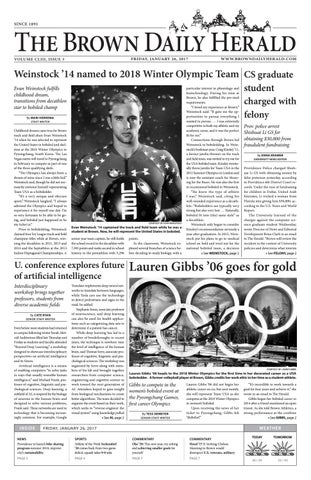
Weinstock ’14 named to 2018 Winter Olympic Team CS graduate Evan Weinstock fulfills childhood dream, transitions from decathlon star to bobsled champ By MARI HERREMA STAFF WRITER
Childhood dreams came true for Brown track and field alum Evan Weinstock ’14 when he was selected to represent the United States in bobsled and skeleton at the 2018 Winter Olympics in Pyeongchang, South Korea. The Las Vegas native will travel to Pyeongchang in February to compete as part of one of the three qualifying sleds. “The Olympics has always been a dream of mine since I was a little kid,” Weinstock said, though he did not necessarily envision himself representing Team USA as a bobsledder. “It’s a very unique and obscure sport,” Weinstock laughed. “I always admired the Olympics and hoped to experience it for myself one day. I’m so very fortunate to be able to be going, and bobsled just happened to be my ticket in.” Prior to bobsledding, Weinstock claimed four Ivy League track and field champion titles while at Brown, winning the decathlon in 2011, 2013 and 2014 and the heptathlon at the 2013 Indoor Heptagonal Championships. A
COURTESY OF EVAN WEINSTOCK
Evan Weinstock ’14 captained the track and field team while he was a student at Brown. Now, he will represent the United States in bobsled. senior year team captain, he still holds the school record in the decathlon with 7,393 points and ranks second in school history in the pentathlon with 5,296
points. In the classroom, Weinstock explored several branches of science before deciding to study biology, with a
particular interest in physiology and biotechnology. During his time at Brown, he also fulfilled the pre-med requirements. “I loved my experience at Brown,” Weinstock said. “It gave me the opportunities to pursue everything I wanted to pursue. … I was extremely competitive in both my athletic and my academic sense, and it was the perfect fit for me.” Connections through Brown led Weinstock to bobsledding. In Weinstock’s freshman year, Craig Kinsley ’11, a former javelin thrower on the track and field team, was invited to try out for the USA bobsled team. Kinsley eventually threw javelin for Team USA in the 2012 Summer Olympics in London and is now the assistant coach for throwing for the Bears. He was also the first to recommend bobsled to Weinstock. “He knew the type of athlete I was,” Weinstock said, citing his well-rounded experience as a decathlete. “Bobsledders are typically very strong but also very fast. … Naturally, bobsled fit into (the) same style” as a decathlon. Weinstock only began to consider Kinsley’s recommendation seriously a year after graduation. In 2015, Weinstock put his plans to go to medical school on hold and tried out for the national bobsled team, a decision » See WEINSTOCK, page 2
student charged with felony
Prov. police arrest Shishuai Li GS for obtaining $30,000 from fraudulent fundraising By ANNA KRAMER UNIVERSITY NEWS EDITOR
Providence Police charged Shishuai Li GS with obtaining money by false pretenses yesterday, according to Providence 6th District Court records. Under the ruse of fundraising for children in Dubai, United Arab Emirates, Li tricked a woman from Florida into giving him $30,000, according to the U.S. News and World Report. The University learned of the charges against the computer science graduate student Wednesday, wrote Director of News and Editorial Development Brian Clark in an email to The Herald. “Brown will review the incident in the context of University policies and determine what interim » See FELONY, page 2
U. conference explores future Lauren Gibbs ’06 goes for gold of artificial intelligence Interdisciplinary workshop brings together professors, students from diverse academic fields By CATE RYAN SENIOR STAFF WRITER
Even before most students had returned to campus following winter break, Metcalf Auditorium filled last Thursday and Friday as students and faculty attended “Beyond Deep Learning,” a workshop designed to showcase interdisciplinary perspectives on artificial intelligence and its future. Artificial intelligence is a means of enabling computers “to solve tasks in ways that usually resemble human intelligence,” said Michael Frank, professor of cognitive, linguistic and psychological sciences. Deep learning, a subfield of AI, is inspired by the biology of neurons in the human brain and designed to solve various problems, Frank said. These networks are used in technology that is becoming increasingly common. For example, Google
INSIDE
Translate implements deep neural networks to translate between languages, while Tesla cars use the technology to detect pedestrians and signs in the road, he added. Stephanie Jones, associate professor of neuroscience, said deep learning can also be used for health applications such as categorizing data sets to determine if a patient has cancer. While deep learning has led to a number of breakthroughs in recent years, the technique is nowhere near the level of intelligence of the human brain, said Thomas Serre, associate professor of cognitive, linguistic and psychological sciences. The workshop was organized by Serre along with members of his lab and brought together researchers from computer science, engineering and cognitive science to work toward the next generation of AI. Attendees hoped to gain insight from biological mechanisms to create better algorithms. The team decided to organize the event based on their work, which seeks to “reverse-engineer the visual system” using knowledge pulled » See AI, page 2
COURTESY OF LAUREN GIBBS
Lauren Gibbs ’06 heads to the 2018 Winter Olympics for the first time in her decorated career as a USA bobsledder. A former volleyball player at Brown, Gibbs credits her work ethic to her time as a student-athlete.
Gibbs to compete in the women’s bobsled event at the Pyeongchang Games, first career Olympics By TESS DEMEYER SENIOR STAFF WRITER
Lauren Gibbs ’06 did not begin her athletic career on ice, but next month, she will represent Team USA as she competes at the 2018 Winter Olympics in women’s bobsled. Upon receiving the news of her ticket to Pyeongchang, Gibbs felt “disbelief.”
“It’s incredible to work towards a goal for four years and achieve it,” she wrote in an email to The Herald. Gibbs began her bobsled career in 2014 after a friend mentioned an open tryout. As she told Brown Athletics, a strong performance at the combine » See GIBBS, page 2
WEATHER
FRIDAY, JANUARY 26, 2017
NEWS Providence to launch bike sharing program summer 2018, improve city’s sustainability
SPORTS Athlete of the Week Seckendorf ’20 comes back from two-game deficit, squash takes 9-0 win
COMMENTARY Oke ’20: This new year, try setting and achieving smaller goals for yourself
COMMENTARY Hood ’17.5: Inviting Chelsea Manning to Brown would disrespect U.S. veterans, military
PAGE 3
PAGE 4
PAGE 7
PAGE 7
TODAY
TOMORROW
36 / 24
52 / 43
NEWS
PAGE 2 • FRIDAY, JANUARY 26, 2017
» WEINSTOCK, from page 1 that launched the start of a young but decorated career. Participating in the North American Cup, European Cup and World Cup bobsled competitions, Weinstock has medalled several times since his inaugural 2015-16 season with Team USA. This winter will be Weinstock’s first time competing on the Olympic stage. Months of dedicated training precede the games. “There’s a lot of things that go into the sport that are not exactly known,” Weinstock said. It’s “the stuff that’s off the ice that really takes the most time.” When they are in season, bobsledders travel internationally from one competition location to the next, and their equipment goes with them. Most important are the sleds, which, being high-tech and finely engineered, require careful maintenance by the bobsledders to ensure peak performance capability. When arriving at a new location, attending to the sleds
» GIBBS, from page 1 that year earned her an invitation to a weeklong camp where she finished with the fastest time. Gibbs first made the national team during the 2014-15 season and has maintained that spot ever since. The 2018 Games will be Gibbs’ first Olympic experience. But Gibbs’ career has not always been smooth sledding. An adductor injury during the 2015-16 season hampered her summer training and set Gibbs back at the beginning of the season but did not stop her from staying on the national team and competing at the elite level. Though she is still relatively new to bobsledding, Gibbs has already amassed an impressive collection of hardware. In addition to her 11 World Cup medals, she also won bronze at the 2016 World Championships in Igls, Austria. Gibbs’ athletic accomplishments date back to her time at Brown where
» FELONY, from page 1 measures may be required,” he wrote. The Department of Homeland Security launched an investigation into Li’s activities Nov. 1 following suspicious activity in his bank account, according to the U.S. News and World Report. On Nov. 27, a woman from
THE BROWN DAILY HERALD
is the first and most time-consuming order of business. The bobsledders also create a makeshift gym in a parking garage or similar location for a lifting session. After lifting, the sled teams each get two practice runs down the racing track. “All the while, (we’re) getting our meals in, going to sleep,” Weinstock said. “That’s more or less a general, typical day in the bobsled world.” In the last couple of weeks leading up to Pyeongchang, the USA bobsled team will shift its training focus from physical conditioning to ensuring that the members remain healthy. The bobsledders are “trying to make sure that our bodies are ready to be the best by the time the Olympics come around,” Weinstock said. “I’m not really sure what to expect when I get” to the Olympics, Weinstock said, though the team will be familiar with its competition as they have raced against them all season. “The atmosphere of the Olympics is what’s really going to make the whole
experience what it is,” Weinstock added. “To see all the nations from all the other sports in the same village as me, and kind of on the same playing field, is really going to be something.” To Olympic hopefuls and current Brown athletes with professional aspirations, Weinstock advised to “really pursue all sorts of avenues and opportunities that may come up. If it’s something you really want to achieve, attack it with everything you have — don’t hold anything back or take any opportunity for granted, because it could be your ticket to your ultimate goal.” Weinstock said he is also grateful for the opportunities and the continued support that he receives from Brown. “I’m very excited that people are interested in my story, or interested in bobsledding,” he said. “I hope if they’re curious, they take a look, and hopefully I get a few more fans of the sport and help grow it.” The Olympic men’s bobsled competitions will take place Feb. 18-25 in Pyeongchang, South Korea.
she found success on the volleyball court. “I was originally recruited for track and field,” she wrote. “When speaking to the coach, I didn’t want to do two seasons. I felt like it would be too much with school work. I was playing volleyball at the time as well, so I sent my recruiting tape to (former head coach) Diane Short. She liked what she saw and invited me for a visit. It was love at first sight.” Gibbs was a three-year starter for the Bears and gained Second Team All-Ivy recognition in 2004 and 2005. With 1,090 career kills, she ranks fourth all-time in Brown volleyball history. She also earned Academic All-Ivy honors during her senior season. While on College Hill, Gibbs learned that she “could do it all as long as I was willing to be dedicated to the things that mattered” and credits her work ethic and time management skills to being a student-athlete
at Brown. Now that she’s reached the highest level of her sport, Gibbs’ days consist of sprints, weightlifting and treatment to stay in top shape. In two weeks, all her training will be put to the test as she teams up with pilot Elana Meyers Taylor to race for the gold. Meyers Taylor is a two-time Olympic medalist, and the pair look to have a solid shot at the podium in South Korea. As she goes on to represent Team USA and Brown at the Olympic level, Gibbs offered advice to student-athletes seeking a professional athletic career: “Find something you love and work hard at it every time you step on the court, field or ice.” The Games officially begin Feb. 9 with the women’s bobsled competition set for Feb. 20 and 21. Gibbs and Meyers Taylor will face off against 19 other sleds, including fellow Americans, as they chase Olympic glory.
Florida deposited $30,000 into his account and later informed investigators that Li had spoken about a school for underprivileged children in Dubai, the article states. Bank of America froze his account, and Li allegedly told the bank that the money had come from a friend and was used to pay rent and tuition.
Li did not enter a plea during a hearing yesterday, and he was made to surrender his passport, according to court records. The bail was set at $3,000. Li did not immediately respond to a request for comment, and the Providence Police Department could not be reached by press time.
» AI, from page 1 from biology, he explained. The workshop featured a series of keynote presentations from University faculty as well as other leading scientists in the field. After the talks, participants from different departments broke into small groups to debate the topics raised. These discussions, along with the public presentations, addressed both the successes and limitations of deep learning, Frank said, adding that hearing world experts present their research showed why it may be necessary to take new approaches to AI. The workshop was a chance to “start the conversation about how we might integrate our efforts to make machines better and also learn something about the human brain,” Jones said. “Beyond Deep Learning” was organized as a culmination to Serre’s
Wintersession class, CLPS 1950: “Deep Learning in Brains, Minds and Machines.” On the last two days of the course, undergraduate students were exposed to experts working on different components of AI and gained the tools to “assess where the state of the art lies … (and determine AI’s) strengths and weaknesses,” Serre said. While progress in AI is significant and substantial, it is often “overhyped” in the media, especially as the topic has been the focus of many startups, he added. Instead, Serre intended to expose his students to the reality of the field through firsthand experience. Serre’s undergraduate students were engaged, asking more than half of the questions during the question-and-answer sessions following the lectures, he said. The conference will pick up again in April with four new speakers to continue the discussions started last week.
ALEXANDRA WESTFALL - HERALD
MEAL PLAN
changes
STEP ONE:
Choose a Meal Plan. VIEW OPTIONS AT BROWN.EDU/FOOD
REMINDER:
Y THE LAST LDPLAAN
TO MAKE MEA EDNESDAY, CHANGES IS W
FEB. 14!
• You can ADD a new Meal Plan at any time during the year • You can make one CHANGE per semester. The deadline for spring semester changes is Wednesday, Feb. 14. • Meal Plan CANCELLATIONS are not available during the spring
STEP TWO:
Let us help!
EMAIL DINING_SERVICES@BROWN.EDU OR CALL 863-3343 WITH QUESTIONS
• Changes may be made in person weekdays from 9:00AM to 4:00PM at the main Brown Dining office located at 144 Thayer Street (Sharpe Refectory).
NEWS
FRIDAY, JANUARY 26, 2017 • PAGE 3
THE BROWN DAILY HERALD
The Hall snubs Bonds and Clemens again, thank goodness JAMES SCHAPIRO sports columnist The calls went out just after 6 p.m. Wednesday night: Four new members were elected to the Baseball Hall of Fame. Minutes later, MLB Network announced the news. And as it did, I breathed a sigh of relief. I was happy, not so much for Chipper Jones, Vladimir Guerrero, Jim Thome and Trevor Hoffman — though all of these inductees were deserving — but rather, about the vote totals for candidates lower down on the list. Prior to the announcement, publicly available ballots showed Barry Bonds and Roger Clemens, the two kingpins of baseball’s steroid era, trending upward by as much as 10 percent. But when the final vote came out, the jump was much smaller at around three. Both with vote shares near 54 percent on the 2017 ballot, Clemens’ and Bonds’ numbers rose to 57.3 percent and 56.4 percent, respectively — about as modest an increase as I could have hoped for. I realize I have never directly addressed the steroid issue before, so let me make my position crystal clear. Steroid users do not belong in the Hall of Fame. Bonds and Clemens should remain on the ballot until their time on it expires. The Hall isn’t just a museum, as some claim; it is an honor. And no cheater deserves to be awarded the highest honor baseball bestows. I can already hear the indignant
responses, so I’ll address them. Some will ask, “But what about the other cheaters? What about Gaylord Perry?” Easy: He should never have been elected either. I don’t know what the Baseball Writers’ Association of America was thinking when it inducted him. And before you bring up another common argument, something as prevalent as stealing signs isn’t cheating, for the simple reason that it’s not against the rules — at least in its traditional form.
one, it requires fans and voters to construct an entire hypothetical career based on a complex set of unknown medical circumstances. Who knows whether Sammy Sosa would have been a Hall of Famer without performanceenhancing drugs either — and if so, should we let him in as well? Additionally, this argument treats steroid use very strangely — it says that breaking the rules is fine as long as you’re good enough.
being punished for it, as cheaters should be. Some will argue that keeping Bonds and Clemens out of the Hall is an affront to history. They were the most important players of their generation, the argument goes: We can’t just pretend they didn’t exist. But we should not celebrate them. Do we really want to bestow an enormous honor on people just because they were historically signifi-
The crime isn’t becoming a better player — the crime is breaking the rules.
But flagrant cheaters, whether they throw banned pitches or take banned substances, have no place in the Hall of Fame. We can’t kick them out, but we can stop electing them in the first place. Some, too, will argue that Bonds and Clemens would have been Hall of Fame material even without performance-enhancing drugs. I’ve never thought much of this argument. For
This runs counter to the fundamental notion of fairness. If a batter uses a corked bat and hits a home run, should he go without punishment if he’s so strong that the ball would have gone over the fence even without the cork? Of course not. The crime isn’t becoming a better player — the crime is breaking the rules. Clemens’ and Bonds’ natural talent is irrelevant here. They cheated and are now deservedly
cant? It’s not hard to recognize history without honoring it. We’ve preserved the story of Watergate in books, newspapers and movies; there’s no need to raise a plaque praising former president Richard Nixon. We won’t forget Bonds or Clemens either: We just don’t need to honor them. If the Hall of Fame were solely a museum, then of course they’d be included. But it’s not. There is a museum portion
of the building; I’m fairly sure Bonds and Clemens, and objects related to them, are already featured there. But being elected and enshrined is a different matter. Finally, some people, in an attempt to strike some kind of balance, argue that Bonds and Clemens should be inducted, but their plaques should display their transgressions. Really? Is this what we want? “Barry Bonds, a possibly illegitimate slugger who set the all-time home run record while cheating…” or “Roger Clemens, seventime Cy Young Award Winner who may have deserved some of them but certainly not all…” Absurd. If the violation is so bad that it has to be written on a player’s Hall of Fame plaque, it’s far better not to induct the player at all. I’ve been to the Baseball Hall of Fame once, in 2005, and I can tell you how truly wonderful it is. Right in the heart of Cooperstown, a beautiful village by Otsego Lake with a main street right out of Disneyland, it really is a temple to the great American game that is baseball. And that beautiful building, a shrine to our national pastime, deserves the best: players who worked hard, who honed their talent and followed the rules. A ticket to Cooperstown — and a plaque in that building — is reserved for the best of the best. And there should never be any room for cheaters.
James Schapiro ’19 can be reached at james_schapiro@ brown.edu.
Providence, RIPTA launch electric-assist bike program Bike-sharing initiative to increase city’s sustainability, funded by $400,000 investment By JACK BROOK SENIOR STAFF WRITER
The city of Providence will introduce 400 electric-assist bikes this summer through New England’s first electric bike-share system, following a deal with JUMP Bikes signed Dec. 15. “A bike-share program positions Providence to be a more sustainable, healthier and fun city for years to come,” said Mayor Jorge Elorza in a recent press release. “We are thrilled to be among the first cities in the region to offer these bikes that will allow residents and visitors to explore the capital city in a unique and exciting way.” The Rhode Island Public Transit Authority will be partnering with the city to provide financial support by administering federal funding through a $400,000 Transportation Investment Generating Economic Recovery grant, according to Barbara Polichetti, director of public affairs for RIPTA. The grant is part of a new mobility initiative focused on expanded investment in the Downtown Transit Connector project, an improved bus corridor under construction in Providence, said Victor Morente, press secretary for the Mayor’s Office. Each e-bike has a pedal assist motor, allowing them to reach speeds of up to 20 miles per hour, making it easier to
LILLY NGUYEN / HERALD
The new bike-sharing initiative will consist of eletronic bikes that allow for greater speeds. Monthly membership to the program will cost $20 per month, but $20 per year for certain low-income households. climb hills and travel for long distances. Equipped with U-locks, e-bikes will be able to be locked anywhere in the city, within certain boundaries. The Brooklyn-based bike company has installed over 12,000 dockless bicycles in over 40 markets, including Washington, D.C. and Portland, Oregon.
The bike-share program will rely on a monthly membership of $20 per month, including one hour free per day. However, the city will also offer discounted memberships of $20 a year for low-income households earning less than 80 percent of Providence’s median income, Morente said.
Providence residents will also be able to use a “pay as you go” rate of $2 for the first 30 minutes, and then on a per minute rate afterwards. The program would complement RIPTA’s mission to reduce the amount of vehicles on Providence roads, further benefitting the environment, Polichetti
said. All RIPTA fixed-route buses are equipped with two bicycle carriers, so people who choose to bike will still be able to use the bus system. “We have a lot of bicyclists who commute to work every day using their bikes for the first and last miles of their trips and using RIPTA to round out the route,” Polichetti wrote in an email to The Herald. The city and parterning company JUMP Bikes will be hosting several public meetings to receive input from community members about potential locations for bike-share stations, Morente said. Further information regarding the meetings will be released in the next month, he added. “We’re excited to bring JUMP Bikes to Providence,” said Ryan Rzepecki, founder and CEO of JUMP Bikes in a press release. “The city has committed to making bicycling a viable transportation option for local residents and is poised to become a leader for the future of sustainable transportation. Our e-bikes will transform Providence for residents and visitors, making communities feel closer than ever and bringing new excitement to bike riding.” In addition to the bike share program, Providence is investing more than $10 million into improving its bicycle infrastructure by implementing more bike lanes, off-road bike paths and racks, Morente said. The investment, taking place over the course of the next three years, is the result of a partnership with the organization PeopleForBikes, which is working with nine other U.S. cities to bolster urban bicycling.
NEWS
PAGE 4 • FRIDAY, JANUARY 26, 2017
THE BROWN DAILY HERALD
ATHLETE OF THE WEEK
Seckendorf ’20 powers Bruno to victory over Dickinson Sophomore battles back from two-game deficit to lead no. 11 Brown team to 9-0 home win By ALEX SMOLAR SENIOR STAFF WRITER
The women’s squash team earned its second straight win last Thursday with a 9-0 victory over Dickinson College. The team, ranked 11th in the nation, was led by Hannah Seckendorf ’20. Playing in the number one slot, Seckendorf fought back from a two-game deficit in a best-of-five sets match to claim victory. Seckendorf, a sophomore from New York, also won a match by three sets to one in a 7-2 victory over No. 16 Amherst College two days prior. For her outstanding performance this season, Seckendorf has been named The Herald’s Athlete of the Week. Herald: Congratulations on the win last week. How did it feel to fight back and win in a tough match? Seckendorf: It’s definitely tough mentally. I know many other people on my team who struggle with negative self-talk on the court when things start to not go in their direction. But what’s really helpful is that each court has three people that play on it, so every time I come off the court I have teammates that sit me down, coach me and help me get out of my own head. We also recently got a new assistant coach, Arthur (Gaskin), who is definitely helpful at taking that energy and making it into intensity and positive anger, rather than anger directed at myself. Why did you choose to play squash? Were you involved in any other sports too?
I definitely sampled a bunch of sports. I loved ice hockey and gymnastics, but when I tried squash for the first time, I knew that it was what I wanted to do. I just stumbled upon it by chance, since neither of my parents played, but I loved it because it was really quick-paced, athletic and could be played in any season.
of respect to our opponents and a lot of respect to ourselves and played really well. So I’d say that we’re on the upswing right now. What are your personal and team goals for the rest of the season? For personal goals, I’m trying to get a bit of a better hold on my mental game. You mentioned that I went down two games and came back to win three games, but I want to cut out the two games that I lost in the beginning. It requires a mental flip to do that, and I think that I could do that more efficiently. For the team, we have a lot of really close matches coming up against our two big rivals, Dartmouth and Cornell. I know that every year, we come really close, and last year we ended up losing to both of them at (the 2017 Women’s National Team Championships). I think that we’re going to come into the season with some revenge for those teams.
When did you decide you wanted to play squash in college? I suppose that I didn’t think about it much until I got to high school. I started to meet people who were a few years older than me in the Junior Squash Circuit and saw them go to college and love their college teams. I realized how cool it would be to have a team experience while in college. So, in my junior winter, I started the whole recruitment process, receiving and sending out emails and calling coaches. Why did you choose Brown? I chose Brown mostly because, when I did my official visit, I fell in love with the team. I thought they were a bunch of nice, smart people who cared about both squash and their school work. I was really certain when I visited that this was the team dynamic that I wanted, since I think that is really crucial to being happy and performing well in a sport. I’d say the people make the place. What’s your favorite part of playing squash at Brown? My favorite part about it is to be with a mostly consistent small group of girls, to see them grow as athletes and to support each other in the process. Squash is an individual sport, and when I did it in high school, it was either individual or on the boys’ high school team, since I was the only girl in my high school that played squash. To be supported by and be able to support a
COURTESY OF BROWN ATHLETICS
Hannah Seckendorf ’20 is focused on improving her mental game in order to perform better on the court. bunch of female athletes has been really inspirational. The team is ranked 11th in the nation. Can you reflect on the season so far? We had a really tough start to the season. We played Stanford University, Penn and Princeton back-to-backto-back and traveled a lot. Those are all really strong teams, and we had a
surprising number of competitive matches against them. I think everyone rose to the occasion and played really well. But it also had the potential to be really hard on morale because we did lose all of those matches. But it was really cool to see that when we played both Amherst and Dickinson — opponents that were not so far out of our league — we were all ready to step it up. We showed a lot
Do you have any aspirations to play squash after college? Right now, I want to take a year to go pro. I don’t want to take more than a year, since I don’t see a future in professional squash. But the international squash community is really tight-knit, so I already know people in a bunch of different countries who play that would be willing to host me and would want to train me. So I’d love to take squash pro, partly as an excuse to travel the world and have that community. But also, I’ve never had the opportunity to solely focus on my athletics, since I’ve always been a student athlete. I’ve always been curious about how strong I could get and how fast I could get, and it would be cool to take a year and figure that out. This interview has been edited for clarity and length.
TODAY
FRIDAY, JANUARY 26, 2017 • PAGE 5
THE BROWN DAILY HERALD
menu
ta k i n g a q u a c k at s p r i n g s e m e s t e r
SATELLITE DINING ANDREWS COMMONS
Steam Bun Tacos, Grinder Sandwiches JOSIAH’S
BLUE ROOM
Fish and Chips, Quesadilla Station
New England Clam Chowder, Three Bean Chili
DINING HALLS SHARPE REFECTORY LUNCH
DINNER
Jamaican Beef Patties, Caribbean Beans, Jerk Chicken with Rice
Mussels in Herb Sauce, Bow Tie Pasta, Baked Cavatelli
VERNEY-WOOLLEY LUNCH
DINNER
Breaded Chicken Fingers, Soy Chik’n Nuggets, Potato Skin Boats
Meatball Tomato Alfredo Pasta, Eggplant Parmesan, Baked Potato with Butter
sudoku
ANITA SHEIH / HERALD
While students continue to pursue new interests during shopping period, a duck ventures into new waters, as temperatures are predicted to rise this weekend.
Q U O T E O F T H E D AY
R
AS
DA
A
“Young people are going to be impacted by the political
W
decisions made today for a long time, and if we’re not at
C c r o s s w o rDd Edited by Rich Norris and Joyce Nichols Lewis
ACROSS 1 Kid’s summer spot 5 Ain’t it the truth 9 Melville’s Billy 13 Craft seen at many a 1-Across 14 Banned apple treatment 15 Current about 16 “Family Matters” nerd 17 __ dry eye in the house 18 Hindu music style 19 Outdo other guests seeking a party drink? 22 Hotel annex? 23 Carson’s latenight predecessor 24 Thurmond who was a senator for 47 years 26 Fancy neckwear 29 Bay Area airport letters 31 Lux. locale 32 Pitcher of milk? 34 Size up 36 Order one so-so ice cream drink? 39 Throw in the direction of 40 __ one’s game: performing below par 41 Bribe 42 Slice of history 44 Hardly silk purse material, in an idiom 48 Building brick 50 Bearing 52 Unnamed degree 53 Activate a dispenser for a fruit drink? 57 Civil rights icon Parks 58 “You bet, señora!” 59 Rye fungus 60 A very long time 61 Lobe adornment 62 Slasher’s title hangout, in film: Abbr. 63 Schools of whales 64 Pops the question 65 H.S. junior’s exam
DOWN 1 Job, and then some 2 Asian capital on a peninsula 3 Champagne brand 4 Assail (with), as snowballs 5 Classic film with dancing hippos 6 Hawaiian hi or bye 7 Works a wedding 8 Catch 9 Too well-done 10 Where not to be paddleless? 11 Whence a front yard growl 12 It may be used to ID a perp 13 Like dice, shapewise 20 Chooses 21 G.I. entertainment 25 Robinson of song 27 November honorees 28 Support group for kids of substance abusers 30 Scam that’s “pulled”
33 Hamburger’s article 35 Without 36 All set 37 Championed, as a cause 38 Fruit used as a vitamin C supplement 39 Airport safety org. 43 Prenatal tests, for short
ANSW R
O
45 Baffling problem 46 Not marked up 47 Classic role for Clark 49 Military bigwigs 51 “Everything’s fine” 54 Worker protection agcy. 55 Cherokee maker 56 www addresses 57 50 Cent’s genre
R
the table, we’re on the menu.
”
— Aaron Regunberg ’12, candidate for RI LT governorship
See Regunberg on Back.
O S
CORRECTION A previous version of the article “Research shows drug reduces risk of certain skin cancers” suggested that certain cancers commonly treated with fluorouracil 5 percent have been shown to be precursors to squamous cell carcinoma. In fact, certain growths called actinic keratoses commonly treated with this drug have been shown to be precursors to squamous cell carcinoma. The Herald regrets the error.
calendar FRIDAY
JANUARY MARCH
S
By Nancy Salomon (c)2012 Tribune Media Services, Inc.
M
T
W
Th
F
S
1
2
31
42
53
64
75
86
97
10 8
11 9
12 10
13 11
14 12
15 13
16 14
17 15
18 16
19 17
20 18
21 19
22 20
23 21
24 22
25 23
26 24
27 25
28 26
29 27
30 28
31 29
30
31
Hack@Brown Google Tech Talk 12:00 P.M. CIT 368
Jackson Pollock Night 8:00 P.M. King House
SATURDAY Getting Started with CareerLAB 2:00 P.M. CareerLAB
NEMISIG Jam Session 7:30 P.M. Grant Recital Hall
SUNDAY International King House Of Pancakes 12:00 P.M. King House
Harmonizing Grace Gospel Choir 5:00 P.M. Manning Chapel
COMMENTARY PAGE 6 • FRIDAY, JANUARY 26, 2017
THE BROWN DAILY HERALD
LETTER TO THE EDITOR
Yiannopoulos has no place at Brown
To the Editor: I am writing in response to the opinions column, “Milo shouldn’t be ‘dangerous,’” written by Fabiana Vilsan ’19 and published in the The Herald Thursday. I appreciate the writer’s time and thought put into this topic which is quite difficult to discuss. However, I emphatically disagree with the piece’s thesis. The piece states, “(Milo) Yiannopoulos is dangerous not because his message is meaningful or worth hearing, but because it is amplified by controversy.” Of course, Yiannopoulos isn’t dangerous because his message is meaningful, but he is instead dangerous because he is spreading ideas and rhetoric which are violent toward many communities in this country. No person has the right to be hosted by a university to give a talk; when a university decides to invite a speaker, it does so because the speaker has
insights or arguments to share that contribute to healthy intellectual discussions on campus. Yiannopoulos does not have any intelligent or useful insights. Moreover, his ideas and speech are fundamentally dangerous. The opinions piece refers to the protests at Berkeley, which “shut him down”; Yiannopoulos had threatened to publicly name undocumented students at University of California at Berkeley during his talk. Students who protest Yiannopoulos’ talks are not “vehicle(s) for Yiannopoulos’ pathetic ticket to fame and fortune.” We are students who reject Yiannopoulos’ deep hatred and violence toward our peers. Brown, and other universities, have standards for selecting speakers to come to campus. Yiannopoulos fails to meet them all.
STAY UP-TO-DATE. FOLLOW US ON FACEBOOK.
Julia Rock ’19
FACEBOOK.COM/BROWNDAILYHERALD
Find us online! facebook.com/browndailyherald
browndailyherald.com
@the_herald
Location: 195 Angell St., Providence, R.I. www.browndailyherald.com
@browndailyherald
youtube.com/browndailyherald
Editorial Leadership
Sections
Multimedia & Production
Editor-in-Chief Elena Renken
Arts & Culture Editors Connor Sullivan Elizabeth Toledano
Design Editors General Managers Kyle Cui Michael Borrello Eduard Muñoz-Suñé Matilda Lynton Assistants: Julie Wang, Kelvin Yang
Metro Editors Emily Davies Bella Roberts
Photo Editors Sam Berube Anita Sheih
News Editors Anna Kramer Eduard Muñoz-Suñé Priyanka Podugu Sarah Wang
Copy Desk Chief Abby Borges
Managing Editor Kasturi Pananjady Senior Editors Julianne Center Madison Rivlin Alex Skidmore Hattie Xu POST- MAGAZINE Editor Saanya Jain
Science & Research Editors Jonathan Douglas Jackson Wells Sports Editors Alexandra Russell Nicholas Wey COMMENTARY Opinions Editors Connor Cardoso Anuj Krishnamurthy Clare Steinman
Illustrations Editor Pia Mileaf-Patel Directors of Web Development Eli White
Business
Office Manager Diane Silvia Directors Sales: Shreya Raghunandan Finance: Ravi Betzig Strategy: Caroline Ziegler
Editorial contact: 401-351-3372 herald@browndailyherald.com
Advertising contact: 401-351-3372 advertising@browndailyherald.com
Submissions: The Brown Daily Herald publishes submissions in the form of op-eds and letters to the editor. Op-eds are typically between 750 and 1000 words, though we will consider submissions between 500 and 1200 words. Letters to the editor should be around 250 words. While letters to the editor respond to an article or column that has appeared in The Herald, op-eds usually prompt new discussions on campus or frame new arguments about current discourse. All submissions to The Herald cannot have been previously published elsewhere (in print or online — including personal blogs and social media), and they must be exclusive to The Herald. Submissions must include no more than two individual authors. If there are more than two original authors, The Herald can acknowledge the authors in a statement at the end of the letter or op-ed, but the byline can only include up to two names. The Herald will not publish submissions authored by groups. The Herald does not publish anonymous submissions. If you feel your circumstances prevent you from submitting an op-ed or letter with your name, please email herald@browndailyherald.com to explain your situation. You can submit op-eds to opinions@browndailyherald.com and letters to letters@browndailyherald.com. When you email your submission, please include (1) your full name, (2) an evening or mobile phone number in case your submission is chosen for publication and (3) any affiliation with Brown University or any institution or organization relevant to the content of your submission. Please send in submissions at least 24 hours in advance of your desired publication date. The Herald only publishes submissions while it is in print. The Herald reserves the right to edit all submissions. If your piece is considered for publication, an editor will contact you to discuss potential changes to your submission. Commentary: The editorial is the majority opinion of the editorial page board of The Brown Daily Herald. The editorial viewpoint does not necessarily reflect the views of The Brown Daily Herald, Inc. Columns, letters and comics reflect the opinions of their authors only. Corrections: The Brown Daily Herald is committed to providing the Brown University community with the most accurate information possible. Corrections may be submitted up to seven calendar days after publication. Advertising: The Brown Daily Herald, Inc. reserves the right to accept or decline any advertisement at its discretion. The Brown Daily Herald, Inc. is a financially independent, nonprofit media organization bringing you The Brown Daily Herald, BlogDailyHerald and Post- Magazine. The Brown Daily Herald has served the Brown University community daily since 1891. It is published Monday through Friday during the academic year, excluding vacations, once during Commencement and once during Orientation by The Brown Daily Herald, Inc. Single copy free for each member of the community. Subscription prices: $200 one year daily, $100 one semester daily. Copyright 2017 by The Brown Daily Herald, Inc. All rights reserved. Periodicals postage paid at Providence, R.I. Postmaster: Please send corrections to P.O. Box 2538, Providence, RI 02906.
COMMENTARY FRIDAY, JANUARY 26, 2017 • PAGE 7
THE BROWN DAILY HERALD
Don’t be afraid to dream small BAMIDELE OKE staff columnist Every new year I make myself a grandiose list of resolutions to follow and every year I forget about them by the end of January. Like most other resolution-ers, I tell myself that I’m going to eat healthier, get back into the gym, smile more, etc. But then all of a sudden life gets in the way and, as Busta Rhymes would say, I’m back on my BS. This year was different though. This year, I didn’t bother setting goals for myself that I knew I couldn’t achieve. Instead, I thought about things in my life that were so easy to fix that I hadn’t even realized that they were problems. Next time you decide it’s time for a big change, remember that it really is just the little things that count. Stretching, for instance, may seem pointless if you don’t play a sport or work out often, but it is actually one of the most beneficial things you can do for your body. In 2015, a Harvard Medical School article stated that the older you get, the less flexible your joints become over time. This in turn can make everyday activities like walking up the stairs or picking something up off the ground significantly harder, and can sometimes even lead to injury. When I was in high school, I
played sports all year round and so stretching was a vital part of my everyday routine. But transitioning from a tri-varsity athlete to a regular college student meant that I no longer had any coaches or gym teach-
to slouch. My neck was then forced to carry the entire weight of my head and, as a result, I suffered from tension headaches almost every day. My doctor was kind enough to show me some simple stretches, and
ners. I’m going to say this only once: midnight Spicy Withs are NOT your friend! I can’t even count the amount of times I’ve trekked to Jo’s after a long day of classes and work, ordered a whole bunch of greasy
I thought about things in my life that were so easy to fix that I hadn’t even realized that they were problems. Next time you decide it’s time for a big change, remember that it really is just the little things that count.
ers monitoring my physical fitness. It wasn’t until I took a trip to Health Services for help with migraines that I realized how grave my problem was. Because I had gotten so used to not stretching, my neck muscles tightened and my shoulders began
two days after I started doing them, the headaches stopped. It just goes to show that your basic 20-second static stretches can make a world of a difference. Another promise I made to myself is to avoid eating late-night din-
food and gone straight to bed, only to wake up with a throbbing stomach and intense regret. Believe me, I get it. We’re in college, and some of us already have so many obligations that we can’t help but procrastinate on eating too. But it shouldn’t be that
way. Poor eating habits in your late teens and early twenties can often lead to heart disease and other health complications later on in life, which could all be avoided by small changes in your diet. I’m not going to tell you what or when you should eat, but as a general rule of thumb, try to leave at least three hours between your last meal and the time you go to bed. That way, you won’t wake up feeling like you’re pregnant with Renesmee from Twilight, but instead you’ll have an appetite for breakfast which puts you right on track to eat three meals a day. All of my new year’s resolutions may seem minor at first, but behind each of them, there’s a bigger picture. Instead of trying to figure out my whole life and change the world at the start of each year, I’ve learned that gradual adjustments can pay off in the long term. Resolutions don’t have to be immediate — Rome wasn’t built in a day and neither were you.
If you have comments or questions, or are in search of a new life coach, don’t hesitate to email the author at bamidele_ oke@brown.edu. Please send responses to this opinion to letters@browndailyherald.com and other op-eds to opinions@ browndailyherald.com.
Don’t invite Chelsea Manning to Brown TRISTAN HOOD
op-ed contributor Matthew Ricci GS and Babak Hemmatian Borujeni GS published an oped in The Herald Wednesday asking that Brown University and the Watson Institute for International and Public Affairs offer Chelsea Manning — a former Army intelligence analyst responsible for the 2010 leak of government documents — a Visiting Fellow position. She had previously been offered a position at Harvard, but the offer was rescinded as pressure from Washington and outrage from the public mounted. The two authors argue that offering Manning a position would “be an opportunity for Brown to demonstrate on the national stage how a university can responsibly channel its substantial influence to fight for global justice and the rights of LGBTQ+ people.” Not only are Ricci and Hemmatian Borujeni grossly misrepresenting Manning’s story, but if Brown “bestowed this distinction” on Manning, the University would undermine the entire military by showing that dishonorable actions can be rewarded. There is no greater insult to Brown’s veterans and veterans across America than offering a position to a traitor who was dishonorably discharged and found guilty of 19 of the 21 charges brought against her — including espionage and the release of classified information.
Manning was convicted in 2013 for releasing over 700,000 sensitive military and government documents. This leak has been described as “the largest leak of classified documents in US history,” according to the Washington Post. Not only did Manning knowingly disobey the Uniform Code of Military Justice, the legal fabric that holds the military together, but the documents released to WikiLeaks unveiled the names of
consequences handed over classified information to unauthorized sources and put countless lives at risk. In 2011, former president Barack Obama claimed that “‘she broke the law’ and deserved punishment.” (Why Obama commuted Manning’s 35-year sentence, of which she served seven at a military prison in Fort Leavenworth, Kansas, is beyond me.) Ricci and Hemmatian Borujeni, however, offer a different interpreta-
ing the information to WikiLeaks and risking their lives. Ricci and Hemmatian Borujeni also claim that Manning is a champion of the LGBTQ+ community, as she underwent gender reassignment surgery while incarcerated. Though the difficulties and challenges of being trans are very real, and Manning has likely experienced these prejudices, these facts do not exonerate her from having undermined the American armed forces.
Manning recklessly and without thought of consequences handed over classified information to unauthorized sources and put countless lives at risk.
many military and civilian operatives working with the United States. Manning defended her actions by claiming she had revealed war crimes committed by the United States; however, she also compromised the safety of numerous personnel, some of whom had to be evacuated at the last minute because they were identified in the documents. Put differently, Manning recklessly and without thought of
tion of Manning’s actions. They argue that Manning is a hero of social justice for whistleblowing. While whistleblowers should be protected under certain circumstances, the costs of the information’s release and the damage that is caused should always weigh in the balance. In this case, Manning neglected to redact the names of the Afghan operatives assisting American forces in the documents before releas-
Indeed, Ricci and Hemmatian Borujeni’s plea rests on some obscure notion of moral superiority — that, by offering Manning a position at the University, Brown will demonstrate to the world its moral strength and vast understanding. This is not only an erroneous idea, but also injurious to the University’s reputation. If the University wishes to bring a veteran who advocates for the LG-
BTQ+ community to campus, then I suggest Kristen Beck. Beck, a former Navy Seal, served multiple tours overseas and separated honorably. Upon separation, Beck underwent gender reassignment surgery. She is a real hero of “global justice and the rights of (the) LGBTQ+” community. Chelsea Manning is a criminal. If Brown offers Manning a position, then one thing will become frighteningly clear: Brown cares more about appearances than substance. It is more important to look like the institution fights for justice, even if its new appointee violated military law, undercut the military’s operations and put many people in harm’s way. I hope Brown and its administration very carefully consider the ramifications of their decisions if they offer her a position. Furthermore, I hope Ricci and Hemmatian Borujeni reconsider their perspective. In selecting a new Visiting Fellow, Brown ought to find someone who has actually fought for justice and endured the hardships and tribulations of trans life without selling out her fellow soldiers.
Tristan Hood ’17.5 is a student veteran and can be reached at tristan_hood@brown.edu. Please send responses to this opinion to letters@browndailyherald.com and other op-eds to opinions@browndailyherald. com.
NEWS THE BROWN DAILY HERALD
FRIDAY, JANUARY 26, 2017
Regunberg ’12 to run for R.I. lieutenant governorship Progressive campaign aims to combat corporate favoritism in R.I. politics, draws youth support By SOPHIE CULPEPPER SENIOR STAFF WRITER
Aaron Regunberg ’12 announced his candidacy for lieutenant governor Oct. 24. Challenging incumbent Daniel McKee, Regunberg sees the office as an opportunity to tackle President Trump’s agenda and represent Rhode Islanders rather than corporations, he said. As state representative for House district four since 2014, Regunberg has seen that everyday Rhode Islanders are underrepresented. “Well-connected institutions in the state … are always present in the State House, every room, every hallway, every fundraiser, while Rhode Islanders who can’t afford a well-connected statehouse lobbyist (are) too often … ignored,” he said. Regunberg said he sees the greatest political challenge facing Rhode Island as “the way the system feels rigged both politically and economically.” Previously, Regunberg has sponsored a bill mandating paid sick days and an increase to the minimum wage for tipped employees. In addition to introducing a single-payer health care initiative for Rhode Island, Regunberg has been active in opposing the agenda of President Trump. Regunberg organized a “Resist Hate RI” meeting of over 1,000 people at Hope High School in Providence and a rally outside the State House following the presidential election.
COURTESY OF AARON REGUNBERG
Currently a state representative for House district 4, Aaron Regunberg ’12 co-founded the Providence Student Union and worked on his first political campaign while at Brown. Regunberg tried to help people becoming politically active for the first time “channel their energy” into “grassroots lobbying, door-knocking and plugging into some of the different legislative campaigns — an example, paid sick days — that wouldn’t have happened if over 7,000 Rhode Islanders” hadn’t make phone calls to their legislators. At 27, Regunberg finds it difficult to be taken seriously as a candidate, he wrote in an email to The Herald. However, he believes young people must be involved with politics. “Young people are going to be impacted by the
political decisions made today for a long time, and if we’re not at the table, we’re on the menu,” he said. His progressive campaign has elicited support from young people, including Brown students. “I heard about (Regunberg) as someone who was challenging Dan McKee … from the left, as a more progressive Democrat,” said Alex Floyd ’18, a press intern for the Regunberg campaign. “We don’t technically endorse anyone, but it’s great to see a former alum run, as well as see a lot of progressive initiatives on the agenda for him,” said Alyssa Sanders ’20, communications
director of the Brown Democrats. As lieutenant governor, Regunberg hopes to make the role a “blowhorn” for the people of Rhode Island, amplifying voices more than a state representative can, said Rose Lang-Maso ’20, a campaign intern. Regunberg described the Democratic primary for lieutenant governor as a race to decide Democratic priorities. Though Regunberg respects the party, “things like the state party endorsement are not going to be the biggest priority” for the campaign, he said. Instead, Regunberg’s campaign website lists his priorities as
“guaranteeing access to healthcare, transitioning to 100 percent clean energy, standing up for a woman’s right to choose, defending hard-working immigrants and supporting our public schools.” Originally from Chicago, Regunberg came to Providence in 2008 to attend Brown, where he concentrated in political science. Even as a student, his passion was to be involved in service work in Providence. “That was sort of my entry into the local community,” he said. Co-founding the Providence Student Union showed him “the impact that (young people) could have … in the decisions that impact them,” Regunberg said. This experience with community organizing ultimately convinced Regunberg to pursue politics. Regunburg’s first experience with a campaign was working for Angel Taveras, who became Providence’s first Hispanic mayor. Ultimately, Regunberg hopes that “Rhode Island can be a real model for the country — not just a leader in the resistance to the Trump agenda, but a model for the kind of bold, positive alternative vision that the Democratic party needs to offer if we’re going to have a shot at winning back power.” Rhode Island has the chance to lead the way in a “transition to a clean energy economy,” for instance, he said. Nationally, “the biggest challenge right now is that … all three branches of our national government are controlled by the most radical political party that I think we’ve ever seen in this country,” he said. The primary election will take place Sept. 12.
State House bill aims to increase school choice, raise tax credit cap Rep. Lancia introduces bill to allow for increase in business funding of private education By CELIA HACK SENIOR STAFF WRITER
Rhode Island State Representative Robert Lancia R-16 proposed a bill on Thursday that aims to increase the number of children who can afford to attend private school. Lancia’s House Bill 7055 would allow for total business donations to need-based scholarships, in exchange for a tax credit, to reach $5 million, as opposed to the $1.5 million cap previously determined by a 2013 House bill, said Sheila Konis, director of Rhode Island Families for School Choice. Bill 7055 comes in honor of National School Choice Week, an annual event that highlights the variety of educational options for students in Rhode Island and beyond. “Fifteen thousand families are underserved educationally in Rhode Island, and the graduation rate at the Community College of Rhode Island is 3 to 14 percent,” Lancia said, adding that he believes House Bill 7055 will connect students with the educational environment best fit to help them succeed. Lancia presented a similar bill last year, House Bill 6031, that died in the Finance Committee, he said.
The state government began exploring avenues to fund non-public school options for students in 2006. They passed a bill that allowed corporations to receive a tax credit in exchange for donating to organizations that award need-based scholarships for private education, Konis said. The newly proposed state budget of $9.4 billion means that Rhode Island can afford to give up taxes from businesses that are allowed to donate to scholarship funds, Lancia said. With a $1.5 million cap, only a fraction of a percent of the students in Rhode Island currently use scholarships from tax credit, said Jonathan Butcher, a senior policy analyst at The Heritage Foundation. Allowing for more business investment in need-based academic scholarships may improve graduation rates as a result of increased school choice for students, Butcher added, citing case studies in Washington, D.C. and Milwaukee. “We have great public schools here, but some students need more than what their town public school is able to give them,” Konis said. Last year, 130 businesses applied for the tax credit through a lottery, but only 15 received it. If all 130 businesses were granted the tax credit, there would have been a $5.2 million increase in scholarship funds available, she added. “But we’re capped at $1.5 million,” Konis said. “That makes no sense.”
CELIA HACK / HERALD
State Rep. Robert Lancia R-Cranston hopes to make private school more accessible by incentivizing businesses to donate more to organizations that award need-based academic scholarships. Members of the Catholic School Parent Federation of Rhode Island showed up for the presentation of the bill. “The bill is important to us in Catholic schools because an increase in the corporate tax scholarship program will
make more money available to offset costs for children in Catholic schools,” said Erin Clark, a member of the federation. “Even a small scholarship amount can really make a difference in whether you can necessarily enroll in Catholic school or not.”
Lancia presented the bill in the midst of a celebration of School Choice Week at the State House, with performances by the St. Pius V school choir, the St. Rose of Lima school band and an introduction by Jason Botel from the U.S. Department of Education.