SINCE 1891
THE BROWN DAILY HERALD FRIDAY, NOVEMBER 17, 2017
VOLUME CLII, ISSUE 110
WWW.BROWNDAILYHERALD.COM
Transfer students grapple Cardoso delivers Ogden lecture with finding place on campus Former President of Brazil Transfer students face challenges adjusting to campus life, finding housing at U. By SARAH WANG SENIOR STAFF WRITER
This article is part of the series Transferring to Brown, a two-part series about transfer students at Brown. The series examines the narratives of various transfer students at the University in two stages: the process of transferring to Brown and acclimation to campus. Transfer students’ first days at Brown are a whirlwind of meeting new people, adjusting to campus and finding a community. “I feel like I have a solid base (of friends) and the rest will sort of work its way out,” said Brendan Sweeney ’20, who transferred to Brown this semester. “I wouldn’t want to expect to have found the closest group of friends ever just yet. But I think there’s a lot of potential there.” For the 116 transfer students
matriculating to Brown this year, Senior Associate Dean for Diversity and Inclusion Maitrayee Bhattacharyya and Transfer Dean of the College Julie Lee act as “a constant point of support to students up through degree completion,” Bhattacharyya said. As they transition to Brown, transfers must navigate not only academic differences, but other challenges that may come more easily to returning students. “Students who do transfer are really embracing the opportunity here at Brown because they are making a conscious choice having come from another institution,” Lee said. Transfer students “bring that sense of initiative, self-directedness (and) willingness to try something to our community.” Orientation When transfer students arrive on campus, the University greets them with resources and programs to help them acclimate to the community. The orientation — meant for transfer, visiting and resumed undergraduate education students » See TRANSFER, page 2
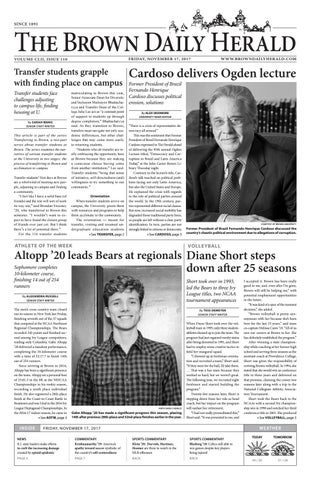
Fernando Henrique Cardoso discusses political erosion, solutions By ALEX SKIDMORE UNIVERSITY NEWS EDITOR
“There is a crisis of representative democracy all around.” This was the sentiment that Former President of Brazil Fernando Henrique Cardoso expressed to The Herald ahead of delivering the 95th annual Ogden Lecture titled, “Democracy and Corruption in Brazil and Latin America Today,” at the John Carter Brown Library Thursday night. Contrary to the lecture’s title, Cardoso’s talk touched on political problems facing not only Latin America, but also the United States and Europe. He explained the crisis with regards to the role of political parties around the world. In the 19th century, parties represented different social classes. But now, increased social mobility has degraded those traditional party lines, so people are left without a clear party identification. In turn, parties are not strongly linked to citizens or democratic » See CARDOSO, page 3
COURTESY OF BROWN UNIVERSITY
Former President of Brazil Fernando Henrique Cardoso discussed the country’s chaotic political environment due to allegations of corruption.
ATHLETE OF THE WEEK
VOLLEYBALL
finishing 14 out of 254 runners
Short took over in 1993, led the Bears to three Ivy League titles, two NCAA tournament appearances
Altopp ’20 leads Bears at regionals Diane Short steps Sophomore completes down after 25 seasons 10-kilometer course, By ALEXANDRA RUSSELL SENIOR STAFF WRITER
The men’s cross country team closed out its season in New York last Friday, finishing seventh out of the 37 squads that competed at the NCAA Northeast Regional Championships. The Bears recorded 245 points and finished second among Ivy League competitors, trailing only Columbia. Gabe Altopp ’20 delivered a standout performance, completing the 10-kilometer course with a time of 32:17.7 to finish 14th out of 254 runners. Since arriving at Brown in 2016, Altopp has been a significant presence on the team. Altopp set a personal best of 25:01.3 in the 8K at the NEICAA Championships in his rookie season, recording a ninth place individual finish. He also registered a 28th-place finish at the Coast-to-Coast Battle in Beantown and was 52nd in the 2016 Ivy League Heptagonal Championships. In the 2016-17 indoor season, he came in » See AOTW, page 3
INSIDE
By TESS DEMEYER SENIOR STAFF WRITER
ANITA SHEIH / HERALD
Gabe Altopp ’20 has made a significant progress this season, placing 14th after previous 28th-place and 52nd-place finishes earlier in the year.
When Diane Short took over the volleyball team in 1993, only three studentathletes showed up to join the team. The program had just regained varsity status after being demoted in 1991, and Short had to employ some creative tactics to field her inaugural squad. “I showed up at freshman orientation and recruited a team,” Short said. “If they went for the ball, I’d take them. … That was a fun team because they worked so hard, but we weren’t great. The following year, we recruited eight freshmen and started building the program.” Twenty-five seasons later, Short is stepping down from her role as head coach, but her impact on the program will outlast her retirement. “I had not really premeditated this,” Short said. “It was presented to me, and
I accepted it. Brown has been really good to me, and, even after I’m gone, Brown will still be helping me,” with potential employment opportunities in the future. “It was kind of a spur of the moment decision,” she added. “Brown volleyball is pretty synonymous with her because she’s been here for the last 25 years,” said team co-captain Melissa Cairo ’18. “All of us owe our careers at Brown to her. She has definitely established the program.” After winning a state championship while coaching at her former high school and serving three seasons as the assistant coach at Providence College, Short was given the responsibility of reviving Brown volleyball. In 1994, she stated that she would win an conference title in three years and delivered on that promise, claiming the crown two seasons later along with a trip to the National Collegiate Athletic Association Tournament. Short took the Bears back to the NCAAs with a second Ivy championship win in 1998 and notched her third conference title in 2001. She produced » See VOLLEYBALL, page 3
WEATHER
FRIDAY, NOVEMBER 17, 2017
NEWS R.I. state leaders make efforts to curb the increasing damage created by opioid epidemic
COMMENTARY Krishnamurthy ’19: America’s apathy toward soccer symbolic of the country’s self-centeredness
SPORTS COMMENTARY Klein ’20: Darvish, Martinez, Hosmer are three to watch in the MLB offseason
SPORTS COMMENTARY Blasberg ’18: Celtics still able to win games despite key players being injured
PAGE 4
PAGE 7
BACK
BACK
TODAY
TOMORROW
44 / 30
51 / 28
NEWS
PAGE 2 • FRIDAY, NOVEMBER 17, 2017
» TRANSFER, from page 1 — includes events and activities similar to first-years’ orientation. “A large emphasis of orientation is raising awareness of resources and communities at Brown,” Bhattacharyya said. The transfer events also make sure to touch on topics pertinent to transfer students, such as academics and degree completion, she added. In addition to orientation, students meet with transfer counselors — previous transfer students who walk new transfers through orientation and offer their advice, said Zoe Zacharopoulos ’19, a transfer counselor. These counselors are transfers’ “strongest base of support,” said James Ford ’19. Even with these initial systems of support, the transfer orientation can be overwhelming for students — Zacharopoulos described it as a flurry of information “thrown at you in the first four days,” said. But the stress of orientation bonds transfers together, Ford said. Housing Besides orientation, transfer students may make initial connections through housing. Though the University lacks a specific housing program for transfer students, transfers often end up with other transfer students. Students are housed with returning students in their class based on availability, Bhattacharyya said. Ford lived with one transfer and three returning students during his first year at Brown — an ideal living situation that allowed him to connect with another transfer student and expand his social circle through returning students, he said. Though some transfer students end up satisfied with their housing upon coming to Brown, others, especially spring transfers, face stress trying to find a place to live on campus. Rachel Risoleo ’19, a spring transfer, missed the application deadline for off-campus housing for the next academic year, so she had to enter the housing lottery. After failing to find a dorm and getting put in the summer assignment process, she eventually got permission to live off-campus after a long backand-forth with ResLife. As she had been on campus for only a month before entering the housing process in the spring, Risoleo said ResLife could be more sympathetic to transfer students. Julia Christensen ’18, another spring transfer, agreed that transfer students are “put at a huge disadvantage” when it comes to housing. “We just got there in the spring, so everyone had to make arrangements quickly,” she said. To ameliorate the stress the housing process can cause, Lee and Bhattacharyya organize a housing information session for transfer students and encourages them to speak with their transfer counselors about housing opinions, Battacharyya wrote in a follow-up email to The Herald. Transitions Whether one chooses to transfer in the fall or spring can not only affect transfer students’ housing experience, but also their ability to find community. When applying to transfer to
Brown as a sophomore, students indicate whether they are willing to enroll in the spring of the fall, and the University decides which semester they will begin. Within the Ivy League, Brown and Cornell are the only institutions that enroll transfers in the spring. Those who enroll in the spring can opt to remain at their original institution or study abroad at one of three Brown-sponsored programs in the fall. Risoleo transferred the spring of her sophomore year, but chose to study abroad in Granada before coming to Brown. Doing so gave her a small community of Brown students who had studied with her when she came to campus. Christensen also chose to study abroad in the fall and echoed Risoleo. Having these connections “was really great for the first few months when everyone is trying to make connections and integrate in the middle of the school year,” Christensen said. Comparatively, Zacharopoulos chose to stay at her original institution during the fall of her sophomore year. When she came to Brown in the spring, Zacharopoulos found it difficult to connect with some of her fellow transfers that studied abroad together in the fall. The spring “is not the place (nor) the time to meet new people,” Zacharopoulos added. In addition to cold and unwelcoming weather, she said “people already have their friend groups established.” Junior transfers face similar difficulties, Ford said. With only two years left of college, Ford found a stronger sense of urgency to become a part of the Brown community both socially and academically. The open curriculum can be “less accessible for (junior) transfers,” since students have less time to explore classes and fulfill concentration requirements, Ford said. Integration Despite the initial difficulties of making a home out of Brown, transfer status is “not something that defines you at Brown,” Zacharopoulos said. “I still feel like Brown is my college.” Many transfers felt that the transfer community helped provide the right amount of support without completely dominating their experiences. Lee and Bhattacharyya have scheduled events for transfers to reconnect throughout the year, but have also emphasized that students widen their social circles beyond fellow transfers. “The transfer community is good in that you can connect with people because you’re transfers, but it’s not necessarily isolating,” Risoleo said. Some transfers have made the effort to deliberately reach out beyond the transfer community to make sure they don’t end up only surrounding themselves with other transfer students. “Depending on your style, I think some people really hit off being pretty good friends during the transfer orientation, and they’ll kind of stick together,” Will Friend ’20 said, adding that he has made an effort to connect with returning students to make diverse connections.
THE BROWN DAILY HERALD
TIFFANY DING / HERALD
Zoe Zacharopoulos ‘19 is a transfer counselor — a student who previously transferred to the University. She helps new transfer students transition to life at Brown during events like orientation.
TIFFANY DING / HERALD
Brendan Sweeney ‘20 trasferred to Brown in the fall. Transfer students face a plethora of challenges upon entering the University, including the lack of a specific housing program and established community.
NEWS
FRIDAY, NOVEMBER 17, 2017 • PAGE 3
THE BROWN DAILY HERALD
» AOTW, from page 1 fourth in the mile at the John Donahue Games with a time of 4:13.97. For his outstanding run last week, Altopp has been named The Herald’s Athlete of the Week. Herald: You placed highly this weekend in the 10K. What was that race like for you? Altopp: It was muddy to begin with, and it was 25 degrees, so it took a lot of focus to not let those factors distract me from the goal, which was to place as high as possible. Over 10 kilometers, it’s 30 minutes of sharp focus that you need to maintain. For me, that was hard at times, especially when it started to hurt later on in the race, but I felt good the whole way through. I just focused on not letting the weather affect me and that ended up working in my favor. Friday’s meet closed out the
» CARDOSO, from page 1 institutions, Cardoso said. “We are in a transition between very stable political organizations” to less stables ones, he told The Herald. In Latin America specifically, generalized corruption and democratic gridlock have increased as the party system has weakened, Cardoso said. He pointed to the “widening gap between peoples’ aspirations and the capacity of political institutions to respond to the demands of society.” All of these factors “pave the way to demagoguery,” Cardoso said. Cardoso turned to address issues plaguing his home country. In the face of corruption charges against major political figures, such as Former President Dilma Rousseff and Former President Lula da Silva, Brazil is confronting a “moral crisis arising now (after) the disclosure of a widespread system of corruption,” Cardoso said. Brazil requires a majority in its congress to pass bills, but, since there are currently 28 parties in the Brazilian legislature — and no party with more than 20 percent of the representatives — the president’s party must build a coalition to advance any legislation. This system “is not a choice, but an imposition on the president,” Cardoso said. Over the last decade and a half, the number of political parties has increased
team’s 2017 campaign. Can you reflect on the season a little? For much of the season, I hadn’t been feeling that great. It seemed like there was a net upward trajectory throughout the season. I started off pretty poorly — I wasn’t racing very well, but then, as the season progressed, I began to perform better. I was not expecting to place as highly as I did, so to finish 14th was definitely a nice surprise, and it was definitely a high point of my season. When did you get into running? The first year I ended up running was in the spring of seventh grade. Seventh grade was the first year that we were able to start playing sports at my middle school, and we only had an outdoor track. Before high school, I moved to Connecticut, and that’s when I became more serious and started running all three seasons.
in Brazil and, as a result, presidents are forced to bargain with more and more representatives for votes. Though corruption has always existed in Brazil, this process has made it much more widespread, Cardoso told The Herald. In 2005, for example, the Mensalão Scandal implicated da Silva’s government in a scheme that paid representatives in monthly installments for their votes. After this incident, the presidential system transformed from “a system of coalition to a system of corruption.” More recently, the Petrobras Scandal — in which government-appointed executives of the state-run oil company diverted money from public contracts into their own pockets — “disclosed the systematic nature of corruption in Brazil.” Now, cynicism toward government percolates throughout the “educated middle class” and the Brazilian people at large, he said. Yet Cardoso struck a tone of optimism at the end of the talk. In previous generations, Brazilians would welcome a military coup to rid their society of corruption, he said. But now, citizens are putting their faith in democratic institutions, such as the court system and federal police, to remedy the country’s political problems. “We know the names of the 11 justices of the Supreme Court,” Cardoso said. “They are household names.”
Did you play any other sports growing up? Yeah, baseball was kind of my sport before running — I only joined the track team in middle school because I got cut from the baseball team. You have competed in different distance events on the track. Do you have a favorite? Yeah, I’d say the 3K, that’s probably my favorite. It’s a nice mix — it’s an endurance event, but it’s not like the 10K. Last Friday was a 10K, and that’s a very grueling race because you’re running for over 30 minutes usually. The 3K is over in eight and a half minutes. I also just enjoy running on the track. Fifteen laps on the indoor track is the perfect length I think. Do you have a favorite meet day breakfast or meal? I usually just go with cereal, but on race day last Friday we were at a hotel,
» VOLLEYBALL, from page 1 three Ivy Players of the Year, two Ivy Rookies of the Year and 27 All-Ivy League players. But her influence on the teams she coached went beyond the accolades. “Coach Short has the most amazing outlook on life,” wrote Shirin Tooloee ’18 in an email to The Herald. “She’s fearless and lives every day to the fullest. Even when faced with adversity, she handles herself so well, and she’s been
so there were more options. I think I had a bagel and eggs, and two cups of coffee; coffee’s a must have — and orange juice. Pretty standard stuff, nothing special. Do you have any pre-race rituals or routines that you do to get in the zone? No, I try to stay relaxed. I try to visualize the race before I get in the line, but that’s not much of a ritual. I guess the biggest thing is just staying relaxed and not letting the nerves get to me, which is pretty easy to do on a stage as big as Regionals or Heps. How did you choose Brown? I was looking at other schools, mostly in the Ivy League. I came to Brown because of the team here. When I visited in the fall of my senior year, this team stood out to me — it was definitely the most cohesive, and I liked a lot of the guys. I had a
such an inspiration to us.” Though she primarily offered guidance on the court, Short understood her athletes were also students and encouraged them to pursue whatever academic path they chose. “She allowed each of us to not only be the kind of athletes we wanted to be but the students we wanted to be (as well),” Cairo said. “She really allowed us to try to reach our full potential as an athlete and a student, and I will be forever grateful for that.”
great host too — shoutout to Andrew Foerder ’18. I was intrigued by the open curriculum — that seemed appealing to me, but it was definitely the team that stood out to me above everything else. It won’t be long until the team starts competing indoors on the track. How are you preparing for that? What are your plans for the off-season? We’re already gearing up for indoor. Right now we’re just doing base mileage — we’re not working out or anything. In the off-season, I’ll still be running. We have winter break, so I plan on enjoying that. I’ll still be running out in the snow, but won’t have classes to worry about or anything. I’m not doing much in the off-season, just getting excited to race in indoors. This interview was edited for length and clarity.
While she won’t necessarily miss the five-hour bus rides to Cornell or the 7 a.m. workouts, Short will miss the she time spent with her assistant coaches and players. But her time off the court may be brief, as she isn’t “burnt out” on coaching at all. “I thoroughly love coaching, and I’m going to coach again,” she said. “I love the sport so much that it doesn’t matter what level I coach. I still enjoy just being in the gym. In a way, I feel like Superwoman in the gym.”
NEWS
PAGE 4 • FRIDAY, NOVEMBER 17, 2017
THE BROWN DAILY HERALD
State officials act to stymie Rhode Island’s opioid epidemic Gov. Raimondo among those who criticize Trump’s rhetoric as little more than empty gesture By JEFF DEMANCHE STAFF WRITER
In the midst of one of the deadliest public health crises in U.S. history, President Trump has directed the Department of Health and Human Services to declare the opioid epidemic a “public health emergency,” a move he hopes will “liberate our communities from this scourge of drug addiction.” But Senator Jack Reed, D-RI, has criticized the declaration as an empty gesture. Many speculated prior to Trump’s announcement that the president might declare a national state of emergency, a move that would have automatically allocated funds to affected states. The public health emergency stops short of this, releasing no funds. “The opioid crisis is a national emergency that requires urgent care, attention and resources. The president’s response has been underwhelming,” Reed said in a press release. In Rhode Island,Gov. Gina Raimondo counts herself among those who believe the Trump
Administration’s declaration is not enough. In an October press release, Raimondo condemned the president’s response, saying that she has “attended the funerals of too many constituents and too many of my friends’ kids who have lost their lives because of this crisis.” “If we’re going to end it and save lives, states like Rhode Island need resources from the President and his administration, not rhetoric,” the release continued. In 2016, the Ocean State saw 336 overdose deaths — a number that has risen each year since the data was first reported in 2009, according to PreventOverdoseRI.org, a website run by the State of Rhode Island and Brown’s School of Public Health. “The Governor believes that the opioid crisis is the most urgent public health challenge facing our state today,” said Catherine Rolfe, Raimondo’s deputy press secretary in an email to The Herald. While Rhode Island has taken significant actions to address the epidemic, Raimondo believes the state needs to commit more funding
to combat the crisis, Rolfe said. As part of an ongoing effort to reduce the number of overdose deaths in the state, the governor signed an executive order in 2015 creating the Overdose Prevention and Intervention Task Force. The task force names guidelines for the treatment of opioid addiction in hospitals and emergency departments and offers medication to state inmates to combat addiction while incarcerated. It is the first program of its kind, said Joseph Wendelken, public information officer for the Rhode Island Department of Health. The state’s task force and associated Overdose Action Plan prioritize reducing the number of overdose deaths first, then attempt to address the wider problem of opiate addiction, said Brandon Marshall, associate professor of epidemiology at the School of Public Health. Part of this effort involves increased funding for the distribution of Naloxone — an antidote to opioid overdose. “What a lot of people don’t realize is that overdose is a relatively slow condition,” Marshall said, noting that it can often take one to two hours for a person overdosed on heroin to succumb, during which they could be
resuscitated by Naloxone. Fentanyl, a relatively new illicit opiate, gives the rescuer less time, part of the reason why it poses such a danger. For its part, Providence has installed a “NaloxBox” in City Hall. Designed by Geoff Capraro, professor of emergency medicine, along with a group from the Rhode Island School of Design, the box aims to distribute Naloxone to those who could intervene during an overdose. “The President is certainly right to call the scourge of opioid addiction a public health emergency,” said Senator Sheldon Whitehouse (D-RI) in a press release. “But to fight this emergency in earnest, we need more than declarations; we need full funding behind the Comprenhensive Additiction and Recovery Act Congress passed last year.” Whitehouse co-authored the act last year with Senator Rob Portman (R-OH), seeking to “educate people about the consequences of drug abuse and to boost prevention efforts,” wrote a spokesperson on behalf of Whitehouse in a follow-up email to the Herald. “The legislation is helping family, friends and health care and law enforcement professionals in confronting an overdose. And it lends support to those following the long, noble path
to recovery.” While former President Obama signed the bill into law in 2016, it still needs more funding to be effective, Whitehouse said. “The number of people who die from opioid addiction is rising extremely fast,” said Marshall, who contributes to the state website. According to Marshall, the opioid crisis rose from wide overprescription of opiate painkillers in the 1990s. That resulted in a “huge amount of opioids circulating in the community.” Many young people’s initial exposure to opioids is through prescription pills, but, as their dependency increases or their access to prescription drugs dries up, many transition into illicit drugs such as heroin or fentanyl, Marshall said. In 2016, illicit drugs caused 214 overdose deaths in Rhode Island, compared with just 31 deaths in 2009. Meanwhile, overdoses due to prescription drugs have decreased. While the crisis appears bleak, Marshall said that recent data suggest the trend of increasing death counts may be shifting. According to Marshall, the first six months of 2017 showed a 12 percent decrease in reported overdose deaths, a figure he calls “encouraging.”
STAY UP-TO-DATE. FOLLOW US ON FACEBOOK. FACEBOOK.COM/BROWNDAILYHERALD
TODAY
FRIDAY, NOVEMBER 17, 2017 • PAGE 5
THE BROWN DAILY HERALD
menu
s ta i r c a s e s k e t c h e s
SATELLITE DINING ANDREWS COMMONS
Pizza: Harvest, Pepperoni, Bacon Alfredo, Buffalo Chicken JOSIAH’S
BLUE ROOM
Chicken Pot Pie Bowl, Quesadilla Station
Sushi Night
DINING HALLS SHARPE REFECTORY LUNCH
DINNER
Barbecue Beef Sandwiches, Cajun Potatoes, Quinoa with Kale and Olive, Blondie Bars
Chicken Parmesan, Escalloped Potatoes, Mac and Cheese, Pineapple Upside Down Cake
VERNEY-WOOLLEY LUNCH
DINNER
Breaded Chicken Fingers, Carne Asada, Spicy Dahl, Breaded Soy Fingers, Blondie Bars
Breaded Turkey Cutlet, Cavatelli Primavera, Panettone Bread Pudding
sudoku
TIFFANY DING / HERALD
A stairwell in List Art Center is decorated with paintings done by students. One such painting depicts a small child eating an ice cream cone and includes a number of abstract designs. R
AS
DA
A
S
ACROSS 1 Musician Ocasek et al. 5 See 15-Across 9 Cavaradossi’s love 14 When some deadlocks are resolved, briefly 15 With 5-Across, barely 16 Racing venue near Windsor Castle 17 Inferior swim? 19 Quick trip 20 Ran out of patience 21 Column affording views 23 Shirt size: Abbr. 24 Novelist Glyn 26 Impertinent camera movement? 29 Shoved off 31 Cried 32 Half a tuba sound 34 Oafs 35 Burly Green Bay gridder? 40 Split 42 Calypso cousin 43 Shackle 46 Kind of offer that saves time 52 Canine telling bad jokes? 54 Over 55 “He’s mine, __ am his”: “Coriolanus” 56 “Get __”: 1967 Esquires hit 58 GPS precursor 59 Critical 62 Suspicious wartime sight? 64 Wonderland cake words 65 Urgent letters 66 Behold, to Caesar 67 “Golf Begins at Forty” author 68 Asian holidays 69 Starting point DOWN 1 Megabucks
c r o s s w o rDd
C
Edited by Rich Norris and Joyce Nichols Lewis 2 Sniff 3 Make the cut together? 4 Oktoberfest souvenirs 5 Dawn rival 6 Menu choice 7 Receipts, e.g. 8 High-strung sorts 9 New Jersey casino, with “The” 10 Mama bear, in Madrid 11 Henry Moore, e.g. 12 Joined a line, in a way 13 Shows up 18 Old congregating locale 22 “Like, no kidding!” 25 Scream 27 Prepare to fire 28 Noel 30 Powell’s “The Thin Man” co-star 33 Gitmo guards
35 Belgian surrealist 36 Yeats’s home 37 “It’s worth __” 38 Rap sheet letters 39 New gnu 40 Breakfast places 41 Average American, it’s said 44 “Star Trek: DSN” character
ANSW R
O
45 Milk for losers 47 __ pad 48 Grand decade 49 Top gun 50 Batting coach’s subject 51 Tooted 53 Semblance 57 H.S. exam 60 Dr.’s order? 61 Set the pace 63 Some PCs
R
O S
Q U O T E O F T H E D AY
“The Governor believes that the opioid crisis is the most urgent public health challenge facing our state today.” — Catherine Rolfe, Deputy Press Secretary to Gov. Raimondo
See opioid on page 4.
calendar FRIDAY NOVEMBER MARCH
S
By Kurt Mueller (c)2012 Tribune Media Services, Inc.
M
T
W
Th
F
S
1
2
3
4
5
6
7
8
9
10
11
12
13
14
15
16
17
18
19
20
21
22
23
24
25
26
27
28
29
30
31
Pediatric Grand Rounds 8:30 A.M. Rhode Island Hospital
EEB Brown Bag Seminar 12:00 P.M. Biomed Center, 202
SATURDAY Shabbat Service and Lunch 10:30 A.M. Hillel
What? Where? When? 2:00 P.M. Smith-Buonanno, 206
SUNDAY Catholic Mass 10:30 A.M. Manning Chapel
Baha’i Club Meeting 7:30 P.M. J. Walter Wilson, 402
COMMENTARY PAGE 6 • FRIDAY, NOVEMBER 17, 2017
THE BROWN DAILY HERALD
BROWN BITES
Nov. 11-17, 2017 Big loss for Bruno Last Friday, Brown faced Dartmouth in football under the lights of Fenway Park. Bruno fell to Big Green by a final score of 33-10. This wasn’t the first time the two teams faced off in the home of the Boston Red Sox. Over 94 years ago, Dartmouth won back-to-back victories against Brown. Even so, the team went into the game feeling confident in their abilities. “Going into it, I definitely thought we had a chance to win the game,” said wide receiver Jaelon Blandburg ’20. “We just had to execute our assignments. It was a tough loss, honestly. But I never once thought that we were out of the game. I never once thought my team gave up.” This weekend, Brown will face Columbia at Lawrence A. Wien Stadium. The Bears are hoping to secure a win and avoid ending the season winless in Ivy League play. Bottoms up With the Brown Student Agencies’ bartending course, students can learn how to bartend in just two days — and they don’t even have to be 21. Students leave the course with Training for Intervention Procedures certification, allowing them to work at campus events and even for private catering companies. However, on-campus work opportunities have been dwindling and students with TIPS certification have had a hard time finding on-campus employment. Several students have expressed concern over BSA’s ability, or lack thereof, to provide students with employment opportunities.
A RT I ST ’ S NA M E
comic(s) Comic1 | Author1
Prioritizing self-care The computer science department is currently pursuing a departmentwide effort to create a healthier environment for its students. In this endeavor, the CS department has hired paid student advocates for health and wellness, responsible for organizing events focused on educating CS students on topics such as mental health and nutrition. However, even as the most popular concentration at Brown, computer science can often cause students to feel isolated. For many, the concentration lives up to its notorious reputation and students find that there is no forum to properly discuss their struggles. This new initiative hopes to remedy that. Second time’s a charm Transferring is more common than a lot of people think: It’s estimated that one third of undergrad students will transfer schools at least once during their education. Brown alone welcomes around 100 to 200 transfers each year. What seems to attract transfer students to Brown in particular is the open curriculum that allows students to “take ownership of (their) education.”
Find us online! facebook.com/browndailyherald
browndailyherald.com
@the_herald
Location: 195 Angell St., Providence, R.I. www.browndailyherald.com
@browndailyherald
youtube.com/browndailyherald
Editorial Leadership
Sections
Multimedia & Production
Business
Editor-in-Chief Lauren Aratani
Arts & Culture Editors Ethel Renia Madison Rivlin
Design Editors Christy Leung Ameer Malik Jessica Yu Assistant: Eduard Muñoz-Suñé
General Managers Henry Ritter Ben Wesner
Managing Editors Matt Brownsword Rebecca Ellis Kate Talerico POST- MAGAZINE Editor Saanya Jain BLOGDAILYHERALD Editor Angelica Cotto
Metro Editor Gwen Everett News Editors Isabel Gensler Alex Skidmore Hattie Xu Science & Research Editor Elena Renken Sports Editors Ben Shumate Nicholas Wey COMMENTARY Opinions Editors Connor Cardoso Anuj Krishnamurthy Mili Mitra
Photo Editors Head: Marianna McMurdock Assistant: Lilly Nguyen Gus Reed Sara Runkel Anita Sheih Copy Desk Chief Abby Borges Multimedia Editor Roland High
Directors Sales: Erin Lueck Sales: Matilda Lynton Finance: Reena Zhan Strategy: William Nober Strategy: Caroline Ziegler Managers Sales: Michael Borello Sales: Elizabeth Doykan Sales: Shreya Raghunandan Collections: Ravi Betzig
Editorial contact: 401-351-3372 herald@browndailyherald.com
Business contact: 401-351-3260 gm@browndailyherald.com
Submissions: The Brown Daily Herald publishes submissions in the form of op-eds and letters to the editor. Op-eds are typically between 750 and 1000 words, though we will consider submissions between 500 and 1200 words. Letters to the editor should be around 250 words. While letters to the editor respond to an article or column that has appeared in The Herald, op-eds usually prompt new discussions on campus or frame new arguments about current discourse. All submissions to The Herald cannot have been previously published elsewhere (in print or online — including personal blogs and social media), and they must be exclusive to The Herald. Submissions must include no more than two individual authors. If there are more than two original authors, The Herald can acknowledge the authors in a statement at the end of the letter or op-ed, but the byline can only include up to two names. The Herald will not publish submissions authored by groups. The Herald does not publish anonymous submissions. If you feel your circumstances prevent you from submitting an op-ed or letter with your name, please email herald@browndailyherald.com to explain your situation. You can submit op-eds to opinions@browndailyherald.com and letters to letters@browndailyherald.com. When you email your submission, please include (1) your full name, (2) an evening or mobile phone number in case your submission is chosen for publication and (3) any affiliation with Brown University or any institution or organization relevant to the content of your submission. Please send in submissions at least 24 hours in advance of your desired publication date. The Herald only publishes submissions while it is in print. The Herald reserves the right to edit all submissions. If your piece is considered for publication, an editor will contact you to discuss potential changes to your submission. Commentary: The editorial is the majority opinion of the editorial page board of The Brown Daily Herald. The editorial viewpoint does not necessarily reflect the views of The Brown Daily Herald, Inc. Columns, letters and comics reflect the opinions of their authors only. Corrections: The Brown Daily Herald is committed to providing the Brown University community with the most accurate information possible. Corrections may be submitted up to seven calendar days after publication.
Illustrations Editor Pia Mileaf-Patel
Advertising: The Brown Daily Herald, Inc. reserves the right to accept or decline any advertisement at its discretion.
Graphics Editor Laura Felenstein
The Brown Daily Herald, Inc. is a financially independent, nonprofit media organization bringing you The Brown Daily Herald, BlogDailyHerald and Post- Magazine. The Brown Daily Herald has served the Brown University community daily since 1891. It is published Monday through Friday during the academic year, excluding vacations, once during Commencement and once during Orientation by The Brown Daily Herald, Inc. Single copy free for each member of the community. Subscription prices: $200 one year daily, $100 one semester daily.
Directors of Web Development Eli White Ivy Wong
Copyright 2017 by The Brown Daily Herald, Inc. All rights reserved. Periodicals postage paid at Providence, R.I. Postmaster: Please send corrections to P.O. Box 2538, Providence, RI 02906.
COMMENTARY FRIDAY, NOVEMBER 17, 2017 • PAGE 7
THE BROWN DAILY HERALD
Why America needs to care about soccer ANUJ KRISHNAMURTHY opinions editor
The nation of Italy is in bad shape. A paroxysm of despair has overcome her people; her newspapers bemoan an imminent “apocalypse,” as her loudest commentators race to dissect shortcomings in Italian culture. No, the country has not suffered some sort of humanitarian tragedy — no political convulsions, no recessions, no nationwide tax on mozzarella. Instead, something far more unthinkable has happened: This week, Italy failed to qualify for the World Cup. The United States actually suffered the same fate a little over a month ago, when the U.S. Men’s National Team scored an own goal and lost 2-1 to Trinidad and Tobago. (I mean no disrespect, but for the love of all that is holy, Trinidad and Tobago won one match out of nine in the weeks leading up to the contest with the United States. They were, literally, among the worst in the regional competition.) Most Americans, however, didn’t seem to care about how horrendous this defeat truly was. Unlike our woebegone friends in Italy, we didn’t embark on a national program of self-flagellation or scrutinize the sorry state of American soccer. Our incompetence barely registered. Even when American soccer players succeed mightily in international competition, they still go underappreciated. The women’s team, for example, is one of the best teams in the world and has notched three World Cups, but still faces discrimination in pay. That apathy is a problem, not just for aspiring American soccer players, but for the United States at large. Our continued indifference toward soccer reflects a much deeper pathology in the American worldview:
We are simply incapable of meeting the world on its own terms and participating meaningfully in traditions that we do not already monopolize. But on a planet where American power — both military and geopolitical — is facing new pressure, and where our global hegemony is no longer an immutable reality, our continued cultural arrogance will spell our undoing. The truth is, if we want to stay relevant, we have to find new ways of connecting with the world. That means accepting the global consensus on climate change, admitting that not everyone in the world aspires to become American and, yes
better, it doesn’t expose players to serious, longterm neurological damage. In effect, soccer is probably the most accessible sport that people play. Still, professional soccer is nowhere close to capturing the American imagination in the way other sports have — and that may have something to do with our country’s reflexive hatred for anything remotely collectivistic. One scholar at the American Enterprise Institute, for example, claims that “soccer and socialism go hand in hand.” Conservative activist Ann Coulter laments the fact that soccer does not risk serious injury, fails to reward individual achievement as
The truth is, if we want to stay relevant, we have to find new ways of connecting with the world. That means accepting the global consensus on climate change, admitting that not everyone in the world aspires to become American and, yes — that means caring about soccer.
— that means caring about soccer. Why Americans are so indifferent, sometimes even hostile, to the very concept of soccer is perplexing. Millions of American children play soccer. Major League Soccer is currently enjoying exponential growth, with the average club valued at $185 million — a 400 percent boost from 2008. And more people play soccer than any other sport in the world. It’s easy to play — you don’t need any manicured greens or specialized courts. It accommodates all age groups, all genders and varying team sizes. Even
much as teamwork and often results in ties. While Coulter has never been known for her nuanced takes on culture — or humanity, for that matter — there is merit to the notion that soccer requires a different set of priorities than American sports. Football, basketball and baseball emphasize short-term tactics; plays, possessions and innings are, after all, discrete, selfcontained events. But soccer is entirely distinct. It is continuous, with only a break at the half. Play is fluid and free-flowing, and requires a coherent strategy for the entire length of the game,
not merely for isolated bursts of action. Further, soccer, as a rule, demands self-abnegation. Individual heroics do not win soccer matches; passing, generosity and restraint do. As such, soccer and American sports are underpinned by two separate value systems: individualism versus collectivism, tactical improvisation versus strategic patience. By embracing soccer, we might learn a thing or two about the intangible, unspoken principles that guide others — and, in turn, better inform our own approach to the world. We might even be able to harness the diplomatic dividends, in the form of goodwill and admiration, from a more robust presence in world soccer. Christian Pulisic, an American 19-year-old midfielder for German soccer club Borussia Dortmund, exemplifies this potential. The youngest American to score a goal for USMNT, and the youngest player to score in the Bundesliga, Pulisic is already making a name for himself in Europe. And it certainly helps to have a popular American in a country where only 22 percent of people trust the United States as an ally. Look, I’m not criticizing American values and all of their associated benefits — I promise. But as commercial and cultural exchange come to dominate global life in the 21st century, we would do well, as a nation, to learn to negotiate the unfamiliar, instead of automatically dismissing alternatives to our values as debased or immoral. Indeed, my dream of an America that is a premier force in soccer has less to do with the sport itself and more with the internationalist, convivial mentality that caring about soccer might induce.
Anuj Krishnamurthy ’19 can be reached at anuj_krishnamurthy@brown.edu.
SPORTS THE BROWN DAILY HERALD
FRIDAY, NOVEMBER 17, 2017
Where the MLB’s stars will go this offseason GEORGE KLEIN sports columnist
The Major League Baseball offseason has arrived, and that means another crop of free agents hitting the open market. While next year’s free agents, a group that includes Bryce Harper and Manny Machado, have garnered more attention, there is still quite a lot of talent available over the next few months for teams in title contention. The following are the top three free agents and predictions of their respective destinations. Yu Darvish The right-hander last left Los Angeles Dodgers fans disappointed after a short start in game seven of the World Series, as he was thoroughly eviscerated by the Houston Astros offense. In two series starts, he surrendered eight earned runs on nine hits in only 3.1 innings pitched, for a 21.60 ERA and 3.30 WHIP. While Darvish was apparently tipping his pitches, his final appearances were simply not the best way to kick off free agency. Darvish’s stamina has been a concern for some time, and his postseason track record — he owns a career 5.81 playoff ERA — has done nothing to alleviate these worries. Even if Darvish pitched terribly in the playoffs, at least he was not injured. The pitcher missed the end of 2014 with an elbow injury, spent the entire 2015 season receiving and recovering from Tommy John surgery, suffered a shoulder strain in 2016 and dealt with a period of back tightness in August 2017. Darvish is already 31 years old; it remains to be seen how many teams will offer him the contract he desires with so vast an injury history. Signing ag-
ing players has been a formula for disaster in recent years — one has only to witness Albert Pujols limp around for the Los Angeles Angels to understand the risk involved. Any team that signs Darvish will be taking a massive leap of faith. Nevertheless, even with all the potential negatives, Darvish is still one of the most talented pitchers in the game. His 2013 season, in which he recorded 277 strikeouts and a 2.83 ERA, speaks for itself. Darvish boasts a sharp slider that is often unhittable and an array of other impressive secondary pitches, which he can mix in at any time. His 2017 season, aside from the back issue and postseason, was nothing short of a success. Darvish pitched 186 and twothirds regular season innings, striking out 209 batters and accumulating a 3.86 ERA and 1.16 WHIP. Darvish has a number of interested teams and will be free to pick a contender to try his luck with and reverse the current postseason narrative of his career. Darvish’s two former teams — the Dodgers and Texas Rangers — reportedly want the righty back, but the New York Yankees, Seattle Mariners, St. Louis Cardinals and Minnesota Twins will all make convincing cases for Darvish to jump ship. But I think he’ll stay with the Dodgers. Darvish will want another chance at World Series glory and playing with the Dodgers presents his best chance to do so. A World Series win back in Los Angeles would be all the sweeter. J. D. Martinez The outfielder has turned into one of the game’s most feared sluggers after a 2014 swing adjustment that kept his bat in the strike zone for a longer period of time. Martinez hit 23 home runs in 2014, 38 in 2015, 22 in an injury-shortened 2016 season and a career-high 45 in 2017. His remarkable .690 slugging
percentage led the majors last year. Acquired mid-season by the Arizona Diamondbacks from the Detroit Tigers, Martinez helped to anchor Arizona’s lineup around Paul Goldschmidt on the way to a playoff appearance. Martinez, represented by the famous agent Scott Boras, is seeking a massive $200-plus million contract. In this golden age of home runs, teams may not be willing to give up that much to sign Martinez. Over the past couple of offseasons, sluggers like Mark Trumbo and Nelson Cruz have been forced to sign for less than expected. Power is a surplus in baseball at the moment, so the market for home run hitters has been depressed. Still, Martinez stands out among the rest of baseball’s sluggers and can play the field adequately, unlike Trumbo or Cruz. The St. Louis Cardinals, Arizona Diamondbacks, San Francisco Giants and Boston Red Sox are the teams currently in the mix for Martinez’s services. Others may follow, but those four teams already represent a breadth of opportunities for Martinez. He could return to a situation in Arizona that has already worked — though the Diamondbacks are unlikely to give him $200 million. On the other hand, hitting at Fenway Park provides Martinez yet another power boost — the right-handed hitting Martinez could hit more than 50 homers over the Green Monster. The Cardinals and Giants, meanwhile, are traditional National League contenders. San Francisco has shown an enthusiasm for big moves this offseason after a rough 2017, attempting to trade for Giancarlo Stanton. I predict Martinez will end up with the Boston Red Sox. The chance to hit a plethora of home runs and contend for a championship is too good to pass up.
JD Martinez, who hit 45 home runs in his 2017 campaign, hits free agency this summer and already has a multitude of teams looking to sign him.
Eric Hosmer The first baseman was the leader on
George Klein ’20 can be reached at george_klein@brown.edu
COURTESY OF WIKIMEDIA COMMONS
the 2015 World Series champion Kansas City Royals and has been a dependable part of their lineup for years. Hosmer totaled 25 HR and 94 RBI with a .318 BA and .883 OPS last year, in his finest big league season yet. At only 28 years of age, Hosmer has several prime seasons ahead of him and will see a lot of generous offers. While 2017 saw a star-quality season from Hosmer, his overall body of work is less encouraging. He hit only .266 with a .761 OPS in 2016, and though his 2013 and 2015 campaigns were better, his OPS figures of .801 and .822 still fall well short of this year’s mark. Hosmer’s 2012 and 2014 seasons were even worse — .663 and .716 OPS numbers respectively — which put the first baseman at the level of a replacement-level player. Hosmer cited a hitting adjustment, learning to lay off inside fastballs, as the reason for his improvement. If that change holds, Hosmer can play at
an All-Star level for years to come and move past the sometimes-shaky beginning of his career. Teams interested in Hosmer include the Red Sox, Royals, Mariners and New York Mets. The Royals are the sentimental choice, but will not be able to offer Hosmer the contract he wants. The New York Mets may not have enough talent healthy on the field to entice the first baseman. It may come down to the Red Sox and Mariners. While Seattle may seem like a dark horse candidate, the team has been willing to spend big in the past and could form a dominant infield with Hosmer, Cano, Jean Segura and Kyle Seager. Hosmer will travel west to play for the Mariners. With the addition of Hosmer, the Mariners can set themselves up for a playoff run in 2018.
Celtics keep winning with depth CHARLIE BLASBERG sports columnist
One thing that has characterized the New England Patriots’ 16-year reign of terror on the NFL has been the team’s ability to win, even when key players are injured or get traded away. Staying the course even when chunks of the team are missing has been dubbed the “next man up” mentality, and it speaks to a team’s depth as well as its overall culture. For example, while the Patriots are famous for delivering wins by optimizing their depth, the Boston Celtics have adopted it this season. And they have been winning. The Celtics’ season was off to a tumultuous start when they lost their blockbuster offseason signing Gordon Hayward to a season-ending ankle injury in the opening minutes of their first game. They went on to lose to the Cavaliers in game one and were defeated by the Milwaukee Bucks in the following game, leaving fans wondering what kind of grit this team had. Fans were right to wonder about this group. After all, it has only four returning
players from the previous season, and its longest tenured player, Marcus Smart, is just in his fourth year with the team. Furthermore, the Celtics were built with Gordon Hayward as a centerpiece. Losing him forced 19-year-old rookie Jayson Tatum to assume a larger scoring burden. Despite their early-season woes, the Celtics responded by rattling off 14 consecutive wins en route to the best record in the NBA. These wins have not come easy as the undisputed leader of the team, Al Horford missed two games while going through the NBA concussion protocol. Kyrie Irving, the most prolific scorer on the team— and maybe in the entire league so far this season — missed almost two games with a facial fracture. Backup center Marcus Morris missed the season’s first nine games with knee soreness, and Jayson Tatum had to miss time due to ankle soreness. Still, since Oct. 18, the Celtics are undefeated. Barring an unpredictable injury to Gordon Hayward, Danny Ainge’s high-profile transactions over the past two years have paid off with terrific oncourt production and leadership from Al Horford and Kyrie Irving. Less visibly, though, his moves this offseason replacing last season’s bench have been just as impressive and impactful.
Ainge signed point guard Shane Larkin who, after being dismissed by the Brooklyn Nets, ended up in Barcelona last summer. He has been a solid scoring guard off the bench, and his 16 points against the Charlotte Hornets and lock down defense against the Nets were instrumental in securing wins against both teams. The backup big men have been just as critical. Like Larkin, Daniel Theis came to the Celtics via Europe, and Theis has been a remarkable defender and rebounder so far. Aron Baynes is also a key piece to the rotation, splitting time with Theis as a replacement for Al Horford. Defense in the paint and rebounding were glaring weaknesses for the Celtics last season. Theis and Baynes, along with Horford, have changed that so far. The Celtics have a league-best 95.8 defensive rating and are third in the NBA with 56.5 rebounds per game. Danny Ainge has shown flashes of Bill Belichick recently by signing other teams’ misfits and castaways and putting them in a position to make an impact. The bench has been crucial to the Celtics’ 13-game win streak, as Hayward is out for the season and Horford, Kyrie Irving and Jayson Tatum have all missed significant time due to injuries. Against strong opponents like the Bucks, San
COURTESY OF WIKIMEDIA COMMONS
Al Horford has been one of the best players for the Celtics this year, increasing his assist numbers after an injury to teammate Gordon Heyward. Antonio Spurs and Oklahoma City Thunder, the bench has stepped up to push the Celtics to victory. Astute offseason transactions by Danny Ainge have enabled these Celtics to be championship contenders even without the
superstar Hayward.
Charlie Blasberg ’18 can be reached at charles_blasberg@brown.edu.