SINCE 1891
THE BROWN DAILY HERALD TUESDAY, SEPTEMBER 27, 2016
VOLUME CLI, ISSUE 73
WWW.BROWNDAILYHERALD.COM
U. prepares for NEASC accreditation after decade University focuses on reinforcing mission, amassing data, identifying areas for improvement By SHIRA BUCHSBAUM SENIOR STAFF WRITER
GUS REED / HERALD
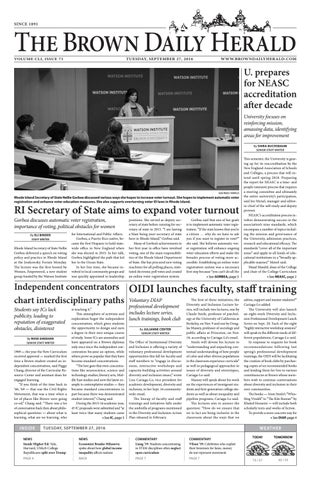
Rhode Island Secretary of State Nellie Gorbea discussed various ways she hopes to increase voter turnout. She hopes to implement automatic voter registration and enhance voter education measures. She also supports overturning voter ID laws in Rhode Island.
RI Secretary of State aims to expand voter turnout Gorbea discusses automatic voter registration, importance of voting, political obstacles for women By ELI BINDER STAFF WRITER
Rhode Island Secretary of State Nellie Gorbea delivered a speech on voting policy and practice in Rhode Island at the Joukowsky Forum Monday. The lecture was the first hosted by Women, Empowered, a new student group funded by the Watson Institute
for International and Public Affairs. Gorbea, a Puerto Rico native, became the first Hispanic to hold statewide office in New England when she was elected in 2015. In her talk, Gorbea highlighted the path that led her to the Ocean State. In her free time, she became involved in local community groups and was quickly appointed to leadership
positions. She served as deputy secretary of state before running for secretary of state in 2015. “I am having a blast being your secretary of state here in Rhode Island,” Gorbea said. Many of Gorbea’s achievements in her first year in office have involved voting, one of the main responsibilities of the Rhode Island Department of State. She has procured new voting machines for all polling places, instituted electronic poll votes and created an online voter registration system.
Gorbea said that one of her goals is to implement automatic voter registration. “If the state knows that you’re a citizen … why do we have to ask you if you want to register to vote?” she said. She believes automatic voter registration will enhance ongoing voter education efforts and make the broader process of voting more accessible. Establishing an online voter registration system was a necessary first step because “you can’t do all the » See GORBEA, page 3
This semester, the University is gearing up for its reaccreditation by the New England Association of Schools and Colleges, a process that will extend until spring 2018. Preparing the report for NEASC is a time- and people-intensive process that requires a steering committee and ultimately the entire university’s participation, said Joe Meisel, manager and editorin-chief of the self-study and deputy provost. NEASC’s accreditation process involves demonstrating success in the association’s nine standards, which encompass a number of topics including the mission and governance of the University, admission practices, research and educational efficacy. The standards “cover all of the important areas” and apply to all kinds of educational institutions in a “broadly applicable manner,” Meisel said. Maud Mandel, dean of the College and chair of the College Curriculum » See NEASC, page 2
Independent concentrators OIDI launches faculty, staff training chart interdisciplinary paths Voluntary DIAP Students say ICs lack publicity, leading to reputation of exaggerated obstacles, disinterest By ROSE SHEEHAN SENIOR STAFF WRITER
1969 — the year the New Curriculum received approval — marked the first time a Brown student created an independent concentration, said Peggy Chang, director of the Curricular Resource Center and assistant dean for engaged learning. “If you think of the time back in ’68, ’69 — that was the Civil Rights Movement, that was a time when a lot of places like Brown were going co-ed,” Chang said. “There was a lot of conversation back then about philosophical questions — about what is learning, what are we learning, who
INSIDE
is teaching it.” This atmosphere of activism and exploration begot the independent concentration, which gives students the opportunity to design and earn a degree in their own unique course of study. Some ICs are anomalies and have appeared on a Brown diploma only once since the independent concentration became an option, while others prove so popular that they have become standard concentrations. “The lore goes that even concentrations like neuroscience, science and technology studies, literary arts, Middle East studies and now the latest example is contemplative studies — they became standard concentrations in part because there was demonstrated student interest,” Chang said. During the 2015-16 academic year, 45 IC proposals were submitted and “at least twice that many students came » See IC, page 3
professional development includes lecture series, lunch trainings, book club By JULIANNE CENTER SENIOR STAFF WRITER
The Office of Institutional Diversity and Inclusion is offering a variety of voluntary professional development opportunities this fall for faculty and staff members to “engage in discussions, interactive workshops and capacity-building activities around diversity and inclusion issues,” wrote Liza Cariaga-Lo, vice president for academic development, diversity and inclusion, in her Sept. 16 communitywide email. The lineup of faculty and staff trainings and initiatives falls under the umbrella of programs mentioned in the Diversity and Inclusion Action Plan released in February.
The first of these initiatives, the Diversity and Inclusion Lecture Series, will include two lectures, one by Claude Steele, professor of psychology at the University of California at Berkeley, on Nov. 9 and one by Douglas Massey, professor of sociology and public affairs at Princeton, on Nov. 16, according to Cariaga-Lo’s email. Steele will devote his lecture to “understanding and unpacking contextual understanding of how people of color and other diverse populations in the classroom experience curricula” as well as pedagogical approaches to issues of diversity and stereotypes, Cariaga-Lo said. Massey will speak about his work on the experiences of immigrant students and first-generation college students as well as about inequality and pipeline programs, Cariaga-Lo said. The lectures aim to answer the question: “How do we ensure that we in fact are being inclusive in the classroom about the ways that we
advise, support and mentor students?” Cariaga-Lo added. The University will also launch an eight-week Diversity and Inclusion Professional Development Lunch Series on Sept. 28. Each of the eight “highly interactive workshop sessions” will speak to the different needs of different populations, Cariaga-Lo said. In response to requests for book recommendations following last spring’s professional development trainings, the OIDI will be facilitating the creation of book clubs by purchasing copies of six recommended books and lending them for free to various constituencies at Brown whose members wish to continue conversations about diversity and inclusion in their own communities. The books — from Steele’s “Whistling Vivaldi” to “The Kite Runner” by Khaled Hosseini — will include both scholarly texts and works of fiction. To provide a more concrete way for » See DIAP, page 4
WEATHER
TUESDAY, SEPTEMBER 27, 2016
NEWS Inside Higher Ed: Yale, Harvard, UMich College Republicans split over Trump
NEWS Economist Branko Milanovic spoke about how global income inequality affects nations
COMMENTARY Liang ’19: Students concentrating in STEM disciplines often neglect open curriculum
COMMENTARY Vilsan ’19: Celebrities who exploit their feminism for fame, money do not represent movement
PAGE 4
BACK
PAGE 7
PAGE 7
TODAY
TOMORROW
73 / 57
63 / 55
NEWS
PAGE 2 • TUESDAY, SEPTEMBER 27, 2016
THE BROWN DAILY HERALD
COURTESY OF WIKIMEDIA COMMONS
To stay accreditated by the New England Association of Schools and Colleges, the University must meet nine standards, addressing areas including curriculum, administration and admission, among others. In preparation for this reaccreditation process, the University encouraged professors to provide syllabi online.
» NEASC, from page 1 Committee, noted that reaccreditation is a “two-fold process,” in that it ensures the University is doing the things it intends to very well, and it provides an opportunity to review newer initiatives and focus their directions. “One of the things academic institutions do very well is constantly check in with themselves,” Mandel said. Accreditation processes are a “form of self-governance among institutions,” Meisel said, adding that the process amounts to a “kind of peer-review system.” After the steering committee compiles an initial report addressing the standards through existing committees on campus this fall, it will reach out to the rest of the campus community for more feedback, Meisel said. Simultaneously, the Office of Institutional Research is collecting data to supplement the narrative report. OIR ran its first round of data collection this past summer, distributing “forms to key staff (members) in major topic areas” such as admission and financial aid, wrote Tracy Barnes, director of institutional research, in an email to The Herald. OIR collects “a wide range of required information and then additional information as needed to inform the report,” Barnes wrote. The final draft of the report will be shared again with the campus as well as NEASC for review and suggestions before final submission, Meisel said. The entire process concludes with a campus visit from a NEASC
committee in spring 2018, Meisel said. The visiting committee members, who are academics from peer institutions, have the opportunity to see the university in action, as well as evaluate the same standards on site. “It’s hard to see yourself,” Mandel said. “The value of bringing in someone from the outside is they can see things you cannot.” In the 2008 review, NEASC recommended the University reevaluate the tenure process to fit peer institutions’ standards, ensuring its priority remained teaching rather than research. In preparation for reaccreditation this time around, the College encouraged faculty members to provide syllabi online prior to the semester so that they are more easily accessible for accreditors. In turn, students were able to make “targeted choices” during shopping period, Mandel said. “In thinking about how to prepare for NEASC, we highlighted an area we thought we could improve before they even got here,” Mandel said. NEASC also notes the university’s strong suits. “We are building on distinction, after all,” Mandel said, referring to the title of President Christina Paxson’s P’19 strategic plan. “We have some real strengths.” The accreditation process is especially relevant to this “specific moment at Brown,” Meisel said. “The last several years, we’ve been going through all kinds of planning and processes. We’ve really been engaging in campuswide, thoughtful discussions. Now we can try to pull all that together.” He added, “You say the word ‘accreditation,’ and no one gets excited, but it’s exciting to do now.”
NEWS
TUESDAY, SEPTEMBER 27, 2016 • PAGE 3
THE BROWN DAILY HERALD
» IC, from page 1 in to talk about doing an IC,” Chang said. After completing the application process, 13 students received approval for their independent concentrations. Students in the process of completing their ICs said the program has a reputation for being difficult because of widespread ignorance and skepticism about the process of proposing and completing them. But students who demonstrate the necessary passion for fields outside the realm of standard concentrations tend to receive approval, Chang said. Independent, and often interdisciplinary “I was originally an econ major, and I wasn’t really happy,” said Yuval Yossefy ’17. “They would give us basically these big mathematical theories, but they wouldn’t really explain much about them … why we believe in them or how we got to them.” In order to find “historical or cultural justification” for economic theories, Yossefy had to combine an education in economics with humanities courses, he said. His IC, the history of economic theory, enabled him to take an interdisciplinary approach to the subject. In fact, many independent concentrators are motivated by a passion that spans departments and disciplines. Radhika Singhal ’17 is concentrating in health economics, or the “social, cultural context that people live in and how that factors into how they perceive health and healthcare,” she said. Her IC focuses on developing countries and the importance of interacting with their citizens and trying to “understand what they want and how they perceive certain things before actually trying to fix” healthcare issues, she added. Though Singhal considered double concentrating in public health and economics, she, like Yossefy, wanted
» GORBEA, from page 1 change at once,” Gorbea said. Gorbea underscored the importance of voting as a crucial way for citizens to make political change. “You will definitely not change anything if you stay home. But you might change something if you go and vote,” she said. Gorbea said she would support an effort to overturn Rhode Island’s voter ID laws — which make it harder for young people, the elderly and people of color, especially in lower income brackets, to vote — but did not plan to propose this reversal herself. Instead of tackling the legislation, Gorbea said she decided “to work on things that actually open up voting for a broader number of people and hopefully get higher numbers of people to participate,” such as education and outreach campaigns.
more “multidisciplinary exposure.” Her IC combines classes in the economics, public health, anthropology and American studies departments. Similarly, Anna Schwartz ’17 chose to concentrate in music cognition, an IC that includes courses from the music and CLPS departments. “The purpose of it is really to look at how these two seemingly different disciplines are in fact really related and connected to each other,” she said. Danielle Perelman ’17 considered at least six different standard concentrations offered at the University but “didn’t really want to settle” on pursuing only one of her interests, she said. So, she created her own IC, multimedia storytelling. “It’s basically looking at how different mediums affect the stories that are being told. So looking at film, photography, journalism, performance, virtual reality,” Perelman said. There are a few common independent concentrations that multiple students have pursued, sometimes simultaneously. For example, three students have applied to concentrate in educational neuroscience, though each has interpreted the concentration “on their own terms, selecting a different advisor and different courses,” Chang said. Independent concentrations are “all about students not just having a lot of disciplines represented in their concentration, but how are the disciplines talking to one another, what’s the relationship,” Chang said. “The program is ideal for students who have a very clear research question or focus in mind and very much see the need to look at it from more than one disciplinary perspective.”
that there’s not a real understanding or personal interpretation.” Other common errors in independent concentration proposals include using “very specific terminology to the field” that committee members have difficulty understanding. Another concern is a lack of cohesion among different disciplines and departments, she added. Yossefy said that the rigorous application process helped him to refine his IC and discover his true objective. “Where I started was very different than what my concentration ended up being,” he said.
Navigating the proposal process A proposal for an independent concentration starts with an application that requires potential independent concentrators to justify their proposed track, usually after a meeting
with Chang or student independent concentration advisors. Students must make an annotated list of the courses that will comprise their concentration, compile a bibliography of texts relevant to the IC, write a proposal for a final capstone project or thesis and attach a letter from a faculty sponsor. “A lot of it is not to discourage people, but to make sure that you’re super committed,” Perelman said. “It weeds out people who are very, very committed versus people who just want to get out of doing theory classes for MCM or something.” In structuring their independent concentrations, students can look to programs at other universities that resemble their proposed IC or to the applications of past independent concentrators for guidance, Perelman added. Finished applications are submitted to a subcommittee of the College Curriculum Council, which is “a faculty administrative body,” Chang said. Students can receive four types of responses. Their concentrations can be fully approved, tentatively approved — greenlighted except for minor changes — sent back with a request for “substantive” changes or outright denied, which typically happens if students run out of time to complete a proposed degree. Students have six opportunities to submit each academic year — proposals are due on the first of the month and decisions are released by the end of the month. In order to pursue an independent concentration, students must receive approval by the end of their sixth semester. The application process is “iterative,” Chang said, adding that proposals are rarely approved on the first submission. Chang noted that there are several mistakes that commonly lead to the CCC requesting changes to a proposal. “Some students make the mistake of just sort of cutting and pasting what’s out there,” Chang said. “But we can see
Reputation as a roadblock Among the general student body, independent concentrations are unfairly stigmatized as unduly difficult, Chang said. “I don’t want that to be the reputation, but I think it still is,” she added. This reputation made the application process daunting, Singhal said. “I remember when I was in the process of applying, it was this almost scary thing in people’s minds where they were like, ‘Oh my God, no one gets it through. That’s the hardest thing you’ll ever do,’” she said. “I did get a lot of people telling me, ‘Don’t do it, it’s not worth it,’ and sometimes I doubted myself,” Schwartz said. Though the widespread misconception of ICs as too hard is not the University’s fault, Singhal said, steps could be taken to show students that independent concentrations are doable. “People probably don’t know about it, or don’t know enough about it, to understand that it’s something that you can do,” she said. A general ignorance of independent concentrations might keep students from applying, Perelman said. “I found out about it through someone else,” she said. Increasing publicity of the option of doing an IC would improve the program and make it more accessible, she added.
“We’ve worked very hard in the past couple of years to be much more concrete about what an IC is and how to get one passed,” Chang said. “We’re not really trying to weed anybody out; we want as many to pass as possible,” she added. A lack of awareness and understanding of the independent concentration program among faculty members can also make pursuing an IC more challenging, Perelman said. “You get a lot of discouragement along the way,” she added. “I met with a few people to be my advisor and they were like, ‘I don’t really support the idea of independent concentrations; why can’t you just do MCM?’” Yossefy said that familiarizing faculty members with the IC process and the role of an IC advisor should be a priority because they play a big role in the application process. “A big hurdle for me in the early stages was … getting (faculty members) comfortable enough to sign on and support me,” he said. Though some faculty members have not encouraged students to independently concentrate, some display enthusiasm and have insight about the process. “My advisor was very helpful because he has been doing this for so long,” Singhal said. “He specifically deals with health economics in developing countries.” Either way, students who are in the process of completing their independent concentrations noted the unique opportunity provided to them by the University. An independent concentration has given her a chance to take advantage of the “freedom and opportunity” inherent in the University’s open curriculum, Singhal said. “I didn’t even know about independent concentrations when I came to Brown,” Schwartz said. “This is my unique way of being a representation of Brown’s overall philosophy of being a leader of your own education.”
She also discussed the importance of women becoming involved in politics. She said a review of Rhode Island’s budget through a gendered lens showed that rollbacks on tax credits significantly impacted the types of households likely to be headed by women while not affecting those that are often male-headed. “We need more women at the policy table,” Gorbea concluded. The fact that childcare is being discussed for the first time as a key issue this presidential election —the first one with a woman leading a major party ticket — is a testament to the claim that “as you see more women in public policy, you see different agenda items,” Gorbea added. Political organizations and events are often structured in a way that makes it hard for women to participate, Gorbea said. But she added, “if the structure doesn’t work for you,
then don’t try to adhere to it. Make it up in a way that works for you.” “Sometimes, the barriers we face — the worst ones are inside our heads,” she said. She also applauded Women, Empowered for fostering a space at Brown to discuss issues affecting women in politics, saying “we need to create safe zones to have these conversations.” Later, she added that while these safe zones create important, necessary spaces, it is very important “to also reach out and listen to those who you don’t agree with and are saying things that are really bothering you,” as doing so helps people meet their goals. Shavon Bell ’17, co-founder of Women, Empowered and a former Herald senior staff writer, said that she enjoyed hearing about the important issue of voting separated from the drama of the presidential election. Along with co-founder Lucrezia Sanes
’17, she emphasized the importance of hearing from intersectional voices in politics. She noted that Gorbea holds a “landmark historical position in Rhode Island history.” Sanes touted Gorbea’s drive to get involved in government and issues
that she found important as a model. “If you see a problem, get involved. There are so many professors and so many resources at Brown for you to get involved and actually make solutions to problems that you see happen,” she said.
Follow Sports! twitter.com/bdh_sports
NEWS
PAGE 4 • TUESDAY, SEPTEMBER 27, 2016
Higher Education Roundup BY ELENA WEISSMANN, NEWS EDITOR
College Republicans all split up over Trump
College Republicans at universities across the country are struggling to remain united over Republican presidential nominee Donald Trump, according to a Sept. 23 New York Times article. When the chapter at Yale decided to endorse Trump, for example, four members of the group’s seven-member executive board resigned and formed two new groups: the Yale New Republicans and Yale Undergraduate Conservatives Against Trump. Harvard’s Republican Club dodged the controversy by refusing to endorse Trump — the first time the group has not supported the Republican nominee since 1888. Its student president, Declan Garvey, said he made the decision after only 10 percent of club members indicated they supported Trump in an August survey. Karl Rove, former White House deputy chief of staff under President George W. Bush, told the Times that most college Republicans tend to be “center-right traditional Republican conservatives,” causing a “little bit of a mismatch.” At other schools, chapters have been more explicit in their support of Trump. Shortly after the Republican National Convention, the University of Central Florida’s College Republicans posted a letter on Facebook advising students to “not get discouraged” by Trump. The University of Michigan’s chapter formally endorsed the Trump campaign on Sept. 14 to a “really great response,” Enrique Zalamea, the president, told The Michigan Review. “Any Republican is better than Hillary Clinton,” Zalamea added.
THE BROWN DAILY HERALD
» DIAP, from page 1 staff in management to get involved, the OIDI will initiate a “12-month fellowship program” that is “designed to nurture talented and diverse staff by providing enhanced access to professional development resources and networks,” Cariaga-Lo wrote in her email. By meeting with divisional heads, engaging in weekly seminar meetings and participating in mentor programs in departments of interest, staff members will gain the skills necessary to become leaders in higher education, Cariaga-Lo said. The OIDI generates its ideas and initiatives largely from feedback it receives from faculty and staff members, Cariaga-Lo said. For example, the OIDI organized a special event Sept. 28 in response to concerns from staff members who wanted more time to discuss the topic of privilege after a recent Staff Advisory Council forum. Other feedback comes from the University’s DIAP implementation working group, student activist groups and administrators who have met with students and passed
on suggestions. The OIDI also collaborates with organizations such as the Sheridan Center for Teaching and Learning, said Mary Wright, director of the center. This fall, the Sheridan Center will focus on inclusive teaching methods that aim to help faculty members and teaching assistants manage diverse perspectives and backgrounds in classrooms. The center also offers orientations for new TAs and faculty members that aim to “leverage student interaction” to enhance student learning, she added. Though no data were collected for new faculty members, 99 percent of participants in the TA orientation indicated they would bring at least one inclusive teaching practice to their classroom, Wright said. Students interviewed expressed mixed reactions about this semester’s lineup of diversity and inclusion trainings, though few said they read the email sent out by the OIDI. Yvonne Wingard ’20 said that in her few weeks at Brown, the discussion of race in her courses has been refreshing. Her public health class in particular has dedicated time to
discussing how race and ethnicity factor into health issues. “I like classes that talk about race,” Wingard said, adding that the faculty and staff trainings are likely a motivator of these discussions. Joon Sung ’20 said that while he thinks the trainings are a good idea, he doubts that professors who need the trainings will actually attend. Only those professors who are “proactive” will attend in order to be “better informed,” Sung added. Students also addressed the question of whether professional development trainings should be mandatory, a topic of discussion when the DIAP was undergoing revision. “I think they should be mandatory,” Aaron Peng ’20 said. “Voluntary means that the people who actually want to be there will learn,” Morgan Ross ’20 said, citing research that shows that mandatory trainings deter learning. Representatives of the Center for the Study of Slavery and Justice, the Brown Center for Students of Color and a number of faculty members did not respond to requests for comment from The Herald.
Northern Michigan University faces criticism from free speech advocates Northern Michigan University previously sent out warnings to students that cautioned them against speaking to their classmates about “suicidal or self-destructive” thoughts, according to an article published by the Chronicle of Higher Education. One such warning letter informed Katerina Klawes, a senior who had attended a counseling session, that she would face “disciplinary action” if she involved other students in “suicidal thoughts.” According to the letter, such involvement would interfere with others’ “pursuit of education and community.” The practice drew the attention of the Foundation for Individuals Rights in Education, a nonprofit “devoted to free speech (and) individual liberty,” according to its website. In a letter to NMU, FIRE wrote that the practice imposed “an unconstitutional gag order” on students and deprived them of peer support. Though the university did not respond to the Aug. 25 letter, a campus spokesman announced on Sept. 24 that NMU changed the emails it sends to students with “self-harm inclinations.” He added that the university created a mental-health task force to examine its policies.
U. of Tennessee students, administrators confront sexual assault concerns
Female students at the the University of Tennessee take drastic measures to protect each other against sexual assault, according to an article published in the Chronicle of Higher Education. Students repeatedly warn each other to carry mace, program the phone number of the campus police chief into their cellphones and refrain from walking home alone. Students wear t-shirts with messages like “Netflix and Chill Does Not Mean Yes,” and relatives warn female students to “be careful.” One student who lives in a “sketchy” offcampus neighborhood told the Chronicle she would “always have (her) keys in between (her) knuckles for protection” when walking alone at night. The university faces two federal investigations into how it has handled reports of sexual assault in the past. In February, six female students filed a lawsuit against the school for possibly treating athletes more favorably in sexual assault cases. Two more students joined the suit later on, making the total plaintiff number eight. The students alleged that basketball and football players were allowed to remain on campus and graduate, and the university settled for $2.48 million in July. The administration has taken significant steps to open up a dialogue on sexual assault. At the start of the semester, the university’s central campus lays out a bright red carpet to alert students to the danger of the “red zone,” or the time of the year when the risk of sexual assault is highest. Additionally, Vincent Carilli, vice chancellor for student life, said he uses orientation sessions to persuade parents to talk more with their children about these types of issues. “One of the things I encourage them to do is talk about the use and abuse of alcohol, what consent means and what a student’s expectations are with regard to sex and relationships,” he told the Chronicle.
STAY UP-TO-DATE. FOLLOW US ON FACEBOOK. FACEBOOK.COM/BROWNDAILYHERALD
Got something to say? Leave a comment online! Visit www.browndailyherald.com to comment on opinion and editorial content.
TODAY
TUESDAY, SEPTEMBER 27, 2016 • PAGE 5
THE BROWN DAILY HERALD
menu
h o w s t r u c t u r a l r a c i s m w o r k s i n e d u c at i o n
SATELLITE DINING ANDREWS COMMONS
Pizza: Spinach and Feta, Pepperoni and Meatball Chipotle Chicken Tacos JOSIAH’S
BLUE ROOM
Make-Your-Own Quesadillas
Three Bean Chili, Butternut Squash Soup, Chicken Saag
DINING HALLS SHARPE REFECTORY LUNCH
DINNER
Corn Chowder, Grilled Citrus and Herb Chicken, Krinkle Cut Fries, Cranberry Blondie Bars
Meatloaf with Mushroom Sauce, Mashed Potatoes, Eggplant Parmesan, Fudge Bars
VERNEY-WOOLLEY LUNCH
DINNER
Lentil Soup, Chinese Chicken Wings, Sweet and Sour Tofu, Edamame with Peppers
Curry Chicken Saute, Steak and Pepper Fajitas, Spanish Rice, Panettone Bread Pudding
sudoku
MAXWELL SIMEON / HERALD
Dean of the University of California, Berkeley Graduate School of Education Prudence Carter delivered a lecture on structural racism. She addressed the intersectionality of racial and educational inequality during the talk.
Q U O T E O F T H E D AY
“You will definitely not change anything if you stay home. But you might change something if you go and crossword
”
vote.
— Nellie Gorbea, Rhode Island Secretary of State
See gorbea on page 1.
calendar TODAY
SEPTEMBER
S
M
T
W
Th
F
S
1
2
3
4
5
6
7
8
9
10
11
12
13
14
15
16
17
18
19
20
21
22
23
25
26
27
28
29
30
24
Professional School Fair 10:00 A.M. Petteruti Lounge
The Birth and Development of a New Democracy 3:00 P.M. Watson Institute
Introduction to Photoshop 6:00 P.M. List 315
Mark Blyth: Global Trumpism 7:00 P.M. Watson Institute
TOMORROW Flu Shot Clinic 10:00 A.M. Josiah’s
Farmer’s Market 11:00 A.M. Sciences Park
First-Gen Fall Community Dinner 6:30 P.M. Kasper Multipurpose Room
How to Find and Fund an Internship for First-Years 7:00 P.M. Metcalf Research Building, 101
COMMENTARY PAGE 6 • TUESDAY, SEPTEMBER 27, 2016
THE BROWN DAILY HERALD
LETTER TO THE EDITOR
Against pets for all in dorms To the Editor: Grace Johnson’s ’19 column (“Pets should be for everyone,” Sept. 26) in yesterday’s paper was poorly thought out, insensitive and under-researched. I highlight just a few of the problems with the column: 1. “Allowing all students access to an emotional support animal would only result in healthier minds and a healthier Brown.” What about students with allergies? 2. Pets are the exact opposite of dorm decorations — they are living creatures that require a tremendous amount of responsibility. Dogs especially need exercise, socialization and space. People with dogs on campus have to be (and the ones I know are) extra diligent about meeting their animals’ needs. It isn’t just fun cuddles all the time; keeping a dog locked in a dorm room all day would be animal cruelty. 3. It’s good that Student and Employee Accessibility Services is regulating who can have a pet on campus. The University needs to know what animals are on campus and who owns them. 4. There’s a difference between missing your dog and living with a mental health disorder. 5. To use the word “excludes” with SEAS is silly. SEAS functions to make this campus more accessible for people with disabilities. It is not some exclusive club for people who want a hamster. SEAS is not discriminating against you because you want a pet and do not have a disability. There is a difference between want and need. 6. The Brown Assisted Animal Therapy program already exists — look it up on Facebook. Charlotte Tisch ’17
MEAL PLAN
changes
STEP ONE:
Choose a Meal Plan.
REMINDER:
Y THE LAMSETALDPA LAN
TO MAKE WEDNESDAY, CHANGES IS
VIEW OPTIONS AT BROWN.EDU/FOOD
SEPT. 28!
• You can ADD a new Meal Plan at any time during the year • You can make one CHANGE per semester. Fall deadline is 9/28 • Meal Plan CANCELLATIONS for the whole year are due by 9/28
STEP TWO:
R O L A N D H IG H
Let us assist you!
EMAIL DINING_SERVICES@BROWN.EDU OR CALL 863-3343 WITH QUESTIONS
• Changes can only be made in person weekdays from 9:00AM to 4:00PM at the Brown Dining office located at 144 Thayer Street (Sharpe Refectory).
brown.edu/food
Find us online! facebook.com/browndailyherald
browndailyherald.com
@the_herald
Location: 195 Angell St., Providence, R.I. www.browndailyherald.com
@browndailyherald
youtube.com/browndailyherald
Editorial contact: 401-351-3372 herald@browndailyherald.com
Business contact: 401-351-3260 gm@browndailyherald.com
Submissions: The Brown Daily Herald publishes submissions in the form of op-eds and letters to the editor. Op-eds are typically between 750 and 1000 words, though we will consider submissions between 500 and 1200 words. Letters to the editor should be around 250 words. While letters to the editor respond to an article or column that has appeared in The Herald, op-eds usually prompt new discussions on campus or frame new arguments about current discourse. All submissions to The Herald cannot have been previously published elsewhere (in print or online — including personal blogs and social media), and they must be exclusive to The Herald. Submissions must include no more than two individual authors. If there are more than two original authors, The Herald can acknowledge the authors in a statement at the end of the letter or op-ed, but the byline can only include up to two names. The Herald will not publish submissions authored by groups. The Herald does not publish anonymous submissions. If you feel your circumstances prevent you from submitting an op-ed or letter with your name, please email herald@browndailyherald.com to explain your situation.
Editorial Leadership
Sections
Visuals & Production
Business
Editor-in-Chief Emma Jerzyk
Arts & Culture Editors Rebecca Ellis Jaclyn Torres
Design Editors Sonia Geba Nicola Ho Jessica Yu Assistants: Minah Seo, Christy Leung
General Managers Moniyka Sachar Joshua Tartell
Managing Editor Joseph Zappa Senior Editors Andrew Flax Caroline Kelly POST- MAGAZINE Editor-in-Chief Yidi Wu
News Editors Lauren Aratani Matt Brownsword Elena Weissmann Sports Editors Taneil Ruffin COMMENTARY Opinions Editors Margaret Hu Mili Mitra Lainie Rowland
Photo Editors Head: Eli White Sam Berube Marianna McMurdock Copy Desk Chief Julia Stemmer Illustrations Editor Roland High
Directors Business Dev.: Antonia Alvarez Finance: Neil Wathore Finance: Benjamin Wesner Strategy: Abraham Galindo Sales Managers Gaby Elanbeck Maisie Lynton Ari Shusterman Lizzy Doykan Finance Managers Collections: Reena Zhan Collections: Varun Narayan
You can submit op-eds to opinions@browndailyherald.com and letters to letters@browndailyherald.com. When you email your submission, please include (1) your full name, (2) an evening or mobile phone number in case your submission is chosen for publication and (3) any affiliation with Brown University or any institution or organization relevant to the content of your submission. Please send in submissions at least 24 hours in advance of your desired publication date. The Herald only publishes submissions while it is in print. The Herald reserves the right to edit all submissions. If your piece is considered for publication, an editor will contact you to discuss potential changes to your submission. Commentary: The editorial is the majority opinion of the editorial page board of The Brown Daily Herald. The editorial viewpoint does not necessarily reflect the views of The Brown Daily Herald, Inc. Columns, letters and comics reflect the opinions of their authors only. Corrections: The Brown Daily Herald is committed to providing the Brown University community with the most accurate information possible. Corrections may be submitted up to seven calendar days after publication. Advertising: The Brown Daily Herald, Inc. reserves the right to accept or decline any advertisement at its discretion. The Brown Daily Herald, Inc. is a financially independent, nonprofit media organization bringing you The Brown Daily Herald, BlogDailyHerald and Post- Magazine. The Brown Daily Herald has served the Brown University community daily since 1891. It is published Monday through Friday during the academic year, excluding vacations, once during Commencement and once during Orientation by The Brown Daily Herald, Inc. Single copy free for each member of the community. Subscription prices: $280 one year daily, $140 one semester daily. Copyright 2016 by The Brown Daily Herald, Inc. All rights reserved. Periodicals postage paid at Providence, R.I. Postmaster: Please send corrections to P.O. Box 2538, Providence, RI 02906.
COMMENTARY TUESDAY, SEPTEMBER 27, 2016 • PAGE 7
THE BROWN DAILY HERALD
STEM courseloads betray the open curriculum MARK LIANG staff columnist “Shakespeare is stupid.” This came out of the mouth of a good friend of mine, an applied math concentrator, over lunch one day. Having just survived shopping period, everyone at the table was comparing class schedules. Between the humanities and science, technology, engineering and math concentrators, it was like we lived in two different worlds. Here at Brown, arguably one of the shining bastions of a true liberal education, STEM students are trampling left and right over the open curriculum. Justifiably concerned about their grade point averages and career prospects, students are slowly turning the university into what one sociology professor called, “a full-on vocational school,” as I heard at the lecture “The Open Curriculum: Open for Whom?” More of us are choosing to isolate ourselves in respective departments, venturing out only to dutifully fulfill what Brown or medical school or graduate school requires of us. Research shows that 97.6 percent of surveyed members of the Brown class of 2007 took two or more classes in humanities, but I have a nagging feeling — informed by nothing but my personal observations — that for many of those STEM kids surveyed, those humanities were easy-A classes. Ask any pre-medical student or engineer on campus what English course they took to fill their requirements, and they’ll mostly give you the same two or three course names. I shudder when I think of humanities
classes with more than a hundred students, where time is filled with movie watching and light 40-page readings. That’s not to say that brilliant professors don’t teach these classes or that the content is insignificant in scope or quality. I just want to point out that there’s a real disconnect between the classes we want to take and the classes we should take, especially for certain hard science concentrators. Lots of the capped courses that are designed to allow students to take full advantage of the freedom Brown offers sit half-empty. Interest among science concentrators dwindles, not necessarily because of lack of interest, but because of curved grading, essay requirements or — even worse — having to actively discuss and participate after a four-hour organic chemistry lab of boiling cumin. (I’m speaking from personal experience here.) As a pre-med student, I skate a thin line between Brown idealism and flatout insanity. I end up taking five courses each semester with both science and humanities courses that interest me. In the end, nevertheless, I rely on that good ol’ Satisfactory/ No Credit crutch to barely survive English so that I can focus on chemistry, statistics and biology, which are all prioritized in STEM graduate and medical applications. Brown doesn’t calculate GPA, but believe me when I say a
whole bunch of us pray to our calculators around finals period. I think my heart is in the right place, but this isn’t sustainable. Is this really what the open curriculum was designed for? Back in the 1960s and ’70s, I’m sure very few would have imagined how encompassing and com-
the ever-so-tempting chance of a stable, high-paying job. Blame it partly on a society that favors some types of education over others, but also put some responsibility on the students who take a class for all the wrong reasons: “I’m taking it because it’s causing me to critically analyze systems of the human experience, and because it may have a lasting impact both on my perceived values as an individual and on my direction as I attempt to enact change in the narrative of this world.” “I’m taking it because it’s easy.” Which one do you hear more often? See my point? Not to mention, communication and critical analysis of written work is fundamentally important for STEM careers; our discoveries and inventions have the ability to change the world, but only if we can defend our work and articulate our methodologies and theories to the public. Taking hard humanities classes is an investment — hell, even a risk — but can pay off in the long run. Of course, DOROTHY WINDHAM / HERALD no sane 20-year-old is gopetitive the technology sector would ing to consider the “long-term investbecome. Now, every STEM concentra- ment” when all those job applications tor and their grandmother is dream- and bills are sitting right there. ing of Silicon Valley or medical school. So what to do? Brown shouldn’t enWhat was designed as an intellectual act more requirements or else risk lookexperiment in liberal learning has be- ing like any other watered-down liberal come an easy work-around for those arts sellout. But University officials can who water down their educations for take another good hard look at the ad-
vising pathways that are designed to support the open curriculum. Faculty members, especially STEM advisors, should be trained to at least remind students of their moral obligation to live up to the philosophy of the open curriculum. There’s currently a huge discrepancy between what Brown promises from advisors and advisors’ actual commitment to advising a Brown education; as the first academic ambassadors on campus, some faculty members are lacking in their first-year advising and often fail to follow up with students and potential new fields of inquiry. According to The Herald’s 2015 poll, a majority of students only meet with their advisors one to two times per year. I’m therefore also a big supporter of crosslisted courses and new interdisciplinary classes, which should be designed to fit STEM concentration needs while providing real-world, rigorous discussion and analytical skills. It’s easy and perhaps a cop-out to tell us that we can take whatever we want. The challenge and the shining hope of Brown is that, with proper guidance, we will decide to take what we need. Of course, those solutions will take time. So right now I’m a huge supporter of the “Exchange Dartboard Student Brown” method. You find anyone in a field completely unlike yours and you throw darts at their schedule, then find a way to work that class into your workload. That’s how I ended up in HIST1110: “Chinese Imperial History.” But hey, at least I got a history concentrator to take physics with me.
Mark Liang ’19 can be reached, for anyone other than his medical school admission officers, at mark_liang@brown.edu.
Fame, fortune and feminism FABIANA VILSAN staff columnist Feminism is central to today’s pop culture. Growing up, I was taught that the feminist movement was about abandoning stereotypical gender roles and enjoying the right to choose. Women from Gloria Steinem to Hillary Clinton broke glass ceilings, inspiring many women to reject their status as second-class citizens, admired only for their sexuality, childbearing capabilities and ability to work a vacuum. The feminists of the past haven’t stood as icons for every woman, as the movement marginalized the needs and interests of women of color, lesbians and transgender women, among others. The movement is far from perfect and far from complete. Yet, according to The Economist, women’s bodies are being objectified on an unprecedented scale. Instead of furthering the feminist effort, pop culture icons-turned-feminist leaders are exposing young girls to a warped version of the social activism they promote. Despite your political differences with Clinton as the Democratic presidential nominee, her 10-fold presence on the New York Times list of 100 Most Influential People is not surprising. She has dedicated her life to breaking down barriers for women in the United States, famously commenting “women’s rights are human rights” as
first lady. It may come as a surprise, then, that the infamous Kim Kardashian was one of the titans on the 2015 Times 100 list. The Times lauded Kardashian for her ability to break the Internet with her provocative images. This description, in the same list as that of Malala Yousafzai, begs the question: Should these two women be sharing a stage when it comes to their contributions to the feminist movement? Considering that more teenage girls can describe Kardashian’s rise to fame than can recount Yousafzai’s struggle, shouldn’t
should be more than just admiration for conventionally beautiful, 20-something models centered on their bodies and looks. Shouldn’t we as a society be making sure that one of the most influential feminists in the world is setting a positive example for young women and teaching them that they have more to offer than their bodies? Today’s youths need to know that there is a distinction to be made between the freedom to express sexuality and body positivity and exploiting one’s sexuality for fame and for-
Considering that more teenage girls can describe Kardashian’s rise to fame than can recount Yousafzai’s struggle, shouldn’t we re-evaluate what constitutes female empowerment and whom we choose as our feminist leaders? we re-evaluate what constitutes female empowerment and whom we choose as our feminist leaders? For Kardashian, sex, money and power are inextricably linked. Her best-selling game has players aiming to get noticed by the press through a modeling career and relationships with fellow celebrities. Players are not given the option of becoming biomedical engineers or earning their PhDs, for example, and are advised against dating common folk who have no potential to further their careers. Such behavior is clearly shallow — is that what we want from a feminist icon? There
tune. We’ve come a long way since sex appeal was all we had to offer. This article may at first appear to be a typical conservative rant, shaming celebrities for voicing their opinions and women for expressing pride in their bodies. I believe that every woman is entitled to her decision to be anything from a cutthroat executive to a stay-at-home mom, and I agree that, for decades, women’s rights to their own bodies have been stifled while men have suffered no such restrictions. I am not here to slutshame or preach double standards. Teaching young girls to enjoy their beauty and express their
sexuality in a healthy, self-empowering way is an important part of the movement. But to me, the feminist campaign is about inspiring women to seek appreciation for attributes beyond their appearance, demanding respect for their ideas, their intellectual ambitions and their desires to break free from the traditional female mold. A nude selfie with a feminist hashtag does not a feminist icon make. Feminism — birthed as a political movement uniting women in a common effort to renounce stereotypical gender roles and assert equality — is now employed as a tool of self-promotion by celebrities who misunderstand the substance of the effort to begin with. Rather than contributing to progress within the feminist political movement, celebrities incorporate the movement into their own personal brands, using it as fodder for consumer and social trends. Celebrities’ voices are heard around the world, with millions of adoring young fans clinging to their words. Meanwhile, many young adults are unable to recognize or even name political or social leaders but can tell you where the Kardashians vacationed last spring. Can everything that needs to be said about gender inequality be neatly summarized by a Kardashian in a 140-character, emoji-laced tweet?
Fabiana Vilsan ’19 can be reached at fabiana_vilsan@brown.edu.
NEWS THE BROWN DAILY HERALD
TUESDAY, SEPTEMBER 27, 2016
SARA RUNKEL / HERALD
Economist Branko Milanovic introduced his book on the effects of globalization across different nations and socioeconomic classes, citing wage stagnation for the U.S. lower-middle class.
Economist maps out global trends in income inequality Branko Milanovic discussed the disparate effects of globalization from WWII to present By KATHERINE LUO STAFF WRITER
Economist Branko Milanovic spoke at the Watson Institute Monday evening about the ideas behind his new book, “Global Inequality: A New Approach for the Age of Globalization.” The intimate, seminar-style lecture was attended by not only undergraduate students but also graduate students, community members and other professionals in the field. Milanovic’s book addresses ways in which worldwide income inequality patterns have developed from the
end of World War II to the present. One of his most notable findings, known as the “Elephant Graph,” compares income percentile to the rate of income change for workers around the world. The graph reveals which groups have benefited and suffered from globalization. For example, the graph depicts the transformation of China’s middle class, stagnant state of the U.S. lower-middle class and slow income growth in many of the world’s leading countries, including the United States, Germany and Japan. Milanovic also discussed inequality within nations and between
nations, as well as key differences between pre-industrial and industrial societies. Rather than economic changes alone, he directs attention to major wars, conquests and epidemics of the modern world to explain many of the prominent economic events that have occurred in recent years. While the industrial revolution led to increased production, this has not necessarily improved living standards and income levels, Milanovic said. He pointed to tax havens and other forms of concentrated wealth as contributors to this phenomenon. “Domestic maldistribution of income has international consequences,” he said. Following many of the major financial crises in the past century,
including the 2008 recession, economists have changed their outlook to address a more global market and new empirical data. Toward the end of his talk, Milanovic addressed the “hollowing out” of the middle class as a contemporary issue that has manifested as a result of globalization. This issue could prompt a wave of populism or even violence, he added. The lecture was opened up to a question-and-answer session for the last half hour, allowing the audience to respond to Milanovic’s points, as well as invite new discussions. Many students who came to the lecture did so out of pure curiosity and did not have any formal background in Milanovic’s findings.
“I find the topic fascinating,” said Heesoo Kim ’19. As a democratic socialist, she said she was most interested by the topic of income inequality. “I very much liked it. It offered a lot of perspectives,” said Aaron Mayer ’18. He added that he appreciated the back-and-forth nature of the lecture, which allowed for free discourse and fruitful conversation. Mayer said he sees directed policy as a means to correct the problem of concentrated wealth. Pointing to the recent popularity of U.S. Sen. Bernie Sanders, D-VT, as well as common opinions among young people, Mayer said, “It’s really something that’s on people’s minds.”