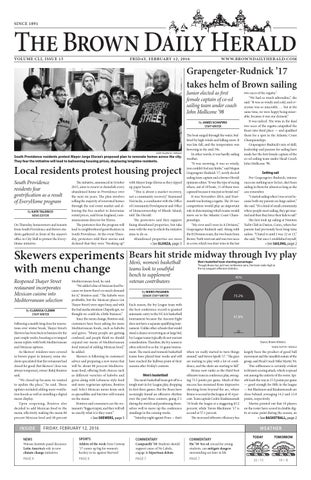
SINCE 1891
THE BROWN DAILY HERALD FRIDAY, FEBRUARY 12, 2016
VOLUME CLI, ISSUE 13
WWW.BROWNDAILYHERALD.COM
Grapengeter-Rudnick ’17 takes helm of Brown sailing Junior elected as first female captain of co-ed sailing team under coach John Mollicone ’98 By JAMES SCHAPIRO STAFF WRITER
KATE TALERICO / HERALD
South Providence residents protest Mayor Jorge Elorza’s proposed plan to renovate homes across the city. They fear the initiative will lead to ballooning housing prices, displacing longtime residents.
Local residents protest housing project South Providence residents fear gentrification as a result of EveryHome program By KATE TALERICO NEWS EDITOR
On Thursday, homeowners and tenants from South Providence and Brown students gathered in front of the mayor’s office in City Hall to protest the EveryHome initiative.
The initiative, announced in October 2015, aims to renew or demolish every abandoned home in Providence over the next six years. The plan involves selling the majority of renovated homes through the real estate market and allowing the free market to determine rental prices, said Evan England, communications director for Elorza. The protesters fear the program will lead to neighborhood gentrification in South Providence. At the event Thursday, protesters told their stories and declared that they were “breaking up”
with Mayor Jorge Elorza as they ripped up paper hearts. “This is about a market recovery, not a community recovery,” Raymond Neirinckx, a coordinator with the Office of Community Development and Office of Homeownership of Rhode Island, told The Herald. The protesters said they support fixing abandoned properties, but take issue with the way in which the initiative aims to do so. Abandoned properties are more » See ELORZA, page 3
The boat surged through the water, buffeted by high winds and falling snow. It was late fall, and the temperature was hovering in the mid-30s. In other words, it was hardly sailing weather. “It was snowing, it was so windy, you couldn’t feel any limbs,” said Megan Grapengeter-Rudnick ’17, newly elected sailing team captain and a former Herald opinions editor. “It was the type of racing where, out of 18 boats, 11 of them were capsized because it was just so brutal out.” It was November 2014, and Dartmouth was hosting a regatta. The 18-race competition would play an important role in determining which teams would move on to the Atlantic Coast Championships. “My crew and I were in A Division,” Grapengeter-Rudnick said. Along with the B Division team, the two boats from Brown “both went out and won two races in a row, which was four wins in the last
two races of the regatta.” “We had so much adrenaline,” she said. “It was so windy and cold, and everyone was so miserable. … but at the same time, we were happy being miserable, because it was our element.” It was indeed. The wins in the final two races of the regatta catapulted the Bears into third place — and qualified them for a spot in the Atlantic Coast Championships. Grapengeter-Rudnick’s mix of skill, leadership and passion for sailing have made her the first female captain of the co-ed sailing team under Head Coach John Mollicone ’98. Setting sail For Grapengeter-Rudnick, intense races are nothing new. In fact, she’s been sailing in them for almost as long as she can remember. “I started sailing when I was seven because both my parents are huge sailors,” she said. “It’s a kind of small community where people meet sailing, they get married and then they force their kids to sail.” She first took up sailing at Noroton Yacht Club in Darien, Conn., where her parents had previously been long-time sailors. “I hated it until I was 12 or 13,” she said, “but once I established myself, » See SAILING, page 2
hit stride midway through Ivy play Skewers experiments Bears Men’s, women’s basketball look to youthful with menu change teams bench to supplement Men’s basketball team shooting percentages Though Bruno has just two conference wins, the team ranks high in the Ivy League’s offensive statistics.
Reopened Thayer Street restaurant incorporates Mexican cuisine into Mediterranean selection By CLARISSA CLEMM STAFF WRITER
Following a month-long close for renovations over winter break, Thayer Street’s Skewers has been back in business for the past couple weeks, boasting a revamped menu replete with both Mediterranean and Mexican options. As Skewers’ windows were covered in brown paper in January, some students speculated that the restaurant had closed for good. But Skewers’ close was always temporary, owner Bahij Boutros said. “We closed up because we wanted to update the place,” he said. Those updates included adding more ventilation hoods as well as installing a digital menu display. Upon reopening, Boutros also decided to add Mexican food to the menu, effectively making the menu 60 percent Mexican food and 40 percent
INSIDE
Mediterranean food, he said. “We added a line of Mexican food because we know there’s so much demand for it,” Boutros said. “The kabobs were profitable, but the Mexican places (on Thayer Street) were super busy, and with the bad media attention Chipotle got, we thought we could do a little business.” Since the menu change, Boutros said, customers have been asking for more Mediterranean foods, such as kabobs and gyros. “Many people are getting confused, and people think we should expand our menu of Mediterranean food instead of adding Mexican food,” he added. Skewers is following its customers’ advice and preparing a new menu that will be about 80 percent Mediterranean food, offering fresh choices such as different varieties of kabobs and gyros along with Lebanese-style food and more vegetarian options, Boutros said. Select Mexican menu items such as quesadillas and burritos will remain on the menu. Boutros said consumers are the restaurant’s “biggest input, and they will tell us exactly what it is they want.” » See SKEWERS, page 3
45%
veteran contributors By NIKKO PASANEN
73.2%
SENIOR STAFF WRITER
Each season, the Ivy League team with the best conference record is granted automatic entry to the NCAA basketball tournament because the Ancient Eight does not have a separate qualifying tournament. Unlike other schools that would stand a chance at receiving an at-large bid, Ivy League teams typically do not warrant consideration. Therefore, the Ivy season is often referred to as the 14-game tournament. The men’s and women’s basketball teams have played four weeks and will have reached the halfway point of their seasons after Friday’s contests. Men’s basketball The men’s basketball team got off to a tough start in Ivy League play, dropping its first three games. But the Bears have seemingly found an offensive rhythm over the past three contests, going 2-1 during the stretch and positioning themselves well to move up the conference standings in the coming weeks. “Saturday night against Penn — that’s
41.8%
Source: Brown Athletics TANEIL RUFFIN / HERALD
when we really started to turn things around,” said Steven Spieth ’17. “The guys are starting to play with a lot of confidence, and the shots are starting to fall.” Bruno now ranks as the third-best offensive team in conference play, averaging 73.5 points per game. Much of this success has stemmed from impressive shooting from beyond the arc, where Bruno is second in the league at 45.4 percent. Team captain Cedric Kuakumensah ’16 leads the league at a staggering 63.2 percent, while Tavon Blackmon ’17 is second at 57.1 percent. The increased offensive efficiency has
largely been the product of good ball movement and the unselfish nature of the group, said Head Coach Mike Martin ’04. This selflessness is certainly evident in Bruno’s scoring attack, which is spread out among the entirety of the roster. Spieth leads the way at 15.5 points per game — good enough for fifth in the league — but Blackmon and Kuakumensah are close behind, averaging 14.2 and 13.8 points, respectively. Martin pointed out that 10 players on the roster have scored in double digits at some point during the season, an » See BASKETBALL, page 2
WEATHER
FRIDAY, FEBRUARY 12, 2016
NEWS Watson Institute panel discusses Latin America’s role in new climate change initiatives
SPORTS Athlete of the week: Erin Conway ’17 comes up big for women’s hockey in tie against Harvard
COMMENTARY Campanelli ’18: Students should support cause of No Labels, engage in bipartisan debate
COMMENTARY Hu ’18: Sex ed crucial for young students, can mitigate dangers surrounding sex later in life
PAGE 4
PAGE 8
PAGE 7
PAGE 7
TODAY
TOMORROW
25 / 15
19 / -8
SPORTS
PAGE 2 • FRIDAY, FEBRUARY 12, 2016
» SAILING, from page 1 I started to really enjoy it.” She quickly began moving up the ladder of sailing competitions. At age 10, she started to compete nationally. Two years later, she was racing around the world. “When I was 12, it got to the international level,” she said. “We started going to Germany, the Netherlands, Italy for competitions. From there until college, I continued doing international all over Europe and South America.” In fact, before starting college, she considered the Olympics. In 2012 and 2013, she qualified for the Sperry TopSider U.S. Olympic Development Team. “It was one women’s boat and one men’s boat for the whole country,” she said. “It was meant to give you an idea of the track you might take. You might sail against these international people, and then once you get older, you might try and do an Olympic campaign.” But then Grapengeter-Rudnick started college and found much less time for international competition “because other countries don’t have college sailing the way we do,” she said. She has only competed in collegiate sailing events since coming to Brown, and the team has seen more than its share of impressive accolades since her arrival. “When I got here, we were doing well in New England,” she said. “We struggled a little bit at nationals my freshman year. Then last year, our co-ed team won New England, which was a very large deal, and the women’s team finished third at nationals.” But this fall, as Grapengeter-Rudnick studied abroad in Paris, the team did not perform as well as they hoped.
» BASKETBALL, from page 1 indication of the bench’s depth. He added that the team is now focused on bringing out more consistency from these players, many of whom are underclassmen and still learning the tricks of the trade. On the defensive end, it has been anything but easy for the Bears. Bruno has the worst rated defense in Ivy League
THE BROWN DAILY HERALD
“It was a little bit of a rough fall for everyone,” she said. “I can’t really speak to it much because I wasn’t around, but we have a pattern. Even if we don’t do so well in the fall, we usually bounce back in the spring.” Aye, aye, captain One December morning in Paris, Grapengeter-Rudnick awoke to exciting news: She had been elected co-ed team captain. “I woke up to a bunch of texts and calls at 5 a.m. from my friends on the team, congratulating me and asking me to Skype in,” she said. According to teammate Reid Secondo ’16, the election “wasn’t very close. It was fairly unanimous.” The election, she knew, was a testament to the strength of her leadership. “It’s hard to get elected when you’re abroad, because people quite literally might forget about you,” she said. “Usually when you go abroad you forfeit whatever claim to leadership positions you would have had otherwise,” said teammate Rachel Gutman ’17, a former Herald copy editor. “But she’s a complete standout in our year. She’s incredibly talented on the water, but she also does a very good job of getting along with absolutely everybody.” Grapengeter-Rudnick is the first woman to be elected co-ed captain since Head Coach John Mollicone ’98 took the helm of the team in 1999. Having already been a strong presence on the women’s team, she has now taken over leadership of the entire group. “It was very validating to be elected co-ed captain as a woman, because it elevated women’s sailing,” she said. play, allowing over 80 points per game. The struggles start with rebounding and defending the interior, both of which have much to do with the team’s general lack of size, Martin and Spieth each mentioned. The team has dedicated practice time to addressing this shortcoming. “We are pretty undersized,” Spieth said. “We’ve been doing a lot of boxingout drills.”
CHRISTINE KIM / HERALD
Megan Grapengeter-Rudnick ’17 was elected co-ed captain of Brown sailing. She brings individual talent and leadership ability to the team. “There’s a general feeling that women’s “It did seem that the women’s team sailing is easier — which it might be. But especially was struggling, because she’s it’s also nice to know that people think the A-skipper,” Gutman said. “She was that just because you sail the women’s already a great source of leadership for circuit doesn’t mean that you’re not a the women’s team, and now that she’s good sailor.” co-ed captain, she’s going to be bringing “There’s an expectation that the best that to the next level.” leader who happens to be a woman will Mollicone noticed her absence as be the women’s captain, which has been well. under fire the last couple of years because “Our women’s team certainly suffered the positions really aren’t equal,” Gutman in the rankings,” he said. “We finished said. “The women’s captain is only a lead- third last year, but this fall was certainly ership role for half the team, if that. The a bit of a rebuilding season without her.” co-ed captain is a lot more involved with coordinating with the coach and with Charting the waters what the team is doing overall.” Grapengeter-Rudnick is excited to “I’ve known her well since she came get back in the water and lead her team to Brown, and I knew her outside of col- once again. lege through sailing,” Secondo said. “She’s “I was elected in December, and I always had a commitment to being a came back and jumped right in,” she good sportsman, leading by example said. “These past four or five months is and being a very inclusive type of captain the longest I’ve ever spent not in a boat and leader.” since I started sailing when I was seven. According to Gutman, Grapenget- I’m really excited to see what we can do er-Rudnick’s absence was noticeable in this spring as a team.” the team’s performance, and her return Grapengeter-Rudnick has already set should produce a positive effect. ambitious goals for the spring season, The lone bright spot has been threetime Ivy League Defensive Player of the Year, Kuakumensah, who earlier this year broke the all-time Ivy League record for blocked shots. Kuakumensah has been his usual self this season, leading the league in blocks at 3.2 per game. The senior power forward now holds the highly unusual position of leading the Ivy League in both three-point percentage and blocked shots per game. The Bears will hope to turn things around on defense tonight against Harvard (9-13, 1-5 Ivy) and tomorrow when they travel to Dartmouth (7-13, 1-5). Facing the league’s cellar dwellers should give Bruno a great opportunity to get back to .500 before they square off against Penn, a team they already beat earlier this season. From there, a top four finish in the conference looks like a real possibility. Women’s basketball After getting off to a blistering start in non-conference play, the women’s basketball team ran into the roadblock that is the Ivy League, dropping its first five conference games before taking down Columbia this past weekend. The team hopes they can build on their latest win and continue to trend in the positive direction. “We faced a really rough beginning to our schedule,” said captain Jordin Alexander ’16. “But I’m proud of the way the girls bounced back against Columbia, and hopefully we can build off that.” During the opening stretch of Ivy League play, the Bears struggled with scoring, averaging a second-to-worst 56.3 points per game in conference play. It seems that shooting has been the team’s kryptonite, particularly from three-point land, where they are converting only 21.1 percent of the time. But while many on the young team
including qualifying for nationals in California. As far as her more distant future goes, Grapengeter-Rudnick is less certain; until her time as captain expires, she will focus entirely on the Brown program. But she has not ruled out a future Olympic bid. “It would be very possible for me,” she said, adding that several female Brown sailing alums are currently pursuing Olympic campaigns. “We’re churning out sailors that are good enough to compete at the Olympic level. I haven’t totally ruled it out.” “She certainly has the skill to compete to go to the Olympics,” Mollicone said. “Right now the Olympic trials are going on for sailing, and three of our recent graduates of the program are in contention to go. Megan stacks up really well with the kind of sailors they were in college to do the same thing if she wanted to.” Regardless, her immediate focus is on her final seasons as a Brown Bear and final chances to win at a national level. As she looks at the upcoming season, Grapengeter-Rudnick is optimistic. “We did so well last spring that I’m just so excited to try and do it again,” she said. “We’ll try and pick up where we left off. I just can’t wait to be a part of it and see where we can all lead each other.” Grapengeter-Rudnick has one full year as captain to accomplish her ultimate goal: both women’s and co-ed teams making the podium at the national championships in California. She’s prepared, confident and ready to hit the upcoming season in stride. And based on her track record, she’ll do all she can to make sure that what is now just a goal becomes reality in May.
Women’s basketball team shooting percentages While Bruno began the season lighting up the scoreboards, the team has struggled to repeat earlier performances in Ivy play.
21.1%
69.5%
39.7%
Source: Brown Athletics
members are still trying to find their touch, the veteran Alexander has been as steady as ever, leading the team with 15.7 points per game. She is also the Ivy League’s sixth-highest scorer. The team is looking to the transition game as a catalyst for better success in the future, Alexander said. “When we push the ball, we can score at will,” said captain Ellise Sharpe ’16. “That’s something we really do well as a team.” She added that they are also hoping to get the ball into the post more often to help generate open looks. Unfortunately for the Bears, things are not much better on the other end of the floor, where the team ranks second worst in the league at 69.2 points allowed per game. But even if the collective defensive product may not be finely polished, there are several areas where Bruno has found success. The team is second in the Ivy League in blocked shots per game, with Janie White ’18 leading the way at an impressive 2.5 per game. Also, Rebecca
TANEIL RUFFIN / HERALD
Musgrove ’17 and Shayna Mehta ’19 have demonstrated their defensive prowess, each averaging over two steals per game. It is important to note that the Bears’ struggles should be taken with a grain of salt. This past weekend, Bruno put out a starting lineup that included three first-years: Mehta, Mary Butler ’19 and Erika Steeves ’19. Mehta and Steeves rank third and fourth on the team in total minutes played in conference games. While playing an inexperienced lineup can be tough in the moment, it can lead to large dividends in years to come. The last six Ivy League contests have gone a long way in the team’s development, Alexander said. “We are learning to keep our composure when the game is close,” Alexander said. “The past few games have been great experiences in that regard, and that will definitely help us down the stretch.” The Bears are now gearing up to face off against Harvard (8-11, 3-3) and Dartmouth (7-15, 2-4). Last season, Bruno swept the teams on the road and hopes to repeat the feat at home.
NEWS
FRIDAY, FEBRUARY 12, 2016 • PAGE 3
THE BROWN DAILY HERALD
» ELORZA, from page 1 likely to become sites for drug activity, prostitution and arson, Neirinckx said. Research suggests that foreclosed abandoned homes lower the values of neighboring properties, he added. Roline Burgison, a member of the Tenant and Homeowner Association and the Direct Action for Rights and Equality, remembers the three abandoned houses in her neighborhood, South Providence. She recalls their battered doors without locks and how people would pick through the houses, stripping them of copper pipes. What she remembers most, though, is the garbage that people would dump on the lawns of the properties — small kitchen appliances, tires, even an oven. “That wasn’t my community doing that,” she said of her tenant neighbors in South Providence, one of the most impoverished areas in the city. “Nobody from our neighborhood’s going to take a stove and throw it into a lot,” she said — someone would have fixed the stove instead. The EveryHome program EveryHome employs three key “tools” intended to revitalize and fill every abandoned and vacant home in Providence, England said. The first is a receivership program, in which a court-appointed agent — an eligible attorney — becomes a “receiver,” taking on the financial risk of the properties he or she has committed to refurbish. The receiver then goes on to hire available contractors to either renovate or demolish these abandoned homes. “This allows us to bring the program to scale,” England said. A revolving loan fund of $3 million has been established to offer small, low-interest loans to receivers so they can more quickly renovate homes without taking on all of the risk in the investment themselves. The second method the EveryHome program will use is diverting homes away from tax sales. When the owner of a home fails to pay property taxes, the taxing authority — in this case, the city of Providence — sells the house in an effort to recover delinquent taxes. When this happens, the home rarely gets renovated because it is usually bought by a bank. EveryHome seeks to “divert those properties until the Providence redevelopment authority is able to find a buyer who has interest to renovate,” England said. Third, England said, federal funds from programs such as the Affordable Housing Act and $1 million in Community Development Block Grants will be put forward to renovate an undetermined number of homes. Creating subsidized housing In the protest, DARE members demanded that the city allocate half of all renovated homes as low-income housing. Burgison and Joe Buchanan, the committee representative of DARE, have seen their communities grapple with
» SKEWERS, from page 1 Kevin Simmons ’16 said he’s eaten Skewers’ Mexican food as well as its previous Mediterranean menu items and that the low prices and quality of food keep him coming back. “The pricing is more agreeable with my wallet,” Simmons said. As for the different styles of food, “I would like it if Skewers had the best of everything:
pervasive poverty of late. The housing crisis of 2007 spurred countless evictions of low-income families in South Providence, forcing many families into homelessness, Burgison said. “We have poor folks living in our neighborhood trying to survive from day to day,” Buchanan said. “What (Elorza is) doing isn’t effecting the families (who) need it most.” Furthermore, when the plan was first released, the group asked the mayor to set up a committee with representatives from the communities most affected by the revitalization projects. This request has not been fulfilled by the mayor’s office. “They treat us like kids,” Buchanan said. “I’m 63 years old. I don’t care what they might think — who are they to dictate to us what we need in our neighborhood?” England said the mayor’s office has worked closely with community development associations, the THA and Rhode Island Housing to carefully consider how each house will be developed to meet the needs of the Providence community. There will be more opportunities to place targeted individuals in homes that are rebuilt with the help of federal funding, England said, though the city must still work within the constraints of the grants. “We want to see the city and our residents really recover from the often painful effects of the housing crisis,” he added. Neirinckx pointed out the irony in the EveryHome project: During the housing crisis, the government evicted people from their homes after they foreclosed, believing that houses needed to be empty in order to sell. But the housing market continued to crumble, along with the empty houses it had produced. “We created blight under the guise of marketing,” Neirinckx said. Now, the complex issue of Providence’s abandoned homes requires an equally “complex response,” he added. Buchanan advocates a program that would allow residents who were kicked out of their homes due to foreclosures to have the first chance at becoming a tenant or owner of one of the revitalized homes built in the areas in which they once lived. While the EveryHome program could help the city start earning taxes again on abandoned properties, it is the surrounding communities who will have to confront the consequences of the government’s actions, Buchanan said. “I’m tired of us bearing the brunt of the city.” Location, location, location Buchanan said he worries as much about the government’s strategy in choosing which of Providence’s hundreds of abandoned homes they will renovate. Elorza is “fixing up neighborhoods that have more money,” he added. The program most heavily targets areas that have already been gentrified, such as Federal Hill, Burgison said. Federal Hill is indeed set to see a pricing, Mediterranean food (and) Mexican food all in one place.” Adriana Saavedra ’15 agreed, adding that the customer service at Skewers is great. “They go a step beyond general customer service. They actually make sure you’re satisfied,” Saavedra said. Skewers expects to have its new, expanded Mediterranean menu running by Monday, when it will be offering free wraps from 11 a.m. to 5 p.m.
higher density of homes renovated than areas such as Upper South Providence, according to the Mayor’s office website. Upper South Providence has one of the highest concentrations of people below the poverty line in the city, The Herald previously reported. Local construction According to Chris Rotondo, organizer of the THA, the city plans to “bundle” together several of the properties and sell them to a national real estate development group. With nearly 800 abandoned properties up for renovation in Providence, these companies would have the power “to control the landscape of a city,” Rotondo said. England said that city officials have discussed this idea before, “but it’s not a function of the EveryHome project,” he said. A liaison associated with each renovation project will work with contractors registered through the state to connect them with receivers, England said. This is in accordance with the First Source ordinance, which requires that employers who receive funds from the city’s office of community development, the office of economic development or other city-administered federal programs must hire all employees from a list of Providence locals. But Rotondo said that the city has often failed to adhere to the First Source ordinance, and it could do the same for the EveryHome project. Because most of the homes are allocated to renovators through the receivership program — in which receivers may or may not use city
funding — receivers have no duty to draw upon the First Source list. “It’s a process made possible by law and the discretion of a judge — not a city program,” England said. Rather, the city will play a “supportive role” in the hiring process for homes that come into ownership through the receivership program. “We’re going to ensure that these jobs are going to Providence residents wherever possible,” he added. Buchanan and Burgison doubt whether the EveryHome project will truly meet that goal. “The jobs … need to be created for people of color — the minorities — not for the white man and his business,” Buchanan said. “We have a lot of minority construction workers. As far as I know, they haven’t been hired,” Burgison said. DARE members also worry that the homes will be built quickly and cheaply, forcing future homeowners or tenants to pay for any necessary repairs in the short term. “We want clear standards — not just livability, it’s longevity,” said Rotondo. “Can a low-income, first-generation homeowner live in (a house) without having to replace the roof?” “Yes, everybody deserves a home, but everyone deserves a quality home,” said Malchus Mills, a member of DARE. Finding the funding Rotondo realizes that to meet DARE’s demands — increased community employment, clear construction standards and a set proportion of low-income housing — the government would have to put forth more funding.
“A lot of this is about putting subsidies down and putting money into this project,” he said. Even with these subsidies, several South Providence community members expressed worry that the introduction of these homes in their tight-knit neighborhood would spur gentrification. “Do we want good homes? Yes, we do. But we also want our neighborhood,” Buchanan said. Burgison, a tenant, fears that she would not be able to remain in her house if rent prices in the area went up. “I’m on a fixed income. I’m trying to find a decent home without rats or cockroaches,” she said. “They want to give us people who don’t live in our community,” Buchanan said. “There are yuppies and bourgeoisies who want to run our neighborhoods.” But Urban Studies Professor Stefano Bloch argued that city administrators should not presuppose gentrification in discussing neighborhood revitalization projects. The danger of these projects is not that the improvements to the neighborhood will make it expensive, Bloch said. The risk is that the renovations will create a profitable opportunity through higher land values. He stressed the need for mechanisms that would stop profiteering from these properties. Yet he expressed some skepticism concerning the logistics of the EveryHome project. “What shouldn’t be targeted is the potentially progressive project, but rather the people with power who seek to profit from this,” Bloch said.
NEWS
PAGE 4 • FRIDAY, FEBRUARY 12, 2016
THE BROWN DAILY HERALD
Presentation addresses climate change in Latin America Researchers, experts discuss effects, significance of Latin America postParis climate conference By GWEN EVERETT SENIOR STAFF WRITER
J. Timmons Roberts, professor of environmental studies and sociology, and Guy Edwards, research fellow at the Institute at Brown for Environment and Society and co-director of the Climate and Development Lab, presented their recently published book, “A Fragmented Continent: Latin America and the Global Politics of Climate Change,” to a panel of experts at the Watson Institute for International and Public Affairs Thursday. The book fills a void in academic research regarding Latin America’s role in climate change, said Richard Snyder, director of Latin American and Caribbean studies at the Watson Institute and professor of political science. The mainstream narrative regarding climate change typically focuses on the United States’ and China’s roles in the climate debate, Roberts said. “I’m utterly frustrated with the focus on the ‘important’ players,” said Camila Bustos ’16, lead researcher at Nivela, a research organization dedicated to innovative approaches to development-based research. Latin America is often portrayed as
a “passive player” or recipient of aid, but countries in the region actually serve an active role in reform, she said. The panelists discussed the significance of the Paris Climate Conference, which took place in December, as a prime example of various Latin American countries stepping into policy-making positions. Latin America “played a leading role” at the Paris Climate Conference, said Isabel Cavelier, minister counselor at the Permanent Missions of Colombia to the United Nations. Though the full effects of the agreement have yet to be realized, “it’s the first time a developing country (Brazil) took an economy-wide commitment” to reduce emissions, she added. “The most important signal from Paris is decarbonizing,” said Natalie Unterstell, a Louis Bacon environmental leadership fellow at the Harvard Kennedy School of Government. Countries in Latin America and beyond are looking to diversify their economies and reduce their use of environmentally detrimental substances, she said. Latin American countries adopted climate change reforms during a time of economic prosperity, but the recent economic downturn might complicate the implementation of future reforms, said Ximena Carranza Risco ’17, a Latin American researcher at Nivela. It is important to think of the human consequences of climate change instead of
COURTESY OF THE CENTER FOR LATIN AMERICAN AND CARIBBEAN STUDIES
Isabel Cavelier, minister counselor to the U.N., Natalie Unterstell, fellow at Harvard, Camila Bustos ’16, Ximena Carranza ’17 and J. Timmons Roberts, professor of environmental studies, discuss climate action in Latin America. just the economic or environmental consequences, she added. Bustos expressed similar concerns, stating, “climate change is still seen as an environmental issue” as opposed to
a social problem. Bustos explained that the Paris Climate Conference symbolizes an opportunity for citizens to hold their governments accountable for the international agreements they commit
themselves to. Climate change reform is not restricted to government policies, and researchers should investigate the role of non-state actors in climate change efforts in the region, he said.
Former ambassador talks faulty U.S. foreign policy Watson Senior Fellow Chas Freeman Jr. criticizes aggression, calls for increased diplomacy By ROLAND HIGH STAFF WRITER
Ambassador Chas Freeman Jr., former American diplomat and senior fellow at the Watson Institute for International and Public Affairs, delivered his second lecture in a three-part series on U.S. foreign policy Thursday afternoon in the Watson Institute’s Joukowsky Forum. This lecture, “The United States in the New World Disorder,” focused on the counterproductive continuation of Cold War foreign policy to the present day. Freeman began the lecture with a brief overview of U.S. foreign policy up to the Cold War, describing a state of “diplomatic minimalism” before World War I made possible by the stability of British global dominance. But World War I ended “Pax Brittanica,”
Freeman said. The United States emerged as the new world power, but our insistence on collecting war debts and pursuing “beggar thy neighbor” policies heightened tensions in Europe, Freeman said. Similarly, at the end of World War II, the United States supplanted Japan and Germany as the dominant geopolitical force in the western Pacific. With the rise of the Soviet Union, a bipolar world order materialized. In response, the United States formed a “new national security structure” and managed a powerful foreign presence designed to contain and isolate the burgeoning USSR. Eventually, the Soviet Union collapsed. Freeman made it clear that this was a critical point in our nation’s history that gave rise to what he jokingly called “enemy deprivation syndrome.” But even with “no existential threat,” the United States refused to change its approach to foreign policy, Freeman said. Instead, “the United States has now expanded our defense responsibilities right up to the borders of
Russia and China.” Freeman said that American foreign policy is still predicated on the belief that “no bluff we make will ever be called.” This “institutional inertia,” Freeman said, has created “self-licking ice cream cones”: self-serving, inefficient or purposeless diplomatic bureaucracies. The rise of domestic terrorism can be explained as a result of U.S. aggression without the balance of Soviet power, as neither the United States nor the USSR, he explained, would allow their respective allies to engage in such tactics. Both nations feared that an attack on the homeland, as opposed to the relative security of proxy warfare, would result in massive retaliation. But now, terrorists and rogue nations are no longer “restrained” by a dominant adversary, Freeman said; unlike Soviet Russia, these enemies have nothing to lose. As a result, America is now “both more powerful and more vulnerable” than ever before. Turning to the current threat of violent jihadist groups, Freeman criticized American leaders for “alienating (the United States) from most of the Muslim world” and warned against increasing tensions within the European Union. Freeman cited the British referendum on EU membership as cause for concern, which Prime Minister David Cameron, leader of the Conservative Party, has promised will take place before the end of 2017. “If Europe disintegrates, so will transatlantic ties,” he said. Freeman also stressed the continued importance of Russia in global affairs, saying that the Obama administration’s attempts to punish and
isolate Russia for its intervention in Ukraine have ironically revealed how important the nation remains. Demonizing Russia is “pure posturing — not policy,” he said. Furthermore, “Diminishing Russia as a has-been power was a mistake.” Next, Freeman addressed China’s emergence on the global stage: “By 2020, the Chinese are expected to have invested $20 trillion abroad.” The “bravado” of the Trans-Pacific Partnership trade agreement, which the White House is fighting for despite fierce Congressional opposition, is a foolish attempt to counter Chinese influence — diplomatic “trench warfare” must come to an end, Freeman said. “There is no longer a global zerosum game. We can afford to try to solve problems,” Freeman said, mentioning the China-Taiwan conflict, the Israel-Palestine conflict and North Korea’s role in international politics. “When I first went there, North Korea had an economy twice the size of (that of) South Korea.” Now, South Korea’s economy is 35 times the size of that of its totalitarian neighbor, Freeman said, indicating that a resolution should be relatively easy with the right policies. Freeman concluded that “Pax Americana” is over, and America must roll back interventionist policies while bolstering diplomatic efforts. There is “no reason for us to shoulder burdens others can now bear,” he said. “Our credibility, with which we’ve become so obsessed, will take care of itself.” The audience, which grew to approximately 70 people, appeared very engaged with Freeman’s lecture. Roma Hayda, an audience member who said she has relations in
Ukraine, expressed concerns over Russia’s trustworthiness during the question-and-answer period. Freeman agreed, advocating cautious negotiations. He also said, to collective laughter, that the Kremlin is “a protection racket pretending to be a government — we know about that in Providence, Rhode Island, I think.” “I think we are building an inherently unstable situation in Europe by not incorporating Russia into the security architecture,” Freeman said. But he also cited the Austrian State Treaty, which created an independent Austria that remained neutral through the Cold War, as a particularly difficult diplomatic accomplishment and a source of optimism for the future of American-Russian relations. “Optimism is to diplomats what courage is to soldiers,” he said, citing a popular refrain. The next question came from J. Brian Atwood, senior fellow for international and public affairs, who noted that the lecture sounded “like a tutorial for the presidential candidates.” Freeman agreed that there was a worrying “degree of ignorance” in the field of U.S. presidential candidates, calling the election “a cavalcade of clowns” and expressing hope that Americans can be educated on the role of diplomacy as an alternative to conflict. More importantly, he said, “it is not for us to tell people what government they should have. The legitimacy of a government is not determined by what foreign governments think of it. It is determined by the governed.” The third and final lecture, “Recovering Diplomatic Agility,” will begin at 4 p.m. Feb. 18 in the Joukowsky Forum.
TODAY
FRIDAY, FEBRUARY 12, 2016 • PAGE 5
THE BROWN DAILY HERALD
campus remains frozen
menu SATELLITE DINING ANDREWS COMMONS
Pizza: Bacon and Feta, Harvest, Buffalo Chicken BBQ Pulled Pork Sandwich JOSIAH’S
BLUE ROOM
Quesadillas
Clam Chowder, Minestrone Naked Burritos
DINING HALLS SHARPE REFECTORY LUNCH
DINNER
Sesame Chicken Wings, Steamed Jasmine Rice, Peas with Mushroom, Brownies
Tortellini Provencale, Butternut Squash with Agave, Red Rice, Ambrosia Cake
VERNEY-WOOLLEY LUNCH
DINNER
Breaded Chicken Fingers, Edamame with Peppers, Curried Chickpeas
Chicken Saltimbocca, Spinach Pie Casserole, Roasted Red Potatoes with Herbs
MARIANNA MCMURDOCK / HERALD
Maddock Alumni Center shines, still blanketed by snow, following Monday’s storm. Freezing temperatures will continue well into the weekend, predicted to reach -7 degrees Sunday night.
sudoku
RELEASE DATE– Friday, February 12, 2016
Los Angeles Times Puzzle c r o sDaily s w oCrossword rd Edited by Rich Norris and Joyce Nichols Lewis
ACROSS 1 Item in a ’60s drug bust 7 Marshal Tito, for one 11 Friendly address 14 Make effervescent 15 Queen’s place 16 Move on water 17 Generic City Hall dog? 19 Caustic chemical 20 __ Toy Barn: “Toy Story 2” setting 21 Japanese volcano Mount __ 22 Guzzle 24 Half a prison? 26 Suffix for professionals 28 Toon who often wore a Metallica T-shirt 29 Why some seek a certain cactus? 32 Bacchanal vessel 33 Rested 34 Choler 35 Essay on meditation? 39 Arboreal critter 41 “__ believer!” 42 Icon with a curved arrow 45 Eschew medical attention? 49 Certify 50 LAX stat 51 “Let her not say __ that keep you here”: “Antony and Cleopatra” 53 Language from which “julep” is derived 54 Centrifuge site 56 Rosamund’s “Gone Girl” co-star 57 Green beginning? 58 Fighter whose stock greeting affects 17-, 29-, 35- and 45Across 63 However, to texters 64 __ dixit 65 Shape, as dough for cloverleaf rolls 66 Strong desire 67 Lacking a date 68 Adam, of the “Bonanza” brothers
37 Global financial 47 Alternative to de DOWN org. Gaulle 1 Holy men who 38 Tournament 48 Buster who turn prayer elimination portrayed Flash wheels point Gordon 2 Cousteau’s 39 Diplomatic case 52 Uncalled for concern 40 Dutch landowner 55 Canaanite 3 Oxymoronic in colonial deity skiing condition America 59 Decide 4 All43 Court action 60 Lee side: Abbr. encompassing 44 Bony 61 Cooper’s concept 45 __ pin creation 5 Gillette brand 46 Pluto’s Egyptian 62 Honorary legal 6 “Empress of the counterpart deg. Blues” Smith 7 “The Tudors” sta. ANSWER TO PREVIOUS PUZZLE: 8 Actress Tyler 9 GPS datum 10 Frost output 11 Eponymous South American leader 12 Beamish? 13 Warning words 18 Upbeat 23 “Obviously, right?” 25 Their colour is affected by melanin 27 Fare on a flat tortilla 28 __ test 30 Master 31 Roofing sealer 36 One of a biblical trio 02/12/16 xwordeditor@aol.com
calendar FRIDAY FEBRUARY
S
M
T
W
Th
F
S
1
2
3
4
5
6
7
8
9
10
11
12
13
14
15
16
17
18
19
20
21
22
23
24
25
26
27
28 By Jeffrey Wechsler ©2016 Tribune Content Agency, LLC
02/12/16
29
Free Valentine’s Day Cards with Brown Pen Pals 2:00 P.M. J. Walter Wilson Lobby
Time Management: Myth or Reality 12:00 P.M. J. Walter Wilson, Room 203
SATURDAY Esports Gameathon 2:00 P.M. Building for Environmental Research and Teaching (BERT)
SEX Trivia Fundraiser 8:00 P.M. Petteruti Lounge
SUNDAY Auditions for Musical Forum’s Production of Carousel 5:00 P.M. New Dorm A
Music of the Night SotG’s Immersive Winter Show 7:30 P.M. Sayles Hall
COMMENTARY PAGE 6 • FRIDAY, FEBRUARY 12, 2016
THE BROWN DAILY HERALD
IN CASE YOU MISSED IT
Brown Bites RIP: our wallets While President Christina Paxson’s P’19 BrownTogether campaign has already raised over $1 billion, the Corporation aims to reduce Brown’s deficit by approving a 4.1 percent hike in tuition. The increase follows a pattern of hikes in the past years and will bring total undergrad charges per year to an estimated $64,566. But along with this hike in tuition comes an increased budget for undergrad financial aid and a 3 percent increase in grad student stipends. And we thought the chips at Jo’s were expensive. If only we majored in CS Students who spend all night in the CIT might be somewhat familiar with a tech company called “Google.” Google is the largest employer of Brown graduates, employing 392 grads across the world. The tech giant is one of the CS department’s top three recruiters, and Google provides students opportunities to interact with the company through a number of networking events — from info sessions to coding competitions. If you need us, we’ll be Googling “careers at Google for people without real skills.” Meta. We’ve got chemistry A petition has been circulating around campus to expand Brown’s chemistry course offerings. Currently, pre-med students who do not place out of CHEM 0100: “Introductory Chemistry” must wait an extra semester to start learning organic chemistry because Orgo I is only offered during the spring semester. This timing can throw MCAT preparation off-balance, as these pre-meds may not be able to take a biochem class until spring semester of junior year. Students are seeking to prevent this by having Orgo I and Orgo II each be offered during both the fall and spring semesters. They also demand that, should Brown hire a new professor to teach the course, the professor be a person of color.
R O L A N D H IG H
Q U O T E O F T H E D AY
“Everyone was so miserable. … But at the same time, we were happy being miserable.” — Megan Grapengeter-Rudnick ’17
See sailing on page 1.
Bad news for the indecisive Brown’s early decision rate for the upcoming Class of 2020 jumped to 22 percent this year, and while Dean of Admission Jim Miller ’73 attributes this higher acceptance rate to an increase in the quality of applicants, others are more skeptical. The director of Ivy Coach, Brian Taylor, suggests that the increase might be a strategy aimed to lower Brown’s total acceptance rate and therefore bump up its U.S. News and World Report ranking. Taylor explains that this strategy is used at many highly selective universities, with Penn using the tactic most obviously. At least Brown will always be number one in our hearts. Don’t show this to worried parents Almost 6,000 crimes took place in Providence in the fall semester, and theft and disorder were the crimes most commonly reported. The Herald reported on a number of crime patterns in the city, including that most robberies occur between 9 p.m. and 10 p.m., while breaking and entering most frequently takes place at 4 p.m. Four streets in particular were also discovered to have extremely high missing person counts. Anybody want to walk us home tonight?
www.browndailyherald.com
Editorial Leadership
Sections
Visuals & Production
Business
Editor-in-Chief Emma Jerzyk
Arts & Culture Editor Jaclyn Torres
Managing Editor Joseph Zappa
News Editors Lauren Aratani Agnes Chan Sandra Lifshits Kate Talerico
Design Editors Meryl Charleston Sonia Geba Andrew Linder Assistants: Nicola Ho, Minah Seo
General Managers Moniyka Sachar Joshua Tartell
Senior Editors Andrew Flax Caroline Kelly POST- MAGAZINE Editor-in-Chief Yidi Wu DIGITAL Director of Audience Development Marcy Huang
Sports Editors Matt Brownsword Taneil Ruffin Multimedia Features Editor Baylor Knobloch COMMENTARY Opinions Editors Margaret Hu Lainie Rowland Editorial Page Editors Emma Axelrod Emma Jerzyk
Photo Editors Head: Eli White Sam Berube Marianna McMurdock Matteo Mobilio Ashley So Web Producer Harsha Yeddanapudy Copy Desk Chief Bonnie Henry Illustrations Editor Roland High
Directors Sales: Henry Ritter Finance: Neil Wathore Finance: Benjamin Wesner Business Dev.: Abraham Galindo Sales Managers Antonia Alvarez Erin Lueck Matthew Meyer William Welland Finance Managers Collections: Reena Zhan Collections: Varun Narayan
facebook.com/browndailyherald
Location: 195 Angell St., Providence, R.I. www.browndailyherald.com
@the_herald
Editorial contact: 401-351-3372 herald@browndailyherald.com
browndailyherald.com
Business contact: 401-351-3260 gm@browndailyherald.com
Corrections: The Brown Daily Herald is committed to providing the Brown University community with the most accurate information possible. Corrections may be submitted up to seven calendar days after publication. Commentary: The editorial is the majority opinion of the editorial page board of The Brown Daily Herald. The editorial viewpoint does not necessarily reflect the views of The Brown Daily Herald, Inc. Columns, letters and comics reflect the opinions of their authors only. Letters to the Editor: Send letters to letters@browndailyherald.com. Include a telephone number with all letters. The Herald reserves the right to edit all letters for length and clarity and cannot assure the publication of any letter. Please limit letters to 250 words. Under special circumstances writers may request anonymity, but no letter will be printed if the author’s identity is unknown to the editors. Announcements of events will not be printed. Advertising: The Brown Daily Herald, Inc. reserves the right to accept or decline any advertisement at its discretion. The Brown Daily Herald (USPS 067.740) is an independent newspaper serving the Brown University community daily since 1891. It is published Monday through Friday during the academic year, excluding vacations, once during Commencement and once during Orientation by The Brown Daily Herald, Inc. Single copy free for each member of the community. Subscription prices: $280 one year daily, $140 one semester daily. Copyright 2016 by The Brown Daily Herald, Inc. All rights reserved. Periodicals postage paid at Providence, R.I. Postmaster: Please send corrections to P.O. Box 2538, Providence, RI 02906.
COMMENTARY FRIDAY, FEBRUARY 12, 2016 • PAGE 7
THE BROWN DAILY HERALD
No Labels at Brown University BRYCE CAMPANELLI ’18 op-ed contributor
In today’s political climate, it seems as though politicians continuously talk past each other and pride themselves on their unwillingness to compromise. Candidates parade their votes against bipartisan agreements and champion thwarting an opposing party’s agenda. This rhetoric and inaction has led to a Congress that pushes through last-minute budget deals, votes along party lines and refuses to compromise. This hyperpartisan attitude in American politics has led to a stagnation of policy and has weakened our federal government. The national organization No Labels was founded to try and break down this partisan divide in order to demonstrate that effective government occurs when people on
the left and right can sit down together and listen to each other. The goal of No Labels is to start a national movement that will result in the presidential administration and both houses of Congress working together, across the aisle, to achieve agreed-upon goals that will solve the nation’s problems. This is not a politically moderate group, but
behind and starts to address the issues facing America. The ambiguous goal of “solving problems” and ending partisan divisiveness may seem daunting, but No Labels has created a National Strategic Agenda to achieve this goal. This Agenda is comprised of four key components: One, create 25 million jobs over the next 10
agenda through a coalition of dedicated representatives in the House and through the No Labels Problem Solver Promise. Six presidential candidates have made this promise. The promise entails that within his or her first 30 days in office, the next president will work with both parties in Congress to meet one of the four goals addressed in the Na-
It is time for a new political dialogue on campus. rather a group that prides itself on embracing passionate liberals, passionate conservatives and anyone in between. Party affiliation should not hinder productivity or collaboration; rather, it should be used to enable progress between individuals from across the country. No Labels wants to lead the charge by ushering in a new era of political problemsolving that leaves partisan rhetoric
years; two, secure Social Security and Medicare for another 75 years; three, balance the federal budget by 2030; and four, guarantee energy security by 2024. These four issues have been specifically targeted because people across the political spectrum have agreed that solving these issues is crucial to American success. No Labels is working to achieve this
tional Strategic Agenda. All of these national programs are beginning to have success, and now this organization is coming to Brown. No Labels at Brown University is the only bipartisan political action group on campus. We are working to push the national goals of No Labels, but we are also trying to change the culture of our campus. There are many politically active
groups at our school who all aim to make Brown, the Providence community or the nation a better place. Unfortunately, these groups often talk past each other and fail to listen to the other side. No Labels at Brown University wants to change this status quo. Our goal is to make Brown’s campus a place fostering true problem solving where people of differing opinions can work together. Working with people of different political outlooks is difficult, but it is the change this nation and campus need. It is time for a new political dialogue on campus, oriented around building coalitions of support to solve the numerous issues we face. Because when it comes down to it, there is a lot we all have in common.
Bryce Campanelli ’18 is the president of No Labels at Brown and can be contacted at bryce_campanelli@brown.edu.
Why we need comprehensive sex ed MARAGRET HU ’18 opinions editor
When I was 10 years old, I first learned about sex from a book: “Lovingly Alice,” a novel about a fifth-grade girl like me. In it, the main character, Alice, asks her single father about the birds and the bees, and he gives a pretty frank response. A rather detailed discussion about the mechanics of sex follows, and as I read, my feelings of curiosity and aghast mimicked Alice’s. “But where do people do it?” Alice asks at one point. “In the backyard,” her older brother jokes. Her father then disapprovingly corrects that people usually do it in the bedroom, leaving Alice slightly confused. I remember also being puzzled — what was wrong with the backyard? I ran to my mom immediately after finishing the passage, eager to drill her with questions of my own. She was surprised when I brought it up, and once she reluctantly realized there was no evading my curiosity, she told me an analogy with tadpoles and eggs. She told me that it was something only “mommies and daddies” did and that it wasn’t something I would have to worry about for a long time. I didn’t really understand, but I was satisfied enough with the information she gave me. After this initial encounter, I retained a surprising amount of naivete about sex for a pretty long time. I spent my middle school years in China, where not only was sex education essentially non-existent, but sex itself
was established as a taboo topic both at school and at home. So when I started high school back in America at age 14, all I really had was the rudimentary knowledge I’d learned back in fifth grade. I didn’t know what a boner or an orgasm or masturbation was. I thought oral sex referred to kissing and that “condom” was short for “condominium.” I had a friend who thought a facelift and a blowjob were the same thing — types of cosmetology surgery. I suppose, in comparison, all that’s not nearly
stinence above all, emphasizing that abstinence was the only way not to become pregnant or catch an STD. I remember leaving class that day freaked out by pictures of terrible gonorrhea and how easy it was to get knocked up. Sex was scary. But it isn’t rare that I received my sex education so late — it’s actually rare that I received it at all. Only 23 states mandate sex ed, and out of those, only 13 require that the instruction be medically accurate. Pennsylvania
Because while it’s funny to recount how confused I was about sex in ninth grade, many college students today are still confused about sex and consent — and that’s not just problematic, it’s potentially dangerous.
as bad as the cluelessness my parents experienced during college in China, where it was commonly thought that if you sat on the same bench with someone of the opposite sex, you would become pregnant. My first encounter with sex education began that year in my health class. Our sex unit covered basic anatomy of both male and female genitalia, scarily detailed coverage of sexually transmitted diseases and a few forms of birth control. While my teacher acknowledged condoms and the Pill, he preached ab-
is not one of them, so it was perfectly legal for my teacher to tell us that you could catch an STD even if you wore a condom, which is incorrect. In fact, it’d be perfectly legal for my teacher to teach us that if we got pregnant, we would die. And considering how much he exaggerated the dangerous nature of sex, that honestly isn’t very far from what he did. Abstinence-only programs like the one I experienced are extremely prevalent. Thirty-seven states require information on abstinence be provided if sex ed is taught, and
25 of those states require that abstinence be stressed. In contrast, only 18 states require teaching information about contraceptives. And while there’s nothing wrong with abstinence itself, it shouldn’t be drilled as the only road you can take. Not only is it impractical — according to the Centers for Disease Control, most Americans have had more than one sexual partner in their lifetimes, and they start having sex at an average age of 17 — but the fact of the matter is that people will, and are entitled to, make different choices about their sex lives. Rather than deny this reality, we ought to focus on providing comprehensive sex education about some of the most important and inevitable decisions teenagers will make. Because there’s more to sex than understanding the anatomical workings of sperm and eggs. Because avoiding the discussion of having sex is at best a short-sighted solution. Because people should be informed of the variety of options they have when it comes to sex and contraception. Because topics like consent, sexual orientation, pregnancy, prejudice and sexual assault are complex issues that need to be addressed. Because while it’s funny to recount how confused I was about sex in ninth grade, many college students today are still confused about sex and consent — and that’s not just problematic, it’s potentially dangerous. And because unlike trigonometry, human sexuality is something you actually need to know about for the rest of your life.
Margaret Hu ’18 can be contacted at margaret_hu@brown.edu.
Got something to say? Leave a comment online! Visit www.browndailyherald.com to comment on opinion and editorial content.
SPORTS THE BROWN DAILY HERALD
FRIDAY, FEBRUARY 12, 2016
Athlete of the Week: Conway ’17 secures tie with clutch performance Bears snap decadelong losing skid against Crimson thanks to late power play goal by junior By BEN SHUMATE SENIOR STAFF WRITER
If any player on the women’s hockey team (3-19-3, 1-14-3 ECAC) deserved to score a clutch third-period goal against Harvard, it was Erin Conway ’17. In the first matchup against the Crimson, ranked 10th nationally at the time, the junior appeared to score, which brought the Bears within one goal as the second period buzzer sounded. After a lengthy video review, the referees ruled that the puck had crossed the line, confirming the call. Inexplicably, the referees then paused for a mysterious second review just before the third period, ultimately disallowing the goal. Conway got her revenge in the road rematch with Harvard Friday. With the Bears down 3-2 late in the third, she scored on the power play to tie the game up. Thanks to Conway’s late score and 51 saves from Monica Elvin ’17, the Bears earned a 3-3 tie and their fifth conference point of the season. Though Bruno is out of contention for the ECAC playoffs with four games remaining, the tie put a stop to a 17-game losing streak against the Crimson dating back to 2006. Conway is tied for fourth on the
team with 10 points (4G, 6A) on the season and is third in shots with 55. Q: How did you set up the gametying goal? A: “We set it up in our normal power play. The puck got to Leah (Olson ’19), she got a shot on net that Sam Donovan ’18 tipped to the side, and I baseball-batted it in out of the air on the backdoor. I didn’t even realize I did it until after I saw it go in.” Q: What did it mean to you to be part of the team that snapped a 10year losing streak against Harvard? A: “It was really good just to show that our team can play that well, and we can compete with these good teams. We’ve been one of the bottom two teams these past few years, so it just felt great to be a part of it and see that we could come back and tie it, especially because we were down for most of the game.” Q: Did your tying goal make up for the disallowed goal in the first Harvard game? A: “It definitely did. I was still really rattled about that goal. I said before the game that I was excited to play them again because I was so mad they had called that goal off. It really killed our momentum and ruined that game. I was excited to get a second chance.” Q: With being eliminated from playoff contention, how is your team
staying motivated for the final four games? A: “Because we have a new coach, it’s really just about continuing to develop, and now our eyes are set on next year. We have four games left, and it would be easy to give up, but our coaches keep practices fun and competitive. Next year we will hopefully get more wins, so that’s what keeps me going. I’m already looking forward to next year and getting off to a better start.” Q: Do you have a pre-game ritual or superstition? A: “The twins (Katie and Samantha Swanstrom ’18) and I always go to McDonald’s and get an iced coffee after team meal before every game. That’s crucial — if I don’t get an iced coffee, then it’s all in my head that I’m going to play bad. My dad comes to all the away games, so he always takes us to Dunkin’ Donuts on the road, or sometimes our coach will take us just so we can get it.” Q: Do you have a favorite road rink to play at? A: “I like to play at Dartmouth or Quinnipiac. Dartmouth isn’t really my favorite anymore after Saturday.” Q: What are your goals for the final two weeks of the season? A: “Definitely this weekend, (our goal) is to win for our seniors because it’s senior weekend, and they deserve it. We’re going to do everything we
COURTESY OF BROWN ATHLETICS
Erin Conway ’17 looks to make a play with the puck. The junior has 10 points on the season, none bigger than her game-tying goal at Harvard Friday. can to get two more wins. Against Clarkson and St. Lawrence, it’s just about putting up a better fight — just to continue to compete and not give up, even though we aren’t in the
playoffs. We want to prove to our coaches that we can finish strong.” This interview has been edited for clarity and length.