SINCE 1891
THE BROWN DAILY HERALD THURSDAY, FEBRUARY 11, 2016
VOLUME CLI, ISSUE 12
WWW.BROWNDAILYHERALD.COM
CS dept. to hire student Admins share love of Brown, civic duty faculty members diversity, inclusion advocates Few start careers intending to New hires will support students, plan inclusion activities, educate TAs on issues of diversity By JULIANNE CENTER SENIOR STAFF WRITER
The Department of Computer Science is seeking to hire student advocates for diversity and inclusion as part of its new action plan to increase diversity. The new hires are part of an administrative effort to address the department’s dearth of gender and racial diversity — just 8.7 percent of concentrators identify as underrepresented minorities and 26.8 percent identify as women, said Ugur Cetintemel, professor and chair of computer science. The student advocates will join the CS Diversity Committee and function as a resource for students, Cetintemel said. In addition, the student advocates will help the department communicate with existing student groups that aim
to promote diversity and inclusion, including Mosaic+, an organization that aims to make CS a more receptive space for underrepresented racial minorities, and Women in Computer Science, a group that aims to increase the participation of women in CS. The student advocates’ responsibilities will include supporting students encountering problems, helping to plan diversity and inclusion activities, raising awareness of existing resources and training teaching assistants, faculty and staff, Cetintemel said. The position will be paid commensurate to the pay levels of current departmental positions, such as teaching assistants, and will be shaped by the students who are selected. “One of their first duties is to work with us to fully define this,” said Tom Doeppner, associate professor of computer science. Other efforts to increase diversity in the department, such as the creation of a new administrative role to handle diversity and inclusion issues, are included in the CS department’s » See CS, page 3
join administration, but embrace chance to lead By SHIRA BUCHSBAUM SENIOR STAFF WRITER
Why be an administrator in higher education? Those at the helm of the school work long hours — often six days a week — and may sacrifice teaching positions and research opportunities to fulfill administrative responsibilities. Yet several Brown administrators, past and present, cited their commitment to the University and passion for working with students and faculty members as more than sufficient motivations to take jobs in administration. Accidentally an administrator Some administrators start their career at Brown and never leave. Dean of the College Maud Mandel “grew up at Brown,” she said. Her first job out of graduate school was as a visiting assistant professor of history. Starting as an assistant professor, she — like many of her colleagues — never imagined
MATTEO MOBILIO / HERALD
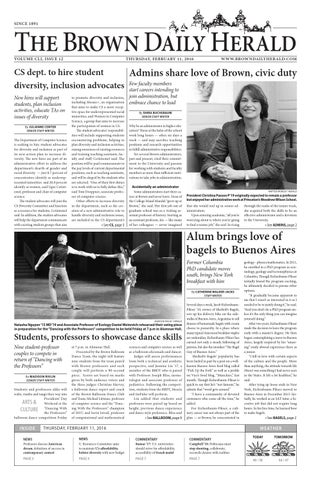
President Christina Paxson P’19 originally expected to remain a professor but enjoyed her administrative work at Princeton’s Woodrow Wilson School. that she would end up in senior administration. Upon entering academia, “all you’re worrying about is where you’re going to find a tenure job,” she said. In rising
through the ranks of the tenure track, she acquired both the skills to be an effective administrator and a devotion to the University. » See ADMINS, page 2
Alum brings love of bagels to Buenos Aires Former Columbia PhD candidate moves south, brings New York breakfast with him By CATHERINE WALKER-JACKS STAFF WRITER
MADISON RIVLIN / HERALD
Natasha Nguyen ‘15 MD‘19 and Associate Professor of Ecology Daniel Weinreich rehearsed their swing piece in preparation for the “Dancing with the Professors” competition to be held Friday at 7 p.m in Alumnae Hall.
Students, professors to showcase dance skills Nine student-professor couples to compete in return of “Dancing with the Professors” By MADISON RIVLIN SENIOR STAFF WRITER
Students and professors alike will waltz, rumba and tango their way into Presidents’ Day Weekend at the “Dancing With the Professors” ballroom dance competition Friday
ARTS & CULTURE
INSIDE
at 7 p.m. in Alumnae Hall. Presented by the Brown Ballroom Dance Team, the night will feature nine students from the team paired with Brown professors and each couple will perform a 90-second piece. Scores are based on marks given by both audience voters and the three judges: Christine Harvey, a ballroom dance expert and coach of the Brown Ballroom Dance Club and Team; Michael Littman, professor of computer science and the “Dancing With the Professors” champion of 2015; and Sorin Istrail, professor of computational and mathematical
sciences and computer science as well as a ballroom aficionado and dancer. Judges will assess performances from both a technical and aesthetic perspective, said Jasmine Liu ’17, a member of the BBDT who is paired with Professor Joseph Bliss, neonatologist and associate professor of pediatrics. Following the competition, students from the BBDT, Mezcla and ImPulse will perform. Liu added that students and professors were paired up based on height, previous dance experience and dance style preference. Bliss said » See BALLROOM, page 8
Several days a week, Jacob EichenbaumPikser ’10, owner of Sheikob’s Bagels, sets up his delivery bike on the sidewalks of Buenos Aires, Argentina to sell dozens of homemade bagels with cream cheese to passersby. In a place where many typical American breakfast staples are unfamiliar, Eichenbaum-Pikser has earned not only a steady following of patrons, but also the moniker “The Bagel Guy of Buenos Aires.” Sheikob’s Bagels’ popularity has been fueled in part by a post on a wellknown Buenos Aires food blog called “Pick Up the Fork” as well as a profile on Vice’s food blog, “Munchies,” last month. Though Eichenbaum-Pikser is quick to say that he’s “not famous,” he admits that “word gets around.” “I have a community of devoted customers who come all the time,” he added. For Eichenbaum-Pikser, a culinary career was not always part of the plan — at Brown, he concentrated in
geology - physics/mathematics. In 2011, he enrolled in a PhD program in seismology, geology and tectonophysics at Columbia. Though Eichenbaum-Pikser initially found the program exciting, he ultimately decided to pursue other options. “It gradually became apparent to me that I wasn’t as interested in it as I needed to be to justify doing it,” he said. “And you don’t do a PhD program unless it’s the only thing you can imagine yourself doing.” After two years, Eichenbaum-Pikser made the decision to leave the program early with a master’s degree. He then began contemplating a move to Buenos Aires, largely inspired by his “amazing” study abroad experience there as a junior. “I fell in love with certain aspects of the culture and the people. More than anything, the attitude towards life (there) was something I had never seen in the States. It felt a lot healthier,” he said. After tying up loose ends in New York, Eichenbaum-Pikser moved to Buenos Aires in December 2013. Initially, he worked as an SAT tutor, a lucrative job that did not require long hours. In his free time, he learned how to make bagels. » See BAGELS, page 2
WEATHER
THURSDAY, FEBRUARY 11, 2016
NEWS Professors discuss American dream, definition of success in contemporary context
NEWS U. Resources Committee aims to maintain U.’s affordability, bolster diversity with new budget
COMMENTARY Kumar ’17: U.S. universities should strive for affordability, accessibility of French model
COMMENTARY Campbell ’18: Politicians must stop shouting, collaborate, reconcile desires with realities
PAGE 3
PAGE 4
PAGE 7
PAGE 7
TODAY
TOMORROW
49 / 38
64 / 47
NEWS
PAGE 2 • THURSDAY, FEBRUARY 11, 2016
» ADMINS, from page 1 Mandel’s love of Brown is shared by her colleagues across the faculty and administration. Sheila Blumstein, professor of cognitive, linguistic and psychological sciences, also started at Brown immediately upon graduating from Harvard. That was 1970. Forty-six years later, she has served as a professor, dean of the College, interim provost and interim president. In 1987, Blumstein started “getting restless and was looking for something new,” she said. As a researcher, she found that she was often too tightly contained in her highly specialized field of study — linguistics — and wanted to experience a “broader perspective” by working with faculty, students and the curriculum. When the dean of the College position opened up, she applied. Similarly, Rajiv Vohra, professor of economics, came to Brown straight out of graduate school in 1983. In 2004, after having served as department chair of economics for four years, Vohra was approached by then-Provost Robert Zimmer about assuming the position of dean of the faculty, he said. “It was kind of accidental. I was quite happy doing my work as a faculty member,” Vohra said. But when former President Ruth Simmons announced a plan to increase the number of faculty members by 20 percent, Vohra became more enthusiastic about the opportunities he would be presented with on the job. He took the position and served until 2011. While many officers find their footing in faculty before shifting to administration, Russell Carey ’91 MA’06, executive vice president for planning and policy, got an unusual start as a junior employee in Brown’s Office of Student Life immediately after his college graduation. Like Mandel, Blumstein and Vohra, Carey has spent his entire career in higher education at Brown. Carey also did not expect to end up as a lifer in administration, but the transition seemed natural given the activities he pursed as an undergraduate at Brown. “From the beginning … I had an interest in the way things worked,” he said. As an undergraduate, Carey served on the Residential Council and was involved with issues surrounding student life. After completing his law degree at Suffolk University, his short stint as
» BAGELS, from page 1 “It was mainly because I really missed bagels, and you couldn’t get a good bagel down here,” he said. “Occasionally you would find them at bougie cafes, but they weren’t bagels, they were just pieces of bread with a hole in them.” Not only are bagels rare in
THE BROWN DAILY HERALD
a prosecutor proved to Carey that he was better-suited for higher education. Over the years, Carey has served in positions spanning six departments within the administration. He added that his continuing interest in the Brown and Providence communities guides his work. “I really have a deep love for the campus,” Carey said. Why stay? Administrative work is not exactly glamorous. “Universities need faculty to run them. Not all faculty enjoy administrative work, so those who do, do a lot of it,” Mandel said. While Mandel served as a full-time faculty member, she gradually amassed additional administrative responsibilities, finding the administrative work “rewarding.” As she gained more experience working in an administrative capacity, people started to think of her as an appropriate choice for higher administrative roles. The assumption was not unwelcome. “I’ve always found academic administration fascinating,” she said. “To be able to help extraordinary people do extraordinary things is an honor.” President Christina Paxson P’19 assumed upon entering academia that she would spend her career teaching and doing research, she said, though she was never “wedded” to just that path. Like many of her colleagues, she entered administrative roles gradually, finding that she enjoyed spearheading new initiatives in the Woodrow Wilson School of Public and International Affairs at Princeton. There, Paxson was charged with putting together a new research center. “That was really fun because it was like a startup,” she said. Conversely, her subsequent work as the chair of the economics department taught her how to “broker consensus” and manage a large staff with lots of “strong personalities.” When she became dean of the Woodrow Wilson School, her primary aim was to “bring together people who complement each other but are doing widely different things,” Paxson said. Drawing together 15 different departments in one school created a “miniature university” and prepared her to become a “University president and especially the president of Brown,” she added.
COURTESY OF BROWN UNIVERSITY
Sheila Blumstein, professor of linguistics, began her career at Brown as a professor in 1970, later serving in three administrative roles. She considers her years in University Hall some of her most meaningful at Brown. Instead, institutions often “silo people in their professional journeys as purely faculty or solely administration” rather than seeing the potential benefits of intersection, said Eric Estes, incoming vice president of campus life and student services. His current role at Oberlin as vice president and dean of students allows him to work in “multiple spheres” that engage with students, curriculum and issues of diversity and inclusion, he added. Estes is drawn to administrative roles that help facilitate students’ college education in and outside of the classroom, he said, adding that “there’s a complex experience that includes both” academic and personal learning. He enjoys being able to focus on how administrators can empower students to make those connections more meaningful. Blumstein agrees that it is unfair to categorize University personnel into “faculty” versus “administrator.” “As soon as you leave, you become one of ‘them,’” she said. “People just don’t give enough slack.” But, Blumstein added, the administration is always trying to bridge the gap between faculty members and administrators — “more so” than faculty members do. “What’s important is to note that all of our administrators have been in the trenches. They know how hard it is to be faculty,” Blumstein said.
Administration, faculty or both? Though Paxson values the
“complementary” aspects of professorship, “what I get a lot of pleasure in is making sure the resources for teaching and research are available.” Being an administrator expands the opportunity to engage with and support people, Mandel added. Research “is very focused; sometimes it’s hard to get a sense that you’re really changing anything,” Blumstein said. As dean of the College, however, Blumstein collaborated regularly with a wide range of campus community members, maintaining her research program as she served. Blumstein said she is pleased that some of her initiatives, such as the Women in Science and Engineering mentoring program and the Mellon Minority Fellowship, have persisted through the decades. Though some administrators attempt to balance their responsibilities with teaching, most tend to focus on their roles while in office. This sometimes leads to an “us versus them” mentality between faculty members and administrators. “Unfortunately, that sentiment is not uncommon,” Vohra said. But having more faculty serve in the administration helps alleviate some tension and reduce the idea of University administration as a “corporate structure,” he added. Given the number of Brown faculty members who have remained on campus for decades on end, it is “surprising that not more faculty serve in administrative roles,” Vohra added.
Opportunities beyond University Hall After seven years at the helm of the
College, Blumstein “came home” to her faculty position — but the experience was worth it, she said. “I had a wonderful time — in lots of ways, I felt I made a little bit of a difference at Brown.” For the time being, Estes wants to remain in roles that further his connections with students and allow him to help enhance their college experiences, he said. His initial intentions of conducting research and teaching have blossomed into a more interdisciplinary approach to higher education. Because Carey is not a tenured faculty member like many of his colleagues, returning to a professorship after his work in the Office of Planning and Policy is not an option, but “I imagine staying in higher ed,” he said. Paxson “could imagine going back” to a faculty position and “teaching and conducting research for a while” after her tenure as president. Her plans are “very wide open” and depend on her future family life. Working in the faculty is “valuable,” Paxson said, because over the course of many decades, “you can reinvent yourself ” as a teacher, researcher, leader and innovator. Whether faculty members remain to further pursue their research or become administrators, she said that most “don’t want to leave Brown.” Indeed, for Carey, Vohra and Blumstein, at their 25th, 33rd and 46th anniversaries of coming to the University, leaving is not a consideration. “It’s been a great place to be,” Vohra said.
Argentina, but large breakfasts in general are uncommon, said Franco Bilik ’18 and Helen Gerstenfeld Abreu ’18, both of whom have lived in Buenos Aires. A typical breakfast in Argentina consists simply of a piece of toast and a cup of coffee, they added.“It’s not like the U.S.,” Bilik said. “Breakfast is really, really small.”
What started in June 2014 as a hobby has now grown into a popular small business and has become EichenbaumPikser’s full-time job. Over time, he has perfected his bagel and cream cheese recipes, invested in a cooking space and professional equipment and hired a business partner. When it comes to bagel flavors,
Eichenbaum-Pikser prefers to keep it simple, typically selling four types: everything, sesame, plain and poppy. He boils and bakes the bagels each morning and usually serves them as sandwiches with scallion or plain cream cheese and lox or tomato. “I’m a little bit of a bagel purist. Especially because bagel culture doesn’t
exist down here, I wanted it to be as authentic and traditional as possible,” he said. Looking forward, Eichenbaum-Pikser said he’s not sure where the business will take him and that he is “taking it day by day.” For now, he said, “the dream is just to be able to make more bagels.”
NEWS
THURSDAY, FEBRUARY 11, 2016 • PAGE 3
THE BROWN DAILY HERALD
» CS, from page 1
MARIANNA MURDOCK / HERALD
Andrew Foster, Seth Rockman and Charles Lee discussed questions of faith and morality and their intersection with the American dream.
Veritas Forum talk explores meaning of American dream Panelists urge audience members to reconsider motivations behind their personal goals By JESSICA MURPHY STAFF WRITER
The Veritas Forum hosted a discussion-based event, titled “The American Dream?,” about morality, faith and the meaning of life in the Salomon Center De Ciccio Family Auditorium Wednesday night. Andrew Foster, professor of economics and director of population studies, asked questions and facilitated conversation between Seth Rockman, associate professor of history, and Charles Lee, professor of management at the Stanford University Graduate School of Business. The conversation revolved around the meaning of success. Lee encouraged the audience to reconsider what success really means and whether or not it is a worthwhile objective. “Success is the attainment of a goal. The real issue is how good your goal is.” He continued to describe his own journey toward faith, growing up in a mainly secular household and finding Christianity at the age of 24. The discovery of religion “made a huge difference in every part of my life,” Lee said. Upon arrival, audience members were encouraged to fill out a short survey, on which they were asked to put information regarding their role on campus, childhood religious background and current beliefs. After the lecture finished, the participants were encouraged to answer another set of questions, such as “Did tonight’s Veritas Forum inspire you to live or think differently in any way?” and “What is your biggest takeaway?” Foster moved the discussion forward by asking several questions about the American dream, including “Who does it benefit?” and “What does it reveal?” Rockman briefly defined the concept as “a belief that your children will do better than you,” which is firmly embedded in the American experience. Using his own family history as an example, Rockman explained that“it is a uniquely American belief that there will be more prosperity tomorrow.” The panelists focused on the importance of inequality and “collective” success, rather than on individual
achievements. “It is important to invest in the success of the people around you,” Lee said. “We have to wrestle with what good means in order to find happiness.” He urged the audience to look beyond societal definitions of happiness and success by asking provoking questions. “Why is your self-worth so dependent on external factors?” he asked. “You are not your resume, and you are not how much money you make.” Students were inspired by real-life applications of the values discussed during the event. “A lot of the questions were about the intersection of faith and social justice, and the discussion really encouraged the audience to think about the ‘why’ behind our goals and actions,” said Gianna Uson ’18. Rockman concluded the lecture by emphasizing the timeless nature of these issues. “The struggle between spiritual and material fulfillment is incredibly old, and it is one of the most robust conversations in the Western world,” he said. “We are in the midst » See VERITAS, page 4
new action plan, which will be finalized in the next couple of months, Cetintemel said. The plan includes structural changes separate from the University’s Diveristy and Inclusion Action Plan but will leverage the resources and structures the University’s plan provides, he added. “I think it’s really important that departments create their own action plans that synergize with the University plans,” Cetintemel said, adding that each department has unique issues and problems regarding diversity and inclusion that must be addressed individually. Applicants will be hired in the following weeks based on a CV and “a one-to-three-page statement on (their) qualifications for the position and what (they will) bring to the role,” Doeppner wrote in an email to The Herald. The statement was due Feb. 8. “We’re well aware that our department is not as diverse as we’d like it to be. Our students have a lot of good ideas, and we’d like to hear their ideas and help them leverage energy to try to do what we can to become more diverse,” Doeppner said. While the percentage of underrepresented minority students
concentrating in CS increased from 3.6 percent to 8.7 percent from 2012 to 2014, according to statistics provided by the CS department, the department should be at least as diverse as the rest of campus, Doeppner said. Likewise, the percentage of female concentrators rose from 21.8 percent to 26.8 percent from 2012 to 2014, significantly higher than the national average for comparable university CS departments, which is around 18 percent, Cetintemel said. The low representation of people of color and women in CS can be partially attributed to where students go to high school, Doeppner said. The students who were exposed to CS before coming to Brown are typically white males from high-achieving schools, and that demographic carries on to college and the field as a whole, he said. The new advocates are part of structural changes the department will enact in order to “do what we can” for students when they arrive on campus and to improve the computing industry, Doeppner said. It is important that STEM fields are diverse for two main reasons, Cetintemel said. First, diverse backgrounds give the field greater creativity, he said. “If you’re only engaging these major groups who represent a fraction of our
society, then you’re losing a lot of important, innovative and creative ideas” that could contribute to the greater good, he added. Second, it is important that underrepresented minorities and women have equal access to the training and education necessary to qualify for desirable, high-paying jobs in the computer industry and other STEM fields, Cetintemel said. Lucy Wei ’19, a member of WiCS who plans to concentrate in CS, said that though she has only taken introductory courses — where disparities in race and gender are less evident — there is a visible lack of diversity in the department. “If you’re a minority and you don’t see your presence represented by TAs or professors, it’s a less welcoming experience,” Wei said. With student groups such as Mosaic+ and WiCS, “there is always someone to talk to,” she said, but she thinks new student advocates will be a more accessible resource for issues regarding diversity and inclusion. “As a department, we just want to make sure these groups feel comfortable here, feel productive here and are not disadvantaged in any way, shape or form. So that’s what we are trying to do,” Cetintemel said.
TIMOTHY MUELLER-HARDER / HERALD
The Department of Computer Science is hiring diversity and inclusion student advocates. The advocates will provide resources for students and will serve as members of the CS Diversity Committee.
NEWS
PAGE 4 • THURSDAY, FEBRUARY 11, 2016
THE BROWN DAILY HERALD
U. Resources Committee presents financial priorities Goals include diversifying campus, maintaining Brown’s affordability, erasing deficit by 2018 By MATTHEW JARRELL STAFF WRITER
Members of the University Resources Committee spoke at the general body meeting of the Undergraduate Council of Students Wednesday, touting the committee’s priorities of maintaining financial sustainability, creating a diverse campus and fostering academic excellence in constructing the University’s operating budget for the 2016-17 school year. “We took a new approach this year with a new provost coming in and some financial challenges ahead of us,” said Vice President for Academic Finance and Administration Lindsay Graham. URC made an effort to “really understand the moving parts” of the budgets of different departments and centers, Graham said. The committee evaluated budgetary requests of those units against its priorities in order to emphasize efficiency, he added. To these ends, addressing rising costs across the board was a main focus of the committee, said Executive Vice President for Finance Barbara Chernow. Brown ranked sixth-most affordable on a list of 20 elite universities in total student charges, according to the URC’s annual report. “We wanted to keep Brown as affordable as possible,” Chernow said. “We believe we’ll remain in this (lower) quadrant.”
The Educational and General budget’s deficit is projected to hover around $4.5 million for the upcoming fiscal year, representing a 60 percent drop from the current one, according to the report. The URC aims to eliminate the deficit completely by the 2018 fiscal year. Undergraduate members of the committee noted that the procedure for finalizing the budget was markedly more effective than in the past. “This felt like a more streamlined process,” said URC Representative Justice Gaines ’16. “We all had our voices heard, and we came up with a budget that we are proud of,” added URC Representative Ben Miller-Gootnick ’17.5. The student representatives highlighted a number of notable changes to the budget that will have an immediate impact on the student body. For example, the URC recommended an elimination of the suite fee for suites that do not include a kitchen, said Christian Hanson ’17, a URC representative. International students on financial aid, previously awarded just one University-financed trip home over the course of their four years, are now allotted one trip per year, Gaines said. Financial aid continues to occupy a prominent place on the agenda of the committee. The budget for financial aid has seen an average annual increase of 8.9 percent over the last eight years, with the percentage of students on financial aid rising from 40 to 44 percent over that timeframe, according to the report. “Not only is it more students, but it’s a more diverse group of students,” Chernow said.
ASHLEY SO / HERALD
University Resources Committee members presented their priorities of financial sustainability, diversity and academic excellence to the Undergraduate Council of Students Wednesday evening. The proposed budget for the upcoming year includes $120.5 million for undergraduate financial aid, representing an increase of 7.1 percent since last year. “There is an understanding that Brown needs to work harder to increase financial aid overall,” Graham said. “The goal is to be as competitive as we possibly can.” UCS general body member Andrew Kutscher ’18 asked about the role of the Annual Fund and endowment in the consolidated budget. The endowment constitutes 19 percent of the budget,
signifying“tremendous support,” Chernow said. But, she added, its 5.7 percent return on investment last year placed Brown behind many of its Ivy peers. According to the International Business Times, Yale’s endowment saw an 11.5 percent return, Princeton 12.7 percent and Dartmouth 8.3 percent. Graham emphasized the importance of the annual fund in budgetary matters. “It is, in essence, unrestricted money,” he said. “Its fungibility makes it attractive.” UCS members offered ideas for
the priorities of the URC moving forward. UCS Vice President Alana Bhatla ’16 mentioned making buildings on campus more accessible, and UCS Treasurer John Brewer ’17 highlighted continued support for mental health resources. The URC members overwhelmingly praised Provost Richard Locke P’17 and the Corporation for their work with the budget. “Financial challenges are still before us,” Graham said. “We took a major step in the right direction, but we still have a few more steps to go.”
» VERITAS, from page 3
was “really compelling, and the topic was relevant to students at Brown and at colleges everywhere.” The conversation was also “very accessible” to this age group, Chen added. Others were curious about the
connection between faith and morals. Nate Umnanhowar ’19 found himself asking, “Is there a possibility that the religious principles that Lee spoke of could stand on their own” without a religious framework?
of an ongoing conversation.” The lecture provoked meaningful, albeit diverse, reactions from the audience. Shirin Chen ’18 said the lecture
Want daily headlines or weekly Brown Bites in your inbox? thebdh.org/subscribe
TODAY
THURSDAY, FEBRUARY 11, 2016 • PAGE 5
THE BROWN DAILY HERALD
menu
wintry reflections
SATELLITE DINING ANDREWS COMMONS
Pizza: Na’cho Pizza, Spicy Five Cheese and Garlic, BBQ Bam Bam Make Your Own Pasta Station JOSIAH’S
BLUE ROOM
Quesadillas
Turkey Chili, Fire Roasted Veggie Madras Chicken Curry
DINING HALLS SHARPE REFECTORY LUNCH
DINNER
Broccoli Alfredo, Savory Chicken Stew, Baked Ham on a Bulkie Role, Rice Krispie Treats
Butternut Squash Formato, Italian Meatloaf, Glazed Carrots, Mexican Ribbon Cake
VERNEY-WOOLLEY LUNCH
DINNER
Beef Vegetable Soup, Cajun Spiced Chicken Sandwich, Rice Krispie Treats
Beef Pot Pie, Mediterranean Couscous, Curried Shrimp Stir Fry, Mexican Ribbon Cake
sudoku
ASHLEY SO / HERALD
A wintry scene reflects back on the windows looking out of the List Art Building. After Monday’s snowstorm, temperatures are expected to drop drastically over this weekend, freezing the snow in place for the time being.
comics Ampersand | Wasita Mahaphanit ’18 RELEASE DATE– Thursday, February 11, 2016
Los Angeles Times Daily Crossword Puzzle c rNorris o s sandwJoyce o rNichols d Lewis Edited by Rich ACROSS 1 Quibble 4 Like the NCAA basketball threepoint line 9 Phantom’s place? 14 Toothpaste tube letters 15 Chevy SUV 16 Honeydew, for one 17 Drop the original strategy 19 Printing heavyweight 20 Aspersion 21 Nickname for Basketball Hall of Famer Maravich 23 Euler’s forte 25 Commencement opening? 26 Online reminders 28 Dilapidated digs 33 Attribute to, as blame 34 Fish order 35 “What __ care?” 36 One always looking up 40 Zeta follower 41 Soccer followers? 42 Causes of many Alaskan road accidents 43 High-end neckwear 46 Declines to raise 47 Bard’s bedtime 48 Machu Picchu denizen 49 Shield bearers 55 Leave out 58 Hot 59 Novel surprise ... and a hint to what’s hidden in 17-, 21-, 36- and 49-Across 61 Cardinal, e.g. 62 “Friend Like Me” singer in “Aladdin” 63 Author Talese 64 Fire sign 65 Gladiator’s milieu 66 Olive shaped like a stick DOWN 1 Complainers 2 “People” person
3 She beat out Madeline Kahn, with whom she shared the screen, for Best Supporting Actress 4 Org. that publishes weekly player rankings 5 Lauren et al. 6 Tazo choice 7 Long spans 8 Collector’s target 9 Filled, folded fare 10 Sneeze cause 11 Ultimatum word 12 Jícama or ginger 13 Actress Hathaway 18 Stumper? 22 Rowing crew, perhaps 24 St. formed from the Southwest Territory 26 Duel tools 27 “The Untouchables” gangster 28 Hotel reservations 29 View from Lake Geneva 30 Chihuahua “Ciao!”
31 Oater group 32 Locations 34 Sour fruit 37 Acid type 38 Bowie’s bride 39 __ Mule: vodka cocktail in a copper mug 44 Hot whistler 45 Plains homes 46 Tart container 49 Cosby of “Inside Edition”
50 Place for a pupil 51 Pledge 52 Rolex Player of the Yearawarding org. 53 “The Sopranos” actor Robert 54 Gelato holder 56 Words to Holmes 57 Texter’s toodleoo 60 Dim sum beverage
A Horse of Any Other Name | Zach Silberberg ’18
ANSWER TO PREVIOUS PUZZLE:
xwordeditor@aol.com
calendar
02/11/16
TODAY
FEBRUARY
S
7
M
T
W
Th
F
S
1
2
3
4
5
6
8
9
10
11
12
13
The United States in the New World Disorder 4:00 P.M. Watson Institute
Axolotl Day at the Science Center 4:00 P.M. Sciences Library, 3rd Floor
Music Now 4:15 P.M. Orwig Music Building, Room 315
Time Management: Myth or Reality 12:00 P.M. J. Walter Wilson, Room 203
TOMORROW
By Steve Marron and C.C. Burnikel ©2016 Tribune Content Agency, LLC
02/11/16
14
15
16
17
18
19
20
21
22
23
24
25
26
27
28
29
Challah in the Blue Room 11:00 A.M. Blue Room
BURP Feel-Good Friday (free massages) 12:00 P.M. Campus Center, Room 229
Café, Té y Pan Dulce 2:00 P.M. Rochambeau House
All That and Dim Sum 5:00 P.M. Andrews Dining Hall
COMMENTARY PAGE 6 • THURSDAY, FEBRUARY 11, 2016
THE BROWN DAILY HERALD
EDITORIAL
Troubling textbook costs The arrival of each new semester brings with it a multitude of great opportunities: the opportunity to join interesting new clubs, the opportunity to not fall behind on your classwork this time, the opportunity to catch up with old friends and, of course, the opportunity to spend hundreds of dollars on textbooks. For most students, one of these prospects is not quite as exciting as the rest. But it is the most inevitable. As previously reported by The Herald, the exorbitant cost of textbooks, as well as other course materials, is one of the biggest financial challenges Brown students face. While it’s true that there are many common methods of bypassing the high prices, these methods are not always possible to employ. Oftentimes, especially in science, technology, engineering and mathematics courses, new editions of textbooks are published annually, and each new edition contains different questions than previous versions. This means students are required to rent or purchase new books, as opposed to used ones, in order to complete assigned problem sets properly. And with academic software becoming more and more prevalent, sites like “MasteringBiology,” which requires each student to submit answers through an individual login, make splitting the cost of site memberships among classmates impossible. Another source of frustration is that the acquisition of these course materials is often mandatory in order to complete homework during shopping period, during which many students are still unsure of the classes they will be taking in the upcoming semester. Though some professors do make materials for the first couple weeks of courses accessible for free, either via e-mail, Canvas, or in-class handouts, most do not, and there is no requirement that they do. In those cases, students are frequently stuck paying for textbooks they don’t end up using and then selling them to other students for a much lower price than they initially paid. What makes this situation even more irritating is the fact that copies of textbooks found at the Brown Bookstore are usually more expensive than those found online. We wish that the University would aim to help its students access the materials they need rather than work against them. Especially with the recently announced tuition increase, students already put so much money into funding their Brown education that many find it difficult to come up with the hundreds of dollars required to purchase textbooks. The University makes many resources available to students for cheaper than they would find anywhere else; why do textbooks not receive the same treatment from the Brown-operated bookstore? There are many students and alums who would be quick to call the Brown experience “priceless.” But while the memories made and knowledge gained here may be extraordinary, they certainly come with a price. With the already-astronomical tuition price continuing to climb and the additional costs for each course adding to the financial burden, too many students are forced to focus more on how to afford college than on how to make the most of their time here. Every single person who attends this school deserves the high-quality education they were promised when they enrolled. Our academic success should not be jeopardized by our economic status. But unfortunately, for now, it still is.
R O L A N D H IG H
CORRECTION Due to an editing error, an article in Wednesday’s Herald (“Birthright exposes Jews to diverse views on Israel, some ‘problematic,’” Feb. 10) incorrectly stated that “Members of Students for Justice in Palestine did not comment to The Herald for this article.” In fact, no member of Students for Justice In Palestine was contacted for the article. The Herald regrets the error.
Q U O T E O F T H E D AY
“The dream is just to be able to make more bagels.” — Jacob Eichenbaum-Pikser ’10
See bagels on page 1.
Editorials are written by The Herald’s editorial page board: its editors, Emma Axelrod ’18 and Emma Jerzyk ’17, and its members, Eben Blake ’17, Aranshi Kumar ’17 and Leeron Lempel ’19. Send comments to editorials@ browndailyherald.com.
Editorial Leadership
Sections
Visuals & Production
Business
Editor-in-Chief Emma Jerzyk
Arts & Culture Editor Jaclyn Torres
Managing Editor Joseph Zappa
News Editors Lauren Aratani Agnes Chan Sandra Lifshits Kate Talerico
Design Editors Meryl Charleston Sonia Geba Andrew Linder Assistants: Nicola Ho, Minah Seo
General Managers Moniyka Sachar Joshua Tartell
Senior Editors Andrew Flax Caroline Kelly BLOG DAILY HERALD Editor-in-Chief Jacob Koffler POST- MAGAZINE Editor-in-Chief Yidi Wu DIGITAL Director of Audience Development Marcy Huang
Sports Editors Matt Brownsword Taneil Ruffin Multimedia Features Editor Baylor Knobloch COMMENTARY Opinions Editors Margaret Hu Lainie Rowland Editorial Page Editors Emma Axelrod Emma Jerzyk
Photo Editors Head: Eli White Sam Berube Marianna McMurdock Matteo Mobilio Ashley So Web Producer Harsha Yeddanapudy Copy Desk Chief Bonnie Henry Illustrations Editor Roland High
Directors Sales: Henry Ritter Finance: Neil Wathore Finance: Benjamin Wesner Business Dev.: Abraham Galindo Sales Managers Antonia Alvarez Erin Lueck Matthew Meyer William Welland Finance Managers Collections: Reena Zhan Collections: Varun Narayan
facebook.com/browndailyherald
Location: 195 Angell St., Providence, R.I. www.browndailyherald.com
@the_herald
Editorial contact: 401-351-3372 herald@browndailyherald.com
browndailyherald.com
Business contact: 401-351-3260 gm@browndailyherald.com
Corrections: The Brown Daily Herald is committed to providing the Brown University community with the most accurate information possible. Corrections may be submitted up to seven calendar days after publication. Commentary: The editorial is the majority opinion of the editorial page board of The Brown Daily Herald. The editorial viewpoint does not necessarily reflect the views of The Brown Daily Herald, Inc. Columns, letters and comics reflect the opinions of their authors only. Letters to the Editor: Send letters to letters@browndailyherald.com. Include a telephone number with all letters. The Herald reserves the right to edit all letters for length and clarity and cannot assure the publication of any letter. Please limit letters to 250 words. Under special circumstances writers may request anonymity, but no letter will be printed if the author’s identity is unknown to the editors. Announcements of events will not be printed. Advertising: The Brown Daily Herald, Inc. reserves the right to accept or decline any advertisement at its discretion. The Brown Daily Herald (USPS 067.740) is an independent newspaper serving the Brown University community daily since 1891. It is published Monday through Friday during the academic year, excluding vacations, once during Commencement and once during Orientation by The Brown Daily Herald, Inc. Single copy free for each member of the community. Subscription prices: $280 one year daily, $140 one semester daily. Copyright 2016 by The Brown Daily Herald, Inc. All rights reserved. Periodicals postage paid at Providence, R.I. Postmaster: Please send corrections to P.O. Box 2538, Providence, RI 02906.
COMMENTARY THURSDAY, FEBRUARY 11, 2016 • PAGE 7
THE BROWN DAILY HERALD
On scholarly sanctity NIKHIL KUMAR staff columnist
While abroad last semester in Paris, I took classes at the Sorbonne, an imposing structure with roots in the 13th century. Housing several of France’s most prestigious universities and long associated with the country’s intellectual elite, the Sorbonne’s physical presence is as awe-inspiring as its reputation — adorned with a dome, statues and gold trim, the building would put Sayles or University Hall to shame. In order to enter this cathedral of learning, all students must present their student card to a guard at the entrance and open their bag for inspection. University authorities tightly control who can and cannot make use of the space. Upon returning to Brown last week, one of the things I appreciated the most about my re-acclimatization to life here was the freedom of movement that students enjoy. No longer was I required to fish in the depths of my coat pocket to locate my student card and struggle to unzip my backpack as I approached a classroom building. Members of the Brown community — and, in theory, the general public — can access many University buildings and outdoor spaces belonging to The University without obstacle. Whereas there is a clear division between the scholarly sanctity of the Sorbonne and the rest of Paris, the Brown campus is continuous with the city of Providence. Despite this contrast in the physical accessibility of the two universities, the opposite is true in the realm of admissions. Any student who has received the baccalaureat (high school diploma) can enroll in a
French university — there is no competitive admission. Furthermore, universities in France, which are funded by the government, are extremely affordable, with undergraduate students paying less than 200€ per year for tuition. Even without selective admissions or private funding, the French university system claims 22 institutions in the Academic Ranking of World Universities.
times as much in income. While (domestic) Brown students benefit from need-blind admission and financial aid that meets 100 percent of demonstrated need, many universities that are similarly expensive do not have such generous policies. Furthermore, admissions have become more and more selective. Stanford boasts an acceptance rate of roughly 5 percent, and a host of
more prestigious than typical French universities, they require a competitive entrance exam and cost anywhere from 500€ to 10,000€ (still modest by U.S. standards). Yet even public universities in the United States are far less accessible than those in France. Kiplinger has ranked the University of North Carolina at Chapel Hill (in my home state) the number-one value in public higher education a re-
STIG BRUNNSTROM
On the other hand, American universities have become an increasingly difficult goal for many students to reach. While the total cost of attendance at Brown is $65,380 for the 2015-2016 academic year (not to mention the 4.1 percent increase recently approved by the Corporation), the United States Census Bureau estimated the median household income between 2009 and 2013 to be $53,046. As a point of comparison, the cost for a year at the University of Pennsylvania in 1950 was approximately $1,400, but the average household enjoyed more than three
other colleges — including Brown — admit less than 10 percent of applicants. Thanks to the digitization of applications and the increasing popularity of the Common App, students can now apply to more schools than ever before, and universities use their minuscule acceptance rates as a way to attract more applicants, creating a feedback loop that seems unlikely to end in the near future. Perhaps it is unfair to compare Brown to the public universities occupying the Sorbonne. After all, the French higher education system also includes the grandes ecoles — even
markable 15 times in a row. Even so, the total cost per year for in-state students is in excess of $20,000, and for out-of-state students, the burden is more than $45,000. And Chapel Hill’s acceptance rate of 28 percent, which seems high compared to Berkeley’s 16 percent and UCLA’s 19 percent, is still shockingly low in relation to that of its French counterparts. Much of this information isn’t new to Brown students or anyone familiar with the ultracompetitive world of American higher education. But my exposure to the French model has allowed me to view the is-
sue from a new vantage point, putting into stark perspective just how unreasonable — and unnecessary — the system really is. In between questions about the rise of Donald Trump and my thoughts on American foreign policy, my French friends and acquaintances would ask me if I really had to pay tens of thousands of dollars to attend Brown. In France, where public services are essential to people’s understanding of government and life in general, such a system is unfathomable. Of course, there are advantages to the American conception of universities in general and private universities like Brown in particular. French universities are generally nonresidential, and after a semester of commuting to class, I can attest to the importance of a campus where students both learn and live together. We also benefit from a range of services that are (in my experience) largely unavailable in France: efficient online course registration and small student-to-teacher ratios, among many others. Those advantages are not insignificant — they explain why I didn’t stay in France for another semester, and why I chose Brown over the “best value” that Chapel Hill offers. Still, in light of the quality of education I received during my time in Paris, it seems clear to me that we in the United States must do something to halt the frightening trend of runaway expenses and plummeting acceptance rates. We should strive to make the benefits of tertiary education more readily available, rather than extending the ivory tower higher and higher into the clouds.
Nikhil Kumar ’17 can be contacted at nikhil_kumar@brown.edu.
Radically moderate VAUGHN CAMPBELL staff columnist
In the wake of the New Hampshire primaries especially, it seems that today there is little audience for moderate or centrist speech. Radical ideas are highly demanded on both sides of the aisle, and it would appear that gap is only widening. Why is it that we, as a nation, disagree so profoundly? Why is it that in the face of that disagreement, each side moves further from compromise? Why is it that Bernie Sanders, a self-avowed socialist, can challenge one of the most wellknown and respected political names of our time? Even if we set aside Trump as an inexplicable aberration of a candidate, we are still left with Ted Cruz as one of the frontrunners on the right, seemingly the embodiment of everything the GOP claimed to be moving away from after the 2012 campaign. How can this be? Historians, including University of Tennessee Professor of History Daniel Feller, have claimed that our current Congress is the most dysfunctional since the pre-war period. Whoops, sorry — that’s the pre-Civil War peri-
od. In light of that, why are we doubling down on the ideology that has been driving us apart? And we are doing exactly that. In 2008, Republicans pilloried Obama as a socialist, so we went out and found a real, live one to succeed him. After losing the 2012 election, many Republican politicians took a step back, and the party released a plan called the “Growth and
after 2012, but all the leading Republican candidates (Kasich, now surging, excluded) would have been seen as radical even then. Ultimately, of course, politicians do what their base demands of them, especially in a primary season. So perhaps a primary season is not the time to complain about polarization. Furthermore, it seems understandable
I do not advocate that we stop working to enact the change that we each desire to see — I only ask that we lower our voices.
Opportunity Project” outlining how it would change and adapt for a new generation. The plan aimed for “comprehensive immigration reform” and outreach to Hispanic and women voters. But come the next election, we support candidates that are climbing over each other to be seen as the toughest on immigration, regardless of the rhetoric they use when discussing immigrants themselves. In fact, not only did the Republican Party not follow through
that we are being driven apart: Democrats and progressives, seeing gains on gay marriage and other issues, feel the momentum and are eagerly pressing for more. Republicans and tea-partiers, then, do not want a leader who can compromise, but one that will roll back the recent changes they oppose. And because the majority of these changes were related to social issues, there is even more ideology and even less room to compromise.
It is not the fact that we disagree that is bothersome. We should disagree. Only authoritarian states can agree all the time — debate is a crucial and necessary feature of republican government. Yet we have disagreed before, and we have still come to compromises. We have overcome larger challenges than the ones that we now face. I do not advocate that we stop working to enact the change that we each desire to see — I only ask that we lower our voices. I ask that we be brave and direct our speech outwards, across the aisle, instead of inwards to rally the base. And though I use polarizing candidates to make my point, I do not necessarily advocate that we only elect moderates. I believe that the demands held by both sides come from a true and honest concern for the state of our union, and I do not dismiss those who are unafraid to express their radical beliefs. But, I do ask two things. One, we must understand that we cannot, that we will not, get all the change we desire. And two, without a dramatic demographic shift or an equally dramatic increase in cooperation, we will have very little change indeed.
Vaughn Campbell ‘18 can be reached at vaughn_campbell@brown.edu.
ARTS & CULTURE THE BROWN DAILY HERALD
THURSDAY, FEBRUARY 11, 2016
Birger ’90 returns to U. for book talk on limited dating market for women Imbalanced gender ratios create difficulty for heterosexual women seeking relationships By REBECCA ELLIS SENIOR STAFF WRITER
Jon Birger ’90 returned to campus Tuesday afternoon to discuss his newest book “Date-onomics: How Dating Became a Lopsided Numbers Game.” Birger started the hour with a prepared talk, discussing why an abundance of college-educated heterosexual women have been unsuccessful in their hunt for Mr. Right. After leaving College Hill, Birger found it “perplexing” that his male friends were marrying earlier and more easily, while his female friends who had “absolutely everything going for them dating-wise” were stuck in the dating market as unhappy singles. “A lot of the guys … are dorks like me, and we were all married, and I couldn’t figure out why it was so much easier for us,” he said. Living in New York, Birger originally credited men’s greater success in the dating world to a “Sex and the City”-type effect, in which cosmopolitan cities, in their seemingly glamorous nature, drew more women than men. But further research showed him that this lopsided dating market wasn’t just a big-city phenomenon, but a national one. Birger found that thanks to the
growing number of women attending college, the United States is experiencing a growing divide between the number of college-educated men and women. While same-sex marriages are not affected, the gender ratio leaves college-educated women seeking a husband with limited options. Men, on the other hand, are spoiled with options and reluctant to settle down — hence why Birger originally wanted to title his book “It’s Not You, It’s the Ratio.” In addition to forcing college-educated heterosexual women to wait around for their Prince Charmings, Birger says the sex ratio may also be driving a wilder college experience. Throughout his talk, Birger consistently rejected the idea that technology, such as the dating app Tinder, is at fault for a more sexualized society. There is, as he put it, “a long, ridiculous history of people blaming the latest technology for people having more sex.” For instance, in the 1920s, society pointed the finger at the automobile, calling it “a house of prostitution on wheels,” he said. Birger, on the other hand, attributes the rise of hookup culture to the lopsided sex ratio at colleges across the country. His findings show that campuses with a higher proportion of females tend to facilitate casual relationships, as men find themselves spoiled by choice and insist on playing the field rather than settling down for a few months of monogamy. But at places like the California Institute of Technology, where the
LILLY NGUYEN / HERALD
Birger ‘90 analyzed lopsided metropolitan dating pools and the skewed gender composition of college student bodies as they impact heterosexual female dating options in a talk for his book “Date-onomics” Feb. 9. gender ratio is highly male, Birger discovered more men inclined to make romantic gestures. Many boyfriends reported their Valentine’s Days were spent making hand-crafted valentine cards and homemade pancakes — not the play-the-field type. “So if you’re not having good luck dating here, move?” one man in the audience asked. Yes, Birger responded. In an idealistic world, you may want to hit up Caltech, Silicon Valley or Aspen, where due to the techie- and ski-dominated
industries, heterosexual women may have more luck with the ratio. But for those grounded with jobs, kids and responsibilities, it may be more reasonable to look for love at a different education level: after all, a shortage of men in the college-educated dating pool means an oversupply of men in the non-college-educated field. “Hearing something like this, it’s like a lightning bolt that explains so much,” said Aaron Mayer ’18.5, who was drawn to the event thanks to his experience at the Hack@Brown,
Shakespeare on Green reinvents Bard’s play » BALLROOM, from page 1 ‘Music of the Night’ explores movement-based acting in immersive, accessible theatre By GABRIELLA REYES STAFF WRITER
“Music of the Night,” Shakespeare on the Green’s winter show, is running Friday through Sunday. The play combines Shakespeare’s “Romeo and Juliet” with “Phantom of the Opera,” but this show is unique. There is minimal talking and singing; instead, the story is expressed predominantly through music and movement. “We did lots of workshops on movement theater for the whole cast: viewpoints, ballet and waltzing and sword fighting,” said Solomon Goldstein-Rose ’16, the show’s director. “The actors built up repertoires to bring to their own scenes and interact with each other, to act their lines rather than say them.” The production was inspired by the “Phantom of the Opera” song “Music of the Night,” which Goldstein-Rose described as “the feeling of immersive theater itself.” Given the parallels between “Romeo and Juliet” and “Phantom of the Opera” — intense passion, tragedy, love and lust — he wanted to combine the two plays in an attempt to “break any expectations of a linear narrative and create a dream world.” Goldstein-Rose
added that a lot of immersive theater has been done with Shakespeare because of the powerful emotions and actions in his works, which “can be acted without lines.” The production seeks to “show on the surface all the human emotions that we normally suppress,” Goldstein-Rose said. “These plays are both really filled with all sorts of emotions of joy and love and pain and lust and grief, and push a very raw and physical expression of emotion.” Goldstein-Rose hopes that the performance evokes feelings audience members have experienced or wanted to experience. Instead of conveying a message, the production seeks to “allow audience members to feel their own emotions and see human life play out in a way we never do in real life,” Goldstein-Rose said. The show is SotG’s second immersive theater production. “Shakespeare on the Green’s big thing is that we’re site-specific,” Goldstein-Rose said. “We’re pushing site-specificity to the extreme by taking a building like Sayles that all Brown students are familiar with and making it into a different world.” Nicole Martinez ’18, who plays Carlotta in the show and is the diversity dramaturge — or theater historian — of SotG, said that the non-speaking format “wasn’t as difficult as I thought it would be” to navigate, though the preparations for the production were “intense.” “So much heart and soul has gone into this production. We want the community to be as proud of the show as we
are,” she said, adding that the production includes trigger warnings for particularly sensitive scenes. Anna Stacy ’17, the chair of SotG, added that the show is handicapaccessible, as it only uses the first floor and basement of Sayles Hall. Stacy added that SotG has been working on making Shakespeare more accessible to the Providence and Brown communities, creating the role of director of outreach in addition to the diversity dramaturge position. In this position, Martinez researches the histories of personal, social and cultural identities that relate to SotG’s shows to determine how to include more diverse actors. “Shakespeare was a white male, and his characters are generally implied to be white,” Martinez said. “We need to acknowledge that this is a white man’s story but still try to expand that, because this is the present day and we want our productions to reflect the Brown student body and not 16th-century England.” Because SotG conceived of “Music of the Night,” the cast members were able to have input and include their identities in the show, Martinez said. “I’m Latina, and I worked with the director to incorporate that into my role,” she said, adding that this is the first show in which she has been able to fully explore her identity. “That was very exciting, because I’ve done a lot of Shakespeare plays on campus, and even though I will always be Latina, my characters are traditionally white.”
www.browndailyherald.com
that like the other competing couples, he and Liu began preparing for the competition in the first weeks of September. Liu choreographed the piece, a “Latin dance that’s morphed into rhythm,” and the couple began practicing for one to two hours each week, Liu said. “Since then, we’ve built up to practicing whenever (Bliss) doesn’t have hospital teachings,” she added. Dancing couple Melinda Rabb, professor of English, and Kevin O’Farrell ’16 followed a similar practice regimen for their East Coast Swing piece. “We started out once a week, but we’ve been practicing three times a week for the past couple weeks,” O’Farrell said. “It’s been pretty great. We both really enjoyed the experience.” For Rabb, dancing in the competition is a personal accomplishment, as she enjoys the sport of dancing and recently returned from an injury. “Last year I couldn’t dance because of a back injury,” she said. “Now I can move again.”
where he worked on an app that will hopefully make dating at Brown easier. “You think, ‘Wow, this is really a phenomenon.’” Birger’s talk may have given some reason to leave the talk feeling optimistic, encouraged by his assurance that failed relationships are not based on trivial matters like “answering his text 10 minutes too early or 10 minutes too late.” According to Birger’s logic, in many cases, unsuccessful romantic pursuits are not anyone’s fault, but consequences of the ratio.
Students acted as coaches throughout the process, choreographing the pieces and providing feedback on technique and style. “The most fun is that the students are the teachers here,” Rabb said. “We — the faculty — are doing the best we can.” Skill levels range from professors who have some background experience dancing — like Bliss, who “used to square dance as a kid,” he said — to those who “haven’t danced since high school prom,” said Professor John Gemmer, postdoctoral research associate of applied mathematics and partner of Angelia Wang ’16. Despite their experience gaps, preparing for the competition has been rewarding for the students and professors alike. “I’ve always been interested in learning more about ballroom dance, and this is a great opportunity to learn from someone who knows what she’s doing,” Bliss said. “It’s nice to see ballroom as a purely fun performance, as opposed to how I used to look at it — as more of a measure of technical ability,” Liu said.