SINCE 1891
THE BROWN DAILY HERALD WEDNESDAY, FEBRUARY 10, 2016
VOLUME CLI, ISSUE 11
WWW.BROWNDAILYHERALD.COM
ELI WHITE / HERALD
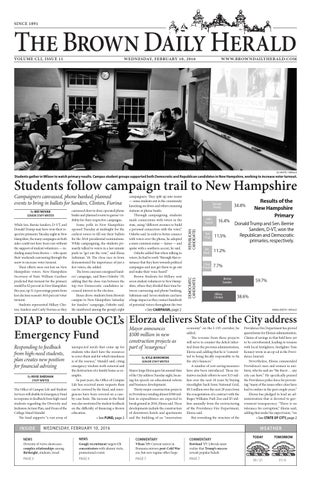
Students gather in Wilson to watch primary results. Campus student groups supported both Democratic and Republican candidates in New Hampshire, working to increase voter turnout.
Students follow campaign trail to New Hampshire
While Sen. Bernie Sanders, D-VT, and Donald Trump may have won their respective primaries Tuesday night in New Hampshire, the many campaigns on both sides could not have been run without the support of student volunteers — including many from Brown — who spent their weekends canvassing through the snow to increase voter turnout. Their efforts were not lost on New Hampshire voters. New Hampshire Secretary of State William Gardner predicted that turnout for the primary would be 62 percent in New Hampshire this year, up 31.4 percentage points from last election season’s 30.6 percent voter turnout. Students represented Hillary Clinton, Sanders and Carly Fiorina as they
canvassed door to door, operated phone banks and planned events to garner visibility for their respective campaigns. Some polls in New Hampshire opened Tuesday at midnight for the earliest voters to fill out their ballots for the 2016 presidential nominations. While campaigning, the students primarily talked to voters in a last minute push to “get out the vote,” said Elena Saltzman ’16. The close race in Iowa demonstrated the importance of just a few voters, she added. The Iowa caucuses energized Sanders’ campaign, said Roro Oshobe ’19, adding that the close run between the top two Democratic candidates increased interest in the election. Buses drove students from Brown’s campus to New Hampshire Saturday for Sanders’ campaign, Oshobe said. He numbered among the group’s eight
Donald Trump
John Kasich
REPUBLICAN CANDIDATES
By MEI NOVAK SENIOR STAFF WRITER
campaigners. They split up into teams — some students out in the community knocking on doors and others manning stations at phone banks. Through campaigning, students made connections with voters in the state, using “different avenues to build a personal connection with the voter,” Oshobe said. In order to better connect with voters over the phone, he adopted a more common name — James — and spoke with a southern accent, he said. Oshobe added that when talking to voters, he had to work “through that resistance that they have towards political campaigns and just get them to go out and make their voice heard.” Brown Students for Hillary sent seven student volunteers to New Hampshire, where they divided their time between canvassing and phone banking, Saltzman said. Seven students can have a huge impact as they contact hundreds of potential voters throughout the two » See CAMPAIGN, page 2
34.4%
16.4%
Ted Cruz
11.5%
Jeb Bush
11.2%
Results of the New Hampshire Primary
Donald Trump and Sen. Bernie Sanders, D-VT, won the Republican and Democratic primaries, respectively.
Chris Christie 7.7%
DEMOCRATIC CANDIDATES
Campaigners canvassed, phone banked, planned events to bring in ballots for Sanders, Clinton, Fiorina
Bernie Sanders
Hillary Clinton
59.7% 38.6% EMMA JERZYK / HERALD
DIAP to double OCL’s Elorza delivers State of the City address Mayor announces $500 million in new Emergency Fund construction projects as Responding to feedback from high-need students, plan creates new position for financial advising By ROSE SHEEHAN STAFF WRITER
The Office of Campus Life and Student Services will double its Emergency Fund in response to feedback from high-need students regarding the Diversity and Inclusion Action Plan, said Dean of the College Maud Mandel. The fund supports “a vast array of
INSIDE
unexpected needs that come up for students who don’t have the resources to cover them and for which timeliness is of the essence,” Mandel said, citing emergency wisdom teeth removal and the destruction of a family home as examples. In past years, the Office of Campus Life has received more requests than can be covered by the fund, and emergencies have been covered on a caseby-case basis. The increase in the fund was also motivated by student feedback on the difficulty of financing a Brown education. » See FUND, page 2
part of ‘resurgence’
By KYLE BOROWSKI SENIOR STAFF WRITER
Mayor Jorge Elorza gave his annual State of the City address Tuesday night, focusing his speech on educational reform and business development. Thirty major construction projects in Providence totaling almost $500 million in expenditures are expected to break ground in 2016, Elorza said. These developments include the construction of downtown hotels and apartments and the building of an “innovation
economy” on the I-195 corridor, he added. The revenue from these projects will serve to counter the deficit inherited from the previous administration, Elorza said, adding that he is “committed to being fiscally responsible to fix the city’s finances.” A number of cost-saving measures have also been introduced. These initiatives include efforts to save $15 million over the next 10 years by buying streetlights back from National Grid, $9.5 million over the next 20 years from the renegotiation of a contract with the Roger Williams Park Zoo and $5 million annually from the restructuring of the Providence Fire Department, Elorza said. But reworking the structure of the
Providence Fire Department has proved quarrelsome for Elorza’s administration. Claims of savings in that field have yet to be corroborated, leading to tension with local firefighters, firefighter Tom Kenney wrote in an op-ed in the Providence Journal. Nevertheless, Elorza commended Providence’s men and women in uniform, who he said are “the finest … any city can have.” He specifically praised the Providence police force for preventing “many of the issues other cities have had to endure in the past couple years.” Elorza has pledged to lead an administration that is devoted to government transparency. “There is no tolerance for corruption,” Elorza said, adding that under his supervision, “we » See STATE OF CITY, page 2
WEATHER
WEDNESDAY, FEBRUARY 10, 2016
NEWS Diversity of views showcases complex relationships among Birthright, students, Israel
NEWS Google recruitment targets CS concentrators with alumni visits, promotional events
COMMENTARY Vilsan ’19: Current unrest in Romania mirrors post-Cold War era, but new regime offers hope
COMMENTARY Rowland ’17: Liberals must realize that Trump’s success reveals popular beliefs
PAGE 3
PAGE 4
PAGE 7
PAGE 7
TODAY
TOMORROW
39 / 21
31/ 6
NEWS
PAGE 2 • WEDNESDAY, FEBRUARY 10, 2016
» FUND, from page 1 “Last May, the (Undergraduate Council of Students) organized a series of conversations with the Corporation and high-need students about some of the hidden costs of a Brown education, and I was in the room for those meetings as were several other key administrators,” Mandel said. According to Mandel, administrators direct students in need to the application on UFunds, a portal on the Brown website for soliciting the fund’s resources. But Mandel said that the fund is publicized largely through “word of mouth.” “Even with doubling the fund, we’re aware there’s still more work to be done,” Mandel said. Gwendolene Mugodi ’18 indicated that, as an international student, she has not always been able to rely on administrators to help her quickly find resources and solve problems. “When I have a problem, I don’t want to be told that I need to go this person and then I get to that office and someone tells me ‘that’s not my job,’” Mugodi said. “It’s very frustrating when you have a
» STATE OF CITY, from page 1 will establish ethics and transparency as hallmarks of City Hall.” Elorza also discussed his EveryHome initiative. Launched this past fall, the project will “revitalize and rebuild” every vacant and abandoned home in the city within six years, Elorza said. He added that the move is important for Providence, a city the Brookings Institution listed as having the fourth-highest income inequality in the country. In an
THE BROWN DAILY HERALD
problem and you want to have it solved … especially when it doesn’t seem like it’s such a hard thing to do.” Divya Mehta ’18 also said that she encountered difficulty accessing University resources last year. “In my first year, I would definitely say it was more difficult to navigate this campus and to get to the right resource,” she said. Mehta also expressed concern about the availability of the Emergency Fund for international students. “I know it’s easily accessible to most American citizens, but I’m not sure how easily accessible it is to international students,” she said. “I have a friend who did have some sort of financial need, and when he did … visit the (Office of International Student and Scholar Services), they kind of just rejected him.” Mandel said that, as part of the DIAP, the fund is intended to make “sure that if you’re here at Brown, the time that you’re here is well-supported so that you can focus on what we want you to focus on, which is your studies.” Other elements of the revised plan include the hiring of an assistant dean of financial advising, whose job is intended
to resolve concerns such as those voiced by Mugodi and Mehta about the advertisement and accessibility of the fund and other financial resources. The administrator’s role “is going to be specifically to support low-income students navigating the various financial resources that are available here at Brown — how to understand loans, how to think about financial literacy or mapping the resources that are available to you over time so that they’re used in the way they’re supposed to be,” Mandel said. The DIAP also contains a provision providing food for students who stay on campus during vacation periods, which addresses concerns that Mugodi said she felt about the availability of meals over breaks. The expansion of the fund is a significant step for high-need students, especially international ones, but Mehta believes more can be done. While Brown has limited funds, “if it wants to continue recruiting a larger international population, it needs to make the life of an international student a little easier on campus,” she said.
effort to further combat this inequality, the mayor’s office has engaged in projects like the creation of a grant program for the RI Black Business Association and the creation of a Latino Merchants’ Association, Elorza said. Education was another major topic of the address. An educational overhaul will include an investment of $20 million within the next two years for repairs and maintenance of school buildings, Elorza said. He also described a “12-month learning calendar” that will
make learning tools accessible to students at any time of year. This “Summer of Learning” campaign will “close the achievement gap and turn the summer from a time of learning loss to a time of gain,” he said. Despite the fiscal deficit and other challenges his administration has faced, Elorza promised that Providence has grown in recent years and there is still more to come. “We are ready for a resurgence, Providence,” Elorza said, “and that resurgence begins now.”
» CAMPAIGN, from page 1 days, she said. Emma Dickson ’16 said she had a long conversation after calling a woman who supported Clinton; they related with one another some of the topics that would affect them positively if she were to become president. In addition, students supporting Clinton’s campaign had the chance to meet Cecile Richards ’80, president of Planned Parenthood, who thanked them for the work they were doing. Kelly Conway ’18 joined up with the Fiorina campaign Saturday in New Hampshire and planned to stay through the end of the primaries. She became interested in Fiorina after writing a paper about her last semester and volunteered with the campaign over winter break. In addition to phone banking, Conway said she hoped to help plan events and rallies while in New Hampshire, as she had throughout her work with the team in the winter. While attending and planning these events, Conway heard Fiorina speak several times. “You really get a feel for her as a person,” she said. Fiorina’s campaign was less successful than others — she finished seventh in the Republican primary — but other campaigns felt confident going into
Tuesday night’s primaries. “We’re feeling optimistic,” Oshobe said. Brown University Students for Bernie is planning events with various groups on campus for later this semester, he added, taking “the enthusiasm and energy people have for Bernie and getting it out to generate support in the community.” Conway added that these past few days have demonstrated the energy and excitement surrounding Fiorina’s campaign. “When you’re in the campaign office you would think she was a frontrunner,” Conway said. “When you go out and talk to people, they say, ‘Oh, she’s still in the race?’” Yet Fiorina’s team carried their passion forward to make “sure the final push is really visible,” she added. Despite their differing political views, students enjoyed the chance to meet up with other campaigners who are “just as passionate about the election,” Saltzman said. Many students have been phone banking around the clock from their dorm rooms or lounges to get the last few voters possible out to support their candidates. “We’ve been eating, sleeping and breathing this since we’ve come back” from winter break, Dickson said. “It’s well worth it.”
Spotlight on the Statehouse BY AGNES CHAN, NEWS EDITOR
Farewell, Buddy Cianci The city of Providence bid farewell to its longest-serving mayor, Vincent “Buddy” Cianci, Jr. with a funeral service Monday. Despite the snowstorm, a crowd of around 100 gathered to watch the procession where Cianci’s casket was carried from City Hall to the Cathedral of Saints Peter and Paul. Both Gov. Gina Raimondo and Mayor Jorge Elorza attended the funeral, where Cianci was eulogized as a talented politician and great leader. The years Cianci spent in federal prison were only referred to indirectly as “his time away” or his “life in New Jersey,” Turn to 10 reported. A close friend of Cianci’s, former Mayor Joseph Paolino, spoke to the funeral attendees after the Mass. “Buddy, we hope you are looking down today with pride, knowing that we — that Providence — will never stop caring about you,” he said.
Grants to improve public housing Over 9,400 households residing in public housing in 25 Rhode Island cities will benefit from $12.9 million in grants awarded by the U.S. Department of Housing and Urban Development, Sen. Jack Reed, D-RI, announced Tuesday. “This federal funding will help Rhode Island housing authorities preserve affordable housing, build stronger neighborhoods and put more contractors to work making necessary repairs,” Reed said in a Feb. 9 press release. The funds will also help “reduce poverty and homelessness and help local housing agencies make much-needed improvements to preserve their aging housing stock,” Reed said. Of the total amount awarded to the state, $3.6 million will be given to agencies in Providence.
‘Rhody Pass’ to help regular commuters One of the proposals presented in Raimondo’s budget plan for next year is “Rhody Pass,” a new initiative that could make regular commuting between Providence and Boston much more convenient. The budget allocates $1.5 million to the Rhode Island Commerce Corporation to execute the Rhody Pass idea. While limited information has been released, Melissa Czerwein, spokeswoman of the Commerce Corporation, said it will “help create more interchangeable connectivity between the (MBTA) and Amtrak,” the Providence Journal reported. Rhody Pass was proposed by the Brookings Institution, a think tank, as a way to help improve the Ocean State’s economy. Brookings described it as “app-based” and stated it will reduce fares for “business travelers entering the state,” the Journal reported.
NEWS
WEDNESDAY, FEBRUARY 10, 2016 • PAGE 3
THE BROWN DAILY HERALD
SAM BERUBE / HERALD
Brown/RISD Hillel will send students to Israel for another free Birthright trip in May, the second of two annual trips aimed at exposing Jewish young adults to Israeli culture and geography.
Birthright exposes Jews to diverse views on Israel, some ‘problematic’ STAFF WRITER
Just a week before Brown/RISD Hillel arrived in Israel for Birthright this January, two young Israelis were stabbed in Jerusalem, reflecting a trend of violence in the Old City that has kept several Birthright trips from visiting the area’s historic monuments. While it was not frequently mentioned, the security situation could not be completely ignored by students on Birthright, a free trip to Israel for Jewish youths aged 18 to 26. Brown/RISD’s Birthright trip did not cancel its visit to the Old City of Jerusalem, though they were accompanied by a security detail, said Elan Cohen, Israel Engagement Fellow at Brown/RISD Hillel. But a planned trip to the popular Ben Yehuda marketplace in Jerusalem was removed from the trip’s itinerary. Despite the increasing risks, there are no plans to cancel the next departure, scheduled for May 29, Cohen added. On the heels of three Israeli incursions into Gaza in the last seven years, Israel has been subject to increasing international scrutiny. This trend has affected how young Jewish people understand their place in the Diaspora, making Birthright a topic of potentially heated debate. Students who go on Birthright are much more likely to support Israel than the general population. A 2014 study by Brandeis University showed that students who travelled to Israel with Birthright were more likely to condone Israel’s response to rocket attacks from Gaza and terrorist incidents in the West Bank. Of students who attended Birthright, 46 percent qualified Israel’s response to Hamas in Gaza as “about right,” compared to 31 percent of 18-to-29-yearolds in the United States. Sixty percent of those who went on the trip “very much” felt support for Israel, compared to just 45 percent of those who applied but did not go on the trip, because they either chose not to or were denied by the program. Yet support for Israel does not presuppose anti-Palestinian sentiments. Students on the Brown trip expressed a diverse array of political stances.
Ben Gladstone ’18 is a member of Brown Students for Israel and advocates for “a more fair treatment of Israel,” he said. He also considers himself pro-Palestinian, believing that peace is only possible through the creation of a Palestinian state. The interplay between these views is reflective of the complexities inherent in any discussion of the Israeli-Palestinian conflict, a geopolitical and religious flashpoint that has triggered heated debates on college campuses across the nation, including Brown’s. Gladstone and other students who attended this year’s Birthright trip acknowledged these complexities and the role of Israel in their lives in discussing the trip. Zoë Gilbard ’18 said that growing up, her family expressed “a lot of pride” about the existence of a Jewish state in the face of adversity. Emma Margulies ’18 also noted the significance of Israel to the Jewish people. She described Israel as “a place where Jews could go to be safe.” The students also expressed a desire to educate themselves about the country itself. “I was curious about what life is like in Israel,” Gilbard said. Along with this interest in learning came skepticism. Participants realized Birthright’s connection with noted billionaire Sheldon Adelson and the American right wing. “We were conscious of who the donors were and what kind of positions we might be exposed to,” Gilbard said. But, she added, “everyone was open-minded. Nobody forced anything on us.” “The goal of the trip was not to teach us a certain perspective,” Gladstone said. Gladstone noted the differences between Brown’s program and those that his peers had attended with other sponsors. His expectations of the trip were shaped by his own research as well as conversations with both “anti-Israel groups” and “liberal, pro-Israel” voices, in which he learned that there is generally “not a lot of critical thinking” among
Support for Israel among Birthright participants and nonparticipants 6% Participants
By MATT JARRELL
Birthright attendees. The Brandeis study showed that most Birthright participants considered themselves liberal — 64 percent. The other 36 percent were divided among moderates — 23 percent — and conservatives — 13 percent. The group is, on the whole, more liberal than U.S. millenials, as indicated by a March 2014 poll by the Pew Research Group. A liberal group themselves, Brown students confronted topics presented from a more conservative standpoint. Some programming that included proIsrael accounts of history — which Gladstone termed “problematic” — was Birthright-mandated, he said. Still, he added, the accompanying Hillel staffers attempted to place the material in context. “The staff gave it a very different dimension from the normal Birthright,” Gladstone said. For some of the more politically slanted material, students “were able to challenge (it) in a way that other trips couldn’t necessarily,” he added. Yet in a September 2014 Herald opinion piece, Peter Mahklouf ’16 said that Birthright may “brainwash” its participants into pro-Israel behavior. “Your ability to call Israel your ‘right’ came at the expense of millions of Palestinian refugees,” he wrote. Yet students on the trip said they engaged in debates regarding divisive policies such as Israeli settlements and areas controlled by Israel within the Green Line in the West Bank. Israeli Defense Force soldiers accompanied the trip, offering students their unique perspectives on these key issues, Gilbard said. The soldiers encouraged students to point out problematic and skewed narratives, Gladstone added. Students returning from this winter’s
14% 60%
Not at all
20%
A little
Nonparticipants
Studies show Birthright attendees likelier to support, connect with Israel, but Brown students skeptical
15% 45%
Somewhat
17% 23%
Very much
Source: Brandeis University Center for Modern Jewish Studies EMMA JERZYK / HERALD
trip confront what they see as a campus climate fraught with controversy around Israel and the conflict. Some of those who attended the trip expressed cynicism about the prospects of constructive dialogue amongst student groups. “On Brown’s campus, it’s difficult to have a conversation about these issues,” Gilbard said. “Some people are unwilling to do their research.” “It’s a really hard thing to talk about,” Margulies added. “You don’t change people’s minds by talking about it.” Experts in the field volunteered similar thoughts. “There’s a combination of ignorance and a lack of understanding
COURTESY OF BROWN/RISD HILLEL
Birthright participants ride camels on their trip to Israel this past winter. The program went on as planned despite recent violence in the area.
that goes beyond not knowing the facts,” said Omer Bartov, professor of history and German studies. He said both sides of the argument perpetrate a “great deal of misinformation.” Bartov, who is Israeli, largely blamed the Israeli occupation of the West Bank, the “bravado and jingoism” of Prime Minister Benjamin Netanyahu and the current Israeli government for the continuing issues in dialogue. Nonetheless, he criticized those who question Israel’s right to exist and described academic boycott as advocated by the Boycott, Divestment and Sanctions movement as “counterproductive.” Gladstone added that BDS emboldens the Israeli right wing. “A huge part of their narrative is that Israel is isolated and under attack, and only by leaning fully toward security and not at all toward peace can Israel protect itself,” he said. “BDS gives power to those voices.” The only way to move beyond the stalemate that characterizes these discussions is for students to try to learn about all aspects of the conflict from many points of view, said David Jacobson, professor of Judaic Studies. “A university should be dedicated to exploring the truth. If you’re arguing one side, you’re not being true to the academic mission,” he said. Members of Students for Justice in Palestine did not comment to The Herald for this article.
NEWS
PAGE 4 • WEDNESDAY, FEBRUARY 10, 2016
THE BROWN DAILY HERALD
Google finds growing number of recruits at Brown TA program within CS department prepares students for job interviews, conflict resolution, leadership By AILEEN SEO STAFF WRITER
On a break from coding during last weekend’s Hack@Brown event, students found themselves overwhelmed with free food, t-shirts and photo booth images paid for by a number of tech companies vying for students’ attention. Among the t-shirts decorated with the names of sponsoring companies and the slices of Flatbread given away, students may have also reached for a water bottle, courtesy of Google, to quench their thirst. The tech giant’s appearance at Hack@ Brown was just one of many ways it garners student interest in its internships and full-time employment opportunities. The company’s intentions at Hack@Brown were clear: Students at the event could also submit their resumes to be passed along to Google and other tech firms for recruitment. The company’s recruiting efforts have evidently made an impression on Brown students. Google is one of the computer science department’s top three recruiters, along with Microsoft and Facebook. Last year, 13 percent of computer science undergraduates were hired either as interns or full-time employees at Google. Furthermore, a LinkedIn survey of profiles indicates the company is by far the largest employer of Brown grads, with 392 graduates employed at Google’s offices across the world. “Google has started paying more attention to building a deep relationship with our department,” said Ugur Cetintemel, department chair of computer science. “They send alums to give talks about specific projects, collect resumes and conduct interviews.”
Through the Industry Partners Program within the computer science department, companies pay a fee in return for direct access to Brown students. They may use this opportunity to network with students to host events such as resume reviews and coding competitions. Google representatives alone schedule visits to campus at least three or four times each semester for department-wide programs, as well as events on campus like Hack@ Brown and next week’s career fair, said Lauren Clarke, who manages the Industry Partners Program. The path to getting hired by Google begins with a phone interview. Those who impress their interviewers will receive an onsite interview at one of Google’s many offices in Mountainview, CA, New York or Cambridge, MA. According to its website, Google considers four key qualities of each student during the interview process: leadership, role-related knowledge, thought process and “Googleyness” — an individual’s “comfort with ambiguity, bias to action and collaborative nature.” Sam Heft-Luthy ’16, a former Herald senior staff writer and a concentrator in computer science and literary arts, has held internships at Google for the past two summers — one on the politics and elections team and another in product management. For his position on the politics and elections team, Heft-Luthy said that he applied online through the normal application and was offered two phone interviews. During these, he was given a Google document and asked to address a coding problem. Following the interview, Heft-Luthy went through a process of “host matching” where his profile was
MARIANNA MCMURDOCK / HERALD
Cliff Weitzman ’16, an ambassador for Google, is one of many students and alums who were recruited and employed by the tech giant.
LAURA FELENSTEIN / HERALD
put on an internal website where Google employees could discover interns that would match the needs of their teams. He was eventually matched with the politics and elections team in Washington, D.C. The following summer, Heft-Luthy emailed the recruiter specifically to apply for the Associate Product Manager program. For that position, he completed one initial phone interview and was subsequently brought to the New York branch for two in-person interviews. He was then asked to write an essay about one of Google’s products. “Interviews for both positions are industry standard,” Heft-Luthy said. “One of them you’re writing code to solve a simple problem. The other one you’re doing more brain teasers to get a sense of what your eye goes to and how you approach complex problems.” As a product manager, Heft-Luthy communicated with engineers and designers to bridge the divide between the two departments. In his role, he was encouraged to host meetings face-to-face and provide guidance to different teams, rather than engage in active work himself, he added. Heft-Luthy said that Google recruits heavily from elite colleges like Harvard, Stanford and University of California, Berkeley. He noted that many of his peers in the Associate Project Manager
program — one of Google’s more selective internships — came from Ivy League schools, rather than public universities. Google keeps track of which schools provide the best-performing interns and turns to them in the next recruiting season, Heft-Luthy added. Google targets a wide range of students, including women and minorities in computer science, Clarke said. In addition, Google is one of the few companies that runs programs specifically geared towards first- and second-years to give them exposure to different fields and build upon their skills in software engineering. Even beyond the active recruiting months from September to December — notably earlier than the recruitment timeline for non-tech fields — Google continues to connect with students through events within the department and on campus. “Even if they are not actively recruiting, they are still taking resumes, and they are still doing open office hours,” Clarke said. During these office hours, students can meet with a Google recruiter to have their cover letters and resumes critiqued before they submit their applications to the company. Google also fosters connections with students in more light-hearted ways. “One year, Google sent a bunch of pies to the department for Pi Day (and) also
sent a couple of alumni to chat informally,” Clarke said. “It’s just another way to connect to the students.” Unlike other schools’ computer science programs, Brown’s employs undergraduates as teaching assistants, allowing them to gain valuable skills that make them attractive hires for companies like Google. “Every semester almost 200 undergraduates serve as teaching assistants, and this is very unique, as in most other schools, it is usually the graduate students who do most of the teaching,” Cetintemel said. “At Brown, it’s sort of flipped.” The TA program offers students the opportunity to not only improve their technical skills by teaching the material, but also to build on soft skills that help them in the communication of technical material, leadership and conflict resolution. The program provides rigorous training in software and leadership skills that prepare students to work at top companies like Google. “By the time they graduate they are the complete package,” Cetintemel said. “In fact, our placement rate is almost 100 percent. Many of the students graduate with great offers.” Google’s interest in innovation and raw talent is a good match for Brown students, who often value creativity and the opportunity to make a real-world impact, Cetintemel said.
TODAY
WEDNESDAY, FEBRUARY 10, 2016 • PAGE 5
THE BROWN DAILY HERALD
snow-capped city
menu SATELLITE DINING ANDREWS COMMONS
Pizza: Honey Boo Boo, Mushroom’s Revenge, Sausage and Spicy Garlic Po’ Boys/Rich Boys JOSIAH’S
BLUE ROOM
Gourmet Grilled Cheese
Beef Chili, Hearty Vegetable Soup, Naked Burrito
DINING HALLS SHARPE REFECTORY LUNCH
DINNER
Cajun Spiced Chicken Sandwich, Sundried Tomato Calzone, Oatmeal butterscotch Cookies
Southern Fried Chicken, Buttermilk Corn Bread, Braised Red Cabbage, Sweet Potato Pie
VERNEY-WOOLLEY LUNCH
DINNER
Italian Marinated Chicken, Fish Sandwich, Potato Cheese Souffle, Oatmeal Butterscotch Cookies
Mediterranean Salmon Stir Fry, Bourbon BBQ Chicken, Beets in Orange Sauce, Boston Cream Pie
sudoku
MATTEO MOBILIO / HERALD
Students study on the fifth floor of J. Walter Wilson as the sun disappears behind downtown Providence. Classes resumed Tuesday after Monday’s snow day, the third in the past two years at Brown.
comics Cat Ears | Najatee’ McNeil ’17
crossword
P- Branes and Bosons | Ricky Oliver ’17
calendar TODAY
FEBRUARY
S
7
M
T
W
Th
F
S
1
2
3
4
5
6
8
9
10
11
12
13
The American Dream? 7:00 P.M. Saloman Center, Room 101
Screening of “Vivir es facil” 7:00 P.M. Rochambeau House
Zika Virus: Separating Fact from Fiction 12:30 P.M. Watson Institute
Yoga Night: A Sophomore Slump Event 6:45 P.M. Hillel Social Hall
TOMORROW
14
15
16
17
18
19
20
21
22
23
24
25
26
27
28
29
Axolotl Day at the Science Center! 4:00 P.M. Sciences Library, Third Floor
Music Now 4:15 P.M. Orwig Music Building, Room 315
Brown Democrats: Democratic Debate Watch 9:00 P.M. Wilson Hall, Room 301
Boston Modern Orchestra Project 7:00 P.M. Granoff Center, Martinos Auditorium
COMMENTARY PAGE 6 • WEDNESDAY, FEBRUARY 10, 2016
THE BROWN DAILY HERALD
EDITORIAL
In support of the chemistry petition Several pre-medical students recently released a petition calling for Brown to offer both CHEM 0350: “Organic Chemistry I” and CHEM 0360: “Organic Chemistry II” during both the fall and spring semesters of the academic year. We support this effort. Brown must offer these classes during both semesters if students from all academic backgrounds are to be given a fair shot at fulfilling requirements. The way that the course schedule currently stands, students who test out of CHEM 0100 with Advanced Placement or International Baccalaureate scores are able to complete the requirements a full academic year before those who cannot. The former group of students are able to take CHEM 0330 their first semesters at Brown, CHEM 0350 their second and CHEM 0360 their third, finishing the chemistry requirements halfway through sophomore year. Indeed, the course schedule currently seems structured with these students in mind: CHEM 0350 is only offered spring semester, and CHEM 0360 is only offered fall semester. But this is a major inconvenience for the students who are unable to skip CHEM 0100. These students have to wait until their second semesters to take CHEM 0330, setting them up to take CHEM 0350 the next fall. Because it is not offered then, they have to wait until that spring to take it and then until the subsequent fall to take CHEM 0360. This sets them up to be unable to finish chemistry requirements no earlier than halfway through junior year — a whole year later than students who can opt out of CHEM 0100. It is unfortunate that disadvantaged students have to wait to take the MCAT simply because each organic chemistry class is only offered during a certain semester. Additionally, forgetting material during the summer between the first and second parts of organic chemistry presents a challenge for students. But it is also important to note that the students who are unable to opt out of CHEM 0100 often come from school systems where neither AP nor IB chemistry — the classes that would allow them to do so — are offered. While there is no way for Brown to control the fact that students come from unequal circumstances, the University should avoid having structures in place that only increase the effect of the gap, such as this scheduling issue. The University has claimed to be dedicated to removing obstacles for disadvantaged students and fostering diversity — especially in the sciences. This seems like an obvious place to start.
K I M B E R LY S A LT Z
Q U O T E O F T H E D AY
“There is so much interest in computer science these days.” — Ugur Cetintemel, department chair of computer science
See google on page 4.
Editorials are written by The Herald’s editorial page board: its editors, Emma Axelrod ’18 and Emma Jerzyk ’17, and its members, Eben Blake ’17 and Leeron Lempel ’19. Send comments to editorials@browndailyherald.com.
Editorial Leadership
Sections
Visuals & Production
Business
Editor-in-Chief Emma Jerzyk
Arts & Culture Editor Jaclyn Torres
Managing Editor Joseph Zappa
News Editors Lauren Aratani Agnes Chan Sandra Lifshits Kate Talerico
Design Editors Meryl Charleston Sonia Geba Andrew Linder Assistants: Nicola Ho, Minah Seo
General Managers Moniyka Sachar Joshua Tartell
Senior Editors Andrew Flax Caroline Kelly POST- MAGAZINE Editor-in-Chief Yidi Wu DIGITAL Director of Audience Development Marcy Huang
Sports Editors Matt Brownsword Taneil Ruffin Multimedia Features Editor Baylor Knobloch COMMENTARY Opinions Editors Margaret Hu Lainie Rowland Editorial Page Editors Emma Axelrod Emma Jerzyk
Photo Editors Head: Eli White Sam Berube Marianna McMurdock Matteo Mobilio Ashley So Web Producer Harsha Yeddanapudy Copy Desk Chief Bonnie Henry Illustrations Editor Roland High
Directors Sales: Henry Ritter Finance: Neil Wathore Finance: Benjamin Wesner Business Dev.: Abraham Galindo Sales Managers Antonia Alvarez Erin Lueck Matthew Meyer William Welland Finance Managers Collections: Reena Zhan Collections: Varun Narayan
facebook.com/browndailyherald
Location: 195 Angell St., Providence, R.I. www.browndailyherald.com
@the_herald
Editorial contact: 401-351-3372 herald@browndailyherald.com
browndailyherald.com
Business contact: 401-351-3260 gm@browndailyherald.com
Corrections: The Brown Daily Herald is committed to providing the Brown University community with the most accurate information possible. Corrections may be submitted up to seven calendar days after publication. Commentary: The editorial is the majority opinion of the editorial page board of The Brown Daily Herald. The editorial viewpoint does not necessarily reflect the views of The Brown Daily Herald, Inc. Columns, letters and comics reflect the opinions of their authors only. Letters to the Editor: Send letters to letters@browndailyherald.com. Include a telephone number with all letters. The Herald reserves the right to edit all letters for length and clarity and cannot assure the publication of any letter. Please limit letters to 250 words. Under special circumstances writers may request anonymity, but no letter will be printed if the author’s identity is unknown to the editors. Announcements of events will not be printed. Advertising: The Brown Daily Herald, Inc. reserves the right to accept or decline any advertisement at its discretion. The Brown Daily Herald (USPS 067.740) is an independent newspaper serving the Brown University community daily since 1891. It is published Monday through Friday during the academic year, excluding vacations, once during Commencement and once during Orientation by The Brown Daily Herald, Inc. Single copy free for each member of the community. Subscription prices: $280 one year daily, $140 one semester daily. Copyright 2016 by The Brown Daily Herald, Inc. All rights reserved. Periodicals postage paid at Providence, R.I. Postmaster: Please send corrections to P.O. Box 2538, Providence, RI 02906.
COMMENTARY WEDNESDAY, FEBRUARY 10, 2016 • PAGE 7
THE BROWN DAILY HERALD
History, revisited FABIANA VILSAN staff columnist
One evening in November 1989, Western families sat in their living rooms to watch the Berlin Wall crumble. Twenty-six years later, the nations of Eastern Europe are still experiencing political evolution, though not as publicly as during the Cold War era. As a Romanian at Brown, I find myself watching from afar as my generation seeks to overturn a corrupt system and inspire real change. As my American peers prepare for the presidential elections (whether they’re “feeling the Bern” or hoping to make America great again), the Romanian population is adjusting to its newly appointed government. It seems that though the televised revolutions of the late 1980s are behind us, political transformation in Romania has just begun. Two months have passed since a fire in a popular nightclub located in the heart of Bucharest, the capital of Romania, spurred a national uprising. The nightclub lacked the proper safety exits and was severely overcrowded, yet the owner had been able to bypass security requirements due to his powerful connections. The burning building and the fire’s innocent victims stood as a symbol for the rampant corruption in the country. Throughout history, revolutions have been spurred by defining moments that represented decades of injustice suffered in silence. In Romania, it took a devastating fire to spark popular unrest. Thousands of Romanians took to the streets in protest, demanding the resignation of the cabinet. In 1989, it took a similar demonstration and a symbolical-
ly shredded Romanian flag to bring down the communist dictator, Nicolae Ceausescu. It seems appropriate that the children of those revolutionaries are demanding change yet again, hopeful that their child r e n w o n ’ t have to. The Romanian regulatory system has been hostile to reform and continues to be a bribable institution. Money and connections, in the case of the nightclub, were valued above the lives of innocent victims. Demands for the resignation of the country’s prime minister, Victor Ponta, began in 2013, when he ran for the 2014 presidential election and faced overwhelming international criticism. U.S. Assistant Secretary of State for European and Eurasian Affairs, Victoria Nuland, described Ponta’s government as “a cancer of democratic regression … that bypasses parliament as often as (it) suits them.” Much of the population seemed to agree, waiting in lines for hours for the opportunity to vote against the corrupt prime minister. Ponta lost that election but maintained his position as prime minister. In 2015, he was forced to resign after standing trial for corruption and facing pressure from the sitting president. While pleading innocence, Ponta relinquished his mandate, declaring that he hopes the end of his govern-
ment will “satisfy the demands of the protestors.” But when did replacing
o n e corrupt government with another ever put
ROLAND HIGH
out a fire? Clearly, deep restructuring and realignment is necessary to spare the next generation from the same heartbreak. The world has become accustomed to a political system comprised of political parties pushing their own agendas. We’re all used to politicians speaking for hours without saying a thing or promising change without any intention of implementing it. The lack of substance among many candidates in the current American presidential campaign stands as a testament to this. Across the ocean, the new Romanian government, led by Dacian Ciolos, promises to be different. It promises to favor rational, honest leadership and to elect officials based on political vision. The institution is to stay in power for one year, during which the cabinet is to modernize the nation and reinstate a sense of trust within the Romanian population. The new cabinet calls itself a technocracy: an alternative to the democratic state, comprised of political leaders who lack party allegiance in
favor of non-partisan progress. Is it crazy to believe that this is the radical change that the nation needs to separate itself from corrupt governmental systems? Can individuals without party allegiance or backing be trusted with a political mechanism? It seems as though, despite the 12-hour flight that separates the United States from Romania, the issues dominating the political scenes are quite similar. As the Romanian people question the competence of their newly appointed government, the American people are turning away from “established” politicians and placing their trust in unconventional candidates who decry politics as usual. The number of anti-establishment Republican candidates this year demonstrates the American public’s turn away from the traditional. Donald Trump’s appeal (besides his entertainment value, of course) is the fact that he isn’t a politician; he promises to cut the crap and make America great again in the same way that he built great skyscrapers. What does it say about the system when a flamboyant business mogul is the preferred alternative to the entrenched politician? Are people so desperate for change that they’ll take a man who wants to build a wall and shut down the Internet over a politician who’ll do nothing at all? Romania may not have a Trump of its own to worry about, but its fresh-faced government certainly doesn’t come worry-free. As of now, it’s impossible to tell whether it’s truly time to put away the symbolic shredded flag or whether the next generation will wave it defiantly once again.
Fabiana Vilsan ’19 can be reached at fabiana_vilsan@brown.edu.
What Brown students get wrong about Trump LAINIE ROWLAND opinions editor
This is not the first column written about Donald Trump’s ascension in the polls, nor will it be the last. Despite his popularity most pollsters and pundits expect that Trump will fade once we get past the early primary states. But that argument has been over-analyzed, granted more than its fair share of time on the talk show circuit and the political headline parade. My issue with Trump’s newfound political popularity is surprisingly under-addressed. Namely, why are liberals — including Brown students — so surprised by Trump’s path to popularity? There are many factors at play, including an unwillingness (or inability?) to recognize steady undercurrents of racism and xenophobia seeping into popular opinion, as well as a deep polarization that isolates us within our own respective political camps. I’m tired of the pundits and peers that attribute Trump’s popularity to his brashness and aversion to “playing by the rules.” That personality describes Chris Christie just as well as it describes Trump. As a New Jerseyan, I should know. It’s tempting to explain away the success
of his racist and xenophobic brand by arguing that the appeal of “The Donald” is less about content and more about charisma. But let’s be real, Trump’s ideas are viewed as legitimate policy solutions by a significant portion of the population. Trump is democracy in action. An MSNBC poll from August revealed that, “The biggest differences between Trump supporters and other Republicans … can be found in their views on public policy issues.” Trump voters, for example, are 20 percentage
ing to a 2015 poll conducted by the Public Religion Research Institute, “a majority of Americans — 56 percent — believe Islam is ‘at odds with’ American values. … The results are even more extreme on a partisan level, with 76 percent of Republicans agreeing with that idea.” Race and education play a statistically significant role in predicting these beliefs. Trump has outpaced his rivals in capturing the support of a full third of Republican voters with a high school education or less. As many pun-
It’s tempting to explain away the success of his racist and xenophobic brand by arguing that the appeal of “The Donald” is less about content and more about charisma. points more likely than non-Trump Republicans to believe “immigrants today are a burden on our country because they take our jobs, housing and health care.” In December, “nearly two thirds of likely GOP primary voters said in a Bloomberg poll that they supported his proposal to block all Muslims from entering the (United States).” In response, I saw a slew of social media posts and opinions pieces condemning his words as un-American and undemocratic. But, the numbers show that his suggestion is disturbingly democratic. Accord-
dits have pointed out, Trump’s surge relies on the less-educated Americans with whom his politics resonate. But he also has a broad pull among other demographics. A Civis Analytics poll of more than 11,000 Republican-leaning respondents shows, “Trump has broad support in the GOP, spanning all major demographic groups.” But the comparison the geographic dispersion evokes is troubling. Nate Cohn of the New York Times wrote that, “It is similar to a map of the tendency toward racism by region, according to measures like the
prevalence of Google searches for racial slurs and racist jokes or scores on implicit association tests. Trump supporters call themselves the “silent majority” — a nod to President Richard Nixon’s appeals to mostly white Americans to reclaim cultural values. While controversial, the phrase acknowledges a harrowing reality. A significant number of Americans feel that Trump’s ideas best address their sources of anger and frustration with the government. And by bucking the establishment, Trump has found a way to give the racist and xenophobic backlash a sense of mainstream legitimacy. At Brown, we act surprised when we watch the TV in the Ratty and hear the next ridiculous thing Trump says. Are we that out of touch? The liberal uproar and borderline cliche bewilderment that occurs in response to Trump’s popularity indicates a willful blindness to fundamental divisions within the population. The disingenuousness of the disbelief is similar to the surprise expressed by many after the events of Ferguson — to which many black leaders replied, “we’ve been telling you this for years.”
Lainie Rowland ’17 can be reached at lainie_rowland@brown.edu.
NEWS THE BROWN DAILY HERALD
WEDNESDAY, FEBRUARY 10, 2016
Providence crime statistics reveal fall semester patterns
Relative percentage of crime Crime rates on College Hill are higher than those in Providence at large in nine out of 15 cases. Theft Assault Robbery Breaking & Entering Liquor Theft of Vehicle Disorder Missing Person Arson Drugs Other Property Crime Vehicle Recovery Weapons Offense Alarm 50
40
30
College Hill
20
10
0
Providence
Source: Providence Police Department LAURA FELENSTEIN / HERALD
400 300 200 100 0 0:00 2:00 4:00 6:00 8:00 10:00 12:00 14:00 16:00 18:00 20:00 22:00 Source: Providence Police Department EMMA JERZYK / HERALD
Thanksgiving decline The week with the lowest rates of overall crime on College Hill was between Nov. 26 and Dec. 3, coinciding with the University’s Thanksgiving break. This trend correlated with the student population leaving campus, Shanley said. “There’s less opportunity for criminals to come here and do anything.” Experts also agreed that it is typical to see a decrease in crime during holidays spent with family. “It seems to me that during Thanksgiving, people are just at home more,” Bloch said. “The people who would commit crimes are spending time with their families, like everyone else.” Isabella indicated that crime fluctuates throughout the year. “During the summer, when people are out on the street more and the weather is better, crime rises slightly. During cold weather events, it lowers.” The police department may analyze these long-term crime trends to strategically pool their resources around highcrime periods, he added. Day vs. night While many perceive the night as the time crime is most likely to occur, data suggest that some crimes do not follow such a predictable pattern. About half of all assaults occurred during daylight hours, between 7 a.m. and 7 p.m. But assaults occurred most frequently between 8 p.m. and 2 a.m., with 6.9 percent of all assaults occurring between 10 p.m. and 11 p.m.
Crime in Providence by week
The highest crime rates in Providence in 2015 were in late October, with 479 crimes committed. The lowest rates were in mid-December, with 278 crimes committed. 500 crimes committed
400
7 /1 12
/3 12
9 /1 11
/5 11
10
/2
2
300
/8
Providence during the fall, three occurred within a small range along Atwells Avenue, and four along Elmwood Avenue. “Like any other business, what’s important is location,” Bloch said. “Prostitutes will often designate certain areas as the place for Johns to solicit sex.” Isabella confirmed that these areas, located in the West End and Valley neighborhoods, respectively, have typically been used by prostitutes as areas to attract business. Bloch added that prostitutes may heavily frequent industrial or retail areas, or areas of economic impoverishment. Specific blocks or locations tend to become hotspots for prostitution, as they become well-known, he said. To address prostitution in Providence, the police force works with social work organizations such as Project RENEW — Revitalizing Engaging Neighborhoods by Empowering Women — which aims “to try to get people who are in prostitution off the streets and into services, such as drug treatment and mental health services,” Isabella said.
10
Downtown disorder charges Disorder charges composed 20 percent of all crimes. These violations were the second-most reported, following just behind theft, which made up 23.1 percent of total crimes. Most of these crimes constitute public disturbances that affect quality of life. Some specific populations, such as the homeless, may be pegged more often for committing these crimes, experts said. Disorder cases were most highly concentrated in downtown Providence during the fall semester. Over the course of those four months, Kennedy Plaza saw 14 disorder charges; Providence Place, 12; Washington Street, 14; and Westminster Street, 28. These locations host a large portion of Providence’s homeless population, who are often the victims of police discrimination, said Kate Miechkowski, an outreach advocate at the House of Hope, a group dedicated to preventing and reducing the social trauma of homelessness in Rhode Island. “For the most part, what I’ve witnessed is the police coming and inviting themselves into situations that they don’t need to be involved with,” Miechkowski said. She said she has witnessed policemen
500 crimes
24
Providence saw 5,889 crimes in total during the University’s fall semester, from Sept. 10 to Dec. 22. Crime experts confirm that a closer look reveals numerous trends related to the times of day, season and locations of criminal occurrences.
Crimes in the city of Providence peak at mid-day and decrease in frequency late in the night.
9/
STAFF WRITER
Crime by time of day
10
By RACHEL SACHS
driving by Broad Street every 10 to 15 minutes, pulling up and blaring their sirens. The sound signals that it is time to leave the area, Miechkowski said. “Everybody knows because it happens every day … they’re telling you to move even if you’re not doing anything wrong.” Those who are homeless are seen as criminal because not having a permanent place to live is perceived as deviant or non-normative, said Stefano Bloch, professor of urban studies. While a homeless person may not be engaged in an activity any different from that of a typical Brown student out acting obnoxiously or drunkenly, “a homeless person is arrested for being outright annoying because their status as homeless is really what’s being criminalized,” he added. But Dean Isabella, captain and commander of the special projects unit for the Providence Police Department, attributed the prevalence of crime around Kennedy Plaza primarily to the large influx of people who move in and out of the area using the city’s bus system, rather than simply its homeless population. The Providence Police Department works closely with social service agencies to perform outreach within the community to help the city’s homeless population, Isabella said. “We would much rather get them into the social services they need to prevent them from committing those types of disorder crimes in the first place.” Providence’s police department is one of the few in the United States that boasts both a full-time mental health clinician and social service advocacy agency that work alongside them, he added. “We look at (these data) to be proactive and preventative in regards to crime trends,” Isabella said. Prostitution along Elmwood and Atwells Avenues Of the 15 prostitution charges in
9/
Crime records point to locations, times for offenses from disorder charges to prostitution
Source: Providence Police Department LAURA FELENSTEIN / HERALD
“Historically, when you think of random assault, that generally does occur at night,” Shanley said. Yet domestic assaults commonly occur during the daytime. “Random assaults are one of the rarest occurrences,” Bloch said. “You are most likely to be assaulted by somebody you’re related to, somebody you’ve done business with — either legally or illegally — or somebody you’re either in love with or have recently fallen out of love with.” Trends appeared concerning the timing of other common crimes as well. Robberies occurred more often under the cover of night. Just 36.5 percent of robberies were carried out between 7 a.m. and 7 p.m. Of all hours in the day, the most robberies occurred between 9 p.m. and 10 p.m. — 9.5 percent of the total. But the trend reverses when looking into accounts of breaking and entering. Nearly 60 percent of the incidences of breaking and entering took place during the daytime, with 4 p.m. as the peak hour — 8.8 percent of the total. Isabella explained that most reports of breaking and entering take place when people are at work during the day, while robberies occur during the afternoon or evening when there are fewer people to observe the robbery taking place. While, as expected, 74.5 percent of liquor crimes took place at night — with 20.4 percent of all liquor violations occurring in the hour before midnight — drug crimes were more likely to be reported during the day. Of these violations, 77 percent occurred during daylight hours, with 12.4 percent of all drug crimes occurring between 11 a.m. and 12 p.m. Liquor law violations On College Hill, 10 liquor law violations were reported along the 100 block of Ives Street. Madeira Liquors and the pub Captain Seaweed’s are both located
on this block. The 200 block of Meeting Street, a range that includes liquor store Spiritus Fermenti, saw three violations. While he could not comment on these areas specifically, Isabella confirmed that areas with bars and liquor stores near college campuses tend to see a higher rate of liquor law violations. These trends follow a semester in which police cracked down more severely on underage drinking. The Herald reported in October that local cops were posing undercover at stores such as Darwin Liquors, Spiritus Fermenti and Madeira Liquors to apprehend customers without valid identification. “We have a license enforcement unit that frequently checks every licensed liquor establishment in the city of Providence,” Isabella said. “Some of them get a reputation for serving underage people, which draws more folks to them, which requires us to check those locations more frequently.” Missing persons epidemic? Four streets in Providence appear to have startlingly high missing person counts. Eighty-two missing persons were reported at the 100 block of Knight Street, 93 at the 300 block of Hope Street, 102 at the First block of Dartmouth Avenue and 129 at the First block of Tappan Street. As it turns out, the calls come from outreach and residential services that house at-risk populations — commonly known as group homes — which are located along these blocks, Isabella explained. “Whenever a client of a group home doesn’t return in time for a curfew or decides to not go back to the group home, the group home is obligated to file a missing persons report,” he said.