SINCE 1891
THE BROWN DAILY HERALD TUESDAY, FEBRUARY 2, 2016
VOLUME CLI, ISSUE 5
WWW.BROWNDAILYHERALD.COM
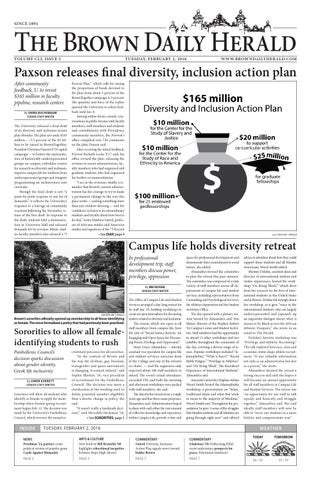
Paxson releases final diversity, inclusion action plan After community feedback, U. to invest $165 million in faculty pipeline, research centers By SHIRA BUCHSBAUM SENIOR STAFF WRITER
The University released a final draft of its diversity and inclusion action plan Monday. The plan sets aside $165 million — 5.5 percent of the $3 billion to be raised in BrownTogether, President Christina Paxson’s P’19 capital campaign — to bolster the representation of historically underrepresented groups on campus, embolden centers for research on diversity and inclusion, improve campus life for students from underrepresented groups and integrate programming on inclusiveness into curricula. Though the final draft is not “a point-by-point response to any list of demands,” it reflects the University’s response to a barrage of community reactions following the November release of the first draft. In response to the draft, students held a demonstration in University Hall and released demands for its revision. Ethnic studies faculty members also released a “5
Percent Plan,” which calls for raising the proportion of funds devoted to the plan from about 3 percent of the BrownTogether campaign to 5 percent. The quantity and force of the replies spurred the University to solicit feedback until Jan. 8. Among online forms, emails, conversations in public forums with faculty members, staff members and students and consultations with Providence community members, the Provost’s office compiled over 720 comments on the plan, Paxson said. After receiving the initial feedback, Provost Richard Locke P’17 said, his office revised the plan, releasing the revision to senior administrators, faculty members who had organized and graduate students who had organized for further recommendations. “I see in the revisions, finally, a reminder that Brown’s current administration has the courage to try to make a permanent change to the way this place works — seeking something more than just window dressing — and the confidence to listen to its extraordinary students and faculty about how best to do that,” wrote Matthew Guterl, professor of Africana studies and American studies and signatory of the “5 Percent » See DIAP, page 4
LILLY NGUYEN / HERALD
Campus life holds diversity retreat In professional development trip, staff members discuss power, privilege, oppression By MEI NOVAK SENIOR STAFF WRITER
SAM BERUBE / HERALD
Brown’s sororities officially opened up membership to all those identifying as female. The move formalized a policy that had previously been practiced.
Sororities to allow all femaleidentifying students to rush
Panhellenic Council’s decision sparks discussion about gender identity, Greek life inclusivity By GWEN EVERETT SENIOR STAFF WRITER
Sororities will allow all students who identify as female to apply for membership when formal spring recruitment begins Feb. 12. The decision was made by the University’s Panhellenic Council, which oversees the annual re-
INSIDE
cruitment processes for all sororities. “In the context of Brown and the way the (lesbian, gay, bisexual, transgender and queer movement) is changing, it seemed natural,” said Sophie Blistein ’16, vice president of recruitment for the Panhellenic Council. The decision was more a clarification of the wording used to define potential member eligibility than a drastic change in policy, she said. “It wasn’t really a landmark decision,” said Meredith Heckman ’16, » See SORORITIES, page 3
The Office of Campus Life and Student Services arranged a day-long retreat for its staff Jan. 19, holding workshops to create an open atmosphere for discussing matters related to diversity and inclusion. The retreat, which was open to all staff members from campus life, bore the title of “Social Justice Retreat: An Engaging and Open Space for Discussing Power, Privilege and Oppression.” Mary Grace Almandrez — interim assistant vice president for campus life and student services, associate dean of the College and one of the retreat’s co-chairs — said the organizers only expected about 100 staff members to attend. The event’s actual attendance exceeded 150, and both the morning and afternoon workshops were packed with staff members, she said. The idea for the retreat arose a couple years ago and has three main purposes, Almandrez said. Administrators hoped to share with each other the vast amount of collective knowledge and experience within Campus Life, provide a time and
space for professional development and demonstrate their commitment to social justice, she added. Almandrez formed the committee to plan the retreat this past summer. The committee was composed of a wide variety of staff members across all departments of campus life and student services, including representatives from Counseling and Psychological Services, the athletics department and the Student Activities Office. The day opened with a plenary session hosted by Almandrez and Tim Shiner, director of the Stephen Robert ’62 Campus Center and Student Activities. Staff members had the opportunity to attend 13 other workshops and two exhibits throughout the remainder of the day, covering a diverse range of issues. Popular workshops included “Islamophobia,” “What is Race?,” “Racial Battle Fatigue,” “Privilege in Athletics” and “On Being ‘Black’: The Racialized Experience of International Students,” Almandrez said. Associate University Chaplain Adrian Wood-Smith hosted the Islamophobia workshop, a presentation on “Islam, traditional Islam and what that tends to mean to the majority of Muslims,” Wood-Smith said. Throughout the presentation, he gave “a sense of the struggles that Muslim students and all Muslims are going through right now” and offered
advice to attendees about how they could support those students and all Muslim Americans, Wood-Smith added. Shontay Delalue, assistant dean and director of international student and visitor experiences, hosted the workshop “On Being ‘Black,’” which drew from her research on the lives of international students in the United States and at Brown. Delalue felt strongly about her workshop, as it gave “voice to the international students who are largely underrepresented and (opened) up an important dialogue about what it means to be Black across the African Atlantic Diaspora,” she wrote in an email to The Herald. Delalue’s favorite workshop was “Privilege and Athletic Recruiting.” The talk explored how race, class and economic status shape athlete recruitment. “It was valuable information not only as an administrator but also as a parent,” she wrote. Almandrez deemed the retreat a strong success and said she hopes it will become an annual opportunity for all staff members in Campus Life and Student Services. The retreat was “an opportunity for our staff to talk openly and honestly and struggle together,” Almandrez said. She said ideally staff members will now be able to “serve our students in a more holistic and compassionate way.”
WEATHER
TUESDAY, FEBRUARY 2, 2016
NEWS Friedman ’14, partner create political version of popular game Cards Against Humanity
ARTS & CULTURE New book by Bill Reynolds ’68 highlights educational inequities between Hope High, Brown
COMMENTARY Guterl: Diversity, Inclusion Action Plan signals move toward bolder Brown
COMMENTARY Gladstone ’18: Politicizing Hillel event undermines prospects for peace, Palestinian statehood
PAGE 2
PAGE 3
PAGE 7
PAGE 7
TODAY
TOMORROW
50 / 33
55 / 47
NEWS
PAGE 2 • TUESDAY, FEBRUARY 2, 2016
THE BROWN DAILY HERALD
Election game lampoons political process ‘Hope’ highlights local Satirical startup inspired by Cards Against Humanity, frustration surrounding election By CATHERINE WALKER-JACKS STAFF WRITER
Instead of spending Martin Luther King Jr. weekend relaxing or catching up on sleep, Amelia Friedman ’14 and her business partner Param Jaggi challenged themselves to complete a “startup weekend,” during which they launched a product in just three days. By the end of the weekend, the pair successfully created the 2016 Election Game — a card game centered on the antics of presidential candidates and inspired by Cards Against Humanity, which was developed by Ben Hantoot ’09, Eli Halpern ’09 and six of their friends. “We wanted to take a weekend to remind ourselves of the true essence of entrepreneurship,” Friedman said. Friedman, 23, and Jaggi, 21, selfproclaimed “serial entrepreneurs,” are the co-founders of a company called Hatch, which allows users to create mobile apps without coding. Having devoted significant time to working on Hatch for the past six months, the two needed something to “invigorate (themselves), because (they) were feeling a little burnt out,” Jaggi said. On the Friday of MLK Jr. weekend, Friedman pitched the idea for
the game to Jaggi. By Monday, the pair had created a design, prototype and website for the game. Examples of cards found in the game include: “Chris Christie joining Weight Watchers,” and “Ted Cruz reading a bedtime story to the Senate,” as well as numerous Donald Trump inspired cards like, “It’s going to be YUGE.” She and Jaggi sourced material for cards by spending the weekend rewatching debates, election coverage and lots of Jimmy Fallon, Friedman said. Inspired by the widespread frustration with the election, the 2016 Election Game is “a great way to bring comic relief to an environment of exhaustion and exasperation,” Friedman said. “Everyone is offended; everyone is frustrated,” Friedman said about the election. “I feel like we’ve gotten down to mudslinging, … and I definitely don’t feel like I have a candidate.” “As a millennial, there’s this feeling that we’re kind of screwed,” Jaggi added. The target audience for the game are millenials interested in politics and are “in the same boat” as the entrepreneurs, Jaggi said. Throughout the process of developing the game, Friedman said “everything has been challenging because everything is new. But that’s why we did it.” While both Friedman and Jaggi have significant experience selling tech products, the 2016 Election Game
is their first physical product. “The way people buy physical products is very different than software,” Jaggi said. Despite a few hiccups along the way, the response to the game has been “amazing,” Jaggi said, adding that the highlight for him has been “building a community around people who are politically unimpressed.” “There might be a few candidates who are offended, but we haven’t heard from their offices yet,” Friedman said. Aziz Rangwala ’17 said he thinks the game is “interesting because it contrasts the political correctness that often surrounds politics with the off-color nature of Cards Against Humanity.” The card game is currently available online for presale purchase. While Friedman and Jaggi did not disclose how many presale decks have been sold, they said the process is going well, and they are hopeful about hitting their goal. As the card decks are being manufactured for the next few weeks, the pair will create cards with new material, using Twitter to crowdsource ideas, Jaggi said. The pair hopes the game provides comic relief and keeps voters informed about the election cycle, Jaggi said. “It’s been a fun journey that has reinvigorated our entrepreneurial spirit.”
education disparities New book spotlights inequality at Hope High School, five minutes away from Pembroke Campus By REBECCA ELLIS SENIOR STAFF WRITER
Only five blocks up from the Thayer Street CVS, Blue State and a bevy of firstyear dormitories lies Hope High School. Though only a two-minute drive apart, Hope and Brown speak to the two stratospheres of our education system. With less than half of the student body proficient in reading and roughly 75 percent of its students considered “economically disadvantaged,” Hope’s similarities to Brown end with its zip code. This is the world Providence Journal sports columnist Bill Reynolds dove into for his new book, “Hope: A School, a Team, a Dream,” in which he shadows Hope’s basketball team, the Blue Wave, through one tumultuous season. The book is composed primarily of three strands: the team’s lackluster games, the difficult — if not traumatic — lives of each player and relevant portions of Providence’s history, which show the reader how Hope High School went from a ‘model city school’ to one of Providence’s most impoverished. In choosing basketball, Reynolds finds the students vying most intensely for escape. While academics has failed them, “the great basketball lottery” provides each kid a shot to receive the golden ticket to a life out of poverty. For the subjects of Reynolds’ book, basketball represents the chance for a college education and a stable income. But it is far from the perfect escape. When Hope students play basketball, they play in a gym that hasn’t been touched for decades. Come practice time, many of their players haven’t had anything to eat since noon. In between the plays, they are preoccupied with potential pregnancies, failing grades and concerns about graduation. They are dealing with the weight of the world in an aging gym with faulty heating.
Strikingly, they are contending with all these challenges only five minutes away from Brown’s Erickson Athletic Complex. Throughout the book, Reynolds repeatedly sheds light on this disparity of educational standards by delving into the dusty corners of a school ravaged by the war on drugs. He finds a school in disrepair, where students walking out of class is common — if not expected — and alums can recount seeing a teacher bound with rope to his chair and heckled by students. It is a school implicated in Rhode Island’s shocking statistic of 40 percent unemployment for young black males, as most students have no plans professionally or academically come June. In a few particularly poignant tales, Reynolds prods the students to reveal those whom the education system has missed — those whose sole knowledge about Brown is that they “have a good cooking school,” those who believe Martin Luther King Jr. freed the slaves or that going a half hour east of Providence puts them in Cuba. These portrayal of the contrast between the privilege of the Brown community and the lack of resources at Hope are where the book shines. But the work falls flat in between the anecdotes, succumbing to dull dialogue and repetitive plot, as the travesty of the team losing again and again is quickly dulled by the frequency with which it happens. Reading “Hope: A School, a Team, a Dream” is like digging for gold. There is a lot of material you must bulldoze through — mainly monotonous recaps of each game, unfulfilling player profiles and heavy-handed rhetoric. But in the middle of what can read as a series of sports clippings, a glimmer of gold appears to reveal an anecdote or history, making the dig worthwhile. And, by the end of the book, you have a collection that gives a valuable glimpse of a life we are somehow sheltered from by the Brown bubble, even though the bubble lies directly on top of the students of Hope.
COURTESY OF BROWN UNIVERSITY BOOKSTORE
Bill Reynolds ’68 wrote “Hope: A School, a Team, a Dream,” which delves into the lives of basketball players at Hope High School.
NEWS
TUESDAY, FEBRUARY 2, 2016 • PAGE 3
THE BROWN DAILY HERALD
Students spearhead Energize R.I. legislation, new carbon tax Upcoming bill to fight climate change, create new green jobs while penalizing fossil fuel use By JULIANNE CENTER SENIOR STAFF WRITER
Students are hoping to pass the United States’ first carbon tax, Energize Rhode Island, a bill written by Solomon Goldstein-Rose ’16. It is “a push to create a clean energy and jobs fund in Rhode Island,” said Kaya Salem ’18, coordinator and intern at Energize R.I. The bill proposes putting a fee on fossil fuel companies in the state to “make the polluters pay,” Salem said. The revenue from the fee will be used to fund programs for weatherization, energy efficiency and renewable energy, Salem said, in addition to direct rebates for businesses and households in the state. The bill was backed by the Energize R.I. coalition — a group comprised of humanitarian organizations, businesses, environmental groups, faith groups and the Brown Democrats. Rep. Aaron Regunberg ’12,
» SORORITIES, from page 1 co-chair of Greek Council. “It’s kind of been a policy that we’ve always had,” she said, adding that during her time in the Greek system, sororities have always operated under the assumption that all women — no matter their assigned sex — are welcome to rush. But codifying “how we want to address the word ‘woman’” in the Panhellenic Membership Recruitment Rules and Procedure — the formal guide by which the Panhellenic Council sets the terms of recruitment each year — is an important statement in itself, Blistein said. The new rule had to be approved by all three sororities — Alpha Chi Omega, Kappa Alpha
D-Providence, introduced the bill to the Rhode Island House of Representatives this session, and the bill has now garnered 40 co-sponsors, Salem said. “From the onset, Energize R.I. was a student initiative,” Salem said, citing that Brown students both funded the organization and wrote the bill. “But since then it has become an organization of Rhode Islanders,” Salem added. Alberta Devor ’15, Dylan Elliot-Hart ’19, Hillary Brame ’19 and Mintaka Angell ’15 are among the five student interns headed by J. Timmons Roberts, technical advisor and professor of environmental studies and sociology. The bill will reduce emissions and improve the economy, challenging the “false dichotomy between business and the environment,” Elliot-Hart said. An economic impact study by Regional Economic Models estimated that the legislation would create between 1,000 and 2,000 new jobs in just the first two years of its implementation. The study shows the bill will discourage the Ocean State’s dependence on fossil fuels, which costs the state more than $3.1 billion annually. The bill was introduced during
the last legislative session but was not passed. Student interns worked hands-on to support the coalition through activities such as refining the language of the bill and generating marketing content on social media, Angell said. She is optimistic the “moderate proposal” will pass this session due to its feasibility and “appeal to people on both sides of the political aisle, as well as people who are on all sides of the social spectrum.” This is not the first time Brown students have been involved in the history of climate legislation in Rhode Island. In 2014, students helped pass the Resilient Rhode Island Act, which set limits on carbon emissions. Student interns researched and campaigned for the bill and were backed by the environmental studies department, Salem said. “This could in some way be considered a follow-up bill because Energize R.I. will get us halfway to the carbon emissions targets,” Salem said. While states such as Massachusetts, Vermont, Washington and Oregon have similar carbon tax campaigns, “I want us to be the first on this one,” Salem said. With over
Theta and Kappa Delta — in order to become official, she added. Aaron Rosenthal ’16, the other Greek Council co-chair, described the Panhellenic Council’s decision as a “bold statement … (that) fits so well with the majority of views on this campus.” The Greek Council has worked this year to redefine the image of Greek life on campus, he said, adding that this decision marked a positive step toward that goal. But the national organization with which each sorority is affiliated may impose its own requirements for new member eligibility, Blistein said. This could complicate the Panhellenic Council’s decision, because though the council “strongly believe(s) that any member who goes through
recruitment would be accepted, … it’s almost impossible to know how national organizations would react,” Blistein said. If national chapters decide to side against the Panhellenic Council’s definition of member eligibility, Brown sororities can choose either to disaffiliate with the national organizations or to comply, she added.
COURTESY OF ENERGIZE RI COALITION
Energize R.I. interns Dylan Hart-Elliot ’19, Alberta Devor ’15, Mintaka Angell ’15, Kaya Salem ’18 and Hillary Brame ’19 pose during a meeting. 400 miles of coastline, R.I. residents experience climate change firsthand every day, she said. Passing carbon tax legislation in Rhode Island could “pave the way on the national level,” she added. “Given that climate change is one of the pressing issues of our generation, I think that we have every
incentive to make sure that we are a leader in national issues,” Angell said. The coalition hopes to see the bill passed this session due to the “level of urgency” that climate change presents to the state, the nation and the world, Elliot-Hart said. “We need to address climate change before we can’t address it anymore.”
Heckman doubts that national organizations will resist the terms of eligibility Brown chapters have recently set. “I don’t anticipate any sort of protest. … The national chapters really do defer to college chapters,” she said. Meanwhile, the Panhellenic Council’s new policy has sparked discussion
surrounding gender identity and rush in the greater Greek community, Rosenthal said. He and the other co-chairs intend to discuss the possibility of adopting a similar policy for all Greek houses, he said. “Seeing as Brown is as open of a place as it is, I really don’t (anticipate) any sort of backlash.”
NEWS
PAGE 4 • TUESDAY, FEBRUARY 2, 2016
» DIAP, from page 1
inclusive community,” Locke said.
Plan” in an email to The Herald. The major changes to the plan include more concrete financing; shortening the deadline to double the number of faculty members from historically underrepresented groups to between five and seven years instead of 10; diversifying the graduate student population through the endowment of 25 graduate fellowships; and generating a “full suite” of optional professional training workshops to educate community members on issues of diversity and inclusion, Locke told The Herald Monday. The increase in funding for the DIAP from 3 percent to 5.5 percent of Paxson’s fundraising campaign came about naturally through more specific financial calculations, Locke said. The $165 million includes $100 million for 25 endowed faculty positions, $25 million for graduate fellowships, $20 million for co-curricular programming and $10 million each to the Center for the Study of Race and Ethnicity in America and the Center for the Study of Slavery and Justice, Locke added. Not included in the plan were specifics for an additional $500 million dedicated to the expansion of financial assistance to support first-generation, low-income and middle-income students, Locke added. Paxson and Locke emphasized the importance of detaching the price tag from the major aims of the plan. “Even more important than financial investments, … we’re really changing the culture and a set of practices of the University to make it a more
Faculty development The development of orientations and trainings for faculty members, staff members and students on diversity, inclusion and sensitivity was a major change between the initial and finalized versions of the DIAP. Throughout the revision process, administrators learned that “mandating diversity training does not change behaviors or attitudes,” Locke said, noting specifically that research by Harvard Professor of Sociology Frank Dobbin, who spoke to Paxson’s cabinet Jan. 12, reveals this trend. Instead, the University is developing a “suite of options,” including lectures, workshops and retreats to engage faculty members more fully, he added. Many of the options are being developed by in-house talent, such as Professor Tricia Rose’s MA’87 PhD’93 Structural Racism lecture series. Outside experts will also be consulted, Locke said. Appendix C of the final draft of the DIAP enumerates the planned roll-out of professional development options for the coming semester. While diversity and inclusion training will be mandated for senior administrators, it will be an “opt-in” model for faculty, Paxson said, because “deep and broad buy-in to the goals of the plan” is the only way to ensure its success. Additionally, Locke noted that because different departments have different needs in terms of sensitivity education, a decentralized model for training would be more effective. Each department is charged with
THE BROWN DAILY HERALD creating and releasing a diversity and inclusion action plan specific to its own needs. The University will provide data on departments’ current standings and provide support and guidance, Paxson said. Though some demands included student approval of department plans, the plans will only be approved by the provost and the Office of Institutional Diversity and Inclusion. The University will use the leverage behind these plans’ approval to ensure that each department’s commitment to improvement on matters of diversity and inclusion is sufficiently robust. The University will not afford departments’ funding to hire new faculty members if they do not work out approvable plans, Locke and Paxson said. Oversight and governance The DIAP creates many different committees and working groups, including the Diversity and Inclusion Oversight Board, which will include students, the vice president for campus life and student services, faculty members and staff members. The board will track the progress of the University and department plans and issue an annual report. Two other groups will report to the board: the Diversity Advisory Council and the Committee on Faculty Equity and Diversity. The Diversity Advisory Council is comprised of alums, and the Committee on Faculty Equity and Diversity will be comprised of faculty. The chair of the CFED will also sit on the DIOB. In turn, the DIOB will report to
the Diversity Steering Committee, made up of senior administrators and chaired by Paxson, who will report to the Corporation. Unlike other universities’ plans, Brown’s action plan furnishes in-depth detail about the strategic approach to implementing diversity and inclusion policies and practices in all aspects of campus functions, Paxson said. “This is the kind of competition that we hope everyone is going to be in,” Locke added. Changes to the curriculum The plan also addresses the “dissatisfaction with how Diverse Perspectives in Liberal Learning works,” Paxson said. The DPLL designation for courses was added in 2002 as a mechanism of indicating classes that engage with issues of intersectionality. The plan pledges to reevaluate the designation through a collective of faculty members, students and staff members, said Dean of the College Maud Mandel. The collective is charged with thinking “about how we can create more robust opportunities for students to engage with questions of diversity in the curriculum,” Mandel said. The committee will “presumably” consider whether there should be a DPLL requirement for graduation akin to the WRIT requirement, she added. “I suspect there would be strong feelings across the Brown community on all sides.” Additionally, the Office of the Provost will coordinate the creation of a Native American and Indigenous Peoples Initiative. The office expects to publish an initial draft of proposals for the initiative by the end of the semester. Disaggregating data In accordance with recommendations of faculty members,
undergraduate students and graduate students, the University will revise how it collects and reports demographic data. A subgroup of the oversight board will be charged with determining how data will specifically be collected and made available to the public, Locke said. In compliance with students’ demands, the Southwest Asian and North African designation will be added to demographic options. Furthermore, all data regarding faculty members, staff members, graduate students and undergraduate students will be made available electronically on the website, Locke said. DPS The Department of Public Safety, a focus of student demands, received one paragraph in the finalized plan. The plan notes DPS’s commitment to and requirement of annual training on a “wide variety of topics, including diversity and inclusion.” The Public Safety Oversight Committee will continue to oversee DPS’s “policies and practices” and will release an overview assessment by the end of this academic year, the plan states. Despite multiple calls for the disarming of DPS, Paxson maintained her stance. “I’ve been very clear that I don’t agree with that,” she told The Herald. “I don’t think stripping DPS of guns will necessarily solve anything,” said Gabe Reyes ’18, who was involved in the Day of Reclamation demonstration. “It’s about un-learning racist thoughts and violent behavior.” The Herald requested comments from eight students who were either unavailable or expressed that they were not comfortable commenting until they had read the DIAP in full. — Additional reporting by Melissa Cruz
TODAY
TUESDAY, FEBRUARY 2, 2016 • PAGE 5
THE BROWN DAILY HERALD
menu
a break from the cold
SATELLITE DINING ANDREWS COMMONS
Pizza: Spinach and Feta, Bacon Chicken Ranch Po’ Boys/Rich Boys, Carbonara Pasta JOSIAH’S
BLUE ROOM
Quesadillas
Three-Bean Chili, Butternut Squash Soup
DINING HALLS SHARPE REFECTORY LUNCH
DINNER
Chicken Chimichangas, Mexican Corn, Steak Fries, Snickerdoodle Cookies
Ratatouille with Cheese, Cajun Blackened Chicken, Roasted Parsnips, Chocolate Cake
VERNEY-WOOLLEY LUNCH
DINNER
Buffalo Wings, Macaroni and Cheese, Grilled Key West Chicken, Orange Delight Cake
Vegan Stuffed Acorn Squash, Thai Basil Pork Stirfry, Chicken Pot Pie, Chocolate Cake
sudoku
SAM BERUBE / HERALD
Students study and socialize on the sunny steps of Faunce House. As unseasonably warm weather settles over campus, students take advantage of the final days of shopping period and enjoy coffee between classes.
comic P-Branes and Bosons | Ricky Oliver ’17 RELEASE DATE– Tuesday, February 2, 2016
Los Angeles Times Puzzle c r o sDaily s w oCrossword rd Edited by Rich Norris and Joyce Nichols Lewis
ACROSS 1 Weight-watcher’s bane 5 Pea jackets? 9 Little marketgoer of rhyme 14 Winans of gospel 15 Long-necked pampas bird 16 Cheri of “SNL” 17 Obeyed the corner traffic sign 20 Coach Steve of the NBA champion Golden State Warriors 21 Philosopher Descartes 22 North Carolina university 23 Place to buy a Nikon 26 Hors d’oeuvres bit 29 Capital of Yemen 31 Cosmetics giant 32 Turkey club spread 36 Uses Redbox, say 38 Soft pitch 39 Conceal, as misdeeds 41 Bank acct. entry 42 Track team member 44 Stuns 45 “I’m ready for the weekend!” 46 Ballerina artist Edgar 48 Gets weak in the knees 50 “For Better or for Worse,” e.g. 54 Nanny’s nightmare 56 Message from the teacher 57 Swedish furniture retailer 60 Warning about sealed-off escape routes from the police, four of whom are aptly positioned in this puzzle’s circles 64 Cow on a dairy container 65 Over and done with 66 Prayer start 67 Oozes 68 Meadow moms 69 State fair structure
DOWN 1 TV/radioregulating agcy. 2 Job for a plumber 3 Top spot 4 Part of many a six-pack 5 Country club instructor 6 Windy City hub 7 Put off 8 Steamy room 9 D.C. big shot 10 “Dinner’s ready” 11 Energetic enthusiasm 12 Grasp intuitively, in slang 13 “Eek!” 18 Ensnare 19 Not as costly 24 Message to employees 25 Plucked instrument 26 Far from rattled 27 Dodge 28 Raising money for a children’s hospital, say 30 Had food delivered 33 Actress Gardner 34 Fine-grained wood
35 Ironworks input 37 Sunscreen nos. 39 Prepare frantically for finals 40 Amer. ally in WWII 43 Self-gratifying pursuit 45 Man bun 47 Greed and pride, for two 49 Xbox One rival
51 Sporty wheels 52 Smoothie insert 53 Curt 54 What top seeds may get in tournaments 55 Film part 58 Perimeter 59 Very long time 61 Some Caltech grads 62 NHL tiebreakers 63 Banned pesticide
ANSWER TO PREVIOUS PUZZLE:
xwordeditor@aol.com
calendar
02/02/16
TODAY
FEBRUARY
S
7
M
T
W
Th
F
S
1
2
3
4
5
6
8
9
10
11
12
13
Massage Day: A Sophomore Slump Event 1:00 P.M. Petteruti Lounge
Annual Martin Luther King Jr. Lecture 6:00 P.M. Salomon Center 101
Film Screening: “A Separation” / Iran 7:00 P.M. Joukowsky Forum
Telescope Observing Night 7:00 P.M. Ladd Observatory
TOMORROW
By C.C. Burnikel ©2016 Tribune Content Agency, LLC
02/02/16
14
15
16
17
18
19
20
21
22
23
24
25
26
27
28
29
Spring Semester KickOff 12:00 P.M. J. Walter Wilson Third Floor
WBRU College Night at Eastside Market 6:00 P.M. Eastside Market
Fernando Llanos Guest Lecture 4:00 P.M. Metcalf Research Building 101
LGBTQA+ Interracial Dating Forum 7:00 P.M. Brown Center for Students of Color
COMMENTARY PAGE 6 • TUESDAY, FEBRUARY 2, 2016
THE BROWN DAILY HERALD
EDITORIAL
Money matters in the DIAP Monday, President Christina Paxson P’19 announced the completion of Pathways to Diversity and Inclusion: An Action Plan for Brown University, a proposal to address and alleviate issues of inequality and exclusion on campus. Well-organized and thought out, the document satisfactorily incorporates community feedback. It is divided into six main sections and describes plans to diversify the graduate student population, the faculty and course offerings and ameliorate other important elements of campus life. In an article published in today’s Herald (“Paxson releases final diversity, inclusion action plan,” Feb. 2), Paxson told The Herald that the most important part of the plan is not how much it costs, but the cultural shift it represents. While promoting an anti-racist cultural shift on campus is absolutely necessary, and the plan addresses this need, the price tag matters. Indeed, what gives the plan force and impact is the specificity with which it approaches the issues of diversity and inclusion. The detailed appendices of the plan outline a specific implementation that community members can participate in and hold the University accountable for. In fact, The Herald intends to do so explicitly. Bolstering the investment in making Brown a more inclusive environment from $100 million to $165 million — more than the ethnic studies faculty members requested in their “5 percent” plan — demonstrates a real commitment to making this change. And while the plan does not address every point community members raised in responding to the initial draft of the plan, this investment makes clear that the University is serious about making Brown a safe and comfortable environment for every member of the community. This plan also makes Brown a leader in this effort. It is important to note that very few of Brown’s peer institutions have made such a commitment, and while one should not be content with such a claim — it does not set the bar very high — the plan marks progress. Though the plan does not meet every demand made by every community member, it also does not represent a midpoint between the initial draft and the demands made by community members; it instead represents a thoughtful, sustainable level of progress that could spur additional change in the future. By creating spaces for every member of the Brown community to educate themselves and discuss inherent biases and structural discrimination, the University will create leaders that will catalyze more change globally — not just at Brown.
K I M B E R LY S A LT Z
Editorials are written by The Herald’s editorial page board: its editors, Emma Axelrod ’18 and Emma Jerzyk ’17, and its members, Eben Blake ’17, Aranshi Kumar ’17 and Leeron Lempel ’19. Send comments to editorials@browndailyherald.com.
Q U O T E O F T H E D AY
“As a millennial, there’s this feeling that we’re kind of screwed.” — Param Jaggi, cofounder of The 2016 Election Game
See election game on page 2.
Editorial Leadership
Sections
Visuals & Production
Business
Editor-in-Chief Emma Jerzyk
Arts & Culture Editor Jaclyn Torres
Managing Editor Joseph Zappa
News Editors Lauren Aratani Agnes Chan Sandra Lifshits Kate Talerico
Design Editors Meryl Charleston Sonia Geba Andrew Linder Assistants: Nicola Ho, Minah Seo
General Managers Moniyka Sachar Joshua Tartell
Senior Editors Andrew Flax Caroline Kelly BLOG DAILY HERALD Editor-in-Chief Jacob Koffler POST- MAGAZINE Editor-in-Chief Yidi Wu DIGITAL Director of Audience Development Marcy Huang
Sports Editors Matt Brownsword Taneil Ruffin COMMENTARY Opinions Editors Margaret Hu Lainie Rowland Editorial Page Editors Emma Axelrod Emma Jerzyk
Photo Editors Head: Eli White Sam Berube Marianna McMurdock Matteo Mobilio Ashley So Web Producer Harsha Yeddanapudy Copy Desk Chief Bonnie Henry Illustrations Editor Roland High
Directors Sales: Henry Ritter Finance: Neil Wathore Finance: Benjamin Wesner Business Dev.: Abraham Galindo Sales Managers Antonia Alvarez Erin Lueck Matthew Meyer William Welland Finance Managers Collections: Reena Zhan Collections: Varun Narayan
facebook.com/browndailyherald
Location: 195 Angell St., Providence, R.I. www.browndailyherald.com
@the_herald
Editorial contact: 401-351-3372 herald@browndailyherald.com
browndailyherald.com
Business contact: 401-351-3260 gm@browndailyherald.com
Corrections: The Brown Daily Herald is committed to providing the Brown University community with the most accurate information possible. Corrections may be submitted up to seven calendar days after publication. Commentary: The editorial is the majority opinion of the editorial page board of The Brown Daily Herald. The editorial viewpoint does not necessarily reflect the views of The Brown Daily Herald, Inc. Columns, letters and comics reflect the opinions of their authors only. Letters to the Editor: Send letters to letters@browndailyherald.com. Include a telephone number with all letters. The Herald reserves the right to edit all letters for length and clarity and cannot assure the publication of any letter. Please limit letters to 250 words. Under special circumstances writers may request anonymity, but no letter will be printed if the author’s identity is unknown to the editors. Announcements of events will not be printed. Advertising: The Brown Daily Herald, Inc. reserves the right to accept or decline any advertisement at its discretion. The Brown Daily Herald (USPS 067.740) is an independent newspaper serving the Brown University community daily since 1891. It is published Monday through Friday during the academic year, excluding vacations, once during Commencement and once during Orientation by The Brown Daily Herald, Inc. Single copy free for each member of the community. Subscription prices: $280 one year daily, $140 one semester daily. Copyright 2016 by The Brown Daily Herald, Inc. All rights reserved. Periodicals postage paid at Providence, R.I. Postmaster: Please send corrections to P.O. Box 2538, Providence, RI 02906.
COMMENTARY TUESDAY, FEBRUARY 2, 2016 • PAGE 7
THE BROWN DAILY HERALD
Faculty support for Diversity and Inclusion Action Plan MATTHEW GUTERL
op-ed contributor
Brown University is at a crossroads. The events of last semester have made it possible for the University to confront head-on persistent issues about equality, diversity and inclusion in its educational and organizational culture and to stage some profound conversations between different segments of the community. Before and after the President’s plan was released in late November, we all witnessed a torrent of letters, broadsides and lists of demands circulated by email, through the web and on old-fashioned paper. Students and faculty left for winter break agreeing that any plan formulated by the University for addressing issues of diversity and inclusion at Brown should be circulated and subject to discussion and response from the campus community before it was finalized. We write today as a group of concerned and now also hopeful faculty members to respond to the revised and re-released Diversity and Inclusion Action Plan. Since the initial draft of the DIAP was released we have met several times, in groups large and small, to share our own views and ideas about how best to support students and to
consider ways in which we might facilitate forward movement. We have met with students, with other faculty members and with the administration. We have listened to the alums of our programs and concentrations. Some of us have written and spoken publicly about the issues that confront the University, while others have worked privately to counsel students and other faculty members. Collectively, we have for months been thinking about what the role of the faculty is, or can be, in wideranging, forward-looking conversations between the administration and
No plan, no administrative measure, is “perfect,” but perfection is generally not the standard by which we measure progress. Rather, we look at this plan and see a concerted effort on the part of Brown’s administration to listen and respond to the voices of the members of its community, to learn from those voices and to build a university that seeks to be more ethical and just. If this plan becomes practice, it will dramatically accelerate our ability to recruit the very best faculty of color, it will create new graduate fellowships for talented students from un-
to read and discuss a preliminary revision, to suggest further refinement and to see the penultimate draft. At each step, we were able to see changes that reflected the interests of the larger campus. This, in itself, is remarkable, and it also speaks to the good faith in which all of the feedback was received. In addition to the inclusion of many suggestions made by faculty members, staff members and students in the revised DIAP, the revisions undertaken by the Provost and the President over winter break have increased the University’s commitment from $100 million to
It is fair to say that none of us ... has seen a plan that is as comprehensive, ambitious and thorough as the one we have before us now. students, and about how we might play an active role in these same conversations, too. As difficult as all of these discussions have been, though, we believe now that this process has resulted in a revised plan that is very encouraging and spotlights a path to make Brown an inclusive, thoughtful and more ethical community. It is fair to say that none of us, in our collective decades of teaching at institutions of higher education, has seen a plan that is as comprehensive, ambitious and thorough as the one we have before us now. It seeks to implement promises made in previous years and then go further.
derrepresented minority groups, it will promote the professional development of our faculty members, students and staff members, it will invest departments in the entire process and it will support new academic programming that will speak to the entire campus — and Providence — community. It rests on the simple, powerful premise that excellence and diversity are not mutually exclusive, but instead are necessary complements. The revised plan also includes detailed and transparent information about how the campus’ feedback to the original draft was received, processed and responded to. Some of us were able
$165 million. If the original draft of the plan was intended to be comprehensive, this new, larger commitment better realizes those intentions and offers more than a mere symbolic promise. If implemented wisely, thoroughly and to the finish, this revised plan promises nothing less than a very different, much bolder Brown in the future. It clears the ground for the Brown community to build a distinctive university/college, marking the opening of another possible period in the history of this institution, one in which the University looks and thinks and speaks like the world around it. This is a promise we, as faculty
members, want to bring to life. The signatories on this letter by no means represent the entire faculty — there are many more who support the sentiments expressed here, and still many more with whom we will have more conversations in the weeks, months and years to come. Some have already been working over the last two months, in graduate committees, in classrooms and in discussions with undergraduates, to bring this vision of a more inclusive Brown to fruition. But we did wish to voice some thoughts on the revised DIAP in as timely a manner as possible, so that the Brown community could have a sense of how deeply many of its faculty members are invested in these issues. We are aware that there is a great deal to be done, and there will always be a great deal more to say. Most importantly, we now have a clear and hopeful sense of the work there is to do and of how we all may set about achieving it. We the undersigned have seen a draft form of the revised DIAP. We recognize that not all faculty have seen it, and we expect that now that it is public, many more of our colleagues will join us.
Matthew Guterl is a professor of Africana studies and American studies. A full list of signatories can be found online.
What does it mean to protest “Jewish journeys”? BEN GLADSTONE op-ed contributor
Thursday evening, Brown/RISD Hillel hosted an event featuring Oscar-winning actor Michael Douglas and human rights activist and Jewish Agency of Israel Chairman Natan Sharansky, on “Jewish Journeys.” Two Jewish figures, one American and one Israeli, came to tell their stories of self. I was very disappointed to see that “Students for Justice in Palestine” had selected this event — one that was meant not as a political discussion but as a conversation about personal identities — as a target for protest. SJP activists politicized the event, and the speakers decided to address the issues that protesters had introduced. Douglas, for example, openly criticized Israel’s settlement construction policies and called out members of Israeli Prime Minister Benjamin Netanyahu’s ruling Likud party for positions with which he disagreed, despite SJP’s attempt to portray Douglas’ acting career as the Israeli government’s attempt to “whitewash” Israeli policies. As a Jewish student in the audience, I couldn’t help but worry about the implications of a group on Brown’s campus accusing a non-Israeli Jew (who openly challenges Israeli policies) of carrying out a foreign government’s subversive plots. Is any Jew in the public eye, then, subject to allegations of fifth-column conspiracy? It is perhaps because of such questions that SJP felt the need to lie about the event when advertising its protest. The members of SJP fortified their claim about Douglas’ secret mission by declaring in no uncertain terms that the event was funded by the Israeli government, which is simply false. Rather, the event was funded by several organizations, some of which receive some funding from the Israeli government, among other sources. SJP’s logic would imply that — because Brown receives funding from the American government — any event hosted by a Brown student organization is bankrolled directly by President Obama’s office. SJP also slammed the event as a violation of
academic freedom, claiming that “American Jews are still not allowed to speak freely regarding Israel within Hillel,” which surprised me. I have had many conversations within Hillel and at Hillelsponsored events with American Jews who wrestle with their connection to Israel, some of whom openly question Israel’s very existence. Last year, for example, Hillel co-sponsored a talk by Palestine Liberation Organization Ambassador Maen Areikat. Of course, the idea of activist groups slandering Jews with unpopular political ideologies is nothing new. SJP lied about an event on “Jewish journeys” to suggest that it abridges academic freedom and invites “infringement of the Israeli government upon our campus.” The American government, while obviously on a different scale, used a similarly misleading tactic in the 1940s when it refused to let Jewish refugees fleeing the Holocaust
ances in both Palestinian and Israeli politics. Many groups in the United States and Europe, by seeking to punish Israel for its policies without engaging in peace negotiations, perhaps unwittingly reinforce the narratives of hawkish Palestinian religiousconservative parties such as Hamas over those of more peace-inclined parties such as Fatah. The latter, although deeply flawed, is willing to negotiate and seeks to establish a secular republic alongside Israel. It is for that reason that Hamas officials have been known to praise the Boycott, Divestment and Sanctions campaign, which SJP tirelessly promotes, whereas Fatah condemns such misguided American and European intervention in Palestinian politics. At the same time, right-wing Israeli politicians such as Prime Minister Netanyahu craft their narratives around fears that the world is hostile to the Jewish State — movements like SJP help them
It’s important that Jews, like every other group on campus, be able to share stories of self without the event being politicized.
into the country in case they might be communists. Meanwhile, in the Soviet Union, oppression of Jews was justified through trumped-up claims that they were “capitalists” — Sharansky himself was imprisoned for nine years, alongside thousands of other Jews incarcerated or otherwise punished simply for wanting to emigrate. Aside from SJP’s disturbing choice to protest and politicize an event that was meant to center on Jewish stories of self and not on Israel, it is important to note that the group’s tactics in general are often flawed. The SJP narrative oversimplifies the complex Palestinian-Israeli conflict into a blackand-white conception of Israel and Palestine as two monolithic, static entities, seeking to promote Palestine as a whole over Israel as a whole. At the event, they chanted the classic line: “from the (Jordan) River to the (Mediterranean) Sea, Palestine will be free” — that is to say, there should be a single state of Palestine that stretches over the entirety of what is today Palestine and Israel, and Israel should be obliterated entirely. Unfortunately, SJP consistently fails to note nu-
maintain power at the expense of left-wing Israelis who see peace and Palestinian statehood as high priorities. At Thursday’s event, in fact, delegates from conservative American organizations took footage of the protesters to use in their promotional materials in support of the Israeli political right. SJP, then, strengthens both Palestinian and Israeli hawks over their more dovish rivals, making the prospects for peace and the establishment of an independent State of Palestine ever more distant. Sadly, those protesting outside the event did not engage in nuanced conversation. At least one of the protesters was inside the room before the event, but instead of staying and hearing another perspective, he chose to distribute leaflets and walk out. Had he and the other protesters joined us inside, they would have heard that, after they politicized the event and forced the conversation to focus on Israel and Palestine, members of the audience expressed a great diversity of opinions. They would have heard fellow students, including leaders of the pro-Israel movement at Brown, voicing their concerns about Jewish Agency poli-
cies. They would have heard both speakers, in fact, voice their support for Palestinian statehood and declare that ending the occupation as soon as possible should be a priority. I, for one, am glad to have Hillel as a place to engage so seriously with these topics, to exchange ideas with people who love Israel passionately and are critical of some of the country’s policies, in some cases, and who don’t think Israel should exist at all, in other cases. But unfortunately, the SJP members heard none of this, because they were too busy standing outside and demanding all of the land “from the River to the Sea.” It’s important that Jews, like every other group on campus, be able to share stories of self without the event being politicized. It’s also important that Jews in this country be allowed to have successful careers without being accused of serving as agents of foreign governments. Despite SJP’s claims about what the speakers believed, neither of them chose to equate anti-Zionism with anti-Semitism, and I agree with them in that the two are certainly distinct. SJP, however, crosses a line when it protests events on “Jewish journeys.” Readers of this article should see it not only as my attempt to voice the grievances of some Jewish students on this campus, but also as my plea to Students for Justice in Palestine to seriously think through the ways in which they frame their arguments and the arguments that they choose to make. Protesting Jewish events is not a necessary evil on the path to Palestinian liberation. In practice, it undermines the prospects for peace and for Palestinian statehood. In a complex situation like the conflict in Israel and Palestine, it is mutual understanding, and not antagonism, that breeds justice. I hope that Students for Justice in Palestine will take a hard look at what they are trying to accomplish, from the River to the Sea, as they bolster the most hawkish figures in both Palestinian and Israeli politics and as their campaign takes aim at American Jews.
Benjamin Gladstone ’18 writes as an individual, not on behalf of Brown Students for Israel or Hillel.
NEWS THE BROWN DAILY HERALD
TUESDAY, FEBRUARY 2, 2016
Professor, grad students make 3D scanning accessible, accurate New algorithm synchronizes projector with detached camera to produce 3D models from ordinary devices By OLIVIA KATCHER STAFF WRITER
Professor Gabriel Taubin, a professor at the School of Engineering, and Daniel Moreno GS, a fifth-year computer engineering PhD student, recently designed an algorithm allowing ordinary smart phones and digital cameras to become 3D scanners. The idea came to them when they started questioning if it was possible to create 3D models without synchronizing a camera and a projector — the method previously believed to be the only way to create 3D models, Moreno said. 3D scanning copies a shape from the real world onto a computer to create a 3D model, Moreno added. “What we’ve tried to do is totally disconnect the projector from the camera,” Moreno said. This past June, at the CVPR, an annual computer vision event in
Boston, Moreno presented another method using the Projector-Camera Calibration software, which includes a camera and a projector connected to a computer. Taubin and Moreno, along with Kilho Son GS, created the model in which a simple projector displays sequencing patterns on the object being scanned. For every pattern projected, a picture of the object is taken and then transferred onto the computer. It is necessary to synchronize the projection of each pattern to the capture of its respective image; otherwise, the image’s pattern will be blurry. The importance of this model is its precision, Moreno said. The synchronized 3D scanner creates high-definition models with a small number of images, he added. This particular method requires a minimum of five photos to be taken — the more photos taken, the more accurate the 3D model of the object will be.
Though the items that can be scanned with this method are endless, there is a limitation to it — the camera and the projector have to be connected and synchronized. “This is the main problem we had to solve, because (if) there is no synchronization between the projector and the camera, they are working at different speeds,” Moreno said. If the two are not synchronized, the camera will take a photograph at a different time than when a pattern is projected, or an image will be captured while a pattern is switching to the next. The image, as a result, would display a combination of the two patterns, Moreno said. “We had to find a way to go around that limitation, and that’s what this (new) method is about,” Taubin said. With this newly discovered algorithm, a projector is able to run by itself and continuously project patterns, like a sequence, but the camera is completely detached, Taubin said. In this case, a smart phone or a digital
camera would be able to become a part of this 3D scanning revolution, he added. The algorithm “takes the images and calculates the new images, which are the ones that would be captured if the camera and projector were synchronized,” Moreno said. It is as if the new images are synchronized, yet the system, the camera and projector are not synchronized. With the newly synchronized images, the previous method that already existed could be used to create 3D models, either on the computer or on a smart phone, he said. “That’s basically the novelty of this method — that we can take unsynchronized images and create synchronized ones,” Taubin said. Because of the new algorithm, cell phones and digital cameras are able to take photographs that will become 3D models. Moreno and Taubin plan on building a mini projector about the size of a flash drive that will project patterns in sequence, Moreno said. They
also plan on making a smart phone app that will run the software for the 3D scanning. “You could potentially build a model, send it to the printer and make a copy,” Taubin said. This 3D scanning method is the first of its kind. Engineers and industrial designers use expensive 3D scanners that cost well over $50,000, to which small industries do not have access, Taubin said. On the other hand, devices such as Microsoft Kinect, which was designed to track the motion of people for games, are used as 3D scanners but are not of the same quality, he added. Taubin and Moreno are also trying to do “something in the middle — good quality and low cost,” Taubin said. The University’s Technology Ventures Office has been helping them file patents for the device that projects the patterns as well as the software that will become a smart phone application. The two are currently in the early stages of exploring the possibility of commercializing their method, he added.
New Instagram account celebrates local artists University initiative aims to promote artistic achievements, community events By MADISON RIVLIN SENIOR STAFF WRITER
STAY UP-TO-DATE. FOLLOW US ON FACEBOOK. FACEBOOK.COM/BROWNDAILYHERALD
With the University’s newly activated @artsatbrown Instagram account, Brown and Providence community members will be able to showcase their work in a shared digital space. Luyuan Xing, program coordinator for the arts, created the account, which published its first post two weeks ago. Xing said Instagram was the ideal choice for a digital arts repository, as the medium provides a navigable interface and simple presentation while also serving as a digital record for the work contributed by the community. “It’s a great way for people to see what we’re creating at Brown,” Xing said. Students have reacted positively to the account’s creation. “It definitely makes me feel more involved in the arts community,” Sophie Houser ’19 said. “As a non-concentrator, it’s great,” said Clementine Quittner ’19. “I’ll know about things going on in the arts community that I wouldn’t have otherwise heard about.” The layout allows conversation to be taken a step further as “a living archive,” said Frank Mullin, production coordinator and photographer for the
Brown Alumni Magazine and the Office of University Communications. Because of regrams, likes, comments and shares, “experiences aren’t just momentary things anymore,” he added. But @artsatbrown functions as more than just a means by which to communicate with those involved or interested in the arts. It highlights students’ impressive artistic achievements and publicizes the lectures, displays and exhibits taking place in the community. “The account gives a visual for the arts activities going on at Brown,” Xing said. “There are so many students who are incredibly talented, and we want to show people what they are creating.” Utilizing Instagram as a platform to showcase aspects of life on campus is not unique to the arts community. The @brownu Instagram account was created four years ago by John Murphy, the social media specialist at Brown. The account captures the authenticity of campus life through first-person photo posts and micro-videos. “The authenticity (of the account) is awesome because it’s a first person perspective of being a student at Brown,” Murphy said. “We couldn’t have done this 10 years ago.” Mark Nickel, acting director of news and communications, said the app provides a window into Brown. “It allows the University to present a very detailed view of itself to the world,” he said.
Got something to say? Leave a comment online! Visit www.browndailyherald.com to comment on opinion and editorial content.