SINCE 1891
THE BROWN DAILY HERALD FRIDAY, FEBRUARY 27, 2015
VOLUME CL, ISSUE 26
WWW.BROWNDAILYHERALD.COM
Black R.I. students see high suspension rates Long-time U. employee
David Ellerbe dies
Brunt of out-of-school suspensions felt most severely by Ocean State’s black students
Dining Services staff members remember colleague as friendly, funny, reserved
By SARAH NOVICOFF STAFF WRITER
PLAYGROUND TO PRISON
By DUNCAN GALLAGHER SENIOR STAFF WRITER
This series will explore the racial dynamics of Rhode Island’s school-to-prison pipeline. This story, the first of three, will look at the racial disparities present in the disciplinary decisions of R.I. public schools. Stumbling late into class and hurriedly sliding into her seat, the high school student was reprimanded by her teacher with a well-known threat — tardiness would result in detention, and missing detention would lead to suspension. The student relayed the school’s policy to » See SUSPENSION, page 3
MORGAN JOHNSON / HERALD
In the Rhode Island public school system, one out of every six black students received an out-of-school suspension over an eight-year study.
David Ellerbe, a Brown Dining Services staff member of 18 years, died Feb. 8. Ellerbe, a food service worker, was 57. President Christina Paxson P’19 notified the Brown community of Ellerbe’s death in an email yesterday. Ellerbe began working full-time at Brown in 1996, spending most of his time in the dish room of the Sharpe Refectory, Paxson wrote. His colleagues described him as reserved, but funny, and a fan of gospel music, she wrote.
According to an online obituary, Ellerbe was born in Rochelle, New York, later serving in the U.S. Army from 1976 to 1979. Comments on the obituary, both from colleagues and a student, portrayed Ellerbe as kind, friendly and upstanding. Ann Hoffman, director of administration for BDS, wrote in an email to The Herald that Ellerbe’s colleagues remember him as highly committed to his work, coming in on off-days if the department needed him. Ellerbe told colleagues he was “honored” to be a BDS employee, the email read. Hoffman wrote that colleagues also described Ellerbe as quiet and industrious, but quick to infuse humor into the workday. A funeral was held Feb. 17 at Bell Funeral Home in Providence.
Public policy program Film festival celebrates French cinema MCM, French studies revamped after merger departments unite to Joint doctoral, MPA program to focus on global learning through Med School partnership By SUSANNAH HOWE SENIOR STAFF WRITER
The University’s public policy program will expand to include two new graduate dual-degree programs and a restructured undergraduate concentration, following the merger of the Taubman Center for Public Policy and American Institutions and the Watson Institute for International Studies, said James Morone, director of the Taubman Center and professor of political science, public policy and urban studies. The center is developing new joint doctoral and master’s programs in public affairs and public health and will officially announce them soon, Morone said. The joint doctoral and master’s of public affairs program, which will be run in partnership with the Alpert Medical School, is unique as a four-year program. The joint MD/ MPA degrees offered at many other universities generally take five years to complete. The joint master’s of public affairs and master’s of public health program, which will be offered in conjunction with the School of Public Health, will last two years, which is also unusual, Morone said.
INSIDE
Students in the restructured undergraduate concentration will pick one of several “substantive policy areas” to focus on, such as education, health or environmental policy, said Shankar Prasad PhD’06, associate director for academic programs and planning at the Taubman Center and the Watson Institute. In addition to completing core requirements in areas such as economics, statistics and ethics, students will take three courses in their chosen track and one course each in two other tracks, Prasad said. Students may also design their own track, he added. Previously, concentrators were required to take two courses in American institutions, two in public policy problems and one in global policy. But several students said these requirements were vague and confusing because so many courses could fulfill them. “It’s really helpful to have some type of structure, especially in a department like public policy,” said Brenna Scully ’17, a public policy concentrator. A number of concentration requirements can be filled with courses from other departments, making more structured requirements useful, she added. Callum Nelson ’17, another public policy concentrator, said he also supports the altered structure. “Kids probably naturally chose tracks anyway. … Now all they’re saying is you have to do it,” he said. » See POLICY, page 2
present week of French film at Cable Car Cinema By JOSEPH ZAPPA UNIVERSITY NEWS EDITOR
“It’s a really good first date opportunity,” said Stephen Crocker ’05.5, University multimedia production manager, of the Providence French Film Festival running at the Cable Car Cinema until Tuesday. “The woman that I’m going to marry this June — it was our first date six years ago.” Though the festival debuted at the Cable Car almost two decades ago as a Department of Modern Culture and Media project, it has blossomed into a joint initiative between MCM and the Department of French Studies, Crocker said. French studies faculty members help select the films, and several French studies courses require students to attend screenings said Stéphanie Ravillon, lecturer in French studies. Students enrolled in MCM and French studies courses volunteer for the festival, checking tickets at the door and putting up posters around Providence, Ravillon added. The festival, which began Wednesday, allows students studying French to use their language skills outside of the classroom, Ravillon said. The event marks a substantial opportunity for cultural exposure, as few French films make their way across
REVIEW
MATTEO MOBILIO / HERALD
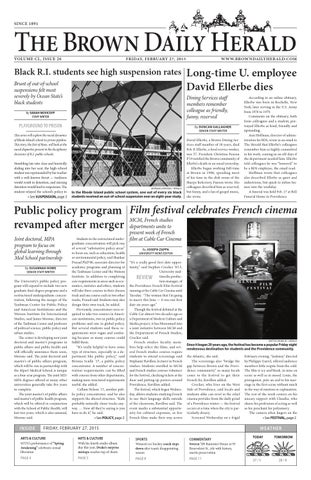
Since it began 20 years ago, the festival has become a popular Friday night rendezvous destination for students and the Providence community. the Atlantic, she said. The screenings also “bridge the gap between Brown and the Providence community,” as many locals come to the festival to get their French fix, Ravillon added. Crocker, who lives on the West Side of Providence, said locals and students alike can revel in the relief cinema provides from the daily grind of a Providence winter — the festival occurs at a time when the city is particularly dreary. Screened Wednesday on a frigid
February evening, “Jealousy,” directed by Philippe Garrel, offered audience members little respite from the cold. The film is icy and bleak, in mise en scene as well as in mood. Louis, the protagonist, puts an end to his marriage in the first scene without much in the way of emotion or explanation. The rest of the work centers on his uneasy rapport with Claudia, who shares his profession of acting as well as his penchant for polyamory. The camera often lingers on the » See FESTIVAL, page 2
WEATHER
FRIDAY, FEBRUARY 27, 2015
ARTS & CULTURE SOTG’s performance of “Spring Awakening” celebrates sexual liberation
ARTS & CULTURE With his fourth studio album due this year, Drake’s surprise mixtape reaches top of charts
SPORTS Women’s ice hockey coach steps down after team’s disappointing season
COMMENTARY Sweren ’15: Bannister House at 93 Benevolent St., rife with history, merits preservation
PAGE 4
PAGE 5
PAGE 8
PAGE 11
TODAY
TOMORROW
27 / 5
28 / 8
UNIVERSITY NEWS PAGE 2 • FRIDAY, FEBRUARY 27, 2015
» FESTIVAL, from page 1 characters’ black-and-white visages, delving deeply into faces that betray frustration and disappointment but rarely break down into red-hot histrionics. A couple of arguments arise and bouts of tears burst onto screen, but these are ephemeral points of divergence in a plot that is relentlessly committed to a cool aesthetic and a realist dilemma: infusing excitement into an ordinary relationship. Louis and Claudia’s bond is rife with worry, as both fret about their own intentions and those of the other. Toward the start of their time living together, Claudia suddenly and inexplicably rushes from the street to their apartment, bounding up the stairs of their building. Upon seeing Louis, she leaps into bed beside him and, clutching onto his arm with both hands as though holding on for dear life, she whispers in between gasps for air, “I thought you’d gone.” Bewildered, he asks, “Where did you want me to go?” Ironically, it is she who cheats first, proving that jealousy works in more ways than one. Claudia, who has not scored an acting gig in six years, begrudges Louis his continual success in theater. Envy eventually drives her to trade in a night at the apartment for one at the bar, and she hooks up with a stranger. The onenight stand signals a turning point, as Claudia seems content thereafter
to accept that she cannot make monogamy work. Louis, on the other hand, says he is in it for the long haul. “I love you for what you are and what you think,” Louis says to Claudia. “I love you, and it’s definitive.” But his words ring laughably false. We know — even if Claudia does not — that he is speaking to himself more than to her, trying to solidify shaky sentiments by uttering them aloud. The exchange also works as comic irony, because — unbeknownst to Claudia — the preceding scene features Louis struggling to wrest himself away from a woman whom he kissed with much more conviction than his words to Claudia exhibit. Thus the obvious contradiction in their convictions: Claudia silently resigns herself to infidelity while Louis fights the urge to engage in it. Yet the defining dilemma in Garrel’s film is not the disparity between the stated desires of the characters he canvasses so vividly. Rather, Louis and Claudia both confront the chasm between their stated preferences and their true wishes. While they claim to stand at either end of a spectrum that ranges from dutiful monogamy to carefree infidelity, both lovers really rest somewhere in between. This inability to accept ambivalence is the key to the tragedy in “Jealousy,” but it is also central to the intellectual musing that makes the work enthralling.
THE BROWN DAILY HERALD
» POLICY, from page 1 Tracks are “the biggest change and the one we’re most excited about,” Prasad said, adding that they are meant to “guide students.” “It’s really important to me that a program like this be very interdisciplinary,” Morone said. “And in that way it really captures one of the great things about Brown, which is we are a very interdisciplinary university.” The Taubman Center is now in the process of determining next year’s course offerings and how Watson faculty members will be integrated into the public policy program, Morone added. In the past, gaining approval for related courses taught outside the Taubman Center was difficult, Scully said, adding that she anticipates the new emphasis on specific policy areas will make the process easier. Current sophomores and students through the class of 2019 may choose between the old and new concentration structures. Thereafter, only the new structure will be offered. Another change is that the concentration’s five core courses will now be taught within the Taubman Center. Previously, students took the majority of core courses in other departments, including economics, political science, sociology and education. The change is intended to help foster a sense of community among concentrators,
Prasad said. Concentrators may also participate in the Engaged Scholars Program run by the Swearer Center for Public Service, which allows students to gain real-world experience through community service or internships, Prasad said. Participants must complete 250 hours of community service or other experiential learning during the summer or school year, in addition to taking two courses featuring hands-on work. Public policy is currently one of five concentrations that aim to connect concentrators with the Engaged Scholars Program, though more departments will likely join in the future, said Dean of the College Maud Mandel. The other participating concentrations are anthropology, engineering, environmental studies and theater arts and performance studies. “What we’d like to do is harness the power of the open curriculum and the creative energy that is Brown’s intellectual experience and channel that into things to do off campus,” Mandel said. Students in any public policy track can participate in Engaged Scholars, though the center is also offering a concentration track in partnership with the Swearer Center that specifically focuses on social change, Morone said. Public policy is “a natural fit” for Engaged Scholars, Morone said, adding that “public policy at its best is about political and social change.” Several students agreed that the Engaged Scholars program fits well with public policy. “I don’t want my education to be four years of learning and then you go apply it. I would like to be able to apply it as soon as possible,” Nelson said. While he is considering participating in the program, he would have done community service even without Engaged Scholars, which “sounds kind of like a title to describe something that’s not drastically different from what my education would be anyway,” he added. Another reason for the new tracks is the program’s embrace of a more global perspective following the recent Taubman-Watson merger, Prasad said.
“Unlike most schools where you say ‘I’m either international policy or I do domestic policy,’ we didn’t feel like that made a lot of sense anymore,” he said. “We live in a much more global world.” Many students praised the new emphasis on a global outlook. Nelson said he supports the “new perspective” because the program previously only required one course in global policy, which did not sufficiently expose students to international issues. The merger is a “win-win,” said concentrator Erika Byun ’17, who considered concentrating in international relations before deciding to study public policy. Amidst these changes, the Taubman Center does not intend to decrease its focus on Rhode Island, Morone and Prasad said. Access to the Watson Institute’s resources will allow them to incorporate new global issues without compromising the center’s historical local interests, they added. The applicant pool for Taubman’s newly designed one-year MPA program has been strong, Morone said. The program, which is set to begin this summer as the only one of its kind among Ivy League institutions, has received more than 400 applications so far, he added. Applications from Brown undergraduates — who often make for high-quality candidates — have also increased, Morone said. The MPA has also adopted a global mindset, focusing on “Rhode Island, the United States and the world,” Morone said. All of the individual changes add up to one lofty goal: “Our ideal is to make public policy a real signature of Brown University,” Morone said. “There are so many students at Brown who have a very idealistic view of the world, who really would like to create social change and political change and are committed to that.” “Public policy is really important as a way of thinking systematically about how to make change,” he said. “It feels to me so central to the Brown mission and the Brown ethos.” — With additional reporting by Duncan Gallagher
Support The Herald! www.browndailyherald.com/donate
METRO
FRIDAY, FEBRUARY 27, 2015 • PAGE 3
THE BROWN DAILY HERALD
R.I. reports fewer homeless for second consecutive year Community, state agencies notice slight decrease in usage of homeless support services By AGNES CHAN CONTRIBUTING WRITER
Though the Ocean State’s homeless population decreased nearly 10 percent in the last year, government and community organizations continue to make efforts to ease the burden faced by the approximately 4,000 people who still have no place to live. Rhode Island’s homeless population shrank by 8.5 percent in the past year, according to the Rhode Island
» SUSPENSION, from page 1 Young Voices — a nonprofit organization that advocates for a youth voice in policy — and they confirmed that suspending a student for missing detention is against state policy. Young Voices named the student when discussing her story with a news source. Rather than helping, drawing attention to the issue resulted in the student being intimidated by school officials and receiving disciplinary action for disrespect, according to Karen Feldman, executive director of Young Voices. Such policies, which individual schools often administer on an ad hoc basis, contribute to the 17,944 high school suspensions issued by Rhode Island public schools in the 2012-2013 school year, according to data reported by the R.I. Department of the Education. But the use of suspension as a disciplinary tool starts even earlier for many students. The high numbers of suspensions at the elementary school level — where students are less likely to commit serious offenses than their older counterparts — drew the attention of an American Civil Liberties Union report released Feb. 19. Rhode Island public schools issued approximately 17,000 elementary school suspensions between 2004 and 2012, according to the ACLU’s report, “The School-to-Prison Pipeline in Black and White.” “That’s a huge number, given the size of enrollment in our state,” said Professor of Education Kenneth Wong. Even more concerning than the total number of suspensions is the disproportionality of suspensions administered to black students. In the eight-year period studied, one of every six black students in the Rhode Island public school system received an out-of-school suspension compared to one in 16 white students, according to the ACLU. At the elementary level, black students are given suspensions six times as frequently as their white peers. The data, collected from RIDE and published in past ACLU reports, also reveals that this racial disparity grows with regard to subjective offenses, such as “disorderly conduct,” “insubordination/disrespect” and “obscene or abusive language toward a teacher or student.” In those cases, black students were “suspended 2.4 times as often as their representation in the population would predict,” the report stated. “It starts in school and it certainly is incredibly toxic in school, but it’s something that perpetuates throughout an entire lifetime and really forces people onto the school-to-prison pipeline,” said Hillary Davis, policy associate at
Coalition for the Homeless. The number of individuals experiencing homelessness is determined annually based on the amount of people who have spent at least one night in one of the state’s shelters. “Whether you come in for one night or all 365 nights, you are counted once as a person who went to a shelter,” said Jim Ryczek, executive director of the Rhode Island Coalition for the Homeless. Last year was the second consecutive year the state saw a decline in the homeless population after rising since 2007. The numbers rose from 3,926 in 2007 to 4,868 in 2012 and only began to decline in 2013. Services in Rhode Island dedicated to serving the homeless have noticed
the recent decrease. The R.I. Department of Human Services stated that usage of its Supplemental Nutrition Assistance Program has declined 2 percent over the past year, “from 179,000 individuals to 176,000 individuals,” said Michael Jolin, legislative and media liaison for the Department of Human Services. The Department’s Rhode Island Works Program, a service that offers temporary cash assistance and job search training, has seen an 8 percent decline in those utilizing the service. Comparing Rhode Island’s homelessness challenges to those of neighboring states, Ryczek said though the Ocean State has an average-sized homeless population, “regionally we
the ACLU of Rhode Island. Suspensions can cause negative consequences even after the student returns to class, according to numerous national studies on the topic, including one by Providence Public School District psychologist Elizabeth A’Vant. Suspensions result in lost classroom time, which makes students feel disconnected from their school environments. This leads to increased dropout and juvenile detention rates. Patrick Guida, chairman of the Council on Elementary and Secondary Education, explained that in-school suspensions are always preferable to outof-school suspensions. Out-of-school suspension is more appropriate only if, “when the child remains in the school, it creates some additional risk either to that child or to another,” Guida said. The ACLU report concludes by calling for the General Assembly to pass legislation limiting the use of out-of-school suspensions and requiring analysis and action regarding the racial disproportionality of administering such suspensions. Wong sees a different path to improving the situation: the state school board. Responsibility for education falls under the state board’s purview because these high rates pose a “systemic challenge” and will require “system-wide strategies” to resolve, Wong said. Those strategies could involve addressing the school climate of particularly problematic districts, improving teacher training for economically and racially diverse populations and issuing a basic set of suspension guidelines statewide, Wong said. “There is a huge need for the state board to leverage resources from the community to support and improve the overall climate of the school,” such as enlisting local university researchers to create strategies for engaging the issue, Wong said. Both routes to reforming Rhode Island’s suspension problem, through the General Assembly or the school board, face hurdles. Senate President Teresa Paiva Weed, D-Newport, issued a statement last week that said “the troubling issues raised in the ACLU report point out how far our society has yet to go before we achieve true equity.” Her statement went on to describe possible legislation that would prevent racial profiling and open full-day kindergarten. But it neglected to mention any legislation specifically regarding school suspension. House Speaker Nicholas Mattiello’s, D-Cranston, statement was even less specific, saying, as quoted by RIFuture.org, “I have not yet had the opportunity to
review the ACLU report, but the House of Representatives will always work to enact policies that treat all persons fairly, equally and without discrimination.” The school board could be another difficult path for change, considering that “each individual district is left with a great deal of discretion” in assigning suspensions in the gray areas of the state board’s official policy, Guida said. “There’s always a preference, if possible, to do suspensions in school with some sort of constructive activity going on that might promote the learning of the student subject to the suspension,” Guida said. “It does sound like a large number to me … but I can’t be judgmental on whether or not it’s too many or not enough without knowing the background circumstances.” School board meetings are open for public attendance and comment, but the issue of school suspensions and their disproportional application has never been brought up by constituents during his time on the board, Guida said. The commissioner and members of the school board can add issues to the agenda without public comment, but they have not yet done so on this issue. “We might get it on the agenda in the context of the more recent information and some evidence that it’s not being administered in an equitable way,” but public comments are usually the engine for new discussion, Guida said. Without statewide action, individual
are behind the curve (in terms of) investments and the solution around affordable housing.” Despite the decline in the number of homeless people, “the shelter systems are still full,” Ryczek said. Fewer first-time homeless people are visiting the shelters, which may be “great from a prevention standpoint,” but a large portion of people remain trapped in the shelter system because they cannot afford to live out in the community, Ryczek added. Recently proposed pieces of legislation are directly aimed at addressing this lack of affordable housing. Sen. Frank Lombardi, D-Cranston, and Rep. Scott Slater, D-Providence, introduced two bills Wednesday calling
for the Department of Human Services and community action programs to provide emergency housing assistance funds. “We know how to end homelessness. ... We should feel ashamed that we — as a state, as a government, as human beings — are not doing more to help them,” Lombardi said in a Feb. 25 press release. Amid this year’s brutal winter, the government is also providing more affordable housing by subsidizing heating bills. In January, U.S. Sen. Jack Reed, D-R.I., announced that the state will receive an additional $2.46 million under the Low Income Home Energy Assistance Program, increasing Rhode Island’s total share of federal funding under the program to $27.1 million.
MORGAN JOHNSON / HERALD
The American Civil Liberties Union’s report found that R.I. black elementary schoolers were suspended six times as frequently as their white peers. school districts and principals still have the power to reform their suspension policies, if they choose to. Stephanie Geller, a policy analyst for Rhode Island Kids Count, recommended the implementation of “tiered supports … that keep the school a safe place but are more productive in terms of addressing especially minor offenses.” Those supports can be similar to those Wong suggested, including professional development for teachers and
school-wide policies. Geller also recommended expanding restorative justice programs across the state that emphasize remedying student behavior over simply punishing children. In cases where behaviors are not disruptive or harmful to others — such as tardiness — restorative justice and tiered supports are unnecessary, and familiarization with state policy on the individual school and teacher levels may be all that is necessary, Wong said.
ARTS & CULTURE PAGE 4 • FRIDAY, FEBRUARY 27, 2015
THE BROWN DAILY HERALD
Shakespeare on the Green in love: ‘Spring Awakening’ at Churchill House Company mounts production of composer Duncan Sheik’s ’92 Tony Award-winning musical By ANDREW DECK CONTRIBUTING WRITER
The musical “Spring Awakening” alternates between punk-rock anthems and folk-infused ballads in its rousing and provocative exploration of the sexual liberation of German teenagers. An adaption of Frank Wederkind’s 19th century play, “Spring Awakening” marks Shakespeare on the Green’s first foray into musical theater. The production company has set the bar high for itself considering the notable material. Duncan Sheik’s ’92 music has a cult following among high school theater nerds, and the 2006 Broadway production received a Tony award for Best Musical. Despite this daunting task, under the direction of Jenn Maley ’16 — following her memorable interpretation of Cabaret last fall — the production finds a solid creative foundation. In the song “The Dark, I Know Well,” Maley stages the male cast as a physical barrier between a dueting Haley Schwartz ’17 and Emily Rudder ‘17 to evoke images of the male gaze and the subjugation of women. Though the stage directions and set design are not always effective — an off-putting green artificial turf covers the stage in an unsuccessful attempt to create a natural springtime environment — they consistently have a powerful effect. The show opens with Amelia Scaramucci’s ’17 angelic version of “Mama Who Bore Me.” As she explains how children are conceived to her reserved and conservative mother, the musical immediately delves into its themes of sexual repression and individuals’ relationship to authority. Hannah Margolin ’16 and Justin Harris ’15, who together portray all of the adult characters in the production, embody this authority. Their moments on stage are brief, but both actors are able to carefully differentiate between the play’s numerous characters. Among the teenage ensemble, the romantic entanglement between two male characters — a collision of Brendan George’s ’18 smarmy swagger and
REVIEW
DANIELLE PERELMAN / HERALD
German teenagers find paths to sexual liberation through music ranging from punk rock to folk in Shakespeare on the Green’s take on Duncan Sheik’s ‘92 Tony Award-winning musical “Spring Awakening” showing this weekend at Churchill House’s Rites and Reason Theater. the Bambi-esque Jonathan West ’16 — is comically entertaining. The leads do well to depict heavy and deeply vulnerable moments on stage, which include instances of nudity and violence. Scaramucci lends a necessary childlike innocence of Wendla’s character. And while Conor Sweeney’s ’18 vocal performance falls flat in difficult falsetto moments, he is steady in his dramatic performance. The production’s most memorable moments feature Frankie Troncoso ‘16 and Schwartz, whose duet “Don’t Do Sadness/Blue Wind” is gripping and heartbreaking. This is especially true of Troncoso. He is able to find emotional depth in the character of the academically-struggling Mortiz, his skittish gestures manifesting the anxieties of parental pressure. The core of the show is not in these individual performances, but rather in the ensemble numbers. “Totally Fucked,” the stomping, jolting, thrashing call to anarchy in the second act, is about as much fun as you could have at a theater production. And the harmonic ballad “The Song of Purple Summer” that closes the show builds the production to an uplifting and stirring conclusion. “Spring Awakening” will play this weekend at Churchill House’s Rites and Reason Theater. The Saturday evening show will be followed by a talk with Sheik.
DANIELLE PERELMAN / HERALD
The theater received a green makeover for the production, with artificial turf laid across the stage. Composer Duncan Sheik ’92 will take to the turf to give a talk following Saturday’s performance.
DANIELLE PERELMAN / HERALD
The strength of Shakespeare on the Green’s “Spring Awakening” lies in the cast’s ability to work as an ensemble. Peter Bowden ’16, Joseph Van Wye ’15, Frankie Troncoso ’16, Conor Sweeney ’18, Brendan George ’18 and Jonathan West ’16 ably perform Sheik’s complex contemporary score in an innovative production that runs through March 1.
ARTS & CULTURE FRIDAY, FEBRUARY 27, 2015 • PAGE 5
THE BROWN DAILY HERALD
‘If You’re Reading This,’ Drake has already topped the charts Surprise mixtape sells 535,000 copies in two weeks, alludes to rapper’s contract conflicts By EVAN BOYD CONTRIBUTING WRITER
Toronto-based rapper Drake raised a lot of questions when he dropped a surprise mixtape on a random Thursday earlier this month. The collection of songs landed online like a smoking Canadian projectile, inscribed with the scratchy, cryptic lettering, “If You’re Reading This, It’s Too Late.” To whom and about what is Drake talking? Like any crash-landed object, the album has attracted many curious onlookers. One prevailing theory is that the album is a ruse to get out of his contract with Cash Money Records. The company is currently entangled in a nasty $51 million lawsuit with Drake’s friend, mentor and label-mate, Lil Wayne. Several lyrics on the new album seem to back up this argument, making it clear with whom “Drizzy” stands: “Brand new Berretta, can’t wait to let it go / Walk up in my label like, where the check though?” he muses violently on the eighth track, “Star67.” Despite any hard feelings or clever ploys, I don’t think Cash Money can be too upset about the drop. “If You’re Reading This, It’s Too Late” has already sold 535,000 copies, broken the debutweek record set by Drake’s last studio album and currently resides at number one on the Billboard 200. All this with good reason — business questions aside, “If You’re Reading” draws on
REVIEW
many of the same brooding aesthetic lines as Drake’s previous works. It tells the tale of a wary, introspective rapper, confident in his legacy but questioning his longevity. The album starts strong on its opener, “Legend.” Though Drake takes his time, building tension and setting a slow lava-like cadence that extends through the entire mixtape, he makes his perspective clear from the outset. “Oh my god, oh my god / If I die, I’m a legend.” It’s hard to argue — from the first slap-you-in-the-face bass kick, Drake summons all of his reckless swagger. Layered, swaying R&B vocal samples lend the track a strange, muffled melody, while a squelching percussive tone drives the whole assembly forward. “Legend “ is actually one of the more musically interesting tracks, if attention is paid to the details cooked up by Toronto producer PARTYNEXTDOOR. Drake no longer seems concerned with reaching the top — he knows he’s there and doesn’t have to prove it. What he is concerned about is the fear of a fall. “Energy,” the second track on the album, reveals what is bothering him. It is a veritable laundry list of problems: clingy girls, rising rap threats, family debts, house mortgages — the accumulated burden of any rap titan. “I got enemies, got a lotta enemies / Got a lotta people trying to drain me of this energy,” he paces back and forth like an agitated lion. While it’s true that the Toronto MC is faced with eager young competition, one does not feel too concerned for his position. Drake’s voice dances on the track with his signature effortless and lazy flow. The song is built around minimal, sinister piano loops draped over a pulsing beat,
a classic work by longtime collaborator Boi-1da. If you are seeking danceable Drake a la “0 to 100/The Catch Up,” this song and the next track, “10 Bands,” are for you. Much of the rest of the mixtape is imbued with the same throbbing melancholy, gloomy piano riffs and hypnotic beats. “Know Yourself ” begins unassumingly — the intro is kind of boring. But at around two minutes, Drake goes off, providing one of the most memorable lines in the entire collection. “Running through the six with my W.O.E.’s!” punctuating the last word as a sung note. “Six” is a reference to his hometown, Toronto, while W.O.E. apparently translates to “Working on Excellence,” an acronym used to refer to his rap crew, October’s Very Own. Though Drake pays homage to the city where he was born and bred, he struggles with the external pull of a big-time rapper: “Thinks about money and women, like 24/7, that’s where my life took me, that’s just how shit happened to go.” The beat is magnetic: Hi-hats rattle on top of fat, distorted bass notes laced with ghostly keys. Another standout is “Now & Forever,” my personal favorite on the mixtape. The track sounds like an evil twin sibling of “Hold On, We’re Going Home”: A distant ghostly choir fades and reappears amongst single resonating bass tones. The most notable feature is a punctuating industrial noise, like a hammer striking steel. Drake’s voice floats above it all: “No more, no more, no more,” he sings, his voice shot through with energy during the chorus. Again, fears of failure and desperate weariness arise: “I gotta get on the road / Can’t be on no laid back shit.”
MATTEO MOBILIO / HERALD
Drake released his chart-topping mixtape by surprise Feb. 13. His fourth studio record, “Views from the 6,” is due out later this year. The penultimate song on the mixtape, “Jungle,” draws on beautiful, muffled, melodic vocals akin to the intro, “Legend.” The track saunters along a slow beat, but by this time, Drake is tired and more sensual, as the track rocks back and forth like a rap lullaby. We are privy to his attempts to navigate a rocky relationship. “Are we still good,” he croons again and again, but there is no response. It may seem that Drake is opening up, but perhaps this is the cockiest way to end the album. He has forgotten we are even there, gone on to deal with his real personal life after having undoubtedly asserted his rap dominance in the previous 15
tracks. What is “If You’re Reading This, It’s Too Late?” An album? A mixtape? A thinly veiled song-dump to flip off Cash Money and wiggle out of contract? Does it matter? Overall, Drake continues to push his singular, self-aware style forward with great success. Though it may be a bit unrefined at points — 17 tracks seems like too much — and a bit musically homogenous throughout, there is a lot to work with and certainly enough to hold us over until his fourth studio album, “Views from the 6,” comes out later this year. Then we will see if Drake’s fears and paranoia are justified.
‘Quitters Never Win’ confronts estrangement, personal loss PW one-act play straddles humor, grief in reunion of high school friends after college freshman year By GRACE YOON SENIOR STAFF WRITER
“Quitters Never Win” tells the all-toofamiliar story of an awkward reunion post-first-year in college. The one-act play — directed by Spencer Roth-Rose ’17, written by Brad Weekes ’17 and produced by the Production Workshop — places the audience in the middle of a catch-up session between Paul and Mark, performed by Sam Heft-Luthy ’16 — a former Herald senior staff writer — and J.D. LaurenceChasen ’17, respectively, at a typical diner with red-checkered tablecloths. From the stage set to the actors’ natural deliverance, the play creates an undeniable atmosphere of familiarity and nostalgia. The two friends revisit past anecdotes while coming to terms with their changed realities after spending a year apart, a phenomenon that resonates with many college students. The conversation starts rather lightheartedly, as Paul and Mark discuss the ordeal of finding the right time and place for masturbation and the necessity to consider their roommates’
REVIEW
GRACE YOON / HERALD
A familiar diner serves as the setting where quirky waitress Pei Ling Chia ’15 and estranged friends J.D. LaurenceChasen ’17 and Sam Heft-Luthy ’16, a former Herald senior staff writer, explore friendship and memory. schedules. Their conversation sweeps through most, if not all, of the topics that may have crossed the minds of many young adults, moving from masturbation to sex to the overratedness of sex and finally, to love. Several segments of their conversation — such
as when Mark obsesses over Paul dating a girl for over a year without being “Facebook official” — elicit laughter from the audience, a testament to the humor and relatability of their stories. But the mood shifts dramatically when, while tickling Paul, Mark
mistakenly calls him Rich, the name of an old mutual friend. One sentence after another, they unravel their friend’s depression and eventual suicide. The previous pleasantness turns sour as Mark expresses no sympathy for Rich. Here, Laurence-Chasen gets up
and walks swiftly around the booth. He locks eyes with the audience and shouts, “No one in this shitty diner is happy,” maximizing the audience’s discomfort, which escalates to guilt. Mark’s own unhappiness becomes apparent in this scene, and Paul attempts to soothe him. But Mark remains in denial, calling Rich a “quitter” in life. He notes that, while everyone may seem sad, seldom do people act upon this sadness and commit suicide. Woven into this one-on-one conversation is a dining ritual: the two men order the usual — chicken fingers for Paul and banana pancakes for Mark. In fact, Mark’s obstinate insistence on banana pancakes exasperates their long-time favorite waitress, Renata, performed by Pei Ling Chia ’15. Chia embodies a quirky, animated character, as she appropriately rolls her eyes, sighs loudly, shouts and curses while putting up with her customers. At times her exuberance seems out of place with the gravity of the play, but at the heavier moments, Chia’s angry demeanor and awkward mannerisms provide comic relief, alleviating the tension between the old friends. From start to finish, the play maintains a precarious balance between familiarity and discomfort, humor and sorrow. In just 50 minutes, the audience joins the conversation between the two men, deciphering and grappling with multiple layers of secrets and emotions.
SPORTS
PAGE 6 • FRIDAY, FEBRUARY 27, 2015
SPORTS COMMENTARY
THE BROWN DAILY HERALD
M. HOCKEY
Cornell, Colgate visit ECAC’s hottest team Last chance for On five-game unbeaten Bruno looks to underachieving Bruins streak, improve standing before BY CHARLIE BLASBERG sports columnist
This hockey season has left Bruins and Bostonians scratching their heads. After reaching the Stanley Cup Finals two years ago and finishing last year with the best regular-season record in the Eastern Conference, today’s Bruins have been seriously underwhelming. With about a quarter of the season remaining, the Bruins are holding on for dear life as the bottom seed in the Eastern Conference. What happened to the team that was projected to be a legitimate Stanley Cup contender? And how do the Bruins create the momentum necessary to make a run in the playoffs? Much of the Bruins’ inconsistent play is a result of their inability to score. Seeing the Bruins control possession of the puck and dictate the rhythm of play, but still lose a low-scoring game, has become a common occurrence at the TD Garden this season. The absence of goal-scorer Tyler Seguin, who was dealt to the Dallas Stars before the 2013-2014 season, is extremely apparent. Seguin, a graduate of Boston University, first made a name for himself by scoring key goals for the Bruins as a rookie in the 2011 playoffs. But his immaturity and heavy partying habits did not mesh with the Bruins’ hard-nosed and physical style of play. He was traded just three years after he started with the team. Seguin is now one of the premier goal scorers in the league, with 29 goals and 30 asssists. His finesse and sheer talent are exactly what the Bruins currently lack. Loui Eriksson and Reilly Smith, whom the Bruins received in exchange for Seguin, are respectable players in their own right. They do their jobs, yet there is only a small handful of players in the NHL who can bring the same spark to the game as Seguin. A main obstacle on the Bruins’ road to the playoffs has been an inability to create and maintain momentum. The season started with a knee-injury to 37-year-old Zdeno Chara, the team’s backbone and best defenseman. The Bruins eagerly awaited his return after playing at just over .500 during his 19-game recovery. They viewed his return as a clear turning point in the season, but Chara’s offensive and defensive production has plummeted compared to his last few seasons. He has notched only 15 points this year, far fewer than the 40 he recorded last year and his career-high of 52. He is also maintaining a plus/minus of just
plus-one, which is unacceptable for a player of his caliber. The struggling Bruins seemed to have found their way in early November, as they strung together five consecutive victories, but they were stymied by back-to-back routs at the hands of their rivals, the Toronto Maple Leafs and Montreal Canadiens. The Bruins once again looked as though they had finally gained some steam by the beginning of January, winning five of seven games, but their momentum was halted by the All-Star break. Since the break, the Bruins are 4-8, including a six-game losing streak, capped off by a knee injury to key center David Krejci. Overworked of late, Bruins goaltender Tuukka Rask has struggled, and if the Bruins can’t stop their skid soon, they may find themselves overtaken by the Philadelphia Flyers or Florida Panthers — and pushed out of playoff contention. But all is not lost. After having an important two nights to rest, the Bruins travel to New Jersey to take on the mediocre Devils Friday night, before a four-game home stand against four beatable teams: the Coyotes, Flames, Flyers and Red Wings. Despite their inconsistent play, the Bruins have shown that they have the talent and grit to hang with the best in the league. If they can win three or four of the next five games, the Bruins will solidify their playoff chances and could gain momentum for the final 20 games of the season. The Bruins can also turn things around with a smart move before Monday’s trade deadline. They are in desperate need of goal production, and Bruins general manager Peter Chiarelli has his eyes on various wingers, most notably the Buffalo Sabres’ Chris Stewart. Talented yet fickle, Stewart could provide the intensity and fresh blood they need to win close games against good opponents. Another player whom the Bruins have been eyeing is Dallas Stars forward Erik Cole. Cole, though difficult to attain, would be a much better catch for the Bruins, as he has proved far more productive than Stewart and, at 36, has the experience necessary to thrive in the playoffs. This season has been one of many ups and downs for the Bruins, yet they have managed to stay in the mix for the playoffs. Both an effective deal before the trade deadline and a successful response to their losing ways of late are essential for a serious playoff run.
Charlie Blasberg ’18 can be contacted at charles_blasberg@brown.edu.
conference tournament By MATT BROWNSWORD SENIOR STAFF WRITER
After the men’s hockey team lost its seventh straight ECAC game at the start of December — a 7-1 scorching from a struggling Union team — little confidence remained that Bruno (817-2, 5-13-2 ECAC) could compete with any team in the country, let alone in the conference. “I always imagined we could go on a run,” said Mark Naclerio ’16. “Our team is very skilled and our record is not reflective of who we were as a team. We have gained some confidence over the last few weekends, and we are just going to keep working hard to continue playing the way we are capable of.” The Bears’ struggles are now behind them, as Brown became the hottest team in the ECAC over its last five games, winning four and tying one. Three of the Bears’ five wins in that time period have come against the ninth-, 10th- and 12th-place teams in the conference, but Brown also toppled No. 16 Harvard and took a 2-0 lead over No. 10 Quinnipiac before the game ended in a draw. Heading into the final homestand of the season, Bruno has all of the momentum. Brown has a chance to escape the bottom of the ECAC and improve its standing right before the conference tournament. A pair of New York rivals — Cornell and Colgate — will make the trip to Providence, and both opponents have a lot on the line heading into the season’s home stretch. Cornell (11-11-5, 9-8-3) will come Friday to Meehan Auditorium seventh in the ECAC, safely slated for a firstround home game and still in contention for a bye. Two points behind fourth-place Colgate and Harvard, the Big Red would have to get results against Brown and Yale and hope for one of those teams to slip up. Cornell’s game plan has been defined throughout the course of the year: Ranked third-to-last in goals per game — one spot below the Bears — the Big Red relies on its defense and goaltending to win games. Mitch Gillam is the ECAC’s best goaltender in terms of save percentage but ranks eighth in saves during conference play. Cornell’s strong defense means Gillam does not need to make many saves, but when the sophomore is called upon, he usually does well. “It’s all about getting pucks on net,” Naclerio said. “With most good goalies you need to get bodies in front of them and force them to make multiple saves. If we provide good screens and get secondary chances we will find ways to score goals.” When the Big Red does score, the team often has junior Christian Hilbrich and sophomore Matt Buckles to thank. The two have combined for about 27 percent of Cornell’s goals
COURTESY OF BROWN ATHLETICS
Ryan Jacobson ’15, as well as fellow seniors Matt Harlow ’15, Joey de Concilys ’15 and Matt Lorito ’15, has played a crucial role in Brown’s run. this year. One of its biggest offensive weapons is Cole Bardreau, who has 14 assists in conference play this year, second only to Harvard’s Jimmy Vesey. In the Bears’ final home game of the season Saturday, Colgate (18-113, 10-7-3) will head into Providence looking to lock up a bye. The Raiders will need to get one more point than Harvard this weekend if they want that elusive fourth bye, which will make their matchup with Brown pivotal. Colgate is not much different from Cornell defensively: Ranked seventh in goals per game in the ECAC, the Raiders give up less than two goals a game, making them a top-four defensive team in the conference. But Colgate is a lot more offensively proficient, with three forwards with double digits in goals this year. Akin to Bruno’s offense, the Raiders’ offense is led by two juniors and a senior, each with over 20 points on the year. The similarities don’t end there: The Colgate trio of Kyle Baun, Tyson Spink and Joe Wilson accounts for 40 percent of Colgate’s goals; Naclerio, Matt Lorito ’15 and Nick Lappin ’16 account for 49 percent of Brown’s goals. But it has been a completely different tale in the net for the two sides. Charlie Finn has been a mainstay for Colgate between the pipes, winning ECAC Goalie of the Week honors three times this season. In contrast, Bruno’s goalies have struggled mightily. Tyler Steel ’17 began the season as the starter but was never able to hold down the starting role, while Tim Ernst ’17 had his own share of difficulties. The goaltender’s play was so bad that Head Coach Brendan Whittet ’94 put Connor Maher ’18 in for two periods against the league’s best team despite the fact that he had never played a collegiate hockey game.
Now Ernst has just about grabbed the spot for good. He has been the starter for the entirety of the Bears’ unbeaten streak, giving up more than two goals in a game only once, during a 6-3 victory for Brown over RPI. “Tim has been unbelievable for us these last five games,” Lorito said. “Our defensemen have definitely played a big role in his success, but he’s made some great saves at key times for us and that’s been the difference.” If the season had ended after last weekend’s results, Brown would be heading up to Hanover for a series with Dartmouth, which has outscored the Bears by nine points this season after facing off in two games. With all of the teams tight in the standings, it is hard to assess where anyone ranked fourth to 11th in the conference will end up. But if Brown were to leapfrog Union, that would be enough to avoid the Big Green. “It’s just important to just make sure we are playing our best hockey,” Naclerio said. “We know that we are getting on the road for the first round and it would be better to play a lowerranked team, but we are just focused on playing our game and doing what makes us successful.” This weekend also marks the last home game for the class of 2015 — Lorito, Joey De Concilys ’15, Kyle Quick ’15, Ryan Jacobson ’15 and Matt Harlow ’15. Lorito achieved his 100th career point last weekend with a two-assist showing against Princeton, but his work is not done. “I’m just looking forward to helping this team go as far as possible,” Lorito said. “I’ve had a great career at Brown, and I don’t want it to end anytime soon. This team has grown a lot over the year, and although it has been tough at times, there’s not a group of guys I would rather play my last game at Brown with.”
Follow Sports! @bdh_sports
SPORTS
FRIDAY, FEBRUARY 27, 2015 • PAGE 7
THE BROWN DAILY HERALD
W. BASKETBALL
Undefeated Princeton, second-place Penn next up for Bruno Final road trip provides last chance for Brown to take down No. 14 Tigers, upset Quakers By TANEIL RUFFIN SENIOR STAFF WRITER
The women’s basketball team looks to deliver massive upsets this weekend when it hits the road to take on the Ivy League’s top two squads, Princeton and Penn. The matchups are the team’s last pair of conference games on the road for the 2014-2015 season and its final chance at finishing with a .500 record in conference play. If Bruno (10-14, 4-6) wants to achieve this goal, it must get at least one win this weekend. Though not the aspiration of potential champions, evening out conference wins and losses would be an impressive improvement from the .286 winning percentage last season. Last weekend, Bruno hoped for a sweep of its opponents but dropped the game against Columbia. The following day in Ithaca, the Bears were determined not to make it easy for Cornell. After unleashing a high-pressure defense, Bruno managed to pull out an impressive win against a formidable Big Red squad that sits just below Princeton (25-0, 9-0) and Penn (16-7, 7-2) in the conference rankings. After forcing a season split with Cornell, the Bears will hope to do the same against the Tigers and Quakers. Bruno will first look to even the series against the Quakers. Penn is currently in the midst of a five-game winning streak, and the team’s explosive forward, Michelle Nwokedi, was just voted the Ivy League’s rookie of the week for the fourth time in five weeks. The last time the Bears faced off against the Quakers, Bruno managed to hold its own against the defensive powerhouse, putting 75 points on the
COURTESY OF BROWN ATHLETICS
Head Coach Sarah Behn goes over a game plan with the Bears. Led by the program’s best three point shooter ever, Sophie Bikofsky ’15, Brown’s season has exceeded expectations. A win over undefeated Princeton would add to Bruno’s strong campaign. board and connecting on just over 33 percent of its shots from the field. Bruno’s offense was especially impressive, considering Penn’s defense has limited its opponents to just 55 points per game and 33 percent from the field on average. Leading the way for the Bears’ explosive offense was Jordin Alexander ’16. The guard recorded 31 points in the contest, the most by a single player in 15 years. In order to be successful this weekend, the Bears must bring the same degree of offensive intensity as they did in their last matchup. Fortunately for Bruno, the squad usually generates effective
offense and leads the Ivy League in free throw attempts and steals per game. Next, the Bears will head back north and take on Princeton. The Tigers have jumped up to 14th in the country — ahead of basketball powerhouses like the University of North Carolina, Duke and Stanford — since the last time Bruno has seen them. Princeton is one of only two Division I teams in college basketball that remain undefeated — the other being the University of Kentucky’s men’s basketball team. “We have really gotten to know the Princeton personnel and their tendencies on offense,” Alexander said. “We
have really been focusing on how we are going to defend them and how we can attack their defense on offense.” Defending Princeton’s offense is bound to be difficult for the Bears. Leading the charge for the Tigers is Annie Tarakchian. The six-foot junior plays at both the guard and forward positions, showcasing her versatility. In Princeton’s game against Dartmouth last weekend, Tarakchian nearly recorded a tripledouble with 11 points, 14 rebounds and eight assists. In addition to Tarakchian’s efforts, the Tigers have the conference’s top three three-point shooters and the second leading rebounder.
Princeton’s undefeated season has been one for the history books, and the squad seems to be on pace to break the Ivy League’s all-time best start 28-0 set by Penn’s men’s basketball team during the 1970-1971 season. But if any team were to play David to Princeton’s Goliath, it would be the young, quick and continuously improving Bruno squad. Last year, the Bears upset the Tigers, preventing Princeton from securing the title of conference champion with a 61-58 victory. “We’re just really pumped,” Alexander said. “And we’re excited to see what we can do this weekend.”
SPORTS
PAGE 8 • FRIDAY, FEBRUARY 27, 2015
THE BROWN DAILY HERALD
M. BASKETBALL
Last-place Penn, middling Princeton come to Providence Yet to win two consecutive Ivy games, Bruno takes on Quakers, Tigers in final home stand By CALEB MILLER SPORTS STAFF WRITER
Five seniors on the men’s basketball team will take the floor at the Pizzitola Center for the last time this weekend, as the squad attempts to salvage a middleof-the-pack conference finish in the Ivy League’s penultimate weekend. Brown welcomes last-place Penn Friday and third-place Princeton Saturday, with the latter game marking Senior Night for Dockery Walker ’15, Joe Sharkey ’15, Jon Schmidt ’15, Longji Yiljep ’15 and co-captain Rafael Maia ’15. “That’s going to be an emotional game,” Maia said. “It’s going to be pretty sad, but I’m looking forward to performing with my teammates in the Pizzitola one more time,” Walker said. Bruno (12-15, 3-7 Ivy) has split each of its last three weekends in Ivy play, and history suggests that streak will continue in this doubleheader. In a road trip two weeks ago, the Bears pulled away from Penn in a 71-55 win and trailed Princeton for the entire second half in a 75-64 loss. Penn (7-16, 2-7) The Quakers are sliding and sliding fast. Penn has lost its last five games — four by a margin of more than 15 points — and has been relegated to the Ivy cellar. Tony Hicks, the team’s talented point guard and leading scorer, struggled to score against the Bears two weeks ago, drew a technical foul out of frustration and was subsequently suspended. “We played pretty well on the defensive end last time we played Penn, and it showed,” Walker said. The team
focused on cutting off Hicks last time and will employ the same strategy in Friday’s contest. Defense keyed the Bears’ win over Penn at the Palestra. Bruno eliminated scoring threats Hicks and starting guard Antonio Woods, and the two ended a dismal 1-of-21 from the floor. In conference play, Matt Howard emerged as Penn’s second-leading scorer and was the only Quaker to do much damage against Brown, scoring 19 points. Darien Nelson-Henry combines size, talent and experience to give the Quakers a post presence, but he has been prone to clumsy turnovers at times. With Nelson-Henry patrolling the middle and Penn’s youth at guard, the Bears exploited the perimeter two weeks ago. J.R. Hobbie ’17 poured in 21 points on 5-of-7 from deep, while point guard Tavon Blackmon ’17 hit a pair of treys in a 14-point effort. Hicks will be difficult to suppress two games in a row, but if the Bears win the battle of the guards by such a wide margin Friday, Penn will be in trouble. Head Coach Mike Martin ’04 said free throw shooting “has become the identity of our team,” and Friday night could present an opportunity for the Bears to capitalize on that strength. Penn commits more fouls than any other Ivy. In the last meeting, nine of Bruno’s final 13 points — during a stretch when the Brown lead tripled — came via the charity stripe. Steven Spieth ’17 was the leader of that campaign, knocking down a stellar 10-of-11. Princeton (12-13, 5-4) Harvard and Yale are in a two-team fight for the Ivy crown, but Princeton is quietly having a quality year. The team does not start any seniors and is one of two teams — along with Brown — that does not have a player in the top seven in scoring in the Ivy League. But the Tigers feature one of the most efficient and
W. HOCKEY
Coach Bourbeau steps down After abysmal 2-19-1 season, team to embark on nationwide search for replacement By ANDREW FLAX SPORTS EDITOR
Amy Bourbeau, head coach of the women’s ice hockey team, has resigned, the University announced Thursday. The third head coach in the program’s history, Bourbeau coached the team for four seasons, with its record declining each year. She has a career record of 23-79-14, equating to a .259 winning percentage. Bruno finished eighth in the ECAC with a .371 winning percentage during Bourbeau’s first season in 2011-12, marking the highest finish
of her career and Brown’s best record since 2006-07. That season, the Bears made their first conference tournament appearance in five years. The 2014-15 season was a difficult one for Bruno, which posted a meager 5-23-1 overall record, with a 2-19-1 record in conference play. The Bears lost 17 of their final 19 games and ended the season ranked last among Division I teams by the NCAA. A Rhode Island native, Bourbeau was a three-time ECAC champion as a player on the Providence College women’s hockey team before graduating in 1996, according to the Brown Bears website. She served as an assistant coach at Princeton for 12 years. While working with the Tigers, she received the American Hockey Coaches Association’s inaugural Women’s Ice Hockey Assistant Coach Award.
www.browndailyherald.com
COURTESY OF BROWN ATHLETICS
Dockery Walker ’15 dribbles past an opponent. Walker will be honored with his fellow seniors before Brown’s game Saturday against a Princeton team that sits firmly in the middle of the Ivy standings. balanced attacks in the league, posting the highest field goal and three-point field goal percentages. Any player in the rotation has a chance to lead the team in scoring on a given night, and the ball movement and vision help Princeton dish out the second-most assists in the conference. Spencer Weisz leads the team with 12 points per game, and forward Hans Brase has the ability to step out and hit a three. Steven Cook drained three treys as part of a game-high 18 points against Brown at Princeton. “The main thing with Princeton is to guard the Princeton (offense),” Walker said. “We have to try to limit their shooters.”
While long-range shooting has contributed much of the Tigers offense this season, Brown should be wary of focusing too much on the perimeter. Two weeks ago, Bruno’s defense was tight on the shooters, and Princeton took advantage by shooting a scorching 62 percent inside the arc, leading to a 42-26 points in the paint edge. Despite Princeton’s potent attack, Brown could find an edge in the frontcourt. Maia had a huge game against the Tigers last time around, scoring 16 points and pulling in 16 rebounds. Other forwards Walker and Cedric Kuakumensah ’16 combined for 20 points as well. On the boards, Brown has a major advantage. The Bears average the most
rebounds per game in the league, while Princeton averages the least. “We felt we had a slight advantage inside” against Princeton, Walker said. “The three of us carried the game well until the last stretch.” The game’s emotional aspect could favor Brown as well. Not only will the team have a Senior Night crowd and mentality, but Princeton could stumble into it. The Tigers blew a big lead last week in a loss to Harvard and are expected to fall at Yale Friday night. Bruno will don throwback jerseys for Senior Night, as it attempts to take another step toward the middle of the Ivy standings. Tip will be Friday at 7 p.m.
W. LACROSSE
Fresh faces topple Bryant in Ocean State Cup Hudgins ’18 steps into sister’s shoes, starts career with two goals in win over Bulldogs By LAINIE ROWLAND SENIOR STAFF WRITER
The women’s lacrosse team started its season on a high note last weekend with a win over Bryant in the Ocean State Cup and expects to sustain its momentum this weekend with matchups against Iona and Central Connecticut State. Bryant “was a great benchmark,” said Head Coach Keely McDonald ’00. “We’re always focused on our composure as well as our team play defensively, so we’ll work on those as we go forward.” The program must fill gaps left by the slew of talented athletes who graduated last year, most notably Bre Hudgins ’14, whose 40 goals powered Brown to some tough wins — including a historic victory over Princeton. But Hudgins’ presence at Stevenson Field will not be lost entirely: The alum joined the team this year as a volunteer coach, providing valuable insights for
the current players, McDonald said. “Even when she was a player, she was kind of a coach,” Janie Gion ’15 said of Hudgins. “It’s really great to have her eye on the field and valuable to hear what she has to say.” The squad also lost offensive weapons Danielle Mastro ’14 and Grace Healy ’14, who fueled Bruno’s offense last season with 30 and 23 goals, respectively. But as newcomers step up and returning players further perfect their games, the Bears seem poised for success. They will be counting on Kellie Roddy ’15 to replicate her impressive play in net last season, which ranked her 12th in the nation for goals against average. Lauren Toy ’16, who started seven games last year, came out on fire last weekend, recording a hat trick in Bruno’s season-opening victory. “It’s a totally fresh team this year,” McDonald said. “We have a ton of freshmen and sophomores playing significant roles for us. … They are going to do that all season long and will step up all season long.” Yuna Hur ’18 impressed during her collegiate debut, notching three goals last weekend against the Bulldogs. McDonald praised her as “a strong player
with awesome game sense and general awareness.” Marissa Hudgins ’18 followed in her older sister Bre Hudgins’ footsteps, scoring twice against Bryant. The last time the Bears faced Iona (2-1) and Central Connecticut State (1-1), they won by large margins. Bruno demolished the Gaels by a score of 17-4 and downed the Blue Devils 21-9. McDonald views these nonconference games as opportunities to “see how we match up” and figure out “where we are and where we need to be.” While it is unlikely that this competition will pose the same challenges that Bruno’s Ivy foes will bring, the squad emphasizes consistency and competitiveness in every game and at every practice. “We are highly, highly focused on each athlete getting better every day,” McDonald said. The Bears jump-started their 2013-2014 season with a seven-game winning streak — a feat they would be happy to replicate. Last year, they dropped three of their Ivy games by a one-goal margin, a disappointing result for a talented team. They hope this year will be different. “We want to get to the Ivy tournament and win,” Gion said.
TODAY
FRIDAY, FEBRUARY 27, 2015 • PAGE 9
THE BROWN DAILY HERALD
h o ly t r i n i t y ( r e p )
menu SATELLITE DINING JOSIAH’S Made-to-Order Quesadillas, Gnocchi BLUE ROOM Naked Burritos Soups: Beef with Bean Chili, Clam Chowder, Minestrone ANDREWS COMMONS Pizzas: Bacon Cheeseburger, Buffalo Chicken, Harvest Asian Tacos, Barbecue Pork
DINING HALLS SHARPE REFECTORY LUNCH
DINNER
Rotisserie Style Chicken, Cajun Fettuccini, Stir-fried Peppers, Roasted Winter Vegetables
Red Fish Provencal, Spaghetti with Meatballs, Vegan Quinoa with Kale and Olives
VERNEY-WOOLLEY LUNCH
DINNER
Breaded Chicken Fingers, Red Potatoes in Chive Sauce, Vegan Brownies, Mediterranean Bar
Herb Crusted Sole, Red Potato Fritatta, Roasted Beets with Rosemary, Au Gratin Potatoes
sudoku
RYAN WALSH / HERALD
The Trinity Repertory Company, situated downtown, is in its 52nd year. The company maintains a partnership with the University, offering a joint master’s in fine arts program in acting.
comics Cat Ears | Najateé McNeil ‘17
RELEASE DATE– Friday, February 27, 2015
Los Angeles Times Daily Crossword Puzzle c rNorris o s sandwJoyce o rNichols d Lewis Edited by Rich ACROSS 1 Fall follower? 5 Ophidian menace 8 Brightness stats 11 Arts supporters 14 Frat letter 15 Akhenaten’s son 16 On the level 17 Battle of Khafji conflict 19 “Battle it out” quintet 20 Plasma particle 21 Loafer’s lack 22 Some audiobooks 23 Pro shop supplies 26 Opposite of bids 27 Kool-Aid alternative 28 “__ Eterno”: 2004 sports documentary 29 Boorish 30 Detergent with Oxi Booster 31 Bone: Pref. 32 “Seasons in the Sun” songwriter 33 Dot on an MTA map 34 “Love in the Time of __”: García Márquez work 36 ICU staffer 39 “Can’t argue with that!” 41 Former carfinancing org. 42 It may come after you 43 Court attire 45 Rooting sound 46 Hardly bright 47 “Agreed!” 48 Title girl in a 1965 #1 hit 50 Sushi topper 51 Mall draw 52 Sci-fi suffix 53 Signs of dissatisfaction 55 Appears ... and the contents of this puzzle’s circles? 57 “Missed your chance!” 59 Brief facilities? 60 Zing 61 Early Alaskans 62 Memphis-toNashville dir.
63 Year abroad 64 Payroll deduction, perhaps
32 Word before or 48 President after name François Hollande’s 35 Key of Dvorák’s birthplace “New World Symphony”: 49 Whale relative DOWN Abbr. 54 Bulldog fans 1 The Police, most 37 Before 56 Facial spot of the time 38 They can’t be 57 Brother of Jack 2 Bit of deception beaten and Bobby 3 A, in Argentina 40 Get Wired again 58 College Football 4 ISP option 43 Fight in the sticks Playoff champion 5 Shoptalk 44 Fred Astaire, by crowned Jan. 12, 6 Treats as persona birth 2015 non grata 7 D.C. figure ANSWER TO PREVIOUS PUZZLE: 8 Realization often preceded by “Whew!” 9 Charlatans 10 Hardly gloss over 11 Still-life subject 12 Swallowed one’s pride 13 Rodgers and Hart title lyric that precedes “I get no dizzy spells” 18 Roadside warning 20 James Brown memoir 24 Inclusive pronoun 25 Quartet member 29 One way to lighten the mood 02/27/15 xwordeditor@aol.com
calendar FRIDAY
FEBRUARY 27
11:00 A.M. BROWN UNPLUGGED: LED LIGHTBULB SWAP
At this EcoReps event, students will trade in their old incandescent lightbulbs for new LED bulbs. The new lights use a sixth of the electricity of a normal lighbulb and a cost a fifth less. Faunce 8:00 P.M. ORCHESTRA CONCERT
Paul Phillips will conduct the Brown Orchestra in a performance of Nielsen’s Saga-Dream, Prokofiev’s Violin Concerto No. 2 in G Minor and the Rhode Island premiere of Philip Glass’s Symphony No. 2. Sayles Auditorium
SATURDAY
FEBRUARY 28
9:00 A.M. RHYTHM OF CHANGE FESTIVAL
This all-day festival will aim to encourage the exchange of ideas amongst artists and social activists, as well as to support social justice. Workshops, yoga and performances will engage participants during Saturday’s programming. Ashamu Dance Studio 5:00 P.M. 1VYG CONFERENCE
This conference will bring together more than 250 first-generation students from all eight Ivy League institutions, as well as nearly 50 alums, administrators and representatives from organizations. The conference will begin with registration 5 p.m. Saturday in Petteruti Lounge. Faunce, Petteruti Lounge SUNDAY
MARCH 1
2:00 P.M. TWELFTH NIGHT
Audiences can laugh at the twists and turns of this classic Shakespeare tale of twins. The play is directed by Jane Nichols and presented by Sock & Buskin in association with Brown’s Department of Theater Arts and Performance Studies. Stuart Theatre 3:00 P.M. PASTA COOKING CLASS
By John Farmer ©2015 Tribune Content Agency, LLC
02/27/15
Whether you’re a kitchen nightmare or a masterchef, students can join Chef Fitzsenry, assistant chef of Brown University Dining Services, and learn how to make pasta for dinner. Following the class, students will be able to enjoy their own meal. Sharpe Refectory
COMMENTARY PAGE 10 • FRIDAY, FEBRUARY 27, 2015
THE BROWN DAILY HERALD
IN CASE YOU MISSED IT
LETTER TO THE EDITOR
Brown Bites: Feb. 21–27
Ballpark does not belong in former I-195 land
BY MARCY HUANG, ONLINE EDITOR
Suspected assaulter arrested Salvatore Romano, the man suspected to have assaulted a Brown alum around 9:30 p.m. on Feb. 18 near Waterman and Gano Streets, was arrested by the Providence Police last week. The victim said the perpetrator made no move to take her belongings and told her “You’re coming with me” while grabbing her. The ProPo intend to charge Romano, who had recently been released on parole, with assault with attempt to rob. Raging hard In more off-campus news, both College Hill residents and students have raised concerns that Brown’s new alcohol policy may push more parties off campus and increase the amount of disruptive behavior in the neighborhoods surrounding campus. Some residents have been showing their distaste for loud off-campus parties through a Facebook community page called “Protect College Hill.” The page’s motto declares, “No ragers in our neighborhood.” College Hill resident Ronald Dwight ’66 explained Brown students’ disruptive parties by saying Brown students are “more into this heavy partying — raging, it’s called. They just can’t wait to get off campus and have these wild parties.” In case you didn’t feel inadequate enough Thirty-two juniors were inducted into the Rhode Island Alpha chapter of Phi Beta Kappa, the nation’s oldest academic honor society. To be eligible, the undergrads must have taken at least 20 courses at Brown, earning an A or an S with distinction in at least 18 of them. Further, at least 40 percent of these courses must have been in the arts, humanities, pure math or social sciences. In completely unrelated news, students all around campus are wishing that they had made fewer Wednesday night trips to Whisco their first year.
To the Editor: Over my time in Providence, I’ve seen the former I-195 space languish in a limbo of vacancy. It is with great trepidation, then, that I’m forced to speak out against a disastrous proposal for the reuse of a significant portion of it as a baseball park (“Pawsox make tracks to Providence,” Feb. 24). Providence has a long history of making suburbanoriented planning decisions, such as the relocation of the railway station away from the city center in the late 20th century, and the leveling of good buildings for the sake of empty lots, i.e. car parks. This proposal is yet another in that vein. It will do nothing but further the theme park
nature of the city center, whereby it only comes alive when suburbanites with a few dollars to spend grace it with their presence and their endless motor cars. This space is valuable. The city center needs affordable mixed-use development, and this is exactly the land to use for it. A city center can only live if real people live in it, if such people are able to find good jobs in it. To sacrifice the unique opportunity that this land provides, an opportunity to bring the Providence city center back into the realm of the living, is both idiotic and shortsighted. The University must use what leverage it has to encourage good development, and this isn’t it. Max Guerrera-Sapone ’15
Q U O T E O F T H E D AY
“We know how to end homelessness. ... We should feel ashamed that we — as a state, as a government, as human beings — are not doing more to help them.
”
— Sen. Frank Lombard D-Cranston
See homeless on page 3.
Show me the Plouf Plouf Meanwhile, students trying to get their Mama Kim’s on have been seriously troubled by the recent lack of food trucks on or near campus. Though the growing prevalence of food trucks has been causing tension for years, ProPo have only recently begun enforcing restrictions on the trucks more strictly, food truck owners said. “Police are kicking us out for old laws that they just all of a sudden started to enforce. To be honest, we feel like we are being bullied,” said Thang Huynh, owner of Lotus Pepper. For the sake of our stomachs, can’t everyone just get along? Getting schooled A new working group has been assembled to discuss the possibility of a winter academic term. The term would give students opportunities both within and without Brown classrooms in the form of online classes, study abroad and travel classes. While adopting a winter session might inconveniently change the Brown calendar, it might also align it with RISD’s calendar, allowing students to take classes at both institutions more easily. Though overall feedback from faculty members and grad students has been positive, we would never have guessed students would want to spend more time in the Providence winter.
Got something to say? Leave a comment online! Visit www.browndailyherald.com to comment on opinion and editorial content. Editorial Leadership
Sections
Visuals & Production
Business
Editors-in-Chief Michael Dubin Maxine Joselow
Arts & Culture Editors Eben Blake Gabrielle Dee
General Managers Sarah Levine Winnie Shao
Managing Editors Kiki Barnes Jillian Lanney
Metro Editors Alexander Blum Emma Jerzyk Drew Williams
Design Editors Loren Dowd Carlie Peters Taylor Schwartz Assistant: Meryl Charleston Assistant: Andrew Linder
Senior Editors Camilla Brandfield-Harvey Isobel Heck Molly Schulson
Science & Research Editors Andrew Jones Steven Michael
BLOG DAILY HERALD Editor-in-Chief David Oyer
Sports Editors Andrew Flax Alex Wainger
Managing Editors Deena Butt Jacob Koffler
University News Editors Emma Harris Caroline Kelly Joseph Zappa
POST- MAGAZINE Editor-in-Chief Adam Asher DIGITAL Online Editor Marcy Huang
COMMENTARY Editorial Page Editors Alexander Kaplan James Rattner Opinions Editors Megan GrapengeterRudnick Kate Kiernan Evan Sweren
Photo Editors Head: Brittany Comunale David Deckey Katie Liebowitz Arjun Narayen Ashley So Ryan Walsh Graphics Editors Avery Crits-Christoph Emma Jerzyk Web Producers Joe Stein Harsha Yeddanapudy Abdullah Yousufi Copy Desk Chief Madeline DiGiovanni Illustrations Editor Angelia Wang Video Editor Richard Flores
Directors Sales: Moniyka Sachar Sales: Jess Urrutia Finance: Josh Tartell Alumni Relations: Marley Rafson Business Dev.: Yuta Inumaru Sales Managers Matthew Meyer Henry Ritter Gulmira Hamit Taylor Casey
facebook.com/browndailyherald
Location: 195 Angell St., Providence, R.I. www.browndailyherald.com
@the_herald
Editorial contact: 401-351-3372 herald@browndailyherald.com
browndailyherald.com
Business contact: 401-351-3260 gm@browndailyherald.com
Corrections: The Brown Daily Herald is committed to providing the Brown University community with the most accurate information possible. Corrections may be submitted up to seven calendar days after publication. Commentary: The editorial is the majority opinion of the editorial page board of The Brown Daily Herald. The editorial viewpoint does not necessarily reflect the views of The Brown Daily Herald, Inc. Columns, letters and comics reflect the opinions of their authors only.
Finance Managers Collections: Neil Wathore Collections: Benjamin Wesner Operations: Carin Papendorp
Letters to the Editor: Send letters to letters@browndailyherald.com. Include a telephone number with all letters. The Herald reserves the right to edit all letters for length and clarity and cannot assure the publication of any letter. Please limit letters to 250 words. Under special circumstances writers may request anonymity, but no letter will be printed if the author’s identity is unknown to the editors. Announcements of events will not be printed.
Business Dev. Manager Project Leader: Kaden Lee
Advertising: The Brown Daily Herald, Inc. reserves the right to accept or decline any advertisement at its discretion. The Brown Daily Herald (USPS 067.740) is an independent newspaper serving the Brown University community daily since 1891. It is published Monday through Friday during the academic year, excluding vacations, once during Commencement and once during Orientation by The Brown Daily Herald, Inc. Single copy free for each member of the community. Subscription prices: $280 one year daily, $140 one semester daily. Copyright 2014 by The Brown Daily Herald, Inc. All rights reserved. Periodicals postage paid at Providence, R.I. Postmaster: Please send corrections to P.O. Box 2538, Providence, RI 02906.
COMMENTARY FRIDAY, FEBRUARY 27, 2015 • PAGE 11
THE BROWN DAILY HERALD
For sale: the Bannister House EVAN SWEREN opinions editor
It’s hard to know a first for anything. When he started loving poetry; when he first saw a boat; when he started scribbling on surfaces; or when, for the first time, he stayed up late at night so that those walking beneath his room could see the light from his tallow candle through the attic chamber window above. After apprenticing in New York then returning to Boston, nights may have provided the only respite to paint and escape the photography studio fumes. Within a mile’s radius of College Hill stands the house of a potential co-conspirator in the Gaspée Affair — Daniel Pearce, who lived on Transit Street. There is the house of one of the North’s biggest slave traders — John Brown, who lived on Power Street. There are two elite schools — Brown University and the Rhode Island School of Design — perched on a 17th century hill. And there is a small brick building, nicely tucked away — owner, forgotten; meaning, unknown. We’re talking about Edward Mitchell Bannister, preeminent 19th century painter, who, in his forties, won the first-prize bronze medal at the Philadelphia Centennial Exhibition for his painting “Under the Oaks” — since lost — only to have his medal temporarily revoked upon the judges’ discovery of the color of his skin: black. We’re talking about Edward Mitchell Bannister, cofounder of the Providence Art Club and one of the original board members of RISD, who moved to Providence in October 1869 and gained success despite “the severest struggles which, while severe enough for white men, have been enhanced tenfold in my case,” to use his own words. We’re talking about Edward Mitchell Bannister, who lived at 93 Benevolent St. from 1884-1898 and whose house is now owned by Brown University. His home was listed on the Providence Preservation Society’s “Ten Most Endangered Properties” list in 2001 and is a contributing property to the College Hill Historic District — a national landmark. Brown acquired the Bannister House in 1989, and the house has historical significance that Brown’s treatment of it has trivialized. The University has since listed the house for sale, though the property is “on hold.” The house on Benevolent Street was built circa 1854. It was an unremarkable, two and a half story “wooden cottage,” framed with timber, slatted on the outside and bricked on the interior. It was the year that, according to the Fugitive Slave Act of 1850, Anthony Burns — a runaway slave in the same city as Bannister — was told that his “master had a right to (him).” He was put on a boat and shipped back to the South. Edward Bannister was never a slave. He was born a free man circa 1828 along the St. Croix River in
New Brunswick, Canada. In 1854, Bannister was living in Boston and working on his first commissioned painting, financed by Dr. J.V. DeGrasse, the first black doctor admitted into the Massachusetts Medical Society. No one knows what this Bannister painting looked liked. These were the early, untrained years of his life. But its title, “The Ship Outward Bound,” gives us an idea. Boston was a city that, a year later, would outlaw segregated schooling. When Burns marched, with his “bracelets … of iron and steel, that wore into the bone,” as he later told members of a black church in New York, onto a ship and back into servitude, an estimated 50,000 people assembled and shouted “kidnappers” and “shame” at Burns’ master and those responsible for his capture and return. “The Ship Outward Bound” was likely in response to this affair, and its colors, tones and lines most likely portrayed the event with a unique Bannister flair, merging the beauty of the sea with the sinister undercurrent of the ship it bore. In the late 1930s, Euchlin Reeves and Louise Herreshoff — great-granddaughter of John Brown and a closet painter herself — bought the house next to Bannister’s former home. Bannister had died many years earlier, in 1901, and his wife, Christiana, distinguished in her own regard, passed away in 1903. The Reeveses were antique collectors. Their collection comprised unimaginable diversity: a chair that once belonged to George Washington and one of the largest ceramics collections — now at Washington and Lee University — in North America. But their home was too small and couldn’t house all of their rare, antique possessions. They purchased the home next door, formerly owned by the Bannisters, and renovated the structure to suit the best objects from their collection. They veneered the exterior with brick to fireproof the building. In order to craft their “little museum,” the Reeveses obliterated any trace of Edward Mitchell Bannister, Christiana Carteaux Bannister and those unnoticeable details that Edward and his wife may have fancied for any number of the precious years that the Bannisters called this house home. In short, the greatgranddaughter of John Brown, a slave trader, destroyed the home of Edward Bannister — a black teacher, painter, activist, barber, husband, brother, sailor and poet — to house the Reeveses’ antiques. The property is part of the University’s “Brown to Brown” program, where homes are advertised
and sold to affiliated faculty members so that they may renovate the structures and live in them. If the owners choose to move, they can only sell the houses back to Brown. Overall, the program has proved successful. It has breathed life into otherwise doomed structures, incorporated them into the Brown community and assured Brown’s involvement in the houses’ longevity. With at least one glaring exception: the Bannister House. There’s a lot to say about Bannister’s former home. How its proximity to the water surely allowed Bannister — a man who worked on boats as a child and later bought a sloop yacht named the Fanchon so that he could sail out to sketch New England’s vistas or frequent the wa-
single person or couple who want minimal yard work.” And I’m left to wonder if Bannister shared these thoughts. Michael Beschloss, a presidential historian, recently wrote about the history of Thomas Jefferson’s most famous residency in the New York Times. He outlined Monticello’s height, its decline and its fortuitous revival. He wrote, “Monticello’s uncertain fate after Jefferson’s death illustrates some of the dangers of leaving a national treasure to the vagaries of the private real estate marketplace.” Yet it seems Brown is flirting with this exact danger. Neil Downing wrote an article for the Providence Journal in 2009 titled “Black contributions kept alive.” Downing describes the Bannister House as “a decrepit, boarded-up brick building, owned by Brown University — and used by Brown to store refrigerators.” The boards and refrigerators have now been removed, but it seems little else has changed. In 2015, the house remains untouched and entirely unused. Downing wrote that Ray Rickman, a black historian and former state representative, was “assured by Brown University President Ruth J. Simmons — the first African-American to head an Ivy League university SOPHIE KIDD MYERS — that the buildterfront at India Point — to sit and ing (would) be preserved.” As an adpaint the shipyards and boats, as a dress, it is preserved; the building Newport Historical Society pho- still stands. As anything more, it is to of a man believed to be Bannis- irrelevant; its cultural meaning has ter shows. Or how the John Brown been stripped to the ground. House and Nightingale-Brown Bannister and his house deserve House fall between his home and his more from the University, and its studio at 2 College St. — now RISD’s neglect and hesitation have conCollege Building. tributed to the price tag. Brown has Perhaps Bannister chose to walk owned 93 Benevolent St. since 1989 by the white-occupied Brown fam- — 26 years. Last year alone, Brown ily mansions in a sign of defiance. spent over $94 million on additions Perhaps he chose to side-skirt the to land, buildings and equipment. houses altogether and take one of There are inconsistencies in the many other routes so as to avoid Brown’s preservation history, and feelings of frustration and pain. Or there is clear disregard for the merperhaps, for those fourteen years it in protecting the reputation and he lived on Benevolent Street, he home of the acclaimed painter Banchose to travel to and from his stu- nister. dio by means of the segregated pubMost recently, the University lic transport: horse-drawn carriage chose not to preserve three historiand, later, electric trolley. cal structures on Manning Walkway Regardless of his mode of trans- — previously a road. Before that, the port, Bannister likely faced jeers and University chose to protect the Peslurs from a hostile white commu- ter Green House by moving it to the nity as he made his way to and from corner of Brown and Angell Streets his studio and the “slums” of Fox and to temporarily refrain from dePoint. As the book on Bannister is- molishing the Lucian Sharpe Carsued by the Whitney Museum notes, riage House — now the Urban Enthere were few civil rights laws in vironmental Lab. Yet both of these New England in the years following structures were built after the Banthe Civil War. nister House was constructed, and Here’s what Brown’s website says: neither housed locally famous, na“This house could be ideal for a tionally famous or culturally pro-
found residents — the UEL housed horses. And then there is the notorious example of the 1950s, when the University razed 51 structures to make room for Wriston Quadrangle. The Providence Preservation Society was founded, in part, as a response to this atrocity. Preservation is not easy, but it should be a burden. It should not be simple to disrupt the fabric of a city and obliterate the past and the meaning of a community and its use of space. Bannister lived in a divided city, and that divide remains. Our conception of College Hill and the role of the Bannister House in relation to the greater Providence community is askew. History has been dishonest, and we are complicit in that dishonesty. Bannister’s paintings are beautiful, but their beauty is not quite pure. They are tinged with the harsh reality that his fields are not just fields and his workers not just workers but specters of black subjugation, excellence and hardship, and this recasts the narrative and repaints the tale. “All I would do I cannot … simply for the want of proper training,” Bannister once said. Yet for society, artists and activists, Bannister stood for so much more. And now we possess the charge. His house, if navigated justly, can once again inspire. His house should function within the Brown community, and it is a property we should be proud of, not one that we should try to pawn off to the lowest bidder. Brown is privileged to call Providence home, and we are privileged that Bannister joined us. Rev. William Simmons, an exslave and the president of Simmons College of Kentucky, sketched a compendium of successful black Americans. Of Bannister, he wrote: “With such ambition and with so laudable a purpose, may it not be hoped that he will be sustained in his aims and purposes.” As Brown expands and moves forward, we can’t escape our origins. And, unless we incorporate and recognize them, we are haphazardly disregarding the merits of research, history and knowledge. Somewhere there’s a Brown where Edward Bannister’s legacy lives on. Where a fund for artists allows sculptors, musicians, painters and poets to live in and interact with the centuries of national and state drama. A Brown where the corner of Brook and Benevolent functions much like the corner of Brown and Angell, where the Brown/RISD Hillel House now stands, and where, over 350 years ago, a muddy lane ran down the hill, past the current Providence Art Club, past the pot stills and pig squeals of the 1700s and into The Cove and clam beds that Roger Williams and Thomas Angell once rowed. Somewhere there’s a Brown where we make bold, historically conscious decisions and where 93 Benevolent St. is known not by address but by name: the Edward Bannister House.
Evan Sweren ’15 is a Herald opinions editor.
SPORTS THE BROWN DAILY HERALD
FRIDAY, FEBRUARY 27, 2015
ATHLETE OF THE WEEK
Matsumoto ’16 breaks school record in 400m individual medley Junior becomes first Bruno Ivy Championship winner in 200m butterfly since 2002 By JACLYN TORRES CONTRIBUTING WRITER
After 17 years, a new name will be slotted into the record book for the 400-meter individual medley. Gina Matsumoto ’16 shattered a school record by nearly two-tenths of a second with a time of 4:18.91 last weekend at the Ivy League Championships. But the swimmer did not stop there, diving back into the pool for the 200-meter butterfly. With a time of 1:58.61, the junior captain took home the race title. No Brown swimmer had won the race at Ivy Championships since 2002. The women’s swimming and diving team finished in sixth place. For her impressive wins at the Ivy League Championships, Matsumoto has been named The Herald’s Athlete of the Week. Herald: How do you pace yourself during the individual medley? Matsumoto: It kind of goes with the training. This was my first year training for the 400 IM. The practices were really hard. You have to be strong and mentally tough to keep going as fast as you can throughout the race’s entirety. You can’t get freaked out and wonder how much time is left in the race. You finished sixth in the Ivy League Championships. How is this reflective of your team’s goals this season? We are still hungry to do better. I think we have come a long way from last year. We were only three points
from fifth place, which is awesome. One of the sophomore girls made a comment to us about how we should be proud about what our team has done this year and how hard we have worked. We have come a long way in just one year from fighting for sixth place to fighting for fifth place this year, so that was very exciting. We are all pretty happy about how it all worked out.
What are the team’s goals for next season? Collectively as a team, we want to move up in the Ivy League. We want to get fifth place. Our longstanding goal is to keep moving forward, getting stronger and faster. We are a great team. We get along really well and love each other. We are looking toward fifth place and having more great swims. What has been the most memorable moment in your career? Saturday morning prelims, when I first broke two minutes in the 200 meter fly. I have been working toward that for a couple of years and my whole team knew. We made goals in the beginning of the season. Once you achieve your goal, everyone knows and everyone is happy for each other. My entire team was there cheering for me and congratulating me. It felt really special to have my teammates there. Who has had the largest impact in your swimming career? My club coach. I joined his club team when I was around 10, and I was there until I graduated high school. I trained with him for 10 years. He taught me and my other club team members how to stay mentally strong, because in swimming you have to be able to train for hours on end and stay focused at a big meet and not
DAVID DECKEY / HERALD
Gina Matsumoto ’16 is setting the pool on fire: The junior has rewritten the Brown record book in the 200-meter butterfly and the 400-meter individual medley and hopes to help the Bears to a better Ivy finish next year. get psyched in your head. He has been with me throughout my college years. I talk to him every now and then. He always texts me “good luck” or “nice job.” What is something about swimming that most people don’t know?
We wear these suits for our championship meets. They are called Fastskins. You get a swimsuit size three sizes smaller than you normally wear. You have to fit yourself into the suit. Most people don’t know how difficult it is to get those suits on. It might take 20 minutes, and you need your
teammates to help you. One of the sophomores, Katie Roche ’17, was the real MVP of this weekend because she got everyone into their suit without ripping it. — This interview has been edited for clarity and length.
SPORTS COMMENTARY
Brown’s pro day: How we stacked up against NFL athletes BY MIKE FIRN sports columnist
The annual NFL combine wrapped up this week in Indianapolis, and by and large, it was a pretty routine showcase. Like every year, some players put on a dazzling display of superhuman athleticism. Like every year, others failed to impress and saw their draft stocks plummet. And like every year, couch warriors all over the country watched a few 300-pound linemen waddle down the field and brazenly claimed, “Even I’m faster than that guy.” It’s a bold statement, especially when mumbled through a mouthful of potato chips. But there’s something undeniably dreamy about the notion of outperforming a professional athlete in the athletic arena. Until the combine results can be put into context, that dream persists. We know the running back who posts a 4.3-second 40-yard dash is blazing fast. We know the lumbering lineman who clocks in at 5.4 seconds is painfully slow. But how fast is fast, and how slow is slow? These burning questions fueled a
recent debate amongst a few of my roommates. With only intramural flag football experience, we’d never tried most of the combine drills. And because we were inexplicably not one of the top 335 football prospects invited to participate, we decided to give it a go on our own. Between the three of us — all washed-up former high school athletes — we boast four intramural championships, one club team membership and one case of asthma. We aren’t quite out of shape, but we’re not quite in shape. So, armed with a ruler, some tape and an iPhone, we set out to discover whether the average college student can survive the rigors of the NFL combine. Here’s how our data stacked up to the best and worst of the 2015 combine. Wonderlic Test All-time combine best: 50 Our best: 45 All-time combine worst: 4 Our worst: 36 The Wonderlic is a problem-solving aptitude test used to predict how well and how rapidly football players will be able to process information on the field. Wonderlic scores are supposed
to be confidential, but the interesting outliers always get leaked. Only one player in history has recorded a perfect 50, and only a handful has posted above 45. The average combine participant scores only 20. Based on our Wonderlic results alone, we all have bright NFL futures. Alas, the Wonderlic test has proven at best to be dubiously predictive of NFL performance. Dan Marino famously scored a 16 at his combine before carving out an elite Hall-of-Fame career. Cowboys cornerback Morris Claiborne blew off the test completely: “I came to the combine for football. I looked at the test, and (there weren’t) any questions about football.” Height and Weight Combine largest: 6-foot-8, 355 pounds Our largest: 6-foot-1, 165 pounds Combine smallest: 5-foot-7, 156 pounds Our smallest: 5-foot-9, 165 pounds Okay, so we can safely rule out nose tackle and center from our list of potential career options. But there are smaller running backs and cornerbacks out there. So far, so good.
Vertical Leap Combine best: 45 inches Our best: 20 inches Combine worst: 17.5 inches Our worst: 13 inches No comment.
bias in the world of professional football — if you’re slow, you’d better be rock strong. If you’re small, you’d better be lightning fast. Sure, we’re not the worst at anything, but relatively speaking, we’re slow, small, weak and unexplosive. The bulk of the data is also skewed toward the good metrics — because most of the participants are incredible athletes, the average is closer to the best than to the worst. There are plenty of obscenely large men in the NFL who “waddle” much faster than I “sprint.” We love poking fun at the massive lineman who picks up a fumble and lumbers downfield before veering toward the sideline for an oxygen mask. What you can’t see on TV is that speed is relative. Watching big Vince Wilfork with the ball in his hands may be pure comedy. But watching any old skinny fan run on that same field would likely look even worse. “Even I’m faster than that guy.” Sorry couch warrior, you’re probably not.
So is the dream still alive? Well, our best trumped or tied the worst metric in every event — note that bench press was conspicuously omitted. But of course, there’s a survival
Mike Firn ’16 is declaring himself eligible for the 2015 NFL Draft. Contact his agent at michael_firn@brown.edu.
40-yard Dash Combine best time: 4.28 seconds Our best time: 5.23 seconds Combine worst time: 5.74 seconds Our worst time: 5.39 seconds Okay, so we can safely rule out running back and cornerback from our list of potential career options. But there are slower nose tackles and centers out there. So far, so good. Broad Jump Combine best: 12 feet, 3 inches Our best: seven feet Combine worst: seven feet Our worst: six feet, four inches No comment.