SINCE 1891
THE BROWN DAILY HERALD MONDAY, NOVEMBER 2, 2015
VOLUME CL, ISSUE 97
WWW.BROWNDAILYHERALD.COM
W. SOCCER
Resolute defense blanks Quakers in home finale Gould ’17 scores Bruno’s only goal in final home game of season, Head Coach Pincince’s tenure By JAMES SCHAPIRO STAFF WRITER
ELI WHITE / HERALD
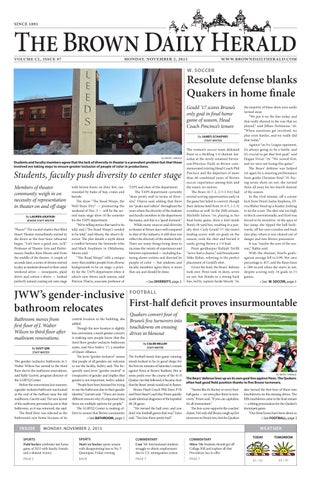
Students and faculty members agree that the lack of diversity in theater is a prevalent problem but that those involved are taking steps to ensure greater inclusion of people of color in productions.
Students, faculty push diversity to center stage Members of theater community weigh in on necessity of representation in theater on and off stage By LAUREN ARATANI SENIOR STAFF WRITER
“Places!” The excited chatter that filled Stuart Theater immediately started to die down as the four-hour rehearsal began. “Let’s have a good one, ya’ll,” Professor of Theatre Arts and Performance Studies Kym Moore said from the middle of the theatre. A couple of seconds later, a series of drums started to play as students dressed in their usual weekend attire — sweatpants, plaid shirts and cotton t-shirts — looked perfectly natural coming out onto stage
with brown boots on their feet, surrounded by bales of hay, crates and barrels. The show “The Road Weeps, the Well Runs Dry” — premiering the weekend of Nov. 5 — will be the second main stage show of the semester for the TAPS department. “We’re telling stories that need to be told, and (‘The Road Weeps’) needed to be told,” said Moore, the show’s director. The plot details a myth about a conflict between the Seminole tribe and black freedmen in Oklahoma, Moore said. “The Road Weeps” tells a unique story that enables people from diverse backgrounds to be on stage, a priority for the TAPS department when it selects new shows each season, said Patricia Ybarra, associate professor of
TAPS and chair of the department. The TAPS department currently “does pretty well in terms of diversity,” Ybarra said, adding that there are “peaks and valleys” throughout the years where the diversity of the students and faculty members in the department fluctuates, and this is a “good moment.” While many sources said diversity in theater at Brown fares well compared to that of the industry, it still does not reflect the diversity of the student body. There are many things being done to increase the variety of experiences and histories represented — including featuring shows written and directed by people of color — but students and faculty members agree there is more that can and should be done. » See DIVERSITY, page 2
The women’s soccer team defeated Penn in a thrilling 1-0 shutout Saturday at the newly renamed Stevenson/Pincince Field, as Brown commemorated retiring Head Coach Phil Pincince and the departure of more than 60 combined years of Brown soccer experience among him and the team’s six seniors. The Bears (6-7-2, 2-3-1 Ivy) had several scoring opportunities early in the game but failed to convert, though their defense held Penn (6-4-5, 1-2-3) scoreless as well. In the 20th minute, Michelle Jolson ’16, playing in her final home game, drew a foul inside Penn’s 18-yard box, resulting in a penalty shot. Carly Gould ’17, the team’s leading scorer with six goals on the season, took the shot and buried it easily, giving Brown a 1-0 lead. Penn goalkeeper Kalijah Terilli “never had a chance,” said broadcaster Mike Rubin, referring to the perfect placement of Gould’s shot. Given the lead, the Bears’ defense took over. Penn took 16 shots, seven on net, but thanks to a strong back line, led by captain Sarah Moody ’16,
the majority of these shots were easily turned away. “We put it on the line today, and that really showed in the way that we played,” said Jillian DeSimone ’16. “When emotions get involved, we play even harder, and we really did that today.” Against “an Ivy League opponent, it’s always going to be a battle, and it’s crucial to get that first goal,” said Hogan Vivier ’16. “We scored first, and we were not losing this game.” The Bears’ defense was helped yet again by a stunning performance from goalie Christine Etzel ’19. Facing seven shots on net, she turned them all away for her fourth shutout of the season. In the 33rd minute, off a corner kick from Penn’s Sasha Stephens, Olivia Blaber lined up a header, looking to tie the score. The shot was too high to block conventionally, and Etzel was forced to be inventive: At the apex of her jump, she tipped the ball backwards, off her own crossbar and back into play, where it was cleared out of danger and into Brown possession. It was “maybe the save of the season,” Rubin said. With the shutout, Etzel’s goalsagainst average fell to 0.99. Her save percentage is .837, and the Bears have a .500 record when she starts in net, despite scoring only 16 goals in 15 games. » See W. SOCCER, page 3
JWW’s gender-inclusive FOOTBALL First-half deficit proves insurmountable bathroom relocates Quakers convert four of Bathroom moves from first floor of J. Walter Wilson to third floor after mailroom renovations By SUVY QIN STAFF WRITER
The gender-inclusive bathroom in J. Walter Wilson has moved to the third floor due to the mailroom renovations, said Kelly Garrett, program director of the LGBTQ Center. Before the renovations last summer, a gender-inclusive bathroom was located at the end of the hallway near the old mailboxes, Garrett said. The new layout of the mailroom prevented access to that bathroom, so it was removed, she said. The third floor was selected as the bathroom’s new home because of its
INSIDE
central location in the building, she added. Though the new location is slightly less convenient, a much greater concern is making sure people know that the third floor gender-inclusive bathroom exists, said Nico Sedivy ’17, a member of Queer Alliance. The term “gender-inclusive” means that people of all genders are welcome to use the facility, Sedivy said. The frequently used term “gender-neutral” is irrespective of gender and implies that gender is not important, Sedivy added. “People have been harassed for trying to use the bathroom due to their gender identity,” Garrett said. “There are many different reasons why it’s important that there are multiple options for people.” The LGBTQ Center is making efforts to ensure that Brown community » See BATHROOM, page 2
Bruno’s five turnovers into touchdowns on ensuing drives in blowout By CALEB MILLER STAFF WRITER
The football team’s four-game winning streak looked to be in good shape for the first six minutes of Saturday’s contest against Penn at Brown Stadium. But at some point over the course of the 41-0 Quaker run that followed, it became clear that the Bears’ streak would end in flames. Bruno Head Coach Phil Estes P’18 and Penn Head Coach Ray Priore quickly made identical diagnoses of the lopsided 48-28 game. “We turned the ball over, and you don’t win football games that way,” Estes said. “You lose them pretty bad.”
ELI WHITE / HERALD
The Bears’ defense lines up on its own goal line against Penn. The Quakers often had good field position thanks to five Bruno turnovers. “Seems like it’s the key to every football game — we were plus-three in turnovers,” Priore said. “If you can capitalize, it’s all momentum.” The box score supports the coaches’ claims. Not only did Bruno cough up five turnovers to Penn’s two, but the Quakers
also turned the first four of them into touchdowns on the ensuing drives. The fifth touchdown came in the final minute — a fitting punctuation for the Quaker’s dominant game. “Our three losses have been about us » See FOOTBALL, page 3
WEATHER
MONDAY, NOVEMBER 2, 2015
SPORTS Field hockey celebrates last home game of 2015 with family, friends and a shutout victory
SPORTS Men’s ice hockey opens season with disappointing loss to No. 5 Quinnipiac Friday evening
COMMENTARY Cam ’15: International students struggle to obtain employment due to U.S. immigration system
COMMENTARY Mitra ’18: Students should get off College Hill and explore all that Providence has to offer
PAGE 3
BACK
PAGE 7
PAGE 7
TODAY
TOMORROW
61 / 42
65 / 47
UNIVERSITY NEWS PAGE 2 • MONDAY, NOVEMBER 2, 2015
THE BROWN DAILY HERALD
» BATHROOM, from page 1
RYAN WALSH / HERALD
The gender-inclusive restroom in J. Walter Wilson has been moved to the third floor due to the renovation of the mailroom over the summer.
» DIVERSITY, from page 1 Seasonal offerings “The Road Weeps” is one of the four main stage shows that Sock and Buskin’s board — which selects the company’s repertoire — chose for this academic year. In addition to these four shows, the season also features a “senior slot” show that is written and directed by a senior, according to the TAPS department website. This season’s senior slot will feature “The Red Paint,” which was written and will be directed by Sock and Buskin Chair Nika Salazar ’16 at the beginning of December. The show “deals directly with the Mexican-American identity,” Salazar said. When writing the play, Salazar’s priority was to create a story that Latino and Latina students can identify with, she said. Theater at Brown lacks representation from Latino and Latina actors, writers and directors, which calls for more shows that deal with their culture and heritage, she added. “It’s interesting because everyone knows (diversity) is a problem, but people still shy away from talking about it and shy away from doing anything about it,” Salazar said. She said she has dedicated her work in theater to “making spaces for people of color.” Though Salazar worked in theater while in high school, she noticed there was a separation between people who had formal training in theater before coming to college and those who had not. Those who receive training before coming to Brown are typically white, she said. “My freshman and sophomore year (at Brown), I was terrified. I went to see shows, and there weren’t many people of color,” Salazar said. “I thought to myself, ‘How could this be a space for me?’” Finding space One of the struggles for people of color in theater is predicting what shows they will be cast in, said Crystal Kim ’16, academic outreach and social co-chair for Sock and Buskin. Whether the director is looking to be inclusive and diverse is “a conversation that happens every time you go into an audition,” Kim said. As an Asian-American woman, Kim has had difficulty auditioning for characters she can culturally identify with due to the lack of plays written with Asian-American characters, she said. During her time at Brown, there have been only two plays that specifically called for Asian-American women, she added. “I just have to be fearless when I go into casting because I don’t see roles for me,” Kim said. “When I saw ‘The King and I’ over the summer, I started
bawling my eyes out because it was the first time I’ve seen a woman like me on a Broadway stage.” Kathy Ng ’17, who is the Providence engagement chair on Sock and Buskin, played a role in “410[GONE],” a show written by Chinese-American alum Frances Ya-Chu Cowhig ’05 that the TAPS department produced last spring. “It was the first time that I ever felt like there was a show that I fit in. … This is such a rare thing,” Ng said. While performances such as “The Road Weeps” and “The Red Paint” tell the stories of people of color, Ng said she wishes directors would cast people of color in more “mainstream” shows, which are also more heavily attended by those not involved in theater. This problem is especially prominent when a director — who is sometimes a student — may have previously “conceived of a cast that is predominantly white,” she added. “It’s so important that these narratives on race are being told, but I don’t feel like that should be the only thing that students of color can be in,” Ng said. “They should be and can be in major stories that are not predominantly about race.” Casting approaches The mindset of the director is critical to getting more people of color in commonly produced theater, such as Shakespeare, Ybarra said. When casting shows, directors will usually take one of two approaches: color-blind casting or color-conscious casting. It’s impossible to avoid seeing race on stage, Ybarra said, adding that colorblind casting attempts to disregard race and ethnicity entirely. For example, color-blind casting could lead to brother and sister characters being cast with actors of different races because the actors fit the roles best. Conversely, in color-conscious casting directors are purposefully “making a claim about race or ethnicity,” Ybarra said. Both types of casting can lead to diverse representation in a show, she added. Casting at Brown “depends on the director,” Ybarra said. But playwrights will sometimes write “culturally specific roles” that more or less require a certain type of actor, she said. Particularly with intersectional representation in plays, diversity outside of race and ethnicity can add nuance to the casting process, Ybarra said. For example, she cast a white man with a disability as the lead character in “Water by the Spoonful,” a show she directed in 2013, even though the character was written as a Latino man with a disability. No Latino actors who openly identified as having a disability auditioned for the show, “so one had to
members know about the gender-inclusive bathrooms on campus, Garrett said. The center is currently updating a list on its website about gender-inclusive bathrooms, which should be completed in a few months, Garrett said. The gender-inclusive bathroom will hopefully be listed on the directories in J. Walter Wilson as well, she added. The conversion of multi-user bathrooms to gender-inclusive bathrooms has found moderate support among the student body. A fall 2013 Herald poll found that approximately 28 percent of students supported making all multiuser bathrooms gender-neutral, while 47 choose one of the intersectional identities when casting, and that is what I did,” Ybarra wrote in a follow-up email to The Herald. Moore said that by directing a play, a person is “creating a reality on stage” in which race and gender make a political statement. “I stopped acting myself because I was only going to play the servant at a certain point,” Moore said. “But if a play is realistic, then (a director) has to be really conscious of race.” Sometimes not enough actors who identify with the race or ethnicity of the characters the show may call for audition, Moore said. The importance of producing a show reflecting diverse experiences overrides the need to cast actors that share the ethnicity of their characters, she added. This was the case with “The Road Weeps,” a show that tells the stories of Native Americans. Though there are no Native American actors in the show, people of color make up over half the cast. While casting “Hype Hero,” which called for an all-black cast, there were not enough black actors to fill the roles, Moore said. But the show “needed to be done,” so, she said, she cast different ethnicities to present a “certain social dynamic that works in the world today.” Not only does the TAPS department emphasize telling important stories, they also focus on giving actors of color opportunities to be on stage, Ybarra said. “We prioritize those roles as they’re written, but sometimes it doesn’t match up. … (Instead) you prioritize bringing actors of color into the room, even if they’re not exactly matching up with the exact ethnicity of the characters,” she added. As a director of “for colored girls who have considered suicide / when the rainbow is enuf,” Salazar said she asked herself whether a white actress could portray a character of color despite her ethnic background. People were “really angry” about her decision to allow white students to audition. “If there was someone who I believed could understand and connect with this text, then I was going to cast them,” Salazar said. “If I didn’t do that, I would be perpetuating the same system that exists that says, ‘Because I look like this, I don’t fit that role.’” Making space The Department of Africana Studies’ Rites and Reason Theatre was founded by George Houston Bass, a former professor of theatre arts and African-American studies. Bass believed theater and culture are “dynamic” and “constantly changing,” said Elmo TerryMorgan ’74, artistic director of Rites and Reason and associate professor of Africana studies and TAPS. TerryMorgan studied under Bass during
percent supported making some bathrooms gender-neutral and 15 percent did not support converting any bathrooms. “People who don’t feel comfortable using men’s or women’s bathrooms still need a place to use the bathroom,” said AJ Whitman ’17, a member of QA and leader of Spectrum, a subgroup for trans, nonbinary and gender-questioning students. “Gender-inclusive bathrooms should be a thought during the planning process and not just an afterthought,” Whitman said. “There’s no reason for single-use, single-gender bathrooms,” Sedivy said. An additional concern for the LGBTQ Center is encouraging
individuals who do not need genderinclusive bathrooms to use other bathrooms that are accessible, Garrett said. Students who identify as cisgender sometimes use a gender-inclusive bathroom when other bathrooms are full, preventing other students who need to use the gender-inclusive bathroom from doing so, she said. “If you don’t have gender-inclusive bathrooms in accessible places, that’s saying you can’t use a bathroom unless you’re in your home, which is not practical,” Sedivy said. “We are not advocating for all bathrooms to be gender-inclusive,” Garrett said. “We want people to have a choice.”
his time at Brown and was able to see the initial stages of Rites and Reason’s creation, he said. “We liked creating our own stories, and he helped us to identify them,” Terry-Morgan said. Bass especially emphasized studying what he called “New World theater” that presented the “Afro view of the world,” Terry-Morgan said. “In terms of diversity, we just do it,” Terry-Morgan said about Rites and Reason, adding that the theater has developed the motto “the place to be who you are becoming.” The basis of Rites and Reason is the “research to performance method” of play production, and the theater produces works that are “informed by research,” Terry-Morgan said. Each year, Terry-Morgan teaches AFRI 1050E: “RPM Playwriting,” which allows students to write a play after intensive research. The class requires students to research a specific area and explain why they are interested in writing that story, Terry-Morgan said. The conversation around diversity in theater often is focused on the “black and white dichotomy,” but in reality it spans beyond race, Terry-Morgan said. In addition to teaching his RPM workshop, Terry-Morgan also teaches AFRI 0990: “Black Lavender: Black Gay/Lesbian Plays/Dramatic Constructions in the American Theatre,” a course that focuses on black playwrights who write about “queer content,” he said. In 2009, Rites and Reason first presented Black Lavender Experience, a festival that showcases plays and lectures from queer artists of color, he added. Each year in his RPM workshop, Terry-Morgan selects one student whose show will be produced at Rites and Reason. Micaela Burgess ’17 is currently writing a play that will be performed during the Black Lavender Experience in April, she said. As a student in “RPM Playwriting,” she began her research for the play through an assignment in which students were asked to write a play on one picture from the “Eminence Gallery” that was on display in the Stephen Robert ’62 Campus Center last year. Burgess’ play deals with queer women who fall in love and must deal with cultural differences along the way, she said. The two lead characters of the play identify as Chicana and Jamaican, she said, adding that though they are both people of color, the way each culture treats queer women creates tension. Along with connecting her experience as a queer Chicana-American to her writing, Burgess also intensely researched the way both cultures of her main characters treat queer women, she said. In Mexican culture, the sexuality of queer women is usually ignored, with some families encouraging women to
marry men despite their coming out, Burgess said. In contrast, Jamaican culture sometimes tries to correct queer women through violence, she added. “I’m lucky that there is a platform that is the Black Lavender Experience festival and (Terry-Morgan) saw something in me and in this play, and he wants to produce it and teach other people something from it,” Burgess said. An indefinite problem Like the Black Lavender Experience, there should be more platforms for people of color in theater, Burgess said. People of color “have so much to say and so many stories to tell, and there’s so much talent that goes unseen,” she said. “Give them a microphone. Give them a platform.” Though representation in theater has gotten better over the years, there is still a lot of work that can be done, Moore said, adding that she wishes there were more people of color who are playwrights and producers working in theater. While the TAPS department tries its best to be inclusive by creating a season of shows by a more diverse group of writers, student groups should “set initiatives to get people of color into spaces,” Salazar said. Despite working in multiple plays as costume designer, actress and director, Salazar still feels “marginalized” within the theater community, she said. “If (people of color) don’t fight, then nothing’s ever going to happen,” Salazar said. “I really made this place my home, and I still don’t feel at home (here).” Even though theater at Brown does not reflect the diversity of the student body, students of color and other underrepresented identities should continue to pursue roles even if “you feel there might not be a space,” Ng said. “There are people working hard to make a space for you in the theater community here.” Kim said she believes she is “not fighting a losing battle,” but she wishes that things would change faster. “I want to go to a point where Viola Davis doesn’t have to have her Emmy speech be about diversity,” Kim said. Salazar said with all the effort she is putting toward works for students of color, such as “for colored girls” and “The Red Paint,” she hopes that people of color will audition for shows that highlight the voices of people of color. “It might not seem like it, but there are people in the theater community who are rooting for you … and they want you to show up to auditions,” Salazar said, adding that she “knows it’s scary.” But “your body being on stage is a political statement. Your body being on stage is a revolution.”
SPORTS
MONDAY, NOVEMBER 2, 2015 • PAGE 3
THE BROWN DAILY HERALD
FIELD HOCKEY
Seniors seal home slate with shutout Miller ’16, Rogers’ 16 each contribute one goal, Arciero ’16 assists on both in Senior Day victory By MATT BROWNSWORD SENIOR STAFF WRITER
ELI WHITE / HERALD
Jennifer Caruso ’19 advances the ball up the field. While the Bears’ offense generated one goal, their defensive play was crucial in securing the win.
» W. SOCCER, from page 1 With the win, the Bears can finish with a .500 record if they defeat Yale next weekend, having reclaimed what seemed like a lost season after they did not score in their first four Ivy matches. Erin Katz ’16, who has paced the Bears all season in terms of intensity and competitive spirit, cited a recent moment as a turning point in the season. “I think it was the Cornell game,” she said. “At that point, we hadn’t even scored in Ivy League (play), and to hold on and win in the second overtime, to put it away, that’s when we said, ‘Okay, we’re really strong right now.’” In the win against Penn, the Bears pulled off one of their best team games of the season, fighting for every ball and executing every play. Even as their offensive attack faltered in the second half, the defense demonstrated some of its most competitive and aggressive play of the season in holding Penn scoreless. Perhaps due to the emotions of the game, the Bears played with an intensity unmatched at any other point this season. “This meant so much — it was our senior game, and we really wanted to win for each other,” Jolson said. “Before the game started, in our pregame huddle, we were talking about how we
were doing this for each other, doing it for (Pincince), doing it for our classmates and for the entire team.” Pincince, coaching the last home game of his 39-year tenure, was a focal point of the game. A banner reading “Thank you Phil!” hung from the building opposite the field, and after the victory, Pincince’s players emptied the cooler on him. In a special Senior Night postgame interview, DeSimone offered some parting words to the departing icon. “We just want to say thank you so much,” she said. “These past four years have been a great experience for all of us, and we know that this program is going to miss you. On behalf of all of Brown women’s soccer, we want to thank you so much for all the dedication and passion that you put toward this program, and we really appreciate it.” Moody, who started every game this year, said that despite Pincince’s retirement, the team will remain strong. Pincince “is gone, and things are going to change, but the group of girls that we have is so strong,” Moody said. As the departing senior class left their home field for the final time, Charlotte Beach ’16 summed up her experience playing for Brown and Pincince: “Brown soccer in one phrase? Win every battle.”
It was all smiles for the five seniors on the women’s field hockey team Sunday when their parents greeted them on the field. The parents and other attendees had come to honor the members of the class of 2016 in the last home game of the season for Bruno (7-9, 1-5 Ivy). When Emily Arciero ’16 was introduced and made an elaborate wave to the fans at Senior Day, more smiles and laughter animated the faces of the Bears. For the first time all season, those smiles never wavered. Brown earned its first shutout all season and scored three well-timed goals to ensure that a winning result was never really in doubt, as it topped Lehigh 3-0. “Our senior class is pretty special,” Miller said. Though “our record wasn’t glorious, we wanted to put our final marks on the program.” Bruno only took 10 minutes to get on
» FOOTBALL, from page 1 beating ourselves more than the other team beating us,” Estes said. Each time the Bears made a mistake, a formidable Quaker ground attack capitalized. When the ball was in Penn’s hands, the formula was clear: run up the middle again and again. In 52 rushing attempts, the Quakers cut through the Bruno interior like a warm knife through butter. Their 263 rushing yards came in consistent chunks, never breaking a run of greater than 16 yards and averaging 5.1 yards per carry. Much of the Bears’ defensive struggles can be attributed to a banged-up defensive line. Priore said his team planned to exploit the numerous injuries in Bruno’s interior, and when this strategy worked early, the Quakers had no reason to stop running the same play. “Our defense is so beat up right now,” Estes said, lamenting the injuries to defensive captain Zach Sparber ’15.5 and his fellow defensive tackles Tom Kutschke ’17 and Jake Walther ’16. “We have two freshmen starting on the defensive line.” Bruno’s depleted defense stung it early. The Bears marched the field for a Johnny Pena ’17 touchdown in their first drive to claim a 7-0 lead, but the momentum evaporated when the Quakers rattled off four touchdowns in a five-drive stretch. Quaker receiver Justin Watson
the board first, scoring a well-orchestrated goal off of a penalty corner. It was a tally crafted by seniority, as Co-Captain Anna Masini ’16 inserted the ball to Arciero, who slid the ball to Co-Captain Alexis Miller ’16, who put a rocket past the Mountain Hawks’ (5-13) goalie. This marked the third time that the combination of Masini, Arciero and Miller had scored this season, accounting for three out of Masini’s seven assists on the year. Bruno thoroughly dominated the first half, registering six corners to Lehigh’s zero while firing off 10 shots to Lehigh’s one. A well-placed cross from Katarina Angus ’17.5 just missed Masini’s stick at the back post, and Lucy Green ’17 created a few chances before the halftime whistle. The second half saw Lehigh hang around for about eight minutes before Angus essentially put the game away with a blistering shot past the Lehigh goalie. Masini and Arciero contributed on the assists. Brown continued to take it to Lehigh but was pushed back a little more than in the first half. Leah Zavalick ’17, Ashley Waldron ’18 and Maddie Ayles ’19 combined with Masini and Angus excellently on defense, with Zavalick especially standing out.
Arciero capped off her incredible day with a third assist on the Bears’ final goal of the game: a beautifully worked corner that Hannah Rogers ’16 tipped in. Arciero faked like she was setting the ball up for Angus, took the ball to the side and fired a shot to the back post that latched onto Rogers’ stick. The sentiment around the field was one of relief for the entire game. The contest marked not only the first notone-goal win for the Bears this year, but also the first time all year that they had held a lead of more than one goal. Katie Hammaker ’19 held firm at the back, pitching her first shutout of the year as Brown took the game 3-0. “The last few games, we gave up a few fluky goals,” Miller said. “We weren’t going to allow ourselves to be in that situation and put Katie in those situations for shots to go on her. We needed to step up, and that’s what we did.” The Bears fell 2-1 to Penn Saturday. Jaclyn Torres ’17, a Herald senior staff writer, scored a cheeky goal over an onrushing goalie. But the Quakers (13-2, 5-1 Ivy) struck with two goals in two minutes in the second half to top Brown. Brown takes on Yale in its final game of the season next weekend.
erased Bruno’s lead on the first chance he got, finding a seam for a 79-yard catchand-run touchdown. In its next two touchdown drives, Penn marched 64 and 80 yards, respectively, without facing a third down of longer than two yards. Trailing 21-7, the Bears gave the Quakers a gift they did not need: an errant snap that Penn recovered inside the red zone. For good measure, Quaker quarterback Alek Torgersen authored a quick drive to sneak in a fifth touchdown before half. The Bears had “a terrible first half,” Estes said. The second half brought Bruno relief from the Quaker onslaught, as the Bears mounted a modest comeback. Receiver Troy Doles ’16 made the first dent in Penn’s 41-7 lead by corralling an 19-yard touchdown between two defenders. After Bruno’s defense finally suppressed a Penn drive, Alex Jette ’17 trimmed the deficit further. Jette made a tremendous leaping catch to open the possession, fighting the sideline and three Quaker defenders to pull down a jump ball. Two plays later, he blew past the secondary for a 34-yard score. With the lead down 20 points, Grant Senne ’16 surprised everyone with a perfect onside kick, which Jordan Ferguson ’17 smothered for the Bears. The crowd was rejuvenated momentarily, but the rally died on the next play when a Fuller
pass fell into the hands of Penn’s Sam Philippi. Fuller “underthrew it,” Estes said. “If he threw it over the top, we would have been cheering because it’s a two-score game.” Priore and the Penn players said even during Bruno’s third-quarter run, the Quaker mood was optimistic. “We stayed pretty level-headed. I don’t think there was too much worry,” Philippi said. “But there was definitely an understanding that we needed to play well on defense.” Penn scored on its next possession to seal the win. As the game began to get away from Bruno, the team turned to a pass-only offense. Even in the ugliness, Fuller and the talented receiving corps put up big numbers. The one-two punch of Jette and Doles continued its impressive season, with the former racking up 145 yards and a touchdown and the latter adding 98 yards and a score of his own. Fuller finished his up-and-down performance with some good — 323 yards and two touchdowns — and a lot of bad — four costly interceptions. “I’m not going to let this game define where we are right now after four straight wins,” Estes said, citing the youth on defense and the turnover troubles as two areas to improve before next week’s battle at Yale.
SPORTS
PAGE 4 • MONDAY, NOVEMBER 2, 2015
THE BROWN DAILY HERALD
Sports Roundup BY TANEIL RUFFIN, SENIOR STAFF WRITER
Volleyball
The 2015 season has provided a testament to the dominance of the volleyball team at the net. The Bears (10-12, 4-6 Ivy) boast a .211 team hitting percentage — the second highest in the Ivy League — and two of the conference’s deadliest players at the net in Sabrina Stillwell ’19 and Payton Smith ’17. But this weekend saw a departure from Bruno’s typical performance in the match against Columbia. The squad recorded a .043 hitting percentage, and the Lions ultimately swept the match. The following night, the Bears alternated games with Cornell but fell to the Big Red in a 3-2 decision.
Equestrian
The equestrian team remained the top seed of the IHSA Zone 1 Region 1 rankings after winning the UMass Dartmouth IHSA Show Saturday. Junior captain Kabisa Baughen ’17 was a team standout, winning open fences and open flat and earning high point rider for the show. In their show debuts, Genoveva Eguiguren ’18 and Natalia Moriel ’18 took fourth and fifth place, respectively, in the walk-trot division. Bruno will look to continue its dominance at the University of Rhode Island IHSA Show Saturday.
Cross country
The men’s and women’s cross country teams competed at the Ivy League Heptagonal Championships in New York City Friday. Three top-20 finishes propelled the women’s team to fourth place. Natalie Schudrowitz ’18 completed the six-kilometer course in just under 22 minutes and placed 12th overall. Schudrowitz’s performance Friday was a worthy culmination of her strong sophomore campaign, for which she received Second Team All-Ivy honors. Taylor Worthy ’17 and Carleen Jeffers ’19 also completed the race within the top 20 with 16th- and 17thplace finishes, respectively. Plagued by illnesses and injuries throughout its roster, the men’s team did not fare as well as the women’s team. Bruno managed an eighth-place finish with 230 points at the Ivy League Championship. Eli Moskowitz ’19 led the way for the Bears, finishing the five-mile course in just under 26 minutes to secure 39th place.
Men’s water polo
After mixed results at the Santa Clara Bronco Invitational last weekend, the No. 12 Bears (21-6, 12-0 CWPA) returned to Providence to face off against conference rivals St. Francis Brooklyn and Fordham in the team’s last games of the regular season. Bruno beat St. Francis Brooklyn, 14-12, and Fordham, 11-6, to finish its regular season undefeated. The team will host the CWPA Northern Division Championship next weekend.
Women’s crew
All four of the women’s crew team’s entries fared well at the Princeton 3-Mile Chase Sunday morning. The varsity open eight finished second, just over half a second behind Virginia in the final race of the fall season. The Cavaliers proved to be Bruno’s stiffest competition of the race. The Bears edged the third-place Yale boat by a margin of 12.105 seconds and the fourth-place Princeton boat by 22.706 seconds. In the 59-boat race, the Bears’ B, C and D entries finished in sixth, 22nd and 39th, respectively. The B boat even outlasted several schools’ A boats, including those of Cornell, Radcliffe College, Penn and Dartmouth.
ELI WHITE / HERALD
Tyler Wood ’17 beats a Holy Cross opponent and looks to receive the puck from a teammate. The Bears were able to generate offense as five different players scored against the Crusaders Saturday evening.
» M. HOCKEY, from page 8 an impressive acrobatic save on the first attempt, but the rebound sat right in the crease for a tap-in for Castan Sommer. The third period started in Brown’s favor, as Marchin got his first goal of his career only 37 seconds into the frame. Less than three minutes later, captain Mark Naclerio ’16 got his first of the season to tie the game up at 5. “We generated a lot of good chances all night,” Naclerio said. “We got pucks to the net, but we just have to limit our goals against.” Unfortunately for the Bears, Sommer got his second goal of the game
to give the Crusaders a lead that they would not relinquish. Mike Barrett got the last goal of the game, and Holy Cross’ seventh, on a power play. The final score was 7-5, which smashed last year’s season high of nine total goals in a game. “A lot of the problems had to do with turnovers and mental mistakes,” Naclerio said. “You could tell that it was our first game and it was their sixth, but we just have to fine-tune our issues.” The Bears’ penalty kill gave up two goals — though one was the result of a two-man advantage — while the power play gave up a goal and scored none. Specialty teams have been a major
weakness for Brown all year, and the first game of the 2015-16 season was no different. “We’re still getting used to the penalty kill,” Naclerio said. “The 5-on-3 goal hurt. On the power play, we just overcomplicated things a little bit. We need to manage the puck better and generate more chances.” Brown will enter conference play next weekend against Harvard and Dartmouth. “We’re looking forward to a good week of practice,” Naclerio said. “We want to take some momentum into next weekend. These are two league games and are of utmost importance, so we need to be ready for that.”
TODAY
MONDAY, NOVEMBER 2, 2015 • PAGE 5
THE BROWN DAILY HERALD
menu
silhoulet te on the seekonk
SATELLITE DINING ANDREWS COMMONS
Pizzas: Rhode to Italy, Caprese, BBQ Chicken Ranch Fried Rice Station JOSIAH’S
BLUE ROOM
Gourmet Grilled Cheese Station
Chicken Noodle Soup Mediterranean Pockets
DINING HALLS SHARPE REFECTORY LUNCH
DINNER
Vegetarian Meatball Grinder, Potato Salad, Cranberry and White Chocolate Chip Cookies
Acorn Squash with Curried Rice and Chickpeas, Apricot Beef with Sesame Noodles
VERNEY-WOOLLEY LUNCH
DINNER
Chicken Fajitas, Vegan Black Bean Taco, Vegan Chana Masala, Snickerdoodle Cookies
Italian Meatballs, Pizza Rustica with Spinach, Italian Couscous, Pineapple Upside Down Cake
sudoku
RYAN WALSH / HERALD
A silhouette of a tree looms above the Seekonk River as the day comes to a close. Due to the recent Daylight Savings time change, the sky will become darker earlier as winter nears and autumn bids its farewell.
calendar TODAY
NOVEMBER
crossword
S
M
T
W
Th
F
S
1
2
3
4
5
6
7
8
9
10
11
12
13
14
Alumni Career Pathways: Demystifying Nonprofits 6:00 P.M. CareerLAB
Python with Paxson: An Intro to Programming 6:30 P.M. MacMillan Hall 117
Screening of “Postmortem” 7:00 P.M. Watson Institute, Joukowsy Forum
Health Leads Info Session 8:00 P.M. Wilson Hall 102
TOMORROW
15
16
17
18
19
20
21
22
23
24
25
26
27
28
29
30
Capitalism, Progressivism and Mass Incarceration 4:00 P.M. List Art Center 120
Brown in Oxford and Cambridge Info Session 4:00 P.M. J. Walter Wilson 440
Effective Interviewing for First-Years 6:00 P.M. MacMillan Hall 117
GWiSE Presents Prof. Barbara Tannenbaum 6:00 P.M. Sciences Library, Third Floor
Never miss a day. comics.browndailyherald.com
COMMENTARY PAGE 6 • MONDAY, NOVEMBER 2, 2015
THE BROWN DAILY HERALD
EDITORIAL
Breaking up the monotony Just like that, we have entered the last full month of the semester. At this point the daily grind of classes, meetings and other commitments has taken its expected, monotonous form. Rather than an opportunity to find something new, Morning Mail has become a time marker of sorts — a regular staple of late nights and a reminder of another day of the semester in the books. It is at this point in the academic calendar, in the three weeks remaining before Thanksgiving break, when we ought to make an extra effort to combat the tedium of the semester. Seeing a production, attending an exhibit or stopping in on a lecture can often provide the break or source of inspiration that we need. While November seems to represent nothing more than an enduring set of midterms, exams and late nights, it is important to recognize that the month also marks the high point for a number of student groups and organizations that have been planning and working toward various events throughout the semester. Taking some time to pay attention to those Facebook invitations and table slips in the Sharpe Refectory might yield some exciting finds. Take this editorial as an invitation: Add escaping the dreariness of the semester to your list of challenges to overcome this November. At a place as exciting as Brown, it is easy to feel overwhelmed by the sheer number of opportunities that could go unnoticed or missed. When students get particularly busy, these opportunities can represent an especially discomfiting reminder of just how much there is to do within the narrow window of time outside of classes and extracurricular commitments. The cure might seem counterintuitive. Rather than throwing ourselves into our routines, it becomes even more important at this time of year to remain attuned to the events and opportunities that pique our interests. Rather than deleting Morning Mail, turning over the table slips or ignoring the Facebook notifications, we ought to take a few seconds to read things a little more slowly. Perhaps this week is the week you decide to go to that event — just for an hour — that caught your eye as you walked under Faunce Arch after a long day. Perhaps these next three weeks — before the campus prepares for finals period — you will be thrilled by the spontaneous decision to walk into the exhibit your professor shared with your class. Regardless of how November looks, make sure to take some time to enliven what can often feel like a monotonous month.
K I M B E R LY S A LT Z
Q U O T E O F T H E D AY
“It might not seem like it, but there are people in the theater community who are rooting for you.” — Nika Salazar ’16
See theater on page 1.
Editorials are written by The Herald’s editorial page board: its editors, Manuel Contreras ’16 and Meghan Holloway ’16, and its members, Emma Axelrod ’18, Noah Fitzgerel ’17 and Aranshi Kumar ’17. Send comments to editorials@browndailyherald.com.
Editorial Leadership
Sections
Visuals & Production
Business
Editors-in-Chief Michael Dubin Maxine Joselow
Arts & Culture Editors Gabrielle Dee Emily Passarelli
General Managers Sarah Levine Winnie Shao
Managing Editors Kiki Barnes Jillian Lanney
Metro Editors Alexander Blum Emma Jerzyk
Design Editors Loren Dowd Carlie Peters Taylor Schwartz Assistant: Meryl Charleston Assistant: Sonia Geba
Senior Editors Isobel Heck Molly Schulson
Science & Research Editor Steven Michael
BLOG DAILY HERALD Editors-in-Chief Deena Butt Charlotte Bilski POST- MAGAZINE Editor-in-Chief Yidi Wu DIGITAL Director of Audience Development Marcy Huang Social Media Editor Camilla Brandfield-Harvey
Sports Editors Andrew Flax Alex Wainger University News Editors Emma Harris Drew Williams COMMENTARY Editorial Page Editors Manuel Contreras Meghan Holloway Opinions Editors Rachel Montoya Chad Simon Robyn Sundlee
Photo Editors Head: Arjun Narayen Sadie Hope-Gund Matteo Mobilio Ryan Walsh Eli White Web Producer Harsha Yeddanapudy Copy Desk Chief Bonnie Henry Illustrations Editor Ivan Alcantara Video Editor Richard Flores
Directors Sales: Moniyka Sachar Sales: Jess Urrutia Finance: Josh Tartell Alumni Relations: Marley Rafson Business Dev.: Yuta Inumaru Sales Managers Matthew Meyer Henry Ritter Gulmira Hamit Taylor Casey Finance Managers Collections: Neil Wathore Collections: Benjamin Wesner Operations: Carin Papendorp
facebook.com/browndailyherald
Location: 195 Angell St., Providence, R.I. www.browndailyherald.com
@the_herald
Editorial contact: 401-351-3372 herald@browndailyherald.com
browndailyherald.com
Business contact: 401-351-3260 gm@browndailyherald.com
Corrections: The Brown Daily Herald is committed to providing the Brown University community with the most accurate information possible. Corrections may be submitted up to seven calendar days after publication. Commentary: The editorial is the majority opinion of the editorial page board of The Brown Daily Herald. The editorial viewpoint does not necessarily reflect the views of The Brown Daily Herald, Inc. Columns, letters and comics reflect the opinions of their authors only. Letters to the Editor: Send letters to letters@browndailyherald.com. Include a telephone number with all letters. The Herald reserves the right to edit all letters for length and clarity and cannot assure the publication of any letter. Please limit letters to 250 words. Under special circumstances writers may request anonymity, but no letter will be printed if the author’s identity is unknown to the editors. Announcements of events will not be printed. Advertising: The Brown Daily Herald, Inc. reserves the right to accept or decline any advertisement at its discretion. The Brown Daily Herald (USPS 067.740) is an independent newspaper serving the Brown University community daily since 1891. It is published Monday through Friday during the academic year, excluding vacations, once during Commencement and once during Orientation by The Brown Daily Herald, Inc. Single copy free for each member of the community. Subscription prices: $280 one year daily, $140 one semester daily. Copyright 2015 by The Brown Daily Herald, Inc. All rights reserved. Periodicals postage paid at Providence, R.I. Postmaster: Please send corrections to P.O. Box 2538, Providence, RI 02906.
COMMENTARY MONDAY, NOVEMBER 2, 2015 • PAGE 7
THE BROWN DAILY HERALD
Why don’t we think about internationals? DENIZ CAM
op-ed contributor
Privilege exists on many levels at Brown — sometimes more conspicuous, sometimes less apparent. While not wanting to overstep any boundaries or talk about other peoples’ struggles, I can say that my Brown experience was significantly shaped by the very fact that I was an international student, and the trope of the “rich international kid” defined an important part of my undergraduate career. As the president of Buxton International House, there were instances that brought me closer to attesting to this trope. Mostly because of Buxton and its legacy (which I think could not be understood by many who have not lived in the house), there were times when the international community definitely appeared as an entitled group, throwing the craziest campuswide parties, affording to be reckless while others could not, and somehow living up to the “jetsetter” ideal. Some of us traveled a lot, and some of us came from multinational backgrounds — which, to my surprise, signified wealth and sophistication in the United States. Some of us represented our own countries’ 0.1 percent by belonging to distinctively privileged families in under-privileged countries. Some of us also did not. Some of us got to the University without having access to SAT classes or college counseling. Most of the people around us at home did not know what “Brown” was besides a color — if they even knew some English. We left our families behind in war-ravaged coun-
tries and took an enormous risk by coming to a country that we had never seen before. Some of us could not have even imagined seeing America before the end of our lives — let alone studying at an American institution. Though we all came from different socioeconomic backgrounds, we all deserved to be at Brown, simply because somebody at the Office of Admission thought we had something unique to bring to this college. Some of us were really good at sports. Some of us made amazing students in science, technology, engineering and mathematics. And some of us were incredible artists, getting the chance to produce things that we otherwise would not have in our home countries. With or without money, we came
the fault of the University and my fellow peers. The fault is deeply rooted in a sentiment that reigns in this country: Nobody really wants to recognize the immigrants, because once they do, the destructive and unaccommodating nature of the U.S. immigration system becomes strikingly clear. You simply cannot look away once you know that you have a system in hand that needs immediate reform. The discriminatory practices of the mechanism that lets people into this country or allows them to stay are more complicated and problematic than Donald Trump’s plans of building a wall between the United States and Mexico. So if you think that wall is worse than anything you can imagine about immigration, you are wrong.
only be unemployed for a total of 90 days and have to inform United States Citizenship and Immigration Services about their employment status. Though OPT might sound like the opportunity of a lifetime, my OPT has not yet worked toward providing me the right opportunity to work in the United States. On the contrary, it has shown me how hard it is to be an immigrant in this country even as an Ivy League graduate — as entitled as this statement sounds. As an aspiring journalist, I have only come across employers who are willing to make me work long hours without paying me, because they do not really have to. In order to keep my OPT, I have to prove I am employed, and in return, nobody truly cares about me as long as I work.
Everybody wants to hang out with the internationals and be like the internationals, but nobody actually wants to be an international. to the United States to live up to our full potentials, but it was never that easy. No matter what we were actually capable of achieving as individuals, the rich and ostentatious international trope always resurfaced. It categorized us into a less complex and less amicable group. I am not saying that the non-international community did not love or did not want to be friends with international students. But the residents of this country never acknowledged these individuals as a group that needed to be recognized more. So many times, I had interactions with administrators and heard the phrase, “Oh, the internationals.” We were always easily brushed off. Does this appear as a problem within Brown? Yes, but it is not merely
No one is actually going to build a concrete wall, given that the invisible wall of immigration already stands tall and strong. The United States is kind enough to give its international students the chance to stay after graduation with what is called an Optional Practical Training visa. OPT gives international students the time to strike a deal for an H-1B, which allows them to stay for longer and even apply for a Green Card in the long run. H-1B is given out based on a lottery, through which only about one of three people can obtain work authorization. Until H-1B, OPT functions as an extended student visa (F-1) for usually a year — not even mentioning the STEM extension and its complicated status. Throughout this year, international students can
Interview processes can get really tough, and you can sometimes find yourself interviewing for weeks or even for months. You slowly set up a “looking-for-job” routine by picking a cafe, buying some coffee, applying to jobs, buying more coffee, searching connections on Linkedin and sending millions of emails. Given the monotonous nature of the task, applications appear to be the same after a while, and you become more acquainted with phrases such as the Veterans Opportunity to Work Act, the Americans with Disabilities Act and Equal Employment Opportunity laws. Yet somehow all of these acts fall short when employers tell you they cannot hire you because you do not hold a U.S. passport. One day, during a final interview, someone from
a prominent news company told me the company would be willing to hire me “the day I won a Pulitzer Prize” — making it clear that someone is hardly worth the immigration hassle. Though I would not say no to a Pulitzer Prize, I do not think I am getting one anytime soon. Everybody wants to hang out with the internationals and be like the internationals, but nobody actually wants to be an international. Regardless of the cultural appeal of being an international, there is such a burden that comes from being one. Nobody wants to plan out where they are going to be 12 months in advance. Nobody wants to consider having to marry their best friends because they want to stay in a country. Being an international means planning, constantly taking risks and losing a lot when there is definitely not a reason to lose — and it is all because of what the system legislates and cannot oversee. We lose opportunities, we lose friends and we lose our incentives to do something for this country and this world. Can the United States change the immigration system overnight? Definitely not. But people can choose to be allies without having to propose to their friends. They can rethink what citizenship means and restructure a vessel of discrimination into a source of celebration.
Deniz Cam ’15 currently lives in New York City and works for a United Nations-affiliated magazine. She is willing to hear any “international” problems and can be reached at deniz_cam@alumni.brown.edu.
Divine Providence MILI MITRA opinions columnist
One of the things I love most about Brown is its beautiful campus. Don’t get me wrong — I also love the intellectual environment, the motivated student body and the plethora of opportunities for personal growth and exploration. But on days when the sun is out and the campus comes alive, I have to admit the aesthetics are a major draw. There’s just something about the Main Green in its fall splendor that never fails to make my day. Unfortunately, living on a gorgeous campus has a downside: I never want to leave. It doesn’t help that Brown is relatively self-contained, making it perfectly feasible to go months without leaving College Hill. But as easy as it would be to live solely within the confines of campus, I wholeheartedly discourage you from doing so. Providence has some incredible hidden treasures — ones you will regret overlooking when it’s finally time to leave. I speak from experience: In my freshman year, I left the College Hill vicinity all of 20 times. It took me almost a year to make the short walk to Wickenden Street, and I spent months believing that Wayland Square and Wayland House were one and the same. I managed to make occasional trips downtown, but I rarely strayed farther than Providence Place
Mall. As embarrassing as it is to admit, my entire world spanned approximately seven blocks. I had no idea what I was missing. I probably would have continued in ignorance if I hadn’t remained in Providence for part of the summer. Without Brown housing or dining halls, I was forced to leave College Hill on a daily basis and explore the city. It turns out that, contrary to popular belief, Providence is an amazing place. It somehow combines that rare small-town charm with all the perks of a city. Thanks in part to the Rhode Island School
ing from its old-world appeal. Make no mistake, Providence is a stunning city. It combines remnants of the past — like the Old State House and the Arcade — with modern architecture in a blend that is truly unique. But Providence is more than just an interesting place to explore. In many respects, it is the perfect setting for an institution like Brown. It is just large enough for students to find a range of diverse opportunities for internships and public service. There are myriad ways to get involved in the community, as a quick glance at the Swearer Center for Public Service’s website
It might not be the most high-profile or glamorous city in the United States, but it sure has plenty of soul. of Design, we live in one of the nation’s creative capitals. Providence has a wonderful arts scene, great local musicians and some of the best Italian food this side of New York. It might not be the most high-profile or glamorous city in the United States, but it sure has plenty of soul. Luckily for us, it happens to be a great time to live in Providence. The city is going through a renaissance of sorts: Kennedy Plaza was recently renovated, condominiums are rising up before our eyes and the Westminster Arcade — a national landmark and the oldest indoor shopping mall in the United States — has been restored. These developments have made the city safer and more up-to-date without detract-
reveals. Yet at the same time, the city is small enough for students to develop lasting connections and make an impact. Brown students have a long history of activism in Rhode Island, and our proximity to the State House is an enormous advantage for the politically minded. The students in bustling metropolises like New York and Chicago might have access to more exciting lifestyles, but few would be able to make such a concrete difference at a local level. It seems there are benefits to living in an out-of-the-way city like Providence after all. The truth finally hit me when I returned home after a grueling first year at Brown. I ful-
ly expected to savor every minute of the summer and looked forward to three months without midterms, papers and fortnightly Herald columns. Yet within two weeks, I found myself dreaming of Fox Point and Federal Hill. I imagined the sun setting behind the State House and the smell of bread at Seven Stars Bakery. I even longed for a glimpse of the hideous Sciences Library. It was official: I was missing Providence. The city may have its shortcomings — the intermittent crime alerts and violence come to mind — but it also has a subtle charm that can really sneak up on you. If there’s one thing I’ve learned from my unadventurous freshman year, it’s the importance of escaping Brown’s confines and discovering the wonders of Providence. I will always regret wasting a year of my Providence experience — so don’t repeat my mistake. Visit Federal Hill, walk through Blackstone Park or watch a movie at the Cable Car Cinema. Take the time to find independent, quirky restaurants and shops. Or if nothing else, make it a point to leave College Hill every few weeks. Whenever you get the chance, break free from the “Brown bubble” and get to know the city. I guarantee it will surprise you.
Mili Mitra ’18 vows to leave College Hill this weekend — or at least go farther from campus than Thayer Street. She can be reached at mili_mitra@brown.edu.
SPORTS THE BROWN DAILY HERALD
MONDAY, NOVEMBER 2, 2015
W. HOCKEY
M. SOCCER
Characteristic second-half goals lift Bears over Penn Goals from Gorab ’16, Akeel ’16 help to elevate Bruno to second place in Ivy League standings By EMILE BAUTISTA STAFF WRITER
ELI WHITE / HERALD
Sam Donovan ’18 skates across the rink in an attempt to break free of a Quinnipiac defender. The forward led the Bears as a rookie last season with 12 goals and led all ECAC newcomers in goals scored in league games.
Losses in conference openers extend skid Bruno totals just 19 shots on goal in weekend contests against No. 5 Quinnipiac, Princeton By BEN SHUMATE STAFF WRITER
The women’s ice hockey team was scoreless this weekend, losing 4-0 to No. 5 Quinnipiac Friday night and 3-0 to Princeton Saturday at Meehan Auditorium. Friday night was the home opener for Bruno (0-4-0, 0-2-0 ECAC), which looked to bounce back from a pair of road losses against Maine last weekend. The Bobcats (5-1-1, 1-1-0) rolled into Providence riding a four-game winning streak and showed why they are regarded as one of the top teams in the country. Melissa Samoskevich got the scoring started for Quinnipiac eight minutes in, capitalizing on a Brown turnover to put the puck past goalie Monica Elvin ’17. Elvin held off the remainder of Quinnipiac’s 14 shots in the period, keeping the deficit at one after the first 20 minutes. Head Coach Bob Kenneally ’90 said he was pleased with Elvin’s effort, praising her for keeping Brown in the game. “To have it be a 1-0 game after the first period was really all due to her,” he said. Elvin “did awesome, — she is the backbone of the team,” said co-captain Alison Rolandelli ’16. The Bears managed only two shots on goal in the first period and would
not put another one on net until there were just two minutes left in the second period. During this drought, Quinnipiac kept the puck in the offensive zone and peppered Elvin with shots. Taylar Cianfarano blasted home a slap shot, and Nicole Brown added another goal four minutes later to give the Bobcats a comfortable 3-0 lead after two periods. Cianfarano added the final goal with 1:43 left in the game. Without a single shot on net in the third, Brown never truly tested Quinnipiac goalie Sydney Rossman. The Bobcats used their speed and passing to keep constant pressure on Elvin and the rest of the Brown defense. In addition to the 33 saves from Elvin, Brown skaters blocked 28 shots. Kenneally put the loss in perspective against a top-tier team like Quinnipiac. “They just have so much talent. That team could win the national championship when it’s all said and done,” he said. The Bears “really hung in there and didn’t give up, and I’m proud of them,” he added. The team faced a quick turnaround for its second game against Princeton, which has gained some national attention as well. Julianne Landry ’18 was between the pipes for Brown, splitting the weekend with Elvin like against Maine. Princeton got off to a quick start, grabbing the lead three minutes in on a goal from Cassidy Tucker. In the first 20 minutes alone, six penalties were called, four of which went against Princeton. Brown had several opportunities on the power-play, including
a 5-on-3 advantage for 1:03, but the Bears could not find the back of the net. Bruno went 0-for-6 on the power-play in the game. The Tigers had more success with the man advantage, as Kelsey Koelzer snuck a backhand past Landry at the 13-minute mark of the first period after Cynthia Kyin ’18 was sent away for holding. Despite being outshot again, Bruno looked capable of hanging with the Tigers, as the lead held steady at 2-0 for the rest of the second period. But the prospects for a comeback looked bleak after Princeton took control with a goal from Morgan Sly two minutes into the third period. “We gave up an early goal and you could see the air come out of the balloon a little bit,” Kenneally said. The Bears put up 16 shots, a significant improvement after registering only three on Friday night. Sam Donovan ’18 led the team with five shots on net, several of which came on the multiple power-plays that Brown received. Kenneally again was pleased with the effort of his goalie. Landry “played really well, and she kept us in the game,” he said. Kenneally added that Landry and Elvin will likely continue to split time. “They’re both playing so well right now,” he said. “This is a process, and we need them both. It’s a long year.” Brown will continue conference play next weekend with two more games against nationally-ranked teams. Bruno will play Friday against No. 10 Dartmouth and Saturday against No. 8 Harvard at Meehan Auditorium.
An equalizer from co-captain Jack Gorab ’16 and a late penalty kick conversion by Tariq Akeel ’16 lifted the men’s soccer team to a 2-1 comeback victory against Penn Saturday night under the lights of Stevenson/Pincince Field. This marked the team’s fourth win in its past five games. With the win and a loss by Harvard, the Bears (9-5-1, 3-1-1 Ivy) claimed sole possession of second place in the Ivy League with two games remaining. The victory also ensured that the team would have a winning record for the first time in three seasons. The game started out slowly, with neither team able to get into a consistent rhythm. The Quakers (2-9-2, 1-31) controlled more possession in the early stages, while the Bears had better chances and applied more pressure on their opponent. Midway through the half, Akeel and Nate Pomeroy ’17 headed two separate chances off Gorab crosses just past the post. Penn responded with a volley that Teo Norhagen ’19 comfortably saved in his third consecutive start of the season. The defining moment of the half came in the 29th minute, when Gabe Welp ’18 brought an opposing player down in the box. The whistle blew, and the referee awarded a penalty kick to Penn. Alec Neumann, the Quakers’ leading goal scorer last season, stepped up to the spot. Norhagen saved Neumann’s initial kick, but the forward jumped on the rebound and tapped it into the net to give his team the lead. For much of the year, Penn has found it difficult to score, averaging an astoundingly low 0.67 goals per game by scoring eight times in 12 games. But after the Quakers scored, they started to control the flow of the game more easily. Bruno was visibly flustered, as the goal had come against the run of play, and was unable to maintain possession effectively. The Bears went into the half down 1-0. “In the first 25 minutes or so before they scored, we were absolutely on top of them,” said co-captain Tim Whalen ’16. “We were getting chances. After they
scored, we lost our mojo a bit.” Head Coach Pat Laughlin’s halftime words certainly resonated with the team, as Bruno came out in the second half with a palpable sense of confidence and urgency. The Bears looked to up the tempo and press the Quakers more frequently in their half. The tables turned from the end of the first half, as Bruno created more chances while Penn struggled to sustain anything. Laughlin “just told us to keep our heads on and focus on how we played for the first 25 minutes,” Whalen said. Jack Hagstrom ’19 headed a 57th minute corner from Matthew Chow ’19 just wide. A series of chances initiated by Quinn English’s ’18 signature long throw-in required the Quakers’ netminder to punch the ball out of the danger zone. Penn did have one delicious opportunity to put the game out of reach in the 67th minute. A counterattack saw Jerel Blades streak down the left side and play a ball into the box to a wide-open Teddie Levenfiche. Norhagen was caught in no man’s land between coming out to try to stop the cross and staying in net. Levenfiche had what should have been a routine shot on frame, but he pushed his effort wide right and the game remained at 1-0, to the relief of the Bears. The nature of the match for the Bears shifted in the 78th minute. Pomeroy crossed from the right, and the ball deflected to Gorab at the edge of the box. He drilled a shot into the bottom left corner to tie the game up, 1-1. The pressure did not stop there, as Bruno pushed forward to find the winner. In the 86th minute, that chance came. Will Cross ’16.5 played a lobbed through ball to Carl Johan Mix ’19 in the box. Mix chested it down and then was dragged down in the box. The officials called another penalty kick — this time in favor of the Bears. Akeel stepped up to the spot and buried it in the right corner, sealing the comeback victory. For much of the season, it has been a tale of two halves for Bruno. Going into this game, the Bears had only scored four goals in first halves, compared to the 16 they had netted in second halves. Against Penn, the Bears started out well, but they were not rewarded with a goal. Then, in typical fashion, the team netted two in the second half to secure the victory. The team hopes to continue its winning streak and Ivy success next weekend against cellar-dweller Yale.
M. HOCKEY
Defensive miscues prove costly in disappointing season opener Bruno’s first contest of season highlights areas to improve upon for upcoming conference match-ups By MATT BROWNSWORD SENIOR STAFF WRITER
Last year, the men’s hockey team let up five goals to a strong Holy Cross team in one of its worst defeats of the year. Bruno could not find the back of the net and was thoroughly beaten by a decent team. Flash forward to this year and a new Bears (0-1) squad — fresh with
four new defenders and a couple of new forwards — put up five goals against the Crusaders (2-4). But some of the same issues from last year came back to bite Brown, as it fell 7-5 in a wild, back-and-forth affair that showed Bruno’s predictable rust in its first game of the year. Brett Lubanski got Holy Cross off the board first when a defensive turnover by Tyler Wood ’17 left goalie Tim
Ernst ’17 helpless. Lubanski latched onto a pass off the turnover and put it into an empty net. The Bears answered 16 seconds later. Tommy Marchin ’19 — one of the five first-years who played — took a shot that was saved directly into the path of an onrushing Nick Lappin ’16, who made no mistake. Brown’s defensive turnovers reared their ugly head again minutes later, as Holy Cross’ Matt Vidal was able to skate toward Ernst virtually unguarded. While Vidal’s shot appeared
to have been saved by Ernst, the puck squeaked by the junior to give the Crusaders a lead. But Pittsburgh Penguins draftee Sam Lafferty ’18 equalized later in the period thanks to helpers from Zack Pryzbek ’17 and Josh McArdle ’18. Bruno took its first and only lead of the game after Joey Prescott ’16 took advantage of a critical mistake from the Crusader goalie. Alex Brink ’19 and Davey Middleton ’17 got their first assists of the season on the Prescott tally. But the Crusaders played their best
period of hockey after Brown took the lead, scoring three unanswered goals before the start of the third period. A tough 5-on-3 situation for nearly two minutes yielded a Holy Cross goal. Less than two minutes later, Brett Mulcahy got his first goal of the game to give the Crusaders a lead. The worst of the Bears’ defensive lapses came on the power play with less than a minute left, when Holy Cross was able to make a shorthanded rush toward Ernst. The junior made » See M. HOCKEY, page 4