SINCE 1891
THE BROWN DAILY HERALD TUESDAY, OCTOBER 20, 2015
VOLUME CL, ISSUE 88
WWW.BROWNDAILYHERALD.COM
Mental health rises in UCS poll among student priorities Financial aid stays top priority with focus on burden on domestic, middle-income families By MATTHEW JARRELL STAFF WRITER
Mental health emerged as a larger priority than last year in the Undergraduate Council of Students Fall Poll, with nearly 40 percent of respondents citing expanding mental health services as their top concern. This marks a 10.8 percent rise from last year and moves mental health into second place among concerns, behind financial aid and trailed by sexual assault policy reform. Approximately 46 percent of the undergraduate student body — 2,888 students — took part in the poll, marking the largest ever turnout. “This representativeness is really important and speaks to the engagement of our student body,” said UCS President Sazzy Gourley ’16. “There’s been increased dialogue about the need for expansion (of mental health resources) as a result of the events on campus last year,” Gourley said, citing several publicized and private suicides in the Brown community. When considering mental health initiatives, students most frequently cited increasing staffing at Counseling
and Psychological Services, with 29.9 percent of respondents ranking it as their top priority in this realm. Sexual assault policy reform may have fallen behind mental health because of perceived progress in this area, as the Title IX Office has adopted several recommendations in the Task Force on Sexual Assault’s final report, Gourley said. “We’ve begun reforming sexual assault policies stemming from the report, so it’s natural to see a slight decrease in the prioritization of sexual assault policy reform,” he said. Improving undergraduate financial aid remained steady as the mostselected option. Approximately 54.3 percent of respondents selected that issue as their top priority, a decline of just 1.7 percent from last year. Within the topic, a vast majority of respondents chose lowering the financial burden for domestic, middle-income families over expanding need-blind admission to international, transfer and resumed undergraduate education students as a focal point for the allocation of funds. The gap between the two focal areas has increased by more than 18 percent over the last two years. The section of the poll addressing President Christina Paxson’s P’19 operational plan asked respondents to select their top four priorities from the initiatives in the plan. In keeping with » See UCS, page 3
RYAN WALSH / HERALD
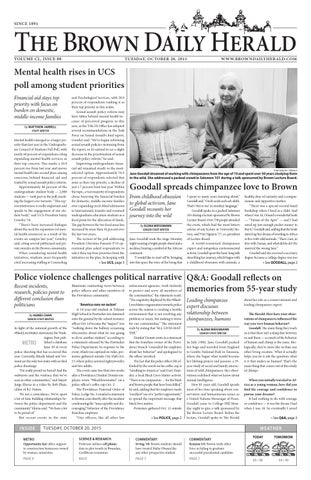
Jane Goodall dreamed of working with chimpanzees from the age of 10 and spent over 50 years studying them in the wild. She addressed a packed crowd in Salomon 101 during a talk sponsored by Brown Lecture Board.
Goodall spreads chimpanzee love to Brown
From childhood obsession to global activism, Jane Goodall recounts her journey into the wild By ELENA WEISSMANN SENIOR STAFF WRITER
Jane Goodall took the stage Monday night wearing a bright purple shawl and a necklace bearing a symbol of the African continent. “I would like to start off by bringing into this space the voice of the being that
I spent so many years learning about,” Goodall said. “Oooh oooh eeeh eeh ahhh. That’s ‘this is me’ in monkey language.” Goodall spoke in a packed Salomon 101 during a lecture sponsored by Brown Lecture Board. Over 750 people attended the event, which had the most lottery entries of any lecture in University history, said Viet Nguyen ’17, co-president of Lecture Board. A world-renowned chimpanzee expert and outspoken environmental activist, Goodall spent the hour-long talk describing her journey, which began with a childhood obsession with animals, a
healthy dose of curiosity and a compassionate and supportive mother. “There was a special second-hand bookshop where I lived as a child. And when I was 10, I found a wonderful book — “Tarzan of the Apes” — and I had saved up just enough pocket money to buy it,” Goodall said, adding that the book stirred up her dream of traveling to Africa to live with wild animals. “There I am, in love with Tarzan, and what did he do? He married the wrong Jane.” Goodall said she received a secretary degree because a college degree was too » See GOODALL, page 2
Police violence challenges political narrative Q&A: Goodall reflects on Recent incidents, memories from 55-year study research, policies point to different conclusion than politicians By AGNES CHAN SENIOR STAFF WRITER
In light of the national growth of the #BlackLivesMatter movement, the Washington Post published a database June 30 of every police shooting that has occurred this year. Currently, Rhode Island and Vermont are the only two states with no fatal police shootings. “I’m really proud we haven’t had the outbursts and the violence that we’ve seen in other communities,” said Mayor Jorge Elorza in a video by Bob Plain, editor of R.I. Future. “It’s not a coincidence. We’ve spent a lot of time building relationships between the police department and the community,” Elorza said. “We have a lot to be proud of.” But recent events in the state
METRO
INSIDE
illuminate contrasting views between police officers and other members of the Providence community.
‘America runs on racism’ A 14-year-old student at Tolman High School in Pawtucket was slammed onto the ground by the school resource officer Oct. 14 because the “suspect” was “walking down the hallway screaming obscenities about what he was going to do to another student,” according to a statement released by the Pawtucket Police Department. In response to the event, which was captured on video, protesters gathered outside City Hall Oct. 15, where police arrested eight juveniles and two adults. The event came less than two weeks after a Providence Dunkin’ Donuts employee wrote “#blacklivesmatter” on a police officer’s coffee cup Oct. 2. The Providence Fraternal Order of Police, Lodge No. 3 emailed a statement to Boston.com shortly after the incident condemning the “unacceptable and discouraging” behavior of the Providence franchise employee. “Our officers, like all other law
enforcement agencies, work tirelessly to protect and serve all members of the communities,” the statement reads. “The negativity displayed by the #BlackLivesMatter organization towards police across the nation is creating a hostile environment that is not resolving any problem or issues, but making it worse for our communities.” The statement ends by stating that “ALL LIVES MATTER.” Dunkin’ Donuts wrote in a statement that the franchise owner of the Providence branch “counseled the employee about her behavior” and apologized to the officer involved. The fact that the police officer felt offended by the words on his coffee cup is “insulting to America,” said Gary Dantzler, a local Black Lives Matter activist. “There is no compassion … for the black and brown people that have been killed,” he said, adding that the employee made “excellent” use of a “perfect opportunity” to spread the important message that black lives matter. Protesters gathered Oct. 12 outside » See POLICE, page 2
Leading chimpanzee expert discusses relationship between chimpanzees, humans By ELENA WEISSMANN SENIOR STAFF WRITER
In July 1960, Jane Goodall packed her bags and traveled from England to Gombe National Park in Tanzania, where she began what would become her lifelong project and passion: a 55year study of social and family interactions of wild chimpanzees. Her observations redefined what we know about animal intelligence. Now 81 years old, Goodall spends most of her time speaking about conservation and humanitarian issues as a United Nations Messenger of Peace. Goodall came to College Hill Monday night to give a talk sponsored by the Brown Lecture Board. Before the lecture, Goodall spoke to The Herald
about her role as a conservationist and leading chimpanzee expert. The Herald: How have your observations of chimpanzees influenced the way you view human behavior? Goodall: The main thing they teach us is that there isn’t a sharp line between us and them — so much of the behavior of human and chimp is the same. Biologically, they’re more like us than any other living creature. What it actually helps you do is ask the question: what is it that makes us human? That’s the main thing that comes out of this study of chimps. When you initially traveled to Africa as a young woman, how did you find the courage and confidence to pursue your dreams? It had nothing to do with courage or confidence — it was the dream I had when I was 10. So eventually I saved » See Q&A, page 3
WEATHER
TUESDAY, OC TOBER 20, 2015
METRO Opportunity fair offers support to construction businesses owned by women, minorities
SCIENCE & RESEARCH Professor utilizes cell phone data to plot trends in Rwandan, Caribbean economies
COMMENTARY Irving ’16: Brown students should have treated Malia Obama like any other prospective student
COMMENTARY Kenyon GS: Brown trails other Ivies in failing to graduate successful presidential candidate
PAGE 4
BACK
PAGE 7
PAGE 7
TODAY
TOMORROW
65 / 48
64 / 49
UNIVERSITY NEWS PAGE 2 • TUESDAY, OCTOBER 20, 2015
» POLICE, from page 1 a Dunkin’ Donuts shop in Providence, donning signs that read “America runs on racism” and “stop ignoring racism” to support the employee. Police-on-police violence Former Providence Police Officer Christopher Owens filed a lawsuit in U.S. District Court Sept. 18 seeking $1 million in damages for being mistakenly identified as a suspect while off-duty. In September 2012, Owens and his son Tyler — both of whom are black — helped chase down a truck driver, Sean Sparfven — a white man — who was suspected of dealing in stolen vehicles and was the subject of a high-speed chase. When police officers arrived at the scene, they immediately assumed Owens and his son were the criminals and arrested them both. Owens and his son “were assaulted, arrested, handcuffed and placed in the rear of police cars due to the color of their skin and because they were African Americans,” according to the lawsuit. Christopher Owens is now permanently disabled. “One officer remarked that all he saw was a big black guy,” the lawsuit states. It also states that the police officers violated the Fourth and Fourteenth Amendments — the right to protection against unlawful search and the right to equal protection of the laws, respectively. State Police Superintendent Steven O’Donnell acknowledged in a statement that it was Owens who apprehended Sparfven. But O’Donnell told the Providence Journal that Owens “has some responsibility for what transpired in that backyard” because he did not follow the proper procedure for identifying himself as an officer. A similar situation involving the Providence Police Department occurred
» GOODALL, from page 1 expensive. “World War II was raging, and there just was not a lot of money.” At 23, she received an invitation from a school friend to visit Kenya. After working for four months to save up money for the fare, Goodall left England solo for Africa. Soon after her arrival, she met with Louis Leakey, a famous archaeologist who later became her boss and mentor. Goodall said Leakey asked her hundreds of questions. “Because I had spent hours in the Natural History Museum in England and had read so many books, I was able to answer most of his questions. He hired me on the spot,” she said.
in January 2000 when two officers mistakenly shot and killed fellow Providence police officer Cornel Young Jr., who was off-duty at the time. By the numbers Northeastern University’s Institute on Race and Justice published a report in 2014 showing racial disparities in traffic stops in Rhode Island. Experts reviewed 153,891 traffic stops that 39 Rhode Island police agencies made between Jan. 1, 2013 and Sept. 30, 2013. The report concluded that Providence Police officers stopped 24.1 percent more non-white drivers than the Driving Population Estimate would have predicted. The DPE — a statistic that accounts for the racial breakdown of the driving population — estimated that 39.9 percent of traffic stops would involve non-white drivers, but in reality, 64 percent involved non-white drivers. The 2014 report is the third of its kind that researchers at Northeastern have conducted. The same methodology used in 2003 and 2006 produced the same conclusion — non-white drivers are much more likely to be stopped than white drivers. The racial breakdown of police officers in Providence sheds some light on why various issues of racial profiling and police brutality towards people of color may arise. Minorities are significantly underrepresented in the police force. Of the 424 total officers in Providence, 326 are white, comprising about 77 percent of the total police force. Only 37 — under 9 percent — are black, 50 are Hispanic, 10 are Asian and one is American Indian, according to the Office of the Mayor.
THE BROWN DAILY HERALD Providence population versus Providence Police population People of color are significantly underrepresented on the Providence Police force, while whites are significantly overrepresented. TRAFFIC STOPS
PROVIDENCE POPULATION
PROVIDENCE POLICE Asian Native 2.4% American Black
0.2%
8.7% White Non-White
Native American
36%
1.1%
11.8%
White
54.5%
64%
Asian
6.0%
Source: Northeastern University Rhode Island Traffic Stops Study
Hispanic
Other
24.9% Black
14.5%
Source: ProvPlan Rhode Island Community Profiles, 2010
White
76.9%
Source: The Office of Mayor Jorge Elorza JILLIAN LANNEY / HERALD
between 150 and 200 students. The police are excited about building “meaningful relationships with young people in the community,” she said. “They all want to do this.”
City efforts Elorza announced in September that the Providence Police Department received a $1.875 million grant from the Community Oriented Policing Services
program within the U.S. Department of Justice to hire up to 15 more police officers. The funds will help “strengthen the Police Department, help support community policing, (improve) crime prevention and ultimately enhance public safety,” said U.S. Rep. David Cicilline ’83, D-R.I., in a Sept. 21 press release. The Police After School Sports program, launched earlier this month, also aims to bridge the gap between the police and the community. A joint effort by Elorza, the Providence Police Department, the Providence After School Alliance, International Game Technology and the Providence School Department, PASS allows off-duty police officers to coach basketball and flag football teams for middle school students across the city. The program strives to “increase youths’ participation in quality sports programs” and to encourage “young people and officers to build closer relationships with each other,” said Hillary Salmons, executive director of PASA, adding that the sports program, which received $40,000 of funding from IGT, will engage 10 police officers and
State policy Signed by Gov. Gina Raimondo in July, the Comprehensive CommunityPolice Relationship Act of 2015 aims to tackle racial disparities at traffic stops. The bill requires all police departments in the state to collect information — age, race, time, reason and whether a search was performed — from all traffic stops over the next four years. The act also bans searches of juveniles unless there is reasonable suspicion. An annual report will be submitted to the Department of Transportation and will be analyzed by Justine Hastings, professor of economics, to identify trends related to racial bias. The bill is a revision of a previous one that failed to pass because it did not garner enough support in the House of Representatives. This new bill “holds police accountable and provides transparency for the community,” said Steven
Paré, Providence commissioner of public safety, adding that one of the challenges of implementing the law will be educating police officers across the state about what is expected of them. Data will be regularly assessed, and law enforcement administrators will observe the trends on a weekly basis, Paré said. This data will be released to the public periodically, he said, though he did not specify how regularly. The legislation is “a first step in addressing the racial disparities that we see in policing in Rhode Island,” said Hillary Davis, policy associate at the American Civil Liberties Union of Rhode Island. “There’s significantly more work that will be done afterwards, but we do hope that some of the protections that are included in the law will provide relief to specifically youth and pedestrians who are currently not feeling so safe in Rhode Island.” It is important to ensure that the data is being collected and constantly evaluated so that “the law doesn’t just exist on paper, but is also used in ways to protect everybody,” Davis said.
Goodall helped Leakey and his wife conduct field work in the plains of Africa. Leakey later picked Goodall to research apes on a project he had been planning due to his interest in the evolutionary history of apes and their connection to humans. Equipped with only “a pair of binoculars and a notebook,” Goodall and her mother set out for Gombe National Park in Tanzania to begin what became a 55-year study of the social and family interactions of wild chimpanzees. “People told me, ‘Oh, Jane, you’re so brave.’ But I wasn’t brave at all! It was just my dream!” Goodall said. Several months into the project,
Goodall was just beginning to run out of hope when she made one of her biggest discoveries. “I saw a chimpanzee crouched over a termite mound. I saw his hand pull out a grass stem and shoot down into the termite mound. He pulled the stem out carefully, termites crawling all over it, picked out the insects with his lips and crunched them up,” Goodall said. “He made a tool!” This discovery brought in money, support and a photographer from National Geographic, leading to an international spotlight on her research. Leakey arranged for Goodall to study ethology at Cambridge University, where she became the eighth person at Cambridge to study for a PhD without having
obtained an undergraduate degree. “The professors told me I had done everything wrong. I couldn’t talk about the chimps having personalities. I couldn’t talk about them having emotions,” she said. “Fortunately, when I was little, I had a teacher who taught me that all those professors were wrong about animals. That teacher was my dog, Rusty.” After completing her PhD, Goodall returned to Gombe, where she continued her research on chimps. “The more I learned, the more it became obvious that there wasn’t a sharp line dividing us from the rest of the animal kingdom,” Goodall said. “Human beings are not the only beings with minds, personalities and emotions.” Goodall said she believes chimpanzees have the ability to show love, compassion and true altruism. As evidence, she explained how she once observed a 12-year-old male chimp named Spindle adopt and nurture a 3-year-old chimp named Mel. Spindle carried the infant around on his back and shared food with him, as Mel’s mother would have done, Goodall said. In 1987, Goodall left Africa to attend a conference in Chicago, where several scientists gathered to discuss conservation efforts and abuse of chimpanzees within the medical research field. “I went to this conference and without any conscious decision, I left as an activist,” Goodall said. “Ever since, I’ve been traveling around the world and talking about the plights faced by chimpanzees.” As she traveled and spoke with other scientists, she learned “more and more about what we have done to our planet.”
“We are the most intellectual species that has ever walked on human earth. So why is it that we’re destroying the planet?” she asked. “It’s kind of a mess that we’ve made.” After meeting with a group of 12 concerned high school students in Tanzania in 1991, Goodall founded the youth-led community action program Roots and Shoots. Now spanning 130 countries, the group carries out service projects aimed at conservation. “I asked a question earlier — how is it possible that we are destroying our home? We’ve lost something called wisdom — making decisions based on how it will affect the future,” Goodall said. “Somehow, we have to reconnect this immensely clever brain with the human heart, with love and compassion,” she added. Goodall ended the talk by playing a video of a wounded chimp named Woonda locking Goodall in a passionate embrace and then hunkering off into the forest. After the lecture ended, students asked Goodall questions during a 15-minute question-and-answer session. “She was amazing and inspiring,” said Greg Lowry ’17. “Her message about how each individual can make a difference is so relevant to everybody, especially University students who have the power to go out and promote change,” he added. “I like the work she’s done in terms of biology conservation and how she’s a role model for many young scientists. I’m mostly just inspired with what she was able to do early on in her career in the ’60s and her inspiration for women in STEM,” said Sydney Clark GS.
UNIVERSITY NEWS
TUESDAY, OCTOBER 20, 2015 • PAGE 3
THE BROWN DAILY HERALD
» UCS, from page 1 the overall results of the poll, 81.2 percent of respondents chose expanding undergraduate financial aid as one of their important initiatives, and 76.1 percent chose expanding internships through BrownConnect, the University’s internship search and networking site. The renovation of the Sharpe Refectory was a distant third, selected by 46.1 percent of respondents. Creating postdoctoral fellowships for underrepresented minority faculty came in fifth overall at 34.6 percent. But the level of selection was far higher when broken down demographically, with 56.8 percent of black students, 52.7 percent of Native American students and 42.9 percent of Latino students identifying this initiative as important. The cost of textbooks stood out as a primary financial area of concern, with 73.8 percent of respondents on financial aid and 84 percent of those without financial aid ranking it as one of their three most important areas of action. Respondents in the former demographic indicated a larger interest in eliminating or reducing the summer earnings expectation. Fifty-one percent of those on financial aid identified this option, compared with just 35.5 percent of those without aid. “It’s significant that students on and off financial aid have the exact same
»Q&A, from page 1 up enough money and was invited by a school friend, and I went. There was no courage involved. I went out to the chimps and nobody knew anything about them. I was out in the forest, and it was in the middle of nowhere. But for me, that was my dream come true. What kind of challenges did you face? The fact that the chimps ran away from me every time they saw me — that was the worst challenge. The fact that the country is very steep, so it’s quite difficult terrain. The fact that I kept getting malaria. Those were the main challenges. Did you ever feel when you were studying the chimps that your scientific objectivity was compromised by the close relationships you had developed with them? I didn’t have any scientific objectivity. I had never been to college. I was only told later, when I went to get a Ph.D., that I had done the study all wrong, and that I couldn’t talk about personality, mind or feeling, and that I couldn’t be anthropomorphic, and I had to be cold and scientifically objective. And I just knew this was wrong. This is not the way to learn about another species — to look at them coldly. You’ve got to have empathy, and you have to feel what they’re feeling. That does not stop you from having scientific objectivity. It’s perfectly possible to do both. And if you don’t involve your heart and you only involve your head, that’s when science can go so wrong, so off the rails, and be very dangerous. So I feel very strongly about that. So do you think that’s why you succeeded when others had struggled before? Yes, definitely. Because how can you interpret a being that’s so like us and yet so different unless you try and
order of priorities,” said UCS Vice President Alana Bhatla ’16. “We’re using the data from this question to inform specific initiatives directly targeting these concrete financial obstacles,” Gourley said. A stark divide emerged between students affiliated with Greek organizations and non-affiliates when it came to analyzing the recommendations of the Alcohol and Social Event Review committee. Targeted training and outreach programs for Greek organizations and varsity sports teams were favored by 53.8 percent of non-affiliated respondents and non-varsity athlete respondents, but just 37.6 percent of Greek organization members and 37.4 percent of varsity athletes. Similarly, just 7.8 percent of Greek organization members favored the prohibition of parties with alcohol in residential spaces, compared with 17.9 percent of non-affiliates. As a result of the recommendations, a new policy is in place this year to staff first-year dormitories with graduate students on weekend evenings. This policy was not popular across the board — it found favor among just 13.9 percent of non-Greek affiliated and non-varsity athlete respondents, 10.3 percent of members of Greek organizations and 8.7 percent of varsity athletes. Gourley said UCS is meeting with the Office of Residential Life this week to gather feedback on “evaluation
Top four operational plan priorities
The majority of respondents cited expanding undergraduate financial aid and increasing internship opportunities through BrownConnect among their top four priorities out of the initiatives in the operational plan. 81%
Financial aid
76%
Internships through BrownConnect
46%
Ratty renovation
43%
Learning Commons Minority postdocs
35%
Entrepreneurship
33%
Engaged Scholarship
32%
Performing arts center Renovating athletic facilities
0%
22% 15% 20
40
60
LILLY NGUYEN / HERALD
mechanisms in place” and find out whether any changes will be made in response to the UCS Fall Poll results. The topic of advising gave rise to a discrepancy between first-years and other students. When asked to rate their current advising experience from very bad to very good on a scale from negative three to three, the average for firstyears was a 1.8, compared with 0.6 for sophomores, 0.7 for juniors and 0.6 for seniors. Both underclassmen and
upperclassmen also graded the firstyear advising experience more positively than the advising experience for other students. The advising experience will remain a focus of UCS moving forward. “We need to continue to evaluate how sophomore and concentration advising are to be developed,” Bhatla said. “We have a specific pilot document that we’re pushing forward with Dean of the College Maud Mandel to make
sure there are avenues for students to offer constructive feedback on advising experiences,” Gourley said. The poll also provided a space for open-ended responses. At least 25 respondents used this space to elaborate on the “dire need” for dormitory renovations, Bhatla said. Many of these respondents specifically cited Perkins Hall and Graduate Center as in need of “broad-scale reform,” Gourley said.
understand what you’re looking at? You can ask, ‘Why is this chimp doing that?’ You can write it all down, and you get a nice objective list of when this behavior occurs and when it doesn’t, and who is there and what result it gives. But at the same time, very often it’s the feeling you have that can dictate your observations. What’s the most touching or memorable moment you’ve had with the chimps you’ve worked with? I think when Flo, an older female chimpanzee who taught me so much about material behavior, let her precious five-month-old infant come and reach out and touch me. It showed I had totally gained her trust. She kept her hand around him, but she let him come up to me, which was a magical moment. He reached out with those big eyes. How has climate change impacted the causes you’ve fought for over your lifetime? Climate change is affecting everything, and soon it’s going to affect even more. The causes of climate change are so numerous and intertwined, and just in general we have to change the way we think. The thing that I’m very passionate about right now is genetically-modified organisms. For example, Roundup is the most widely used herbicide in the world, and just recently a doctor discovered that the main ingredient of Roundup, glyphosate, causes cancer. You see, before genetically-modified crops were made to withstand Roundup, the crops were sprayed only twice a year. They couldn’t do it more because it would harm the crop you were trying to grow, and it would kill most of the weeds. But once they were able to produce a plant that you could spray with Roundup, then they used five times more — that’s five times more cancerproducing element out in the air. This is very scary to me. — This interview has been edited for length and clarity.
80
Source: Undergraduate Council of Students Fall Poll Report
www.browndailyherald.com
METRO
PAGE 4 • TUESDAY, OCTOBER 20, 2015
THE BROWN DAILY HERALD
U., city partner to support construction Superfund research earns Contractors network with women-, minority-owned business enterprises to diversify industry By SHAWN YOUNG CONTRIBUTING WRITER
An opportunity fair for minority- and women-owned business enterprises in construction was held Friday at the Wyndham Garden Hotel in Providence. The fair, hosted by the University’s Office of Government Relations and Community Affairs, aimed to highlight opportunities with general contracting companies for these enterprises. “We need to start making sure that we’re connecting the job opportunities with the people who are ready, willing and able to take advantage of those opportunities,” said Mayor Jorge Elorza in his opening remarks. Barriers such as acquiring insurance or capital prevent minority- and women-owned business enterprises from obtaining work in construction, Elorza told The Herald. All of the nine general contracting companies in attendance have previously completed construction projects for the University and are looking to subcontract work to these enterprises.. Leveraging people of different backgrounds and skill sets is important in the construction industry, said Kyle
Lloyd, a representative for Shawmut, a general contracting company that previously worked on the Stephen Robert ’62 Campus Center. Minority- and women-owned business enterprises tend to be small, which makes finding work in the construction field more difficult, Lloyd said. One of the goals of the opportunity fair was to tackle this difficulty, said Michael Guglielmo, Jr., director of project management for the Department of Facilities Management. By more directly helping minority- and women-owned business enterprises to find work, the University can strengthen its relationship with local people, Guglielmo told The Herald. In the past, construction involved mostly physical work, which many
people stereotypically associated with men, Lloyd said. But now construction also involves much managerial work, he said. The demographic of the construction industry is changing, said David Barrus, a representative from BOND, a general contractor that worked on Barus and Holley and the Prince Engineering Laboratory. Diversity within the field is on the rise, and the industry is no longer male-dominated, he said. But Victor Ofokansi, a representative from V and L Construction, Inc., a minority-owned business enterprise, said he thinks diversity in the construction industry is “not up to par.” While “there is a long way to go” in terms of diversity, he said, the next step is to “give (contractors) our numbers, pick up hammers and start working.”
SHAWN YOUNG / HERALD
Mayor Jorge Elorza joined contractors to eliminate barriers facing minority- and women-owned business enterprises.
State receives paid family leave grant R.I. one of eight states awarded part of grant to allow for expansion of unique program By MARIAH KENNEDY CUOMO CONTRIBUTING WRITER
Rhode Island has been awarded $235,737 by the Labor Department for its Temporary Caregiver Insurance Program, making it one of eight states to receive a portion of a larger $1.55 million grant. The TCI program started in January 2014, making Rhode Island one of only three states in the U.S. — along with California and New Jersey — that offer paid family leave. Paid family leave in Rhode Island provides all private and some public sector employees up to four weeks off per year, during which employees receive a portion of their paycheck. Reasons for paid family leave include bonding with a new child and caring for family members with serious health concerns. The grant money awarded this year will be used toward tasks including evaluating the program’s reach, identifying gaps, addressing denials, designing Educational Ooutreach Marketing protocols for future state proposals and enhancing data collection, according to the grantee information from the Labor Department. “The most recent grant money will allow (the University of Rhode Island) to kind of go deeper on the study that they’ve conducted and to gauge their opinion about whether or not they think that Rhode Island should expand,” said Mike Healey, chief public affairs officer at the state’s Department
of Labor and Training. Paid family leave is funded entirely by employees, amounting to about 64 cents a week for workers earning $40,060 a year, the Huffington Post reported. An employee must have paid $9,600 into the Temporary Disability Insurance fund to be eligible. Like those of California and New Jersey, Rhode Island’s TCI program builds off of the infrastructure of the state’s TDI program. Only 12 percent of private sector workers in the United States have access to paid family leave through their employers, according to the Department of Labor. “We know that this is a serious problem,” said Sarah Flesich Fink, senior policy counsel at the National Partnership for Women and Families. “As we become a more global economy, the U.S. really needs to catch up with the rest of the world,” she added. Flesich Fink predicted that as people, businesses and lawmakers become more educated, the program will expand. The TCI program is beneficial to business because it “increases loyalty, turnover and productivity” among workers, and those who take paid family leave are more likely to return to work afterwards, she said. Last month, 4,485 paid family leave were filed. Among the claims, caring for a newborn or adopted child accounted for over 80 percent, and caring for a family member accounted for over 18 percent. Less than 1 percent of eligible workers filed claims in Rhode Island. Payments averaged $572 per week. Rhode Island’s TCI program diverges from others because it includes job protection, guaranteeing that employees who take a leave can return to their job.
“This is a really important tool for families in Rhode Island” said Sen. Gayle Goldin, D-Providence, who has spearheaded the promotion of paid family leave in Rhode Island. Goldin said her decision to become a strong advocate for paid family leave was spurred by her own life experiences. In 2001, after having just moved to Rhode Island and purchased a house with her husband, Goldin suffered a severe back injury. She said her husband’s attempt to leave work when he did not have the time was a “strain” on their family and made her recovery more difficult. Later that year, Goldin had her first child. She said her experience differed from that of her sister, who also had a child around the same time while living in Montreal. “My sister had 15 weeks of paid leave and I didn’t because I lived six hours south,” she said. In September 2014, Rhode Island was awarded $161,417 by the Labor Department to research the efficacy and reach of the paid family leave program. Study methods have included distributing a questionnaire that has yielded a high response rate and conducting interviews over the phone with customers, Healey said. “What we hear from our customers is that they appreciate it,” Healey said. The program is a “very helpful program for working families,” he added. Goldin said she would appreciate expansion. “I certainly would like to see us go beyond that four weeks. Having a little leeway is certainly helpful and its certainly a drop in the bucket compared to what other countries have.” Rhode Island has “a lot to learn … about the use of paid family leave programs” from the eight states awarded the grants, Flesich Fink said.
$10.8 million national grant Four new projects will target human impacts, harms of past, future contaminants By HATTIE XU STAFF WRITER
The National Institute of Environmental Health Sciences renewed funding for the Brown Superfund Research Program last month, granting $10.8 million to support four projects over the next five years, said Kim Boekelheide, professor of pathology and laboratory medicine and director of the SRP. The four projects focus on different aspects of the theme “Toxicant Exposures in Rhode Island: Past, Present and Future,” he said. The Superfund sites are areas that the government considers to be heavily polluted. After closely missing renewal last year, the proposal for the SRP grant renewal earned the best score among a highly competitive field of applicants this year, said Robert Hurt, professor of engineering and SRP project leader. “It was a huge relief,” said Shelby Wilson ’15, SRP research assistant, who started working for the program during the spring of her sophomore year. “A lot of the other centers that have received funding are much larger and already have a lot of money behind them,” she said. For the University “to not only receive it, but to have that as a smaller university, is even more impressive,” Wilson added. Though there are 12 Superfund sites in Rhode Island, the researchers’ work is applicable on a national and global scale, Boekelheide said. Researchers work with Superfund-related chemicals and contamination concerns to form new strategies for understanding the health impacts, he said, adding, “It’s a bigger thing than site-specific (research).” One of the chemicals studied at these sites is trichloroethylene, a common industrial solvent used to degrease mechanical parts, which is known to cause cancer. Researchers associated with SRP are studying the chemical to examine its effect on male reproduction, said Eric Suuberg, professor of engineering and SRP project leader. Many of these chemicals were spilled or dumped after being heavily used during the Industrial Revolution, causing them to seep into the soil and create a location for the release of potentially harmful vapors into buildings and other heavily populated areas, he said. Suuberg said he is collaborating with Boekelheide on the development of toxicant detection procedures. He is also working with Hurt to investigate the potential role of nanomaterials like graphene — an extremely strong carbon structure that is one atom thick — as part
SCIENCE & RESEARCH
of a solution to vapor intrusion. Hurt said he is researching potential risks of nanomaterials with Agnes Kane, chair of the pathology and laboratory medicine department and SRP project leader. “A lot of (the research) focuses on legacy contaminants — past industrial pollutants that are still here in the soil and water. Our part, the other half of it, focuses on contaminants of the future,” Hurt said. To understand these nanomaterials, the researchers predict “what these materials may do and learn to commercialize them in a way that avoids these problems of the past,” he added. Kane is also collaborating with Boekelheide on the identification of biomarkers and other ways to test for the effect of toxicants on humans, particularly in the male reproductive system, she said. Findings from these research projects are shared with the NIEHS and other federal and state agencies, Kane said. The researchers also reach out to communities affected by these toxicants to share information and learn about their experiences, Boekelheide said. Cooperation between these communications, researchers and the government “has allowed us to have multiple strategies for dealing with complex realworld environmental pollution here in Rhode Island,” Kane said. Another one of the SRP’s core goals is to train and involve students and researchers at all levels, Boekelheide said. Wilson said being part of the SRP team was an essential part of her undergraduate experience. “I had some good classes and wonderful instruction, but at the end of the day, I feel I really learned hard skills and how to do science by being in this lab,” she said. The translational nature of the SRP is particularly appealing to the researchers, said Edward Dere, assistant professor of surgery, pathology and laboratory medicine and a bioinformatics researcher for the SRP. “Every year, more and more chemicals are being used and introduced into the market, and we really need to be able to screen, characterize and assess the potential hazards of all these different compounds,” Dere said. “You can apply (our research) to environmental contaminants, pharmaceuticals. … It has tremendous benefits to society in general.” David Klein, postdoctoral research fellow in pathology and laboratory medicine, also noted the wide applications of the SRP. “I like knowing that it’s clinically relevant … and that it’s helping human health,” Klein said. “There’s still a lot of work that needs to be done in understanding the basic biology (of the body) and how toxicants interact with it, and I feel like there’s a contribution I can make there.”
TODAY
TUESDAY, OCTOBER 20, 2015 • PAGE 5
THE BROWN DAILY HERALD
menu
m o t i vat i o n t o m a r c h
SATELLITE DINING ANDREWS COMMONS
Pizzas: Bacon Chicken Ranch, Spicy Five Cheese with Garlic, Pepperoni and Meatball JOSIAH’S
BLUE ROOM
Made-to-Order Quesadillas
Chicken Kadhai, Aloo Gobhi Masala
DINING HALLS SHARPE REFECTORY LUNCH
DINNER
Fire-Braised Pork Shoulder Sandwich, Golden Grahams S’mores Bars
Vegetarian Lasagna, CiderGlazed Turkey, Yellow Cake with Coconut Frosting
VERNEY-WOOLLEY LUNCH
DINNER
Zucchini Parmesan Sandwich, Enchilada Bar, Golden Grahams S’mores Bars
Thai Basil Pork Stir Fry, Rice and Orzo Pilaf, Yellow Cake with Coconut Frosting
sudoku
SADIE HOPE-GUND / HERALD
Organizers of #RiseUpOctober — a march against police terror that will take place Oct. 24 in New York City — promoted the event to Brown students Monday afternoon on the sidewalk outside J. Walter Wilson.
comic P-Branes and Bosons | Ricky Oliver ‘17
crossword
calendar TODAY OCTOBER
S
M
T
W
Th
F
S
1
2
3
4
5
6
7
8
9
10
11
12
13
14
15
16
17
18
19
20
21
22
23
24
25
26
27
28
29
30
31
NEW DIRECTIONS IN THE HISTORY OF U.S. SLAVERY 12:00 PM Brown/RISD Hillel
T. HOWARD FOUNDATION INFORMATION SESSION 4:30 PM CareerLAB
MARRIAGE RIGHTS AND QUEER STRIFE: MPC WORKSHOP 6:30 PM Faunce, Petteruti Lounge
QUEER & ASIAN MEETING 7:00 PM Faunce, Room 321
TOMORROW FARMERS MARKET 11:00 AM Manning Hall Steps
PEOPLE OF COLOR SUPPORT GROUP 1:00 PM J. Walter Wilson, Room 516
BROWN IN OXFORD AND CAMBRIDGE INFO SESSION 12:00 P M J. Walter Wilson, Room 440
SCREENING OF FULL DISCLOSURE 6:00 PM Watson Institute, Joukowsky Forum
COMMENTARY PAGE 6 • TUESDAY, OCTOBER 20, 2015
THE BROWN DAILY HERALD
EDITORIAL
Sorry, Malia Obama The college application and selection process is stressful for most students who go through it, but one can only imagine how much the stress multiplies when the whole nation is watching. That is what Malia Obama is experiencing right now. News outlets as prominent as the New York Times are covering her touring process, and students at elite colleges across the country cross their fingers and chat over dining hall food about how cool it would be to go to the same school as President Obama’s daughter. As most Brown students know by now, the weekend before last was Brown’s turn on the tour. Students who left campus for the long weekend can read about her stay on Buzzfeed or the Daily Dot, two of several news sources that have picked up coverage of her visit from students’ social media. The Daily Dot accurately summarized the experience when it entitled its article “Brown University had no chill when Malia Obama came to visit.” Both articles feature several tweets from Brown students excited about Malia’s visit. Some of the tweets include photographs of her that were clearly taken when she was not looking. Many of them mention her presence at a party, where she was seen taking shots and playing beer pong. The motivation to take these pictures was obvious: being at a party with the president’s daughter was an exciting, unexpected moment that many of us wanted to share with our friends. We often do not think about our tweets and Snapchats reaching anyone besides our friends and followers, and certainly not news outlets with wide circulation like Buzzfeed. Many Brown students were surprised and embarrassed to see themselves cited in the articles, as other Brown students posted them on Facebook with disappointed captions that criticized their peers for not simply leaving the 17-year-old alone on her college visit. Social media has become such an ingrained part of our daily routine that we sometimes forget the wider effects it can have. What we choose to post on social media is not just visible to our friends; it is public to the world if we do not protect our accounts. It is a shame that Malia was unable to visit Brown and enjoy herself at a party without several news headlines coming out about it the next day. While it is understandable that so many students were excited about her visit, it is likely that few of us would enjoy having strangers take pictures of us while we were unaware and post them on the Internet. Malia did not choose to grow up in the White House, and it is unfair that everything she does at just 17 years old is subject to such harsh scrutiny. While the chances of her selecting Brown have probably decreased since the publication of those articles, if she does ever come back to Brown, hopefully next time we will “have more chill.” Editorials are written by The Herald’s editorial page board: its editors, Manuel Contreras ’16 and Meghan Holloway ’16, and its members, Emma Axelrod ’18, Noah Fitzgerel ’17 and Aranshi Kumar ’17. Send comments to editorials@browndailyherald.com.
I VA N A L C A N TA R A
CORRECTION A story in Monday’s Herald (“Late-game heroics lift football over Princeton,” Oct. 19) had a photo caption that misidentified a football player. The photo is of Quintin Rizek ’16 and Zachary Gillen ’16. The Herald regrets the error.
Q U O T E O F T H E D AY
“People told me, ‘Oh, Jane, you’re so brave.’ But I wasn’t brave at all! It was just my dream!” — Jane Goodall, conservationist and leading chimpanzee expert
Letters, please!
See goodall on page 2.
letters@browndailyherald.com
Editorial Leadership
Sections
Visuals & Production
Business
Editors-in-Chief Michael Dubin Maxine Joselow
Arts & Culture Editors Gabrielle Dee Emily Passarelli
General Managers Sarah Levine Winnie Shao
Managing Editors Kiki Barnes Jillian Lanney
Metro Editors Alexander Blum Emma Jerzyk
Design Editors Loren Dowd Carlie Peters Taylor Schwartz Assistant: Meryl Charleston Assistant: Sonia Geba
Senior Editors Isobel Heck Molly Schulson
Science & Research Editor Steven Michael
BLOG DAILY HERALD Editors-in-Chief Deena Butt Charlotte Bilski POST- MAGAZINE Editor-in-Chief Yidi Wu DIGITAL Director of Audience Development Marcy Huang Social Media Editor Camilla Brandfield-Harvey
Sports Editors Andrew Flax Alex Wainger University News Editors Emma Harris Drew Williams COMMENTARY Editorial Page Editors Manuel Contreras Meghan Holloway Opinions Editors Rachel Montoya Chad Simon Robyn Sundlee
Photo Editors Head: Arjun Narayen Sadie Hope-Gund Matteo Mobilio Ryan Walsh Eli White Web Producer Harsha Yeddanapudy Copy Desk Chief Bonnie Henry Illustrations Editor Ivan Alcantara Video Editor Richard Flores
Directors Sales: Moniyka Sachar Sales: Jess Urrutia Finance: Josh Tartell Alumni Relations: Marley Rafson Business Dev.: Yuta Inumaru Sales Managers Matthew Meyer Henry Ritter Gulmira Hamit Taylor Casey
facebook.com/browndailyherald
Location: 195 Angell St., Providence, R.I. www.browndailyherald.com
@the_herald
Editorial contact: 401-351-3372 herald@browndailyherald.com
browndailyherald.com
Business contact: 401-351-3260 gm@browndailyherald.com
Corrections: The Brown Daily Herald is committed to providing the Brown University community with the most accurate information possible. Corrections may be submitted up to seven calendar days after publication. Commentary: The editorial is the majority opinion of the editorial page board of The Brown Daily Herald. The editorial viewpoint does not necessarily reflect the views of The Brown Daily Herald, Inc. Columns, letters and comics reflect the opinions of their authors only.
Finance Managers Collections: Neil Wathore Collections: Benjamin Wesner Operations: Carin Papendorp
Letters to the Editor: Send letters to letters@browndailyherald.com. Include a telephone number with all letters. The Herald reserves the right to edit all letters for length and clarity and cannot assure the publication of any letter. Please limit letters to 250 words. Under special circumstances writers may request anonymity, but no letter will be printed if the author’s identity is unknown to the editors. Announcements of events will not be printed.
Business Dev. Manager Project Leader: Kaden Lee
Advertising: The Brown Daily Herald, Inc. reserves the right to accept or decline any advertisement at its discretion. The Brown Daily Herald (USPS 067.740) is an independent newspaper serving the Brown University community daily since 1891. It is published Monday through Friday during the academic year, excluding vacations, once during Commencement and once during Orientation by The Brown Daily Herald, Inc. Single copy free for each member of the community. Subscription prices: $280 one year daily, $140 one semester daily. Copyright 2015 by The Brown Daily Herald, Inc. All rights reserved. Periodicals postage paid at Providence, R.I. Postmaster: Please send corrections to P.O. Box 2538, Providence, RI 02906.
COMMENTARY TUESDAY, OCTOBER 20, 2015 • PAGE 7
THE BROWN DAILY HERALD
Let’s make memories, not headlines KEILLOR IRVING op-ed contributor
As I am sure many people now know, Malia Obama came to visit Brown during Fall Weekend. On Friday, a Snapchat photo of Malia at a party, standing in front of a beer pong table, was leaked to the press. The story was promptly picked up by Buzzfeed, Maxim and the Daily Mail, among many other major news sources. By the time this oped is published, I am sure the story of Malia’s visit will undoubtedly be featured in even more publications. Danielle Wiener-Bronner wrote in a Fusion article, “Brown students: try to acquire some chill.” I wholeheartedly agree, and I even feel this advice is an understatement. Within hours of Malia’s arrival on campus, there were numerous tweets announcing her presence on College Hill. The Tab published an article featuring paparazzi-like, zoomed-in photos of Malia sitting outside Andrews Dining Hall with a group of students. I am sure she is familiar with paparazzi, press and
news headlines, and she was maybe even expecting some in Providence. I wish we as a campus could have surprised her by rising above that expectation. We are not paparazzi; we are her contemporaries. And in our failure to treat her as such, we have failed ourselves as a campus community. Maybe this absence of courtesy is due to the culture of social media, in which experiences can
the actual moment itself? The point between high school and college is a time often fraught with uncertainty and worry for the future, and sometimes the smallest things can make the biggest difference. I do not know what Malia’s feelings are on Brown (or any other college she is interested in). I do not know if Malia enjoyed her weekend visit. But I do hope she knows that there is so much more here than just
or should. Malia was here visiting friends as a prospective student experiencing the different facets of college life — something that is not and should not be newsworthy. It is unfortunate that Brown’s current reason to be in the news is akin to a “Stars: They’re Just Like Us!” feature. In these articles, most of the information about her visit has been sourced directly from the social media postings of current Brown stu-
I do not know if Malia enjoyed her weekend visit. But I do hope she knows that there is so much more here than just people looking for the next campus celebrity. be shared almost instantly without second thought. I am sure that many people were simply excited to see Malia, and that she shares an interest in Brown. But why is sharing that common interest in Brown not enough? What is there to be gained by publicizing the fact that Malia was here at Brown, doing normal teenage things? Are the retweets, likes and shares worth more than
people looking for the next campus celebrity. I genuinely hope that she got to see the many positive aspects of the University during her stay, and that her feelings about Brown and Brown students haven’t been marred by the headlines that followed. As of press time, the White House had not made a statement on the matter, nor do I think it will
dents. It is an inescapable fact that we, Brown students, are the reason her visit to Brown is now a trending headline. Shame on us. When we have friends visit us, we show them the best that Brown has to offer. Sometimes it’s the annual themed party that everyone dresses up for, and sometimes it’s a Blue Room breakfast sandwich on a Sunday morning. As a collective
community, I wish we could have been the best that Brown has to offer for Malia. Brown students look out for each other. I wish we could have shown her that rather than making her fodder for clickbait. I wish we had given her the respect that all of us have simply by being anonymous. I wish we could have shown her that her weekend activities at Brown will not become the stuff of tabloid gossip. We should have made her weekend special by making it ordinary. Brown could have stood out by letting her blend in. Malia was not here as the president’s daughter. She was not here as a celebrity. She was here as a high school teenager trying to figure out her next steps in life — something everyone at Brown did with the freedom of anonymity. We should have welcomed her with open arms, not smartphone cameras. As a prospective student, Malia deserved better. And as Brown students, we owe it to ourselves to be better.
Keillor Irving ’16 can be reached at keillor_irving@brown.edu.
Brown: a leaderless university IAN KENYON opinions columnist
In an era of breaking glass ceilings, it still remains that a Brunonian has yet to break through to the highest elected office in the land. Last Tuesday, the Twittersphere was abuzz with commentary on the first Democratic primary debate of the 2016 presidential campaign cycle. The two Democrat front-runners, former Secretary of State Hillary Clinton and Vermont Senator Bernie Sanders — along with the trolling tweets of Republican front-runner Donald Trump — dominated the trending topics. But Brunonia’s own former Rhode Island Governor Lincoln Chafee ’75 P’14 P’17 was an inspiration with a number of colorful and comedic insights. Likening Chafee’s listless debate performance to a “screensaver,” “an old issue of Yankee Magazine in the storage hold of someone’s boat” and “a Model T era town car,” Twitter users poked fun at the former governor. Taking into account further mocking of Chafee’s own assertion that he is “a block of granite” (enter funny photos of piles of granite dubbed “Lincoln Chafee, in a fun family portrait, palling around with his wife and children”), the former governor clearly failed to galvanize support. Chafee’s less-than-stellar performance attaches to larger questions: Where is the love for a Brunonian on the national debate stage? Will Brown ever produce a president?
Granted, in the 2016 election cycle, Brunonia has contributed a candidate to each side of the political aisle: the aforementioned Chafee and Louisiana Governor Bobby Jindal ’91.5. Jindal, like Chafee, has also failed to garner support for his presidential bid. Unable to graduate from the Republican “undercard” debates and gain larger national visibility, Jindal has seen his poll numbers remain at an average of 0.6 percent of support from the Republican electorate. Let it be said, though, that both Chafee and Jindal are about as electable to the Oval Office as it is likely that the Brown community will agree on a definition of “expression”
In the hypothetical scenario that the general election were to be held tomorrow, the two current front-runners — Donald Trump as a Penn graduate and Hillary Clinton as a Yale Law School graduate — would only further aggregate the dominance of the White House by non-Brunonian Ivy Leaguers. What is it that stops Brunonians from making it all the way to 1600 Pennsylvania Avenue? Make no mistake, Brown has produced many renowned graduates who appear in a litany of different professions and positions throughout society. In addition to the two Brunonians running to capture the White House this election cycle, Brunonians in high
The question remains, though: Why is it Brunonians cannot break through the glass ceiling that is reaching the White House? anytime soon. (In a Herald opinions column last spring, I predicted the doomed fate of the Chafee campaign.) A review of our peer institutions highlights a clustering of presidents to five of the eight Ivies. Harvard leads the count, having graduated eight of our 43 presidents, including President Barack Obama. Yale has graduated five presidents, including former President George W. Bush. Princeton and Columbia have each graduated three former presidents, while President William Henry Harrison attended Penn but never graduated. Brown, along with Dartmouth and Cornell, remains without a president to call its own.
office include New Hampshire Governor Maggie Hassan ’80 P’15, Delaware Governor Jack Markell ’82 and Chair of the Federal Reserve Janet Yellen ’67. Looking to Hollywood, several notable Brunonians stand out, including Jon Krasinski ’01, Julie Bowen ’91 and Emma Watson ’14. In business, one can find media magnate Ted Turner ’60 and former Apple CEO John Sculley ’61. This is only a handful of alums in a great and continuous tradition of men and women walking out through the Van Wickle Gates and achieving noteworthy milestones in society. The question remains, though: Why is it Brunonians cannot break through the glass
ceiling that is reaching the White House? Would the United States and our society not benefit from a recipient of the open curriculum? Does the University’s unofficial “most liberal of the Ivies” label bother conservative voters? (It wouldn’t bother this columnist!) Or are our Brunonian alums and students alike just so passionate and dedicated to other far-reaching causes in this world to care about running for public office? Perhaps Brunonians are just too busy, supposedly playing beer pong with Malia Obama, to aspire for a presidential life. Indeed, the University lacks a law school and a business school — each type of institution-within-an-institution having delivered our last several presidents — but could our cozy relationship with the Rhode Island School of Design produce a president? Could the Warren Alpert Medical School offer up a Brunonia-inspired Ben Carson? Perhaps a contemplative studies concentrator could give our federal government some insight and wisdom that it most desperately needs. Despite the facts today, I am convinced just yet that we will elect a fellow Brunonian to the White House one day. Perhaps it will be you; perhaps it will be me. Let’s just hope that whoever it is performs better than our two current representatives in the Democrat and Republican primaries. Yikes!
Ian Kenyon GS is a public affairs candidate with the Watson Institute for International and Public Affairs and lives, eats and breathes campaign season. Email him at ian_kenyon@brown.edu.
Got something to say? Leave a comment online! Visit www.browndailyherald.com to comment on opinion and editorial content.
SCIENCE & RESEARCH THE BROWN DAILY HERALD
TUESDAY, OCTOBER 20, 2015
RESEARCH SPOTLIGHT
Björkegren uses cell phone data to uncover economic trends By STEVEN MICHAEL SCIENCE & RESEARCH EDITOR
This profile is part of a series focused on Brown faculty members and students engaged in science and research, with the purpose of highlighting and making more accessible the work being pursued at all levels across disciplines. For all researchers, including economists, a paper is only as good as the data on which it is based. In the United States, researchers have access to plenty of economic data that is collected by the government and other organizations. But in many developing countries, economic data is scarce, especially for rural populations. Assistant Professor of Economics Daniel Björkegren uses data from people’s cell phones to bridge this data
gap and study developing economies. Currently, Björkegren is working on two projects that link cell phone data to economic trends. The first project looks at the adoption of cell phones in Rwanda from 2005 to 2009. Expansion of cell phone usage is a classic example of the network effect — as a product gains more users, it becomes more valuable. When cellular service is implemented in developing countries, service begins in wealthier urban areas and later expands to rural areas, he said. Björkegren examined how to make cell phone coverage in Rwanda socially optimal, rather than just profitable. One method to achieve this goal is to mandate that a certain percentage of the population be covered by the carrier. Another method is to require
the carrier to use some funds to provide free handsets to populations in rural areas, thus boosting the net-
work effect. Both methods increase social welfare, Björkegren said. Rwanda was a good candidate for the study because it has only one
major cellular carrier and the carrier was willing to provide anonymous cellular metadata, he said. Cell phone metadata includes the type of phone, the length of the call, the time of the call, money left on prepaid phone cards and the rough location of the caller based on information from the cellular tower. “What can we learn now that we have this information about people’s behavior?” Björkegren asked. “Cell phones have spread and become part of people’s lives.” In the second project, Björkegren analyzes cell phone data to predict loan repayment rates in an undisclosed Caribbean nation. Cell phone records from the country are linked to loan records. The identity of the borrowers was kept secret. Cell phone consumers who left a minimum balance on their prepaid
phone cards were more likely to repay loans, as were those who travelled more widely across the country, Björkegren said. A third factor, periodicity — the variation in time and occurance of cell phone usage — also correlated with reliability of loan customers, Björkegren said, adding that this finding was unexpected. The research was completed in partnership with the Entrepreneurial Finance Lab, a credit scoring organization for those with little or no credit. Björkegren said cell phone data could potentially be used to determine lending decisions for individuals. Björkegren said he hopes to determine through future work whether the repayment factors can be generalized to other regions and to use this data to influence decisions about loans. PHOTO COURTESY OF MOLLY TRACY
Library special collections reveal trove of scientific writing, history Pieces include book annotated by Galileo, Audubon sketches, antiquated scientific equipment By MARK LIANG STAFF WRITER
Some of the University’s most valuable scientific works lie behind unlocked doors. Granted, the room is alarmed, said Holly Snyder, librarian and curator of American Historical Collections, as she walked into the Lownes Reading Room, located on the second floor of the John Hay library. The room is home to books from the History of Science Collections, which offer intriguing and rare pieces of literary art, all available for students, staff and faculty to peruse. Categorized into different sections, The History of Science Collections contain “one of the nation’s finest collections of science collections,” according to its website. Of these special groupings, the Lownes Collection of Significant Books, named after Albert E. Lownes ’20, is by far the most extensive. Consisting of over 5,000 individual pieces, the collection encompasses the life’s work of the philanthropist, who made his money in textiles. Lownes’ passion for the history of science was so profound and thorough that the University employed him as a visiting lecturer for 30 years, Snyder said. A striking piece in this assembly is the book “Siderius Narcius,” which contains the first written observations of celestial bodies using telescopes. Written by the famous astronomer Galileo Galilei, the book fits neatly into a custom boxed protector and is stored in the vault in the Hay. Featuring beautiful plate etchings of the moon and sun, the Siderius is in surprisingly
good condition despite having been cut down and rebound multiple times. Besides its notable rarity, the work is thought to be annotated by Galileo himself — a belief that skyrocketed its value at auctions and sales before Lownes acquired it, Snyder said. “Books here are important for starting dialogue,” Synder said. The Siderius, when published, was read widely by scholars around Europe, including Johannes Kepler, a famous mathematician, astronomer and astrologer known for his discoveries on planetary motion. The notes on the manuscript could even be considered a precursor for a second edition after Galileo heard critiques of his work, Snyder said. Whole collections within the library provide a unique perspective on the scientific progress of the time. According to Snyder, people from as far as Japan have come to visit the David E. Pingree Collection on the History of Mathematics and Exact Sciences, which is named after a former history professor and also located in the reading room. Pingree’s personal collections — consisting of multiple works of Indus mathematics — have become a vital resource for the University. Rather than traveling all over India and the world, many scholars visit Providence to study a cohesive set of works in one place. For those students whose Latin or Hindi might be a little lacking, Snyder points to the room itself, full of artifacts and interesting curios. Original telescopes, antiquated scientific equipment and ancient clocks — all of which hold ties to the collection and were
donated by alums and organizations — line the walls of the reading room. Some particularly striking features of the room include the black and white prints of birds, also donated by Lownes, that hang on the walls above the locked cabinets. Considered inferior to the color prints popular at the time, most of these Audubon sketches have been lost or destroyed, Snyder said. These donations are vital to the breadth and integrity of the library system, Snyder said. The University’s endowment annually provides approximately $1,500 for the acquisition of new works, but these funds rarely cover the cost of buying rare works from sales and auctions. While the University has an entire annex in Cranston for the storage of books, as well as lucrative
collection deals — for example, a copy of every single book published by St. Martin’s press is sent to the library system — the libraries are always looking for unique and significant pieces to add to their collection, said Librarian Associate Andy Moul. One particularly unique piece the library has obtained is the Catoptrum microcosmicum, a 17th-century anatomical atlas donated by the Rhode Island Medical Society. The atlas is peculiar not in its writings, but in the descriptions and pictures that follow it, Snyder said. Rather than face persecution and censorship from the Church at the time due to showing exposed body parts, the author of the work essentially glued layers of paper skin and muscle over every anatomical model in the
work, she said. The manpower alone required for publishing each work is awe-inspiring; the layers, as many as 25 laid over each other, peel back to reveal nerves, genitalia and even the occasional fetus within the body, all lined in perfect proportion. One could almost call the Catoptrum the world’s first published flip-book. There is an art in the way these books are categorized and placed together, as well as a science behind their history and preservation. But perhaps the most under-used aspects of these collections are the librarians themselves. Snyder stressed that she and fellow librarians are always available to help students in search of a particular subject. “People are good resources as well,” she said.
COURTESY OF BROWN UNIVERSITY
The Lownes Reading Room in the John Hay Library is home to various special collections. Every year, the University’s endowment allocates about $1,500 for libraries to acquire new works.
Follow Us on Twitter! twitter.com/the_herald