SINCE 1891
THE BROWN DAILY HERALD THURSDAY, SEPTEMBER 10, 2015
VOLUME CL, ISSUE 61
WWW.BROWNDAILYHERALD.COM
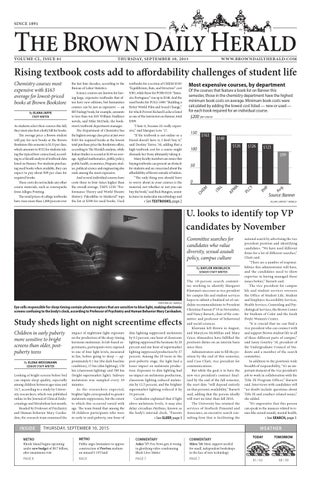
Rising textbook costs add to affordability challenges of student life Of the courses that feature a book list on Banner this semester, those in the chemistry department have the highest minimum book costs on average. Minimum book costs were calculated by adding the lowest cost listed — new or used — for each book required for an individual course. $200 per course
150
$163
$149 $126
100
$126
$123 $99
50
Av g.
PH P
PL CY
0 AP M A
As students select their courses this fall, they must also foot a hefty bill for books. The average price a Brown student will pay for new books at the Brown Bookstore this semester is $133 per class, which amounts to $532 for students taking the typical four-course load, according to a Herald analysis of textbook data listed on Banner. For students purchasing used books when available, they can expect to pay about $99 per class for required books. These costs do not include any other course materials, such as coursepacks from Allegra Printing. The retail prices of college textbooks have risen more than 1,000 percent over
Most expensive courses, by department
L
STAFF WRITER
textbooks for a section of CHEM 0330: “Equilibrium, Rate, and Structure” cost $383, while those for POBS 0110: “Intensive Portuguese” run up to $348. And the used books for POLS 1490: “Building a Better World: Film and Social Change,” for which Provost Richard Locke is listed as one of the instructors on Banner, total $309. “I hate it, because it’s really expensive,” said Marques Love ’17. “If the textbook is not online or a friend doesn’t have it, I don’t buy it,” said Destiny Torres ’16, adding that a high textbook cost for a course might dissuade her from ultimately taking it. Many faculty members are aware that buying textbooks can present an obstacle for students and are concerned about the affordability of Brown outside of tuition. “The only thing you should have to worry about in your courses is the material, not whether or not you can buy the book,” said Rick Bungiro, senior lecturer in molecular microbiology and » See TEXTBOOKS, page 2
ITA
By ELANA JAFFE
the last four decades, according to the Bureau of Labor Statistics. Science courses are known for having large, expensive textbooks that often have new editions, but humanities courses can be just as expensive — an $85 biology book, for example, amounts to less than ten $10 William Faulkner novels, said Mike McDade, the bookstore’s textbook department manager. The Department of Chemistry has the highest average class price at just over $163 for required books at the lowest total purchase price the Bookstore offers, according to The Herald’s analysis, while Italian Studies is second at $149 on average. Applied mathematics, public policy, public health, economics, Hispanic studies, political science and engineering also rank among the most expensive. And several individual courses have costs three to four times higher than the overall average. TAPS 1230: “Performance Theory and World Theatre History: Paleolithic to Medieval” tops the list at $390 for used books. Used
CH EM
Chemistry courses most expensive with $163 average for lowest-priced books at Brown Bookstore
Source: Banner JILLIAN LANNEY / HERALD
U. looks to identify top VP candidates by November Committee searches for candidates who value diversity, sexual assault policy, campus culture By BAYLOR KNOBLOCH SENIOR STAFF WRITER
RYAN WALSH / HERALD
Eye cells responsible for sleep timing contain photoreceptors that are sensitive to blue light, making electronic screens confusing to the body’s clock, according to Professor of Psychiatry and Human Behavior Mary Carskadon.
Study sheds light on night screentime effects Children in early puberty more sensitive to bright screens than older, postpuberty teens By ELENA WEISSMANN SENIOR STAFF WRITER
Looking at bright screens before bed can impair sleep quality, especially among children between ages nine and 14.7, according to a study by University researchers, which was published online in the Journal of Clinical Endocrinology and Metabolism last month. Headed by Professor of Psychiatry and Human Behavior Mary Carskadon, the research team examined the
INSIDE
impact of nighttime light exposure on the production of the sleep-timing hormone melatonin. In lab-based experiments, participants were exposed to one of four light levels, measured in lux, before going to sleep — approximately 0.1 lux (the dark baseline condition), 15 lux (dim lighting), 150 lux (classroom lighting) and 500 lux (bright supermarket light). Salivary melatonin was sampled every 30 minutes. As the researchers expected, brighter light corresponded to greater melatonin suppression, but the extent to which this occurred varied with age. The team found that among the 38 children participants who were in early to mid-puberty, one hour of
dim lighting suppressed melatonin by 9.2 percent, one hour of classroom lighting suppressed the hormone by 26 percent and one hour of supermarket lighting suppressed production by 37 percent. Among the 29 teens in the post-puberty stage, the light had a lesser impact on melatonin production: Exposure to dim lighting had no impact on melatonin production, classroom lighting reduced melatonin by 12.5 percent, and the brighter supermarket lighting reduced it by 24 percent. Carskadon explained that if light alters melatonin levels, it may also delay circadian rhythms, known as the body’s internal clock. “Parents » See SLEEP, page 3
The 10-person search committee working to identify Margaret Klawunn’s successor as vice president for campus life and student services hopes to submit a finalized set of candidate recommendations to President Christina Paxson P’19 in November, said Nancy Barnett, chair of the committee and professor of behavioral and social sciences. Klawunn left Brown in August, and MaryLou McMillan and Mary Grace Almandrez have fulfilled the position’s duties on an interim basis since then. Administrators aim to fill the position by the end of this semester, said Cass Cliatt, vice president for communications. But while the goal is to have the new vice president’s contract finalized by the end of the fall semester, the start date “will depend entirely on that person’s availability,” Barnett said, adding that the person ideally will start no later than fall 2016. The University has retained the services of Storbeck Pimentel and Associates, an executive search consulting firm that is facilitating the
national search by advertising the vice president position and identifying candidates. “We have used different firms for a lot of different searches,” Cliatt said. “There are a number of responsibilities this administrator will have, and the candidates need to show expertise in having managed those issues before,” Barnett said. The vice president for campus life and student services oversees the Office of Student Life, Student and Employee Accessibility Services, Health Services, Counseling and Psychological Services, the Brown Center for Students of Color and the Sarah Doyle Women’s Center. “It is crucial that we can find a vice president who can connect with and support Brown student life in all of these different parts of campus,” said Sazzy Gourley ’16, president of the Undergraduate Council of Students and a member of the search committee. In addition to the position’s wide breadth of responsibility, “it’s an important element of the vice president’s job to work in collaboration with the Title IX Program Officer,” Barnett said. Interviews with candidates will “no doubt include questions about Title IX and conduct-related issues,” she added. “It’s imperative that this person can speak to the nuances related to issues like sexual assault, mental health, » See SEARCH, page 3
WEATHER
THURSDAY, SEPTEMBER 10, 2015
METRO Rhode Island begins operating under new budget of $8.7 billion, after unanimous vote
METRO Public urges lawmakers to oppose construction of PawSox stadium on unused I-195 land
COMMENTARY Asker ’17: Fox News gets it wrong in glorifying video condemning Black Lives Matter
COMMENTARY Mitra ’18: More support needed for small, independent bookshops in the face of new technology
PAGE 8
BACK
PAGE 7
PAGE 7
TODAY
TOMORROW
81 / 63
68 / 59
UNIVERSITY NEWS PAGE 2 • THURSDAY, SEPTEMBER 10, 2015
THE BROWN DAILY HERALD
RYAN WALSH / HERALD
College textbook retail prices have risen more than 1,000 percent over the last four decades, according to the Bureau of Labor Statistics. Students who buy new Brown Bookstore books will spend an average of $133 per class.
» TEXTBOOKS, from page 1 immunology. “If a student came over and said, ‘Dr. B, I’m having trouble getting that book,’ I would do whatever I could to get the book for them, and if necessary, I would walk them over to the bookstore and buy it.” “For every kid that comes to me, there are probably five others that don’t,” he added. Administrators are concerned with textbook affordability and encourage faculty members to keep prices down through conversations with department chairs and other faculty members. “We’ve had various conversations with
departments and spoken with faculty about struggling between the costs of materials for the course and the materials they think are best for that course,” said Dean of the College Maud Mandel, adding that the administration is conscious of the cost discrepancy for students in different disciplines. But rarely does a student pay the full retail price for a textbook, said Steve Souza, director of the Brown Bookstore. The average student today pays 20 percent less than in 2008, he added. The increased popularity of Amazon, Chegg and other online sources for discounted textbooks has likely contributed to the reduction of student
bills. The bookstore also has a special site — brown.verbacompare.com — where students can compare prices with these online retailers. Many students choose to rent books from the Brown Bookstore, looking for a cheaper alternative to buying or daunted by the prospect of falling behind in their courses while waiting for textbooks to arrive from online retailers. Roughly two-thirds of undergraduates rented at least one book last year, McDade said. “Rentals have been the saving grace of this industry, because it significantly lowers the cost for students,” Souza said. But there is a certain amount of risk involved with the rental business
— publishers are releasing updated textbook editions more frequently than in the past, and the prices of textbooks have risen 6 percent per year over the last 13 years, he added. “When we first entered the rental business, it tended to be in the big classes, with the expensive textbooks, but it’s moved past that,” Souza said. Working with the bookstore’s suppliers and retaining consistently in-demand books means that most paperbacks are rentable — a result of the bookstore’s efforts to “aggressively grow” the rental program. Other options gentler on students’ wallets are online readings and occasionally course packets from Allegra Printing. Though they can be pricey, they usually come out to less than purchasing all of the included texts individually. An Allegra Printing employee declined to reveal how many professors order course packets or the average price of course packets, citing confidentiality concerns. Some course material can also be found on reserve at libraries, with humanities courses having the largest amount. The libraries do not purchase textbooks, wrote Ned Quist, associate University librarian for research and outreach, in an email to The Herald. “Sometimes faculty members will put a personal copy of their course textbook on reserve, but this is by no means a comprehensive practice.” Financial aid packages at Brown include a $1,450 allowance for books, ranking the highest among the Ivies by at least $200, said Jim Tilton, director of financial aid. This amount is based
on the consumer price index from the Bureau of Labor Statistics, information from the Brown Bookstore and tuition and fee increases, and it has risen steadily over the last few years, Tilton said. But students still wish there were a fundamentally different system for obtaining course materials. “I don’t need this $200 book for 13 weeks that I might not even use,” Love said. “I’d really like to see a way for there to be a textbook bank, where … instead of selling their books, people could have them available so people could check them out for a semester,” Bungiro said, adding that it could be institutional, student-run or joint effort. Spurred by student feedback about financial barriers to buying textbooks and calls for a space that allows for resource sharing, the Undergraduate Council of Students launched brown. texts.com — an online platform that allows Brown students to buy, sell and exchange textbooks directly from each other — last spring. UCS President Sazzy Gourley ’16 said the platform was designed to create a more efficient system for textbook exchange and to alleviate some of the financial burden of buying textbooks. UCS is currently working to get more students to create free accounts, so that it can be “a thriving online space,” he said. “It’s not a question of the administration and faculty not caring. It’s that we haven’t always been aware of the problem in a way that’s made us able to change things,” Bungiro said. “It’s not that we haven’t taken steps, it’s that we don’t necessarily know what those steps should be.”
Join the Herald! ATTEND AN OPEN HOUSE TO LEARN MORE
JOURNALISM: Friday 9/11 @ 6 PM, Sunday 9/13 @ 3:00 PM BUSINESS: Friday 9/11 @ 5 PM, Sunday 9/13 @ 2:00 PM WEB: To be scheduled; please email 125@browndailyherald.com if interested.
SCIENCE & RESEARCH THURSDAY, SEPTEMBER 10, 2015 • PAGE 3
THE BROWN DAILY HERALD
» SLEEP, from page 1 should keep the bedroom as dark as possible for the half hour or so before bed and eliminate any screens, since most screens have a bluish tinge to them,” she added. Retinal cells in the eye that provide information about the time of day have their own unique type of photoreceptors that are specifically tuned to short blue wavelengths, Carskadon said. The bluish light that emanates from iPhones, televisions and laptops can therefore confuse the brain’s internal clock, she said. Though the study focused on
young teens, other studies have found similar results in college students. “Using these screens pushes up your arousal level. Playing internet games, talking with your friends or being on Facebook before bed will all work against your efforts to fall asleep,” Carskadon said. “This is solid work, and we definitely should reduce light exposure according to the results,” said Mariana Figueiro, director of the Light and Health Program at Rensselaer Polytechnic Institute’s Lighting Research Center. Among several projects, Figueiro has examined how light in nursing homes affects Alzeimer’s
patients’ sleep and how light in U.S. Navy submarines affects alertness levels. Figueiro said her only objection to the paper is that it lacks a sufficient description of the light stimulus. “If you measure levels of light at eye level, that might be a different amount of lux than if you were to measure it looking down or looking up,” she said. “It doesn’t explain how the light was delivered.” Carskadon’s next project will investigate whether certain lighting systems can enhance circadian rhythms in middle school students and potentially improve academic performance.
COURTESY OF BROWN UNIVERSITY
Administrators seek to fill the position of former Vice President for Campus Life and Student Services Margaret Klawunn.
» SEARCH, from page 1 our racial climate and the queer community,” Gourley said, adding that the person “must also be committed to prioritizing the needs of students from marginalized backgrounds.” As the University works to
incorporate the recommendations from the Task Force on Sexual Assault report and the Mental Health Community Council report, the new vice president “needs to feel comfortable coming in and immediately implementing all of these changes on the intended timeline,” Gourley said.
Follow us on Twitter! twitter.com/the_herald
SCIENCE & RESEARCH PAGE 4 • THURSDAY, SEPTEMBER 10, 2015
Science & Research Roundup BY STEVEN MICHAEL, SCIENCE & RESEARCH EDITOR
Researchers recommend new pneumonia drug dosage for obese patients A new study conducted by researchers at the Veterans Affairs Medical Center, which is affiliated with the Brown Alpert Medical School, examines the ideal dose of medicine for administration to obese and extremely obese patients presumed to have antibioticresistant pneumonia. The article was published online Sept. 6 in the journal Pharmacotherapy. Typically, patients with pneumonia that is caused by the Staphylococcus aureus bacteria and that is resistant to the methicillin antibiotic are administered the antibiotic vancomycin. But obese patients may metabolize the drug at a different rate than other patients, and until recently there were no existing guidelines on the dosage they should receive. The researchers found the ideal dosage for obese patients to be 30 mg of vancomycin per kilogram of body weight, compared to the standard guideline of 15 to 20 mg per kilogram of body weight. For extremely obese patients, the newly suggested guideline is 20 to 25 mg. Haley Morrill, Aisling Caffrey, Eunsun Noh and Kerry LaPlante of the Veterans Affairs Medical Center collaborated on the study. LaPlante is also an adjunct associate professor of medicine at Alpert Medical School.
Study upholds value of flu vaccine for elderly Vaccinating elderly patients against influenza lowers their likelihood of hospitalization or death, according to a study led by University researchers and published in the Journal of the American Geriatrics Society. Each year, a new flu vaccine is created, but the vaccine strain does not always match the strain of flu most common during that year, reducing the immunity conferred by the vaccine and creating variation in the efficacy of the vaccine. Some public health experts have questioned whether vaccinating the elderly is beneficial. To explore this question, the researchers compared the match between a year’s most common flu strain and vaccine with the mortality and hospitalization rates of the elderly population. The researchers predicted that, if the vaccines were indeed useful, then mortality and hospitalization rates would be lower when the match was closer. Over the10-year span examined, closer matches between the most common strain and the vaccine corresponded to lower hospitalization and mortality rates among the elderly, leading the researchers to conclude that flu vaccinations are worthwhile for the elderly population. “Annual vaccination is the only way to maximize the vaccine, no matter what the age,” said Stefan Gravenstein, adjunct professor of medicine and health services, policy and practice and a co-author of the paper, in a University press release.
Researchers create and test dehydration metric Research led by an Alpert Medical School professor developed and tested a new point scale and decision tree to determine if a child suffers from severe dehydration. “You could miss kids with severe dehydration and not apply the correct treatment, and you could overtreat kids who don’t need it, which wastes precious resources,” said Adam Levine, assistant professor of emergency medicine and lead author of the study, in a University press release. To ameliorate this problem, the researchers devised systems that rely upon easily observable symptoms. The scale requires the clinician to rate the patient’s general appearance, respiration, tears and results of a skin pinch — a procedure of recording how long it takes skin to return to its normal state after being pinched. Similarly, the decision tree comprises two steps — first assessing physical appearance and then either eye appearance or results of a skin pinch. Based on the assigned point values or result of the decision tree, the clinician can immediately diagnose and treat the child for severe dehydration if deemed necessary. The scale and the decision tree were tested in Bangladesh where cholera- and infection-induced dehydration are serious public health issues. Accurate prediction of severe dehydration was found to correlate strongly with both the tree and the scale.
www.browndailyherald.com
THE BROWN DAILY HERALD
» PAWSOX, from page 8 Newberry, R-North Smithfield and Burrillville, said Mattiello’s perceived change of heart may have come out of sensitivity to changing opinion in the legislature and general public. He said many legislators were “cautiously opposed” to the stadium deal from the outset and that the public’s opposition caused many representatives to intensify their stance. Vice President for Communications Cass Cliatt told the Journal Sept. 3 that “if the city, state and people of Rhode Island determine that a stadium is desirable, Brown will be
supportive and would be willing to sell any of our land that is needed at a fair price.” Multiple sources reported over the summer that Brown’s unofficial asking price was about $10 million. But in an August letter, Executive Vice President for Planning and Policy Russell Carey ’91 MA’06 set the asking price at $15 million, taking into account the $6 million spent to purchase the property and $7.5 million spent to develop it, Carey wrote. Combined with the large amount of public opposition to the previously proposed price of the PawSox stadium, adding $15 million to the sum effectively killed the deal.
Given the significant hurdles that moving the stadium to the parcel owned by the I-195 Redevelopment District Commission, Warwick Mayor Scott Avedisian wrote a letter to former PawSox owner James Skeffington proposing three sites in his city where the stadium could reside, including the D’Ambra Construction property on Jefferson Boulevard, Hillsgrove South on Post Road or the site of the former Atwood Grill. “I have yet to meet a member of the public who supports this,” Newberry said of the Providence stadium deal. “I don’t think I’ve had a single person in my district say they’re in support.”
TODAY
THURSDAY, SEPTEMBER 10, 2015 • PAGE 5
THE BROWN DAILY HERALD
menu
summer sun
SATELLITE DINING ANDREWS COMMONS
Make Your Own Pasta Pizzas: Nacho Pizza, Spicy Five Cheese and Garlic, Barbecue Bam Bam JOSIAH’S
BLUE ROOM
Gnocchi, Quesadillas
Soups: Fire Roasted Vegetable, Chicken Artichoke Florentine
DINING HALLS SHARPE REFECTORY LUNCH
DINNER
Toasted Ravioli with Italian Salsa, Grilled Ham and Swiss Sandwich, Frosted Cupcakes
Beef and Andouille Burgers, Marinated Vegetable Salad, Cajun Apple Cake
VERNEY-WOOLLEY LUNCH
DINNER
Vegetable Strudel, Shaved Steak Sandwich with Sauteed Mushrooms and Onions
Roast Turkey with Stuffing, Chocolate Espresso Cake, Buttermilk Cornbread
sudoku
NAVEEN BALAKRISHNAN / HERALD
Brown and Rhode Island School of Design students, faculty members and staff members soak up the sun at RISD Beach as summer comes to a close and classes begin.
crossword
comics A Horse of Any Other Name | Zach Silberberg ‘18
calendar TODAY
SEPTEMBER
S
M
T
W
Th
F
S
1
2
3
4
5
6
7
8
9
10
11
12
13
14
15
16
17
18
19
20
21
22
23
24
25
26
27
28
29
30
31
1
2
Artist Talk with Photographer Dana Gluckstein 4:00 P.M. - 7:00 P.M. Watson Institute
Rachel Stern, Political Reliability and the Chinese Bar Exam 4:00 P.M. - 5:30 P.M. Watson Institute, McKinney Conference Room
First Readings: The New Jim Crow Lecture 4:00 P.M. - 5:00 P.M. Smith-Buonanno 106
2015 Activities Fair 7:00 P.M. - 10:00 P.M. OMAC
TOMORROW Creative Activism: Art and Social Justice 12:00 P.M. - 1:30 P.M. Watson Institute, Joukowsky Forum
Americana in Global Perspective 3:00 P.M. - 5:00 P.M. John Carter Brown Library
UCS Info Session 5:00 P.M. - 6:00 P.M. Stephen Robert ‘62 Campus Center
AASA Speed Friending 8:00 P.M. - 10:00 P.M. Faunce, The Underground
COMMENTARY PAGE 6 • THURSDAY, SEPTEMBER 10, 2015
THE BROWN DAILY HERALD
EDITORIAL
CORRECTIONS
Orienting our mental health
An article in Wednesday’s Herald (“Student support services emerge as key UCS priorities,” Sept. 9) misspelled the name of the textbook exchange website, brown.texts.com. The Herald regrets the error.
First-year orientation at Brown consistently includes three things: the famed ice cream social, Convocation and the mandatory, full-class, threepart lecture series. Every year, the University invites a variety of speakers to give incoming first-years the tools they need to discuss diversity, drink responsibly and seek consent in sexual encounters. Noticeably lacking from this series and the orientation program in general is a mandatory discussion of mental health at Brown. The 2015 first-year orientation schedule included an optional event in which Counseling and Psychological Services staff presented the resources available to all students and hosted a panel of students who discussed their experiences with CAPS. While this event did help to spread awareness of the resources CAPS offers, it did little to provide all students with a working knowledge of mental health. This gap in programming is not without consequences. Brown students are naturally overachieving, and freshman year is associated with its own set of pressures: Many students are faced with living independently for the first time while beginning an academically rigorous course of study in a brand new environment. Unsurprisingly, mental illness is prevalent on many college campuses, including Brown’s. In a survey by the National Alliance on Mental Illness, one in three students reported experiencing prolonged periods of depression. And in a 2013 survey of 125,000 students from more than 150 colleges around the country, more than 30 percent of students who sought services for mental health issues reported that they seriously considered attempting suicide. The Brown community grapples with these issues as well. CAPS estimates that 25 percent of Brown students have been previously medicated for a mental illness and 40 percent have previously sought counseling before coming to Brown — yet only 17 percent of students seek CAPS services. While there could be a number of reasons for this discrepancy, it is clear the University could take an earlier and more proactive approach to increase awareness and access to these resources. Due to student pressure, the University is making incremental changes. In its first report, the Mental Health Community Council recommended that Brown provide more trainings and workshops to “increase understanding of mental health needs, to provide resource information and to promote the skills necessary to make effective referrals.” This year, the University has already held a training session for the well-known community suicide prevention program “Question, Persuade and Refer,” and there are events planned for Suicide Prevention Day in September and National Depression Screening Day in October. In addition, the report included many more suggestions about how to effectively increase awareness of the resources on campus. There is a clear understanding that the lack of trainings for faculty advisers, students and staff should be corrected, and a good place to start should have been orientation. Full-class discussions are presently a keystone of the orientation programming — adding another would not pose too difficult of a challenge and would come with great benefits. Not only would Brown students become more aware of the resources and support available to them, but they would also gain the tools necessary to effectively support peers experiencing mental health challenges. By starting to discuss mental health early and openly, we would begin to change the college culture for the better.
An article in Wednesday’s Herald (“Brown preserves faculty, staff benefits,” Sept. 9) incorrectly stated that Brown was introducing a visiting scholars housing program to fill vacancies. In fact, it is curtailing that program because its shortterm leases lead to frequent vacancies. The article also misstated that the purpose of an open forum later this month is to discuss the deficit reduction recommendations. In fact, the forum is to discuss academic and campaign planning. The Herald regrets the errors. An article in Wednesday’s Herald (“Summer months see administrative reshuffling,” Sept. 9) referred to the Watson Institute for International and Public Affairs by its former name, the Watson Institute for International Studies. The Herald regrets the error.
Q U O T E O F T H E D AY
“It’s not a question of the administration and faculty not caring.” —Rick Bungiro, senior lecturer in molecular microbiology and immunology
See textbooks on page 1
Editorials are written by The Herald’s editorial page board: its editors, Manuel Contreras ’16 and Meghan Holloway ’16, and its members, Emma Axelrod ’18, Noah Fitzgerel ’17 and Aranshi Kumar ’17. Send comments to editorials@browndailyherald.com.
Editorial Leadership
Sections
Visuals & Production
Business
Editors-in-Chief Michael Dubin Maxine Joselow
Arts & Culture Editors Gabrielle Dee Emily Passarelli
General Managers Sarah Levine Winnie Shao
Managing Editors Kiki Barnes Jillian Lanney
Metro Editors Alexander Blum Emma Jerzyk
Design Editors Loren Dowd Carlie Peters Taylor Schwartz Assistant: Meryl Charleston Assistant: Sonia Geba
Senior Editors Isobel Heck Molly Schulson
Science & Research Editor Steven Michael
BLOG DAILY HERALD Editors-in-Chief Deena Butt Charlotte Bilski POST- MAGAZINE Editor-in-Chief Yidi Wu DIGITAL Director of Audience Development Marcy Huang Social Media Editor Camilla Brandfield-Harvey
Sports Editors Andrew Flax Alex Wainger University News Editors Emma Harris Drew Williams COMMENTARY Editorial Page Editors Manuel Contreras Meghan Holloway Opinions Editors Rachel Montoya Chad Simon Robyn Sundlee
Photo Editors Head: Arjun Narayen Sadie Hope-Gund Matteo Mobilio Ryan Walsh Eli White Web Producer Harsha Yeddanapudy Copy Desk Chief Bonnie Henry Illustrations Editor Angelia Wang Video Editor Richard Flores
Directors Sales: Moniyka Sachar Sales: Jess Urrutia Finance: Josh Tartell Alumni Relations: Marley Rafson Business Dev.: Yuta Inumaru Sales Managers Matthew Meyer Henry Ritter Gulmira Hamit Taylor Casey
facebook.com/browndailyherald
Location: 195 Angell St., Providence, R.I. www.browndailyherald.com
@the_herald
Editorial contact: 401-351-3372 herald@browndailyherald.com
browndailyherald.com
Business contact: 401-351-3260 gm@browndailyherald.com
Corrections: The Brown Daily Herald is committed to providing the Brown University community with the most accurate information possible. Corrections may be submitted up to seven calendar days after publication. Commentary: The editorial is the majority opinion of the editorial page board of The Brown Daily Herald. The editorial viewpoint does not necessarily reflect the views of The Brown Daily Herald, Inc. Columns, letters and comics reflect the opinions of their authors only.
Finance Managers Collections: Neil Wathore Collections: Benjamin Wesner Operations: Carin Papendorp
Letters to the Editor: Send letters to letters@browndailyherald.com. Include a telephone number with all letters. The Herald reserves the right to edit all letters for length and clarity and cannot assure the publication of any letter. Please limit letters to 250 words. Under special circumstances writers may request anonymity, but no letter will be printed if the author’s identity is unknown to the editors. Announcements of events will not be printed.
Business Dev. Manager Project Leader: Kaden Lee
Advertising: The Brown Daily Herald, Inc. reserves the right to accept or decline any advertisement at its discretion. The Brown Daily Herald (USPS 067.740) is an independent newspaper serving the Brown University community daily since 1891. It is published Monday through Friday during the academic year, excluding vacations, once during Commencement and once during Orientation by The Brown Daily Herald, Inc. Single copy free for each member of the community. Subscription prices: $280 one year daily, $140 one semester daily. Copyright 2015 by The Brown Daily Herald, Inc. All rights reserved. Periodicals postage paid at Providence, R.I. Postmaster: Please send corrections to P.O. Box 2538, Providence, RI 02906.
COMMENTARY THURSDAY, SEPTEMBER 10, 2015 • PAGE 7
THE BROWN DAILY HERALD
Don’t blame black culture
NICHOLAS ASKER opinions columnist
One night late in August, my brother and I were flipping through the channels on TV — an activity that speaks to how contentedly bored we were, too lazy to even turn on Netflix. We flipped to Fox News to see Bill O’Reilly lecturing about the insolence of the #BlackLivesMatter movement and how it was wrong. Intrigued, we continued watching. The segment of the show glorified an emotional video from Peggy Hubbard, a black grandmother from a St. Louis suburb, that went viral in August. In the video, Hubbard rails against black people generally for not condemning the black-on-black violence endemic to her city and instead focusing their attention on police brutality. In particular, she complains that people involved in the Black Lives Matter movement, rather than condemning the recent killing of a nine-year-old black girl by an as-yet uncaught black male, have instead protested against the police over the killing of a man whom officers said pulled a gun on them. The New York Times reported on his death on August 21: “an 18-year-old St. Louis man whom the police said they shot after he pointed a gun at officers died from a bullet that entered the middle of his back.” Hubbard indignantly demands that people stop defending the 18-year-old and victims of police brutality generally. Rather than pointing fingers at police, she exhorts people to condemn the black-on-black violence that she says is all too common. She says, “Police brutality? How about black brutality? You
black people, my black people, you are the [expletive] most violent [expletives] I have ever seen in my life.” I think the most obvious point to make here is that it’s not mutually exclusive to oppose both police brutality and civilian murderers. You can do both at the same time. In the particular case of the 18-year-old, sure, it’s possible he was an actual law-breaker whom police were justified in killing because he actually posed an imminent danger to society. Frankly, I don’t like drawing conclusions about the state of the relationship between the police and black people from individual instances, especially when the facts are murky. But over the past year and a half, undeni-
ate the notion that the problems black people face are self-inflicted. Megyn Kelly, a Fox News anchor, sums up her station’s view on the matter quite explicitly in an interview with Republican presidential candidate Ben Carson: “We have been talking for months on this show about how some believe too few in the black community have turned and said ‘Stop, don’t act as victims, and don’t look squarely at the police, and start looking inward.’” The underlying premise of the conservative logic above is the existence of a “black culture” in which sordid, nonfamily values spontaneously grow from within the community itself, with no exogenous stimuli — values that in-
people and Greek people. “It’s true all around the world. … It’s a human thing when you abandon folk.” That’s of course not to say that people should stop trying their hardest to be good people. And it’s not to take away from the hard work of some who against many unfortunate circumstances heroically manage to be good people, nor is it to give an excuse to those who commit crimes. People who work hard and follow basic civil norms — norms necessary for us to live together in society, e.g.“don’t kill others” — should be applauded. Individuals who choose to violate basic societal norms should be ostracized and punished because they pose a threat to society. Determining
Resolution won’t come from demanding people succeed in the face of herculean obstacles or that they vigorously preach good morality. able evidence has come to light of systemic, unjustified police brutality and discrimination across this country. When the state is systematically violating the rights of a group of people, reform is clearly needed, and lawful protest to achieve that reform should not be met with scorn. But there’s something more interesting about Hubbard’s video: It makes plain a flawed conservative assumption about the disproportionate violence against black people present in many communities today. It was a convenient video for Fox News — so convenient I seriously wonder whether the video was actually viral, which they claimed when they aired it, before they got ahold of it. O’Reilly used it to simultaneously dismiss the Black Lives Matter movement as a whole and to perpetu-
duce black people to criminal acts. In other words, “their” culture is the ultimate cause of the violence black people face on a day-to-day basis, and as such we need to blame it — and it alone — and act to root it out. Then the problem will be solved. The problem with this assumption is best explained by Cornel West in an interview with Megyn Kelly regarding Peggy Hubbard’s tirade. “When you socially neglect a people, when you economically abandon people, when you transfer wealth from them to the wellto-do, generation after generation, how will they respond? They’re gonna respond with unbelievable levels of very sad forms of despair. This is true for anybody; I don’t care what color you are,” West says, mentioning people in Appalachia, indigenous people, Irish
culpability in any other way would be unsustainable. But we need to realize that there are outside factors that explain why categories of people transgress more than others. Unfortunate circumstances unique to certain groups of people can sometimes eclipse even the most wellintentioned, most hard-working, most well-raised individual. All successful individuals are lucky in the sense that the circumstances around them weren’t so horrible that they outweighed their good qualities and the positive influences in their lives. Because of the nature of racial discrimination, many black people have a shared experience of oppressive circumstances that surely have the power to overwhelm in the sense described above. History and current lived realities attest to this
point, including but not limited to slavery, Jim Crow (see Brown’s first-year student reading, Michelle Alexander’s “The New Jim Crow”), redlining, racist drug policies, racial profiling by police, unconscious biases in hiring practices and the disenfranchisement that comes from voter ID laws. The way to prevent the natural consequences of what the West refers to as neglect — including objectively criminal activity and human suffering — is to eliminate racist policies and discriminatory tendencies to the best of our ability. Resolution won’t come from demanding people succeed in the face of herculean obstacles or that they vigorously preach good morality. Talk all you want, but harsh realities will always overpower when it comes to determining people’s behavior. The good thing about Fox News manufacturing this story by bringing an otherwise peripheral video to the forefront is that it generated conversation, along with a robust refutation from people who understand how a person’s environment, shaped by current and historical social structures, shapes him or her. The bad news is that the people at Fox News don’t recognize this refutation as valid because they’re too caught up in their moralizing, which allows them to feel better about themselves rather than face the hard truth about a modern America they often see as reproachable. Potentially fruitful dialogue ends because of obstinate cowardice, with many afraid of embracing what will disenchant them of their self-importance.
Nicholas Asker ’17 can be reached at nicholas_asker@brown.edu.
Where have all the bookshops gone? MILI MITRA opinions columnist
Yet again, I am forced to mourn the passing of a beloved bookshop. I remember when there was a bookseller of some sort in every mall or square — they were as ubiquitous as the Starbucks on each corner. Now I find myself struggling to find a single new bookshop, even as my old favorites close down all around me. My clearest childhood memories involve me running through aisles and tripping over books. I could always convince my parents to buy me new titles. I would return from the mall each weekend with bags of colorful novels that I would finish within hours. I loved the smell of newly printed paper, the piles of books placed along the aisles, the wooden shelves extending from wall to wall and reaching to the ceiling. It’s hard to resist the charm of a bookstore, even if it is rather quaint and old-fashioned. And yet all of my childhood bookshops have vanished, making way for chain restaurants and clothing brands. The few old-world bookshops that still exist in my hometown are invariably silent and deserted. The demand for real books has drastically declined, replaced by the more versatile Kindle or iPad. Admittedly, I cannot criticize those who prefer such devices to the cumbersome hard copy. I love e-books as much as the next per-
son. That being said, I still find myself in the market for actual books — no amount of technological development can replicate the experience of reading the real deal. I find it hard to believe that the simple introduction of e-book technology can eliminate the demand for local bookstores. After all, the development of DVDs and Netflix has not made movie theaters obsolete. So perhaps a better question is:
book lovers in a place like Brown. After all, it is reassuring to know so many people who can still enjoy a good book as much as the latest hit sitcom. As students, we are forced to frequent the libraries and read hundreds of pages on a weekly basis. Our university is full of avid readers who genuinely love books and everything they represent. But that does not change the fact that bookshops — often community
As modern technology continues to offer us so many tantalizing distractions, we run the risk of forgetting how to read for pleasure. Where have all the readers gone? I may be stating the obvious, but our generation has some of the lowest reading-forpleasure rates recorded. With the advent of computers, social media and online streaming, people depend less on books to pass the time and more on the latest Apple product. In an eye-opening jolt this summer, I discovered that my 4-year-old cousin knows how to type and YouTube his favorite song — but doesn’t know how to read or even concentrate on a picture book! As modern technology continues to offer us so many tantalizing distractions, we run the risk of forgetting how to read for pleasure. It might be pessimistic to lament the loss of
hallmarks that have lasted for generations — are disappearing everywhere. And with them, we are losing the sheer variety we once found in books. Every bookshop I visit seems to have the same collection of books — essentially based on the New York Times Best Sellers list. Of course, many of those novels are worth reading. I prefer, however, the more diverse collections I once used to find in small, independent shops. The independent, family-run bookstores of old took pride in stocking unknown books. Booksellers would promote obscure but wonderful novels and spotlight local authors. Instead of anonymous recommendations, owners and shop attendants would take the time to advise read-
ers on a range of books. These stores took the time to stock niche books alongside the popular hits. They were cozy, warm and personal — I can’t help but miss them. I know that there are still some incredible bookshops out there. There are even a few in and around College Hill. I’ve heard great things about Books on the Square, an independent shop in Wayland Square that attracts authors from across the country. Last semester, I found a wonderful bookshop called Symposium Books on Westminster Street. It had an enormous collection of new and used books at great prices, with the cozy charm of an oldworld bookseller. The Brown Bookstore is also worth mentioning; it might not be a traditional bookstore, but it has a great range of books and knowledgeable employees. These stores have a solid customer base and seem to be thriving — but I still worry that they will go under like the stores in my hometown. Every once in a while, I stumble across another one of these shops and tell myself I have nothing to worry about: We haven’t outgrown books just yet. Yet as I see more and more bookshops shut down, I wonder how long that will last. Books have been a significant part of our cultural heritage for centuries. I can only hope they remain so for generations to come.
Mili Mitra ’18 can probably be found browsing the shelves in the Brown Bookstore. She can also be reached at mili_mitra@brown.edu.
METRO THE BROWN DAILY HERALD
THURSDAY, SEPTEMBER 10, 2015
R.I. begins operating under new budget University’s asking price has This year’s $8.7 billion state budget promises tax cuts for some, education opportunities for others By ALEXANDER BLUM METRO EDITOR
The Ocean State has been operating under a new state budget, passed unanimously by the Rhode Island House of Representatives and confirmed by all but three state senators July 1. The $8.7 billion budget embraces many of Gov. Gina Raimondo’s suggested steps for improving the state’s economic conditions. Under the new budget, most Social Security benefits are tax-exempt, businesses receive several tax exemptions and more funds are devoted to the state’s educational system. “We’re laser-focused on jobs and the economy, and when we put out a pro-jobs, pro-economy budget, the members rallied around it and responded appropriately and supported it overwhelmingly,” said Speaker of the House Nicholas Mattiello, DCranston, after the budget passed June 16, WPRI reported. Businesses around the state are expected to benefit from several measures in the budget. One measure allows businesses not to pay sales tax on electricity and heating fuels — a tax break already enjoyed by households. Also affecting businesses, the
minimum corporate tax was reduced from $500 to $450, WPRI reported. An important aim of the budget was to cut spending on the state Medicaid program, which provides healthcare to the disabled and poor. With nearly one quarter of the state receiving Medicaid benefits, Raimondo turned to the “Working Group to Reinvent Medicaid” she appointed, headed by Secretary of the Rhode Island Department of Health and Human Services Elizabeth Roberts. The budget cut the projected state cost of the Medicaid program by over $30 million while still keeping the reforms palatable for nursing homes and hospitals around the state. HealthSource R.I., the state health insurance exchange, which was not guaranteed a future at the beginning of the legislative session, was also supported by the budget. Legislators had the option to abandon the exchange in favor of using its federally-run counterpart, HealthCare. gov. But lawmakers decided to fund HealthSource R.I. by levying a tax on insurance premiums for individuals and businesses. The state budget also finalized the pension settlement, resolving nearly all of the legal challenges to the state’s 2011 redesign of the pension system. The pension law, which was crafted by Raimondo while she was serving as the state’s treasurer, was intended to save taxpayers nearly $4 billion by cutting retirement benefits for state workers. It has been under scrutiny
as many unions sued, charging that the law was unconstitutional. Under the terms of the settlement, “some of the nearly 60,000 retirees and workers impacted by the pension overhaul would receive small increases in their benefits in exchange for dropping the suit,” WPRI reported June 9. Under the new budget, education program funding will increase by about $33 million, and an additional $20 million has been earmarked for school construction projects. The University of Rhode Island, Rhode Island College and the Community College of Rhode Island will each receive $7.5 million more under this budget than they did last year. Though Raimondo’s RhodeWorks proposal — aimed at improving the state’s roads and bridges by imposing tolls on commercial trucks traveling along highway corridors — was not part of the final budget, General Treasurer Seth Magaziner’s Rhode Island Infrastructure Bank was created and will replace the Rhode Island Clean Water Finance Agency to focus more broadly on projects regarding energy efficiency and state infrastructure. Some taxpayers will also face additional costs under the new budget: A 25-cent hike will be added to the current sales tax on cigarettes, and elderly and disabled citizens earning below 200 percent of the federal poverty level will be required to pay half-fare to ride RIPTA buses, while all Rhode Islanders under the poverty line previously paid nothing.
Prov. stadium on life support Despite initial optimism, public pushes lawmakers to oppose PawSox stadium on I-195 land By DUNCAN GALLAGHER SENIOR STAFF WRITER
The February sale of the Pawtucket Red Sox came with announcements of several significant changes for the team. It was being tentatively rebranded as the Rhode Island Red Sox and ultimately relocated to downtown Providence, the purchasers said. In April, the new owners announced their intent to construct a 10,000-seat stadium in Providence at a cost of $85 million. A site in the Jewelry District, almost directly on the river and formerly occupied by highway I-195, emerged as a favorite of the owners. The project, which they announced in April, would be completed by 2017 and receive public funding, estimated at $2 million annually. But the possibility of the PawSox owners’ making a deal for that piece of land, of which Brown owns 2.19 acres, now appears to be dead after the University set the asking price higher than expected at $15 million. Public opposition to a downtown stadium became vocal over the summer, making it less likely that the two
chambers of the General Assembly would support a deal. Sam Bell GS, state coordinator for the Rhode Island Progressive Democrats of America and chair of “Stop the Stadium Deal,” said the University’s stated intent to be sensitive to the public’s desires “really helped crystalize and increase the opposition to this deal.” Speaker of the House Nicholas Mattiello, D-Cranston, had spoken of the possibility of a special legislative session to consider the stadium proposal, but he has since come out against the proposal, the Providence Journal reported. An Aug. 6 Journal article quotes Matteillo as saying the General Assembly was “very close” to a deal with the team, after it made a second proposal over the summer. But Federal Highway Administration spokesman Doug Hecox told the Journal Aug. 27 that utilizing the parcel formerly occupied by I-195 commercially, rather than as a park, would require the state to pay back the FHA the market price of the land. Bell also said that after canvassing Mattiello’s district, the group has “seen him really backtrack,” from supporting the deal at the outset to suggesting recently that it may be off entirely. Mattiello’s office did not respond to a request for comment by press time. House Minority Leader Brian » See PAWSOX, page 4