SINCE 1891
THE BROWN DAILY HERALD THURSDAY, APRIL 23, 2015
VOLUME CL, ISSUE 59
WWW.BROWNDAILYHERALD.COM
Softball coach Flynn accused of bullying Paxson discusses U. Three-quarters of elitism, community growth underclassmen on team State of Brown address covers recent email leak, administrators’ plans for creating safer campus
during Flynn’s first season have since left By TANEIL RUFFIN SENIOR STAFF WRITER
Several softball players have left the team over the last three seasons after allegedly being bullied by Head Coach Katie Flynn, according to interviews with five former players and emails reviewed by The Herald. The coach made disparaging remarks about players’ body weights and created a hostile environment for them during games, the former players said. Though players and their parents brought their concerns to Director of Athletics Jack Hayes, President Christina Paxson P’19 and other administrators, no substantive action has been taken by the University. The softball team has been plagued by poor player retention during Flynn’s tenure, now in its third year. Of the team’s 12 underclassmen in 2013
By NATALIE FONDRIEST SENIOR STAFF WRITER
SPORTS
COURTESY OF BROWN ATHLETICS
Softball players accused Head Coach Katie Flynn of making snide comments about their physical appearances and creating a hostile environment. — Flynn’s first season as head coach — only three remain, according to team rosters listed on the Brown Athletics website. The five players interviewed for this
Female STEM students cite isolation, lack of role models ‘Imposter syndrome’ plagues some physics, CS students as they pursue male-dominated fields By ELENA WEISSMAN STAFF WRITER
This article is the third in a three-part series exploring the history and current state of women’s role in STEM education.
THE XX FACTOR “I ask myself this constant stream of questions: Have I proven myself? Do I belong here? Is my whole life going to be a struggle if I continue with this?” said Amy Butcher ’17, one of the few women in her sophomore class who is concentrating in physics. “My first year, I constantly felt like I didn’t belong in a field that I desperately wanted to belong in. If I wasn’t so stubborn, I probably wouldn’t still be here,” she added. The gender disparity Butcher sees in her physics classes are both intimidating and distracting, she said. “When I was a freshman, I would find myself counting in lecture to see how many people looked like me. There would usually be around four or five
INSIDE
other women.” Females are often in the minority across science, technology, engineering and mathematics departments at Brown. Among sophomore concentrators in engineering, only 32 percent are female, according to a recent post by BlogDailyHerald. Among computer science concentrators, that percentage dips down to 28. The gender breakdown in the neuroscience department, on the other hand, is more equal: Around 52 percent of concentrators are female. Nationwide, these statistics are even more split. Around 18 percent of engineering and computer science majors are female, according to a National Public Radio article published in 2014. These numbers are worrying because they can produce issues of isolation, said Jill Pipher, one of two female professors of mathematics at Brown. “There’s research out there that shows that until the percentages for an underrepresented group gets to around 25 percent, these members will feel very uncomfortable,” she added. Tension in the classroom Many students interviewed for this article agree that though there is no » See STEM, page 8
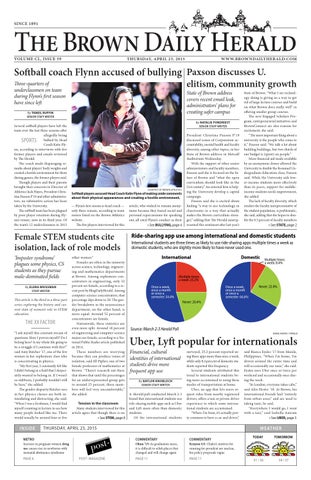
Ride-sharing app use among international and domestic students International students are three times as likely to use ride-sharing apps multiple times a week as domestic students, who are slightly more likely to have never used one.
Domestic
International
POST- MAGAZINE
Multiple times a week: 8.4%
Multiple times a week: 25.2% Once a week, once a month or once a semester: 54.4%
Once a week, once a month or once a semester: 66.6%
Never: 25.0%
Never: 20.4%
Source: March 2-3 Herald Poll EMMA HARRIS / HERALD
Uber, Lyft popular for internationals Financial, cultural identities of international students drive more frequent app use By BAYLOR KNOBLOCH SENIOR STAFF WRITER
A Herald poll conducted March 2-3 found that international students use ride-sharing mobile apps such as Uber and Lyft more often than domestic students. Of the international students
surveyed, 25.2 percent reported using these apps more than once a week, while only 8.4 percent of domestic students reported this frequency. Several students attributed this trend to international students being more accustomed to using these modes of transportation at home. Uber, an app that lets users request rides from nearby registered drivers, offers a taxi or private driver experience to which some international students are accustomed. “Where I’m from, it’s actually pretty common to have a car and driver,”
said Bianca Eyales ’17 from Manila, Philippines. “When I’m home, I’m driven around the entire time and will occasionally use taxis,” she said. Eyales uses Uber once or twice per weekend and occasionally once during the week. “In London, everyone takes cabs,” said Alex Hester ’18. At Brown, his international friends hail “entirely from urban areas” and are used to taking taxis, he said. “Everywhere I would go, I went with a taxi,” said Isabella Amram » See UBER, page 3
WEATHER
THURSDAY, APRIL 23, 2015
METRO Increase in pregnant women drug use causes rise in newborns with neonatal abstinence syndrome PAGE 6
article, who wished to remain anonymous because they feared social and personal repercussions for speaking out, all cited Flynn’s conduct as their » See BULLYING, page 4
President Christina Paxson P’19 discussed issues of Corporation accountability, mental health and faculty diversity, among other topics, in her State of Brown address in Metcalf Auditorium Wednesday. With the support of other senior administrators and faculty members, Paxson said she is focused on the future of Brown and “what the open curriculum should look like in the 21st century.” An external firm is helping the University develop a capital campaign. Paxson said she is excited about finding “a way to use technology in classrooms in a way that actually makes the Brown curriculum stronger,” adding that The Herald misrepresented this sentiment after last year’s
State of Brown. “What I see technology doing is giving us a way to get rid of large lecture courses and build on what Brown does really well” in offering smaller group courses. The new Engaged Scholars Program, entrepreneurial initiatives and BrownConnect are also reasons for excitement, she said. “The most important thing about a university is the people who come to it,” Paxson said. “We talk a lot about building buildings, but two-thirds of our budget is (spent) on people.” More financial aid made available by an anonymous donor allowed the University to double the Resumed Undergraduate Education class, Paxson said. While the University aids lower-income students more effectively than its peers, support for middleincome students needs improvement, she added. The lack of faculty diversity, which renders the faculty unrepresentative of the student population, is problematic, she said, adding that she hopes to double the 8.5 percent of faculty members » See STATE, page 2
COMMENTARY Okun ’15: As graduation nears, it is difficult to relish places that changed and will change again
COMMENTARY Kenyon GS: Chafee’s motives for running for president are unclear, his policy proposals vague
PAGE 11
PAGE 11
TODAY
TOMORROW
51 / 36
54 / 37
UNIVERSITY NEWS PAGE 2 • THURSDAY, APRIL 23, 2015
» STATE, from page 1 who are underrepresented minorities in the next 10 years. This year’s new diversity postdoctoral program will help “to build the pipeline of people who are coming in,” she said. Paxson said she rejects the suggestion from several Herald opeds “that graduate students are somehow at odds” with undergraduates, and she will focus on doctoral education in the future. Paxson acknowledged that Brown has dealt with emotionally difficult issues this year. “We’ve been asking how can we make our campus safe from the threat of sexual assault and gender-based violence and harassment,” she said. “I am always happy that Brown has students that aren’t complacent,” Paxson said. “I would rather have you (protest) than to not care.” The University is also focused on “how to improve mental health services on campus and take away the stigma” of mental illness, Paxson said. Brown must restructure its mental health system despite costs, she added. Unlike the work of the Task Force on Sexual Assault, the Mental Health Community Council’s efforts will be ongoing, Paxson said. Paxson said she seeks more integration of physical and mental health in the resources offered on campus. In addition to increasing capacity through more hires, expanding the seven-session CAPS limit and providing more support to students through the entire process of taking medical
leave, restructuring efforts will look to include improving student health insurance coverage for counseling and better coordinating referrals, said Margaret Klawunn, vice president for campus life and student services. Paxson then opened the floor for discussion, fielding questions from more than 15 students in the hour following her initial address. Candice Ellis ’16 asked how Paxson intended to effectively report any increases in faculty diversity given that “doubling (the percentage) would not be impactful” if it were not distributed evenly. Paxson said Brown would be more likely to see data across academic divisions — humanities and social, life and physical sciences — to avoid causing anyone to “feel singled out.” Justice Gaines ’16 asked what Paxson is personally doing to learn about issues of inclusion and identity, adding that some students do not feel comfortable going to the administration for support. In addition to attending events like Seder at the Brown/RISD Hillel, Paxson said she tends to “like less formal interactions with smaller groups.” “I need your help,” Paxson said. “This has to be a two-way thing.” Jamie Marsicano ’15.5 read aloud an excerpt of an email, leaked in the SONY hacks and published online on Gawker, that Paxson sent to current and emeriti members of the Corporation regarding letters of recommendations for applicants. “When you look at the sexual assault case, when you
THE BROWN DAILY HERALD
RYAN WALSH / HERALD
Students raised questions about faculty diversity, the inclusivity of campus culture and a recent Gawker article questioning the integrity of the admission process during President Christina Paxson’s P’19 State of Brown talk. look at this email that you sent to the Corporation and think about what connections the Corporation has … how can you tell us that the hashtag Money Talks at Brown is not a true one?” Marsicano asked. The article showed the letter selectively, not entirely, Paxson said, adding that the full text is available on Wiki Leaks. “You can go get it,” she said of the email. “The real purpose for that letter is to let people set their expectations about the level of influence they can have,” Paxson said. “Nobody can buy their way into Brown.” Several times throughout the address, Paxson repeated that admission
is separate from fundraising. “What I’ve been trying to do is to actually increase the separation — make it crystal clear that admissions is separate from everything else.” “I know that the people who work in the Admission Office have incredible integrity — I believe that to my bones. How do I convince you of that? I’m not sure how,” Paxson said in response to an audience question about administrative accountability. “When people talk about the Corporation, who do you think you’re talking about?” Paxson asked. As Paxson listed professions of Corporation members, including a law professor and a head of research
at the Massachusetts Institute of Technology, Darian Surratt ’15 called out “elite!” repeatedly. “Those are still very elite people with money, and in the grand scheme of the United States, those are people with a lot of money,” Surratt said. These people are Brown students 30 years later, Paxson replied. “The day you got accepted to Brown put you in a position of privilege and power.” “This is a longer conversation we have to have,” Paxson said. “We want to have a really wonderfully diverse community,” she added, saying, “This is not about getting rich kids into Brown. This is about finding the best students.”
UNIVERSITY NEWS
THURSDAY, APRIL 23, 2015 • PAGE 3
THE BROWN DAILY HERALD
» UBER, from page 1
TOM SULLIVAN / HERALD
Students with the group formerly known as DIvest Coal rallied outside University Hall in 2012 for the University to divest from coal companies.
Fossil Free Brown makes less noise than peer groups
While Harvard students sue school and Yale students hold sit-in, Brown activists are quiet By ANNE-MARIE KOMMERS CONTRIBUTING WRITER
Student activists campaigning for fossil fuel divestment at higher education institutions such as Harvard, Yale and Stanford University have recently captured headlines. While Stanford divested from coal, Harvard student activists took legal action and Yale student activists staged sit-ins within the past year, Brown’s movement — led by Fossil Free Brown — has remained relatively quiet this year. Fossil Free Brown is the new name of the student group Brown Divest Coal, which failed to convince the University to divest in October 2013. A year and a half later, the University stands by its position. The Corporation, the University’s highest governing body, “determined that divestment from coal companies was not the right tool for achieving the societal goals to which we all aspire,” wrote Mark Nickel, former interim vice president for communications, in a statement to The Herald. The process that led to the decision against divestment allowed for a full exchange of views, Nickel wrote, adding that the University “would not take lightly any request to repeat its former process without the availability of new information or new arguments.” Fossil Free Brown has expanded on the mission of Brown Divest Coal, adding divestment from natural gas and oil to its cause. The group has spent the past year trying to regain the movement’s momentum following the University’s rejection of divestment, said Austen Sharpe ’18, a member of Fossil Free Brown. One measure Fossil Free Brown has taken to further its cause this year is launching a new petition to demand that the University divest from the 200 publicly traded companies holding the majority of the world’s fossil fuel reserves. “The petition is kind of like a tool for us to explain the concept to people,” said Kai Salem ’18, adding that over 500 people have signed the petition so far. In addition to students, alums and faculty members have also signed the petition and made other tangible contributions to the divestment campaign, Salem said. “We probably have a better base in alums than we do with the students,” she said. Young alums have helped Fossil Free Brown organize, while older alums have contributed to financing the campaign, she added. While many professors in the Department of Environmental Studies support Fossil Free Brown, tenured professors have more leeway to involve themselves
in controversial topics, Salem said. More proactive steps to push for divestment, such as rallies and sit-ins, offer other ways to support the movement, Sharpe said. Fossil Free Brown has also hung banners around campus, knocked on doors and set up tables to raise awareness about its cause, Salem said. The group held a protest on the Main Green in February, and more rallies are planned for the future, she added. Meanwhile, activists at Harvard and Yale have caused particularly large stirs this year. Yale students staged a sit-in inside the office of the university’s president April 9. Yale personnel threatened the students with arrest, and they were fined $92 each for occupying a campus building, the Yale Daily News reported. At Harvard, seven undergraduates, graduate students and law students filed a lawsuit in November against the president and fellows of the school for what they termed “mismanagement of charitable funds,” the New York Times reported. The lawsuit has since been dismissed, but the students are appealing the decision. Fossil Free Brown does not plan on filing its own lawsuit because the group does not have law students, Sharpe said. Still, Sharpe and Salem both said they are confident the University will reconsider divestment. The movement is “not just going to die,” Sharpe said, adding that the University is under pressure to reconsider the issue because of successful campaigns at other colleges. But the University is unlikely to divest from fossil fuels simply because other schools are doing so, said Stephen Nelson, associate professor of educational leadership at Bridgewater State University and a senior scholar in the Leadership Alliance at Brown. The decision to divest will be made “campus by campus rather than (like) falling dominoes,” Nelson said. If pressured to divest, Corporation members could even go in the opposite direction and become more determined not to divest, Nelson said. “Nobody wants to look like they’ve been bullied into this,” he said. Nelson also noted that investment in alternative, possibly more environmentally friendly industries could slow the rate of the University’s endowment growth. Fossil Free Brown does not have any specific ideas about investments to replace those the University currently has in fossil fuel companies. “One of the reasons we didn’t focus on re-investment was because we didn’t see that as our place,” Sharpe said. “We don’t want to tell the University exactly what to do. We just want to tell them that (investment in fossil fuels) is not okay,” Salem added.
’17 of Istanbul, Turkey. “I don’t drive there because it’s much more efficient to use public transportation and taxis,” she said. Omar Ben Halim ’15 of London, United Kingdom tied frequent Uber use to the higher socioeconomic statuses of some international students. The University’s need-aware financial aid policy for international applicants, as well as the financial means needed to attend a school overseas, makes it so that “on average, you’re getting richer international kids, and therefore they’ll use Uber more because they can,” he said. Even for domestic students who have the financial means to use Uber, the idea “never really crosses their minds,” said Beatriz Vilela dos Reis Vianna ’18 of Sao Paulo, Brazil. “It doesn’t occur to them to get an Uber somewhere unless it’s super cold,” she said. The nature of requesting and waiting for a ride from Uber contributes to this phenomenon, Vianna said. “You’re used to not waiting for anything, and the idea of waiting three minutes for an Uber is foreign,” she said, adding that she is used to waiting this amount of time for a cab at home. For some, the structure of Uber resembles that of taxi apps at home. 99Taxis is an app similar to Uber that is commonly used in Brazil, Vianna said. Taxibeat is a popular app in Greece, said Anthony Kanellopoulos ’16 of Athens, Greece.
Several international students also cited past experiences with nightlife in their home countries as spurring them to take ride services to parties off campus. For many, these parties at downtown clubs hold greater allure than Greek or athletic house parties on campus. “In Istanbul, we never had any house parties,” Amram said. “We only went to clubs. I am not used to the sport house parties and all of that. It was very unfamiliar to me.” “The club scene has a much higher percentage of internationals than the usual party scene here, so we’d be more likely to Uber out to clubs,” Hester said. “International students like going
down the hill a little more than American students, hence taking the car ride,” said Harkaran Uppal ’16 of New Delhi, India. An additional factor is that “international kids are much less likely to own a car,” Halim said, adding that this causes them to look elsewhere for modes of transportation. All international students interviewed voiced their preference for Uber rather than Lyft, citing pricing, popularity and convenience. Valentin Perez ’18 of Cancun, Mexico, who uses ride-sharing apps two or three times per week, said he relies more on Uber than Lyft. “I like startups a lot, so I’m always looking into what they do,” he said.
ASHLEY SO / HERALD
International students expressed familiarity with ride-sharing applications similar to Uber, which allow users to request rides from nearby drivers.
UNIVERSITY NEWS PAGE 4 • THURSDAY, APRIL 23, 2015
THE BROWN DAILY HERALD
LGBTQ students note feelings of inadequacy »BULLYING , from page 1 Female students, Hispanic students also indicate greater feelings of academic inadequacy By SHAVON BELL SENIOR STAFF WRITER
A March 2-3 Herald poll revealed that students who identify as LGBTQ experience greater feelings of inadequacy than their counterparts in a variety of categories. Respondents answered the question “Do you feel inadequate relative to other Brown students?” Among the undergraduates surveyed, 32.6 percent responded that they felt inadequate with regards to their academic abilities, 19.3 percent with regards to their social lives, 20.1 percent with regards to their sex/love lives, 14 percent with regards to their appearances, 16.6 percent with regards to their socioeconomic status and 9.3 percent about a factor not listed in the question. About 43 percent of students responded that they do not feel inadequate compared to other Brown students. Across all factors of inadequacy that the poll addressed, non-heterosexual students indicated feeling more inadequate. “A lot of queer students here intersect with other identities,” causing pressures from each to compound upon one another, said Justice Gaines ’16. “Brown oftentimes acts like these problems are inevitable, but they’re not,” Gaines said. The University can minimize these issues of inadequacy “not only by changing conversation but by making sure that policy is reflecting what students need,” Gaines added. Though Adrian Lev Guerra’s ’16 personal experience as a queer student at Brown has been “really magical” on all fronts, he acknowledged that the LGBTQ identity can
exacerbate pressures from other spheres of life. While Lev Guerra said he has not felt inadequate at Brown, he has felt that way in his home nation of Costa Rica, “because the social expectations were different.” Overall, the largest demographic gap within the results was between women and men regarding their academic self-confidence. About 41 percent of women, compared to about 23 percent of men, indicated they felt inadequate about their academic abilities. Aly Todich’ii’ni Lawson ’18 said this discrepancy is partially rooted in the makeup of Brown faculty. “The people that you’re learning from … are usually white males. The texts that you’re reading from are usually written from a male’s perspective,” she said, adding that it is more difficult for women to “hold themselves (in) as high” esteem because of these biases in the classroom. Disparities in perceptions of inadequacy also correlated with ethnicity. About 48 percent of Hispanic students indicated they feel insufficient with regards to their academic ability, while about 31 percent of nonHispanic students indicated such feelings. Andrea Cordova ’17, who identifies as Latina, noted the lack of Hispanic faculty as central to this statistical gap. “It might not make (Hispanic) students feel as comfortable as other students who are represented in the faculty,” she said. Nicolas Montano ’17, who identifies as Latino, said while he acknowledges his socioeconomic privilege, he is conscious that some Hispanic students from working class families have a set of financial stressors that wealthier students are completely ignorant of. Consequently, these more privileged students “have a lack of context” when they interact with students from working class and lowincome backgrounds, he said. Cordova said she does not think
of her financial stressors “as linked to her Hispanic identity,” but she noted that this may not be true for all Hispanic students on campus. Similarly, black students reported higher instances of inadequacy based on socioeconomic class. For Maya Finoh ’17, this is directly related to larger patterns of discrimination in American history, such as the slave trade and Jim Crow laws, she said. “I’m not surprised by the statistics regarding socioeconomic status,” she said. “Historically, black people in this country have suffered from generational poverty because we have been constantly discriminated against.” In contrast, athletes expressed lower levels of inadequacy with regards to their social lives, appearances and socioeconomic statuses, while international students expressed lower levels of inadequacy with regards to their academics, social lives, sex/love lives, appearance and socioeconomic status. Augusto Ballón ’18, who is from Peru, said that in his experience international students, especially those who have previously lived away from home, find it easier to be truly independent when they arrive at college. Jessica Kenny ’17, who is from Brazil, said her identity as an international student has given her the ability to “know how to live among differences.” For Rob Hughes ’17, a member of the football team, confidence among athletes is linked to the inherent support provided by one’s team. Upon arriving at college, athletes find that their team members “love and respect you no matter what your class status or anything like that is. You feel like you have a big network, regardless of where you are,” he said. “In many cases, athletes are forced in their specific sport to gain … confidence,” said Lawrence Kemp ’17, a member of the men’s lacrosse team. “That can leak into other parts of life so that can be why you see those trends.”
Follow The Herald on Twitter! @the_herald
primary reason for leaving the team. Hayes declined to comment on the specific case, citing confidentiality concerns in personnel matters in an email to The Herald. But he wrote generally, “Under no circumstance would we tolerate bullying. We value open communication with members of any sports team, and we approach all questions or concerns carefully, thoughtfully and seriously in line with the values of the institution.” Flynn also declined to comment for this story, writing in an email to The Herald that Hayes spoke on behalf of the entire Athletics Department. Paxson did not respond to a request for comment. Several former players spoke of comments Flynn made about their physical appearances. The students expressed heightened concern about the remarks because one of the team’s former players has an eating disorder. A former player who is now a senior recalled one incident that occurred while the team was on a trip to California for a game during the 2014 season. After her parents hosted a team dinner at their home, the student said Flynn stood at the front of the team’s bus and said, “She lives a block away from an ice cream shop? That explains a lot.” Flynn also told other coaches in front of some players that she resembled the Cookie Monster, the student said. After the student informed Hayes of the first incident, she said he confirmed it with team captains and addressed the matter with Flynn. Flynn later wrote a brief apology to the player and put it in her mailbox. But the student described the threesentence note as inadequate. “The comments she made to me really affected me,” the former player said. “I don’t typically have any issues with my body, but after her comments, I felt pretty shitty about myself.” The student said Flynn’s comments about her weight were the reason she quit the team. “I’ve played softball since I was seven years old, and the fact that that’s the note I ended on after playing my entire life hurt,” she said. “I decided that it’s not worth the love of the sport to be told you’re fat in front of your entire team.” In a March 2014 email to a professor who offered to advise her on the situation, the student wrote, “My experience as a softball player has been ruined by (Flynn). I do not think I can mentally and emotionally play for her any longer.” The professor replied, “If I made a remark like that to a student in my
class, I’d expect to be severely disciplined.” Another player recalled Flynn making her feel uncomfortable when trying on a uniform. “I asked for a smaller size, and (Flynn) said ‘no’ and that I was ‘definitely not that size,’” the former player said. “When the pants came, I showed up with the size she allowed me to get, and then she made comments on how they looked like balloon pants.” In another incident on a team trip to Princeton, a player’s aunt brought the team chocolates. A former player recalled Flynn saying to her teammate’s aunt, “Have you seen our outfielders? They don’t need those.” Former players said they were also troubled by the hostile environment Flynn created during games. “People would cry in the dugout,” one said. During one game, a former player was put in for a teammate who had committed an error, she recalled. “I made all of the plays, and then in my second inning there was a line drive (that) went past me. … I saw (Flynn) throw her clipboard across the dugout,” she said. “That was the last time I played the field all season.” “I would dread the weekends because of the games. I would detach from my friends on weekends. I would have to mentally prepare to deal with this emotional abuse I knew I would be facing,” the student said. “I have been exponentially happier since quitting the team.” During Flynn’s second year as coach, several players and their parents contacted Hayes to voice their concerns. In an email to Flynn explaining her decision to leave the team, one former player detailed experiences that affected her emotional and academic well-being. Referring to Flynn’s remark about the ice cream shop near her home, the student wrote, “You singled me out in front of my peers and publicly humiliated me.” Despite the volume of criticism from players, many still believe their grievances have not been appropriately addressed. “We sort of got ignored and were told that we didn’t know what we were talking about,” a former player said. “I talked to Jack Hayes for 45 minutes. … No matter how many facts I told him, he just did not believe me.” Flynn “is totally undeserving of representing Brown. We should be able to have a better coach or at least one that treats (her) players with respect,” the student added. “It’s one thing to be a bad coach, but if you’re not even going to respect the people you work with every day, … I don’t understand how Brown let that happen.”
UNIVERSITY NEWS
THURSDAY, APRIL 23, 2015 • PAGE 5
THE BROWN DAILY HERALD
Seniors reflect on research passions at annual conference This year’s Theories in Action presentations focus on social justice, study abroad insights By ANTON MANZANO CONTRIBUTING WRITER
ZEIN KHLEIF / HERALD
A mozzarella stretching demonstration from Narragansett Creamery took place at the Sharpe Refectory Wednesday as part of an Earth Day dinner that emphasized Dining Services’ local and sustainable food initiatives.
Earth Week plants seeds of change Week of events highlights year-round initiatives, aims to inspire change through food, art, film By SUSANNAH HOWE SENIOR STAFF WRITER
As students enjoy the sunny weather, this year’s Earth Week aims to celebrate sustainability efforts at Brown and educate community members about how to contribute. With events such as a solar panel demonstration, trash sorting, composting, bike rides, panel discussions and film screenings, the Earth Week committee hopes to “make sustainability accessible to everyone” through “fun events that people will want to show up to,” said Haily Tran ’16, the committee’s coordinator. The Earth Week committee, which includes representatives from each of emPOWER’s 10 subgroups, started organizing in December and began meeting in earnest at the beginning of the semester, said Tran, who also served as a coordinator last year. One of the week’s main events was an eco-friendly dinner Wednesday at the Sharpe Refectory. The event featured a local and seasonal menu, a mozzarella-stretching demonstration by Narragansett Creamery and presentations by food-focused student groups as well as eco-friendly vendors who supply food for Dining Services. Approximately 305 pounds of compost were collected at the event. The dinner was “a celebration of the things we do year-round,” said Isabelle Aubrun ’16, a Dining Services sustainability intern. Though sustainability was highlighted at the dinner, “it’s a well-kept secret” that Dining Services takes steps to be ecofriendly throughout the year, Aubrun said, adding that she hopes students realize “there’s a very concerted effort to have good-quality food.” So many students signed up to volunteer at the Earth Day dinner that there were not enough positions for all of them, said Meggie Patton, academic and student engagement coordinator at the Office of Energy
and Environment, who served as an adviser and helped with logistics for Earth Week. The situation was “the greatest problem to have,” she added. Dining Services and the Sustainable Food Initiative also sponsored a dinner special called “Turn Down for Wheatberry” at the Blue Room Monday, Aubrun said. The dish — which included local vegetables, grains and all-natural meat — may become a permanent feature at the Blue Room or the Ratty, she said. Events focused on food can reach a wide segment of the Brown community, Aubrun said, adding, “Food is a pretty big unifier.” Though “it’s easy to get bogged down in the negatives” when talking about environmental issues, SuFI tried to “keep things positive,” said Rosie Kissel ’17, a SuFI representative on the committee. “Food is one thing you can get people excited about.” Earth Week’s other large event is a community fair on the Main Green Sunday. Both student groups and community groups from Providence and Rhode Island will be present. In addition to education, the fair will provide “zero-carbon fun and relaxation” through music performances and the inclusion of other groups such as the Brown University Relaxation Project, Tran said. By inviting community groups, the committee hopes to “integrate campus sustainability to local sustainability,” Tran said. “There’s a lot of overlapping issues between the Providence community and the Brown community.” Getting some community organizations to attend the fair posed a challenge since many had other events planned for Earth Week, but the groups that attended last year were happy to return, Tran said. The week’s kickoff event — a seedling giveaway for faculty and staff — had to be rescheduled for Wednesday due to rain Monday, she said. But the rescheduling did not hurt the week’s momentum, she added. Coordinators also faced the challenge of scheduling and reserving space amidst the many other events happening on campus this week,
including A Day on College Hill, the Social Enterprise Economic Ecosystem Development summit and the Brown Folk Festival, Tran said. But the Earth Week committee established good relationships with those groups and has been able to share space with SEEED and help the Folk Festival with sustainability, she said. ADOCH coordinators also plan to work with the Earth Week committee next year to make their events eco-friendly, she said. Earth Week helps the University reach its goal of reducing greenhouse gas emissions 42 percent from 2007 levels by 2020, Patton said. So far, emissions have decreased 26 percent, largely through eco-friendly renovations and other infrastructure improvements, but “a huge part of our energy footprint comes from people occupying the buildings,” she said. Earth Week encourages the “behavior change, engagement component of energy use,” she added. The committee strove to make the entire planning process environmentally friendly, said Kissel. Most of the promotion for the week’s events was done online to save paper, and the committee decided not to order T-shirts because it could not find a green producer, she said. “We hear a lot of doom and gloom” about the environment, said Maya Faulstich-Hon ’17, a SCRAP representative and committee member. But Earth Week is “a celebration of this planet that we live on,” she said. The week’s goal is “turning the focus of sustainability away from the problems and more toward the solutions,” she added. The committee also hopes that Earth Week will educate students and prompt them to change their behavior. The events aim to “create those moments that really get people to consider their own personal impact and what they can do,” Patton said. “There’s a lot of things that we do as people on a day-to-day basis that really have huge impacts,” said Bailey McLaughlin ’17, a SCRAP representative and committee member. “Everybody is capable of changing for the better.”
Serving as an opportunity for graduating seniors to share experiences and studies across their four years at Brown, the sixth annual Theories in Action conference will take place in various locations around campus Sunday. The conference will offer students a chance to present their theses, research and capstone projects in a group setting to attendees from the Brown community and beyond, said Peggy Chang ’93 MA ’13, director of the Curricular Resource Center. Over 60 seniors will participate in this year’s conference, some through themed roundtable discussions and others through individual presentations. Topics vary widely, though many are oriented around issues of social justice. “Theories in Action is a moment for seniors and for others to listen to what students are saying about a culminating experience for them,” Chang said. This year’s organizers attempted to place emphasis on an “idea exchange,” Chang said. Rather than having solely one speaker talk on the panel, organizers will encourage audience members to voice their opinions and knowledge on the matters being discussed, she said. Interested seniors applied using an online form, in which they described their projects and how they would benefit audiences, said Sophia
Dalce ’15, a conference coordinator. Applicants also had to explain how they would uphold the conference’s mission. Dalce said she hoped the applicants would report on activities outside of their academic fields, especially extracurriculars and projects. Sophia Tsang ’15, a geology concentrator, said she decided to participate in Theories in Action because she wanted to share her study abroad experience with a more general audience. Tsang will present on the effects of changes in land use and earthquakes on Christchurch, New Zealand, where she studied abroad. “It’s a bit of a challenge to myself to see how well I can connect with a larger audience and explaining the geological phenomenon happening,” she said. Nora Aimee McDonnell ’15, a double concentrator in Africana studies and comparative literature, elected to participate in the conference after feeling inspired by last year’s event. She will share her thesis, entitled “Where Personal and Political Merge: Locating Women’s Prison Narratives in a Legacy of Female Slave Memoir,” as part of a roundtable discussion. “I am looking forward to seeing the way in which the different presenters present and how the presentations will change the way we look at our own work,” McDonnell said. Theories in Action will kick off Sunday with an opening reception featuring remarks by Maud Mandel, dean of the College, followed by an all-senior public art night in the Petteruti Lounge and the Leung Family Gallery. The conference will conclude with a celebratory dinner Tuesday at the Faculty Club.
www.browndailyherald.com
UNIVERSITY NEWS PAGE 6 • THURSDAY, APRIL 23, 2015
THE BROWN DAILY HERALD
ADOCH gives prospective students taste of campus About 700 prospective students visit campus to experience Brown, inform matriculation decision By LAUREN ARATANI STAFF WRITER
Excited chatter filled a large, white tent on the Main Green as hundreds of admitted applicants to the class of 2019 awaited the official start to this year’s A Day on College Hill at its opening reception Tuesday night. Spanning three days and two nights, ADOCH attracted about 700 prospective students from around the world to experience Brown’s academics and student life. “Class of 2019, good evening, congratulations on your admission and welcome to Brown,” said Dean of Admission Jim Miller ’73 at the reception. “I can’t begin to tell you how much time we, the admission office, have spent with you. … It’s reassuring to see all of you and all of your dimensions.” Of the roughly 30,397 applicants to the class of 2019, about 8.5 percent were admitted. The Office of Admission “fully expects the class of 2019 to be the single best class next year at Brown,” Miller said. A variety of student groups participated in this year’s ADOCH events, which included salsa workshops, a comedy show and a capella
performances under Wayland Arch and Morris-Champlin Arch known as “arch sings.” A bulk of the events occurred at night, with some ending at 2 a.m. Prospective students also had the option to attend “ADOCH Shopping Period,” in which they could visit classes in various departments and attend lectures given by guest speakers. This marks the second year that gender-neutral housing was offered to ADOCH participants. The change came after the student group GenderAction advocated its implementation in 2013, said Sana Teramoto ’16. When gender-neutral housing became an option for enrolled first-years in 2013, the logical next move was to offer the option to prospective students during ADOCH as well, Teramoto added. The provision is intended to ensure students feel “comfortable” and have the best possible experiences during their stays on campus. Many admitted students agreed that ADOCH provided them with a good impression of Brown. Yasmin Toney of Tampa, Florida said Brown “really exceeded (her) expectations,” adding that she especially enjoyed seeing many of her potential peers during the opening reception. Lamar Greene of Richmond, Virginia said Brown students seem “openminded and passionate” while also interested in meeting different people. While students often attend ADOCH to help inform their decision between Brown and other schools,
COURTESY OF JAMIE MCCLUNG
Prospective students, some of whom are still deciding between schools, took a tour of campus Wednesday as part of the annual three-day event A Day on College Hill. some students who had already chosen Brown also joined in the festivities. Kevin Chen, who was accepted to the Program in Liberal Medical Education and hails from San Merino, California, said he plans on committing to Brown but came to ADOCH because “it’s fun” and he wanted to visit campus before he started school in the fall. Katie Wu of New York City said she had already committed to Brown because of the nice weather, good liberal arts education and abundance of
“happy people” on campus. ADOCH Student Coordinators Aaron Rosenthal ’16 and Alissa Rhee ’16 started planning for the event last May. Along with the different student planning committees, Rosenthal and Rhee spent countless hours and “about 4,000 emails” making sure the three days would run smoothly, Rhee said. Ling Song ’18, a unit representative for ADOCH, said she signed up to recruit current students to host prospective students in their dorms because she wanted to give prospective students a “reason for coming” and “represent the school in a good light.” This year’s approximately 700 attendees is slightly lower than last year’s 767 attendees due to recent holidays and Spring Weekend, which caused ADOCH to be held later in the semester than usual, Rhee said. The dates of ADOCH coincide with other schools’ accepted student events, such as Yale’s Bulldog Days, which could also account for the lower numbers,
Rosenthal said, adding that coordinators were still pleased with the turnout. Slight changes to ADOCH’s schedule included an additional night of “Faunce Events,” in which student groups such as First-Gens and emPOWER held “mixers” to introduce themselves to interested prospective students, as well as a new panel on mental health and well-being, Rhee said. Additionally, instead of featuring ice cream as in past years, the first social event featured cookies and hot cocoa, allowing prospective students to socialize more as they “weren’t waiting in line to get ice cream,” she said. Campus “comes alive” during ADOCH, Rosenthal said. “ADOCH is one of the only times when everyone on campus can get on the same page and can get invested with what’s going on,” Rhee said. ADOCH’s final event entitled “Farewell, Friends!” is set to take place on the Main Green at Thursday at 11 a.m.
METRO
THURSDAY, APRIL 23, 2015 • PAGE 7
THE BROWN DAILY HERALD
Quinn selected to join Rhode Island Ethics Commission Prior experience, perspective as Brown administrator cited as valuable qualities for serving on commission By AGNES CHAN STAFF WRITER
Marisa Quinn, director of communications and outreach at the Watson Institute for International Studies, was appointed by Gov. Gina Raimondo to the Rhode Island Ethics Commission earlier this month. “Building upon my ongoing commitment to uphold the highest standards of integrity and ethical conduct in government, I am pleased to announce my appointment of Marisa Quinn to the Rhode Island Ethics Commission,” Raimondo said in a press release. “Marisa has a proven experience fostering clear communication, accountability and innovation and will be an excellent addition to the Commission.” The Rhode Island Ethics Commission is a constitutionally mandated body that enforces a code of ethics to which all public officials and employees must abide. Nine members comprise the commission, four of whom are appointed directly by the governor. The other five members are nominated by the House speaker, in conjunction with the House and Senate majority and minority leaders, though they must be confirmed by
the governor. Quinn’s appointment marks the beginning of a five-year term, filling a vacancy left by Sister Deborah Cerullo, who was supposed to remain on the commission until Sept. 1 but left the position to take a six-month sabbatical. “I also want to thank Sr. Deborah Cerullo for her service on this Commission and great work on behalf of our state,” Raimondo said in the press release. Quinn, former vice president of public affairs and University relations, said she has always been open to taking on this sort of role. “I’ve always been committed to some kind of public service. I’m on the Kids Count board, my background is in public policy and I’ve worked in the government,” she said. As a member of the commission, Quinn said she hopes to “bring sound judgment to the role” and to “work with fellow commissioners to serve the citizens of our state.” She said she believes it is vital for the state to have “expectations for standards of conduct for all of our elected and appointed officials” included in the constitution. This is an “important concept that is critical to the functioning of government,” she said. Quinn has held positions at the
Rhode Island Department of Elementary and Secondary Education as well as with the Port Authority of New York and New Jersey. She was also the policy advisor to Gov. Jim Florio of New Jersey and a legislative aide to Claiborne Pell, who served as a Rhode Island U.S. Senator from 1961 to 1997. “There is a bit of a time commitment with this particular appointment,” Quinn said, noting the two-hour meetings with the commission every other Tuesday. Before accepting the position, Quinn sought approval from Richard Locke, director of the Watson Institute, who was equally enthusiastic about her appointment. Ross Cheit, chair of the Rhode Island Ethics Commission and professor of political science and public policy, praised Quinn’s suitability for the job. “Marisa Quinn has been at Brown and in Rhode Island for a long time,” he said. “Given her position in government and community relations, I think she knows a lot … and cares about the state.” Cheit added that Quinn will bring “an important combination of knowledge and concern” to her new role. Recent events that concern the state’s ethics commission include the arrests of former Speaker of the House Gordon Fox for bribery and Rep. Joe Almeida, D-Providence, for misusing campaign
funds. These scandals have highlighted the need for the ethics commission to enforce transparency in state affairs. Cheit said the commission remains “responsive” to complaints and requests and will continue to enforce its code “rigorously and impartially.” Since Quinn is serving on the commission as a citizen of Rhode Island and not as a member Brown’s faculty, her appointment is not expected to impact
the University. But Cheit said having a faculty member on the commission is favorable, because “nobody at Brown is under the code of ethics.” “The good thing about having people from universities in Rhode Island that are not public on the commission (is that) those people don’t have any kinds of conflicts of interest,” he added. “There’s a kind of independence that comes from being at a place like Brown.”
COURTESY OF BROWN UNIVERSITY
Marissa Quinn, director of communications at the Watson Institute, said she will aim to “bring sound judgment” to the R.I. Ethics Commission.
More infants born with prior exposure to alcohol, drugs Increased use of drugs in pregnant women leads to more babies born with opioid withdrawal By ELAINA WANG SENIOR STAFF WRITER
The rate of babies being born with neonatal abstinence syndrome in Rhode Island doubled between 2006 and 2013 according to Rhode Island Kids Count’s 2015 Factbook. Babies are born with NAS when exposed to opioids such as vicodin, oxycontin and heroin in the womb. “For a state our size, the fact that 76 babies were born (in 2013) with opioid exposure is an alarming statistic,” said Elizabeth Burke Bryant, executive director of R.I. Kids Count. “It’s on everyone’s radar screen as a number that we want to turn around and improve.” Babies with NAS undergo physical withdrawal from opioids in which “everything kind of revs up,” said Marcia VanVleet MPH’10, assistant professor of
pediatrics and director of the Newborn Nursery at Women and Infants Hospital, adding that these symptoms include high fever, diarrhea, rapid breathing and irritability. The newborns “miss the opioids they had been exposed to in utero,” VanVleet said, adding that symptoms typically appear between three to five days after birth, depending on the drug type and last dosage taken. While withdrawal in babies is similar to adults easing off drug use, babies are affected more because of their smaller stature, VanVleet said. She added that babies can become dehydrated through vomiting and diarrhea and also experience seizures — symptoms adults do not usually exhibit. This increase may result from the fact that more women of reproductive age are becoming addicted to opioids,
said Lynn Hess ’99, clinical assistant professor of psychiatry and human behavior. The increase in addiction is due to a “historically enormous increase in the number of prescription drugs that are being prescribed by doctors,” she said. Patients can start using opioids for pain relief, but then their bodies become physically dependent on the substance, Hess said. A patient might find that the opioid “feels good, helps them forget their problems (and) helps them become more productive,” she said. But pregnant women addicted to opioids are not recommended to stop opioid use while pregnant because the “risk of relapse is very high,” Hess said. When opioid addicts stop using, they develop flu-like symptoms, such as diarrhea, vomiting and tremors, she added. When pregnant addicts relapse, finding opioids becomes a priority, even over taking care of their babies. Instead of asking pregnant women addicted to opioids to stop using during pregnancy,
physicians prescribe either methadone, which is an opioid, or buprenorphine, which acts like an opioid. Both of these medications also cause NAS in babies. Treatment is administered early on in a baby’s life to get drugs out of his or her system, Bryant said. Babies exposed to opioids are treated with morphine, methadone and phenobarbital, VanVleet said. “These trends are the same that people are seeing nationally, so I’m not surprised,” VanVleet said, adding that
the number of babies born to mothers taking prescription medications, morphine and methadone have all increased. A possible solution is ensuring access to high-quality prenatal care, Bryant said, adding that “it is so much wiser to invest in prevention than have to intervene when these bad outcomes happen.” Ultimately better communication between providers and patients is also part of the solution, VanVleet said.
SCIENCE & RESEARCH PAGE 8 • THURSDAY, APRIL 23, 2015
THE BROWN DAILY HERALD
» STEM, from page 1 Research documents high rates of hepatitis C in prisons
Inmate treatment, diagnosis costs exceed R.I. Department of Corrections’ budget By ANDREW JONES
SCIENCE & RESEARCH EDITOR
Hepatitis C affects millions of people nationwide, but the disease is especially prevalent in prisons: Approximately 17 percent of Rhode Island inmates are infected, according to a new study by University researchers. Diagnosing and treating all of these cases incurs a large financial burden on the R.I. Department of Corrections — a cost that is probably not realistically affordable under the current budget, the researchers report in a paper on the topic, which was published in the April issue of the Journal of Urban Health. The Department of Corrections currently focuses its resources on infected inmates whose diseases have progressed to a late stage, said Brian Montague, assistant professor of medicine and health services, policy and practice, who led the study. The department would ideally test and treat all prisoners at risk for becoming infected with hepatitis C, but “that amount of money would be an order of magnitude beyond what they could support,” Montague said. Full treatment of the virus can involve several rounds of medication. “If they put all that work in, the bill just goes up and up and up,” Montague said. Treating all inmates with greater than six months remaining in their prison sentences would cost around $34 million, which is 13 times the department’s pharmacy budget, according to the study. For years, issues regarding hepatitis C centered around treatment methods, said Andrew Talal, professor of medicine at the University of Buffalo, who was not involved with the study. As of October, the U.S. Food and Drug Administration
approved a new oral combo therapy, which has a much higher efficacy than any prior treatment methods, he added. Now, the biggest problem regarding hepatitis C treatment is the cost, Talal said, adding that the cost to treat one patient is about $150,000. “The burden is not ‘How do we get patients cured?’ but ‘How do we treat the largest number of patients?’” Hepatitis C among the prison population is typically associated with injection drug or cocaine use, Montague said. Many people who engage in these behaviors end up in prison, raising the disease’s prevalence within correctional institutions, he said. One of the biggest problems facing correctional facilities’ medical care is that prisoners are not eligible for Medicare or Medicaid, Montague said. These programs typically cover the vast majority of patients’ required treatments for hepatitis C, but instead the full cost of care falls to the department, which is unreasonable for the size of its budget, he added. “As a patient, it doesn’t sound good to hear ‘Well, you don’t have late-stage liver disease so we’re not going to treat you,’” Montague said. But there are a variety of issues with only treating patients with end-stage liver disease, Talal said. Untreated patients leave a “resevoir of infection,” which can harm other people in addition to the patients themselves. But the department’s triage strategy — focusing on patients with the most dire need — is one of the most reasonable ways to solve the budget problem, Montague said. To reconcile the immense financial and public health issue, the Department of Corrections should seek new payment strategies, such as working with outside programs, the authors wrote in the study. New treatments are currently being developed that are more costly and more effective. The earlier the problem is fixed, the better, the authors concluded.
outward hostility expressed toward women, the atmosphere in certain Brown STEM courses can be uncomfortable and sometimes unwelcoming. “In some classes, I’m definitely hesitant to ask questions because I don’t want to put myself on the line as much. And I think men are much more inclined to do that in this environment,” said Allison Hamburger ’16, a CS concentrator. Several women expressed similar sentiments of implicit inferiority. “I feel like I have to be a representative of my gender … like if I ask a dumb question, it’s not just me as a person asking that. It’s me as a woman,” said Ardra Hren ’15, a CS concentrator. Many female concentrators in both CS and physics said they struggle with “imposter syndrome,” a psychological phenomenon in which people feel a persisting sense of inadequacy despite clear competency. India Prentice ’15, a CS concentrator, said she wishes her selfconfidence was higher. “A lot of my discomfort is brought on by myself when I feel imposter syndrome. Luckily at this point I am able to recognize it, but that doesn’t make it any less vivid of a feeling.” Offhand comments, jokes or misunderstandings can augment tension both in and outside of the classroom, said both male and female students. “During class, a male peer once said something like ‘women don’t study physics because there’s a difference in aptitude and preference.’ And I was just shocked trying to explain why that was utterly incorrect,” said Kate Storey-Fisher ’16, a physics concentrator. “The best response is to call people out on it — interrupt the conversation and note that biases are being held,” she added. Butcher recalled a specific moment when she felt especially uncomfortable about her place in STEM education. During a colloquium sponsored by the physics department last semester, one speaker made several jokes and bizarre comments about women in science, she said. “You have to imagine this huge lecture hall, with around 80 people — five of whom are women. I was just sitting there, already feeling like I didn’t belong,” she said. “No one ever spoke to the professor about his comments, and so he had no idea that he had made me feel the most marginalized I’ve ever felt as a white woman.” Gendered comments can make students feel less comfortable interacting with others, which is an integral aspect of conducting science, said Jason Hu ’15, a CS concentrator. “And when you don’t have people to work with for problem sets or projects, you really struggle. You don’t have that ability to get feedback on your work,” he added. Department-specific biases But many women in STEM departments also cite positive experiences in their classes. “My peers in physics were great. The guys I worked with were really inviting, and they always asked me to work with them on problem sets,” said Lily Hoffman ’17, an applied math concentrator who switched out of physics last year. Female students often feel more comfortable in classes and
departments that have more equal gender distributions, such as neuroscience, biology and chemistry, several female students said. “I just kind of do my own thing, and I’m not really aware of any bias due to my gender or my race,” said Sahana Nazeer ’17, a neuroscience concentrator. “If I don’t get the job, I don’t think it’s because I’m a girl. It’s because my resume isn’t strong enough.” “My lectures are usually around 50 percent female,” said Therese Carter ’16, a chemistry concentrator. “Overall, I’ve felt pretty supported. But there are always small issues, like professors calling more on boys in class,” she added. A lack of female role models Amidst the ongoing bias that affects female students in STEM at Brown, successful female role models can help overcome this discrimination. But many STEM departments’ faculty makeups are predominantly male. In the physics department — which possesses one of the most unequal gender distributions at the University — just 11 percent of the faculty are women. Nationally, 14 percent of physics faculty members are women, according to data published by the American Institute of Physics. “We should be above average at Brown, but we’re not,” said Professor of Physics Meenakshi Narain. “From the student’s point of view, I can see that they would want more representation to relate with us,” she added. Many students said they are discontent with the lack of female faculty members and teaching assistants in STEM departments at Brown. “In upper level courses, you typically don’t see female TAs on staff,” said Aisha Ferrazares ’15, a CS concentrator. “And I don’t think I’ve had any female CS professors. That doesn’t leave us with many role models.” One student, who asked to remain anonymous for confidentiality concerns, ended up feeling more disappointed than inspired when she took a science class with a female professor. “I wanted my professor to be the strong, confident, take-no-shit scientist that I want to be. But she would apologize so many times during lecture when she made a mistake, and she would be so flustered. It wasn’t what I wanted to see,” the student said. “I’m a big believer in the role model effect. Seeing people who look like you makes you want to pursue those fields,” said Abi Kulshreshtha ’15, a physics concentrator and co-leader of the Physics Departmental Undergraduate Group. Systems of support The University funds several programs for women in STEM fields, including Women in Science and Engineering and Women in Computer Science. Both programs match younger female students with upperclassmen mentors and hold social and activist events, though WiCS is purely student-run. Students gave mixed reports on the effectiveness of WiSE. “WiSE wasn’t very supportive when I wanted to look for research or needed help on a problem set,” Hoffman said. “If there were a group
of women at Brown who worked together and did research together, I think that would be really cool,” she added. One of the most substantial problems with WiSE is that female first-years are often matched with mentors concentrating in different departments, Storey-Fisher said. “I just didn’t connect very well with my mentor,” she added. But the program is moving toward grouping by concentration, said David Targan, associate dean of the College for science and a coordinator of WiSE. Members of WiCS more unanimously praised the department’s student support group. Many students said WiCS has created a community of support as well as a safe space for conversations about issues faced by women in CS. “WiCS does a good job pushing the conversation forward and making people aware of microaggressions or stereotypes within the community,” Hu said. But several students said the University could do more to support its female STEM concentrators, especially in the physics and computer science departments. “There’s never been a professor who has asked me about my experience. There’s no real support,” Butcher said. “As much as we’d like to believe that we’re this liberal place that deals with social issues well, it’s hard to paint a rosy picture. It’s really no one’s job to deal with it, so no one does,” she added. Forging ahead Students and professors alike had a multitude of ideas on how to close the gender gap and put an end to bias at Brown. Many said simply acknowledging the problem is an important first step. “More professors need to feel comfortable talking about this type of thing. They need to know that they can bring it up and it’s okay. Instead, it’s just this silent thing where the minorities steadily drop out of the course,” Butcher said. Creating a dialogue between professors and students is essential, Narain said. “We know our students within our classrooms, but we don’t know them as a community. Even if one student does not feel connected, that means we have not done our jobs,” she added. Other solutions mentioned included hiring more female faculty members, building up awareness, creating more communities of support and implementing a stronger mentorship program. “We could bring actual experts on gender and education into the classroom,” Hren said. “The (CS) department is welcoming and supportive but could be doing more.” “Come into things with an open mind,” said Daniel Hoffman ’15, a CS concentrator. “It’s our preconceived ideas that tend to lead to a lot of our gender and diversity problems.” The course of action to increasing the number of female students and faculty in STEM is complex, Pipher said. “It’s not something that can be remedied over night, but it can be remedied with a commitment to do so. This is certainly on the mind of our new provost, and I think we’ll see some changes in this direction.”
TODAY
THURSDAY, APRIL 23, 2015 • PAGE 9
THE BROWN DAILY HERALD
menu
f lo w e r p o w e r
SATELLITE DINING JOSIAH’S Gnocchi, Early Breakfast BLUE ROOM Soups: Chicken Artichoke Florentine, Roasted Vegetable, Turkey Chili ANDREWS COMMONS Pizzas: Okie Dokie Artichoke, Nacho Cheese, Pepperoni and Sausage
DINING HALLS SHARPE REFECTORY LUNCH
DINNER
Rosemary Portobello Sandwich, Peas Franciase, Hot Corned Beef, Cinnamon Crunch Bars
Chicken Pesto Pasta, Beef Lo Mein, Pasta with Eggplant and Olives, Caribbean Rum Cake
VERNEY-WOOLLEY LUNCH
DINNER
Turkey Cutlet Sandwich, Stuffed Shells, Wax Beans, Curly Fries, Cinnamon Crunch Bars
Grilled Cilantro Chicken, Broccoli Stuffed Tomatoes, Cranberry Sweet Potatoes
sudoku
SADIE HOPE-GUND / HERALD
Flowering dogwood greeted students and visitors to campus Wednesday. The dogwood trees burst into blossom just in time for A Day on College Hill, homework on the Main Green, reading period and Senior Week.
comics A Horse of Any Other Name | Zach Silberberg
crossword
P-Branes and Bosons | Ricky Oliver
calendar TODAY
TOMORROW
12:00 P.M. “CAN MACHINES LOVE? AND SHOULD WE
12:00 P.M. ANTHROPOLOGY LECTURE
LOVE MACHINES?”
Adrienne Keene, postdoctoral fellow in the anthropology department, will deliver a lecture entitled “Native Education, Nation Building and the Complexities of ‘Giving Back’: Portraits of Native Students in College.” 128 Hope Street
The Philosophy DUG will lead a discussion on the growing trend of portraying humans falling in love with machines in the media and the intersections of love, relationships and machines. Wilson 101 6:00 P.M. FAIL FEST
A collaboration between the Social Innovation Initiative and Brown Entrepreneural Program, the event will feature students’ live stories about their moments of failure, mistakes and mishaps. Brown/RISD Hillel, Winnick Chapel 8:00 P.M. RECYCLED GARDEN WORKSHOP
Artbeat and Earth Week Committee will lead students in making flowers out of aluminum cans for an art installation on the Main Green. List 225
6:00 P.M. “THE SECRET LIFE OF EATING AT BROWN”
This performance piece created by Phoebe Nir ’14 will feature anonymous student narratives about body image and food culture at Brown. Salomon 203 7:30 P.M. BROWN FOLK FESTIVAL INDOOR SHOW
Brown Folk Festival will host its first show indoors. The show will feature two student bands and local artists. Pembroke Field House
COMMENTARY PAGE 10 • THURSDAY, APRIL 23, 2015
THE BROWN DAILY HERALD
EDITORIAL
Community building and the Corporation Community building has been at the root of many discussions over the past academic year. With continued concerns and difficult conversations surrounding sexual assault and mental health, many students feel a diminution of trust and pride in the University. The Corporation’s upcoming May meeting will serve as a valuable forum to both address and tangibly improve the brittle nature of community at Brown. While it is easy to simply kick the proverbial can down the road and hope this demonstrated tension will dissipate with time, the Corporation holds a unique power to transform the campus itself, which we see as key to fostering stronger, more sustainable bonds tying our community together. The residential experience at Brown is a significant point of concern within the context of community building. Unlike peer institutions such as Harvard, Yale and Princeton that employ a residential college framework, Brown lacks a discernible structure. While the campus is loosely and increasingly organized in clusters to promote cohesion within particular class years, this effort gradually diminishes as students move into like-minded program houses and self-selecting, off-campus offerings. Though not always the case, these residential spheres where students spend a great deal of time are often insular and often do not reflect the true diversity of the Brown community. As discussed in a previous editorial (“What does diversity mean?”, Oct. 27), often it seems the diversity that is shown in brochures and first-year dorms is quickly lost as students self-segregate by housing in their sophomore and junior years. This phenomenon creates environments in which other students do not feel entirely comfortable and welcome, despite their underlying bond as Brown students. The housing lottery — which can fray friendships and inject turmoil into students’ social lives — exacerbates the problem. Residential colleges break up these divisions. They create communities that are more representative of the diversity that Brown rightly celebrates. Living near the same students for four years fosters the casual friendships among hallmates that students make as first-years but let fade away after that first summer. This sense of community may have a sustained effect that passes beyond graduation into stronger alumni loyalty. Students who feel a deeper bond to a sector of their university — such as athletes and Greek life participants — are perhaps more likely to stay connected to the school after graduating. Alums often give to the communities that contributed to their experiences, and residential colleges could fill a void for those who otherwise lack a more concrete or well-defined connection. Implementing a residential college system does not have to require substantial renovation. Indeed, the well-dispersed dormitories lend themselves to independent communities. The existing centers — Pembroke campus, Keeney Quadrangle, Wriston Quadrangle and Perkins Hall — are adaptable if additional spaces are added to create autonomous colleges with adequate dining, exercising and study facilities. Revisiting the character of the residential system at Brown would, as thenPresident Henry Wriston wrote in 1946, “reinforce the tradition which stimulated the foundation of the College” and “perpetuate and strengthen the democratic character of student life.” Wriston Quad was born out of the concern that the housing system at Brown “had never been defined with adequate clarity or administered with sufficient energy.” A reevaluation of the current residential scheme at Brown would similarly help in mending and strengthening the sense of community on campus at a time when we stand at a crossroads. We strongly urge the Corporation to prioritize this goal in its meeting next month.
A N G E L IA WA N G
EDITORS’ NOTE Today’s issue marks The Herald’s final print edition of the semester. The Herald will publish breaking news updates online during reading period, finals and the summer, and regular publication will resume Sept. 8. Thank you for reading. Editors’ notes are written by The Herald’s 125th Editorial Board: Michael Dubin ’16, Maxine Joselow ’16, Kiki Barnes ’16, Jillian Lanney ’16, Camilla Brandfield-Harvey ’15.5, Isobel Heck ’16 and Molly Schulson ’16.
C L A R I F I C AT I O N A previous version of an article in Wednesday’s Herald (“First in the family: First-gen students navigate college obstacles,” April 22) placed a quote by Manuel Contreras ’16 out of context, implying that Contreras thought his father’s first instinct at Brown would be to do the landscaping. In fact, this quote was in reference to being at an alum’s house in San Diego, California, for an admitted student event.
CORRECTION A previous version of an article in Tuesday’s Herald (“Pembroke alums reflect on 1960s STEM experiences,” April 21) misspelled the name of John Dillon. The article also misstated that Judy Woll ’65 attended Brown’s summer session. In fact, she attended the City College of New York’s summer session. The Herald regrets the errors.
Q U O T E O F T H E D AY
“The people that you’re learning from … are usually white males. The texts that you’re reading from are usually written from a male’s perspective.
Editorials are written by The Herald’s editorial page board: its editors, Alexander Kaplan ’15 and James Rattner ’15, and its members, Natasha Bluth ’15, Manuel Contreras ’16, Baxter DiFabrizio ’15, Mathias Heller ’15 and Aranshi Kumar ’17. Send comments to editorials@browndailyherald.com.
— Aly Todich’ii’ni Lawson ’18
See inadequacy on page 4.
Editorial Leadership
Sections
Visuals & Production
Business
Editors-in-Chief Michael Dubin Maxine Joselow
Arts & Culture Editors Eben Blake Gabrielle Dee
General Managers Sarah Levine Winnie Shao
Managing Editors Kiki Barnes Jillian Lanney
Metro Editors Alexander Blum Emma Jerzyk Drew Williams
Design Editors Loren Dowd Carlie Peters Taylor Schwartz Assistant: Meryl Charleston Assistant: Andrew Linder
Senior Editors Camilla Brandfield-Harvey Isobel Heck Molly Schulson
Science & Research Editors Andrew Jones Steven Michael
BLOG DAILY HERALD Editor-in-Chief David Oyer
Sports Editors Andrew Flax Alex Wainger
Managing Editors Deena Butt Jacob Koffler
University News Editors Emma Harris Caroline Kelly Joseph Zappa
POST- MAGAZINE Editor-in-Chief Adam Asher DIGITAL Online Editor Marcy Huang
COMMENTARY Editorial Page Editors Alexander Kaplan James Rattner Opinions Editors Megan GrapengeterRudnick Kate Kiernan Evan Sweren
Photo Editors Head: Brittany Comunale David Deckey Katie Liebowitz Arjun Narayen Ashley So Ryan Walsh Graphics Editors Avery Crits-Christoph Emma Jerzyk Web Producers Joe Stein Harsha Yeddanapudy Abdullah Yousufi Copy Desk Chief Madeline DiGiovanni Illustrations Editor Angelia Wang Video Editor Richard Flores
”
Directors Sales: Moniyka Sachar Sales: Jess Urrutia Finance: Josh Tartell Alumni Relations: Marley Rafson Business Dev.: Yuta Inumaru Sales Managers Matthew Meyer Henry Ritter Gulmira Hamit Taylor Casey
facebook.com/browndailyherald
Location: 195 Angell St., Providence, R.I. www.browndailyherald.com
@the_herald
Editorial contact: 401-351-3372 herald@browndailyherald.com
browndailyherald.com
Business contact: 401-351-3260 gm@browndailyherald.com
Corrections: The Brown Daily Herald is committed to providing the Brown University community with the most accurate information possible. Corrections may be submitted up to seven calendar days after publication. Commentary: The editorial is the majority opinion of the editorial page board of The Brown Daily Herald. The editorial viewpoint does not necessarily reflect the views of The Brown Daily Herald, Inc. Columns, letters and comics reflect the opinions of their authors only.
Finance Managers Collections: Neil Wathore Collections: Benjamin Wesner Operations: Carin Papendorp
Letters to the Editor: Send letters to letters@browndailyherald.com. Include a telephone number with all letters. The Herald reserves the right to edit all letters for length and clarity and cannot assure the publication of any letter. Please limit letters to 250 words. Under special circumstances writers may request anonymity, but no letter will be printed if the author’s identity is unknown to the editors. Announcements of events will not be printed.
Business Dev. Manager Project Leader: Kaden Lee
Advertising: The Brown Daily Herald, Inc. reserves the right to accept or decline any advertisement at its discretion. The Brown Daily Herald (USPS 067.740) is an independent newspaper serving the Brown University community daily since 1891. It is published Monday through Friday during the academic year, excluding vacations, once during Commencement and once during Orientation by The Brown Daily Herald, Inc. Single copy free for each member of the community. Subscription prices: $280 one year daily, $140 one semester daily. Copyright 2015 by The Brown Daily Herald, Inc. All rights reserved. Periodicals postage paid at Providence, R.I. Postmaster: Please send corrections to P.O. Box 2538, Providence, RI 02906.
COMMENTARY THURSDAY, APRIL 23, 2015 • PAGE 11
THE BROWN DAILY HERALD
Requiem for a green BY ELI OKUN guest columnist
One late night sophomore year, I was up trying to finish a book for my African literature class in the morning when there was a knock at my suite door. I opened it, tentative; we didn’t usually have visitors at 3 a.m. “Are you Eli Okun?” asked one of the Department of Public Safety officers standing there. “Yes?” “Have you been posting on poetry.com?” “No.” “Are you okay?” I’d never heard of poetry.com, and they didn’t offer more information before bidding me good night. The only explanation I could conjure — unlikely as it may be — was that perhaps someone named Eli from Brown had posted some disturbing stanzas, and DPS was checking in with all of the possible authors. It was shocking to think there might be another person with my name at my school who also had a habit of spinning late-night sadness into words. I felt worried, but less alone. I never heard anything more about it. Brown is older than the United States and richer than a couple dozen countries, so it’s sometimes tempting to imagine it as a monolith, un-
yielding in its history and static in its power. Every undergraduate enters, careens through some kind of education and exits. The institution endures. But now that graduation tugs at the remaining weeks like a whirlpool, I find myself considering all of the things that have changed in my four years here. Some are significant, like the gathering momentum of activism this year on sexual assault, mental
ship of college. That grass is where I read my first college book. Those sidewalks are where I worked through my emotions on many a night. But as soon we left that year, Littlefield became a sophomore dorm, and the Corporation rechristened the green as the Ruth J. Simmons Quadrangle to honor the departing president of the University. With every entering class since then, I have felt a little protective.
before it blinds me. In middle school I learned that Spanish has two words for leaving: “salir,” to depart from a place, and “dejar,” to leave something behind. At college, with graduation impending, the former has always been inevitable, but increasingly I worry about the latter. This is an altruistic anxiety but also a selfish one. I want to improve Brown, but I’m also scared by Simmons Quad, and I want some assur-
It’s difficult to accept reminders that this place is bigger than me and changing all the time — even before I graduate, even in the grass beneath my feet. health and first-generation student experiences. Others are so small that they crop up only in occasional failings of my memory: declining balance becoming Bear Bucks, MyCourses switching to Canvas. But there is one name change I’ve had trouble accepting. Behind Sayles Hall lies a beautiful expanse of grass that slopes downward to Soldiers Arch. In the springtime, it’s zigzagged by Frisbees and supine students, speckled by the sunlight floating through trees. I lived in Littlefield Hall my first year at Brown, next to the green. And glorious Lincoln Field still feels emblematic of my time here. Those benches at the top are where I created my first close friend-
Do they know it hasn’t always been like this? I used to live there. They don’t get it. This week I asked my four first-year Meiklejohn advisees what they call the green, and three said Simmons Quad or a mixture of the two names — the fourth said the Quiet Green. Why do I care so much, or at all? I can’t account for all of the contours of my mind, but I imagine it has something to do with my fear of time. It’s difficult to accept reminders that this place is bigger than me and changing all of the time — even before I graduate, even in the grass beneath my feet. Thinking about leaving is like staring at the sun: I can do it directly for only a few moments
ance that my time here won’t just vanish when I walk through the gates — that I will have somehow imprinted myself on this place. That’s an illusion, of course. It will take only a few years or months before nobody here remembers the experiences of me and my friends: all of the dreams and ambiguities, the public breakdowns or the nighttime trek underneath the highway to IHOP. The bird that flew into the Absolute Quiet Room window and died in front of me. The girl at the gym who glanced at my leg brace as I stepped off the treadmill and said, “You were incredible.” The DPS officer who showed up at my door and shook me from some kind of reverie. These will be carried with us or forgotten, but they won’t linger.
I’ve been trying to figure out why I feel such a need to leave something good behind, besides an ineffable nostalgia. Perhaps it’s the knowledge that after Brown, the canvas for creating change suddenly stretches to encompass the whole world, and soon I will be a small person in a big city on my own. Marcus Aurelius, whose statue stands guard over my favorite place on campus, once wrote, “Turn thy thoughts now to the consideration of thy life, thy life as a child, as a youth, thy manhood, thy old age, for in these also every change was a death. Is this anything to fear?” These seem like words intended for someone older, but they feel relevant nonetheless. As do Joan Didion’s, albeit in a very different context: “I have already lost touch with a couple of people I used to be.” I’ve been worried about what I will leave on this campus, but perhaps what will remain after I’m gone is the 17-year-old Eli Okun who entered, shed like a snakeskin. He is less hopeful and more certain. He’s never gotten stitches or tattoos. He still thinks it’s called Lincoln Field. And I’m planning to leave him there.
Eli Okun ’15 is a former Herald editor-in-chief and an international relations concentrator from Rockville, Maryland. He can be reached at eliok46@gmail.com.
What’s Chafee’s endgame? BY IAN KENYON opinions columnist
His announcement packed a punch. Few saw it coming. Now, two weeks after former R.I. Gov. Lincoln Chafee ’75 P’14 P’17 declared that he was forming an exploratory committee to examine a run for the Democratic Party’s 2016 presidential nomination and then announced his candidacy during an appearance on CNN, questions linger. While clearly Chafee seems to have made up his mind on whether or not to run — why not just launch a campaign a la Sen. Ted Cruz, R-Texas, skipping over the exploratory committee aperitif — I’m still scratching my head about the motives behind a Chafee candidacy. Make no mistake, this column is not a direct critique of the recent column by Brown Students for Chafee (“Lincoln Chafee — Conscience first,” April 10). But I disagree with Brown Students for Chafee in that I believe this candidate at this time would not be an appropriate addition to the exclusive list of 44 who have called 1600 Pennsylvania Avenue home. While Chafee touts his “Fresh Ideas for America,” his announcement video is hardly refreshing. He immediately launches an attack on Republicans, stating that “when the Republicans were last in power, they left the economy in shambles,” countering that “over the last six years, President Obama has led admirably” and insisting that Obama has “revived our economy.” Chafee makes no bold policy proposals but instead alludes that he anticipates sharing broader thoughts with the public in the weeks and months ahead. The aesthetics of the announcement are stuffy at best. Flanked by overflowing bookcases, Chafee
appears to be caught in a corner of a library, waxing on about his presidential aspirations. His tone is stiflingly calculated and remarkably hollow as he declares “campaigns are the time for debates, about the vision for our future and for voters to assess the character and experience of those offering ideas.” Smooth words, but that statement holds absolutely no substance. Even the choice of his tie, a navy and green stripe, harkens to his conservative persona with a slight emphasis for the green things in life, perhaps. Chafee’s positions are loose, at best. In a recent interview with The Herald (“Q&A: Possible presidential hopeful Chafee eyes international in-
ary Clinton, Chafee described Clinton’s pro-Iraq War vote as a “major issue” and insisted that it will be a topic of debate. As refreshing a campaign as Chafee claims to run, his rhetoric is centered around American politics already a decade old. Perhaps he has found a Democratic alternative to when Republicans habitually reference Ronald Reagan in debate? While Chafee was slow to disclose any sort of substantive policy outline differentiating his campaign from others, he does have a unique characteristic that no other candidate in the race holds: a history of different party affiliations. Chafee switched his affiliation from Independent to Dem-
I may be the only Brunonian willing to ask this question — in print — but what is Chafee truly seeking vis-à-vis his candidacy? fluence,” April 22), when pressed with questions outlining international influence, Chafee provided only brief talking points lacking in substantive originality. Asked why he wants to run for president, Chafee asserted that Americans have been “acting with our biceps, not our brains.” Talking about where the international community stands, with a litany of crises from ISIS to Iran, Chafee centered his viewpoint on one issue, explaining, “I have the record — going against the Iraq War — and the passion to get us back to a more peaceful world.” Haunted by the ghosts of administrations past, Chafee standing on his vote against the Iraq War in 2002 does not constitute a foreign policy. Further pressed about a primary contest against former Secretary of State Hill-
ocrat in 2013, after having remained an Independent since leaving the Republican Party in 2007. Supporters such as Brown Students for Chafee maintain this is simply the result of Chafee’s consistency in principles. The question that remains is, will this consistency lead to future changes in alliances, or will Chafee’s philosophical reticence manifest itself in a stubborn president? I may be the only Brunonian willing to ask this question — in print — but what is Chafee truly seeking from his candidacy? Clinton is to the Democratic Party what inevitable GOP presidential candidate and former Florida Gov. Jeb Bush is to the Republican Party: the formidable candidate. While the perennial question of “How will you face Jeb?” envelopes current and soon-to-be
GOP candidates, the question for Chafee is, “How will you face Clinton?” I am not talking about catchy soundbites or differing policy positions, though soon-to-be longshot GOP candidate and former Hewlett-Packard CEO Carly Fiorina possesses both of those; she also boasts better odds of capturing the presidency than Chafee does. I am talking about financial power. I am talking about facing off against the financial war chest that is the Clinton campaign. How does Chafee, who can only seem to afford a single, long-take announcement video, compete with the Democratic Party’s candidate-in-waiting? No presidential candidate walks into the limelight without a Plan B. The 2016 election season has barely opened, and at this point in the 2008 presidential cycle, then-Senator Obama was hardly a consideration for the nomination. But surely Obama had to have other plans in the event that his candidacy would fail. What could Chafee be thinking? A cabinet position? Ambassadorship? Vice President Chafee? Leading a campaign of fresh ideas, Chafee is too tied to the past in his rhetoric. Quick to dig up the skeletons of yesteryear, Chafee may just be the cheerleader another candidate — announced or in waiting — needs to secure the nomination. His payment would come in the form of political junkets, of some form. Speculation is addicting — perhaps I have just watched one too many episodes of House of Cards.
Ian Kenyon GS is an MPA candidate with the Taubman Center for Public Policy and American Institutions. He is happy to see a Brunonian in the big contest and can continue the debate at ian_kenyon@brown.edu.
UNIVERSITY NEWS THE BROWN DAILY HERALD
THURSDAY, APRIL 23, 2015
Raimondo focuses on economic recovery, gender equality in the workplace Gov. Gina Raimondo used first 100 days in office to position state for future economic growth By MATTHEW JARRELL STAFF WRITER
On the night she defeated Republican challenger Allan Fung to win the Rhode Island governor’s race, Gina Raimondo proclaimed, “It’s time for new people, a new direction, a culture that includes everyone and not a culture that favors insiders.” One hundred days later, Raimondo has taken preliminary steps toward the fulfillment of that lofty goal, blending the traditional Democratic reliance on the power of government with a no-nonsense, bureaucracy-busting emphasis on efficiency. The administration has made overhauling Rhode Island’s budget a priority. The state’s fiscal condition is considered poor, ranking 39th in the nation as of last year, according to a report by the Mercatus Center. Raimondo has begun her efforts to remedy the situation by highlighting the jobs portion of her budget — including a number of tax incentives and investments meant to promote economic growth. She proposed a set of real estate tax incentives for construction, a fund to redevelop land formerly occupied by I-195 and another for loans to small businesses. The plan was introduced to the House Finance Committee April 15. “Over the course of these first 100 days, my top focus has been on how to jumpstart an economy that is out of gas,” Raimondo wrote in an email to The Herald. “My commitment will remain steadfast for the next 100 days and beyond.”
The Rhode Island State Assembly has displayed an eagerness to work with the governor in pursuit of a remodeled budget. “I was impressed with several of her proposals, and many others are being closely scrutinized by our House Finance Committee,” House Speaker Nicholas Mattiello wrote in an email to The Herald. “There are some significant challenges that we will work on in the weeks ahead.” Though preliminary indications suggest that Raimondo will prioritize government spending to stimulate economic growth, the administration has also signaled that it plans to streamline Rhode Island’s notoriously ineffective bureaucracy. Of the nine executive orders signed by Raimondo since she took office, three have targeted governmental excess in some capacity. In February, Raimondo submitted an order to revamp the regulatory process. The order states: “Rules shall not impose an undue burden upon those persons or entities who must comply with the rules.” Later that month, she ordered the creation of a committee to reform Medicaid, and on April 9 she founded the Lean Government Initiative to cultivate “a culture of continuous improvement in state government,” according to the document. A series of executive orders addressed the historic blizzard of Jan. 27, in which the governor’s office declared a state of emergency and implemented statewide travel bans. The quick response earned widespread praise, the Providence Journal reported. Raimondo holds the distinction of being the first female governor in the history of Rhode Island, and her campaign priorities reflected her unique position. Five weeks into her term, she announced the creation of an
DUNCAN GALLAGHER / HERALD
On the night of her election, Gov. Gina Raimondo promised Rhode Islanders economic reform focused on cutting down on government excess and streamlining fiscal efficiency as well as elimination of insider favoring. anonymous tip line for the reporting of gender-based wage discrepencies, according to the website PolitiFact. Equal pay certification status is also in development for companies, granting an official label to those that adhere to practices eliminating the gender wage gap. To these ends, Raimondo announced the reconvening of the Rhode Island Commission on Women March 31. Nonetheless, Raimondo has faced controversy surrounding gender wage differences. An 8 percent wage gap remains between men and women in the governor’s office. Removing non-technical jobs from the equation, average wages for men rise by 16
percent, while only doing so at a rate of 7 percent for women — increasing the gap even further. Relations with the State House also faced tension. In February, Raimondo rebuked the General Assembly’s conduct with regards to the state budget, accusing its members of circumventing the governor’s office and acting without transparency. Her comments set her at odds with Speaker Mattiello. “I’m disappointed the governor provided an inaccurate depiction of the budget process to her Washington audience,” he told the Providence Journal. Looking ahead, Raimondo remains committed to a diverse array
of projects. These include the creation of the Rhode Island School Building Authority and a scholarship fund for low-income high school students. Raimondo also hopes to raise the minimum wage, but this initiative may be particularly challenging politically. PolitiFact reports that Raimondo has already dropped her campaign goal of indexing the minimum wage to inflation. Raimondo has yet to begin building the Rhode Island Innovation Institute, another signature promise of her campaign. She has also expressed a desire to increase gun regulations, improve public transportation and improve tourist facilities statewide.
UFB grants $1.4 million to 150 student groups in 2014-2015 academic year This year, UFB provides consistent funding, considers options for maintaining future budget By ELANA JAFFE SENIOR STAFF WRITER
The Undergraduate Finance Board met 80 percent of student group requests for funding this semester, marking a slight decrease from the 82 percent during the 2013-2014 academic year. Student groups collectively requested $1.75 million, and the UFB allocated around $1.4 million, said UFB Chair Alex Sherry ’15. UFB determines funding allocations on an event-by-event basis, and its priority is to create events that are effective for the entire Brown community, Sherry said. The UFB budget pulls a $250 student activities fee from each student’s tuition. For the 2015-2016 academic year, this amount will rise to $258. The fee will need to increase over the next couple of years for UFB to maintain the same budget, as it is currently using funds from a residual budget saved over previous years, Sherry said. Around 150 student groups are qualified to receive funding from UFB, he said, adding that the funding for each group from this year is “on par” with the numerical breakdown of previous years. The Brown Concert Agency
received the most funding this year, following a trend from previous years. BCA was granted $273,200, though around $100,000 is returned every year from ticket sales. The top seven groups remained consistent between this year and last. Following BCA were Brown Lecture Board, Class Coordinating Board, Special Events Committee, Mock Trial, Brown Band and the College Hill Independent. “We’re kind of a little bit resistant to change,” especially if the event has no precedent for it, Sherry said. “Groups that tend to be the happiest are the ones that understand the process.” “Our experience has been generally very positive with a few hiccups,” said Michael D’Ortenzio ’15, leader of Brown Mock Trial. “What we appreciate is that they’re receptive to those hiccups and do their best to address them.” This year, for the first time, the funding application process was on BearySync, an online platform used in an effort to streamline the process. But the new system also created “bureaucratic hassle” that UFB is working to address, D’Ortenzio said. In previous years, Brown Stand Up Comics primarily asked for baseline
funding, said Bryan Smith ’15. “This year I asked for additional things,” most of which were rejected, he said. Smith called the process “frustrating” due to “arbitrary rules” and the feeling that UFB is not entirely “approachable.” But Smith “was surprised and pretty impressed with the supplemental funding process,” calling it a “more preferred way of doing things.” The group received funding for two major events: its Comedy Conference and its podcast “You’re the Expert.” The supplemental budgeting was better than “proposing a massive spring budget,” primarily because it’s “so hard to project what you’ll need a year from now,” he said. Uday Agrawal ’15, head of the South Asian Students Association and treasurer of Brown Badmaash, said both groups received all of the funding they requested. “I can imagine it being difficult for people who are new to the process,” Agrawal said, adding that though UFB offers a lot of guidance, it is also the responsibility of the student group to make sure one member is trained or briefed in UFB procedure. In the amount allocated to each group, “a lot of the jostling will come from new things,” Sherry said. Some groups this year were interested in holding events for the first time and made other requests that required new funding. For example, Brown Motion
Pictures needed new equipment — a long-term investment that will not be a part of its funding request next year. The cost for honorarium speakers increased dramatically from the past. Some groups requested as much as $10,000 solely for an honorarium speaker, not including other event costs, Sherry said. Such a sum is simply not in the UFB budget if it is determining cost-benefit trade-off for students, he said. Beginning this year, UFB decided to cover all food costs if food was integral to an event, Sherry said. Last year UFB covered 50 percent, and in years prior UFB did not cover food at all. Portions of the almost $1.5 million budget are dispensed to the Brown Center for Students of Color, Pride Month, Women’s History Month, an attorney for all students and club sports. “A lot of groups suggest you request more than you need so you have wiggle room in your budget,” Smith said, adding that this creates a mentality that values overcompensation. Richard Yue ’16, a UFB representative and member of Brown Motion Pictures, said UFB is “not naive to the fact that every group inflates their budget every year to get that wiggle room,” adding, “Our job as a board is to determine whether these events will better student life on campus, the student groups and the community as a whole.”
Looking ahead, UFB plans to make several changes, said Dakotah Rice ’16, vice chair of UFB and UFB chair-elect. Rice said he hopes to implement a forum in the fall to announce the UFB funding awarded to various student groups and to offer a space for students who are interested in giving feedback on the UFB process, which will be addressed the following spring. Other changes will include approving supplemental funding requests under $500 via e-mail, as it is currently an “inefficiency” not to and the online requests will prevent groups from “wasting their time,” Rice said. Rice said he also hopes to make the Service Group Funding Board a more collaborative group that includes individuals from the Swearer Center for Public Service and other groups. The board currently falls under UFB and receives $10,000 every year. One reason driving this change is that many service-oriented groups, such as Brown Refugee Youth Tutoring and Enrichment and China Care, currently receive funding from UFB, and potentially “get shortchanged” because they are “not typical Category 3 student groups,” Rice said. Since the UFB budget comes from the student activities fee and many of these groups work in communities outside of Brown, revising the Service Group Funding Board is a logical step, he added.