SINCE 1891
THE BROWN DAILY HERALD WEDNESDAY, APRIL 22, 2015
VOLUME CL, ISSUE 58
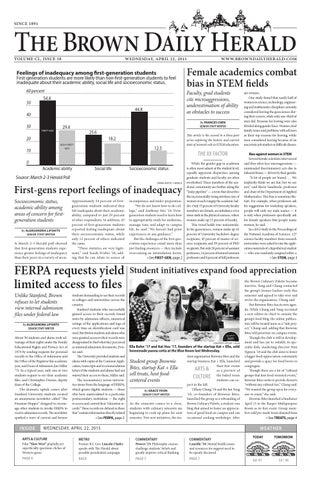
Feelings of inadequacy among first-generation students
First-generation students are more likely than non-first-generation students to feel inadequate about their academic ability, social life and socioeconomic status. 60 percent 50
30
Female academics combat bias in STEM fields
Faculty, grad students cite microaggressions, underestimation of ability as obstacles to success
54.4 44.8
40
WWW.BROWNDAILYHERALD.COM
By FRANCES CHEN FIRST-GEN
29.4
SENIOR STAFF WRITER
25.6
20
18.2 NON-FIRSTGEN
10
12.3
0 Social life
Academic ability
Socioeconomic status
Source: March 2-3 Herald Poll EMMA JERZYK / HERALD
First-gens report feelings of inadequacy Socioeconomic status, academic ability among areas of concern for firstgeneration students By ALEKSANDRA LIFSHITS SENIOR STAFF WRITER
A March 2-3 Herald poll showed that first-generation students experience greater feelings of inadequacy than their peers in a variety of areas.
Approximately 54 percent of firstgeneration students indicated they felt inadequate about their academic ability, compared to just 29 percent of other respondents. In addition, 45 percent of first-generation students reported feeling inadequate about their socioeconomic status, while only 12 percent of others indicated the same. “These statistics are very legitimate,” said Isaiah Frisbie ’18, adding that he can relate to senses of
incompetence and under-preparation. “We do not know how to do college,” said Anthony Mei ’18. Firstgeneration students need to learn how to appropriately study for midterms, manage time and adapt to campus life, he said. “We haven’t had prior experiences or any guidance.” But the challenges of the first-generation experience entail more than just finding resources — they include overcoming an intimidation factor, » See FIRST-GEN, page 2
This article is the second in a three-part series exploring the history and current state of women’s role in STEM education.
THE XX FACTOR While the gender gap in academia is often most salient at the student level, equally apparent disparities among graduate students and faculty are often overlooked. These members of the academic community are further along the “leaky pipeline” — a term that describes the incrementally rising attrition rate of women at each rungup the academic ladder. Only 33 percent of University faculty members are female, an imbalance even more stark in the physical sciences, where women make up 15 percent of faculty. This trend holds true nationwide. In the geosciences, women make up 42 percent of University bachelor’s degree recipients, 45 percent of master of science recipients and 39 percent of PhD recipients. But only 26 percent of assistant professors, 14 percent of tenured assistant professors and 8 percent of full professors
are women. One study found that nearly half of women in science, technology, engineering and mathematics disciplines seriously considered leaving the geosciences during their careers, while only one-third of men did. Reasons for leaving were also divided along gender lines. Women cited family issues and problems with advisers as their top reasons for leaving, while men considered leaving because of an uncertain job market or difficult classes. Bias against women in STEM Several female scientists interviewed said they often face microagressions — unintended discriminatory acts due to inherent biases — driven by their gender. “A lot of people are biased. … We implicitly think we are fair, but we are not,” said Bjorn Sandstede, professor and chair of the Department of Applied Mathematics. This bias is sometime blatant. For example, when professors ask for suggestions for workshop speakers, people will only say male names — it is only when professors specifically ask for female speakers that people name women, he said. In a 2012 study in the Proceedings of the National Academy of Sciences, 127 science faculty members from research universities were asked to rate the application materials of a hypothetical student — who was randomly assigned either a » See STEM, page 3
FERPA requests yield Student initiatives expand food appreciation limited access to files Unlike Stanford, Brown refuses to let students view internal admission files under federal law By ALEKSANDRA LIFSHITS SENIOR STAFF WRITER
About 50 students and alums took advantage of their rights under the Family Educational Rights and Privacy Act of 1974 by sending requests for personal records to the Office of Admission and the Office of the Registrar this academic year, said Dean of Admission Jim Miller ’73. In a typical year, only one or two students request to see their academic files, said Christopher Dennis, deputy dean of the College. The dramatic uptick comes after Stanford University students created an anonymous newsletter called “The Fountain Hopper” designed to encourage other students to invoke FERPA to receive admission records. The newsletter sparked a wave of current and former
INSIDE
students demanding to see their records at colleges and universities across the country. Stanford students who successfully gained access to their records found notes by admission officers, numerical ratings of the applications and logs of every time an identification card was used. But Brown students and alums who were granted access to their records were disappointed to find what they perceived as minimal admission documents, Dennis said. The University provided students and alums with copies of the Common Application, transcripts and recommendation letters if the students and alums had not waived their access to them, Miller said. The inconsistency across universities stems from the language of FERPA, which grants eligible students — those who have matriculated to a particular postsecondary institution — the right to access and control their “education records.” These records are defined as those that “contain information directly related » See FERPA, page 2
COURTESY OF KAT + ELLA
Ella Bohn ’17 and Kat Hsu ’17, founders of the startup Kat + Ella, sold homemade panna cotta at the Blue Room last Wednesday.
Student group Brownie Bites, startup Kat + Ella sell treats, host foodcentered events By GRACE YOON SENIOR STAFF WRITER
As the semester comes to a close, students with culinary interests are beginning to cook up plans for next semester. Two new initiatives, the stu-
dent organization Brownie Bites and the startup business Kat + Ella, launched their first events as a preview of the baked treats students can expect in the fall. Tiffany Chang ’16 and Ho Jun Yang ’16, co-founders of Brownie Bites, launched the group as a rebranding of Brown Culinary Palette, a student-run blog that aimed to foster an appreciation of good food on campus and ran occasional cooking workshops. After
ARTS & CULTURE
the Brown Culinary Palette became inactive, Yang and Chang contacted the group’s former leaders early this semester and agreed to take over and revive the organization, Chang said. But Brownie Bites has its own agenda. While Chang and Yang recruited a new editor-in-chief to sustain the group’s food blog, the online publication will be treated more as a “side project,” Chang said, adding that Brownie Bites will prioritize on-campus events. Though the club is still in development and has yet to solidify its specialty dish, marketing director Nini Nguyen ’18 said the club aims to foster a bigger food-appreciation community and provide a space for food lovers to congregate. Though there are a lot of “cultural groups that host food-oriented events,” Brownie Bites seeks to provide desserts “without any cultural ties,” Chang said. “We wanted the group open for everyone to enjoy,” she said. Brownie Bites launched a fundraiser April 15 in the Kasper Multipurpose Room as its first event. Group members sold pre-made treats donated from » See TREATS, page 4
WEATHER
WEDNESDAY, APRIL 22, 2015
ARTS & CULTURE Film “Slow West” playfully yet superficially questions cliches of Western genre
METRO Former R.I. Gov. Lincoln Chafee speaks with The Herald about possible presidential campaign
COMMENTARY Powers ’15: Philosophy courses challenge students’ beliefs and greatly improve critical thinking
COMMENTARY Lanzillo ’16: Mental health issues and resources for support need to be openly discussed
PAGE 4
BACK
PAGE 7
PAGE 7
TODAY
TOMORROW
62/ 41
52 / 36
UNIVERSITY NEWS PAGE 2 • WEDNESDAY, APRIL 22, 2015
» FERPA, from page 1 to a student and which are maintained by an educational agency or institution or by a party acting for the agency or institution,” according to the U.S. Department of Education website. But the documents are not required to hold “specific information,” and institutions are allowed to destroy records without notifying students, according to the website. At the University, there has never been a practice of sharing internal admission notes, Miller said, adding that these notes are not for faculty or administrative use. “Each institution can constitute what determines a permanent record,” he said. Universities therefore range widely in what kinds of information they will release to students. Stanford, Harvard and Princeton grant access to admission officers’ comments and reader scorecards. The Penn admission office planned to remove “certain personal comments” from applicants’ files, the Daily Pennsylvanian reported in January. Columbia destroys readers’ scorecards before students matriculate, the Daily Spectator reported earlier this month. After news of Stanford students gaining admission file access broke in January, Yale changed its policy: its admission office now “regularly” deletes admission documents, the Yale Daily News reported in March. Brown is neither immediately destroying admission records nor allowing students to access the files, Miller said. The internal admission file, which is not considered part of the academic record and thus does not fall under FERPA, is destroyed the summer after a student graduates, he said.
Current students do not have the right to their admission files under FERPA — there is a distinction between the permanent academic record and the admission file, Dennis said. “This has been a source of national confusion for both students and institutions,” he said. After hearing about the Stanford case, Pratik Chougule ’07 requested his records under FERPA at Brown and at Yale Law School, expecting to see his admission details and reviewers’ notes. Yale Law School gave him a straightforward response and showed him his original application and application ranking, he said. The only documents that Yale did not reveal to him were his letters of recommendation, to which he previously waived his right. Shortly after Chougule’s request, Yale Law School destroyed all of its admission data, the Yale Daily News reported. Following his fruitful interaction with Yale Law School, Chougule was “doubly surprised” by Brown’s unresponsiveness. After Chougule sent a FERPA request to the Office of the Registrar, it took a few weeks to set up a meeting with Dennis. Dennis provided Chougule with “course takings and routine stuff ” and referred him to Brown’s General Council, Chougule said. The “whole process was off-putting,” he said, adding that the University could have at least provided him with the names of the admission officers who reviewed his application. “What are they trying to hide?” Chougule asked. “You would think (Brown) would want to be responsive to an alum” who is requesting records for his own interest without a political agenda, he said.
THE BROWN DAILY HERALD Ironically, the University’s unresponsiveness spurred him to consider involving other individuals and organizations — ones with better legal expertise. Though FERPA has increased transparency for some eligible students and alums across the country — even if not at Brown — it may have obfuscating effects in the long run. Higher education expert Stephen Nelson said one implication of more students requesting their records could be that officers will verbally discussing applicants instead of formally documenting their comments out of concern that notes could later be revealed. Admission offices could make sure to have “nothing in a file that couldn’t be in some way misread by a lawyer or the general public,” Nelson added. Nelson, who often writes recommendation letters, said he will generally not write anything that he could not later discuss with the student. But he would possibly be less candid if he knew a student would see it, he said. Since the McCarthy era, people have been fairly careful in the recent decades about what they record, Nelson said. “My guess is that no one has been documenting things like ‘close family friend of big donor,’” he said. It’s a “wink and nod” process, he added. Nelson said he does not expect the admission records that are revealed to the public to have any serious influence on the college application process. Though “most high school guidance counselors may not know every little detail of the admission process, they have a pretty good sense,” he said. The admission records will not tell them anything they do not already know, he added.
» FIRST-GEN, from page 1 Frisbie said. For example, many firstgeneration students encounter difficulty when choosing a concentration with little to no outside guidance. “I do not know how to approach people for advice. I feel like I am bothering them,” said Heidy Mendez ’17. As a first-year, Manuel Contreras ’16 was set on becoming an engineer after orientation — not because he liked it, but because a student “who looked like he knew what he was doing” told him to consider engineering. Contreras, a member of the Herald editorial page board, has since decided to pursue cognitive science. Mendez, who is concentrating in health and human biology and plans to attend medical school after Brown, said these feelings of confusion and academic inadequacy are especially prevalent in science, technology, engineering and mathematics courses. “In high school I was used to getting top grades, but coming here I had to get used to trying to maintain average grades,” she said. These challenges expand past the classroom for some first-generation students, creating a disconnect between home and the University. “I had a hard time bridging home life and school life all together,” Mendez said. “I wish I could tell (my parents) more about the things that go on in my life, but I fear that I am going to give them a wrong idea of what I am doing here,” Mendez said. For example, when Mendez consistently called home in the evenings before going to taekwondo practice, her parents became worried that she was dedicating too much time to a club rather than schoolwork. “That wasn’t the case,” she added. “I did not have the language to discuss college with my parents,” Contreras said, adding that his family first heard about Brown from doctors who worked at the hospital where his mother cleans. Contreras said his parents have never been able to visit campus. “My dad’s first instinct would probably be: ‘Can I do the landscaping here?’” he added. Due to the significant intersection between first-generation students and low-income students, first-generation students often feel pressure to pursue more traditional concentrations, several students said. “If I told my family I was studying archeology, they would ask: ‘What does that mean? What job can you get with that?’” Mei said, adding that many first-generation students grapple with their families’ expectations of financial success. Going to college for many firstgeneration students is more than an attempt to get a good education — it is about trying to improve their families’ economic standings, said Guadalupe Morales ’15. Posts on Brown University Class Confessions — a Facebook page that highlights experiences of students from diverse socioeconomic backgrounds — portray many of the challenges first-generation students face, said the founder of the page, Michael, whose name has been changed due to confidentiality concerns. Michael said he created the page because many students do not feel comfortable discussing class-related
concerns with their friends for fear that “they would be looked at differently.” Confessions on the page include: “I don’t think I’ve actually had a real conversation about my socioeconomic background with anyone outside of Facebook” and “I feel awkward when I say I couldn’t do something because ‘I had work’ and people assume I mean homework instead of my actual job.” Common concerns on the page include complicated relationships with friends and family from home, lack of openness with friends at Brown and culture shocks. Herald poll data corroborates this trend of difficulty connecting with other Brown students. Twenty-six percent of first-generation students indicated they feel inadequate about their social lives, marking a slight but statistically significant uptick from the 18 percent for students whose parents have attended college. While most Brown students come from families with college experience, the number of students identifying as first-generation has climbed significantly in recent years, said Dean of Admission Jim Miller ’73. This increase is a function of amplified outreach by admission officers and greater awareness of Brown as an option on the part of prospective first-generation students, Miller said. Admission officers decide which locations to visit and forge relationships with the hope of reaching out to students who have not been historically well-represented, he added. There are resources available on campus that address the statistic gap, provide guidance and help build community for first-generation students, wrote Dean of the College Maud Mandel in an email to The Herald. “All first-gen first-years are contacted during the summer, with events during orientation and throughout the year designed specifically for them,” Mandel wrote. From Feb. 27 to March 1, firstgeneration students from all over the Ivy League convened on College Hill for the first conference hosted by 1vyG, an organization started at Brown to provide a space for firstgeneration Ivy League students to connect. Students and administrators who participated in the 1vyG conference “were able to create an action plan that we will be working on this upcoming year,” Mandel wrote. “We hope that the conference will be hosted by another university next year and plan to support our students’ attendance then,” she added. But Morales said she did not feel like there was a place for first-generation students on campus prior to 1vyG’s inception. Though the University sends out many emails to first-generation students, few students attend the events because the University “does not make an effort to encourage a first-gen narrative,” she said. While it is comforting to graduate this year knowing that future students will have the 1vyG support network, the University “could make a larger effort to reach out to families,” she added. “There are a lot of ironies that are imbedded in the Ivy League firstgen,” Contreras said. “My family was first and foremost happy that I was going to college — it did not matter which one.”
UNIVERSITY NEWS
WEDNESDAY, APRIL 22, 2015 • PAGE 3
THE BROWN DAILY HERALD
The confidence gap For women starting out in STEM fields, it can be intimidating to be the only woman in the room, Lysyanskaya said, adding that not seeing others like themselves can make women feel different and uncomfortable. “When you’re in the minority, you’re less likely to take risks or speak up,” said Provost Vicki Colvin, who was previously a professor of chemistry and chemical and biomolecular engineering at Rice University. Sara Maloni, assistant professor of mathematics, said a number of female students have approached her to tell her they feel uncomfortable being the only woman in her class. She tries to console them by telling them about her own experience, she said. Women tend to be harder on themselves, Maloni said. “When women drop a class, they have a B average, whereas when men drop a class, they are often failing,” Maloni said. Because they are self-selecting, women who end up staying in the field tend to be better students than the average male, Lysyanskaya said. On average, “when a woman comes up with an idea, they are a little less confident. We think a lot before we say something and make sure that it makes sense. And men don’t always do that,” Ghosh said.
Balancing act The biggest issue women face is finding a work-life balance, Colvin said. “We’re a society of overachievers,” Lysyanskaya said. Society believes that women “have to do an amazing job with our career, with our kids and maintain a beautiful home. … We want to do a good job in every single thing, and it’s not easy.” Those entering academic careers often need to move around many different institutions before finding a permanent position, sometimes making it difficult for women who also want to start a family, Maloni said. “A career in academia is seen as a demanding job,” Colvin said.
Percentage of female faculty, by academic division Though women occupy less than half of faculty positions across academic divisions, the disparity is most dramatic in the physical sciences. 47% 38%
33%
31%
Source: Office of Institutional Research Brown offers faculty members benefits, such as six weeks of fully paid leave after the birth of a child, according to the University’s administrative policies. But not all faculty members take use of this leave. “After my first child, I went back to work after 10 days because of the pressure, even though I technically had parental leave,” said Professor of Physics Meenakshi Narain. “There’s a misconception that unless I’m 100 percent in, I can’t stay in a STEM field,” said Professor of Engineering Iris Bahar. But much of this pressure is selfimposed, and academia can actually offer much more flexibility than a job in industry, Colvin said. Industry requires people to work rigid hours, whereas an academic has much more flexibility on when and where they work, she added. “I have more flexibility in this job than any other job I could think of,” said Stefanie Tellex, assistant professor of computer science and engineering. Many of the women interviewed agreed that having a female mentor was important in showing them that they could balance an academic career with life outside of work. Tellex said when she started her career, she was unsure if she could achieve this balance. But when her postdoctoral adviser introduced her to female role models in the field, she realized she did not have to work crazy hours. “Because we are so few in number, it is really important to have a role model and mentor,” Narain said. “My thesis adviser was a woman, and she showed me how to be professional but also have a life,” she said. Another mentor of hers not only gave her professional advice but also “showed me the best strategies for teaching, and as
sc So ie ci nc al es
P sc hy ie sic nc a es l
Total
& sc me ie dic nc a es l
15%
s
Cultural and social norms Many professors interviewed cited cultural norms — such as expecting women to be the homemaker and the caretaker — as some of the reasons for the low numbers of women in STEM. “A simple thing such as expectation over gender roles has changed substantially in the past three decades,” said James Valles, professor of physics and chair of the department. “The working professional PhD woman is not an anomaly now. It’s much more common, … as are two breadwinner families.” “There’s this assumption that the woman is supposed to be the one taking a break from her career and not the man. Why should that be the case?” Lysyanskaya said. “Men have a life, too. Men have families, too, and they should also have their work-life balances. They shouldn’t be workhorses. The whole idea that work-life balance is a woman’s issue is really bizarre and makes no sense. The countries that are really progressive on this issue have not only maternal leave for mothers but also paternity leave for fathers,” she said. Mitrovic said one female graduate student approached her because she was upset by her mother’s disapproval of her choice to attend graduate school. The student’s mother expected her to get married and settle down and threatened to cut off communication after she chose to pursue graduate studies instead, Mitrovic said. “I couldn’t believe her story,” she said, adding that it was appalling to think a mother would disapprove of her daughter’s decision to go to graduate school. Mitrovic recommended that the student read a relevant book and value her independence. “She was never bothered by her mother’s thoughts again,” Mitrovic said. The student went on to finish her PhD and work as a postdoctoral fellow in a large lab in Germany, Mitrovic added.
Li fe
male or a female name — for a laboratory manager position. The researchers found that the faculty rated the male applicant as significantly more competent and more likely to be hired than the female applicant with an identical application. The male applicants were also offered a higher starting salary and more mentoring than the female applicants. Some female faculty members said they have had academic experiences that made them feel isolated from their predominantly male counterparts. Professor of Computer Science Anna Lysyanskaya said during graduate school she shared an office with a male classmate named Danny. Lysyanskaya said whenever she picked up the phone for Danny, people would assume she was a secretary rather than an officemate. She said she had to explain that she was not responsible for finding Danny or transcribing detailed messages for him. “If I were a man, I don’t think I would have to explain that. … It isn’t so much discrimination as constantly having to assert yourself,” she said. “These things really add up, and it kind of gets on your nerves.” During her time as an undergraduate in India, Esha Ghosh GS, who is studying computer science, said many of her male classmates had condescending attitudes toward women. She said they did not think women could be successful in STEM fields, but this drove her to perform well and prove them wrong. Even now Ghosh said she faces an implicit bias when collaborating with male colleagues. “When a woman says something, there’s a tendency to brush it aside, even though it’s correct. I had this issue with my collaborators where I had suggested something, but because I was saying it much more calmly, people would brush it aside. Eventually they would come back to the idea because it was a good idea.” “All of these microaggressions and everyday issues feed into the idea that this is not a woman’s field,” Ghosh said. Many of the professors interviewed mentioned that they are usually treated
with respect when working with those in their subdiscipline who know their work but often face problems outside of that circle. “There were a lot of problems going to conferences,” said Vesna Mitrovic, associate professor of physics. “People would flirt with you, and if you don’t go with them, then they say all sorts of things behind your back. They hold grudges against you,” she said. Mitrovic said she recently gave a talk after which a male audience member, unfamiliar with her field, offered rude criticism. As a woman in STEM, “it’s harder, but you just have to be careful and be around the right people.”
Hu m an iti e
» STEM, from page 1
JILLIAN LANNEY / HERALD
an assistant professor and a female, how to best project yourself,” she said. Narain still keeps in touch with her mentors and reaches out to them whenever she has a question, “personal or professional.” University initiatives The University has adopted policies and programs aimed at increasing the number of female and underrepresented minority faculty members through the Target of Opportunity program. “This program identifies women and underrepresented minorities and allows us to take a variety of measures to hire these groups,” Colvin said. The administration also works with individual departments to make it easier for them to hire women in STEM disciplines. They do this by allowing hiring off-season and even creating new positions for talented female candidates. “We normally have a search season to find new faculty, but there could be a small pool during this time, and there may not a good balance of women in the pool,” Valles said. If an impressive female candidate becomes available mid-year, a department may be able to hire her if the University reacts quickly and creates a position for her. If other departments are also seeking to enhance diversity, then the competition can be fierce, so it is very important to be nimble, he said. The University also offers a program called Back-Up Care, in which faculty members can call and have a child caretaker sent to their home, Lysyanskaya said. Several professors interviewed said guidelines for family-friendly policies were brought up at a recent faculty meeting. One of the guidelines suggested was that no meetings should be held after 5:30 p.m. in order to respect the work-life balance of faculty with family obligations.
ARTS & CULTURE PAGE 4 • WEDNESDAY, APRIL 22, 2015
THE BROWN DAILY HERALD
‘Slow West’ reimagines Western genre Film employs absurdist, existentialist lens to question cinematic cliches of Wild West By SHIRA BARTOV CONTRIBUTING WRITER
The artfully absurdist reformulation of Western film cliches is sure to confound anyone who expects a typical Western from “Slow West,” a film directed by John Maclean. Students were treated to an early screening at Avon Cinema Thursday as part of the Ivy Film Festival. The film’s premise is simple enough: Wide-eyed, naive Scottish boy Jay Cavendish, played by Kodi Smit-McPhee, traverses 1870s Colorado in pursuit of the woman he loves. He joins forces with the tough-hearted Silas Selleck, played by Michael Fassbender, who
REVIEW
» TREATS, from page 1 Seven Stars Bakery and the Duck and Bunny. But they added a twist to an otherwise typical bake sale by simultaneously holding a demonstration session. “We wanted to do it in a way that made us more distinct,” Nguyen said. For the demo, Brownie Bites presented a collection of do-it-yourself desserts in Mason jars. They initially researched online recipes for the desserts, which included Oreo cheesecake and banana cream pudding and later modified them to “fit our own needs,” Chang said. For instance, they used egg substitutes for the banana cream pudding and created their own special filling for the chocolate pudding, she added. Meanwhile, Kat Hsu ’17 and Ella Bohn ’17, founders of Kat + Ella, hosted their second panna cotta sale at the Blue Room the same day. Due to popular demand, they set up their second
takes up the classic Western style of brutish, dry-humored and monosyllabic charisma. Though Silas’s ulterior motive for following Jay to his beloved is a bounty over her head, the steely man’s outlook predictably softens toward his companion as their treacherous journey unfolds. Apart from some clever deviations, these protagonists are solidly identifiable types. Similarly, the landscape they cross is skillfully dramatized — a savagely beautiful yet ultimately derivative vision of the Wild West. The film’s allure lies in its existential interrogation of its own paradigm. What starts as a straightforward plot becomes repeatedly interrupted by outbursts of satiric humor, philosophical digressions supplied by a cast of surreal background characters and dumbfounding violence that is selfconsciously and bewilderingly pointless. These jarring and sometimes distressing elements eventually prove not to be interferences at all, but rather
the heart of the film. Its mounting absurdism tears into the fragility of its characters and the human beliefs they represent. But the crucial question we ask of absurdism is whether it has a meaning. Generally, the characters of “Slow West” remain abstractions. Investigations into their psyches never reach considerable depth before they are cut short. Yet there is a palpable and unshakable melancholy throughout the film that moves us, if not to empathize with its figures, then at least to mourn their existential conditions. The last scenes are at once the most absurd — the most brashly defiant of our expectations — and the most wistful and poignant. In the end, “Slow West” refuses both to fulfill a classic Western’s promises and resolve its own moral dilemmas. The ideals that it throws into question are neither validated nor destroyed. They are ridiculed, honored, shot at, then finally shrugged at and tucked in a drawer.
round of sales within a week after their first one, Bohn said. Hsu and Bohn, both members of French House, shared their passion for food and event planning when they teamed up to coordinate the program house’s first-ever formal in December, Hsu said. Subsequent dinner parties at which friends praised their panna cotta sparked the idea for their business, she said. While Hsu and Bohn researched online recipes for the base of their panna cotta, they continuously experiment with various toppings. For their second sale, they infused the panna cotta base with black tea, while most of their other items stayed a conventional vanilla, Bohn said. Kat + Ella will likely host another panna cotta sale as part of the Earth Week Fair this weekend, Hsu said. The duo will also prepare a three-course dinner party May 1 in the hopes of showcasing their culinary finesse.
“It’ll be a starting point to get our name out there,” Hsu said, adding that she eventually aims to solidify Kat + Ella’s identity as a catering organization for other student groups. By comparison, Brownie Bites is “more of a recreational organization,” Chang said. The group will resume its bake-andmake sessions next semester. Group members aim to introduce an array of events that are fun and informative, she said, adding that ideas include Iron Chef competitions and a panel for professors to share their research on food and agriculture. Looking beyond College Hill, the group also anticipates collaborating with students from Johnson and Wales University, capitalizing on its culinary arts program. “We’re still in development, so we’re still open to student feedback,” Chang said. “How Brownie Bites will take shape — that’s something to be on the lookout for.”
This Week in Higher Ed BY EMMA HARRIS, UNIVERSITY NEWS EDITOR
Gender discrimination at UCLA research center An external investigation at the University of California at Los Angeles reported that female faculty members were subjected to a “climate of conflict, tension, hostility and mistrust,” for about 10 years at the university’s Alzheimer’s disease research center, the Los Angeles Times reported Saturday. The female researchers were treated in an “unprofessional, demeaning manner,” the report stated. In a leaked letter to the faculty and staff of the David Geffen School of Medicine at UCLA, Vice Dean for Faculty Jonathan Hiatt wrote that three women had repeatedly reported instances of mistreatment by male colleagues to administrators before university action was taken, the Times reported. While the investigation concluded in October, Hiatt’s letter was written in March and leaked to the media this week. Hiatt wrote in the letter that the department of neurology had undergone changes as a result of the investigation, including the appointment of a new interim department chair, Marie-Francoise Chesselet, and the creation of a new position to oversee gender discrimination in the center, the Times reported. The letter did not indicate that any faculty members had been disciplined as a result of the complaints.
University of Wisconsin to cut 400 employee positions Chancellor Becky Blank of the University of Wisconsin at Madison wrote on her official blog Friday that state budget cuts will force the university to eliminate about 400 positions and discontinue certain programs over the next two years. Though out-of-state tuition has increased, there is still a “structural deficit that may be as much as $96 million as a result of state budget cuts in the upcoming fiscal year,” Blank wrote. Programs such as those in information technology, agriculture and arts will be closed or merged with other programs, Blank wrote. Job cuts will probably lead to “larger classes and fewer course options,” while there will also be a less robust advising system, potentially leading to lower retention rates and fewer degrees awarded, she wrote. Support services, including IT support, and building and facilities maintenance will also be reduced. The university is advocating a smaller budget cut, but it must prepare for the cuts to be implemented in the new fiscal year, which begins July 1, Blank wrote.
Three shot at Delaware State Greek cookout Three people were shot at a fraternity and sorority event at Delaware State University Saturday evening, USA Today reported Sunday. Thousands of community members were celebrating at the annual Field Day cookout Saturday before the incident occurred. Shots were fired around 8 p.m. in a central campus location, then again a few hours later at 1:15 a.m. in a student housing area. No one was injured in the second shooting, USA Today reported. Victims were taken to Kent General Hospital in Dover, President Harry Williams wrote in a statement. They were all reported to be in stable condition Saturday night. It has yet to be clarified as to whether the victims are students, USA Today reported.
www.browndailyherald.com
TODAY
WEDNESDAY, APRIL 22, 2015 • PAGE 5
THE BROWN DAILY HERALD
menu
a s u n n y d ay o n c o l l e g e h i l l
SATELLITE DINING JOSIAH’S Gourmet Grilled Cheese BLUE ROOM Mediterranean Pocket Soups: Baked Potato, Tomato Florentine, Hearty Country Vegetable ANDREWS COMMONS Pizzas: Honey Boo Boo, Thai BBQ, Mushroom Madness
DINING HALLS SHARPE REFECTORY LUNCH
DINNER
Chicken Cutlet Parmesan Sandwich, Spinach Pie Calzone, Honey Citrus Vegetable Sautee
Seafood Cavatelli, Red Potato Fritatta, Stir Fried Carrots with Lemon and Dill, Parslied Rice
VERNEY-WOOLLEY LUNCH
DINNER
Steak and Pepper Fajitas, Black Bean and Spinach Soft Taco, Swiss Fudge Cookies
Chopped Sirloin Patty with Onion Sauce,Vegan Garden Chili, Sunflower Bread
sudoku
SADIE HOPE-GUND / HERALD
Students admitted regular decision arrived on campus Tuesday toting suitcases and high expectations for A Day on College Hill, the University’s annual three-day showcase of academic offerings and student life.
comics Class Notes | Philip Trammell RELEASE DATE– Wednesday, April 22, 2015
Los Angeles Times Daily Crossword Puzzle c rNorris o s sandwJoyce o rNichols d Lewis Edited by Rich ACROSS 1 Source of fine wool 7 Flotation device 11 24-hr. banking service 14 Thingamabob 15 “__ the Woods” 16 La Mancha Mrs. 17 Chinese course in a bowl 19 Elton John’s title 20 “Vive __!” 21 Milk source 22 Assuage 25 Reason to skip the Skippy 29 Plastered 30 Believer’s suffix 31 One working in a studio 32 Like a ballerina 34 38th-parallel land 35 Classic cop show catchphrase 39 Enjoys a bistro, with “out” 40 Set of moral precepts 43 Hanukkah toy 46 Expected 48 “Don’t think so” 49 Browse on Madison Avenue, say 51 Excellent 52 Tequila sunrise direction 53 Siouan speakers 55 Director Ang 56 Begin working, and a hint to the starts of 17-, 25-, 35- and 49Across 62 P.O. delivery 63 Without restraint 64 Serengeti heavyweights 65 Help-wanted sign? 66 Word on some family business signs 67 “Gracias” reply DOWN 1 Fruity drink 2 Fuel for the fire 3 Faddish ’90s disc 4 Confuse 5 Part of TLC 6 Festoons
7 Call on 8 “Small Craft on a Milk Sea” musician 9 “The Simpsons” disco guy 10 Tank or tee 11 Claim with conviction 12 Emergency priority system 13 Saint Agnes, e.g. 18 Sulk 21 One living in a studio 22 Keebler spokesman 23 Feel poorly 24 Bump, as a toe 26 Like two peas in __ 27 Croft of video games 28 Holder of a collateral loan 30 Enthusiastic yes 33 Table salt additive 34 Irish rd. sign abbreviations 36 “... Yorick! I __ him, Horatio” 37 Slippery ones 38 “That’s terrible!”
41 “Atonement” novelist McEwan 42 Ally of Fidel 43 Lives 44 Meet, as a challenge 45 Signs up for 46 Bouncer’s post 47 __ mobility 50 Sticks figures 51 Invite for a nightcap, say 54 Throb
56 Fun time 57 Punk rock subgenre 58 Exaggerated homework amount 59 “Barefoot Contessa” host Garten 60 Agree quietly 61 Govt. procurement agency
Ampersand | Wasita Mahaphanit
ANSWER TO PREVIOUS PUZZLE:
xwordeditor@aol.com
calendar
04/22/15
TODAY
TOMORROW
5:30 P.M. “THE ART OF AMERICAN BOOK COVERS”
12:00 P.M. TOUR OF THE RATTY
Book artist and scholar Richard Minsky will give a talk on book cover art from 1875 to 1930, using examples from Brown’s collections. John Hay Library, Lownes Room
The Undergraduate Council of Students and Dining Services will offer a tour of the Sharpe Refectory kitchens and explain how food is prepared at the facilities. Sharpe Refectory
7:00 P.M. THE STATE OF BROWN ADDRESS
4:00 P.M. “BROWN UNIVERSITY AND THE EDUCATION
At this annual event sponsored by the Undergraduate Council of Students, President Christina Paxson P’19 will discuss current issues at Brown, with a question and answer period to follow. Metcalf Auditorium
OF AMERICA”
Nancy Beadie of the University of Washington and John Thelin of the University of Kentucky will discuss the lives and work of Horace Mann, Alexander Meiklejohn and Henry Wriston. Salomon 001
7:00 P.M. “ALIVE INSIDE” SCREENING
Alzheimers Activists will present a screening of the documentary “Alive Inside,” which examines the healing power of music. MacMillan 115 By Marti DuGuay-Carpenter ©2015 Tribune Content Agency, LLC
04/22/15
8:00 P.M. ARTBEAT RECYCLED GARDEN
In honor of Earth Week, participants will be able to make a flower or leaf out of an aluminum can for an art installation to be displayed on the Main Green. List 225
COMMENTARY PAGE 6 • WEDNESDAY, APRIL 22, 2015
THE BROWN DAILY HERALD
EDITORIAL
Spend a summer in Providence As 700 prospective students visit for A Day on College Hill while another 1,500 students prepare to graduate and become alums, it is funny to stop and realize how cyclical Brown truly is. Each year, Brown transforms students into scholars and serves as a place where ideas form, dissipate and then reemerge as novel a few short years later. Poetic waxings about Brown aside, there are not enough opportunities along this cycle to stop and reexamine one’s journey, to reflect and reevaluate one’s standing in the world. As wonderful as school breaks are, students often spend this time developing their resumes or chasing accolades. While these pursuits are important, more students would benefit by slowing down on these breaks and reflecting. Students should consider spending at least one summer in Providence — not at Brown per se — to appreciate the city and their individual experiences on College Hill a little bit more. Each summer, as Brown students distribute themselves around the globe, a couple hundred of us move out of our dorms and down a few blocks into old Victorian houses, either as leasers or as subletters. Reasons for staying in Providence range widely, including conducting research with a professor, interning for a local nonprofit or working to save up for the Expected Student Contribution. Whatever their reasons for staying, these individuals help form a community of Brown students who would never have otherwise met or interacted. A summer in Providence introduces them to housemates, co-workers and new friends. Summer disrupts seemingly fixed friend groups, encouraging all students to mingle across years, disciplines and experiences and form strong bonds that carry over into the next school year. More importantly though, spending time in Providence — when Brown is not necessarily the focal point — is a remarkable opportunity to realize that Providence continues beyond Thayer, Angell and Waterman Streets. Providence is home to more than 175,000 dynamic people. Spending a summer in Providence is an opportunity for students to not only live in Providence, but also to contribute to our city’s community. Instead of just watching Waterfire, consider volunteering for the organization and lighting those braziers yourself. March in the PrideFest parade in June. Use your free Rhode Island Public Transit Authority access to travel to small towns along the coast, see the Newport cliffs or go on a hike. Learn to survive New England humidity. By spending a summer in Providence, you have an opportunity to experience Providence’s culture in a way that seems nearly impossible during the school year — an experience that is but a mere walk or bus ride away. Living in an off-campus house thrusts you into adulthood: for many students, its the first time they have cooked, cleaned and paid household bills themselves. Tranquil living requires you to learn to communicate expectations, rotate chores and coexist with your fellow housemates. These lifelong skills cannot be taught in a classroom; they must be experienced. One of the most stunning realizations from spending a few months untethered to Brown’s campus in Providence is how small the campus truly is. Your life in Providence does not need to revolve around the Main Green or the Sharpe Refectory. At the same time, spending some time on campus outside of the academic year can help you appreciate the unique character of the Brown community. This summer, like the rest of your Brown experience, is yours to shape. Spend it how you would like, but never take for granted the communities around you.
M I R A N DA F R I E L
LETTER TO THE EDITOR
Physical evidence not immune to power To the Editor: In reference to your editorial (“Response to Emma Sulkowicz’s talk,” April 19), I want to clarify that my position, like yours, is that survivors should seek justice and get rape kits done and allow testing for date-rape drugs. Of course, this is only if they feel comfortable doing so, for the police can often traumatize survivors further, and I in no way mean to be prescriptive about any sort of universal healing process. I brought up the issue of date-rape drugs in my speech
“I did not have the language to discuss college with my parents.” — Manuel Contreras ’16
See first-gen on page 1.
Letters, please! letters@browndailyherald.com
Editorial Leadership
Sections
Visuals & Production
Business
Editors-in-Chief Michael Dubin Maxine Joselow
Arts & Culture Editors Eben Blake Gabrielle Dee
General Managers Sarah Levine Winnie Shao
Managing Editors Kiki Barnes Jillian Lanney
Metro Editors Alexander Blum Emma Jerzyk Drew Williams
Design Editors Loren Dowd Carlie Peters Taylor Schwartz Assistant: Meryl Charleston Assistant: Andrew Linder
Science & Research Editors Andrew Jones Steven Michael
BLOG DAILY HERALD Editor-in-Chief David Oyer
Sports Editors Andrew Flax Alex Wainger
Managing Editors Deena Butt Jacob Koffler
University News Editors Emma Harris Caroline Kelly Joseph Zappa
POST- MAGAZINE Editor-in-Chief Adam Asher DIGITAL Online Editor Marcy Huang
COMMENTARY Editorial Page Editors Alexander Kaplan James Rattner Opinions Editors Megan GrapengeterRudnick Kate Kiernan Evan Sweren
Photo Editors Head: Brittany Comunale David Deckey Katie Liebowitz Arjun Narayen Ashley So Ryan Walsh Graphics Editors Avery Crits-Christoph Emma Jerzyk Web Producers Joe Stein Harsha Yeddanapudy Abdullah Yousufi Copy Desk Chief Madeline DiGiovanni Illustrations Editor Angelia Wang Video Editor Richard Flores
Emma Sulkowicz
Q U O T E O F T H E D AY
Editorials are written by The Herald’s editorial page board: its editors, Alexander Kaplan ’15 and James Rattner ’15, and its members, Natasha Bluth ’15, Manuel Contreras ’16, Baxter DiFabrizio ’15, Mathias Heller ’15 and Aranshi Kumar ’17. Send comments to editorials@browndailyherald.com.
Senior Editors Camilla Brandfield-Harvey Isobel Heck Molly Schulson
(which apparently some found hard to follow) to examine a more nuanced, post-structuralist argument concerning the nature of truth. My point is that all objective and scientific evidence is vulnerable to being dismantled and dismissed by those who have the balance of power in their favor. Recent articles in The Herald suggest that others have the same worry (“Corporation ties to student accused of serving GHB questioned,” March 6).
Directors Sales: Moniyka Sachar Sales: Jess Urrutia Finance: Josh Tartell Alumni Relations: Marley Rafson Business Dev.: Yuta Inumaru Sales Managers Matthew Meyer Henry Ritter Gulmira Hamit Taylor Casey
facebook.com/browndailyherald
Location: 195 Angell St., Providence, R.I. www.browndailyherald.com
@the_herald
Editorial contact: 401-351-3372 herald@browndailyherald.com
browndailyherald.com
Business contact: 401-351-3260 gm@browndailyherald.com
Corrections: The Brown Daily Herald is committed to providing the Brown University community with the most accurate information possible. Corrections may be submitted up to seven calendar days after publication. Commentary: The editorial is the majority opinion of the editorial page board of The Brown Daily Herald. The editorial viewpoint does not necessarily reflect the views of The Brown Daily Herald, Inc. Columns, letters and comics reflect the opinions of their authors only.
Finance Managers Collections: Neil Wathore Collections: Benjamin Wesner Operations: Carin Papendorp
Letters to the Editor: Send letters to letters@browndailyherald.com. Include a telephone number with all letters. The Herald reserves the right to edit all letters for length and clarity and cannot assure the publication of any letter. Please limit letters to 250 words. Under special circumstances writers may request anonymity, but no letter will be printed if the author’s identity is unknown to the editors. Announcements of events will not be printed.
Business Dev. Manager Project Leader: Kaden Lee
Advertising: The Brown Daily Herald, Inc. reserves the right to accept or decline any advertisement at its discretion. The Brown Daily Herald (USPS 067.740) is an independent newspaper serving the Brown University community daily since 1891. It is published Monday through Friday during the academic year, excluding vacations, once during Commencement and once during Orientation by The Brown Daily Herald, Inc. Single copy free for each member of the community. Subscription prices: $280 one year daily, $140 one semester daily. Copyright 2015 by The Brown Daily Herald, Inc. All rights reserved. Periodicals postage paid at Providence, R.I. Postmaster: Please send corrections to P.O. Box 2538, Providence, RI 02906.
COMMENTARY WEDNESDAY, APRIL 22, 2015 • PAGE 7
THE BROWN DAILY HERALD
Why study philosophy? ANDREW POWERS opinions columnist
When I first walked into my first philosophy class, PHIL 0750: “Epistemology,” I didn’t know exactly what to expect. What is the study of knowledge and why should I care about it? I thought philosophy would offer an environment in which I could say and write anything without criticism. I saw philosophy classes as abstract art viewings or TED Talks about innovation — you throw around a lot of buzzwords and everyone nods in agreement. Little did I know that the course would encourage me to properly engage in arguments and to be more amenable in many aspects of my life. There’s a joke philosophers often hear from disdainful mathematicians: Math departments deserve more funding because they need pencils, paper and trashcans, while philosophy departments need only pencils and paper. Unfortunately, I quickly found this isn’t at all true. In my first couple of philosophy lectures, I raised my hand to ask some smart-ass ques-
tion, only to have my stupidity carefully unpackaged and made public by the professor. Never have my ideas been more thoroughly dismantled than in the margin scrawlings of graded papers, and given Brown’s ideological homogeny, it’s invaluable to have one’s beliefs seriously challenged. It encourages an open mind — an essential asset that can be applied to almost any situation. The inaccurate view that philosophers will buy any argument stems
supposed to provide rational justification for someone to change his or her view. Thus, the quality of an argument is solely a function of the reasoning it uses and has nothing to do with the conclusion it entails. If you disagree with an argument simply on the grounds that the conclusion sounds unreasonable, you’re not actually engaging the argument. Engaging the argument also does not mean providing an argument that comes to the opposite conclusion.
counterintuitive conclusions, but philosophers go where their reasoning takes them, whether they like it or not. Personally, I find this commitment to emotional sterility intellectually admirable, even endearing. But most Brown students consciously choose not to think in such a rigorous manner. Our university’s activist culture is more concerned with being loudly convincing than logically coherent. One online commenter noted on a previous article of mine that the priority is to “Make
It’s invaluable to have one’s beliefs seriously challenged. from hearing about all of the seemingly absurd views to which they subscribe. Who can genuinely consider arguments that show that killing babies is justified, that we live in a computer simulation or that we should pick one box in Newcomb’s problem? But these judgments of arguments based on their conclusions defeat the stated purpose of argumentation. When two people argue, each person obviously thinks the other’s conclusion is wrong. An argument is
As with any other academic subject, the techniques of constructing and analyzing arguments are ones that can be improved through consistent practice. A friend of mine once noted that many people — including my freshman self — see philosophers as professional “bullshitters.” But as we see, this couldn’t be further from the truth. Philosophy is all about recognizing and picking apart bad arguments while accepting good ones. At times, this can lead to superficially
Change” rather than to pursue the truth. Refusing to properly engage your opponents’ arguments is fine if you’re morally infallible, but it’s naive otherwise. It’s natural to have predilections for certain conclusions, but emotional attachments inevitably come with irrational biases. If there’s one life lesson I’ve taken away from philosophy, it’s that we should keep our minds open. There are always intelligent people on every side of a debate. Formalizing one’s own ideas is
a fruitful exercise in any context — many times I have started writing a paper only to realize my argument isn’t nearly as convincing as I had thought. But philosophy further requires students to consider the ideas of those with whom they disagree. When writing a paper, it’s not enough to contradict an opposing view — one is expected to refute it. Critiquing an opponent’s view demonstrates far more thought and understanding than putting forth one’s own views. Coming up with and addressing the strongest possible counter arguments — including those the opponent didn’t propose — forces one to consider the controversial nuances of the discussion. Often there’s at least one counter argument with more bite than initially expected. So I would encourage all Brown students to take at least one philosophy class in their time here. While the material might not be directly applicable to real life, the critical reasoning skills garnered are useful in nearly any context.
Andrew Powers ’15 can be reached at andrew_powers@brown.edu.
Finding order amidst disorders ELIZA LANZILLO guest columnist
Initially, when Andrea Petersen of the Wall Street Journal asked to interview me for her piece on transitioning to college with mental health issues, I was ambivalent. As president of Brown’s chapter of Active Minds, a nonprofit organization that strives to reduce the stigma surrounding mental illness, I welcomed the opportunity to speak out about the availability of mental health support and resources for students entering college. But I was not particularly keen on having my own battle with anorexia and anxiety reported in the Wall Street Journal. I would be revealing a part of myself that I had tried to hide for so long. Nevertheless, I decided that my failure to talk about these issues would only contribute to the stigma surrounding eating disorders and mental illness. I wanted to be part of the solution, not the problem. My battle with anorexia began when I was 16 years old, attending an international boarding high school in Wales, U.K. I found myself in a highly competitive academic environment, surrounded by 170 other highachieving students. Ultimately, my stress and anxiety manifested in an eating disorder. My senior year was particularly difficult, but after finally acknowledging my illness and seeking treatment, I started to recover. My transition to Brown coincided with the first few months of my recovery process from anorexia. I did not really consider how the transition would affect my anxiety and recovery, and I viewed my entrance to Brown as a
new beginning. I refused to recognize the potential risk factors and triggers for relapse. But during the process of adjusting to new classes and expectations, making new friends and becoming involved in extracurricular activities, things began to feel like they were spiraling out of control. In order to cope with these feelings, I once again began to restrict my eating. After a period of denial, I was forced to acknowledge and accept that I needed help. My experience gives me insight into how to help students who are transitioning to college with mental health issues. I recommend that
vices can be criticized for the exact issues addressed in Peterson’s article — long wait times to set up an appointment and a limit on the number of sessions available to students — CAPS remains an excellent resource for students, especially for obtaining referrals for treatment in the community. Additionally, CAPS offers support groups for students who are survivors of sexual assault, students transitioning back to Brown after a medical or personal leave and students with obsessivecompulsive disorder, attention deficit hyperactive disorder and chronic medical condi-
I decided that my failure to talk about these issues would only contribute to the stigma surrounding eating disorders and mental illness. I wanted to be part of the solution, not the problem.
these students set up a support network and find out what resources are available to them on and around campus. It is important to do this right away. Petersen correctly noted that many young people who have battled eating disorders or other mental illnesses frequently relapse within years of treatment. She also accurately observed that the college environment, including the life changes and academic and social stresses it typically involves, can be particularly triggering for relapse. Even if you believe, as I did, you are not at risk of relapse, it is prudent to determine the resources available while you are not facing a crisis. While Counseling and Psychological Ser-
tions. Though support groups or group therapy may seem intimidating at first, I have found it extremely beneficial to confide in people my own age who have faced challenges similar to my own. CAPS has great potential but remains hamstrung by insufficient resource allocation from the University. While the administration has shown significant progress in recognizing the importance of mental health on campus, it needs to dedicate more funding to the resources available to students and be more transparent with the student body with regard to policies related to mental health, such as forced medical leave.
In addition to establishing a support system, one must learn to recognize individual risk factors and triggers. These will vary from person to person. For some, like me, comments about others’ physical appearance and eating habits, certain locations on campus and academic stress could all be triggering. Being mindful and aware of these triggers allows me to use strategies I have acquired in treatment to cope in a healthy manner. Family support, if available, is also extremely helpful. In my circumstance, I was very fortunate. My experience with anorexia and anxiety became a family affair. My parents and sister continue to provide me with endless support. I would advise parents in this situation not to fear that their child is succumbing to a challenge that they had previously overcome. Denial is never good — for the parent or the student — and recovery is a process, not an instantaneous event. Parents should be prepared for resistance and may recognize the problem long before their son or daughter does. Most importantly, a working relationship that allows candid communication with parents regarding issues of mental health is critical. These are the resources and strategies that allowed me to confront and overcome my prior struggles with an eating disorder, and they remain with me should I ever face a similar challenge in the future. I hope what I have learned in my struggle is useful to others facing their own.
Eliza Lanzillo ’16 is a psychology concentrator and the co-president of Brown’s chapter of Active Minds. She can be reached at elizabeth_lanzillo@brown.edu.
METRO THE BROWN DAILY HERALD
WEDNESDAY, APRIL 22, 2015
Q&A: Possible presidential hopeful Chafee eyes international influence Former R.I. governor speaks on foreign policy, party shifts in months before potential clash with Clinton By DREW WILLIAMS METRO EDITOR
Though he has not officially announced his intention to seek the Democratic presidential nomination in 2016, former Rhode Island Gov. Lincoln Chafee ’75 P’14 P’17 has already started to lay out a framework for his candidacy. Chafee spoke with The Herald about his decision to consider running, the issues that drive him and what sets him apart from frontrunner Hillary Clinton. The Herald: What was the timeline for your announcement of the presidential exploratory committee? Was there any particular event that set it in motion? Chafee: No, just what’s happening around the world, a cumulative sequence of events. We saw the rise of ISIS, and some of the ramifications of bad decisions in the Middle East and North Africa led me, after I concluded my term as governor, to consider this run. What is your motivation in running for president? We can do better internationally. America’s been acting with our biceps, not our brains, and making bad decisions that have major consequences for future generations. What do you offer voters? It’s really three things: a record of accom-
plishments as a mayor, as a U.S. Senator and as a governor. It’s also a vision — I have a clear vision of what I want to do not only internationally, but domestically. And lastly, character— I’ve been in service for 30 years and there’s never been any questions about my ethics. In a recent interview with CNN, you attribute your dissatisfaction with the Republican Party to the leadership of President George W. Bush, though you have said in the past that you strongly supported his father. What was it that drew you to the party of President George H.W. Bush, and do you believe the party can ever return to that? I made the decision to disaffiliate based on my belief that we’re not going to go back to the old Republican Party that welcomed and embraced liberal social policies and had the intention of making sure we took care of the books. Now it’s completely flipped. It’s totally fiscally irresponsible. The Republican Party — they don’t pay for what they buy, and they’re focused on social issues. I made the decision to leave after a lot of thought, exactly to that question: Will it ever come back? And I just don’t think it will. You have brought foreign policy to the front of the discussion in the last couple of weeks, especially in reference to your Senate voting record. But it could be argued that, since your
election as governor in 2010, you have not had much interaction with U.S. diplomacy. What experience do you bring to this area, particularly considering the rise of foreign policy issues in the Middle East and Russia? In the Senate, I was on the Foreign Relations Committee. I chaired the Subcommittee on the Western Hemisphere and traveled throughout South America and know those issues fairly well. Then I chaired the Subcommittee on the Middle East and North Africa subsequently, and I traveled throughout the Middle East, and I know the issues there. After I left the Senate, I spent two and a half years at the Watson Institute for International Studies at Brown. And then I was chosen to be on a board that worked in Ukraine — I think I made 12 trips to Ukraine. So yes, since I became governor I focused on state issues, but it’s not that long ago that I was involved in international issues, and I have a passion for them. Lastly, even as governor, they invited three governors to travel to Kuwait and Afghanistan, and of course I accepted. In your announcement video, you praised President Obama for reviving the economy. What specifically do you think he has done well, and how would you build off of that? I was in the Senate when all of those Bush tax cuts were flying through that favored the wealthy, and I voted against all of them. I was concerned that they were going to jeopardize our economy, and they did. So Obama, when he came in, was very methodical. There was a
mix of austerity and stimulus, and we’re seeing a recovery. We’d all like it to be better and we’d like to close the income inequality gap, but at least we’re seeing recovery, and I give him credit for that. Rhode Island is currently tied for the nation’s 10th highest unemployment rate and has struggled at attracting new businesses to create jobs. How did you tackle the economic downturn during your time as governor, and do you think Rhode Island’s situation would prepare you well for the national economic recovery? First of all, the facts are that when I took office, the unemployment rate was 11.4 percent. And today the unemployment rate is 6.3 percent. To answer your question — is this transferable to a national approach — absolutely. It’s a slow, methodical approach of investing in education, investing in infrastructure and, in my case as a governor, looking out for cities and towns. It worked in Rhode Island and I’m sure it would work nationally, whether it’s federal programs in education such as Head Start and Pell Grants or an infrastructure and highway bill to keep all of our infrastructure modernized. Hillary Clinton is already the favorite in the Democratic Party, as she was early in the race in 2008. Do you plan on running against her in any similar way to then-Senator Obama? Considering the magnitude of the Iraq War decision — it was 12 years ago in October of 2002 — and the magnitude
of the consequences that we live with today, there’s going to be a major issue between me and Senator Clinton. We were both there in the Senate looking at the evidence and, considering the ramifications of that decision, she made the wrong decision. I don’t think she should be president, and I don’t think she should lead the Democratic Party. That decision has resulted in 4,000 American servicemen losing their lives — that’s more than 9/11 — and bipartisan estimates are saying $6 trillion is the cost in the long term. Imagine what we could do with $6 trillion. It’s a monumentally bad decision. Even Senator Clinton, in her book, says it weakened our country’s standing in the world. She said it set back our strategic interests in the region — those are her words right from her book. So this is going to be a major issue for me. The New York Times’ The Upshot recently ran an article saying that strong competition in the primary would not be good for Clinton, who, the author argues, will inevitably win the primary. How do you view your candidacy with regard to the Democratic Party as a unit that looks to win the upcoming election? All this talk of inevitability is nonsense. History shows us that Americans like an underdog, and frequently the frontrunner fails to win the nomination. That’s just media chatter. There’s a long way to go, and I expect a vigorous campaign. — This interview has been edited for clarity and length.