SINCE 1891
THE BROWN DAILY HERALD TUESDAY, APRIL 21, 2015
VOLUME CL, ISSUE 57
WWW.BROWNDAILYHERALD.COM
Identities mark differences in views on GHB, sexual misconduct cases President Paxson’s approval ratings also split along gender, athlete, sexuality, Greek lines By KATE TALERICO SENIOR STAFF WRITER
Students are divided along lines of gender, sexual orientation, involvement in varsity athletics and Greek-life participation in their opinions on both the sexual misconduct case and drugging case concerning two women who attended an October Phi Kappa Psi party. Males, heterosexual students, varsity athletes and fraternity and sorority members were more likely to approve both of the University’s decision to cancel the hearing for the student accused of serving a drink with GHB at the party as well as the Student Conduct Board’s reasoning for finding a different individual accused of sexual assault not responsible, according to a Herald poll of undergraduates conducted March 16-17. Among the most staggering differences on campus are those between males and females. The proportion of females approving the cancellation of the drugging hearing — 8 percent — is
less than half that of males, 20 percent of whom approve. Similarly, 15 percent of male students approve of the Student Conduct Board’s decision, compared to just 6 percent of female students. Nearly 50 percent of males disapprove of how the case was handled, but an overwhelming majority of females — 70 percent — disapprove. Because sexual assault is typically labeled as a women’s issue, males may be less upset about these cases, said Emily Schell ’16, co-founder of Stand Up! and a Women Peer Counselor. She warned that some males’ apathy about issues of sexual assault can be harmful. “This is a largely national trend,” said Maahika Srinivasan ’15, president of the Undergraduate Council of Students. “It’s not just something we see on our campus. Heterosexual women have a much higher rate of reporting to a university than any other population, but that doesn’t mean that they are the only targets of sexual violence.” Students who approved of the Student Conduct Board’s decision were also more likely to approve of President Christina Paxson’s P’19 job performance. While Paxson did not influence either the decision to cancel the alleged » See MISCONDUCT, page 2
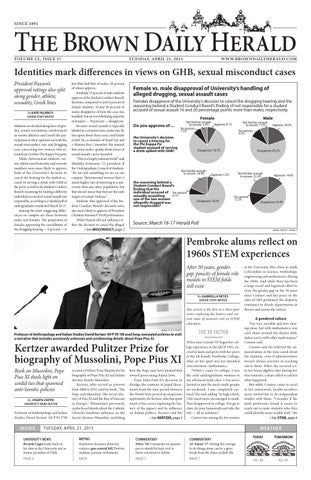
Female vs. male disapproval of University’s handling of alleged drugging, sexual assault cases Females disapprove of the University’s decision to cancel the drugging hearing and the reasoning behind a Student Conduct Board’s finding of not responsible for a student accused of sexual assault 16 and 20 percentage points more than males, respectively. Female
Do you approve of ...
Not familiar enough to answer: 5.9% No opinion: 7.3%
the University's decision to cancel a hearing for the Phi Kappa Psi student accused of serving a drink spiked with GHB?
Male
Not familiar enough to answer: 7.5%
Approve: 8.1%
No opinion: 9.3%
Disapprove: 78.7%
Not familiar enough to answer: 18.4%
the reasoning behind a Student Conduct Board's finding that the individual accused of No opinion: 6.1% sexually assaulting one of the two women allegedly drugged was not responsible?
Approve: 20.0%
Disapprove: 63.2%
Not familiar enough to answer: 22.4%
Approve: 5.5%
Disapprove: 70.0%
No opinion: 12.2%
Approve: 14.9%
Disapprove: 50.4%
Source: March 16-17 Herald Poll EMMA JERZYK / HERALD
Pembroke alums reflect on 1960s STEM experiences After 50 years, gender gap, paucity of female role models in STEM fields still exist By GABRIELLA REYES SENIOR STAFF WRITER
This article is the first in a three-part series exploring the history and current state of women’s role in STEM education. HERALD FILE PHOTO
Professor of Anthropology and Italian Studies David Kertzer ’69 P’95 ’98 used long-concealed archives to craft a narrative that includes previously unknown and condemning details about Pope Pius XI.
Kertzer awarded Pulitzer Prize for biography of Mussolini, Pope Pius XI Book on Mussolini, Pope Pius XI sheds light on sordid ties that spawned anti-Semitic policies By JOSEPH ZAPPA UNIVERSITY NEWS EDITOR
Professor of Anthropology and Italian Studies David Kertzer ’69 P’95 P’98
INSIDE
secured a Pulitzer Prize Monday for his biography of Pope Pius XI and Italian dictator Benito Mussolini. Kertzer, who served as provost from 2006 to 2011, said his book, “The Pope and Mussolini: The Secret History of Pius XI and the Rise of Fascism in Europe,” illuminated previously undisclosed details about the Catholic Church’s insidious influence on the fascist dictator Mussolini, including
how the Pope may have pushed him toward persecuting Italian Jews. Pope John Paul II’s decision to divulge the contents of papal documents from the time period between the World Wars proved an auspicious opportunity for Kertzer, who has spent much of his career exploring the history of the papacy and its influence on Italian politics. Kertzer said the » See KERTZER, page 3
THE XX FACTOR When Jane Connor ’65 began her college experience in the fall of 1961, excited to learn and grow with her peers at the all-female Pembroke College, what set her apart was her intended concentration: mathematics. “When I came to college, I was the only undergraduate woman in my advanced math class. I was never invited to join the men’s study groups on weekends. I was completely isolated,” she said, adding “In high school, I felt much more encouraged in math. That disappeared in college. You go to class, do your homework and take the test — all in isolation.” Connor was among the few women
at the University who chose to study a discipline in science, technology, engineering and mathematics during the 1960s. And while there has been a large social and logistical effort to close the gender gap in the 50 years since Connor and her peers in the class of 1965 graduated, the disparity continues to divide departments at Brown and across the nation. A gendered culture “I’m very sociable and love sharing ideas, but with mathematics, you can’t share around the dinner table unless you’re with other math majors,” Connor said. Connor said she believed the administration at the time cared about the students, even if administrators weren’t always assertive in reaching out to them. When she received a C in her linear algebra class during her first semester, a dean called to ask her what happened. But while Connor came to excel in her coursework, faculty members never invited her to do independent studies with them. “I wonder if the male professors found it easier to reach out to male students who they could identify more readily with,” she » See STEM, page 4
WEATHER
TUESDAY, APRIL 21, 2015
UNIVERSITY NEWS Ricardo Lagos looks back on his time at the University and as former president of Chile
METRO Statehouse discusses domestic violence gun control bill, PawSox stadium, pension settlements
COMMENTARY Mitra ’18: Comments on opinion pieces should be kept civil to foster constructive debate
COMMENTARY Al- Salem ’17: Having the courage to do things alone can be a great break from the chaos of daily life
PAGE 3
BACK
PAGE 7
PAGE 7
TODAY
TOMORROW
66 / 46
62/ 43
UNIVERSITY NEWS PAGE 2 • TUESDAY, APRIL 21, 2015
THE BROWN DAILY HERALD
Greek vs. non-Greek on cancellation of drug hearing, Student Conduct Board’s sexual assault decision
Students involved in Greek life are nearly twice as likely to approve of the University’s decision to cancel a hearing for the student accused of drugging a drink and a Student Conduct Board’s finding in a related case that a student accused of sexual assault was not responsible. A majority of both groups disapproved of both decisions. Greek Not familiar enough to answer: 3.6%
Do you approve of ...
Approve: 21.3%
No opinion: 10.1%
the University's decision to cancel a hearing for the Phi Kappa Psi student accused of serving a drink spiked with GHB?
No opinion: 7.7%
Disapprove: 65.1%
Not familiar enough to answer: 11.9%
a Student Conduct Board's finding that the individual accused of sexually assaulting one of the two women allegedly drugged was not responsible?
Non-Greek Not familiar enough to answer: 7.4%
Approve: 11.9%
Disapprove: 73.0%
Approve: 15.5%
Not familiar enough to answer: 22.2%
Approve: 8.4%
No opinion: 11.9% No opinion: 8.2% Disapprove: 60.7%
Disapprove: 61.2%
Source: March 16-17 Herald Poll EMMA JERZYK / HERALD
» MISCONDUCT, from page 1 GHB server’s hearing or the Student Conduct Board’s decision, actions taken by other members of the administration may still shape students’ opinions of the president, said Justice Gaines ’16, a member of the Task Force on Sexual Assault. While 37 percent of men approve
of Paxson, only 31 percent of women approve. The converse is also true: More women than men disapprove of Paxson. “There’s a sense, for some people, of betrayal,” Schell said, adding, “One of the reasons why that initial protest happened at the female presidents’ conference was to draw attention to this sense of hypocrisy — to say, ‘You are female, why are you not standing in solidarity
with this?’” Schell said she also disapproved of Paxson’s emails asking for student support for the administration’s handling of the cases. “Trust is something that’s supposed to be earned back,” she said. This same sense of distrust is present among LGBTQ students on campus, Gaines said. Students who identify as LGBTQ are also more likely to
disapprove of Paxson, according to the poll. LGBTQ students may feel that Paxson is not attuned to their issues and has not made a great enough effort to understand their perspectives, Gaines added. “When there are conversations centering around sexual assault, they tend to be very assuming of heterosexual dynamics,” Gaines said. “A lot of queer communities feel like they are not in these conversations in the first place.” Fraternity and sorority members proved more likely to approve of the GHB hearing cancellation and Student Conduct Board decision. Just over 20 percent of students involved in Greek life approve of the cancellation, whereas only 12 percent of non-Greeks approve. Comparably, 16 percent of Greeks approve of the reasoning behind the Student Conduct Board’s decision, double the rate of approval among non-Greeks. Nevertheless, nearly two-thirds of Greeks disapprove of the GHB hearing cancellation — slightly lower than non-Greeks’ disapproval rating of 73 percent but still a clear majority. Greeks and non-Greeks disapproved of the Student Conduct Board decision at an equal rate of 61 percent. “Asking around, I’ve gotten more sympathetic views toward the University’s decisions from people within the Greek system than outside of it,” said Robbie Hogan ’15, a member of Delta Tau. “A lot of fraternities look at this case and aren’t worried about what the University did but are more concerned about what the University is going to do to them next,” said Kevin Carty ’15, a member of Alpha Epsilon Pi and a sexual assault peer educator. “In one camp, there were some people who thought (the alleged GHB server) really was innocent and that the University was pinning him to the case because they were already handling it poorly, and they needed a scapegoat to appease the community,” Hogan said. “In the other camp, a lot of the people who I have talked to in DTau feel that if he was truly innocent, there was no real reason that the trial wouldn’t have shown that. Personally, I believe he deserves the trial out of respect to the victims.” Carty said several of his fellow AEPi members “think it’s too easy to bring charges (within a University process) — to gloss over information and find people guilty.” Carty said he makes a point in teaching AEPi members about sexual assault that they should always be sure to receive clear consent. He also said that many members afraid of the University process for sexual misconduct hearings simply had not “thought about consent much before Brown.” Yet there is a sense of “self-selection” within Greek houses, Carty added. Some people may join Greek life because “they think it’s an easy way to get away with something they are already doing because people are drinking and partying a lot. It’s a kind of inherited legacy.” Carty also said “all-male groups make it easier to be misogynistic and homophobic. … As a whole, if you spend a lot of time with men, you’re going to be more likely to be sexist and to not take sexual assault seriously.” Despite this, in recent years, AEPi has “experienced an upsurge” in members interested in sexual assault prevention, Carty said, adding that the house has become less sexist and members are readily participating in the sexual assault education program.
Athletes also reported a higher approval rating of the drugging hearing’s cancellation — 18 percent compared to non-athletes’ 13 percent. Differences between athletes and non-athletes were sharper on the Student Conduct Board’s handling of the sexual assault case, as 21 percent of athletes approve, while only 8 percent of non-athletes approve. Similarly, only 25 percent of athletes strongly disapprove of the Student Conduct Board’s reasoning, whereas 46 percent of non-athletes strongly disapprove. “Sexual violence is an issue I am comfortable talking about, but it’s not something I talk about very much with my team,” said Maggie Jordan ’16, a member of the women’s varsity swimming team and a WPC. “But I don’t think it’s fair to say it’s something we never talk about,” she added. Because the men’s and women’s swimming teams were a combined program until last summer, Jordan said there may be more awareness of gender issues on their teams. “A lot of people aren’t in full knowledge or understanding of the issues at hand,” said Corbin Booker ’15, a member of the men’s lacrosse team. While he said the team participates in monthly conversations about consent and sexual assault with Men’s Health Coordinator Mark Peters, he added that the team has rarely discussed the cancellation of the drugging hearing and the Student Conduct Board’s decision. Chris Smith ’15, a member of the baseball team, said that while sexual assault is important to him and his teammates, it can be hard to find the time to talk about these cases given the time they spend practicing, traveling for games and completing coursework during the spring season. Athletes said their social circles can also restrict many of their conversations. “We are somewhat limited to who we talk to outside of class and outside of practice,” Smith said. He added that a few of his teammates were not aware of the full details of the two cases until one teammate offered an explanation following the March 11 campus protest, which put the issue on their radar. “Most of us were pretty appalled at the reasons behind some of the decisions the University made,” Smith said. Athletes were also more likely to approve of Paxson — 44 percent of athletes approved compared to 32 percent of non-athletes. Through Athletic Director Jack Hayes, Paxson has “gotten rid of ineffective staff and hired new coaches … and is giving more attention to athletics than Ruth Simmons,” Jordan said. Other athletes may simply question the administration’s decisions less. “We know that people have a very tough time making these decisions, but they are the people in charge,” Booker said. “We all process it differently. It’s perceived that these issues don’t affect us as much because our immediate surroundings are the team,” Jordan said, adding, “That’s not to say that the broader campus culture doesn’t impact us.” Srinivasan said it is important to recognize the involvement of all communities on campus in addressing the issue of sexual assault. “If you look at the Act4RJ protest, there were 400 students in attendance. I stood at the door, and I watched people come in, and I could tell that there were people from so many different communities who were involved in trying to understand what was happening,” Srinivasan said.
UNIVERSITY NEWS
TUESDAY, APRIL 21, 2015 • PAGE 3
THE BROWN DAILY HERALD
Former Chilean President Ricardo Lagos shares experiences, advice
Lagos reflects on Watson residency, talks economic growth and education challenges in Chile By LAUREN ARATANI STAFF WRITER
Former President of Chile Ricardo Lagos will end his eight-year residency as professor-at-large at the Watson Institute for International Studies at the end of this semester. As president from 2000 to 2006, he ended his term with recordhigh approval ratings after significantly improving Chile’s economy. Lagos spoke with The Herald about his time at the Watson Institute, his experiences as president and future changes he hopes to see in government. The Herald: Why did you decide to come to Brown and join the Watson Institute to serve as a professor-atlarge? Lagos: I got an offer that was very difficult to resist. (The University) told me, “Look, why don’t you come here as professor-at-large.” What does that mean? Well, that means you have to be in residence one month during the academic year. What you do with that time is up to you. Then, they told me you can give some conferences, participate in seminars — to do whatever you want, but you have to be in residence. I used to be a professor in my own country many, many years ago, so I thought that was a good excuse to have a chance to think a little bit of what I have done and to discuss with members of academia. I discovered that being a professor at Brown, I am much more an
» KERTZER, from page 1 archives’ availability spurred him to embark on writing a biography of Pius XI and Mussolini, calling it “too tantalizing a topic not to write about.” Kertzer also capitalized on the accessibility of fascist documents, noting that the espionage Mussolini conducted on the Vatican exposed what was going on “behind the scenes” in the Catholic enclave of Rome. Delving through the fascist and papal archives, Kertzer unearthed a papal envoy to the totalitarian government. The messenger conveyed “the Pope’s requests for the dictator to take action … using the police and the authority of the fascist regime,” Kertzer said, adding that documents revealed that the messenger “used his position to try to warn Mussolini about the danger posed by Italy’s Jews.” The “eye-opening” revelation constitutes a concrete example of Pius XI provoking state-sanctioned anti-Semitism in the years leading up to and during World War II, Kertzer said. In 1938, Mussolini’s government, which infamously allied itself with Hitler’s Nazi party, implemented laws that stripped Jews of Italian citizenship and barred them from holding government positions. Of the prize, Kertzer expressed excitement and offered praise for his colleagues.
intellectual than a practitioner. But nevertheless, being the president of Chile, I used to be much more a practitioner than an intellectual. I thought that even if you are a very pragmatic person at the very end, you have some ideas that are coming from the intellectual world. As (John Maynard) Keynes, the famous economist, used to say, “Practical ideas are usually the slaves of very intellectual ideas.” Since I came here in October 2007, it was interesting. A year later, you have the economic crises. Several years later, even though people knew about Al-Qaeda, you discover ISIS. In other words, you discover the question of war and peace is not only among nationalist states, as it used to be in the past, but of this other non-governmental organization that turns from the world. When I had a talk here with Romano Prodi, the former prime minister of Italy, he presented the view from Europe, and I presented the view from Latin America. For me, that was a very interesting dialogue from different perspectives, and to have that discussion in the U.S. was much more interesting. What have you been doing with the Watson Institute? Normally, what I do is give two or three conferences. The first time I came here there was a seminar on income inequality in Latin America. That conference finished with a presidential dialogue between myself and former “Obviously it’s extremely gratifying to get that kind of recognition,” he said, adding, “There are a number of people who were involved in this book. … It’s awesome to know that everybody gets some recognition.” President Christina Paxson P’19 acknowledged Kertzer’s accolades in a campus-wide email Monday night, calling the Pulitzer a “rare and welldeserved honor” and adding that Kertzer “mastered an immense body of information” in combing through the archives, ultimately producing a “book that is both authoritative and compelling to read.” An author of nine books, Kertzer has already commenced a new project, this time turning back the clock to key in on the Vatican and Italy during the Italian states’ 1848 revolution. In addition, his 1997 work “The Kidnapping of Edgardo Mortara,” a finalist for the National Book Award for Nonfiction, has drawn the attention of famed filmmaker Steven Spielberg and playwright Tony Kushner, who will produce and write the screenplay, respectively, for a film based on the book. Jordan Harrison MFA’03 also garnered plaudits from the Pulitzer Prize Board, finishing as a finalist for the prize for drama. His recognition marks the fourth time in four years an alum has either been nominated for or taken home the award.
Support The Herald www.browndailyherald.com/donate
President of Brazil Fernando Henrique Cardoso. It’s a good story because next week there is going to be (a seminar on) income distribution in Latin America. What happened within the last eight years in Latin America with regard to income distribution? Well, that’s very interesting, because change has been very big, very huge. Besides working at the Watson, what else have you been busy with? Oh, you wanted to know if there was life after being president? Yes, there is life. I was in pro bono as the special envoy of Ban Ki-Moon, the Secretary General of the U.N., on negotiations for climate change. In addition, I have published a few things. I have published “The Southern Tiger,” written in English and for the American people, about what our fight against the dictatorship of Pinochet in Chile was and, later on, what we needed in government. I have also been involved in politics, but not too much, because now I’m a former president.
Montesquieu” — the Secretary, the Parliament and the Judiciary. People also used to say there was a fourth power, which is the press. Now I say there is a fifth power, which is the web. Where do people who are very young get the news of what’s going in the world? On the web. The web is the fifth power, so I created El Quinto Poder, where all the citizens can write whatever they want.
At this time, Lagos pulled out his cellphone and displayed an online platform that he created called “El Quinto Poder,” which translates to “The Fifth Power.” The website features various articles on major events written by Chilean citizens.
Do you think there are any other means that governments can use, such as the web, to become more efficient? More efficient, more accountable, more democratic? Yes. I think that because of the web, new political institutions will emerge. For instance, in today’s world, the Finnish parliament, when they are discussing a law and a number of members say, “I would like to listen to the people. Can we put the discussion that we are having in regards to this legislation online?” They can publish that online, and say to the people, “You have sixty days to discuss.” That’s new political inclusion. Democracy, by definition, is representative because you have to elect representatives. The question of the issues is yes, of course it has to be representative, but web allows you to give some voice to the people, so how about that?
I do believe that the web will change political institutions that you and me know today. It is going to be quite different in the future because of that. For instance, normally people used to say there were three different “powers of
As president, what was your goal for Chile, and do you think you accomplished those goals? First, I was part of a generation that had to fight against a dictatorship. And while that dictatorship was defeated, it
was up to us on how we would like to run the country. That means, for instance, to have a bigger growth rate and to live in a country with more equity and more opportunity for everybody. And we are rather proud of the fact that in 20 years, we were able to reduce poverty from 40 percent of Chileans living under the poverty line to only 11 percent. The question of how we are going to have economic growth with increasing degrees of equity — that’s a big challenge. It’s easy to talk here at Brown, but what are the practical measures to take? What issues does Chile currently face, and what do you think can be done to solve them? The most important issue for Chile is to understand that economic growth is important. In Chile, because of our growth, we’ve changed agenda because the major demands are from those that left poverty behind them. There is an emerging middle class, and that middle class is more demanding, particularly in the area of education. The major issue in Chile is education. The question is not to let students enroll, but the question is to give them a quality education, and to improve quality is much more difficult. What do you think makes an effective leader? The most important and most difficult (quality) is that a leader has to believe in what he says he believes. He has to be sure. This interview has been edited for clarity and length.
SCIENCE & RESEARCH PAGE 4 • TUESDAY, APRIL 21, 2015
» STEM, from page 1 said. “For me, a source of emptiness at Brown was (that) I don’t remember ever really having a personal relationship with professors outside of class. Having become a university professor myself, I know how much motivation kids need in terms of professional development.” Elizabeth Glass Loggia ’65, also a math concentrator, said there were only one or two women in each of her math classes, though she was used to this dynamic from high school. “It was really kind of a given,” she said. Though Loggia became a programmer for IBM while pursuing a JD at Georgetown University at night, she said she noticed the difficulties some of her peers faced finding jobs after college. “Senior year when we were interviewing for jobs, there were fewer opportunities for women. Life was really different then from now. It didn’t personally affect me, but I think that some people felt that they were really limited in where they could go,” she said. “They could do a lot while they were in college, but there wasn’t much they could do when they graduated. I think some people may have felt that Brown didn’t prepare them,” she said. Connor eventually lost interest in math because of the unwelcoming environment, and she ultimately found a new passion in psychology. Connor spent 35 years teaching at the State University of New York at Binghamton and is now retired. But before accepting her post at SUNY, she applied to join the faculty of Vanderbilt University and ultimately sued the school for gender discrimination when they didn’t comply with governmental affirmative action policies. “My husband, a clinical psychologist, had gotten a job at Vanderbilt in the early 70s. At that point, (Vanderbilt) was 200 years old, and it hadn’t hired a woman for the psychology department in its existence,” she said. “A position in the psychology department opened up in my area, which I applied for. I was not hired.” Her husband encouraged her to apply for jobs elsewhere, saying he would follow her. “That was very nontraditional for a man to follow his wife,” she said. Coming in with a passion Exposure to a STEM field before college was uncommon for women entering the class of 1965, but prior exposure often determined their choices of study, according to several alums. Though the women interviewed for this article derived their individual inspiration from a variety of sources, they all arrived on campus with a strong passion for science. Zulette Masson Catir ’65 entered Pembroke eager to pursue physics. “I was always interested in astronomy when I was a young kid, and when I was 13, I read about Albert Einstein and was just enamored with the idea of exploring the universe,” Catir said. Catir was the only woman studying physics after her first year, which she said led her to feel “quite isolated.” As a result, and so she could take more liberal arts classes with women, Catir switched from pursuing a bachelor of science to a bachelor of arts. Even today, women are the recipients of fewer than 20 percent of all physics degrees nationwide, according
to a study by the National Science Foundation. Despite support from her mentor — former Professor of Physics John Dylan — Catir said she felt discouraged during her senior year. “I wasn’t sure I’d picked the right major,” she said. “Although I came in very inspired by physics, in the end I wasn’t sure what I wanted to do.” After college, Catir became a teacher, then an educational consultant and later a therapist. “I wandered pretty far from physics,” she said. Suzanne Love ’65, who received a bachelor of science in chemistry, was inspired to study the field of her father, who was a pharmaceutical chemist. “I heard a lot about chemistry from him and found it interesting,” she said. She noted that there were more men than women in the chemistry program, but the number of concentrators was slim to begin with. A Pembroke community Until the merger in 1971, male and female students were split into two separate undergraduate colleges: Brown and Pembroke. With the exception of a few introductory courses, women and men took their classes together and received the same University degree upon graduation. After World War II, the separation by sex effectively played a role only in housing and dining, but it shaped the female-centric Pembroke community, said Nancy Buc ’65, the third woman to serve on the Corporation’s Board of Fellows. “There were some things that were Pembroke-specific. They tried to foster a sense of community in the residence halls,” Loggia said. Faculty members, along with their families, lived in the residence halls and were responsible for events such as Wednesday teas. “It was a community without the men, so it promoted a lot of friendship. But we had so many classes and other activities together that we didn’t feel like we were really segregated in any way.” This Pembroke culture also encompassed academic attitudes. Math and science concentrations were not popular among Pembroke students in part because of the barriers to entry. Students who chose to pursue STEM subjects had to know they wanted to do so upon matriculating because of the many degree requirements. “In terms of the barriers historically, I think the cultural image of who becomes a scientist and who becomes an engineer when I was growing up in the 1950s was all male,” said Professor of Biology Ken Miller ’70. Miller listed the dearth of role models and social pressure as two issues women interested in STEM fields faced then and continue to face now. “When you find yourself in a class that is mostly male, it’s quite easy to get the impression that you don’t really belong there,” he said. Aspiring female science students could look to Pembroke deans Nancy Duke Lewis, a mathematician, and Rosemary Pierrel Sorrentino PhD’53, an experimental psychologist, for inspiration, Buc said. At the time, administrative positions were more accessible to women than professor positions. It wasn’t until 1964 that Elizabeth Leduc, a pioneer in cell biology, was appointed the first female full professor in an academic department at the University.
THE BROWN DAILY HERALD Leduc was appointed director of biology in 1967, dean of biological sciences in 1973 and associate dean of the College in 1987. “She was a very distinguished leader in her field, and she was on the committee that recruited me for Brown,” said Susan Gerbi, professor of biochemistry and biology. Gerbi said having female faculty members is essential for attracting more women to STEM, adding that many female scientists have male role models because there are so few female ones available. Leduc was an early leader in cultivating a more positive environment for women, she said. “She hired several women in biology when it was uncommon — this did a lot for the climate at Brown,” said Kathryn Spoehr ’69, professor of cognitive, linguistic and psychological sciences and public policy. Disparities within the sciences Janet Blume, associate professor of engineering and senior associate dean of the faculty, said the life sciences achieved a “critical mass” of women more quickly than the physical sciences. They reached a point when there were enough women in the field that they did not feel isolated anymore. In the physical sciences, the lack of such a critical mass can compound insecurities when a student is starting off, she said.“If somebody is unsure of herself, the feeling of being in the minority is not helpful and doesn’t build confidence.” Barriers fell in the life sciences before the physical sciences because these disciplines “opened up to women
first,” Miller said. But while women studying life sciences often felt less isolated than their peers studying physical sciences, obstacles still readily presented themselves. Judy Woll ’65 attended the Bronx High School of Science and was advised to apply to Pembroke by her guidance counselor. A pre-medical student, she started as a chemistry concentrator and switched to biology after taking the introductory courses during Brown’s summer session. “I went to a high school where girls were encouraged to do things like becoming a doctor, so it didn’t seem to be an unreasonable goal,” she said. “In certain ways Brown was supportive of me, and in certain ways it wasn’t. It was still very sexist,” she said. “The first biology course I took was comparative anatomy. The class had over 100 students in it, of which fewer than 20 were girls.” Most of the As in the class were awarded to female students, much to the professor’s dismay, Woll said, adding that “it killed him, and he said so out loud.” He also had to give an award to the best student in the class, and “it broke his heart that he had to give it to a woman, because she was the best in the class — he had no shame about saying things like that,” she added. Susan Offner ’65, who also pursued an Sc.B. in biology, said she experienced this “critical mass” of women in the life sciences. “I had friends and people to study with. I studied with the guys some, but if I had been the only girl it would have been much less
comfortable,” she said. “We had all our classes at Brown, and that was what was really important,” she added. “There weren’t special dumbed-down classes for the girls. That was one of the big reasons I went to Brown and not to one of the Seven Sisters. The Ivies at that point were not accepting women, but the fact that we were going to classes with the guys was a really big deal.” But while female participation in STEM fields has increased nationwide, the gap experienced in the 1960s remains to this day, and there are still significantly more women in the life sciences than physical sciences. According to the same NSF study, undergraduate women in 2012 received 58.2 percent of degrees in the biological sciences, compared to 43.1 percent in math, 19.2 percent in engineering and 18.2 percent in computer science. “Your experiences are shaped by what you see,” said Sarah Delaney, associate professor of chemistry. “If a woman doesn’t see other women pursuing what she wants to pursue, she might get the idea that it’s not for her. If you look around and see people who are like you pursuing that field, it probably wouldn’t occur to you that it’s unusual that you’re pursuing this field.” Spoehr said the effects of the various fields’ cultures tend to snowball. Because there are more female faculty members in the life sciences, “mentoring starts earlier, better and sooner, and the effects multiply,” she said, adding that this has been true since the 1960s.
TODAY
TUESDAY, APRIL 21, 2015 • PAGE 5
THE BROWN DAILY HERALD
menu
APRIL SHOWERS
SATELLITE DINING JOSIAH’S Gnocchi, Made-to-Order Quesadillas BLUE ROOM Soups: Butternut Squash, Turkey Sausage and Kale, Three Bean Chili ANDREWS COMMONS Pizzas: Bacon Chicken Ranch, Spicy 5 Cheese, Pepperoni and Meatball
DINING HALLS SHARPE REFECTORY LUNCH
DINNER
Hot Turkey Sandwich with Gravy, Sauteed Zucchini with Rosemary, Macaroon Cookies
Seafood Jambalaya, Corn and Sweet Pepper Saute, Zesty Lemon Chicken Thigh, Red Velvet Cake
VERNEY-WOOLLEY LUNCH
DINNER
Chinese Chicken Wings, Broccoli Quiche, Ginger Sugar Snap Peas and Carrots, Macaroon Cookies
Zucchini Burger, Fresh Vegetable Melange, Mac and Cheese Bar, Red Velvet Cake
sudoku ARJUN NARAYEN / HERALD
Campus was rinsed clean yesterday by torrential rainstorms that caused the National Weather Service to issue a coastal flood advisory in some parts of the state.
comic
Egoheads | J.H. Zech
crossword
STAY UP-TO-DATE. FOLLOW US ON FACEBOOK. FACEBOOK.COM/BROWNDAILYHERALD
calendar TODAY
TOMORROW
4:00 P.M. THE CUBAN ARGUMENT WITH ITSELF
5:30 P.M. THE ART OF AMERICAN BOOK COVERS
The Department of American Studies will host a talk on the history of Cuban politics and solutions for reopening trade negotiations between the United States and Cuba. Lyman 007
Book artist Richard Minsky will dissect the cover styles of selected books from the John Hay Library. John Hay Library 7:00 P.M. ALIVE INSIDE: SCREENING AND PIZZA
4:00 P.M. TOWARDS A GAY WORLD HISTORY
Richard Parkinson, professor of egyptology at the University of Oxford, will deliver a lecture on how museums can spread
Brown Alzheimer’s Activists will screen “Alive Inside,” a film that touts the healing power of music over prescription medication. MacMillan 115
LGBTQ awareness in global history. Smith-Buonanno 201 8:00 P.M. THE PUNK SYNDROME SCREENING 6:00 P.M. DOCTORS WITHOUT BORDERS ON ACCESS TO MEDICINES IN THE DEVELOPING WORLD
Judit Rius, U.S. Manager of the Access Campaign for Doctors Without Borders, will discuss the Trans-Pacific Partnership and its effect on developing countries. Wilson 101
Writer’s Group will show “The Punk Syndrome,” a film featuring Finnish band Pertti Kurikan Nimipaivat, which is completely made up of adults with Down syndrome and autism. Salomon 202
COMMENTARY PAGE 6 • TUESDAY, APRIL 21, 2015
THE BROWN DAILY HERALD
EDITORIAL
Defeating imposter syndrome Brown is a special place, but it can also be a place where it is difficult to feel special. Surrounded by thousands of other high-powered, brilliant individuals, it is easy to lose sight of how and where one belongs. But if this mentality — known as imposter syndrome — persists, it can be limiting. Each student at Brown is here for a reason, and while it may take some time to understand what that reason is, that is nonetheless a necessary reminder. Students should never feel unnecessary to the Brown community. We all take an active role in our education; we just do so in different ways. Because students engage in different lifestyles, they contribute to the Brown environment in diverse ways. This year, 8.5 percent of applicants were accepted to the Class of 2019 — a miniscule proportion of applicants that substantiates the University’s claim that it hand-picks a student body that will flourish at Brown. Dean of Admission Jim Miller ’73 told the Herald last year, “We will never bring a student here that we do not think will be successful.” Redefine what success means to you, and make the most of your time at Brown, even if it entails trying new things. During one’s time at Brown, one should not shy away from getting involved in new ways both on and off campus. Apply for an Undergraduate Teaching and Research Award, a Cogut Center Fellowship, a split-semester or even a job for which you may not feel entirely qualified — regardless of outcome. Even in the realm of interviews and applications, practice makes perfect, and each attempt bequeaths lessons learned and newfound confidence. It’s easy to lose perspective on College Hill, which, from its perch above the rest of Providence, can seem insular and often isolating. But no matter how you look at it, Brown is a highly skewed environment, unrepresentative of what lies beyond its borders. This is something to embrace, but it must also serve as a point of awareness. While undergraduates make a life on College Hill for four years, what they learn during that time is not only relevant to campus but can also be readily applied to life after Brown. Your Brown experience is what you make of it, so make it a healthy challenge, and don’t underestimate yourself. Surrounded by a cushion of peers and faculty members who are here to support the student body, knowing that you belong is a necessary step to defeat imposter syndrome in order to push yourself in new directions and take ownership over your time at Brown.
K I M B E R L EY S A LT Z ’ 1 7
Editorials are written by The Herald’s editorial page board: its editors, Alexander Kaplan ’15 and James Rattner ’15, and its members, Natasha Bluth ’15, Manuel Contreras ’16, Baxter DiFabrizio ’15, Mathias Heller ’15 and Aranshi Kumar ’17. Send comments to editorials@browndailyherald.com.
Got something to say? Leave a comment online!
Q U O T E O F T H E D AY
“A leader has to believe in what he says he believes.” — Ricardo Lagos, former president of Chile and professor-at-large
Visit www.browndailyherald.com to comment on
See lagos on page 3.
opinion and editorial content.
Editorial Leadership
Sections
Visuals & Production
Business
Editors-in-Chief Michael Dubin Maxine Joselow
Arts & Culture Editors Eben Blake Gabrielle Dee
General Managers Sarah Levine Winnie Shao
Managing Editors Kiki Barnes Jillian Lanney
Metro Editors Alexander Blum Emma Jerzyk Drew Williams
Design Editors Loren Dowd Carlie Peters Taylor Schwartz Assistant: Meryl Charleston Assistant: Andrew Linder
Senior Editors Camilla Brandfield-Harvey Isobel Heck Molly Schulson
Science & Research Editors Andrew Jones Steven Michael
BLOG DAILY HERALD Editor-in-Chief David Oyer
Sports Editors Andrew Flax Alex Wainger
Managing Editors Deena Butt Jacob Koffler
University News Editors Emma Harris Caroline Kelly Joseph Zappa
POST- MAGAZINE Editor-in-Chief Adam Asher DIGITAL Online Editor Marcy Huang
COMMENTARY Editorial Page Editors Alexander Kaplan James Rattner Opinions Editors Megan GrapengeterRudnick Kate Kiernan Evan Sweren
Photo Editors Head: Brittany Comunale David Deckey Katie Liebowitz Arjun Narayen Ashley So Ryan Walsh Graphics Editors Avery Crits-Christoph Emma Jerzyk Web Producers Joe Stein Harsha Yeddanapudy Abdullah Yousufi Copy Desk Chief Madeline DiGiovanni Illustrations Editor Angelia Wang Video Editor Richard Flores
Directors Sales: Moniyka Sachar Sales: Jess Urrutia Finance: Josh Tartell Alumni Relations: Marley Rafson Business Dev.: Yuta Inumaru Sales Managers Matthew Meyer Henry Ritter Gulmira Hamit Taylor Casey
facebook.com/browndailyherald
Location: 195 Angell St., Providence, R.I. www.browndailyherald.com
@the_herald
Editorial contact: 401-351-3372 herald@browndailyherald.com
browndailyherald.com
Business contact: 401-351-3260 gm@browndailyherald.com
Corrections: The Brown Daily Herald is committed to providing the Brown University community with the most accurate information possible. Corrections may be submitted up to seven calendar days after publication. Commentary: The editorial is the majority opinion of the editorial page board of The Brown Daily Herald. The editorial viewpoint does not necessarily reflect the views of The Brown Daily Herald, Inc. Columns, letters and comics reflect the opinions of their authors only.
Finance Managers Collections: Neil Wathore Collections: Benjamin Wesner Operations: Carin Papendorp
Letters to the Editor: Send letters to letters@browndailyherald.com. Include a telephone number with all letters. The Herald reserves the right to edit all letters for length and clarity and cannot assure the publication of any letter. Please limit letters to 250 words. Under special circumstances writers may request anonymity, but no letter will be printed if the author’s identity is unknown to the editors. Announcements of events will not be printed.
Business Dev. Manager Project Leader: Kaden Lee
Advertising: The Brown Daily Herald, Inc. reserves the right to accept or decline any advertisement at its discretion. The Brown Daily Herald (USPS 067.740) is an independent newspaper serving the Brown University community daily since 1891. It is published Monday through Friday during the academic year, excluding vacations, once during Commencement and once during Orientation by The Brown Daily Herald, Inc. Single copy free for each member of the community. Subscription prices: $280 one year daily, $140 one semester daily. Copyright 2015 by The Brown Daily Herald, Inc. All rights reserved. Periodicals postage paid at Providence, R.I. Postmaster: Please send corrections to P.O. Box 2538, Providence, RI 02906.
COMMENTARY TUESDAY, APRIL 21, 2015 • PAGE 7
THE BROWN DAILY HERALD
Thinking out loud on campus MILI MITRA opinions columnist
It has been almost 2,000 years since the destruction of Pompeii in 79 A.D. Yet when people wander through the rubble of the city, they can still come across ancient carvings etched onto its walls — age-old graffiti that has withstood the test of time. These markings have survived volcanic eruptions, archaeological digs and legions of disruptive tourists. They include love notes, poetry and, most significantly, comments and criticism about the city itself. It is a testament to the durability of opinions and the mediums in which they are transposed. Even after two millennia, the citizens of Pompeii are making their voices heard. The power of opinion is unparalleled, especially in today’s world. Of course, freedom of opinion is a basic human right, but it encompasses more than just liberty. Strong commentary is a driving force of progress, bringing attention to unrecognized issues and providing a platform for change. It is not enough simply to allow opinions to be shared. To be worthwhile, they need to be engaged with, respected and challenged in equal measure — which is why I am growing increasingly concerned with the backlash
against controversial opinions at Brown. As an opinions columnist for The Herald, I enjoy expressing my thoughts on current events and student life. The Herald’s commentary pages are a wonderful forum to share ideas with the wider Brown community and bring together different groups of people. And while Herald commentary is often thought-provoking and insightful, I still believe there is a dearth of constructive re-
abuse among the comments. My fear was not irrational or unprecedented. Shielded by anonymity, commenters have often resorted to vulgar, misogynistic insults and even emailed threats. In response, many columnists have written about comment etiquette and the importance of basic respect, citing repeated abuse at the hands of unnamed readers. And just one week before my first column, one of my fellow columnists wrote a divisive piece
generate debate and disagreement. But I take issue with the fact that many comments are personal attacks rather than constructive critiques. More importantly, powerful commentary is important for reflection and development. Students should not have to feel scared about sharing their thoughts. A conformist atmosphere will only stifle productive discussion and crush voices that need to be heard, and that doesn’t sound very tolerant to me.
So, to all of those who delight in making rude or offensive comments anonymously, I would encourage you to take a few extra minutes and write a quick email to the writer, letter to the editor or even a response column in The Herald. sponse and inclusivity on campus. In putting forth this viewpoint, I am not mindlessly critiquing our campus culture. Rather, I speak from personal experience. Two months ago, I wrote my first column for The Herald. Sad though it may sound, I remember being wildly excited to see my name in print. Unfortunately, that excitement was marred by the fact that I was simultaneously terrified of potential backlash. My column was about fostering religious pluralism on campus — an admirable goal — but I feared insults and
about ROTC at Brown. His column earned him near-instant notoriety, with numerous letters to the editor and guest columns on the subject. It gained attention from Fox News, which turned his contentious argument into a topic of national debate. Though some of the comments on his article were intelligent and valid, many more were offensive ad hominem attacks. Could I be blamed for wanting to avoid the same fate? Perhaps columnists like me should develop thicker skin: After all, opinion pieces are supposed to
If we intend to tackle tough questions and truly get to the heart of the matter, we as a community need to foster stronger discussion. And whether we like it or not, that will involve embracing a variety of different — and sometimes directly opposing — perspectives. This doesn’t mean that students should be provocative for provocation’s sake. But if someone has a particularly divisive perspective, their ideas should not be drowned out in a sea of unnecessary hate. Disagreement is much more powerful when it re-
mains respectful. So, to all of those who delight in making rude or offensive comments anonymously, I would encourage you to instead spend a few extra minutes writing an email to the writer, letter to the editor or even a response column in The Herald. Make your voices heard, and engage the community in important discussion. And if you simply want to jot down your immediate thoughts, go right ahead and post a comment. Just remember that your vitriol against an argument should not be directed at the writers themselves. In ancient Pompeii, people used paint and chisels to share their thoughts. Two thousand years later, new platforms have emerged: We have op-eds and blog posts that streamline communication and make opinions more accessible and meaningful. But the ease and anonymity of the Internet should not encourage, abuse or limit critical discussion. I’d love for conversation at Brown to be a fraction as meaningful and heartfelt as Pompeii’s simple street art. And for that to happen, we need to put aside the ad hominem attacks and keep the conversation civil. We need to challenge ourselves to challenge others.
Mili Mitra ’18 can be reached at mili_mitra@brown.edu.
Brave up and be alone SARA AL-SALEM opinions columnist
The first time I went to watch a movie alone, I tried to make it look like I was waiting for a friend during the entire movie. Of course now I realize that probably no one in that cinema even realized I was on my own, and I wasted a lot of mental energy when I could have been enjoying Wreck-It Ralph. But in my 17-yearold mind, this moment was so nerve-wracking for me that it had to consume all of my attention. Now, I relish my alone time. I have taken breaks from my daily life by taking a random train to Boston to enjoy a day of proper “me time.” Visiting museums, eating out at an Italian restaurant, watching a movie alone for the second time, strolling through the park — all this with nothing but the sounds of the National blaring in my ears. But when I come back from this self-date and share my experiences with friends, they are all alarmed and uncomfortable with the idea that I did this alone. “Don’t you feel lonely?” is the question I almost always get when I am caught doing something on my own. First, it is important to realize that being alone is not the same thing as feeling lonely. The former is an act of independence and choice; the latter is a feeling that can occur regardless of who is or isn’t around. Second, this stigma of loneliness and pity around being alone causes so many people to miss out on opportunities of self-care. Research demonstrates that there are ben-
efits to alone time, including alleviating depression, the Huffington Post reported. This stands out to me because most people see being alone as a cause for depression, and while there are valid reasons for that perception, being alone often gives you time to take a step back from reality. The Huffington Post article also does well to mention that you learn to actually have fun by yourself. Once the idea of being alone doesn’t scare you, solitude is liberating. I real-
revelry, festivities and continuous human interaction at Brown — made this issue particularly relevant to me. I had a lot of moments during the weekend where I would choose to sit on my own because things got a little too rowdy for my taste. I found throughout the weekend that fellow students looking overwhelmed or in need of a break would come huddle by me — all of us together but separate and alone. But as soon as my friends rejoined me, these strangers would move away to find
The benefits of being alone should outweigh any nervousness or insecurity. It’s the best way to tell yourself that your time and your life matter.
ize that’s hard to do in college, since the college social scene normalizes constant socializing and the “fear of missing out” that people feel if they are not in the center of campus or at a particular event. But we all can get exhausted by others and need a reboot. Be it sitting in your room or taking a long walk by yourself, spending time by yourself is healthy and normal — an underrated version of selfcare that can enable us to enjoy ourselves more, rather than what most consider a display of antisocial behavior. Spring Weekend — the ultimate time of
a more secret place to be alone. Though I might be incorrect in assuming that people moved because they did not want to appear to be alone, I speak from personal experience in the difficulties of embracing being and looking alone. Most of the time, I would either try to make it look like I was waiting for someone or stare intensely at my phone as if I were dealing with a serious conflict that required separation from the crowd. But now, rather than feeling self-conscious about my solitude, I openly sit alone as I observe my surroundings. It has been one of the
best things I have learned to do in my adult life. Quality alone time is one of the keys to self-care, even for people who might be more extroverted than I am. When you have time to collect your thoughts and reflect on your feelings, you have time to evaluate your experiences more clearly. In other instances, being alone is just a perfect time to have nothing on your mind but the things immediately surrounding you. It is a time to be wholly selfish without any guilt and to put your feelings before anyone else’s. It’s almost a funny contradiction that when you are alone, you don’t have to follow any social cues and rules, but the very act of being alone is a red flag that makes others feel uncomfortable. If you see a person eating alone at a restaurant, the natural reaction is to pity that person. But there are plenty of people — myself included — who like doing social acts alone and who don’t have an accompanying feeling of loneliness. It’s pretty ironic that the only person who feels uncomfortable is the person who thinks being alone should be an uncomfortable thing. When you are alone, you find out a lot about yourself that you wouldn’t otherwise. It is nothing to be ashamed about, and I tip my hat to those who choose to be alone sometimes because I know it takes a lot of bravery to do so. The benefits of being alone should outweigh any nervousness or insecurity. It’s the best way to tell yourself that your time and your life matter.
Sara Al-Salem’17 can be reached at sara_al-salem@brown.edu.
METRO THE BROWN DAILY HERALD
Spotlight on the Statehouse BY EMMA JERZYK, METRO EDITOR
Bill addresses domestic violence gun control The Statehouse continues to be a battleground for gun reform, as Rep. Teresa Tanzi, D-South Kingstown and Narragansett, testified before the House Judiciary Committee about her proposed bill to prohibit the possession of firearms by those who are convicted of domestic violence or subject to a restraining order due to domestic abuse. The Senate companion bill has been referred to the Senate Judiciary Committee. The bill reflects a federal statute called the Domestic Violence Offender Gun Ban, and Massachusetts has enacted similar legislation. No other state in New England prohibits the ownership and use of guns by those convicted of domestic violence, though Connecticut and New Hampshire prohibit those who are under protective orders due to domestic violence from buying firearms. Every child murdered in a reported domestic violence incident in Rhode Island since 1980 was killed by a firearm, the Rhode Island Coalition Against Domestic Violence testified at the committee hearing. This type of legislation is supported by over 80 percent of Rhode Islanders, according to poll data released last week by Everytown for Gun Safety and the Rhode Island Chapter of Moms Demand Action for Gun Sense in America. This comes after over 350 people, including Mayor Jorge Elorza and Providence Public Safety Commissioner Steven Pare, rallied at the Statehouse to support the many gun reform bills currently before the General Assembly. The House Judiciary Committee has also heard bills during the last week that would prohibit the use of firearms by minors unless supervised by an adult, close a loophole allowing concealed weapons to be carried into schools and limit magazine capacity to 10 bullets.
PawSox stadium proposal under review Pawtucket Red Sox owners unveiled their proposal for a new Providence stadium April 16. The $85 million, 10,000-seat ballpark would cost a net $2 million per year for Rhode Island taxpayers, the owners said. PawSox president James Skeffington said at a news conference that legislation will need to pass in the General Assembly during the current session to ensure construction can begin and the team can move to the downtown stadium by 2017. The PawSox owners proposed that, once the construction is finished, the state can enter into a 30-year lease with them at $5 million per year and the team would sublease the stadium for $1 million per year. But consultants from Brailsford and Dunlavey said the state would receive an additional $2 million in tax revenue from the stadium, therefore making the net cost $2 million per year, Rhode Island Public Radio reported. The owners also proposed that the City of Providence waive all property taxes during the 30-year lease. Ed Fitzpatrick, columnist for the Providence Journal, wrote Saturday that the state has been “gun-shy” about large, potentially risky investments ever since the loan to 38 Studios approved by former Gov. Donald Carcieri went sour in 2012. Sen. James Sheehan, D-North Kingstown and Narragansett, immediately opposed the proposal, saying it “gives new meaning to the term ‘money ball,’” according to a press release. “Publicly supported ballparks provide little to no economic benefits to taxpayers or the community in which they are located. Instead, they typically generate lowpaying jobs, for only a portion of the year,” Sheehan said. Rep. Doreen Costa, R-Exeter and North Kingstown, tweeted, “Find your own investors and not use the taxpayer.” But Rep. John Carnevale, D-Providence, told RIPR he thinks most representatives will ultimately support the proposal. Speaker of the House Nicholas Mattiello, D-Cranston, told RIPR that the House Finance Committee will review the proposal and hold hearings to deliberate. Senate President Teresa Paiva Weed, D-Newport, told RIPR that the entire chamber will review the proposal and analyze it through a “transparent process.”
Pension settlement gets preliminary go Rhode Island Superior Court Justice Sarah Taft-Carter gave preliminary approval to the Rhode Island state pension settlement Monday, calling it “fair, reasonable and adequate.” Though the vast majority of unions involved in the settlement have okayed it, the settlement will not be finalized until after Taft-Carter conducts a public fairness hearing May 20. If Taft-Carter gives her final approval after the hearing, the settlement will need to pass in the General Assembly as an amendment to the pension statute. All 60,000 public-sector workers and retirees who are part of the unions that agreed to the settlement will be subject to the terms if the settlement passes. Those who are members of any police union or the Cranston fire union will not be subject to the settlement, as those unions previously voted against it. Taft-Carter will hear a trial between the state and those unions June 8.
TUESDAY, APRIL 21, 2015
Gov. seeks Social Security tax exemption Measure has bipartisan support, but Democrats want exemptions only for lower-income taxpayers By DUNCAN GALLAGHER SENIOR STAFF WRITER
Following years of Statehouse attempts to alter Rhode Island’s taxation of Social Security benefits, Gov. Gina Raimondo included an unprecedented provision in her budget proposal last month that would eliminate the tax for low- and middle-income recipients. By including the measure in her budget — which the General Assembly will likely vote into law this spring — Raimondo effectively introduced it as legislation. Similarly purposed legislation has failed in the General Assembly for several years. One recent attempt by Sen. Paul Fogarty, D-Burrillville, Glocester and North Smithfield, is still on the floor. Speaking before a joint session of the General Assembly in March, Raimondo touted her first budget proposal as balanced, focused on stimulating economic growth and rooted in “no
broad-based tax increases.” In fact, Raimondo’s proposed budget stands to lighten the load on both individual and corporate taxpayers in several places. In the months leading up to the budget announcement, Speaker of the House Nicholas Mattiello, DCranston, vocally supported altering the state’s taxation of Social Security income. Rhode Island is currently one of 13 states to tax Social Security benefits. Two days before Raimondo’s announcement, Mattiello told the Providence Journal that he expected the measure to appear in the budget proposal. Mattiello has called for Social Security benefits’ outright exemption from state income taxes, while the Raimondo budget proposes to eliminate them only for low- and middleincome recipients. In her address, Raimondo said the tax measures would “help families live a little more comfortably.” Larry Berman, Mattiello’s communications director, wrote in an email to The Herald that Mattiello believes the measure will make Rhode Island a more appealing place for older
individuals to live. “Keeping people in Rhode Island, with more discretionary income in their pockets, will be a significant long-term gain for our economy,” Mattiello said in a statement to The Herald. House Minority Leader Brian Newberry, R-North Smithfield and Burrilville, said the tax exemption would also serve to help Rhode Island compete with other states with lower or nonexistent Social Security taxes. “I have constituents who … tell me it literally costs them thousands of dollars to stay here based on Social Security tax alone,” he said. Newberry and Mattiello both indicated strong support for the bill in the General Assembly. “I’m not sure there’s any real opposition to it,” Newberry said, adding that “It’s obviously going to pass in some form.” Newberry went on to speculate that as the General Assembly revises the budget, the measure may pass in an expanded form — applying to a larger range of incomes. House Republicans have championed the exemption for several years. “It was our idea,” Newberry said, adding, “I’m glad the Democrats have finally adopted it.”