SINCE 1891
THE BROWN DAILY HERALD THURSDAY, APRIL 16, 2015
VOLUME CL, ISSUE 55
WWW.BROWNDAILYHERALD.COM
COURTESY OF DOLAPO AKINKUGBE
COURTEST OF CLYDE LAWRENCE
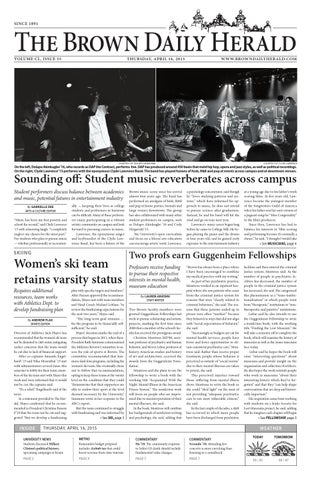
On the left, Dolapo Akinkugbe ‘16, who records as DAP the Contract, performs live. DAP has produced around 450 beats that meld hip hop, opera and jazz styles, as well as political recordings. On the right, Clyde Lawrence ‘15 performs with the eponymous Clyde Lawrence Band. The band has played fusions of funk, R&B and pop at events across campus and at downtown venues.
Sounding off: Student music reverberates across campus Student performers discuss balance between academics and music, potential futures in entertainment industry By GABRIELLE DEE ARTS & CULTURE EDITOR
“Music has been my first priority and school the second,” said Clyde Lawrence ’15 with a knowing laugh. “I completely neglect my classes for the most part.” For students who plan to pursue music — whether professionally or recreation-
ally — keeping their lives as college students and performers in harmony can be difficult. Many of these performers enjoy participating in a vibrant artistic community on campus and look forward to pursuing careers in music. Lawrence, the eponymous singer and keyboardist of the Clyde Lawrence Band, has been a fixture of the
Brown music scene since his arrival almost four years ago. The band has performed an amalgam of funk, R&B and pop at house parties, formals and large venues downtown. The group has also collaborated with many other student performers on campus, such as Dolapo Akinkugbe ’16 and Cody Fitzgerald ’15. The University’s open curriculum and focus on a liberal arts education can encourage artists’ work. Lawrence,
at a young age due to his father’s work scoring films. At five years old, Lawrence became the youngest member of the Songwriters Guild of America when his father sent his son’s version of a pageant song for “Miss Congeniality” to the film’s producers. Since then, Lawrence has had to balance his interests in “film scoring and performing because it’s normally a choice,” he said. “I thought I would take » See MUSICIANS, page 4
Two profs earn Guggenheim Fellowships
SKIING
Women’s ski team Professors receive funding to pursue their respective in mental health, retains varsity status interests museum education
Requires additional resources, team works with Athletics Dept. to develop fundraising plan By ANDREW FLAX SPORTS EDITOR
Director of Athletics Jack Hayes has recommended that the women’s ski team not be demoted to club status, mitigating earlier concerns that the team would be cut due to lack of financial support. After co-captains Amanda Engelhardt ’15 and Nika Mosenthal ’15 met with administrators several times this semester to lobby for their team, members of the ski team met with Hayes this week and were informed that it would not be cut, the captains said. “It’s a relief,” Engelhardt said of the news. In a statement provided to The Herald, Hayes confirmed that he recommended to President Christina Paxson P’19 that the team not be cut and suggested “that we develop a fundraising
INSIDE
a psychology concentrator, said though he “loves studying patterns and systems,” which have informed his approach to music, he does not intend to pursue science after graduation. Instead, he and his band will hit the road and go on tour next year. Lawrence’s music career began long before he came to College Hill. He began playing the piano and the drums at four years old, and he gained early exposure to the entertainment industry
plan with specific targets and timelines.” After Paxson approved the recommendation, Hayes met with team members and Head Coach Michael Leblanc “to review the fundraising expectations for the next two years,” Hayes said. “The long-term goal remains … for the program to be financially selfsufficient,” he said. Hayes’ decision marks the end of a process that began in 2011, when thenPresident Ruth Simmons commissioned the Athletics Review Committee to assess the role of sports at Brown. The committee recommended that Simmons slash four programs, including the women’s ski team. She eventually chose not to follow that recommendation, opting to keep those teams at the varsity level on the condition that they could “demonstrate that their supporters are able to endow their sport at the level deemed necessary by the University,” Simmons wrote in her response to the ARC’s report. But the team continued to struggle with fundraising and was informed by » See SKI, page 3
By LAUREN ARATANI STAFF WRITER
Two Brown faculty members were granted Guggenheim Fellowships last week to pursue scholarship and artistic projects, marking the first time since 2008 that a member of the school’s faculty has received the prestigious award. Christine Montross MD’06, assistant professor of psychiatry and human behavior, and Steven Lubar, professor of history, American studies and history of art and architecture, received the awards from the Guggenheim Foundation. Montross said she plans to use the fellowship to write a book with the working title “Acquainted With the Night: Mental Illness in the American Prison System.” The nonfiction work will focus on people who are imprisoned due to misinterpretation of their mental illnesses, she said. In the book, Montross will combine her backgrounds of nonfiction writing and psychology, she said, adding that
“Brown has always been a place where I have been encouraged to combine my medical practice with my writing.” As part of her psychiatric practice, Montross worked in an inpatient hospital where she saw patients who came from the criminal justice system for reasons that were “clearly related to criminal behaviors,” she said. The reasons that these patients ended up in prison were often “murkier” because they behaved in ways that did not align with “social expectations of behavior,” she said. “Increasingly as budgets are cut for mental health services, people have fewer and fewer opportunities to obtain consistent psychiatric care,” Montross said. Rather than receive proper treatment, people whose behavior is perceived as outside of “social norms” due to their mental illnesses are taken to prison, she said. This perceived injustice toward those suffering from mental illness drove Montross to write the book so she could “shed light” on the issue of not providing “adequate psychiatric care to our most vulnerable citizens,” she said. In the last couple of decades, a shift has occurred in which more people have been discharged from psychiatric
facilities and then entered the criminal justice system, Montross said. As the number of people in psychiatric facilities has decreased, the number of people in the criminal justice system has increased, she said. She categorized this phenomenon as a “trans-institutionalization” in which people went from “therapeutic” institutions to “nontherapeutic and punitive” institutions. Lubar said he also intends to use the Guggenheim Fellowship to write a nonfiction book, with the working title “Finding the Lost Museum.” He will take a semester off to complete the book, which will examine the history of museums as well as the issues museums face today. Lubar said he hopes the book will raise “interesting questions” about museums and provide insight on the organization and collection of artifacts. He also hopes the work reminds people who work in museums “about their interesting history which they’ve forgotten” and that they “can help shape conversations that are deep and historically important.” His inspiration came from working with students on a Jenks Society for Lost Museums project, he said, adding that he imagines each chapter will begin » See FELLOWSHIP, page 3
WEATHER
THURSDAY, APRIL 16, 2015
UNIVERSITY NEWS Students discussed Hillary Clinton’s political history, upcoming campaign at forum
METRO Raimondo’s budget proposal includes Airbnb tax that could boost revenue from state tourism
COMMENTARY Ha ’18: The community response to Sohn’s GS death should include fundamental value changes
COMMENTARY Secondo ’16: Attending live concerts is more enriching than listening to a soundtrack
PAGE 2
PAGE #
PAGE 7
PAGE 7
TODAY
TOMORROW
59 / 43
60 / 47
UNIVERSITY NEWS PAGE 2 • THURSDAY, APRIL 16, 2015
THE BROWN DAILY HERALD
RYAN WALSH / HERALD
Brown Students for Hillary hosted an information session about Hillary Clinton Wednesday evening, including a presentation about her personal and political background and an open discussion about her policies. The group hopes to promote Clinton’s presidential candidacy on campus and off — an effort that will include campaigning and canvassing.
‘Hillary 101’ reflects on Clinton’s past amid campaign launch Presentation, Q&A session allow students to learn about Democratic frontrunner’s campaign By AGNES CHAN STAFF WRITER
About 50 students gathered in Wilson 101 Wednesday night for an information session and discussion forum on Hillary Clinton in light of her announcement of her presidential campaign Sunday. Brown Students for Hillary, which hosted the event and was founded two weeks ago in preparation for Clinton’s campaign, is affiliated with Ready for Hillary, a movement of college students supporting Clinton that is developing nationwide, said group co-presidents
Emma Dickson ’16 and Elena Saltzman ’16. The forum opened with a Powerpoint presented by Dickson and Saltzman outlining Clinton’s family background, education and political career. They then opened the floor for discussion and questions. Much of the discussion centered on Clinton’s vigorous campaigning for breaking the glass ceiling during her time as First Lady. “There was actually an article I saw today that talked about how she was really the first First Lady who didn’t go into it with anyone thinking she was
going to be subservient,” Dickson said. As a new grandmother, Clinton could promote the idea of women balancing family dynamics and careers in her campaign, Dickson added. Clinton’s campaign announcement video focuses primarily on Clinton’s support for families, but students said they would like to see her elaborate on how she intends to address economic problems. “I think you will see sustained pressure on her to address income inequality, to address structural shifts in the economy that have happened,” said Mathias Heller ’15, a former Herald managing editor. “Obama has gotten us back from the brink of the recession, but we need to have sustained dialogue
about how to move forward.” Jeffrey Salvadore ’17 said he hopes Clinton will play up her efforts to protect children’s rights in her campaign. “I had no idea about the work she’s done for child rights. … It’s not something people really talk about,” he said. “It’s really cool to hear that she’s at the forefront of that.” Clinton’s support for the wars in both Iraq and Afghanistan remains a controversial aspect of her political history. Students debated how this will affect her chances of victory. “She needs to think of some way to explain it, like … that she did it mainly for the rights of the women in Afghanistan. That to me is a very compelling reason for her to vote the way she did,” said Talia Rueschemeyer-Bailey ’18. A long-time Clinton supporter, Rueschemeyer-Bailey said she learned a lot about Clinton’s policies and background during the discussion, most notably her backing of U.S. military involvement in Iraq and Afghanistan — a facet of her career RueschemeyerBailey was previously unaware of. Citing her admiration for Clinton’s work on women’s rights and child development, Rueschemeyer-Bailey said
she has “always looked up to (Clinton) as a female leader.” “I am a huge fan of Hillary Clinton,” Salvadore said. “It’s time for a female president, and I want to do everything to make sure she gets elected.” He added that he attended the discussion as a way of both showing his support for Clinton and learning more about her campaign. “I didn’t know all that stuff about her early years. … It really gave me a more complete sense of her campaign.” The group intends to continue supporting Clinton by joining forces “with national organizations and ideally with (Ready for Hillary) chapters at other schools in the area,” Dickson said. The group also plans to hold campaigning and canvassing trips in Providence and in other places, like New Hampshire, in the fall and spring. All of the chapters of Ready for Hillary are “building from the ground up” and “starting early,” Dickson said, adding that a common issue for candidates is that “they don’t have a lot of grassroots support until the general election.” As part of the student movement supporting Clinton, Brown Students for Hillary will be “ready to be part of the campaign,” Saltzman said.
UNIVERSITY NEWS
THURSDAY, APRIL 16, 2015 • PAGE 3
THE BROWN DAILY HERALD
» FELLOWSHIP, from page 1 with a story from the Jenks Museum. “I really want the book to help shape the conversations about what museums should be,” he said. The process of applying for the Guggenheim Fellowship consists of writing a letter to the Guggenheim Foundation about the project one wants to pursue,
Lubar said. The fellowship is a “pretty easy thing to apply for,” he said. The Guggenheim Fellowship is awarded to individuals who have “demonstrated exceptional capacity for productive scholarship or exceptional creative ability in the arts,” according to the Guggenheim Foundation’s website. While nearly 4,000 individuals apply each year, only 200 awards are granted.
COURTESY OF BROWN UNIVERSITY
Christine Montross, assistant professor of psychiatry and human behavior, will use the fellowship to write a book on mental health and prisons.
UCS prepares for structural makeover vote Creation of new positions, bi-weekly general body meetings proposed to increase efficiency By NATALIE FONDRIEST SENIOR STAFF WRITER
The Undergraduate Council of Students reviewed structural changes proposed by the UCS Outreach and Advocacy committee and other council members at its general body meeting Wednesday. Proposals for the UCS Executive Board included creating new positions for a chief of staff and a communications director. The incoming UCS Executive Board will appoint students to both positions for general body approval April 29 so that “the whole E-board is together for the summer,” said UCS President Maahika Srinivasan ’15. Council members also proposed the creation of a management board “to run UCS logistics and operations,” Srinivasan said. The board would also include two new positions: a general body secretary and a community relations manager who would “take on anything … with the Providence community beyond campus,” said Ryan Lessing ’17, chair of the UCS Admissions and Student Services committee. The inclusion of experts — including graphic designers and students with extensive policy knowledge — on the council not necessarily as general body members was also proposed. The model
» SKI, from page 1 the Athletics Department in Spring 2014 that it needed to improve its fundraising efforts. The team met its goals for the fiscal years 2014 and 2015 but was still in jeopardy of being cut. Engelhardt and Mosenthal said Hayes implied during a February meeting that the team was likely to be demoted if it could not raise its endowment to $1.5 million in as little as three weeks. But the skiers argued that the requirements Simmons established for teams in 2011 were unclear and that the Athletics Department failed to remain in contact with the team about fundraising goals, as Simmons stipulated. Mosenthal said “the biggest reason” that the team was not demoted was the “vagueness” of Simmons’ response to the 2011 report. “Over the next two years, we’re
COURTESY OF BROWN UNIVERSITY
Steven Lubar, professor of history and American studies, will take a semester off to write a nonfiction book titled “Finding the Lost Museum.”
is “very prevalent at Yale,” Srinivasan said. OAC would meet on an ad-hoc basis to respond to immediate campus issues “before they become long-term projects that are dedicated to a specific program area committee,” according to the draft of the proposal. The general body would meet biweekly, with the council hosting administrator visits or open-forums on “off weeks” as needed, Srinivasan said. “The bulk of the work (members) do is in committee, and we want to put more weight on that,” she added. This restructuring would increase the need for improved advertising of open forums, said Peter Dutton ’18, a UCS general body member, who was recently elected chair of the UCS Admissions and Student Services committee effective next semester. The council will vote April 29 on a resolution to create a summer working group that would review the proposal in detail. The group would serve to make specific recommendations so that any code changes can be passed at the first general body meeting of fall 2015. “I would love to pass code changes at the end of this year … but a lot of us are really nervous about changing code without thinking about the details of how these changes are going to be implemented,” Srinivasan said. Benjamin Gladstone ’18 also presented a resolution he drafted calling for “increased sensitivity” to LGBT students. The resolution, which the council will also vote on April 29, includes requests to change the male or female prompt on
Brown’s admission application, establish accessible gender-neutral bathrooms in University buildings and create funds for students whose parents or legal guardians stop providing them financial assistance when they come out, Gladstone said. The resolution also requests increased resources for the LGBTQ Center. “Even just trainings about pronouns and names changes … a lot of that is not happening to the fullest capacity because there’s only one Kelly,” he added, referring to LGBTQ Center Program Director Kelly Garrett. Srinivasan said President Christina Paxson P’19 appreciates the council’s mental health letter delivered last week and “is waiting on the Mental Health Community Council’s recommendations to be able to move forward.” The Alcohol and Social Policy Review committee will meet Thursday to hear from independent students living in program housing on Wriston Quad about their experiences, said Sazzy Gourley ’16, UCS vice president, chair of the OAC, and UCS president-elect. The committee will use these students’ experiences to frame discussion about the possibility of social events in the future, Gourley added. The UCS Student Activities committee will host new leadership orientation next week, focusing on BearSync for all approved student groups, said Dara Bernstein ’18. The council also approved the Socially Responsible Investment Fund as a Category 3 student group and the Black Pre-Law Society as Category 1.
going to have to increase our fundraising substantially, but everything’s a lot more clear now, so we appreciate the fact that (Hayes) is taking the time to give us more concrete, realistic goals,” Mosenthal said. Hayes “developed a certain pathway for us, and we’ll have checkpoints along the way, but they’re definitely way more reasonable” than the original demand of $1.5 million on short notice, she said. Engelhardt said she was confident in the team’s ability to meet the fundraising benchmarks. After initially expressing frustration with what they perceived as an Athletics Department unreceptive to their concerns, the captains were pleased with Hayes’ responsiveness. The University cooperated with parents and the Brown Sports Foundation, which coordinates fundraising for all teams, to “figure out what reasonable and attainable goals would look like,”
Engelhardt said. “It was really nice to see that people listened,” Mosenthal said. Given a second chance to fundraise effectively, the skiers will “make a more legitimate plan for how, on our side, the fundraising is going to work,” Engelhardt said. “Everyone’s really invested now.” “The last thing I would want to see is for all the hard work that everyone put into saving the team … (to) mean pretty much nothing if the forward momentum is lost and people don’t keep working towards the goals that we now clearly have,” she added. Having created a realistic plan with the Athletics Department, the skiers said they are happy to have secured the future of their team. “In the end, the outcome was really positive, and everyone learned a lot,” Mosenthal said. “Going forward we’re in a good, very transparent, clear place.”
ARTS & CULTURE PAGE 4 • THURSDAY, APRIL 16, 2015
» MUSICIANS, from page 1 a crack at performance because now is the time to fuck around with that.” “Only in high school I started taking myself seriously as a singer, and only in college did I have the idea that I wanted to be the frontman of a band,” he said. Music also emerged as an early passion for Akinkugbe, who records as DAP the Contract. “I listen to music 24 hours a day — it’s weird that I don’t have earphones dangling right now,” he said. His mother was a piano teacher, and he grew up surrounded by music ranging from the classical melodies of Beethoven and Mozart to the anthems of Eminem and the Beatles. In a quiet voice laced with British and Nigerian inflections, he speaks quickly but with consistent rhythm. Though his sound often focuses on hiphop, his tracks feature rap mixes with a wide variety of influences — such as opera, recordings of political speeches, jazz and classical piano — layered on top of one another. His potent lyrics address topics both political and personal, including police brutality in the United States, homophobia in Africa, the Nigerian government and relationships in his everyday life. The unifying concept behind all of the lyrics is that they focus on real events, he said, adding, “I don’t make stuff up.” “It’s always me, no matter what genre or style it is,” Akinkugbe said. He cited rap gods Kanye West, J Cole, Drake and Kendrick Lamar as well as legendary producers Just Blaze, Timbaland and Pharell as his main influences. Since forging his own musical path, Akinkugbe has produced around 450 beats, each individually labeled. Sometimes the inspiration comes in a flash, he said, noting that he produced one of his favorite songs in just 25 minutes. But at other times, producing requires stolid patience, and he takes up to six hours to perfect a track. “You’re already telling the story in your head as you make the beat,” Akinkugbe said, explaining that he simultaneously writes his raps and crafts his beats. “Rappers who just rap can be amazing, but they’re always going to miss that last bit of musicality.” Rebecca Carrol ’15 also writes all of her own material, and her lyrics tackle issues including female empowerment in the entertainment industry. “I want to make my thoughts and problems I see in the world digestible in rap form,” she said. “Listen, this is fair and square / I’m kind of obsessed with your derriere,” she sings in the first lines of “Boy Booty,” a song that responds to the music industry’s focus on women’s bodies and paucity of attention to men’s bodies. Carrol “raps from her heart about issues that are actually important,” said Asia Nelson ’15, manager for ReMC, Carrol’s stage name. “Her raps are very powerful when I listen to them — they take something funny and playful and make it have a deep meaning.” ReMC stands not only for Carrol’s initials, but also for mic controller. But Carrol recently decided to rename herself as Malka Red, which “sounds more like an actual name,” she said with a laugh. In her raps, Carrol often refers to herself by her alter ego “Red Queen.” The persona stems in part from the Red Queen hypothesis, which Carrol learned about as an evolutionary
anthropology concentrator. The hypothesis asserts that in order to survive, every creature must continually adapt to an ever-changing environment. “I really want to make upbeat club banger songs that still have an underlying message if you listen hard enough,” Carrol said. She listed her main influences as Nicki Minaj, Chance the Rapper, MIA and Angel Haze. Her trajectory in rapping began in high school, where her interest in wordplay and rhyming inspired her to execute her entire valedictorian speech
THE BROWN DAILY HERALD and thus richard assembled. Most of the band’s members said they began playing music on multiple instruments at early ages. Janssens began playing the marimba when he was three years oldbefore he moved on to the glockenspiel. But a “career-ending finger sprain” led him to pick up the piano and finally the drums. “My family all sings, so I grew up singing, too,” Kibble said, adding that she also started to learn the piano at a young age. Enriquez began playing the piano
that is a central tenet of jazz music, he said. But he soon learned to adapt to multiple styles. “I was worried if I left I’d leave the music behind,” Akinkugbe said, adding that by the end of his time at Berklee, he released an entire compilation of songs entitled “Goodbye for Now.” At Brown, Akinkugbe studies classics and computer music. His academic pursuits often inform his rapping and producing, as his music frequently references Latin and Greek texts. One of his most recent songs features a poem
COURTESY OF RICHARD
Perfectly at home performing in basements and living rooms, the members of the punk hip-hop fusion band richard said a good way to describe their sound is “sexy silky funky fun.” in “kind of a slam-poem-rap hybrid,” she said. The band richard, on the other hand, began in “a grungy-ass, flea-infested basement,” said one of the nine members during a joint interview with The Herald. Eight members of the hip-hop punk fusion band — alto saxophonist Sumner
at seven years old, switching in middle school to the guitar, which he has played ever since. The band members all agreed that Enriquez masterminds much of their work. The band’s style ranges from smooth R&B to upbeat hip-hop fusion. “Someone once described us as ‘sexy silly funky fun,’ and we loved it,” Sanders
COURTESY OF REBECCA CARROL
Rapper Rebecca Carrol ’15 performs under the pseudonym Malka Red, drawing inspiration from performers like Angel Haze and Nicki Minaj. Becker ’14, trumpet player Sage deLisser ’15, guitarist Peter Enriquez ’16, bassist Ana Gonzalez ’15, drummer Arun Janssens ’15, vocalist Chloe Kibble ’17, keyboardist Grant Meyer ’16 and track producer Wes Sanders ’15 — piled onto the front steps of a Power Street house, slightly inebriated. “We shotgunned beers before you came,” a band member said. Jannsens said richard started when he needed to pull together a show to raise funds for the Food Recovery Network, a student group that distributes leftover food from campus eateries to homeless shelters in Rhode Island. He blasted an email to musicians he knew,
said. “Oh my god, that’s what we are!” another band member agreed, suggesting that the band monogram towels with the acronym “SFFF.” Encompassing a wide range of genres, styles and instruments, these student performers are united by their ability to channel their passion on a campus that lacks a traditional music curriculum. Before matriculating to Brown, Akinkugbe spent a year at the Berklee College of Music. While attending a school rooted in the study of jazz, his background in classical music left him struggling to capture the improvisation
translated from English to Latin in a classical opera style. Carrol dons a bright red wig that is bobbed to her shoulders while on stage. Mixing theatricality with pithy lyrics, she dramatically eyes the audience, introducing her song as the initial beats throb behind her. Carrol bounces onstage with an energy that drives her fast-paced raps and high voice. The members of richard crowd into a single living room, tripping over guitar and bass wires, brass instruments, drums and piano sets. They start to play a set, beginning with an upbeat “banger,” creating an eclectic mix of rap and jazz without missing a beat in the wake of frequent tempo changes. “Everything we make is a banger. Everything,” Kibble said. It is hard to imagine richard playing in any venue besides a basement, whether to a crowd pulsing with energy or to a group of friends winding down for the night. Jazz riffs from saxophones and pianos herald DAP’s disarming lyrics, which then break into melodious collaborations with singers, political speeches, news reports or remixed anthems, such as “Where is the Love” by the Black Eyed Peas. His songs turn from slow, wistful piano duets to quick, heavily layered raps, again mirroring the diversity of his influences. Akinkugbe’s will to incorporate his entire being into his music is evident — snippets of his year at Berklee meld with his ties to Nigeria. Though Brown is not a music school, its student body often shows support for musically inclined classmates. B-Side Magazine, a student group that highlights work by student musicians and local bands through an online publication, was born when Ben Williams ’16 and Francis Torres ’16 returned from their respective
study-abroad programs last semester. Williams and Torres noticed that many students were interested in music and read relevant publications, such as Pitchfork and the Fader. “We want to make a mini version without the pretentiousness,” Torres said. Williams said the talent and support for the music scene are palpable on Brown’s campus. At B-Side’s launch concert April 10, student performers including DAP, Lawrence and richard took the stage. “That’s what fuels art — bouncing off other people and ideas,” Carrol said, adding that she has been a part of an allfemale rap cypher and has met up with singers on campus to generate catchier hooks for her own songs. Last semester, Carrol created a Group Independent Study Project called “The Language of Hip Hop,” and she is currently putting together a rap musical on evolution and DNA for one of her classes. The campus music scene is “beginning to flourish, but it’s not wild enough,” Gonzales said. Student musicians would benefit from being able to register off-campus shows in order to avoid being shut down by the Department of Public Safety, she added. “Being in a student band gives you license not to give a fuck,” Sanders said, adding that she thinks student performers are afforded more informal settings in addition to more freedom of expression. Akinkugbe said he appreciates that the Brown music scene bustles with collaborations, adding that he has partnered with the Clyde Lawrence Band, multiple a capella groups and Nice, a local band in Providence. Richard has also collaborated with Clyde Lawrence, DAP and several a capella groups. Members of Brown’s artistic community support each other, even outside the music scene, Becker said. As an audience member and critic, Williams said, “It’s far cooler to see someone you have some sort of connection to in the community.” Many of Brown’s prominent musicians said they intend to stay focused on their art, even if they do not plan to make a career out of it. Lawrence said he “100 percent” plans to pursue a musical career after graduation. His sister Gracie Lawrence ’20, who was admitted to Brown early decision in the fall, will take a year off before matriculating to accompany the band on tour. After walking through the Van Wickle gates, Carrol plans to move to New York in the hopes of advancing her rap career and exploring “the fusion of rapping and acting.” “I would not be able to stop making music,” Akinkugbe said. He intends to apply to law school after Brown, potentially continuing his involvement with music in entertainment or copyright law. “I’m going to be on tour rolling joints for Bruce (Springsteen), driving a bus for Bruce,” one member of richard called out, while another joked that he has “a job with Willy Wonka, because they’re a bars factory.” Mostly seniors, the members of richard give mixed reviews about remaining in the music industry. To keep the band alive on campus, the members of richard aim to pass on their title to a group of younger students this year. “We are kidnapping people. We’re having a sacrifice. We’re forming a cult,” Janssens said. “It’s gonna be dope.” - With additional reporting by Eben Blake
TODAY
THURSDAY, APRIL 16, 2015 • PAGE 5
THE BROWN DAILY HERALD
sun’s out, students out
menu SATELLITE DINING JOSIAH’S Gnocchi, Quesadillas BLUE ROOM Mediterranean Pocket Soups: Chicken Artichoke Florentine, Fire Roasted Vegetable, Turkey Chili ANDREWS COMMONS Make Your Own Pasta Pizzas: Nacho Pizza, Okie Dokie Artichokie, Pepperoni and Sausage
DINING HALLS SHARPE REFECTORY LUNCH
DINNER
Ve g a n Q u i n o a S t u f f e d Portabello, Italian Chicken Parmesan, Oatmeal Cookies
Vegan Italian White Beans, Cajun Baked Fish, Chicken Broccoli Pasta Alfredo
VERNEY-WOOLLEY LUNCH
DINNER
Asian Sesame Chicken Salad, Roasted Eggplant with Tomato Sauce, Macaroni Salad
Sweet and Sour Pork Saute, Steamed Vegetable Melange, Pretzel Bread Rolls
sudoku
crossword
ASHLEY SO / HERALD
Students soaked up the sunshine on the Main Green Wednesday, taking advantage of the recent shift toward typical spring weather just in time for the outdoors Spring Weekend concerts Friday and Saturday.
comic A Horse Of Any Other Name | Zach Silberberg ‘18
calendar TODAY
TOMORROW
2:30 P.M. LYNN XU READING
12:00 P.M. “THE NEW MCCARTHYISM”
Poet Lynn Xu, author of “Debts and Lessons” and “June,” will read her work as part of the Writers on Writing series sponsored by the Department of Literary Arts. McCormack Family Theater
Brown Students for Justice in Palestine will host Steven Salita, a Palestinian-American professor, who will lead a discussion on censorship of Palestinian academics in America. Rhode Island Hall 108
5:00 P.M. CARNIVAL
SPecial Events Committee will host an outdoor festival to kick off Spring Weekend featuring carnival rides, a dunk tank, student performances, face painting, popcorn and cotton candy. Main Green
3:30 P.M. PHILOSOPHY COLLOQUIUM
Ted Sider, professor of philosophy at Cornell, will lead a colloquium entitled “Asymmetric Personal Identity” followed by a reception. Salomon 203 3:30 P.M. “HOW TO RAISE MONEY FOR STARTUPS
8:00 P.M. “CARRY THAT WEIGHT”
Emma Sulkowicz, a senior visual arts major at Columbia University, will discuss her senior thesis, which involves carrying a mattress to protest Columbia’s response to her alleged sexual assault. Metcalf Auditorium
IN TODAY’S ENVIRONMENT”
A panel of experts will discuss methods for raising capital to fund entrepreneurs in the sciences. Sydney Frank 220
COMMENTARY PAGE 6 • THURSDAY, APRIL 16, 2015
EDITORIAL
THE BROWN DAILY HERALD
Q U O T E O F T H E D AY
Students show moral inconsistency On Friday and Saturday, roughly 5,000 Brown students will pay money to crowd the Main Green to applaud and cheer along Waka Flocka Flame and Pusha T. We will give them tens of thousands of dollars, both out of the University’s operating budget and directly from our pockets in ticket purchases. Why? Rape culture bears a relation to the lyrics that Waka Flocka Flame and Pusha T will sing. Rape culture is one of the most pervasive and entrenched causes of sexual violence. Aspects of our society — including music, television and film — blend violence and sex in a way that either explicitly or implicitly encourages sexual aggression. While some dispute the rape culture narrative, this is a campus that overwhelmingly accepts the existence of rape culture in our society. Last fall, the Janus Forum invited Wendy McElroy, a fringe women’s rights activist, to speak on a shared stage with Jessica Valenti, a more mainstream voice on these issues. Criticism of McElroy’s views on rape culture was so loud that President Christina Paxson P’19 felt obligated to weigh in through a campuswide email, writing explicitly, “I disagree.” Why does Paxson not feel the need to clarify that her administration does not endorse Waka Flocka when the musician says, “All I wanna do is sit back and watch you move and I’ll proceed to throw this cash”? Or Pusha T when he says, “Don’t let your side bitches settle in. Might have to head-butt your Evelyn” — a reference to Chad “Ochocinco” Johnson, who pled guilty for head-butting his wife, Evelyn. The reason is that for some inexplicable reason, no one is protesting. Instead, we are patronizing these performers. The Brown community has been proudly vocal and unequivocal in its condemnation of sexual violence. In addition to those who publicly criticized McElroy, 3,436 Brown community members signed a petition organized by Imagine Rape Zero — a movement that aims to reform the University’s response to sexual assault on campus — over the last year. An estimated 400 students gathered on the Quiet Green last month to protest the University’s handling of two date-rape drug and sexual assault cases, and around 40 students participated in the second annual March Against Sexual Assault last week. Across these efforts, a large and representative segment of the student body has come together to advocate more effective policies to combat sexual assault. If we are going to stand up to the forces in our society that perpetuate sexual violence, we cannot be selective. We cannot protest the people we do not want to listen to and willfully ignore those with artistic talent. Indeed, young people in this country are learning far more from musicians and actors than from academics and social scientists. If we want to prevent another generation of backward and damaging values, we need to be strict in our commitment to minimizing those who perpetuate sexual violence. This is not to argue that these or similar artists should be censored or prohibited. They are absolutely legally entitled to say whatever they please, regardless of how disgusting. But we do not need to invest in them or offer them a stage. If this sounds like a buzz-kill at a time when we all want to distract ourselves and enjoy a weekend before finals, it should. But pushing against the forces of society for meaningful change takes more than periodically signing a petition. On one side of University Hall, we protested together for justice for sexual assault survivors. On the other, we will come together in even greater numbers to patronize rape culture. No one is obligated to protest Waka Flocka and Pusha T. But in our collective conscience, are we comfortable with this juxtaposition?
“Being in a student band gives you license not to give a fuck.” — Wes Sanders ’15
See musicians on page 1.
Editorials are written by The Herald’s editorial page board: its editors, Alexander Kaplan ’15 and James Rattner ’15, and its members, Natasha Bluth ’15, Manuel Contreras ’16, Baxter DiFabrizio ’15, Mathias Heller ’15 and Aranshi Kumar ’17. Send comments to editorials@browndailyherald.com.
Editorial Leadership
Sections
Visuals & Production
Business
Editors-in-Chief Michael Dubin Maxine Joselow
Arts & Culture Editors Eben Blake Gabrielle Dee
General Managers Sarah Levine Winnie Shao
Managing Editors Kiki Barnes Jillian Lanney
Metro Editors Alexander Blum Emma Jerzyk Drew Williams
Design Editors Loren Dowd Carlie Peters Taylor Schwartz Assistant: Meryl Charleston Assistant: Andrew Linder
Senior Editors Camilla Brandfield-Harvey Isobel Heck Molly Schulson
Science & Research Editors Andrew Jones Steven Michael
BLOG DAILY HERALD Editor-in-Chief David Oyer
Sports Editors Andrew Flax Alex Wainger
Managing Editors Deena Butt Jacob Koffler
University News Editors Emma Harris Caroline Kelly Joseph Zappa
POST- MAGAZINE Editor-in-Chief Adam Asher DIGITAL Online Editor Marcy Huang
COMMENTARY Editorial Page Editors Alexander Kaplan James Rattner Opinions Editors Megan GrapengeterRudnick Kate Kiernan Evan Sweren
Photo Editors Head: Brittany Comunale David Deckey Katie Liebowitz Arjun Narayen Ashley So Ryan Walsh Graphics Editors Avery Crits-Christoph Emma Jerzyk Web Producers Joe Stein Harsha Yeddanapudy Abdullah Yousufi Copy Desk Chief Madeline DiGiovanni Illustrations Editor Angelia Wang Video Editor Richard Flores
Directors Sales: Moniyka Sachar Sales: Jess Urrutia Finance: Josh Tartell Alumni Relations: Marley Rafson Business Dev.: Yuta Inumaru Sales Managers Matthew Meyer Henry Ritter Gulmira Hamit Taylor Casey
facebook.com/browndailyherald
Location: 195 Angell St., Providence, R.I. www.browndailyherald.com
@the_herald
Editorial contact: 401-351-3372 herald@browndailyherald.com
browndailyherald.com
Business contact: 401-351-3260 gm@browndailyherald.com
Corrections: The Brown Daily Herald is committed to providing the Brown University community with the most accurate information possible. Corrections may be submitted up to seven calendar days after publication. Commentary: The editorial is the majority opinion of the editorial page board of The Brown Daily Herald. The editorial viewpoint does not necessarily reflect the views of The Brown Daily Herald, Inc. Columns, letters and comics reflect the opinions of their authors only.
Finance Managers Collections: Neil Wathore Collections: Benjamin Wesner Operations: Carin Papendorp
Letters to the Editor: Send letters to letters@browndailyherald.com. Include a telephone number with all letters. The Herald reserves the right to edit all letters for length and clarity and cannot assure the publication of any letter. Please limit letters to 250 words. Under special circumstances writers may request anonymity, but no letter will be printed if the author’s identity is unknown to the editors. Announcements of events will not be printed.
Business Dev. Manager Project Leader: Kaden Lee
Advertising: The Brown Daily Herald, Inc. reserves the right to accept or decline any advertisement at its discretion. The Brown Daily Herald (USPS 067.740) is an independent newspaper serving the Brown University community daily since 1891. It is published Monday through Friday during the academic year, excluding vacations, once during Commencement and once during Orientation by The Brown Daily Herald, Inc. Single copy free for each member of the community. Subscription prices: $280 one year daily, $140 one semester daily. Copyright 2015 by The Brown Daily Herald, Inc. All rights reserved. Periodicals postage paid at Providence, R.I. Postmaster: Please send corrections to P.O. Box 2538, Providence, RI 02906.
COMMENTARY THURSDAY, APRIL 16, 2015 • PAGE 7
THE BROWN DAILY HERALD
The blame lies with all of us DAVID HA opinions columnist
As we are all aware, Hyoun Ju Sohn GS killed himself on campus March 31. It was a tragic loss for our community and has affected many of its members. Yes, this has been discussed often both in print and elsewhere. Some may believe that we must move past this. But there are two reasons preventing me from forgetting this tragedy. First, I was walking fairly close to the Sciences Library when the incident occurred. Though I did not directly witness it, I was nevertheless shocked by the news when I heard about it from those who were passing by. Second, I believe there are concrete reasons why this took place. We unknowingly contributed to the occurrence of this incident by narrowly devoting ourselves to school work without a purpose to better our community and neighbors through education. This is a reminder that we, as a community, need to reset our priorities. This may sound unrelated, but hear me out.
A surprisingly high number of students are restricted from opportunities to take a break from their incessant pursuit of their goals. They have no chance to slow down and discover the purpose of their education. Students work toward their individualized goals. The school strives to better its profile. Faculty members
number of articles announcing new programs and personnel designed to assist those in need. Most of them outline what we must actively do or say — none of them really suggest not doing anything. A narrow-sighted race to the top, without a concrete goal in mind, can be dangerous for both the community and the individual.
to the suicide appears to be simply throwing more bureaucracy and personnel at mental health, not focusing on changing community values. The discussion has coalesced around what the University must provide in terms of counseling services in order to prevent similar incidents. The University’s recent measures
Though a systemic approach to problem solving is often effective, the present situation requires us to reprioritize our most fundamental values in education.
seek to produce more research and move up the ranks. All these goals are good, but there seems to be a lack of more selfless motives behind our work. In an environment like this, how could there not be people who feel left out, those who feel as if they do not belong? Sometimes a seemingly unproductive state is healthier than fiercely working toward a goal, especially if there isn’t a proper motive behind it. In The Herald, there have been a
Much of this is reflected in many students’ lacking — or perhaps distorted — sense of purpose. Students tend to strive for individual success, not greater causes beyond it. We have turned a blind eye to many things in the aftermath of this event, especially that we all bear some responsibility — every one of us. The University must make clear what the purpose of a Brown education is: to give back to others and contribute to our communities. Much of the University’s response
to reform sexual assault policy, like appointing a new Title IX program officer, evince a similarly disappointing focus on personnel instead of values. Given the size of Brown’s student body — there are more than 6,000 undergraduates and nearly 2,000 graduate students — it seems almost inevitable that students will divide into many groups and stay isolated. I feel that there is a growing consensus within the campus that allows us to perceive ourselves as mere in-
dividuals, not part of the campusor the community. We have unknowingly created a separated community where people of different backgrounds and cultures cannot interact with each other. Though a systemic approach to problem solving is often effective, the present situation requires us to reprioritize our most fundamental values in education. We must establish a school environment where individual success does not top the list of priorities and build a tight-knit community where the tools of healing are not bureaucracy and trained personnel, but rather more personal attention to those who surround us. I still want to commend the University’s efforts in trying to rebuild the community at a more personal level. I hope that such goals can quickly spread throughout the student body and the campus to produce a warmer and more welcoming community. Let us always carry Sohn’s death in our hearts. It is necessary both to move forward and to engrave this tragedy in our minds.
David Ha ’18 can be contacted at woosuk_ha@brown.edu.
Listen to the music REID SECONDO opinions columnist
As the sun slowly begins to shine and the birds test out their vocal chords, spring becomes more of an everyday reality. Besides shortswearing weather and Main Green lounging, spring also signals the beginning of the summer concert season. With big-name festivals, touring artists and our very own Spring Week(end) upon us, music is in the air and bringing in much deserved celebratory flair. Music is both a medium with unlimited artistic potential and a source of entertainment with special significance for each individual. It is simultaneously a unifying and distinctively personal experience. Whether you’re the one making the music or listening to it, being a part of a concert is a celebratory experience of self-expression and entertainment. Performers and their audiences connect through their energy and mutual appreciation for the music that binds them together. Brown students are lucky to have Providence perfectly centralized along the Northeastern seaboard where touring artists and groups — headlining or obscure — often stop on their way to New York or Boston. In addition to the infinite musical talent in both our school and local community, we have constant opportunities to hear tones and tunes that get us engaged and grooving. In this of age of streaming media and societal demands for instant gratification, concerts and live music are losing appeal in presentation and purpose. Why spend a fair sum of money to hear an artist when his or her entire
catalog is widely available across many platforms for a fraction of the cost, or none at all? Why even bother going to a concert with the intention of listening, given it serves as an environment for ulterior social and recreational intentions? I jump at any opportunity for a live concert experience — whether in a box seat at Carnegie Hall for Haydn’s “Mass in Time of War” or in a mosh pit jamming to Kygo’s tropical house hits. Though different genres and venues re-
systems by rebalancing levels of oxytocin. This evokes feelings of contentment, self-awareness and serotonin for better memory, mood and circadian functions. Research shows it also ignites our neural reward pathways, simulating the release of dopamine to make us feel elated, USA Today reported. When Walk the Moon’s indie rock sound with catchy synths and soaring vocals hit my eardrums, I felt an instant infectious desire to “shut up and dance.” Each song’s hook and
Going to a concert is living for an experience and making a memory — a temporary retreat from the daily doldrums that you’ll forever revisit to tap back into that positive place.
sult in an infinite variety of concert experiences, my most recent experience at a concert by Walk the Moon, an alternative pop-rock group, was the ideal example of how attending a concert enlivens the body and soul. Like a vibrational panacea, listening to music is proven to be beneficial for our mental and physical health, the Huffington Post reported earlier this year. Extensive research demonstrates that music can ease pain, improve cognitive function and reasoning, aid athletic performance, reduce anxiety and depression and boost the immune system. Engaging with music is a whole brain activity that stimulates the nervous and endocrine
beat that thumped through my body felt like a revitalizing electric wave, purging inhibitions while promoting liberation. Within 20 minutes of being enveloped in the music, I felt the weight of the week’s stresses slip away as I was lifted into a good place. That’s a testament to the power of music and the quality artistry of the band. Finding yourself naturally transported to such a place is uncommon nowadays. Synthesize music’s impact on our well-being with the additional social and mental benefits of concert psychology, and you now have an entertaining way of achieving euphoria and temporal enlightenment. Going to a concert is living for an experience and making a memo-
ry — a temporary retreat from the daily doldrums that you’ll forever revisit to tap back into that positive place, as demonstrated by a project examining the benefits of attending live music events by students at the University of California Los Angeles. Often financial costs make attending concerts such as the ones I have described prohibitively expensive for many people. But we receive more gratification from experiences than material possessions given the lasting impressions they leave on us, similar to the effects of a vacation. There are completely free live and local concerts that can produce the same benefits for audience members and do not require a cost-benefit analysis. As fiercely social animals, we inherently like engaging with people and becoming part of a unifying moment. Belting out choruses and dancing together are celebratory experiences that heighten our presence and connections with each other. It is also a way to appreciate and support the arts and talents of gifted people. At a live concert, we listen to, dance to, sing and feel the music in a way that cannot be transferred on a recording. We see the band’s showmanship: exhilarating; the music: ecstatic; the moment: timeless. This comparatively tiny clip in life’s movie reel will not be forgotten, especially its soundtrack. Music is a reliable source for making us feel alive. But live music takes it a step further: With our open eyes and ears, it makes us live in the present and remember for a lifetime.
Feel free to continue the conversation with Reid Secondo ‘16 at reid_secondo@brown.edu.
METRO THE BROWN DAILY HERALD
THURSDAY, APRIL 16, 2015
COURTESY OF AIRBNB
The so-called Airbnb tax aims to create equity in the state tax code between alternative property rental platforms and traditional hotels.
New tax targets Airbnb-style rentals ELI WHITE / HERALD
Construction on the South Street Power Station, formerly known as Dynamo House, is expected to reach completion two months later than originally anticipated and be ready for use in November 2016.
Dynamo opening delayed two months Nursing education center shared by URI, RIC to become operational in November 2016 By DUNCAN GALLAGHER SENIOR STAFF WRITER
The nursing education center to be housed in the former South Street Power station will open in November 2016, about two months after the original date, the University of Rhode Island announced last week. The power station, popularly known as Dynamo House, has stood vacant in the Jewelry District since it was decommissioned in 1995. The University announced plans in July 2013 to renovate the property in conjunction with URI and Rhode Island College. Officials from the three schools, the city and the state ceremonially broke
ground on the project last December. The site will include a nursing education facility shared between URI and RIC as well as administrative offices and graduate housing for the University. The University, which signed a separate lease than RIC and URI, has always planned to move into the site in January or February 2017, said Russell Carey ’91 MA’06, executive vice president for planning and policy. The deviation from RIC and URI’s previously announced occupancy dates does not affect the University’s current plans of moving in, Carey said. The idea that the November date represents a delay in the process is somewhat misleading, Carey said, noting that the developers had long made the state aware that a November completion date was a possibility. The change will likely have a greater impact on the curriculum and planning of URI and RIC than on the University, he added.
President Christina Paxson P’19 affirmed her support of the development and outlined its potential impact in a Providence Journal guest column Tuesday. Commonwealth Ventures Properties, which is overseeing the renovation, initially indicated two potential dates for RIC and URI to begin occupying the site. The later of the two dates falls in November, the Providence Journal reported. Though CV Properties intended to have the site ready for the start of the Fall 2016 semester, URI’s Assistant Vice President for Business Services Vernon Wyman told the Providence Journal that the earlier date is no longer possible. Construction is scheduled to begin next month, and the development is “entirely consistent” with the timeline that CV Properties President Richard Galvin ’79 established in the two leases, Carey said. “These things take time, but it’s absolutely moving forward.”
Tax in Raimondo’s budget plan draws critics citing small revenue, proponents lauding tourism impact By ELAINA WANG SENIOR STAFF WRITER
Companies that provide alternative lodging for travelers — such as Airbnb, FlipKey and vacationrentals.com — have not traditionally paid lodging taxes but will face a 13 percent tax if Gov. Gina Raimondo’s budget proposal is passed. Because sites like Airbnb are not travel accommodations themselves but rather platforms on which individuals can rent their properties, they sidestep taxes entirely, the Providence Journal reported. The tax on Airbnb would consist of all the lodging taxes that hotels currently pay — a 7 percent sales tax, 5 percent hotel tax and 1 percent local hotel tax, wrote Melissa Czerwein, senior communication manager for the Rhode Island Commerce Corporation, in an email to The Herald. Currently these taxes only apply to properties that rent out two or fewer rooms, Providence Business News
reported. The House Finance Committee held a hearing for the legislation — the socalled Airbnb tax — April 7. Rep. Robert Jacquard, D-Cranston, and Rep. Teresa Tanzi, D-Narragansett and South Kingstown, both voiced their opposition to the proposed tax, the Journal reported. “People in Rhode Island are not competing with hotels,” Jacquard said. Tanzi expressed concerns — which were echoed by other committee members — that revenue from the tax would go to the state Commerce Corporation instead of local tourism boards. The tax would be “very hard to administer … and difficult to patrol,” said Scott MacKay, political analyst for Rhode Island Public Radio, adding that companies like Airbnb are “a person-to-person thing.” The majority of people using Airbnb are not businesses but individuals who rent out their property infrequently, and there is no easy mechanism for those people to pay this tax, MacKay said. Defenders of the bill argue that an increase in tax revenue could help pay for the state’s expanding tourism industry, the Journal reported. But the revenue generated by the tax is “a miniscule amount of money,” MacKay said. The state faces a $34.5 million deficit for the current fiscal year, according to the Associated Press, and the revenue from the tax could result in about $700,000 for the state, wrote Larry Berman, communications director for Speaker of the House Nicholas Mattiello, D-Cranston, in an email to The Herald. The Senate Finance Committee will hold a hearing on the budget article Thursday.