SINCE 1891
THE BROWN DAILY HERALD TUESDAY, APRIL 7, 2015
VOLUME CL, ISSUE 48
WWW.BROWNDAILYHERALD.COM
Students debate efficacy of safe spaces at BPF event While some praise safe spaces, others express concern over opinions being discouraged By TANEIL RUFFIN SENIOR STAFF WRITER
MATTEO MOBILIO / HERALD
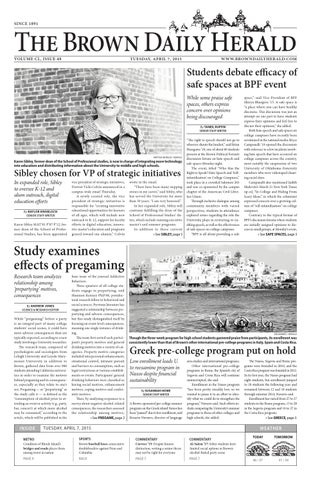
Karen Sibley, former dean of the School of Professional studies, is now in charge of integrating more technology into education and distributing information about the University to middle and high schools.
Sibley chosen for VP of strategic initiatives In expanded role, Sibley to oversee K-12 and alum outreach, digital education efforts By BAYLOR KNOBLOCH SENIOR STAFF WRITER
Karen Sibley MAT’81 P’07 P’12, former dean of the School of Professional Studies, has been appointed
vice president of strategic initiatives, Provost Vicki Colvin announced in a campus-wide email Thursday. A newly created role, the vice president of strategic initiatives is responsible for “creating innovative educational opportunities for learners of all ages, which will include new outreach to K-12, support for faculty efforts in digital education, innovative master’s education and programs geared toward our alumni,” Colvin
wrote in the email. “There have been many stepping stones in my career,” said Sibley, who has served the University for more than 30 years. “I am very honored.” In her expanded role, Sibley will continue fulfilling the dean of the School of Professional Studies’ duties, which include running executive master’s and summer programs. In addition to these current » See SIBLEY, page 3
“The right to speech should not go to whoever shouts the loudest,” said Brian Hasegawa ’18, one of about 60 students present at the Brown Political Forum’s discussion forum on hate speech and safe spaces Monday night. The event, titled “Who Has the Right to Speak? Hate Speech and ‘Selfinfantilization’ on College Campuses,” took place in a crowded Salomon 203 and was co-sponsored by the campus chapter of the American Civil Liberties Union. Through inclusive dialogue among community members with varied perspectives, students in attendance explored issues regarding the role the University plays in restricting or enabling speech, as well as the effectiveness of safe spaces on college campuses. “BPF is all about providing a safe
space,” said Vice President of BPF Shreya Bhargava ’15. A safe space is “a place where you can have healthy discourse. This discussion was just an attempt on our part to have students express their opinions and feel free to discuss their opinions,” she added. Both hate speech and safe spaces on college campuses have recently been scrutinized in the national media. Bryce Campanelli ’18 opened the discussion with reference to a few incidents involving hate speech that have occurred on college campuses across the country, most notably the suspension of two University of Oklahoma fraternity members who were videotaped chanting racial slurs. Campanelli also mentioned Judith Shulevitz’s March 21 New York Times op-ed, “In College and Hiding From Scary Ideas,” in which the columnist expressed concern over a growing culture of “self-infantilization” on college campuses. Contrary to the typical format of BPF’s discussion forums where students are initially assigned opinions to discuss in small groups, at Monday’s event, » See SAFE SPACES, page 3
Study examines effects of pregaming
Research team analyzes relationship among ‘prepartying’ motives, consequences By ANDREW JONES SCIENCE & RESEARCH EDITOR
While “pregaming” before a party is an integral part of many college students’ social scenes, it could have more adverse consequences than are typically expected, according to a new study involving a University researcher. The research team, composed of psychologists and sociologists from Lehigh University and Loyola Marymount University in addition to Brown, gathered data from over 900 students attending California universities in order to examine the motives behind pregaming and its consequences, especially as they relate to one’s sex. Pregaming — or “prepartying” as the study calls it — is defined as the “consumption of alcohol prior to attending an event or activity (e.g., party, bar, concert) at which more alcohol may be consumed,” according to the article, which will be published in the
INSIDE
June issue of the journal Addictive Behaviors. Three-quarters of all college students engage in prepartying, said Shannon Kenney PhD’06, postdoctoral research fellow in behavioral and social sciences. Previous literature has suggested a relationship between prepartying and adverse consequences, but this study distinguished itself by focusing on event-level consequences, meaning one single instance of drinking. The team first sorted each participant’s preparty motives and general drinking motives into a variety of categories. Preparty motive categories included interpersonal enhancement, situational control, intimate pursuit and barriers to consumption, such as legal restrictions at various establishments or events. Participants’ general drinking behaviors were classified as having social motives, enhancement motives, coping motives and conformity motives. Then, by analyzing responses to a survey about negative alcohol-related consequences, the researchers assessed the relationship among motives, » See PREGAME, page 2
KIKI BARNES / HERALD
Though the three-week program for high school students garnered praise from participants, its enrollment was consistently lower than that of Brown’s other international pre-college programs in Italy, Spain and Costa Rica.
Greek pre-college program put on hold Low enrollment leads U. to reexamine program in Naxos despite financial sustainability By SUSANNAH HOWE SENIOR STAFF WRITER
A Brown-sponsored pre-college summer program on the Greek island Naxos has been “paused” due to low enrollment, said Rosario Navarro, director of language
area studies and international programs. Other international pre-college programs in Rome, the Spanish city of Segovia and Costa Rica will continue uninterrupted, she said. Enrollment in the Naxos program “has been pretty steadily low, so we wanted to pause it in an effort to identify what we could do to strengthen the program,” Navarro said. Such efforts include comparing the University’s summer programs to those of other colleges and high schools, she added.
The Naxos, Segovia and Rome programs were founded in 2010, and the Costa Rica program was founded in 2012. In its first year, the Naxos program had eight students, but enrollment jumped to 18 students the following year and remained between 12 and 18 students through summer 2014, Navarro said. Enrollment has varied from 27 to 37 students in the Rome program, 13 to 28 in the Segovia program and 18 to 27 in the Costa Rica program. » See GREECE, page 3
WEATHER
TUESDAY, APRIL 7, 2015
METRO Condition of Rhode Island’s bridges and roads places them among worst in nation
SPORTS Brown baseball loses consecutive doubleheaders against Penn and Columbia
COMMENTARY Corvese ’15: Despite honors distinction, writing a senior thesis may not be right for everyone
COMMENTARY Al-Salem ’17: Sober students have limited social options in Brown’s alcohol-fueled party scene
PAGE 4
BACK
PAGE 7
PAGE 7
TODAY
TOMORROW
46 / 37
41 / 34
SCIENCE & RESEARCH PAGE 2 • TUESDAY, APRIL 7, 2015
THE BROWN DAILY HERALD
Science & Research Roundup BY STEVEN MICHAEL, SCIENCE & RESEARCH EDITOR
Researchers outline diagnosis criteria for pregnant women with headaches
ARJUN NARAYEN / HERALD
According to a new study, about three-quarters of college students engage in “prepartying.” Students are motivated to drink by several factors including interpersonal enhancement and intimate pursuit.
» PREGAME, from page 1 consequences and sex. Preparty-related consequences were assessed on a survey with items such as “I found it difficult to limit how much I drank” and “I took foolish risks,” according to the study. The study’s results showed that both drinking to cope and drinking to conform were linked to greater preparty alcohol consequences. Of the preparty motives measured, situational control, interpersonal enhancement and barriers to consumption also correlated with a higher risk of adverse
alcohol-related consequences. The team’s analyses controlled for alcohol consumption, which “suggests something about the context of prepartying that places students at heightened risks,” Kenney said. In addition to drinking, there may be an effect of social pressure that leads to negative outcomes, she added. Women in the study were more likely than men to select situational control and barriers to consumption as preparty motives. The authors partially attribute this result to women wanting to protect themselves by avoiding drinks that have been tampered with,
according to the study. Males in the study were more likely to use prepartying to find a potential sexual partner, according to the study. Men’s sexual motives could be “concerning” given past evidence that alcohol consumption is linked to risky sexual behavior. Prepartying, which often involves “drinking quickly and excessively,” is often used to “get a good buzz” before going to a party, Kenney said. Students should be aware of possible outcomes of their actions and “maximize the positive aspects of their social life in college and minimize the negative aspects” when they go out, Kenney said.
A recent study led by a physician affiliated with the Alpert Medical School suggests a framework for diagnosing pregnant women who come to the emergency room with headaches. The paper detailing this framework was published in last month’s issue of the Western Journal of Emergency Medicine. A pregnant woman’s headache could be harmless, or it could be a warning sign of more dangerous conditions such as preeclampsia, a potentially fatal condition in pregnancy characterized by high blood pressure; carbon monoxide toxicity; cerebral venous thrombosis, the presence of a blood clot in the cerebral sinuses; arterial dissection, the tearing of the inner lining of the arterial walls; or pituitary apoplexy, the loss of blood flow to the pituitary gland in the brain. To determine whether it is an ordinary headache, all of these other conditions should be ruled out initially, according to the study. The research team included Jessica Schoen, teaching fellow in emergency medicine, and Ronna Campbell and Annie Sadosty of the Mayo Clinic. Since radiation and contrast agents, which are used for imaging, can harm the fetus, the researchers instead advise using magnetic resonance imaging if possible, as it does not involve any radiation exposure. If the patient’s history and physical examination include symptoms such as high blood pressure, fever and a headache above the baseline, the most likely diagnoses are preeclampsia and carbon monoxide toxicity, according to the study. In the absence of these and other symptoms, the headache should be treated as a standard headache.
Geobaramoter developed to better understand supervolcanoes A novel type of geobarometer that measures the pressure of magma originating from supervolcanoes provides more accurate data to understand the chain of events behind the destructive events, according to a study published in the Journal of Mineralogy and Petrology last month. “We’re always striving to get new and better barometers,” said Ayla Pamukcu, lead author of the study and a postdoctoral research associate in earth, environmental and planetary sciences, in a University press release. “The fact that this one is more widely applicable is exciting.” Another benefit of the new geobarometer is its ability to exclude data from rocks that have undergone changes post-erruption, which would supply inaccurate data, according to the release. Super volcanoes are classified as those that can erupt more than 1,000 cubic kilometers of lava. Though a super volcano has not erupted in human history, the research suggests that a super volcano could erupt under the right conditions in the future, according to the release. The research focused on a super erruption that occurred 19 million years ago in the area that is now Arizona, California and Nevada, according to the release. As different minerals are found in the magma depending on the pressure and depth under which it was stored, the geobarometer can determine where the magma originated.
Researchers produce microscopic semiconductors with potential technological benefits
University researchers recently developed new nanoribbons and nanoplates — microscopically small structures used as semiconductors — from silicon telluride that could have commercial applications, according to a University press release. The team of researchers — including Assistant Professor of Chemistry Kristie Koski, Sean Keuleyan GS, Mengjing Wang GS, Frank Chung ’15 and Jeffrey Commons ’15 — examined how to synthesize these nanomaterials. Their paper, which details the findings, was published March 12 in the journal Nanoletters. “Silicon-based compounds are the backbone of modern electronics processing,” Koski said in the release. “Silicon telluride is in that family of compounds, and we’ve shown a totally new method for using it to make layered, two-dimensional nanomaterials.” The researchers found that factors such as temperature and the process used to create the nanomaterials affected the size and shape of the final nanoribbons and nanoplates produced, according to the release. Following this work, the team aims to examine the nanomaterials usage in optics and electronics, Koski said in the release.
UNIVERSITY NEWS
TUESDAY, APRIL 7, 2015 • PAGE 3
THE BROWN DAILY HERALD
» SIBLEY, from page 1 functions, Sibley will also work to integrate technology into education for people of all ages. Sibley will lead the charge to get “more Brown materials in the hands of students and teachers in private and public middle and high schools,” Colvin said, adding that Sibley will work on packaging, marketing and delivering “modules that get integrated into school districts.” Undergraduates may also stand to benefit from Sibley’s technological efforts, as she will lead faculty members’ attempts to digitize their teaching. “We are hoping faculty will use her for developing online content,” Colvin said. “She will help with achieving goals for digital education.” Other parts of Sibley’s new role include synchronizing resources between the School of Professional Studies and the Graduate School and making graduate programs more available to alums. “We need more and better alumni outreach for executive master’s students,” Sibley said, adding that alums constitute a key population among these programs’ students. Sibley’s new title reflects the number of varied initiatives she has spearheaded in recent years, said Colvin, who cited Sibley’s work with various schools internationally. The role shows Sibley’s “status is important in the global context.” Administrators and staff members said Sibley’s ability to spearhead educational innovation coupled with her longstanding connection to the University allow her to lead the school into the future without straying from its values. Sibley “is really good at thinking outside the box but staying close to Brown’s culture and values,” Colvin said. “She knows what Brown really cares about, so she doesn’t end up getting too commercial.” Over the past decade, Sibley has focused on “reinventing the way we provide educational experiences and to whom we provide them,” said Robin Rose, senior associate dean of the School of Professional Studies, who has worked with Sibley since 2002. “The audience may change, (and) the methodology may change, but the values don’t,” she said. Sibley is “very passionate about her work, and she is eager to serve Brown,” said Alyssa Frezza, who has worked as Sibley’s assistant for the past eight months. “She’s a great leader,” Frezza said. “I love Brown deeply, and I know it well,” Sibley said. “I’m a person who likes to connect the dots. … I like to think creatively.” — With additional reporting by Emma Harris
Follow us on Twitter! @the_herald
support or if it refers more abstractly to a discussion with rules that ensure attendees do not feel uncomfortable. Despite these existing discrepancies, group members reported back to the larger discussion that many students agreed that safe spaces have a place on campus. But there was more disagreement when the conversation later explored
how safe spaces could discourage people from sharing their opinions. “It creates an atmosphere where people are petrified of saying something that could make someone go to a safe space,” one student in attendance said. He added that people could think “they’ve done something wrong by voicing an opinion or being controversial” after saying something that is triggering for
someone else. Heated arguments arose when the larger group set out to discuss lectures and debates held on campus. Many students referred to the events surrounding former New York City Police Commissioner Ray Kelly’s scheduled talk in October 2013. While some thought protesters unjustly prevented Kelly from speaking, others took issue with Kelly’s being invited to give a lecture on campus in the first place. “Speech can be harmful,” said Malik Jarvis ’18, adding that people can sometimes internalize and normalize what is said, causing “negative externalities” such as the rise of contagious diseases in the case of the anti-vaccination movement and the promotion of rape culture. Campanelli highlighted the benefits in hearing opinions that may differ from your own. “I want my school to bring in speakers who will challenge me to think in ways that I totally don’t agree with and because of that, then I can grow.” The discussion exceeded the allotted time of an hour. “It was great to hear the different perspectives we had throughout the room,” Bhargava said. “That’s all what healthy discourse is about — listening to people with different points of view. I hope most people who attended the discussion have a broader perspective and can make better and well-informed decisions about hate speech and the topics that we discussed today.”
learned about Ancient Greece and Byzantium and how historical concepts relate to modern Greek society, she said. Naxos is a “unique and beautiful island” that offers a “rich archaeological past,” Amanatidou said. In the years it ran, the program had excellent relationships with the island’s residents and its local government, which allowed participants to become “immersed in the local community,” she added. The location was also void of major safety concerns. The program was “such a rich, rewarding experience,” Amanatidou said. Throughout the summer, faculty members saw students’ understandings of the ancient world develop significantly, she said, adding that the program “was challenging, but it was also fun.” Naxos “was definitely an experience I won’t forget,” said Matthew Chang, who
participated in the program in the summer of 2014 and is now a first-year at the State University of New York at Geneseo. Chang said he is still in touch with people he met during the trip. “It’s very upsetting to hear that the program is closed.” Chang also praised the Rome program, in which he was a student in 2013. “It was really fun to go see different countries and live among the people, getting a taste of what it’s like to live their life,” he said. The programs were also good preparation for college life, Chang added. Many of the participating students in Naxos wanted to apply to Brown after participating in the program, Amanatidou said, adding that a few are current Brown undergrads. “I think we were excellent ambassadors for Brown.” Though enrollment in the Naxos
program was relatively low, it attracted, “the ideal number,” Amanatidou said. “Because of the nature of the program and because of the hands-on experience … 15 was a pretty good number.” Amanatidou added that the low enrollment was high enough to sustain the program financially, though it did not generate large profits. “Fifteen students did not make the program run at a loss.” Ultimately, Summer Global Programs “had a business plan — I didn’t. I was responsible for the academic content,” Amanatidou said. Amanatidou said she has a good relationship with Navarro and others who are responsible for overseeing pre-college programs. “I would be happy to keep talking about how we can make the program fit their vision of what a Brown program should be,” she added.
RYAN WALSH / HERALD
About 60 people gathered in Salomon 203 to discuss the University’s role in enabling or restricting speech, as well as the effectiveness of safe spaces on college campuses.
» SAFE SPACES, from page 1 students were asked to separate into four groups and engage in conversation “with actual views in mind” due to the complexity of the issues. In one group, there was initial confusion as to what a safe space was. Students debated whether a safe space constitutes a separate physical space for
» GREECE, from page 1 Despite its low enrollment, Navarro praised the Naxos program, which has received “glowing” evaluations from students. “I’m really proud of these programs. They are life-changing experiences for these students,” Navarro said. “You’re offering the Brown experience off-site.” The international programs are staffed by Brown faculty, and current Brown students serve as residential advisors, she added. The Naxos program focused on “the ancient world, but within its contemporary context,” said Elsa Amanatidou, senior lecturer in language studies and classics and founder and director of the program. Through a combination of classroom lessons and field trips, students
METRO
PAGE 4 • TUESDAY, APRIL 7, 2015
THE BROWN DAILY HERALD
Spotlight on the Statehouse BY ALEXANDER BLUM, METRO EDITOR
Technicians reach settlement with RISD After a five-day strike led by Rhode Island School of Design technicians that began Thursday, RISD administrators and President of the RISD Technical Association Tucker Houlihan reached an agreement Monday that includes a stipulation maintaining the tech workers’ 8 percent retirement contribution, RI Future reported. Forty-four technicians participated in the strike, protesting breakdowns in contract negotiations that had been in progress since May 2014. The technicians are responsible for operating machines and shop spaces in the school’s studios. The strike caused the RISD campus to “basically shut down,” said Erik Lack, president of the RISD Student Alliance, The Herald reported Monday. Hundreds of students and supporters marched to encircle the administrative offices, though administrators approached Houlihan before the student-led march, RI Future reported.
Melted but not forgotten Though most of campus has emerged from the blankets of snow deposited this winter, the emergence of warmer weather will not bring back the money spent by local government and nonprofit organizations to help manage the wintry weather. But with the help of the federal government, they might not be completely out of luck. On Friday, President Obama declared a disaster for Rhode Island for Winter Storm Juno. The storm dumped just over 19 inches — the fourth heaviest snowfall on record for the city — in Providence Jan. 26–28. The funds will help defray costs of related emergency work and facilities repair for local governments and some nonprofit organizations in all five of the state’s counties, Rhode Island Public Radio reported Friday. The Federal Emergency Management Agency office in Boston will work with state officials to establish a Joint Field Office in Rhode Island. Municipalities will submit project proposals from which funding will be determined, with 75 percent coming from the federal government and 25 percent coming from state and local governments, NBC 10 News reported Thursday.
Cranston schools open on Good Friday Despite nearly 25 percent of staff members and almost 40 percent of students being absent from Cranston public schools on Good Friday last week, all of the district’s schools were open barring one middle school, which was closed for lack of staff. New Shoreham was the only other school district in Rhode Island that held classes that day. Cranston does not have a tradition of being open on Good Friday, but this year the School Committee decided to hold classes. The Cranston school district also voted to remain open on Rosh Hashanah, the Providence Journal reported Friday. The Cranston Teachers’ Alliance challenged the committee’s decision, and many expressed concerns about it in the days and weeks leading up to Good Friday. An official decision was not made until around 6:15 a.m. Friday morning because the district was unsure how many sick calls it would receive, said Raymond Votto, chief operating officer of the city’s School Department, the Journal reported. Rhode Island is the most Catholic state in the United States, with 44 percent of its population identifying with the religion, according to the Public Religion Research Institute, WPRI reported in March.
New leadership for I-195 Commission Gov. Gina Raimondo selected Joseph Azrack as chair of the I-195 Redevelopment District Commission, replacing former chair Colin Kane, who resigned in January. Azrack is part of a group of six — including Beppie Huidekoper, the University’s former executive vice president for finance and administration — that Raimondo selected to replace all of the commission’s members but one. Though Azrack spent 20 years with AEW Capital Management, a Boston-based real estate investment management firm, he has lived in Little Compton with his wife — a Rhode Island native — for more than 15 years, the Journal reported. Serving as the commission’s chair is a volunteer position, and this will be Azrack’s first experience in the public sector. “You have to work hand-in-glove as a good partner with state agencies and legislature and leadership, as well as with the city, and then to engage local institutions and private-sector capital,” Azrack told the Journal.
DAVE DECKEY / HERALD
With 42 percent of roads in Rhode Island labeled as being in poor condition, the state has attempted to improve them with Pothole Killers, “an on-call pothole patching service” that fills potholes within minutes.
Long road ahead for R.I. infrastructure After harsh winter further decimates roads, Rhode Island commits renewed effort to filling potholes By CASSANDRA COLE CONTRIBUTING WRITER
Over the past several years, Rhode Island’s infrastructure, especially its roads and bridges, have face chronic problems, which have been exacerbated by harsh winter weather and are proving difficult to address due to funding limitations. Such issues, though not unique to the Ocean State, have put it in contention for the dubious distinction of having the worst bridges in the nation, said Andrew Herrmann, former president of the American Society of Civil Engineers. But recently there has been evidence of progress, with increased efforts to patch potholes around the state. In 2013, nearly 22 percent of Rhode Island’s 766 bridges were found structurally deficient, compared with the national average of only 11 percent, and nearly 25 percent of the state’s bridges were deemed functionally obsolete, compared with a national average of 14 percent, Herrmann said. Only Pennsylvania fared worse. “A structurally deficient bridge gets to that condition if significant load-carrying elements are found to be in poor or worse condition due to deterioration or damage,” Herrmann said, noting that bridges may also be labeled deficient if the waterway underneath them is not open enough. “A structurally deficient bridge isn’t necessarily unsafe,” Herrmann said. Once a bridge earns this label, the city may consider closing it, doing emergency repairs, scheduling future repairs or limiting the loads it can bear, Herrmann said. Highway bridges are inspected
biennially, and “the departments of transportation who authorize these inspections are responsible for public safety — they are making sure that the bridges we’re traveling on are safe,” Herrmann said. A “functionally obsolete” bridge is one that “was designed to older standards,” Herrmann said, adding that a functionally obsolete bridge may have lanes or shoulders that are too narrow or a turning radius that is too tight. These bridges are still used, but may have slower traffic speeds, more congestion or lower load restrictions, he said. Many of the Ocean State’s infrastructure woes can be attributed to its location in the Northeast, Herrmann said. The state “gets lots of ice and snow, and that takes a toll on roads and bridges” since road salt — applied to melt ice — can degrade steel and concrete, he added. “If you do the maintenance and take care of these structures, you can make them last,” Herrmann noted. But he also explained that bridges sometimes only receive temporary maintenance measures, especially because the federal highway trust fund is “approaching insolvency again … which puts the departments of transportation of all the states in quite the bind.” Rhode Island’s roads are also in need of attention: 41 percent are considered to be in poor condition, compared to 32 percent of roads nationally. The average R.I. motorist spends $662 each year in “extra vehicle repairs and operating costs due to the poor condition” of the roads, Herrmann said. “This past winter season was the second-snowiest winter on record in Rhode Island,” and “the severity of the season had a significant impact on the condition of the state’s roadways,” wrote Rose Amoros, chief public affairs officer at the Rhode Island Department of Transportation, in an email to The Herald.
Besides sending out RIDOT crews to apply “upwards of 20 tons of patching material,” or enough to fill more than 100 potholes, the department also uses Pothole Killers, “an on-call pothole patching service,” that can clean and fill potholes in just a few minutes, Amoros wrote. RIDOT is also “working to compile an inventory of roadways across the state in need of immediate attention” and collaborating with municipalities on immediate projects, including a recent roundtable discussion about roadway repairs with local leaders, Amoros wrote. Rep. Deborah Ruggiero, D-Jamestown and Middletown, who serves as chairwoman of the House Finance Committee’s Subcommittee on Environment and Transportation, emphasized the importance of Rhode Island’s roads and bridges, calling them “the underpinnings of everyday life,” and adding that “no one thinks about roads … until we can no longer use them.” Ruggiero attributed the difficulty of maintaining the state’s roads to rising costs exceeding unchanging funding levels. “Rhode Island is the fourth highest in the country in road costs per mile, but we’re 45th in road quality,” she said. Nearly 80 percent of RIDOT’s $500 million budget comes from federal funding, and “the real issue is that the federal gas tax has not changed” since 1994, Ruggiero said. In addition, Congress’ 2012 passage of the Moving Ahead for Progress in the 21st Century Act in 2012 replaced previous six-year federal highway bills with a set level of funding, making it more difficult for state transportation departments to plan ahead. While roads and bridges in Rhode Island remain passable even as they deteriorate, maintaining the Ocean State’s infrastructure is important because “it’s how we commute; it’s how we go on vacation; it’s how we get everything we need,” Ruggiero said.
TODAY
TUESDAY, APRIL 7, 2015 • PAGE 5
THE BROWN DAILY HERALD
menu
p u p py lo v e
SATELLITE DINING JOSIAH’S Mashed Potato Bowl, Made-to-Order Quesadillas BLUE ROOM Mediterranean Pocket Soups: Butternut Squash, Turkey Sausage and Kale, Three Bean Chili ANDREWS COMMONS Pizzas: Bacon Chicken Ranch, Spicy Five Cheese and Garlic, Pepperoni and Meatball
DINING HALLS SHARPE REFECTORY LUNCH
DINNER
Braised Rainbow Swiss Chard, Grilled Lemon and Pepper Chicken, Whole Wheat Brownies
Chicken Ar tichoke Pasta Medley, Vegan Ratatouille, Peas with Mushrooms, Custard Pie
VERNEY-WOOLLEY LUNCH
DINNER
C a j u n S p i c e d C h i c ke n Sandwich, French Fries, Vegan Asian Blend Vegetables
Bourbon BBQ Chicken, Couscous Croquettes, Cheese Ravioli Salad with Lemon
sudoku
ARJUN NARAYEN / HERALD
Charlie, a Golden Retriever often seen in campus, captures a student’s heart with his warm personality and affectionate puppy kisses Monday.
crossword comic Class Notes | Philip Trammell ‘15
calendar TODAY
TOMORROW
12:00 P.M. BROWN BAG LUNCH TALK WITH PROF.
12:00 P.M. STUDENT JOURNALISTS REPORT FROM
SEAN MOORE
NICARAGUA
Sean Moore, associate professor of English at the university of New Hampshire, will discuss Alexander Pope’s poem “Windsor Forest” and its main theme of slavery in the United States. Salomon 001
Students who traveled to Nicaragua as part of an international journalism course taught by former New York Times correspondent Stephen Kinzer will share their experiences. Joukowsky Forum, Watson Institute
jjjhgjhjksadfd
12:00 P.M. THE NATIONAL TRUTH COMMISSION
5:30 P.M. BROWN STUDENTS FOR HILLARY INTEREST
REPORT
MEETING
Brazilian federal prosecutor Marion Weichert will talk about his views on the recently published Brazilian National Truth Commission Report. Watson Institute, McKinney
Students interested will learn how to get involved in former Secretary of State Hillary Clinton’s likely upcoming presidential campaign. Wilson 301
Conference Room 6:00 P.M. GRADUATE WELLNESS SERIES 6:15 P.M. SCREENING OF VARIED WORKS FROM TODD HAYNES ’85
Todd Haynes’ ’85 films, which often deal with postmodernist ideas of identity and sexuality, will be screened as part of the Ivy Film Festival. Granoff Center
This session will discuss social norms about alcohol consumption in graduate school and why graduate students might develop alcohol use disorders. Faunce 225
COMMENTARY PAGE 6 • TUESDAY, APRIL 7, 2015
THE BROWN DAILY HERALD
EDITORIAL
Gourley ’16, Bhatla ’16 for UCS Polls for the Undergraduate Council of Students and Undergraduate Finance Board elections open online Tuesday at noon, when all undergraduates will be emailed a link to the ballot. As voters consider the important choice of whom to select to lead next year’s student government, we endorse Sazzy Gourley ’16 for UCS president and Alana Bhatla ’16 for UCS vice president. In the presidential race, voters have a choice between three candidates who all bring passion and thoughtfulness to the table: Justice Gaines ’16, a UCS general body member and a member of the Task Force on Sexual Assault, Zachary Nelkin ’17, a former UCS general body member, and Gourley, UCS vice president and chair of the UCS Outreach and Advocacy Committee. All three have drawn attention to the need for the University to revamp mental health resources and reform sexual assault policies while also positioning themselves as best suited to making UCS a more accountable and proactive organization. We applaud Gaines’ clear and resonant call for ensuring that administrators as well as UCS-appointed representatives respond to the diverse range of student voices on campus. And we are impressed by Nelkin’s bold and creative reform agenda aimed at breaking down the Council’s top-down structure to be more democratic. But Gourley’s focus on building cross-campus relationships, proven track record of effectiveness and detailed knowledge of the urgent issues facing Brown set him apart as the best potential UCS president. Involved in Swearer Center for Public Service programs, a Departmental Undergraduate Group, Greek life and varsity athletics, Gourley is well positioned to bring disparate groups into constructive dialogue at a time when we believe Brown must remember the importance of respecting and listening to all community members. As UCS vice president, Gourley has shown a tireless commitment to implementing a best practices approach to reforming mental health policies, and he pledges to give underclassman members of UCS more agency to combat the council’s struggle to retain first-year talent. Gourley’s support for establishing uniform, understandable standards for sexual assault policy and his call for student activists’ demands to be supported alongside the general welfare of all students distinguish him as a leader who grasps both the urgency and complexity of key issues. The vice presidential race provides voters with two candidates holding extensive UCS experience: Bhatla, UCS media director and former UCS treasurer, and Ryan Lessing ’17, chair of the UCS Admissions and Student Services Committee. While both Bhatla and Lessing echoed the general sentiment surrounding hot-button issues like sexual assault prevention and mental health in their platforms, each candidate placed varying degrees of emphasis on the current structural weaknesses of UCS governance. Lessing pushed an alternative, democratic structure for UCS characterized by a more uniform distribution among class years. Bhatla, alternatively, underscored the need to craft a heightened degree of transparency and welcoming atmosphere by way of more regular communication with the student body at large. Though we appreciate the unparalleled parliamentary fluency and firm reformist approach offered by Lessing, the current climate at Brown requires a vice president to help in actively engaging with the plethora of communities on campus — a task that Bhatla is clearly positioned to achieve. Her long-standing tenure on UCS — paired with her involvement in Women in Science and Engineering, Brown University Sexual Education and peer advising — underscores this necessary degree of engagement, a quality that would complement Gourley’s agenda effectively. Bhatla’s platform properly weighs the true priorities on campus, and as such, best serves the Brown community at the current juncture. Editorials are written by The Herald’s editorial page board: its editors, Alexander Kaplan ’15 and James Rattner ’15, and its members, Natasha Bluth ’15, Manuel Contreras ’16, Baxter DiFabrizio ’15, Mathias Heller ’15 and Aranshi Kumar ’17. Send comments to editorials@browndailyherald.com.
K I M B E R LY S A LT Z
LETTER TO THE EDITOR
‘Cleaning up’ campus culture To the Editor: In a March 18 editorial (“Cleaning up social media pages”), The Herald’s editorial page board argued that students’ social media accounts should be cleaned up because inappropriate material on them reflects badly upon Brown. How about The Herald clean up its Blog by removing the juvenile, vulgar, obscene, pornographic “Sextion” feature? That “online presence” is surely an important factor in the public’s perception of the University, and it doesn’t reflect favorably on the culture of the Brown campus. It is also interesting that, in its interim report, Brown’s Task Force on Sexual Assault has determined that changes
An article in Monday’s Herald (“Sohn remembered for physics passion, supportive character,” April 6) misstated that Hyoun Ju Sohn GS was a teaching assistant for PHYS 0040: “Basic Physics.” In fact, he was a TA for PHYS 0060: “Foundations of Electromagnetism and Modern Physics.” The Herald regrets the error.
Q U O T E O F T H E D AY
“In 2013, nearly 22 percent of Rhode Island’s 766 bridges were found structurally deficient.” — Andrew Herrmann, former president of American Society of Civil Engineers
See infrastructure on page 4
Editorial Leadership
Sections
Visuals & Production
Business
Editors-in-Chief Michael Dubin Maxine Joselow
Arts & Culture Editors Eben Blake Gabrielle Dee
General Managers Sarah Levine Winnie Shao
Managing Editors Kiki Barnes Jillian Lanney
Metro Editors Alexander Blum Emma Jerzyk Drew Williams
Design Editors Loren Dowd Carlie Peters Taylor Schwartz Assistant: Meryl Charleston Assistant: Andrew Linder
Science & Research Editors Andrew Jones Steven Michael
BLOG DAILY HERALD Editor-in-Chief David Oyer
Sports Editors Andrew Flax Alex Wainger
Managing Editors Deena Butt Jacob Koffler
University News Editors Emma Harris Caroline Kelly Joseph Zappa
POST- MAGAZINE Editor-in-Chief Adam Asher DIGITAL Online Editor Marcy Huang
COMMENTARY Editorial Page Editors Alexander Kaplan James Rattner Opinions Editors Megan GrapengeterRudnick Kate Kiernan Evan Sweren
Photo Editors Head: Brittany Comunale David Deckey Katie Liebowitz Arjun Narayen Ashley So Ryan Walsh Graphics Editors Avery Crits-Christoph Emma Jerzyk Web Producers Joe Stein Harsha Yeddanapudy Abdullah Yousufi Copy Desk Chief Madeline DiGiovanni Illustrations Editor Angelia Wang Video Editor Richard Flores
David Curry ’51
CORRECTION
Editors’ note: Due to personal conflicts of interest, Bluth, Contreras, Kaplan and Rattner recused themselves from the board’s endorsement process for UCS president.
Senior Editors Camilla Brandfield-Harvey Isobel Heck Molly Schulson
in the culture of the campus are necessary if the University is to be a “safe and welcoming place to learn.” The interim report did not address those changes, but its final report will surely consider the following features of the campus culture that may influence sexual harassment and violence: coed and gender-neutral housing, SexPowerGod, Sex Week, Condom Carnival, Nudity in the Upspace, Naked Donut Run. Add the general promotion of a “hooking up” culture by The Herald, student organizations and the University itself by virtue of permission granted for use of its property for the above listed activities.
Directors Sales: Moniyka Sachar Sales: Jess Urrutia Finance: Josh Tartell Alumni Relations: Marley Rafson Business Dev.: Yuta Inumaru Sales Managers Matthew Meyer Henry Ritter Gulmira Hamit Taylor Casey
facebook.com/browndailyherald
Location: 195 Angell St., Providence, R.I. www.browndailyherald.com
@the_herald
Editorial contact: 401-351-3372 herald@browndailyherald.com
browndailyherald.com
Business contact: 401-351-3260 gm@browndailyherald.com
Corrections: The Brown Daily Herald is committed to providing the Brown University community with the most accurate information possible. Corrections may be submitted up to seven calendar days after publication. Commentary: The editorial is the majority opinion of the editorial page board of The Brown Daily Herald. The editorial viewpoint does not necessarily reflect the views of The Brown Daily Herald, Inc. Columns, letters and comics reflect the opinions of their authors only.
Finance Managers Collections: Neil Wathore Collections: Benjamin Wesner Operations: Carin Papendorp
Letters to the Editor: Send letters to letters@browndailyherald.com. Include a telephone number with all letters. The Herald reserves the right to edit all letters for length and clarity and cannot assure the publication of any letter. Please limit letters to 250 words. Under special circumstances writers may request anonymity, but no letter will be printed if the author’s identity is unknown to the editors. Announcements of events will not be printed.
Business Dev. Manager Project Leader: Kaden Lee
Advertising: The Brown Daily Herald, Inc. reserves the right to accept or decline any advertisement at its discretion. The Brown Daily Herald (USPS 067.740) is an independent newspaper serving the Brown University community daily since 1891. It is published Monday through Friday during the academic year, excluding vacations, once during Commencement and once during Orientation by The Brown Daily Herald, Inc. Single copy free for each member of the community. Subscription prices: $280 one year daily, $140 one semester daily. Copyright 2015 by The Brown Daily Herald, Inc. All rights reserved. Periodicals postage paid at Providence, R.I. Postmaster: Please send corrections to P.O. Box 2538, Providence, RI 02906.
COMMENTARY TUESDAY, APRIL 7, 2015 • PAGE 7
THE BROWN DAILY HERALD
Is an honors thesis right for you? GABRIELLA CORVESE opinions columnist
There’s nothing quite like April at Brown, which brings increasingly warmer weather, leisurely afternoons on the Main Green and the countdown to Spring Weekend. But we cannot forget about the less glamorous scenes appearing around campus: hordes of seniors racing to finish their honors thesis projects. The word thesis connotes numerous meanings: stacks of books, SciLi all-nighters, sweatpants. The end of the process also ushers in new beginnings. As seniors print and bind their honors theses, juniors start to consider if they want to design and undertake their own year-long project. While the surface-level stress can give other students an idea of what the thesis entails, the wide range of emotions accompanying the process are much less visible: from desperation to elation, from boundless procrastination to working without end. The process can be empowering, but at times, it can be demoralizing. Writing a thesis can have many outcomes, and the task is more personal than practical. For that reason, prospective writers should seriously consider if a thesis is the right choice. Unlike a dissertation, people will not call you “doctor” once you finish your thesis. Instead, you gain a sin-
gle revealing word: honors. While the term can be an ego boost, Brown does not seem to care for this linguistic distinction. On the Dean of the College’s page with information about University honors, the University recommends that students place “greater weight on the act of learning than on external marks of success.” That doesn’t mean that Brown thinks all merit is worthless. The
Completing an honors thesis feels like a culmination of the bizarre culture of obligation that engulfs higher education. At our orientation activities fair, we signed up for every student group imaginable. Some of us attended less-than-fun general body meetings for countless clubs since we had no clue what else to do — or since we felt like we had to. And here we are now, seniors spending our final nights at Brown
in the form of the witty, summarizing statements found on the Tumblr “lol my thesis.” For example, a thesis entitled “Processing and functional diversity of plant microRNA” is reduced to “RNA is made of and done stuff ” — a comical reduction of a massive project that may be amusing for some but frustrating for others. The value of the title “honors” must also be called into question.
Completing an honors thesis feels like a culmination of the bizarre culture of obligation that engulfs higher education.
page also lists the faculty-nominated Dean of the College’s Distinguished Senior Thesis Award for a students who conduct “exemplary” theses, which then awards $500 to top projects across concentrations. Still, in the spirit of our liberal arts educations, shouldn’t we be working out of passion for our discipline and not for the promise of a check? Though passion can be a reason for starting a thesis, it is not always the defining factor. The reasons for pursuing the thesis in the first place may be muddled — and they can get even murkier come April’s final stretch.
in the stacks because we felt that our education should end with writing a really long paper. This is not to say that there are no tangible results from writing a thesis. Writing a thesis might just be a matter of turning results from previous research or lab work into a paper. Exceptional work is likely to be published in academic journals. Some projects even have the potential to advance the knowledge of a discipline. But at the other end of the postthesis spectrum comes the fear that it will end up as little more than a unique conversation topic, possibly
On one hand, it designates exemplary work and an exceptional academic feat. I am confident that the pride my peers and I feel upon completion of our theses will be grand and unprecedented. But the emotional satisfaction of completing a thesis may not be enough for some — which might prove difficult when a prospective employer cares more about internships and skills than a little word next to one’s degree. While there is no right or wrong way to approach writing a thesis, we should deeply consider the values and priorities of their educational experiences.
Despite all of these concerns, one fact is certain: Writing a thesis is a deeply personal experience. You immerse yourself in a body of knowledge, borrowing bits and pieces to synthesize something new. You read books and journal articles until the words bleed together. You realize you don’t understand anything. You soar with glee when you can finally make sense of the results. Whether or not your conclusions are groundbreaking, you can step away from work resulting from months of rigorous discipline and say, “I did that.” That process isn’t for everyone. In order to streamline and elucidate this decision for underclassmen, advisors and deans should provide more accessible and detailed information on what goes into writing a thesis besides choosing an advisor and meeting deadlines. Perhaps testimonials from current and previous thesis writers would be helpful. Regardless, all students would benefit if their understanding of writing an honors theses included more than doing research and staying up late. Overall, was writing a thesis worth it? I’m not sure yet. But I am sure that I’ve grown in ways I didn’t think were possible. To my fellow seniors who have already handed in their manuscripts, I wish you congratulations! And to the rest of us: We’re almost there.
Gabriella Corvese ’15 wrote this instead of working on her thesis and can be reached at gabriella_corvese@brown.edu.
Being sober in college SARA AL-SALEM opinions columnist
Before coming to college, I thought I was unsure of many things but one: I would never drink alcohol. I was lucky enough to grow up in an environment where drinking wasn’t a part of the culture, so I definitely attribute that lifestyle to my pre-college mentality. But I never expected to find myself dealing with conflicting qualms about drinking until I thought my sobriety put my social life at risk. As teenagers, we are taught that it is wrong to instigate or fall for peer pressure. But it is always depicted as this blatant action where someone is urging someone to do something: pushing a drink into her hand or mocking her for not holding a solo cup. But the way drinking actually works on college campuses is a lot more emblematic of peer pressure than any obvious bullying shown on PSA clips. It’s important to me that I first preface the following sentiment with two key facts: I absolutely do not judge those who drink, and my experience is not intended to voice anyone else’s. I know a few people who do not drink and appear to have as great a time at social outings and clubs as anyone else. My doubt about being unwilling to start drinking began late in my freshman spring semester when a close friend who also didn’t
drink left campus for the semester. Without her company during the weekends at events, I felt a disconnect between myself and the social scene. Everyone always says it must be terrible to be the sober one at a party, but I had never really understood that until I was the only sober one at a party. When I had a friend along with me, I did not sense the isolation between those who drank and those
enjoying the night as much as everyone else. To some, the person who does not drink becomes a burden or floats around aimlessly. The response to a situation like the one I described would be, “Oh, then just don’t go to parties with alcohol.” This presumes the fact that college isn’t a place where drinking is the beating heart of the social scene. If you decide to forgo parties, you are forced to cut
Everyone always says it must be terrible to be the sober one at a party, but I had never really understood that until I was the only sober one at a party.
who didn’t. I do not think that people who drink at parties actively try to make those who abstain from alcohol uncomfortable or neglected. I don’t think anyone wants to make someone feel excluded, but it is only natural to get along with people who are at the same energy or excitement level. The person who stands back as everyone else gathers around to do vodka shots at a pre-game seems not to be
your friend group essentially in half. If they ask you to hang out and you decline, you are labeled as a hermit or, worse, flaky. I cannot emphasize how hard it is to explain to people with whom I want to spend time that I value their friendship but that I must also take into account how I almost always feel after college parties — irrelevant and unwanted. I focus college parties because I have found that outside of college, drinking isn’t such a
frantic, be-all-end-all of a party. I have gone to parties where everyone ended up drunk, but it was still a great time. I found that because the goal was not to get drunk, the attitude toward alcohol wasn’t that of “I can’t have fun or enjoy myself without alcohol.” Similarly, this more mature mentality toward drinking also seems more prevalent in international communities, especially of students raised in countries with younger drinking ages, where drinking is less taboo than it is in the United States. When these students come to college, their attitude toward drinking is thus a lot more lax. Like everyone, I have grown a lot since coming to Brown, and I have found myself accepting my sobriety as a sort of closed gate to a certain college social life. But for anyone else who may have also struggled with this, it is important to know it’s okay to have doubts, and it’s okay to decide to drink — as long as you do it for the right reasons and not to fit a certain status quo. And if you decide not to drink and you find yourself exiled from a community, remember that those who really value you will make time for you if they understand the drinking scene isn’t your scene. You will eventually find your place in your own social scene. I promise.
Sara Al-Salem ’17 can be reached at sara_al-salem@brown.edu.
SPORTS THE BROWN DAILY HERALD
TUESDAY, APRIL 7, 2015
BASEBALL
Bears suffer winless weekend against Penn, Columbia After doubleheader postponed by rain to start weekend, Bruno drops four consecutive games By MATT BROWNSWORD SENIOR STAFF WRITER
After splitting consecutive doubleheaders with Ivy foes Cornell and Princeton and coming on the heels of impressive wins against Georgetown and George Mason, the baseball team suffered a major setback this weekend, as it was swept by both Penn and Columbia. “We obviously did not play our best,” said Head Coach Grant Achilles. The games with Columbia originally scheduled for Saturday had to be postponed after field conditions were deemed unplayable, making the Sunday tilts with Penn the first of the weekend for the Bears (6-17, 2-6 Ivy). Penn (129, 7-1) started out with a four-run first inning and never looked back, finishing the first game on top 13-2. Eddie Fitzpatrick ’15 started the game but gave up eight earned runs in 4.2 innings, walking four while only striking out one. The Quakers mashed five home runs on the day, including two from second baseman Ryan Mincher. The second game went exactly like the first for Brown, with Penn adding
three more home runs to its weekend total before beating the Bears down by a final score of 14-2. Reid Anderson ’18 made the start and fared a little better than his senior counterpart, giving up five earned runs in four innings. Lions first baseman Austin Bossart registered five RBIs in the game, while Brown countered with Will Marcal ’15 and Robert Henry ’17, who each had one RBI. Brian Ginsberg ’18 got the start at shortstop for Tim McKeithan ’16, who had been struggling at the plate, and went 1-for-3 on the day with a run scored. After a postponement, a pushback and a relocation to URI, Brown finally took the field against Columbia (14-10, 7-1) Monday for the first part of its doubleheader. Unfortunately for Bruno, the weekend trend continued: Taylor Wright ’15 let up four earned in 5.1 innings, and the Bears’ offense was unable to get anything going in an 8-0 loss. Dante Bosnic ’18 entered in relief and gave up multiple earned runs for the first time all season while walking one batter and striking out two. The theme continued in the second game, with Columbia capitalizing on a six-run first to hand the Bears their fourth loss of the weekend. Max Ritchie ’17 failed to record an out before being pulled for Austin French ’16, who struck out nine batters in 4.1 innings of work. One run in three consecutive
ELI WHITE / HERALD
Eleven pitchers, including Grant Greeno ’18, gave up 44 runs over the course of the four games against Penn and Columbia, while Bruno’s offense managed only eight runs. The Bears will play Harvard this weekend. innings — culminating in a home run by Marcal — cut the deficit in half, but the Lions touched up French and Dave St. Lawrence ’15 in the fifth and sixth innings to put the game out of reach, eventually winning 11-3. It was a poor showing for Brown pitching over the four games, as 11 different Bears gave up nine home runs, 44 runs and 43 hits combined. And it was arguably a worse performance by the offense, which mustered a paltry eight
runs and only ten extra base hits over the two-day span. “(Columbia and Penn) threw the ball really well,” Achilles said. “It’s tough offensively when you put yourself in a hole — hitters try to do too much. It didn’t show up on the stat sheet, but we got the barrel on the ball a lot. Unfortunately we just didn’t produce.” Achilles acknowledged his team’s struggles but recalled the team’s Ivyopening weekend as a reason for
optimism. “It’s a tough league, but we have a week’s worth of work ahead of us,” he said. “We’ve had good games individually, so hopefully we can put that together and be a different team this weekend than last weekend and even when we won two Ivy games two weekends ago.” The Bears will host UMass Lowell for a solitary game Wednesday before welcoming Harvard to College Hill for four games this weekend.
COMMENTARY
Revisiting Eastern Conference predictions as season winds down JAMES COHAN sports columnist
Before the NBA season began, I made five bold predictions. Well, not that bold, considering they included such nuggets as “A bunch of teams will fall well below expectations,” and “All predictions will be incorrect.” But hidden amidst the rambling was one substantive note: The Eastern Conference is separated into tiers. So how did the James of the past, in all his ignorance, do in predicting the Eastern Conference landscape? The Favorites (Chicago, Cleveland) It would have been hard to mess that up. The two consensus favorites both turned out all right. There was a lot of drama for Cleveland early on, but it mostly dissipated after they started destroying teams — LeBron leaving Kevin Love out of Instagrams aside. The Bulls’ season was marred yet again by a Derrick Rose injury, but — fingers crossed — he (or at least some version of him) should be back for the playoffs, and the rest of the roster has looked as good as advertised. Pau Gasol magically returned to form after escaping the dark cloud hovering over the Lakers organization. Jimmy Butler made a shocking leap from Solid Piece on a Good Team to All-Star Who Briefly Generated Irresponsible MVP Buzz. Best of all, when the calendar flipped to March, Nikola Mirotic revealed the monster lurking beneath the Foreigner Just Happy To Be in the NBA Facade he
had been faking, suddenly dropping 20-plus points night after night after averaging a measly seven all year. Despite the fact that only three wins separate these teams, the consensus is that the two are no longer in the same tier. Rose is out, and Cleveland has LeBron, and LeBron has represented the Eastern Conference in the Finals the past four years. That’s tough to argue with. The Bulls fit better now with … The Challengers (Washington, Toronto) Both came into the season looking a step above most of the East but a step below the real players. And that’s pretty much where they stand today. These teams have looked incredibly impressive at times only to inexplicably go into long slumps. That’s made them two of the most frustrating teams in the NBA to watch this season. When everything’s clicking, it feels like they can take anybody. And then they go out and look flummoxed by the Hornets. There’s still a sliver of hope for both teams in the playoffs, but neither has impressed enough to look like any more of a threat than they did at the outset. The Good Teams (Atlanta, Charlotte, Brooklyn, Miami) Hmm, which one doesn’t belong? Okay, I whiffed on Atlanta. Calling Atlanta “good” is like calling Russell Westbrook “fast.” It’s true, but it’s also enough of an understatement to be vaguely insulting. There was just no way to see this coming. Atlanta was a feisty eight-seed last year, taking the Pacers to seven games, but at the time
it seemed to have more to do with Roy Hibbert’s feelings being hurt by his teammates than it did with anything on the part of the Hawks. Well, Atlanta’s been good all right. Sadly, the same cannot be said of Charlotte or Brooklyn. They currently inhabit the group of sub-.500 Eastern conference teams scrapping for the East’s final two playoff spots, a group that includes the Boston Celtics. For Charlotte and Brooklyn, two teams with big-money free agents that came into the year with playoff-run aspirations, to be in the same sentence as an organization that is trying to lose games, something has gone very wrong. The Nets’ recent hot streak has them currently sitting in a playoff spot, so perhaps it’s not too late for them. Miami, too, finds itself in that unglamorous class. For a brief moment, it looked like everything might be different. Hassan Whiteside emerged out of nowhere in the middle of the season as a 7-foot rim protector with post moves who somehow hadn’t been able to make an NBA roster. Then the Heat landed Goran Dragic at the trade deadline, and for a few hours Heat fans were sporting a Dragic-WadeDeng-Bosh-Whiteside starting lineup. Then news broke that Bosh was out for the season, and the dream was cruelly yanked away. The Bad Teams (New York, Detroit, Indiana, Boston, Orlando, Milwaukee, Philadelphia) I’d like to take a second to pat myself on the back for this line: “Yeah, I put New York in the same group as Philly.” It may have been my only
somewhat insightful prediction, but I was onto New York. New York has actually been a bit worse than Philly, which is astounding when you remember that this team was the two-seed in the East just two short years ago and still has its best player from that team. (They were just as bad when Carmelo was playing). On a happier note, Milwaukee managed to rise out of the Eastern Conference ashes and into the throes of the playoffs with nothing more than good coaching and player development. It looked like Milwaukee was putting together some interesting young pieces, but this good, this fast? And without Jabari Parker? Jason Kidd’s come a long way from his courtside soda-spilling days. Boston, currently fighting for a playoff seed that management would probably like to see slip away, has been a nice surprise as well. Consider this: The three most highly paid players on Boston’s roster are Gerald Wallace, Isaiah Thomas and Brandon Bass. And Thomas has only been on the Celtics for a month. A record of 35-42 should not be good enough for the playoffs, but give credit where credit is due. Detroit, meanwhile, has had a bumpy ride. Expectations were probably a little too high thanks to Stan Van Gundy’s reputation. One Josh Smith cut and one Reggie Jackson trade later, and the Pistons are about where they were last year: mediocre. That’s disappointing, but it’s a little too soon to pull the plug on this edition of the Pistons. There’s not a whole lot to talk about with the Magic and Sixers, unless you’re a fan of NBA five-year plans, in which case this is your Super Bowl. Players on both teams (Victor Oladipo
and Elfrid Payton for the Magic, Nerlens Noel for the Sixers) have shown promise, but neither seems to have landed the foundational superstar it’s been tanking for. Finally, there’s Indiana, which more than any other team in the Eastern Conference is still a question mark. Seventy-six games into the season, that’s saying something. After losing Lance Stephenson in free agency and dealing with what at the time seemed like a season-ending Paul George injury, the Pacers looked like a lottery team coming into the year. Without George Hill for most of the season, the Pacers struggled to a 15-29 record. But since getting Hill back, the Pacers have gone 19-14, and the on/ off court numbers tell an even starker story. With Hill in the lineup, the Pacers have a point differential per 100 possessions of 5.0. For some perspective, the Hawks’ differential on the season is 5.5. Without Hill, the Pacers drop to -3.2, or about the same as the confused mess in Brooklyn. Factor in a Paul George return and if the Pacers can snag the eighth spot — they’re currently 1.5 games back — they may have something sneakily scary here. Or they’ll end up in the lottery, and that’ll be it. Final Grades You’re an Idiot: Atlanta, Milwaukee A Little Off: Charlotte, Brooklyn, Miami, Boston Everybody Saw That Coming: Chicago, Cleveland, Philadelphia, Orlando Too Soon to Say: Indiana Well Done: Detroit, Washington, Toronto You’re a Genius and the Voice of This Generation: New York