SINCE 1891
THE BROWN DAILY HERALD FRIDAY, APRIL 3, 2015
VOLUME CL, ISSUE 46
WWW.BROWNDAILYHERALD.COM
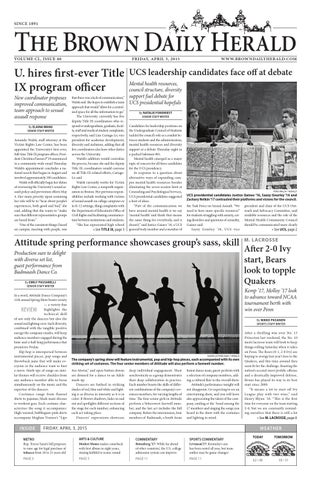
U. hires first-ever Title UCS leadership candidates face off at debate Mental health resources, IX program officer council structure, diversity New coordinator proposes improved communication, team approach to sexual assault response By ELAINA WANG SENIOR STAFF WRITER
Amanda Walsh, staff attorney at the Victim Rights Law Center, has been appointed the University’s first-ever, full-time Title IX program officer, President Christina Paxson P’19 announced in a community-wide email Thursday. Walsh’s appointment concludes a national search that began in August and involved approximately 100 candidates. Walsh will officially begin her duties of overseeing the University’s sexual assault policy and prevention efforts May 4. Her main priority upon assuming her role will be to “hear about people’s experiences, both good and bad,” she said, adding that she wants to “make sure that different representative groups are heard from.” “One of the consistent things I heard on campus, meeting with people, was
that there was a lack of communication,” Walsh said. She hopes to establish a team approach that would “allow for a centralized space for all the information to go.” The University currently has five deputy Title IX coordinators who respond to undergraduate, graduate, faculty, staff and medical student complaints, respectively, said Liza Cariaga-Lo, vice president for academic development, diversity and inclusion, adding that all five coordinators also have other duties across the University. Walsh’s addition would centralize the process, because she and the deputy Title IX coordinators would convene on all Title IX-related efforts, CariagaLo said. Walsh currently works for Victim Rights Law Center, a nonprofit organization in Boston. Her previous responsibilities include working with victims of sexual assault on college campuses or in K-12 settings, filing complaints with the Department of Education’s Office of Civil Rights and facilitating communication between institutions and students. “She has represented high school » See TITLE IX, page 3
support fuel debate for UCS presidential hopefuls By NATALIE FONDRIEST SENIOR STAFF WRITER
Candidates for leadership positions on the Undergraduate Council of Students tackled the council’s role as a conduit between students and the administration, mental health resources and diversity support at a debate Thursday night in a packed Salomon 001. Mental health emerged as a major topic of concern for all three candidates for the UCS presidency. In response to a question about alternative ways of expanding campus mental health resources besides eliminating the seven-session limit at Counseling and Psychological Services, UCS presidential candidates suggested a host of ideas. “Part of the communication we have around mental health is we say ‘mental health’ and think that means the same thing for everybody, and it doesn’t,” said Justice Gaines ’16, a UCS general body member and a member of
RYAN WALSH / HERALD
UCS presidential candidates Justice Gaines ‘16, Sazzy Gourley ‘16 and Zachary Nelkin ‘17 contrasted their platforms and visions for the council. the Task Force on Sexual Assault. “We need to have more specific resources” for students struggling with anxiety, eating disorders and questions of sexuality, Gaines said. Sazzy Gourley ’16, UCS vice
president and chair of the UCS Outreach and Advocacy Committee, said available resources and the role of the Mental Health Community Council should be communicated more clearly » See UCS, page 2
Attitude spring performance showcases group’s sass, skill M. LACROSSE
After 2-0 Ivy start, Bears look to topple Quakers
Production sure to delight with diverse set list, guest performance from Badmaash Dance Co. By EMILY PASSARELLI SENIOR STAFF WRITER
In a word, Attitude Dance Company’s 11th annual Spring Show boasts variety — a variety that highlights the technical skill of not only the dancers but also the sound and lighting crew. Such diversity, combined with the tangible positive energy the company exudes, will keep audience members engaged during the hour-and-a-half-long performance that premieres Friday. Hip-hop is interspersed between instrumental pieces, pop songs and throwback jams that will make everyone in the audience want to bust a move. Mash-ups of songs on similar themes will receive chuckles from any audience member able to focus simultaneously on the music and the expertise of the dancers. Costumes range from flannel shirts to pajamas, black maxi-dresses to workout gear. Each costume characterizes the song it accompanies: High-waisted, bubblegum-pink skirts accompany Meghan Trainor’s “Lips
Kemp ’17, Molloy ’17 look to advance toward NCAA tournament berth with win over Penn
REVIEW
INSIDE
By NIKKO PASANEN SPORTS STAFF WRITER
DANIELLE PERELMAN / HERALD
The company’s spring show will feature instrumental, pop and hip-hop pieces, each accompanied with its own striking set of costumes. The four senior members of Attitude will also perform a farewell number. Are Movin,” and open button-downs are donned for a dance to an Adele mash-up. Dancers are bathed in striking shades of red, blue and white and lighting is as diverse in intensity as it is in color: It throws shadows, fades in and out and spotlights different sections of the stage for each number, enhancing each act taking place. Dancers’ expressions showcase
deep individual engagement. Their synchronicity as a group demontrates their deep collaboration in practice. Each number boasts the skills of different combinations of the company’s seventeen members, for varying lengths of time. The four senior girls in Attitude perform a bittersweet farewell number, and the last act includes the full company. Before the intermission, four members of Badmaash, a South Asian
fusion dance team, guest-perform with a selection of company members, adding a cultural flair to the overall show. Attitude’s performance tonight will not disappoint. Go expecting to see an entertaining show, and you will leave also appreciating the talent of the company, smiling at the bond among the 17 members and singing the songs you heard in the show with the costumes and lighting in mind.
After a thrilling win over No. 13 Princeton last weekend, the No. 10 men’s lacrosse team will look to keep things rolling Saturday when it takes on Penn. The Bears (8-1, 2-0 Ivy) are hoping to avenge last year’s loss to the Quakers, and this time around they seem fit for the challenge. Boasting the nation’s second-most prolific offense and a drastically improved defense, Bruno has played its way to its best start since 2009. “It means a lot to start off Ivy League play with two wins,” said Henry Blynn ’16. “This is the first time for everyone on the team starting 2-0, but we are constantly reminding ourselves that there is still a lot » See M. LACROSSE, page 8
WEATHER
FRIDAY, APRIL 3, 2015
METRO Rep. Teresa Tanzi’s bill proposes to raise age for legal purchase of tobacco from 18 to 21 years old
ARTS & CULTURE Modest Mouse makes comeback with first album in eight years, staying faithful to iconic sound
COMMENTARY Rotenberg ’17: While far ahead of other countries’, the U.S. college admission system can improve
SPORTS COMMENTARY Levinson’17: Kentucky’s size has been noted all year, but team outlier may be game-changer
PAGE 3
PAGE 5
PAGE 11
PAGE 11
TODAY
TOMORROW
62 / 48
50 / 31
UNIVERSITY NEWS PAGE 2 • FRIDAY, APRIL 3, 2015
THE BROWN DAILY HERALD
Record snowfall increases removal costs, facilities damage Staff worked overtime during blizzards to clear snow from walkways, mechanical units
By CATHERINE WALKER-JACKS CONTRIBUTING WRITER
Along with 80 inches of snow and two campus-wide closings, recordbreaking snowfall this year also resulted in unprecedented costs to the University. The University spent $625,000 on snow removal alone this year, up from $435,000 last year and a marked increase from the $275,000 average spent annually over the past seven years, said Stephen Maiorisi, vice president of Facilities Management. In addition to basic snow removal costs, another $35,000 was spent on “proactive” measures to prevent damage caused by snow, Maiorisi said. Typical snow damage includes water damage and flooding caused by roof leaks or open windows. The cost for damage to University structures is projected to total approximately $150,000, though that figure does not account for major damages to University buildings such as the Pizzitola Center and Manning Chapel, Maiorisi said. In February, a section of the roof
» UCS, from page 1 to students. “The first point of access can be vastly more approachable,” he said, referencing his current OAC project of overhauling the CAPS website. Gourley also called for “more avenues for advocacy” in order to “change the ways we talk about this subject.” Gourley told The Herald after the debate that if he had been given more time, he would have liked to discuss increasing the diversity of CAPS staff, clarifying leave-taking policy for students and providing more support in the external referral process once a student reaches the seven-session limit. “It is important to make campus a safe space to discuss mental health without stigma,” said Zachary Nelkin ’17, a former UCS general body member. Nelkin criticized President Christina Paxson’s P’19 strategic plan for prioritizing “buildings over students … when it’s not willing to spend money
of the Pizzitola Center collapsed. More recently, the ceiling of Manning Chapel detached from the roof, likely due to pressure from snow on top of the building. The cost associated with these two incidents is not yet known and will add to the estimated $150,000 of routine damages, Maiorisi said. “We track snow removal costs every year, and this year was the highest it’s been since I’ve been here,” Maiorisi said. The majority of these costs stem from “people’s time — and a large part of that is overtime,” he added. Staffing costs constituted the lion’s share of snow removal expenditures, coming in at $440,000, up from $163,000 spent in recent years, Maiorisi said. University closings, which require more overtime pay, explain the jump in staffing costs, he added. Most of the $35,000 put toward preemptive steps to shield buildings from damage financed removal of snow from roofs. “In typical years, we don’t do much of that at all,” Maiorisi said, adding that the measure is particularly costly. “Hopefully (it) had a huge payoff for us.” Students expressed satisfaction with Facilities Management’s efforts to mitigate inconvenience caused by the snow.
on mental health.” Anna Pierobon ’16, who is from Italy, asked the presidential candidates how they would support international students’ mental health after Hyoun Ju Sohn GS, a first-year doctoral student from Korea, jumped to his death from the Sciences Library Tuesday. “We have to make sure our international students, based on where they’re from, are getting the proper attention they need,” Gaines said, adding that support cannot end with international orientation. Gourley agreed that international orientation needs to be “completely rehauled” in terms of mental health and augmented with “follow-up” support. Nelkin said he “would like to hear from international students” about what specific support they need. The presidential candidates also debated the council’s role as a conduit for student activists. UCS “shouldn’t be a conduit — it
RYAN WALSH / HERALD
The University spent approximately $625,000 on snow removal this winter, almost $200,000 more than last year. Staffing costs were the largest portion of expenditures at $440,000, up from last year’s $163,000. John MacDonald ’17.5 said he was “really impressed” with the University’s handling of snow removal. “Given how intense the winter was this year, I felt like the pathways were surprisingly well cleared and walkable,” MacDonald said. Sarah Cronin ’18 commended Facilities Management workers, who “worked hard through every storm to make the campus safe.”
In combatting snowstorms, Facilities Management workers’ duties include more than “just shoveling stairs and plowing sidewalks, walkways and paths,” Maiorisi said. For example, snow-clearing operations often deal with mechanical units on roofs. “Because filters get clogged up by the snow, we actually have people 24/7 during blizzards simply shoveling out mechanical units that are on
roofs,” he said. This allows the units, particularly in lab buildings, to continue functioning, which keeps the air in the building operational, he added. During blizzards, some workers must stay on campus overnight to respond to emergencies such as power outages, he said. “Fortunately, in these storms, we didn’t lose power, which is a great concern for blizzards.”
should be an advocate,” Gaines said, adding that the council needs to “make sure student voices are not only heard, but listened to.” “I’m a gender-queer student of color. This is not only something that I’m running on a platform — this is my life here. This is a lot of students’ lives here,” Gaines said. Nelkin said he would like to include student activist groups in UCS meetings. “Though you may have the right to come to UCS and speak, no one ever does,” he said. “It is critically important that we make UCS … into more of a town hall.” “It is essential UCS takes active stances on important campus issues” and “critical (that) we’re doing so in ways that support all students on campus,” Gourley said, noting that he helped write a Herald guest opinions column by UCS about mental health this semester. “As it stands, UCS is a mostly unelected body,” Nelkin said. The council
“fundamentally has to be a democratic body” in order to be representative of undergraduate sentiment, he said, adding that he has rewritten a full constitution for the council. Nelkin advocated “the ability to recall members of UCS if they are not performing their duties as they were intended to.” Support for students and faculty members of color also drove much discussion among the presidential hopefuls. Gaines criticized Paxson’s stated goal of doubling the percentage of underrepresented minorities in the faculty in the next decade. “Doubling is not nearly enough when we have 45 percent students of color on this campus,” Gaines said. Gaines would seek student input on diversifying the faculty and would also advocate increasing administrator diversity. One of Gourley’s “main priorities” this year is gathering student input on the Diversity Action Plan and finding “concrete objectives … because this is how we will make an end goal happen,” he said. Fields of science, technology, engineering and mathematics have been “rightly criticized for having one of the least diverse faculty of any field of study,” said Nelkin, an engineering student. “It’s not just an issue of justice — it’s directly affecting experiences that students have on campus” and their abilities to perform well in class, he added. Earlier in the debate, Alana Bhatla ’16, UCS media director and former UCS treasurer, and Ryan Lessing ’17, chair of the UCS Admissions and Student Services committee, went headto-head for the UCS vice presidency. In response to questions about the council’s low member retention rate and “top-heavy” image, Bhatla and Lessing critiqued the structure of UCS. Bhatla said she hopes to collect more student feedback through open forums and an online emphasis. The council
could “transition into being more of a group that is friendly and welcoming for all” and have “more of a family community setting than a business setting,” she said, adding that the Rhode Island School of Design hosts community dinners where students can directly offer feedback to their student government. “UCS definitely has a problem relaying its accomplishments to students — it is extremely hard to hold UCS accountable right now,” Bhatla said. To increase accountability, Bhatla suggested that the council release a monthly agenda and summary of its projects, adding that the council does not try hard enough to get feedback on its fall agenda or to follow up with the student body at the end of the year. Lessing reiterated the need to increase student feedback. What to Fix Brown, the council’s online feedback form that Lessing spearheaded, “was a great start, but we need to go beyond that,” he said. “The fundamental problem is that general body members are not finding UCS a rewarding experience,” Lessing said. “The cycle of general body members being all freshmen and then quitting is not sustainable — it kills us in terms of institutional knowledge,” he said. Creating a council of more evenly distributed class years is “the first step” in creating “a more representative body,” he added. The UCS Elections Board did not include candidates for leadership positions on the Undergraduate Finance Board in the debate, as Dakotah Rice ’16 and Faith Moses ’18 will run unopposed for chair and vice chair of the board, respectively. The debate was co-sponsored by the UCS Elections Board and The Herald. UCS Elections Board Chair Heather Sabel ’17 and Herald Editor-in-Chief Maxine Joselow ’16 moderated the debate. Students can vote online April 7–9.
RYAN WALSH / HERALD
Vice presidential candidates Alana Bhatla ‘16 and Ryan Lessing ‘16 offered suggestions to improve the council’s structure during Thursday’s debate.
METRO
FRIDAY, APRIL 3, 2015 • PAGE 3
THE BROWN DAILY HERALD
Bill seeks to raise legal tobacco purchase age to 21 Bills’ opponents critique lost sales revenue from 18 to 20 age group, encroachment on individual rights By ELAINA WANG SENIOR STAFF WRITER
A bill introduced by Rep. Teresa Tanzi, D-Narragansett and South Kingstown, proposes to increase the legal age to buy or sell tobacco products in Rhode Island from 18 to 21 years old. After being introduced in February, the legislation entered the hearing stage last week, spurring debate between medical professionals, politicians and other interested parties. Similar legislation has been passed in municipalities across the country, but the legislation’s passage would make Rhode Island the first state in the nation to raise the legal age for purchasing or selling tobacco to 21.
“There’s very good research that decision-making among 18 to 21 year olds is still not fabulous,” said Patricia Risica, professor of epidemiology. “The kind of social pressures put on them override what they know to be a bad decision,” Tanzi said. Increasing the legal age not only decreases the risk of smoking in that age group but also reduces access to cigarettes for underage youth who get their tobacco products from young adults, Risica said. The municipal government in Needham, Massachusetts passed an ordinance raising the age of buying tobacco to 21, which immediately decreased the percentage of people under 21 who have smoked within
the last 30 days by 48 percent, Tanzi said. New York City also enforces the older legal age. A hearing for the bill was held by the House Committee on Health, Education and Welfare March 25. Opponents cited an overstep in government regulation as one of the bill’s defects. Some pointed out that 18-year-olds are allowed to vote and join the military, and they should have the right to make decisions for themselves, the Providence Journal reported March 26. Raising the age could also cost the state to lose tax revenue from cigarettes, said Scott Mackay, political analyst for Rhode Island Public Radio, adding that Gov. Gina Raimondo’s recently unveiled budget proposes an additional 25 cents-per-package increase on the state cigarette tax. “There’s nothing to stop a young
person between 18 and 21 to just drive 3 or 4 miles over the border and go to Massachusetts to buy cigarettes,” which would hurt R.I. retail sales, MacKay said. “This would be a much easier choice if Massachusetts did the same thing.” Small business owners testified against the bill at last week’s hearing, said Karina Wood, public policy director for the American Lung Association, adding that while the association supports the state’s small businesses, “there are many other things that convenience stores and gas stations in Rhode Island can sell and make good money.” Cigarette sales to the 18 through 20 age group make up 2 percent of convenience store sales, Tanzi said. “It’s a drop in the bucket,” she added. The money lost would be made
up by savings on health care expenditures on tobacco-related illnesses, Tanzi said. Brain development and growth in self-regulation continue past the age of 18, according to an FDA-initiated study from the Institute of Medicine entitled “Public Health Implications of Raising the Minimum Age of Legal Access to Tobacco Products.” “High-risk behaviors, including tobacco use, are generally more common in adolescents and young adults than in older adults,” the IOM reported. “Additionally, the tobacco industry, prohibited from marketing to those younger than 18 years of age, has for decades targeted marketing and promotional activities to young adults.” Ninety percent of adult smokers began before the age of 21, according to an American Lung Association study.
» TITLE IX, from page 1
studies at Northeastern University and obtained a law degree from the Roger Williams School of Law, Paxson wrote. “I’m so glad that we’re finally filling the position. This is long overdue,” said Maahika Srinivasan ’15, a member of the Title IX officer search committee. Walsh is “incredibly qualified … and had a trauma-informed survivor focus that was really appealing to the two
undergraduates, graduate student and medical school student on the committee,” she added. “I’m just thrilled that she agreed in a time when so many of our other peer institutions are searching” for a Title IX coordinator, Cariaga-Lo said. “My reaction was one of complete excitement,” Walsh said. “I think that Brown can really be a leader in this area.”
and college victims of sexual violence, trained educational administrators on campus sexual violence issues and advocated for clients at administrative and legal proceedings, including university disciplinary hearings,” Paxson wrote in the campus-wide email. Walsh pursued her undergraduate
COURTESY OF BROWN UNIVERSITY
“My reaction was one of complete excitement,” said newly-appointed Amanda Walsh. “I think that Brown can really be a leader in this area.”
www.browndailyherald.com
ARTS & CULTURE PAGE 4 • FRIDAY, APRIL 3, 2015
THE BROWN DAILY HERALD
Film traces tumultuous history of Women’s Liberation Movement Documentary delves into activism surrounding abortion, sexual assault, violence against women By KHIN SU STAFF WRITER
Mary Dore’s feature documentary, “She’s Beautiful When She’s Angry,” celebrates the Women’s Liberation Movement of the mid-’60s and early ’70s. A combination of historic photographs, archived documents, video footage and interviews with leaders of the movement captures the passionate and defiant tone of an often overlooked movement that has so strongly shaped modern American society. The documentary, which is playing at the Cable Car Cinema until Sunday, reaches viewers at a moment when society is once again embroiled in the same inflammatory issues that the Women’s Liberation Movement challenged. From the fight against sexual assault on college campuses to the “No More” campaign against domestic violence to the battle for abortion rights, audiences cannot help but notice worrying parallels that force them to reflect on enduring social issues. The film chronologically follows the evolution of the Women’s Liberation Movement starting with the 1966 creation of the National Organization for Women. Bearing picket signs with messages such as “same job same pay,” participants in the movement sought equal pay for women in the workforce. The movement subsequently snowballed, and the plethora of new organizations that sprung up nationwide built upon the momentum of women who previously believed they were alone in feeling outraged by sexism. The movement grew to encompass a range of political women’s issues including sexual assault, abortion, child
REVIEW
COURTESY OF INTERNATIONAL FILM CIRCUIT
“She’s Beautiful When She’s Angry” highlights historic high and low points in the evolution of the Women’s Liberation Movement, exploring topics such as “lesbianism” and emerging groups such as Women’s International Terrorist Conspiracy From Hell. care and sterilization. The historic images and clips pieced together with music from the ’60s and ’70s and interviews with prominent feminist leaders such as Betty Friedan, Jo Freeman, Susan Griffin and Rita Mae Brown create a compelling and moving experience. Though it is interesting to hear directly from these leading women, it is difficult at times to keep track of the myriad names and faces.
The movement in its early stages centered on the concerns of white, middle-class heterosexual women. This focus led to new factions of the movement founded along race, class and gender lines, such as Black Sisters United and the Black Women’s Liberation Committee. The voices of women such as Eleanor Norton and Fran Beal offer a fresh perspective in the film. Similarly, factions such as the Lavender Menace, a group of feminists that protested the exclusion of lesbians from the Women’s Liberation Movement, challenged the narrow scope of the umbrella movement. A memorable moment in the documentary reenacts this radical lesbian group crashing a meeting at the Congress to Unite Women by suddenly shutting off the lights and having covert members stand up to reveal the T-shirts they were wearing
underneath other clothes, which read “Lavender Menace” in a dramatic expression of their anger at what they called “lesbianism.” The documentary also places the Women’s Liberation Movement in the context of the larger civil rights and anti-war movements during the ’60s. Though the movement attempted to define itself as a branch of other peace and civil rights movements, men were unreceptive and even hostile to the emerging group. This reaction came as a shock to those involved in the Women’s Liberation Movement, as they had expected the general population, including men, to easily accept this new call for anti-discrimination and equal pay as part of a greater effort to achieve peace and liberation. The film highlights that, despite these setbacks, the movement had
endearing and energetic moments that offer audiences inspiration and humor. Beyond the iconic burning of the bras and PhDs, the film also showcases more obscure events and organizations. One such organization is the Women’s International Terrorist Conspiracy From Hell, a group of young women that sought to challenge the patriarchy by dressing in witch costumes — black outfits, capes and pointy hats — and hexing people with chants. Another radical organization of feminists held the First National Ogling event, during which women walked down the street making objectifying statements and suggestive compliments directed at men. A badge displayed in one of the protests read, “Uppity Women Unite!” — and that rebellious and quirky attitude carries throughout this provoking film.
ARTS & CULTURE FRIDAY, APRIL 3, 2015 • PAGE 5
THE BROWN DAILY HERALD
Modest Mouse’s new album: From nostalgic to novel Indie band drops first album in eight years, stays faithful to classic sound while exploring its limits By EVAN BOYD CONTRIBUTING WRITER
In the music scene of 2015, Modest Mouse is indeed a stranger. The indie rock band’s latest album is its first in eight long years. Where has the group been and what has taken so long? Touring is part of the answer to these questions. Starting with a North American circuit in 2008, Modest Mouse has been travelling around the globe, playing festivals and concerts from Queensland to Malaysia. Then there was the exit of Eric Judy, the band’s bassist, co-founder and creative engine. “Yeah that was a loss, man,” said lead singer Isaac Brock in a March 21 interview with CBS This Morning. “He did a lot of writing in the past.” There was a shuffling of producers, beginning with Atlanta hip-hop icon Big Boi, and later the former Nirvana bassist Krist Novoselic. Brock even managed to open his own studio, Ice Cream Party, during the neardecade stretch. Through it all, Modest Mouse chipped away at its sixth major work, “Strangers to Ourselves.” But more than anything else, Brock — the band’s lynchpin — blames himself for the long wait. “I’m absolutely terrified of making a half-assed record,” he said in a March 10 interview with Rolling Stone. “There were songs that we did 100-or-some takes. Finally, I’d have to be like, ‘Look, we have no idea why we’re doing this again.’” It makes sense that Brock and Co. feel a bit of pressure coming off of their certified Gold 2007 charttopper “We Were Dead Before The Ship Even Sank” — an album that solidified their status as indie greats.
But if perfectionism lies at the root of the delay, is perfect what we get on their new album, “Strangers to Ourselves”? If you are a long-time fan and Modest Mouse expert, you can definitely count on consistency. The record picks up where the band left off back in 2007, though everything sounds a bit darker, a bit more “I’m going to call you out on your bullshit.” If you are a newcomer to these cluttered-not-crowded, schizophrenic symphonies, you are in for a grungy treat. “Strangers to Ourselves” brings a throwback palette of angsty ’90s instrumentation mixed with newer electronic, studio tweaks. The opening title track is a lazy, levitating ballad. For some reason this seems fitting. It works in slow motion like a trance or a time warp, pleasantly bridging the eight-year gap since the band’s previous record. Brock sings softly and delicately over prolonged cello notes, brushed snare and bubbling ambient noises. The song eases you in, preparing you for a reintroduction to the band’s classic sound: your long-lost friend. The following track, “Lampshades on Fire,” skillfully replaces this spacey intro with dirty guitar riffs and Brock’s eccentric vocals. It encapsulates the album, perhaps the band, as a whole — a concentrated dose of all sounds Modest Mouse. The song also addresses the record’s ecological theme: “Burn it up, or just chop it down / Ah, this one’s done so where to now?” Consider the startling birds-eye depiction of an Arizona RV camp on the cover and you’ll get the point. “Shit in Your Cut” and “Pups to Dust” are strewn with moody guitarpicked melodies. The former begins with a novel collection of scratching, clacking percussion over which Brock displays the impressive flexibility of his voice, melding a deep growl with Jack White-esque croons. This sort of
COURTESY OF WIKIMEDIA COMMONS
The members of Modest Mouse, coming off of their certified Gold 2007 album “We Were Dead Before the Ship Even Sank,” felt pressure to make their latest work “Strangers to Ourselves” perfect, according to the band. vocal layering is well-executed and recurs often in the album. The latter tune is notable for its shifting, timestretched chorus. Again, themes of humans’ place on the planet arise: “We don’t belong here / We were just born here.” At times, the band departs from its typical style and ventures into more experimental territory. “Coyotes” is a refreshing respite from the electrically charged songs that precede it. Brock conjures up the softer side of his register again and tosses some female vocals into the melodic chamber. The tune wears the guise of a Beatles track, building to a beautiful, reverberating conclusion. “God is an Indian and You’re an Asshole” is as good as it sounds: an abrupt acoustic injection of folky, twangy goodness. It’s pretty
uncharacteristic of Modest Mouse, but it works. You’ll find yourself humming to this while walking across campus or at your next campfire jam. At the other end of the spectrum are “Pistol” and “Sugar Boats,” a couple of over-cooked tracks that provide evidence of Brock’s meticulous studio tinkering. In “Pistol,” a drunken mess driven by an epic drum track and bursts of steam, the heavy layering works. But “Sugar Boats” — tuba blasts clashing against distorted guitar licks — sounds like a carnival ride gone wrong. “I mean it’s definitely not a race,” Brock said in a March 7 interview with National Public Radio. “I’m not trying to put out a record; I’m kind of waiting for a record to show up. There was a lot of time, between the last couple records, where I wasn’t
S L I D I N G I N TO A C T I O N
DANIELLE PERELMAN / HERALD
Meredith Heckman ’16 falls into place next to Maddie Johnson ’16, Marina Hyson ’18, Alix Taylor ’15, Vivian Leigh Ojeda ’16 and Olivia Kasmin ’15, who will perform Friday night in Attitude Dance Company’s 11th annual spring show.
sure it was even an environment I felt like releasing music into.” Modest Mouse’s members are neither apologists nor conformists. “Strangers to Ourselves” is a noble attempt to re-inject the band’s guitar-driven indie rock into a musical landscape that has, for the most part, moved past this trend. Though at times the music seems a bit redundant and overworked, the band deserves much credit for producing a solid, coherent album after a long hiatus. It is exciting to see these veterans back in the mix, their old sound becoming a new flavor in a vibrant crowd of rising alternative artists. The sixth studio album is definitely praise-worthy and satisfies pent-up demand. Take a listen and you’ll be psyched for Spring Weekend. We are in for a great show.
ARTS & CULTURE PAGE 6 • FRIDAY, APRIL 3, 2015
THE BROWN DAILY HERALD
Comedy explores infidelity, celebrates absurdity ‘A Flea in Her Ear’ finds balance between absurdism and caricature in farcical comedy By ANDREW DECK CONTRIBUTING WRITER
Though short on substance, Georges Feydeau’s frantic comedy, “A Flea in Her Ear,” which runs at the Trinity Repertory Company this month, entertains in an absurdist and innuendo-heavy exploration of infidelity. The 1907 French work is a classic in the genre of farce. True to its form, the play is often ludicrous — it features both a duplicitous doppelganger named Pocket and an S&M R&B musical number. Under the direction of Tyler Dobrowsky MA’08, the play wholeheartedly runs with this absurdity, even through its set design. By including a series of doors in the staging of the production, Dobrowsky adds a Benny Hill-inspired comedy to the cast’s frenzied movements on and off stage. The play begins when Raymonde Chandebise, an upper-class Parisian woman, conspires with a friend to seek
REVIEW
revenge on her husband Victor Emmanuel, who the pair believes to be unfaithful. To gather evidence against him, they write Victor a seductive, perfumedrenched letter from a “secret admirer” requesting to meet at a hotel. Their plan, however, unravels. Victor is entirely faithful and believes the letter must be meant for his friend Tournel, who is already secretly pursuing Raymonde. Within ten minutes, it becomes clear that this play will follow the style of sexfilled comedies of error before it. Mistaken identities and physical comedy are featured heavily. But “A Flea in Her Ear” sets itself apart with its heavy-handed and undeniably hilarious innuendo. A string of scandalous wordplay pushes contemporary theater standards, let alone those of the early 20th century. And the riotous laughter of the audience admittedly made the inappropriateness even funnier. The cast features many Brown alums and current graduate students, a product of Trinity Rep’s long-standing joint MFA theater program with the University. Overall, the cast does well in walking the fine line between absurdism and caricature. Stephen Thorne exemplifies this achievement. Thorne plays Victor’s speech-impaired nephew, Camille,
who is unable to pronounce consonants. Camille’s exclusively vowel-ed speech could easily have become grating, but Thorne finds a depth of humor — and surprisingly strong enunciation — in this absurd role. The same can be said for Fred Sullivan Jr., a lecturer at the Rhode Island School of Design, who plays Victor and his doppelganger, Pocket. His quick changes between a choleric aristocrat and a drunkard bellboy are impressively smooth. But the line is still occasionally crossed, especially with the mobsterinfluenced Spaniard Don Carlos Homenides De Histangua, played by Timothy Crowe. Don Carlos’ leopard-skinned jacket, thick accent and Scarface allusions somehow feel heavyhanded even as part of a generally unsubtle comedy. The same could be said for Angela Brazil, an instructor for the Brown/Trinity Rep program who, while generally very funny as Don Carlos’ wife, adds fandango flourishes to her performance that feel unnecessary and stereotypical. While the play lacks any truly revolutionary commentary — it’s scant on commentary at all, really — it is a product of its genre. The goals and criteria of farce stand separate from those of a traditional drama, and camp, such as “A
COURTESY OF TRINITY REPERTORY COMPANY
In “A Flea in Her Ear,” a Parisian woman’s suspicion of her husband’s infidelity and her desire for revenge lead to a sex-infused comedy of errors. Flea in Her Ear,” is necessarily superficial. So keep in mind that this play is for those who prefer their dirty jokes and
pratfalls to their biting political critique. “A Flea in Her Ear” will play at Trinity Rep until April 26.
410[GONE] haunts crowds with universal emotion despite cultural elements Sock and Buskin play hopes to fuel conversation about Asian Americans’ reactions to mental health By SOPHIE YAN STAFF WRITER
What do Dance Dance Revolution, a jar of pickles and the Chinese land of the dead have in common? The answer is absolutely nothing, unless you are familiar with the story of “410[GONE],” the latest production staged by Sock and Buskin, which opened Thursday at the Leeds Theater. The semi-autobiographical play was written by Frances Ya-Chu Cowhig
’05, who first conceived of the piece while a student at Brown, said Paul Margrave, publicity and box office coordinator for the Department of Theatre Arts and Performance Studies. The story centers around Seventeen, a Chinese-American boy played by Bee Vang ’15.5 who has killed himself and is now passing through the land of the dead. There, he meets an assortment of strange characters: Ox-Head, played by Lizzy Callas ’15, the Goddess of Mercy, played by Ziyi Yang ’16, and
COURTESY OF BROWN UNIVERSITY
Sock and Buskin will co-host a number of dinners and talks focusing on the topic of mental health within the Asian-American community.
the Monkey King, portrayed by Pei Ling Chia ’15 — all characters from traditional Chinese legend. While Seventeen grapples with this strange new world into which he has been thrust, the audience also meets his sister, Twenty-one — played by Kathy Ng ’17 — who is struggling with the loss of her baby brother. The details of the show are complex and often culturally specific. There are several obscure references to Chinese beliefs and folklore, which are bizarrely juxtaposed with American pop culture references. The popular arcade dance game, Dance Dance Revolution, is the mechanism by which souls transmigrate into the afterlife. The Goddess of Mercy, instead of an omniscient spiritual being of peace, is a sardonic, jaded slacker wearing black jeans and biker boots under her goddess costume and purple wig. The production brims with culture clash, a phenomenon reflected by the often jarring electronic dance music that alternates with soft, melodic instrumental tunes. At times, it is almost too much to take in — the context of Chinese legend is difficult to comprehend for those who are not familiar with it, and the characters sporadically slip into exaggerated Chinese accents, pronouncing their l’s like r’s as if imitating offensive racial caricatures. “Stylistically, (the production) takes up certain challenges,” said Erik Ehn, the play’s director and chair of the TAPS department. But “the story is not so far out — there are plot points to follow all the way through, and I wanted to make sure we told a simple story simply, even while we were involved with gods and ghosts,” he added. In theater, “there are a lot of challenges and a lot of decisions to make, but that’s what you’re in it for, the fracture and fall of it,” Ehn said. “You want
a chaos to stumble forward through.” Though “410[GONE]” may have its confusing moments for those uninitiated to Chinese culture, the story is ultimately carried by universal emotion that shines through the cultural elements, supported by the explosive performances of its talented cast. Yang and Chia have insuppressibly energetic and hilarious on-stage chemistry, providing the audience with witty oneliners, shouting arguments and even a full-out physical altercation. Vang and Ng, on the other hand, balance the hysteria with nuanced and heartfelt expressions of sadness, confusion, inner turmoil and ultimately love. “It’s a very direct but sophisticated and unusual love story,” Ehn said, adding that “401[GONE]” discusses “love not in the romantic sense, but the absolute sense.” Themes of love, religion and attachment run throughout the script, Ehn said. In addition, “there are particular issues related to suicide, and we want to face those squarely, along with Asian-American issues of identity and acculturation.” Sock and Buskin hopes to inspire conversation about Asian-American cultures and how they deal with mental illness, suicide and death, Margrave said. “410[GONE]” “looks at suicide and mental health in the Asian-American community — that can be a really difficult subject to talk about,” he added. “The play is trying to find ways into that conversation — and I think (it’s) going to do that incredibly well.” Sock and Buskin will co-host a series of dinners and talks on this topic with Counseling and Psychological Services and the Brown Center for Students of Color, Margrave said. The last dinner conversation, scheduled for the evening of April 14, aims to give audience members a chance to reflect
on their experiences, he added. “I couldn’t be happier with the conversation that’s (already) been going on onstage and backstage,” Ehn said. “A play is not just a show that we put on, it’s not just what happens when the lights go down — it’s when the light in your head turns on.” “I’m from Hong Kong ... but I went to an American international school back home,” Ng said. “So I feel like I don’t have direct experience with what (my) character has gone through, growing up in an isolated place where Asians aren’t commonly found.” She added that she found her character often demanding and selfish, something difficult to relate to herself. Ng said many of her Asian-American friends are very excited about the show and its subject matter. “I’m not the loudest activist, but I’m glad that I get to be a part of something that promotes conversation,” she added. “It’s a very personal story and one that’s very specific to Asian-American identity. ... I hope people who come to see it will be exposed to a sincere story that’s from a part of America that’s not always talked about,” Ng said. But when watching the play, even a person who cannot relate to AsianAmerican culture at all would be able to appreciate the universal themes of love, loss and longing that are expressed throughout. Underneath all the references, “410[GONE]” is ultimately a twist on the story of Orpheus and Eurydice — and like Orpheus, Twenty-one learns that “the best thing you can do sometimes for someone that you love is to let them be on their way,” Ng said. “The perfection in love is so vast that we can’t hold it,” Ehn said. “To live life fully, you have to learn from love the art of letting go.”
ARTS & CULTURE THE BROWN DAILY HERALD
FRIDAY, APRIL 3, 2015 • PAGE 7
Groups take creative approach to exploring health GlobeMed at Brown partners with Kenyan U-Tena to raise health awareness through art By GRACE YOON SENIOR STAFF WRITER
GlobeMed at Brown — the University’s chapter of the national organization that aims to alleviate global health disparities — hosted “Intersection of Art, Health and Social Justice” at the Ashamu Dance studio Tuesday. Using performance and creative arts to promote health equity and social justice, the event welcomed a series of artists to share the stage with the audience members in their creative endeavors. U-Tena, a performance art-based group from Nairobi, Kenya, aims to promote HIV testing and safe sex practices through engaging performances. U-Tena has partnered with GlobeMed since the chapter’s founding four years ago, said Elaine Hsiang ’15, internal co-president of GlobeMed at Brown. The event was notable for the ways in which it brought U-Tena and GlobeMed together. This was the first time that U-Tena came to the United States to showcase its work, Hsiang said. Though some of GlobeMed’s members have previously visited Kenya to assist U-Tena with its work over the summers, this event marked the first meeting between the two groups, said Lily Cohen ’18, a member of GlobeMed’s advocacy committee. “So much of our work is focused on Kenya and also just trying to support our partner’s projects,” Hsiang said, adding that the event served as a stepping stone for GlobeMed to directly engage with Brown and the broader Providence community. In addition to U-Tena’s performance, the event incorporated groups in a wide array of formats, from spoken word to craftwork, said KC Caine ’15, GlobeMed’s director of finances. Featured participants included WORD!, a spoken-word poetry group, and Artbeat, a new visual arts organization that promotes self-expression through workshops and public art
installations. The event started with a workshop run by Matthew Garza ’11, who invited audience members to the dance floor for an interactive activity designed to address empathy. Garza then introduced a series of exercises about “breaking the barrier between the audience and the performer” — a phenomenon particularly crucial to being sensitive to the needs of people around you, Garza explained to the audience. Audience members walked around the room while Garza called out numbers at intervals. In response, people with the designated numbers pretended to faint. Garza told the other audience members to react to the situation as realistically as possible, urging them to think through all the methods of providing help for the person in need. Leah Rivard ’15 said she found Garza’s workshop enlightening and appreciated how its message of empathy “tied back to global health.” Performances by WORD! followed Garza’s workshop. Performers included Christopher Johnson, WORD!’s community resident, and Sam Lin-Sommer ’17, who shared a piece on multiracial identity. Members of Artbeat staged the next workshop. Co-founder Mandi Cai ’17 and planning team member Elli Sawada ’17 led an exercise in which participants created human figures out of wire. Audience members molded these wire figures into positions that conveyed positivity. The participants then strung their creations together, creating a thread of figures molded in various positions. Cai and Sawada prepared the exercise to be cohesive with the day’s themes, Sawada said. U-Tena concluded the event with a series of on-stage dances. In a combination of prepared performance and improvisation, U-Tena’s members danced, chanted and drummed, at points inviting audience members to join them on stage. U-Tena’s “energy and enthusiasm for their cause is out of this world — it’s palpable,” Caine said, adding that those who attended the event would “take that spirit with them.”
COURTESY OF OLIVIA RECABO
Blending choreogrpahed performances with improvisational acts, U-Tena’s members danced, chanted and drummed, occasionally encouraging attendees to join them on stage.
COURTESY OF OLIVIA RECABO
Tuesday’s event, “Intersection of Art, Health and Social Justice,” marked the first time that U-Tena and GlobeMed have come together at Brown since beginning their partnership in 2011.
COURTESY OF OLIVIA RECABO
Performances at the event included spoken word poetry, dance shows and an interactive group exercise that asked participants to mold pieces of wire into symbols of positivity.
STAY UP-TO-DATE. FOLLOW US ON FACEBOOK. FACEBOOK.COM/BROWNDAILYHERALD
SPORTS
PAGE 8 • FRIDAY, APRIL 3, 2015
THE BROWN DAILY HERALD
W. LACROSSE
Bruno hosts Harvard with conference playoff berth uncertain After first nonconference loss against San Diego State, Bears look for first Ivy win against Crimson By LAINIE ROWLAND SENIOR STAFF WRITER
On the heels of its first nonconference loss of the season to San Diego State, the women’s lacrosse team is gearing up to face Harvard Saturday and attempt to collect its first Ivy victory. Harvard sits fourth in the Ivy standings with wins over Dartmouth and Columbia, while Bruno sits in the cellar. Only the top four teams qualify for the Ivy tournament, so without a win soon, the Bears’ attempt to qualify for the first time in 17 years may fall flat. The Crimson (4-4, 2-1 Ivy) boasts a top scorer in Marisa Romeo, whose 25 goals are fourth in the league. Audrey Todd and Julia Glynn have each recorded 20 points on the season, helping power some of Harvard’s relatively high-scoring games. Most recently, the Crimson eked out a 9-8 victory over Dartmouth (0-9, 0-3) in which Todd netted a hat trick with three goals in a span of seven minutes. But Harvard suffered in the second half after leading by four during halftime. This recent shaky play mirrors the inconsistencies that have plagued the Bears this season. Bruno (5-4, 0-3) has floundered in Ivy matchups, allowing opponents to outpace its offense and racking up insurmountable deficits, despite a number of
» M. LACROSSE, from page 1 of lacrosse to be played this season.” Much of the season remains, but the Bears have been nothing short of impressive up to this point. With a new, up-tempo offense installed this offseason, a change spearheaded by Assistant Coach Sean Kirwan, Bruno has embraced its new identity and has reaped the benefits along the way. Through nine games, the Bears have already scored more goals than they did all of last year. Dylan Molloy ’17, the nation’s
COURTESY OF BROWN ATHLETICS
Brown will need to keep track of Harvard’s leading scorer Marisa Romeo — along with teammates Audrey Todd and Julia Glynn — when the Crimson visit Providence Saturday in an effort to halt the Bears’ quest for their first conference win of the season. late offensive surges. The Bears have cited their inability to finish games strong as a catalyst for their conference free fall. In their first Ivy contest against Penn (9-1, 3-0), the Bears entered the second half down by five and ultimately narrowly lost by two. The Bears were outscored by six in the first half against Cornell (8-2, 3-0) last weekend, and a second-half rally could not lift them out of that hole.
Bruno’s most recent loss to San Diego State featured a role reversal — the Bears held an 11-6 lead with nine minutes left in play, but they squandered it by allowing seven goals before the final buzzer. Contrary to the Bears’ attempted comeback patterns this season, the Aztecs’ surge was successful in sealing the victory, with the winning goal scored a mere five seconds before the end of regulation. Bruno’s 88 goals on the season match
up well with Harvard’s 90, though the Bears have played one more game than their rivals. Accordingly, the Crimson averages about a goal-and-a-half more per game than the Bears, but the teams have achieved exactly the same percentage of successful shots. Statistically, the two squads seem poised to play a competitive game, though their vastly different records seem to suggest otherwise. It’s important
to note, however, that out of Bruno’s three opponents thus far, Penn and Cornell still possess undefeated conference records. Halfway through their Ivy season, the Bears are under pressure to capture a win. With Harvard as Bruno’s midpoint, the question now is: will the matchup be the turning point? The teams face off Saturday at noon at Stevenson Field.
leading scorer, has led the charge, but the team’s offensive prowess is anything but concentrated. Blynn and Kylor Bellistri ’16 have both been outstanding, netting 21 and 20 goals on the season, respectively. The team’s offensive versatility was on full display in last weekend’s contest against Princeton, when the Bears won despite Molloy being held scoreless for the first time this season. But the team’s difference makers are not just on the offensive end. In the face-off X, Will Gural ’16 has done a superb job, ranking 11th
nationally in face-off winning percentage, while long-stick midfielder Larken Kemp ’17 has bounded into the national spotlight as the nation’s leader in turnovers caused per game. Not to mention goalie Jack Kelly ’16, who is fresh off an impressive 15-save effort against the Tigers. Molloy and Kemp were named to Inside Lacrosse’s Mid-Season AllAmerican First Team on Thursday, representing two of three Ivy League players selected for the honor. It was an impressive feat for the two emerging stars, as they were the only
sophomores to make the esteemed list. Blynn and Head Coach Lars Tiffany ’90 acknowledged the strong efforts of players like Molloy and Kemp, but they ultimately credited the team’s determination and confident mentality for its success. “What has made this team so effective is our work ethic in practice and belief in each other’s abilities,” Blynn said. “Everyone on this team trusts each other and believes that we can win the Ivy and national championships. That’s the first time I can
honestly say that about a team I have played for.” “From my perspective, the extra possessions we have earned with our play at the face-off x and the wings has been critical,” Tiffany said. “We are not a team that maintains possession for long due to our aggressive nature, so earning more possessions with a gritty, unrelenting drive to pick up ground balls is key for us.” As for this weekend’s game against Penn (3-6, 0-3), there is plenty to look forward to. The Quakers started off the season ranked 13th in the nation, but after falling to No. 3 Maryland and Penn State, they have not been able to regain their footing. Despite their struggles, they are not a team to be taken lightly. Two weeks ago, Penn battled No. 6 Cornell in a triple overtime thriller, losing by a final margin of 10-9. “We have watched film of Penn’s most recent contests,” Tiffany said. “Despite the losses, the quality of this team is clearly evident.” With talk of a possible Ivy League title and NCAA tournament appearance, there is a lot of excitement surrounding the team. Bruno has not reached the tournament since 2009, and this year seems to be a golden opportunity. But Tiffany was quick to downplay the heightened expectations and chatter about the postseason. “I know this is coach-speak, but the truth of the matter is that the only thing we are focusing on now is Penn,” Tiffany said. “If we lose, then there is no next discussion about playoffs. We can only focus on what is directly in front of us, and that is a talented Penn team.”
COURTESY OF BROWN ATHLETICS
Jack Kelly ’16 had an impressive game against No. 10 Princeton, making 15 saves on 23 shots against the favored Tigers. Kelly, Larken Kemp ’17, Dylan Molloy ’17 and the rest of the Bears look to continue their success in the Ivy League when they take on the Quakers Saturday.
TODAY
FRIDAY, APRIL 3, 2015 • PAGE 9
THE BROWN DAILY HERALD
on the marquee
menu SATELLITE DINING JOSIAH’S Made-to-Order Quesadillas, Mashed Potato Bowl BLUE ROOM Naked Burritos Soups: Clam Chowder, Minestrone, Beef with Bean Chili ANDREWS COMMONS Grinder Station, BBQ Pork, Asian Tacos Pizzas: Bacon Cheeseburger, Harvest, Buffalo Chicken
DINING HALLS SHARPE REFECTORY LUNCH
DINNER
Cavatelli Primavera, Parsley Potatoes, Shaved Steak Sandwich, Rice Krispie Treats
Baked Tilapia, Bacon Rounds, Herb Rice, Vegetable Melange, Brazilian Chocolate Cake
VERNEY-WOOLLEY LUNCH
DINNER
Breaded Chicken Fingers, Vegan Nuggets, Italian White Beans, Zucchini and Onions Sautee
Blackened Catfish, Braised Rainbow Swiss Chard, Spanish Rice Bowl with Bacon and Beef RYAN WALSH / HERALD
sudoku
Letter by letter, an Avon worker changes the movie listings on the theater’s billboard. The cinema will show “‘71,” “Gett: The Trial of Viviane Amsalem” and “Mr. Turner” this weekend.
comics Comic Sans | Neille-Ann Tan ‘18
Cat Ears | Najateé McNeil ‘17 RELEASE DATE– Friday, April 3, 2015
Los Angeles Times Daily Crossword Puzzle c rNorris o s sandwJoyce o rNichols d Lewis Edited by Rich ACROSS 1 Spell 5 Traitor 10 Letters causing a rush 14 Property measurement 15 Flopped financially 16 Bonkers 17 Response to a drone 18 Quibble about accommodations? 20 Zeus’ beginning? 21 Forgives 22 Director Burton 23 Little bit 25 “Too Much, Too Little, Too Late” duettist 27 Marshmallow that’s been toasted too long? 33 4x4, e.g. 34 “1984” worker 35 Get used (to) 38 Assembly stage 40 Hit from a tee 42 Start of Operation Overlord 43 Scrutinized, with “over” 45 Abounds 47 Generation 48 Small group of tiny monarchs? 51 Google, say 53 Canyon part 54 “A Bug’s Life” extra 55 It might blow up in a crash 59 Shade at the shore 63 Worthless buzzer? 65 [I’m doomed] 66 Goes wrong 67 Bridge expert on some “Sports Illustrated” covers 68 Mozart’s “a” 69 Soft-spoken painter Bob 70 Irish hero, briefly 71 Pringles competitor DOWN 1 Now hyphen-less rapper
2 “Dies __” 3 Spotted aquarium dweller 4 Film estate with a championship golf course 5 “Avian” for whom flight is often futile 6 __ Reader 7 It may be hammered out 8 Help providers 9 Stain 10 European attraction 11 Independent country since 2011 12 When Hamlet says, “The play’s the thing ... ” 13 Dickinson output 19 “Amen!” 24 Trivia Crack, e.g. 26 Mind 27 Horrified reaction 28 One of the Ringling brothers 29 Drowns in the garden 30 __ Star 31 Circular
32 Chevy’s “American Pie” destination 36 Woolen yarn 37 Socket set 39 Review target 41 Newly formed 44 Joe sans jolt 46 Take on moguls 49 The Cat in the Hat’s numbered cohorts 50 Visuals
51 Word with tooth or saw 52 Año starter 56 Repeated word in “Take Me Out to the Ball Game” 57 Do a new mom’s job 58 On a cruise 60 Gave notice 61 Radius neighbor 62 Pinnacle 64 ’40s spy org.
ANSWER TO PREVIOUS PUZZLE:
FRIDAY
calendar
APRIL 3
7:00 P.M. ASIAN ARTS FEST
The Asian American Students Association will hold its annual show featuring performances related to Asian culture. Natalie Tran, an Australian Youtube star, will be this year’s special guest. Salomon 101 8:00 P.M. 410[GONE]
The Department of Theatre Arts and Performance Studies will present “410[Gone],” a play written by Frances Ya-Chu Cowhig ‘05 that centers on a woman’s varied ways of coping with the loss of her brother. Leeds Theatre
xwordeditor@aol.com
04/03/15
SATURDAY
APRIL 4
1:00 P.M. FEMINIST SELF-DEFENSE WORKSHOP
Martial arts expert Anne Kuzminsky will lead workshops on self-protection. Kuzminsky has a seventh-degree black belt and is certified by the Self Defense for the National Women’s Martial Arts Federation. Sarah Doyle Women’s Center 4:30 P.M. AN INTIMATE NIGHT WITH SHADES OF BROWN
Covers of rhythm and blues as well as alternative music will be performed at the Shades of Brown a capella concert. Faunce Underground
SUNDAY
APRIL 5
12:00 P.M. IMPULSE AUDITIONS
Impulse Dance Company will hold spring auditions for dancers of all styles and levels. Those planning to audition are requested to arrive at 11:30 a.m. TF Green 3:00 P.M. PASTA COOKING CLASS WITH CHEF FITZSENRY
Aaron Fitzsenry, assistant chef of Brown University Dining Services, will teach a class on making pasta. Participants will By Jim Quinlan ©2015 Tribune Content Agency, LLC
04/03/15
be able to eat the pasta they make for dinner. Sharpe Refectory
COMMENTARY PAGE 10 • FRIDAY, APRIL 3, 2015
THE BROWN DAILY HERALD
IN CASE YOU MISSED IT
Brown Bites: March 28-April 3 BY MARCY HUANG, ONLINE EDITOR
Hyoun Ju Sohn First-year physics doctoral student Hyoung Ju Sohn died in an apparent suicide by falling through a 12th-floor window of the SciLi Tuesday morning. Sohn was from South Korea and had completed his undergraduate studies in 2013 at Columbia. An emotional vigil mourning Sohn’s death took place in front of Faunce with over 300 attendees paying their respects. Community members searching for support can look to Counseling and Psychological Services and the Office of the Chaplains and Religious Life as well as several other student groups on campus. Bear cubs Brown is set to gain some fresh faces, as 1,970 students were accepted to the class of 2019 in the regular decision process, bringing the total number of acceptances this year to 2,580. This year marked a record-low acceptance rate of 8.5 percent and the second largest applicant pool in University history. Students from 85 countries and all 50 states were accepted, with 45 percent of admits identifying as African American, Latino, Native American or Asian American. Around 800 of these admitted students are expected to come to ADOCH this month. Prospective students can be easily identified through their use of lanyards as necklaces and their eagerness to wake up at 9 a.m. for Principles of Economics. Troubled waters Shark Bar and Grille has been in deep water recently amidst allegations that former Speaker of the House for the General Assembly Gordon Fox accepted $52,500 in bribes in 2008 in exchange for Shark’s liquor license. Fox pled guilty last month to federal charges of accepting bribes, wire fraud and filing a false tax return. On Monday, Shark received temporary receivership status, allowing the bar to keep its liquor license for the time being. Brown students everywhere remain on the edge of their seats over the potential loss of Scorpion Bowls. 1,000 days of Paxson In honor of President Paxson’s first 1,000 days in office, The Herald published a three-part series this week delving into the major implications her presidency holds for the University: grad-undergrad tensions, female leadership and alum approval. The first part detailed Paxson’s plan to bulk up the Grad School — suggesting a shift toward prioritizing Brown as a research university rather than as a university-college. The second part of the series called attention to Brown’s status as the only Ivy League school with a female president and a female provost. Though many students voiced their satisfaction with the number of women in the administration, some still feel underrepresented because most of those women are white, heterosexual and cisgender. The third part in the series discusses Brown’s ongoing relationships with alums, which Paxson has tried to bolster through the creation of BrownConnect and a change in the donation system.
A N G E L IA WA N G & K EV I N O’ FA R R E L L
Q U O T E O F T H E D AY
“The perfection in love is that we can’t hold it. To live life fully, you have to learn from love the art of letting go.” — Erik Ehn, chair of the TAPS department
See 410[gone] on page 6.
Polling Undergrad opinion about Paxson was also called into question with the recent release of the results of The Herald’s two spring polls. While the polls covered a wide breadth of topics, reactions over the handling of the recent sexual assault and GHB cases were noteworthy. The first poll, conducted March 2-3, showed students split on the University sanctions imposed on Phi Psi and Sigma Chi and revealed that about 41 percent of students approved of Paxson’s performance. The poll was re-administered March 16-17, after campus controversies surrounding a sexual assault hearing and a canceled hearing in a GHB case emerged. This second poll found that the majority of students disapproved of the way the cases were handled and the reasoning behind the decisions. Paxson’s approval rating dropped 8 percent in this two week span.
Editorial Leadership
Sections
Visuals & Production
Business
Editors-in-Chief Michael Dubin Maxine Joselow
Arts & Culture Editors Eben Blake Gabrielle Dee
General Managers Sarah Levine Winnie Shao
Managing Editors Kiki Barnes Jillian Lanney
Metro Editors Alexander Blum Emma Jerzyk Drew Williams
Design Editors Loren Dowd Carlie Peters Taylor Schwartz Assistant: Meryl Charleston Assistant: Andrew Linder
Senior Editors Camilla Brandfield-Harvey Isobel Heck Molly Schulson
Science & Research Editors Andrew Jones Steven Michael
BLOG DAILY HERALD Editor-in-Chief David Oyer
Sports Editors Andrew Flax Alex Wainger
Managing Editors Deena Butt Jacob Koffler
University News Editors Emma Harris Caroline Kelly Joseph Zappa
POST- MAGAZINE Editor-in-Chief Adam Asher DIGITAL Online Editor Marcy Huang
COMMENTARY Editorial Page Editors Alexander Kaplan James Rattner Opinions Editors Megan GrapengeterRudnick Kate Kiernan Evan Sweren
Photo Editors Head: Brittany Comunale David Deckey Katie Liebowitz Arjun Narayen Ashley So Ryan Walsh Graphics Editors Avery Crits-Christoph Emma Jerzyk Web Producers Joe Stein Harsha Yeddanapudy Abdullah Yousufi Copy Desk Chief Madeline DiGiovanni Illustrations Editor Angelia Wang Video Editor Richard Flores
Directors Sales: Moniyka Sachar Sales: Jess Urrutia Finance: Josh Tartell Alumni Relations: Marley Rafson Business Dev.: Yuta Inumaru Sales Managers Matthew Meyer Henry Ritter Gulmira Hamit Taylor Casey
facebook.com/browndailyherald
Location: 195 Angell St., Providence, R.I. www.browndailyherald.com
@the_herald
Editorial contact: 401-351-3372 herald@browndailyherald.com
browndailyherald.com
Business contact: 401-351-3260 gm@browndailyherald.com
Corrections: The Brown Daily Herald is committed to providing the Brown University community with the most accurate information possible. Corrections may be submitted up to seven calendar days after publication. Commentary: The editorial is the majority opinion of the editorial page board of The Brown Daily Herald. The editorial viewpoint does not necessarily reflect the views of The Brown Daily Herald, Inc. Columns, letters and comics reflect the opinions of their authors only.
Finance Managers Collections: Neil Wathore Collections: Benjamin Wesner Operations: Carin Papendorp
Letters to the Editor: Send letters to letters@browndailyherald.com. Include a telephone number with all letters. The Herald reserves the right to edit all letters for length and clarity and cannot assure the publication of any letter. Please limit letters to 250 words. Under special circumstances writers may request anonymity, but no letter will be printed if the author’s identity is unknown to the editors. Announcements of events will not be printed.
Business Dev. Manager Project Leader: Kaden Lee
Advertising: The Brown Daily Herald, Inc. reserves the right to accept or decline any advertisement at its discretion. The Brown Daily Herald (USPS 067.740) is an independent newspaper serving the Brown University community daily since 1891. It is published Monday through Friday during the academic year, excluding vacations, once during Commencement and once during Orientation by The Brown Daily Herald, Inc. Single copy free for each member of the community. Subscription prices: $280 one year daily, $140 one semester daily. Copyright 2015 by The Brown Daily Herald, Inc. All rights reserved. Periodicals postage paid at Providence, R.I. Postmaster: Please send corrections to P.O. Box 2538, Providence, RI 02906.
COMMENTARY FRIDAY, APRIL 3, 2015 • PAGE 11
THE BROWN DAILY HERALD
On legacy, interviews and college admission GRAHAM ROTENBERG opinions columnist
As students all across the globe review acceptance and rejection letters, many will wonder what determined their fate. There are some mysterious factors, as David Ha ’18 noted in The Herald (“Ha ’18: The prisoner’s dilemma in college admission,” March 30), and many are in favor of demystifying these secrets. But there are other practices that occur in broad daylight that many regularly choose to ignore. The New York Times recently published a “Room for Debate” feature in which a bunch of smart people describe their ideas on how to improve the college admission process in the United States. There are a lot of ideas. Swarthmore Professor of Psychology Barry Schwartz advocates a lottery after candidates meet a certain bar of qualification. If they do not, their names are weeded out, and the remaining names are “put into a hat and the winners would be drawn at random,” Schwartz wrote. Others, such as college consultant Michele Hernandez, suggest that applicants be evaluated more holistically. Economist Alvin Roth advocates a system whereby students could signal which colleges they strongly want to attend, thereby
informing schools of how seriously to consider their application. There is unifying underlying assumption: America’s college processes are broken. And they are, but just because something is flawed does not mean that it’s still not the best. The United States’ college admission process far exceeds that of many other countries. But there is still room for improvement, and there are many perversions worth
sivism and the values of higher education. The consideration of legacy disadvantages people whose parents did not have the privilege of attending college, solidifies social strata and allows many to coast through high school knowing that their family already blazed the path for them. And why should this bloodline matter more to a school than alumni interviews? The way in which the alumni interview has been propa-
flex of the admissions process. These interviews should carry more weight than legacy does. Alumni interviewers care enough about their school to sit down with students and gauge whether they are worth admitting. I have heard of multiple cases where alumni interviewers sent voluntary letters supporting a particular applicant — many to no avail. When these alums advocate,
The United States’ college admission process far exceeds that of many other countries. But there is still room for improvement, and there are many perversions worth noting.
noting. Let’s start with the concept of legacy, which baffles me. I understand there is a clear financial incentive for a school to have familial connections. This attempts to reduce the alienation between a corporation like Brown and individuals who choose to finance and donate to the school. It establishes a connection, however superficial it might be. But the fact that having a parent who attended Brown — or any other school — influences admission as heavily as it does runs counter to progres-
gated is perplexing. Professionals, interested parties and many others spend a considerable amount of time meeting with prospective students, adding their insights and learning about those who might matriculate. Yet, according to Karen Richardson of Tufts University, these interviews do not “make or break” decisions. In short, they have little to no effect. Richardson argues that the interviews, in fact, are just as much an opportunity for the student to learn about the institution as they are a re-
without coercion or pressure, on behalf of students, schools often disregard the information; yet if a student possesses alumni blood, this information is emphasized. In Canada, the admission process is much worse since the major universities are public institutions. In Ontario, my native province, it took me less than 30 minutes to apply to college. You open the Ontario University Application Centre. Fill out your senior grades. Find corresponding school codes and click submit. This leads to universities
that are even more stratified since little information beyond GPA is considered. Though some programs have a more strenuous application process that includes personal statements, it is much less comprehensive than what is required by most elite U.S. institutions, which often require incredibly difficult supplements in addition to the Common Application. Anecdotally, when I visited Connecticut College, I was introduced to rugby players and asked about my tenure as class president. It felt as if the admission officer truly understood who I was rather than just seeing me as another number applying to a massive monolith. I hope that my native Canada and its institutions adopt a more holistic application process so that they attract a wider swath of applicants. Canada might look to the U.S. model, even with its flaws. I also hope that Americans begin to improve upon the system and realize that, although strenuous, taxing and imperfect, the U.S. system is better than they might believe. We certainly don’t need newspaper sections and transparency to fix the invisible. The things that need fixing are already staring us in the face.
Graham Rotenberg ’17 can be reached at graham_rotenberg@brown.edu.
SPORTS COMMENTARY
Freshmen, Frank, frontcourts: The keys to the final four BY DEREK LEVINSON sports columnist
Yet again, Tom Izzo’s Michigan State Spartans are making a deeper tournament run than you might expect given their status as a lowly seventh seed. But do not jump on the bandwagon yet. Michigan State has not been quite as impressive as a Final Four team should be. It took on a Virginia squad that has not looked the same since Justin Anderson’s injury and was spared from having to play Villanova by an upset. The Spartans had a nice win against Oklahoma but have not won a single tournament game by more than seven points. Not that the team isn’t deserving — its low seed is due mainly to bad luck during the regular season. But the Spartans will be heavy underdogs against Duke. Unfortunately for Michigan State, the Blue Devils do not present a fa-
vorable matchup. Travis Trice is tremendously skilled, but he does not have the athleticism to challenge Duke guards Tyus Jones and Quinn Cook. Matt Jones has come up big for Duke over the last few games, and I expect he will play heavy minutes on Saturday to neutralize Denzel Valentine, who has the potential to bully Duke’s other perimeter players. Branden Dawson has been the Xfactor for Michigan State all year. The senior power forward plays physically and racks up blocks and steals for a team that has had trouble forcing turnovers all year. Much will be made about Dawson’s experience if he outplays Duke freshman Justise Winslow, but Winslow is likely to have the advantage. Winslow is similar to Dawson but a bit bigger and more athletic — and with an outside shot to boot. Michigan State vs. Duke will be great, but if you can only watch one game this weekend, make sure it is Kentucky vs. Wisconsin. If Kentucky wins out, it may be considered the greatest college basketball team ever,
and some have already proclaimed its defense the best in college history. Either claim could easily be true, but Wisconsin’s offense is even more of an anomaly. Based on stats from KenPom. com, the Badgers are about three points per game better than any other team since advanced stats have been recorded. To put that in perspective, a three-point edge gives a team roughly double its opponent’s odds of winning. Wisconsin definitely has the firepower to take down the Wildcats. They also have a good matchup — or at least as good as anyone can have — against Kentucky’s mammoth roster. All of Wisconsin’s starters can play on the perimeter, which should drag Kentucky’s big men away from the basket, much like Notre Dame did in the Elite Eight matchup. But unlike Notre Dame, Wisconsin is big enough to bother Kentucky on defense. Frank Kaminsky lacks the strength and Sam Dekker lacks the skill to be good post defenders, but just being the same size as Ken-
tucky’s front line is more than most teams can boast. At 6’8,” Nigel Hayes is a bit undersized for this battle of giants, but he has fantastic lowerbody strength and post skills and will likely be called upon to guard Kentucky’s biggest threats on the block. The frontcourt battle is likely where this game will be won, but we have been talking about Kentucky’s size and athleticism all year. What is more notable at this point is the one player who does not fit that description. At 5’9” and 155 pounds, point guard Tyler Ulis is shorter than anyone in either team’s starting lineup by seven inches. Kentucky coach John Calipari has long favored big players — especially big point guards — but made an enormous exception in recruiting the diminutive Ulis. Because of his stature, Ulis cannot see over defenses or muscle into the paint like Kentucky’s other guards, so Calipari has designed a different offense for the team when Ulis is on the floor.
This might seem like more trouble than it is worth, especially given that Ulis does not crack Kentucky’s starting five. But Ulis makes up for his height with brilliant court awareness and poetic footwork. To negate his size disadvantage, Ulis has invented moves that I have never seen before. But Ulis’s importance goes beyond his talent. He and Devin Booker are the only above-average shooters on Kentucky. Wisconsin likes to play a very passive defense, which allows semi-contested three-pointers. That style is perfect against Kentucky’s athletic starting lineup but will be less effective against Ulis and Booker. The two players will be crucial tools for Calipari when the Wildcats’ spacing is too tight. It just might be the 5’9” guard who wins the game for his team of seven-footers.
Derek Levinson ’17 is 6’2”, but John Calipari didn’t recruit him. Commiserate with him at derek_levinson@brown.edu.
Got something to say? Leave a comment online! Visit www.browndailyherald.com to comment on opinion and editorial content.
SPORTS THE BROWN DAILY HERALD
FRIDAY, APRIL 3, 2015
ATHLETE OF THE WEEK
Orona ’18 garners Ivy Co-Rookie of Week honors Standout first-year boasts 1.97 ERA, 7.47 strikeouts per game, as many wins as last year’s team By EMILE BAUTISTA SPORTS STAFF WRITER
COURTESY OF KATIE ORONA
The first-year left-hander has had impressive performances against nonconference and conference foes but has yet to get her first Ivy win.
Though the past week may not have resulted in the most desirable final scores for the women’s softball team, pitcher Katie Orona ’18 continued to impress. The sensational first-year has been pitching virtually lights out all season long with a 1.97 ERA and averaging 7.47 strikeouts per game. In seven starts, Orona has thrown seven complete games and compiled a 4-3 record, with her three losses each coming down to one run. Last week, she pitched a total of 19.2 innings, including a phenomenal performance against Princeton, in which she allowed just one run on four hits and four strikeouts. Orono’s performances over the course of the last week earned her Ivy League CoRookie of the Week — for the second time — and Corvias ECAC Rookie of the Week honors. Due to her spectacular performance on the field, Orona has been named The Herald’s Athlete of the Week.
Herald: How long have you played softball and what got you into it? Orona: I played T-ball when I was really young for two years. Then I stopped until sixth grade. I started taking it seriously probably going into freshman year of high school. My whole family is a really big baseball family. So it was kind of understood that I was going to play softball at some point. How does it feel to be named Ivy League Co-Rookie of the Week for the second time this season? I think it’s very rewarding to know that I’m representing the team well. It is a reflection of all the work the team has put in as a whole, and I guess I am happy to be the person who gets recognition for it.
What typically goes through your mind when you are on the mound? I’m just trying to do my job and I try to get ground balls. I try for something my defense can work with, I guess. My coach always tells me to challenge every batter and to make sure that if they do get a hit or get on base, that they earned it. That’s a big goal. What is your favorite pitch to throw? Probably a change-up. I’d say it’s
one of my better pitches.
Do you have any pre-pitch or pregame rituals? My catcher and I drink sweet tea before every game and it seems to be good luck so far, so we’ll keep up with that. What is your relationship like with your catcher? I love Julia Schoenewald ’17, she’s one of my favorites. She’s by far the best catcher that I’ve ever had. She’s really helped me with my mental game. We’ve really gotten to know each other, both personally and on field, which helps a lot when we’re playing. She knows when to calm me down, and I really do rely on her a lot in game. If you could play any other position, what would it be? Well I’m left-handed so I’m really limited in what I can do. I don’t know, probably outfield. I always wish I were faster, so probably that. What about any other sport? Probably basketball. When I was younger, my dad always wanted me to play basketball, but I wasn’t exactly skilled at it. — This interview has been edited for clarity and length
BASEBALL
Bruno hosts Gehrig Division front-runners Penn, Columbia
Lion offense, Quaker pitching present challenges for Bruno ahead of weekend tilts By MATT BROWNSWORD SENIOR STAFF WRITER
After the baseball team split its first two Ivy doubleheaders with Princeton and Cornell — the two teams picked to finish last in the Gehrig Division by d1baseball. com — Brown (6-14, 2-2 Ivy) hosts the teams picked to finish in the top half of the Gehrig Division, Columbia and Penn. Mother Nature may disrupt current plans, but for the time being, the Bears look to open their home slate with the Lions (11-10, 3-1) Saturday. Columbia comes in with a much higher pedigree than the Bears, as it has played a much tougher nonconference schedule and looks to be one of the frontrunners for the Ivy League title. The Lions have already shown their strength in two victories over then-No. 6 Houston in an opening series split. “Columbia has experienced guys that know how to win in this league,” said Taylor Wright ’15. “They’ve played in regionals and know how to perform in big games.” Joey Falcone and Jordan Serena lead the Lions’ potent lineup this year, each batting well over .300 for the season. Falcone has also brought a lot of power to Columbia’s offense, slugging .663 with four home runs and 18 RBIs in 80 at bats. Gus Craig is the only other Lion with double-digit RBIs, but seven players have six or more. Comparably, Noah Schulman ’16, Robert Henry ’17, Dan Kerr ’15 and Josh Huntley ’17 all have double-digit RBIs
COURTESY OF BROWN ATHLETICS
Nick Fornaca ’15 throws the ball to first. The last time Brown started 2-2 in conference play was in 2012, which also happens to be the last time that the Bears registered wins against Gehrig Division foes Penn and Columbia in the same season. this season. Columbia’s starting rotation has not been the biggest contributor to the Lions’ success: Of the three pitchers who have started three or more games this season, none has an ERA lower than 3.50. But Columbia’s relievers have been impressive, as three of them — two with eight appearances — boast ERAs of 3.00 or lower. All that said, only one Brown pitcher has an ERA lower than 4.00 — Dante Bosnic ’18, who has two wins in seven relief appearances. “Dante has been awesome for us,”
Wright said. “It’s nice to know there’s a guy in the bullpen that you know is going to come in and get the job done. Especially as a freshman it’s impressive that he’s been able to come in in big spots and get people out.” Sunday’s weather looks a little more promising for the Bears’ tilts with Penn (8-9, 3-1), which, like Columbia, had a strong first weekend of conference play. Two wins against Harvard preceded by a split with Dartmouth mean the Quakers come to Providence with a solid premiere in Ivy play behind them.
The top four batters for Penn all hit over .285 and three of them have batting averages of over .300. Two hitters — Mitch Montaldo and Matt Greskoff — lead the Quakers in RBIs but hit below .250 for the season. Having only played 17 games, the batters’ individual numbers are deflated compared to Bruno’s, though Bruno still has an edge over the Quakers, scoring almost a full run more per game. Penn’s strength has been in its starting pitching: All four Quakers who have started three or more games have an ERA
lower than 3.00. If the starting pitchers have a rare bad start and depend on middle relief, Penn may be out of luck since of its six relievers who have appeared in four or more games, only one has an ERA lower than 3.00. “Penn has some talented arms and those guys compete,” Wright said. “They come right after hitters and can throw all of their pitches for strikes.” The Bears take on Columbia Saturday at 12:30 p.m. and 2:30 p.m. before facing the Quakers Easter Sunday at the same times.