SINCE 1891
THE BROWN DAILY HERALD THURSDAY, MARCH 19, 2015
VOLUME CL, ISSUE 40
WWW.BROWNDAILYHERALD.COM
Paxson endorses Act4RJ demands Task Force on Sexual Assault’s final report to include movement’s policy change suggestions By NATALIE FONDRIEST SENIOR STAFF WRITER
COURTESY OF RACHEL SPAULDING
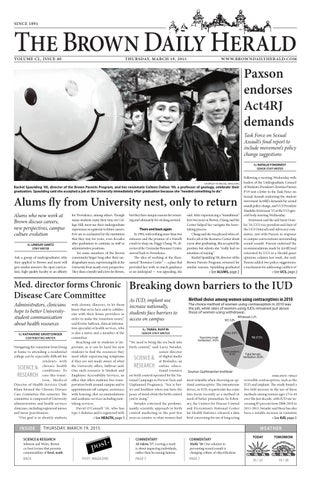
Rachel Spaulding ’00, director of the Brown Parents Program, and her roommate Colleen Dalton ’00, a professor of geology, celebrate their graduation. Spaulding said she accepted a job at the University immediately after graduation because she “needed something to do.”
Alums fly from University nest, only to return Alums who now work at Brown discuss careers, new perspectives, campus culture evolution By LINDSAY GANTZ STAFF WRITER
Ask a group of undergraduates why they applied to Brown and most will give similar answers: the open curriculum, high-quality faculty or an affinity
for Providence, among others. Though many students enjoy their time on College Hill, most use their undergraduate experiencee as a gateway to future careers. Few are so enchanted by the institution that they stay for years, even decades after graduation to continue in staff or administrative positions. Yet some members of the Brown community linger long after their undergraduate years, experiencing life at the University from nearly every perspective. They share a loyalty and a love for Brown,
Med. director forms Chronic Disease Care Committee Administrators, clinicians hope to better Universitystudent communication about health resources By KATHARINE GROETZINGER CONTRIBUTING WRITER
Navigating the transition from living at home to attending a residential college can be especially difficult for students with chronic health conditions. To ease this transition, Medical Director of Health Services Unab Khan formed the Chronic Disease Care Committee this semester. The committee is composed of University administrators and health services clinicians, including registered nurses and nurse practitioners. “Our goal is to identify students
SCIENCE & RESEARCH
INSIDE
with chronic illnesses, to let them know that we’re here and to collaborate with their home providers in order to make the transition easier,” said Kristie Sullivan, clinical information specialist at health services, who is also a nurse and a member of the committee. Reaching out to students is important, as it can be hard for new students to find the resources they need while experiencing symptoms if they are not made aware of what the University offers, Sullivan said. One such resource is Student and Employee Accessibility Services, an office that offers students free transportation both around campus and to appointments off campus, assistance with housing, diet accommodations and academic services including notetaking services. David O’Connell ’16, who has type 1 diabetes and is registered with » See HEALTH, page 3
There and back again In 1994, with nothing more than two suitcases and the promise of a friend’s couch to sleep on, Peggy Chang ’91, director of the Curricular Resource Center, moved back to Providence. The idea of working at the thennamed “Resource Center” — a place that provided her with so much guidance as an undergrad — was appealing, she
said. After experiencing a “tumultuous” first two years at Brown, Chang said the Center helped her navigate the leavetaking process. Chang said she was pleased when offered a job at the Resource Center about a year after graduating. She accepted the position but admits she “really had no intention of staying.” Rachel Spaulding ’00, director of the Brown Parents Program, returned for similar reasons. Spaulding graduated » See ALUMS, page 2
Breaking down barriers to the IUD As IUD, implant use increase nationally, students face barriers to access on campus
Method choice among women using contraceptives in 2010 The choice method of women using contraception in 2010 was the pill, while rates of women using IUDs remained just above those of women using withdrawal. IUD: 5.6%
By TANEIL RUFFIN
“We need to bring the sex back into birth control,” said Larry Swiader, senior director of digital media at Bedsider, an online educational resource on birth control operated by the National Campaign to Prevent Teen and Unplanned Pregnancy. “Sex is better and healthier when you have the peace of mind about the birth control you’re using.” Swiader criticized the predominantly scientific approach to birth control marketing in the past few years as counter to what women find
POST- MAGAZINE
Withdrawal: 5.2%
Other: 8.8%
SENIOR STAFF WRITER
Vasectomy (male sterilization): 10.0%
Pill: 27.5%
Male condom: 16.3%
SCIENCE & RESEARCH
Tubal (female) sterilization: 26.6%
Source: Guttmacher Institute EMMA JERZYK / HERALD
most relatable when choosing an optimal contraceptive. The intrauterine device, or IUD, in particular has come into focus recently as a method in need of better promotion. In February, the Centers for Disease Control and Prevention’s National Center for Health Statistics released a data brief concerning the use of long acting
reversible contraceptives, such as the IUD and implant. The study found a five-fold increase in the use of these methods among women ages 15 to 44 over the last decade, with IUD use increasing 83 percent from 2006-2010 to 2011-2013. Swiader said there has also been a notable increase in visitation » See IUD, page 3
WEATHER
THURSDAY, MARCH 19, 2015
SCIENCE & RESEARCH Johnson and Wales, Brown co-host lecture that presents commonalities of food, math BACK
but they have unique reasons for returning and ultimately for sticking around.
Following a meeting Wednesday with leaders of the Undergraduate Council of Students, President Christina Paxson P’19 sent a letter to the Task Force on Sexual Assault endorsing the student movement Act4RJ’s demands for sexual assault policy change, said UCS President Maahika Srinivasan ’15 at the UCS general body meeting Wednesday. Srinivasan said she and Sazzy Gourley ’16, UCS vice president and chair of the UCS Outreach and Advocacy committee, met with Paxson in response to campus conversations surrounding sexual assault. Paxson endorsed the recommendations made by Act4RJ and reiterated by UCS in a Herald guest opinions column last week, she said. Paxson added two policy suggestions: a mechanism for addressing conflicts of » See UCS, page 2
COMMENTARY Al-Salem ’17: Leaving a mark is about impacting individuals, rather than becoming famous
COMMENTARY Malik ’18: One solution to preventing sexual assault is changing culture of objectification
PAGE 7
PAGE 7
TODAY
TOMORROW
35 / 22
35 / 28
UNIVERSITY NEWS PAGE 2 • THURSDAY, MARCH 19, 2015
» UCS, from page 1 interest and a move to an independent investigator model, she added. The task force’s final report will include the original text of Paxson’s letter, Gourley said. Srinivasan and Gourley also met with the Mental Health Community Council Monday to discuss suicide prevention and peer adviser training, Srinivasan said. Currently, advisers themselves are not provided with the necessary training to address advisees’ suicidal thoughts, she said. Additionally, advisers “themselves don’t get the support that they need,” she said, adding that she plans to standardize a single online feedback system for the entire Brown community. The Undergraduate Finance Board approved an $8,000 UCS budget for next academic year, up from $6,000 this year, but below the requested budget of $12,000, said UCS Treasurer Malikah Williams ’16. Members of the UCS New Initiatives Fund finished interviews this weekend and funded 20 of 30 applicants, Williams
» ALUMS, from page 1
with an Sc.B. in psychology and wondered what she could do with her degree besides attending graduate school, she said. “I just needed a temp job. I needed something to do,” she said. The summer after graduation she got a job working for the director of University events. “I graduated, and I was the best and the brightest, and for the rest of the summer I put labels on envelopes as centered as I could possibly make them,” Spaulding said, laughing. “It was an abrupt and difficult transition to make.” More than two decades after first accepting her job, Chang now works with students and deans on academic and peer advising programs as director of the CRC. Spaulding is now in her 15th consecutive year working for the University. She has worked in Public Affairs and University Relations, the Office of the President and the Division of Advancement.
THE BROWN DAILY HERALD
said, adding that she will meet with Vice Provost for the Arts Michael Steinberg after spring break in response to several applications from arts groups. Williams, Gourley and Timothy Ittner ’18 met with Liza Cariaga-Lo, vice president for academic development, diversity and inclusion, to review the Diversity Action Plan draft. Cariaga-Lo hopes to formalize the report by May, Ittner said. “While we have a decadelong goal, we would really like to see more incremental goals, so that we hold ourselves accountable,” he added. Elena Saltzman ’16, chair of the UCS Academic and Administrative Affairs committee, solicited feedback on the “advising roadmaps” flowchart the committee designed to distribute to rising sophomores at their March 31 class meeting. Many council members offered positive reviews as well as graphic design suggestions. “I feel like it’s really great and really beautiful, but also I look at it and I want to scream,” Gourley said of the flowchart. The handout will also include a glossary of advising terms and resources
pertinent for sophomores, Ittner said. The initiative comes in response to concerns from the dean of the College office that “we have a lot of different advising resources, but students don’t know how to get to them all, don’t know what they all are,” Saltzman said, adding that these resources could fill a 10-page Google Doc. With its flowchart, the AAA committee aims to create “something you can actually navigate” without overwhelming a student, she added. The UCS Campus Life Committee met this week with Associate Director of Dining Services Peter Rossi to discuss strategies for presenting student feedback — collected from What to Fix Brown and the suggestion box in the Sharpe Refectory — to Dining Services, said Walker Mills ’15, chair of the UCS Campus Life committee and a Herald opinions columnist. UCS Media Director Alana Bhatla ’16 said she plans to publicize past and current UCS projects through graphics on the council’s website and Facebook page. In preparation for elections for
Spaulding creates fundraising strategies and manages non-alumni parent solicitation, among other duties. “My life is great — I work with great people doing really enjoyable things that matter,” Spaulding said. “I think Brown has an amazing thing going for it,” Chang said. “That’s why I’m still here.”
Brown has always been evolving,” he said, adding that Brown is a place that has had significance for him “personally and professionally.” As an undergrad, Tracy Barnes ’83, director of Institutional Research, also thought she knew what path her employment would take. After studying psychology and Hispanic studies as an undergrad, she went on to receive a master’s in clinical psychology. But when she started a Ph.D. program, Barnes said she realized a career in clinical psychology was no longer what she wanted to do. Barnes said she came back to Brown because she was “trying to decide what to do next.” For 27 years, “my affection for the place has kept me here,” she said.
Off the beaten path After graduating, Executive Vice President for Planning and Policy Russell Carey ’91 MA’06 accepted a summer job as a student life officer at the University to pay his way through Suffolk University Law School. But upon beginning a career as a prosecutor, Carey “almost instantly realized that it wasn’t right,” he said. Switching paths, he called the University to see if there were any openings and has been back ever since. “Virtually everything I’ve done at
New campus perspectives Several alums interviewed said the University has evolved since they were students. Carey noted that when he was an undergrad, there was not even a universal Brown email. The feeling on campus now is “different — different in a good way,” Carey said. “What is consistent is a feeling of being a part of a place that is a community.” As a student, Spaulding said she perceived herself and her education as being central to her experience. But “as a staff member, I felt like I was looking at the University from a vantage point where I felt like I could see the whole thing,” she said. Carol Cohen ’83, associate dean of the college for first-year and sophomore studies, said she often shares her own experiences as an undergrad with students, especially on issues pertaining to
MATTEO MOBILIO / HERALD
Committee leaders on the Undergraduate Council of Students provided updates on their progress at the UCS general body meeting Wednesday. leadership positions on UCS and UFB, the council approved the 2015 Elections Board, which will include Chair Heather Sabel ’17, Vice Chair Ryan Bahar ’18, Sahil Prasad ’18, Errol Danehy ’18, Gian Christian Ignacio ’18 and Helen Gerstenjeed Abreu ’18. Sabel, Bahar, Danehy and Abreu are UCS general body members, while the other Elections Board members hail from outside the council. “They all seem super enthusiastic,” Sabel said. The council approved 10 student
groups for categorization or re-categorization. Six student groups gained Category 1 status, including FirstGeneration College Students, Brown Student Chamber Orchestra and Black in Business at Brown. Three groups gained approval as Category 2, including Brown Market Shares and the Bear Bones, while Brown University Film Forum and Social Enterprise Ecosystems for Economic Development achieved Category 3 status.
COURTESY OF BONNIE BUZZELL
“I like Providence. I like Rhode Island. I’m very fortunate,” said Bonnie Buzzell ’72, who has worked in the University’s libraries for 47 years. mental health. “My experience as a student was mixed … once I landed here professionally, a lot of that uncertainty was gone,” Cohen said. Cohen, who concentrated in American Civilization, worked at a Jewish Community Center upon graduating but soon returned to Brown in search of a job. She began working at the Admissions Office and became a dean in 1989. “My time here as a student really shapes my work,” Cohen said. Alternate endings In 1968, as a first-year student, Bonnie Buzzell ’72 began working in the Sciences Library. After graduation, she was offered a different job there and decided to take it. Forty-seven years later, Buzzell is still working in a Brown library, now as a senior knowledge systems librarian at the Rockefeller Library. As an undergrad, Buzzell studied
studio art and hoped to pursue graphic design or “just get a job and do art on the side,” she said. Though she hasn’t done much art since graduating, she said working in the library has been “a really good fit” and “a fun career because of all the technological changes.” “Indirectly, I’ve had input to thousands of students,” Buzzell said, reflecting on the years she spent working at the circulation desk. Throughout her career, Buzzell has seen a number of opportunities to leave Brown. Just weeks into her new job at the SciLi, Buzzell was offered a position at a graphic design company in a different city. She turned it down. “I do wonder what would have happened,” Buzzell said, though she added she does not regret the choice to stay. “I like Providence. I like Rhode Island. I’m very fortunate.” Other alums echoed this sentiment. MaryLou McMillan ’85, senior director for planning and student engagement, said she has occasionally questioned if what she is doing now is related to her expertise in public health and health education — McMillan concentrated in the former and received her master’s in both areas. “Then I remind myself … I’m still using the way I think about community and health problems from a public health standpoint,” she said. Buzzell said she has enjoyed being a librarian but is starting to think about retirement. Despite those thoughts, Buzzell said she “can’t imagine not being at Brown. I think it’s a beautiful place to be.”
SCIENCE & RESEARCH
THURSDAY, MARCH 19, 2015 • PAGE 3
THE BROWN DAILY HERALD
» IUD, from page 1 to the IUD and implant pages on the Bedsider website. “I’m able to report that the IUD and the implant are visited more now than when we launched the site” in November 2011, he said. A June 2014 Time magazine article praised the IUD, deeming it the best method of birth control on the market for sexually active women. The IUD is a small T-shaped rod inserted into the uterus by a trained healthcare provider. Once inserted, the IUD creates a hostile environment for sperm, making it hard to fertilize an egg. The IUD is more effective than birth control pills — one out of 100 women will get pregnant each year while using the IUD, while six to 12 out of 100 women will get pregnant while using the pill, according to the CDC. The greater effectiveness of the IUD stems partly from the fact that “there is no need to remember to do something daily or before intercourse. … And no need to buy refills each month,” wrote Melissa Nothnagle, associate professor of family medicine and a director of the women’s reproductive health concentration at the Alpert Medical School, in an email to The Herald. Though highly effective and requiring minimal attention, the IUD remains uncommon compared to other forms of contraception, such as the birth control pill and condoms, with 6.4 percent of American women ages 15 to 44 using an IUD between 2011 and 2013. The Sexual Health Education and Empowerment Council hosted a workshop Monday evening entitled, “Plan A, B or C: Do You Have an Option? (Access to Contraceptives),” as a part of its Sex Week programming. Student feedback from the workshop revealed that women on campus believe their birth control options at Brown are limited. Students at the workshop discussed the challenges they face when accessing sexual health resources and appraising reproductive health options. Many attendees said they were aware Health Services and BWell Health Promotion provided condoms and emergency contraception but not any other methods of birth control. In fact, students can obtain birth control pills, dental dams, the Ortho Evra patch, the Depo-Provera shot, the NuvaRing and spermidical foams and jellies at Health Services.These resource and knowledge barriers may
» HEALTH, from page 1 SEAS, said the office helped him when he had to miss an exam due to his condition. “I have great protection in those instances, so I wasn’t punished for missing the exam,” he said. Students whose diets are restricted because of allergies and autoimmune disorders can receive access to special meals through SEAS to supplement the offerings of the required first-year meal plan. Emily Breuer ’16 cannot eat wheat, rye or barley due to Celiac disease. Through SEAS, she can request special meals prepared without the risk of cross-contamination with the ingredients she cannot tolerate. While this service exists, it is not publicized, Breuer said.
explain why the IUD also remains uncommon among women at Brown.
to recommend IUDs to any woman who has not already had children, fearing that any subsequent fertility problems would be attributed to the device,” she wrote. “Many providers still follow outdated limits on eligibility for IUDs, which has probably been the biggest barrier to U.S. women accessing IUDs.” Swiader said Bedsider has focused on provider outreach especially. He said those at Bedsider understand how important providers are “to the equation of people getting their birth control right.” Peipert also stressed the ease of inserting the IUD as long as a provider is trained. “If they draw blood, they can put in an implant. They just have to be trained … It’s not rocket science,” he added.
Fighting the stigma A rocky history has also played a role in women’s hesitance to choose the IUD. Physicians and educators have been working to alter long-held perceptions.
Though the IUD has been on the market for decades, many women have been reluctant to use them due to widespread complications in the 1970s and 1980s. The IUD’s public image was tarnished by a plethora of problems with the first product, the Dalkon Shield. Though the shield’s popularity grew quickly — sales hit 2.8 million by the early 1970s, according to the CDC — the shield was connected to high rates of pelvic inflammatory disease, which can be extremely painful and risk infertility. Due to the flaws of the shield, IUD usage faced a sharp decline in the 1980s and rates remained low until 2002. Though the design of the IUDs on the market has since changed and the IUD has been touted by physicians as one of the most effective forms of birth control, the stigma associated with the method persists. Most of the women interviewed for this story spotlighted a difference between their parents’ perspectives and their own, noting that their parents remain wary of the IUD. “When I talked about it with my mom, she was supportive of my decision to go off the pill but a little apprehensive when I told her about my decision to get an IUD,” said Isabella, a junior who requested to be identified by only her first name due to confidentiality concerns. Isabella said her mother’s generation was “most notably affected (by complications with IUDs), so we spent a lot of time looking into what had changed since then.” Lizzie Davis ’15 also said her mother expressed disapproval of her getting an IUD. “My mom thought I wouldn’t be able to have kids or get pelvic inflammatory disease,” she said. Traditional beliefs of the dangers associated with IUD use, particularly for younger women, are not unique to the patients. The stigma persists among many within the medical community. Davis said her doctor at home also did not support giving her an IUD, since she had not yet had children. In order to get her IUD inserted, Davis sought a doctor in Providence who “could relate to me more and had a much more current view,” she said. An unwillingness among doctors to propose the IUD as an option results in part from the “medicolegal climate” in the United States and the device’s troubled past, Nothnagle wrote. “Physicians have been reluctant
“It is my responsibility to tell (SEAS) that I have an allergy, but I definitely had to chase them down,” she said. Teri Minogue ’18, who has anaphylactic nut allergies in addition to severe allergies to fruits and vegetables, also said she had trouble initially securing support from SEAS. “The resources are there, but you have to go out of your way to find them,” she said. Minogue now has a key to a room in the Sharpe Refectory, where she can access allergen-free food, but she said she had to surmount substantial obstacles to get it. “They didn’t give it to me until after I’d had a reaction,” she said. Minogue called Emergency Medical Services and ended up in the Miriam Hospital after having a reaction to
nuts. “I had a meeting with SEAS, and they gave me the key,” she said. “They have special meals, but you have to go find them.” Mark Rubinstein, a psychotherapist at Health Services, runs a support group for students with chronic conditions in which students can share their frustrations and advice about attending Brown while facing significant health concerns. Rubinstein said the attendees often share resources with one another. “Some people come here who haven’t registered with SEAS, and students will tell them how SEAS can help them,” he said. Putting students with chronic conditions into contact with SEAS early on during their academic experience could reduce the issues they face
coming into Brown, as “SEAS does a good job acting as a conduit for services,” Rubinstein said. But for some students, chronic conditions develop after arriving at the University. Sarah Pierce ’16 struggled with finding the services she needed when she was diagnosed with Hodgkin’s lymphoma during her first year at Brown. “It’s not that the resources aren’t there, it’s that it’s hard to find them when you’re sick,” she said. Pierce said she never registered with SEAS, since she did not view her medical condition as chronic, and so did not receive the support it offers. “I think they could let people know about the daytime shuttle to the hospital,” she said. “There was so much going on that I didn’t have
Attempts at access The students in attendance drafted a list of recommendations for BWell Health Promotion and Health Services to increase access to sexual health resources at Brown. The list highlights students’ desires to have more agency in choosing contraceptives. One barrier to this choice is that Health Services will not insert an IUD, though it will refer women to local providers. Ardra Hren ’15 said her attempt to obtain an IUD was a “huge ordeal.” Hren conducted her own research and visited a Planned Parenthood in Providence to have it inserted, she said. “I was meaning to do it for awhile before I actually did it,” Hren said, adding that she could see how the inability to receive the IUD on campus “would be a deterrent” for women at Brown. Jeffrey Peipert ’82 P’11, professor of obstetrics and gynecology at the Washington University School of Medicine in St. Louis and a former professor at the Alpert Medical School, said he conducted surveys about contraceptive use at Brown as part of a consistent study that began in the 1970s. He also conducted another survey in 2011. Very few sexually active women who responded to the survey indicated that they used an IUD. Peipert said he was surprised by how few women at Brown were choosing the LARC methods and gathered that the lack of access on campus may be a hindrance. Peipert stressed that once women face an access barrier, they are less likely to pursue a particular contraceptive. “I’m putting IUDs in high school students, so why wouldn’t we see more of it at Brown?” he asked. Peipert is also an author of a study entitled the Contraceptive CHOICE Project, which enrolled nearly 10,000 women, removed the financial costs of LARCs and provided counseling on all birth control methods. With financial barriers removed and education available, the study found that two-thirds of all women chose a LARC.
Preference for the pill Many women opt for the pill as a more accessible and accepted method, though most of the women interviewed said they switched to the IUD because of complications with the pill. “I had been on the pill for close to five years, and I had flare-ups of some of the side effects,” Isabella said. “Various doctors tried to alleviate them by changing my dosage, but it was still wreaking havoc on my body.” Davis has also been on birth control and said she “felt that had a lot of negative side effects for me, and I wanted to try something else … I felt that I was very moody and irritable, and I didn’t want to be taking that dosage of hormones on a day-to-day basis.” Julia, whose name has been changed to maintain her confidentiality, said the pill caused more than hormonal changes. For some pill users, “it can thin the lining of your vulva, and it can cause really bad tearing during sex,” she added. “It also decreases your natural levels of lubrication, so I was having really painful sex,” Julia said, adding that she felt better as soon as she went off the pill and has since chosen Skyla — the smallest of the IUDs and one that offers a lower dose of hormones than Mirena, another variety on the market. Unforeseen costs As Peipert’s Contraceptive CHOICE project discovered, the cost of the IUD, which can be as much as $1,000, can prevent many women from selecting the method. Since the passage of the Affordable
Care Act, all methods of contraception should be covered without any out-of-pocket expenses for patients. Furthermore, federally funded Title X clinics and Planned Parenthood provide the full range of contraceptive options to low-income and uninsured women on a sliding-scale basis. Peipert said he enrolled several members in the study whose employers, such as religious organizations, were exempt from providing contraception in their health plans. Julia named various unexpected costs as a downside to opting for the IUD. “It was fully covered by my health insurance, so the actual cost of the device was zero dollars,” Julia said, though she added that her health insurance did not cover the actual cost of visiting the doctor. “So that was an unexpected cost, plus having to go so far away. I had to rent a car to get there.” Nevertheless, Julia believes the IUD is ultimately cost-effective. “You stop getting your period as long as it’s a hormonal replacement IUD, so you save money on tampons.” “You save money on condoms if you’re with a partner that you trust and you’ve both been tested,” she added. Side effects and successes In spite of multiple barriers, women are more likely to opt for an IUD than they have in past years. According to Nothnagle, the IUD is the most popular form of reversible contraception among women physicians. Women physicians “appreciate the convenience and recognize that the method is extremely safe and effective,” Nothnagle wrote. “Busy students probably share some of these same values.” When asked about their overall experience with the IUD, all of the women interviewed said it has been a positive one. While the insertion of the IUD is painful for many women, “All side effects are not created equal,” Swiader said. “We shouldn’t downplay that there’s definitely some discomfort with it,” he said, adding that “women who are really well-prepared for that manage the temporary side effects associated with insertion very well.” “I feel proud of myself,” Davis said. “I feel excited that I found a good option for myself.” -With additional reporting by Camilla Brandfield-Harvey
time to look.” Pierce said she thinks it is important for the University to do a better job publicizing resources available to students. While identifying incoming students with chronic conditions to ensure they receive support remains a priority for the committee, many students echoed the desire for a list of services and resources that could help them cope with common chronic and severe health conditions. Sullivan said while the committee’s current goal is to identify incoming students, its future goal is to determine how to incorporate current students into their strategic plans. “If the committee could make a website that lists the resources available, that would be great,” Rubinstein said.
SPORTS
PAGE 4 • THURSDAY, MARCH 19, 2015
» MADNESS, from page 8 take Dayton. Sweet Sixteen Virginia (29-3): This team is unbelievably good defensively with Tony Bennett at the helm. And it’s not the athletic defensive style employed at Kentucky; it’s a system that revolves around all five players on the court doing their jobs. Getting Malcolm Brogdon back will be huge for the Cavaliers, who will reach the Sweet Sixteen quite easily. Wyoming (25-9): The state of Iowa will be heartbroken, but I really don’t have confidence that Northern Iowa can retain its unbelievable team shooting statistics in the tournament. A No. 12 seed that can share the ball and play respectable defense is always a dangerous team, so the Cowboys should have the right upset combination. North Carolina State (20-13): Another upset here in the East, as the Wolfpack makes Villanova the first No. 1 seed to bow out of the tournament. Jay Wright has had a tough time getting out of the first weekend, and with a lack of real competition in the Big East, Villanova won’t be able to contain Cat Barber and the Wolfpack. Dayton (25-8): Anyone who is still reading might be tempted to stop after these three sweet sixteen picks, but I’ll stick to them. This has a lot to do with the fact that the feel-good story of Peter Hooley and Albany can knock off Oklahoma, in which case the Flyers will be the favorite after beating Providence. Final four pick: Virginia. West Region Upset alert: Eleventh-seeded Ole Miss (21-12) over sixth-seeded Xavier (21-13) Ole Miss beat BYU in one of the best play-in games in tournament history, overcoming a 17-point Cougar lead to advance to the first round. Stephan Moody’s athleticism and
the Rebels’ exceptional free throw percentage can take down a Xavier team that has only won seven of its last 13 games. Sweet Sixteen Wisconsin (31-3): Frank Kaminsky is just too much for any potential first- or second-round opponent to handle, and Sam Dekker is an athletic complement that should make a trip to the Sweet Sixteen an easy job for the Badgers. North Carolina (24-11): As someone born in Chapel Hill, I tend to favor my Tar Heels over most teams. But in this tournament, Carolina has a particularly easy road to the Sweet Sixteen. Undersized Harvard should not be able to contain post players Brice Johnson, Kennedy Meeks, Joel James and Isaiah Hicks, while inexperienced Arkansas will have trouble against Marcus Paige’s veteran savvy. Baylor (24-9): Here’s my tip of the cap to the Big 12, in which Baylor has recently been close to the top. As the second-best offensive rebounding team in the country, neither Georgia State nor Ole Miss should be able to take care of the glass enough to upset the Bears. Arizona (31-3): After going crazy in the East region, I decided to go chalk in the West, picking the top four teams to make the Sweet Sixteen. Arizona is one of the strongest teams in the country and is largely considered to have the best starting five in the tournament, so in March — when the minutes are condensed to the best players — the Wildcats should retain supremacy. Final four pick: Arizona. South Region Upset Alert: Twelfth-seeded Stephen F. Austin (29-4) over fifthseeded Utah (24-8). Stephen F. Austin was a huge bracket-buster last year, upsetting VCU after receiving one of the weirdest referee decisions the NCAA tournament has seen. This year, the
THE BROWN DAILY HERALD Lumberjacks are back and better than ever, taking on a Utah team that won just one of its four matchups against top-25 teams. The Lumberjacks will use their offensive rebounding prowess to beat the Utes. Sweet Sixteen Duke (29-4): The combination of Jahlil Okafor and Tyus Jones is the best freshman duo in the country — as any true North Carolina fan will tell you — and those two future NBA stars will be too much for any team before the final 16. Stephen F. Austin (29-4): The Lumberjacks are primed for a deep tournament run, especially with an extremely weak No.4 and No. 5 seed combination of Georgetown and Utah as potential opponents. Stephen F. Austin will get to the Sweet Sixteen with the esteemed position of being able to fall to Duke. Iowa State (25-8): I love Iowa State. The team beat Kansas for the Big 12 conference tournament title and is a No. 3 seed for the second straight NCAA tournament. Last year, the Cyclones beat my Tar Heels even without their star Georges Niang, who was sidelined with a broken foot. This year, with Niang healthy, the Cyclones should get to the Sweet Sixteen. Gonzaga (32-2): I hated this team when they were a No. 1 seed two years ago, and I was proven right when they lost to Wichita State in the second round. This year, Kyle Wiltjer and Kevin Pangos lead a team that has the depth and quality guard play to make a deep run. Final four pick: Iowa State. So there you have it. My final four of Kentucky, Arizona, Virginia and Iowa State will be sure — read: trust me at your peril — to win your bracket pool. I won’t tell you my national champion — I want to win any possible bracket pool that I have with you, reader — but let’s just say that like this bracket attempt, one team will fall just short of perfection.
Science & Research Roundup BY ANDREW JONES, SCIENCE & RESEARCH EDITOR
Under the sea By examining layers of sediment from deep under the ocean floor, a research expedition led by a University professor aims to reconstruct more than 15 million years of monsoon history, according to a University press release. Steven Clemens, associate professor of earth, environmental and planetary sciences, returned this semester from a two-month voyage in the Indian Ocean, during which researchers collected core samples of sediment that will be analyzed for hints of past climate change. The team is particularly interested in the monsoon history of the Indian Ocean. To collect the core samples from the ocean floor, the mission used a converted oil-drilling vessel named The Resolution that drills holes several kilometers deep. Analyzing these samples could provide clues about future climate change, according to the press release. By correlating rainfall with other environmental factors — such as greenhouse gases and glacial ice — the researchers hope predictive patterns will emerge. Though the collection process is complete, core analysis will continue for several years, according to the press release. Due to the sheer magnitude of data collected, the team will convene again in 2017 to discuss the expedition’s results.
Digging deep A University archaeologist is part of a Guatemalan dig that was awarded a $20,000 grant from National Geographic, according to a University press release. Professor of Anthropology Stephen Houston is the principal investigator on the project, which aims to examine the Mayan ruins in the city of El Zotz, where researchers believe the tomb of an ancient queen may lie,. The dig previously unearthed a temple and a pyramid, which were believed to honor the Mayan sun god. More recently, the team found a new tomb that may contain the remains of an ancient Mayan queen. The project — which has been ongoing for several years — will now focus on fully unearthing and examining the tomb. The project could prove especially useful for better understanding women’s role in Mayan culture, according to the press release. This particular Mayan community may have been ruled by a “stranger king” who married a local woman to prove his dominance, Houston said in the press release. The archaeological dig marks a joint effort among researchers at Brown, the University of Southern California and The University of Texas at Austin.
Meals on wheels The benefits of home-delivered meals to seniors may extend beyond nutritional value, according to a recent study by University researchers. Led by Kali Thomas, assistant professor of health services, policy and practice, the study examines the physical and mental impact of the Meals on Wheels program on senior residents, according to a University press release. The study’s results indicate that elderly people who received meals at their homes felt less isolated, less lonely and less concerned about remaining in their homes. Senior citizens who lived alone saw the greatest benefits, presumably because of the increase in face-to-face interaction, according to the study. Meal recipients also experienced fewer falls and hospitalizations, since they left their homes less frequently. Thomas said in the press release she used to work as a delivery driver for Meals on Wheels and was not surprised by the positive impact of home-received meals. “My granny, who lived to be 98 years old while still independent in her home, was grateful for the meals and enjoyed the visits with her meals delivery person,” she said.
TODAY
THURSDAY, MARCH 19, 2015 • PAGE 5
THE BROWN DAILY HERALD
Game of life
menu SATELLITE DINING JOSIAH’S Early Breakfast, Made-to-Order Quesadillas BLUE ROOM Chicken Artichoke Florentine, Fire Roasted Vegetable, Turkey Chili ANDREWS COMMONS Nacho, Okie Dokie Artichokie, Pepperoni and Sausage
DINING HALLS SHARPE REFECTORY LUNCH
DINNER
Shaved Steak Sandwich, Roasted Fingerling Potatoes, Fresh Show Peas, Zeppoles
Vegetarian Pot Pie, Slow Roast Pork Loin, Roasted Couscous, Rice Pilaf, Sponge Cake
VERNEY-WOOLLEY LUNCH
DINNER
Beef Pot Pie, Vegetarian Pot Pie with biscuits, Garlicky Green Beans, Zeppoles
Honey Citrus Pork Saute, Cheese Ravioli with Pink Vodka Sauce, Sponge Cake Jelly Roll
sudoku
ASHLEY SO / HERALD
Members of Stand Up for Graduate Students invited community members on the Main Green Wednesday to take their chances in the Game of Grad Student Life, a spin-off of the traditional board game.
comics A Horse of Any Other Name | Zach Silberberg ’17
crossword
Class Notes | Philip Trammell ’15
calendar TODAY
TOMORROW
2:30 P.M. READING BY POET JULIA FIEDORCZUK
12:00 P.M. SPRING EQUINOX SUNGAZING
Julia Fierdorczu, a Polish writer, poet and translator, will read from her work as part of the Writers on Writing
Attendees will observe the sun through a solar telescope in celebration of spring’s arrival. Sciences Library Patio
series. McCormack Family Theater. 2:00 P.M. “OPEN ACCESS IN THE HUMANITIES: 3:00 P.M. “CELEBRITY GOSSIP, THE ACADEMY AND
BENEFITS, CHALLENGES AND ECONOMICS”
BuzzFeed features writer Anne Helen Peterson will deliver a talk, entitled “From Clara Bow to Jennifer Lawrence: The History of the Gossip Industry.” Faunce, Petteruti Lounge
Martin Paul Eve, professor of literature and technology at the University of Lincoln in the United Kingdom, will discuss the meaning of a career in the humanities. Rockefeller Library, Patrick Ma Digital Scholarship Lab
4:00 P.M. “BLACK COMMUNITIES AND THE POLICE:
6:00 P.M. WATCH AND LEARN: EXAMINING
ON THE MEANING OF FERGUSON”
PORNOGRAPHY
Scholars specializing in race and inequality will debate the implications and long-term effects of the shooting of Michael Brown. Watson Institute, Joukowsky Forum
Sex Week will come to a close with a pornography screening and an open discussion on the content and implications of pornography. Salomon 001
THE PUBLIC “
COMMENTARY PAGE 6 • THURSDAY, MARCH 19, 2015
THE BROWN DAILY HERALD
EDITORIAL
Establishing trust Brown has a trust problem. When an estimated 400 students rallied on the Quiet Green March 11 to protest the University’s handling of the widely discussed sexual assault and date-rape cases last semester, it signaled yet another instance of increased friction between students and administrators. Beyond the intricacies of the cases, the recent developments are situated in a context of heightened student distrust and skepticism toward the administration. Experiences such as the Ray Kelly incident, graduate students rallying for improved conditions and the tense library worker negotiations last semester have shaped an underlying sentiment of suspicion at Brown. As individuals, administrators may be considered wellmeaning, but collectively, their track record has led students to expect frustration and bureaucratic failure. This perception breeds an “us versus them” mentality that is not sustainable or productive. For a majority of undergraduates, this has been the dominant sentiment since we arrived at Brown. The pertinent question that both students and administrators must ask is not “how do we rebuild trust?” but rather “how do we establish it?” Trust requires honesty on both sides, as well as a willingness to admit mistakes or errors. Building trust requires vulnerability and opening oneself up to conversations on how to grow. Most importantly, trust is rooted in mutual respect. For students and administrators, this means a mutual respect for Brown as an institution. To build a better Brown, students must trust administrators to implement changes, and administrators must trust student guidance and input in crafting policy. Over the past few decades, the number of administrators serving students has grown significantly, which has sparked criticism about rising student entitlement. Administrators are much more involved in student life than ever before, with offices devoted to counseling, career support, social opportunities and more. They are also expected to handle sexual assault cases efficiently and responsibly. While these critiques are worthy of examination, that does not negate the fact that students are entitled to a Brown that not only espouses moralistic beliefs about living life with “usefulness and reputation” but also practices it too, across all levels of the University. To begin to build trust, the University should address the most pressing issue on campus: sexual assault policy reform. It should engage students by directly responding to the list of demands of last week’s protest: a thoughtful and transparent communication of what changes Brown has implemented in the sexual assault disciplinary process since the Task Force on Sexual Assault was formed, and what will or will not change. President Christina Paxson’s P’19 last campus-wide email, in which she outlined her approach to addressing the pervasive issue of sexual assault, came almost two months ago on Jan. 22, prior to the recent developments. For an issue that plagues the University on a daily basis, we need more regular updates and tangible progress. When 400 students organize on the Quiet Green, the University must respond. There is no magic bullet to establishing trust between students and administrators at Brown, especially in such a turbulent time. But reforming policies around sexual assault presents an opportunity to begin building a new dynamic.
A N G E L IA WA N G
Q U O T E O F T H E D AY
“This is one of the things that makes cooking better than mathematics, because you can smell it!” —Michael Brenner, Harvard professor of applied mathematics and physics
See Cooking on page 8.
Editorials are written by The Herald’s editorial page board: its editors, Alexander Kaplan ’15 and James Rattner ’15, and its members, Natasha Bluth ’15, Manuel Contreras ’16, Baxter DiFabrizio ’15, Mathias Heller ’15 and Aranshi Kumar ’17. Send comments to editorials@browndailyherald.com.
www.browndailyherald.com Editorial Leadership
Sections
Visuals & Production
Business
Editors-in-Chief Michael Dubin Maxine Joselow
Arts & Culture Editors Eben Blake Gabrielle Dee
General Managers Sarah Levine Winnie Shao
Managing Editors Kiki Barnes Jillian Lanney
Metro Editors Alexander Blum Emma Jerzyk Drew Williams
Design Editors Loren Dowd Carlie Peters Taylor Schwartz Assistant: Meryl Charleston Assistant: Andrew Linder
Senior Editors Camilla Brandfield-Harvey Isobel Heck Molly Schulson
Science & Research Editors Andrew Jones Steven Michael
BLOG DAILY HERALD Editor-in-Chief David Oyer
Sports Editors Andrew Flax Alex Wainger
Managing Editors Deena Butt Jacob Koffler
University News Editors Emma Harris Caroline Kelly Joseph Zappa
POST- MAGAZINE Editor-in-Chief Adam Asher DIGITAL Online Editor Marcy Huang
COMMENTARY Editorial Page Editors Alexander Kaplan James Rattner Opinions Editors Megan GrapengeterRudnick Kate Kiernan Evan Sweren
Photo Editors Head: Brittany Comunale David Deckey Katie Liebowitz Arjun Narayen Ashley So Ryan Walsh Graphics Editors Avery Crits-Christoph Emma Jerzyk Web Producers Joe Stein Harsha Yeddanapudy Abdullah Yousufi Copy Desk Chief Madeline DiGiovanni Illustrations Editor Angelia Wang Video Editor Richard Flores
Directors Sales: Moniyka Sachar Sales: Jess Urrutia Finance: Josh Tartell Alumni Relations: Marley Rafson Business Dev.: Yuta Inumaru Sales Managers Matthew Meyer Henry Ritter Gulmira Hamit Taylor Casey
facebook.com/browndailyherald
Location: 195 Angell St., Providence, R.I. www.browndailyherald.com
@the_herald
Editorial contact: 401-351-3372 herald@browndailyherald.com
browndailyherald.com
Business contact: 401-351-3260 gm@browndailyherald.com
Corrections: The Brown Daily Herald is committed to providing the Brown University community with the most accurate information possible. Corrections may be submitted up to seven calendar days after publication. Commentary: The editorial is the majority opinion of the editorial page board of The Brown Daily Herald. The editorial viewpoint does not necessarily reflect the views of The Brown Daily Herald, Inc. Columns, letters and comics reflect the opinions of their authors only.
Finance Managers Collections: Neil Wathore Collections: Benjamin Wesner Operations: Carin Papendorp
Letters to the Editor: Send letters to letters@browndailyherald.com. Include a telephone number with all letters. The Herald reserves the right to edit all letters for length and clarity and cannot assure the publication of any letter. Please limit letters to 250 words. Under special circumstances writers may request anonymity, but no letter will be printed if the author’s identity is unknown to the editors. Announcements of events will not be printed.
Business Dev. Manager Project Leader: Kaden Lee
Advertising: The Brown Daily Herald, Inc. reserves the right to accept or decline any advertisement at its discretion. The Brown Daily Herald (USPS 067.740) is an independent newspaper serving the Brown University community daily since 1891. It is published Monday through Friday during the academic year, excluding vacations, once during Commencement and once during Orientation by The Brown Daily Herald, Inc. Single copy free for each member of the community. Subscription prices: $280 one year daily, $140 one semester daily. Copyright 2015 by The Brown Daily Herald, Inc. All rights reserved. Periodicals postage paid at Providence, R.I. Postmaster: Please send corrections to P.O. Box 2538, Providence, RI 02906.
COMMENTARY THURSDAY, MARCH 19, 2015 • PAGE 7
THE BROWN DAILY HERALD
On leaving a mark
SARA AL-SALEM opinions columnist
On my college applications, I wrote that my greatest goal in life was to leave a mark on the world before I leave. During senior year of high school, making that grand statement, I imagined that mark would be some amazing combination of winning a Nobel Peace Prize for literature and rescuing Palestine from occupation. By sophomore year of college, I still have no idea what that mark will be, but it has recently been consuming me. I do not want to be just one number amongst many. When I read headlines like “20 dead in freak accident” juxtaposed with even bigger headlines like “So-orso celebrity dead at 56,” I always wonder who those 20 accident victims were in their lifetimes. I wonder why they couldn’t all have big headlines of their own commemorating the lives they led. It may sound narcissistic to associate tragic deaths with my own personal fear of being another footnote to the world’s dead, but being someone special today feels like even more of a challenge than it ever did before. As argued in the opinions column in TIME “How the Cult of Early Success Is Bad
for Young People,” young people are more and more expected to become household names by the time they turn 20. Malala Yousafzai, the youngest-ever Nobel Prize laureate, and pop star Taylor Swift are only two of the many examples of people who have eternally imprinted their names on history due to their accomplishments. I find that at college the expectations of success and aspirations for fame are even more present and daunting. On my Facebook newsfeed, I see posts from many of my peers excelling
visions for success. We get burdened by feeling inadequate. This sense of insufficiency can be exacerbated when the legacy of success comes through one’s family. My friend’s sibling graduated with degrees from Harvard College, Harvard Medical School and the John F. Kennedy School of Government at Harvard and is now working for a famous doctor. The pressure on my friend to follow in a sibling’s footsteps is an additional weight to carry along with the more natural desire to excel individually. If family
involved in a sensationalized criminal trial. We have many of these types of notable alums from Brown who work in every field, including politics, activism and the entertainment industry. Though I still struggle myself with this ideal of expectation, we can leave impacts without having our names plastered on important news bulletins. It is the impact we make on individuals that can leave a deep legacy, even if it does not become a part of the public consciousness. Especially during this stressful time
Those you affect will hold your story and your life with them like an old newspaper in which you are the only headline. in their studies or extracurriculars, getting phone calls from Congressional representatives or having Google take interest in apps they developed. And then I look at my own life feed, and I see my half-attempts to get up with my alarm for class. And failures to do so. The presumption that we can all accomplish our supposed life goals or make our mark becomes a vortex we get sucked into. On one hand, we are pulled by the desire to succeed and do something worth remembering. On the other hand, we get trapped when we slip up and let our failures bury our
were a metaphor for life, you would instantly be the middle child whose accomplishments were constantly overshadowed by an older sibling. While I am not trying to water down the personal success of getting into Brown, it feels at times that’s not enough. The privilege of being a student here — and constantly being told that you have to do something big and are talented — often feels like it means you need to do something like find a cure for a rare disease or become a best-selling author, world-famous musician or successful defense attorney
of year as students work on completing those last midterms and finalizing — or initiating — decisions about summer plans, we should be reminded that everything from selfless kindness to a well-articulated or passionate argument about a particular issue can leave a strong impression on our peers. Every interaction we make today leaves a butterfly effect that we can’t always trace. The mark you leave on this world will not always take the shape of an amazing internship at McKinsey & Company consulting firm or a job
working for Facebook. Though these accomplishments are substantive and can be life-changing for those who attain them, each of us will make a unique, individual mark on our environments and the people in our lives. College isn’t an easy place to feel like you are becoming the best version of yourself. For that matter, being in your 20s isn’t an easy time to feel assured or successful. And that is okay. But it’s vital to believe that you are more important than you will ever know, and just because your name isn’t the headliner, it doesn’t mean you are only a number. You will never just be a number. Those you affect will hold your story and your life with them like an old newspaper in which you are the only headline. Banksy once said, “They say you die twice. One time when you stop breathing and a second time, a bit later on, when somebody says your name for the last time.” It’s up to you to leave as many small, powerful imprints in your own life as you can, but don’t ever belittle your worth for the starry effect of becoming a household name. Everyone you touch is a household that will hold your name close long after you pass.
Sara Al-Salem ’17 can be reached at sara_al-salem@brown.edu.
A societal problem AMEER MALIK opinions columnist
The recent date-rape drug and sexual assault cases have many criticizing or lauding the University’s maneuvering around the issue and have made way for many suggestions on how to address such cases in the future. In a March 12 letter to the editor in The Herald, the Undergraduate Council of Students outlined policy changes it would like the University to adopt when addressing future cases involving date-rape drugs and sexual misconduct, all of which I agree with. Though there are substantive policy changes that need to be considered — in particular the council’s proposal to amend the Student Code of Conduct — we also need to continually remind ourselves of the culture outside Brown in our discourse around sexual violence on campus. According to a December article in Slate Magazine, “Non-student females are victims of violence at rates 1.7 times greater than are college females,” and adult women not living on college campuses are more likely to experience sexual violence. These statistics clearly show that sexual assault is a societal epidemic, not a plague that emerges from college campuses. Discussions about sexual violence among students and faculty members should broaden beyond “the campus climate at Brown” that Executive Vice President for Planning and Policy Russell Carey ’91 MA’06 and Vice President for Campus Life and Student Services Margaret Klawunn wrote about in a Jan. 19 campus-wide email. We are taught at Brown — as we were in my first-year sexual assault awareness orientation — that “no” means “no,” but we still arrive on campus with harmful ideas that we have adopted from the world outside the University. The culture of the society we live in is a major contributing factor to campus sexual assault, and if we do not consider this, then we may not be able to tackle the problem as best we can.
In addition to its current presentations and workshops on preventing sexual assault, which provide concrete advice — such as urging that people who attend a social gathering together ensure each other’s safety — the University should establish mandatory programs that highlight the ways in which societal attitudes can lead to sexual violence. Such attitudes, according to the article “Why Do Men Sexually Assault Women?” in Psychology Today by Noam Shpancer, psychology professor at Otterbein College, are the acceptance of violence and the objectification of other people. These ideas should be brought to light so they can be reshaped, and this can hopefully lead to fewer occurrences of sexual assault in the coming years. New programs might help us consciously reject
to a July 2012 Atlantic article, a study found that both men and women “are guilty of taking in the parts instead of the whole” when viewing images of fully dressed, average women. It also indicated that “the cognitive process behind perception of objects is the same … when looking at women.” The subconscious objectification of women has to be brought to light in order to prevent sexual assaults from occurring on campus. I wish I had learned this information from my orientation at Brown instead of from the Internet. Only if we know the ways in which our minds work can we consciously act and think in ways that challenge these deeply embedded processes. Yet objectification is not always sexual in nature. In her paper “Objectification,” Martha Nuss-
The culture of the society we live in is a major contributing factor to why sexual assault happens on campus, and if we do not consider this, then we may not be able to tackle the problem as best as we can. the constant messages we see in the media about the acceptability of violence and treating others like objects. The media reinforces gender stereotypes that male characters need to use violence to solve problems, as the Representation Project — an organization that uses film to combat stereotypes — described in its video “Demand Better Media in 2015.” Therefore, society influences us not only to think violence is acceptable, but also to think it can be used to reach specific ends. Shpancer notes that women are often reduced to sexual objects in popular culture. Many of us are aware of this; we see this in advertisements, movies, television shows and other media. The sexual objectification of women has been so prevalent and pervasive that it may be ingrained into the minds of both men and women. According
baum, a former Brown professor who currently serves as a professor of law and ethics at the University of Chicago’s Law School, explained that there are seven attitudes involved in treating someone like an object. Two of these include when one treats another person merely as a way of achieving one’s end goal and when one disregards another person’s feelings and subjective experience. The scary thing is that we are often guilty of these ways of objectification. This attitude, I believe, has crept from society into college campuses. I have often been told to spend my years in college trying to network with people in order to gain benefits in the professional world. The relationships formed through networking would be based solely on what other people can do for me, and I would not have to even think about them as
humans with subjective experiences and feelings. Even in other types of relationships, I fear that a lot of us focus too much on what other people can do for us. This could be the by product of the individualistic attitudes in our culture. I am not saying that objectification of these kinds is morally wrong per se, but that our culture allows us to deny the humanity of others. It is culturally acceptable to pay attention to ourselves rather than others. But if we see our individual selves as humans and others as less valuable objects, we are more likely to treat each other poorly. Combine this with our inherited acceptance of violence, and we open the door to being aggressive and violent toward each other. This socially acceptable form of objectification can also be undermined by the University. I remember taking an online course for my psychology class about how to treat human test subjects humanely when conducting a study. I do not see why the University cannot sponsor programs or workshops that emphasize the need for students to see and treat each other as human beings. There is already a consciousness on campus that favors social justice, emphasizing fairness and equality. On a practical level, the University instilling these values among its students can help build a stronger community and a more unified student body I am not suggesting that we are all likely to commit acts of sexual violence, but I seek to point out how attitudes that we possess that we are not aware of can contribute to incidents of sexual assault at Brown. I also do not think we should focus less on specific efforts to change University policies and procedures regarding incidents of sexual assault. It is completely suitable that, due to recent events, protests and panels at Brown have emphasized particular policy changes and strategies that the University should adopt. But we cannot leave any factors related to sexual assault unconsidered. This means we have to broaden our discourse to include the world outside the University.
Ameer Malik ‘18 can be reached at ameer_malik@brown.edu.
SCIENCE & RESEARCH THE BROWN DAILY HERALD
THURSDAY, MARCH 19, 2015
Brothers explore future of visual Turing tests Lecture deliciously Test based off that of Alan Turing assesses ability of computer systems to process complex images By ASHNA MUKHI STAFF WRITER
A new test developed by researchers at Brown and Johns Hopkins University could allow for vast improvements in the ability of computer vision systems to recognize objects. The research team constructed a “visual Turing test” to evaluate how computer vision systems understand images compared to humans, according to the paper published on this work. The study — published ahead of print March 9 in the journal Proceedings of the National Academy of Sciences — was led by Donald Geman, professor of applied mathematics and statistics at Johns Hopkins and his brother Stuart Geman, professor of applied mathematics at the University. The test builds upon the work of Alan Turing, a British computer scientist who is widely regarded as the father of the modern computer. The Turing test proposes a method for assessing a machine’s thinking capacity. If a human is unable to distinguish the machine from another human in a “natural language conversation,” then the machine has at least the same level of thinking as a human, according to the study.
The visual Turing test constructed in the study uses a device that generates unpredictable and binary questions from an image. The test is unique in that it focuses on a system’s ability to understand, not just to detect objects. “Automated systems are not asked to do much compared to the depth of description human beings can give based on a single image,” Donald Geman said. The test is a “way to scale up evaluation,” he added. The test poses “high-level questions which likely require a computer vision system to know other things like where the objects are, and a rough layout of the scene,” said James Hays, assistant professor of computer science, who was not involved in the study. “These are very hard questions for a computer vision system” to answer, he added. “The test questions are about the existence of objects, relationships and attributes of the objects,” Donald Geman said. For example, the test might ask the system “Is there a red car?” or “Is there a person in the designated region?” The test questions are first administered to a human operator, who either provides the correct answer or rejects the question as ambiguous. The test is then given to the computer vision system. The correct answer to a question is provided before the next question is presented. Systems are evaluated by comparing the computer’s answers to those provided by the human operator.
“The key property of the questions that are asked is that they are unpredictable,” said Donald Geman, adding that it is vital that the correct answers to the questions do not provide clues to the answers to subsequent questions. The query generator — the core of the system — is learned from a database containing thousands of images annotated by humans, Donald Geman said. These annotations include the identification, attributes and relationships of the objects in the images. Generating such unpredictable queries from these images posed a challenge to the researchers. Due to similarities in the sample images, the researchers said they found it difficult to generate a large number of questions whose answers could distinguish one image from the next. “So after you have asked a certain number of questions, you have very few samples by which to estimate a new question,” Donald Geman said. The paper demonstrates that it is feasible to generate a Turing test for computer vision systems. “This test raises all sorts of questions,” Hays said, adding that the most immediate question is how well computer vision systems would work when presented with this new benchmark. Donald Geman said he hopes members of the computer vision community will rise to the challenge that the visual Turing test poses, “even though they may fail miserably.”
SPORTS COMMENTARY
Predicting the 2015 NCAA Tournament By MATT BROWNSWORD SENIOR STAFF WRITER
Widely considered the most impossible task in all of sports, filling out a bracket for the NCAA tournament is a sacred tradition for millions of people around the world every March. Whether you have no knowledge of college basketball or have watched every game of ACC play this season, filling out a bracket for March Madness has become as commonplace as wearing green for St. Patrick’s Day. With every year come new storylines — 2015 is no different. Among the hundreds of headlines entering the tournament, Kentucky’s quest for perfection reigns supreme. Since the 1976 Indiana Hoosiers, no college basketball team has ever completed the season with a national championship and a zero at the end of the loss column. Kentucky is looking to complete this quest, especially with NBA-bound prospects Karl AnthonyTowns and Willie Cauley-Stein, but 63 other talented teams stand in its way. So let’s try to do the impossible: successfully predict every single game of the NCAA tournament out of more than 9 quintillion possible bracket combinations. Which team will be this year’s Cinderella? Does anybody have the firepower to knock off the Wildcats? Will a power-conference school make a run to April or will a mid-major catch the world by surprise? I don’t claim to be able to come close to making every single successful prediction, but as the esteemed Wayne Gretzky — but really Michael Scott — once said, “You miss 100
percent of the shots you don’t take.” Mr. Gretzky, here is my shot at perfection. Midwest Region Upset alert: Twelfth-seeded Buffalo (23-9) over fifth-seeded West Virginia (23-9). Headline wins over Kansas and Oklahoma put an extremely positive stamp on West Virginia’s season, but Buffalo will be unlike a team it has encountered since the start of conference play. The Bulls play extremely quickly, with the ninth most possessions per game among teams in the tournament. Usually when midmajors play quickly, they fall victim to relying on the three ball too much, but Buffalo’s play relies largely on power forward Justin Moss, who almost averages a double-double. Such a well-rounded, mid-major stacks up well against the Mountaineers — especially when two of West Virginia’s better players are banged up — and I think Buffalo will be able to stage the upset. Sweet Sixteen Kentucky (34-0): Kentucky is just too good to fall to a No. 16 seed or the winner of Cincinnati/Purdue. Neither of these potential opponents have the individual skill that is required to take down the best defensive team in the country, and Kentucky’s size will manhandle any competition that is not immaculate on the defensive boards. Maryland (27-6): Freshman starlet Melo Trimble has paced the Terrapins to one of the best seasons in
Maryland’s history, and Trimble — along with Dez Wells and Jake Layman — should be able to survive two upset-minded teams in Valparaiso and Buffalo. Butler (22-10): Those pesky Bulldogs have their work cut out for them, with a first round matchup with The University of Texas at Austin and then a probable tilt with the extremely hot Notre Dame. Notre Dame relies too much on the three for my liking, and if Butler can shut down Jerian Grant, it can take down the Irish. Wichita State (28-4): After disappointing many by not living up to its No. 1 seed last year, the Shockers are back in this year’s tournament as the Midwest Region’s seventh seed. Kansas is a very formidable No. 2 seed opponent, but the Jayhawks are as tournament-tested as many pundits make them out to be. Give me Wichita in the battle for the pride of Kansas. Final four pick: Kentucky East Region Upset alert: Eleventh-seeded Dayton (25-8) over sixth-seeded Providence (22-11). This pick is less about Dayton being a good team as it about Providence not being as good as advertised. Another theme in my bracket is the lack of teams from the Big East — a conference that has devolved after losing Syracuse, Louisville, Pittsburgh and others. Our very own Brown Bears beat Providence at the Dunkin Donuts Center, capitalizing on poor shooting and abysmal post play from seven-footer Cameron Desrosiers. I’ll » See MADNESS, page 4
blends cooking, math Professor, chef entertain audience with unorthodox, participatory experiments By ANNE-MARIE KOMMERS CONTRIBUTING WRITER
“For most of my career, I taught classes that people fall asleep in,” said Michael Brenner, professor of applied mathematics and physics at Harvard. But in a lecture Tuesday evening in a packed Salomon 101, Brenner, along with Mark Ladner, executive chef of the Michelin-starred Del Posto restaurant in New York City, entertained the audience by examining the intersection of cooking and mathematics. The lecture, entitled “Mathematics of Cooking,” was co-hosted by the University’s Institute for Computational and Experimental Research in Mathematics and Johnson and Wales University, Ladner’s alma mater. The event also marked the first time that Brown and JWU have co-hosted an event. Brenner opened the event by quoting Jean Anthelme Brillat-Savarin, a French lawyer, politician and epicurean: “The discovery of a new dish confers more happiness on humanity than the discovery of a new star.” Brenner and Ladner maintained a theatrical commentary throughout the lecture, eliciting laughs from audience members and encouraging them to clap whenever a new mathematical formula was displayed on their PowerPoint presentation. The lecture explored four scientific and mathematical topics that Brenner said are central to cooking — packing, phase transitions, elasticity and diffusion. Brenner explained the mathematical side to each topic with formulas, while Ladner and several assistants performed cooking demonstrations on a long table placed in the middle of the stage. The first topic, packing, demonstrated the density of various foods. Brenner and Ladner called up three volunteers from the crowd and assigned them to whisk a bowl of egg yolks, a bowl of egg whites and a bowl of water, respectively. The egg whites turned into a solid foam after Ladner’s more practiced hands took over the task of whisking. Brenner said the eggs contain molecules called surfactants that create bubbles in the foam. To create other kinds of foam that do not taste like eggs, the surfactants can be removed from the eggs and put into the mixture that a chef wants to turn into foam. Brenner held up a bowl of red beet foam as an example. For their participation, all three volunteers were awarded aprons decorated with mathematical formulas. The second topic of the lecture was phase transitions — the changes among solid, liquid and gas states. Brenner dropped an ice cube onto a hot pan, which quickly melted into a liquid and evaporated into gas. Brenner then cracked an egg into the hot pan to demonstrate that the egg became a solid instead of a gas. Ladner feigned
disdain and said “No, no, no” to much laughter from the audience. Brenner and Ladner used glutenfree pasta to explain elasticity, the third concept. Brenner explained that kneading dough with gluten aligns the glutenin protein molecules, creating stronger bonds. When Brenner and Ladner pulled apart a highly processed dough containing gluten, it stretched out like putty for several feet before the bonds were broken and the dough fell apart. When they pulled apart an outwardly identical but gluten-free piece of dough, the dough fell apart immediately because it did not have the glutenin proteins to form equally strong bonds. The only substance keeping the glutenfree dough together is xanthan gum, a thickening agent, which does not work as well as gluten. Next, Brenner displayed a picture of steak, molten chocolate cake, rigatoni and ceviche made of salmon and lime juice. “What do they all have in common?” he asked the audience. All four foods, he said, illustrate diffusion, the fourth topic of the lecture. Ladner proceeded by heating up a steak for three minutes. As the aroma of steak began filling the room, Brenner said, “This is one of the things that makes cooking better than mathematics, because you get to smell it.” When Ladner finished heating the steak, he showed the audience that it was cooked on the outside but still raw on the inside. In contrast to the steak, Brenner held up a piece of partially cooked ceviche. Though the ceviche had been cooking for one hour, its cooked layer was not as thick as that of the steak, which had only cooked for three minutes. The reason for this discrepancy is that the ceviche had been cooked with an acid — lime juice — rather than heat. To conclude the lecture, Brenner and Ladner threw a bowl of green marshmallow Peeps into liquid nitrogen. The peeps instantly froze. After trying the peeps themselves, Brenner and Ladner threw them into the audience, drawing much applause. Brenner was chosen to give the talk because he had already garnered a reputation due to his popular undergraduate class at Harvard, “Science and Cooking: From Haute Cuisine to the Science of Soft Matter,” said Ruth Crane, assistant director of ICERM. Peter Lehmuller, associate dean of academic affairs at the College of Culinary Arts atJWU, had the idea of inviting Ladner to the lecture as well, Crane said. Brenner and Ladner had already worked together for Brenner’s Harvard class. In the question-and-answer session following the lecture, the two speakers were asked to recommend a book about science and cooking. Brenner suggested “On Food and Cooking” by Harold McGee. Ladner recommended the classic cookbook “Joy of Cooking” and New York Times food columnist Mark Bittman’s “How to Cook Everything” as cookbooks that should be in every kitchen.
Follow Sports! twitter.com/bdh_sports