SINCE 1891
THE BROWN DAILY HERALD THURSDAY, MARCH 12, 2015
VOLUME CL, ISSUE 35
WWW.BROWNDAILYHERALD.COM
DANIELLE PERELMAN / HERALD
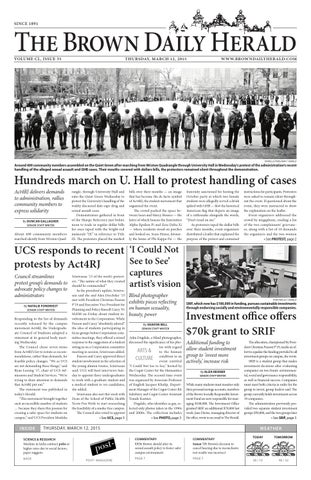
Around 400 community members assembled on the Quiet Green after marching from Wriston Quadrangle through University Hall in Wednesday’s protest of the administration’s recent handling of the alleged sexual assault and GHB cases. Their mouths covered with dollars bills, the protestors remained silent throughout the demonstration.
Hundreds march on U. Hall to protest handling of cases Act4RJ delivers demands to administration, rallies community members to express solidarity By DUNCAN GALLAGHER SENIOR STAFF WRITER
About 400 community members marched silently from Wriston Quad-
rangle, through University Hall and onto the Quiet Green Wednesday to protest the University’s handling of the widely discussed date-rape drug and sexual assault cases. Demonstrators gathered in front of the Sharpe Refectory just before noon to trade in regular dollar bills for ones taped with the bright-red numerals “IX” in reference to Title IX. The protesters placed the marked
bills over their mouths — an image that has become the de facto symbol of Act4RJ, the student movement that organized the event. The crowd packed the space between Sears and Marcy Houses — the latter of which houses the fraternities Alpha Epsilon Pi and Zeta Delta Xi — where residents stood on porches and looked on. Sears House, formerly the home of Phi Kappa Psi — the
fraternity sanctioned for hosting the October party at which two female students were allegedly served a drink spiked with GHB — flew the historical American flag that depicts an image of a rattlesnake alongside the words, “Don’t tread on me.” As protesters taped the dollar bills over their mouths, event organizers distributed a leaflet that explained the purpose of the protest and contained
instructions for participants. Protesters were asked to remain silent throughout the event. If questioned about the event, they were instructed to show the explanation on the leaflet. Event organizers addressed the crowd by megaphone, reading a list of the two complainants’ grievances, along with a list of 10 demands the organizers and the two women » See PROTEST, page 2
UCS responds to recent ‘I Could Not See to See’ protests by Act4RJ Council streamlines protest group’s demands to advocate policy changes to administrators By NATALIE FONDRIEST SENIOR STAFF WRITER
Responding to the list of demands recently released by the campus movement Act4RJ, the Undergraduate Council of Students adopted a statement at its general body meeting Wednesday. The Council chose seven items from Act4RJ’s list to restate as recommendations, rather than demands, for feasible policy changes. “We as UCS are not demanding these things,” said Ryan Lessing ’17, chair of UCS Admissions and Student Services. “We’re trying to draw attention to demands that Act4RJ put out.” The statement was published in today’s Herald. “This movement brought together such an incredible number of students … because they share this passion for creating a safer space for students on campus,” said UCS President Maahika
INSIDE
Srinivasan ’15 of the week’s protesters. “The nature of what they created should be commended.” In the president’s update, Srinivasan said she and Alex Drechsler ’15 met with President Christina Paxson P’19 and Executive Vice President for Planning and Policy Russell Carey ’91 MA’06 on Friday about student involvement in the Corporation. While Paxson and Carey “absolutely adored” the idea of students participating in focus groups before Corporation committee meetings, they offered a mixed response to the suggestion of a student sitting in on a Corporation committee meeting in session, Srinivasan added. Paxson and Carey approved direct student involvement in the selection of the young alumni trustee, Srinivasan said. UCS will host interviews Sunday to appoint three undergraduates to work with a graduate student and a medical student to vet candidates, she added. Srinivasan also met this week with Dean of the School of Public Health Terrie Fox Wetle to start researching the feasibility of a smoke-free campus. The Council also voted to appoint » See UCS, page 3
Blind photographer exhibits pieces reflecting on human sexuality, beauty, power By SHAVON BELL SENIOR STAFF WRITER
John Dugdale, a blind photographer, discussed the significance of his photos with regard to the human condition in an event entitled “I Could Not See to See,” hosted by the Cogut Center for the Humanities Wednesday. The second-time event was organized by Associate Professor of English Jacques Khalip, Department Manager of the Cogut Center Kit Salisbury and Cogut Center Assistant Traude Kastner. Dugdale, who identifies as gay, selected only photos taken in the 1990s and 2000s. The collection includes » See PHOTO, page 3
ARTS & CULTURE
RYAN WALSH / HERALD
SRIF, which now has $100,000 in funding, pursues sustainable investments through endorsing socially and environmentally responsible companies.
Investment office offers $70k grant to SRIF Additional funding to allow student investment group to ‘invest more actively,’ increase risk By ALIZA REISNER SENIOR STAFF WRITER
While many students must monitor only their personal savings accounts, members of the Brown Socially Responsible Investment Fund are now responsible for managing $100,000. The Investment Office granted SRIF an additional $70,000 last week, Jane Dietze, managing director of the office, wrote in an email to The Herald.
POST- MAGAZINE
The allocation, championed by President Christina Paxson P’19, marks an effort to equalize the funding provided to all investment groups on campus, she wrote. SRIF is a student group that makes investment decisions after evaluating companies on two fronts: environmental, social and governance responsibility, as well as financial success. Companies must meet both criteria in order for the group to invest, group leaders said. The group currently holds investments across 19 companies. The administration previously provided two separate student investment groups $50,000, and the two groups later » See SRIF, page 3
WEATHER
THURSDAY, MARCH 12, 2015
SCIENCE & RESEARCH Muslims in India contract polio at higher rates due to social factors, paper suggests BACK
captures artist’s vision
COMMENTARY UCS: Brown should alter its sexual assault policy to foster safer campus environment
COMMENTARY Isman ’15: Brown’s decision to cancel hearing due to inconclusive test results was incorrect
PAGE 7
PAGE 7
TODAY
TOMORROW
38 / 19
40 / 32
UNIVERSITY NEWS PAGE 2 • THURSDAY, MARCH 12, 2015
THE BROWN DAILY HERALD
DANIELLE PERELMAN / HERALD
Justice Gaines ’16, Katie Byron ’15 and Eve Woldemikael ’16 led protesters through the John Nicholas Brown Gate on George Street during the Act4RJ protest Wednesday around noon. “This is a community that demands responsibility,” said Byron, an organizer and a member of the Task Force on Sexual Assault.
» PROTEST, from page 1 collectively drafted. The organizers criticized the cancellation of a hearing for the student accused of administering GHB and the reasoning behind the finding of not responsible for the student accused of sexual assault. The protest leaders expressed their intention to deliver the demands directly to the administration, noting the two women’s desire that all actions be directed at the University’s handling of the case instead of the alleged perpetrators. “As a result of her incapacitation and memory loss from the date-rape drug, the survivor, due to her incomplete memory, could not provide a narrative to counter that of her assailant,”
Katie Byron ’15, an organizer and a member of the Task Force on Sexual Assault, read from a prepared statement. “Using the logic of the panel, to find justice, she needed to consume enough of the date-rape drug to both show and remember showing obvious symptoms of incapacitation,” Byron said, adding, “So no blacking out allowed.” Byron said the hearing’s resulting reliance on the accused student’s account “contradicts the notion that consent is an action, not a perception.” The procession was led by several event organizers and a pair of individuals carrying an unadorned mattress, reminiscent of Emma Sulkowicz’s protest at Columbia. Maahika Srinivasan ’15, president
of the Undergraduate Council of Students, held open the University Hall door as protesters filed in, past the offices of the president and the provost and out onto the Quiet Green. Inside University Hall, event organizers taped the list of demands to Assistant to the President Kimberly Roskiewicz’s door, Byron told The Herald. Roskiewicz said she and other University Hall staff members were aware the protest would take place. The protesters formed a circle on the Quiet Green, where organizers, assembled in front of the Van Wickle Gates, thanked them for their participation in the 45-minute event. “This is a community that demands responsibility,” Byron said to a chorus of snaps.
Raizella Berman ’18 said she attended “in solidarity with survivors of sexual assault, and to protest (the) University’s mishandling of the issue.” Berman added that she was equally frustrated by the possibility that the Corporation ties of the student accused of spiking the drink influenced the hearing’s cancellation and by the outcome of the sexual assault hearing. Charlotte Biren ’16 said the large turnout for the protest was important in encouraging the University to be transparent, especially in light of information released after a long period of confusion surrounding the case’s facts. Emma Storbeck ’17 said she appreciated a large community showing to emphasize solidarity with the complainants, as opposed to malice toward the accused. Organizer Jeanette Sternberg Lamb ’15 said she, the complainants and the other organizers were pleasantly surprised by the large turnout. While she characterized the event as a success,
she added that it is too early to anticipate future actions by Act4RJ before the administration responds. “I’ve been wanting to help stand in solidarity for a while,” Srinivasan said, adding that she has been working with the complainants to help effect institutional change. Srinivasan said she can act as a bridge between concerned students and the administration. “This protest was symbolically a way for students to ask for accountability from the University, and my being at the door was just kind of a symbolic offering that students should feel that they can ask for that and that I will help fulfill that in any way, shape or form that I can,” she said. Though Srinivasan said it is too early to predict the administrative response, “they’re working to the best of their ability to respond to this situation in the parameters that they are limited to … especially when it comes to Title IX,” she said.
UNIVERSITY NEWS
THURSDAY, MARCH 12, 2015 • PAGE 3
THE BROWN DAILY HERALD
» SRIF, from page 1
» UCS, from page 1
combined to form the Brown Investment Group with a total of $100,000 in funds, Dietze wrote. SRIF was originally granted $30,000 in 2009, so the administration allocated another $70,000 from the University’s operating funds to give the fund equal access to $100,000, Dietze added. The decision came after the administration reviewed SRIF’s performance and noted that it had been “a good steward of the funds and had continued to vigorously pursue its educational mission,” Dietze wrote. “SRIF is an empowering and unique place where people from vastly different academic backgrounds can come together and have the same conversations,” said Sophie Purdom ’16, SRIF co-president. SRIF members are excited about the additional $70,000, which will allow the group to “invest more actively” and “take some riskier stances,” Purdom said. One problem the group faced prior to the increase in funding was the “pressure over us to (sell positions) to liquidate funds in order to remain productive,” said Nicole Shimer ’16, the other SRIF co-president and former Herald general manager. “In order to buy more companies we would have to first sell them, which led to us selling companies before we necessarily wanted to,” she added. The administration’s decision to increase SRIF’s funding is “making a statement that Brown stands for socially responsible investing,” Purdom said. “While this won’t happen overnight because the endowment is heavier to turn than SRIF, there are promising conversations happening within the administration,” she added. Sustainable investing is important not only from a moral perspective, but also from a financial outlook, Shimer said. “Socially responsible companies are more efficient and have strong leadership teams and care about their employees, which translates into strong financial gains because the company runs well,” she said. Additionally, consumers are looking to support socially responsible companies, she added. Currently, the group is examining the possibility of investing more in each of its 19 holdings. While the precedent has been to invest $2,000 in each new position, with the new funds, SRIF is looking into investing $2,500 or $3,000 per company to increase its ability to engage in shareholder advocacy. In order to leverage companies for either environmental, social, governance or financial reasons, investors must hold at least $2,000 in shares and have been invested for at least one year. SRIF is considering restructuring its board to include a shareholder advocacy chair, who would engage with companies by writing them letters with social advocacy suggestions. The group is also looking to add an education chair to maintain its commitment to educating its members. Going forward, SRIF may partner with the Investment Office as the office aims to build a more socially responsible fund under its own auspices by creating a fossil free portion of the endowment. The group plans to help the Investment Office establish a more qualitative and quantitative framework for assessing the environmental, social and governance aspects of companies, Shimer and Purdom said. Next week, the group will vote on whether to invest in Unilever and Time Warner Cable Inc., both of which they see as long-term value investments.
34 students to positions on 19 University committees during the general body meeting. The UCS Outreach and Advocacy Committee met with Vice President for Campus Life and Student Services Margaret Klawunn and several Counseling and Psychological Services representatives to discuss the transformation of the CAPS website. The renovation will include staff member biographies “to put a face to a mysterious resource,” said Sazzy Gourley ’16, UCS vice president and OAC chair. The OAC also evaluated the council’s current structure this week using the
SADIE HOPE-GUND / HERALD
John Dugdale presents a collection of photographs detailing the human condition in a lecture sponsored by the Cogut Center for the Humanities.
» PHOTO, from page 1 works from the onset of his blindnessinducing stroke and intense hospital treatment for HIV/AIDS through his spiritual reckoning with human mortality a decade later. Dugdale began the talk with a quote from an Emily Dickinson poem: “Because I could not stop for death, he kindly stopped for me.” For Dugdale, the quote directly parallels his experiences with HIV and his loss of sight. To take a picture, Dugdale has someone else focus the camera and then presses the shutter button himself, he said. Throughout his presentation, Dugdale recounted anecdotes to contextualize the intensely personal photographs. His first photograph “The Artist’s Mother,” depicts Dugdale and his mother embracing in an evocative, emotionally charged pose. His sister captured the photo while Dugdale was hospitalized, in a poignant moment when his mother told him simply, “put your head on my shoulder,” he said. However personal each photo is to Dugdale, he also strives to capture the “universality” of the human condition within his work, he said. “The Artist’s Mother” became a contemporary “pieta” for mothers with children suffering from HIV, he explained. Similarly, Dugdale cast his
photograph “Sun God” as more broadly applicable, rather than only personal, in its artistic aims. The piece depicts a muscled, nude male in profile, grasping a bouquet of sunflowers. “These are my Greek pictures of sexuality and beauty and power,” he said. Losing his sight allowed his experiences of the world to become “more important and more mystical and more beautiful,” he said. He returned “to being able to notice every bit of life,” another thematic thread within his works. For example, Dugdale’s still life photographs often center upon the small details of everyday life. His piece “Luminous Glass” focuses only on a small antique goblet glowing in the light due to its flecks of uranium. In Dugdale’s words, photographic moments like these seem to be “written by the sun,” he said. “I don’t feel like I take these pictures — I feel like they take themselves,” he added. He continued to describe the process as almost magical. “I have the idea, but it seems like some alchemy” through which the photos are taken, he said. The presentation ended with a Walt Whitman quote of Dugdale’s choosing: “We affect each other without ever seeing each other, and never perhaps to see each other, is every bit as wonderful.”
assessment model developed at last week’s UCS general body meeting. The New Initiatives Fund, which will host interviews this weekend, is seeking $12,000 this year, up from $6,000 last year, said UCS Treasurer Malikah Williams ’16. The UCS Admissions and Student Services committee is preparing “a bigger rollout” of the Brown Developer Exchange tentatively scheduled for Tuesday, Lessing said. The UCS Academic and Administrative Affairs committee designed a sophomore advising handbook this week to distribute at the rising sophomore meeting March 31, said Timothy Ittner ’18, a member of the committee.
SCIENCE & RESEARCH PAGE 4 • THURSDAY, MARCH 12, 2015
THE BROWN DAILY HERALD
Hawking film explores love, not universe ‘Theory of Everything’ insufficently covers renowned physicist’s key accomplishments By ANDREW JONES SCIENCE & RESEARCH EDITOR
This article is the third in an ongoing series, Science at the Cinema, which explores research and researchers portrayed in film. A heart-wrenching tale of Stephen Hawking’s love life and passion for physics, “The Theory of Everything” is a big bang for talented acting but not for scientific depth. The film, which was nominated for five Academy Awards, catalogues Hawking’s growth from a scatterbrained student at the University of Cambridge to a world-renowned theoretical physicist, all while struggling to keep his physical health afloat. Hawking and Jane Wilde — played by Eddie Redmayne, who won the Academy Award for his performance, and Felicity Jones, who received a nomination for Best Actress — meet at Cambridge, and the two quickly fall into a cerebral kind of love. Their relationship becomes increasingly strained once Hawking is diagnosed with ALS, commonly known
as Lou Gehrig’s disease, but the two solidify their commitment with marriage and soon after, a son. Over the course of the film, Wilde and Hawking’s relationship follows the trajectory of a wave function that oscillates up and down as they fall in and out of love. The couple eventually splits after each pursues other romantic interests. These relationships were documented in Jane Wilde Hawking’s memoir “Travelling to Infinity: The True Story Behind The Theory of Everything,” from which the film was adapted. While the film deftly brings Hawking’s personal life to light, it mentions his achievements in theoretical physics only in passing. One of Hawking’s most renowned accomplishments was his graduate thesis project, which provided theoretical evidence of the Big Bang, said Ian Dell’Antonio, professor of physics. Hawking postulated that at the beginning of the universe, there was a singularity — or region of infinite density — that then rapidly expanded. His proposal was highly controversial at the time of its publication, Dell’Antonio said. “The Theory of Everything” portrays Hawking’s thesis work only in brief scenes of vigorous chalkboard scribbling, which may be less than satisfactory for a physics enthusiast viewing the film.
Follow us on Instagram!
But perhaps Hawking’s most famous discovery is one that “The Theory of Everything” hardly touches at all: Hawking radiation. According to the laws of quantum mechanics, black holes do not let anything escape, but Hawking discovered that they do emit some radiation — the magnitude of which is inversely proportional to their size, Dell’Antonio said. More recently, Hawking has played a more public role in the physics community, writing best-selling books and giving lectures that are more accessible to the general public. His “many worlds” theory has attracted due criticism from physicists but has garnered more interest from armchair scientists. This theory posits that new universes are continually being created as quantum waves collapse, Dell’Antonio said, adding that the theory implies there are an infinite number of universes, and we happen to live in just one of them. “If you ask the community of physicists, most would say they want to think about something else,” he said. While “The Theory of Everything” paints an inspiring portrait of a man overcoming seemingly insurmountable odds, it does not do full justice to Hawking’s legendary contributions to theoretical physics — at least in this universe.
@bdhphoto Use #bdhphoto for a chance to be our reader photo of the week.
TODAY
THURSDAY, MARCH 12, 2015 • PAGE 5
THE BROWN DAILY HERALD
menu
sunshine
SATELLITE DINING JOSIAH’S Crepes BLUE ROOM Mediterranean Pocket Soups: Chicken Artichoke Florentine, Fire Roasted Vegetable, Turkey Chili ANDREWS COMMONS Pizzas: Nacho Pizza, Okie Dokie Artichokie, Pepperoni and Sausage
DINING HALLS SHARPE REFECTORY LUNCH
DINNER
Falafel, Grilled Turkey Burger, Feta and Tomato Quiche, Oatmeal Chocolate Chip Cookies
Chicken Broccoli Alfredo Pasta, Cajun Baked Fish, Vegan Italian White Beans, Herbed Turnips
VERNEY-WOOLLEY LUNCH
DINNER
Tacos, Vegan Southwest Black Bean Burger, Mac and Cheese Bar, Caribbean Jerk Chicken
Cilantro Chicken, Vegetarian Butternut Squash Risotto, Raspberry Mousse Torte
sudoku
ASHLEY SO / HERALD
Olivia Moscicki ’18 and Lauren Black ’18 show some affection and share some sun on the steps of the Stephen Robert ’62 Campus Center, taking advantage of the recent rise in temperature after a long, snowy winter.
comic A Horse of Any Other Name | Zach Silberberg
crossword
calendar TODAY
TOMORROW
12:00 P.M.”EMERGENT
GHETTOS:
BLACK
3:00 P.M. EXPLORING FILM WITH CHRISTINE VACHON
John Logan, professor of sociology, will present his research on the history of racial segregation in urban areas. Brown/RISD Hillel, CSREA Conference Room
Christine Vachon, who produced films such as the Academy Award-nominated film “Still Alice,” will give a talk followed by a reception as part of the Brazenly Brown Series and Women’s History Month. Smith Buonanno 106
4:00 P.M. “ANTIFUNGAL DRUG DISCOVERY IN THE
8:30 P.M. FOLK FESTIVAL BATTLE OF STUDENT
ACADEMIC SETTING”
BANDS
NEIGHBORHOODS IN NORTHERN CITIES, 1880-1940”
Damian Krysan of the University of Rochester Medical Center will give a lecture as part of the Pathobiology Seminar Series. 70 Ship Street
Several student muscians will perform and compete for a spot in April’s Folk Festival. Faunce, The Underground
10:00 P.M. FIFTY SHADES OF BAE 8:00 P.M. PI(E) DAY
Brown’s SPecial Events Committee will serve students free sweet and savory pies in anticipation of Pi Day, which occurs on 3/14 to reflect pi’s value of 3.14. Faunce, The Underground
Harambee, in collaboration with Brown Organization of Multiracial and Biracial Students, is hosting a spring party. Harambee House Lounge
Follow us on Twitter! @the_herald
COMMENTARY PAGE 6 • THURSDAY, MARCH 12, 2015
THE BROWN DAILY HERALD
EDITORIAL
A more data-driven curriculum The open curriculum provides students with the freedom to pursue courses that speak to their interests and preferences. But it can also allow them to avoid courses in fields that are difficult, yet ultimately enriching, including data-driven curricula. A basic knowledge of statistics can inform one’s understanding of the world tremendously. Brown should move toward a stronger emphasis on data fluency in the classroom, as called for in President Christina Paxson’s P’19 strategic plan. Incorporating a greater proficiency with data into students’ experiences would, like the writing requirement already in place, help students in the transition to a complex and changing world, in which working with statistical data is integral to critical thinking and global engagement. Many statistics are thrown at us every day: Women make $0.77 for every $1 men earn; the unemployment rate of the workforce is 5.5 percent; there are 11 million undocumented immigrants in the United States. It is critical to know how these numbers are calculated and aggregated before the issues can be thoughtfully discussed. How about another example many of us have seen before: With a 95 percent effective test for a rare disease occurring in 1 out of every 1,000 people, if you survey 1,000 people, what’s the probability that anyone who tests positive actually has the disease? This kind of knowledge is more than a parlor trick — it allows us to understand relevant problems and to think critically about the math and science that are presented to us. Basic math and epistemology skills learned studying math and statistics give students tools to parse the quantitative world — to even read the studies themselves, the way the humanities at Brown inform how students react to the world of the arts. This is not about just understanding data presented to us in daily life, but also about exposing students to a different academic mindset: Table their point of view, ask the right questions of the data and let them speak. It also means learning how to ask unbiased questions and testing hypotheses that may invalidate students’ intuition. Those students who study data will share the experience of feeling the subjective invalidation of data supporting something other than their hypothesis, and in one moment there is frustration, and in the next, forward movement in the search for truth. The increased emphasis on data might involve hiring more faculty members to add courses that open applied mathematics to a broader range of students. But, like WRIT-designated courses, data can be incorporated into other fields. Political science allows students to analyze the endless polls that are conducted every day on American voters. Lab courses in physics and chemistry depend on data distribution in making conclusions. These would not need to be definitive courses, but certainly classes that force students to confront the empirical reliability of statistical inference and the responsibility that goes into interpreting a study or statistics to hopefully expose them to a new world of empiricism and substantiable claims about the world. We utilize quantitative methods because we aim to explore and derive truth on a contextual basis. Analyzing data sets within the sphere of the humanities or sciences enables us to discern the validity of our beliefs and how to better describe these phenomena and trends; these modes of analysis span academic departments. A greater emphasis placed on data fluency within the existing — and complementary — framework of the New Curriculum would undoubtedly serve Brown well and prepare students for a more data-driven world beyond the Van Wickle Gates. Editorials are written by The Herald’s editorial page board: its editors, Alexander Kaplan ’15 and James Rattner ’15, and its members, Natasha Bluth ’15, Manuel Contreras ’16, Baxter DiFabrizio ’15, Mathias Heller ’15 and Aranshi Kumar ’17. Send comments to editorials@browndailyherald.com.
A N G E L IA WA N G
LETTER TO THE EDITOR
The Walk should house the performing arts To the Editor: The announcement that we will soon know the proposed site for a new and long overdue performing arts center is welcome news. Of the many potential locations on campus, my hope is that it will be sited somewhere on the Walk. The Walk was created in part to celebrate Brown with new and exciting large structures. Though placing the new center on the west side of
A previous version of an article in Wednesday’s Herald (“Dropped drugging charges dominate BUCC meeting,” March 11) stated that President Christina Paxson P’19 said, “I don’t know whether or not I would have agreed with their conclusion, but I can’t judge whether it was wrong or right,” adding that SCB members are the only individuals who review all evidence and testimonies in a case. Paxson was referring to the Student Conduct Board’s finding of no responsibility in the sexual misconduct case, not to Campus Life deans’ decision to not move the drug case to the SCB.
CORRECTION An article in Wednesday’s Herald (“Sexual assault legislation under revision after community feedback,” March 11) misattributed the quotes “It seems in large part that there has been a problem with victims who do want to elevate the incident and do want to have a response” and “From my perspective it seems like one thing to do is that if a victim has chosen to move ahead, to go ahead and go through the proper channels” to Al Dahlberg, the University’s AICU representative. In fact, Rep. Joseph Shekarchi, D-Warwick, said these quotes. The Herald regrets the error.
Sections
Visuals & Production
Business
Editors-in-Chief Michael Dubin Maxine Joselow
Arts & Culture Editors Eben Blake Gabrielle Dee
General Managers Sarah Levine Winnie Shao
Managing Editors Kiki Barnes Jillian Lanney
Metro Editors Alexander Blum Emma Jerzyk Drew Williams
Design Editors Loren Dowd Carlie Peters Taylor Schwartz Assistant: Meryl Charleston Assistant: Andrew Linder
Science & Research Editors Andrew Jones Steven Michael
BLOG DAILY HERALD Editor-in-Chief David Oyer
Sports Editors Andrew Flax Alex Wainger
Managing Editors Deena Butt Jacob Koffler
University News Editors Emma Harris Caroline Kelly Joseph Zappa
POST- MAGAZINE Editor-in-Chief Adam Asher DIGITAL Online Editor Marcy Huang
COMMENTARY Editorial Page Editors Alexander Kaplan James Rattner Opinions Editors Megan GrapengeterRudnick Kate Kiernan Evan Sweren
Photo Editors Head: Brittany Comunale David Deckey Katie Liebowitz Arjun Narayen Ashley So Ryan Walsh Graphics Editors Avery Crits-Christoph Emma Jerzyk Web Producers Joe Stein Harsha Yeddanapudy Abdullah Yousufi Copy Desk Chief Madeline DiGiovanni Illustrations Editor Angelia Wang Video Editor Richard Flores
Peter Mackie ’59
C L A R I F I C AT I O N
Editorial Leadership
Senior Editors Camilla Brandfield-Harvey Isobel Heck Molly Schulson
the Walk would require relocation of existing structures — either Lucian Sharpe Carriage House on the north end or some of the smaller buildings between Waterman Street and Angell Street to the south — it would be well worth the effort and expense. A Walk location would put performing arts at the center of campus, where they belong.
Directors Sales: Moniyka Sachar Sales: Jess Urrutia Finance: Josh Tartell Alumni Relations: Marley Rafson Business Dev.: Yuta Inumaru Sales Managers Matthew Meyer Henry Ritter Gulmira Hamit Taylor Casey
facebook.com/browndailyherald
Location: 195 Angell St., Providence, R.I. www.browndailyherald.com
@the_herald
Editorial contact: 401-351-3372 herald@browndailyherald.com
browndailyherald.com
Business contact: 401-351-3260 gm@browndailyherald.com
Corrections: The Brown Daily Herald is committed to providing the Brown University community with the most accurate information possible. Corrections may be submitted up to seven calendar days after publication. Commentary: The editorial is the majority opinion of the editorial page board of The Brown Daily Herald. The editorial viewpoint does not necessarily reflect the views of The Brown Daily Herald, Inc. Columns, letters and comics reflect the opinions of their authors only.
Finance Managers Collections: Neil Wathore Collections: Benjamin Wesner Operations: Carin Papendorp
Letters to the Editor: Send letters to letters@browndailyherald.com. Include a telephone number with all letters. The Herald reserves the right to edit all letters for length and clarity and cannot assure the publication of any letter. Please limit letters to 250 words. Under special circumstances writers may request anonymity, but no letter will be printed if the author’s identity is unknown to the editors. Announcements of events will not be printed.
Business Dev. Manager Project Leader: Kaden Lee
Advertising: The Brown Daily Herald, Inc. reserves the right to accept or decline any advertisement at its discretion. The Brown Daily Herald (USPS 067.740) is an independent newspaper serving the Brown University community daily since 1891. It is published Monday through Friday during the academic year, excluding vacations, once during Commencement and once during Orientation by The Brown Daily Herald, Inc. Single copy free for each member of the community. Subscription prices: $280 one year daily, $140 one semester daily. Copyright 2015 by The Brown Daily Herald, Inc. All rights reserved. Periodicals postage paid at Providence, R.I. Postmaster: Please send corrections to P.O. Box 2538, Providence, RI 02906.
COMMENTARY THURSDAY, MARCH 12, 2015 • PAGE 7
THE BROWN DAILY HERALD
Echoing the need for sexual assault policy change UNDERGRADUATE COUNCIL OF STUDENTS guest columnist
On the night of Oct. 17, two female Brown University students reported receiving a spiked drink at an unregistered fraternity party, and one of the two women reported being sexually assaulted later that night after leaving the party. In recent weeks, students standing in solidarity with the two women have expressed concern and frustration toward the University’s handling of this case. These students have formed a campus movement, Act4RJ, which recently published a list of demands for the University, intending to seek justice for both the particular women involved in this case and all survivors of sexual violence at Brown. As the Undergraduate Council of Students, it is our responsibility to hold the University accountable for ensuring a safe and secure environment for all its students. We are committed to shaping institutional policies that foster a positive campus climate for all. Our response to the aforementioned demands is grounded in our desire for lasting, institutional change in the way Brown handles cases of sexual misconduct. Act4RJ has put forward a list of specific actions Brown can take to improve our sexual assault adjudica-
tion policies, and we are endorsing several of these measures. Moreover, we believe the following policy changes are vital recommendations that should be immediately integrated into the work done by the Task Force on Sexual Assault. The Student Code of Conduct should be amended to include the administration of a date-rape drug as an act of sexual misconduct. All interviews conducted by the Department of Public Safety should be recorded and
Board panel or processes appeals should receive substantial training on the concept of consent. This includes students, faculty members, deans and provosts. There should be a codified and clear definition of the minimum amount of evidence required for a hearing to proceed. When a decision is made to not proceed with evidence, the reasoning should be clearly provided to both the complainant(s) and the respondent(s). Brown should provide students with access
Over 400 students came together to demonstrate an active desire to shift campus culture and change University policy. The work of Act4RJ to mobilize student voices over the past couple weeks is incredibly important as we identify ways to move forward as an entire campus. transcribed on all occasions to avoid mistakes. The University should provide legal guidance for both complainants and respondents involved in a hearing process. Also, a neutral actor should be present in meetings between the University’s general counsel and any legal representation from either respondents or complainants. Anyone who sits on a Student Conduct
to professional, adequate date-rape drug testing that is considered admissible and the results of which Brown will support and stand behind in a hearing. In cases where survivors are unable to provide a complete narrative due to memory loss, there should be a codified mechanism to address this narrative imbalance so that the hearing decision does not unfairly rely on the
narrative of the respondent at the expense of the survivor. Not all of the demands published by Act4RJ are listed above. Those additional demands speak further to the frustration and lack of trust students feel towards current policies and surrounding communication. As the administration reviews these concerns, we implore it to take all of these demands seriously. Some will require more long-term conversation, and it is critical that members of the Brown community on all levels — students, faculty members and staff members — engage with these ideas and vocalize their opinions. Today’s protest serves as a powerful example of the community that Brown undergraduates can build. Over 400 students came together to demonstrate an active desire to shift campus culture and change University policy. The work of Act4RJ to mobilize student voices over the past couple of weeks is incredibly important as we identify ways to move forward as an entire campus. We hope that students continue to call for sustained dialogue and concrete solutions so that, together, we can ensure progress is achieved.
The Undergraduate Council of Students passed this statement unanimously at its March 11 general body meeting. Please contact ucs@brown.edu to continue this conversation.
Why do lab results have the final say? SAMANTHA ISMAN opinions columnist
The case of two female students who were allegedly served a drink laced with the date-rape drug GHB at a Phi Kappa Psi party this past October seemed to have a relatively straightforward situation: Two girls were served spiked drinks, and the alleged perpetrator should face the consequences. Yet months later I find myself asking why the case has come undone so fast. The University’s use of the inconclusive hair and urine test results as grounds for dropping charges against the accused student seems to be unfair given the circumstances and the history of the lab that tested the hair sample. To rely on the lab results as a decisive factor in this case — especially given that the students involved have statements of what happened that night and there is other witness testimony to support their case — is a blatant misuse of evidence. The University’s decision to cancel the hearing based on the lack of physical evidence in the case is unfair. Whereas a negative lab result
might justify a hearing’s cancellation — though even that does not mean that GHB was not ingested — inconclusiveness provides no reliable information about the case. Additionally, the University was negligent in not doing the appropriate research in finding a trustworthy lab to test the hair sample. “The Carlson Company … and Ernest Lykissa, the director of the labora-
the tests. This demonstrates not only that the lab interpretted the test incorrectly but also that it was willing to release careless results that could change someone’s life. With either end result — using the erroneous lab results or canceling the hearing — a Brown student was going to be unfairly treated. This is a mistake by the University as much as by the labs. The two
it seems that no one was going to be treated fairly. While it is unfortunate that there is a lack of physical evidence, the University’s choice to regard the hair test “as unreliable and (not to use it) as evidence,” as The Herald previously reported, was the correct one. But this lack of physical evidence is not enough to cancel the hearing altogether. The University
This demonstrates not only that the lab interpretted the test incorrectly but also that it was willing to carelessly release results that could change someone’s life. With either end result — using the erroneous lab results or canceling the hearing — a Brown student was going to be unfairly treated.
tory that analyzed the hair sample, have both been previously accused of inaccurate and misleading test reporting,” The Herald reported March 4. Moreover, Lifespan Laboratories recanted its conclusion that a urine sample for one of the complainants tested positive for exogenous GHB after two outside experts reviewed
students who were allegedly served the drugged drink should not suffer the repercussions of poor testing and bad information. The University should demonstrate that it understands this. While laboratory results are supposed to provide hard evidence, they should not always be trusted as the ultimate truth. In this situation,
acknowledged in a March 1 community notification that “a failure to positively identify the presence of exogenous GHB does not prove that GHB or another drug was not ingested.” The students who were allegedly served the drugged drink deserve to be heard. Additionally, the existence of “witness statements, video
evidence, and the statements of the students who filed complaints,” as the community notification stated, means that the case should have proceeded as planned. Moreover, the University’s acknowledgement that there was plenty of evidence elsewhere demonstrates the University’s lack of trust in the complainants. While both sides’ evidence deserves to be given equal weight, in this case, it seems that the complainants were not treated fairly. It has become clear that the University has not dealt with this case appropriately. While it is understandable to question lab results that came from a untrustworthy lab — such as the one used for the hair test — and try to find a fair way to move forward, the choice to cancel the hearing was not the correct one. Granted, this case became complicated because of third-party mistakes. Yet either way, the University needs to look out for the well-being and fair treatment of all of its students and make the appropriate decisions to create a safe campus.
Sami Isman ’15 thinks everyone deserves a fair chance to protect themselves and seek justice.
SCIENCE & RESEARCH THE BROWN DAILY HERALD
THURSDAY, MARCH 12, 2015
Paper investigates prevalence of polio among Muslims in India Rashid Hussain ’10 MD’14 explores Muslims’ opposition to polio vaccine, disparity in those affected By LAUREN ARATANI STAFF WRITER
Though Muslims made up only 16 percent of India’s population in 2006, they accounted for 70 percent of those infected with polio. Rashid Hussain ’10 MD’14 explores reasons behind the increase in polio among India’s Muslim population in his research paper “Partition and Poliomyelitis: An Investigation of the Polio Disparity Affecting Muslims during India’s Eradication Program,” published March 5 in Public Library of Science ONE. Hussain began his research during his undergraduate career as an anthropology and human biology concentrator. ANTH 1030: “International Health: Anthropological Perspectives,” taught by Professor of Anthropology Daniel Smith, inspired him to conduct public health research, he said. Hussain said he “bumped into
polio by accident.” “I just wanted to explore,” Hussain said. “There was actually very little research at the time on health inequities affecting minorities in India.” With the lack of polio coverage in the mass media, the population disparity was “blamed exclusively on rumors” about the effects of the polio vaccine, Hussain said. In the summer of 2009, Hussain traveled to the Aligarh district of Uttar Pradesh in India to conduct research for his undergraduate senior thesis. He used the anthropological method of “participant observation” and collected his data as a part of the Global Polio Eradication Initiative’s door-to-door team. He conducted 107 “structured or semi-structured” interviews, according to the research paper. “It was all about grassroots networking,” Hussain said, adding that he was able to make connections through “word of mouth and different people’s reputations and recommendations.”
Polio was eradicated in India after Hussain had finished his research, with its last case appearing in 2011 thanks to the “extraordinary” community intervention efforts of the Indian government, Hussain said. Though Hussain started his paper as part of his undergraduate work, he continued his research at the Alpert Medical School. Stephen McGarvey, professor of epidemiology, and Lina Fruzzetti, professor of anthropology, assisted Hussain in producing the research paper. “There is a relatively low level of health system development in communities,” McGarvey said, adding that sparse education and poorly run clinics contribute to the disparity of disease contraction among impoverished populations. All of these problems are “interactive” and build upon one another, McGarvey said. Hussain’s paper has received praise from scholars, including Naomi Rogers, associate professor of history and history of medicine at Yale. Rogers said she was “very impressed” by the
way the authors of the paper were able to identify relevant social and political factors in relation to the disparity of polio contraction, adding that she especially appreciated the paper’s historical explanation of how religious bias towards Muslims has translated into neglect and segregation. “I thought this is really a thoughtful way of dealing with very profound issues around the social determinants of health,” Rogers said, adding that the paper made these determinants “come alive.” Rogers said she was especially intrigued by Muslim families’ opposition to polio vaccines, some of which stemmed from the government’s shaky health infrastructure that can lead to more health problems, according to the paper. There should be more research papers like Hussain’s that “strip away the easy way of dismissing people who resist vaccines as just not appreciating good science,” Rogers said, adding that it suggests a larger context of how “big, scientific goals” can be achieved by considering “structural
issues” first. The biggest cause of health inequity is poverty and the lack of resources, power and health literacy that comes with it, Hussain said. “If you have a strong state public health institution, then that protects (people) to a large extent,” Hussain said, adding that, though having strong health care is a “luxury,” when institutions implement “forced” vaccination, people will resist at a “grassroots level.” Though the eradication effort has succeeded in India, the process in which the overall “structural violence” continues to create such disparities within communities is “not easy” to eradicate and requires the engagement of the community through a cultural relativist lens, McGarvey said. Closing these health gaps further will require “talking to (the communities) about whatever it is — polio, clean water, childhood diarrhea,” McGarvey said. Interventionists will have to combine cultural and biomedical knowledge to “develop a feasible and sustainable intervention.”