SINCE 1891
THE BROWN DAILY HERALD WEDNESDAY, MARCH 11, 2015
VOLUME CL, ISSUE 34
WWW.BROWNDAILYHERALD.COM
Dropped drugging charges dominate BUCC meeting
SILENCE SPEAKS
President Christina Paxson P’19 addresses University’s handling of GHB, sexual assault cases By BAYLOR KNOBLOCH SENIOR STAFF WRITER
MATTEO MOBILIO / HERALD
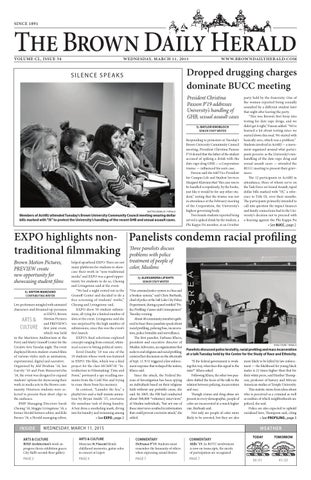
Members of Act4RJ attended Tuesday’s Brown University Community Council meeting wearing dollar bills marked with “IX” to protest the University’s handling of the recent GHB and sexual assault cases.
Responding to protestors at Tuesday’s Brown University Community Council meeting, President Christina Paxson P’19 denied that the father of the student accused of spiking a drink with the date-rape drug GHB — a Corporation trustee — influenced his son’s case. Paxson said she told Vice President for Campus Life and Student Services Margaret Klawunn that “this case was to be handled scrupulously, by the books, just like it would be for any other student,” noting that the trustee was not in attendance at the February meeting of the Corporation, the University’s highest governing body. Two female students reported being served a spiked drink by the student, a Phi Kappa Psi member, at an October
party held by the fraternity. One of the women reported being sexually assaulted by a different student later that night after leaving the party. “This was Brown’s first foray into testing for date rape drugs, and we didn’t get it right,” Paxson added. “We’ve learned a lot about testing since we started down this road. We started with basically zero, which was a problem.” Students involved in Act4RJ — a movement organized around what participants perceive as the University’s mishandling of the date-rape drug and sexual assault cases — attended the BUCC meeting to present their grievances. The 12 participants in Act4RJ in attendance, three of whom serve on the Task Force on Sexual Assault, taped dollar bills marked with “IX,” a reference to Title IX, over their mouths. The participants primarily intended to call into question the impact finances and family connections had in the University’s decision not to proceed with a hearing against the Phi Kappa Psi » See BUCC , page 2
EXPO highlights non- Panelists condemn racial profiling panelists discuss traditional filmmaking Three problems with police Brown Motion Pictures, PREVIEW create new opportunity for showcasing student films By ANTON MANZANO CONTRIBUTING WRITER
Live performers mingled with animated characters and dreamed-up personas at EXPO, Brown Motion Pictures and PREVIEW’s first joint event, which was held in the Martinos Auditorium at the Perry and Marty Granoff Center for the Creative Arts Tuesday night. The event displayed Brown student-created films of various styles such as animation, experimental, digital and narrative. Organized by Alif Ibrahim ’16, Ian Garrity ’16 and Pom Bunsermvicha ’16, the event was designed to expand students’ options for showcasing their work in media arts to the Brown community. Nineteen students were selected to present their short clips to the audience. BMP Managing Directors Sarah Cheung ’16, Maggie Livingstone ’16, a former Herald features editor, and Kiki Barnes ’16, a Herald managing editor,
ARTS & CULTURE
INSIDE
helped spearhead EXPO. There are not many platforms for students to showcase their work in “non-traditional media” and EXPO was a good opportunity for students to do so, Cheung and Livingstone said at the event. “We had a night rented out in the Granoff Center and decided to do a free screening of students’ works,” Cheung and Livingstone said. EXPO drew 50 student submissions, all vying for a limited number of slots at the event. Livingstone said she was surprised by the high number of submissions, since this was the event’s first launch. EXPO’s final selections explored concepts ranging from comical, whimsical scenes to biting political satire. Errol Danehy ’18 was one of the 19 students whose work was featured in EXPO. His film, which was a final project for the class MCM0710: “Introduction to Filmmaking: Time and Form,” portrayed a spy recalling moments from the Cold War and trying to erase them from his memory. In contrast, “Launder the Sea,” a playful two-and-a-half-minute animation by Bryan Smith ’15, overturns the mundane task of doing laundry. A boy dons a snorkeling mask, diving into his laundry and swimming among » See EXPO , page 2
treatment of people of color, Muslims
By ALEKSANDRA LIFSHITS SENIOR STAFF WRITER
“Our criminal justice system is a bias and a broken system,” said Chris Burbank, chief of police at the Salt Lake City Police Department, during a panel entitled “Police Profiling: Causes and Consequences” Tuesday evening. About 40 community members gathered to hear three panelists speak about racial profiling, policing bias, incarceration, police brutality and surveillance. The first panelist, Farhana Khera, president and executive director of Muslim Advocates, an organization that seeks to end religious and racial profiling, centered her discussion on the aftermath of Sept. 11. 9/11 triggered a law enforcement response that reshaped the nation, Khera said. Since the attack, the Federal Bureau of Investigation has been spying on individuals based on their religious faith without any probable cause, she said. By 2005, the FBI had conducted about 500,000 “voluntary interviews” of Muslim individuals, “but not one of these interviews resulted in information that could prevent a terrorist attack,” she added.
RHEA STARK / HERALD
Panelists discussed police brutality, racial profiling and mass incarceration at a talk Tuesday held by the Center for the Study of Race and Ethnicity. “If the federal government is working this way, what does this signal to the state?” Khera asked. Following Khera, the other two panelists shifted the focus of the talk to the relation between policing, incarceration and race. Though crimes and drug abuse are present in every demographic, people of color are incarcerated at a much higher rate, Burbank said. Not only are people of color more likely to be arrested, but they are also
more likely to be killed by law enforcement — the likelihood for young black males is 21 times higher than that for their white peers, said Heather Thompson, professor of history and African American studies at Temple University. This statistic stems from ideas about who is perceived as a criminal as well as realities of which neighborhoods are policed, she said. Police are also expected to uphold racialized laws, Thompson said, citing » See PROFILING , page 3
WEATHER
WEDNESDAY, MARCH 11, 2015
ARTS & CULTURE RISD Architecture’s work-inprogress thesis exhibition graces City Hall’s second-floor gallery
ARTS & CULTURE Musician St.Vincent blends childhood memories, guitar solos in concert at Lupo’s
COMMENTARY DeFranco P’15: Students must remember the humanity of others when expressing sexual desires
COMMENTARY Mills ’15: As ROTC involvement is now on transcripts, the merits of participation are recognized
PAGE 2
PAGE 4
PAGE 7
PAGE 7
TODAY
TOMORROW
50 /31
41/ 23
ARTS & CULTURE PAGE 2 • WEDNESDAY, MARCH 11, 2015
THE BROWN DAILY HERALD
At City Hall, RISD architecture dept. airs works in progress Architecture students devise custom adaptations to prepare thesis projects for display in municipal space By DUNCAN GALLAGHER SENIOR STAFF WRITER
The imposing granite structure at the tip of Kennedy Plaza — City Hall — does not immediately appear conducive to an art exhibit. Its interior, though similarly designed, is decidedly municipal. Dark green walls with gold trim are lit by overhead fluorescent fixtures. A massive central staircase summits in a glass atrium, the only source of natural light. Nevertheless, for several years, the second floor has been home to a public gallery, which was created to “highlight the city’s artistic community,” said Stephanie Fortunato, deputy director of the Providence Department of Art, Culture and Tourism. In addition to housing a permanent collection of portraits, the gallery hosts rotating exhibits that feature the work of local artists and community-based arts organizations. This month, the public gallery space is displaying the Rhode Island School of Design’s department of architecture’s
annual show of in-progress theses, Fortunato said. Polished works rest alongside preliminary sketches in the heart of a highly specialized, impersonal space. Between municipal offices, tiny abstract sculptures sit across from collages of photographs and CAD-style blueprints. This year’s exhibition, entitled “Thinking Architecture: RISD Works in Progress,” marks a departure from the RISD tradition of showing the works on College Hill, Fortunato said. The decision to display the partially completed thesis projects in a city venue was part of the architecture department’s goal of challenging students to think broadly and engage with the city, she added. The craftsmanship on display is truly remarkable. From strolling the gallery, it is evident that architecture theses, especially in their formative stages, can take varied forms. In one corner, RISD student Timothy Dobday’s elegant watercolor drafts and development plans for a mixed-use
space at 35 Weybosset Street hang across from Cameron Breck’s “Architect As Joint”: two massive pine beams linked by a peg. Big-picture plans for a massive undertaking face a study in the fundamentals of construction. Fortunato said several considerations had to be made for displaying sculpture and large numbers of wall hangings in a bustling 19th-century building. RISD students devised specialized frames that enabled the wall space to be utilized more efficiently than it has been before, she added. More projects sit on view atop tables lining the perimeter of the building’s balustrade. Highlights include Jamie Graham’s “Topography of Manhattan,” a corrugated cardboard relief of the city, and Kim Dupont-Madinier’s “Veiled Spaces and Enveloping Boundaries.” Despite the curators’ design adaptations, the true nature of the building remains apparent. City Hall employees may slow and occasionally stop to appreciate the works occupying the hallway. During the course of one visit, two works fell and were rehung by Fortunado and a City Hall staff member. One more fell shortly thereafter.
ALEXIA DELHOUME / HERALD
“Thinking Architecture” was produced by the RISD architecture department and brought to City Hall by the Department of Art, Culture and Tourism. Fortunato shrugged it off as she and another City Hall staff member made repairs. “It’s real life gallery-making,” she said with a smile.
“Thinking Architecture” will be on display in City Hall’s second-floor gallery through March 31. Admission is free.
MATTEO MOBILIO / HERALD
The choice to drop charges against the student accused of spiking a drink was unrelated to his Corporation ties, said President Christina Paxson P’19.
» BUCC, from page 1
SADIE HOPE-GUND / HERALD
Managing Directors Sarah Cheung ’16 and Maggie Livingstone ’16 along with Directors of Technology Ian Garrity ’16 and Alif Ibrahim ’16 introduce EXPO, a film showcasing held by Brown Motion Pictures and PREVIEW.
» EXPO, from page 1 his soiled socks and shirts in a journey of pure imagination. A two-minute narrative called “CAKE” by Caroline D’arcy Gorman ’18 abruptly switched gears, overlaying
a silent middle-aged couple at the dinner table with subtitles satirizing individuals including Republicans and former President George W. Bush. The contrast between the humorously sarcastic text and the stone-faced actors emphasized the parody and highlighted D’arcy Gorman’s
eclectic style. Abrahim said he thought EXPO would be an appropriate space to bring modern culture and media students together to share their work. “We want to have the general Brown community see this kind of work.”
member, said Act4RJ participant Will Furuyama ’15. After the results of urine and hair tests for the drug were deemed inconclusive, “there was not enough evidence to bring this case forward to a hearing,” Paxson said. Due to insufficient evidence, the University decided to drop the charges against the student Feb. 21. “The investigation into these crimes was haphazard and ineffectual,” Act4RJ participant Eve Woldemikael ’16 read from a statement crafted by the group in collaboration with the two complainants. “It seems like money and influence were two factors that informed the University’s refusal to proceed with a hearing against the accused drugger.” An outside expert hired by the accused student brought into question the methodology and conclusiveness of the urine test used to detect GHB, prompting the University to hire an independent toxicologist who deemed the results of the urine test inconclusive. The accused student was able to question the testing because he had the financial means to do so, Furuyama said. He added that “the imbalance of
resources is something that the University needs to address going forward,” quoting from the statement. “Brown cannot be a safe space when crimes like these go unaddressed and unpunished,” Furuyama said. Klawunn defended the decision to drop the charges at the meeting, noting that “more evidence is required to connect the offense with a specific individual and to prove intent.” “A mere allegation should not be sufficient to compel someone to appear at a hearing,” said Beverly Ledbetter, general counsel and a BUCC cabinet member. “If there’s no testing, you must go with what is left, and what is left is sometimes not sufficient for the board to bring the case to a hearing.” “I don’t know whether or not I would have agreed with their conclusion, but I can’t judge whether it was wrong or right,” Paxson said, adding that SCB members are the only individuals who review all evidence and testimonies in a case. Attendees at the BUCC meeting also reviewed progress on the alum networking and internship-finding website BrownConnect and the Brown Innovation Initiative, a proposal aimed at facilitating and increasing entrepreneurship on campus.
ARTS & CULTURE WEDNESDAY, MARCH 11, 2015 • PAGE 3
THE BROWN DAILY HERALD
COURTESY OF VIETNAMESE STUDENT ASSOCIATION
The Vietnamese Student Association, which organized its first culture show in two years, will celebrate its 25th anniversary Friday.
VSA show aims to increase visibility of Vietnam’s culture ‘Timeless: Past, Present, and Future’ to highlight Vietnamese fashion, dance, history By GRACE YOON SENIOR STAFF WRITER
Past, present and future of Vietnam’s rich traditions will collide at the Brown Vietnamese Student Association’s cultural show, “Timeless,” Friday evening. An array of artists will draw on both fashion and dance to celebrate the country’s history and culture. As VSA celebrates its 25th anniversary, the event aims to draw attention to the club’s presence on campus and explore Vietnamese and Vietnamese-American identities. The club has seen ups and downs over its 25 years on campus, continually expanding in both membership and campus presence, said Vi Mai ’17, one of the event’s organizers and a former Herald contributing writer. “Timeless” marks the first culture show that VSA has put together in two years, she added. A fashion show by Fashion4Freedom, a nonprofit organization that advocates ethics in apparel manufacturing and aims to foster small craft businesses in central Vietnam, will kick off the event, Mai said. Fashion4Freedom’s head designer, LanVy Nguyen, will showcase her new line and give a speech shedding light on the group’s mission, Mai said. The organization highlights the intersection between fashion and social responsibility, said Mary Nguyen ’17, another event organizer. As the event’s name suggests, “Timeless: Past, Present and Future” will fuse history with contemporary
issues and art forms. Both Brown and Northeastern University’s Vietnamese Student Associations will perform at the event, encouraging collaboration between schools. Though the dances recall traditional Vietnamese styles, they add a contemporary flare, Nguyen said. The evening will also feature Vietnamese spoken word performances by students. “All the performers play a part in reiterating what the history of Vietnam is, in informing the audience and making them understand who we are,” said Brandon Le ’18, a member of the VSA’s logistics committee tasked with planning the event. The show will also highlight documents that outline the history of Vietnamese migration in America, as well as current information on the VSA, Mai said. “We want to tell the story of Vietnamese and Vietnamese Americans.” VSA aims to highlight Vietnamese culture, which tends to be little-known beyond the momentous Vietnam War, Mary Nguyen said. “I hope people can get a better sense of the diverse meaning of being Vietnamese,” she said. “There’s not that many Vietnamese students at Brown, and oftentimes coming here we feel isolated because we’re far away from our families,” Mai said. The club aims to foster a family setting on campus that celebrates Vietnamese identity, she added. The club also shares Vietnam’s cultural and historical heritage among its members, adding an intellectual dimension to the social group, Mary Nguyen said. Through “Timeless,” VSA hopes to draw attention to a relatively small group on campus, springboarding the club toward larger membership and events of a bigger scale, Mai said.
COURTESY OF ANNE HARRIGAN FOR TRINITY REP
Trinity Repertory Company has completed its Theater for Every Generation campaign, which will allow the company to expand its programs. Over six years, the company surpassed its fundraising goal by $100,000.
Trinity Rep fundraising supports community $18 million capital campaign to fund educational programs, new resident actors By ANICA GREEN STAFF WRITER
“There was not a dry eye in the house — it was so moving and so phenomenal,” said Kathy Calnan, director of development for Providence’s Trinity Repertory Company, describing a sold-out production of “A Christmas Carol,” which featured a cast composed entirely of children with autism spectrum disorders. The show was the culminating project of the Trinity Rep Active Imagination Network, a program designed by the theater’s education programs manager Jordan Butterfield to tap into “the power of drama therapy as a communication tool,” Calnan said. Demand for the program has tripled since its 2010 inception, she added. Thanks to the recent conclusion of Theater for Every Generation, an $18 million capital campaign, it will soon be able to flourish and expand. The fundraising campaign began in 2008 as a private effort with a goal of $12 million, going public and increasing this goal in 2010. In the 2011 fiscal year, Trinity Rep hired campaign consultants to assist with its efforts, which included multiple events involving the Providence community, such as a gala and semiannual theater tours, Calnan
» PROFILING, from page 1 the 10 to one disparity between crack and powder cocaine sentence laws as an example. While incarceration in the U.S. remains high, reintegration into society after serving jail time poses difficulties. “We have no avenue for (people) to find their way out of the system,” Thompson said. Sixty-seven percent of those arrested return to jail after they are released, often
said. As a nonprofit organization, Trinity Rep relies on ticket and concession sales to cover between two-thirds and three-fourths of its operating costs. Over the course of six years, the theater has not only met its fundraising goal, but has surpassed it by more than $100,000, according to a Feb. 20 Trinity Rep press release. TRAIN is just one example of the many different ways that Trinity Rep plans to use the new money in expansion efforts. The funding has allowed for the hiring of three new resident actors, marking the first addition to the company in several years. The actors, Mia Ellis MFA’12, Charlie Thurston MFA’12 and Rebecca Gibel MFA’10, all graduated from the Brown/Trinity MFA Program. “Adding company members means they’re with us forever,” said Curt Columbus, artistic director at Trinity Rep. “They get full seasons’ worth of work, three or four shows every year and are part of the planning process going forward. They’re developing their work as playwrights and as directors.” “Our resident acting company is an important part of who we are,” Calnan said. “We want to expand their professional development in playwriting, teaching and directing.” Aside from these initiatives, Trinity Rep will allocate the money raised to expansion and maintenance of its facilities and programs. A portion of the funds will support a summer theater camp for underprivileged children. Upgrades to Trinity Rep’s facilities will
feature technological improvements, fire code upgrades and a new roof, Calnan said, adding that the company will also launch a new website to foster its online presence. The funds will significantly reduce Trinity Rep’s debt by $3 million, she added. One of the new Brown MFA hires, Thurston, is in the process of writing a new play. “I’m proud that what we’re doing is creating challenging theater that still makes audiences think, but that we haven’t, like other theaters around the country, been dumbing down our programming just to make a buck,” Columbus said. The campaign has also served to bring Trinity Rep national attention. Joe Wilson, Jr., one of the company’s current resident actors, recently received the Theater Communication Group’s prestigious Fox Foundation Resident Actor Fellowship, Calnan said. The theater has also managed to attract funding from the Harold and Mimi Steinberg Charitable Trust, allowing 10 new plays to be workshopped. The company looks forward to a number of upcoming events, including a party March 9 that will celebrate the campaign’s successful conclusion, as well as its annual beer and wine tasting slated for this month. Trinity Rep just turned 50 this past year, Calnan said, adding that she hopes the conclusion of this campaign will set the theater up for a great 50 years to come.
for the same category of crime, he said. “This is not success.” “So should every crime that occurs end up in incarceration?” Burbank asked the audience. He responded to his own question by noting that more options for rehabiliatory programs and treatment would target underlying reasons for the crimes. From an economic standpoint, high incarceration is not a sound solution when 25 individuals cost the state of Utah $1 million, he added.
Joey Massa ’17, called the panel “great” because it explored the question of whether incarceration accomplishes what it should. The important follow-up question “is not what we can do, but what we should do,” Massa said, reiterating Burbank’s words. The panel was presented by the Center for the Study of Race and Ethnicity and co-sponsored by the Taubman Center for Public Policy and the Watson Institute for International Studies.
ARTS & CULTURE PAGE 4 • WEDNESDAY, MARCH 11, 2015
THE BROWN DAILY HERALD
KATE TALERICO / HERALD
St. Vincent extended her Digital Witness tour, which included a stop at Lupo’s Heartbreak Hotel Sunday night, into this summer. She received her first Grammy nomination for Best Alternative Music Album in December 2014 for her eponymous album St. Vincent, and she demonstrated her lyrical genius during her performance in Providence.
St. Vincent crushes Lupo’s with intensity in dynamic concert Audience embarks on spiritual journey to St. Vincent’s eccentric performance Sunday night By KATE TALERICO SENIOR STAFF WRITER
For those celebrating International Women’s Day, St. Vincent’s performance at Lupo’s Heartbreak Hotel Sunday could not have been a better example of a powerful woman. Supported by Toko Yasuda on keyboard, guitar and backup vocals, Pete Dyer on keyboard and Matt Johnson on drums, Annie Clark — whose stage name is St. Vincent — displayed the full spectrum of quiet emotion to unadulterated fun. The set, which began with “Bring Me Your Loves” and quickly transitioned to crowd favorites such as “Digital Witness” and “Cruel,” was punctuated by stories told by Clark, who wove together
REVIEW
imagined vignettes of the crowd’s shared childhood. “Your family calls you ‘kangaroo’ for some reason, but like braces in seventh grade, you wish it would stop. You think Sophie at the bus stop is inexplicably beautiful,” she described, speaking with a voice so warm that audience members could not help but fall into her dreamlike narratives. Clark’s words recalled fragments of her own childhood, foreign pictures that became the audience’s own. “Once when you were a little kid, you told a lie and you got very sick the day after, and you thought you were being punished. But you don’t even believe in that kind of eye-for-eye ‘Code of Hammurabi,’” she continued. “So you went into your garage and you made a fort out of aluminum foil and toilet paper cylindrical rolls and Pabst Blue Ribbon cans. You
thought you had created something beautiful out of all this muck and you thought that for once all was right with the universe.” Crab-like, Clark scuttled around stage to a point of fluidity where, if audience members had only watched her head rather than her high-heeled feet, they would have thought a puppeteer was pulling her through space. Nearly every song was interjected with a guitar solo by Clark. When she was not shredding, Clark was rolling across the floor in her sequined black dress while Yasuda filled the space with high-energy notes from her keyboard and, as Clark later described, “facemelting” bass-guitar rifts. The show was tight and well-rehearsed, never missing a beat even at songs’ most climactic points. The crowd responded with frenzy and heavy applause to Clark’s dance movements, synchronized with Yasuda, like two
robots programmed in harmony. Ballads like “Prince Johnny” put Clark in a more emotional light, exposing her vulnerabilities, while showcasing her lyrical genius. Some audience members tried to fill the moments of higher tension, which could be perceived as awkward silence, with cat calls and shouts of “I love you!” But Clark’s more somber fans treated the silences and hollow, drawn-out notes with reverence. The show was packed with suspense, and Clark pulled out one stunt after another to keep the audience engaged. During “Surgeon,” she jumped off of the stage and onto an amp before the front row, and then took off her guitar as the crowd hungrily pushed forward as if lured in by Clark’s hypnotic power. The act foreshadowed her final song, “Lips,” during which she crowd surfed on the clamoring audience. She was not passed along far before a security
team member pulled her back on stage. After returning to the stage, Clark indicated to the security guard to crouch down. She climbed onto his back, grabbing onto a nearby ledge on the right side of the stage. As she attempted to climb onto the ledge, it faltered under her weight and tumbled toward the audience along with her — she had literally torn the house down. “This place is a shithole!” she screamed as she was delivered back on stage. The audience passed back the disembodied ledge, chanting her name and feeding Clark back her own energy. St. Vincent’s show matched psychedelic awe with moments of intimacy. Her performance left audiences feeling not as though they had witnessed a set of songs, but rather as though they had been transported through a spiritual experience. As Clark said herself: “Beautiful, strange — the curse of music.”
KATE TALERICO/HERALD
KATE TALERICO / HERALD
Annie Clark, whose stage name is St. Vincent, sang high-energy crowd favorites like “Digital Witness” and “Birth in Reverse” but slowed down for more emotional pieces like “Prince Johnny” in her well-rehearsed show.
During the show, Clark crowd surfed and even tore down a ledge next to the stage after attempting to climb onto it.
TODAY
WEDNESDAY, MARCH 11, 2015 • PAGE 5
THE BROWN DAILY HERALD
march, in like a lamb
menu SATELLITE DINING JOSIAH’S Gourmet Grilled Cheese BLUE ROOM Mediterranean Pocket Soups: Hearty Country Vegetable, Tomato Florentine, Baked Potato ANDREWS COMMONS Pizza: Honey Boo Boo, Mushroom Madness, Thai BBQ Chicken
DINING HALLS SHARPE REFECTORY LUNCH
DINNER
Sundried Tomato Calzone, Pesto Seafood Pasta, Tortellini Italiano with Sausage LUNCH
Sweet Ginger Pork Stir-Fry, Vegan Apricot Tofu with Sesame Noodles
VERNEY-WOOLLEY
Tacos, Vegan Black Eyed Peas with Spinach, Vegan Rice with Beans, Zucchini
DINNER
Cilantro Chicken, Linguini with Tomato Basil, Vegetarian Butternut Squash Risotto
sudoku
MATTEO MOBILIO / HERALD
Students, including Duncan Weinstein ‘17, a Herald opinions columnist, and Kutay Onayli ’17, took advantage of the melting snow by enjoying the recently uncovered terrace outside the Stephen Roberts ‘62 Campus Center.
comics P-Branes and Bosons | Ricky Oliver ‘17 RELEASE DATE– Wednesday, March 11, 2015
Los Angeles Times Daily Crossword Puzzle c rNorris o s sandwJoyce o rNichols d Lewis Edited by Rich ACROSS 1 See the 67Across clue 5 Suitor’s purchase 10 Geological age 14 Major follower? 15 Like the accent on “passé” 16 Proofer’s catch 17 Sandwich option 20 Good-humored banter 21 Superstore division 22 Mandela’s org. 23 Wrath 24 Very, in music 26 Rats, gnats and brats 28 Loads 29 E. Berlin’s land 32 13-mile race 36 Prefix with European 39 Words on Alice’s cake 40 Chichén __: pyramid site 41 Equine sprinter 44 Home of the NFL’s Rams 45 High spot 46 Indian region known for its tea 50 Goldman’s sonin-law and partner 52 Share of the profits 54 Poke one’s nose (into) 55 What we have here 57 Boraxtransporting driver 59 It prohibits cruel and unusual punishment 62 Coastal bird of prey 63 Met event 64 More: Abbr. 65 Sign that stands out 66 Old West trackers 67 It can follow the starts of 17-, 32-, 41- and 59Across
DOWN 1 Bundle up again 2 Natural gas component 3 Unemotional types 4 Spill the beans 5 Less experienced, as a recruit 6 Natural earth shade 7 Chop __ 8 DFW posting 9 Arrange dishes and utensils on 10 Skylit lobbies 11 Ophthalmologist’s concern 12 Australian gem 13 Botanical junction 18 Woman in a “Paint Your Wagon” song 19 Enzo’s “Enough!” 24 San Antonio mission 25 More achy 27 Hammer-toting god 28 The Beatles’ “I __ Walrus” 30 Donut box qty. 31 Genetic letters 33 One who won’t let go 34 Produces produce
35 Associations 36 Educ. testing data 37 Bolt partner 38 Repeat symbol, in scores 42 “Be silent,” in music 43 Filled to the limit 47 Maker of brief briefs 48 Political philosopher Hannah
49 South Carolina’s __ Beach 51 Sickly looking 52 Offstage aides 53 Forearm bones 55 Babysitter, often 56 Charter, as a bus 57 Fr. wives 58 Eliot Ness, e.g. 60 Bounce 61 GI’s address
ANSWER TO PREVIOUS PUZZLE:
xwordeditor@aol.com
calendar
03/11/15
TODAY
TOMORROW
12:00 P.M. “EVERYTHING YOU ALWAYS WANTED TO
5:30 P.M. “THE LIFE AND LITERARY IMPACT OF H.P.
KNOW ABOUT GETTING OP-EDS PUBLISHED”
LOVECRAFT”
Steve Cohen ’75, who has had several op-eds published in major newspapers, will share tips and strategies for getting accepted for publication. Taubman Center, Seminar Room
Author Leslie S. Klinger will discuss the life and writing of H.P. Lovecraft and sign copies of her book “The New Annotated H. P. Lovecraft.” John Hay Library
5:30 P.M. “I COULD NOT SEE TO SEE: AN EVENING
7:00 P.M. “THE ORIGIN OF THE CONTINENTS (OR WHY
WITH JOHN DUGDALE”
MARTIANS DONT HAVE GRANITE COUNTERTOPS)”
Photographer John Dugdale will discuss his career and work as an artist who is blind. Pembroke 305
Assistant Professor of Earth, Environmental and Planetary Sciences Stephen Parman will discuss theories about the formation of the continents in this Science Underground event. Flatbread Company
6:00 P.M. “NARRATIVE OF UNHEARD VOICES: INDIGENOUS WOMEN AND VIOLENCE”
By Thomas Takaro ©2015 Tribune Content Agency, LLC
03/11/15
The Native American Heritage Series will host Jennifer Nez Denetdale, associate professor of American studies at the University of New Mexico, who will will discuss violence against indigenous women. Smith-Buonnano Hall, Room 106
8:20 P.M. “DEAR WHITE PEOPLE” SCREENING
The American Studies DUG will host a screening of the film, which follows the experiences of four black students at an Ivy League college. Metcalf Auditorium
COMMENTARY PAGE 6 • WEDNESDAY, MARCH 11, 2015
THE BROWN DAILY HERALD
EDITORIAL
Visual arts at a liberal arts institution Over the past year, the University has made strides to expand the presence of performing arts on campus. Members of the Committee on Reimagining the Brown Campus and Community said last year that lack of performance space and collaboration with local groups has resulted in missed opportunities. The University has since added a vice provost for the arts and appointed Michael Steinberg, professor of history, music and German studies, to fill the position. The Herald reported Tuesday (“New venue to blend liberal and performing arts”, March 10) that plans for the proposed performance space are advancing, and a site will be decided before this summer. Just four years ago, the Perry and Marty Granoff Center for the Creative Arts opened to much acclaim. Richard Fishman, professor of visual arts and then-department chair, told The Herald, “The arts departments are now spread out around the campus,” adding that he hoped the Granoff Center would connect faculty members across the University’s various arts programs. These words sound like they could have been said Monday, when the University released information about the selection of a new arts space. Four years after the Granoff Center’s opening, we wonder about the progress of these goals of greater faculty interaction and exchange among departments. What will make the new space different? How will administrators ensure that the University realizes a return on the substantial investment of money and time in constructing a new arts space? Planners involved in the current process need to address these questions — and to make sure that they do something other than simply build a bigger version of the Granoff Center. Engagement with the wider community — especially students and faculty members — needs to be integral to crafting a new home for the arts on campus. Administrators should figure out which performance groups face the biggest hurdles to accessing space or resources on campus and work to incorporate their needs into the new space without duplicating buildings already in place. And if the new center is to successfully combine the arts with the liberal arts “in a really cutting-edge way,” as Steinberg said, then planners must look beyond architectural blueprints and figure out how to holistically connect a new building with the broader academic environment at Brown, including both the humanities and the sciences. The danger in not having core requirements is that we risk missing out on fundamental components of education. The solution is often to find ways to mix disciplines. Language studies, for example, incorporate film and literature to expose students to foreign arts. We should strive to find more ways to infuse the humanities and sciences with visual arts. Expansion of spaces and programs will increase the availability, but we must still seek ways for students to take advantage of Brown’s resources, especially artistically gifted students. Community members of the school that likes to think of itself as “the creative Ivy” deserve nothing less.
M I R A N DA F R I E L
CORRECTION An article in Tuesday’s Herald (“Craig Mello ’82 gives biology keynote,” March 9) misquoted Craig Mello ’82 as saying that the germ lines of humans and nematodes “have journeyed together on this planet for 3 million years.” In fact, they have done so for 3 billion years. The Herald regrets the error.
Q U O T E O F T H E D AY
“This place is a shithole!” — St.Vincent
See St. Vincent on page 4.
Got something to say? Leave a comment online!
Editorials are written by The Herald’s editorial page board: its editors, Alexander Kaplan ’15 and James Rattner ’15, and its members, Natasha Bluth ’15, Manuel Contreras ’16, Baxter DiFabrizio ’15, Mathias Heller ’15 and Aranshi Kumar ’17. Send comments to editorials@browndailyherald.com.
Visit www.browndailyherald.com to comment on opinion and
twitter.com/The_Herald
editorial content.
Editorial Leadership
Sections
Visuals & Production
Business
Editors-in-Chief Michael Dubin Maxine Joselow
Arts & Culture Editors Eben Blake Gabrielle Dee
General Managers Sarah Levine Winnie Shao
Managing Editors Kiki Barnes Jillian Lanney
Metro Editors Alexander Blum Emma Jerzyk Drew Williams
Design Editors Loren Dowd Carlie Peters Taylor Schwartz Assistant: Meryl Charleston Assistant: Andrew Linder
Senior Editors Camilla Brandfield-Harvey Isobel Heck Molly Schulson
Science & Research Editors Andrew Jones Steven Michael
BLOG DAILY HERALD Editor-in-Chief David Oyer
Sports Editors Andrew Flax Alex Wainger
Managing Editors Deena Butt Jacob Koffler
University News Editors Emma Harris Caroline Kelly Joseph Zappa
POST- MAGAZINE Editor-in-Chief Adam Asher DIGITAL Online Editor Marcy Huang
COMMENTARY Editorial Page Editors Alexander Kaplan James Rattner Opinions Editors Megan GrapengeterRudnick Kate Kiernan Evan Sweren
Photo Editors Head: Brittany Comunale David Deckey Katie Liebowitz Arjun Narayen Ashley So Ryan Walsh Graphics Editors Avery Crits-Christoph Emma Jerzyk Web Producers Joe Stein Harsha Yeddanapudy Abdullah Yousufi Copy Desk Chief Madeline DiGiovanni Illustrations Editor Angelia Wang Video Editor Richard Flores
Directors Sales: Moniyka Sachar Sales: Jess Urrutia Finance: Josh Tartell Alumni Relations: Marley Rafson Business Dev.: Yuta Inumaru Sales Managers Matthew Meyer Henry Ritter Gulmira Hamit Taylor Casey
facebook.com/browndailyherald
Location: 195 Angell St., Providence, R.I. www.browndailyherald.com
@the_herald
Editorial contact: 401-351-3372 herald@browndailyherald.com
browndailyherald.com
Business contact: 401-351-3260 gm@browndailyherald.com
Corrections: The Brown Daily Herald is committed to providing the Brown University community with the most accurate information possible. Corrections may be submitted up to seven calendar days after publication. Commentary: The editorial is the majority opinion of the editorial page board of The Brown Daily Herald. The editorial viewpoint does not necessarily reflect the views of The Brown Daily Herald, Inc. Columns, letters and comics reflect the opinions of their authors only.
Finance Managers Collections: Neil Wathore Collections: Benjamin Wesner Operations: Carin Papendorp
Letters to the Editor: Send letters to letters@browndailyherald.com. Include a telephone number with all letters. The Herald reserves the right to edit all letters for length and clarity and cannot assure the publication of any letter. Please limit letters to 250 words. Under special circumstances writers may request anonymity, but no letter will be printed if the author’s identity is unknown to the editors. Announcements of events will not be printed.
Business Dev. Manager Project Leader: Kaden Lee
Advertising: The Brown Daily Herald, Inc. reserves the right to accept or decline any advertisement at its discretion. The Brown Daily Herald (USPS 067.740) is an independent newspaper serving the Brown University community daily since 1891. It is published Monday through Friday during the academic year, excluding vacations, once during Commencement and once during Orientation by The Brown Daily Herald, Inc. Single copy free for each member of the community. Subscription prices: $280 one year daily, $140 one semester daily. Copyright 2015 by The Brown Daily Herald, Inc. All rights reserved. Periodicals postage paid at Providence, R.I. Postmaster: Please send corrections to P.O. Box 2538, Providence, RI 02906.
COMMENTARY WEDNESDAY, MARCH 11, 2015 • PAGE 7
THE BROWN DAILY HERALD
A letter to the students of Brown University STEPHEN RAGLOW-DEFRANCO guest columnist
My daughter is a senior at Brown University, and she has enjoyed a wonderful experience and has taken advantage of every opportunity Brown has to offer. I couldn’t be prouder of her, and she does not need me to take care of her or protect her. So it has been a difficult decision for me to go ahead and write this column. I am writing because my daughter talked with me about something that happened to her, and she wanted to get my feedback about what she ought to do about it. She is a teaching assistant in a few classes, and at a party one evening, a male junior student for whom she is a TA was there as well, and after some small talk, he asked her if she would give him her number in case he had questions about the material she was teaching. The next morning she read texts from this student, including “My TA is so fucking hot” and “I want to fuck you.” Hearing such things is not good for my blood pressure. I wonder sometimes what has happened to our culture today. But then I think back to when I went to college. I attended a Catholic university, yet we too had our parties with our games of quarters (now it’s beer pong, I
hear), and “binge drinking” was simply called “drinking.” As someone who once was a student at the height of his libido-driven longings, I can relate to the havoc that an intense sex drive can have when let loose by the inhibition-releasing effects of alcohol. Back in my day, having grown up Catholic, I was taught to believe that boys will be boys and it is in our nature to relentlessly pursue women,
nally agreed to come to my room. After stumbling into my room, I began to undress her at a frenzied pace. But then I saw that tears were streaming down her cheeks, and instantly I sobered up and learned that she did not want to be with me but was just acquiescing based on her own frustration, loneliness, drunkenness, whatever. How hard it is for me to admit that it was only then that I saw her as another human be-
to our psyches than other shared recreational experiences. Yet even in the current environment of a more casual attitude toward sex, how could what the young man said to my daughter be acceptable communication? If there is a move toward a more overt discussion of our sexual needs, wants and intentions on our college campuses, does that environment give license to the kind of offensive, antagonistic
I encourage all students, male and female, to step forward and have the courage to intervene and report and publicize behaviors that they know are harmful to the culture of what Brown aspires to be. whom we should depend on to be the gatekeepers of our morality. If a woman did not resist our advances persistently for such and such amount of time, she was a “slut” and not worthy of the pursuit. We expected resistance, expected “no,” but were to search for body language (perceived or otherwise) which indicated she meant “yes” … eventually. Alcohol served as the perfect excuse, often for both parties, to allow us to “sin” because a “waft of wind” pushed us over the cliff of propriety. One time I was so possessed with alcohol-induced libido while hounding a young lady at a bar that she fi-
ing with a heart and not just a body. I have often asked myself if today’s college culture might be healthier than in my time. At least students seem more open about their sexual needs and desires, and perhaps women are not as condemned as “sluts” for one-night stands while men are simply sowing their wild oats. The truth is I don’t know the answer. It seems to me sexual intimacy is a very deep and meaningful part of what it means to be fully human. While humans are capable of sloughing off a casual sexual experience as meaningless, there is something much more deeply connected
communication those texts convey? I don’t think so, and I am hopeful that the young man, through some intervention, will come to realize the inappropriateness of his actions. But it took me a few weeks to gently urge my daughter to address the issue appropriately. She finally agreed to do so, but it was not without anxiety. After all, she’s very busy and addressing this would require time and emotional energy. Also, she’s a resilient woman and fully capable of ignoring these texts, moving on and not letting this man’s ignorance and rudeness get in her way. So I asked her what message
she might be giving this man and the fraternity brothers with whom he may have shared his texts. Could her silently ignoring his inappropriateness have emboldened him to “keep trying” in order to eventually “score”? My daughter finally decided, of her own volition, to address the issue with her professor to do her part to try to improve the culture at Brown, especially as it relates to sexual harassment and rape. How much better for her to put a stop to sexually harassing behaviors before they slippery-slope into far worse. I love my daughter no matter what, but I admire her courage in addressing what happened to her for the greater good. I encourage all students, male and female, to step forward and have the courage to intervene and report and publicize behaviors that they know are harmful to the culture of what Brown aspires to be. I urge students to talk about and think about and reflect on what it means to be human in all its positive and potentially negative aspects, and to avoid the mistake that I and many in my generation made to conveniently blind ourselves at times so we could fulfill our selfish desires at the expense of another’s humanity.
Stephen Raglow-Defranco is a concerned father and a budding feminist.
Credit where credit is due WALKER MILLS opinions columnist
Bundled with its approval for the expansion of Brown’s Reserve Officers’ Training Corps partnerships in a faculty resolution was a smaller provision calling for transcript notation of involvement with ROTC. The core of the proposal is that Brown students who are part of the ROTC at Providence College will have their transcript reflect this involvement. This is in many ways a technicality — but it is also a powerful symbolic gesture to those students about their accomplishments and the merit of their extracurricular course work. As it stands now, the University treats the ROTC like any other extracurricular activity without any mention of it on a student’s transcript. This is disappointing because, if you allow me to state the obvious, the ROTC is not like any other extracurricular activity. Students who are enrolled full-time in the ROTC program take extra classes and labs almost every semester, engage in weekly physical training with their units and can have training commitments over the summer. Participation in the ROTC program for a full four years is also a competitive process — not all students are accepted or can complete the program. The ROTC is fundamentally different than other extracurricular activities. It is not like playing club or varsity sports, being involved with campus clubs or Greek life or performing community service. The ROTC is really cocurricular; it involves semesters of academic
coursework, physical training and leadership education in and outside the classroom. In the new plan, starting next year, Brown students who take classes in the ROTC curriculum at Providence College will have those classes listed on their transcripts alongside their coursework at Brown. But their noncredit statuses will be noted, and in the comments section of the transcripts, there will be a note explaining the students’ participation in the ROTC unit at Providence College. This is a welcome change — for years Brown students have been enrolled in the ROTC pro-
Theory” and CLPS 0220: “Making Decisions.” Why would we give ROTC students credit for only the courses they take here? It’s already not the case that students have to take every course they count toward graduation in a classroom on College Hill. Brown already allows students to transfer credits from other universities and study abroad programs. Some students might cry foul if the University noted involvement in the ROTC on student transcripts. “If they can get credit for ROTC why can’t I get credit for…” — I can imagine the refrain now. I would answer that
Transcript notation of ROTC coursework is about giving our current and future ROTC students the credit they deserve.
gram at Providence College with little or no recognition of their efforts. Now they will at least have notation of their extra coursework, even though they will still be denied academic credit for the work that would count toward their graduation requirements. Across the country, students are given full credit for the courses they complete on their campuses in the ROTC curriculum. Even at peer institutions like Yale, this is the case. Courses in the ROTC curriculum on topics like military history, ethical decision-making and leadership are not different than courses already taught at Brown. Some of these types of courses include POLS 1823: “Women and War,” SOC 1315: “Macro-Organizational
you can have transcript notation for courses you complete at other universities during a study abroad program. When you can find another extracurricular as demanding, comprehensive and widely accepted as the ROTC, then we should think about noting that on transcripts as well. I can also imagine faculty members and administrators with concerns over their inability to control the content and structure of the coursework in ROTC classes. To this, I would respond that the ROTC curriculum is taught at universities across the nation — and the courses are rather loosely structured, which gives the professor broad leeway to design a course as long as it meets the basic
requirements set forth by the military. Why doesn’t a Brown professor design a course that could count toward the ROTC curriculum and also be available to the whole Brown community? Is there no space in the history department for a course on the history of warfare? On the whole, I regard any steps toward the expansion or accommodation of the ROTC or other commissioning programs on campus as positive. I have great respect for the program and the men and women that it produces. I also believe that our campus is relatively sheltered from exposure to the military, and that this marks a limitation of our education at Brown. If you need any more convincing on this point, look no further than a certain February opinions column (ROTC: Return of the criminals, Feb. 5). Any changes that would help increase our exposure to the military by better accommodating our current ROTC students or recruiting incoming students interested in the ROTC are positive. But specifically, transcript notation of ROTC coursework is about giving our current and future ROTC students the credit they deserve. They deserve to have their ROTC coursework noted on their transcripts, and they deserve credit toward graduation for their ROTC coursework as well. Maybe one day the Office of the Registrar will give full credit where it is due.
Walker Mills ’15 plans on commissioning as a second lieutenant in the United States Marine Corps after graduation and can be reached at walker_mills@brown.edu.
METRO THE BROWN DAILY HERALD
WEDNESDAY, MARCH 11, 2015
Sexual assault legislation under revision after community feedback Suggested bill would require university reporting of sexual assault, aims to protect survivors By ANICA GREEN STAFF WRITER
A bill proposed in January that would require all institutions of higher education in Rhode Island to report incidents of sexual assault to law enforcement will likely undergo significant amendments to give greater autonomy to victims, according to a Feb. 23 press release from the General Assembly. The legislation’s sponsor — Rep. Mia Ackerman, DCumberland and Lincoln — met with college and university representatives following the initial proposal to gather community feedback, which led to the incorporation of concerns about privacy rights into the still-developing bill. In the original Jan. 8 statement, Ackerman expressed confidence in Rhode Island law enforcement as the entity “best able to handle complaints of sexual assault.” The legislation is currently in the committee stage and will likely undergo significant changes before it reaches a vote. “I think the bill as written is not
going to pass and I don’t think there’s interest in it passing, because I think people really want a bill that works well for all sides,” said Rep. J. Aaron Regunberg, D-Providence, a co-sponsor of the bill. “I’m trying to get everyone to the table to have a conversation about this,” Ackerman wrote in the Jan. 8 statement. “I purposely made the bill broad so everyone could come and give us input so Rhode Island can take the lead and become a model for the whole country.” To gather input for the legislation, Ackerman met Feb. 20 with representatives from Johnson and Wales University, the New England Institute of Technology, Providence College, Roger Williams University, Salve Regina University, the University of Rhode Island and the Association of Independent Colleges and Universities in Rhode Island — a group that represents the interests of several colleges in the state, including Brown, Bryant University and the Rhode Island School of Design. The meeting surfaced concerns surrounding the privacy and rights of
survivors — a topic that became a main factor in Ackerman’s planned changes. “It’s clear that it’s a problem that needs to be addressed publicly — and it needs to be handled delicately — as we all need to be sensitive to the worries and concerns of the victims, who have already endured a severe emotional and physical trauma and have no desire to relive it,” Ackerman said in a Feb. 23 press release. Al Dahlberg, the University’s AICU representative, stressed that creating effective avenues for those seeking legal justice was also an important topic of discussion between Ackerman and the schools. “It seems in large part that there has been a problem with victims who do want to elevate the incident and do want to have a response,” Dahlberg said, adding, “From my perspective it seems like one thing to do is that if a victim has chosen to move ahead, to go ahead and go through the proper channels.” Regunberg expects to see some clarification of privacy concerns in later iterations of the bill, including which university administrators would have the authority to bring cases to the police, he said. “It’s a difficult question. On the one
ALEXIA DELHOUME / HERALD
Representatives from the State House and R.I. universities have been working together to develop a bill that gives victims greater autonomy. hand, we don’t want to be so heavyhanded as to compel colleges to hand over every case to law enforcement, with no regard to the wants and desires of the victim. On the other hand, we also
don’t want perpetrators of sexual assault to think there will be no repercussions,” Ackerman wrote in a guest column for GoLocalProv. She could not be reached for comment by press time.