SINCE 1891
THE BROWN DAILY HERALD FRIDAY, MARCH 6, 2015
VOLUME CL, ISSUE 31
WWW.BROWNDAILYHERALD.COM
Student found not responsible for sexual assault
Corp. ties to student accused of serving GHB questioned
Due to complainant’s incomplete memory of incident, initial ruling upheld upon appeal
Charges dropped against Phi Psi member accused of giving drink with GHB after tests invalidated
By CAROLINE KELLY
By JOSEPH ZAPPA
UNIVERSITY NEWS EDITOR
UNIVERSITY NEWS EDITOR
The student accused of sexual assault by one of two female students who reported being drugged at an October party has been found not responsible by the University’s Student Conduct Board, according to a Feb. 20 letter reviewed by The Herald from Deputy Provost Joseph Meisel to the complainant. Meisel, the appeal officer in the case, upheld the SCB’s initial decision upon appeal, according to the letter. The SCB wrote in its findings that » See ASSAULT, page 3
Individuals familiar with the case surrounding the alleged use of a date-rape drug raised concerns that the University may have unfairly handled the disciplinary proceedings due to the accused student’s family ties to the Corporation, according to sources and documents reviewed by The Herald. Charges against the Phi Kappa Psi member who was accused of serving a drink containing GHB at an October party held by the fraternity » See GHB, page 4
KIKI BARNES / HERALD
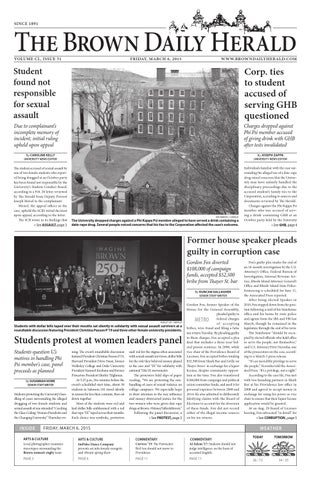
The University dropped charges against a Phi Kappa Psi member alleged to have served a drink containing a date-rape drug. Several people voiced concerns that his ties to the Corporation affected the case’s outcome.
Former house speaker pleads guilty in corruption case Gordon Fox diverted $108,000 of campaign funds, accepted $52,500 bribe from Thayer St. bar By DUNCAN GALLAGHER SENIOR STAFF WRITER
ASHLEY SO / HERALD
Students with dollar bills taped over their mouths sat silently in solidarity with sexual assault survivors at a roundtable discussion featuring President Christina Paxson P’19 and three other female university presidents.
Students protest at women leaders panel Students question U.’s motives in handling Phi Psi member’s case, panel proceeds as planned By SUSANNAH HOWE SENIOR STAFF WRITER
Students protesting the University’s handling of cases surrounding the alleged drugging of two female students and sexual assault of one attended “Cracking the Glass Ceiling: Women Presidents and the Changing University” Thursday eve-
INSIDE
ning. The event’s roundtable discussion featured President Christina Paxson P’19, Harvard President Drew Faust, former Wellesley College and Duke University President Nannerl Keohane and former Princeton President Shirley Tilghman. At 5:25 p.m., five minutes before the event’s scheduled start time, about 30 students in Salomon 101 stood silently in unison for less than a minute, then sat down together. Most of the students wore red and had dollar bills emblazoned with a red duct tape “IX” taped across their mouths. Each choice was symbolic, protestors
said: red for the stigma often associated with sexual assault survivors, dollar bills for the role they believed money played in the case and “IX” for solidarity with national Title IX movements. The protesters held slips of paper reading, “We are protesting the mishandling of cases of sexual violence on college campuses. We especially hope to draw attention to the way influence and money obstructed justice for the two women who were given date rape drugs at Brown. #MoneyTalksAtBrown.” Following the panel discussion, a » See PROTEST, page 2
Gordon Fox, former Speaker of the House for the General Assembly, pleaded guilty to federal charges of accepting bribes, wire fraud and filing a false tax return Tuesday. By pleading guilty to these charges, Fox accepted a plea deal that includes a three-year federal prison sentence. In 2008, while vice chair of the Providence Board of Licenses, Fox accepted bribes totaling $52,500 from Shark Bar and Grille on Thayer Street in exchange for a liquor license, despite community opposition at the time. Fox also transferred $108,000 from campaign and political action committee funds, and used it for personal expenses between 2008 and 2014. He also admitted to deliberately falsifying claims with the Board of Elections to account for the diversion of these funds. Fox did not record either of the illegal income sources on his tax returns.
METRO
Fox’s guilty plea marks the end of an 18-month investigation by the U.S. Attorney’s Office, Federal Bureau of Investigation, Internal Revenue Service, Rhode Island Attorney General’s Office and Rhode Island State Police. Sentencing is scheduled for June 11, the Associated Press reported. After being elected Speaker in 2010, Fox stepped down from the position following a raid of his Statehouse office and his home by state police and agents from the IRS and FBI last March, though he remained in the legislature through the end of his term. The Statehouse “should be occupied by elected officials who hold office to serve the people, not themselves,” said U.S. Attorney Peter Neronha, one of the prosecutors on the case, according to a March 3 press release. “It’s an incredible privilege to serve the people,” Neronha told the Associated Press. “It’s a privilege, not a right.” According to the case file, Fox met with two founding partners in Shark Bar at his Providence law office in 2008 and agreed to accept money in exchange for using his power as vice chair to ensure that their liquor license application would be granted. At an Aug. 29 Board of Licenses hearing, Fox advocated “in detail” for » See CORRUPTION , page 5
WEATHER
FRIDAY, MARCH 6, 2015
ARTS & CULTURE Local photographer examines stereotypes surrounding the Brown women’s rugby team
ARTS & CULTURE ImPulse Dance Company presents an infectiously energetic and vibrant spring show
COMMENTARY Corvese ’15: The Pawtucket Red Sox should not move to Providence
COMMENTARY Al-Salem ’17: Students should not judge intelligence on the basis of accented English
PAGE 5
PAGE 6
PAGE 11
PAGE 11
TODAY
TOMORROW
26 / 13
34 / 25
UNIVERSITY NEWS PAGE 2 • FRIDAY, MARCH 6, 2015
» PROTEST, from page 1 question-and-answer session was held. Katie Byron ’15, a protest leader and a member of the Task Force on Sexual Assault, asked the first question, reading off of a piece of paper: “I’m here voicing concerns raised by students regarding the administrative response to an incident of sexual violence at Brown. We are concerned for the way money, power and privilege seem to influence the adjudication and sanctioning processes when those accused are connected to large donors. It appears as though the University is more concerned with its image and with keeping its donors happy than with protecting its students. As university presidents, you clearly have to balance a lot of different interests. How do you think about balancing the University’s fiscal interests with the safety and wellbeing of the student body?” Paxson responded that “the safety and welfare of our students comes before anything else,” adding that the cases related to the student Byron referenced were “very difficult and complex.” The group began organizing about a week and a half ago, said Lauren Stewart ’15, another protest leader, adding that the panel was “the perfect opportunity” for staging a protest. “I think that there is an important symbolic element … especially for the survivors involved, to know that there are all these people who are very symbolically sitting with them in their silence and highlighting the way in which they’ve been silenced both by the legal implications of the case and also by the University and … the statements that Phi (Kappa) Psi has been releasing,” Byron said. “Our purpose was to highlight inconsistencies that we’re observing with Brown’s implementation of its policies regarding sexual assault on campus,” she added. Protestors said they are specifically concerned about the role of family connections to the Corporation in decisions made on the case in question. The father of the Phi Psi student accused of administering GHB, against whom charges have been dropped due to a lack of physical evidence, is a member of the Corporation and has donated large amounts of money to the school, as reported in today’s Herald. Byron said the usual standard for determining whether to move forward with a hearing is whether or not an assault could have plausibly occurred, and cases generally do not require forensic
evidence to proceed. Though the protestors remained present during the whole event, the discussion proceeded as planned. To start the panel discussion prior to the Q&A, Jean Howard ’70, chair of the Pembroke Center Associates Council, welcomed the audience. Paxson then took to the podium to introduce the three panelists, noting that each was the first female president at her respective institution. She also welcomed audience members Rosanne Somerson, who was recently appointed president of the Rhode Island School of Design, and Louise Lamphere, who brought and won a class-action case against Brown in 1975 accusing the University of sex discrimination. Many of the questions focused on women’s leadership styles and obstacles to their leadership. All participants acknowledged that female leaders often act differently than men, though they stressed that these differences are socialized rather than innate gender differences and that women are not a homogeneous group. “There’s a part of me that doesn’t want to admit that women lead any differently than men,” Tilghman said, though she added that in her experience “women are more likely to lead by consensus-building rather than command and control,” largely due to “the way we were raised.” Women also tend to listen more than men do, due to their socialization, Faust said, adding that this can be “an invaluable trait for leadership.” “To say that all women lead the same is obviously untrue,” Keohane said, citing Margaret Thatcher and Mother Theresa as examples of women who led with very different styles. The choice of the verb “cracking,” rather than “breaking,” in the event’s title was deliberate and intended to signal that women still have not achieved parity in many areas, Paxson said. Paxson asked the panelists to name “next steps” for women leaders. “I think it’s childcare, okay?” Tilghman said to enthusiastic applause. Solutions must be devised to “make it possible for women to think about both work and family as complementary and mutually beneficial activities that are completely natural; likewise, that men can be able to think about them in exactly the same way,” she said. The panelists also discussed the prejudice that women still face. “Early on I realized that women are allowed a narrower personality range than men.
THE BROWN DAILY HERALD
ASHLEY SO / HERALD
President Christina Paxson P’19, Harvard President Drew Faust, former Wellesley College and Duke University President Nannerl Keohane and former Princeton President Shirley Tilghman discussed female leadership.
COURTESY OF COLLIN WILES
Pei Ling Chia ’15 was one of many protestors to wear a red “IX” duct taped to a dollar bill over the mouth to represent the stigmas, financial influences and Title IX national movements connected to the date-rape drug case. It’s just fact, and you can rail against it, but you would be wise to try and walk between the boundaries,” Tilghman said. Structural issues such as the difficulty of starting a family while in tenure-track positions are now greater obstacles than prejudice, Keohane said. One audience member asked a question about childcare and work-family balance, to which Tilghman said it is “scandalous” that the United States does
COURTESY OF COLLIN WILES
Protesters held slips of paper with the message: “We especially hope to draw attention to the way influence and money obstructed justice for the two women who were given date rape drugs at Brown. #MoneyTalksAtBrown.”
not have paid maternity leave. “And paternity leave!” shouted an audience member. One audience member asked Lamphere about her experience with the classaction suit against Brown. “You didn’t know you were going to be on the panel!” Paxson remarked. Students also raised concerns about issues regarding gender and sexuality. “As a nonbinary-identified student, I’d like to problematize the gender binary in this discussion. I feel like I and other trans students often feel like we’re falling through the cracks,” said Brian Levy ’17, who asked panelists how they see trans issues fitting into the discussion. “When I was in college we were just starting to talk about people being gay,” Paxson said. “This is the next wave, and it’s a welcome wave. It takes a while for people of the next generation to figure out the language that you’re using and why this is important,” she said, adding, “you can make progress, it sinks in.” “I wanted to see if (trans issues are) something they thought about,” Levy told The Herald after the event. “To me, that’s something that I would hope the president of my university would have taken into account, and based on her response I’m not convinced that has been the case.” Another student asked the panel about women of color. “We’ve heard a lot about childcare, and I think that’s extremely important, but women of color have been taking care
of their own children and white women’s children for centuries,” said Justice Gaines ’16, adding that trans women also face unique obstacles. Amid loud snapping from audience members, Gaines asked the panelists to speak about “queer women, trans women, women of color, combinations of those different identities and … what are their glass ceilings and how can we help them as well.” “You reminded us, we use the term women as though everybody was all the same, and we know that’s not true,” Keohane said in response. Since childcare is an issue for women professors, “can you only imagine the challenge for someone who is in a lowincome job,” Tilghman said. It “felt like a ghost from the past” that the discussion was “so exclusively focused on white straight women,” said audience member Miriam Langmoen ’17 after the event. “I thought it was strange that no one really mentioned Ruth Simmons, who was not just the first female president of Brown, but was also black,” she added. Masha Traber ’75, Rachel Wyon ’73 and Mimi Pichey ’72, who had been involved in feminist activism as Brown undergrads, attended the event to support Lamphere and celebrate the progress Brown has made on gender equality since their graduation. But they also said that there is still progress to be made on sexual assault and that they support continued student activism.
UNIVERSITY NEWS FRIDAY, MARCH 6, 2015 • PAGE 3
THE BROWN DAILY HERALD
Panelists discuss ‘Palestinian question,’ peace process Palestinian legislator Hanan Ashrawi advocates Palestinian selfempowerment By ZACK BU SENIOR STAFF WRITER
“When it comes to Palestine, the laws of physics do not apply. You cannot say that for every action there is an incurrent opposite reaction,” said Hanan Ashrawi, a Palestinian legislator, activist and scholar to a crowded Perry and Marty Granoff Center for the Creative Arts Thursday evening. Ashrawi is among a group of panelists who presented at “What is to be Done?” — the fourth in a series of discussions about the Israeli-Palestinian conflict held by the Department of Middle East Studies and co-sponsored by the Watson Institute for International Studies. Director of Middle East Studies Beshara Doumani introduced the panel, which also included Chancellor Emeritus Stephen Robert ’62 and Hani Masri, director general of Masarat, the Palestinian Center for Policy Research and Strategic Studies. Ilan Pappé, director of Exeter University’s European Centre for Palestine Studies, was also a slated panelist but did not attend due to a flight delay. Doumani emphasized the panelists’ expertise in Middle Eastern issues, particularly Ashrawi. “She’s an elected representative of the Palestine Representative Council, representing Jerusalem,” he said, adding that Ashwari was the first woman to join the Palestine Liberation Organization’s executive committee. “In the overall configuration of Middle East peace, Palestine is actually
» ASSAULT, from page 1 the complainant’s incomplete memory of the event did not allow her to effectively counter the alleged assailant’s testimony that she consented, Meisel wrote. The woman appealed the decision, citing the “dangerous precedent” set by not adequately taking into account the memory loss that accompanies the ingestion of date-rape drugs, according to the letter. But in his appeal decision, Meisel wrote that, because no new evidence had emerged, he remained unable to call for a rehearing of the case — even
SADIE HOPE-GUND / HERALD
“If there is to be real peace, the U.S. has to take a critical stance, “ said Palestinian legislator Hanan Ashrawi. Experts in Palestinian studies accompanied her on the panel entitled “What is to be Done?” at the Perry and Marty Granoff Center for the Creative Arts Thursday evening. the weakest, the most vocal component. We are always being asked to think creatively, to think outside of the box, to find ways out of an impasse, to try to find strategic options,” Ashrawi said. “Although we know we are not in control of what’s happening around us, the Palestinian question has never been an isolated, discrete issue. It has always been several external factors and powers.” Ashrawi said Israel has increased its settlement activity and sent the message to the rest of the world that it does not want a two-state solution or peace. “Israel is holding back (Palestine’s) funds, so that there is a severe financial crisis. So Palestine doesn’t really have
any budget to work with right now,” Ashrawi said. “There is a chance of imminent collapse. It’s not just the money — I think it’s an incremental process.” Ashrawi said that after the latest attack on Gaza, a ceasefire was negotiated by Egypt. But that ceasefire was supposed to be followed by other steps, and Palestine has not seen any initiatives taken. Ashrawi denounced the United States’ continuous support of Israel. “It has undermined the integrity of the peace process; it has enabled Israel to persist with its violations and policies. Therefore, if there is to be real peace, the U.S. has to take a critical stance,” she said. In exploring the solutions to
Palestine’s current predicament, Ashrwai stressed that self-empowerment is essential against external pressure. She said the PLO has adapted a series of initiatives, including accepting international treaties and applying to the United Nations Human Rights Council. The PLO is redefining Palestine’s authority, institutions and laws, all of which will eventually shape the nature of Palestine and enable it to become a part of the international community, she said. Ashrawi also addressed the division between Hamas and the PLO, adding that this rift needs to be healed “to serve the national cause.” Robert tackled the debate from the perspective of an American Jew.
He condemned what he perceives as Israel’s persecution of Palestinians and appealed for change in Israeli politics. “It’s painful to say, but in my view, Israel is no longer a democratic Jewish state. It’s basically a binational state, with 35 percent of the population with no rights at all, and the other 65 percent have every right,” Robert said. Israel has no chance of peace without a new government, he said. The current government will not engage in negotiations and will only exacerbate the situation. The will to implement proposed agreements is crucial, he added. “All you need is an Israeli administration that will seriously negotiate peace,” Robert said.
if he were to give the greatest possible weight to the complainant’s “flash memories.” Administrators, including Meisel, did not respond to requests for comment. The alleged assailant, who is unaffiliated with Phi Kappa Psi, was charged with “non-consensual physical contact of a sexual nature” and sexual misconduct involving “penetration, violent physical force or injury,” the letter states. The SCB’s finding of not responsible relied heavily upon its conclusion that the accused student may not have known the degree to which the
complainant was incapacitated. The night of the incident, the complainant had been drinking, was “having trouble with unlocking a door” and needed “to lean against the wall,” Meisel wrote in the letter, recapping her testimony. The accused student’s descriptions of the night “indicate that he recognized you had been drinking to some degree,” Meisel wrote to the complainant. “The question is whether the visible presentation of your stumbling could or should have led (the alleged assailant) to infer that ... your level of intoxication was past the point at which it would have been reasonable
to assume you were capable of giving consent.” The complainant’s testimony of being “unable to respond, move or consent” during the sexual act was at odds with the alleged assailant’s account of “sustained activity and responsiveness throughout the sexual encounter,” Meisel wrote. “This finding represents a gross misunderstanding of how consent works,” said Katie Byron ’15, a member of the Task Force on Sexual Assault. “This is an atrocious Catch-22 that the University has put itself in where they say that because her memory was flawed, because she was incapacitated,
that she can’t provide any sort of alternative testimony,” Byron said. “But yet somehow, she was … still able to give clear and convincing consent. You can’t have both of those things.” Justice Gaines ’16, also a member of the task force, said “the fact that only the accused’s memory is taken into account because the victim doesn’t have a memory is horrifying.” Gaines expressed concern that the decision could establish a precedent according to which a victim who does not completely recall an incident is not considered to have been “victimized” or to have “experience(d) a sexual assault.”
Join the Herald Editorial Page Board! The Brown Daily Herald Editorial Page is accepting applications for board members, especially but not limited to underclassmen and graduate students. The 10-person board is responsible for writing four pieces per week that address major issues affecting the Brown community. Ideal applicants are good writers who are informed and engaged with campus debates. Contact editorials@browndailyherald.com for more information or to apply.
UNIVERSITY NEWS PAGE 4 • FRIDAY, MARCH 6, 2015
THE BROWN DAILY HERALD
Lawyers Olson, Boies talk path to same-sex marriage laws Panelists survey their work overturning Proposition 8, issue of marriage equality By LAUREN ARATANI STAFF WRITER
Same-sex marriage is the “defining civil rights issue of the century,” said David Boies, one of the two lawyers who helped overturn Proposition 8, to a packed Starr Auditorium Thursday night. Boies and fellow lawyer Ted Olson first came to the public’s attention during the 2000 Supreme Court case Bush v. Gore, which resolved the controversy over the vote count in the presidential election. Olson represented former President George W. Bush, while Boies represented Democratic candidate Al Gore. The duo later came together after the case closed and found common ground in fighting against Proposition 8 — the state constitutional amendment that banned same-sex marriage — in the 2012 Supreme Court Case Perry vs. Schwarzenegger. “When Ted called me up asking if I was interested in joining him in a prosecution in trying to overturn Proposition 8, I immediately said yes,” Boies said. At that time, people thought it was “too early” and “too dangerous” to have such a lawsuit advance to the higher courts, he said. “I believed that it was the right thing to do.” Since Olson is a Republican and Boies is a Democrat, they were both aware their collaboration would receive a lot of attention. “We felt that because my background
» GHB, from page 1 were dropped Feb. 21 due to a lack of physical evidence, The Herald reported Wednesday. A faculty member with knowledge of the case, the father of one of the two complainants and two members of the Task Force on Sexual Assault all expressed worry that the relationship between the accused student and his father, a Corporation trustee, may have influenced how the case unfolded. None of the documents reviewed by The Herald point to specific instances of preferential treatment as a result of the accused student’s family connections, and no physical evidence publicly identified in the case has conclusively tested positive for GHB. But the concerns raised by individuals familiar with the situation have added to mounting pressure on the University over its handling of the case. Administrators did not respond to multiple requests for comment, and the trustee did not return a call seeking comment by press time Friday morning. After formally charging the student Dec. 10, the University scheduled a hearing for Dec. 19. But following a court injunction filed by the student, the University was required to put the disciplinary proceedings on hold until the end of January, according to a Dec. 15 email to one of the two complainants from Yolanda Castillo-Appollonio ’95, associate dean of student life and director of student conduct.
had been involved in Republican politics, and I had been known as a conservative, that it would be wonderful if we could assemble a legal team of someone on the opposite of the political spectrum,” Olson said. Boies called the progress that has been made on “a civil rights issue” substantial, adding that “none of it could have happened without decades of preparation.” Many children in past generations did not know people with a variety of sexual orientations existed, Boies said. “Whole new generations have grown up knowing friends, neighbors, doctors and teachers who are gay and lesbian. … So there’s nothing unusual about it,” Boies told The Herald before the event. “You didn’t get a chance to relate to them.” Olson and Boies both proclaimed themselves firm believers in the idea that marriage is a “fundamental right” that cannot be infringed upon for any citizens. James Morone, director of the Taubman Center for Public Policy and American Institutions and moderator of the forum, asked Olson about an instance during the trial when Justice Antonin Scalia inquired of Olson, “When did it become unconstitutional to exclude homosexual couples from marriage?” Morone cited the moment as the “core of the case.” “There is no substitute for preparation” before going in front of the Supreme Court, Olson said, adding that lawyers must know where each justice stands on issues in order to anticipate questions. Olson and Boies, along with their team, clocked in a total of 32,000 “lawyer hours” on the case alone.
“Citizens in California have erected a wall against their gay and lesbian citizens,” Olson said, recalling his words during the trial. “You cut them off from one of the most important, fundamental rights — the right to be treated equally and the right to marry.” “I wanted to make the point that this was a constitutional concept,” Olson said. “When the court decided Brown v. Board of Education, that’s not the moment it became unconstitutional. That’s the moment the Supreme Court recognized that it was unconstitutional.” Boies hopes lecture attendees left with
a greater understanding that same-sex marriage is a “constitutional and human rights issue,” as well as a greater sense of how the U.S. legal system works and how one can use the legal system to “promote human rights,” Boies told The Herald. “We hope to convey some of the passion that we have for the emotions and feelings and damages that were done to our society as a result of discrimination … and how much better we can be as a society when we recognize the equality of all of our citizens,” Olson told The Herald. Olson also encouraged students who
are interested in law to further pursue the field. “Law is an absolutely fabulous occupation,” Olson told The Herald. “You’re in a process of learning your entire life. I think that if you approach studying law not as a chore, but as an opportunity because you’re learning something about our society, how to solve problems and how to communicate with people, that’s fun.” The event, entitled “The Constitutional Right to Marriage Equality,” was part of the first annual Steven Yee and Erich Theophile Family Lecture series.
The hearing was further delayed when an independent expert hired by the accused student called into question the accuracy of a GHB test originally found positive, according to a March 2 email from Castillo-Appollonio to one of the complainants. The expert, a professor at Tufts University School of Medicine, cast doubt on the urine test’s methodology. Meanwhile, a Brown professor informally advising one of the two women, J. Timmons Roberts, spoke to Margaret Klawunn, vice president for campus life and student services, on Jan. 23. “It sounds like the number of lawyers involved and the resources of (the accused student) have slowed and complicated this,” but administrators are moving as quickly as they can, wrote Roberts, professor of environmental studies and sociology, in an email to the complainant later that day. On Feb. 7, the father of the other complainant wrote an email to Chancellor Thomas Tisch ’76 P’18 expressing concern about the accused student’s connection to the Corporation. “My daughter has been involved in this process for over four months. This is a process that should have taken 60 days,” he wrote. “Having a very wealthy member of the Board of Trustees as a parent of (the accused student) raises the question if my daughter can get a fair hearing at Brown.” Despite the Tufts professor’s assertion that the urine test might be inconclusive, the University was “prepared to proceed” with the hearing and hired its own independent
toxicologist, Guy Vallaro, to reevaluate the urine and hair tests, according to Castillo-Appollonio’s March 2 email. Acting on a report written by the independent toxicologist, the University announced Feb. 21 that the urine test was, in fact, inconclusive. The accused student’s hearing was canceled that day due to the lack of conclusively positive physical evidence. “What message have we sent by not holding a full and fair hearing against a student who is accused of drugging another?” Roberts wrote in an email to The Herald Thursday. “It potentially sends a message that some are above being subject to the rules.” “We cannot build a community of trust at Brown with seeming impunity for some and impossible evidentiary standards,” he wrote. “If he is innocent, that should be borne out in a hearing.” Phi Kappa Psi members vehemently defended the innocence of all the organization’s members in a letter to the community published by The Herald Oct. 28. “Sexual assault and the use of illegal date-rape drugs number among the most heinous of crimes,” the fraternity’s members wrote. “We are confident that in no way did any member of Phi Kappa Psi engage in or perpetrate such atrocious and criminal behavior.” Katie Byron ’15, a member of the Task Force on Sexual Assault, said that to her knowledge, the standard of evidence required to proceed with a hearing is if the alleged incident is “plausible.”
“In so many of these instances, there’s no evidence. There’s somebody who comes forward and discloses an experience, and for the most part, that person’s testimony is enough to warrant a hearing,” she said,
characterizing the way this case was handled as “inconsistent” with others. “It does concern me that that conflict of interest exists,” said Justice Gaines ’16, another member of the task force.
ASHLEY SO / HERALD
David Boies and Ted Olson spoke about how they joined forces as the two-lawyer team that helped overturn Proposition 8, the state constitutional amendment that banned same-sex marriage in California.
UNIVERSITY NEWS FRIDAY, MARCH 6, 2015 • PAGE 5
THE BROWN DAILY HERALD
Neuroscience, chemistry professors awarded Fulbright Awards Jerome Sanes to study Parkinson’s disease, Paul Williard to explore molecular structures By LAUREN ARATANI STAFF WRITER
Jerome Sanes, professor of neuroscience, and Paul Williard, professor of chemistry, have won Fulbright Scholar Awards to conduct research in France, according to a Feb. 27 University press release. “It was a wonderful opportunity,” said Sanes, who will study Parkinson’s disease at the Brain and Spinal Cord Institute, which is affiliated with the University of Paris. Sanes will spend the year looking at “the cognitive flexibility in patients with Parkinson’s disease” with
colleagues in Paris, he said. “The type of research that we and others do with patients” tries “to understand something fundamental about the disease,” Sanes said. The research will focus on a phenomenon Sanes calls “internal changes of mind,” which can be driven by sensory stimuli or changes in a person’s memory or thought process. “There is nothing evident that is driving” these changes, he said. “You’re walking around on campus, and all of a sudden, instead of walking straight you turn right, and there’s no evident reason why you did that,” Sanes said. “There’s some sort of internal event happening.” People with Parkinson’s disease have cells in their brains that project dopamine into the motor stream, and Sanes and his team believe “that these people have some difficulty in
cognitive processing,” Sanes said. Sanes hopes the study will find a way to offer “therapeutic benefits” to patients with Parkinson’s disease, especially through noninvasive brain stimuli. Williard will spend six months working at the University of Rouen in Mont-Saint-Aignan, France. He will use nuclear magnetic resonance to determine the structure and interactions of molecules and solutions. “I was pleasantly surprised,” Williard said. “These Fulbright fellowships are not trivial, so I didn’t anticipate one way or another.” Potential applications of the study are wide-ranging, and include screening libraries of potential drugs to see which of the molecules will bind to their biological targets and turning carbon dioxide into a fuel source. The fact that Williard and Sanes
both ended up in France, despite their different focuses, is “quite unusual,” Williard said, adding that he and Sanes have previously discussed collaborating at the University on imaging, a technique they both use for their research. The Fulbright grant is a part of a program initiated by the U.S. Bureau of Educational and Cultural Affairs. Approximately 8,000 individuals receive Fulbright grants each year, including undergraduates, graduate students, professors and professionals in a variety of fields, according to the U.S. Bureau of Educational and Cultural Affairs’ website. To apply for a Fulbright grant, a professor must find a “collaborator in a foreign country and a background for suitability to that foreign country,” Williard said. While students must apply for
Fulbright grants through the University, faculty members apply through the Council for International Exchange of Scholars, said Linda Dunleavy, associate dean of the College for fellowships. The University is known for producing large numbers of both student and faculty Fulbright recipients — Brown ranked third among research universities in the number of Fulbright grants awarded in 2012, according to a report published by the Chronicle of Higher Education. A Fulbright grant is an “award that supports independent thinking and willingness to explore,” Dunleavy said, noting that she often sees these traits in students. “Perhaps the same could be said about the faculty,” she added. “The overall campus environment encourages people to leave the University and explore.”
Photographer captures intersections of violence, grace in women’s rugby Carles-Tolra’s series, “The Bears,” explores stereotypes behind Brown women’s rugby team By AGNES CHAN CONTRIBUTING WRITER
For Alejandra Carles-Tolra, photography transforms the world into a theater. It immerses her in otherwise distant cultures and environments, granting her the capacity to capture the story behind an individual’s identity within a two-dimensional space. In her latest series of photographs, “The Bears,” Carles-Tolra simultaneously pursues her fascination with individuals who share a strong group identity and discovers what it would be like to be part of an American university’s sports team: the Brown women’s rugby team. “The Bears,” which was on display at the Chazan Family Gallery at Rhode Island College from Jan. 28 to Feb. 27,
ARTS & CULTURE
captures the many dualities found in women’s rugby: violence and grace, weakness and strength, masculinity and femininity. Through her photography, Carles-Tolra questions stereotypes of the “rugby girl,” revealing that traditional perceptions of the team as masculine and strong do not necessarily define the individuals within it, many of whom are not just “rugby girls” when taken out of the group context. While Carles-Tolra was exposed to photography from a young age through her father, she only began considering it as a career when studying at the University of Barcelona, she said. As a sociology major, she chose to use photography as a tool to conduct and present her research, she said. Since beginning her graduate studies at the Massachusetts College of Art and Design, Carles-Tolra has completed two major projects: “Fall In,” which features college students in ROTC, and “The Bears.” Both projects focus on how community involvement shapes personal identity. Upon moving to Providence,
Carles-Tolra began in-depth research about the identities of college athletes. “I’ve always been very fascinated by sports in American universities,” she said. “It’s not like that in Spain at all … there are some people who play soccer, basketball, but that’s pretty much it. There is no competition between schools in regards to sports. So this for me has always just been something you see in movies.” As to why she chose the women’s rugby team as her subject, Carles-Tolra said, “I wanted to photograph women who are … struggling to find their own identity because of their age, but at the same time are in a very maledominated sport.” Originally interested in often-stereotyped sports such as ballet, which is often viewed as feminine, Carles-Tolra was immediately intrigued when she came across Brown women’s rugby, a sport to which she had no prior exposure, and was “fascinated by the idea of diversity in the group.” “The exciting thing about doing a project like this is that I know I’m going to have some ideas before I
photograph that are going to be totally broken up … it’s a very enriching experience,” she said. The process was as much about research as about the creative process. After attending the training sessions, home games and even following the players to a game at Dartmouth, Carles-Tolra came to better understand the dynamics of college athletics. Rugby “can be very physical, but there is also a lot of camaraderie … it is a group that has a very strong identity but is also a safe environment in which (players) are able to find their own identity and grow to become who they want to be,” she said. Her perception of rugby also underwent a drastic change. “I always thought of rugby as just bruises, blood and broken noses … but I actually learned to appreciate the grace in the sport,” Carles-Tolra said, adding that she was surprised to see girls who were smaller than her in size contributing so much strength and spirit to the team. Within the collection of photographs, Carles-Tolra believes the four close-up shots of players in a scrum
» CORRUPTION, from page 1 the restaurant’s application and moved that the board approve it. The liquor license was approved 3-0 with one member of the board absent. Shark Bar’s liquor license has been approved every year since its 2008 opening. Subsequently, the same owners met again with Fox at his law office and gave him $17,500 in cash and $17,500 in checks in exchange for Fox’s official actions. One of the owners brought checks from a third silent partner for an additional $17,500. The names of these three partners are not indicated in the case file. One of the co-founders of Shark Bar and current owner is Ray Hugh, who also owns Shanghai Restaurant, Skewers and at the time XTreme Pizza and Wings. Hugh declined to comment for this story. Neronha has not said whether the government will investigate the bar, the Associated Press reported. Providence Mayor Jorge Elorza said in a statement that his administration is “investigating whether the license can be legally revoked.”
ASHLEY SO / HERALD
Former R.I. House Speaker Gordon Fox accepted more than $52,000 in bribes from the owners of Shark Bar and Grille on Thayer Street in exchange for a liquor license.
best capture the overall message of the project. “I was … thinking about how the viewer could feel like (players) are part of a group,” she said. “They are intimidated and yet they are also feeling powerful, because they are part of this very intense moment.” As for the players, seeing the photographs at the exhibition for the first time made the purpose behind CarlesTolra’s project clear. “We always talk about it on our team that we have a good amount of diversity … and I think the pictures speak for (themselves),” said Oksana Goretaya ’17, captain of the women’s rugby team. Goretaya said she found the photograph of one of the player’s bruised legs most intriguing, because she perceived its subject matter as very different from what sport photographers usually depict. The photographs accurately depict the nature of playing rugby on a team, Goretaya added. “She was able to capture real moments of our team and the real people who play. We didn’t do our makeup specifically for her pictures … it was really candid.”
ARTS & CULTURE PAGE 6 • FRIDAY, MARCH 6, 2015
THE BROWN DAILY HERALD
ELI WHITE / HERALD
Jason Vu ’17, Griffin Hartmann ’15, Jenzel Espares ’16 and Dara Emery ’15 prepare for their spring show, which debuts Friday. While the group’s work is primarily hip-hop, the performance represents its talent in a range of musical genres. Elaborate costumes will help shape the alter egos that each dancer portrays throughout the show.
ImPulse’s spring performance rises to the occasion ‘ImPulse Rising,’ features guests Badmaash and Static Noyze, explores notion of the alter ego By CORINNE SEJOURNE STAFF WRITER
Dancers dressed in gold weave and flow through shifting flashes of colorful light in an opening set of “ImPulse Rising.” After intensive preparation, Brown’s imPulse Dance Company will take the stage in Alumnae Hall for its annual show Friday and Saturday.
REVIEW
The buildup to this spring performance accumulated over the course of a year. Two auditions took place: the first following last year’s spring show and the second in the fall. The whole company returned to campus from winter break early for a full week of 12-hour-long practices, said Layla Heidari ’15, publicity chair for imPulse. This year’s show, “ImPulse Rising,” is seamless and effortless, despite the intensity and variety that the challenging two-hour-long performance presents. The show revolves around an alter ego theme, with certain pieces showcasing the superheroes and supervillains among them. Two guest groups — Brown Badmaash, an Asian
fusion dance troupe, and Static Noyze, a Boston-based group — will join the troupe in the second half of the show. Simultaneously playing the role of student and dancer, each member of the cast has a unique personality or an alter ego, Heidari said, adding that these personalities are represented in the student-choreographed pieces. Though primarily a hip-hop group, the company showcases its vast range of styles and abilities in each subsequent piece. The dancers transition smoothly from fast-paced intensity to smooth balletic movement. They shift from two-person interpretive pieces to fullgroup sets that exude power through the precision and coordination of 26
individuals. The choreography and performance showcase physical strength and energy coupled with grace and control. The dancers bring self-awareness to a new level, with consistently appropriate facial expressions — be it bright smiles or menacing glares — to complement practiced moves, adding emotion and attitude. The music is carefully woven into the show, switching from piece to piece. The audience will experience both popular hits and the works of lesserknown artists in an entirely new way through the dancers’ fresh interpretations. Elaborate and distinct costumes both distinguish and unify the pieces.
Impeccably timed lighting matches the music and movement perfectly, further developing the shifting moods in each piece. Such close attention to detail from beginning to end creates a cohesive show that seems to tell the story of the company. No two pieces are alike, revealing individuality within a diverse group. What stands out most is how much fun the dancers — described by Heidari as a “close-knit family” — seem to have with every piece. Their energy does not fade, despite the stamina required for such an elaborate show. Their fun and energy are contagious, making “ImPulse Rising” a show well worth watching.
» W. BBALL, from page 12
arc and shooting just 30 percent from the field. Fortunately for the Bears, lockdown defense and Dartmouth’s poor response to pressure enabled the squad to eke out a close victory. Bruno must bring the same intensity in the backcourt this Friday, as the Big Green boasts the conference’s leading scorer, Fanni Szabo. Szabo averages 17 points per game and the 6-foot-1 sharpshooter’s range makes it difficult for teams to shut her down. Bruno will play its final game of the season Saturday against Harvard. The Crimson sits just above Dartmouth and Brown in fifth place and has been marred by inconsistency for the duration of the season. While the squad
excels on the glass, Harvard gives up an average of 70 points per game: the most in the Ivy League. In order to claim a victory, the Bears will look to employ their fast-paced offense and capitalize on the Crimson’s generosity in the contest. Before tip-off Saturday night, Bruno will honor the team’s three seniors — Bikofsky, Nelly Weledji ’15 and Christine Rush ’15, a former Herald staff writer. “We all love our seniors so much and they have all contributed so much to this program, on and off the court,” Alexander said. “Watching them play their last games here is going to be hard.”
5-7). The quick and well-balanced Bears perform at their best when they are able to dictate the pace of the game on both ends of the court. “We need to keep playing together like we have been,” Alexander said. “We’ve been running the floor very well and pushing the ball, which should be effective against Harvard and Dartmouth.” First up, Bruno will take on Dartmouth. The Bears are currently tied with the Big Green for sixth place in the Ivy League. The last time the teams saw each other, Bruno struggled offensively, going 0-7 from behind the
www.browndailyherald.com
SPORTS
FRIDAY, MARCH 6, 2015 • PAGE 7
THE BROWN DAILY HERALD
M. BASKETBALL
Bruno visits Dartmouth, Harvard in last regular season weekend With Ivy League title potentially on the line, Brown looks to spoil Crimson’s season By CALEB MILLER SPORTS STAFF WRITER
The men’s basketball team has little on the line entering its final weekend of play. An Ivy title and even a .500 record are out of reach, but that has not hindered Bruno’s preparation for the road trip to Dartmouth Friday and Harvard Saturday. “We just want to build on the foundation that’s been laid down over the course of this season,” said Cedric Kuakumensah ’16. “We always play to win, and we want it to be a good weekend for the younger guys to get some momentum and take that into next season.” The Bears’ Friday bout could determine sixth place in the conference standing, as Dartmouth sits one game ahead of Bruno (13-16, 4-8 Ivy) entering the weekend. But the Big Green fell to Bruno earlier this season, so a win would give the Bears the tie-breaker. Dartmouth (12-14, 5-7) Midway through its Ivy schedule, the Big Green appeared to be the weakest team in the league and sat last in the standings. But thanks to a ferocious surge and the parity among the Ivies, Dartmouth needs only a strong closing weekend and some Princeton losses to finish in third place behind powerhouses Harvard and Yale. The Big Green beat Penn two weeks ago and followed up with a stunning road sweep of Cornell and Columbia. “Dartmouth is a fast-paced, up-tempo team that can slow it down and play in the halfcourt,” Kuakumensah said. “They have great shooting and solid big guys, so they’re a very dangerous team.” History is on the side of Bruno. The Feb. 7 meeting between the Bears and the Big Green at the Pizzitola Center ended in a narrow 67-64 victory for the home squad. J.R. Hobbie ’17 drained five three-pointers in the contest, which kept Dartmouth at bay as Bruno led the entire second half of its first Ivy win. The performance of Hobbie’s longrange game has been a good indicator of Brown success this season. The
ELI WHITE / HERALD
Tyler Williams ’18 brings the ball up the court. The first year filled in against Princeton after Tavon Blackmon ’17 was forced out by a leg injury. Blackmon will be back in the Bears’ final weekend, as they try to end the season on a high note with wins against Dartmouth and Harvard. sophomore guard has drained four or more treys in a game seven times this season — including three times in conference play — and the Bears are undefeated when he eclipses the mark. Getting the ball to Hobbie “falls on me,” said Tavon Blackmon ’17. “He’s played a lot more since league play started, and he’s one of the best shooters in the league, so I have to try to get him the ball any time I can.” The play of co-captain Rafael Maia ’15 will be critical Friday. Not only was Maia the second-leading scorer against Dartmouth last time, but he will also be called upon to guard the Big Green’s talented big man Gabas Maldunas. “Maldunas is a tough guy to handle,” Kuakumensah said. “Our coaches have stressed playing tough and not taking any possessions off in practice this week.” Maldunas made his mark in the last meeting with 15 rebounds, but Maia held him to nine points — the only Ivy game he has scored in single digits. Miles Wright carried the Dartmouth offense at the Pizzitola, racking up 21 points. In the Big Green’s recent run, speedy guards Alex Mitola and Malik Gill have anchored the attack.
Mitola leads the team in scoring, which makes for an excellent matchup at point guard, as floor general Blackmon is Bruno’s leading scorer in conference play and a difference maker with his ability to pass and score. In its three-game win streak, the Big Green has shown a tremendous capacity to outscore high-scoring teams, putting up 84 to oust Columbia, and out-defend defensive squads, holding Cornell to 45 points. Harvard (20-6, 10-2) Harvard’s Friday contest against Yale will very likely decide the 2014-15 Ivy League champion. But if the Crimson loses Friday and Yale stumbles at Dartmouth, Bruno’s matchup with Harvard would actually determine the conference champion. Regardless, the Bears will be playing for revenge after the Crimson stole a 76-74 overtime win Feb. 6. “It’s easy to get up for Harvard,” Blackmon said. “They started the year in the top 25 and are competing for a league title this year. I think it’s easier to play against teams when no one gives you a chance against them, because all you want to do is prove those people
wrong.” The test for the Bruno defense will be limiting the consensus best player in the Ivy League. Wesley Saunders won Ivy Player of the Year in each of the last two seasons and notched a career-high 33 points and 10 rebounds at the Pizzitola in February as part of his compelling case for a three-peat. Much of the credit for Bruno’s ability to hang with the Crimson the first time around goes to Blackmon. The sophomore posted his best game as a Bear, racking up career highs with 25 points and nine assists. Saunders will undoubtedly carry the offense, but the Crimson features a deep cast of scorers behind him. Agunwa Okolie scored 11 points and corralled eight rebounds against Brown in the last meeting, and Jonah Travis made a huge impact off the bench with 11 points. Point guard Siyani Chambers and forwards Steve Moundou-Missi and Zena Edosomwan were all relatively quiet last meeting, but they are incredible athletes who could make a major impact. Bruno’s frontcourt of Maia and Kuakumensah outplayed the athletic Harvard forwards last time around. Kuakumensah poured in 15 points in
that game but has been a bit streaky in conference play, while Maia embodies consistency and will likely finish near his Ivy averages of 10.8 points and 9.5 rebounds. With Blackmon running the point, Hobbie raining threes and the captains Maia and Kuakumensah manning the middle, it is easy to forget Bruno’s impactful glue-guy. Steven Spieth ’17 does a little of everything and could be a difference maker Saturday because he seems to turn up his game against the best opponents. Spieth scored 21 against Illinois and 15 in an upset over Providence — two possible NCAA tournament teams — and three of his top four scoring games in Ivy play have come against Harvard, Yale and Princeton. The last weekend of Ivy League play also brings a number of side stories. The senior class of Maia, Dockery Walker ’15, Jon Schmidt ’15, Longji Yiljep ’15 and Joe Sharkey ’15.5 will play its last weekend with Brown basketball. Maia also currently averages .1 fewer rebounds per game than Cornell’s Shonn Miller, and if he can jump Miller, he will lead the Ivy League in rebounding for the third consecutive season. Friday’s tip is at 6 p.m.
ATHLETE OF THE WEEK
Ernst ’17 earns honor of ECAC Goalie of the Month Sophomore spurs Brown’s second-half surge, leads ECAC in save percentage in February By EMILE BAUTISTA SPORTS STAFF WRITER
It was a tumultuous three months for the men’s hockey team, which started the season 4-16-1 and seemed to be destined to live in the ECAC cellar. But in February, the team found its form, ripping off four straight wins and a sixgame unbeaten streak. At the center of this revitalization was goaltender Tim Ernst ’17. Head Coach Brendan Whittet ’94 switched between starting Ernst and Tyler Steel ’17 for much of the season. Ernst
finally won the starting job in a Feb. 7 game against Harvard and has since compiled a 4-1-2 record. The sophomore netminder posted a .938 save percentage and a 1.97 goals against average in February — metrics that would rank second and third in the ECAC, had he recorded them over a full season. Ernst was rewarded for his play in the crease by being named ECAC Goaltender of the Month for February. For his stellar work in net and his off-the-ice accolades, Ernst has been named The Herald’s Athlete of the Week. Herald: Growing up, did you always want to be a goalie? Ernst: I started hockey at four or five. I tried out for a team as a player, and it was the first year you could be on a travel team. I really wanted to be on
that team, and I guess I was an honest five-year-old — I looked around and realized I probably wasn’t good enough to make it. They said, “We need a goalie, and if you’re the goalie, you’ll make it.” So I said I’d be the goalie.
What do you think have been the keys to the team’s recent successes? At the very start of the year, I think we thought we were a lot better than we were. I think we were overconfident. In the middle of the year, I think we were playing better, but we would make these weird mistakes that would cost us a goal or two and then a loss. Now, we’re playing a simpler game. It’s not as pretty, but we’re not making those mistakes anymore. What does it mean to you to be named
ECAC Goaltender of the Month? Did you ever expect that? Oh, no, I didn’t expect it. It’s nice, but I’m trying not to think about it at all because of the huge games this weekend. ECAC Goalie of the Month isn’t going to win me any games. I think it means more to my parents, and it’ll probably be nice in a month or two, but right now, I’m focused on this weekend.
What goes through your mind when you’re on the ice as a goalie? I try not to think about it too much. You know, stop the next shot regardless of whether the last shot was a goal or a save. The tough part about being a goalie is that you have to stop the next one whether you’re down or up five to nothing. When you’re playing well, you’re not really thinking about anything. I just
try to stay relaxed and react to pucks.
Do you have any pregame rituals? Not really, actually. I guess I’m weird in that sense. I just do the warm-up and go through it. I have a ball and throw it off the wall a ton. I’m always bouncing or throwing it. Some goalies will just not talk to people, but I don’t do any of that. If you could play another sport, what would it be? I played baseball growing up, and I really like pitching a lot. I think if you can be good at baseball, then you have to choose it, because those guys rake in 300 million dollars and don’t really do much. — This interview has been edited for clarity and length.
SPORTS
PAGE 8 • FRIDAY, MARCH 6, 2015
THE BROWN DAILY HERALD
W. LACROSSE
Bruno heads into conference play in tilt with No. 13 Penn Hunt ’17, Toy ’16 headline Brown’s potent attack ahead of matchup with Quakers By LAINIE ROWLAND SENIOR STAFF WRITER
The women’s lacrosse team will open Ivy League play this weekend in a faceoff against a perennially dominant Penn squad. The No. 13 Quakers have consistently outperformed their Ivy opponents, capturing eight consecutive conference titles. For a program that has not broken the top four conference rankings in recent memory, defeating the Quakers will be a tall order. Penn has “been really strong in the past,” said Kerianne Hunt ’17. “So we expect them to come out really hard and for it to be a complete battle the whole time. But I think we’re capable of battling with them.” When the two teams played last year, Penn (3-0) walked away with a 12-6 win, mostly due to the players’ ability to apply overwhelming offensive pressure. The only current Bears (3-0) who scored in that game are Hunt and Lauren Toy ’16, who each notched one goal apiece against the Quakers. This year, Penn boasts an intimidating 15 returning letter-winners on its roster. Though the team has a lot of experience playing together, the high number of returning players means the Quakers will likely play a similar style, allowing the Bears study their opponent extensively. “We’ve been watching a lot of film on Penn,” Hunt said. “They haven’t really changed up any of their systems.” The Bears have been using what they have learned in the film sessions to guide their practices, Hunt added. “They’re a fast team, so we just want
to slow them down and focus on some key threats,” said Alyssa DiBona ’15. But Bruno will not alter its plan of attack too much. “We’re going to go with what we’ve been doing, just with more of a focus on some of their personnel,” DiBona said. The Quakers have already garnered accolades early in the season, with two players honored as Ivy League Player of the Week. Midfielder Nina Corcoran was named Offensive Player of the Week after notching a career-high six points last Sunday, while Megan Kelly earned Defensive Player of the Week two weeks ago, when she caused three turnovers in a game. The Quakers have already notched victories over Delaware, Vanderbilt and Rutgers this season. They are slated to face a series of nationally ranked teams in addition to their Ivy opponents, and they expect to rise to the challenge of heated competition. “The caliber of play is going to be so much higher than it has been for our first three games,” Hunt said. But the Bears are coming off of three decisive wins against nonconference opponents. Bruno has gained valuable experience and come out on top by relatively large margins. Even early in the season, the depth of the team is evident. Twelve different players have contributed to Bruno’s 38-goal total. Penn relies “more on the individual, while we have really been stressing how important every person is to our team,” Hunt said. Offensively, Toy and Janie Gion ’15 have been clear standouts for Bruno with eight and six goals, respectively. Rookie Yuna Hur ’18 has already scored seven goals this season, setting a precedent for younger players to make significant contributions to Bruno’s offense.
KATIE LIEBOWITZ / HERALD
Ali Kim ’17 looks to avoid an onrushing defender. The Bears are off to a hot start, but a game against Penn — which had two players receive recognition from the Ivy League for their play last week — should prove tough. “We have a lot of energy, a lot of depth,” DiBona said. “We have a ton of threats on offense, which is huge.” On the other side of the field, Kelly Roddy’s ’15 save percentage ranks her second among Ancient Eight goalies. Roddy will anchor a defense that will need to play its best to fend off Penn’s highly skilled attack.
The Bears will have a few days to rest before taking on Holy Cross (0-5) Tuesday. Bruno bested the Crusaders 9-6 last year. Though the Bears will approach the game with the same mentality as in their league contests, nonconference foes like Holy Cross pose less of a challenge than teams like Penn. This year’s slate of Ivy games is more
or less a flip of last year’s schedule. The Bears scorched through the front half of their season last year before losing five consecutive conference contests to drop out of the running for the Ivy Tournament. A win this weekend would put some wind in Bruno’s sails and set the team on course for a topfour finish.
M. LACROSSE
No. 20 Brown eviscerates Hartford after dominant first half Molloy ’17 adds to season total of 18 goals, leads nation’s top offense to 17-8 win By NIKKO PASANEN SPORTS STAFF WRITER
It is hard to imagine a better start to the year for the men’s lacrosse team, which continued its string of impressive play with a 17-8 drubbing of Hartford Wednesday. Wednesday’s game “showed us that we are still improving, and all of our hard work in practice and our preparation is really paying off,” said Dylan Molloy ’17. “It was a great overall win, because it gave a lot of players a chance to contribute.” The Bears (3-0), who are now officially ranked 20th in the U.S. Intercollegiate Lacrosse Association Coaches Poll, dominated the contest from start to finish. Once again, the team’s efforts were highlighted by Molloy, who put up six goals against Hartford (1-2) to bring his season total to 18. The star sophomore now leads the nation in goals per game, averaging six per contest. Brendan Caputo ’16 and Matt Graham ’16 also added to the mix, scoring three
and two goals respectively. As a team, Bruno now has the nation’s top offense, leading the NCAA with just over 17 goals per game on the young season. So far, it seems that the new high-tempo system has worked very well for the team. “I think it says a lot about our new offensive coach, Sean Kirwan,” Molloy said. “He’s brought us alive with a new tempo of play and we are just running with it. Being the most prolific offense definitely gets us the respect that we deserve from our opponents going into games, since they have to try and tame us.” On Wednesday afternoon, it did not take long for the Bears to take control of the game. By the end of the first period, Bruno had already taken command with a 6-1 lead and never looked back. The Bears managed to outperform themselves in the second quarter, this time shutting out the Hawks and scoring another six goals. Leading 12-1 at the half, Bruno extended its lead to 16-2 before letting some younger players get into the mix during the fourth quarter. The offensive efforts were certainly attention-grabbing, but the team’s stout defensive play contributed just as much to the victory. Goalie Jack Kelly ’16
DAVID BRAUN / HERALD
Brown is on the attack in its game against Hartford. Bruno catapulted to No. 20 in the country after accruing three straight wins, thanks to an offensive outburst spearheaded by new offensive coach Sean Kirwan. stopped eight of nine shots that came his way before he exited the game after the first half. Kelly now sits among the top five goalies in the country in save percentage, with a rate of 66 percent. Alec Tulett ’17 also contributed on the defensive end with a team-high eight ground balls and showed some offensive prowess by scoring an unassisted goal.
The Bears will head back out on the road Saturday, traveling to Ann Arbor to take on Michigan. The Wolverines (3-2) are sure to provide the toughest test Bruno has seen so far this year, and the team is looking forward to the challenge. With a ranking to its name, Bruno will have to learn how to play with a bit of a target on its back, but Molloy
is confident that it will not be a distraction. “We’re not a team that really takes the rankings too seriously,” Molloy said. “We usually don’t get the attention we deserve.” “We’re still going to work hard, play our game and focus on winning,” he added. “If we play fast and stay smart out on the field, we will be fine.”
TODAY
FRIDAY, MARCH 6, 2015 • PAGE 9
THE BROWN DAILY HERALD
menu
signs of snow
SATELLITE DINING JOSIAH’S Gnocchi, Made-to-Order Quesadillas BLUE ROOM Naked Burritos, Soups: Clam Chowder, Minestrone, Beef with Bean Chili ANDREWS COMMONS Asian Tacos, Pizzas: Bacon Cheeseburger, Buffalo Chicken, Harvest
DINING HALLS SHARPE REFECTORY LUNCH
DINNER
Cajun Pasta with Chicken, Beef Lo Mein, Vegan Portuguese Peas, Chocolate Banana Cupcakes
Orange Teriyaki Haddock, Grilled Cilantro Chicken, Vegan Lemon Rice, Pound Cake
VERNEY-WOOLLEY LUNCH
DINNER
German Sausage Chowder, Breaded Chicken Fingers, Whole Green Beans, Mashed Potato Bar
Herb Crusted Sole, Cheese Tortellini with Alfredo Sauce, Stir Fried Tofu, Rainbow Chard
sudoku
ASHLEY SO / HERALD
Snow coated the sign outside the Brown Bookstore after yet another winter storm hit Providence Thursday. Multiple blizzards last month made February the snowiest month on record for the city.
Comic Sans | Neille-Ann Tan ‘18
comic
RELEASE DATE– Friday, March 6, 2015
Los Angeles Times Puzzle c r o sDaily s w oCrossword rd Edited by Rich Norris and Joyce Nichols Lewis
ACROSS 1 Biting 8 Pulley wheel 14 Beyond enthusiastic 16 __ arch: blood vessel section 17 Pennsylvania athletes 19 “Charlotte’s Web” monogram 20 Like dreamers, often 21 Word of suspicion, to Tweety 22 Steering aids 24 __ moment 26 Langley-based org. 27 Maritime raptor 28 Florida athletes 32 Booyah, e.g. 33 Tax shelter initials 34 Gray wrote one in a country churchyard 35 Illinois athletes 39 Teatime choice 42 “Un-PC” was added to it in 2014 43 “Take a Chance on Me” group 47 Michigan athletes 50 Company headquartered in Trollhättan 51 Fizzy prefix 52 Words before hear or see 53 Needing to be picked up 54 “Let it be” 56 Address label words 60 Düsseldorf distances: Abbr. 61 Sports cliché that explains 17-, 28-, 35- and 47Across 64 Make final adjustments to, as a concert piano 65 Family feud 66 They may be intangible 67 Setting piece
DOWN 1 Electrical units 2 Scott Adams’ Evil Director of Human Resources 3 Wrap around 4 Grafton’s “__ for Ricochet” 5 Rum desserts 6 Post-op areas 7 Red Sox great Yastrzemski 8 The tenth Muse, to Plato 9 Old TV knob 10 Proof word 11 Diplomatic official 12 Taking in 13 “Understanding is a kind of __”: Sagan 15 Part of XXL: Abbr. 18 Proceed 23 Air freshener scent 25 Ray or Jay 28 Emcee’s aid 29 The Era of __: period in Notre Dame sports lore 30 Toon with a cat named Bowser 31 Satisfy 36 Health care orgs.
37 Vintner’s prefix 38 Hose users: Abbr. 39 Words on the Royal Canadian Air Force badge 40 Is ready to blow 41 “__ of Philadelphia”: Oscar-winning song 44 Court scores 45 Long-grained Asian rice
46 Beyond poor 48 Pre-game decision makers 49 Property encumbrance 53 Eiffel’s world 55 Level 57 Fall mo. 58 “Mon __!” 59 Salon treatment 62 Sinusitis-treating MD 63 Top __
ANSWER TO PREVIOUS PUZZLE:
FRIDAY
calendar
MARCH 6
4:00 P.M. “DOES HAPPINESS MAKE FOR A GOOD LIFE?”
Daniel Haybron of Saint Louis University will explore happiness in a lecture sponsored by the philosophy department. Salomon 001 8:00 P.M. 28TH ANNUAL ERIC ADAM BRUDNER ’84 MEMORIAL CONCERT
The Brown Jazz Band will perform with saxophonist and young jazz star Ben Solomon. Since 1991, the Brown Jazz Band has been featured alongside several prominent jazz musicians, including James Williams and Carl Fontana. Salomon 001
SATURDAY
MARCH 7
7:00 P.M. INTERNATIONAL CHAMPIONSHIP OF COLLEGIATE DUBSTEP A CAPPELLA xwordeditor@aol.com
03/06/15
A cappella groups from Rensselaer Polytechnic Institute and Smith College will compete against Brown’s Wubappella to remix and learn a song within three hours. This performance will showcase the fruits of their labor, including both dubstep and non-dubstep songs. MacMillan 117 8:30 P.M. BRUNO’S MASQUERADE BAR MITZVAH
Brown RISD Hillel will invite students to an event emulating a Bar Mitzvah party for Bruno the Bear, featuring masks, games, snacks and a slow dance. Faunce, The Underground
SUNDAY
MARCH 8
1:30 P.M. “WOMEN IN THE WOODS”
This workshop organized by the Sarah Doyle Women’s Center and Brown Outdoor Leadership Training will explore the barriers between gender, race and class, as well as the links between these categories and the outdoors. List Arts 110
5:30 P.M. BOMBS OPEN MIC: MULTIPLICITY
Brown’s Organization of Multiracial/Biracial Students will host a free open mic night and encourage singers, dancers, By Steve Marron ©2015 Tribune Content Agency, LLC
03/06/15
poets and instrumentalists of all identities to share their talents. Walk-on performers will also be welcome. Salomon 001
COMMENTARY PAGE 10 • FRIDAY, MARCH 6, 2015
THE BROWN DAILY HERALD
Today in U. history: March 6 BY ISOBEL HECK, SENIOR EDITOR AND JILLIAN LANNEY, MANAGING EDITOR 1962 Brown undergraduates were among 300 college students from Rhode Island traveling to Maryland to protest racial segregation through peaceful demonstrations and sit-ins, The Herald reported at the time. Roger Wilson ’62, treasurer of the Northern Student Movement — the group organizing the protests — said at the time that the goal of the efforts was “to desegregate restaurants and to publicize the need for a public accommodations bill.” The students hoped to avoid arrest, and were aware of a Maryland trespassing law that required protesters to leave a premises only upon the arrival of police. The Northern Student Movement was invited to the area by several civil rights organizations based in Maryland, The Herald reported. 1975 After the fraternity Alpha Delta Phi elected a female president, the international organization’s board of governors unanimously voted to put the fraternity’s future in the hands of a board of 48 delegates from local chapters, The Herald reported 40 years ago today. Though the organization allowed the Brown chapter to include women in some capacities through an “informal agreement,” the election of a woman to the presidency was seen as an overreach by certain members of the organization. Fraternity members stood behind their choice to fully incorporate women into their chapter and hoped they could build support among alums as they faced possible suspension. If two-thirds of the two local bodies — 24 chapter members and 24 alums — voted in favor of the resolution, ADPhi could have been suspended from the international organization. The fraternity was not suspended, but in 1992 the Brown chapter helped establish an offshoot of the organization — the Alpha Delta Phi Society — which was fully coeducational.
A N G E L IA WA N G
1980 For students at Brown 35 years ago, winter break did not offer reprieve from academic pursuits, as the University scheduled exams for immediately after the vacation. But the formation of the Undergraduate Council of Students Calendar Reform Committee, which was announced in The Herald March 6, 1980, marked the beginning of the end of that pattern. The committee, created with the goal of reforming the exam calendar by moving finals to before winter break, rather than after, hoped for a faculty and Corporation vote to take place in the fall of 1980. The committee chair told The Herald at the time that the committee expected President Howard Swearer would stand behind its efforts, and that it aimed to win student and faculty support. Though a similar attempt in 1977 did not pass, the efforts of the early 1980s did.
Q U O T E O F T H E D AY
“I’m going to do whatever I can to help bring Brown its first ECAC title.” — Matt Lorito ’15
See M. Hockey on page 12
1995 Twenty years ago today, The Herald made its internet debut. On March 6, 1996, the then-129-year-old paper took its first steps into the digital world with the launch of “Heraldsphere” — The Herald’s first online version. But despite the technological advance, personal computers were uncommon. To successfully access the newly launched site, students had to use Mac and IBM computers located in clusters on campus where they could “load the Netscape program” and launch the site, The Herald reported at the time. The site included “special pages, issue archives and constantly changing projects.”
Editorial Leadership
Sections
Visuals & Production
Business
Editors-in-Chief Michael Dubin Maxine Joselow
Arts & Culture Editors Eben Blake Gabrielle Dee
General Managers Sarah Levine Winnie Shao
Managing Editors Kiki Barnes Jillian Lanney
Metro Editors Alexander Blum Emma Jerzyk Drew Williams
Design Editors Loren Dowd Carlie Peters Taylor Schwartz Assistant: Meryl Charleston Assistant: Andrew Linder
Senior Editors Camilla Brandfield-Harvey Isobel Heck Molly Schulson
Science & Research Editors Andrew Jones Steven Michael
BLOG DAILY HERALD Editor-in-Chief David Oyer
Sports Editors Andrew Flax Alex Wainger
Managing Editors Deena Butt Jacob Koffler
University News Editors Emma Harris Caroline Kelly Joseph Zappa
POST- MAGAZINE Editor-in-Chief Adam Asher DIGITAL Online Editor Marcy Huang
COMMENTARY Editorial Page Editors Alexander Kaplan James Rattner Opinions Editors Megan GrapengeterRudnick Kate Kiernan Evan Sweren
Photo Editors Head: Brittany Comunale David Deckey Katie Liebowitz Arjun Narayen Ashley So Ryan Walsh Graphics Editors Avery Crits-Christoph Emma Jerzyk Web Producers Joe Stein Harsha Yeddanapudy Abdullah Yousufi Copy Desk Chief Madeline DiGiovanni Illustrations Editor Angelia Wang Video Editor Richard Flores
Directors Sales: Moniyka Sachar Sales: Jess Urrutia Finance: Josh Tartell Alumni Relations: Marley Rafson Business Dev.: Yuta Inumaru Sales Managers Matthew Meyer Henry Ritter Gulmira Hamit Taylor Casey
Letters, please! letters@browndailyherald.com
facebook.com/browndailyherald
Location: 195 Angell St., Providence, R.I. www.browndailyherald.com
@the_herald
Editorial contact: 401-351-3372 herald@browndailyherald.com
browndailyherald.com
Business contact: 401-351-3260 gm@browndailyherald.com
Corrections: The Brown Daily Herald is committed to providing the Brown University community with the most accurate information possible. Corrections may be submitted up to seven calendar days after publication. Commentary: The editorial is the majority opinion of the editorial page board of The Brown Daily Herald. The editorial viewpoint does not necessarily reflect the views of The Brown Daily Herald, Inc. Columns, letters and comics reflect the opinions of their authors only.
Finance Managers Collections: Neil Wathore Collections: Benjamin Wesner Operations: Carin Papendorp
Letters to the Editor: Send letters to letters@browndailyherald.com. Include a telephone number with all letters. The Herald reserves the right to edit all letters for length and clarity and cannot assure the publication of any letter. Please limit letters to 250 words. Under special circumstances writers may request anonymity, but no letter will be printed if the author’s identity is unknown to the editors. Announcements of events will not be printed.
Business Dev. Manager Project Leader: Kaden Lee
Advertising: The Brown Daily Herald, Inc. reserves the right to accept or decline any advertisement at its discretion. The Brown Daily Herald (USPS 067.740) is an independent newspaper serving the Brown University community daily since 1891. It is published Monday through Friday during the academic year, excluding vacations, once during Commencement and once during Orientation by The Brown Daily Herald, Inc. Single copy free for each member of the community. Subscription prices: $280 one year daily, $140 one semester daily. Copyright 2014 by The Brown Daily Herald, Inc. All rights reserved. Periodicals postage paid at Providence, R.I. Postmaster: Please send corrections to P.O. Box 2538, Providence, RI 02906.
COMMENTARY FRIDAY, MARCH 6, 2015 • PAGE 11
THE BROWN DAILY HERALD
From PawSox to ProSox? GABRIELLA CORVESE opinions columnist
I was never a big fan of watching baseball, whether on ESPN or in person — the endless innings bored me. But experiencing the sport at a historic stadium was always a spectacle worth beholding. Growing up in Rhode Island, I spent countless childhood summer days in the stands at McCoy Stadium, home of the Pawtucket Red Sox. As the minor league affiliate to the Boston Red Sox a few miles north, the PawSox had games with predictably lower stakes. I still hoped to catch a home run ball anyway. So when I learned that the PawSox were sold for $20 million to investors who want to move the team to Providence, I was heartbroken. And after the sadness faded, I was angry, because a new baseball stadium is not what Providence needs. Nostalgia aside, there are plenty of reasons why a Providence stadium is a strikeout. One of the most glaring issues is the New Englander’s complaint of choice: traffic. Unlike Boston, where Red Sox fans can conveniently hop on a train to Fenway Park, Providence lacks an efficient and widely-used public transportation system.
The increased traffic in and around the city’s slim streets will make car travel nightmarish, and parking garages will just consume real estate that would be better used for buildings not full of cars. The Rhode Island Public Transit Authority will need to significantly alter its routes and running times to accommodate transport to a stadium — a move that may not be logistically or financially feasible. And while the proposed streetcar project in the Jewelry District could provide some
um can only provide employment in the spring and summer months — and low-paying jobs, at that. Even if the stadium also hosts concerts and amateur games, it is doubtful that this would make up for winter losses. How can we possibly justify an empty McCoy Stadium alongside a Providence Stadium that will be unoccupied for six months out of the year? Sen. James Sheehan, D-Narragansett and North Kingstown, opposed the plan on these terms, stat-
caused by the departure must not be overlooked. Pawtucket Mayor Donald Grebien told NBC 10 that the move is “both heartbreaking and gut-wrenching.” McCoy also took in over half a million visitors last year, the New York Times reported, and while that number is lower than in previous years, it nevertheless represents the success of a team that defined Pawtucket for decades. While it’s true that the team is fundamentally a business that needs to improve and sustain itself — as it
Nostalgia aside, there are plenty of reasons why a Providence stadium is a strikeout. benefit, it is currently unclear how much of Providence it would serve. The notion that Providence has ample space to comfortably fit a stadium and its accompanying amenities is as preposterous as the idea of Boston having space to host the 2024 Summer Olympics — there’s no need to densely pack our budding metropolis. In addition to a waste of traffic space, a stadium would also be economically destructive to the potential of the I-195 land. The front page of the city of Providence’s website reads “A City that Works.” It won’t be doing much more of that if the stadium is erected. A baseball stadi-
ing that using the land for industries like biomedicine “is more likely to generate economic growth than jobs at a baseball stadium,” the Providence Journal reported. While Fenway Park hosts figure skating and hockey events in the winter, using a stadium for these purposes contributes little to significant economic growth. Providence is not a city like Boston or New York that has a sustainable baseball franchise in addition to other prominent industries — our development priorities should lie elsewhere. Still, if the stadium did provide some economic benefit to Providence, the devastation to Pawtucket
appears lead investors James Skeffington and Boston Red Sox President Larry Lucchino hope to do — it’s still a move that will hurt Pawtucket. This is a classic case of the business boys picking on the smaller guys, and nothing about that shouts Rhode Island team spirit. Perhaps some of the push behind the proposed move is a deflated ego, a sense of inferiority to neighboring big cities with more substantial sports franchises. But while Providence may not be a haven of professional sports fervor like Boston, it doesn’t need a baseball stadium to stand out. Our city should instead drive itself based on our re-
cent branding as the “Creative Capital,” with a push to empower our local artists and creators. That would certainly be more delightful than an influx of debauched sports bars. Yet I am doubtful that the new stadium will end up anywhere but Providence. The possibility for a new sense of Providence spirit is high, but the damage to Pawtucket is regretfully irreparable. One small perk: Lawmakers are encouraging the investors to seek funds from private sources rather than taxpayers — sources that Skeffington and Lucchino can likely access and will ease the approval process. At the very least, we can rest assured that the 38 Studios debt debacle will hopefully not be repeated. Though it’s possibly the most frivolous detail of the debate, I’m concerned about the mascot for the prospective Providence team. What could possibly usurp Paws, the beloved Pawtucket polar bear? One of the proposed team names, the “Rhode Island Red Sox,” brings to mind the Rhode Island Red, our not very majestic state symbol. As most of us Brunonians know, bears are better.
Gabriella Corvese ’15 is a former Herald opinions editor and can be reached at gabriella_corvese@brown.edu.
Accent shouldn’t be a meter for intelligence SARA AL-SALEM opinions columnist
I have never been a fan of classes that require attendance in section. There are usually too many students, awkward attempts by a recently graduated teaching assistant to create dialogue and that one student who thinks she or he is the voice of common sense. But I go to them anyway because a) I don’t have a choice and more positively b) sometimes I am surprised by just how intelligent and creative some students can be. But there’s this one class this semester that has brought out the absolute worst in Brown students. It is not because the reading material is too controversial or the teaching assistant is too brutal. No, apparently, for some Brown students, if you speak English with a strong accent, your right to teach shouldn’t be respected. Not only does this discrimination bring forth an array of problematic factors, including Eurocentrism and inherent biases, but it also questions what it means to be intelligent in a world where even your IQ is judged by Western standards and speculation. In most sections I have been in, my peers have respected the TA regardless of communication skills. I have been in sections where the TA struggled to facilitate conversation,
and I have been in sections where the TA was truly dedicated to enhancing students’ knowledge and experience of the lecture. Students may have congregated afterward to complain about how much they hated the section, but that was the most they did. I had never seen students belittle the TAs by talking over them, scoffing at their explanations or snickering with other students until I was in this section. When students act like preteens in middle school, I can understand why the TA ends up do-
I do agree that if a person cannot teach a group of students well, he or she should not be hired for a teaching position. But I know of many TAs this description applies to who have not been treated as badly as the TA with a strong accent who leads my section. This attitude of several of my peers isn’t accidental. Many people, whether they will admit to it or not, inherently hold the belief that a person’s proficiency in English is closely tied to their intelligence. Though
our TA’s first language is not English. This issue with accents and English as a scale of intelligence comes from years of being thought of as smart in my high school because my English was more fluent than that of my classmates. Coming to Brown, I found out that my accent and pronunciation of a lot of words were a lot worse than I thought. A lot of times I would joke around and say “hashtag ESL.” But I have sometimes found myself defending my knowledge when I mispronounce certain
Of course, while I know that not everyone at Brown thinks this way, I do think there is a stigma whereby your accent is proportional to your intelligence. ing worse than he or she would have if the students had behaved like the adults they are. Speaking to some fellow students after class and venting my frustrations about the ridiculousness of those in our class disrespecting the TA, I surprisingly found that I was the only one who held this sentiment. Some of my classmates thought it was the TA’s fault for applying to be a TA at all and argued that someone should not be chosen for the position without the ability to communicate the material coherently.
some students I spoke with claimed they were frustrated at being unable to understand the TA, I think it’s a lack of respect that causes them to be so dismissive. I have had TAs whom I don’t understand because they aren’t communicating the work well, but the students kept their personal frustrations to themselves because they still respected the fact that the person was a TA. But with this specific TA, if the students do not view the person as intelligent, they don’t feel obliged to give them respect. I find that to be strongly associated with the fact that
“obvious” English words — for example, the instrument “bass” is not pronounced like the fish, “bass.” Similarly, my mother, who has a difficult time communicating in English, understands the language enough to read plenty of books and watch many episodes of Criminal Minds. But if someone heard her try to speak the language, he or she would assume that she wasn’t intelligent. Little do they know, she has a BA and an MA from American universities and can outwit most people any day. It’s almost funny to me that this
misconception persists when the fact that someone speaks two languages well enough to attend a school that is only taught in her second language is impressive. I know many people with heavy accents who speak five different languages. A lot of the students from the class with that TA only speak one. I am sensitive to people who mock accents or disrespect others who speak English as a second language, based on my own relationship with the language in my personal and academic life. Of course, while I know that not everyone at Brown thinks this way, I do think there is a stigma whereby your accent is proportional to your intelligence. It is more internalized than in the scenario of the specific TA where the students did not hold back, but it is there nonetheless. It is one of those hush-hush things that those with supposedly clearer accents say amongst each other, and it needs to go. Let’s not forget that many of the most intelligent scientists and philosophers we know do not speak English as their first language. If intelligence only relied on language abilities, the scale of intelligence still weighs in for those with accents.
Sara Al-Salem ’17 thinks everything sounds better in an accent and can be reached at sara_al-salem@brown.edu
SPORTS THE BROWN DAILY HERALD
FRIDAY, MARCH 6, 2015
M. HOCKEY
Bears take on Crimson in first round of ECAC tournament Second half surge sets up rematch between Bruno, No. 19 Harvard after regular season split By MATT BROWNSWORD SENIOR STAFF WRITER
Since the men’s hockey team registered its first conference win of the season in December, it has remained firmly rooted in the 11th spot in the ECAC. It was not until consecutive wins over Rensselaer and Union — the ninth and 10th teams in the conference standings, respectively — that Brown had a chance to escape the bottom two. Heading into the last weekend of the season, Bruno (8-18-3, 5-14-3 ECAC) was one point out of 10th but surrendered a 3-0 lead to Cornell, which forced a tie. The results last Friday solidified Brown’s spot as the 11th seed in the ECAC tournament, but who Bruno’s opponent would be was still unclear. Dartmouth — which had beaten the Bears 6-0 and 6-3 already this season — beat No. 11 Quinnipiac, securing the fifth seed and a trip to Princeton. After Harvard beat the Tigers, the Bears finally knew they would have to visit Cambridge for a best-of-three series against the No. 19 Crimson. “Harvard is a great matchup,” said Mark Naclerio ’16. ”Both teams have a lot of speed, so it will be a really fast-paced and energetic game.” “We’re very excited,” said Matt Lorito ’15. “We feel like it’s a good matchup for us, and having beaten them once this year gives us confidence. But they’re a good team, and it’s not going to be easy to beat them in their rink.” Harvard (15-11-3, 11-8-3) dismantled Brown earlier in the season, claiming a 6-2 victory in which the Crimson scored three of its goals on the power play. Tyler Steel ’17 was removed from net just two minutes into the second period after giving up his third goal on 19 shots. Tim Ernst ’17 performed just as poorly, allowing three goals on 23 shots, as Brown suffered one of its worst losses to Harvard in recent memory.
BRITTANY COMUNALE / HERALD
Zach Pryzbek ’17 skates up the ice in the teams’ last matchup. Tyler Bird ’18 and Nick Lappin ’16 got the Bears’ two goals in their 2-1 win over the Crimson, which marked the third time that Brown beat Harvard in its last four tries. The best-of-three series starts Friday at 7 p.m. in Cambridge. But the second of the teams’ matchups was an entirely different story: Fresh off of a double-overtime loss to Boston University and a loss to Yale, Harvard’s tired legs allowed Brown to get two goals and ride Ernst’s 23-save effort to a 2-1 victory. Despite the season split, the Bears will definitely come into the game as the underdogs because of their multiple prolonged stretches of poor play this year. “We don’t really see it as pulling off an upset,” Naclerio said. “We split with them this year, and we know when we play our way, we can beat anyone. So we are just going to stick to playing Brown hockey and control what we can control.” The win against Harvard propelled Ernst to the starting position, which he has held since. Over the past month, the sophomore has led the league in save percentage and saves in conference play, which was enough for the conference to award him ECAC Goaltender of the Month honors.
“Becoming comfortable with the speed of the game has been huge,” Ernst said. “When I was first playing, I hadn’t played in more than a year, so I felt like I was chasing the game, where now I feel more comfortable in net.” Since the game against Brown, Harvard has gone 3-3-1 with an impressive 4-1 win over fourth-place Colgate and losses to Quinnipiac, St. Lawrence and Boston College. Jimmy Vesey leads the Crimson with 44 points on the year, tallying 22 goals and 22 assists. The junior leads the ECAC in both points per game and goals per game, while linemate Kyle Criscuolo is third in the former statistic. Tyler Moy and Alexander Kerfoot are also formidable Harvard forwards, and both are top-20 in the conference in points. In contrast, the Bears only have two players in the top-25 in the ECAC in points, and both Lorito and Naclerio have fewer points than Kerfoot, Harvard’s fourth-leading scorer.
“The key for us is going to be making sure we’re playing from the defensive side,” Lorito said. “We’re going to have to be smart with the puck and not give them much in transition.” But a more recent view of the individual scoring picture reveals that Brown’s top forwards have been more productive than Harvard’s of late, as Naclerio, Lorito and Nick Lappin ’16 rank in the top 15 in points per game for February. Conversely, only Vesey and Criscuolo rank that highly among conference players in that time span. In order to beat Harvard, the players in the first line — and the rest of Bruno’s forwards — will have to be on top of their game. “The season is important, but playoffs is when it counts, so this is the time when you want to be at your best,” Lorito said. Goalie Steve Michalek, who ranks sixth in the conference in save percentage, anchors Harvard between the pipes. The senior netminder has had some ups and downs this season, including a
63-save performance against BU in the Beanpot and a loss to Union in which he gave up five goals on 26 shots. Michalek has been in poor form as of late, ranking eighth in the ECAC in save percentage in the past month. Despite the lopsided win totals, Ernst has definitely been the better of the two netminders in the last month of the season. “It will be fun,” Ernst said. “There’s no pressure, so I’m just going to go out and have fun with it.” In last year’s postseason — in which the Bears lost two straight games to St. Lawrence — Bruno struggled in the absence of Lorito, who missed the series due to an injury. “Obviously it’s never fun being hurt, but it was especially difficult last year not being able to help the guys compete for an ECAC championship,” Lorito said. “I’m thankful that I have the opportunity to do that this year, and I’m going to do whatever I can to help bring Brown its first ECAC title. ”
W. BASKETBALL
Bruno looks for top-four Ivy finish against Dartmouth, Harvard Bikofsky ’15, Weledji ’15, Rush ’15 to be honored in last career matchup with Crimson By TANEIL RUFFIN SENIOR STAFF WRITER
DAVID DECKEY / HERALD
Rebecca Musgrove ’17 looks for a pass. Musgrove and Brown’s other guards will have to play well against Dartmouth’s leading scorer, Fanni Szabo, who also leads the league in points per game.
In spite of pessimistic preseason polls, the women’s basketball team will look to finish in the top half of the Ivy League standings this weekend, as the squad faces Dartmouth and Harvard at home in the final games of the season. The Bears (10-16, 4-8 Ivy) have dropped five of their six conference matchups since sweeping both teams a month ago, but Bruno will look to wrap up the season on a high note with a pair of gratifying wins at home. That sweep was the first time Bruno had bested both teams on the road since 1993. “The team is really excited for this weekend,” said Jordin Alexander ’16. “It’s senior weekend and we all really want to send the seniors out with some
wins. Both teams are very beatable teams, but they are both going to be a fight.” Last weekend, Bruno battled against conference heavyweights No. 13 Princeton and Penn. Though the Bears dropped both contests and displayed an uncharacteristically stagnant offense against the Quakers, they managed to hold their own against the undefeated Tigers. A key factor in Bruno’s ability to stay fairly close to its opponent was the squad’s greatly improved offense. Alexander led the Bears with 25 points — the eighth time this season the guard has finished a game with over 20. Sophie Bikofsky ’15 also contributed to the offensive effort with nine points and five assists. To top off her performance, the team captain scored her 1,000th career point. Bruno must summon its offensive abilities for one more weekend in order to pull out wins against the Big Green (13-13, 4-8) and the Crimson (12-14, » See W. BBALL, page 6