SINCE 1891
THE BROWN DAILY HERALD MONDAY, MARCH 2, 2015
VOLUME CL, ISSUE 27
WWW.BROWNDAILYHERALD.COM
Conference unites first gens to discuss college experience 1vyG offers collective reflection on ways to enhance college life for first-gen students By SHAVON BELL SENIOR STAFF WRITER ELI WHITE / HERALD
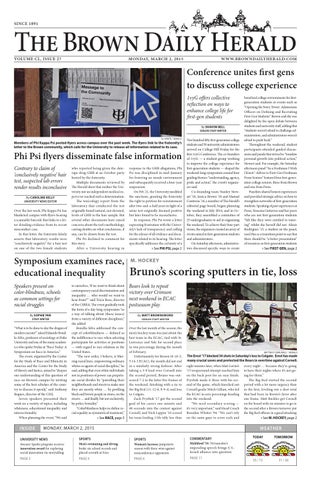
Members of Phi Kappa Psi posted flyers across campus over the past week. The flyers link to the fraternity’s letter to the Brown community, which calls for the University to release all information related to its case.
Phi Psi flyers disseminate false information Contrary to claim of ‘conclusively negative’ hair test, suspected lab errors render results inconclusive By CAROLINE KELLY UNIVERSITY NEWS EDITOR
Over the last week, Phi Kappa Psi has blanketed campus with flyers bearing a scannable barcode that links to a letter detailing evidence from its recent misconduct case. In that letter, the fraternity falsely asserts that laboratory results were “conclusively negative” for a hair test on one of the two female students
who reported being given the daterape drug GHB at an October party hosted by the fraternity. Multiple documents reviewed by The Herald show that neither the University nor an independent medical expert ever reached such a determination. The toxicology report from the laboratory that conducted the test originally found natural, not elevated, levels of GHB in the hair sample. But several other documents have raised concerns about the test’s methodology, casting doubts on what conclusions, if any, can be drawn from the test. Phi Psi declined to comment for this story. After a University hearing in
response to the GHB allegations, Phi Psi was disciplined in mid-January for fostering an unsafe environment and subsequently received a four-year suspension. On Feb. 21, the University modified the sanctions, granting the fraternity the right to petition for reinstatement after two-and-a-half years in light of a urine test originally deemed positive but later found to be inconclusive. In response, Phi Psi wrote a letter expressing frustration with the University’s lack of transparency and calling for the release of all evidence and documents related to its hearing. The letter specifically addresses the certainty of a » See PHI PSI, page 2
Two hundred fifty first-generation college students and 50 university administrators arrived on College Hill Friday for the first 1vyG Conference. The co-founders of 1vyG — a student group working to improve the college experience for first-generation students — shaped the weekend-long symposium around four guiding themes: “understanding, agency, pride and action,” the event’s organizers said. Co-founding team Stanley Stewart ’16, Jessica Brown ’16 and Manuel Contreras ’16, a member of The Herald’s editorial page board, began planning the weekend in July 2014, and in October, they assembled a committee of 25 undergraduates to aid in organizing the weekend. To achieve their four-part vision, the organizers created an array of events aimed at first-generation students and administrators. On Saturday afternoon, administrators discussed specific ways to create
beneficial college environments for firstgeneration students at events such as “Opening the Ivory Tower: Admissions Officers on Defining and Recruiting First-Gen Students.” Brown said she was delighted by the open debate between students and university staff, adding that “students weren’t afraid to challenge administrators, and administrators weren’t afraid to push back.” Throughout the weekend, student participants attended guided discussions and panels that strived to “translate personal growth into political action,” Stewart said. For example, the Saturday afternoon panel “‘As a Freshman I Wish I Knew’: Advice to First-Gen Freshman From Seniors” featured four first-generation college seniors, three from Brown and one from Penn. Panelists shared honest experiences and provided strategic advice on how to strengthen networks of first-generation students. Speaking of past experiences at Penn, Yessenia Gutierrez said her peers who are not first-generation students “felt like they were entitled to tutoring” whilst she herself did not. Alexis Rodriguez ’15, a student on the panel, used this as a transition point to say that there should be “a better presentation” of resources as first-generation students » See FIRST GEN, page 2
Symposium examines race, M. HOCKEY Bruno’s scoring sputters in tie, loss educational inequality Speakers present on color-blindness, schools as common settings for racial struggles By SOPHIE YAN STAFF WRITER
“What is to be done to slay the dragon of modern racism?” asked Eduardo Bonilla-Silva, professor of sociology at Duke University and one of the many academics who spoke Friday at “Race Today: A Symposium on Race in America.” The event, organized by the Center for the Study of Race and Ethnicity in America and the Center for the Study of Slavery and Justice, aimed to “deepen our understanding of this question of race on Brown’s campus by inviting some of the best scholars of the country to discuss it openly,” said Anthony Bogues, director of the CSSJ. Seven speakers presented their work on a variety of topics, including whiteness, educational inequality and intersectionality. When planning the event, “We said
INSIDE
to ourselves, ‘If we want to think about contemporary racial discrimination and inequality … who would we want to hear from?’” said Tricia Rose, director of the CSREA. The event gradually took the form of a day-long symposium “as a way of talking about (these issues) from a variety of different disciplines,” she added. Bonilla-Silva addressed the concept of colorblindness — defined as the indifference to race when selecting participants for activities or positions — with regard to race relations in the United States. “The new order, I believe, is blurring racial lines, empowering ordinary whites as agents of racial discipline,” he said, adding that even white individuals not in positions of power can perpetuate racial divides by “patrolling their neighborhoods and streets to make sure they are mostly white … by profiling black and brown people in stores, on the streets … and finally, but not exclusively, by police brutality.” “Colorblindness helps us define racial equality as symmetrical treatment,” » See RACE, page 3
Bears look to repeat victory over Crimson next weekend in ECAC postseason play By MATT BROWNSWORD SENIOR STAFF WRITER
Over the last month of the season, the men’s hockey team was just about the best team in the ECAC, tied with St. Lawrence and Yale for second place in win percentage during the month of February. Unfortunately for Brown (8-18-3, 5-14-3 ECAC), the month did not end in a similarly strong fashion: After taking a 3-0 lead over Cornell into the second period, Bruno was outscored 7-2 in the latter five frames of the weekend, finishing with a tie to the Big Red (11-12-6, 9-9-4) and loss to Colgate. Zack Pryzbek ’17 got the second goal of his career one minute and 40 seconds into the contest against Cornell, and Nick Lappin ’16 scored his team-leading 11th tally less than
BRITTANY COMUNALE / HERALD
Tim Ernst ’17 blocked 34 shots in Saturday’s loss to Colgate. Ernst has made many crucial saves and protected the Bears in overtime against Cornell. eight minutes later, when Matt Lorito’s ’15 wraparound attempt reached him on the back post for an easy finish. Pryzbek made it three with his second of the game, which knocked out Cornell goalie Mitch Gillam, who led the ECAC in save percentage heading into the weekend. “We need secondary scoring — it’s very important,” said Head Coach Brendan Whittet ’94. “We can’t rely on the same guys to score each and
every night … because they’re going to have their nights where it’s not going for them.” The Big Red started the second period with a lot more urgency than in the first, leveling out a shot total that had been in Brown’s favor after one frame. Matt Buckles got Cornell on the board with six minutes to go in the second after a Brown turnover put the Big Red offense in a good attacking » See M. HOCKEY, page 2
WEATHER
MONDAY, MARCH 2, 2015
UNIVERSITY NEWS Swearer Sparks program receives innovation award for exploring social innovation via storytelling
SPORTS Men’s swimming and diving broke six school records and placed seventh at Ivies
SPORTS Women’s lacrosse jumpstarts season with three wins against nonconference opponents
COMMENTARY Makhlouf ’16: Netanyahu’s impending speech brings U.S.Israeli alliance into question
PAGE 3
PAGE 4
PAGE 6
PAGE 11
TODAY
TOMORROW
35 / 13
31 / 26
UNIVERSITY NEWS PAGE 2 • MONDAY, MARCH 2, 2015
» PHI PSI, from page 1 GHB hair test, the results of which were never made public by the University. The fraternity originally sent the letter to The Herald, which declined to publish it Feb. 23 without additional information to back up its assertions. The Providence Journal published the letter on its website later that day. Members of the fraternity have distributed the letter widely in high-traffic areas around campus in recent days. The Carlson Company, which produced the lab report, sent the sample to ExperTox, a Texas-based laboratory, to perform the test. The University hired Guy Vallaro, director of the division of scientific services at Connecticut’s Department of Emergency Services and Public Protection, to independently review test results related to Phi Psi’s case. A major concern raised by multiple parties about the Carlson Company’s report was the process by which the hair was tested. Since recently ingested substances appear in higher concentrations in
» FIRST GEN, from page 1 begin their college careers. Later in the evening, Eric Waldo ’00, executive director of First Lady Michelle Obama’s Reach Higher Initiative, gave the keynote address at a dinner hosted in Alumnae Hall. Like the panelists, Waldo spoke of empowerment for first-generation students. He spoke extensively about the Reach Higher campaign, which aims to increase enrollment in higher education nationwide. To the 1vyG team, helping to establish connections between first-generation attendees was just as important as featuring prominent speakers. “One of the things that … I wanted people to get out of this was genuine connection — the idea that we’re first gens and we’re not alone,” Stewart said. Aubrey McDonough ’17, a student attendee, said, “Coming to this conference, sharing my experience and hearing
THE BROWN DAILY HERALD
hair closest to the scalp, measuring the strand of hair by section — a process called segmenting — is “essential” to reveal any spikes in GHB levels, Vallaro wrote Feb. 5 in his report to Margaret Klawunn, vice president for campus life and student services. “There is no indication that the hair was segmented prior to analysis,” Vallaro wrote. A letter reviewed by The Herald describes interactions between Unab Khan, medical director at Health Services, and Ernest Lykissa, laboratory director at ExperTox, in early January. Lykissa was “adamant” in defending the accuracy of the test results and his procedures, according to the letter. But in a separate Jan. 12 letter to Lykissa, Khan expressed doubts about the validity of those methods. “You are very confident that the results are negative even though the whole hair shaft was tested for GHB … instead of a particular area that would have corresponded to the time of the alleged event,” she wrote. “You mentioned that averaging the result of the whole hair shaft could give false negative results.”
Khan also raised questions about whether Lykissa recorded GHB levels for each segment, as opposed to the full strand, and whether the Carlson Company has the requisite certifications to “report segmented levels of GHB in hair tests.” Khan could not be reached for comment by press time. The Herald sought comment from Klawunn for this story early Sunday morning. She did not comment. On Sunday evening, the University sent a community-wide email addressing the hair test and other aspects of the case. The University “received inconsistent accounts from the laboratory about how the test was conducted, leading to concerns about the reliability of the information from the laboratory,” the email stated. The email also reiterated that “a failure to positively identify the presence of exogenous GHB does not prove that GHB or another drug was not ingested.”
the experience of other people with similar stories” gave her “a sense of solidarity” and the feeling that she belongs. As students and administrators left campus Sunday, Brown said the 1vyG team looks forward to future collaborations with first-generation activists at other universities. Attendees are
mobilized and ready to implement solutions and continue the discourse at their own campuses, she added. As a result of this mobilization, as well as the increased transparency among first-generation community organizers, Contreras said he believes that the conference “will create ripples across higher ed.”
- With additional reporting by Michael Dubin
RICHARD FLORES / HERALD
1vyG’s first conference featured speakers such as Eric Waldo ‘00, executive director of First Lady Michelle Obama’s Reach Higher Initiative.
» M. HOCKEY, from page 1 position. “We played a great first period,” Whittet said. “We were good halfway through that second period, and then they got their first goal and we just have a tendency to go into a shell. We didn’t forecheck, we didn’t play physical and we let them dictate, and that’s what they did for basically the last two periods and then the overtime.” John McCarron got Cornell’s second of the game four minutes later, cutting the Brown lead to one. The Bears had a power play to close out the second period but could not convert — a recurring theme this weekend. Cornell evened the score five minutes into the third period, as a rebound from a save by Tim Ernst ’17 went right to Christian Hilbrich, who slid the puck under the diving Brown goaltender. The third period featured a lot more open play than the previous two, with Cornell holding a distinct 14-6 shot advantage in the final frame. All of the drama was left for overtime: After Ernst made a few crucial saves — including one on a blast from Joakim Ryan — Cornell appeared to put the puck in the net courtesy of a Cole Bardreau rebound wrister. The referees reviewed the play for more than five minutes and decided that the goal would be waved off after replay showed that Hilbrich interfered with Ernst. The call was hotly contested, as it was unclear whether Hilbrich spun Ernst around or if Ben Tegtmeyer ’18 forced Hilbrich into an unfortunate position. “It was something where somebody’s stick for Cornell twisted (Ernst) around and then it went in the net, so he didn’t have an opportunity to make a play on the puck,” Whittet said. “That was my interpretation and that’s what (the referees) told me.” Ernst “allowed us the opportunity to get a point, which we probably didn’t deserve, quite honestly,” Whittet added. But it remained no goal, and the
game ended in a 3-3 tie. Given the outcome, Brown needed Union not to win or RPI to lose to be able to move up a spot. The Bears had no luck, as Union beat St. Lawrence 3-2 and RPI tied Clarkson 3-3. So Bruno entered its matchup with Colgate (19-11-4, 11-7-4) — which came into the game needing a win to guarantee a bye in the first round — playing for the seniors in their last game at Meehan Auditorium. Massimo Lamacchia ’15, Matt Harlow ’15, Kyle Quick ’15, Joey de Concilys ’15, Ryan Jacobsen ’15 and Lorito were honored before the game, receiving flowers and a framed picture of each one playing in a Brown uniform. It was Lorito who kicked off the day, scoring three minutes and 13 seconds into the contest after Naclerio’s poke check set the senior on a breakaway. Then, after Colgate equalized, the senior scored his second of the game and tenth of the season on a beautiful individual goal, taking the puck in the neutral zone, faking a shot and then wrapping around the back to put the puck past Finn. “He’s been a great hockey player for four years here,” Whittet said. The second period was goalless, as the battle between a team that had everything to play for and a team that had relatively nothing to play for wore on. Ernst came up huge again, stopping a Colgate breakaway and the rebound from his stomach. The twoperiod blocked-shot total for Brown was 12, as the Bears tried to keep as many pucks away from Ernst as possible. Baun was sent to the box 54 seconds into the third period, which set up the abysmal Brown power play to finally redeem itself. It did the opposite: While the man advantage expired, Jake Kulevich pushed a shot past Ernst that looked like it crossed the line, but the officials called no goal. After a review, it was ruled a goal, and the game was tied at two. The Brown power play has now converted just one of its last 20 attempts, giving up a shorthanded goal to Princeton and a goal one second after a penalty expired to the Raiders. “There’s some inadequacies that we have to work out — our power play has been abysmal,” Whittet said. “You’re not going to go far in the playoffs with a power play that not only doesn’t score but gives up a lot of shorthanded opportunities as well.” Tyson Spink gave Colgate the lead 17 seconds later, and Tim Harrison all but finished the game just over halfway through the third period with a five hole of Ernst. The sophomore finished with 34 saves in the losing effort, after a 29-save effort the night before. Results around the league were more favorable for the Bears Sunday. With the Big Green’s 3-1 win over Quinnipiac and the Crimson’s 5-0 win over Princeton, Bruno was officially set for a trip to Cambridge for a best-of-three series against Harvard. Avoiding Dartmouth — which has outscored Brown 12-3 this season — was a great development for the Bears, and Brown’s win over Harvard earlier this month should provide a confidence boost heading into the postseason. “We just have to continue to do the things that we’ve been doing and just do them with a little more consistency,” Whittet said. “No matter who we play, we’re going to be ready to battle.”
UNIVERSITY NEWS
MONDAY, MARCH 2, 2015 • PAGE 3
THE BROWN DAILY HERALD
Swearer Sparks honored at national event » RACE, Swearer Center program shares social work via website, receives award for innovation By KHIN SU STAFF WRITER
Swearer Sparks, a student-run website that shares stories about social innovation in the Brown community and beyond, was formally recognized with the Ashoka U-Cordes Innovation Award at a conference Saturday. Alex Braunstein, communications and outreach manager at the Swearer Center and founder of the website, accepted the award at the Ashoka U Exchange conference in Washington, D.C. “I was floored,” Braunstein said of receiving the honor. “It’s still a young program, but I think the work we are doing is innovative and something that the field of social education really values.” Swearer Sparks launched in May 2014 and is part of the Storytellers for Good program at the Swearer Center. The website aims to create a network that shares the innovative social work of students, faculty members and alums with the rest of the Brown community, Braunstein said. Upon joining the Swearer Center in 2012, Braunstein noticed that Brown community members came to the center to explore ways of connecting with others in the field of social innovation work. Now, with more than 200 stories on the site, Swearer Sparks is an “evolving space for the social innovation and social justice community at Brown,” she said. Ashoka offers funding and support to social entrepreneurs around the world, with more than 3,000 Ashoka fellows in 70 nations, according to its website. Last year, the University gained recognition as one of Ashoka’s 22 Changemaker Campuses and hosted the Ashoka U Exchange, a global conference focused on social entrepreneurship. Candidates for the Ashoka U-Cordes Innovation Award are
considered on the basis of innovation, replication and maturity. Swearer Sparks fulfills all of these criteria because it has been able to adapt and make corrections as it grows, said Diana Wells ’88, president of Ashoka, adding that the program could be easily replicated on other campuses. “Storytelling is a very powerful tool, and when I think about the work Ashoka has done over these five years, we’ve helped the world see that the social entrepreneur exists across the globe,” Wells said. “It’s been a gigantic leap forward to make our work visible,” said Kate Trimble, acting director of the Swearer Center. The website is “a really vibrant place for students to share their work” and “reflects the diversity of work we do here,” she added. Five undergraduates are currently working directly with Braunstein to produce audio stories and other digital content for the website. Sophie McKibben ’16, who grew up listening to National Public Radio and other radio stations, said she joined the program in fall 2014 because she wanted to find and tell stories. “The coolest thing about Storytellers for Good is that it lets people into the world of social
entrepreneurship,” she said. Isabel DeBre ’18, another storyteller, said the platform “unites the realms … of storytelling and social justice on campus.” DeBre has written about and spoken with Brown alums, photographers, representatives from National Geographic and Brown faculty members about the social work in which they are involved. Student storytellers attend editorial meetings and workshops with Braunstein in which they learn skills in storyboarding, photography, digital media and storytelling, DeBre said. “The more I’ve been in it, the more I’ve gained,” she added. This year, the program is expanding to cover a broader range of topics, said Liza Yeager ’17, a storyteller who joined in the fall of 2013, the year the program started. While Storytellers for Good focused on social innovation last year, it now includes social justice work on campus and other social change work in the community, she said. “Part of why it’s so exciting … (is) I’ve been able to really shape the program,” Yeager added. “I get to spend time with a really small group of people who really care about the things they do.”
from page 1
said Kimberlé Crenshaw, professor of law at the University of California, Los Angeles, who spoke about intersectional issues of race in her lecture entitled “Race, Gender, Inequality and Intersectionality.” “To be colorblind as a response to race and racism, you have to boil down racism to decisions on the basis of race … you have to have a static definition of race, framed as skin color,” she added. Crenshaw said color-blindness has historically been used in the context of law to denounce policies such as affirmative action as preferential treatment. She added that the idea behind affirmative action directly contrasts the idea behind color-blindness. Na’ilah Suad Nasir, associate professor of African American studies at the University of California, Berkeley, drew connections between affirmative action and racial divides in her talk entitled “The Culture of Educational Equality.” “Schools are longstanding sites of racial struggle,” as they “both reproduce inequality and also disrupt it,” Nasir said. She added that she primarily researches how culture, stratification and identity play into students’ learning and educational outcomes. A growing emphasis on the three interrelated phenomenons of neo-liberalism and marketization, color-blindness and meritocracy has led to greater segregation and inequality in an increasingly diverse world, Nasir said. “These three trends deeply inform one another,” she added. “They open up certain learning pathways to students and close others.” Rose said she was thrilled with both the volume and diversity of the audience. She added that she and Bogues were very pleased with the speaker selection, describing the group as a “dream team” of academics from across the
country. “These are scholars who are doing some of the best work in race studies today,” said Leila Blatt ’15, an Africana studies concentrator, adding that she was really impressed with the number of attendees. “I’m not surprised about the turnout,” Bogues said. “There’s something in the air. … People want to grapple with and have conversations about” race, he added. “I’ve been interested in learning about how discrimination exists at Brown and (the Rhode Island School of Design) today for a while now,” said Soo Joo, a sophomore at RISD. Joo said classes she has taken at Brown and the symposium made her “think about how even in such elite and liberal and multicultural institutes of higher education, discrimination still exists in the form of sexism, racism” and judgments based on sexual orientation. “I hope that this momentum that’s happening right now where students are thinking about race and racial issues kind of builds and provides a greater platform for the Center for the Study of Race and Ethnicity and for the Center for the Study of Slavery and Justice,” Blatt said. Blatt added that she wishes events similar to the symposium happened more frequently. “Often issues of racial formation in the 21st century are set aside to the margins of academia … and I think there’s still a significant portion of Brown (students) who think that conversations like this aren’t relevant to them,” she said. For Joo, the next step is to consider how she can act on what she learned at the symposium. “If we focus on not just talking about it, but also finding ways to address these issues in our own communities, I think that would be an ideal goal.”
www.browndailyherald.com
TIMOTHY MUELLER / HERALD
The Swearer Sparks program is broadening its online story topics from social innovation at Brown to social justice work on and off campus.
SPORTS
PAGE 4 • MONDAY, MARCH 2, 2015
THE BROWN DAILY HERALD
M. SWIMMING
Bears set six program records in seventh-place finish at Ivies
DAVID DECKEY / HERALD
Coaching and structural changes marked a transition year for the swimming and diving teams. The year culminated with Ivy Championships, where many Bears swam personal bests but could not beat opponents.
Riley Springman ’18 smashes two school records, posts Brown’s top finish at Ivy Championships By LAINIE ROWLAND SENIOR STAFF WRITER
The men’s swimming and diving team capped off its 2014-15 season this weekend with a seventh place finish at the Ivy Championships, outscoring only Dartmouth. Six school records fell in the process, marking a year of program growth for Bruno. “Our goal was to learn how to compete with the upper levels in the sense that we perfect our races and be
confident athletes,” said co-captain Brian Barr ’15. “That was the biggest change that was made this year, and it was a step in the right direction.” In individual medley competition, Riley Springman ’18 broke the first Brown record of the weekend with his performance in the 200-yard individual medley, though his time placed him 20th in a competitive field. He issued a repeat performance in the 400-yard individual medley on day two, smashing a five-yearold record by more than three seconds
and earning a 10th-place finish. Springman continued to shine in the 200-yard butterfly, earning fifth place — Bruno’s top finish of the weekend — with a time of 1:45.96. “Tommy Glenn (’14) left a big hole to fill on this team, but Riley is well on his way to fill that spot,” said Connor Lohman ’17. First-years saw their fair share of record-breaking swims this weekend. Grant Casey ’18 swam the 1,000-yard freestyle in 9:08.57, 2.34 seconds faster than the previous program record and enough to earn a 10th-place finish at the Ivy Championships. Casey “stepped up in every event,”
Barr said. The top performances by young athletes bode well for the squad’s future. The medley relay team of Alex Pascal ’15, Christopher Meyers ’16, Jeffrey Strausser ’15 and Daniel Klotz ’17 made big contributions with two sixth-place finishes in the 400-yard medley relay and the 200-yard medley relay. Their time of 1:28.55 in the 200 earned them a new school record. “Of course, we all knew lots of people were capable of breaking (the school records), but it’s not often that everything comes together all at once like that,” Lohman said. Meyers also contributed to the record-breaking performances, swimming the 100-yard breaststroke in a time of 54.75 in preliminaries to best a fouryear-old record. Lohman also chipped in, swimming the 200-yard breaststroke in a time of 1:59.23 to set yet another program record and finish 11th in the event. “What’s most impressive is that (the record breaking) was from four different people, not one guy,” Barr said. Jonathon Schlafer ’17 represented Brown from the diving board, finishing eighth in both the 3-meter and 1-meter dives. “Watching our divers compete so well at Ivies was one of the best parts of the weekend,” Lohman said. “They have improved a lot this year and really were huge point-scorers for us, topping off a great year for diving.”
The freestyle relay teams also garnered points for the Bears as the quartet of Klotz, Strausser, Pascal and Jack Nee ’17 finished seventh in the 200-yard freestyle relay and eighth in 400-yard freestyle relay. Klotz also finished 10th in the 50-yard freestyle with an NCAA “B” cut time as Strausser finished 15th in the race. The relay team of Barr, Cory Mayfield ’16, Kevin Mertz ’17 and Talbot Jacobs ’18 rounded out Bruno’s scoring with a seventh-place finish in the 800yard freestyle relay. Though the results may seem disappointing on paper, the season marked a transition for Bruno in coaching, training and structure as the program attempts to generate a new upward trajectory. “This year was about improving the team while also adjusting to a new program with almost all new coaches,” Lohman said. “Teams don’t always show immediate improvement in transition years, and I think our performance this year is just a preview of what’s coming up.” The squad is focused on competing at an elite level going forward and sees this season as a stepping stone to further success. Competing against top athletes at Ivy Championships gets them one step closer. “I actually took a picture of the crowd last night because it made me realize the level of what we’re competing at,” Barr said. “It’s a cool atmosphere to be in once you realize you’ve come that far.”
SPORTS
THE BROWN DAILY HERALD
MONDAY, MARCH 2, 2015 • PAGE 5
SQUASH
Three represent Bruno at Individual National Championships Bears rank low in ‘B’ division of national championships at Princeton this weekend By JACLYN TORRES CONTRIBUTING WRITER
The best squash players in the nation battled it out this weekend in the last tournament of the season: the College Squash Individual National Championship. Three members of the squash team traveled down to Princeton Thursday for matches from Friday morning until Sunday night. Hannah Hay-Smith ’17, ranked No. 71 in the country, Mina Shakarshy ’15, ranked No. 74, and Nicolas Talbott ’15, ranked No. 71 among men, all competed in this weekend’s tournament. Hay-Smith and Shakarshy competed in the Holleran Division — the “B” division of play. Talbott competed in the Molloy Division, the men’s “B” division. “This was my first squash tournament ever,” Talbott said, who switched to squash from tennis this year. “It was great playing at the top collegiate level against guys who are at or just below the pro level.” Hay-Smith fared the best in the tournament. In the first round of play on Friday, she faced Drexel sophomore Mary Fung-A-Fat, ranked No. 59 in the country. Hay-Smith got off to a shaky start, losing the first set 11-5. She quickly bounced back to win the second set 11-6, but the Brown sophomore stumbled again in the third set and lost 11-7. With Fung-A-Fat up two sets to one, Hay-Smith edged out two victories in the next two sets, winning both 11-9 to advance. Late Friday afternoon, Hay-Smith walked back into the courts to face off against Middlebury junior Saskia Pownall-Gray, ranked No. 40 in the country. Hay-Smith took the first two sets 11-9 and 11-1, respectively. The
third set proved difficult — it was a constant back-and-forth, with neither player grabbing the necessary twopoint lead to win. Finally, Pownall-Gray claimed victory 14-12. But Hay-Smith quickly crushed any newfound confidence Pownall-Gray might have gained, finishing out the match with an 11-3 win in the fourth set. With two matches won on the first day of tournament play, Hay-Smith looked to her next match Saturday afternoon. Meanwhile, Shakarshy was having more trouble in the first round of play against Yale junior Georgia Blatchford, ranked No. 56 in the country. Shakarshy got off to a rough start, losing the first set 11-7. After regrouping, Shakarshy entered the court with a new fire and claimed the next two sets. With two wins under her belt, Shakarshy was ready to hammer home a victory. But Blatchford came out with a vengeance and stole the next two sets to move on. Though Shakarshy lost in the first round of play, she continued to vie for a top spot in the consolation bracket. Later in the day, the senior faced HaySmith’s first opponent, Fung-A-Fat, in the second round of consolation play. The match was even, with Fung-A-Fat taking the first set 12-10 and Shakarshy taking the second and third sets 1210 and 11-5, respectively. Shakarshy had a quick dip in her play, losing the fourth set 11-7, but she quickly came back to win the fifth set by a narrow 14-12 margin. Over in the men’s bracket, Talbott battled Williams senior Kevin Chen, ranked No. 58 in the country, in the first round of play. Talbott took a brutal beating, losing all three sets. The senior then entered the consolation bracket and found success. A few hours after his loss to Chen, Talbott matched up against Dickinson freshman, No. 74 Nicholas Struzenski, and swept him in all three sets.
JOSH STERN / HERALD
Nick Talbott ’15 played in his first championship tournament this weekend. Talbott, who was previously on the men’s tennis team, has translated his skills from the tennis court to the squash court. “My strategy is to outrun the other Shakarshy then headed to the con- teammate Shakarshy, who stepped guy,” Talbott said. “I make the game a solation semifinals, where she faced onto the court for the consolation physical match instead of a skills match Williams junior Nicole Feshbach, finals against Yale sophomore No. because my skills are not at the level ranked No. 75 in the country. Sha- 83 Madeline Tomlinson. In the first of most of my opponents — guys who karshy had a rocky start and lost the two sets, it was impossible to tell who have been playing for 15 years.” first set 11-9. But she quickly gained would win. Tomlinson took the first set As all three Brown players ad- back her confidence and took the next 12-10 and Shakarshy took the second vanced to Saturday, the stakes were three sets to advance to the finals. set by the same score. The tension was higher. Hay-Smith faced Blatchford Talbott played Princeton junior palpable, and the stress was building. and struggled to find her footing, Sam Ezratty, ranked No. 65 in the Shakarshy struggled to win points and dropping all three sets. With her loss country, in the consolation quarterfi- lost the two remaining sets 11-5 and in the third round, Hay-Smith did nals and swept him in three sets. But he 11-5. not qualify for the consolation games stumbled in his next matchup against The three Bears performed well this and finished the tournament with a Middlebury freshman No. 67 Will weekend at the College Squash Indirespectable 2-1 record. McBrian. Talbott could not find his vidual Championship tournament and Similarly, Shakarshy was finding rhythm for the first two sets, dropping finished the season strong, while the success. After a close win Friday, she both, but he came back to edge out an men’s and women’s teams ended with found her spark Saturday. She played exhaustive 15-13 win in the third. But a 7-9 record and 0-7 in the Ivy League. Haverford freshman Isabelle Guatoco, he was not able to maintain his game, “We had a great season,” Talbott ranked No. 79 in the country, in the losing the fourth set. He finished the said. “We got three new freshmen on consolation quarterfinals. Shakarshy tournament with a 2-2 record. the men’s side who have really got the dominated the entire match, winning Once Hay-Smith and Talbott were ball rolling. The rankings were tough, the first set 11-6 and the last two sets both out of the championship tourna- but we hope to establish a spot in the 11-3. ment, they turned to support their ‘B’ division for next year.”
SPORTS
PAGE 6 • MONDAY, MARCH 2, 2015
THE BROWN DAILY HERALD
W. LACROSSE
Bears start season on high note with decisive victories Nonconference opponents allow Bruno to tune up before Ivy League play starts next weekend By ANDREW FLAX SPORTS EDITOR
The women’s lacrosse team continued its strong start to the season this weekend, drubbing Iona and Central Connecticut State on the road 13-6 and 13-5, respectively. The Bears (3-0) are continuing a trend of early-season success: Last year’s team started 7-0, including a pair of Ivy League wins. But Bruno wilted down the stretch, finishing the year 2-6 and dropping all five of its final conference games. Midfielder Abby Bunting ’15 said the team hopes to stay hot this year. “If we remain positive throughout our season and focus on getting better every week, we won’t have a chance to cool off,” she said. Last season ended with Bruno in seventh place, falling short of the fourth-place finish necessary to qualify for the Ivy tournament. The team has not made the tournament in the last 13 years, which is as far back as records are available. But Bunting believes this year’s team is even better than it has shown so far.
“Our team has a lot of potential, and we are nowhere close to being our best selves,” she said. “We have a lot of work to do, and if we continue to grow, it will make us that much better later on in the season when we play some of our tougher games.” Despite the graduation of more than half of the team’s goals from 2014 — a total of 93 from Bre Hudgins ’14, Danielle Mastro ’14 and Grace Healey ’14 — the Bears are still a potent offensive force. They have scored at least 12 goals in each of their first three games, and they torched the Gaels (2-2) and the Blue Devils (1-3) for 13. “A lot of different people have been stepping up on offense, which has made us a hard team to stop,” Bunting said. “We are a new team, so the more we play together, the better we understand each person’s tendencies, and that makes our offense much more dynamic.” Filling the departed seniors’ shoes, three more players have emerged as the team’s primary offensive options. Lauren Toy ’16 leads the Bears with eight scores, followed closely by Janie Gion ’15 with six and Yuna Hur ’18 with five. The trio has combined for exactly half of Bruno’s 38 goals on the year. But against Iona and CCSU, the Bears distributed their offense well. Eight different players scored against the Gaels, and nine found the back
of the net against the Blue Devils. No player scored more than three goals in either game. The Bears jumped all over Iona, leading 6-2 at halftime and taking an 11-3 lead just over halfway through the second half to all but seal the victory. Toy led the offense with three goals on the afternoon. Against Central Connecticut, Bruno entered the intermission with a 5-2 lead and pulled away with five goals in just over five minutes early in the second half. Bruno’s defense also had an excellent day against the Blue Devils. The back line limited CCSU to just 21 shots and 15 on goal, while the Bears mustered up 31 and 24, respectively. Against Iona, the Bears held only a 2220 lead in shots but a decisive 20-12 advantage in shots on goal. Goalie Kellie Roddy ’15 did her part in stonewalling both teams, saving 15 of 26 shots on the weekend. She has saved an even 55 percent of her shots faced this season, a dramatic improvement on last season’s 45.4 percent rate. The Bears open Ivy play Saturday against No. 12 Penn, which will mark the first true test of this team’s mettle. “We are really excited,” Bunting said. “Ivy League games bring out a whole new level of intensity and competition. Penn is a great team, and we always play them close, so we are excited to get the win this year.”
KATIE LIEBOWITZ / HERALD
Alyssa DiBona ’15 won four ground balls this weekend as Bruno’s attack rolled past Iona and Central Connecticut State’s defenses.
» M. BBALL, from page 12 It was a blowout across the board, with the Tigers besting Bruno in field goals, three-pointers, free throws, rebounds, assists, steals and turnovers. The lead ballooned to as much as 29 before the Bears finished on a 22-11 run to make the final score a little easier to swallow. “That wasn’t any fun, and Princeton deserves a lot of credit,” Martin said. “They’ve got multiple guys that can dribble, pass and shoot at a high level. They are unselfish, and they move the ball.” Solid Senior Night performances from Bruno’s eldest players provided bright spots in the bleak game. Walker was energetic inside, scoring 10 points and grabbing five rebounds. Maia was as impactful and consistent as usual with nine points and nine rebounds. In his rare minutes, Yiljep went 2-of3 from the field, and crowd favorite
» W. BBALL, from page 12 Alexander stopped the bleeding with a jumper of her own, only for Princeton’s star guard Blake Dietrick to come back up the floor and score three the oldfashioned way. The Tigers began to increase their lead to as much as 16. The Bears came as close as eight with a little over a minute to play but would not get any closer, as Princeton held on for the victory. The Bears tested the seventh-best defense in the nation. Sixty-seven points was the most the Tigers had allowed all season. Unfortunately for the Bears, their usually reliable threepoint shooting was not up to par on this night: The team shot a miserable 2-of-17 from downtown.
Schmidt made a nice post move and sunk a shot in the final minute for his second basket of the season. “It was very emotional for me. It’s unfortunate that I didn’t get the result that I wanted for my last game here,” Maia said. “I love Brown.” Blackmon’s injury forced Martin to rely on first-years, which created passing-of-the-torch lineups filled with seniors and first-years. Patrick Triplett ’18 had one of the best games in his rookie campaign, compiling seven points, five assists and just one turnover while filling in at point guard. Triplett said he felt more comfortable than he had early in the season, so he thought he “should be a little aggressive.” Blackmon said he will certainly return for Bruno’s final weekend of the season, and the Bears will need him. The squad hits the road this weekend to face conference-leading Harvard and red-hot Dartmouth.
“If we could have just shot the percentage that we normally do from the arc, we would have been able to cut it even closer in the final minute or so,” Alexander said. Dietrick is the engine that makes Princeton’s offense tick. She ended with 15 points and five assists on 60 percent shooting. Overall, her team shot an impressive 54 percent. While the Tigers did turn the ball over 18 times, the Bears could only produce 10 points off those mistakes. “They are a tough team … so I was really proud of how we did not back down at all,” Alexander said. The Bears will end their season with a home doubleheader against Dartmouth (13-13, 4-8) and Harvard (12-14, 5-7) this weekend.
UNIVERSITY NEWS THE BROWN DAILY HERALD
MONDAY, MARCH 2, 2015 • PAGE 7
SPORTS
PAGE 8 • MONDAY, MARCH 2, 2015
THE BROWN DAILY HERALD
M. LACROSSE
Molloy ’17 spearheads weekend defeat of UMass Bruno’s fast-paced offense outscores two nonconference opponents by total of 17 goals By NIKKO PASANEN STAFF WRITER
The men’s lacrosse team continued its impressive start to the season, taking down University of Massachusetts at Amherst by a final tally of 18-12 Saturday. Bruno (2-0) came out firing on all cylinders, scoring the first five goals of the contest and never looking back. Although the Minutemen (0-4) are winless on the season, their 14-13 loss to No. 13 Harvard last weekend proves this was certainly a solid result for the Bears. “We are just focusing on playing together and dictating the pace of the game,” said Kylor Bellistri ’16. “We all are excited to get out there and play the game we love.” The team was led by Dylan Molloy ’17, who netted a career-high seven goals on just 11 shots. Bellistri chipped in with three goals and three assists, while Henry Blynn ’16 put up four goals. It was a promising showing from Blynn, who missed the entirety of last season due to injury. In goal, Captain Jack Kelly ’16 made eight saves, bringing his season total to 23. “This is a great confidence builder for our team,” Molloy said. “Seeing success definitely motivates us more to continue to push ourselves and keep our expectations high for this season.” After the Bears’ scorching start in the first quarter, the game started to even up come the second. The Minutemen, who scored with just 16 seconds left in the first, matched the Bears goal for goal during the frame,
leaving the score at 9-5 going into the half. At one point UMass trimmed the lead to just two, but Blynn and Molloy both connected with under three minutes left in the quarter to push the margin back to four. At the start of the third quarter, UMass brought on the pressure again, this time cutting the lead to 9-6. But Bruno quickly followed with a goal of its own by Brendan Caputo ’16 and kept momentum to take a 13-8 lead into the final frame. Once again, Blynn and Molloy each scored at the end of the period. The Bears extended their lead to 18-10 with back-to-back goals by Molloy midway through the fourth period, effectively sealing the win. The win demonstrates that the Bears have reason to be optimistic about the upcoming season. So far the Bears’ new up-tempo offense has worked like a charm, with Molloy leading the charge. Last season, he took home the Brown FirstYear Male Athlete Award, and this season he will look to take his game to the next level. Expectations are certainly high, as the star sophomore tallied the sixth-most goals in the Ivy League in his first year out on the field. But so far it seems that Molloy is not fazed by the heightened attention, with 12 goals to his name already on the young season. “If I am scoring a lot of goals, it’s a domino effect,” Molloy said. “It just means that everyone on the team is doing well because it takes a great face-off player along with a great midfield and defense for the ball to get to the attack and the offensive side of the
KATIE LIEBOWITZ / HERALD
Captain Jack Kelly ’16 ranks second among Ivy League goalies in save percentage, boasting a 60.5 percent save rate with a total of 23 saves on the season. field so many times.” On the defensive side of things, Kelly will look to continue his impressive play in goal from last season, in which he led the Ivy League in saves per game. Bellistri also mentioned the stellar efforts of Jake Miller ’18, who has stepped up as an important long-stick defenseman. The Bears will now prepare for a Wednesday matchup at Hartford and
then travel to Ann Arbor to take on Michigan Sunday. Looking ahead, Bellistri and Molloy both expressed confidence that the team can have a successful year despite stiff competition in the Ivy League. “Playing as a team is the biggest thing,” Bellistri said. “We all want to win for each other, and we believe we have the weapons and mentality to make a deep run into the tournament.”
“We are very fortunate to have been given tools that no Brown team before us has had, like an amazing new locker room where our team can meet and discuss games, watch film and hang out together as a team,” Molloy said. “I have no doubt that with our team’s talent, attitude and the coaching that we are receiving that we will be a competitor in the Ivy League tournament.”
TODAY
MONDAY, MARCH 2, 2015 • PAGE 9
THE BROWN DAILY HERALD
B l a d e s o f G lo ry
menu SATELLITE DINING JOSIAH’S Crepes, Grilled Cheese BLUE ROOM Naked Burritos Soups: Chicken Noodle, Spinach and Feta, Three Bean Chili ANDREWS COMMONS Chili Bar, Steam Bun Sliders Pizza: Cheese Steak, BBQ Chicken Ranch, Caprese
DINING HALLS SHARPE REFECTORY LUNCH
DINNER
Andouille Red Beans and Rice, Meatball Grinder, Vegetarian Gnocchi Alla Sorrentina
Cajun Turkey Cutlet, Braised Fennel, Creamy Smashed Sweet Potatoes, Chocolate Cake
VERNEY-WOOLLEY LUNCH
DINNER
Pulled Pork, Moroccan Beans with Raisins, Carrots in Orange Sauce, Macaroni and Cheese
Bulgar Stuffed Peppers, Red Flannel Hash, Apricot Beef with Sesame Noodles, Egg Noodles
sudoku
DAVID DECKEY / HERALD
The Brown Band took to the ice after Saturday’s hockey game against Colgate. The band celebrated its 45th year on the ice this weekend.
comic Egoheads | J.H. Zech
crossword
calendar TODAY
TOMORROW
9 A.M. “IN FLANDERS FIELD” EXHIBIT
4 P.M. BASIC MENDELEY
Orwig Music Library will present an exhibit of works related to the 1915 poem “In Flanders Fields” that helped recruit new U.S. troops during WWI. Orwig Music Building
Students will learn how to use Mendeley, a software program for citation managements. The workshop will be designed for beginners. Rockefeller Library, Hecker Room
7 P.M. “THE HUNTING GROUND” SCREENING
4:30 P.M. “ABUS DE FAIBLESSE” SCREENING
Ivy Film Festival and the Sarah Doyle Women’s Center will show “The Hunting Ground,” a documentary that explores
“Abus de Faiblesse,” which translates to “Abuse of Weakness,” will play as part of the Providence French Film Festival. The film explores the relationship between a bedridden filmmaker and a conman. Cable Car Cinema
sexual assault on college campuses. Granoff Auditorium 8 P.M. SWING DANCE LESSONS
The Brown Swing Club will offer free, professionally-taught swing lessons. Beginners will be taught the Charleston and those at the intermediate level will learn the Lindy Hop. Alumnae Hall
4:30 P.M. “EPISTEMIC SHIFTS AND ANGELINA JOLIE”
The talk will detail the social factors that influence medical decisions, focusing on Angelina Jolie’s 2013 op-ed on her decision to undergo a double mastectomy. Science Center
COMMENTARY PAGE 10 • MONDAY, MARCH 2, 2015
THE BROWN DAILY HERALD
EDITORIAL
GET: Bear Bucks online Bear Bucks machines are centrally located and well-spaced throughout campus, with stations at the Sciences Library, J. Walter Wilson, the Sharpe Refectory, the Verney-Woolley Dining Hall, the Rockefeller Library and the Stephen Robert ’62 Campus Center. But for students who live off campus or need PawPrints in a pinch, some of these options limit their freedom of behavior, waste time and actually deny Brown a small but potentially significant source of revenue. Bear Bucks could easily be an online platform, if the University were to update its payment software with the CBORD Group Inc., the company managing the Bear Bucks GET portals. The added revenue could supplement dining costs, and it could even lead to Brown monetizing more interesting aspects of student life, such as events held by student groups. Bear Bucks provide an excellent internal currency for the University. It is money on the student ID card that Brown students can use and get reimbursed for at the end of each academic year. The student ID is like a debit card for Brown. The Bear Bucks system should be, like most bank accounts that students have, paperless. Students in a bind may prefer to use their credit cards to update Bear Bucks on the go, and GET already has a smartphone app that allows for this at most schools. But the University’s payment system does not have this feature, as it offers no option to use a credit card for a digital deposit. Brown could easily adopt this feature, as it already is part of GET’s digital system. So who stands to win from this change? Surprisingly, it’s Brown. As the University progressively raises tuition and deficit problems loom, small gains stand out. Motivating students to expend revenue on campus benefits Brown tremendously. Making Bear Bucks more convenient would guide more students to use their available Bear Bucks to buy Blue Room sandwiches, even if they are not on meal plan. It would motivate students to print via Brown’s system, instead of waiting it out with their own printers or those of friends. It could also get people to shop more at the Brown Bookstore. For parents, Bear Bucks provides a way to give their children money that can be spent only at Brown — which is particularly helpful for textbook shopping — and protects their children from having to carry wallets or cash, which is a liability if mugged. In the future, it is even possible that potential assailants will not target college students knowing they carry only student ID cards. It could be a fascinating innovation to make payments to student groups via the Bear Bucks system, to track purchases and budgets. Imagine if we could pay for student group events, such as a capella concerts, with Bear Bucks. Groups could borrow card scanners and easily ask for donations or charge for attendance. Some groups might chafe at the idea, but if cashing out with Bear Bucks were possible, the events could get more patronage from students who might not have cash on them. The change would make the University instrumental in providing money to its student groups and becoming more involved in their processing. Monitoring how student groups raise money would provide data on where and when the most successful fundraisers are, helping the many charitable or self-financed groups on campus. Facilitating spending on campus, monitoring cash flow and sharing that data with students presents an opportunity to increase University revenues, keeping money in Brown’s hands as it faces a deficit. The first step could be as simple as allowing online deposits.
KAYA H I L L
Q U O T E O F T H E D AY
“Of course, we all knew lots of people were capable of breaking (the school records), but it’s not often that
”
everything comes together all at once like that.
— Connor Lohman ’17
See m. swimming on page 4.
Got something to say? Leave a comment online! Visit www.browndailyherald.com to comment on opinion and editorial content.
Editorials are written by The Herald’s editorial page board: its editors, Alexander Kaplan ’15 and James Rattner ’15, and its members, Natasha Bluth ’15, Manuel Contreras ’16 and Baxter DiFabrizio ’15. Send comments to editorials@browndailyherald.com.
Editorial Leadership
Sections
Visuals & Production
Business
Editors-in-Chief Michael Dubin Maxine Joselow
Arts & Culture Editors Eben Blake Gabrielle Dee
General Managers Sarah Levine Winnie Shao
Managing Editors Kiki Barnes Jillian Lanney
Metro Editors Alexander Blum Emma Jerzyk Drew Williams
Design Editors Loren Dowd Carlie Peters Taylor Schwartz Assistant: Meryl Charleston Assistant: Andrew Linder
Senior Editors Camilla Brandfield-Harvey Isobel Heck Molly Schulson
Science & Research Editors Andrew Jones Steven Michael
BLOG DAILY HERALD Editor-in-Chief David Oyer
Sports Editors Andrew Flax Alex Wainger
Managing Editors Deena Butt Jacob Koffler
University News Editors Emma Harris Caroline Kelly Joseph Zappa
POST- MAGAZINE Editor-in-Chief Adam Asher DIGITAL Online Editor Marcy Huang
COMMENTARY Editorial Page Editors Alexander Kaplan James Rattner Opinions Editors Megan GrapengeterRudnick Kate Kiernan Evan Sweren
Photo Editors Head: Brittany Comunale David Deckey Katie Liebowitz Arjun Narayen Ashley So Ryan Walsh Graphics Editors Avery Crits-Christoph Emma Jerzyk Web Producers Joe Stein Harsha Yeddanapudy Abdullah Yousufi Copy Desk Chief Madeline DiGiovanni Illustrations Editor Angelia Wang Video Editor Richard Flores
Directors Sales: Moniyka Sachar Sales: Jess Urrutia Finance: Josh Tartell Alumni Relations: Marley Rafson Business Dev.: Yuta Inumaru Sales Managers Matthew Meyer Henry Ritter Gulmira Hamit Taylor Casey
facebook.com/browndailyherald
Location: 195 Angell St., Providence, R.I. www.browndailyherald.com
@the_herald
Editorial contact: 401-351-3372 herald@browndailyherald.com
browndailyherald.com
Business contact: 401-351-3260 gm@browndailyherald.com
Corrections: The Brown Daily Herald is committed to providing the Brown University community with the most accurate information possible. Corrections may be submitted up to seven calendar days after publication. Commentary: The editorial is the majority opinion of the editorial page board of The Brown Daily Herald. The editorial viewpoint does not necessarily reflect the views of The Brown Daily Herald, Inc. Columns, letters and comics reflect the opinions of their authors only.
Finance Managers Collections: Neil Wathore Collections: Benjamin Wesner Operations: Carin Papendorp
Letters to the Editor: Send letters to letters@browndailyherald.com. Include a telephone number with all letters. The Herald reserves the right to edit all letters for length and clarity and cannot assure the publication of any letter. Please limit letters to 250 words. Under special circumstances writers may request anonymity, but no letter will be printed if the author’s identity is unknown to the editors. Announcements of events will not be printed.
Business Dev. Manager Project Leader: Kaden Lee
Advertising: The Brown Daily Herald, Inc. reserves the right to accept or decline any advertisement at its discretion. The Brown Daily Herald (USPS 067.740) is an independent newspaper serving the Brown University community daily since 1891. It is published Monday through Friday during the academic year, excluding vacations, once during Commencement and once during Orientation by The Brown Daily Herald, Inc. Single copy free for each member of the community. Subscription prices: $280 one year daily, $140 one semester daily. Copyright 2014 by The Brown Daily Herald, Inc. All rights reserved. Periodicals postage paid at Providence, R.I. Postmaster: Please send corrections to P.O. Box 2538, Providence, RI 02906.
COMMENTARY MONDAY, MARCH 2, 2015 • PAGE 11
THE BROWN DAILY HERALD
Miscalculated arrogance PETER MAKHLOUF opinions columnist
Israeli Prime Minister Benjamin Netanyahu will speak to Congress Tuesday, March 3, in an event unprecedented in U.S. history. Never before has the Speaker of the House invited a foreign diplomat to instruct the bicameral legislature on its own foreign policy measures. When Netanyahu speaks, he will address the recent negotiations between the United States and Iran, which have been aimed at easing tensions between the two countries and convincing Iran to curb its nuclear enrichment program. But prior to Netanyahu’s decision to speak in Congress, an American Israeli Public Affairs Committee lobbyist announced that it had secured a veto-proof majority guaranteeing Congressional approval for more sanctions against Iran. Netanyahu has left AIPAC and his broad base of U.S. support in a state of confusion and consternation. And while American support matters to Israel’s prime minister, it seems the upcoming, Israeli midterm elections matter more. Many U.S. commentators have drawn attention to Netanyahu’s opportunism, including President Obama who insists — as is U.S. protocol — that he will not meet with a foreign diplomat whose country will soon be counting ballots; the Israeli elections are only two weeks away. Netanyahu’s decision is unleashing a whirlwind of anxiety in Washington and Tel Aviv, in Congress and the Knesset and in the homes of American and Israeli voters. This is Netanyahu’s method of demonstrating to the Israeli electorate that he wields power over U.S. policy. While many liberal Zionists shame Netanyahu for threatening the necessary U.S.-Israeli partnership, he is attempting to paint a different picture. The true America, according to Netanyahu, rests in the hands of the American right —
AIPAC, the Republicans and Christian conservatives. Rather than appeal to both parties as he has typically done, this time he is mainly pandering to conservative groups. And these groups have been vocal: The Emergency Committee for Israel and Christians United for Israel Action Fund issued a joint statement vowing to take action against any politicians who have refused to attend the speech. Netanyahu’s speech is opening one of the first cracks between Democrats and Republicans on the issue of Israel. Historically, U.S. relations with Israel have been the only point of fanatical agreement between the American left and right. Susan Rice, Obama’s top security aide, called attention to this anomaly, stating that support for Israel has always been bipartisan and
ity Office. Coupled with international disapproval of Israel’s treatment of Palestinians, support for Israel may be cracking under pressure. Those running for office will have to make a choice: Align themselves with Zionist ideology or jump the gap and act on behalf of U.S. interests and morals at the risk of upsetting Netanyahu, Israelis and pro-Israel supporters. And there is certainly a lot of money poured into American politics from pro-Israel donors. Sheldon Adelson, who once claimed that Palestinians are an “invented people” and who has been footing the bill for Republican campaigns for some time now, has gone on the record saying that he supports Republicans because they support Israel.
are caught between supporting the Democratic Party and supporting Netanyahu’s visit. According to Gallup, Jews who identify as Democrats have fallen 10 percentage points from 2008 until now — a sign of the rapid rate at which the issue of Israel is governing political agendas. Many perceive J-Street — affectionately called AIPAC lite — as a more centrist, moderate group in contrast to the right-wing AIPAC. Yet in this case, not even J-Street has asked Netanyahu to cancel his speech. As political sentiment around the world becomes more critical of Israeli policy — illegal settlements, the Gaza blockade, military occupation and apartheid policies — the Israeli public recognizes that it must rely on U.S. ideological and fiscal support now more than ever.
Will we fall for Netanyahu’s duplicity with regards to Iran like we fell for weapons of mass destruction in 2002? that “we need to keep it that way.” And there are some fairly obvious causes of this growing fissure. Obama had called Netanyahu and asked him not to interfere with these negotiations. But Netanyahu ignored the president and leaked classified information regarding the Iran negotiations to the Israeli press, the Washington Post reported. Last summer, the White House declassified documents from the Nixon era outlining the United States’ clandestine acknowledgement of Israel’s nuclear program. And the biting irony: U.S. law refuses to grant foreign aid to countries operating secret nuclear programs. Of course, the United States overlooked that point when it came to Israel. Despite full knowledge of Israeli nuclear programs, the United States has continued to supply Israel with aid to the tune of $1,000 per Israeli citizen per year according to the U.S. Government Accountabil-
Obama is aware of the intricate constellation of financial and ideological support that donors provide for Israel. The New York Times reported that, in a lengthy meeting with Democratic senators, Obama said that “he understood the pressures that senators face from donors.” Nonetheless, he urged the senators to look beyond the short term political support that bolstering Israel provides. Many Democrats who have time and time again voted unanimously in support of the Jewish state are not so convinced this time. Nearly three dozen have decided to boycott the speech, citing the overt lack of political decorum as simply too blatant to be ignored. For the first time, the unease in American Jewish discourse is starting to show, and the calcified stance of “back Israel at any cost” is dissolving. Jewish constituencies are overwhelmingly liberal but
U.S. backing — ideological, financial or in the form of a United Nations veto — is all that Israel has left as former allies continue to champion human rights and the Palestinians knock at the door of the International Criminal Court. And the extent to which Israel has a say in American politics is made doubly discomfiting by the fact that Israel is hardly an apt moral compass when it comes to — well, anything. In 2002, Netanyahu testified in front of Congress — under oath, though not as Prime Minister — that the United States must invade Iraq to seize Saddam Hussein’s nuclear stores. As it turned out, not only were those nuclear stores a fiction, but the fateful marriage of American neocons and the Israel lobby incited the catastrophic invasion of Iraq in 2003. Most recently, Netanyahu lied again in front of the United Nations when speaking about Iran’s capacity
for a nuclear program. Documents leaked to the media show that even though Mossad, the Israeli intelligence service, had informed Netanyahu that Iran did not have the potential to develop nuclear weapons, he repeatedly said otherwise to the United States and the international community. Typically, Israel has not needed to interfere directly in American politics, as political elites from both parties have been quick to conform to Israeli policies. Their reasons for supporting Israel range from strategic interests — read: oil — to funding from lobbyists. Further, politicians and voters alike are afraid of being critical of Israel for fear of being slandered as anti-Semites, a tactic that has already been at work in this most recent controversy. Times columnist Thomas Friedman called the speech a “bad mistake” and was immediately called an anti-Semite by Commentary Magazine, arguably the most important publication for the American Jewish community. In many ways, those waiting for the end of U.S.-Israeli relations were thrilled with Netanyahu’s decision to speak before Congress. He forced U.S. politicians to decide openly whether they would again accede to Israel’s intrusions or make independent decisions. His ill-conceived talk with Boehner catapulted the full depths of U.S.-Israeli collusion into plain sight. Will we fall for Netanyahu’s duplicity with regards to Iran like we fell for weapons of mass destruction in 2002? Or will we make a decision free of foreign pressure and guilt? It is perhaps best to consult former President George W. Bush in times such as these: “There’s an old saying in Tennessee — I know it’s in Texas, probably in Tennessee — that says, fool me once, shame on — shame on you. Fool me — you can’t get fooled again.”
Peter Makhlouf ’16 can be contacted at peter_makhlouf@brown.edu.
SPORTS THE BROWN DAILY HERALD
MONDAY, MARCH 2, 2015
M. BASKETBALL
Bears outpace Penn, fall to Princeton in weekend split J.R. Hobbie ’17 leads Bruno with 21 points in forceful takedown of Quakers By CALEB MILLER SPORTS STAFF WRITER
The sharpshooting of J.R. Hobbie ’17 carried the men’s basketball team over Penn 75-69 Friday, but Princeton left Bruno with its fourth consecutive weekend split by dealing the team a decisive 80-62 defeat. Rafael Maia ’15, co-captain and the Ivy League’s second leading rebounder, suited up for the final game of his storied four-year career at the Pizzitola Center. His fellow seniors Jon Schmidt ’15, Longji Yiljep ’15 and Dockery Walker ’15 have each chipped in valuable contributions at different points over the last four years. Joe Sharkey ’15 was honored as well, though he was unable to play due to an injury. The split drops the Bears (13-16, 4-8 Ivy) into sole possession of seventh place, where they will likely finish unless they have a surprising final weekend. Brown 75, Penn 69 Bruno finished a season sweep of the Quakers (7-18, 2-9) with Friday’s win, and if there was one common denominator in the two victories, it was Hobbie. Penn clearly had not learned its lesson from two weeks ago, when Hobbie drained five three-pointers in
Bruno’s win at the Palestra. The sophomore gave them a refresher course Friday, knocking down six treys and leading the team with 21 points. Three of Hobbie’s treys fell in the first five minutes, and Bruno raced out to a 17-5 lead. The advantage grew to as large as 17 on a Jason Massey ’18 layup with two minutes left in the first half, and Bruno’s potent attack took a commanding 41-28 lead into the locker room. Bruno continued to push the lead early in the second half until a 20-7 Penn run threw the game back into question. Penn All-Ivy point guard Tony Hicks, who was relatively quiet offensively two weeks ago and suspended for both of last weekend’s games, used the second half to remind the Ivy League what he can do. Hicks scored 16 points and racked up three rebounds, three assists and two steals all in the final 20 minutes of play. With the help of two treys from Sam Jones and 11 critical points from first-year Quaker Antonio Woods, Hicks led Penn all the way back to within four, 71-67, in the final minute. But Bruno’s offense was too dynamic, and the team stymied Penn’s wild comeback attempt. In a crucial stretch with three minutes to play, Woods and Jones each hit treys, but first Tavon Blackmon ’17 and then Hobbie answered with a three-pointer apiece. “We always get a lot of shots — we were just hitting them,” Blackmon said.
ELI WHITE / HERALD
Tyler Williams ’18 went 1-of-2 shooting from the line against Princeton. The Bears’ momentum was stymied Saturday against the Tigers, who dominated every facet of play and downed Bruno on Senior Night. Head Coach Mike Martin ’04 called Bruno “a different team” when Hobbie’s shots are falling, and the guard’s success certainly spread to his teammates Friday. Blackmon is not usually known as a perimeter shooter, but he poured in three treys in a 16-point effort. “I was trying to catch up to J.R.’s six, which is why I kept shooting,” Blackmon joked after the game. Maia and Cedric Kuakumensah ’16 capitalized on the extra room created inside to score a combined 28 points. Three-point success — the team ended the game shooting 9-of-16 — and an 18-11 advantage in points from the line enabled the Bears’ offense to hold off the Quakers’ late storm.
Princeton 80, Brown 62 The Tigers (13-14, 6-5) did not allow Bruno’s momentum to show up Saturday, souring its Senior Night with a decisive blowout. Princeton blitzed the Bears from the start, and the game was never close. The Tigers started the game on a 12-2 run, most of which came against an unorthodox starting lineup that included seniors Yiljep, Schmidt and Walker alongside usual starters Maia and Blackmon. Princeton then racked up a 17-6 run later in the half, scored a tremendous 43 first-half points and led by 14 at the break. “We were being reactive and not proactive,” Maia said of the defensive struggles.
The second half brought more of the same, as a 13-0 Tiger streak effectively squashed the Bears’ hopes of a Senior Day win. The Bruno offense sputtered in the absence of floor general Blackmon, who was kneed in the quad against Penn and experienced tightness against Princeton that sidelined him for nearly the entire game. Steven Spieth ’17, who led the team with 17 points, was the only Bear to find much success. All of the Tigers’ runs displayed their incredibly balanced attack and crisp passing. Steven Cook, Henry Caruso and Spencer Weisz broke doubledigits to lead the team, but eight Tigers finished with six or more points. » See M. BBALL, page 6
W. BASKETBALL
Bikofsky ’15 hits 1,000-point mark amidst weekend losses Bears mount impressive effort against No. 14 Princeton, come up short during second half SPORTS STAFF WRITER
of Brunonian history by scoring her 1000th point.
In a tough weekend on the road against the top two teams in the Ivy League, the women’s basketball team lost both games, quashing its chances of finishing the season with a .500 record. The Bears lost by an aggregate total of 29 points after being blown out by Penn and hanging close but ultimately falling to nationally-ranked Princeton. The weekend also saw Sophie Bikofsky ’15 etch her name in the annals
Penn 75, Brown 58 Just two weeks ago, the Quakers (18-7, 9-2 Ivy) squeaked by the Bears (10-16, 4-8) by an eight-point margin. In the teams’ rematch last weekend, the defensive-minded Red and Blue prevailed again, this time by an even wider margin of 75-58, taking the season series against Bruno. Penn had four starters in double figures, with elite sophomore center Sydney
By EMILE BAUTISTA
Stipanovich leading the way with 18 points. Bikofsky paced the Bears with 13. The contest started out as a heated game of tug-of-war: There were five lead changes within the first four minutes of the game. The back-and-forth affair halted when Penn broke out for a 12-0 run and snatched a 17-6 lead midway through the half. Brown’s high-scoring offense — the second best in the Ivy League — was held without a field goal for more than six minutes. The half continued with alternating offensive spurts from each team before Penn took a nine-point lead heading into the break.
DAVID DECKEY / HERALD
Head Coach Sarah Behn talks strategy with her players. Facing top teams on the road this weekend, even the Bears’ best drawn out plays could not pull Bruno ahead of either the Quakers or the Tigers.
The Bears managed to cut the lead to eight thanks to a Bikofsky threepointer before the Quakers rattled off a back-breaking 9-0 run to extend their lead to 17. Penn controlled the game from that juncture, never letting its lead dip below 14 and peaking at a 23-point gap. The Bears were held to 33 percent shooting in the second half, while their opponent made a staggering 48 percent of its attempts. “We got off to a good start but just fell flat soon after and could not recover,” said Jordin Alexander ’16. Defense was the name of the game for the hosts. They showed off their prowess by holding Bruno to a meager 35 percent shooting for the game. The towering duo of Stipanovich and Michelle Nwokedi anchors a Quaker defense that ranks first in the conference in blocked shots and second in scoring and field goal percentage defense. The aforementioned are the top two shot blockers in the league, averaging a combined five per game. Together they rejected seven shots on the night. Bruno found it difficult to generate any offensive rhythm in the loss. Alexander, who leads the team in scoring and netted 31 points in the team’s last meeting with Penn, only managed to post six points on 3-of-10 shooting. Though Bruno did manage to convert 15 Quaker turnovers into 19 points, it could not match the offensive efficiency of its opponent.
Princeton 79, Brown 67 The Bears followed the blowout against Penn with a closely contested battle against undefeated No. 14 Princeton (27-0, 11-0). The Tigers are undoubtedly the best team in the Ivy League, ranking as the number one squad in nearly every major statistical category. Despite having been routed by the national powerhouse by 28 points earlier in the season, the Bears stayed fairly close to the Tigers for much of the game. Alexander rebounded from her poor shooting performance the day before by posting 25 points on 10-of-18 shooting, but the Bears still came up short. Michelle Miller led the way for Princeton with 20 points. The game started out positively for Bruno: It jumped to a 13-12 lead within the first eight minutes. Princeton responded with a 12-2 run punctuated with a trey by Miller, who is one of the top three-point shooters in the conference. The teams continued to trade baskets and free throws, and while the Bears came within three on two separate occasions, the Tigers were up by five at halftime. The first half also saw a historic moment for senior captain Bikofsky. She sank a free throw for that elusive 1,000th point, becoming the 18th player in the program’s history to reach such a mark. The Tigers came out firing with a 7-0 run to extend their lead to 12. » See W. BBALL, page 6