SINCE 1891
THE BROWN DAILY HERALD THURSDAY, FEBRUARY 26, 2015
VOLUME CL, ISSUE 25
WWW.BROWNDAILYHERALD.COM
BDSM workshop emphasizes consent Kink, toys, media portrayal and safety measures addressed in open discussion By ANICA GREEN STAFF WRITER RYAN WALSH / HERALD
Science, technology, engineering and mathematics courses for underclassmen are often taught in a large lecture format. Proposals are in place to restructure this way of teaching by introducing video lectures, which would allow professors to interact more with students during class time.
Provost spearheads digital education efforts
Flipping classrooms, increasing number of online courses among Colvin’s plans By BAYLOR KNOBLOCH SENIOR STAFF WRITER
Provost Vicki Colvin is leading the charge toward a digitalized educational experience at Brown, focusing on
flipped classrooms and online courses as ways of realizing a major initiative in President Christina Paxson’s P’19 strategic plan. Colvin said she will reach out to faculty members in March to gauge interest in flipping classrooms. In a flipped classroom, students watch lectures online for homework, while class time is used for the professor to more actively assist students with problem sets and applied work, Colvin said.
This particular form of digital education embodies Paxson’s call for “aggressive experimentation in new modes of education, testing new ideas, assessing their efficacy and adapting them as necessary” — a goal detailed in the educational leadership section of her strategic plan, “Building on Distinction.” At Rice University, where Colvin taught before coming to Brown, she offered a flipped course in analytical
chemistry. “A lot of my view on this is informed by my own experience,” she said. For the course, she filmed her lectures and uploaded them for students to watch outside of class. In a departure from the large lecture halls in which science, technology, engineering and mathematics classes are often held, Colvin taught the flipped analytical chemistry course in a large, flat » See DIGITAL, page 2
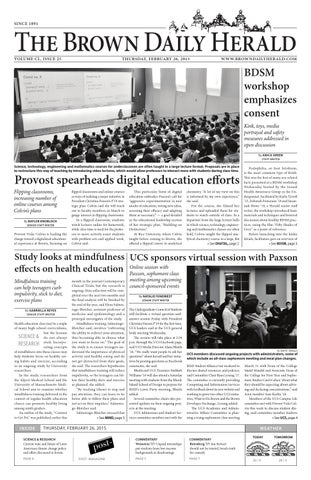
Podophilia, or foot fetishism, is the most common type of fetish. This was the first of many sex-related facts presented at a BDSM workshop Wednesday hosted by the Sexual Health Awareness Group in the Underground. Facilitated by Kayla Tyrrell ’15, Deborah Pomeranz ’18 and Susannah Howe ’18, a Herald senior staff writer, the workshop introduced basic materials and techniques and fostered discussion about healthy BDSM practices, using the film “Fifty Shades of Grey” as a point of reference. Before launching into the kinky details, facilitators gave an overview of » See BDSM, page 3
Study looks at mindfulness UCS sponsors virtual session with Paxson session with effects on health education Online Paxson, sophomore class Mindfulness training can help teenagers curb impulsivity, stick to diet, exercise plans By GABRIELLA REYES SENIOR STAFF WRITER
Health education class may be a staple of many high school curriculums, but the lessons do not always stick. Incorporating concepts of mindfulness into those classes may help students focus on healthy eating habits and exercise, according to an ongoing study by University researchers. In the study, researchers from the Alpert Medical School and the University of Massachusetts Medical School aim to examine whether mindfulness training delivered in the context of regular health education classes can promote healthy living among ninth graders. An outline of the study, “Commit to Get Fit,” was published earlier this
SCIENCE & RESEARCH
INSIDE
month in the journal Contemporary Clinical Trials, but the research is ongoing. Data collection will be completed over the next two months and the final analysis will be finished by the end of the year, said Elena Salmoirago-Blotcher, assistant professor of medicine and epidemiology and a principal investigator of the study. Mindfulness training, SalmoiragoBlotcher said, involves “cultivating the ability to redirect your attention, thus becoming able to choose what you want to focus on.” The goal of the study is to ensure teenagers understand the importance of physical activity and healthy eating and do not get distracted from their goals, she said. The researchers hypothesize that mindfulness training will reduce impulsivity, so the teenagers can follow their healthy diets and exercise as planned, she added. “By teaching (them) to stop and pay attention, they can learn to be better able to follow their plans and not act on their impulses,” Salmoirago-Blotcher said. Salmoirago-Blotcher stressed that » See MIND, page 3
By NATALIE FONDRIEST SENIOR STAFF WRITER
The Undergraduate Council of Students will facilitate a virtual question-andanswer session Friday with President Christina Paxson P’19 for the first time, UCS leaders said at the UCS general body meeting Wednesday. The session will take place at 2:30 p.m. through the UCS Facebook page, said UCS Media Director Alana Bhatla ’16. “We really want people to ask her questions” about herself and her initiatives by posting questions as Facebook comments, she said. Bhatla and UCS Treasurer Malikah Williams ’16 will also attend a Saturday meeting with students from the Rhode Island School of Design to prepare for RISD’s Lawn Party meeting, Bhatla added. Several committee chairs also presented updates on their ongoing projects at the meeting. UCS Admissions and Student Services committee members met with the
ELI WHITE / HERALD
UCS members discussed ongoing projects with administrators, some of which include an all-class sophomore meeting and meal plan changes. RISD Student Alliance last weekend to discuss shared resources and policies, said Committee Chair Ryan Lessing ’17. The committee is currently providing Computing and Information Services with feedback about its new website and working to grow two other UCS initiatives, What to Fix Brown and the Brown Developer Exchange, Lessing added. The UCS Academic and Administrative Affairs Committee is planning a rising sophomore class meeting
POST- MAGAZINE
March 31 with Dean of the College Maud Mandel and Associate Dean of the College for First-Year and Sophomore Studies Carol Cohen “about what they should be expecting about advising and declaring concentrations,” said AAA member Sam Karlin ’16. Members of the UCS Campus Life committee met with Provost Vicki Colvin this week to discuss student dining, said committee member Andrew » See UCS, page 4
WEATHER
THURSDAY, FEBRUARY 26, 2015
SCIENCE & RESEARCH Current state and future of Latin American climate change policy and effors discussed in forum PAGE 4
meeting among upcoming council-sponsored events
COMMENTARY Weinstein ’17: Unpaid internships put students from low-income backgrounds at disadvantage
COMMENTARY Rotenberg ’17: Jon Stewart should not be trusted, bends truth for comedy
PAGE 7
PAGE 7
TODAY
TOMORROW
23 / 9
26 / 3
SCIENCE & RESEARCH
PAGE 2 • THURSDAY, FEBRUARY 26, 2015
THE BROWN DAILY HERALD
Study examines EMA as research tool » DIGITAL, Ecological momentary assessment offers way of measuring symptoms, moods in real time By GABRIELLA REYES SENIOR STAFF WRITER
Researchers affiliated with Butler Hospital and the Alpert Medical School investigated how ecological momentary assessment — a term that refers to data collection techniques that measure peoples’ symptoms and behaviors at a given moment — can be used to develop interventions for depression and self-inflicted harm. A paper detailing their techniques will be published in the Aug. 1 issue of the journal Current Opinion in Psychology. “Ecological momentary assessment is a set of methods that are used to better understand an individual’s day-to-day experiences in the world,” said Michael Armey, assistant professor of psychiatry and human behavior. “They’re contrasted with standard self-report measures like questionnaires, because if you think about it, oftentimes people are really bad at remembering what they did in the past.” EMA software created for use on smartphones and tablets asks participants to report their emotions at given moments in order to gather
more accurate information, Armey said. EMA is useful for finding out what causes problematic behaviors in participants, he said, citing selfinflicted harm as an example. “If we look at the emotions people have in the hours prior to an episode of self-injury, we can actually predict when that behavior’s going to occur, because people start getting more frustrated and more upset,” he said. Personal devices can also measure a patient’s level of movement throughout the day, which is useful because lethargy can be a symptom of depression, he added. “For researchers who are interested in emotion … the major benefit (of EMA) is that you aren’t relying on retrospective reports of feelings,” wrote Renee Magnan, assistant professor of psychology at Washington State University at Vancouver who was not involved in the study, in an email to The Herald. “How you feel in the moment can influence how you report your previous feelings,” she wrote. “The research that we do is largely designed to collect baseline information about suicide and self-harm phenomena using EMA, so we can develop interventions in the future,” Armey said. “We’re not really focused on treatment development now. That comes later when we better understand what’s going on.”
While EMA can be helpful for participants of all ages, it is most beneficial for patients who are comfortable with technology, namely young people, Armey said. EMA has its roots in techniques — such as completing journals and questionnaires — that were prevalent before the invention of portable electronic devices, Armey said. Usage of EMA has increased over the past few years due to a surging demand for more accurate participant information, he added. One of the greatest barriers to EMA is its high cost. Software, staff trained in using the technology and participants who own smartphones or tablets are necessary for its use. Another issue is that some participants may find the day-long questioning annoying or invasive — it could bring to mind issues participants would rather not think about, Armey said. Magnan wrote that she uses EMA in her own research, though she added that the method has flaws as well. “Perhaps one of the largest (flaws) is the issue of reactivity to the procedures,” Magnan wrote. “For example, if you are asking a person to monitor their cravings and report on the experiences of those cravings, you could potentially increase a person’s cravings. In other words, the process of self-monitoring could change behaviors, thoughts or feelings.”
from page 1
classroom, dividing the total number of students registered for the course into smaller sections of about 50. In these relatively small classes, the students broke off into groups to tackle problem sets together. Colvin and several teaching assistants circulated throughout the room, helping groups with specific problems. “If you’re looking at 100- to 150-person lectures, this is a good way to get more professor-student interaction,” Colvin said, adding that she learned the names of more students in the flipped format than she did when “standing in front of a classroom.” A target area for the use of flipped classrooms is STEM courses that typically attract underclassmen, Colvin said. When observing calculus sections in Barus and Holley, Colvin noticed “there is someone up at the board doing problems and everyone is scribbling notes — some people were even trying to take iPhone pictures of it,” she said. Flipping these kinds of courses “might be a better option,” she added. One section of the course ECON 1110: “Intermediate Microeconomics” that used a flipped-classroom format in fall 2013 garnered positive feedback from students. In the flipped section, students watched explanatory videos by Associate Professor of Economics Pedro Dal Bo throughout the week, reviewed problems on Wednesdays and attended lectures on Mondays and Fridays. In the fall, Colvin convened a planning group tasked with examining how the University uses digital education and proposing steps for development. “Higher education is changing,” said Karen Sibley, dean of the School of Professional Studies and a member of the planning group. The group’s focus
was to determine how to ensure the University “delivers relevant education in an evolving context,” she said. The group produced a “set of recommendations for the University to continue to engage in piloting online content with awareness of the costs and the time demands, and to create incentives for faculty to get involved,” Sibley said, adding that it will continue to meet and form proposals. The group also examined other realms of digital education, such as courses offered completely online to Brown students for credit, as well as massive open online courses, which are available to the general public and cannot be taken for credit. Online courses allow students to “be anywhere and be learning,” Colvin said. “I don’t think they threaten the physical campus. I think they just add to it, and they let our students have more freedom.” Colvin said she aims to offer 20 online courses over the next five years. Within that time frame, she also hopes to flip more than one-third of STEM courses for underclassmen with more than 150 students. “I would really like to see that implemented,” said Katelyn Weingart ’18, who is currently enrolled in two applied mathematics lecture courses as well as a computer science lecture course. “That’s a much more effective use of meeting with a knowledgeable person,” she said. The video-based format of delivering information in flipped classes is how the current “generation has been learning to learn,” Colvin said. “I want to make sure we stay with the times and we’re being responsive to the needs of the students.” “We need to be experimenting,” she added. “That’s what Brown is really good at.”
Follow us! @the_herald
METRO
THURSDAY, FEBRUARY 26, 2015 • PAGE 3
THE BROWN DAILY HERALD
Spotlight on the Statehouse BY DREW WILLIAMS, METRO EDITOR
HIV transmission bill faces backlash
The House heard discussion Tuesday on a bill that would criminalize sexual activity, blood donation and the sharing of needles by those who knowingly are infected with HIV. The bill also prohibits individuals with an HIV infection from engaging in the already-illegal activities of prostitution and forcible sexual intercourse and mandates up to a 15 year prison term or $5,000 fine for those who violate any of its provisions. Rep. Robert Nardolillo, R-Coventry, brought the bill to the floor Jan. 29. Amy Nunn, head of the Rhode Island Public Health Institute and assistant professor of behavior and social sciences and medicine at the Alpert Medical School, refuted the legislation as “draconian,” noting that punitive actions have proven unsuccessful in reducing HIV transmission, Rhode Island Public Radio reported Wednesday. Nunn added that police action does not change sexual activity or drug-related habits and it is likely to interfere with treatment. Nardolillo, a self-reported survivor of sexual assault as a minor, addressed public safety improvement and the need to fix “weak legislation” related to sexual crimes during the last campaign season, according to his website. He defended the bill in an interview with ThinkProgress, saying that current misdemeanor laws regarding the transmission of sexually transmitted diseases are insufficient in preventing the transmission of HIV in particular. The bill was referred back to the House Health, Education and Welfare committee, where it could be killed, undergo changes or be brought back to the floor pending further study, RIPR reported.
Tension flares over gov. transparency
Gov. Gina Raimondo and House Speaker Nicholas Mattiello, D-Cranston, publicly faced off over the budgetary process twice last week, with each accusing the other of facilitating a lack of transparency in their respective branch of government. Raimondo spoke Friday during Politico’s Fifth Annual State Solutions Conference in Washington, D.C., detailing her frustration with Rhode Island’s budget process in a question-and-answer session. “The governor proposes a budget and then the General Assembly takes the budget and — often in the dark of night, in a quiet room — the lobbyists and the General Assembly get together and they hack it up every which way,” Raimondo said, adding that her job is to “shine a light” on the proceedings, the Providence Journal reported Wednesday. Mattiello responded Tuesday that “the House Finance Committee holds dozens of hearings when the public can offer testimony.” These hearings are more transparent than the “closed doors” tactics that Raimondo employed in her initial budget proposal, Mattiello added. Mattiello’s criticism extended to a separate issue Tuesday, when he critiqued Raimondo’s “unacceptable” proposal for a “placeholder” cut of $40 to $50 million in Medicaid spending for its lack of clarity regarding which programs would lose funding, the Providence Journal reported Tuesday.
R.I. grapples with infrastructure funding
Policymakers believe the amount of federal funding Rhode Island receives for transportation projects is insufficient to ameliorate the Rhode Island Department of Transportation’s list of 1,100 miles of roads in “fair or worse condition,” the Providence Journal reported. The Ocean State currently collects $220 million in federal funding for highway, bridge and transportation projects — an amount that decreased by 4.6 percent between 2008 and 2013. Twenty percent of state bridges are cited as “structurally deficient,” including eight of the 11 bridges at the interchange of Route 6 and Route 10, The Herald previously reported. The General Assembly is looking to increase state funding from $12 million to $184 million by July 1, 2018 — a massive uptick that would necessitate increases in taxes or fees. Lawmakers have already passed initiatives raising the gas tax from 33 to 34 cents per gallon starting July 2015 and implementing mandatory inspection fees from $39 to $55 beginning in 2016. Raimondo began a discussion on further possibilities Monday, including private-public partnerships and tolls. Last year, the General Assembly fought over a proposed toll at the Sakonnet River Bridge, but eventually rejected it. But Raimondo supported initiatives to collect money for transportation repairs, calling them “the basic minimum services that government must provide.” She added that infrastructure must improve in order to draw business to the state.
MATTEO MOBILIO / HERALD
Susannah Howe ’18, a facilitator for the Sexual Health Awareness Group and a Herald senior staff writer, led the icebreaker of a workshop discussing BDSM in the context of safety and consent.
» BDSM, from page 1 terminology. The acronym BDSM can be broken down into three components: bondage and discipline, dominance and submission and sadism and masochism, facilitators said. A BDSM encounter is referred to as a “scene,” while engaging in BDSM activity is called “play.” Someone who exerts power and control in a BDSM relationship is called a “dominant” or a “top,” while their acquiescent partner is called a “submissive” or “bottom.” An emphasis on safety was upheld throughout the workshop — another important acronym presented at the beginning of the workshop was RACK, which stands for risk aware consensual kink. Howe gave an overview of safe words, terms agreed upon by both parties that are used to stop play mid-scene. The workshop also stressed the importance of negotiation — a term used by facilitators to mean discussing limits, boundaries, hopes and expectations — and aftercare, or checking in with a partner emotionally and taking time to evaluate what worked and what did not work in the scene. Howe stressed that though negotiation can sound awkward and tedious, it does not have to be. “You can do it while you’re cuddling,” she said. “It can be a time for dirty talk.” In a healthy BDSM relationship, roles
» MIND, from page 1 mindfulness is a tool and not a solution in and of itself, but that applying mindfulness to programs such as health education can improve their effectiveness. Adding mindfulness interventions to health classes serves as a “novel approach” to education, she said. If the results of the study are promising, the researchers plan to design a larger efficacy trial involving more schools across different states, she added. The researchers have formed partnerships with schools in the current
are agreed upon with consideration for the partner in mind. “Being a dom is not about ignoring what your sub wants; Being a sub doesn’t mean ignoring what you want,” Howe said. Midway through the presentation, SHAG members distributed scarves and Gaurav Manek ’17 taught participants how to fashion a scarf into a pair of makeshift handcuffs, an activity that elicited much laughter and excitement. The group also distributed a ball gag, bondage tape, a paddle, handcuffs and a Wartenberg pinwheel for attendees to examine more closely. A Wartenberg pinwheel resembles a handheld pizza cutter, except the round blade is replaced by a wheel of metal points. The tool is actually a medical device used to test nerve reactions, but has been repurposed by many in the BDSM community to explore a range of sensations. Facilitators also opened the floor for discussion of the blockbuster “Fifty Shades of Grey,” asking audience members whether they felt the film accurately portrays BDSM. One participant pointed out that the portrayal is damaging in multiple ways, as not only does male lead Christian Grey, played by actor Jamie Dornan, ignore he and his partner’s safe word multiple times, but the character’s troubled background also feeds into the common stereotype that anyone
who is interested in BDSM must have a history of abuse or be sexually damaged in some way. Another participant cited a recent sexual assault case in which the perpetrator, an undergraduate at the University of Illinois at Chicago, claimed to be reenacting a scene from the movie, as one of the film’s many toxic effects. On the contrary, it has been proven that BDSM does not correlate with previous rape, abuse or mental disorders, another participant said. Research shows that people who practice BDSM may actually have superior mental health, according to a June 5, 2013 Huffington Post article. The workshop concluded with discussion of a report of the benefits of exploring BDSM. Howe cited a 2009 study which she said found “that BDSM brought couples closer together.” SHAG also raffled off some bondage tape and a book about kink to attendees. Participants and facilitators alike deemed the workshop a success. “I’m just kind of glad this exists. There were new things I learned, like the Wartenberg pinwheel,” said Sonja John, a junior at the Rhode Island School of Design. “I liked that we could do interactive demonstrations, giving people a safe way to use BDSM in their own lives,” Tyrrell said. “I think it went well, we had a good turnout.”
trial, building on the 20-year collaboration between UMass Medical School Professor of Medicine Lori Pbert, the other principal investigator of the study, and local schools in Massachusetts, Salmoirago-Blotcher said. Using a “cluster randomized trial” design, students in one school were assigned to mindfulness training in addition to the standard health education curriculum and will be compared to their peers in another school, who were in an “attention control” condition, meaning they received an equal amount of learning time but no intervention. The students’ physical activity and dietary habits were
measured before the start of the study and will be measured again once the intervention is complete. Michael Goldstein, adjunct professor of psychiatry and human behavior who was not involved in the study, said the intervention is an “innovative way to enhance health education and promote exercise and healthy eating among young people.” One potential downside is that it is currently unclear if the researchers can generalize their findings from schools in Massachusetts to adolescents everywhere, he said. “It’s a good place to start,” Goldstein said.
SCIENCE & RESEARCH PAGE 4 • THURSDAY, FEBRUARY 26, 2015
THE BROWN DAILY HERALD
Panelists discuss Latin American climate change efforts Speakers explore role Latin American countries can play in global sustainability By ZACK BU SENIOR STAFF WRITER
In anticipation of the 2015 United Nations Climate Change Conference, which will be held in Paris in December, speakers from various institutions gathered at the Joukowsky Forum of the Watson Institute for International Studies Wednesday to discuss the progress of climate change efforts in Latin America. The panelists included Walter Vergara, senior fellow at the World Resources Institute, Mariana Panuncio, director of climate change at the World Wildlife Fund, Jorge Gastelumendi, senior policy adviser at The Nature Conservancy and J. Timmons Roberts, professor of environmental studies and sociology. The event was organized and moderated by Guy Edwards, research fellow and co-director of the University’s climate and development lab. Edwards opened the discussion by asking all of the panelists what they believe to be the significance of climate change awareness. “It’s not an understatement to say that what’s at the stake is the future of our planet,” Panuncio said. “By that I mean for every human being as well as every life form. We know that the
trajectory that we’ve been in, in terms of emissions, basically puts us on a path that’s unsustainable, that is likely to have deep and irreversible impacts on the planet.” In addition to stressing the perils climate change poses for the planet, the panelists delved into the importance of Latin America’s role in global efforts. “Latin American countries have increased their influence at the U.N. climate change negotiations fairly remarkably. And (they) began to offer solutions on both coping with global warming and reducing emissions, taking a low-carbon pathway to economic development,” Roberts said. But there are also great challenges facing Latin American countries, Edwards said, adding that the political and economic landscapes have to be taken into consideration. Many factors could potentially impede the success of the climate movement: the generally poor economic conditions of Latin American nations, the fragmentation of the entire region, the unwillingness of many nations to prioritize climate issues and the power dynamics between major stakeholders who have different visions of balancing climate actions and prosperity, he said. Many panelists said this year marks a crucial moment for the history of climate change action. In previous climate negotiations, countries agreed to publicly outline by March which
BRITTANY COMMUNALE / HERALD
Panelists discussed the shift from fossil fuels to renewable energy sources in Latin America. Increasing sustainability efforts in Latin American countries could benefit both the climate and economy of the region. actions they intend to take before the Paris climate summit. This agreement is known as Intended Nationally Determined Contributions. By the December summit, the nations committed to put a final stamp on a new international climate agreement with specific goals, according to the World Resources Institute. The collective global efforts would be tallied up to examine whether they fit in the global objective of limiting the average global temperature rise to 2
degrees Celsius, according to the WRI. Vergara said countries are struggling with the agreement, and implementing its proposals could pose difficulties. For Latin American nations, “tackling climate change can be a win-win for securing climate and development objectives,” Edwards said. Panuncio said she agreed that Latin America should collectively be a key player in climate talks. “When we talk about climate change, we are talking about not an environmental challenge,
we are talking about it as a developmental challenge,” she said. “What needs to happen is that we basically need to reengineer our economy,” she added. “We need to change the structure of our economy from a economy that has been driven by fossil fuels to one that is powered by renewable energy, one that maintains natural capital and one that prepares all sectors of the economy for the impacts that are already here and the impacts that are coming.”
» UCS, from page 1
Campus Life Committee and a Herald opinions columnist, adding that Colvin reminded the committee that unionized labor laws complicate hours of operation. Williams said the UCS Initiatives Fund received 31 applications from students and student groups seeking grants. The UCS Student Activities committee is raffling off Spring Weekend tickets for personal profile creators for the fifth week of its “6 Weeks of BearSync” contest, Williams said. The council approved two Category 1 student groups: B-Side, an online writing publication about the music scenes at Brown and in Providence, and Poetry, Improv, Creative Arts — an interdisciplinary workshop group. UCS did not approve PICA’s application for categorization last semester because it seemed to seek a role on campus that
overlapped with that of more productoriented performing arts groups such as Brown Unheard, said UCS President Maahika Srinivasan ’15. The council approved Srinivasan’s nomination of Heather Sabel ’17 as UCS elections board chair. Sabel held the position last year and will revise the elections code to incorporate social media use, Srinivasan said. The council briefly discussed Saturday’s community-wide email from Russell Carey ’91 MA’06, executive vice president for planning and policy, and Margaret Klawunn, vice president for campus life and student services, about the modification of sanctions on Phi Kappa Psi. “The emails don’t foster as much discussion as they should,” said UCS Appointments Chair Minoshka Narayan ’18. “I don’t hear friends discussing it.”
Kutscher ’18. In their hour-long presentation to Colvin, committee members reviewed common meal plan complaints, including the disproportionate expense of dropping from the highest meal plan option to lower ones and a lack of clarity on the Dining Services website, Kutscher said. They also offered suggestions from students, such as implementing unlimited and “pay as you go” meal plan options and letting students use BearBucks at restaurants on Thayer Street. Colvin asked UCS Campus Life committee members to rank students’ preferences for eateries. When the committee suggested extending operating hours at the main dining halls beyond 7:30 p.m., Colvin was “shocked” that the Sharpe Refectory closes “that early,” said Walker Mills ’15, chair of the UCS
TODAY
THURSDAY, FEBRUARY 26, 2015 • PAGE 5
THE BROWN DAILY HERALD
menu
calling all photographers
SATELLITE DINING JOSIAH’S Gnocchi, Gourmet Grilled Cheese BLUE ROOM Mediterranean Pocket Soups: Chicken Artichoke Florentine, Fire Roasted Vegetable, Turkey Chili ANDREWS COMMONS Pizza: Nacho, Okie Dokie Artichokie, Pepperoni and Sausage
DINING HALLS SHARPE REFECTORY LUNCH
DINNER
Hot Corned Beef on Rye Bread, Falafel Bar, Braised Cauliflower, Cream Cheese Brownies
Pot Roast Jardiniere, Vegetarian Spinach Strudel with Cheese Cream Sauce, Pudim de Leite
VERNEY-WOOLLEY LUNCH
DINNER
Turkey Cutlet, Stuffed Shells, Kale and Beet Burgers, Cream Cheese Brownies
Grilled Cilantro Chicken, Butternut Squash and Leek Risotto, Apple Streusel Pie
sudoku
crossword BRITTANY COMUNALE / HERALD
Sophie Schwartz ’17 puts up posters calling for submissions to the photography magazine Paper and Pixel alongside posters for the Providence French Film Festival and other events.
comics A Horse of Any Other Name | Zach Silberberg ’18
calendar TODAY
TOMORROW
1:30P.M. “ARAB COMICS: 90 YEARS OF POPULAR
11:00 A.M. “IS COMMUNICATION THEORY A THEORY
VISUAL CULTURE”
OF EVERYTHING?”
Scholars and artists from the U.S. and Lebanon will discuss the history and themes of comics in the Middle East. Watson Institute, Joukowsky Forum
Christopher Rose, professor of electrical and computer engineering at Rutgers University, will talk about communication information theory and its ability to solve diverse problems. Barus and Holley 190
2:30 P.M. READING BY NOVELIST MARTÍN SOLARES
As part of the Writers on Writing series, novelist Solares will read from his murder mystery “The Black Minutes.”
5:30 P.M. “1948 — ONCE UPON PALESTINE” FILM
McCormack Family Theater
Two films depicting the history of Israel and Palestine that were curated by Ariella Azoulay, assistant professor of comparative literature and modern culture and media, will be screened. Watson Institute, Joukowsky Forum
6:00 P.M. “PLACEMAKING IN THE CREATIVE CAPITAL: INNOVATING URBAN DISTRICTS”
A panel of urban designers, developers and planners will discuss the challenges for placemaking in the city. BERT 130
SERIES
7:00 P.M. CARNAVAL 2015
The Dominican Student Group will celebrate Carnaval with food and music performances. Kasper Multipurpose Room
COMMENTARY PAGE 6 • THURSDAY, FEBRUARY 26, 2015
THE BROWN DAILY HERALD
EDITORIAL
Revamping DUGs Departmental Undergraduate Groups, or DUGs, could be a lot more than what they currently are. While most DUGs meet only a few times throughout the semester, the ones that stand out survive because of regular and self-reinforcing student and faculty involvement. Making DUGs fun, social and informative opportunities for students within and without concentrations would not require a top-down approach from faculty members alone, or an approach led only by students. It would take mutual effort from both departments and their concentrators. Improving DUGs could in turn improve advising in general, as sharing information and piquing interest would help new students choose their paths. Active DUGs would be fun and collegial settings in which students could forge new friendships and learn more about their classmates. DUGs might see a dramatic rise in energy from more frequent meetings. At Pomona College, the linguistics department’s equivalent of a DUG holds a weekly dinner with several faculty members in a main dining hall. This dinner fosters a sense of collegiality and makes a community out of the group, though it does not leave it up to the group’s officers to do everything. The key is that everyone — not only faculty members or students — must contribute to the DUG to make it work. While weekly dinners would cost departments a bit more money, certainly a monthly meal of the sort would not be out of the question. The classics DUG already holds weekly events called “pizza Thursdays” in which lunch and a lecture go together, though few Brown community members are aware of this initiative. Most DUGs can also go miles in complementing students’ learning in courses. Many science DUGs — including those for neuroscience, math and computer science — have their own websites that feature a schedule of upcoming events, testimonials and suggestions from students about the DUG and what kind of social and academic resources it presents. The math DUG website also offers many helpful guides on how to solve certain problems and run certain statistical software. The site is a hub of good information that should be publicized to all students who take or utilize math at Brown, not merely concentrators. Yet the DUGs that are ultimately most successful — such as the neuroscience DUG — rely on faculty support. Professors advertize the DUG in class, and the websites for the neuroscience department and some neuroscience courses refer to the neuroscience DUG’s website. Sharing this information is important, and it obviously takes student input — probably a lot of studentcoded HTML — to make these resources available. It also takes a spirit of anticipating positive developments, rather than expecting any one entity to carry the whole weight. So, for this to work, faculty members and students will both have to give a little. Brown courses are often narrowly focused, as they should be. DUGs can be a good place for students to learn about other courses and other professors’ research to which they might not otherwise be exposed. A little more institutional support to get it off the ground, matched by effort on students’ part to attend events, will quickly pay dividends in many new memories, new learning and real joy in the study of a discipline. Editorials are written by The Herald’s editorial page board: its editors, Alexander Kaplan ’15 and James Rattner ’15, and its members, Natasha Bluth ’15, Manuel Contreras ’16 and Baxter DiFabrizio ’15. Send comments to editorials@browndailyherald.com.
A N G E L IA WA N G
LETTER TO THE EDITOR
Alcohol policy does not cause issues off campus To the Editor: In the early 1990s, in response to a Providence municipal ordinance, the University began requiring student organizations to obtain Class F entertainment licenses for certain types of social functions where alcohol was served. Students argued that this change, which included having to charge entrance fees to these events, would drive social life- and alcohol-related problems off campus. We know this because the one of us who was a Brown student at that time made this particular argument to the then-director of student activities. That argument turned out to be wrong — there was no increase in off-campus problems related to that policy change. Nor has that been the case in the many instances where campus social function policy has changed (and improved) over the many years since. We were disappointed to see the same argument made in Wednesday’s Herald editorial (“Reevaluation of interim alcohol policy,” Feb. 25). Relying on scant, anecdotal data and without any prior discussion with any of us, the editorial claims that the interim policy changes we announced on Jan. 19 “force students to socialize off campus in far less regulated environments” and implies an increase in off-campus related incidents as a result. On the contrary, we have not seen such an increase this semester, nor in prior years, of off-campus problems. Since the interim policies were implemented in
Editorial Leadership
Sections
Visuals & Production
Business
Editors-in-Chief Michael Dubin Maxine Joselow
Arts & Culture Editors Eben Blake Gabrielle Dee
General Managers Sarah Levine Winnie Shao
Managing Editors Kiki Barnes Jillian Lanney
Metro Editors Alexander Blum Emma Jerzyk Drew Williams
Design Editors Loren Dowd Carlie Peters Taylor Schwartz Assistant: Meryl Charleston Assistant: Andrew Linder
Senior Editors Camilla Brandfield-Harvey Isobel Heck Molly Schulson
Science & Research Editors Andrew Jones Steven Michael
BLOG DAILY HERALD Editor-in-Chief David Oyer
Sports Editors Andrew Flax Alex Wainger
Managing Editors Deena Butt Jacob Koffler
University News Editors Emma Harris Caroline Kelly Joseph Zappa
POST- MAGAZINE Editor-in-Chief Adam Asher DIGITAL Online Editor Marcy Huang
COMMENTARY Editorial Page Editors Alexander Kaplan James Rattner Opinions Editors Megan GrapengeterRudnick Kate Kiernan Evan Sweren
Photo Editors Head: Brittany Comunale David Deckey Katie Liebowitz Arjun Narayen Ashley So Ryan Walsh Graphics Editors Avery Crits-Christoph Emma Jerzyk Web Producers Joe Stein Harsha Yeddanapudy Abdullah Yousufi Copy Desk Chief Madeline DiGiovanni Illustrations Editor Angelia Wang Video Editor Richard Flores
Directors Sales: Moniyka Sachar Sales: Jess Urrutia Finance: Josh Tartell Alumni Relations: Marley Rafson Business Dev.: Yuta Inumaru Sales Managers Matthew Meyer Henry Ritter Gulmira Hamit Taylor Casey
January, one noise complaint has been reported to the Office of Residential Life. Since September, five noise complaints involving off-campus residences have been handled through the student conduct system, and last year there were eight for the entire academic year. That is not to say there are no conflicts or tensions between students living off campus and the College Hill neighborhood, and the Office of Residential Life and Public Safety responds proactively to those situations. From time to time particular streets or houses are cause for concern, and we actively address and seek to resolve those problems as quickly as possible. It is not the case, however, that there has been an overall increase in off-campus incidents or that Brown students at large are a disruptive force on College Hill. The vast majority of Brown students who live off campus do so respectfully and as positive contributors to neighborhood life, a fact we hear regularly from College Hill neighbors. The editorial also speaks, again without data, to concerns regarding planned growth in the student body. It should be noted that over the past several years the University has added nearly 300 beds to the on-campus residence hall inventory, through conversion and renovations to Wayland House, Metcalf Hall, Miller Hall, Vartan Gregorian Quadrangle and 315 Thayer, among other projects. The dean of the College is currently leading a review of the impact of planned growth on all aspects of campus life, including
facebook.com/browndailyherald
Location: 195 Angell St., Providence, R.I. www.browndailyherald.com
the residential and dining experience. What is a fact is that the level of heavy episodic drinking reported by Brown students is higher than at peer institutions. The 2011-2012 survey by the Center for Alcohol and Addiction Studies revealed that 45 percent of Brown students reported having five or more drinks at least once in the past two weeks, compared to a national college population rate of 35.6 percent. Brown students reported a number of negative outcomes of alcohol consumption, including actions and statements individuals regretted, injury and health risks and missed academic obligations, among others. This is the unsafe community behavior we are seeking to address through the current review of alcohol and social event policies. Students are an active part of the committee charged with conducting that review, and we invite all students, faculty members and staff members to engage in discussions based on data, evidence and experience aimed at creating and sustaining a safe, respectful, inclusive, vibrant and diverse social life on campus for all to enjoy.
@the_herald
Editorial contact: 401-351-3372 herald@browndailyherald.com
Russell Carey ’91 MA’06 Executive Vice President for Planning and Policy Margaret Klawunn Vice President for Campus Life and Student Services Richard Bova Senior Associate Dean of Residential and Dining Services
browndailyherald.com
Business contact: 401-351-3260 gm@browndailyherald.com
Corrections: The Brown Daily Herald is committed to providing the Brown University community with the most accurate information possible. Corrections may be submitted up to seven calendar days after publication. Commentary: The editorial is the majority opinion of the editorial page board of The Brown Daily Herald. The editorial viewpoint does not necessarily reflect the views of The Brown Daily Herald, Inc. Columns, letters and comics reflect the opinions of their authors only.
Finance Managers Collections: Neil Wathore Collections: Benjamin Wesner Operations: Carin Papendorp
Letters to the Editor: Send letters to letters@browndailyherald.com. Include a telephone number with all letters. The Herald reserves the right to edit all letters for length and clarity and cannot assure the publication of any letter. Please limit letters to 250 words. Under special circumstances writers may request anonymity, but no letter will be printed if the author’s identity is unknown to the editors. Announcements of events will not be printed.
Business Dev. Manager Project Leader: Kaden Lee
Advertising: The Brown Daily Herald, Inc. reserves the right to accept or decline any advertisement at its discretion. The Brown Daily Herald (USPS 067.740) is an independent newspaper serving the Brown University community daily since 1891. It is published Monday through Friday during the academic year, excluding vacations, once during Commencement and once during Orientation by The Brown Daily Herald, Inc. Single copy free for each member of the community. Subscription prices: $280 one year daily, $140 one semester daily. Copyright 2014 by The Brown Daily Herald, Inc. All rights reserved. Periodicals postage paid at Providence, R.I. Postmaster: Please send corrections to P.O. Box 2538, Providence, RI 02906.
COMMENTARY THURSDAY, FEBRUARY 26, 2015 • PAGE 7
THE BROWN DAILY HERALD
The ethics of unpaid internships DUNCAN WEINSTEIN opinions columnist
On my first day as an unpaid campaign intern, I was told, “We could pay you, or we could buy more TV ads, and you’re already here, so we’re going to buy more TV ads.” While I may have been disappointed by the campaign’s attitude toward its priorities, I understand it. Campaigning is a lot like working for a government agency or nonprofit organization: It’s more about ideological commitment than making money. Campaigns regularly recruit volunteers — who are a substantial source of strength to a campaign as free labor — and rely on the dedication of professional campaign staffers willing to work long hours for low pay. The need of organizations, like political campaigns or charities, to have affordable but reliable employees raises the ethically complicated question of the role of an unpaid intern. Money used to pay interns doesn’t come out of profits, but it means less money spent reaching voters or providing social services. People volunteer for these organizations all the time out of a sense of social responsibility, rather than out of a wish to help someone else make money. In this context, it’s possible to see interns not as employees, but as scheduled volunteers, donating their time to a cause. While it’s always better for interns to be paid, it’s understandable for some interns
not to be. In a for-profit context, the logic of unpaid internships is flat-out indefensible. Replace “buy more TV ads” with “make more money,” and you get the idea. When she was acting director of the U.S. Department of Labor’s Wage and Hour Division, Nancy Leppink told the New York Times, “If you’re a for-profit employer … there aren’t going to be many circumstances where you can have an internship
regulating an internship’s substantiveness would be difficult. The point is that employers need to be transparent about what interns will spend their days doing, so that interns can take offers based on complete information. The other two standards are crucially important and should be rigorously enforced by the Labor Department. Unpaid internships are terrible for the labor market — they allow
lets the intern experience an industry as though it were a snack product. On an individual level, unpaid internships can both provide real learning experiences and substantially boost resumes. But that’s exactly the problem. According to one study from market research firm Millenial Branding, 90 percent of employers expect college students to have completed at least one internship before graduation. This puts
A good internship is a lot like a free sample in a grocery story: It doesn’t cost the company very much, and it lets the intern experience an industry as though it were a snack product. and not be paid and still be in compliance with the law.” The Labor Department has a sixpart test regulating unpaid internships at for-profit companies. Think back to the last unpaid internship experience you heard about. Was the internship “similar to training which would be given in an educational environment?” Did the intern “displace regular employees” or do work companies would otherwise have to pay for? Most importantly: did the employer “derive immediate advantage” from the intern? Unless you answered yes, no and no, that intern should have been paid. The “educational environment” standard is flawed: internships are supposed to simulate the working world, not the classroom. Employers should give students substantive assignments so that they learn, but
companies to replace temporary and entry-level workers with students who work for free. It doesn’t take an expert knowledge of economics to realize that this lowers pay for everyone. Given that wages for the bottom 80 percent of earners are at or below 2007 levels, according to the Economic Policy Institute, this is an especially pressing problem. What’s more, paid internships are likely better than unpaid ones. According to Nathan Parcells, cofounder and chief marketing officer for the internship posting site InternMatch, paid internship positions garner an average of three times as many applicants as unpaid ones. This means employers get a more diverse applicant pool and a better fit. A good internship is a lot like a free sample in a grocery store: It doesn’t cost the company very much, and it
students from low-income backgrounds — who have the financial need to be paid over the summer — at a disadvantage when their resumes lack unpaid internships. Some internships aren’t just unpaid — they’re also prohibitively expensive. I was lucky that I could pursue an unpaid internship in my chosen field while living at home. But many industries cluster geographically, such as publishing in New York City, film in Los Angeles or government in Washington, D.C. Most students can’t afford to pay rent in expensive cities with $0 income. This limits upward mobility and diversity in many of these fields, while providing comparatively more opportunities for students who can afford to pay their living expenses. Executives in some industries, such as publishing, argue that tough
economic times prevent them from paying their interns. But as long as a company is making a profit, it has enough money to afford paying its interns. It’s time to call unpaid internships at for-profit companies what they are: greedy and exploitative. It’s simply unethical to take a profit without paying all of your employees first; It goes against everything we believe about the value of work. Some defenders of unpaid internships assert that they’re valid economic transactions, in which interns choose to work for experience and letters of recommendation. But let’s not forget we once allowed individuals to work 14-hour days for very low pay and no benefits. The value of work shouldn’t be determined by supply and demand alone — it ought to have some connection to the actual labor being done. Fortunately, college grant programs that compensate unpaid interns, such as the University’s LINK program, help equal the internship playing field. President Christina Paxson’s P’19 strategic plan also includes the aim of providing every undergraduate on financial aid with at least one funded internship or research opportunity. But only students in non-profit sectors should need to apply for them. It’s time for the whole private sector, not just high-margin industries such as computer science and finance, to step up.
Duncan Weinstein ’17 would really like to be employed this summer — and paid. He can be reached at duncan_weinstein@brown.edu.
Why I won’t miss Jon Stewart GRAHAM ROTENBERG opinions columnist
Since Jon Stewart announced his departure from the legendary “The Daily Show,” media outlets around the world have showered him with praise. It’s true that Stewart has had a substantive impact on the face of media and politics. Americans trust “The Daily Show,” a satirical outlet, more than Al Jazeera America, Bloomberg and the Economist — all objective news organizations, according to the Pew Research Center. The Atlantic ran a Feb. 14 feature on Stewart entitled “Waiting for the Conservative Jon Stewart.” In the feature, Oliver Morrison contends that Stewart embodies a brand of comedy that is about “skewering Republicans (and less frequently Democrats) for absurd statements or pompousness or flagrant hypocrisy.” While politicians of all stripes will be hypocrites — that is the nature of trying to govern while being forced to enter a system that requires asinine amounts of fundraising — it seems Stewart has figured out how to amass more power and respect than most politicians. But this is his Achilles’ heel. Though Stewart has an entertaining voice, he has amassed too much power for a satirist and hides behind his comedic license when faced with the impact of his social power. And this is particularly dangerous when people begin to trust what he says without realizing that the facts and in-
formation presented have been manipulated for comedic effect. He commands the respect of many in our generation. According to the Pew Research Center, which interestingly lumped Stewart and Stephen Colbert’s shows into the same group with news organizations, Stewart and Colbert’s audiences are by far the youngest. Stewart is more trusted than venerable news organizations. He is viewed as an arbiter of what is reasonable. He pins himself as the most sane person in a world of political madmen, in which it his personal job to civi-
because of the enhanced legitimacy of these actors — and they are actors. Stewart’s legend began after his appearance on “Crossfire,” which was a long-running debate show on CNN in which politicians aired their opposing views on the issue of the day. When Stewart appeared, he consistently repeated the catchphrase “Stop hurting America” to the hosts Tucker Carlson and Paul Begala. In saying this, Stewart invoked morality. The show was eventually canceled, and many think Stewart contributed to the show’s demise.
Stewart and other comedians typify something deeply wrong with satire and discourses on politics that are increasingly viewed as legitimate sources of information. lize others. This was seen, most evidently, in the “Rally to Restore Sanity and/or Fear” — an October 2010 event held by Stewart and Colbert at the National Mall in Washington, D.C. that drew approximately 215,000 attendees. Stewart and other comedians typify something deeply wrong with satire and discourses on politics that are increasingly viewed as legitimate sources of information. They project an image of nuance, understanding, sanity and morality but are in fact deeply flawed, biased and unfair. One could argue that the latter is not a problem since there is always a place for humorous commentary. But it is a problem
On one episode of “Crossfire,” Carlson asked Stewart why he had inquired of John Kerry “How are you holding up?” in 2005, when Kerry was a presidential candidate. Stewart responded, “The show that leads into me is puppets who make crank phone calls.” This type of response reveals an interesting aspect of Stewart’s self-awareness. It conflates the two version of his persona: the most sane one and the one who follows puppets — the insane. These are just a few of examples of the dangerous cocktail of Stewart’s hubris and condescension mixed with his social status and trustworthiness.
By shrouding himself in the language of morality and the illegitimacy of the “Crossfire” endeavor, Stewart established himself as an arbiter of reason. Yet at the same time, he hides behind the role of a comedian. Stewart is not unique in this endeavor. His protege John Oliver also employs similar tactics. For example, Oliver, in one of his pieces, asks how Ayn Rand is “still a thing.” Oliver describes Objectivism in his piece as a “nice way of saying being a selfish asshole.” His piece is followed by a number of interviews with Rand and quotes that demonize and decontextualize her viewpoint. The quotes that Oliver references paint Rand as an intolerant ideologue who is fundamentally bigoted. Ayn Rand’s philosophy is far from flawless — her fundamental thesis is that altruism is a mirage and that all actions are based off inherent self-interest. But even if one doesn’t subscribe to her theories, there’s a big difference between saying “I disagree” and refusing to acknowledge an entire discourse of thought by saying “It’s not a thing.” Ayn Rand is “a thing,” and so are her theories. While Stewart and Oliver are entertaining, we should learn the difference between entertainment and knowledge. It’s alright to go to them just for laughs, but if we keep trusting their viewpoints and the information they present, their role in society will be more hurtful than helpful.
Graham Rotenberg ’17 can be reached at graham_rotenberg@brown.edu.
SCIENCE & RESEARCH THE BROWN DAILY HERALD
THURSDAY, FEBRUARY 26, 2015
U. study uses tadpoles to explore link between VPA, hyperconnected brain Tadpole experiments have implications for neurodevelopmental studies, autism research By FRANCES CHEN SENIOR STAFF WRITER
In a recent study, University researchers used a tadpole model to better understand the effects valproic acid — an anti-epilepsy drug commonly known as VPA — has on neurodevelopment and behavior. VPA has long been known to have deleterious effects on fetuses, such as increasing the risk for developing autism. The study shows specific parallels between behavioral deficits in tadpoles exposed to the drug and humans with autism. “We don’t have an ethical way of accessing an active, functional brain” in humans, but tadpoles offer a convenient animal model for neurodevelopmental studies, said Eric James GS, lead author of the study. A specific benefit to using tadpoles is that the rearing medium they grow up in is similar to the embryonic fluid of other animals, he added. The team used electrophysiology to measure VPA’s effects on the tadpoles, James said. Researchers patched a glass electrode onto an individual brain cell to measure its activity. By observing individual brain cells, they also examined how the brain cells act
together, he added. Exposure to VPA causes the brain to become hyperconnected even though individual neurons become less excited. This tends to correlate to an immature brain, James said. “It is an emerging view that autism stems from hyperconnectivity of the brain,” said Carlos Aizenman, associate professor of neuroscience and senior author of the study. The brain becomes garbled when hyperconnected, causing it to function abnormally, he added. The researchers tested the tadpoles by repeatedly startling them and recording their responses. The tadpoles that were not exposed to VPA jumped the first time but reacted less and less during subsequent trials. But the tadpoles that were exposed to VPA were still very sensitive to being startled even after the first time, Aizenman said. The social behavior of tadpoles was also hindered by VPA exposure, Aizenman added. It is believed that tadpoles sense other tadpoles’ locations through vibrations from their swimming patterns, leading them to swim close to each other in schools, Aizenman said. The tadpoles that were exposed to VPA were often found swimming alone, indicating that they likely cannot process that information correctly. “The point of this study isn’t to highlight the deleterious effects of VPA, but instead to use VPA as a tool to better understand neurodevelopment,”
James said. The brains of vertebrates such as tadpoles and humans are similar in that the brain organization, genes involved in brain functions and developmental processes in which the brain gets wired are the same, Aizenman said. But the brains of tadpoles and humans are not identical, so it is important to recognize that an animal model will have its limitations, he added. “Even if we can’t apply it directly, it can help us understand step by step how it happens in humans,” said Florence Roullet, a post-doctoral fellow at McMaster University, who was not involved in the study. With a rodent model, tadpole model and human model, we can gain a better understanding of the process by which VPA causes neurodevelopmental problems, James said. By finding common ground among the animal models, neuroscientsists can start identifying molecules that play important roles in these disorders. The combined findings can also lead to a better understanding of whether neurodevelopmental disorders caused by environmental and genetic risk factors have the same mechanisms as drug-induced ones, James said. Studies like these are “important for research on humans because they open the door to understand molecules that could have similar effects,” Roullet said.
COURTESY OF ARSENY KHAKHALIN
In the study, tadpoles exposed to valproic acid were very sensitive to being startled, possibly due to brain hyperconnectivity.