SINCE 1891
THE BROWN DAILY HERALD FRIDAY, JANUARY 30, 2015
VOLUME CL, ISSUE 8
WWW.BROWNDAILYHERALD.COM
Med School co-founder Aronson remembered for humility Students Prolific scholar known for genetics research, promotion of science education By BAYLOR KNOBLOCH SENIOR STAFF WRITER
Stanley Aronson, co-founder of the Alpert Medical School, died Jan. 28 at the age of 92, leaving behind a legacy of innovations and the admiration of countless colleagues and students. After conducting groundbreaking research on the rare genetic disorder Tay-Sachs disease, Aronson co-founded the Med School in 1972 and served as its dean until 1981. “He created a medical school that was very unlike any other med school because of the values it established,” said Fred Schiffman, professor of humanistic medicine, adding that the school has “scientific rigor with a heart and soul.”
M. BASKETBALL
After leaving his post as dean, Aronson turned his focus toward establishing the first hospice program in Rhode Island, which he continued to advise until his death. “His knowledge base was so wideranging,” said Terrie Wetle, dean of the School of Public Health, who first met Aronson and his wife Gale when Wetle came to Providence in 2000. “Sitting with him was like having a human Google,” she said. Wetle got to know Aronson more when her husband Richard Besdine, professor of geriatric medicine, served as the interim dean of the Med School from 2002 to 2005. “I found him to be the most knowledgeable on the largest number of things of any person I’ve ever encountered in my life,” Besdine said. Aronson was also a prolific journalist, publishing more than 1,000 columns in the Providence Journal. His last » See ARONSON, page 3
By ZACK BU
STAFF WRITER
By CALEB MILLER SPORTS STAFF WRITER
While an 0-2 start in the Ivy League was not what the men’s basketball team hoped for, the Bears can take a big step forward this weekend with their New York doubleheader at Cornell and Columbia, this Friday and Saturday, respectively. Bruno (9-10, 0-2 Ivy) dropped two contests to Ivy leader Yale (13-6, 2-0) in the first two weekends of conference play, and the road will not get much easier this weekend. Cornell (9-9, 1-1) and Columbia (9-7, 1-1) boast the top two scorers in the Ivy League, and each team has a number of weapons on both ends of the court. The Empire State rivals split with one another to open league play. A tightly matched battle against Yale on the road last Saturday could have given the Bears some momentum, but instead they took a hit this week with the news that starting forward and leading scorer Leland King ’17 is leaving the basketball program for personal reasons. » See M. BBALL, page 8
INSIDE
Search committee reviews nearly 100 applications with goal of filling role by end of semester By KATE TALERICO SENIOR STAFF WRITER
COURTESY OF BROWN UNIVERSITY
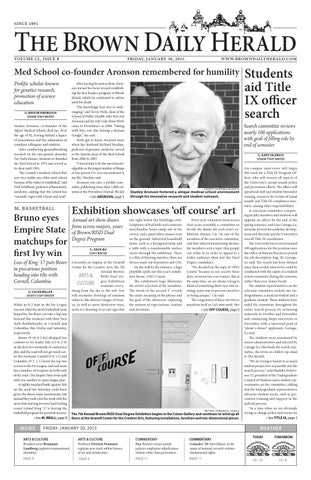
Stanley Aronson fostered a unique medical school environment through his innovative research and student outreach.
Exhibition showcases ‘off course’ art
Bruno eyes Annual art show draws across majors, years Empire State from of Brown/RISD Dual matchups for Degree Program first Ivy win Loss of King ’17 puts Bears in precarious position heading into tilts with Cornell, Columbia
aid Title IX officer search
Currently on display at the Granoff Center for the Creative Arts, the 7th Annual Brown/ RISD Dual Degree Exhibition examines everything from the sky to the self. You will encounter drawings of common subjects, like abstract images of women, as well as more distinctive ones, such as a drawing of an exit sign that
ARTS & CULTURE
sits right below the building’s own. Sculptures of frail birds and cosmetics merchandise boxes jump out at the viewer, and a giant fabric mouse rests on the ground. Subverted household items, such as a hexagonal lamp and a table with a transformable surface weave through the exhibition. There is a film of burning matches; there are dresses made out of potatoes and CDs. On the wall by the entrance, a logo playfully spells out this year’s exhibition theme: Of(f) Course. The exhibition’s logo illustrates the artists’ rejection of the mundane. The tweak of the second ‘f ’ reveals the entire meaning of the phrase and the goal of the showcase: exploring the notions of expectations, routine and deviation.
Every year, volunteers from across class years assemble a committee to decide the theme for each year’s exhibition. Bonnie Cai ’18, one of the members of the executive committee, said that when brainstorming themes, the members seek a topic that people can relate to in order to appeal to a wider audience than just the Dual Degree candidates. “We decided on the topic of ‘Of(f) Course’ because in our society these days, everyone has a set routine. But at the same time, we are always trying to think of something that’s new and exciting, some way to present ourselves as being unique,” Cai said. The congruence of these two forces manifests itself in Cai’s own work. Her » See OFF COURSE, page 5
BRITTANY COMMUNALE / HERALD
The 7th Annual Brown/RISD Dual Degree Exhibition begins in the Cohen Gallery and continues to wind up all floors at the Granoff Center for the Creative Arts, featuring installations, furniture and two-dimensional pieces.
On-campus interviews will begin this week for a Title IX Program Officer, who will oversee all aspects of the University’s sexual assault policy and prevention efforts. The officer will spearhead staff and student bystander training, resources for victims of sexual assault and Title IX compliance measures, among other responsibilities. A selection committee comprising faculty members and students will appoint an officer by the end of the spring semester, said Liza Cariaga-Lo, associate provost for academic development and diversity and the University’s overall Title IX coordinator. The University has received around 100 applications for the position since the Office of Human Resources posted the job description Aug. 29, CariagaLo said. The search has been delayed since then so that interviews could be conducted with the input of a student search committee during the semester, rather than over winter break. The student representatives on the selection committee include two undergraduates, a medical student and a graduate student. These students have aided the committee throughout the entire search process by reviewing materials in October and November and conducting Skype interviews in December with a narrowed pool of “about a dozen” applicants, CariagaLo said. The students were nominated by senior administrators and selected by Cariaga-Lo, who heads the search committee, she wrote in a follow-up email to The Herald. “We are trying to funnel in as much student perspective as possible into the search process,” said Maahika Srinivasan ’15, president of the Undergraduate Council of Students and a student representative on the committee, adding that the undergraduate representatives advocate student needs, such as prevention training and support in the judicial process. “In a time when we are obviously trying to change policy and ensure we » See TITLE IX, page 2
WEATHER
FRIDAY, JANUARY 30, 2015
ARTS & CULTURE Resident artist Benjamin Lundberg explores transnational identities
ARTS & CULTURE Professor Dietrich Neumann explains new track within history of art and architecture
COMMENTARY Foa: Brown’s sexual assault policies emphasize adjudication reform rather than prevention
COMMENTARY Gonzalez ’18: Surveillance in the name of national security violates fundamental rights
PAGE 4
PAGE 4
PAGE 11
PAGE 11
TODAY
TOMORROW
35 / 10
19 / 8
UNIVERSITY NEWS
PAGE 2 • FRIDAY, JANUARY 30, 2015
THE BROWN DAILY HERALD
Second inaugural GELT grants expand learning through travel Seven students find academic enrichment in global immersion experiences By ELANA JAFFE SENIOR STAFF WRITER
Four courses offered in 2015 will feature travel components enabled by the second inaugural Global Experiential Learning and Teaching grants, according to a Jan. 23 University press release. A total of seven 2015 GELT grants were awarded, marking a slight decrease from last year, when nine grants were bestowed. The grants are offered by the Office of Global Engagement and provide funding in two stages. In the first phase, faculty members apply for up to $4,000 of funding to develop a course. In the second phase, the University provides up to $35,000 to send 12 students and a professor abroad for a course-related experience. The only class to have used a GELT grant for travel last year, ENVS 1575: “Engaged Climate Policy at the United Nations Climate Change Talks,” traveled to Lima, Peru, with Professor of Environmental Studies and Sociology J. Timmons Roberts. In Peru, the class attended the UN Framework Convention on Climate Change. Students were able to witness the negotiations firsthand and meet delegates and “NGOs, students, professors and climate change experts from around the world,” Roberts said. “Thanks to the generosity of GELT, I was able to be in an environment that allowed me to physically sit down across the table from oil company executives and ask them the hard questions that I have been developing throughout my academic experiences at Brown,” said Sophie Purdom ’16, an environmental science concentrator who took the class. She added that traveling allowed her to “engage” with material that is “usually hypothetical or in a textbook.” Roberts has championed the model of “not just reading texts, but trying to actually talk with the people at the conference and effecting the changes you want to see,” said Alison Kirsch ’15, who also enrolled in the course. Roberts said when he has taken
» TITLE IX, from page 1 have the proper resources and people in place, we want to be sure that we find the right individual,” CariagaLo said. “Even if someone has had deep experience at a university community other than Brown, they have to understand that they would enter a community with unique needs,” she added. Applicants have brought unique perspectives to the Title IX position, including backgrounds in law, advocacy and therapy, Cariaga-Lo said. “People see Brown as a place where some really good work can be done.” “We had a highly diverse pool of candidates who came from a wide variety of institutions — not just universities, but also nonprofit organizations and government agencies who have been doing work related to Title IX and sexual assault,” Cariaga-Lo said. The committee hopes to find a
COURTESY OF MARIS JONES
Jeff Baum ’15, Ali Kirsch ’15, Maris Jones ’15, Professor of Environmental Studies and Sociology J. Timmons Roberts, Tory Hoffmeister ’17, Cassidy Bennett ’15 and Ximena Carranza Risco ’17 traveled to a climate conference in Lima, Peru, last year through GELT funding.
students to this conference in the past, they spent much of the semester raising funds for the trip. The GELT grant afforded students this year more time and freedom to learn about negotiations and climate change, he added. While Roberts’ grant is not immediately renewable for future iterations of the course, four other courses received phase two funding. The proposed courses undergo a rigorous review process by a committee of five faculty members and administrators, said Sonia Feigenbaum, associate provost for global engagement. Committee-approved proposals are then passed on to her office, which awards the grants. The initiative “responds to the dynamism of Brown” and allows for students “who cannot study abroad for longer periods of time to have that opportunity,” Feigenbaum said. The grant funds come from a collaboration between the Offices of Academic Development and Diversity, Dean of the College, Dean of the Faculty and the School of Professional Studies, according to the press release. The grant process also includes
feedback to professors, as well as monitoring between the first and second phase. “Comments from anonymous reviewers” were very helpful, said Dietrich Neumann, professor of history of art and architecture and urban studies. In HIAA 1850H: “Berlin: Architecture, Politics and Memory,” students will travel to Berlin to study monuments and memorials, said Neumann, whose proposal just received phase two funding, he said. “To actually be there is really crucial for what I try and achieve with students,” Neumann said. “I’ve always thought of doing something like this, and now to be able to integrate this into a regular seminar for the students is absolutely exciting and wonderful,” he said, adding that he hopes travel becomes a regular part of the University’s curriculum. While the phase one funding could have allowed Neumann to fly to Berlin to develop the course, he decided instead to use the “more open” funding on his students because he knows the city well. Two scholars will fly to Brown with the phase one funding to meet with Neumann’s students and give lectures
candidate who understands regulations within a changing landscape of campus sexual assault policy and has a “trauma-informed” perspective, which would allow the officer to direct students to available resources, “whether they are survivors or even bystanders,” she said. “In addition to understanding regulation, compliance and resources, they must also have the ability to be a leader and bring together the broad constituencies of individuals who will work together on issues of sexual assault,” she added. Srinivasan said the new program officer should not only understand Brown’s “collaborative and open environment,” but also be willing to “shake things up a bit.” “We need a shift in campus culture,” Srinivasan said. “This person should be able to evaluate the culture we have but also be bold enough to come in and try to change that.” “There’s not a prerequisite of
knowledge of Brown,” said Will Furuyama ’15, the other undergraduate representative on the selection committee. The job demands an individual who is “able to navigate Brown as an institution, as well as the specific communities within Brown,” Furuyama said. During the first few months on the job, the program officer will interact with a variety of faculty members, students and members of the Providence community in order to establish connections and develop a sense of campus culture, Cariaga-Lo said. The committee will transition from Skype interviews to in-person meetings this semester to get a better idea of how candidates will operate within the Brown community. “It’s evident from the way that (applicants) respond to questions about problems that we’ve named on campus … (whether) they would be a good fit for Brown,” Furuyama said,, adding that on-campus interviews will help solidify the committee’s decisions.
open to the public. “It’s going to be a rich program and a wonderful opportunity for the students to get involved in the city and its history,” Neumann said, adding that “I hope it will be quite eye-opening for them.” The fall 2015 course “Global Tectonics” — offered by the Department of Earth, Environmental and Planetary Sciences — is “global” also in the sense that it will include students not only from Brown but also from the Universidad Nacional de Cordoba, Argentina, funded by their own university. This group will join the Brown class virtually throughout the semester using Brown’s Web Ex live-streaming, as well as in Argentina in January 2016 for the field work. The trip will “cross most of the southern continent from the coast towards the Andes,” said Alberto Saal, associate professor of Earth, environmental and planetary sciences, who will lead the trip. Students on the trip will look at rocks and structures in order to “compare the geological evolution of the North American continent with the South American continent at the latitude of Argentina,” Saal said.
The course will study both the phenomena happening in present day Argentina and the historic mysteries that Argentine geology holds from up to 700 million years ago, he added. Sarah Tobin, associate director of Middle East studies, spent the last year in Syrian refugee camps in Jordan studying early marriage, security and resilience, as well as the neoliberalization of the refugee experience. Having received a phase one grant, Tobin will spend the next semester developing a course for the upcoming academic year in which she and a dozen students will travel to Jordan to learn about refugee life. The trip promises to be an “unprecedented experience” and a “unique opportunity,” Tobin said, adding that students interested in the course should contact her early in the process and attend related events this semester. The difference between learning about refugee camps in the classroom and visiting them is like “trying to tell someone who has never seen the ocean what it’s like,” Tobin said, adding that “the longer you’re there, the deeper the ocean gets.”
Follow us on twitter! @the_herald
METRO
FRIDAY, JANUARY 30, 2015 • PAGE 3
THE BROWN DAILY HERALD
As trial over pension reform nears, past controversies resurface Legal clashes over pension benefits between unions and government abound in state’s recent history ELAINA WANG SENIOR STAFF WRITER
Unions representing public employees filed suit in the Rhode Island Superior Court in June 2012, questioning the constitutionality of the 2011 Rhode Island Retirement Security Act: The case is set to go before a jury this April. The updated pension system transitioned all members of the state pension system from the traditional “definedbenefit” pension plan to a hybrid “defined-benefit, defined-contribution” plan. The R.I. General Assembly passed RIRSA in 2011 to deal with the massive funding gap in the pension system. Despite the fact that Rhode Island contributed the “recommended amount” to its pension fund between 2005 and 2010, the fund remained insufficient to meet the demand for pension benefits fully. For example, “the system was 49 percent funded in fiscal 2010 and faced a $7 billion funding gap,” the Pew Center on the States reported. The state began to tackle its pension problem by executing three rounds of benefit cuts between 2005 and 2010, altogether reducing benefits by 23 percent, according to a report from the Economic Policy Institute. Gov. Gina Raimondo, who was the state’s general treasurer at the time, led the effort to expose the pension system’s funding shortage publicly, releasing a report titled “Truth in Numbers” in May 2011. The report revealed that unfunded liabilities — the discrepancy in pension funds — were between $6.8 and $9 billion, and taxpayer contributions to the pension fund were projected to be over $1 billion by fiscal year 2022. Raimondo’s concerns were confirmed in August 2011, when Central Falls declared bankruptcy, partially due to its $80 million unfunded pension system. Decades of instability Rhode Island’s current pension crisis traces its roots back to 1983, when a R.I. Supreme Court decision gave the Providence Retirement Board autonomous control over the city’s pensions despite the fact that union members made up a majority of the board. In December 1989, the board voted to raise cost-of-living adjustments — year-to-year increases in benefits — to 6 percent and increase retirement funds for police officers and firefighters by roughly more than three times their original amount. The adjustment
» ARONSON, from page 1 column was published Jan. 26, just two days before his death. “I’ll miss reading his column in the newspaper, which I always enjoyed,” Wetle said. Aronson’s colleagues and friends noted that despite his many achievements,
in COLAs alone allowed pensions to double about every 12 years. The city challenged the board’s newfound control in state Superior Court, only to lose twice. While the issue was pending in the state Supreme Court, then-Mayor Vincent “Buddy” Cianci — having just been elected with significant union support — settled the dispute. On Dec. 18, 1991, Cianci signed a consent decree that tied the city to the board’s changes for the pension system “in exchange for a few union concessions,” the Providence Journal reported. This consent decree prohibited the City Council from taking action on the pension system even after the state Supreme Court handed over the reins after the eventual resolution of the case in 1992. In 2000, a state Supreme Court allowed high COLAs to continue for many pensioned employees. “The financial impact was enormous — Providence’s unfunded pension liability more than doubled from $167 million to $412 million in a single year after the 1991 consent decree was established as legally binding,” WPRI reported. Another disruption to the pension system occurred around the same time at the state level in 1991, when thenGovernor Bruce Sundlun borrowed $20.9 million from the pension fund to alleviate financial damage caused by a 1990 state banking crisis. Sundlun also chose to defer annual required contributions to the pension plan for the next two years. In 1993, the funding ratio for the state employees’ pension fund dipped to 72.6 percent, while the teachers’ fund was at 66.7 percent. Funding ratios measure “how well-funded the pension plan is,” and are determined by private actuarial firms, said R.I. Auditor General Dennis Hoyle. “They look at the information and … make an assumption as to when that person is likely to retire and how long they might live once they’re retired and collect the benefits,” he said. Though funding ratios improved within the decade — climbing to 81.6 percent for state employees and 77.4 percent for teachers by 1999 — the state employees’ and teachers’ systems regressed to 56.3 percent and 55.4 percent, respectively, by 2005. “Rhode Island’s pension liabilities grew 70 percent between 1999 and 2008, outpacing assets, which grew 25 percent in that period,” according to the Pew Center. The state attempted to lessen its funding gap during this time period by raising the retirement age and restricting COLA increases for less-tenured public employees. When those measures proved insufficient, they turned to a solution that would drastically he remained a humble scholar, friend and mentor. “This is not a man who put his accomplishments on his sleeve,” said Jack Elias, dean of medical and biological sciences. When Elias assumed Aronson’s former position in September 2013,
EMMA JERZYK / HERALD
change the source of pension benefits: RIRSA. An unwelcome change The argument over RIRSA centers on the reduction of benefits, particularly the guaranteed welfare that “definedbenefit” pensions afford. “Under a (defined-benefit pension), you’re guaranteed a certain benefit based on your years of service,” Hoyle said, adding that “the government funds that benefit regardless of specific investments.” The new plan incorporates a “defined-contribution” aspect to the existing defined-benefit plan. In a definedcontribution pension, employees are required to contribute money to investments, and the result of their investments makes up their retirement fund. “It’s like you had 100 dollars and invest in the stock market for 20 years,” Hoyle explained. “There’s no guarantee what it will be worth.” “The value to the employee from a (defined-benefit) plan is you know how much you’re receiving and the risk of poor market performance is on the employer and not on you as the employee,” said Sam Zurier, city councilman and lawyer for the union in April’s pension trial. “Conversely … the state bears the risk of poor markets under defined benefit, and they’re relieved of that risk under defined contribution.” “It transfers some of the risk to the employee, whereas before the employer was holding all the risk,” Hoyle said. RIRSA also increased the retirement age from 62 to 67 and suspended COLAs until certain employee pension plans “reached a funded status of 80%,” Aronson “immediately took me in like a son,” Elias said. “As the new dean of the Medical School, I think he saw me as one of the people who would continue to help the program grow.” “The thing that I loved about him was his extraordinary valuing and respect to other people,” Besdine said.
according to the auditor general’s annual 2014 report. The passage of RIRSA was designed to lower the state’s unfunded liability by $3 billion and save $274 million in taxes, according to the Pew Center and the Providence Journal, respectively. Preparing for (legal) battle The trial itself revolves around the constitutionality of RIRSA — whether the state has the right to alter retirement plans retroactively. “One of the legal issues is when they passed the law with the COLAs and then they passed a law later on removing the COLAs, is that violating a contract?” Zurier asked. “Does the GA have the authority to change these terms without having to make up this money to the employees?” “The unions want the cost-ofliving adjustments restored,” Zurier said. “There’s a transition for some employees from a defined-benefit plan to a defined-contribution plan.” The state and unions entered courtordered mediation in December 2012. A settlement was announced in February 2014 that would give a one-time 2 percent increase to the first $25,000 of an employee’s pension, with a 3.5 percent increase every four years starting in 2017 and continuing until pension funding reached 80 percent. But 61 percent of the police union members, who represent 1 percent of the total settlement voters, effectively ended mediation by voting against the settlement. The resulting jury trial will commence in April. “The State continues to believe that the pension changes enacted by our
General Assembly are constitutional and that the State has strong legal arguments to support its positions,” Shana Autiello, director of communications for the general treasurer, wrote in an email to the Herald. “The State’s legal positions in the litigation … will be a matter of public record.” “I cannot speak for the state, but I would observe that the factual findings in some of the earlier rulings that the judge made were going against the state,” Zurier said. The state unsuccessfully asked presiding Judge Sarah Taft-Carter to recuse herself from the case, claiming she had personal stakes in the outcome. “There are actually four different cases,” Zurier said. They include state employees and teachers, municipal employees, retired employees and firefighters and policemen. The nature of the trial means that no end date can be pinpointed, Zurier said, adding that “if (the cases are) tried back-to-back-to-back-to-back, it could be a very long time.” Even after the proceedings end, the chance of appeal to the R.I. Supreme Court is very high, WPRI reported. An appeal process through the state Supreme Court could take one to two years, Zurier said. There are “billions of dollars” involved in this “high-stakes” case, Zurier said. “You want to exhaust all your chances before accepting an unfavorable result.” But settlement is not necessarily out of the question, Zurier added. “There are so many moving parts to this case that it makes more sense to settle it, if at all possible.”
Aronson kept in contact with many med students whom he knew during his tenure as dean. There is an “amazing number of people, who he trained (and) who he is still in contact with, who adored the man,” Schiffman said. Current and former med students
frequented Aronson’s private residence, even during his last weeks, Besdine said. “Four days before he went into hospice care, he had half a dozen medical students at his home,” Besdine said. “People thronged there to be in his presence,” he added. “He was an astounding man.”
www.browndailyherald.com
ARTS & CULTURE
PAGE 4 • FRIDAY, JANUARY 30, 2015
THE BROWN DAILY HERALD
Neumann melds passions for architecture, urban design in academia Professor to structure new track within history of art and architecture concentration By EMILY PASSARELLI SENIOR STAFF WRITER
Dietrich Neumann, professor of history of art and architecture, engages with architecture on a level greater than just teaching theoretical and studio classes on campus. His research investigates the historical significance of architecture from the late 19th century to modern day, and he has published essays on architectural techniques and curated architecturally themed exhibitions. Born in Germany, Neumann earned his Ph.D. in architectural history from the Technical University in Munich and came to Brown in 1989 as a visiting professor. He became an assistant professor in 1991 and a professor in 1999. Known on campus for contextualizing the history of art and architecture in terms of urban studies, Neumann sat down with The Herald to discuss teaching, designing classes and the new architecture concentration. What initially made you interested in architecture, and how old were you at the time? I think it was early on. I played with Legos a lot and when I was four. I told everybody that I wanted to become an architect. I have some photos of when I was building a skyscraper. I must have
been five at that point, and that skyscraper is bigger than I am. I’m standing there as a little German kid with my Legos, and I decided I was going to be an architect then, and then I started studying architecture in London at the (Architectural Association School of Architecture) and started working in practice. I got a very nice teaching offer in Munich, and I finished my Ph.D. and then came to Brown.
Where specifically is your interest in architecture? Can you tell me a little more about the expansion of the architecture concentration that you are developing? I’ve always felt that architecture is something that many Brown students are interested in. I’ve worked for a number of years on an attempt to grow this field, and I think that now we are at a point where this is actually happening in collaboration with the two departments I belong to — urban studies and history of art and architecture. We are launching a new undergraduate track next year that will prepare students better for studying architecture or urban planning and will sort of integrate the humanities and architecture and urbanism. I think the idea is that many schools will give them advanced standing, which means they can get to their masters in two years, instead of three. There will be more requirements (for the concentration, which) officially starts next year, but we are already organizing classes now. The official launch will be in April, when we are having a big conference jointly with RISD that talks about topics of
architecture, urbanism and the humanities.
How much of an undergraduate response to the new concentration do you expect? When we introduced these classes, all of them were over-enrolled multiple times and so I think there is clearly an interest there. I happen to believe that urban studies is an extremely important field — and architecture, of course, and the sort of affiliated sphere of art, too. And if you look at the world’s population and that half of it lives in cities, and how around 50 percent of our energy consumption goes into the making and maintenance of buildings and such, then you see sort of an important shoot of urban studies. I’m curious about the many exhibitions you have designed. Which are you most proud of, and why? Can you describe the process of organizing and developing an exhibition? I’ve done a number of exhibitions, and one was about the history of movie sets and it was called Film Architecture. It was great fun. We put together movie set designs and looked at architectural qualities and how they came about over around 100 years of film-making. I did another one about architectural illumination called Architecture of the Night. One that I really enjoyed, here in Providence, was called Unbuilt Providence. It was about projects that were designed for the city of Providence and for the campus of Brown University by important architects that were never executed. So I thought
about the mashing of the city and what the old campus might have looked like — what used to have been built. So I think that a lot of what interests me in architecture has to do with the ephemeral — illumination at night, or architecture and film sets that are only important for that purpose and then taken down, the perception of architecture in other media.
Can you tell me a little bit about the classes you designed and teach here at Brown? How did you come up with such interdisciplinary topics? I truly believe in interdisciplinarity. I think that context is one of the most important things to understand building, and for architecture it’s very important to understand how the object was used in different parts of its history, the conditions under which it was involved, financial constraints, the urban piece and so on. The class HIAA 0900: “City and Cinema” grew out of that exhibition project years ago on film architecture. Can you tell me a little about the seminar HIAA 1910A: “Providence Architecture,” which examined Brown’s campus and recorded its architecture on a mobile app? That seminar was taught last semester as well as two years ago, and we put together a very nice app called FACADES. It stands for “Facts About Campus Architecture, Design, Environment and Spaces.” If you open it up you find your position on campus and about 130 total described pieces. It’s been very successful — we’ve had about 2,500 downloads so far. And last semester we did a new round and we
have about 100 new buildings that we’ll add. There will be a new edition with more features such as panoramic photography. When you came up with the class, did you expect a mobile app to be the end result, or was this a consequence of seminar discussion? I always wanted to do something like this. At first I thought we would do a printed guide to the campus, but it turned out that there was already a printed guide being written by an alum. And so we decided to do an app, which of course has great advantages because it means that you can always update it when there is a new building on campus. You can always grow it as you learn more about it. And I found a good developer up in Montreal, and a good photographer here in Providence. The new edition will be twice as big as the edition that is out now. Why did you end up choosing to be a professor rather than a practicing architect? When I got the offer to teach I realized that I really enjoyed it. I really enjoyed researching and writing and so I think it just happened that way. I probably have a much less stressful life than I would working in architecture because I don’t have to constantly worry about the next commission, and they’re dependent more on the economy level than I am. I’m most grateful that I ended up in the position that I am. This interview has been edited for length and clarity.
ARTS & CULTURE FRIDAY, JANUARY 30, 2015 • PAGE 5
THE BROWN DAILY HERALD
Resident artist’s work explores feeling at home with transnational identity Benjamin Lundberg develops interactive performance art in residence at AS220 By SOPHIE YAN STAFF WRITER
Benjamin Lundberg, a performance artist whose work explores issues of transnational identity, is the newest resident artist at AS220, a local nonprofit community arts center based in downtown Providence. Lundberg previously served as a member of AS220’s rotational Artist in Residence program last September, said Sheyla Rivera, AS220’s director of programs. While artists in residence can stay at AS220 for a period ranging from two weeks to one month, resident artists hold more permanent positions within the community, she said. The Artist in Residence program dates back to AS220’s move to its current location at Empire Street in downtown Providence. Historically, AS220 has welcomed artists from all over the world, including from countries such as Sri Lanka, South Korea, Germany and Cuba. Rivera first met Lundberg at an artists’ collective event in Boston. “I saw his work, and it really (had an impact on) me,” she said. “I thought we should definitely connect, so we did.” Soon after, Rivera invited Lundberg to visit Providence and participate in the AIR program. The piece that Lundberg worked on during his time in the artist residency was a triptych, or three-part, performance art piece revolving around themes of transnational identities and politics of the body. “The first two parts of it I had been working on for a little over a year,” Lundberg said.
The piece begins with a reenactment of his naturalization ceremony and “then segues into a fully interactive piece where the audience collaborates in giving me a fake elective cosmetic surgery to make me more Colombian,” he said. The piece ends with a resurrection of new possibilities, in which he makes arepas — traditional Colombian flatbread — while speaking and singing in a celebration of his identity. “My work … specifically draws on a lot of personal narratives,” Lundberg said, noting that he was adopted from Colombia. “My experience at the residency … allowed me to do a lot more than I was even planning on doing,” he added. “Being in a community with a lot of other artists is fantastic. You get daily interaction with folks who are also making (art).” Lundberg took advantage of being in Providence to audit a performance studies seminar at Brown, TAPS 2200N: “Liveness: Performance and Neoanimism in Late Capitalism.” He also had the opportunities to show pieces in Rhode Island’s 13th Annual Latin American Art Expo and curate a performance at Aurora, a venue in downtown Providence. Lundberg invited not only artists from the downtown arts community but also master’s and doctoral students at Brown, he said. “A goal of mine is to contribute to the idea that performance can be deemed as research,” he said. For example, the centerpiece of his work at AS220 focused on observing and archiving the audience’s opinions of Colombia and how they were rendered on a body. “I also re-inscribe the markings that people put on my body from performance to performance,” Lundberg said. “In that way, my body, as
COURTESY OF AS220
Benjamin Lundberg is not afraid to get personal with his audience: The artist invites audience members to make markings on his body and conduct a mock cosmetic surgery in his performances at AS220. opposed to a research article, becomes an archive for a lot of knowledge that is based on an investigation of stereotypes, or people’s fascination with bodies: Latin American bodies, Colombian bodies.” But “there is a tension” between artists and scholars at Brown and those in the greater downtown area, Lundberg said. “Even geographically, it’s a pretty stark manifestation of the divide,” he added. “The geography of the hill really lends itself to the idea that academia is an ivory tower.” “As somebody who is coming in as an outsider, I felt like it was easier for me to navigate that relationship,” he added. “It really mirrors my relationship to my work and my identity, since I feel outside of the U.S. and outside of Colombia.” Lundberg said he identifies with
both the academic and creative attitudes toward art that he found in Providence. “I drew inspiration from two different worlds and methodologies,” he said. After his initial departure from Providence, he continued to commute back and forth before finally moving in the first week of January. Residency is very flexible, and artists are offered all of AS220’s facilities and tools during that time, Rivera said. Though residents are not required to finish projects, it is mandatory to participate in at least one public showcase of work, she added. Lundberg will reside in the communal living space on the third floor of AS220, where 11 other artists live and work. “First and foremost, the communal living aspect of the residency is what is most valuable,” Lundberg said.
AS220 programs “over five hundred performances a year, so there’s something going on every single night,” he added. “To be in an environment” where people “are creating all the time” and “performance is happening all around you every day, is really fantastic.” The AIR Program has been an “interesting way that AS220 connects with a broader network of artists,” Rivera said. She added that AS220 tries to focus on supporting artists who do not necessarily have the time or space to do work, or whose work is culturally specific. Young artists are increasingly expected to immediately produce sellable work, Rivera said. “Residencies allow for the process of the artist to take priority. I think it helps artists figure out what route they want to take.”
» OFF COURSE, from page 1 charcoal drawings, entitled “Sky,” capture the consistency of the sky’s presence as well as the vicissitude of its patterns. In her two contrasting pieces, the simplest colors compose vivid images of skies encompassing nocturnal mysteries and divine lights. The theme spawned diverse interpretations. Dual Degree candidates from distinct backgrounds embody similar concepts in their own media and narratives. The exhibition showcases the innovative techniques and personal perceptions these artists use to express deviations from normality. Out of the many media used, the software-generated self-portrait by Philip Bayer ’19 stood out. Contrary to the precision of lines and shapes typical of computer-based drawings, the image is amorphous and abstract. Bayer said the piece stemmed from one of his visual dynamic studio classes, in which he learned how to use the software Rhino 3D. Bayer said he 3D-scanned himself onto the software, multiplying and manipulating the image to produce a self-portrait. Though from afar, the portrait hardly resembles traditional human forms, a closer look reveals that it consists of repetitions of human figures that convey a sense of ambiguity and intimacy. While Bayer takes advantage of innovative media, others seek sparkles in their conceptions. In his work, “New
BRITTANY COMMUNALE / HERALD
A ceramic piece, “Two Birds” by Maya Bjornson ’19, gleams in the light in the Cohen Gallery. First-year Dual Degree student Bjornson’s work responds to the fragility and symbolic power of birds, according to her artist statement. Haven, Three Views,” Jeremy Wolin ’19 examines issues of urban planning and cultural contemplation by carving into three books that his mother owned.
Wolin said he has always been interested in making artwork that reacts to his surroundings and to relevant issues.
Candidates are particularly optimistic of the prospects the program has to offer. “The (Dual Degree) courses
allowed me to explore so many different ways of making artworks. It changed my perspective of the art world and how I think,” Bayer said.
SPORTS
PAGE 6 • FRIDAY, JANUARY 30, 2015
THE BROWN DAILY HERALD
SQUASH
Dominant Bruno squashes opposition in six-game sweep No. 13 men slide past Colby while No. 11 women cruise past White Mules, Polar Bears By NIKKO PASANEN CONTRIBUTING WRITER
The men’s and women’s squash teams kicked off this semester in great form last week, sweeping both Colby and Bowdoin over the weekend and beating Amherst Wednesday night. The No. 11 women are now 4-2 on the season, while the No. 13 men move to 5-2. Action began last Friday night, with the men winning a tight 5-4 contest over Colby (8-2). The match was ultimately decided at the number-one slot, where Jack Blasberg ’16, a Herald sports columnist, defeated William McBrian 11-7, 11-7, 9-11, 11-4. Other Bruno players to record wins were Alexander Baldock ’17, Thomas Blecher ’18, Michael Snower ’17 and Charlie Blasberg ’18, who is also a Herald sports columnist. “I was able to go out there and shut out the pressure,” said Jack Blasberg. “And I was happy that I could come away with a win for my teammates.” The women had a slightly less stressful night, cruising to a 9-0 victory over the White Mules (5-6). The Bears were led by number-one player Quincy Beck ’18, who won decisively 11-3, 11-6, 11-6. Saturday, not much changed for the
women, who once again displayed their dominance in a 9-0 win over Bowdoin (5-8). It was a spectacular effort by the Bears, as they did not drop a single set on the day. Mina Shakarshy ’15 was particularly impressive, giving up just 10 points over the course of her entire match. Shakarshy noted that the team felt confident coming into the season after the winter recess. “We worked really hard over break — we trained a lot,” she said. “And it really showed in our efforts, competing and winning matches. We really put a lot into it.” The men followed suit by besting the Polar Bears (1-11) by the same 9-0 margin later that day. When asked what made the difference from the previous night, Jack Blasberg said the team “really wanted to go out on Saturday and show that there was a little more in them.” Wednesday proved no different for either team, as both won once again. The women collected a third consecutive 9-0 victory to cement their strong early-season results. The Bears dropped only four games in the process, with Beck losing just three points in her individual match. Shakarshy said it can be easy for a team to look past an opponent, but she was happy with the way they managed themselves throughout their recent string of successes. “It can be really easy to play down,” she said. “We have to have the attitude
COURESTY OF BROWN ATHLETICS
Oliver Booth ’16 returns an opposition hit. After an inconsistent start to the season, the Bears rebounded this week, winning games against NESCAC opponents. of treating every match as the same, no matter if we are supposed to win or lose.” The men took eight of nine matches on the day, with Baldock standing out after a thrilling comeback win at the second position. Down two games to
none, Baldock dominated the third game 11-1 and ultimately prevailed. All in all, it was a promising week for both teams, which will look to continue climbing up the rankings when they travel to Williams (men 8-6 and women 9-5) Friday.
Jack Blasberg said he felt things are heading in the right direction, though both teams need to stay focused. “We can’t really rest on our laurels,” he said. “We need to keep going out there and compete and try to make the most out of our opportunities.”
» W. HOCKEY, from page 12
impressive .925 save percentage. Clarkson and St. Lawrence are “two physical and offensively gifted teams,” Yang said. The two squads will pose unique but formidable challenges to a talented Brown squad that has struggled to put together wins. In preparation for this weekend, the team is focusing “on utilizing our strengths and minimizing our mistakes,” Yang said. “If we do that, we know we’ll be successful.” To win this weekend, Bruno will have to perform consistently and aggressively, racking up shots on goal and playing a smart game. In practice, the Bears have been working on defensive zone play and their ability to read situations, Yang said. To be competitive, they must continue to capitalize on power plays and maintain solid defense against their higher-scoring rivals. Bruno’s goal leaders, Keon and rookie Sam Donovan ’18, have lead the charge against opponents’ defenses, but the Bears have still been outscored by 37 goals this season. They are hoping to break that trend this weekend against Clarkson and St. Lawrence. Otherwise, it seems unlikely that they will emerge from the cellar of the ECAC.
from more successful teams. Bruno has also proved potent on the power play, ranking near the top of the conference in conversion percentage. In their overtime win over Yale, the Bears showed grit and a never-say-die resilience that drove them to victory. They found success in their passes and connections, which paid off on the scoreboard. “We moved the puck well during certain times of the games, and we want to continue to do this going into the weekend,” said Janice Yang ’15. “We have been successful on the power play, and hopefully this will carry over into the weekend.” Bruno will need to replicate these strengths against St. Lawrence, another tough ECAC foe. The Saints, who are currently riding a five-game winning streak, have only dropped two home games this season. They feature a deep roster, with four different players having amassed more than 20 points on the season. Co-captain Kaitlyn Keon ’15 leads the Bears with 16 points. For the Saints, Brooke Webster has been especially lethal on offense, and Carmen MacDonald has played well in goal, earning an
SPORTS
FRIDAY, JANUARY 30, 2015 • PAGE 7
THE BROWN DAILY HERALD
W. BASKETBALL
Sports Roundup BY ANDREW FLAX AND ALEX WAINGER, SPORTS EDITORS Women’s rugby After a wildly successful season that saw the Bears (9-1, 7-0 Ivy) sweep their Ivy League competition and win a first-round matchup in the NCAA tournament, the women’s rugby team received one more accolade for its historic year: USA Rugby announced Saturday that Head Coach Kathy Flores was selected as the Female Coach of the Year. This fall marked the Bears’ first season after being promoted from club to varsity status. With high expectations accompanying their new mantle, the team flourished, crushing its first nine opponents by an average of 42.4 points per game and winning the Ivy League championship before falling to Quinnipiac in the national semifinals.
DAVID DECKEY / HERALD
Jordin Alexander ’16 defends the Brown basket from an onrushing Yale guard. The Bears will look to put two losses to the Elis in the rearview mirror before hosting the Lions and the Big Red.
Bears head into crucial Ivy weekend Columbia, Cornell next opportunites for Bikofsky ’15 and last-place Brown to secure first Ivy win By TANEIL RUFFIN SENIOR STAFF WRITER
After coming up short in both games in the series against Yale, the women’s basketball team will look to collect its first conference wins when it takes on Cornell and Columbia at the Pizzitola Sports Center this weekend. “We are very excited going into the weekend,” said guard Rebecca Musgrove ’17. “And we’re looking forward to wearing the throwback uniforms on Saturday evening.” Last week, the Bears (6-10, 0-2 Ivy) were plagued by inconsistent play. Though the squad demolished the New Jersey Institute of Technology earlier in the week and then immediately came out on the attack against visiting Yale in Friday’s contest, a breakdown in Bruno’s defensive intensity in the second half spurred a comeback by the Bulldogs. “In our past games, we have shown weakness on the defensive end,” Musgrove said. “We’ve recognized this and have really been focusing on communicating and getting stops. In order to be victorious, we must play with heart and
fight from the tip-off. We can’t afford to take any plays off and must focus on our defense and shutting down their key players.” The Bears must unearth their ability to deliver strong performances on both ends of the floor for the entire 40 minutes this Friday, as their matchup against Cornell (11-5, 2-0) is likely to be a tough one. The Big Red, which boasts a potent offense, will come to Providence looking to lengthen its fivegame winning streak. Leading the charge is 6-foot sophomore Nia Marshall, who chips in just over 17 points per game — the thirdhighest scoring average in the Ivy League — and has eclipsed the 30-point mark in three games this season. She has also been named the Ivy League’s player of the week three times in the 2014-2015 season. In the teams’ last meeting, Cornell’s tight defense rattled the Bears, creating 13 turnovers and allowing the squad to connect on only 23 percent of its shots from the field. The Big Red has emerged victorious in four of its last five matchups with the Bears. While Cornell sits atop the conference, Columbia (6-10, 0-2) is currently in last place. In spite of the squad’s far from impressive season, Bruno must be wary of its opponents’ prowess on the glass. The Lions lead the conference in
rebounds with 42 per game. Last year, the Bears split the series with Columbia, with each team notching its win on the road, but the Lions lag behind Bruno in the all-time series, 24-34. In addition to solid defense, the Bears’ success seems linked to the performance of captain Sophie Bikofsky ’15. In all but one of the team’s victories, Bikofsky has recorded at least 13 points. The senior guard had only one and four points, respectively, in the team’s losses against Yale. “It has been an adjustment with a new staff and a new style of play,” Musgrove said. “We had to adjust to a whole new offense, and we continue to make adjustments as the season progresses.” Nevertheless, Bruno has seen solid contributions from other members of the squad. Jordin Alexander ’16 has made tremendous contributions throughout the season. Musgrove and Natalie Ball ’16 were both on the Ivy League’s honor roll last week for their impressive performances in the team’s most recent contests. Not much is expected from the Bears in the Ivy League: An early season poll predicted Brown would come in last place. “We have a lot of people to prove wrong,” Musgrove said. “We are a great team and look forward to displaying that.”
Join The Herald! Info sessions at 195 Angell St. (between Brook and Thayer):
Tuesday, February 3 @ 7 p.m. Sunday, February 8 @ 1 p.m. Monday, February 9 @ 7 p.m.
Design, reporting, photography, business, opinions and more!
Skiing For the 36th consecutive divisional race, the skiing team emerged victorious. The Bears swept the Clarkson Carnival in Lake Placid, New York last weekend, extending their winning streak in the MacConnell Division of the Eastern Collegiate Ski Conference. The last time Bruno failed to earn first place in either a slalom or a giant slalom event was in 2011. Natalie Pearl ’17 continued her dominant sophomore campaign, placing first in the slalom event Sunday. The phenom has finished with the best time in five of the six races that the team has competed in this season, earning her the top spot in the division’s individual standings. Pearl has amassed 500 points on the season — 100 for each first-place victory. The only two competitors in the division within 200 points of the sophomore are teammates Ali Gunesch ’17 and Amanda Engelhardt ’15. Gunesch took home her first victory of the season in giant slalom Saturday, while Engelhardt earned second place in the slalom. This weekend, the team will travel to Crotched Mountain in New Hampshire to compete in the St. Anselm Invitational. Gymnastics The gymnastics team came away with a victory in its second match of the season Saturday, defeating the University of Bridgeport, Rhode Island College and the University of Rhode Island in the Beauty and the Beast meet. Caroline Morant ’17 won the all-around, finishing first on the beam and second on the vault, earning the title of ECAC CoGymnast of the Week. Competing at the same time as the wrestling team, the Bears defeated the Purple Knights, winners of six consecutive USA Gymnastics Collegiate National Championships, in addition to the Anchormen and Rams. Bruno narrowly fell to Bridgeport in its season opener at Southern Connecticut State two weeks ago and went winless in the teams’ three head-to-head meetings last season, before the Purple Knights claimed the national championship at the Bears’ own Pizzitola Center. After winning the ECAC championship and their second consecutive Ivy League title last year, the Bears are off to a strong start. Their schedule will continue Saturday at Rutgers University with Michigan State University and the University of Wisconsin at Oshkosh. Women’s tennis The women’s tennis team opened the spring season last weekend at the Ivy Kick-Off Weekend in New Hampshire. Bruno lost its first dual match to host Dartmouth but rebounded smoothly and secured a narrow victory over Cornell. The Big Green (3-0) held serve on its home court, beating the Bears (1-1) by a comfortable 5-2 margin. The hosts took two of the three doubles matches — which equates to a single team point — and handled Bruno 4-2 in the singles contests. But the Bears bounced back Sunday, drawing Cornell (0-2) 3-3 in singles and earning the all-important doubles point to win the matchup 4-3. Hannah Camhi ’16, a former Herald sports staff writer, was a bright spot for the Bears over the course of the two-day event. The junior took both of her singles bouts, as well as a doubles match that sealed the win for Bruno over Big Red. The team will return home for a dual match against UMass-Amherst (1-0) Friday at 4 p.m.
Follow Sports! @bdh_sports
SPORTS
PAGE 8 • FRIDAY, JANUARY 30, 2015
THE BROWN DAILY HERALD
M. HOCKEY
Homestand offers chance to escape conference basement Bruno squares off against conference-leading Quinnipiac and fellow bottom-dweller Princeton By MATT BROWNSWORD SENIOR STAFF WRITER
Tied for last in the ECAC, the men’s hockey team is heading into a four-game homestand against two of the top teams in the conference — Quinnipiac and Harvard — and two bottom feeders — Princeton and Dartmouth. Despite the unlikeliness of getting results against the upper echelon teams, the next two weekends will provide excellent chances for the Bears to accrue some muchneeded points. This weekend, Brown (4-15, 1-11 ECAC) will welcome Quinnipiac (15-81, 10-2), the top team in the conference, and Princeton (3-14-1, 1-11), which is tied with the Bears for last place in the ECAC. “It will be a good challenge — we aren’t really looking at the games as the first and last place teams,” said Mark Naclerio ’16. “We see it as four points that we need to have at home and are excited for the weekend. We have had a great week of practice and plan to carry that over into Friday’s game.” First up will be the Bobcats, who came into the season as a prime contender for the conference title and have hardly faltered. Their only two ECAC losses came at the hands of Clarkson (10-11-4, 7-4-2) — which massacred the Bears last weekend — and Harvard (12-4-2, 8-3-2), which beat Bruno 6-2 earlier in the season. Leading the charge offensively for the Bobcats has been sophomore Sam Anas, who has 13 goals and 15 assists this season. Thirteen goals is good enough for
» M. BBALL, from page 1 The talented sophomore ranked fourth in the Ivy League in scoring and third in rebounding. The loss of King certainly diminishes the Brown attack. That said, the team played a much closer game against Yale the second time around when King was not in the lineup. But guard J.R. Hobbie ’17 said the difference lay in the team’s energy, not in King’s absence. “Leland is a great player, a great scorer, but it helps free things up a little bit,” Hobbie said. “We are moving the ball well.” The Big Red went a dismal 2-26 last season, winning just one conference game en route to a last place finish. But the new season has brought new life to the squad, particularly in the form of senior forward Shonn Miller. The 6-foot-7 Miller brought home First Team All-Ivy honors two years ago but missed all of last season due to a shoulder injury. He has returned this year and is quickly making up for lost time. Miller leads the Ancient Eight in scoring and rebounding, with 16.7 points and 8.1 boards per game. The senior occasionally steps out to hit a three but does most of his work inside, shooting 46 percent from inside the arc and 86 percent from the free throw line. “It’s going to be a team effort. Shonn Miller is … one of the best in the Ivy League,” Hobbie said. “We come into every game knowing defense is going
HUNTER LEEMING / HERALD
Forward Matt Lorito ’15 and defenseman Dane Cooper ’18 defend the Brown net on the penalty kill. Lorito only needs five points to reach 100 for his career; he currently ranks first among active Ivy Leaguers in points. third in the conference, tied with Mike Vecchione of Union (12-10-2, 4-7-1) and behind Harvard’s Jimmy Vesey and Union’s Daniel Ciampini. Despite underwhelming offensive statistics in conference play, the Bobcats are the best in the ECAC in goals against average, giving up only 1.5 goals a game. For reference, the Bears’ GAA is 4.39 — worst in the conference. Quinnipiac has derived much of its success from its special teams — the Bobcats are 10th in the nation on the power play and 14th on the penalty kill. Unfortunately for Bruno, owners of the nation’s worst penalty kill, Brown gave up two power play goals the last time it took on a team that ranked in the top 15 with the man advantage, falling 7-1 to Union. “Our penalty kill has been working well the past few games but we’re definitely going to pay attention to some certain things that Quinnipiac does well on their power play because it is a strength to win us games, and stopping him is a big part of that.” After Miller, the Big Red is very top-heavy with its scoring. Three more starters — Robert Hatter, Devin Cherry and Galal Cancer — average more than nine points per game, but nobody else on the roster scores more than four. A member of Cornell’s top four has led the team in scoring and rebounding every game and in assists every game but one. After attempting to defend the league’s leading scorer Friday night, the Bears will face the league’s secondleading scorer Saturday in the Lions’ junior guard Maodo Lo. Preseason polls ranked Columbia close to Brown in a fight for third place in the Ivy League — behind Harvard and Yale. Thanks in part to Lo’s offensive exploits and a stout defense devised by Head Coach Kyle Smith, the Lions have some impressive games under their belt. Columbia made national headlines when it traveled to undefeated No. 1 Kentucky for what should have been a blowout. Instead, the Lion defense limited the powerful Wildcats all night, and Columbia lead until midway through the second half when Kentucky pulled out a 56-46 victory. The game also served as a coming-out party for Lo, who hit four threes as part of a gamehigh 16 points. Hobbie said the team is focused on Cornell and has not set its defense for Lo yet, but the Bears will likely counter him the way they guarded Yale guard
for them,” Lorito said. One silver lining for the Bears could be some questionable Bobcat goalie play. Against Merrimack (13-8-3, 4-62 Hockey East), junior Michael Garteig let up two first period goals and was subsequently pulled for freshman Sean Lawrence, who went on to finish the game and start the next one. Lawrence has only appeared in six games this year, and if he starts, the Bears could take advantage of an inexperienced freshman in his first career ECAC start. Facing the Quinnipiac goalie will be the Bears’ impressive first line, which has recently found its form. Nick Lappin ’16 has scored in five of Brown’s last seven games, while Matt Lorito ’15 only needs five points to reach 100 for his career. The senior currently ranks first among active Ivy Leaguers and third among active ECAC players in points. “It would definitely be a special thing to join that club with all of the great players that have played here over the
years,” Lorito said. “It would also mean a lot to me and my family considering my journey to college hockey and the adversity I faced to get to this point.” “Matt is a tremendous player and has been very successful throughout his four years at Brown,” Naclerio said. “It’s great to see him accomplishing some great milestones because he deserves it. As his line-mate I have seen firsthand his ability and know he will accomplish many more great things.” On Saturday, the Bears will welcome Princeton to Providence. The Tigers are coming off their first win since beating Michigan State (9-11-2, 3-3-2 Big Ten) Nov. 28. The Tigers have only three wins on the season, beating Cornell (8-9-2, 6-6-0) Nov. 7 for their only conference win. “I think this game is a must win — like every game — considering where we are on the standings,” Lorito said. “Princeton is obviously a big rival and an Ivy opponent as well so regardless of
where we are in the standings you always want to play your best against them.” Because Princeton didn’t play in any ECAC games last weekend, its game against Army (5-17-2, 5-13-2 AHC) was its first in two-and-a-half weeks, so the Tigers will be well-rested coming into Meehan. No Princeton player has scored more than three goals this season in an offense that ranks last in the ECAC in goals per game and shots. For all of the Tigers’ offensive woes, they also give up an average of around 3.5 goals a game — second to last in the conference, only ahead of the Bears. Jonathan Liau comes into the weekend as Princeton’s leading point scorer with nine points, including a threepoint game against Army. All three of the Bears’ front liners have nine or more points on the year, so Brown should have an offensive advantage. The problem for the Bears will exist — as it has for the majority of the year — on the defensive side, where Head Coach Brendan Whittet ’94 has used a different starting combination in almost all of their games this year. Another question heading into the weekend will be who starts at goalie, as both Tim Ernst ’17 and Tyler Steel ’17 have seen time in double digit games so far. Last weekend, Steel started against Clarkson but gave up three goals and was pulled for Ernst, who finished the game and then played the entirety of the Bears’ loss to St. Lawrence (13-10-2, 9-4-0). Whatever the situation at goalie may be, the Bears will have their work cut out for them against one of the top teams in not only the conference, but also in the country. If Brown can put up a good performance against Quinnipiac on Friday and then carry that performance into the matchup against Princeton on Saturday, Bruno could escape the cellar of the ECAC.
DAVID DECKEY / HERALD
Rafael Maia ’15 shoots a free throw. The senior center will have to step up as Leland King ’17, the Bears’ leading scorer, leaves the team for personal reasons. Javier Duren, with a mix of Tavon Blackmon ’17 and Steven Spieth ’17. Martin may also put in athletic first-year Jason Massey ’18 to square up Lo, as he did with Duren. Most of Columbia’s scoring comes from its back court, where second- and
third-leading scorers Kyle Castlin and Steve Frankoski join Lo. Senior center Cory Osetkowski is a big body at 6-foot-11, but Bruno should have the advantage down low with talented big men Rafael Maia ’15 and Cedric Kuakumensah ’16.
With Columbia picked to finish third in the conference and Cornell resurging this season, the New York Ivies will make noise in the league. A strong showing this weekend is just what Bruno needs to forget its rocky start.
TODAY
FRIDAY, JANUARY 30, 2015 • PAGE 9
THE BROWN DAILY HERALD
menu
w i n t e r l e av e s fa l l b e h i n d
SATELLITE DINING JOSIAH’S Gourmet Grilled Cheese BLUE ROOM Naked Burritos Soups: Clam Chowder, Minestrone, Beef with Bean Chili ANDREWS COMMONS Bacon Cheeseburger Pizza, BBQ Pork Sandwich, Asian Tacos
DINING HALLS SHARPE REFECTORY LUNCH
DINNER
Vegetarian Cajun Pasta, Tacos with Lettuce and Tomato, Grilled Turkey Burger
Tuscan Parpardelle Pasta, Seafood Cavatelli, Boston Cream Pie
VERNEY-WOOLLEY LUNCH
DINNER
Roasted Corn Chowder with Bacon and Potato, Breaded Chicken Fingers
Roasted Corn Chowder with Bacon and Potato, Crispy Baked Filet of Sole
sudoku
RHEA STARK / HERALD
Though winter is in full force, traces of fall can be found beneath the layers of snow left behind by Tuesday’s Winter Storm Juno.
comics Ampersand | Wasita Mahaphanit ‘18
A Horse of Any Other Name | Zach Silberberg ‘18
crossword
calendar TODAY
JANUARY 30
6:30 P.M. EAT, GREET, TEACH - LEARNING EXCHANGE INFO SESSION
Those interested in teaching engineering or computer science to middle school students in Providence can attend an information session to learn about getting involved this spring. Sciences Library, 315 7:00 P.M. “A BEAUTIFUL MIND” MOVIE SCREENING
Students for Samaritans and the Psychology DUG will host a screening of this biopic dramatizing the life of Nobel Laureate John Nash. Clinical Psychologist Brandon Guadiano will answer questions about the film and mental illness. Petteruti Lounge, Stephen Robert ’62 Center
TOMORROW
JANUARY 31
7:00 P.M. LECTURE BY DAN GOODS, NASA/JPL DATA ARTIST
Data artist for NASA Dan Goods will describe how to clarify complex scientific concepts for understandable stories. The lecture will be presented by RISD+Brown STEAM. RISD Chace Center 8:00 P.M. THE BROWN DERBIES PRESENT: DERBEACH BOYS FEAT. THE SMITH SMIFFENPOOFS
Returning from their California tour, the Derbies will be back with some new friends — the Smith Smiffenpoofs hailing from Smith College. Tickets are $1 presale and $2 at the door. Metcalf Research Laboratory, Friedman Auditorium
DAY AFTER
FEBRUARY 1
6:15 P.M. SUPER BOWL VIEWING PARTY
Students will gather to watch the Patriots take on the Seahawks in NFL Super Bowl XLIX and to celebrate with friends. Stephen Robert ’62 Campus Center, Leung Gallery 7:00 P.M. TIME MANAGEMENT ACADEMIC WORKSHOP
Peer Academic Coaches will offer advice on how to navigate overscheduled academic, extracurricular and social schedules. J Walter Wilson, 310
COMMENTARY PAGE 10 • FRIDAY, JANUARY 30, 2015
THE BROWN DAILY HERALD
IN CASE YOU MISSED IT
Brown Bites: Jan. 26–30 BY MARCY HUANG, ONLINE EDITOR
Winter Storm Juno came, saw and conquered Brown this week, leaving behind more than a foot of snow and a canceled day of classes in its wake. Luckily for Brown students who hadn’t seen a snow day in two years, while most buildings closed down for the day, the Ratty stayed open, supplying students with snack packs and meals all day long. Dining workers coined a new “Ratty Challenge” when they were forced to spend the night in the Ratty after Gov. Gina Raimondo issued a travel ban. The Ratty also made headlines for its scheduled renovation as part of President Christina Paxson’s strategic plan. The Ratty was last renovated more than 50 years ago and has since been strained in its food and seating capacities. Students have been vocal about suggestions, with some desiring fresher ingredients and more varied food offerings. While students on meal plan can look forward to these changes, off-meal plan students might be more excited by the new openings on Thayer. Skewers and Mighty Sharp Barber Shop are slotted to replace the closed-down Juniper Frozen Yogurt and Shades Plus, while the restaurant that will replace beloved karaoke spot Spats has yet to be determined. Students’ last chance to grab a drink with Sheila Blumstein, professor of cognitive, linguistic and psychological sciences, is coming to a close as well. Blumstein, who has been at Brown since she was 26, will enter phased retirement effective July 1. She has served in a number of administrative roles, including interim president and chair of the CLPS department. She plans on maintaining post-retirement ties to Brown, saying, “Brown’s been my life. I certainly don’t see it not being a part of it.” Meanwhile, the Undergraduate Council of Students met Wednesday night to discuss what students are referring to as Brown Prohibition: the alcohol policy change that rocked campus with a single paragraph in an email from administrators. The Jan. 19 email from Vice President for Campus Life and Student Services Margaret Klawunn and Executive Vice President for Planning and Policy Russell Carey ’91 MA’06 banned parties with alcohol service in residential areas, including Greek and program houses. UCS members voiced the concerns of many on campus in their meeting, discussing possible implications of relating sexual assault policy to alcohol consumption. “Alcohol isn’t a cause for sexual assault, and when we talk about it we can’t ever frame it like that,” said UCS President Maahika Srinivasan ’15.
Z AC HA RY N E L K I N
E D I T O R’ S N O T E An article in Wednesday’s Herald (“Young alums honored as social innovators,” Jan. 28) mistakenly identified three alums as being included on the 2015 Forbes 30 Under 30 list. In fact, these alums were included on the 2014 version of the list. The article has been retracted due to the structural flaw related to the time of publication. We apologize to our readers.
Q U O T E O F T H E D AY
“The geography of the hill really lends itself to the idea that academia is an ivory tower.” — Benjamin Lundberg, resident artist at AS220
See AS220 on page 5.
Got something to say? Leave a comment online! Visit www.browndailyherald.com to comment on opinion and editorial content.
Editorial Leadership
Sections
Visuals & Production
Business
Editors-in-Chief Michael Dubin Maxine Joselow
Arts & Culture Editors Eben Blake Gabrielle Dee
General Managers Sarah Levine Winnie Shao
Managing Editors Kiki Barnes Jillian Lanney
Metro Editors Alexander Blum Emma Jerzyk Drew Williams
Design Editors Loren Dowd Carlie Peters Taylor Schwartz Assistant: Meryl Charleston Assistant: Andrew Linder
Senior Editors Camilla Brandfield-Harvey Isobel Heck Molly Schulson
Science & Research Editors Andrew Jones Steven Michael
BLOG DAILY HERALD Editor-in-Chief David Oyer
Sports Editors Andrew Flax Alex Wainger
Managing Editors Deena Butt Jacob Koffler
University News Editors Emma Harris Caroline Kelly Joseph Zappa
POST- MAGAZINE Editor-in-Chief Adam Asher DIGITAL Online Editor Marcy Huang
COMMENTARY Editorial Page Editors Alexander Kaplan James Rattner Opinions Editors Megan GrapengeterRudnick Kate Kiernan Evan Sweren
Photo Editors Head: Brittany Comunale David Deckey Katie Liebowitz Arjun Narayen Ashley So Ryan Walsh Graphics Editors Avery Crits-Christoph Emma Jerzyk Web Producers Joe Stein Harsha Yeddanapudy Abdullah Yousufi Copy Desk Chief Madeline DiGiovanni Illustrations Editor Angelia Wang Video Editor Richard Flores
Directors Sales: Moniyka Sachar Sales: Jess Urrutia Finance: Josh Tartell Alumni Relations: Marley Rafson Business Dev.: Yuta Inumaru Sales Managers Matthew Meyer Henry Ritter Gulmira Hamit Taylor Casey
facebook.com/browndailyherald
Location: 195 Angell St., Providence, R.I. www.browndailyherald.com
@the_herald
Editorial contact: 401-351-3372 herald@browndailyherald.com
browndailyherald.com
Business contact: 401-351-3260 gm@browndailyherald.com
Corrections: The Brown Daily Herald is committed to providing the Brown University community with the most accurate information possible. Corrections may be submitted up to seven calendar days after publication. Commentary: The editorial is the majority opinion of the editorial page board of The Brown Daily Herald. The editorial viewpoint does not necessarily reflect the views of The Brown Daily Herald, Inc. Columns, letters and comics reflect the opinions of their authors only.
Finance Managers Collections: Neil Wathore Collections: Benjamin Wesner Operations: Carin Papendorp
Letters to the Editor: Send letters to letters@browndailyherald.com. Include a telephone number with all letters. The Herald reserves the right to edit all letters for length and clarity and cannot assure the publication of any letter. Please limit letters to 250 words. Under special circumstances writers may request anonymity, but no letter will be printed if the author’s identity is unknown to the editors. Announcements of events will not be printed.
Business Dev. Manager Project Leader: Kaden Lee
Advertising: The Brown Daily Herald, Inc. reserves the right to accept or decline any advertisement at its discretion. The Brown Daily Herald (USPS 067.740) is an independent newspaper serving the Brown University community daily since 1891. It is published Monday through Friday during the academic year, excluding vacations, once during Commencement and once during Orientation by The Brown Daily Herald, Inc. Single copy free for each member of the community. Subscription prices: $280 one year daily, $140 one semester daily. Copyright 2014 by The Brown Daily Herald, Inc. All rights reserved. Periodicals postage paid at Providence, R.I. Postmaster: Please send corrections to P.O. Box 2538, Providence, RI 02906.
COMMENTARY FRIDAY, JANUARY 30, 2015 • PAGE 11
THE BROWN DAILY HERALD
Let’s be clear: sexual assault 101 PAMELA FOA guest columnist
The problem with Brown’s interim response to the White House directive to address sexual assault on college campuses is that it has chosen to address procedures and not substance. The University has refined and expanded procedures for adjudicating charges of sexual assault instead of seeking to prevent it. Nicholas Asker ’17 goes a step further in his column earlier this week (“How sororities can fight derelict frats and rape,” Jan. 27), discussing the advantages of sororities rather than fraternities hosting parties — an idea Alan Schwarz proposed in the New York Times Jan. 19. Asker cogently addresses how to change a party environment that appears to foster sexual assault and misconduct. But what is missing from the discussions to date is a definition of sexual assault or the criteria for it. Clarity about what constitutes sexual assault or misconduct should make it easier for students to know what is at risk in a sexual encounter, assert their rights to leave situations that make them uncomfortable and re-
duce the number of sexual assaults that blight the social lives of the community. The substance of the offense can be understood through three concepts: consent, coercion and impairment. In what follows, for simplicity, I use the example of a man assaulting a woman, but I in no way believe that sexual assault is limited to that model. It is beyond dispute that engaging in a voluntary sex act requires the consent of both parties. If a woman
paired, then both parties proceed at some risk. Women who are impaired are more likely to feel pressured to act contrary to their own wishes: that is, to be coerced. This results in assault. They may be silent when they would speak out if sober. They may show a reluctance to engage in sexual conduct — but that reluctance is overcome or not acknowledged by their male partner. And men may not notice or respond to women making signals in impaired states as they would if they were sober. Sexual
she has done, but both parties share the moral responsibility of having acted when it would have been wiser to wait until everyone was sober and competent enough to make adult judgments about adult behavior. If a man intentionally impairs the judgment of a woman in order to engage in sexual conduct with her, then he is likely to be committing sexual assault if he engages in that sexual conduct. That will certainly be the case when the woman does not know that she has been intentionally im-
The University must do more than tinker with the machinery of its quasicriminal process. says “no,” no matter when, then the encounter should end. Such a “no” must be respected in every instance, at every moment of the encounter. If it is not, then the continued sexual conduct becomes a sexual assault. Gone are the days when a man can respond that when his partner said “no,” he didn’t believe her or thought that she meant “yes.” The matter of sexual assault gets more complicated when one or both of the parties are knowingly impaired, whether by alcohol or drugs. As a general rule, if anyone is im-
conduct that stems from coercion or indifference to a partner’s wishes is morally insupportable and reasonably described as sexual assault. However, when a woman voluntarily becomes impaired for the very purpose of having sex, then the sexual engagement with her partner cannot reasonably be described as an assault, even if she later regrets her decision. She is morally responsible for the consequences of her voluntary actions just as a drunk driver is for injuries and damage caused by his drunk driving. She may regret what
paired, such as with date-rape drugs. While it is not as clear when alcohol is the instrument of impairment, alcohol and coercion are a surefire way to find oneself accused of assault unless there is a clear and convincing “yes” along the way. If a man involuntarily impairs a woman, it is also misconduct for yet another man to take advantage of that situation and to engage in sexual conduct. It is assaultive behavior at its root, since the judgment of his partner is impaired. It is particularly dangerous when the woman who has
been involuntarily impaired, such as with a date-rape drug or a heavily alcoholic drink, may not understand that her judgment has been impaired, and thus may be more easily coerced, scared or intimidated into silence or into a view that to be anything other than passive will put her at risk of physical harm or social humiliation. Whether you agree with these distinctions, the University, which claims that it wants a more stringent standard for acceptable sexual conduct than that of the criminal law, must do more than tinker with the machinery of its quasi-criminal process. What it must do — should it wish to continue to have an in loco parentis role in student life and to reduce sexual assault and misconduct effectively — is characterize what constitutes sexual assault. That will put everyone on notice of what actions are permissible under what conditions. While there may still be questions about a particular sexual encounter, there should be fewer, which, after all, is the stated goal of the University and the effort it is undertaking.
Dr. Pamela Foa, senior fellow at the Pembroke Center, is a former federal prosecutor.
The perversion of our rights GRAHAM GONZALES opinions columnist
Amidst the heat of continued Republican opposition, President Obama has faced many a stalemate and government shut-down. Senate Majority Leader Mitch McConnell said it best before the 2012 election: “The single most important thing (Republicans) want to achieve is for President Obama to be a one-term president.” Gridlock and polarization have defined Obama’s presidency and affected the government’s ability to operate efficiently. Unfortunately, the American people and not Obama have taken the brunt of these Red v. Blue standoffs, and, as a result, there has been a continuous degradation of American rights. While Obama, in the 2015 State of the Union, gave us brief hope in our political system, preaching ambitious, forward-thinking propositions — such as free community college, faster and freer internet and updated infrastructure — we must recognize the misdirection and look instead toward the imminent and egregious violations of constitutional rights taking root in our society. These violations are neither Democratic nor Republican in nature; they are the result of polarized politics and unfounded fears of potential terrorist attacks. Recent controversy over the National Security Agency’s mass data collection comes to the forefront of this discussion. If our right to privacy was constitutionally established in the 1965 Supreme Court case Griswald v. Connecticut — as well as earlier in the 1961 case Mapp v. Ohio — why is the privacy of our online records and phone calls open to interpretation? Following the 1965 landmark case, in which the Supreme Court concluded that the right to privacy is protected in the Constitution, Justice Arthur Goldberg wrote a concurring opinion and used the Ninth Amendment to invoke sup-
port for the ruling. Journalist and author Brian Doherty, who has written many books on the topic, writes in “Radicals for Capitalism” that the Ninth Amendment “specifically roots the Constitution in a natural rights tradition that says we are born with more rights than any constitution could ever list or specify.” Therefore, if anything, our rights should and must expand upon precedent and not detract from it — as seen with the growing support for LGBTQ rights, women’s rights and the rights of undocumented immigrants. In keeping with the long-standing American tradition of unequivocal support for the rights of “We the people,” it is our duty to stand up for the under fire right to privacy. I am not wholly opposed to operations conducted by the NSA that promote the safety and well-being of our citizens. I am principally opposed to unrestricted access to my records in the absence of any legislation that specifies rules and
when students “take a book out of the library,” “log on to the campus Wi-Fi network,” “swipe their student ID,” “buy lunch at the dining hall,” or “post an assignment on a class discussion board and at almost every other point throughout their day.” The real problem arises, Newman contends, when the question of who owns this data is brought into play — is it the students or the colleges? No one truly knows, and the legality is disputed since the Family Educational and Privacy Rights Act protects only “the privacy of student education records,” according to the U.S. Department of Education’s website. Online “education records” are left in that nasty grey area. Unfortunately, these transgressions against our rights extend to the university we call home. Yes, for those Brown students who use Google Apps for Education — which includes Brown email — the University reserves the “ability to monitor, use or disclose data” and “Google provides Brown the
There need to be restrictions and regulations placed upon the record collections of the NSA. boundaries. There need to be restrictions and federal regulations placed upon the record collections of the NSA, combined with bipartisan legislation that protects citizens from the oppression and tyranny that can result from the government’s access to all of our records. In addition to the government and its unabated collection of data, there exists a group of organizations engaging in similar practices unbeknownst to the general public. And, worst of all, they are institutions that promote progress and intellectual growth — ideas that should point to the protection of our rights. Instead, these organizations violate them. Colleges and universities collect not only transcripts, but also almost any other data they can get their hands on. As Jonah Newman wrote in a Sept. 25 Marketplace article, schools collect information
ability to do so,” according to the University’s website. For a school that boasts progressive values, this policy presents not only an intrusion into our privacy, but also a crime against what we stand for and fight for on campus. Regrettably, this is our current state of affairs, and the future looks bleak with a Republican-controlled Congress that champions Democratic losses over passing bills. A recent bill in the Senate authored by Sen. Patrick Leahy, D-VT, and supported by the Obama administration along with major tech companies — Google, Microsoft, Apple and Yahoo — proposed to end the NSA’s “collecting telephone metadata” while still allowing analysts to look into the phone records of suspects after receiving a court order, the New York Times reported Nov. 18. Sadly, Sen. McConnell, R-KY, led a successful Repub-
lican campaign against the Democrat-endorsed bill, which required 60 votes and failed marginally — 58-42, with 41 Republicans opposing. With such gridlock on Capitol Hill, the petty clashes of our elected officials are hurting the American people and their rights. Though the Republicans defeated a proposed bill that would protect our right to privacy, the Obama administration and the Democrats are not without fault. Sen. Rand Paul, R-KY, asked thenAttorney General Eric Holder if Obama could authorize a targeted attack on an American citizen on American soil. Holder replied that the Obama administration could legally use military force “for incapacitating a terrorist threat,” whether or not it was on American soil, the Huffington Post reported last spring. Paul proposed the hypothetical in the wake of drone warfare and the possibility of military intervention on our home soil against our own citizens. At first glance, this may appear to be a debate over the limits of executive authority. But this issue in fact points to a deeply perturbing possibility — a situation in which citizens suspected of planning to commit terrorism are murdered with military force without the right to a fair trial. Our right to the due process of law is not actively under attack, but it is threatened. Can we truly feel safe at home when so many of our constitutional rights are under attack by legislators in the name of national protection and the threat of terrorism? I wholeheartedly believe in the interests of national security, but unless there is a direct, imminent threat or war on an international scale, I stand behind the protection and expansion of our individual rights. While many acquiesce to the recent trend of curtailing our fundamental rights, I do not. A violation of one of our liberties is a violation of all of our liberties.
Graham Gonzales ‘18 is concentrating in economics and political science. He can be reached at graham_gonzales@brown.edu
SPORTS THE BROWN DAILY HERALD
FRIDAY, JANUARY 30, 2015
ATHLETE OF THE WEEK
Elvin ’17 breaks 10-game losing streak with impressive performance Sophomore’s 47-save effort sets new career high in Bruno’s second conference win By NIKKO PASANEN CONTRIBUTING WRITER
In the middle of a tough losing streak, the women’s hockey team was in desperate need of a breakout performance, and Monica Elvin ’17 certainly played the part. In last weekend’s home victory over Yale, Elvin delivered a stellar performance in net, stonewalling 47 of the 49 shots that came her way. It was a new career high for the sophomore goalie, who also stopped a penalty shot in the second period. Elvin will be a cornerstone of the team in the years to come, as it tries to work its way into the upper echelons of the ECAC. For her career-best performance and game-saving efforts, Elvin has been named The Herald’s athlete of the week. Herald: How did you first get into playing hockey? Especially in Oakland, where hockey isn’t the most popular of sports. Elvin: Well, my older brother played hockey as a kid, and I always wanted
to follow in his footsteps, so when his club needed a peewee goalie, it just started out from there. He coached me from nine years old. There is a rink in Oakland, but, you’re right, the area is not well-known for hockey. Northern California in general is not huge in hockey. You do have to travel a bit of a ways. There were years when we had to travel two hours just to get to my home rink. But it always worked out, and I’d say it was worth it. I mean, it got me here. Why did you choose to come play hockey here at Brown? Well, I was approached by a coach who used to work here. She saw me at a goalie clinic and expressed interest. At that point I had been playing boys’ hockey all growing up, so I wasn’t in the college process. I didn’t have a lot of people looking at me. So I was really excited to have the opportunity to possibly come here, and I jumped on it as soon as I could. What does it mean to you and the team to get a win against an Ivy League opponent like Yale to break a tough losing skid? It was huge for us. I think it couldn’t have come at a better time. We’ve just
been working so hard and having close games and fighting but not getting that win. So it was really big to have it happen in a league game, especially against Yale, which I feel is a bit of a rivalry. They were talking a lot of stuff before the game as well, so it was nice to throw it back at them.
What was the first thing you thought of when Janice Yang ’15 scored that game winner? Luckily nobody looks at me when we score because I go a little nuts. But I was just relieved, and when I took my first breath, I was just so happy for the team, and for Janice, especially her being a senior and coming up big like that. If you played any other sport what would it be? I played tennis with my brother when I was growing up, so I feel like I could do tennis. For a goalie, it’s kind of the same quick lateral movements. It’s also more of a Californian sport. What is your favorite on-campus eatery? Well I live next to the V-Dub, so for proximity’s sake I’d have to go V-Dub. And it’s right next to the rink, so I never really have to walk more than 10 yards.
KATIE LIEBOWITZ / HERALD
Monica Elvin ’17 has had a standout season despite a disappointing year for the women’s hockey team. The sophomore made a career-high 47 saves. What did you do during the snow day on Tuesday? My friends and I went trash bag
sledding. I live with a Canadian so she knew all about it — it’s definitely in her element. She showed me the ropes.
W. HOCKEY
After win, Bears face top-ranked Clarkson, St. Lawrence Standout goalie Elvin ’17, Donovan rookies will be tested by strong ECAC opposition By LAINIE ROWLAND SENIOR STAFF WRITER
The women’s ice hockey team gained some much-needed momentum Jan. 23 when it picked up a win over Yale to snap its 10-game losing streak. The squad hopes to carry that momentum over to this weekend, when it will face two top-ranked squads in Clarkson (15-7-3, 9-2-2 ECAC) and St. Lawrence (14-8-3, 8-3-2) on the road. Clarkson, the defending NCAA women’s ice hockey champion, will undoubtedly give the Bears (5-16-0,
2-12-0) a tough run. Ranked eighth nationally and third in the ECAC — a testament to the competitiveness of the conference — the Golden Knights boast a fierce offense. Cayley Mercer and Shannon MacAulay lead the ECAC in points, guiding their squad to an average of 3.08 goals per game. In comparison, Brown scores about two goals per game and has no players in the top five of any offensive categories. But the Bears do have Monica Elvin ’17, who stepped up to start in goal this season, filling the big shoes of former standout goaltender Aubree Moore ’14. Elvin ranks fourth in the conference in total saves and boasts a respectable save percentage of .879 — ranking above a number of goalies » See W. HOCKEY, page 6
DAVID DECKEY / HERALD
A Bruno center faces off with her opposition. Coming off an impressive win against rival Yale, the Bears will look to continue the momentum and upset both Clarkson and St. Lawrence.