SINCE 1891
THE BROWN DAILY HERALD THURSDAY, JANUARY 29, 2015
VOLUME CL, ISSUE 5
WWW.BROWNDAILYHERALD.COM
Teach-in UCS offers feedback on alcohol policy changes Council members sound explores off on recent changes to input to Klawunn freedom of provide at next week’s meeting speech By NATALIE FONDRIEST
Panelists discuss race, religion, French identity, history of satire after Charlie Hebdo attacks By ALEKSANDRA LIFSHITS SENIOR STAFF WRITER
“Dig below the rather simplistic media headlines describing Charlie Hebdo,” said Maud Mandel, professor of history and Judaic studies and dean of the College, capturing the essence of “France’s 9/11?,” a teach-in yesterday that aimed to address the complexities of the Jan. 7 shooting at the Paris office of Charlie Hebdo, a French satirical magazine. Around 100 community members attended the packed event, which was organized by the Department of French Studies, the Department of Middle Eastern Studies and the Watson Institute for International Studies. “Why is the world paying so much attention to these events rather than other terrorist attacks that happen in other places every day?” asked David Wills, professor of French studies and moderator of the event, in his opening statement. The attack was a symbol that “hit the heart of what many French thought was special about them: their liberal values and freedom of speech,” said Beshara Doumani, professor of modern Middle East history and director of Middle East studies. Since the 1960s, Charlie Hebdo has » See HEBDO, page 3
SENIOR STAFF WRITER
In anticipation of a planned email Thursday from Vice President for Campus Life and Student Services Margaret Klawunn clarifying last week’s announcement of alcohol policy changes, Undergraduate Council of Students members shared their concerns about the changes at the UCS general body meeting Wednesday night. Parties with alcohol service are banned in residential areas, including Greek and program houses, while the Division of Campus Life and Student » See UCS, page 3
RYAN WALSH / HERALD
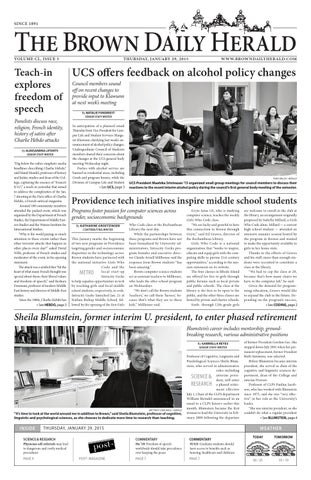
UCS President Maahika Srinivasan ‘15 organized small group meetings for council members to discuss their reactions to the recent interim alcohol policy during the council’s first general body meeting of the semester.
Providence tech initiatives inspire middle school students Programs foster passion for computer sciences across gender, socioeconomic backgrounds By KATHARINE GROETZINGER CONTRIBUTING WRITER
This January marks the beginning of two new programs in Providence targeting gender and socioeconomic disparities in the technology sector. Brown students have partnered with the national initiative Girls Who Code and the local start-up Intracity Geeks to help equalize opportunities in tech by teaching girls and local middle school students, respectively, to code. Intracity Geeks launched Jan. 21 at Nathan Bishop Middle School, followed by the opening of the first Girls
METRO
Who Code class at the Rochambeau Library the next day. While the partnerships between these programs and Brown have not been formalized by University administrators, Intracity Geeks program founder and executive director Claude Arnell Millhouse said the response from Brown students “has been amazing.” Brown computer science students act as assistant teachers to Millhouse, who leads the after-school program on Wednesdays. “We don’t call the Brown students ‘teachers,’ we call them ‘heroes,’ because that’s what they are to these kids,” Millhouse said.
Gryte Satas GS, who is studying computer science, teaches the weekly Girls Who Code class. “We are lucky and grateful to have this connection to Brown through Gryte,” said Ed Graves, director of the Rochambeau Library. Girls Who Code is a national organization that “works to inspire, educate and equip girls with the computing skills to pursue 21st century opportunities,” according to the mission statement on its website. The four classes in Rhode Island are offered for free to girls through public forums such as local private and public schools. The class at the library is the first to be open to the public, and the other three classes are hosted by private and charter schools. Sixth- through 12th-grade girls
are welcome to enroll in the club at the library, an arrangement originally proposed by Isabella Millard, a Girls Who Code alum. Millard — a current high school student — attended an intensive summer session hosted by the program in Boston and wanted to make the opportunity available to girls in her home state. Thanks to the efforts of Graves and his staff, more than enough students were recruited to constitute a class at the library. “We had to cap the class at 20, because that’s how many chairs we have in the computer lab,” he said. Given the demand for programming education, Graves would like to expand the club in the future. Depending on the program’s success, » See CODING, page 2
Sheila Blumstein, former interim U. president, to enter phased retirement Blumstein’s career includes mentorship, groundbreaking research, various administrative positions By GABRIELLA REYES SENIOR STAFF WRITER
Professor of Cognitive, Linguistic and Psychological Sciences Sheila Blumstein, who served in administrative roles including interim president, will enter a phased retirement effective July 1, Chair of the CLPS department William Heindel announced in an email to a CLPS listserv earlier this month. Blumstein became the first woman to lead the University in February 2000 following the departure
SCIENCE & RESEARCH
BRITTANY COMUNALE / HERALD
“It’s time to look at the world around me in addition to Brown,” said Sheila Blumstein, professor of cognitive, linguistic and psychological sciences, as she chooses to dedicate more time to research than teaching.
INSIDE
PAGE 4
WEATHER
THURSDAY, JANUARY 29, 2015
SCIENCE & RESEARCH Physician self-referrals may lead to dangerous and costly medical procedures POST- MAGAZINE
of former President Gordon Gee. She stepped down July 2001 when her permanent replacement, former President Ruth Simmons, was selected. Before Blumstein became interim president, she served as chair of the cognitive and linguistic sciences department, dean of the College and interim Provost. Professor of CLPS Pauline Jacobson, who has worked with Blumstein since 1975, said she was “very effective” in her role as the University’s leader. “She was interim president, so she couldn’t do what a regular president » See BLUMSTEIN, page 4
COMMENTARY Ha ’18: Freedom of speech worldwide should take precedence over keeping the peace
COMMENTARY SUGS: Graduate students should have access to benefits such as housing, healthcare and childcare
PAGE 7
PAGE 7
TODAY
TOMORROW
30 / 25
35 / 10
UNIVERSITY NEWS PAGE 2 • THURSDAY, JANUARY 29, 2015
» CODING, from page 1 the library could seek grant or state funds to expand its resources in order to serve more learners. Satas said her lessons follow a national curriculum set by the organization, which uses Scratch — a program developed by the Massachusetts Institute of Technology — to introduce students to the concept of coding. The weekly curriculum begins with “telling a computer how to draw a square or a circle,” she said. “A few girls picked it up really fast and started making art immediately,” Satas said, adding that “Some girls physically got up and started acting it out. It was really interesting watching them.” The class will create a website that serves the community in some way as part of its final project, empowering the girls to put their new skills to use beyond the classroom. While 74 percent of girls show interest in science, technology, engineering and mathematics fields in middle school, only 0.3 percent of high school girls choose computer science as their intended college major, according to data published on the Girls Who Code website. “At this point there aren’t explicit barriers for girls in CS. It’s that young girls might not get encouraged as much,” Satas said. “Showing girls that this can be a creative hobby is important for correcting that.” Salas said she hopes to ignite an interest in computer science that extends beyond the classroom and
encompasses potential future career paths in any field. Millhouse also stressed the importance of exposure in creating opportunity for the students whom Intracity Geeks hopes to reach. “My vision is to combat income inequality with access,” he said. “Having access combated income inequality for me.” Millhouse learned to code at a young age at his public school in Cape Cod, Massachusetts. He said this coding knowledge made it possible for him to rise up out of the poverty in which he was raised. “I fell in love with technology and had an amazing career in tech,” he said. Over the past few decades, Millhouse has taught many of his friends to code, helping them improve their own circumstances by securing higher paying jobs in tech. “I remember thinking, there has to be a way to do this at an earlier age and on a mass scale,” he said. It was with this vision that Millhouse went to the Providence After School Alliance — an organization aiming to broaden Providence students’ learning opportunities — last September with his plan for Intracity Geeks. Millhouse said PASA was “highly receptive” to his idea, as the organization has wanted to sponsor an after-school coding program for a long time. “It was a matter of finding the right team,” he said. “We have that now, and we’re moving at rocket pace.”
THE BROWN DAILY HERALD
COURTESY OF INTRACITY GEEKS
Claude Arnell Millhouse works with his afterschool students during the second meeting of Intracity Geeks. Millhouse said he plans to teach young students HTML, CSS and Robotc. Much of this nascent success has been made possible through the program’s connection to Brown. Cara Dorris ’15, a Herald opinions columnist, met Millhouse when she applied for a marketing job at one of his businesses last fall. When Millhouse discovered Dorris attended the University, he offered her an alternative position — helping him develop his after-school program. “We started connecting with Brown in November, which really made things take off,” Dorris said. Dorris posted job listings for teachers on the Brown Job and Internship Board — the University’s
internship finding site prior to BrownConnect — and immediately began receiving applications. “I was surprised by how many kids at Brown want to be a part of this,” she said, adding that she still receives student inquiries about assisting with the program. The program’s connection to the University extends beyond putting teachers in the classroom. Last semester, Millhouse and Dorris visited the computer science department to introduce their program to professors. Research scientist John Raiti “invited us to bring the kids here to see the department,” Dorris said. Millhouse said he is planning a field trip with the students to see robotics at Brown. He plans to teach them how to write code in Java so they will be able to control one of the robots, he added. The curriculum for the Junior Bootcamp — Intracity Geeks’ first stage of programming — is still being developed. Millhouse uses input from Brown students to develop lesson plans that he tests on his sixth grade son, who then helps as a teaching assistant in the classes. As of now, Millhouse said he hopes to teach students how to use HTML, CSS and Robotc, in addition to Java. Lego Mindstorms kits, which allow the kids to program robots on a miniature scale, have also been purchased for the class using funds from PASA. “I have a unique approach to teaching,” Millhouse said. “The course is only 20 percent lecturebased,” he said, adding that the students use search engines and basic commands to apply the lessons on HTML and other languages. Millhouse said he hopes his
students will be able to go out and show their friends how to code, thus creating momentum toward a society in which coding is cool and inclusive. “Most coding programs out there are really geeky and are aimed at geeks,” Millhouse said. “We are changing the concept of that word to show kids that girls can be geeks, as well as people of different ethnic backgrounds and nationalities.” The Intracity Geeks participants and Brown computer science students will convene for a hackathon, an event arranged by student group Hack@ Brown. Hack@Brown has invited Intracity Geeks to come to campus to watch a college hackathon Feb. 8 before participating in their own Junior Hackathon, a four-hour event hosted over two days at Nathan Bishop Middle School and Brown that will act as the culminating component of the Junior Bootcamp. Ricky Medina ’16, general outreach coordinator for Hack@Brown, described a hackathon as “hundreds of kids coming together to build amazing things with code.” Dorris, a friend of Medina’s, contacted him on behalf of Intracity Geeks to ask for help from Hack@Brown in connecting the students in the program to the event. Like the Girls Who Code final project, the Junior Hackathon will allow students to put their new skills to use in creating something of their own. “If we train these kids, in eight years they are going to start businesses that will create the growth to transform and ignite Rhode Island’s economy,” Millhouse said. “It was a perfect alignment of vision,” Medina said. “It would have felt irresponsible not to get involved.”
UNIVERSITY NEWS
THURSDAY, JANUARY 29, 2015 • PAGE 3
THE BROWN DAILY HERALD
» UCS, from page 1 Services conducts a review of the University’s alcohol policies this semester, wrote Klawunn and Executive Vice President for Planning and Policy Russell Carey ’91 MA ’06 in a Jan. 19 campus-wide email. Carey and Klawunn announced “a pretty monumental change” in just one paragraph of the email, said UCS President Maahika Srinivasan ’15. Other parts of the email addressed sanctions incurred by Phi Kappa Psi and Sigma Chi after students who attended separate unregistered parties with alcohol service at the two fraternities filed separate sexual misconduct reports. Klawunn will attend next week’s UCS meeting to solicit student feedback and answer questions about the policy changes, Srinivasan said. Sazzy Gourley ’16, UCS vice president and chair of the UCS Outreach and Advocacy committee, led a review of the email before the general body divided into smaller discussion groups. The council wanted to “talk about it as a group so we know where everyone is standing,” he said. “Alcohol isn’t a cause for sexual assault, and when we talk about it we can’t
»HEBDO, from page 1 played a role in France’s “long history of satire,” said Youenn Kervennic, senior lecturer in French studies. Part of the name of the magazine, “Charlie,” came from the combination of Charles de Gaulle, former president of France, and Charlie Brown from Peanuts, encapsulating the magazine’s multifaceted political identity , Kervennic said. The main topics on which the magazine’s cartoonists comment include religious cults, popular culture, Islam, extreme Right politics and Judaism, he added. Charlie Hebdo has confronted financial difficulties for its liberal use of freedom of speech. The magazine’s executives refused to accept funding from private donors or advertisers, granting the staff full reign over its content, Kervennic said. Before the terrorist attack, the magazine was selling 30,000 copies a week — hardly enough issues to stay afloat, Kervennic said. But the first edition after the attack sold seven million copies, he
ever frame it like that,” Srinivasan said. The policy change was “important to portray an image of Brown taking action,” said UCS general body member Matthew Boney ’18 in a discussion group. But “just saying alcohol shouldn’t be served at certain parties isn’t really going to change anyone’s actions, so it may just be hurting us because it might be putting more people in violation of school policy,” he added. Gourley said the interim policy “definitely has the potential to push more (parties) underground” and off campus. “It makes sense that fraternities need to host recruitment events,” said UCS general body member Christian Hanson ’17. “If I (were) in a fraternity, I would feel like they just brushed over something that’s really integral to my organization just for the sake of, perhaps, diffusing responsibility.” In considering the interim guidelines’ effect on the rate of reporting sexual assault, Boney said the policy could cause the number of reports to decrease because it “might scare people away from being open with the University.” UCS committee leaders also updated the general body on their plans for the semester.
The UCS Admissions and Student Services committee will continue preparing the launch of “WTF Brown,” or “What to Fix Brown,” an online forum for students to provide feedback to UCS and administrators on issues of student life, said Committee Chair Ryan Lessing ’17. Committee members will also continue working to create the Brown Developer Exchange for students interested in building software for the University, he said. UCS Campus Life Committee Chair Walker Mills ’15 said that in the short term, committee members will focus on responding to the influx of former fraternity members living in temporary housing, as well as increasing feedback about dining services. UCS Academic and Administrative Affairs Chair Elena Saltzman ’16 said her committee plans to improve sophomore advising by the concentration declaration deadline. The council also reconstituted several student groups. The group formerly known as Karin and the Improvs gained approval to change its name to Comic Sans, while the groups Students for Life and Students for Samaritans were approved to have leadership specifications added to their constitutions.
added. Rather than focusing on the history of satire, panelists Mandel and Ourida Mostefai, visiting professor of comparative literature and French studies, shifted the discussion’s focus to historical and contemporary relations between the ethnically French population and those who have immigrated to France over the last few decades. The recent terrorist attacks are “deeply entangled in France’s colonial history,” Mandel said. Many of the Muslims and Jews in France today are of Algerian descent, she said. During the decolonization of Algeria, France granted citizenship to the Jewish population of Algeria but not the Muslim population, leading to two “extremely different” paths of integration into French society, she said. Looking to the future, Mandel expounded on the probability that these attacks will influence France’s foreign policy going forward. If previous reactions to this kind of violence are any indication of a future response, Mandel said she is not “overly optimistic.”
“There is a true confusion in France between the relations of race and citizenship,” Mostefai said. The main difference between the events of January and Sept. 11 is that the attack on Charlie Hebdo was carried out by citizens rather than by the country’s outsiders, she said. Anne-Caroline Sieffert GS, who is studying French, said she appreciated that Kervennic provided a history of the magazine. “It frustrates me that many people informed by only five covers of Charlie Hebdo are having a debate about France’s freedom of speech,” she said. Paula Martinez Gutierrez ’17 said the most interesting part of the discussion was the question of Islam’s compatibility with the Republic. In relation to this question, the panelists broached the topic of France’s 2004 ban on wearing conspicuous religious symbols in schools — a law that has stirred heated debate concerning the Muslim veil, or hjiab. The conversation on the veil bolstered the quality of the teach-in, Martinez Gutierrez added.
Higher Education Roundup BY EMMA HARRIS, UNIVERSITY NEWS EDITOR
Yale student held at gunpoint Yale police officers held junior Tahj Blow at gunpoint Jan. 24, wrote his father Charles Blow in a Jan. 26 New York Times column. Around 6 p.m., Blow was returning to his dorm room from the library when an officer raised his gun and told him to drop to the ground, his father wrote of his son’s experience. The officer asked Blow for his student ID, and another officer later informed him a burglary had been reported and the suspect resembled him, his father wrote.His father repeatedly tweeted about the incident that evening, using popular hashtags such as “#BlackLivesMatter.” The Yale Police Department will conduct an internal investigation of the incident, the Yale Daily News reported Jan. 27. In a campus-wide email, University President Peter Salovey, Yale College Dean Jonathan Holloway and Yale Police Department Chief Ronnell Higgins wrote the incident was “not a replay of what happened in Ferguson; Staten Island; Cleveland; or so many other places in our time and over time in the United States,” the Daily News reported.
Obama revokes motion to cancel 529 college savings plans After public criticism, President Obama called off his plan to eliminate 529 college savings plans, multiple news outlets reported. Obama’s decision came after House Speaker John Boehner, R-Ohio, called for the proposal to be stricken from the budget “for the sake of middle-class families,” the New York Times reported Tuesday. At a press conference Tuesday, a White House official called the backlash a “distraction,” noting that Congress can now focus instead on education and child care tax relief, the Times reported. The plan was part of Obama’s effort to aid middle-class families, as he announced in the State of the Union Jan. 20. The proposal was based on the notion that wealthier families tend to utilize the savings plans, and taxing them would allow funds to be reallocated to middle-class families, the Washington Post reported Tuesday. About seven million families have 529 plans, which total about $217 billion, the Times reported. 529 plans are run at the state level and allow parents to deposit money that may grow over time. The money can then be removed tax-free to pay for children’s college expenses.
Duke suspends frat following sexual assault allegation Duke University suspended its chapter of Alpha Delta Phi Jan. 20 after a student reported an incident of sexual assault at an off-campus party Jan. 8, the Duke Chronicle reported Jan. 20. The Durham Police Department obtained a search warrant Jan. 10 and is probing into the situation as part of a second-degree rape investigation, the Chronicle reported. The female student who filed the claim maintained she had been drugged and raped, according to the search warrant and an attached probable cause affidavit. After drinking hot chocolate served by the fraternity that did not taste alcoholic, her last memory “was dancing with her friends before she woke up the next afternoon with a t-shirt she did not recognize, no bra and no underwear,” the affidavit reads. The leggings she wore the night before were torn on the floor, the Chronicle reported. She received a text from an unknown number at 1:30 a.m. saying she “WENT BACK” with someone the sender knew. “YOU’RE SCREWED,” the text read, according to the document. Police officers searched the house where the incident occurred and collected three liquid samples and photographs, the Chronicle reported. No charges have been filed, the New York Times reported Jan. 20.
Dartmouth faces cheating scandal
www.browndailyherald.com
After being accused of cheating in a fall course entitled “Sports, Ethics and Religion” Nov. 11, 64 Dartmouth students have been sanctioned by a disciplinary committee, the Dartmouth reported Monday. Punishments ranged from four terms of academic probation to two terms of suspension, with most of the 64 students suspended for one term, the Dartmouth reported. The course was taught by Randall Balmer, chair of the religious studies department, and was created for student athletes, the Dartmouth reported Nov. 12. One method of evaluation in the course was clicker quizzes — assessments in which students use personal clickers to answer questions. Some students were accused of giving their clickers to peers to complete the quizzes, while others were accused of directly completing the quizzes for peers. Balmer suspected students were not attending class and giving other students their clickers, the Dartmouth reported. On Oct. 30, he gave a clicker quiz followed by a hard copy of the same quiz and found that 43 more students completed the clicker quiz. Students’ appeals to the decisions were declined, and the entire judicial process lasted under three months, the Dartmouth reported.
SCIENCE & RESEARCH PAGE 4 • THURSDAY, JANUARY 29, 2015
THE BROWN DAILY HERALD
Study exposes physician self-referrals » BLUMSTEIN, Fee-for-service health care system endangers patients, can raise deductables By FRANCES CHEN SENIOR STAFF WRITER
When physicians order certain medical tests or procedures to be done for a patient, they have the option to selfrefer patients back to their own office. These self-referrals are widely viewed as financially motivated and selfserving, yet loopholes in the law allow their continuation. A recent paper by Eli Adashi, professor of medicine, and Robert Kocher, senior fellow at the University of Southern California, explains how and why these loopholes should be closed. Self-referrals often lead to excessive and unnecessary testing, which can be dangerous for patients and costly for taxpayers, according to the article published in this month’s issue of the Journal of the American Medical Association. “If you look at physicians who give imaging scans … many more of the self-referral cases are negative,” said Edward Feller, clinical professor of medicine at the Alpert Medical
School. The evidence suggests that many self-referral tests are unnecessary, he added. Physicians are financially incentivized to self-refer patients largely because the United States currently has a fee-for-service health care system, in which physicians are paid for each test or procedure that is done, Feller said. A related report issued by the Government Accountability Office “specifically states that these activities, in their judgment, are financially motivated,” Adashi said. Taxpayers who pay for Medicare, Medicaid and their own insurance premiums often suffer the consequences, Adashi said. Though the insurance covers the cost of the procedures, excessive testing causes a hike in deductibles, he said. Overtesting occurs in part because patients do not need to think about the cost of procedures that are covered by insurance, Feller said. “A fee-for-service system is divorced from patient interest,” he said, adding that he has done thousands of colonoscopies and “never, ever, ever in my career did a patient with health insurance ask me how much it cost, and I wouldn’t have known.” Educating the general public
about the prevalence of overtesting may help solve the problem, Feller said. Copays, deductibles and lifetime limits on health care spending may also aid in alleviating the problem by increasing personal financial responsibility, Adashi added. Past laws have attempted to prevent physician self-referrals, but over time subsequent amendments and regulations have created loopholes. In order to reduce self-referral rates, Adashi said he recommends switching from the current fee-forservice system to a fee-for-value system, in which physicians are paid according the quality of care they provide. For example, primary care providers are responsible for screening patients for symptoms relating to diabetes, Adashi said. If a patient is found to have diabetes, the physician should also order tests screening for other symptoms of diabetes, such as problems with eyesight and urination. In a fee-for-value system, a physician that orders these tests would be rewarded with a bonus, while physicians who fail to do so would be paid less. “The idea is to use incentives and disincentives, so you link payment to performance,” Adashi said.
Got something to say? Leave a comment online! Visit www.browndailyherald.com to comment on opinion and editorial content.
from page 1
could do, which is to bring a whole vision and launch a whole program, but I think she was very well-loved,” Jacobson said. “People were very appreciative of her stepping into the presidency when there was a sudden vacuum,” Jacobson said, adding that Blumstein “did a great job keeping things ordered and happy while a more permanent search was completed.” Over the next three years, Blumstein said she will teach half of the standard number of courses and will no longer accept graduate students into her lab. Other details, such as her involvement in advising and University committees, are yet to be worked out, she added. “Right now I work full blast six days a week, and frankly I don’t want to do that anymore,” she said. “It’s time to look at the world around me in addition to Brown.” “It was a very heart-wrenching decision for me,” Blumstein said. “I’ve been at Brown since I was 26 — I came directly from graduate school. It’s been a lot of years, and I’ve done a lot of things. It’s really been a great trip, but I think it’s time to try something different.” Blumstein said she plans on maintaining her ties to the University postretirement. “Brown’s been my life. I certainly don’t see it not being a part of it” in the future, she said. For example, Blumstein said if she continues to receive grant funding, she will continue to do research, and operate her lab, albeit on a smaller scale. Eiling Yee PhD ’05, assistant professor of psychology at the University of Connecticut and a former graduate student in Blumstein’s lab, emphasized Blumstein’s warmth and humor. Even after students have moved on from Brown, Blumstein continues to be “very supportive, protective and loyal,” Yee said. “In the classroom, she was always very warm — surprisingly so for someone of her stature in her field,” Yee said. “In the lab, she was extremely encouraging. She always looked on the bright side and had something positive to say. She would always help you think about ways to explore questions to move on from something discouraging, and she
was a great cheerleader.” Emily Myers PhD ’06, assistant professor of speech, language and hearing sciences at the University of Connecticut and adjunct assistant professor of CLPS, was both a graduate student and a postdoctoral fellow in Blumstein’s lab. She and Blumstein continue to collaborate on both grants and research. Myers said Blumstein’s mentorship has been a positive force in her career. “Whenever I have a tough question to deal with regarding a student or in research, I think ‘What would Sheila do?’ Even when she’s not physically in the room, I still have the sense that she’s guiding the process,” she said. Blumstein deeply cares about her students’ success, Myers said. “She has very high standards for those students, but she also has incredible loyalty and forgiveness when things inevitably don’t go well.” Blumstein is “the best mentor a young scientist could ask for,” Myers added. A number of undergraduate research assistants have also worked in Blumstein’s lab. “Her lab is definitely a teaching lab, so she’s always looking for new students to shadow her,” said Natalya Machado ’16, who began working in Blumstein’s lab during her sophomore year. “Sheila is incredibly available to students and helpful, and she just really wants undergrads to get the most out of lab.” Jacobson cited Blumstein’s full office hours and years of teaching of CLPS 0020: “Approaches to the Mind: Introduction to Cognitive Science,” the department’s entry-level class, as evidence of her continued commitment to undergraduates. “She’s obviously totally dedicated to her students and spends a lot of time and energy on them.” Blumstein is a reputed expert in neurolinguistics and speech processing. She has received many academic honors, including the Guggenheim Fellowship and the Claude Pepper Investigator Award. She is also a member of the American Academy of Arts and Sciences, the American Association for the Advancement of Science and a fellow of the American Philosophical Society, according to her University profile.
TODAY
THURSDAY, JANUARY 29, 2015 • PAGE 5
THE BROWN DAILY HERALD
menu
frozen
SATELLITE DINING JOSIAH’S Mashed Potato Bowl BLUE ROOM Chicken Saag and Avial Coconut Vegetable Curry Soups: Chicken Artichoke Florentine, Fire Roasted Vegetable, Turkey Chili ANDREWS COMMONS Pizzas: Nacho, Pepperoni and Sausage, Artichoke
DINING HALLS SHARPE REFECTORY LUNCH
DINNER
Falafel, Grilled Chicken Alfredo Sandwich, Broccoli Rabe, Vegan Ratatouille, Frosted Brownies LUNCH
Baked Potato Bar, Italian Beef Noodle Casserole, Chocolate Vanilla Pudding Cake
VERNEY-WOOLLEY
Turkey Cutlet, Stuffed Shells with Meatless Sauce, Curly Fries, Cream Cheese Brownies
DINNER
Grilled Cilantro Chicken, Cheese Ravioli, Butternut Squash and Leek Risotto, Apple Streusel Pie
sudoku
SADIE HOPE-GUND / HERALD
Students leave their tracks across the Main Green. After just one snow day, classes continued as planned, despite Winter Storm Juno’s heavy snowfall.
comics Class Notes | Philip Trammell
crossword
Hepatitis Contact Lens | Joshua Greene
calendar TODAY
TOMORROW
12:00 P.M. “THE DANGERS THAT SURROUND THE
12:00 P.M. ANTHROPOLOGY LECTURE BY KRISTIN
CHILD”
PETERSON
Daniel Rodriguez, assistant professor of history, Latin America and the Caribbean will address his research on the racial and gendered politics of infant and maternal health in Cuba. Brown/RISD Hillel 303
Dr. Kristin Peterson, professor of anthropology at the University of California, Irvine, will deliver a talk entitled “Other Drugs: Speculative Capital, Pharmaceutical Markets, and Hustling the Day in Nigeria.” Giddings House 212
12:00 P.M. BEARSYNC TRAINING
5:00 P.M. FISHIN’ FOR FUN
system. Petteruti Lounge
Students will be able to get their very own pet goldfish and design a tank for it to call home, all while watching “Finding Nemo.” Faunce
6:30 P.M. FEMSEX INFO SESSION
5:30 P.M. OPENING RECEPTION: 2015 NCECA BIENNIAL
Student group leaders will have the opportunity to learn the ropes of BearSync, the new student organization software
The session will address the 12-week extracurricular program that focuses on gender, sexuality and safe sex. The Underground
The opening ceremony of the 2015 National Council on Education for the Ceramic Arts Biennial. List Art, Bell Gallery
COMMENTARY PAGE 6 • THURSDAY, JANUARY 29, 2015
THE BROWN DAILY HERALD
EDITORIAL
Thinking outside of Brown CareerLAB is a resource widely under-utilized by Brown students, many of whom either write off the center as unnecessary or are unaware of the services it provides. The acronym LAB stands for “Life After Brown,” and the center is devoted to facilitating various opportunities outside of the University, both during and after one’s college experience. A valuable resource, CareerLAB helps students find and transition to internships and jobs, which can often be problematic for students following a traditional liberal arts education. Brown students, who tend to be self-sufficient and hardworking, may hold reservations about seeking out advice. Nonetheless, CareerLAB provides a wide variety of services. Matt Donato, the incoming CareerLAB director, plans to prioritize making the center more accessible to students. Especially at a school like Brown — one that is devoid of core graduation requirements — linking the interdisciplinary education of students with liberal arts degrees to future careers is of the utmost importance. A heightened focus on improving the visibility and availability of CareerLAB should be applauded. Along with Donato, President Christina Paxson P’19 has also pledged to assist students with the generally intimidating process of acquiring internships and jobs. Last November, the University launched BrownConnect, an internship finding and alumni networking site that is part of Paxson’s goal in her strategic plan to provide every undergraduate receiving financial aid with at least one funded internship or research opportunity. Other resources, such as the Job and Internship Board and BRUnet, exist as online search engines geared towards helping students connect with alums and research jobs. Additionally, an in-person meeting with a staff member at CareerLAB can serve as a quick and painless way of editing a resume or cover letter or practicing for an interview. The center hosts university-wide career fairs several times a year that bring in as many as 100 employers, as well as smaller events such as the recent January Career Laboratory, which allowed students to attend panel discussions in different fields of interest. This past session invited alums working in media and communications, public health, business, public policy, environmental sustainability, entertainment, startups and science. In utilizing CareerLAB’s programs, students are able to interact with potential future employers, graduate admissions officers and former Brown students to learn more about different opportunities outside of the University. Students should use CareerLAB to their advantage. While time spent at Brown is precious, planning the steps to one’s future is critical. CareerLAB’s services — both free and easy to use — should not be underestimated or ignored. The unique resources are available, and only a small amount of self-motivation is required in order to take advantage of them. Editorials are written by The Herald’s editorial page board: its editors, Alexander Kaplan ’15 and James Rattner ’15, and its members, Zoila Bergeron ’17, Natasha Bluth ’15, Manuel Contreras ’16, Baxter DiFabrizio ’15, Manuel Monti-Nussbaum ’15 and Katherine Pollock ’16. Send comments to editorials@browndailyherald.com.
Letters, please!
M I R A N DA F R I E L
Q U O T E O F T H E D AY
“If we train these kids, in eight years they are going to start businesses that will create the growth to transform and ignite Rhode Island’s economy.
— Claude Arnell Millhouse, founder and executive director of Intracity Geeks
letters@browndailyherald.com
See coding on page 2.
Editorial Leadership
Sections
Visuals & Production
Business
Editors-in-Chief Michael Dubin Maxine Joselow
Arts & Culture Editors Eben Blake Gabrielle Dee
General Managers Sarah Levine Winnie Shao
Managing Editors Kiki Barnes Jillian Lanney
Metro Editors Alexander Blum Emma Jerzyk Drew Williams
Design Editors Loren Dowd Carlie Peters Taylor Schwartz Assistant: Meryl Charleston Assistant: Andrew Linder
Senior Editors Camilla Brandfield-Harvey Isobel Heck Molly Schulson
Science & Research Editors Andrew Jones Steven Michael
BLOG DAILY HERALD Editor-in-Chief David Oyer
Sports Editors Andrew Flax Alex Waigner
Managing Editors Deena Butt Jacob Koffler
University News Editors Emma Harris Caroline Kelly Joseph Zappa
POST- MAGAZINE Editor-in-Chief Adam Asher DIGITAL Online Editor Marcy Huang
COMMENTARY Editorial Page Editors Alexander Kaplan James Rattner Opinions Editors Megan GrapengeterRudnick Kate Kiernan Evan Sweren
Photo Editors Head: Brittany Comunale David Deckey Katie Liebowitz Arjun Narayen Ashley So Ryan Walsh Graphics Editors Avery Crits-Christoph Emma Jerzyk Web Producers Joe Stein Harsha Yeddanapudy Abdullah Yousufi Copy Desk Chief Madeline DiGiovanni Illustrations Editor Angelia Wang Video Editor Richard Flores
”
Directors Sales: Moniyka Sachar Sales: Jess Urrutia Finance: Josh Tartell Alumni Relations: Marley Rafson Business Dev.: Yuta Inumaru Sales Managers Matthew Meyer Henry Ritter Gulmira Hamit Taylor Casey
facebook.com/browndailyherald
Location: 195 Angell St., Providence, R.I. www.browndailyherald.com
@the_herald
Editorial contact: 401-351-3372 herald@browndailyherald.com
browndailyherald.com
Business contact: 401-351-3260 gm@browndailyherald.com
Corrections: The Brown Daily Herald is committed to providing the Brown University community with the most accurate information possible. Corrections may be submitted up to seven calendar days after publication. Commentary: The editorial is the majority opinion of the editorial page board of The Brown Daily Herald. The editorial viewpoint does not necessarily reflect the views of The Brown Daily Herald, Inc. Columns, letters and comics reflect the opinions of their authors only.
Finance Managers Collections: Neil Wathore Collections: Benjamin Wesner Operations: Carin Papendorp
Letters to the Editor: Send letters to letters@browndailyherald.com. Include a telephone number with all letters. The Herald reserves the right to edit all letters for length and clarity and cannot assure the publication of any letter. Please limit letters to 250 words. Under special circumstances writers may request anonymity, but no letter will be printed if the author’s identity is unknown to the editors. Announcements of events will not be printed.
Business Dev. Manager Project Leader: Kaden Lee
Advertising: The Brown Daily Herald, Inc. reserves the right to accept or decline any advertisement at its discretion. The Brown Daily Herald (USPS 067.740) is an independent newspaper serving the Brown University community daily since 1891. It is published Monday through Friday during the academic year, excluding vacations, once during Commencement and once during Orientation by The Brown Daily Herald, Inc. Single copy free for each member of the community. Subscription prices: $280 one year daily, $140 one semester daily. Copyright 2014 by The Brown Daily Herald, Inc. All rights reserved. Periodicals postage paid at Providence, R.I. Postmaster: Please send corrections to P.O. Box 2538, Providence, RI 02906.
COMMENTARY THURSDAY, JANUARY 29, 2015 • PAGE 7
THE BROWN DAILY HERALD
Message to the non-Charlies DAVID HA opinions columnist
In response to the shootings that targeted the staff of the French magazine Charlie Hebdo, many have recently risen up under the slogan “Je suis Charlie,” which translates from French to “I am Charlie.” The slogan sympathizes with those who were killed in the massacre, thereby supporting freedom of speech and of the press. There are, however, differing opinions on the incident. Herald opinions columnist Peter Makhlouf (“Makhlouf ’16: “Je ne suis pas Charlie, Jan. 22) and many others took a difference stance. “Je ne suis pas Charlie,” which translates to “I am not Charlie,” was their slogan. They argued that the real blame laid in the French magazine that ridiculed Islam. Some of them even went on to suggest that the “I am Charlie” movement is guided by nothing but a feeble political motive seeking to unite the West under nationalism and fanaticism. Is this true? The answer would depend on what we, as society, should value more: freedom of expression or politeness. If communicating politely is so important, to the extent that we believe the right to free expression can be abridged, then we may be able to justify the action of the terrorists to some degree.
For me, what is more important is definite — and I reached this conclusion by reflecting on a childhood incident. One peaceful day in sixth grade, I was walking around like an idiot with my pants zipper wide open — unintentionally, of course. A girl whom I barely knew walked up to me and boldly shouted, “Your fly is open!” With a flushed face, I hurriedly pulled it up. While the girl was honest to my childhood self, in the grown-up
and helps us overcome each other’s differences. In fact, I can now thank the girl who suggested I pull up my zipper, for that was the right thing to do, albeit a slightly unskillful way of accomplishing the goal. We must remember that the right to freely express an opinion is the most fundamental freedom upon which our nation was founded. This was, in fact, our very first amendment to the Constitution. Though such freedom may evoke humiliation, this should not, by any
iculing others’ beliefs is a brilliant idea? Absolutely not. Effective journalism derives not only from freedom, but also from wisdom. Critiques are effective when they are creative, not antagonistic. Media that only has freedom, not wisdom, is nothing but a babbling child seeking attention. But words are never to be met with violence, even when they are not communicated in a subtle or empathetic fashion. Let them be. If they seek to insult,
Humiliation that derives from the rude nature of some opinions is a fait accompli of a free and civilized society.
world, there exists a social norm that prohibits people from being honest at all times. We no longer shout to each other about open zippers. The discomfort tied to such confrontations discourages us from speaking up. From this experience, unimportant perhaps in appearance, I learned to argue for the importance of freedom of speech: the right to free speech allows us to live without fear
means, serve as a reason to restrict it. If humiliation or anger follows as a consequence of expressing an opinion, then that is a repercussion we need to humbly accept in order to construct a civilized society. This freedom was won through countless sacrifices. Suppressing it would undermine a valuable right that is enjoyed in only a handful of nations. Does this mean that I believe rid-
so be it. If they are rude, overlook their vain efforts. Humiliation that derives from the rude nature of some opinions is a fait accompli of a free and civilized society. If violence is justified, the attention becomes wrongly centered on the less significant issue. The public begins to miss the point. An action to justify utilizing violence as a response mechanism blinds us from the truth. I fear many journalists and
columnists are pursuing this erroneous path. Let us return to my childhood anecdote for a moment. The action of the French magazine is really not comparable to pointing out an open zipper, but rather to making fun of the pants itself. A rather rude and personal remark, indeed. But even so, the best course of action certainly would not be to fight back with fists. A movement to cherish freedom of expression should never be threatened. When a movement, at its core, has as its purpose treasuring honesty and sincerity, it is our job to remove hurdles in its path. It is unfortunate that some choose to use the valuable right in our society of free speech with immaturity and disrespect, but as a civilized community, we must respond with maturity and respect. Brown, fortunately, is one of the communities where the right to free speech is universally enjoyed — and we must be thankful for it in every situation, even when rudeness and humiliation may be involved. Nothing must shadow the necessity to fight against violence that puts society’s most important freedom in jeopardy.
David Ha ’18 is doing his best to take advantage of the right to free speech. He can be contacted at woosuk_ha@brown.edu
Standing up for Brown’s grad students STAND UP FOR GRAD STUDENTS (SUGS) guest columnist
The old joke goes that graduate students are paid to read. It’s true, we read. A lot. But reading is not solely what we are paid to do: We are also paid to teach and mentor undergraduates, conduct research for faculty members and conduct our own research in order to write journal articles, papers for presentations at academic conferences and — finally — booklength dissertations. The work we do isn’t just meant to advance our own careers in an increasingly brutal academic job market. Our teaching and mentoring helps the University make good on its promise of delivering a rigorous, engaged and collaborative undergraduate education. And our academic work burnishes Brown’s reputation as a prestigious research institution. Far from just getting “paid to read,” graduate students perform much of the intellectual labor that goes on at the University. We represent a crucial motor that keeps this community running. But despite all of the intellectual labor we do in and for Brown, a question persists: Are we workers or are we students? The Graduate School certainly treats us like workers when it requires our labor. But it insists we are students when we demand workplace protections and an institutional voice. We live in a precarious in-between space here at Brown — not quite students and not quite workers — and this insecure position
makes us vulnerable to reduced wages and benefits, lacking much recourse for sexual harassment and assault and subject to a broader invisibility on campus. We at Stand Up for Grad Students are committed to exposing the increasingly precarious position of grad students. We argue that the vulnerability we face threatens to impoverish the integrity of workplace democracy, academic freedom and ra-
ing burdens onto cash-strapped departments; and delivering transparent, responsible sexual harassment and assault adjudication for grad students. These issues, we believe, are not just important to grad students. They are crucial to making the Brown community healthier and more just for all who participate and work in it. We urge you to stand with SUGS and our
The Graduate School certainly treats us like workers when it requires our labor. But it insists we are students when we demand workplace protections and an institutional voice.
cial and gender equity in the larger Brown community. In order to bring graduate education in line with the University’s commitment to educational leadership and academic excellence, SUGS is launching a multi-pronged campaign devoted to improving grad students’ access to housing, child care and healthcare; transforming the ideal of racial and gender equity into a lived reality; reducing the culture of competition among grad students, exacerbated by the Grad School’s new measures to push fund-
efforts to make Brown a better place to learn, work and live for everyone by supporting these demands: The Grad School must provide us with access to affordable housing, childcare, healthcare and dental insurance. This would ensure that all enrolled grad students are able to research, teach and contribute without need. Healthy bodies and families are essential for a healthy Brown. Institutional structures should also be created that would increase recruitment of faculty
of color and mentoring for both grad students and faculty of color. Diversity at Brown should be more than just a buzzword — it needs to be a lived reality on campus. The Grad School must abandon its unrealistic five-year model for doctoral degrees and provide all students in good standing advanced funding in order to preserve the noncompetitive ethos at Brown that is so attractive to prospective and current students. It takes between six and eight years to complete a PhD program in the humanities and social sciences, but the University is increasingly pushing students onto a five-year funding clock despite the fact that peer institutions regularly allow grad students to work for funding beyond their fifth year. Last fall, Yale formally acknowledged the importance of rejecting the time-to-degree speedup by guaranteeing all students six years of funding. We urge Brown to model Yale’s funding structure in order to foster community, not competition, on campus. Finally, we are also calling for responsible, transparent sexual harassment and assault protection, training and adjudication. Sexual protection for grad students makes everyone on campus safer. We hope you will stand with SUGS in our efforts to make Brown a more democratic, fair and equitable place to live, work and learn.
SUGS is kicking off its spring campaign with a Feb. 2 rally on housing and healthcare, and its members will be present at the Feb. 4 open forum on sexual assault hosted by the Graduate Student Council.
METRO THE BROWN DAILY HERALD
THURSDAY, JANUARY 29, 2015
Proposed bill demands mandatory GMO labeling in R.I. Proposition, similar to those in Maine and Connecticut, responds to increase in public awareness By ALON GALOR STAFF WRITER
Legislation introduced Jan. 15 would require genetically engineered products in Rhode Island to be clearly labeled “produced with genetic engineering,” and would also specify what the term “genetically engineered product” — which has multiple definitions — would mean in the state. Rep. Raymond Hull, D-Providence and Rep. Dennis Canario, D-Portsmouth, Little Compton, Tiverton separately introduced legislation on genetically modified organisms, though the two will likely collaborate in the future, Hull said. Similar bills have been passed in Maine and Connecticut but will not take effect until comparable legislation is passed in other states, according to a General Assembly press release. For the bill proposed in Maine to take effect, five nearby states must pass similar legislation, while Connecticut’s law is contingent on the passage of GMO bills in enough northeastern states so that their combined populations include 20 million residents, according to the press release. The announcement of Rhode Island’s bill arrives during a period of increased media scrutiny of GMOs, following the Jan. 13 dissolution of the European Union-wide ban on genetically modified farming, which allowed national governments to impose their own restrictions. “I’ve introduced this bill for four years,” Hull said. “It gets just so far and then it stops. But there is more momentum now than there has been in the past. We’re very optimistic.”
The U.S. Department of Agriculture, which regulates the disclosure requirements of foods, declares that there is no meaningful difference between GMO and non-GMO foods. The department also sets standards for labeling of ingredients, including artificial flavors, colors, preservatives and sweeteners. It stipulates that fruit juices must be labeled “fresh” or “made from concentrate,” and producers are not allowed to use the term “juice” if the product is not made of 100 percent juice. It also mandates that specific labels such as “fresh,” “frozen,” “fresh frozen” and “frozen fresh” be assigned to products such as peas. Around the country and in Rhode Island, labels exist to specify non-GMO foods and certified organic foods, which by definition are not genetically modified. Studies have shown that genetically modified crops may exhibit increased drought resistance, higher pesticide tolerance and increased nutritional content. “We are moving into a world that is more food-stressed over the next 50 years due to climate change and population growth,” said Rep. Arthur Handy, D-Cranston, a co-sponsor of Hull’s bill and chairperson of the House Environment and Natural Resources Committee. “Genetically modified foods may play a roll in combating this stress.” Other studies link genetically modified foods to decreased antibiotic efficacy, more frequent use of pesticides and unapproved food additives and allergens. The longterm implications of
Genetically-modified crops, 1996-2014
The percentage of planted acres of genetically-modified crops has increased more than tenfold since 1997, particularly in heat-tolerant corn, which consisted of only 3 percent of planted acres in 1997 and 97 percent in 2014. 100 percent
HT soybeans HT cotton HT corn Bt cotton Bt corn
80
Corn
1997
Geneticallymodified: 3%
60
2014 Non geneticallymodified: 11%
40 20 0
Non geneticallymodified: 97%
Geneticallymodified: 89%
1996 1998 2000 2002 2004 2006 2008 2010 2012 2014
HT stands for heat-tolerant. Bt is a genetic modification that minimizes crop damage from caterpillars.
Source: U.S. Department of Agriculture
EMMA JERZYK / HERALD
Genetically modified organisms have become more prevalent in the past few years, prompting increased media attention and growing public awareness. genetically modified foods may be difficult to foresee since they have only been around for a few decades. “There have been no longitudinal studies conducted on the health impacts of genetically engineered foods on humans,” said Jim Leahy, executive director of Citizens for GMO Labeling, a grassroots movement dedicated to labeling genetically modified products. Approximately 70 percent of supermarket foods contain genetically modified ingredients, according to the U.S. Department of Agriculture. “I think that consumers ought to have the right to know exactly what they are purchasing,” Handy said, adding that “unless we can get to a point where we are positive that everything is safe, it would be better for us to be informed.”
GMO labeling is practiced in 65 countries, Leahy said. Many polls — including some conducted by the New York Times, MSNBC, Reuters and ABC News — all indicate that more than 90 percent of Americans are in favor of GMO labeling. With issues such as gun control and GMO labeling, there is a large public majority that supports government regulation, but vocal and powerful groups have hindered the ability of policymakers to enact change, Handy said. Opponents of labeling genetically modified products “are being much more vocal,” he said, adding that “unless folks express themselves more vigorously on this issue, we’re more likely to go with the folks we hear from.” “A central concern of manufacturers and producers is that labeling
sends a signal that GMOs are bad,” Handy said. “They are worried that it may cut into their bottom line,” Hull said. Hull’s proposed bill would not impose GMO labeling on alcoholic beverages, food provided in any restaurant, farm products sold by a farmer or food derived from a non-genetically modified animal fed or injected with engineered foods or drugs, according to the bill’s text. “It doesn’t mean that we can’t revisit those caveats after the bill is passed,” Hull said. Looking ahead, Hull said he would “probably join forces” with Canario and his bill, though he added that only his own bill addresses concerns such as liquor companies’ use of genetically modified corn in producing alcohol.
R.I. schools can administer new standardized test starting in March
SAM KASE / HERALD
Students, parents, teachers and members of the American Civil Liberties Union expressed concern that if the bill were implemented immediately, schools would have little time to adapt to its effects.
Despite opposition and calls for delay, public officials approve the use of PARCC test this year By ANICA GREEN CONTRIBUTING WRITER
The Partnership for Assessment of Readiness for College and Careers,
a standardized test that has been administered in the United States only in its trial phase, will be given to Rhode Island high school students in March and may be used as a graduation re-
quirement as early as 2017. In August, State Education Commissioner Deborah Gist, who is also a member of the PARCC Governing Board, recommended that the test become a graduation requirement in 2020 instead of 2017, the year dictated by current law. Gist issued a Jan. 16 memo to superintendents stating
that “school districts can have policies requiring participation” in the test as early as this spring. Though the test will not be used as a graduation requirement this year, Gist proposed that school officials could factor PARCC test results into students’ grades. These suggestions have raised concern among students, parents and teachers alike, in addition to inspiring action from the American Civil Liberties Union of Rhode Island. The organization’s members oppose using PARCC in a potentially punitive way so soon and believe test results may vary dramatically among schools, said Steve Brown, executive director of the ACLU of Rhode Island. “It’s important to give time for schools to adjust, so the curriculum matches what the test is measuring,” Brown said. Districts and students have not had enough time with the test in place to factor results into students’ grades, he said, adding that a new test with new challenges requires an adjustment period. Elliot Krieger, public information officer for the Rhode Island Department of Education, said he disagrees with the ACLU’s stance. By law, Rhode Island schools cannot use standardized assessments to determine eligibility for graduation
before 2017, Krieger said. The decision on whether the law specifies 2017 or 2020 now stands before the Council on Elementary and Secondary Education, Krieger said. The council recently delayed voting on the issue but will take it up during its next meeting, he said. “The PARCC assessment is an important tool for the purpose of accountability, so that student performance can be compared across different states and districts,” said Kenneth Wong, professor of education and chair of the department. By identifying schools that are consistently under performing, test results can be used to improve policy and practices at “the state, district and school level,” Wong said, adding that it is important to make sure schools have enough time to adjust to the test. RIDE has already started implementing a transition plan to ensure that schools can meet PARCC standards. This multi-year plan focuses on supporting teachers’ professional development, Wong said, adding that a strong technology plan must be in place, since the test is administered online. Despite these challenges, he said, “the timetable for using PARCC assessment for accountability will allow teachers and students sufficient preparation time.”