THE BROWN DAILY HERALD

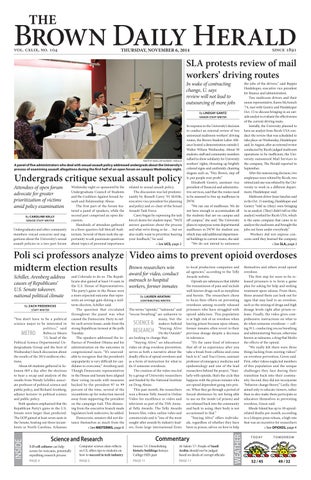
Attendees of open forum advocate for greater prioritization of victims amid policy examination
By CAROLINE KELLY SENIOR STAFF WRITER
Undergraduates and other community members voiced concerns and suggestions about the University’s sexual assault policies in a two-part forum
Wednesday night co-sponsored by the Undergraduate Council of Students and the Coalition Against Sexual Assault and Relationship Abuse.
The first part of the forum featured a panel of speakers, while the second part comprised an open discussion.
Hundreds of attendees gathered in a three-quarters-full Metcalf Auditorium. Several of them took the opportunity to ask passionate questions about topics of personal importance
Schiller, Arenberg address causes of Republicans’ U.S. Senate takeover, national political climate
By ZACH FREDERICKS STAFF WRITER
“You don’t have to be a political science major to be interested in politics,” said Rebecca Mears ’15, head of the Political Science Departmental Undergraduate Group and the host of Wednesday’s lunch discussion about the results of the 2014 midterm elections.
About 60 students gathered in Salomon 003 a day after the elections to hear a recap and analysis of the results from Wendy Schiller, associate professor of political science and public policy, and Richard Arenberg, adjunct lecturer in political science and public policy.
Both speakers emphasized that the Republican Party’s gains in the U.S. Senate were larger than predicted. The GOP gained at least seven seats in the Senate, beating out three incumbents in North Carolina, Arkansas
and Colorado to do so. The Republicans also gained at least 14 seats in the U.S. House of Representatives.
The party’s gains in the House were a more expected outcome that represents an average gain during a midterm election, Schiller said.
The question that circulated throughout the panel was what caused the Democratic Party to suffer such severe losses, aside from the strong Republican turnout at the polls Tuesday.
The speakers addressed the influence of President Obama and his administration on the outcomes in congressional races. “It’s unavoidable to recognize that the president’s unpopularity is very difficult for candidates to overcome,” Arenberg said.
Though Democratic representatives in the House and Senate have aligned their voting records with measures backed by the president 97 to 99 percent of the time, several of the incumbents up for reelection moved away from supporting the president on the campaign trail. This distancing from the executive branch made legislators look indecisive, he added.
Democratic senators did not distance themselves as much from the
related to sexual assault policy.
The discussion was led predominantly by Russell Carey ’91 MA’06, executive vice president for planning and policy and co-chair of the Sexual Assault Task Force.
Carey began by expressing the task force’s desire for student input. “We’ll answer questions about the process and what we’re doing so far … but we also really want to prioritize hearing your feedback,” he said.
» See UCS, page 2
In wake of contracting change, U. says review will not lead to outsourcing of more jobs
By LINDSAY GANTZ SENIOR STAFF WRITER
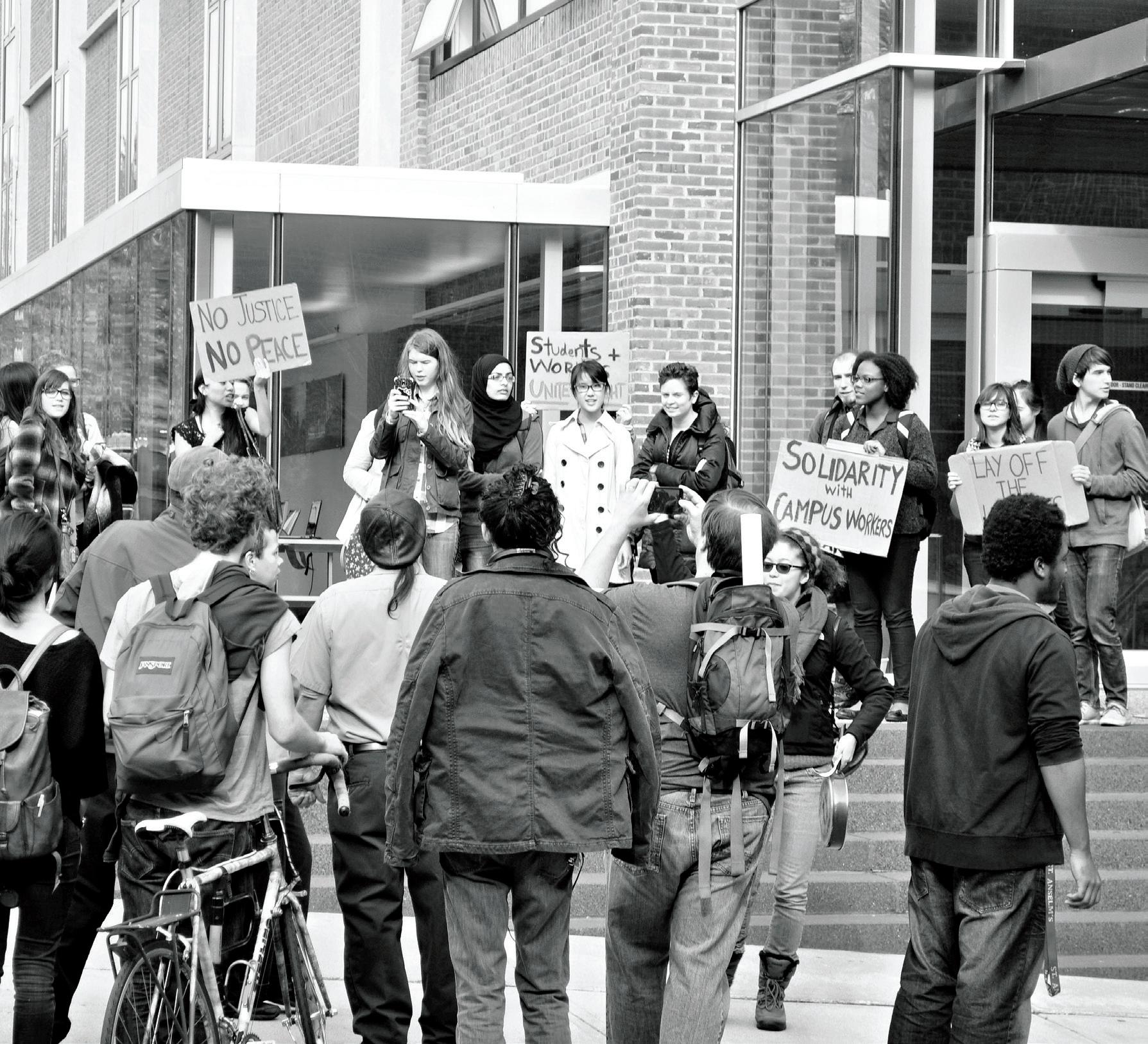
In response to the University’s decision to conduct an external review of two unionized mailroom workers’ driving routes, the Brown Student Labor Alliance hosted a demonstration outside J. Walter Wilson Wednesday. About 50 students, staff and community members rallied to show solidarity for University workers’ rights, thrusting up brightly colored signs and uniformly chanting slogans such as, “Hey Brown, step off it, put people over profit.”
Elizabeth Gentry, assistant vice president of financial and administrative services, said that the routes need to be assessed to free up mailboxes in JWW.
“We ran out of mailboxes. We do not have enough to accommodate all the students that are on campus and off campus,” she said. The University plans to repurpose some departmental mailboxes in JWW for student use, which may add additional departmental buildings to current routes, she said.
“We do not intend to outsource
the jobs of the drivers,” said Beppie Huidekoper, executive vice president for finance and adminstration.
Two mailroom drivers and their union representative, Karen McAninch ’74, met with Gentry and Huidekoper Oct. 15 to discuss bringing in an outside analyst to evaluate the effectiveness of the current driving route.
Initially, the University planned to have an analyst from Ricoh USA conduct the review that was scheduled to take place on Wednesday, Huidekoper said. In August, after an external review conducted by Ricoh judged mailroom operations to be inefficient, the University outsourced Mail Services to the company, The Herald reported in September.
After the outsourcing decision, two employees were rehired by Ricoh, two retired and one was rehired by the University to work in a different department, Huidekoper said.
Mailroom driver Jesus Sanchez said in the Oct. 15 meeting, Huidekoper and Gentry “told us (they) were bringing in an analyst. (They) didn’t tell us (the analyst) worked for Ricoh USA, which is the same company that came in to analyze the mailroom and brought the jobs out from under everybody.”
Workers did not express concerns until they learned the company
Brown researchers win award for video, conduct outreach to hospital workers, former inmates
By LAUREN ARATANI CONTRIBUTING WRITER
The terms “opioids,” “naloxone” and “rescue breathing” are unknown to many, but the makers behind “Staying Alive On the Outside” are looking to change that.
“Staying Alive,” an educational video on drug overdose prevention, serves as both a narrative about the deadly effects of opioid overdoses and as a form of instruction for what to do if someone overdoses.
The creation of the video was led by a group of University researchers and funded by the National Institute on Drug Abuse.
to local production companies and ad agencies,” according to the Telly Awards website.
Opioids are substances that inhibit the transmission of pain and include well-known drugs such as morphine and heroin. The researchers chose to focus their efforts on preventing overdoses among recently released prisoners who have struggled with opioid addiction. This population is at high risk of an overdose when leaving prison because upon release, former inmates often revert to their previous dosage despite a decrease in tolerance.
“It’s the same kind of tolerance that all of us experience after you take a break from caffeine and come back to it,” said Traci Green, assistant professor of emergency medicine and epidemiology and one of the lead researchers behind the project. “Similarly with opioids, that’s the cycle that happens with the prison inmates who are opioid dependent going into prison. When they go through a period of forced abstinence by not being able to use on the inside (of prison) and are released back into the community and back to using, their body is not accustomed to that.”
themselves and others avoid opioid overdose.
The first step for soon-to-be released prisoners is to form a game plan for asking for help and seeking treatment upon release. From there, those around them can look out for signs that may lead to an overdose, such as the mixing of drugs and high dosage levels right after prison release. Finally, the video gives comprehensive instructions on what to do when someone overdoses — calling 911, conducting rescue breathing and administering Narcan, otherwise known as naloxone, a drug that blocks the effects of the opioid.
This past month, the researchers won a Bronze Telly Award in Online Video for excellence in video and television as part of the 35th Annual Telly Awards. The Telly Awards honors film, video, online video and commercials and is “one of the most sought-after awards by industry leaders, from large international firms
“Staying Alive” offers individuals, regardless of whether they have been in prison, advice on how to help
“We really felt there were three things lacking from existing videos” on overdose prevention, Green said. First, other videos neglected members of this population and the unique challenges they face during their transition back into their community. Second, they did not incorporate “behavior change theory.” Lastly, they aimed only to educate viewers, rather than to also make them participate as educators themselves in preventing overdose, Green said.
Rhode Island has up to 30 opioidrelated deaths per month, according to a Lifespan press release, a high rate that was an incentive for researchers
» See MIDTERMS, page 8 » See SLA, page 2


conducting the analysis would be Ricoh, Gentry said. Ricoh was chosen to conduct the review because analyst services are included in its contract with the University, she said.
After being informed of the drivers’ dissatisfaction, the University postponed the external review, Huidekoper said, adding that the timeline for the new review is unknown.
Huidekoper and Gentry met with the two mailroom drivers Wednesday morning to discuss their concerns. “Brown University will not outsource your Mail Driver/Clerk position,” Huidekoper wrote in a letter she gave to the two drivers at the meeting.
“I think we really came to an understanding of why they were concerned,” Huidekoper said, adding that the analyst from Ricoh who made the outsourcing recommendation in May will not conduct the review of the mailroom driving route. In her letter to the drivers, she wrote that their “input to the review will be very important and valuable.”
The review “could result in recommended changes,” and the drivers will be involved in the review of any recommendations, Huidekoper said.
Christopher Steele, a former mailroom employee who worked at the University for three years, said he has a difficult time believing Huidekoper’s
promise. “The reason why so many of us didn’t unionize years ago is that we were told by the administration that we had nothing to worry about,” he said, adding that his severance ended last week and he is continuing to look for work.
The drivers’ duties have shrunk, she said, and “their overtime has been tampered with.” McAninch said that despite assurance of job security, “really it’s more than just those two jobs.”
“We’re also acknowledging that this transition has not been without problems,” Huidekoper said, citing unclear email notifications, system problems and long wait times as areas for improvement.
“This place is a disaster,” Sanchez said.
In an open Undergraduate Council of Students forum in September, students expressed dissatisfaction about the current mailroom operations, said UCS President Maahika Srinivasan ’15.
UCS received about 250 short-answer responses to a survey that ask students to evaluate how their experience with Mail Services compared to last year, and University representatives “promised us they would continually look at those results and that feedback,” Srinivasan said.
“The larger story and our message is that we see this as something that happened without accountability to workers, and without transparency to

» UCS, from page 1
There is a tension between the University’s needs to adhere to fair disciplinary processes and to prioritize the safety of individuals, Carey added.
Other committee members present included Michele Cyr, associate dean for academic affairs for biology and medicine and co-chair of the task force, Kirstin Boswell-Ford, associate University chaplain, Jack Hayes, director of athletics, Liza CariagaLo, associate provost for academic development and diversity, and student representatives Lauren Stewart ’15, Katherine Byron ’15 and Justice Gaines ’16.
Audience member Sarah Dillard ’16 expressed concern to the members of the task force that “for the appeal process, it’s a very specific process with five days to file an appeal, but there is no mentioning of how long any of the other parts of the process take.”
Gaines responded by acknowledging an imbalance exists between students’ deadlines in the process and the University’s own time frame. “That’s something we’ll definitely be looking at.”
the larger campus,” SLA member Stoni Tomson ’15 said she told Huidekoper in a meeting Tuesday.
In response, Huidekoper said, “We are absolutely open to making sure that this is all more transparent if and when we consider anything like this again.”
According to a letter presented to the Brown University Community Council on Oct. 29, SLA is requesting that “before Brown University representatives outsource a Universityadministered function, … they must bring the proposal before the Brown University Community Council for its review and recommendation.” Tomson said SLA hopes this action will increase transparency and accountability.
Workers from dining, facilities and the libraries attended the rally and were joined by the hotel workers’ union UNITE HERE, public employee union American Federation of State, County and Municipal Employees and representatives from the organization Rhode Island Jobs with Justice, Tomson said.
Derek Lisi, who has been employed with Facilities for three years, said he attended the rally “to support the student workers and the mailroom staff,” adding that “how they’re subcontracting everything out is not right.”
“We’ll continue to stand in solidarity with the workers and with what they think are their best interests,” said Samantha Chomsky ’18, a member of SLA.
If a student is charged with sexual assault, there is no measure preventing the student from appealing the ruling and staying on or near campus, Gaines added.
Emma Hall ’16, another audience member, said when people are waiting for administrative decisions on suspending or expelling an alleged perpetrator of sexual assault, de facto punishments could potentially be less severe than intended: “The time that they’re spending on campus during the appeal process is being subtracted from the time they’re supposed to be away from the University.”
Several students suggested improving the manner in which sexual assault policies treat victims.
“The victim should definitely have some say in the deadline that the perpetrator can reapply for admission,” said Susannah Slepian ’15, an audience member.
Jamie Marsicano ’15.5, another audience member, said he was frustrated with “just the fact that an assailant can come back to campus while their victim is still a student. Their existence in this space is triggering. This
has to change.”
Some suggestions audience members raised for educational and preventative methods included sending a document about reporting sexual assault to first-years as part of their orientation materials and requiring leaders of student groups and organizations to be trained in preventing sexual assault.
“A lot of this information is buried in PDFs and PDFs,” said Edward Cleofe ’15, adding that one concise document “with flow charts of how these processes work would be really helpful.”
UCS President Maahika Srinivasan ’15 said group leaders are currently required to attend meetings to acquire certain group categorizations, adding that including sexual assault prevention training “as part of party training is something that needs to happen.”
Additionally, a panel of administrators affiliated with sexual assault policy spoke about the nature of their jobs and their involvement in the process of examining sexual assault charges.
The speakers included Michelle Nuey, manager of community relations and outreach at the Department of Public Safety, Bita Shooshani, coordinator of sexual assault prevention and advocacy, Gail Cohee, director of the Sarah Doyle Women’s Center, Yolanda Castillo-Appollonio, associate dean of student life, and Cariaga-Lo.
Moderated by Director of Health Promotion Francie Mantak, the speakers emphasized their work to make survivors aware of their options in sexual assault proceedings, including health care options and ways of reporting assault.
“It is important to recognize that the work around concerns around sexual assault … is really a collective work of the community,” Cariaga-Lo said. “The people at this table are a team, who we realize bring a wealth of expertise to these issues.”
The event Wednesday night marked the first in a series of forums featuring the Sexual Assault Task Force members.
A second forum aimed at gathering undergrad input will take place on Tuesday, and a third forum seeking faculty and staff feedback will occur next Friday.



During stop on book tour, Shavit reflects on moving forward after recent violence in Gaza
By ALEKSANDRA LIFSHITS STAFF WRITER
Ari Shavit, senior correspondent for the liberal Israeli newspaper Haaretz and author of the 2013 book “My Promised Land,” spoke to an overflowing Wilson 102 Wednesday night about Israel’s past, present and future. His wide-ranging lecture touched on Zionism, his personal experiences living in Israel, modern antiSemitism and prospects for peace in the Middle East.
The audience comprised mostly undergrads and Providence community members. All students in attendance received a free copy of Shavit’s book.
In his opening statement, Shavit said the events in Gaza this summer raise many fundamental questions about
Israel: What is Israel? Why does it exist? What is its future? He answered these questions through a combination of historical analysis and personal experiences.
Shavit traced the story of his greatgrandfather, who was part of the early Zionist movement in Britain in the 19th century. “To challenge extinction, early Zionists like my great-grandfather transferred a people from one continent to another,” he said.
Shavit expressed disappointment in individuals who claim that Zionism is equivalent to colonialism. “We were not agents of empire, but rather went back to our ancient homeland because we faced death in Europe,” he said. But the one sin of Zionism is that it came a couple decades too late, he said, noting that if a Jewish state had existed in the 1920s,
millions of lives would have been saved during the Holocaust.
In discussing Israel’s security, Shavit described how his two sons heard the howling sirens warning of a rocket attack for the first time this summer. “My sons are just like any typical American boys, but there is a challenge that they face that no children in any other democracy face,” he said.
Shavit commended the engineers of the Iron Dome, an Israeli air defense system, as the heroes of this summer’s Israel-Gaza conflict. The Iron Dome’s construction prevented both Israeli and Palestinian deaths during the outbreak of violence in the region this summer, he said.
The hour-long lecture was followed by a question-and-answer session in which several students took the opportunity to ask about internal and external issues that Israel faces.
In response to a student’s question about the relationship between Judaism and Jewish identity, Shavit said Zionism allows people who are not religious to be Jewish. “We need a place that will be a powerhouse for Jewish identity. We need an Israel that we can all be proud of.”
Addressing another student’s question about whether the Islamic State poses a threat to Israel, Shavit responded that it is not an immediate threat, but the right course of action is to “ally with the moderate players and stabilizing forces in the Middle East.”
Shavit stressed the importance of working to achieve a gradual peace. “We must not only demilitarize Gaza, but also be generous by giving the Palestinian people the resources and the opportunities for life.”
Shavit ended his talk on a positive note. “I am an optimist and believe that peace will come soon,” he said.
Shavit’s lecture at the University was part of a larger tour of American campuses organized by Hillel International that included a stop at Yale on Monday. Prior to the lecture on campus Wednesday evening, Shavit spent the day engaged in a series of workshops with students who were interested in journalism, students who read “My Promised Land” as part of a book group held by Brown/RISD Hillel and members of the groups Brown Students for Israel and J Street U Brown.
“The students that I have met today at Brown and … at Yale were full of great values,” Shavit said. “My dialogue with them has really inspired me.”
Sam Dunietz ’18 said he enjoyed the lecture, adding that Shavit recognized the complex nature of the Israeli-Palestinian conflict by acknowledging how “the narrative of Israelis still carries the heavy weight of the Holocaust.”

» OPIOIDS, from page 1
to create the video.
“We have to provide treatment for people who are already hooked and try to find the support to get them back to being productive at home and enjoying their life rather than having their lives taken over by drug use,” said Josiah Rich, professor of medicine and epidemiology, and the principle investigator of the project.
Since its release, the video has been shown in a local prison as well as prisons around the country, Green said, adding that Rhode Island Hospital and Miriam Hospital are using the video to train emergency staff. The video is also available online.
“I think getting the (Telly) award is obviously a tremendous honor, but when we created it, we didn’t create it to get awards,” Rich said. “We created it to get it out there … Having an award gives us more of an opportunity to get the word out.”
Sarah Bowman, project manager of a related study at the Rhode Island Hospital, emphasized the importance of the general increase in knowledge and education surrounding drug overdose and treatment.
“It is valuable for everyone to see themselves, their community and families and their experiences reflected in the material that we’re generating. We’re certainly just one part of that.”

Overdoses from opioids, which include certain medications and illegal drugs, cause 30 deaths per month in Rhode
group of University researchers has releasd an award-winning educational video distributed to hospitals and prisons to reduce


Delphix leader highlights roles that open curriculum, CS dept. played in his tech career
By JASON NADBOY SENIOR STAFF WRITER
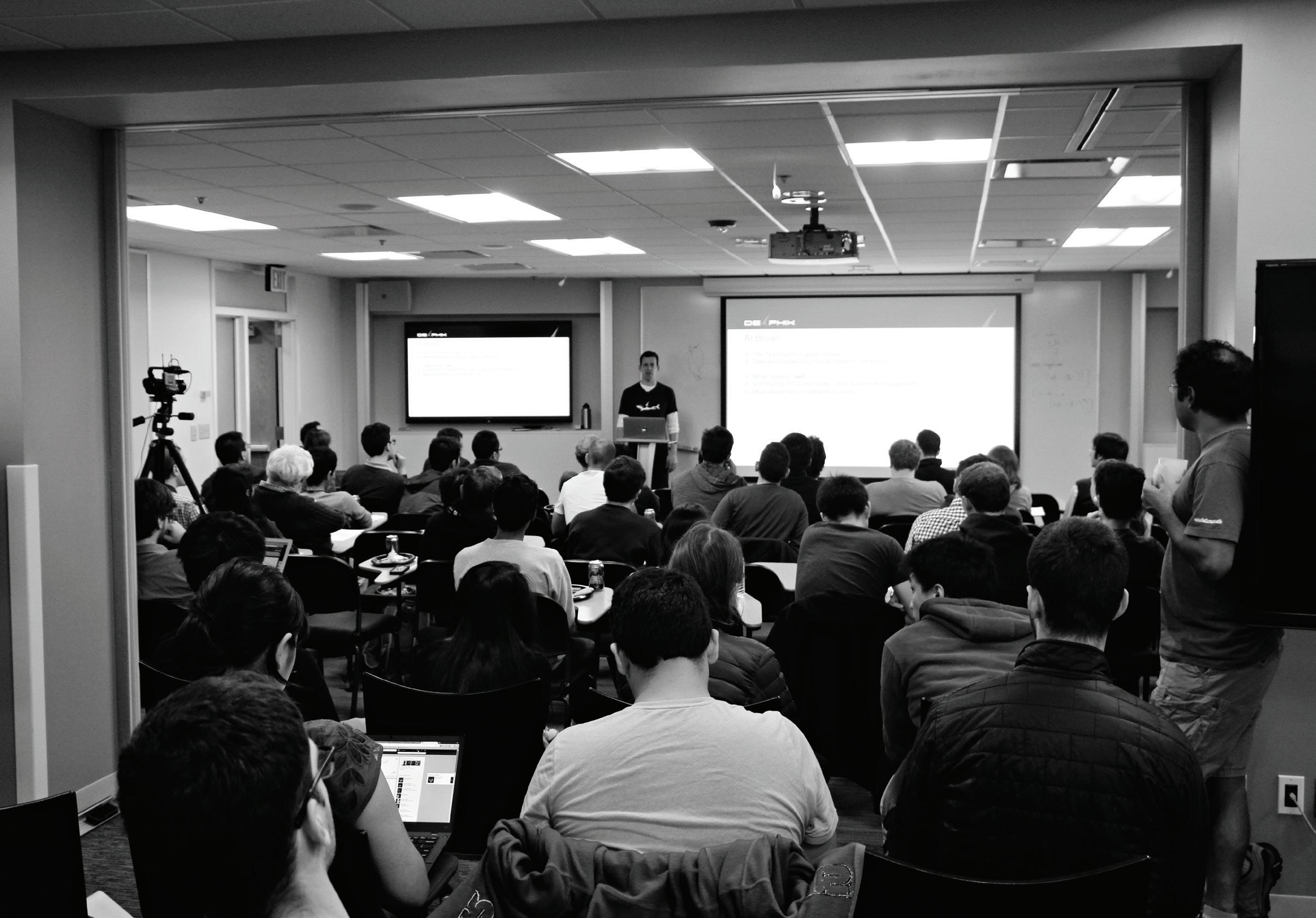
At Brown, making money is a taboo subject, as most students don’t want to talk about pursuing their passion for profit. But making money isn’t a bad thing, Chief Technology Officer at Delphix Adam Leventhal ’01 told an audience of around 40 students and faculty members at a lecture Wednesday in the third-floor atrium of the Center for Information Technology.
The number of people who buy a product can often indicate whether the product is good or needs improvement. In this way, making money can be a barometer for quality, said Levanthal, whose company is a start-up venture that specializes in data management.
Leventhal kicked off the Life After Brown Series, an initiative by the Department of Computer Science that seeks to expose students to the careers and experiences they can obtain after graduation, said Tom Doeppner, associate professor of computer science and one of the organizers.
“Many students are not totally clear on what jobs computer science students get,” he said, adding that hearing stories from successful alums like Leventhal could help provide ideas to students.
Leventhal discussed his time as an undergraduate and the twists and turns of his career that led him to his current position at Delphix. He recounted his switch from a math to computer science concentration, the hours he spent in the CIT’s SunLab and the last semester he “barely” passed.
“There were always CS courses I poured my heart into,” he said. Leventhal helped design CSCI0170: “Computer Science: An Integrated Introduction” and was a teaching assistant for the course, despite the fact that he never took it, Doeppner said during his introduction.
After graduating from Brown, Leventhal began working at Sun Microsystems — a former computer software
and information technology company — because he wanted to work on interesting problems and receive strong mentorship, he said. He added that he loved the good feeling he derived from solving a problem that a customer cares about.
Levanthal’s work also altered his perspective on computer science and software development, he said. “In the industry, you determine your own due date” and are expected to bring a high level of creativity to the workforce, he noted.
Brown impacted his career by providing him with communication skills, Levanthal said, adding that during his time at Sun Microsystems, he began to blog about his experiences as a programmer.
Being able to write well is a great skill to have because it involves clear thinking and organization. But too
many technical students neglect the importance of this skill, Levanthal said.
Leventhal also highlighted the New Curriculum’s value in letting students “construct” their education, as this experience in “constructing” can be applied to developing a product in the workforce, he said.
Leventhal’s career took a turn when the large tech company Oracle took over Sun and Leventhal decided to leave the company. He didn’t want to just be another “code-monkey,” he said.
“Don’t be afraid to … take on other options,” he said, advising students to be open to changing their interests and finding jobs they enjoy doing.
After the change, Leventhal accepted a job at Delphix, where he rose up from a developer to a manager to the position of CTO, he said. During this process he faced tough decisions
because he loved building things, he said, but managerial positions tend to be less hands-on.
Through this experience, Leventhal learned the importance of entrepreneurship, he said. While the traditional Brown culture should be preserved, students would benefit from an increased focus on entrepreneurship, he added.
After his presentation, Leventhal engaged in a question-and-answer session with the audience.
One audience member asked why computer science students who are offered comfortable jobs in companies such as Google or Facebook need to think about starting their own company.
Leventhal responded with something a colleague once told him — “hard problems aren’t solved by small companies.” But small companies have
the unique opportunity of solving many problems that bigger companies may not think of, he said, adding that some students may find these problems stimulating.
Students said they enjoyed the lecture, and Surbhi Madan ’17 noted that she, too, wishes entrepreneurship played a bigger role at Brown.
After the presentation, Leventhal told The Herald he hoped students would gain appreciation for Brown’s uniqueness, something he didn’t realize until after he graduated. He praised the undergrad TA program in the CS department and undergrad research as two components to this unique experience.
“I loved my time at Brown, my time in the computer science department,” Leventhal said, noting his pleasure at returning. “It’s always exciting just walking on campus.”



RESEARCH SPOTLIGHT
This profile is part of a series focused on Brown faculty and students engaged in science and research, with the purpose of highlighting and making more accessible the work being pursued at all levels across disciplines.
BY SARAH PERELMAN SCIENCE & RESEARCH EDITOR
Many compounds in the environment — whether ingredients in food or materials that make up everyday objects like plastic water bottles — could be harmful to humans, but have never been tested, said Samantha Madnick, a senior research assistant in Professor of Medical Science Kim Boekelheide’s lab.
Madnick works with a team of scientists in the Boekelheide Lab to explore the potential of 3-D cell cultures to create quicker and cheaper screens for toxicants, man-made chemicals that may be toxic to the body.
Current screening methods rely on animal models, which are timeintensive and expensive, explained her co-researcher Maggie Vantangoli GS. To explore the effect of a substance on the liver, for instance, researchers must expose animals to the toxicant, wait for effects and then excise cross-sections of the liver to examine it.
“The idea is that you can do quick in-vitro screens” with 3-D cell cultures to bypass the time and money required for animal testing, Vantangoli said.
“Hopefully with more technology we can eventually test new chemicals before they go on the market,” Madnick said, adding that these important health implications are what she finds most rewarding about their work.
Using technology originally developed by the Morgan Lab at Brown, the team of researchers is using 3-D cell cultures to examine the effect of toxicants that may interfere with the body’s estrogen. Many of the compounds have a similar structure to estrogen, and could physically block estrogen from binding to the proper receptors in the
body by attaching to the receptors themselves.
“By using these human cell lines in a really simple, inexpensive and relatively quick model, we can assess the potential endocrine toxicity of a lot of different compounds,” Vantangoli said.
The 3-D cells paint a clearer picture of toxicants’ effects than 2-D cell cultures, another current option for toxicology testing, said Shelby Wilson ’15, a member of the research group.
They also create a more reliable image than other types of cultures that rely on an external scaffold, as these types of scaffolds are not present in the body, she added.
The lab’s 3-D cultures arrange themselves in a similar conformation to body tissues and even retain some of their functions, Vantangoli said. For example, her group has created breast cell cultures that could secrete some milk proteins.
As part of their work, the researchers examine whether exposure to suspected toxicants causes the cell cultures to retain the same shape as cell cultures devoid of those toxicants.
“If you have a change in structure, you’re going to have a change in function,” Vantangoli said.
Wilson pulled out a box full of slides to demonstrate some of the changes the toxicants might cause. First, she placed a cell culture lacking toxins under the microscope. A series of small, red, circular blobs sat in the shape of a donut.
Next, she picked a slide of cells infected with a known toxicant. These cells did not arrange themselves with an open center, but instead formed solid blobs.
The researchers spend a lot of time determining how best to use the new technology that 3-D scaffold-free cultures provide, Wilson said. Varying cell strain and density can allow them to optimize their screens.
“I like that it’s a new technology and a growing field,” Vantangoli said.



president as congressmen did, in part because of the leadership role of Majority Leader Harry Reid, who has a reputation for keeping senators aligned with the president, Schiller said.
“People get sick of the president,” she said. Other presidents have historically had low approval ratings midway through their second terms, which has led to gains for the other political party during midterms.
But Schiller suggested that in the wake of this recent election, there is an opportunity for collaboration
between the Democrats and Republicans, similar to the cooperation between the Democratic majority in Congress elected in 1986 and the administration of Republican President Ronald Reagan.
But the “poisonous atmosphere of political polarization” has become so strong that the case of 1986 is no longer applicable to the contemporary political climate, Arenberg said.
Following the 1986 elections, the Democratic Senate passed a series of sweeping bills. If the Republicans want to maintain their majority in the Senate for 2016, U.S. Sen. Mitch McConnell, R-Ky., who will become

the new majority leader, will have to maneuver his “troops” to garner support for “simple things” like infrastructure, trade and corporate tax reform, Schiller said.
Speaker of the House John Boehner, R-Ohio, and McConnell need to show that they can compromise and deliver on legislative promises if they want to maintain control for the next two years, she added.
The panel also discussed the timeline for collaborating and accomplishing legislative goals.
Republicans need to come out strong in the first three or four months of the new legislative session
to stay on top of the election cycle, Arenberg said. This will allow congressmen up for reelection in 2016 to demonstrate recent successes.
The concerned voters who turned out in large numbers to express their disapproval with the current executive and legislative branches are not going to disappear by 2016, Schiller said.
If campaigns are aware of the influence these voters can have in any election year, they need to begin working on crafting their campaign promises and goals soon, she said.
The political party that is able to capitalize on these concerns and
successfully garner support will likely win in swing states, including Florida, Schiller added.
“If Latinos can get their turnout up by 5 percent, they will control 2016 elections,” she said.
Arenberg and Schiller also expressed the importance of a higher turnout among young people, who only had a 24 percent turnout rate, Schiller said.
“If you guys can go out there and vote, you can get politicians to represent your generation,” she said, adding that there is a lot of power in millions of people mobilizing and voting in an election year.


SATELLITE DINING
JOSIAH’S Made-to-Order Quesadillas
BLUE ROOM
Mediterranean Pocket Soups: Chicken Artichoke Florentine, Fire Roasted Vegetable, Turkey Chili
ANDREWS COMMONS menu
Pizza: Na’cho Pizza, Okie Dokie Artichokie, Pepperoni and Sausage
DINING HALLS
SHARPE REFECTORY LUNCH DINNER
Vegan California Veggie Stew, Wisconsin Ziti with Four Cheeses, Hot Turkey Sandwich Red Potato Frittata, Baked Chicken, Beef Stew, Savory Rice Pilaf, Root Vegetable Medley
VERNEY-WOOLLEY
LUNCH DINNER
BBQ Beef on a Bun, Cheese Tortellini, Baked Spaghetti Squash, BBQ Navy Beans
Chicken Pesto Pasta, Tofu Parmesan, Stewed Tomatoes, Garlicky Green Beans

made of recycled lobster rope. The display will remain on campus through next

TOMORROW
4 P.M. A REPORTER’S FIRST HAND REPORT: ASSAD, ISIS, OBAMA AND U.S. MIDDLE EAST POLICY
Reese Erlich, who has reported from the Kurdish region of Iraq for CBS Radio, will assess the rise of the Islamic State and the U.S. response.Watson Institute, Joukowsky Forum
5:30 P.M. SCANDAL(OUS) REALITIES: BLACK AND BROWN IMAGES IN TV AND HOLLYWOOD
This panel discussion will address how the current portrayal of black and Latino individuals in media perpetuates racism and discrimination in society. Salomon 101
6 P.M. THE FUTURE OF WIRELESS ELECTRICITY Kanyam Hedayat, from the engineering company WiTricity, examines the future of wireless power in a talk as part of the UnPlugged series hosted by the Brown International Organization. Barus and Holley 190
12 P.M. CAMPUS TREE TOUR WITH FACILITIES MANAGEMENT
The Brown Grounds Team will give a tour of the over 70 trees on the Main Green that exemplify a variety of species. Van Wickle Gates
3 P.M. URBAN STUDIES BUS TOUR NUMBER ONE: ‘THE PROVIDENCE WATERFRONT’
This bus tour explores areas along the Providence waterfront and is open to the public and sponsored by the Department of Urban Studies. 29 Manning Walk
7:30 P.M. A BILINGUAL READING BY POET SUZANNE DOPPELT
French writer and photographer Suzanne Doppelt will read from her works in this installment of the Contemporary Writers Reading Series. McCormack Family Theater
The startling statistics of the prison problem in the United States are often heard through mainstream media. Though the U.S. prison population has been declining for the past several years, the United States still has more prisoners than any other country, even China. The cost of maintaining our federal prison population has more than doubled — from $12 billion to $24.6 billion — over the past decade, and no resolution to this growing fiscal drag on the federal budget readily presents itself. Of course, this does not scratch the surface of the moral, ethical and humanitarian issues associated with the treatment of the 2.3 million prisoners and their access to justice.
Beyond the questionable morality of prison, the numbers show that prison doesn’t work. The Bureau of Justice Statistics released statistics showing that in 30 states in 2010, three in four former prisoners are arrested again within five years of their release. If the goal of prisons is to reduce crime, recidivism rates show failure. Thus, an important first step in improving the prison system would be recognizing the difference between punishment and restraint or confinement. For violent, conspiratorial prisoners, prolonged incarceration should be on the table. But for the vast majority of nonviolent offenders, such restraint is not necessary. Many people argue that punishment is necessary, but “punishment” in the traditional sense of inflicting some type of pain to teach someone a lesson has been proven ineffective by both recidivism rates and psychological research studies on prisoners and parenting. Even B.F. Skinner, a father of the behaviorist movement in psychology, said he hated punishment because it did not teach people what to do but rather instilled anger and frustration.
Perhaps a prison system could be potentially justified if it were restructured to emphasize rehabilitation, rather than acting as a punitive box for those found guilty. McKean Federal Correctional Institute in Lewis Run, Pennsylvania, has classrooms, chapels, recreation facilities and cramped but orderly cellblocks. McKean is a product of a federal campaign that seeks to drastically change the face of U.S. prisons, focusing far more on the importance of rehabilitation in lowering recidivism rates and reducing the number of prisoners in the country. Although prisons like McKean face widespread criticism as going “soft” on crime and even evoking “country club” images, McKean has proven to be, in many ways, the country’s most successful medium-security prison: Between 2005 and 2011, only nine assaults occurred within its walls — the same number of assaults that many prisons face in a week. According to McKean’s former warden, Dennis Luther, the prison’s tremendous success comes from its founding principle that an “unconditional respect for prisoners” as people leads to a positive, rehabilitating culture, in which prisoners have a stake in the prison as a community and ultimately re-enter the world as engaged community members, the Atlantic reported in 2011. This ideology takes shape in various recreation and education programs that hold prisoners to high standards of behavior. While specific recidivism rates for McKean have not yet been compiled, numerous expansive studies have shown a deep connection between education programs and lowered recidivism rates. While a widespread overhaul of federal prisons modeled after McKean may be fiscally unfeasible at this point, some type of nationwide system of reform based on the above stated principles is necessary. Not only would it improve assimilation of released prisoners, but a more efficient system, even at a higher cost, would in the long run likely reduce spending through shorter sentences and reduced incarceration rates from recidivists. Reforming the prison system is a daunting task given the millions of people and billions of dollars involved, but the potential budgetary savings and lives returned are gains that cannot be overlooked.
Editorials are written by The Herald’s editorial page board: its editors, Alexander Kaplan ’15 and James Rattner ’15, and its members, Natasha Bluth ’15, Manuel Contreras ’16, Baxter DiFabrizio ’15, Manuel Monti-Nussbaum ’15, Katherine Pollock ’16 and Himani Sood ’15. Send comments to editorials@browndailyherald.com.

Yeddanapudy Abdullah Yousufi
Copy Desk Chief Claire Postman
Assistant: Madeline DiGiovanni
Illustrations
To the Editor:
At the faculty meeting Tuesday, President Christina Paxson initiated a very important and welcome discussion about increasing efforts here at Brown to diversify the faculty. The Herald article (“Paxson aims to double underrepresented minorities on the faculty,” Nov. 5) reports that I suggested “compromise” may be necessary to achieve our diversity goals, but the way in which my comment is paraphrased in the article does not accurately reflect the point I made at the meeting, or indeed my views. I appreciate the opportunity to continue this important discussion and to clarify my point.
We all agree on the need to diversify our faculty, and ultimately the academic mission and vision of Brown require the collective contributions of a diverse faculty. We are also keenly aware that, in certain disciplines, progress toward this goal has been slow. There are myriad contributing factors, but it is the responsibility of each of us to consider what we can do to affect positive change.
Both Paxson and Provost Vicki Colvin pointed out the need for conversations at all levels of the University. I raised the point that we cannot compromise on quality. Hiring the most outstanding scholars and educators to Brown is paramount. However, I believe there are conversations that should happen within departments at the start of the hiring process that place diversity as a priority.
Often, when a faculty line opens in a department, there are many competing needs, including teaching, academic priorities and building a critical mass of scholars in specific fields. These needs are real. But the more narrowly defined the faculty position within a given subfield, the smaller the applicant pool. Whenever possible, we need to consider conducting searches that are less narrowly defined by specific subfields, to ensure a deep, diverse and academically strong applicant pool.
An article in Wednesday’s Herald (“Raimondo wins governor race,” Nov. 5) misquoted Meghan Holloway ’16. She said, “The whole room … just burst into cheers when the results were called” for Gina Raimondo’s victory, not “burst into tears.” The Herald regrets the error.
An article in Wednesday’s Herald (“Students venture off College Hill, onto campaign trail,” Nov. 5) incorrectly referred to Joe Van Wye ’15 as a member of the Brown Democrats executive board. In fact, he is a general body member. The article also misstated the start time for the Brown Democrats’ final canvassing push for Tuesday’s election. It was 4 a.m., not 5 a.m. The Herald regrets the errors.
An article that appeared in The Herald the day after the 1916 presidential election (“Hughes elected to presidency, Republicans carry both houses,” Nov. 8, 1916) incorrectly announced that Republican nominee Charles Evans Hughes 1881 was elected president of the United States. In fact, the Democratic nominee, incumbent President Woodrow Wilson, won the election. The Herald regrets the long-uncorrected error.
General Managers
Directors Sales: Winnie Shao Finance: Sarah Levine
Finance: Sameer Sarkar
Alumni Relations: Alison Pruzan
Business Dev.: Melody Cao
Office Manager Shawn Reilly
Sales Managers
Regional: Edward Clifford
Regional: Sarah Pariser
Regional: Ananya Shukla
Regional: Jessica Urrutia
Student Group: Moniyka Sachar
Finance Managers
Collections: Jacqueline Finkelsztein
Collections: Joshua Tartell
Operations: Jessica O’Dell
Alumni Relations Manager
Engagement: Sarah Park
Business Dev. Manager
Project Leader: Kaden Lee

Angell
Providence, R.I. www.browndailyherald.com

Editorial contact: 401-351-3372 herald@browndailyherald.com

Business contact: 401-351-3260 gm@browndailyherald.com
Corrections: The Brown Daily Herald is committed to providing the Brown University community with the most accurate information possible. Corrections may be submitted up to seven calendar days after publication.
Commentary: The editorial is the majority opinion of the editorial page board of The Brown Daily Herald. The editorial viewpoint does not necessarily reflect the views of The Brown Daily Herald, Inc. Columns, letters and comics reflect the opinions of their authors only.
Letters to the Editor: Send letters to letters@browndailyherald.com. Include a telephone number with all letters. The Herald reserves the right to edit all letters for length and clarity and cannot assure the publication of any letter. Please limit letters to 250 words. Under special circumstances writers may request anonymity, but no letter will be printed if the author’s identity is unknown to the editors. Announcements of events will not be printed.
Advertising: The Brown Daily Herald, Inc. reserves the right to accept or decline any advertisement at its discretion.
The Brown Daily Herald (USPS 067.740) is an independent newspaper serving the Brown University community daily since 1891. It is published Monday through Friday during the academic year, excluding vacations, once during Commencement and once during Orientation by The Brown Daily Herald, Inc. Single copy free for each member of the community. Subscription prices: $280 one year
EVAN SWEREN
opinions columnist
The second in a series of columns on Brown’s libraries and academic spaces.
Here are some highlights from President Christina Paxson’s letter to the Corporation on plans for the new applied mathematics and engineering buildings, as quoted in a recent Herald article: “ongoing engagement with neighbors … to ensure we are sensitive to the needs and interests of the surrounding community … preserving the character of Hope Street … comfortable with the style of the building.”
It’s easy for leaders to make big, $80 million decisions when the past is off the table. It’s even easier to make those decisions when so few people are involved. A school can marginalize a department, or two, to the outskirts of a campus and then, overnight, inform those departments that their buildings will soon be destroyed. Money talks and, well, academia takes that long walk.
Here’s the play-by-play. Four University-owned buildings, one home to the Urban Studies Program and one home to the Division of Applied Mathematics, are slated for destruction — all are eligible for historical status. No Brown students were consulted in the making of the decision. No building schematics have yet been released to the public. And recommendations made by the Providence Preservation Society to move the buildings have been ignored. Mike McCormick, assistant vice president of planning, design and construction, said moving the
buildings poses a risk of “causing collateral damage to the streets,” The Herald reported. Trust me, I love creative problem-solving, but demolishing the buildings to save the streets seems a bit like burning the paintings to save the frames.
But Brown does have some standards. McCormick noted that, in order for Brown to save buildings, “there needs to be other historic significance to them other than they are just old in the neighborhood and kind of nice.” I couldn’t agree with him more. If only there were someone or somebody with that type of “judgment of the true value of them.”
Let’s start with 37 Manning St., an example of a Colonial Revival house built in 1897, according to the University’s online campus map, and renovated by Albert Harkness in 1936.
Surely Brown saves buildings with true historical significance, such as the home of Edward Bannister, a preeminent African-American painter of the mid-19th century and founder of the Providence Art Club, peer institution to the Rhode Island School of Design. I’ll save you the walk down Benevolent Street. Brown does not save this structure, either. The house is wasting away,
Or maybe we should start with 29 Manning St., an “uncommon example of the Modern Style in the College Hill Historic District,” according to a document published by PPS this year. It was designed and lived in by J. Peter Geddes, a well-known Providence architect who later partnered with — you guessed it — Albert Harkness, son of Albert Granger Harkness, son of Albert Harkness, class of 1842. But I cannot argue with McCormick. The buildings are old — I’d even say “kind of nice.”
and the University has no plans to sell or renovate it. Brown’s main interest in the Bannister House, now that refrigerators are no longer stored there, is one of “strategic value” for expansion, said Richard Spies, former executive vice president of planning, in a 2012 Herald article. In comparison, check out the Nightingale Brown House on Benefit Street for another example of a Brownowned building; Joseph Nightingale was a slave trader. Justifying which buildings should be saved and which should not can lead to overt instances of racism and other issues.
I have no doubt KieranTimberlake, the architecture firm chosen to design the new engineering building, will create a state-of-the-art building where the four historic homes now stand. And I have no doubt that the University’s new building will provide added space and attract great researchers. But I find these expansionist policies worrisome. Somehow, we need to ensure that construction and renovation do not mean obliteration. Paxson’s letter to the Corporation, the 250+ celebration and the University’s continual destruction of the past are at odds with each other. It’s time to stop focusing on the + and start focusing on the 250. The University is repeating disturbing trends. We tend to move things around when we should build new buildings, and build new buildings when we should be looking inward at the spaces we already have. Consider Manning Hall and Robinson Hall, originally designed as libraries. The buildings have been repurposed; their original intent and history are gone, and they take up prime locations that are grossly underutilized. The facilities crisis Brown now faces is a result of this poor decisionmaking. Books must be stored offsite in downtown warehouses, while places like Andrews Commons and the Leung Family Gallery, intended as social spac-
es, are largely used by students as quiet libraries. It’s a shame we eviscerated what we had and ate our history. Unique spaces are integral to the formation of cultural identity, and history helps to inform how these unique spaces should develop and unfold. Edmund Burke wrote extensively on the role of culture and history in unifying a community. Brown is systematically stripping itself of all these spaces. The bar at the Underground is gone. The Gate is gone. And the Hourglass Cafe, a student-run cafe formerly in the basement of Faunce, is gone. And all we are left with are multipurpose study spaces that, in themselves, are void of purpose. Inefficient floor plans make no allusion to the past, history, intent or location, and instead are modeled for a generation of group study and social media. We are creating buildings of hallways, spaces void of personality and a community void of interior substance. Without culturally unique spaces, Brown ceases to be Brown. It’s time we look our gift horses in the mouth. It’s not bad manners. It’s our obligation. One day, the University sends out a campus-wide email about an operating deficit, and the next day it accepts more strings-attached donations and pats itself on the back for another $1 million perversion of space. At some point, we have to learn that demolishing buildings and subjecting history to minimalist renovation isn’t sustainable practice, isn’t economically sound and isn’t conducive to creating a historical, incorporative College Hill. It’s a betrayal of the community, and it’s a betrayal of ourselves.
Evan Sweren ’15 is a senior at Brown.
Word pedometers count number of new words children hear as part of effort to close literacy gap
By BAYLOR KNOBLOCH CONTRIBUTING WRITER
Providence Talks — a literacy program aimed at increasing reading readiness in lower-income children — plans for expansion as its pilot phase, which began Feb. 3, comes to a close, said Rob Horowitz, spokesperson for Providence Talks.
The program was inspired by research that suggests the existence of a gap between the number of words heard by children from lower-income families compared to those of higher-income families, according to an October White House press release.
Providence Mayor Angel Taveras launched the program after winning the Bloomberg Philanthropies’ Mayor’s Challenge in 2013. Upon winning the award, Providence was given a $5 million implementation award, according to the program’s website.
Through the program, the 58 children involved in the pilot phase were each outfitted with a device called a word pedometer, which measures the number of words heard by a child as well as the child’s number of “conversational interactions,” Horowitz said. Children wear the pedometer — which can record audio for up to 16 hours — all day and take it off when they go to bed, according to the Providence Talks website.
Children’s Friend and Meeting Street, two local nonprofit social service agencies, worked to recruit families to participate in the program’s pilot phase, the Providence Journal reported at the time of the pilot’s launch.
Families participating in the program also receive twice-monthly visits from educators, who review the pedometer’s data with them and teach them strategies to enhance
conversational engagement with their children, Horowitz said. The educators also supply age-appropriate books for parents to read to their children, he added.
In the coming year, the program plans to expand to 500 families, Horowitz said, adding that it hopes to reach reach 2,000 by 2016. “I think we have a good plan about how to get there, but it will take a little while,” he said. “Our goal is to make it accessible to any family in Providence who wants to participate.”
Horowitz called the preliminary results of the pilot program “promising.” Families that started with low word daily counts increased their word usage by about 50 percent and their conversational turns — the switching back and forth between child and parent during dialogue — by 30 percent.
“I am quite favorably leaning towards the notion that this program will produce positive outcomes,” said Kenneth Wong, department chair of
education, who Taveras asked in 2012 to help with the program’s planning and implementation. Wong was involved in the program’s grant-writing process, which lasted until March 2013 when the grant was approved, and continued his work through the pilot phase.
But at a White House conference last month, entitled “Federal, State and Local Efforts to Bridge the Word Gap: Sharing Best Practices and Lessons Learned,” Kathy Hirsh-Pasek, a psychology professor at Temple University, presented her research findings, which suggest that the quality of words spoken to children may be more important than the quantity of words they hear. This concept is the focus of the Providence Talks program.
“When you have something like a word gap, your tendency is … to fix it by filling it,” Hirsh-Pasek told The Herald. “Everything is headed in the right direction because you’re bringing more of a focus on how important
this gap is,” she said of Providence Talks. “My cautionary note, however, is that we have to be careful moving forward to focus on the quality of the interactions as much as the quantity.”
At the end of the pilot phase, Wong and his colleagues recommended that the program use a “more scientific design to study the impact of the program,” he said, adding that this entails separating the effects of reading to children from the effects of speaking with children, he said.
“We also tried to encourage the use of Spanish because some parents are fluent in Spanish and might be less fluent in English,” Wong said, adding, “This is a very exciting but also very complex initiative.”
Wong called Providence Talks a “major municipal investment” and noted that its findings may “have important implications across the country.”
Other cities are considering implementing programs similar to Providence Talks, he said.