THE
BROWN DAILY HERALD vol. cxlix, no. 74
since 1891
WEDNESDAY, SEPTEMBER 24, 2014
Overdose rate Elorza highlights education, waterfront development Democratic candidate for inspires mayor Jorge Elorza speaks antidote to Brown Democrats, lays out policy agenda distribution
Local hospitals fight rising overdose fatalities, supply outgoing patients with drug Naloxone By EMMA JERZYK SENIOR STAFF WRITER
Rhode Island, Miriam and Newport Hospitals have begun to distribute naloxone — an opioid-overdose antidote — in kits provided to discharged patients admitted for overdoses, according to a Sept. 12 Rhode Island Hospital press release. This move comes as part of the larger initiative to increase the availability of naloxone statewide in the face of an epidemic of overdoses on the class of drugs, which includes heroin, oxycontin, fentanyl and other prescription painkillers. The drug Naloxone — also known by its brand name Narcan — is not new, but Rhode Island’s opioid addiction problem is. Drug overdose is now the most common cause of accidental death in the state, The Herald previously reported. Over 140 people in the state died during the first six months of 2014 from an accidental overdose. Rhode Island has “a really huge prescription drug and heroin addiction problem,” said Kristin Gourlay, a health care reporter for Rhode Island Public Radio. “It’s bad here.” Josiah Rich, professor of medicine and epidemiology and attending physcian at Miriam Hospital, cited the role of the pharmaceutical industry in increasing the amount of prescription drugs on » See ANTIDOTE, page 2
METRO
By ELAINA WANG
CONTRIBUTING WRITER
“My life has been a bit of an improbable journey,” said Jorge Elorza, Democratic nominee for mayor, as he addressed approximately 50 students at a Brown Democrats event Tuesday night in Wilson 101. As Guatemalan immigrants, Elorza’s parents “came to this country with nothing,” he said, adding that opportunities that his parents had when they arrived in the U.S. no longer exist — like working » See ELORZA, page 2
METRO
ORLANDO LUIS PARDO LAZO / HERALD
Providence’s Democratic nominee for mayor Jorge Elorza poses with the Brown Democrats. Elorza spoke about increasing job opportunities, improving public transportation and a creating a local internship program.
Engineering building plan calls for demolition of historic houses City’s preservation society opposes destruction of four houses with ‘architectural value’ By ASHWINI NATARAJAN SENIOR STAFF WRITER
HUNTER LEEMING / HERALD
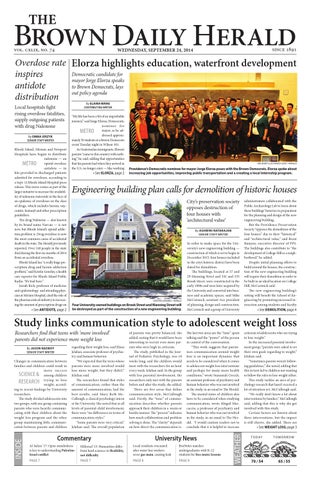
Four University-owned buildings on Brook Street and Manning Street will be destroyed as part of the construction of a new engineering building.
In order to make space for the University’s new engineering building — construction of which is set to begin in December 2015, four houses included in the city’s historic district have been slated for demolition. The buildings, located at 37 and 29 Manning Street and 341 and 333 Brook Street, were constructed in the early 1900s and were later acquired by the University and converted into business and academic spaces, said Mike McCormick, assistant vice president of planning, design and construction. McCormick and a group of University
administrators collaborated with the Public Archaeology Lab to learn about these buildings’ histories in preparation for the planning and design of the new engineering building. But the Providence Preservation Society “opposes the demolition of the four houses” due to their “historical” and “architectural value,” said Brent Runyon, executive director of PPS. The buildings also contribute to “the development of College Hill as a neighborhood,” he added. Despite initial planning efforts to build around the houses, the construction of the new engineering building will require their demolition in order to be built in an ideal location on College Hill, McCormick said. The new engineering building’s setting will benefit the School of Engineering by promoting increased interaction among students and faculty » See DEMOLITION, page 4
Study links communication style to adolescent weight loss By JASON NADBOY SENIOR STAFF WRITER
Changes in communication between families and children could result in more success among children trying to lose weight, according to recent findings by University researchers. The study divided adolescents into two groups, with one group containing parents who were heavily communicating with their children about the weight loss program and the other group maintaining little communication between parents and children
inside
SCIENCE & RESEARCH
regarding their weight loss, said Elissa Jelalian, associate professor of psychiatry and human behavior. “We expected that the teens whose parents were more involved would lose more weight, but they didn’t,” Jelalian said. The researchers found that styles of communication, rather than the amount of communication, had the best results, said Mary Beth McCullough, a clinical psychology intern at the University. She noted that at all levels of parental-child involvement, there were “no differences in terms of communication styles.” “Some parents were very critical,” Jelalian said. The overall population
of parents was pretty balanced, she added, noting that it would have been interesting to recruit even more parents who were high in criticism. The study, published in the Journal of Pediatric Psychology, was 16 weeks long, and the children would meet with the researchers for an hour every week, Jelalian said. In the group with less parental involvement, the researchers only met with the parents before and after the study, she added. There are five areas that define communication style, McCullough said. Firstly, the “tone” of communication describes whether parents approach their children in a warm or hostile manner. The “process” indicates how much collaboration and problem solving is done. The “clarity” depends on how direct the communication is.
Commentary
The last two areas are the “time” spent talking and the “power” of the person in control of the conversation. “This work suggests that parentteen communication around weight loss is an important dynamic that needs to be considered when it comes to adolescent weight loss interventions and perhaps for many more health conditions,” wrote Suzannah Creech, an assistant professor of psychiatry and human behavior who was not involved in the study, in an email to The Herald. The mental states of children also have to be considered when studying communication, wrote Abigail Marcaccio, a professor of psychiatry and human behavior who was not involved in the study, in an email to The Herald. “I would caution readers not to conclude that it is helpful to increase
University News
Al-Salem ’17: Open-mindedness is key to understanding PalestineIsrael conflict
Hillestad ’15: Humanities differ from hard sciences in flexibility, not difficulty
Local residents evacuated after water line workers sever gas main, causing leak
BruNotes matches undergraduates with K-12 students for free music lessons
PAGE 7
PAGE 7
PAGE 8
PAGE 8
weather
Researchers find that teens with ‘more involved’ parents did not experience more weight loss
criticism of adolescents who are trying to lose weight.” In the increased parental involvement group, “parents were asked to set their own goals regarding to weight,” Jelalian said. “Sometimes parents weren’t following guidelines,” she noted, adding that this in turn led to children not wanting to follow the rules to lose weight either. This study tackles an area of psychology research that hasn’t received a lot of attention yet, McCullough said. “We really don’t know a lot about interventions by families,” McCullough said, adding that this is why she got involved with this study. Certain factors are known about these interventions, but the impact is still elusive, she added. There are » See WEIGHT LOSS, page 3 t o d ay
tomorrow
70 / 54
65 / 55
2 metro » ELORZA, from page 1 one’s way up to the middle class. Elorza referenced his “aggressive job creation program,” which involves investing in Rhode Island’s waterfronts and doubling exports over the next five years. If successful, this plan could create around 1,500 jobs for the middle and working classes in Providence, he said. Elorza also proposed creating a “citywide internship program,” to keep college
» ANTIDOTE, from page 1 the market and the prescribing practices of doctors as two factors contributing to the wider availability of opioids. Both of these could also contribute to the spike in the number overdoses, he said. Heroin generally costs less than prescription drugs, so people addicted to opioids turn to it as an alternative for financial reasons, Rich said. The spike in overdoses has spurred a range of responses, which include the greater distribution of naloxone and development of the state’s Prescription Drug Monitoring Program. Naloxone restores consciousness and normal breathing in an individual experiencing an overdose. The drug — which can be administered intravenously, intranasally, or via injection — has no negative side effects and will have no effect on a patient who has not overdosed. With distributions by hospital personnel, pharmacists, volunteers at state prison programs and law enforcement officials, it has become more widely available to at-risk populations.Walgreens and CVS Pharmacy do not require a prescription
THE BROWN DAILY HERALD WEDNESDAY, SEPTEMBER 24, 2014
graduates in the local community, citing studies that show college students who engage in local internships while they are in school are almost three times more likely to stay after graduation. “He made me want to go out and canvas on Saturday, personally,” said Amber Lowery ’18. Improving the city’s education system is something Elorza feels strongly about, as someone who almost did not graduate from high school and was rejected from
every college he applied to. Elorza went on to attend the Community College of Rhode Island and the University of Rhode Island, he said. After working on Wall Street, Elorza moved back to Providence when a childhood friend was murdered. He then decided to become a lawyer, eventually earning his degree at Harvard Law School. “Every single child — and I truly mean every single child — has the
capacity to be great in their own different ways,” Elorza said. “If I’m remembered for one thing, I want to be remembered as the mayor that turned around (Providence) schools.” Elorza said he would like to have school buildings open longer, so parents could take English classes synchronized with the instruction their children receive. This would allow parents to help their children with homework, he said. Following his talk, Elorza stayed for
a question and answer session, during which students introduced topics ranging from his joining forces with former mayoral candidate Brett Smiley to Providence’s transportation issues. “Everyone seemed to be really receptive and really excited by Elorza, which is the goal — to make everyone put a face to the candidate that we’re trying to get everyone to volunteer for,” said Meghan Holloway ’15, president of Brown Democrats.
to buy naloxone. Since the drug is not covered by all health insurance policies, providing naloxone in hospitals can be challenging financially, Gourlay said. “It is a cost, but they’re willing to absorb it with the hope that they’ll be able to save a life,” said James McDonald, chief administrative officer of the Rhode Island Board of Medical Licensure and Discipline, referring to the hospitals’ decision to distribute naloxone. The highest costs associated with overdoses are from hospitalizations and time spent in the intensive care unit, said Traci Green, assistant professor of emergency medicine and epidemiology. The Care New England health system was the first in the state to begin administering naloxone through various programs at Kent Hospital and Butler Hospital — in Warwick and Providence, respectively — in August, according to a Care New England press release. Prison programs across the state, such as the Preventing Overdose and Naloxone Intervention Program, have begun distributing naloxone upon release to help prevent relapse among
formerly incarcerated individuals with a history of prescription drug addiction. Parolees who were regularly using opioids before incarceration have a decreased tolerance for the drugs since they stop using in prison. But this decreased tolerance heightens the risk of overdosing if parolees resume their former levels of use, Rich said. State police have been encouraged to carry the drug with them while on duty, and more officers are being trained to administer the antidote, the Providence Journal reported. The Good Samaritan Law, passed in June 2012, provides immunity to individuals present at the scene of an overdose when police arrive in order to incentivize people to call emergency medical responders.“The trouble is, it’s not being applied uniformly,” Gourlay said. “It’s going to take some change in the culture.” Distributing naloxone becomes “a bridge to treatment,” Green said. Even though not all patients will enter a treatment program after receiving naloxone, it might be an incentive for them to consider getting help for their addiction,
she said. Both U.S. Sen. Jack Reed, D-R.I., and U.S. Sen. Sheldon Whitehouse, DR.I., have sponsored bills to increase resources for addiction programs. Reed’s bill focuses on increasing nationwide availability of naloxone, whereas Whitehouse’s bill attempts to address broader issues of addiction by increasing funding for programs, RIPR reported. Though federal funding for programs to increase the availability of naloxone and counteract the addiction epidemic is “wonderful and necessary,” Green said, “we risk being cut out at some point … at the whim of politicians.” One aspect of Whitehouse’s bill provides funding for states to improve their prescription drug monitoring programs and databases. Rhode Island’s database, which is managed by the Department of Health, is two years old but has not been as widely used as the department would like, McDonald said. Only 39 percent of clinicians who can prescribe a controlled substance in Rhode Island are registered to use the database, McDonald said. Clinicians
are now required to register for the database when they renew their licenses to prescribe opioids and other drugs in its class. But this does not ensure that providers will check the database before prescribing, McDonald added. The Department of Health estimates that clinicians look at the database less than 10 percent of the time when writing a prescription, McDonald said. “It’s been two years of asking nicely, and there might come a point where we need to require it,” she said. The database does not have a steady source of funding from the state, Gourlay said, adding that more money would enable the Department of Health to make it more user-friendly and attractive to doctors. Information about the black market or the use of illegal drugs, such as heroin, is not captured in the database, Gourlay said, adding that the database is “not a silver bullet.” Decreasing the stigma associated with addiction and finding new ways to treat pain will be critical parts of turning the tide on the overdose epidemic, McDonald said.
THE BROWN DAILY HERALD WEDNESDAY, SEPTEMBER 24, 2014
This Week in Higher Ed BY TONYA RILEY, UNIVERSITY NEWS EDITOR
Wesleyan announces fraternities must go coed Wesleyan University announced Monday that it will require all fraternities on campus to admit women within the next three years, multiple news outlets reported. Fraternities that do not comply within this timeframe will lose recognition from the University. “The trustees and administration recognize that residential fraternities have contributed greatly to Wesleyan over a long period of time, but we also believe they must change to continue to benefit their members and the larger campus community,” wrote Wesleyan’s President Michael Roth and Joshua Boger, chairman of the institution’s board of trustees, in an email to the campus Monday. The Wesleyan Student Assembly passed a resolution in April requesting the administration require all on-campus fraternities to become coeducational, the Wesleyan Argus reported at the time. The change follows a series of reported incidents at Wesleyan fraternity houses, including a serious injury sustained by a student after falling out of a third-story window of the Beta Theta Pi house earlier this month, the Argus reported. There have been two reported rapes at Wesleyan fraternity houses since 2010, the New York Times reported.
Rutgers campus shaken by two student deaths on same day Rutgers University senior Darsh Patel died Sunday in a suspected black bear attack — believed to be New Jersey’s first fatal bear attack in over 150 years — while sophomore Caitlyn Kovacs died the same day of suspected alcohol poisoning at a fraternity party, multiple news outlets reported. “Darsh was killed in a bear attack yesterday while hiking with friends in a wooded area of Passaic County,” said Rutgers-New Brunswick Chancellor Richard Edwards said in a statement on the university’s Facebook page. “As we grieve over his tragic passing, please know that our thoughts and prayers go out to his family and loved ones and to all his friends and fellow students at Rutgers.” Patel was with four other men when they came across the bear, the Washington Post reported. The four men split up, but could not relocate Patel and called in a search and rescue unit, which found Patel’s body a few hours later, the Post reported. The campus community was also confronted with Kovacs’ death, which was announced Sunday morning. A preliminary police investigation linked Kovacs’ death to suspected alcohol poisoning, authorities told NJ.com. Friends took a “distressed” Kovacs to the hospital from a party at a Rutgers fraternity house, NJ.com reported. Police are still determining the exact cause of death. “At the core of our university’s mission is our primary concern for the well-being of our students, and it is at heartbreaking moments like this that we must take special care to reach out with compassion and support,” Edwards said in a statement.
CSU bans discriminatory sports organization California State University recently revoked recognition from its campus chapter of InterVarsity, a national Christian sports organization, for excluding gay students from joining the group. The group’s policy first came to CSU administrators’ attention in August of last year, the Daily 49er reported. The InterVarsity chapter failed to comply with a one-year deadline given by the university to update its bylaws to allow for membership regardless of sexual orientation or religious identity. The organization required members to sign a “statement of faith,” the Daily 49er reported. Bailee Campbell, president of CSULB’s InterVaristy chapter, cited “religious integrity” as why the organization failed to comply with the university’s directive. InterVarsity has chapters on nearly 600 campuses nation-wide, according to the group’s website.
university news 3 » WEIGHT LOSS, from page 1 “gaps in research.” “We need more research that examines and bolsters the resources of family and intimate relationships on health,” Creech wrote, “and this study
is an outstanding sample of how to do that.” “It struck me that while adolescents are more independent than younger kids, their parents still have an influence,” Jelalian said. Jelalian is working on a new study
right now that is trying to figure out how adolescents who lost weight were able to accomplish their goals and has noticed that the “common theme” in teens’ ability to reach a healthier size has been that they are self-motivated.
4 university news »DEMOLITION , from page 1 while still retaining a connection to the current engineering program in Barus and Holley, Dean of Engineering Lawrence Lawson said. “Not only is it close to Barus and Holley, but it’s close to all the other areas of campus that we have really close intellectual and scholarly ties to.” “I think that all of us are sad to see the buildings go, but I think that given the options we have for increasing the capacity in the engineering site, there’s nothing we can do,” he added. University administrators considered saving the houses by moving them to street corners, but they are too big to relocate without causing collateral damage to the streets, McCormick said. Marisa Quinn, vice president for public affairs and University relations, said the University has conducted significant outreach to ensure that planning, design and construction of the site can move forward while enabling
community members to give their feedback on the construction process. The construction has already been approved by the city’s Planning Commission, she added. Maintaining good relationships with community members is important to the University, said Al Dahlberg, director of state and community relations. “We have open minds to communication with PPS and neighborhood assocations. We build good relationships because of that.” Though the PPS opposes the demolition of the historic houses, Runyon added that the group “applauds Brown’s effort to do community building.” While the buildings do qualify as “historic,” this designation does not hold much significance, McCormick said. In the 1970s, any building that was 50 years or older was nominated as a historic structure “without much judgement of the true value of them,” he said. Since the 1970s, the meaning of
what makes buildings “historic” has been changing. Now, “there needs to be other historic significance to them other than they are just old in the neighborhood and kind of nice,” McCormick said. The process of finding a suitable location for the new engineering building involved extensive planning, including meetings with community and neighborhood groups, such as the PPS, the Neighborhood Association and Fox Point leadership, McCormick said. The University aims to plan construction in “the most sensitive and effective way,” even if some sacrifices have to be made along the way, he said. Though the PPS is well aware that not all buildings can be saved, the group’s members “hope that what replaces the building or buildings will contribute to the community in a way that is greater than the loss of the other buildings would be” and that new structures will be “compatible with the neighborhood,” Runyon said.
THE BROWN DAILY HERALD WEDNESDAY, SEPTEMBER 24, 2014
Science & Research Roundup BY SARAH PERELMAN, SCIENCE & RESEARCH EDITOR
Appearances deceiving in salt marsh recovery Once-depleted salt marshes in Cape Cod may be growing green and tall now, but that does not mean they are protecting the land from erosion, according to a new study by University researchers. These results concern ecologists because “the metric of a recovered habitat should not be ‘Does it look like a recovered habitat?’ but ‘Does it restore the ecosystem services?’” said Mark Bertness, professor of biology and senior author of the study, in a University press release. Bertness worked with two former students to measure a wide array of Cape Cod salt marshes’ abilities to protect the land behind them. They set up chalk posts and noted how much the chalk waned after waves passed through the salt marshes in order to model the erosion of the land behind the marshes. They next compared the results to the biomass and height of the marsh grass in front of the area. The results, published in the journal Biological Conservation, indicate that the marshes’ protection ability has increased more sluggishly than plant mass and height in these areas, which has implications for how conservationists should approach protecting Cape Cod’s shores, according to the release. “We need to prevent the die-off or understand the recovery enough to do management conservation tasks, such as fertilization, that would enhance the recovery,” Bertness said in the release.
Private intensive care unit rooms for infants boost health, study suggests Though many hospitals boast intensive care units with lines of beds facing the center, a new study led by University researchers suggests that private family rooms in neonatal intensive care units may have a positive impact on the health of the babies leaving the hospital. Infants hosted in private rooms generally needed fewer medical procedures, displaying increased attention as well as “less lethargy and less pain,” the researchers wrote. Additionally, underweight babies leaving the hospital from private rooms tended to be heavier and showed more rapid weight gain than those in communal rooms. The researchers came to these conclusions after comparing the medical and behavioral outcomes of 403 infants born below the weight threshold of 3.3 pounds. Some of these babies received care in large, non-private rooms, while others stayed in single-family intensive care unit rooms. “In a room, you have privacy, the lighting you want, nurses who work one-on-one with the moms. It’s relaxed, it’s calm,” Barry Lester, lead author of the study and director of the University’s Center for the Study of Children at Risk, told the New York Times.
Richard Gold receives Physician of the Year award Associate Professor of Diagnostic Imaging Richard Gold was celebrated for his patient care and contributions to medicine with the Miriam Hospital’s 2014 Charles C.J. Carpenter, MD Outstanding Physician of the Year Award, according to a Lifespan press release. In addition to his position as a University faculty member, Gold serves as radiologist-in-chief at the Miriam Hospital. Gold has worked at the hospital for 20 years, and assumed the position of chief of radiology just four years after joining the staff. “It is a privilege to interact with and get to know patients and have the opportunity to help them with their health problems,” Gold said in the release. The award recognizes Gold’s excellence in leading the radiology department, the work of which is critical because “interpreting medical imaging is many times the first step toward addressing patients’ critical health concerns,” said Thomas Tracy Jr., vice chairman of the Alpert Medical School’s department of surgery, who also serves as chief medical officer and senior vice president at the hospital, in the release.
» MUSIC, from page 8 technical growth and performance, BruNotes is “about loving music and passing it on to other people,” she said. The founding of BruNotes comes at an especially crucial time in light of the national reductions of music education in public schools, said Nicole Denton, advocacy chair of the Rhode Island Music Educators Association, a nonprofit that promotes music education statewide. When Denton worked as a music teacher in a Woonsocket middle school, she watched the student band drop from 300 to 22 members within a three-year span after music went from being part of the school day to an afterschool activity. “They are taking music out of the
school day because it’s not a tested subject,” Denton said. Rescheduling music education to this time puts it in competition with sports and other activities, she added, and it also prevents students with work and babysitting obligations from participating. Torabi and Gentry face similar hardships in jump-starting their own music education group. Even if the group receives a grant from the Brown Venture Launch Fund, the money will only cover sheet music and books, Torabi said. To meet its goals, BruNotes is currently accepting instruments from students, professors and community members. “It’s hard for me to put how I feel about music into words,” she said. “It’s a power we can’t see.”
today 5
THE BROWN DAILY HERALD WEDNESDAY, SEPTEMBER 24, 2014
menu
sensory perception
SATELLITE DINING JOSIAH’S Steamed Dumplings with Dipping Sauces BLUE ROOM Mediterranean Pocket ANDREWS COMMONS Po Boy Sandwich
DINING HALLS SHARPE REFECTORY LUNCH
DINNER
Artichoke and Red Pepper Frittata, Julienned Red Peppers, Popcorn Chicken
Sweet and Sour Tofu Stir-Fry, Snow Pea Pods, Savory Chicken Stew, Basmati Rice Pilaf
VERNEY-WOOLLEY LUNCH
DINNER
Pulled Pork Sandwich, Vegan Quinoa Stuffed Portobello, Italian Meatballs with Sauce
BBQ Chicken Quarters, Tortellini Pesto Salad, Jamaican Pork and Apricot Stir-Fry, Veggie Burgers
sudoku
crossword ALEXIA DELHOUME / HERALD
Michael Hendrix, partner and managing director of design and consulting firm IDEO in Boston, spoke at RISD this week as part of Design Week RI. Hendrix spoke about the importance of all five senses in design perception.
comic Class Notes | Phillip Trammell ’15
calendar TODAY 10 A.M. IMAGES OF POWER: RULERSHIP IN THE
TOMORROW 2:30 P.M. READING BY NOVELIST JESSE BALL
This collection examines the decorative arts in independent kingdoms, called fons, located in the northwest grasslands of Cameroon. Haffenreffer Museum of Anthropology
Novelist and poet Jesse Ball will read from his works, which include “A Cure for Suicide,” “Silence Once Begun” and “The Curfew” as part of the Writers On Writing series. McCormack Family Theatre
4 P.M. 28TH ANNUAL KATZ LECTURE
6 P.M. U.S. PEACE CORPS INFORMATION SESSION
GRASSLANDS OF CAMEROON
Guest speaker Albert Siu from Mount Sinai Hospital delivers a lecture titled, “Saving Medicare: the Defining Domestic Policy Challenge for our Generation.” 121 South Main, Room 245
A Peace Corps representitive will be on campus to discuss her service experience, as well as answer questions on volunteering opportunities at home and abroad, and explain the updated application process. CareerLAB
8 P.M. LATINO STUDENT GROUP FIRST MEETING
9 P.M. DEAD POETS SOCIETY SCREENING
The Latino Student Group meets to discuss Latino culture and community-building at their first meeting of the semester. Brown Center for Students of Color
In honor of the recent death of comedian Robin Williams, Brown University Film Forum hosts a screening of this fan favorite. Smith-Buonanno Room 106
6 commentary
THE BROWN DAILY HERALD WEDNESDAY, SEPTEMBER 24, 2014
EDITORIAL
A true opportunity for school spirit The upcoming Fall Celebration tied to Brown’s 250th Anniversary presents a distinct opportunity to craft a definite sense of school spirit on campus. As discussed in a previous editorial (Sept. 8, “Ra Ra Brunonia?”) we firmly believe that Brown lacks a distinguishable aura of pride and fails to actively and vocally support its historic, Ivy League athletic program. This tempered degree of spirit and tradition unfortunately holds true consequences in the future trajectory of the institution, as Brown relies heavily on its ever-growing alum base for monetary donations and gifts. We urge the Brown community at-large to actively participate in the myriad events offered over the course of the Fall Celebration and by doing so, help restore and bolster a once vibrant sense of Brunonian spirit. Opportunities to come together as a campus are rare. Even less common are those that attract alums from around the country. This weekend is a chance for first-years making their first trek up to Brown Stadium to fill it alongside students of their grandparents’ generation, representing perhaps 70 of Brown’s 250 years. Demonstrating school spirit and supporting sports teams are not contingent upon success or elite status, and this weekend should not rest solely on Brown’s prestige. Rather, the sense of community should come more simply from the sharing of an experience afforded to few. While undergraduates have spent the first month conversing around dinner tables and occasionally packing the Main Green or lecture halls, this weekend is an occasion to come together in large numbers with one clear purpose: to celebrate Brown. Interactions between 18-year-olds and octogenarians will undoubtedly be limited, but seeing the faces of those who came before and those who follow suffices to remind us of both the history and the future of this campus that is so often lost as we scurry between classrooms to libraries. School spirit is inextricably tied to tradition. Beyond the matchup against Harvard, the comprehensive agenda of the weekend includes a number of events and exhibits which aim to celebrate the institution’s deep-rooted history and embedded sense of tradition, specifically “25 Objects: The Stories of Our Past, Present and Future” and “In Deo Speramus: The Symbols and the Ceremonies of Brown University.” These particular events bring about the convergence of material history and the rather amorphous topic of school spirit and identity, with the underlying hope of crafting a more explicit and visible institutional character. However, Brown is as much a product of its traditions as it is of the individuals who perpetuate them. The Brown community must continue to remain aware of tradition and work to strengthen these often overlooked cornerstones. The last weekend of September signals for many students the tail end of summer or the beginning of midterm exams. It is often the last chance to take full advantage of Brown’s resources beyond our courses. We would, as a community, do well to push off academic anxieties until Monday and come together to celebrate what we share on College Hill. Editorials are written by The Herald’s editorial page board, led by Alexander Kaplan ’15 and James Rattner ’15. Send comments to editorials@browndailyherald.com.
KO R B Y N SI M P S O N
Q U O T E O F T H E D AY
“It looked like the littlest spark could have set off a potentially devastating explosion.” — Christopher Erb GS
See gas leak on page 8.
CORRECTION A previous version of a column that ran in Friday’s Herald (“The Islamic State: conceived by American hubris,” Sept. 19) incorrectly referred to Iraq as a majority-Sunni nation. In fact, it is a majority-Shiite nation. The Herald regrets the error.
Got something to say? Leave a comment online! Visit www.browndailyherald.com to comment on opinion and editorial content.
Editorial Leadership
Sections
Visuals & Production
Business
Editor-in-Chief Eli Okun
Arts & Culture Editor EmmaJean Holley
Managing Editors Mathias Heller Sona Mkrttchian
Features Editors Phoebe Draper Sabrina Imbler
Design Editors Brisa Bodell Einat Brenner Mie Morikubo Assistant: Carlie Peters
General Managers Jennifer Aitken Nicole Shimer
Senior Editors Maddie Berg Katherine Cusumano Kate Nussenbaum
Metro Editors Mariya Bashkatova Kate Kiernan Molly Schulson
BLOG DAILY HERALD Editor-in-Chief Georgia Tollin Managing Editors Charlotte Bilski David Oyer POST- MAGAZINE Editor-in-Chief Adam Asher COMMENTARY Editorial Page Editors Alexander Kaplan James Rattner Opinions Editors Gabriella Corvese Robyn Sundlee Maggie Tennis
Science & Research Editors Isobel Heck Sarah Perelman Sports Editors Caleb Miller Dante O’Connell University News Editors Kiki Barnes Michael Dubin Maxine Joselow Tonya Riley
Photo Editors Head: David Deckey Brittany Comunale Samuel Kase Sydney Mondry Arjun Narayen Tom Sullivan Video Editor Henry Chaisson Graphics Editor Avery Crits-Christoph Web Producers Harsha Yeddanapudy Abdullah Yousufi Copy Desk Chief Claire Postman Assistant: Madeline DiGiovanni Illustrations Editor Angelia Wang
Directors Sales: Winnie Shao Finance: Sarah Levine Finance: Sameer Sarkar Alumni Relations: Alison Pruzan Business Dev.: Melody Cao
facebook.com/browndailyherald
Location: 195 Angell St., Providence, R.I. www.browndailyherald.com
@the_herald
Editorial contact: 401-351-3372 herald@browndailyherald.com
browndailyherald.com
Business contact: 401-351-3260 gm@browndailyherald.com
Office Manager Shawn Reilly
Corrections: The Brown Daily Herald is committed to providing the Brown University community with the most accurate information possible. Corrections may be submitted up to seven calendar days after publication.
Sales Managers Regional: Edward Clifford Regional: Sarah Pariser Regional: Ananya Shukla Regional: Jessica Urrutia Student Group: Moniyka Sachar
Commentary: The editorial is the majority opinion of the editorial page board of The Brown Daily Herald. The editorial viewpoint does not necessarily reflect the views of The Brown Daily Herald, Inc. Columns, letters and comics reflect the opinions of their authors only.
Finance Managers Collections: Jacqueline Finkelsztein Collections: Joshua Tartell Operations: Jessica O’Dell Alumni Relations Manager Engagement: Sarah Park Business Dev. Manager Project Leader: Kaden Lee
Letters to the Editor: Send letters to letters@browndailyherald.com. Include a telephone number with all letters. The Herald reserves the right to edit all letters for length and clarity and cannot assure the publication of any letter. Please limit letters to 250 words. Under special circumstances writers may request anonymity, but no letter will be printed if the author’s identity is unknown to the editors. Announcements of events will not be printed. Advertising: The Brown Daily Herald, Inc. reserves the right to accept or decline any advertisement at its discretion. The Brown Daily Herald (USPS 067.740) is an independent newspaper serving the Brown University community daily since 1891. It is published Monday through Friday during the academic year, excluding vacations, once during Commencement and once during Orientation by The Brown Daily Herald, Inc. Single copy free for each member of the community. Subscription prices: $280 one year daily, $140 one semester daily. Copyright 2014 by The Brown Daily Herald, Inc. All rights reserved. Periodicals postage paid at Providence, R.I. Postmaster: Please send corrections to P.O. Box 2538, Providence, RI 02906.
commentary 7
THE BROWN DAILY HERALD WEDNESDAY, SEPTEMBER 24, 2014
Keep the humanities free and the sciences hard SAM HILLESTAD opinions columnist
Hard-core students study the hard sciences but leave the humanities to the slackers. After all, anyone can cook up a philosophy paper, but try that approach on an orgo exam and you’ll learn firsthand that grade inflation at Brown isn’t all it’s chalked up to be. Or so goes the common rhetoric here. While there is an undeniable difference between the work required in the sciences and in the humanities, that’s no reason to change anything. The humanities are what you make of them. And you can make very little of them if you want. The workload gap between the sciences and humanities is a common, albeit controversial, talking point among Brown students. And that conversation usually ends in a begrudging compromise. The computer science concentrator admits she would only write a paper because of Brown’s writing requirement, and the history student accepts that he would never venture into the depths of a biology classroom. And that’s perfectly fine. Brown’s open curriculum grants more than enough freedom to students. Contrary to what a recent Herald editorial argued (“Make science and humanities equally difficult,” Sept. 16) there is no reason to arbitrarily tinker with the difficulty of classes to get more intermingling between departments. In fact, there is no inherent gap between the workload of the sciences and the humanities. The workload in a humanities course is not necessarily lighter. But it can be if you want. The difference between the disciplines is
that the humanities allow for a wider range of effort. The alleged problem with the humanities is that shortcuts are acceptable. You can get by in a political science course without doing all of the reading. You can skate through courses in the humanities without learning much of anything at all. You’ll get by with mainly B’s, or if you’re especially lazy, even the occasional C. But none of that matters. At Brown, the impetus for learning is placed in the hands of the individual. Brown is not culpable for your lack of an education.
The hard sciences, on the other hand, force you to learn the material or fail. While that’s intimidating — and maybe even unfortunate — that’s the nature of the beast. Science is fundamentally about facts, objectivity and pure methodology. There’s no room for interpretation or creativity. But again, that’s not a problem. If I were legitimately interested in studying the hard sciences, I would, regardless of the course load’s difficulty. The Herald’s recent editorial correctly points out that the sciences, on average, take
There is no inherent gap between the workload of the sciences and the humanities. The workload in a humanities course is not necessarily lighter. But it can be if you want. I should know. I’ve taken my fair share of humanities courses in which I’ve skimped on the readings and sat through class in a halfasleep stupor. And I regret taking those classes. It’s not that the professor should have made the course harder. It’s not that I wish physics courses were easier so I could take those instead. I just took the wrong class and suffered the consequences. That’s a risk we take with the open curriculum. Studying the humanities — especially at Brown — is risky. The freedom can be stifling. If you don’t customize your education just right, you may get stuck in boring humanities classes where you can get an A with minimal effort.
up more time per week than the humanities — sometimes even requiring twice the work. But that average is skewed by non-concentrators taking humanities courses, a phenomenon that is generally not reciprocal. Furthermore, the lack of mandated weekly work in humanities courses means you can skip readings, and sometimes even class, without jeopardizing your grade. So yes, humanities courses tend to take less effort. But their upper bound is infinitely higher than that of the sciences. A humanities paper can always be improved and polished further. You can always redo readings, analyzing the arguments in greater and greater detail. You can even do original work, exploring the
philosophical depths of your own mind, using classwork as little more than a springboard. But a problem set can never be more correct. In contrast to science coursework, the amount of effort you put into a humanities course is entirely up to you. Moreover, there are plenty of easy, introductory science courses at Brown. GEOL 0010: “Face of the Earth,” also known as “Rocks for Jocks,” or CSCS 0080: “A First Byte of Computer Science,” are notoriously simple courses that non-concentrators can take for an easy A. These courses are widely mocked, showing that Brown students have an extreme aversion to watering down the sciences. Even as a philosophy concentrator, I join them in their mocking. I took GEOL0010 sophomore year. It felt like a high school class, and an easy one at that. The editorial argues, “The current system does not address the blatant inequalities in the associated workload and benchmarks.” I agree wholeheartedly. But I disagree that this is a problem that needs to be addressed, and even if it were, the solution would be to increase the difficulty of humanities courses, not to soften the hard sciences. The humanities can be as difficult or as easy as you want them to be. That makes studying the humanities both rewarding and dangerous. Any alteration to the system of free inquiry that the humanities have carefully cultivated, or any lowering of the rigorous academic standard set by the sciences, would be to the detriment of Brown students.
Sam Hillestad ’15 will defend the humanities, with all its flaws, to the death. He can be reached at samuel_hillestad@brown.edu.
Young voices, old conflict SARA AL-SALEM opinions columnist
I entered Petteruti Lounge Monday Night an hour earlier than the anticipated student-run panel on the Gaza War was said to start. I had my dinner in hand and was prepared to be wildly disenchanted by the panel, which I thought would essentially normalize a complex conflict into idle chitchat. As the hour drew near, however, I took a seat in the second row and watched the room fill up with people from all different backgrounds. This helped bring into reality the footnote on the event’s Facebook posting that stated, “students of all ideological backgrounds are strongly encouraged to attend and participate.” It was obvious from the turnout that many people who might shy away from this issue out of fear that they weren’t informed felt comfortable enough to make an appearance, which gives me hope about the future of dialogue around this issue on campus. When it comes to an issue like the Palestinian-Israeli conflict, the most helpful component in moving forward and seeing real progress exists in today’s generations’ willingness to shed the idea that a political stance must be static. An open
mind is a conflict’s greatest enemy, and, if panelists and attendees come in with one, then an event can start real change. The introduction from Tala Doumani ’17, one of the two moderators of the night, really impressed me. She had a strong, commanding voice that made you want to listen to what she had to say, and she gave the impression that she had the authority and maturity to moderate a discussion like this. Her short
was moderated created more tension than needed. Eital SchattnerElmaleh ’17, a moderator alongside Doumani, managed to keep things going in an orderly fashion but at the cost of cutting people off short at very pivotal moments and creating a sense of urgency and tension. Those are logistical issues that will sort themselves out in time. The more important issue at hand is the question I was left wondering at the end of the panel, which was wheth-
can. Although I understand the issue is a sensitive one, some panelists came out sounding either naive or simply racist, and, because of the way the panel was orchestrated, a lot of these problematic factors were not addressed. At one point, after tensions were officially and visibly high and opinions turned into terse rebuttals, I wanted to ask the panelists why they were even there at all. I be-
I hope that moving forward, the conversation is less about defending what you believe and more about learning what others believe. opening statement that detailed her stance on the Palestine-Israel issue shed a great deal of light on her perspectives without framing the discussion in any specific way, which is a difficult but admirable quality to master. Due to Doumani’s emphasis on keeping the space neutral, she fell short as a moderator when it came to challenging the panelists. The panel also had some other flaws that, although understandable due to it being the group’s first attempt at an event like this, should have been avoided. To start, I believe that while the moderating was done to control time and temper, the tense manner and attitude with which the panel
er this event did more harm than good. To dissect that notion, one must look at the panelists who Doumani and Elmaleh had to moderate. Peter Makhlouf ’16, a Herald opinions columnist, and Max Schindler ’15, a former Herald staff writer, easily stole the show with their ability to communicate their ideas and beliefs without disregarding facts and history. Whatever your political opinion was, you had to take both seriously because they spoke from a place of knowledge and experience. It was an added bonus that both were from two different sides of the issue — Schindler identifying as an American Jew and Makhlouf as a Palestinian Ameri-
lieve Doumani and Elmaleh started the discussion on the right foot and had planned for a space to learn and benefit from one another. But the impression I was left with by the end of the night was that this was every side’s chance to defend its opinions and beliefs. I believe in justice for Palestine, I believe the occupation will end one day and I think the initiative Doumani and Elmaleh took toward that idea was the right one. But I do not think the panel was executed well, and the fault lies with the panelists. While it’s great to have a student-run panel sans professors and old academics where the divide between generations is too vast to promote unity, the conversa-
tion runs the risk of becoming one of catty dismals and defensive arguments. That’s not to say that panels with legitimate academics and scholars do not turn out the same way. The recent teach-in entitled “Why Gaza Matters” that was led by faculty faced a tense audience. The Palestine-Israel issue has always been sensitive, so it is no surprise that the panel turned out the way it did. I applaud the panelists and the organizers of Monday’s panel for putting in the effort, but I hope that, moving forward, the conversation is less about defending what you believe and more about learning what others believe. We must grow away from the idea that once you’ve declared a political stance you can’t go back. If anything, I hope this panel encourages some of the more strongly politically affiliated individuals to have more of an open mind in future discussions. If a panel strives for this as much as it strives for creating a neutral space, then the possibility of a more informed generation and campus that can fight for change is on the horizon.
Sara Al-Salem ’17 is happy there’s dialogue happening about Palestine-Israel at all and can be reached at sara_al-salem@brown.edu.
WEDNESDAY, SEPTEMBER 24, 2014
THE
BROWN DAILY HERALD university news Gas leak sparks evacuation BruNotes strikes chord Repair work on damaged water line leads to severed gas main on East George and Ives By MOLLY SCHULSON METRO EDITOR
The Providence Fire Department evacuated about 10 homes due to a gas leak at the intersection of East George Street and Ives Street Monday evening, said Fire Department Captain Robert Vincent. The issue arose early Monday morning when a contractor working on telephone conduits damaged a water line, said Mark Haroian, senior manager of transmission and distribution of the Providence Water Supply Board. Workers “hit the (water) line that directly fed into the unit that I live in,” said Christopher Erb GS. “We had no water for the rest of the day,” he added.
The contractors told Erb that the water line was not “where it was supposed to be,” Erb said. When Providence Water employees attempted to repair the broken water line around 5 p.m., inconsistencies between pipeline markings and the lines’ actual locations led to the gas leak, Haroian said. “They severed a two-inch gas main, and that was the cause of the evacuation,” Vincent said. National Grid workers arrived on the scene and shut the valves down to stop the leak within 45 minutes, Vincent said. “They were very efficient, they checked everything,” said Bernie Maceroni, a live-in landlord on East George Street. Erb’s house was one of several to be evacuated after the gas leak. Firemen “essentially said go away and stay away for awhile,” he said. The water company had to “excavate in a more aggressive way than
we normally would have” due to the “inaccurate” markings of the National Grid gas lines, said Ricky Caruolo, general manager of Providence Water. “If (the markings) were accurate, we probably would not have been so aggressive,” Caruolo said. When Erb first noticed the incident outside his house, a “dense cloud” of gas was coming out the ground, he said, adding “it looked like the fumes were just spewing onto the face of the house.” “It looked like the littlest spark could have set off a potentially devastating explosion,” Erb said. “I think that steps should be taken to make sure this type of thing doesn’t happen again.” Officials said the coordinated response to the gas leak worked effectively. “We took the appropriate measures internally to document the incident in place with employees that were involved,” Caruolo said.
with music lovers New group promotes music education among Providence students, supplies free lessons By EMILY WOOLDRIDGE STAFF WRITER
Before Tara Torabi ’15 could put in effect her plan to bring music education to lowincome youth in Providence, she had to return to the piano keys. An avid piano player before college, Torabi couldn’t find time to practice once she arrived on College Hill. It was only after she started playing again this summer at Steinert Practice Center that she remembered her long-lost passion. “I was very shy when I was growing up, and music gave me the ability to articulate my feelings when words couldn’t,” Torabi said, fondly remembering the weekly car rides with her father to the
lessons, as well as the instruction itself. “I had the opportunity to receive music lessons, but what about kids who simply don’t have the opportunity because their parents can’t take them or can’t afford it?” That’s where Torabi’s pilot program, BruNotes, steps in. Under the leadership of Torabi and Anne Gentry ’15, BruNotes will pair about 20 Brown undergraduates with K-12 students in Providence for free, individualized music lessons at local schools, churches and community centers. The lessons will include instruction in piano, voice, guitar, clarinet, violin, piccolo, flute, saxophone and trombone. The program will also go beyond private music lessons. “We want to take them to piano concerts and have get-togethers where students can talk about music or play music together,” Torabi said. BruNotes fills a niche in the campus music scene, Gentry said. Where many music programs at Brown revolve around » See MUSIC, page 4