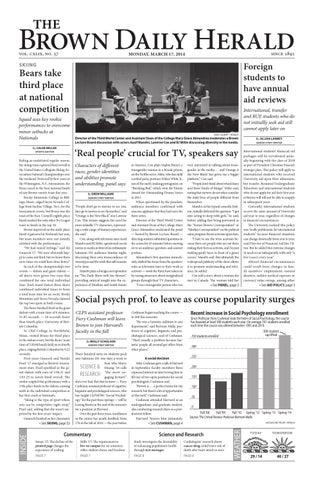
THE
BROWN DAILY HERALD vol. cxlix, no. 37
since 1891
MONDAY, MARCH 17, 2014
Foreign students to have annual aid reviews
SKIING
Bears take third place at national competition
By CALEB MILLER SPORTS EDITOR
inside
Riding an undefeated regular season, the skiing team captured third overall at the United States Collegiate Skiing Association National Championships over the weekend. Powered by first-years at the Wilmington, N.Y., tournament, the Bears raced to the best national finish of any Brown varsity team this year. Rocky Mountain College in Billings, Mont., edged Sierra Nevada College from Incline Village, Nev., for the tournament crown, but Bruno was the toast of the East. Cornell’s eighth-place finish marked the only other Ivy League team to finish in the top 10. Bruno improved on the sixth-place finish it garnered at Nationals last year, but team members were not entirely satisfied with the performance. “We had mixed feelings,” said Ali Gunesch ’17. “We were obviously happy to come out third, but we know there were times we could have done better.” In each of the championship’s two events — slalom and giant slalom — all skiers were given two runs that combined for one total individual time. Each team’s fastest three skiers combined individual times to form a total team time for an event. Rocky Mountain and Sierra Nevada claimed the top two spots in both events. The Bears finished third in the giant slalom with a team time of 6 minutes, 31.65 seconds — 10 seconds faster than fourth-place University of British Columbia. St. Olaf College in Northfield, Minn., ousted Bruno for third place in the slalom event, but the Bears’ team time of 5:20.60 barely held on to fourth place, edging British Columbia by 0.22 seconds. First-years Gunesch and Natalie Pearl ’17 emerged as Brown’s tournament stars. Pearl sparkled in the giant slalom with runs of 1:04.21 and 1:03.25 to notch third overall. The rookie coupled that performance with a 15th-place finish in the slalom, earning sixth in the individual competition at her first crack at Nationals. “Skiing is the type of sport where you can be competitive right away,” Pearl said, adding that she wasn’t surprised by the first-years’ impact. Gunesch finished on her classmate’s » See SKIING, page S3
EMILY GILBERT / HERALD
Director of the Third World Center and Assistant Dean of the College Mary Grace Almandrez moderates a Brown Lecture Board discussion with actors Aasif Mandvi, Laverne Cox and RJ Mitte discussing diversity in the media.
‘Real people’ crucial for TV, speakers say Characters of different races, gender identities and abilities promote understanding, panel says By DREW WILLIAMS SENIOR STAFF WRITER
“People don’t go to movies to see you, they go to movies to see themselves,” said “Orange is the New Black” star Laverne Cox. This truism suggests the need for more relatable TV characters, representing a wide range of human experiences, she said. Cox, along with television stars Aasif Mandvi and RJ Mitte, questioned social norms in media in front of an enthusiastic Salomon 101 audience Sunday night, discussing their own transcendence of stereotypes and the work that still remains to be done. Mandvi plays a foreign correspondent on “The Daily Show with Jon Stewart,” providing satirical insight into the experiences of Muslims and South Asians
in America. Cox plays Sophia Burset, a transgender woman in a female prison, on the Netflix series. Mitte, who has mild cerebral palsy, portrays Walter White Jr., son of the meth-making protagonist, on “Breaking Bad,” which won the Emmy Award for Outstanding Drama Series in 2013. When questioned by the panelists, audience members confirmed with raucous applause that they had seen the three series. Director of the Third World Center and Assistant Dean of the College Mary Grace Almandrez moderated the panel — hosted by Brown Lecture Board — directing student-submitted questions to the actors for 45 minutes before moving on to an audience question-and-answer portion. Almandrez’s first question immediately shifted the focus from the speakers’ roles as television stars to their work as activists — work the three have taken on by raising awareness about marginalized groups through their TV characters. “I was a transgender person who was
very interested in talking about transgender in the media … and ‘Orange is the New Black’ has given me a bigger platform,” Cox said. “People don’t think about wheelchairs and those kinds of things,” Mitte said, noting that viewers do not often consider the daily lives of people different from themselves. Mandvi, in his typical comedic fashion, initially deflected the question. “I got into acting to sleep with girls,” he said, before adding that being portrayed as the “Senior Brown Correspondent” or “Muslim Correspondent” on the political satire program thrust activism upon him. “I hate to use the term activism because there are people who are out there risking their lives as activists, and I’m just making goofy faces in front of a green screen,” Mandvi said. But ultimately the widespread publicity of the show allows it to promote understanding and tolerance, he added. Cox told a story about a woman she met in Canada. The woman told her » See PANEL, page 2
By JILLIAN LANNEY SENIOR STAFF WRITER
International students’ financial aid packages will be reevaluated annually beginning with the class of 2018 as part of President Christina Paxson’s strategic plan. This policy will apply to international students who received University aid upon their admission, but transfer, Resumed Undergraduate Education and international students who do not apply for aid their first year at Brown will still not be able to reapply in subsequent years. Currently, international students receive the same amount of University aid year to year, regardless of changes in financial circumstances. The University realized this policy was “really problematic for international students” because financial situations can change drastically from year to year, said Director of Financial Aid Jim Tilton. But he added that extreme changes in need occur infrequently, with only “a few (cases) every year.” Altered financial circumstances could result from changes in family members’ employment, natural disasters, sudden medical expenses or currency value swings, among other » See AID POLICY, page 3
Social psych prof. to leave as course popularity surges CLPS assistant professor Fiery Cushman will leave Brown to join Harvard’s faculty in the fall By MOLLY SCHULSON SENIOR STAFF WRITER
Three hundred sixty-six students pack into Salomon 101 two days a week to hear who Marcy Huang ’16 calls “the most engaging lecturer” she’s ever had. But that lecturer — Fiery Cushman, assistant professor of cognitive, linguistic and psychological sciences, who has taught CLPS0700: “Social Psychology” for the past three springs — will be leaving Brown at the end of the semester for a position at Harvard. Over the past three years, enrollment in the course has nearly doubled, from 178 in the fall of 2010 — the year before
SCIENCE & RESEARCH
Cushman began teaching the course — to 366 this semester. “He was a fantastic addition to our department,” said Bertram Malle, professor of cognitive, linguistic and psychological sciences, said of Cushman. “That’s usually a problem because fantastic people all around get offers from other places.” A social decision After Cushman gave a talk at Harvard in September, faculty members there expressed interest in interviewing him to fill one of two open positions for social psychologists, Cushman said. “Brown is … a perfect home for my research, but there’s a lot of opportunities at Harvard,” Cushman said. Cushman attended Harvard as an undergraduate and graduate student, also conducting research there as a postdoctoral fellow. Harvard “knows him intimately, » See CUSHMAN, page 4
Commentary
Recent increase in Social Psychology enrollment Since Professor Fiery Cushman took the helm of Social Psychology, the course has boasted at least 300 students each year. On average 101 students enrolled each time the course was offered between 1995 and 2010. 300-student cap lifted
350 students enrolled 300 250 200 150 100 50 0
Fall '08 Fall '09 Fall '10 Spring '12 Spring '13 Spring '14 Source: The Critical Review; Professor Bertram Malle JACQUELINE FEILER / HERALD
Science and Research
Isman ’15: The decline of the printed page changes the experience of reading
Mills ’15: The requirement to live on campus for six semesters stifles student choice and freedom
Study investigates the desirability of enhancing population’s health through text messages
Cardiologists’ research shows cancer drug could lower risk of death after heart attack in mice
PAGE 7
PAGE 7
PAGE 8
PAGE 8
weather
Squad uses key rookie performances to overcome minor setbacks at Nationals
International, transfer and RUE students who do not initiallly seek aid still cannot apply later on
t o d ay
tomorrow
29 / 14
40 / 27
2 university news
THE BROWN DAILY HERALD MONDAY, MARCH 17, 2014
Former Gate space remains vacant, awaiting renovation
ARJUN NARAYEN / HERALD
Alumnae Hall, which formerly housed the Gate in the basement, is not up to current building and fire regulations, and must undergo renovation before a new usable space is created.
Despite lack of concrete plans, Alumnae Hall basement will likely become new student space By STEVEN MICHAEL SENIOR STAFF WRITER
Since Andrews Commons opened at the beginning of this semester, the space in the basement of Alumnae Hall — previously home to the Gate — has stood vacant, with no immediate plans for renovation. “We’re not at the point where we’re
determining what’s next,” said Stephen Maiorisi, vice president for facilities management. “Once a decision is made, it would take a year to design and a year or two to build,” Maiorisi said, adding that a decision may not be made for over a year. Marisa Quinn, vice president for public affairs and University relations, said the Alumnae Hall basement will most
likely become a space for students, not administrators. She cited the University’s goal of transferring administrative offices to the Jewelry District outlined in President Christina Paxson’s strategic plan, “Building on Distinction.” The necessity of complying with state and federal regulations complicates any potential renovations. Built in 1927, Alumnae Hall does not meet the standards of either the Rhode Island Fire Safety Code or the Americans with Disabilities Act, Maiorisi said, adding that Alumnae Hall was grandfathered
into fire safety regulations because of its age. But in the aftermath of the Station nightclub fire, Rhode Island removed the grandfather exemption in 2005, so the building must meet fire code for any future renovation, he said. One of these regulations that must be met includes upgraded sprinkler systems. “From 2005 to 2009, we spent over $30 million upgrading sprinkler systems and fire alarm systems in dormitories,” Maiorisi said of the University’s response to the new code, adding that many other buildings have also been updated. Alumnae Hall is among the few buildings on campus lacking a sprinkler system, so officers from the Department of Public Safety or the fire department must be present for any large event, Maiorisi said. Future renovations would also have to add an interior elevator to comply with the Americans with Disabilities Act, he said. Some students have formulated their own ideas about the best use of the basement space. “It would be really cool to have a venue — a version of the Underground that’s more set up for student performance,” said Isaac Berkowitz ’14, chair of the Alumnae Hall Advisory Board, an umbrella organization for student
John Lee Beatty ’70: Brown to Broadway » MEDIA PANEL, English concentration resurfaces in scenic designer’s Tony Awardwinning career By MARCUS SUDAC STAFF WRITER
Tony-award winning scenic designer John Lee Beatty ’70 could not tell you the number of Broadway sets he has constructed. He thinks that “Tales from Red Vienna,” his ongoing project with the Manhattan Theater Club, is his 107th or 108th production — nothing’s definite. Beatty graduated with a degree in English Literature, a flourishing passion for scenic design and a collection of theater experiences, all of which pushed him to Broadway. Two Tony awards later, Beatty said his most significant accomplishment is that he’s “still designing.” “I’d been designing scenery since I was seven or eight,” Beatty said. His talent for design arose in Claremont, Calif., where his father served as dean of students for Pomona College, and his move to Brown included not only an adjustment to East Coast culture, but also an introduction to elements of theater outside design. “I got a chance at Brown — because of Sock and Buskin — to be scenic designer, actor, writer, director, board member, whatever,” Beatty said, referring to the University group in charge of mainstage performance selection. His assiduous involvement in Brown theater presented him with a range of projects, while his academic trajectory allowed him to witness the introduction of theater design courses. Beatty’s concentration choice stemmed from Brown’s lack of a Department of Theater and Performance Studies — which was created in 1973, after he had graduated — and personal
FEATURE
COURTESY OF JOAN MARCUS
John Lee Beatty ’70 designed the sets for “Mothers and Sons,” which opens on Broadway March 24. inflection. Beatty’s concentration has gone on to affect his work in profound ways, despite a career focused almost exclusively on theater design. “I tend to be a bit of a writing snob when I select my pieces,” Beatty said, adding that he feels project selection and design rely immensely on the literary backbone of the piece itself. Especially with the design of Western theater pieces, “English literature is incredibly helpful,” Beatty said. Following Brown, Beatty spent three years at the Yale School of Drama, after which he joined a theatrical union as both a designer and scenic painter. He soon moved to New York, working on smaller-scale projects before moving on to both Broadway and Off-Broadway productions. He has received 15 Tony award nominations and 15 Drama Desk nominations, with his most recent Tony awarded in 2013 for “The Nance,” which starred Broadway veteran Nathan Lane. “Most of my connections have been
Brown connections,” Beatty said, contrasting it to Yale networking.“Sometimes companies didn’t want a snotty Yalie,” he said. A Brown alum introduced Beatty to the Manhattan Theatre Club, for which Beatty still works. Beatty considers himself a sort of “poster child as to how a liberal arts education is useful.” In an industry where many consider arts school a necessary pedestal for intense training, a broad education can prove very applicable. “Everything in our culture is useful for a designer,” he added. Beatty said he was speaking with friend and colleague Hugh Jackman the other day about “Carousel,” a Rodgers and Hammerstein musical Jackman hopes to adapt into a movie, when he recalled an experience at Brown. Beatty’s Spanish literature professor had translated the musical for use in a course. “These little bits of your education float back up to the surface,” Beatty said. “Nothing is lost.”
from page 1
watching Cox’s character in “Orange is the New Black” allowed her to start a conversation with her partner about being transgender. Writers and producers play a critical role in enabling TV shows to confront stereotypes that may be associated with characters of certain races, religions or abilities, panelists said. “Tokenization is the difference between writing someone who is an ethnicity as opposed to a human being,” Mandvi said. “I would go and read for a South Asian character and say to the casting director, ‘I’m glad you wrote a role for a South Asian character — it’s unfortunate you’ve never met a South Asian.” Writers create characters based on “what they think a person is like, and they don’t have any clue,” Mitte said. “I’ve learned if you are a good enough actor, you can take what they wrote to try to box you in and use it as leverage to transcend the stereotypes,” he said, adding that he has never had that problem with “Breaking Bad,” as writer Vince Gilligan focuses on creating characters who are realistic people. Even on “Orange is the New Black,” a show that transcends the need for central male characters, social norms still influence the production process, Cox said. The protagonist, a white woman who finds herself incarcerated with black, lesbian and transgender women, was described by the producers as a “gateway drug” for audiences into this world, Cox said. “It’s unfortunate that the media needs that.” Mandvi quipped, “People love white people on television. They’re easier to light.” He added, “The inherent nature of this business is that (Hollywood producers) want to reduce you down to an idea that they can market and sell.” This profit-driven system often cuts actors out of the decision-making process. Actors can try to elevate compromising material beyond the level of tokenism, but ultimately having characters representing real people “starts with the script, and the
performance groups that use the hall, including Brown Opera Productions, Brown University Gilbert and Sullivan and several dance groups. Berkowitz emphasized the need for more student performance space, particularly dance studios and spaces amenable to sets. After Andrews Commons was converted into an eatery, luncheons and other functions previously held there are now often held in Alumnae Hall, Berkowitz said. As a result, Brown Opera Productions recently missed a day of rehearsal during tech week for the Students of Caribbean Ancestry Ebony Soiree in Alumnae Hall, Berkowitz said. The use of Alumnae Hall for University events also limits student performances to the stage, preventing productions from a theater in the round format, he said. “With the taking of Andrews, we knew there would be more pressure on Alumnae,” Maiorisi said, adding that the University recognizes the need for more space, and a performing arts space is an option for the Alumnae Hall basement. These spaces may be created as part of the strategic plan, which calls for “new or renovated space for academic needs in the creative and performing arts” in its section “The Built Environment.”
director needs to be on board,” Cox said. Mandvi is involved in the creative process of “The Daily Show,” due to the sketch-style segments and his “expertise” on situations related to Muslims and South Asians, he said. But Mandvi’s situation is unusual for actors, Cox noted. The speakers discussed the choice actors often face between accepting a role in an unstable job environment or passing on it because it is not something they want to represent. “I used to bring a lot of complexity when I would say ‘get out of my cab,’” Mandvi joked. “It’s a personal choice. You have to pay the rent.” The power to destroy the need for stereotypes within Hollywood, all three maintained, lies in the hands of viewers. “Hollywood is a business, and they ultimately are creating what people will watch and demand to see. It’s up to you guys,” Cox said. The actors were optimistic about television’s direction, partially due to advancements in social media. “What’s great about this day and age is that with social media you have the power to push back” against inequalities, Cox said, relating a recent incident in which Katie Couric’s interview with Cox and another transgender woman sparked Internet outrage over the “objectification” in Couric’s line of questioning, which focused on the physicality of transitioning. With such public platforms, users intent on social justice are fighting back against obvious intolerance, Mitte said. “If you are that hateful person, people will see you for that and throw you out on the street,” he said. Cox asked the crowd how many people had cable, eliciting only a few hand raises, before asking how many people had Netflix, to which the vast majority of hands shot up. She expressed hope that this shifting landscape toward television that does not rely on advertising will spark the creation of more “profound human characters” with whom audiences can identify regardless of race, gender or ability.
university news 3
THE BROWN DAILY HERALD MONDAY, MARCH 17, 2014
Bartending course focuses on alcohol safety Popular course encourages frat brothers to distribute alcohol safely, reduce EMS rate By KERRI COLFER STAFF WRITER
LAUREN GALVAN / HERALD
As part of President Christina Paxson’s strategic plan, international students on financial aid will have their packages reevaluated annually.
» AID POLICY, from page 1 situations, Tilton said. Drops in the value of students’ home countries’ currencies may also affect international students’ ability to pay college costs, said Lucie Lapovsky, principal for Lapovsky Consulting and an expert in higher education finance and governance. Under the revised policy, all international students who seek assistance in a given year will undergo the reevaluation of their financial status, as domestic students do. The new policy will still not treat international students exactly like domestic applicants, since the University will not allow foreign students who applied for aid but did not qualify for it to reapply, despite any changes in ability to pay. Domestic students can receive need-based aid at any point, regardless of whether they applied for aid as firstyear applicants. But U.S. transfers or RUE students — who, like international students, are subject to need-aware admission — can have their aid packages reviewed annually only if they applied for aid for their first year at Brown, Tilton said. This policy stems from concerns that some students subject to needaware admission systems may decide not to apply for financial aid in order to increase their chances of getting an acceptance letter, Lapovsky said. She added that most universities follow an approach similar to the policy Brown is now phasing out — setting aid packages for international students at the outset of their time in college. Despite the restrictions, some students said the revised policy for international students is fairer and more flexible than before. Julmar Carcedo ’16, a Filipino student who receives a full scholarship from the University, said many international students struggle as a direct result of the current policy. Some students take on significant loans to pay for their education, while others take a leave of absence from Brown until they can afford to continue. Some students also petition for advanced standing so that they may graduate early, he said. Both Carcedo and Burak Ceyhun Karaca ’17, who is from Turkey, said the current policy can make visa applications difficult for students with initially low financial aid packages or who receive no assistance during their first year.
Getting a visa is “easier if you’re on financial aid because you need to be able to prove that you have the funds to complete your education,” Karaca said. He added that the existing system “is just assuming that my financial aid situation will not change,” which is far from certain for some students over a four-year period. Alex Mechanick ’15, president of Brown for Financial Aid, called the new policy more “flexible,” adding that he worked on the reform while serving on the strategic planning Committee on Financial Aid. The program is “cheap,” he said, because it allows students whose need increases to receive more aid, but also decreases the packages of any students whose financial situations improve. “If something wonderful changes for (one) family, it means their financial aid can be adjusted so someone else can come to Brown,” said Olivia Del Balzo ’14, president of the Brown International Scholarship Committee, an organization that raises funds for international students’ tuitions. “It’s much more effective to have a flexible system.” Despite not allowing some students to apply for aid after their first year, the University continues to “work toward” universal need-blind admission, according to the strategic plan. “One of the areas that the University has been paying close attention to … is the importance of being need-blind for all students,” Tilton said, adding that need-aware policies for international, RUE and transfer students are “something we continue to review.” Until Paxson became president, BISC was at odds with administrators over the importance of going need-blind for all students, Del Balzo said. Now, due to encouragement in the strategic plan and a greater sense of shared goals with administrators, BISC’s “agenda has shifted,” she said. With the administration’s increased commitment to need-blind admission, BISC can focus less on raising awareness of Brown’s need-aware admission policy toward international students and more on fundraising to help foreign applicants afford a Brown education, said Ignacio Semerene ’15, BISC vice president. While the new reevaluation process for international students’ financial situations “is a small step on the way to becoming need-blind,” Mechanick said the University should continue to work toward accommodating all students’ financial needs.
Brown Student Agencies is working with Greek Council to encourage fraternity brothers to take bartending certification courses, in the hope of reducing EMS incidents at frat parties. The Student Activities Office and the Rhode Island Bartending School have also helped plan the courses, which have been held in the Underground since last semester and cost $100 per person. “The SAO and BSA are interested in having any party that any of the Greeks host have a sponsored bartender,” said Connor Shinn ’14, executive director of BSA. Timothy Shiner, director of Student Activities and the Stephen Robert ’62 Campus Center, said he thinks the bartending classes will create a safer environment on campus and provide job opportunities for students. One goal of the courses is “to minimize underage drinking and unsafe drinking,” he said. “It includes mixology but also how to recognize if someone has had too much to drink and how to check IDs.” The SAO has been working with Greek Council over the past year, but individual fraternities will ultimately
decide if they want to participate in the program, Shiner said. “This is a program to increase safety and reduce liability for the University, for houses, for groups,” he said. “It would decrease the likelihood that something will happen, which is our main goal.” But some students have voiced concern that this initiative is part of a growing trend to regulate oncampus parties. “There is some concern about increased oversight at their parties, but I’ve done my best to be transparent and talk to them about it,” Shiner said. “If the goal is to decrease underage alcohol consumption, I doubt it’s going to achieve that goal,” said Kevin Carty ’15, a brother of the Alpha Epsilon Pi fraternity, former Greek Council member and former Herald opinions columnist. “Usually when people get EMSed at a party, it’s because they came drunk,” he said, adding that “decisions to further restrict on-campus parties reflect a willingness of the University to prioritize the concerns of insurance liability over student welfare.” Though the courses are being advertised to Greek Council members, they are open to all undergraduates. Several students who took the course last semester praised their experiences, though some expressed frustration with finding bartending employment afterward. “It’s got something to offer everyone,” said Michael Robinson ’14.
“If you just want to learn how to do it for your own parties or want to work at a bar for a little bit, it’s a great way to learn about that business and environment. So no matter what your reason is for going, it’s an all-around good experience.” Students who have completed the course receive a nationally recognized bartending certification and have the opportunity to practice mixing drinks at the Rhode Island Bartending School on Friday nights, he added. Despite receiving a certification, Robinson said he has experienced difficulty finding jobs off campus, adding that employers have turned him away because he is a second-semester senior and is leaving Providence at the end of the academic year. The Students of Caribbean Ancestry’s annual Ebony Soiree on March 8 was the first on-campus event that employed students who have completed the course. “There were four drinks on the menu, and we were given them a week in advance and we just had to learn those,” said Izzy Greene ’17, who worked at the event. “It was nice that the first bartending job I had was at a Brown event. It was fun and kept us interested.” BSA received positive feedback overall in a survey of students who completed the course, Shinn said. Looking ahead, BSA plans to hold two more courses this semester, he said, adding that the waitlist has grown to 30 or 40 people.
4 university news
THE BROWN DAILY HERALD MONDAY, MARCH 17, 2014
Athletes break out of comfort zone through One for Me Upperclassman athletes’ letters aim to encourage recruits to take classes without teammates By ALEX WAINGER SENIOR STAFF WRITER
With thousands to choose from, selecting courses can be a daunting task, especially in a student’s first year at Brown. As part of the University’s efforts to address this challenge, all incoming recruited athletes now receive a letter from a peer adviser on their team as part of the One for Me program, which has expanded from its initial four-team pilot to encompass all teams. First-year varsity athletes, in particular, can be susceptible to simply picking courses in which their teammates are enrolled, shying away from shopping a wide range of classes, said several administrators, coaches and players. “I am, in fact, concerned about freshman athletes arriving on campus, feeling overwhelmed ... just looking to their teammates and asking, ‘what classes are you taking?’ and just following their teammates to classes,” said Lars Tiffany ’90, head coach of the men’s lacrosse team and a member of the Campus Life Advisory Board’s subcommittee on athletics and physical education. The One for Me program is designed to counter this trend by making incoming recruited athletes conscious of the depth and breadth of courses offered at the University, said Associate Director of Athletics Sarah Fraser. Fraser, along with other subcommittee members, launched a One for Me pilot program in fall 2010 with four participating teams: men’s lacrosse, women’s soccer and the men’s and women’s swimming and diving teams. In 2012, after two successful pilot years, all of Brown’s athletic squads were invited to join the program, Fraser said. Over the summer before their first year on College Hill, incoming recruited athletes receive letters from both their coach and a peer adviser — a member of the team who has been selected to usher the first-year into campus life. “These letters serve to let the first-year know what the program is and why it’s important,” Fraser said, praising the role of peer advisers. “They talk about their Brown experience and lessons they’ve learned, not only about course selection, but really just sharing their experiences with the incoming first-years.” The letters serve as resources particularly for the fall athletes, who arrive on campus early to begin training for their season, said Carolan Norris, associate director of athletics and former head coach of the field hockey and women’s lacrosse teams. “It provides them with a comfort zone, someone they know they can talk to on their first day at Brown,” Norris said. “It lets them know there are more options academically than what everybody on their team is taking.” All students often take advice from friends and peers. But because studentathletes spend many hours with their teammates every day, a recruit’s team often becomes his or her primary friend group. Without other resources, first-year athletes can be inadvertently influenced to take a class simply because a teammate has taken or is taking it, Fraser said.
“You’re just trying to get the experiences of the other athletes, so you end up doing a lot of the same things they do,” said track and field sprinter Ajani Brown ’14, who served as a peer adviser for sprinters in the class of 2016. Following in the footsteps of teammates “really limits athletes academically and socially,” Brown said. “Socially, if recruits keep taking classes with just their teammates, they won’t branch out and find people that they could be great friends with.” One for Me encourages students to step outside their comfort zone and take a class without a teammate. “We want them to take a look at the curriculum, see what’s out there and make some good choices for themselves,” Norris said. “We just want these student-athletes to open themselves up to something new.” Tiffany said non-athletes tend to be more knowledgeable about the open curriculum, which is often a primary reason for their interest in the University, than athletes, who are frequently focused on the athletic program. For instance, the recruitment process familiarizes prospective student-athletes more with their teams’ reputation and culture than the University’s academic philosophy, he added. “Often times, this means recruited athletes may not have a great comprehension of why Brown is different from the other Ivies,” Tiffany said. “The One For Me program can really bring them along and open their eyes to the opportunities and the advantages of the open curriculum.” But taking a course with a teammate has benefits as well as costs, Brown said. Student-athletes keep each other accountable, making sure their teammates are staying on top of the workload and attending class regularly. “When you miss a practice, a teammate will ask you why you weren’t there. The same thing applies to class. It increases accountability,” he said. Having a teammate for a classmate can also encourage athletes to seek help if they need it, Brown added. “When you’re studying, if you’re having difficulty with a topic, you don’t have to text a random tutor or go to a TA you might not know.” The initiative does not force studentathletes to take any class they do not wish to take. “If first-year students decide not to participate or not to take advantage of the advice that is being given as part of the program, then that is their prerogative,” Fraser wrote in an email to The Herald. While the letters serve as the initial contact between peer advisers and incoming first-years, some teams go beyond the letters in acclimating new student-athletes to Brown. “I have a lot of people, even this year when I wasn’t a peer adviser, come to me saying ‘I’m interested in political science, what classes would you recommend?’” Brown said. Tiffany cited recruits’ praise for the program during dinners with other teams involved with One for Me as evidence of its positive impact. “To hear the students talk about the class they chose to take that they normally wouldn’t have, the class that pushed them outside of their comfort zone a little bit, it was incredible,” Tiffany said. “As a coach, I just felt great that some of my older guys were able to influence my younger recruits in such a positive way.”
COURTESY OF KRIS KRUG
Many students attribute the recent enrollment surge in CLPS 0700: “Social Psychology” to the engaging lectures of Fiery Cushman, assistant professor of cognitive, linguistic and psychological sciences.
» CUSHMAN, from page 1 and they know exactly what he offers,” Malle said. But being an alum did not play a role in his decision, Cushman said. Instead, the decision came down to family matters. “This is what academics call the twobody problem,” Cushman said, noting that his wife currently works in Boston. At Harvard, Cushman said he plans to teach the same social psychology course he does at Brown, adding that his course was modeled “to a large extent on what colleagues at Harvard had done.” Cushman said he will miss his colleagues in the CLPS department and the graduate and undergraduate students he has worked with “tremendously.” “Brown has a much more intimate community than … most other Ivy schools do,” Cushman added. “You feel like you’re coming home when you’re coming to work, and I’ll miss that as well.” Rising popularity In 2007, an internal review began which led to the formation of the CLPS department in 2010, combining the Department of Psychology with the Department of Cognitive and Linguistic Sciences. “As part of this integration, administration realized social psychology was extremely important,” Malle said. As a result, two faculty positions were created — one for Malle, who was hired first, and one for Cushman. Between 1995 and 2007, the average enrollment in Social Psychology was 88 students, Malle said. Marcy Huang’s sister Monica Huang ’10, who took Social Psychology during the fall of 2006 with Joachim Krueger, professor of cognitive, linguistic and psychological sciences. At the time, “I wouldn’t have said that the class was unusually popular, but … there were a lot of non-psychology concentrators who took the class,” she wrote in an email to The Herald. This average increased to 155 students between 2008 and 2010. No social psychology course was offered in 2011, but the number of enrollees
» ST. PAT’S, from page 8 they’re probably like a lot of small immigrant groups — they kept quiet for a while,” she said, adding that she doubted St. Patrick’s Day was widely celebrated on campus until about 50 years ago. In recent years, Brown Dining Services has planned a St. Patrick’s Day-themed meal for the holiday — a tradition that continues this season. “We are serving Irish oatmeal maple scones for breakfast, St. Patrick’s Day
increased significantly in 2012 — the first year Cushman taught the course — to 280, Malle said. Marcy said Social Psychology has been her “favorite class” so far at Brown. She took the class in the spring of 2013 when it had to be capped at 300 students. “More people actually wanted to take it (in 2013), but they didn’t have enough TAs,” wrote Adam Morris ’15, a spring 2013 teaching assistant for the course, in an email to The Herald. This year, to accommodate the surplus of students interested in taking the course, the number of undergraduate TAs increased from four to eight. These undergrads supplement the four graduate TAs. Cushman said he does not know why the class size has increased so significantly, adding that many factors influence a course’s popularity. One of these factors may be word of mouth. Students really enjoy the course and then tell others about it, Malle said. “It is one of those trendy classes that pretty much everyone shops or takes at some point,” Marcy said. “Every lecture feels like a TED Talk,” Morris wrote, adding that he thinks most of the class’s increase in popularity is due to Cushman. In early March, Cushman received a Teaching and Advising Award — an award given by the Academics and Administrative Affairs committee of the Undergraduate Council of Students. The undergraduate student body nominates the recipients. “The recognition … is extremely touching,” Cushman wrote in an email to The Herald. “It is especially meaningful to get that feedback from students themselves.” The focus on the role of cultural evolution and dual practice models, as well as his emphasis on experiments is what makes his course “distinctive,” Cushman said. Cushman “never loses sight of the big picture,” Morris wrote, adding that he “has the explicit goal of understanding what makes humanity amazing, and he really hits that goal over and over again.” Jason Roth ’17 said Cushman is a “dynamic force” who combines practical
and theoretical concepts.
cupcakes (with a touch of Guinness, Irish whiskey and Irish cream) at lunch, and a traditional corned beef dinner (along with cabbage, potatoes and Irish soda bread) for dinner,” wrote Ann Hoffman, director of administration for Dining Services, in an email to The Herald. She also highlighted “a special Guinness chocolate cake at the Blue Room.” Many on-campus festivities began over the weekend, with parties and fraternity events taking on a St. Patrick’s Day theme.
“Most of the Psi pledge class of AEPi met with brothers, got on RIPTA, went to Newport and went to the St. Patrick’s Day parade in Newport,” said Ben Owens ’17, who is pledging Alpha Epsilon Pi fraternity. “Things got rowdy early and stayed that way the whole time.” Though Brown and the wider Providence community may not have the most deep-rooted St. Patrick’s Day traditions, the shamrock holiday is still on track to turn tonight into a green, shenaniganfilled adventure.
‘The age of the mind’ But the course’s increasing popularity may also be due to growing interest in the field of social psychology itself. “Historically, social psychology has been experiencing a surge for the last 20 years,” Malle said. The number of PhD applicants who indicated a specific interest in social psychology has risen from 40 to 90 students over the past five years, Malle said. “It has the largest number of applicants in any area our department covers,” he added. Morris wrote that he was interested in becoming a TA because he wanted to take Social Psychology again. He also works in Cushman’s moral psychology lab and plans on obtaining a PhD in moral psychology. “There’s an increase in awareness and appreciation in social psychology,” Cushman said, adding that we are entering “the age of the mind.” A relatable field Cushman became interested in social psychology because he said he thinks it “holds the key” to answering the question of what makes human cognition different from non-human cognition. Humans “have conversations and completely transformed the world, and non-human animals continue running around naked,” he said. “It’s got to be something in our brains and I think social psychology … has the promise to unlock our understanding of what the difference is.” Social Psychology “is such a fun class to teach,” Cushman said. “It’s the part of psychology that everyone can relate to.” While other aspects of psychology are “equally as interesting,” Cushman said it takes less time for students to see why social psychology is relevant to them. The course dives into topics such as morality, love, conflict, self-esteem and willpower, Cushman said. “If you sat down at the Ratty, all conversation topics are issues in social psychology,” he said. “I think that’s more true in social psychology than any other discipline on campus.”
THE BROWN DAILY HERALD
SPORTS BULLETIN
MONDAY, MARCH 17, 2014
BASEBALL
Bats resurrect Bruno in one-for-three weekend at GMU Despite losses, Bruno picks up first win of season against Patriots this weekend By ANDREW FLAX SENIOR STAFF WRITER
The baseball team won its first game of the season Friday against George Mason University, but dropped the next two games to lose the weekend series. A strong offensive showing helped Bruno (1-5) pull out its first win, 6-3, after suffering a shutout last weekend. But the Patriots (11-7) claimed Saturday and Sunday’s games when the Bears’ offense could not replicate its earlier output. For the second straight weekend, the Bears lacked power, hitting no extra base hits against the Patriots after posting just two in three games against No. 1 South Carolina last weekend. But Head Coach Marek Drabinski was unconcerned with this aspect of the Bears’ play. “Would I like to get some (extra base hits)? Yeah,” he said. “Am I
concerned about not hitting a ton of extra base hits so far this season? No.” Infielder Nate Kukowski ’14 was similarly unfazed, saying he had not realized the team had only hit singles. “A couple of balls that could have been doubles, some of their outfielders made good plays on.” Despite their power outage, the Bruno bats were up to the task of facing the George Mason pitching staff. Friday: Brown 6, George Mason 3 The Bears captured their first win of the season in dominating fashion, knocking 13 hits and scoring their first six runs of the year. George Mason starter Anthony Montefusco had yet to allow a run this season, but Bruno jumped all over him right out of the gate. The Bears scored three runs on four hits and a basesloaded walk in the first inning, and though they would not score off him for the rest of his six innings, they did manage six more hits for a total of 10 off the starter. Though Montefusco had looked dominant entering the game, it was Brown starter Lucas Whitehill ’14 (W,
1-0) who pitched like one of the best in the country. He subdued the Patriot offense with ease, tossing seven innings and allowing just three hits and two walks while striking out seven. “I thought Whitehill was dominant,” Drabinski said. “He made it look easy for seven innings.” Bruno’s relievers struggled, as Kevin Guthrie ’16 and Nathan Mann ’15 combined to allow five hits and three runs in their two innings. The two runs Guthrie allowed in the bottom of the eighth nearly let the Patriots back in the game, but the Bears scored three more runs in the top of the ninth to lock the game down. Most of Bruno’s offensive power came from the top six hitters in the lineup. Second baseman J.J. Franco ’14 led the way with three hits and two runs scored, marking his third straight game with a hit. Center fielder Robert Henry ’17, first baseman Dan Kerr ’15, designated hitter Josh Huntley ’17 and left fielder Daniel Massey ’14 each had two hits Friday, after no Brown player had a two-hit game in last weekend’s series against the Gamecocks. » See BASEBALL, page S2
M. LACROSSE
KATIE LIEBOWITZ / HERALD
Chris Smith ’15 prepares to pitch. The Bruno bullpen struggled this weekend, giving up four runs in just 5.1 innings pitched.
W. LACROSSE
Rout extends Bears’ unbeaten start to six Hudgins ’14 continues torrid goal-scoring pace with five tallies as Healy pitches in hat trick By LAINIE ROWLAND SPORTS STAFF WRITER
KATIE LIEBOWITZ / HERALD
Kylor Bellistri ’16 leads the Bears with seven dimes on the season, but he and the rest of the Bears’ offense were stifled in the second half of their Ivy opener at Harvard.
Crimson roll Bears in third stanza After even first, Harvard rolls through Bruno with 8-2 second half, holding leading scorer Molloy ’17 scoreless By ALEX WAINGER SENIOR STAFF WRITER
The men’s lacrosse team faltered on the road Saturday against Harvard, losing its first conference matchup of the season by a 16-10 decision. Though the teams tied 8-8 in the first half, the Crimson outscored Bruno 8-2 in the second half. The Crimson (4-2, 1-0 Ivy) opened the scoring with two quick goals in the first three minutes. But the Bears (3-2, 0-1) fired back with two retaliation goals from Brendan
Caputo ’16 and Tyler Landis ’15 to knot the game. With 19 ticks left in the first quarter and Harvard leading 4-3, Will Walker slotted an unassisted goal past Jack Kelly ’16 to give the Crimson a two-goal advantage. Walker would finish the game with three goals, one of three players to score a hat trick for Harvard. “Harvard is a really dangerous offensive team,” said Head Coach Lars Tiffany ’90. “They’re athletic at every position, and they were consistently exposing us on our defensive end and creating great shots for themselves.” The Bears hit the Crimson with a number of defensive schemes — early slide, man-to-man and zone — but the Crimson had an answer
for every new look Bruno presented, Tiffany said. Bruno won the second-quarter battle, netting five goals to Harvard’s three and leveling the score at eight. At the midpoint, Crimson goalie Jake Gambitsky had made just two saves while allowing the Bears eight goals. “At halftime, I’m feeling great about our offense, but I’m flabbergasted as to how to defend Harvard,” Tiffany said. “Kelly had nine saves in the first half — he’s playing great — while the other goalie has two saves. So we’re playing really efficient, smart offensive lacrosse, but we’re relying on our goalie to keep this game level.” Kelly was no match for the Crimson offense in the second half. » See M. LACROSSE, page S2
The women’s lacrosse team furthered its best season start in recent history this weekend, thumping Central Connecticut State University 21-9 Saturday. The win extended the Bears’ undefeated season to 6-0, and cocaptain Bre Hudgins ’14 continued to assert her dominance, scoring a game-high five goals. Bruno (6-0, 2-0 Ivy) shot ahead early, clinching a 3-0 lead after less than three minutes of play. Hudgins scored first, followed by Janie Gion ’15 and Kerianne Hunt ’17. The Blue Devils got on the board at the threeminute mark, but Hudgins scored her second goal less than a minute later to regain the three-goal lead. But CCSU (2-4) rallied back and scored three consecutive goals to tie the game 4-4. The draw was quickly broken by Ali Kim ’17, who notched a tally on a helper from Danielle Mastro ’14. Co-captain Grace Healy ’14 followed with a goal of her own as the Bears started to build momentum that they would ride through the second half. Before the first-half buzzer sounded, the Blue Devils notched another goal, but the Bears outpaced them with three — two from Natalie Fox ’17 and one more from Hudgins that gave her a first-half hat trick and brought the score to 9-5 entering
intermission. “CCSU was a really great demonstration of a full-team effort,” Lauren Toy ’16 said. “I think in the beginning we were a little slow to react on defense, but then momentum generated from things we were doing well on offense. And later when the offense got tired, the defense picked them up.” Bruno outshot the Blue Devils by 11 in the first half and won twice as many draw controls. In the second half, Brown extended these differences, seizing 14 draw controls, while conceding only three and outshooting CCSU by 13. Mastro kickstarted the second half with her first goal of the game, widening the Bears’ lead to five. She went on to assist Toy on Bruno’s next tally less than 30 seconds later. The Blue Devils responded with three unanswered goals — three of the total four they would score in the half. CCSU’s Amanda Toke completed a hat trick plus one, netting four of her team’s nine total goals. Healy scored her second goal of the game midway through the second half, and Hudgins quickly followed with her fourth and fifth. Hunt, Healy, Mastro and Toy all scored again before the Blue Devils netted their last goal with one minute and 16 seconds left to play. Despite the clock running continually after Toy’s goal — an effect of a 10-goal margin mercy rule — Bruno managed three goals in the last minute. Carolyn Westphal ’16, Dianne Vitkus ’16 and Sarah Nesi ’16 each added to Brown’s point total, with Westphal scoring her first goal » See W. LACROSSE, page S3
S2 tennis
THE SPORTS BULLETIN MONDAY, MARCH 17, 2014
TOM SULLIVAN / HERALD
Hannah Camhi ’16, a Herald staff writer, returns a volley. She lost only one game in her two-set sweep of her Holy Cross opponent. The Bears won all seven matches Friday by a combined score of 84-5.
Sweep of Crusaders preps Bears for Drake Bruno steamrolls past Holy Cross, but faces tougher litmus test against 8-2 Bulldogs Thursday By CHRISTINE RUSH SPORTS STAFF WRITER
The women’s tennis team silenced its competition Friday, sweeping the College of the Holy Cross 7-0. The Bears (10-4) limited the Crusaders (5-6) to only five game wins throughout the day. Dayna Lord ’17, recently ranked No. 120 in the country, held down the number-one singles position, sweeping both sets 6-0. Lord said she was “pretty much dominating throughout the match” and moving through points very quickly. Brown is “just a stronger team than they are,” she added. Hannah Camhi ’16, a Herald staff writer, who dominated at the numbertwo singles position — winning 6-0, 6-1 — agreed that the Crusaders were just not as good as the Bears. Camhi also
stepped up at the number-one doubles spot with partner Lord, coming away with a 6-1 win. Bruno took this opportunity to work on its aggressive play, especially “capitalizing (on the) first three shot points,” Camhi said. Such play meant “taking your opponent from side to side,” while remaining in control of each point, she added. The Bears kept the Crusaders moving and worked on their combinations, Camhi said, adding that the team managed to “get in some good strikes.” Nikita Uberoi ’15 said the match proved to be great practice for the team, as the Bears worked on improving their plays and closing out opponents. The junior controlled the third singles spot, pulling away with a 6-0, 6-1 win. She also prevailed at the second doubles position with partner Sarah Kandath ’15, finishing off their opponents 6-1. Uberoi noted how she and Kandath have been “on and off as doubles partners” throughout their careers. They have been a doubles team this whole semester and have adopted a more “aggressive
style of doubles,” Uberoi said. This style includes a lot of volleying and poaching — a type of play involving stepping to the front of the net to answer a shot with a volley. Uberoi says their goal is “to end the point as quick as possible” by using signals on where to serve. Uberoi said she is happy with the way the two have been playing together. We are just “really confident with our plays,” she said. Bruno will take on Drake University (8-2) Thursday at home. Camhi said a win against Drake could earn Bruno “some potential ranking points.” The next day, the women’s team will travel to Florida for spring break to match up against Florida Atlantic (7-8) and Florida International (5-4). Camhi said this week’s practice will focus on “getting our consistency up” and “playing high percentage shots.” The men’s tennis team will take on Bryant (9-8) Tuesday and then travel to Florida for the upcoming break, competing against South Florida (10-4) and Florida Atlantic (7-9).
» BASEBALL, from page S1
Taugner ’17.
Massey had three runs batted in, while Will Marcal ’15 had two more despite getting no hits — he drove in runs via a bases-loaded walk and a bases-loaded hit by pitch. “We had a really good offensive game,” Kukowski said. “That was important for us from a confidence standpoint.”
Sunday: George Mason 2, Brown 1 The Patriots won the third game after grabbing a late lead, and the Bears squandered a great effort from the starter Taugner, who masterful in keeping the game tied before yielding the go-ahead run in the eighth inning. Sunday “was not a hitter’s day,” Drabinski said, citing the cold weather and heavy clouds. “You knew there weren’t going to be a lot of runs scored.” Taugner (L, 0-2) was the hard-luck loser for the second straight weekend. He gave up just one earned run, but two total runs, on six hits and no walks while striking out eight. Three of those hits and the lone earned run came in the eighth inning, when the George Mason bats finally caught up to Taugner’s pitches. The first-year had little margin for error, as the Patriot pitching staff mowed Bruno down. Starter Tyler Zombro pitched five innings and gave up one unearned run on three hits, and reliever Evan Porcella allowed just one hit in four innings, retiring the last 10 Bears straight. “It’s a little frustrating,” Taugner said, referring to the lack of offensive support. But he was sure to mention that the blame lies with him for allowing the runs, and said he wished he could have back the “just one pitch I missed.” Franco and Kerr each had a hit, with Kerr pitching in the only RBI, while the other two base knocks came from third baseman Marc Sredojevic ’17 and catcher Wes Van Boom ’14. The coach and players agreed that the offense is not yet where it needs to be, but that it will certainly get there. “We took a step forward… execution-wise,” Drabinski said. “I think (the offense) will come. I don’t think we’re far away.” “It takes a while for hitters to catch up” at the beginning of the season, Franco said. “When we get settled, we should be performing the way we know we’re capable of.” “The hitting will come,” Taugner added. The team will take the field again March 22 against University of Massachusetts-Lowell in Williamsburg, Virginia.
Saturday: George Mason 5, Brown 2 The Patriots struck back in the second game of the series, as their starter Jared Gaynor held the Bears hitless for the game’s first four innings. Gaynor started out strong, stymieing Bruno’s hitters, but they started catching up as the game went on. The Bears had no hits in the first four innings but at least one in every inning from the fifth through the ninth. Still, Bruno did not score until the eighth, and even that one run came with the help of an error. As Gaynor continued to deteriorate, the Bears notched another run off him in the ninth, and he was pulled just one out short of the complete game. Brown starter Dave St. Lawrence ’15 (L, 0-2) was matching up well with Gaynor early, keeping the Bears even. But a triple and two homers for George Mason in the fifth did him in, giving the Patriots a 4-0 lead they would not relinquish. St. Lawrence’s final line was five innings, seven hits, four earned runs, two walks and seven strikeouts. Drabinski was happy with St. Lawrence’s performance, noting that he “just had that one bad inning… overall he was good.” The Bears’ offense again posted a better showing than last weekend’s shutout, scraping together eight hits and two runs, but it was not enough. Marcal pitched in two hits — his first since the season opener — and Guthrie knocked three, a day after giving up two runs on the mound. Though his team scored just twice, Drabinski felt the Bears hit the ball better than the scoreboard indicated on Saturday. “We had five lineouts that went right at guys,” he said. “The little things went their way and that kind of set the tone for the rest of the weekend,” said Christian
» M. LACROSSE, from page S1 Harvard blew the game open in the third quarter, scoring five times on 10 attempts on goal, while holding the Bears to just two shots on target. “Our offense wasn’t able to sustain what they did in the first half,” Tiffany said. “We were really sloppy with the ball (and) had a ton of turnovers. We just couldn’t keep up the high level that Harvard was playing at.” Bruno picked up two goals in the fourth quarter, but gave up three more. Kelly ended the day saving 15 of the 31 attempts fired at him. Dylan Molloy ’17, the talented rookie who leads the Bears in goals, was stifled by the Crimson defense. Molloy managed just one shot attempt and was forced into three turnovers. “The secret is out: Number four for Brown is really good,” Tiffany said, referring to Molloy. “Harvard put its best defenseman, Stephen Jahelka, on (Molloy). He’s one of the best defensemen in the country... But to Dylan’s
credit, he kept playing. He didn’t back down from the challenge, and he continued to go hard at the goal. But it was a tough matchup for him.” The Crimson battered Bruno’s defense all day, ripping 45 total shots. The difference in the game came down to athleticism, Tiffany said, adding that Harvard is probably the most athletic team the Bears will face this season. “They’re just so fast and talented,” Tiffany said. “You can only do so much to prepare for that in practice.” The Bears will try to shake off the stinging Ivy loss and focus on their next game Wednesday against Bucknell University (3-4, 2-2 Patriot). The Bison run a 10-man ride defense that involves their goalie leaving the cage to cover one of the opponent’s attackers, freeing up a defender to cover another player higher up the field, Tiffany said. Bucknell is “a high-powered offense,” he said. “But we’re ready for the challenge.”
w. lacrosse S3
THE SPORTS BULLETIN MONDAY, MARCH 17, 2014
» GYMNASTICS, from page S4 victors UNC. In the face of this tie, Morant and Walters turned in two exceptional performances to vault the Bears over the home team. Morant proved victorious with a career-best score of 9.825, and Walters followed close behind, earning second with a score of 9.800, a personal record. By the end, Morant accumulated a career-high, all-around score of 39.025, good for a second-place individual finish. Walters finished fourth with 38.925, with Shnayder fifth at 38.700. “I was really excited. Going into
ECACs, I’ve been a little nervous. … So it was nice to have that meet I know I could have,” Morant said. A week after posting the school’s all-time total score record, the gymnastics team managed to outdo itself. “We’ve been doing so well this year,” Morant said. “We really did not expect to break the record we had just broken a week before.” This meet concluded the Bears’ regular season. Postseason action begins next weekend at the ECAC Champsionship. Strong performances in the championships could allow some gymnasts to qualify for NCAA Regionals April 5.
» SKIING, from page 1 heels with a 10th-place showing in the giant slalom, only two seconds off Pearl’s pace. But Gunesch did most of her damage in the slalom. After a 52.69-second first run placed her in a modest 29th place, the first-year turned in a blistering 51.81-second run to climb all the way to 11th, Bruno’s top finish in the event. Pearl called Gunesch’s second slalom run one of the tournament’s best. “I had made a big mistake and wasn’t happy after my first run,” Gunesch said. “I was really fired up to put a good performance down for my team.”
Fellow first-year Eugenia Kronenburg ’17 contributed Brown’s thirdfastest time in the slalom with 1:50.43, earning 25th place. In the giant slalom, Amanda Engelhardt ’15 posted a 20thplace finish that rounded out Bruno’s team time. Engelhardt has been a team leader all season and hoisted the individual trophy at the regional tournament, but she was dealt a setback on the second run of the slalom. Engelhardt had won the event in her last three tournaments entering Nationals, and the junior looked poised to compete for the title after a promising first run landed her in third place. Racing aggressively to catch
» W. LACROSSE, from page S1
HERALD FILE PHOTO
Bre Hudgins ’14 added to her Ivy-best scoring total by pouring in five more goals in Bruno’s blowout of Central Connecticut State University this weekend. Hudgins leads the Bears with 20 goals on the season.
of the season. Everyone on the the team played an important role in securing the win, Toy said. “We don’t play at a different level just because we’re playing out of conference.” The drubbing of CCSU contributed to a number of impressive statistics for the Bears. Healy’s hat trick combined with Hudgins’ five goals to lead the team offensively. The two also combined for 13 draw controls — more than half of Brown’s game total 24. Mastro’s three assists and two goals earned her a five-point game — building on her league-best 24 points. Hudgins’ 20 goals on the season also lead the conference. Not to be outdone by her offensive teammates, goalie Kelly Roddy’s ’15 totals in save percentage and goalsagainst average lead the Ivy League. This weekend’s Ivy action also makes Brown the only undefeated conference member, tied for first place with perennially dominant Penn. The Bears’ 21 goals, their highest-scoring game this season, push the team’s goal total to 89 on the year, for an average offensive output of almost 15 goals per game. Bruno’s performance earned it last week’s number 20 spot on Lacrosse Magazine’s team rankings. The latest win only adds to the team’s momentum. “Each game feeds into another. There are ups and downs throughout the games, but knowing our ultimate goal is in the back of our minds always keeps us going,” said Toy. “The ultimate goal is obviously an Ivy League championship.” The squad travels out west next weekend for a doubleheader at Colorado University (4-4) and University of Denver (4-1). A very competitive Denver squad, which defeated the Buffaloes 15-4 earlier this season, represents Bruno’s toughest nonconference challenge of the season.
the leaders on her second run, Engelhardt was overturned by a rough patch of snow and could not finish the run. Emma LeBlanc ’14 lost a ski on one of her runs, a sour note in her final national competition. Mishaps by Engelhardt and LeBlanc were detrimental to the team’s overall morale, Pearl said. But she added that it is unlikely the squad would have jumped Rocky Mountain or Sierra Nevada even without the problems. Few Brown varsity teams ever come close enough to sniff a national title, and the women’s skiing team’s mixed reactions to a third-place finish attest to the squad’s high caliber.
THE BROWN DAILY HERALD
MONDAY, MARCH 17, 2014
SPORTS BULLETIN commentary
Riches to rags: How million-dollar athletes go broke MIKE FIRN sports columnist
It’s no secret that being a professional athlete is a lucrative profession. Simple economics follows that, when supply meets demand, Aqib Talib gets $57 million from the Broncos. At no other time of year is this reality more visible than during the NFL’s negotiating period. Over the first three days of free agency, teams shelled out more than $927 million on player contracts. But what happens when you give celebrity status to a recent college grad and stuff his pockets? In far too many cases, the money slips right through his fingers. Two years after retirement, 78 percent of former NFL players are either bankrupt or under significant financial stress. Champion boxer Mike Tyson went broke despite earning over $400 million in the ring. How can such impossible amounts of wealth completely evaporate? It can’t just be the money. CEOs earning big bucks don’t often blow through their fortunes. So what is it about the culture of professional sports that encourages such financial mismanagement? The easy answer points to extravagant lifestyles. Consuming excessively and conspicuously is a sign that a pro athlete has made it. For players from modest backgrounds, doors that have
always been shut are finally opening. Pressure to spend lavishly plus seemingly boundless wealth inevitably equals temptation. For young athletes caught up in the whirlwind of living their dreams, this temptation is tough to resist. As MLB pitcher LaTroy Hawkins told Sports Illustrated in 2009, “When I was a young buck, I was trying to spend all my money. … I’ve got all this stuff from 10 years ago — jewelry, rims — that I think, ‘Why the (expletive) did I even buy this?’” When the spotlight shines on an athlete, the phone starts ringing. “Friends” on the other line start asking for favors, and often, players just don’t know how to say no. Massive entourages can rack up quite a tab. Pressure to live beyond your means also comes from teammates. The rookie splurges on a nice car to impress veteran players. In the competitive, testosterone-filled world of professional sports, what good is wealth if it’s not flaunted? The road to bankruptcy is generally a downward spiral, but the biggest single blow to a player’s wealth is undoubtedly divorce. Estimates peg the divorce rate for professional athletes between 60 and 80 percent. With fame and fortune comes increased attention and pursuit, and athletes don’t always choose right. Tiger Woods’ messy divorce in 2010 reportedly cost him around $100 million. Former NFL player Travis Henry has nine children with nine different women and was ultimately imprisoned
for non-payment of child support. Exacerbating the issue, most of these divorces occur post-retirement when the well of steady income has run dry. Athletes often struggle to readjust their lifestyles to their now-permanently lower net worth. Beyond these factors, many athletes lose money to poor financial management. To a twenty-something year-old kid surrounded by glitz and glamour, conservative securities investment is unintelligible, boring and invisible. Instead, athletes pour their money into tangible ventures: restaurants, nightclubs, clothing lines, etc. Everybody wants to be the next athlete-turnedbusiness mogul, like Magic Johnson. Fueled by being the exception to the rule in one field, athletes are prime financial prey to shady businessmen. That first big payday from that first big contract represents an enormous financial transformation. We’re talking about people who have essentially just won the lottery. As NFL agent Leigh Steinberg put it, “coming off college scholarships, they probably haven’t even learned the basics of budgeting.” Instead of turning to the world of professional financial services, many athletes hire friends and relatives to manage their wealth. They place way too much trust in these unqualified advisors, and the consequences are often disastrous. The data is convincing, and the roots run deep. Agents, teams and
leagues aren’t paying attention, because why should they? Any solution must be driven by the players’ unions. No one else has the right combination of player incentives and political clout. The NFL Players’ Association has already instituted a groundbreaking Financial Education Program that has drawn over 1,000 participants. Rightly, players don’t want to be told what to do with their money. They earned it, and they want to spend it. In terms of budgeting and lifestyle, unions should primarily educate. For example, the NFLPA should push to include a financial education segment in the mandatory Rookie Symposium. Let athletes know that, statistically speaking, they are particularly vulnerable to financial stress down the road. Unions should also pressure teams to impose stricter behavioral guidelines. These athletes were kids when they turned pro, and with the world at their fingertips, many of them never have to grow up. If teams can send stricter messages about what sorts of immature behavior are not tolerated (e.g. DUIs), athletes may be forced to become more responsible. It’s tempting to advocate micromanagement for a quick fix. Theoretically, unions could compel teams to uniformly stipulate certain conditions of financial planning in player contracts. But telling players what’s best for them will create tension without actually instilling sound management principles.
Mandating action is counterproductive, but providing advice is not. Upon joining the union, each player should be assigned a professional financial adviser. These advisers should generate yearly summaries of expenditures, analyze investment opportunities and advise on allocation of wealth. To prevent backlash, the player should still have full decision-making control. But advisers should at least show players the data. Present this service not as a mandatory condition, but as a free resource at each player’s disposal. Even if players ignore all recommendations, they should at least be forced to evaluate the relevant information. To change the culture of money mismanagement, professional financial service has to be the default, not just an option. Nightclubs are exciting, and public securities are boring. But bankruptcy isn’t so fun, either. No million-dollar former athletes want to go broke and ask themselves, “What the hell just happened?” The cars and mansions aren’t going away. Friends won’t stop calling, and marriages won’t stop failing. The temptations will always be out there, but so will the proper advice. Someone just has to make sure it’s heard.
When Mike Firn ’16 goes pro, he’ll be a sound investor. Contact him at michael_firn@brown.edu.
GYMNASTICS Wizards’ ‘big three’ renew spark of fandom
JAMES COHAN sports columnist
I’m finally in on this Washington Wizards team. I reserve the right to pretend I never said that, but after the WizardsMagic game on Friday, I think I’m finally ready to get behind this group. That might sound strange. Barely eking out a win over a team with the third-worst record in the NBA is what finally convinced me? Pretty much. Well, I’m not sold on the entire roster. I still feel like the Wizards’ starting bigs, Nene and Marcin Gortat, are the definition of “good,” and I don’t mean that in a positive way. The bench has a little too much Trevor Booker for my liking, though Andre Miller has been a nice addition. But what I am completely, 100 percent, all in on is the Wizards’ “Big Three.” I’m pretty sure nobody is referring to John Wall, Bradley Beal and Trevor Ariza as the “Big Three,” but it’s time to start. Since the All-Star break, Ariza has led the league in three-pointers made per game and been fourth in threepoint percentage. That is insane. His three-point percentage is up a whopping 6 percentage points from last season, even while his attempts have increased from 3.7 per game to 6.0. My theory: Ariza was offended by the Wizards’ offseason moves at his position, small forward. The Wizards drafted Otto Porter third overall to fill their “hole” at small forward. They
signed Martell Webster, another small forward, to a four-year, $22 million contract, a sizable amount for a player with pedestrian numbers over his eight-year career. Meanwhile, Ariza was being referred to as just an expiring contract. I think all this gave Ariza a chip on his shoulder. The rest is history. Beal and Wall have just continued to get better. This probably isn’t a surprise to most people, but I couldn’t quite shake the nasty feeling, after years of watching the Wizards screw up their draft picks, that neither of these guys would develop properly. But they’ve both put these fears to rest, especially Wall. He hasn’t relaxed even a little bit after getting paid this summer. He always looks like the most competitive guy on the court, which is a great thing for a team’s star player. So this brings us back to the Magic game on Friday. The Wizards are down one with a minute left in overtime, and the Magic’s Jameer Nelson has the ball on a fast break with no one in front of him. If he makes the easy layup, the Wizards go down three, and their chance of winning isn’t great. Somehow Beal is able to chase Nelson down and make a ferocious block from behind, the kind of block that makes you go, “Wow, this guy is athletic.” Wall trails the play and manages to secure the rebound. He chucks the ball up court to Ariza, who nails the three-pointer. Instead of being down three, the Wizards go up two and hold on for the win. Beal — Wall — Ariza. I’m all in.
EMILY GILBERT / HERALD
Michelle Shnayder ’14 tied for first in the floor exercise and collected one of Bruno’s three top-five all-around finishes. For the second meet in a row, the Bears broke the program scoring record.
Raising bar, Bears best record — again Chretien ’16 wows on bars, tying school record, while Morant ’17 takes floor and beam crown By EMILE BAUTISTA SPORTS STAFF WRITER
The gymnastics team sizzled for the second straight week, posting a team score of 194.225 to eclipse the program record it set just last week. The team finished second in the quad meet hosted by William and Mary — behind the University of North Carolina, but ahead of William and Mary and Rutgers University. Post-
ing two first-place finishes, Caroline Morant ’17 led the way for the Bears, who had a total of six top-three performances. The Bears came out strong on the floor, their first event of the day. Morant and Michelle Shnayder ’14 owned the floor exercise, ending in a tie for first place with scores of 9.800. Diana Walters ’16 took fifth place with a 9.700, helping boost the team’s overall floor score to 48.575. Next up was the vault, in which Shnayder and Rebecca Freedman ’14 tied for fourth with twin scores of 9.750. Morant finished sixth with a 9.675, and Bruno ended up with a total vault score of 48.475.
The team made its move in the day’s third event — the uneven bars — posting its best total score in any event with a 48.625. Alexandra Chretien ’16 starred, tying for second place and matching the school record, with a score of 9.875. Walters seized third with a 9.775, Morant came in fourth with a 9.725 and Jorden Mitchell ’17 rounded out Brown’s brilliant bars performances with a score of 9.700 and fifth-place finish. Going into its last event — the balance beam — the team found itself in a tie for second with host William and Mary at 145.675 apiece, both the Tribe and the Bears trailing eventual » See GYMNASTICS, page S3
today 5
THE BROWN DAILY HERALD MONDAY, MARCH 17, 2014
menu SHARPE REFECTORY
v i ta l o r g a n VERNEY-WOOLLEY
LUNCH Ginger Chicken Pasta, Sweet and Spiced Baby Carrots, Vegan Garden Chili, My Goodness My Cupcake
Bacon Ranch Chicken Sandwich, Swiss Broccoli Pasta, Cut Green Beans, My Goodness My Cupcake
DINNER Corned Beef Brisket, Broccoli Rabe, Pasta-Tomato Bake, Mushroom Quiche, Apple Oatmeal Crisp
Corned Beef Brisket, Spinach Pie Casserole, Parsley Potatoes, Rotini, Irish Cream Cheesecake
JOSIAH’S
THREE BURNERS
QUESADILLA OR GRILLED CHEESE
Gnocchi Bar
Grilled Cheese
BLUE ROOM
SOUPS
DINNER ENTREES
Chicken Noodle, Fire Roasted Vegetable, Beef with Bean Chili
Naked Burritos
sudoku
DAVID BRAUN / HERALD
Mark Steinbach, University organist and lecturer in music, performed “Organ Works of Anton Heiller” Sunday on the Sayles Hall organ.
comics Against the Fence | Lauren Stone ’17
crossword Editor’s note: Starred Crossword #2 clues contain a number.
By Ian Everbach ’17
ACROSS 1 Mixed, as hide color *5 The Social _____ (2010 Facebook film) 10 Fat on the body 14 Small landmass 15 Treatise by Carl von Clausewitz 16 All you need, according to the Beatles 17 Textile fiber 18 One third of NPR 19 It turns litmus paper red *20 City west of Dallas *22 Spruce, pine and fir 24 “Go team!” 25 Greasy spoon 26 Elevated pole for parade-walkers 29 Darling 03/17/14 30 Muslim leaders 34 Mosey 69 Does, of old 29 Acting as matron 51 Convertibles 37 Cut of the house 52 River islets 38 As easy as 1,2,3, DOWN 31 Silly 53 Male deer according to the 1 Humorous 32 “Little Orphant 54 [Bow], to stringJackson 5 improvised Annie” poet players monologue 33 It trumps a heart 55 Chauffeur’s ride *39 “To the 2 Norwegian capital 35 __ malai (Indian 56 Area conquered strongest!” for 3 Wing-shaped cheesecake) by Caesar that Alexander the *4 [The] afterlife 36 Unsympathetic is modern-day Great 5 Direction of a FML response France 41 Made in the compass needle 40 Plant pore 57 Milk’s favorite manner of 6 Chromosome 1 *43 A mob of them cookie 42 Spill the beans gene invaded Versailles 58 To avoid the risk 44 Impoverished *7 Auto transmission in 1789 that 46 Hombre’s title sys. not great on *45 A firearms victim 59 Band 48 Suffix with slippery roads may have one 62 Rep’s opponent 5-down 8 Breakfast cereal 47 Rock ’n’ roll: abbr. 49 Daisy plant with a sun mascot 50 Stir-crazy Solution to last Monday’s puzzle: 9 Estonian dollar 52 U.K. education until 2011 official *10 Flukes, for *53 Soap-making example plants *56 Cashmere and 11 Out to lunch 12 Eager others 13 Places for flowers 60 Prune or pillows 61 Suffix on anthrop21 Badger-like or sinusmammal 63 Kidney compound 23 Money for a 64 Looney Tunes service company *25 “It’ll be okay.” 65 Pressurized actuators, in short 26 Q-tips, for example 66 Famous Scottish 27 Statistics chart loch 28 Peruvian, 800 67 Fool 68 Cousins of HTML years ago
Culture Shock | Chloe Hequet ’17
calendar TODAY
MARCH 17
4 P.M. MARTHA NUSSBAUM PRESENTS “INJUSTICE AND THE DUBIOUS VALUE OF ANGER”
Modern philosopher and University of Chicago Professor of Law and Ethics Martha Nussbaum lectures on the validity of anger playing into decision-making, especially related to politics. Salomon 001 6 P.M. U.S. SPYING IN A GLOBALIZED WORLD
Visiting Lecturer in Political Science and International Studies Arnulf Becker and Visiting Fellow in International Studies Timothy Edgar lead a conversation on U.S. surveillance missions in other countries. Joukowsky Forum, Watson Institute
TOMORROW
MARCH 18
5 P.M. BROWN VEG SOCIETY PRESENTS: ANIMAL RIGHTS, HUMAN OBLIGATIONS
The Brown Veg Society has invited People for the Ethical Treatment of Animals founder and president Ingrid Newkirk to present a lecture and participate in a question-and-answer session with audience members. Barus and Holley 166 5 P.M. CAMPUS CENTER DUCK HUNT
The Campus Center is hosting its annual duck hunt, during which 125 numbered ducks are hidden throughout the building, to be exchanged at the Student Activities Office for prizes ranging from candy to an iPad mini. Stephen Robert ’62 Campus Center
6 commentary
THE BROWN DAILY HERALD MONDAY, MARCH 17, 2014
EDITORIAL
MOOCs for enrichment, not credentials Ever since massive open online courses were created, debate has ensued over their effectiveness and value. Proponents and those with financial stakes in the burgeoning MOOC industry argue, as New York Times columnist Thomas Friedman does, that MOOCs can “unlock a billion more brains to solve the world’s biggest problems.” EdX President Anant Agarwal envisions MOOCs creating an educational landscape that is “borderless, gender-blind, race-blind, class-blind and bank account-blind,” Slate recently reported. Critics, in contrast, have largely been skeptical of these claims, and worry that MOOCs could exacerbate a divide between expensive private education and public options. Recent studies have shed light on the type of students taking MOOCs and how they are using these resources. While this evidence pushes back against claims that MOOCs could substitute for higher education, we believe MOOCs could be best utilized as a supplemental resource, rather than a replacement. One of the most widely read studies, done by the Penn Graduate School of Education, reported that only 4 percent of students who registered for MOOCs completed the course in question. A later Massachusetts Institute of Technology and Harvard analysis of edX classes reported a similar 5 percent completion rate. However, most people who dropped courses did so within two weeks of signing up, and those who made it past that point had much higher completion rates. Also, if MOOCs remain relatively inexpensive, students may not feel compelled to continue, and may only remain in courses in which they feel fully engaged. Perhaps our greatest fallacy regarding MOOCs is the idea that they would have similar completion rates to standard courses, when all evidence indicates they should have a different purpose and trajectory. Demographic information of MOOC participants also suggests a reality that contradicts Agarwal’s vision of online courses. The Penn study found that 83 percent had two-year or four-year degrees, and 44 percent had advanced degrees. The researchers note that in Brazil, Russia, India, China and South Africa, “almost 80 percent of MOOC students come from the wealthiest and most well-educated 6 percent of the population,” according to a 2013 Philadelphia Inquirer article. Additionally, about 57 percent of MOOC users are male, and about 70 percent are employed. This evidence indicates that MOOC courses may not be as democratizing as previously hypothesized. However, they hold promise as enrichment opportunities for people all around the world in different walks of life. Though many MOOC creators claim their invention could revolutionize college educations, most of the creators themselves were educated at elite universities. Without a strong credentialing process, it is highly unlikely that MOOC diplomas will actually have worth in the job market. Thus, MOOC enrollment or expansions are not a substitute for necessary expansions in public universities, and it certainly would not be proper for federal loans to be used for MOOCs. However, MOOCs offer promise for education in the most idealistic sense — as a source of enrichment and enjoyment. Senior citizens or people in isolated environments could be given the resources of large cultural centers, and MOOCs could be used for anyone who seeks knowledge about a previously unknown topic. MOOCs will not replace traditional education, but they may provide great value in nontraditional ways. Editorials are written by The Herald’s editorial page board: its editors, Matt Brundage ’15 and Rachel Occhiogrosso ’14, and its members, Hannah Loewentheil ’14 and Thomas Nath ’16. Send comments to editorials@browndailyherald.com.
A N G E L IA WA N G
LETTER TO THE EDITOR
AP/IB changes bolster W&M experience To the Editor: We read the March 11 article “U. to evaluate AP and IB weight” and want to clarify how AP and IB credits will work under the College of William and Mary’s new undergraduate general education curriculum, also called the College Curriculum (COLL). The new curriculum requires a total of 10 classes, seven of which carry a “COLL” designation. AP/IB credits cannot be applied to the seven COLL courses. The COLL courses will be designed and taught by W&M faculty members to provide students with a common and integrated liberal arts experience over an entire undergraduate career. AP/IB credits can be applied to the remaining three general
Due to an editing error, an article in Wednesday’s Herald (“Harkness, a history: Wriston’s varied past,” March 12) incorrectly stated the name of an encyclopedia containing information about President Henry Wriston’s changes to residential life in the 1940s. It is the Encyclopedia Brunoniana, not the Encyclopedia Brunonia. The Herald regrets the error. A photo caption accompanying an article in Wednesday’s Herald (“Panel discusses bias in STEM fields,” March 12) misidentified the panelist second from the right in the photo. She is Janet Blume, not Lorna Gibson. The Herald regrets the error.
Q U O T E O F T H E D AY
“People love white people on television. They’re easier to light.” — Aasif Mandvi, actor
See media panel on page 1.
letters@browndailyherald.com Editorial Leadership
Sections
Visuals & Production
Business
Editor-in-Chief Eli Okun
Arts & Culture Editors Katherine Cusumano Andrew Smyth
Design Editors Brisa Bodell Einat Brenner Assistant: Loren Dowd Assistant: Carlie Peters Assistant: Taylor Schwartz Assistant: Sean Simonson
General Managers Jennifer Aitken Nicole Shimer
Senior Editors Maddie Berg Kate Nussenbaum BLOG DAILY HERALD Editor-in-Chief William Janover Managing Editors David Oyer Georgia Tollin POST- MAGAZINE Editor-in-Chief Ben Resnik COMMENTARY Editorial Page Editors Matt Brundage Rachel Occhiogrosso Opinions Editors Gabbie Corvese Sarah Rubin Maggie Tennis
Features Editors Sabrina Imbler Maggie Livingstone Metro Editors Kate Kiernan Katherine Lamb Science & Research Editors Isobel Heck Sarah Perelman Sports Editors Caleb Miller Dante O’Connell University News Editors Kiki Barnes Michael Dubin Maxine Joselow Tonya Riley
Photo Editors Head: Tom Sullivan Brittany Comunale David Deckey Emily Gilbert Samuel Kase Sydney Mondry Video Editor Henry Chaisson Graphics Editors Andersen Chen Avery Crits-Christoph Greg Jordan-Detamore Jillian Lanney Web Producer Joseph Stein Copy Desk Chief Claire Postman Assistant: Sara Palasits Illustrations Editor Angelia Wang
John Griffin and Lu Ann Homza Arts and Sciences Dean of Undergraduate Studies and Dean for Educational Policy, College of William and Mary
CORRECTIONS
Letters, please!
Managing Editors Mathias Heller Sona Mkrttchian Adam Toobin
education courses, to the electives generally, to required proficiencies (such as the mathematics requirement) and, in the cases of some majors, toward major degree requirements. W&M faculty members have adopted a new general education curriculum that aims to raise the liberal arts to the forefront of the undergraduate educational experience here. At the same time, it will provide the necessary flexibility for today’s high-achieving students. We hope this clarifies the matter for your readers.
Directors Sales: Winnie Shao Finance: Sarah Levine Finance: Sameer Sarkar Alumni Relations: Alison Pruzan Business Dev.: Melody Cao
facebook.com/browndailyherald
Location: 195 Angell St., Providence, R.I. www.browndailyherald.com
@the_herald
Editorial contact: 401-351-3372 herald@browndailyherald.com
browndailyherald.com
Business contact: 401-351-3260 gm@browndailyherald.com
Office Manager Shawn Reilly
Corrections: The Brown Daily Herald is committed to providing the Brown University community with the most accurate information possible. Corrections may be submitted up to seven calendar days after publication.
Sales Managers Regional: Edward Clifford Regional: Sarah Pariser Regional: Ananya Shukla Regional: Jessica Urrutia Student Group: Moniyka Sachar
Commentary: The editorial is the majority opinion of the editorial page board of The Brown Daily Herald. The editorial viewpoint does not necessarily reflect the views of The Brown Daily Herald, Inc. Columns, letters and comics reflect the opinions of their authors only.
Finance Managers Collections: Jacqueline Finkelsztein Collections: Joshua Tartell Operations: Jessica O’Dell Alumni Relations Manager Engagement: Sarah Park Business Dev. Manager Project Leader: Kaden Lee
Letters to the Editor: Send letters to letters@browndailyherald.com. Include a telephone number with all letters. The Herald reserves the right to edit all letters for length and clarity and cannot assure the publication of any letter. Please limit letters to 250 words. Under special circumstances writers may request anonymity, but no letter will be printed if the author’s identity is unknown to the editors. Announcements of events will not be printed. Advertising: The Brown Daily Herald, Inc. reserves the right to accept or decline any advertisement at its discretion. The Brown Daily Herald (USPS 067.740) is an independent newspaper serving the Brown University community daily since 1891. It is published Monday through Friday during the academic year, excluding vacations, once during Commencement and once during Orientation by The Brown Daily Herald, Inc. Single copy free for each member of the community. Subscription prices: $280 one year daily, $140 one semester daily. Copyright 2014 by The Brown Daily Herald, Inc. All rights reserved. Periodicals postage paid at Providence, R.I. Postmaster: Please send corrections to P.O. Box 2538, Providence, RI 02906.
commentary 7
THE BROWN DAILY HERALD MONDAY, MARCH 17, 2014
The future of books erases their past SAMANTHA ISMAN opinions columnist
As an avid reader and lover of books, I find the evolution of the physical book both fascinating and unnerving. The slow and gradual shift from reading print to reading on a screen is changing how we relate to what we read and why we read. From the appearance of Google Books to the creation of the Kindle and the Nook, literature is entering the cyber age along with almost everything else around us. The rising popularity of e-books is fundamentally changing the purpose and act of reading. The slow, but very likely, disappearance of print publications is a great disservice to us and to future generations of readers. From 2011 to 2012, the number of paperbacks sold fell by 8.6 percent, while the sale of e-books grew by 45 percent. As we speak, the printed book is slowly dying out as more and more people consume e-books. A publishing industry insider who wished to remain anonymous was quoted in a 2012 PandoDaily article as writing that in the long run, “there’s no future in printed books.
… Everybody in publishing knows this, but most are in denial about it.” While readers can speculate about what is going to happen to printed books, publishers have to begin preparing for what they know is inevitable. The emergence of e-books demonstrates the evolution of an industry and the desire to ensure that literature remain an important part of our culture, instead of becoming obsolete as new devices and forms of
lating myself. E-books challenge this practice. Often when we read on the computer or on a tablet, we become easily distracted by other applications or the Internet. We can no longer keep our focus because we have so many possibilities at the tips of our fingers. Though this is not necessarily the case with e-readers, such as the Nook and Kindle, none of these devices allow total isolation and immersion in a piece of literature.
book. It loses the history that comes along with buying a used book that is highlighted and underlined — a book that has coffee stains and smells faintly damp. Though e-books are making literature more accessible, they are also getting rid of the history that comes along with the physical book. The printed book, with its markings and particularities, produces permanence. Gerald Richards, CEO of 826 National, a nonprofit organization
Though e-books are making literature more accessible, they are also getting rid of the history that comes along with the physical book. entertainment arise. It demonstrates a desire from not only publishers but also readers to continue enjoying written works. Yet the experience of reading an e-book differs from the experience, and purpose, of reading literature. For me, reading for pleasure has been about the transcendental experience it provides. It has always been about leaving my own place in the world and immersing myself in another, imaginative one. In other words, reading means mentally iso-
More than that, reading printed books can create a community, a common history and a family. As John Weirick wrote in a Thought Catalog piece last year, “Printed books are heavier, pricier and less convenient (than e-books), but they’ve got the ability to go beyond their original owner.” Print books can be shared and handed down from generation to generation. While the Kindle allows you to see other readers’ annotations on a certain book, the ebook loses the character of a printed
helping students with expository and creative writing, told the Guardian in 2012 that watching a student with a printed book is a very different experience because “there’s that power of having something physical that they own, particularly when they write and see their name in print: It’s always there. With computers, it’s gone at the touch of a button.” Granted, often individuals who own an e-reader are frequent readers and buy hard copies of the “books they really want,” as a 2011 article
on PC Magazine’s website put it. As such, literature lovers still want and are willing to pay for the permanence of print books even as they enjoy the ease of an e-reader. But the question remains as to whether this population is large enough to save the print industry. E-books come with their own set of positives for the reading and writing community. The trend toward ebooks opens up the market for many new writers who would not have been able to see their imaginations solidified. It has also opened up new possibilities for genre fiction and for cheaper high-quality texts. But the disappearance of print books and the increasing popularity of e-books marks a transformation in the purpose of reading for many individuals. Gone are the hours spent sitting on the floor of a bookstore deciding what book you want to buy. Now all you have to do is click a button and you’ll have a sample and — if you really want — a whole book in mere seconds.
Sami Isman ’15 owns a Kindle, but her favorite book is still her copy of “The Great Gatsby” with all its annotations and funky smell.
Re-thinking the six-semester requirement WALKER MILLS opinions columnist
Brown has a requirement that undergraduates spend at least six semesters living on campus. There are exceptions for Resumed Undergraduate Education students, married students, students with special needs and students who live close enough to campus to commute. There are also several dozen juniors who are granted permission to live off campus so that the University has enough space to house all the sophomores and first-years, and any senior who applies for off-campus permission is granted it. But the six-semester requirement is a fundamental disservice to students at Brown. It limits an individual’s ability to choose his or her own housing, gives the University an economic situation where it doesn’t need to offer competitive housing and creates situations where on-campus dorms are overfilled. Let me state these points one by one. The first one is simple: If I have to live on campus for six semesters, then I don’t really have the freedom to choose where I want to live. I don’t want to be too dramatic, but I think most of us believe Brown is all about intellectual freedom and diversity of opinions and options. Is it not hypocritical that the University then denies us choice in housing? Next, the six-semester requirement essentially gives the University a monopoly on student housing for first-years, sophomores and juniors. If it can force students to live on campus, then it doesn’t need to compete with the rest of the market. It creates a captive market. The University can set prices on housing that are higher than the market value of a space.
Let’s look at the numbers. The standard room rate is about $7,000 for the year. We go to school from September through May. Our dorms, however, are closed for much of December and January. So we’ll call that eight months. You’re paying about $900 a month for what could be half a double, or about 80 square feet. If you live in a suite — that is to say, you have a sink, a common space, a private bath or kitchen appliances — you are charged an additional $100 per month. You could be paying over $1,000 a month for oncampus housing.
doesn’t know exactly how many will matriculate at Brown. It doesn’t know exactly how many current students will study abroad or how many students will be no-shows. But when the University fails to get these numbers just right, there is overflow. You’ve probably seen it. Overflow is the students that were living in your dorm kitchens and lounges at the beginning of the semester — maybe some of them still do. I was in overflow last year. I lived in a lounge with three friends, and we paid about $3,600 a month for that single room.
The six-semester requirement is a fundamental disservice to students at Brown.
The suite fee also comes with the baggage of de facto segregation, as discussed in a recent Herald editorial (“Class segregation in the housing lottery,” Feb. 19). If you haven’t looked at rental listings on College Hill, I invite you to — see if you think $1,000 a month is fair market price. A quick look at summer sublet prices reveals $500 a month for rooms on Power Street, $500 a month for the corner of Governor and Freemont streets and $650 a month for Benevolent Street. Finally, the issue that brought this all to my attention: overflow. The University has to project the number of students it will need to house every year. These numbers can be difficult to model accurately for several reasons. When acceptance letters are sent out to high school seniors, the Office of Residential Life
This year, I returned from winter break to find that three of the four kitchens in my building were occupied by overflow. In January, The Herald wrote an article on students in temporary housing (“Returning students placed into temporary housing,” Jan. 24). The article quoted Richard Hilton, associate director of residential life, who said most students who are placed in temporary rooms with kitchens enjoy the extra amenities. I probably would, too, but what about all the students who no longer have access to a kitchen because someone is living in theirs? This includes students who might be off meal plan and students who might have dietary restrictions or students. The temporary status of this housing is also questionable. Though ResLife does its best to move the overflow students
into permanent housing, including offering professional moving services free of charge, rooms become available only when other students leave or do not return to school. ResLife can only move overflow students into rooms vacated by others. If the University were to significantly expand off-campus permission for juniors, there would be empty beds and lost revenue. The main reason that the University maintains the six-semester requirement is that it wants the money from having all its beds filled. Some administrators have also asserted that the sense of community created by forcing students to stay on campus is valuable. I agree that first-years and maybe even sophomores see value in living on campus. By the time junior year rolls around, however, students should be afforded the opportunity to live where they want. There are also questions about how increasing the number of students living off campus would affect the community. But those who ask that question forget that, over the next few years, there will be increases in enrollment without increases in on-campus housing, leading to more students living off campus anyway. I propose that the University reduce the six-semester requirement to a four-semester requirement and allow any junior or senior to live off campus. The University should create competitive housing that draws students to stay on campus, not charge a premium for sub-par housing.
Walker Mills ’15 is involved with both the Undergraduate Council of Students and the Residential Council. He would be happy for any feedback and can be reached at walker_mills@brown.edu.
MONDAY, MARCH 17, 2014
THE
BROWN DAILY HERALD arts & culture
Spirits rise for annual St. Patrick’s Day festivities Despite lack of centralized campus celebrations, local traditions provide means for joviality By CAROLINE KELLY SENIOR STAFF WRITER
Though neither Providence nor the University are hotbeds of St. Patrick’s Day activities, the shamrock holiday is still likely to bring its fair share of celebration this year. St. Patrick is the patron saint of Ireland, and the original holiday was a religious festivity commemorating the day of his death. But much of the holiday’s local celebration revolves around drinking and dressing in green. “I know that in Providence on St. Patrick’s Day, it’s hard to find an Irish bar or pub or restaurant that isn’t full,” said John Logan, professor of sociology. “I’ve had the experience of ‘they’ve already run out of corned beef,’ so it’s definitely a big deal in the region.” While there is a sizable Irish presence in Providence, much of the holiday’s appeal seems to come from its potential to market the city’s celebration as a “tourist attraction,” Logan said. In the same way that some cities’ Chinatown neighborhoods developed based on their ability to draw visitors, St. Patrick’s Day has evolved apart from its historical
foundations as a day for the Irish to celebrate their heritage, he said. For example, in New York City, like in many other Northeastern cities, “a lot of people view St. Patrick’s Day as an excuse to go out and drink a lot of beer.” Providence’s St. Patrick’s Day parade paid tribute to the holiday a little early — on March 8 — in its traditional spot between the Pawtucket St. Patrick’s Day Parade March 1 and the Newport St. Patrick’s Day parade March 15. Since 2010 the Providence parade has shared the route with the St. Pat’s 5K Tour de Patrick Road Race, in which Diana Davis SCM’10 PhD’13 took first place among women in 2010 and 2011. “It’s growing each year. We’ve had up to 4,000 people compete in the road race,” said Charlie Breagy, the race’s organizer. “It’s kind of a fun thing to do because people can run up and down the parade route, and there’s loads of spectators there to cheer them on and wave for the parade, so it’s a pretty fun time,” he said. “It’s very colorful. People definitely dress up to run in the 5K.” Pat Griffin, organizer of the Providence parade, said he has seen a similar uptick in interest. When he arrived in Providence in 1992, he noticed the lack of a parade and decided the following year to start one himself. “It wasn’t really well attended at that time,” he said. “But last Saturday, we had the parade and we
had the best attendance ever.” Griffin, who is the owner of Patrick’s Pub on Smith Street, also sees the varied social elements of the holiday. His restaurant will serve “a tremendous amount of corned beef over the next week or two … over a thousand pounds,” he said. Other observers of the holiday will take a different dietary approach. “Some people get up as early as 5 o’clock in the morning to do an Irish breakfast,” Griffin said, referring to the hearty combination that often includes eggs, bacon and black sausage. People enjoy the opportunity to “get dressed up in green, put on some hats and be part of the Irish for the day,” he said. Up in Boston, St. Patrick’s Day has become about more than just drinking. After a representative of South Boston Allied War Veterans Council, the group that organizes Boston’s parade, announced that members of MassEquality, an organization committed to preserving same-sex marriage in Massachusetts, would not be permitted to enter the parade, Boston mayor Martin Walsh released a statement saying he would not be marching this year. Though parade organizers say that LGBTQ people are not prohibited from marching — only people advocating for a particular cause are banned — numerous sponsors, including Guinness and Gillette, have joined the mayor in sitting out the parade. The
KATHLEEN SAMUELSON / HERALD
Natalie Ball ’16, left, and Madison Edens ’16 show off their St. Patrick’s Day apparel. Boston Globe reported that negotiations over MassEquality’s participation boiled down to whether the group’s members could carry banners displaying the word “LGBTQ” or similar language. It is unclear whether the Providence parade had a similar requirement for participating groups, though its website listed no restrictions. Back on campus, St. Patrick’s Day has traditionally not been as heavily feted as other occasions, like Halloween. Jane Lancaster PhD’98, University historian, said she remembers seeing mid-century issues of The Herald on St. Patrick’s Day
printed on orange paper, a design that offended Irish Catholic students on campus. “In subsequent days, there were a lot of angry letters from Catholic Irish students, because orange is the Protestant color,” she said. Such concern may have stemmed from the days when Brown was not as religiously diverse. “Catholics were not welcome at Brown for a very long time, probably until the 1890s,” Lancaster said. “For a very long time, they weren’t welcome to join into fraternities, so » See ST. PAT’S, page 4
Study explores text message health service Cancer drug could help Researchers join movement to increase access to care in underserved communities By ELANA JAFFE CONTRIBUTING WRITER
Across the country, the mobile health movement — mHealth — seeks to provide medical attention to c om mu n it i e s with restricted access to health care. But the desirability of some of these mobile health care tools remains unknown, spurring researchers to examine the prevention of adolescent mental health issues through a new text messaging program. Published last month in the Journal of Adolescent Health, the findings of a new study confirmed patient and public demand for a text messaging intervention program for at-risk teens. The study, conducted by Megan Ranney, assistant professor of emergency medicine at Alpert Medical School, focused on adolescent females checked into the emergency department. Previous interventions in mHealth — a field in its infancy — have successfully aided patients with smoking cessation, HIV/AIDS medication adherence and weight loss. The suggested program, designed for teenagers at risk for depression, aims to prevent further development of mental health issues. Participants in the study were extremely enthusiastic about and receptive to the idea of being a part of a program that would
SCIENCE & RESEARCH
send a regular text message to their cellphones, according to the study. The study explored the optimal language, structure and regularity of the text message intervention, as well as the feasibility of such a program. Several participants in the study suggested that the message be individually tailored to how subscribers were feeling on a particular day, Ranney said. The mHealth movement also focuses on expanding access to care. While the text message program is designed to work within a larger health care network, it has potential even on its own to serve as a bandage or quick fix until patients are integrated into other systems of care, Ranney said. “In an ideal world every kid would be hooked up to an ideal home” and would be linked to a health care network and its resources, Ranney said. But this support structure is absent for many adolescents due to issues of accessibility and health care coverage. The prevention service may reach underserved populations, Ranney said. The study was unique in that it focused on how teens would want a text message-based intervention program to be structured. This step is essential in creating evidence-based solutions for patients, Ranney said. “Very few physicians are going to start prescribing mHealth programs without evidence that it changes behavior,” she added. The University currently does not employ any forms of mHealth, said Sherri Nelson, director of Psychological Services. “Certainly we are open to other technological innovations, but that’s not something that’s immediately on our horizons,” Nelson said. A program similar to the text
messaging system explored by the study would be very helpful in “reaching a greater segment of the (student) population,” because “virtually all students” use cellphones, she said. Raven Carson ’16, a student worker at Brown Health Education, said a program similar to the one proposed in the study would be a wonderful addition to the University’s existing network of resources. Many students are hesitant to seek mental health services, but texting would be an easy way for students to “advocate for themselves and get a little bit of help,” Carson said. “Knowing you’re not alone is healing,” Carson said, adding that a texting service for high-risk students could be “a life-saver.” “I’m all for it — I think that in general, medicine is moving from curative to preventative,” said Jessi Haddad ’16.5, a psychology concentrator in the Program in Liberal Medical Education. Such a preventative program is a step toward improved care and would not be difficult to implement on a college campus, she added. Health Education has two programs that send texts to subscribed students. One, called BWELL, sends updates about campus health events such as Heavy Petting. The other is offered by the Sexual Health Awareness Group, which offers “personalized, confidential answers to students’ sexual health and safer sex questions via text,” according to its website. But there is no texting service available at the University that addresses mental health. Future research must be done to ensure that such a program would be “acceptable and feasible,” Ranney said.
treat heart problems Study finds medication for cancer improves cardiac health in mice after heart attacks By CONNOR MCGUIGAN CONTRIBUTING WRITER
A class of drugs originally developed to treat cancer may also help reduce the risk of death after a heart attack, a new study by University researchers suggests. Cardiologists at the Alpert Medical School administered different types of the cancer drugs — c-SRC inhibitors — to mice that had developed abnormal heartbeats after suffering heart attacks. After four weeks, they found that mice treated with the drug had healthier hearts and a lower risk of death than those in the control condition. Their findings will be published Tuesday in the Journal of the American College of Cardiology. The mice served as a “heart attack model” to determine the drug’s effects on humans, said Samuel Dudley, professor of medicine and chief of the division of cardiology at the Med School, who coauthored the study. Dudley and his colleagues have already patented the drug and eventually plan to submit the drug for trials in heart disease patients, he said. Gideon Koren, a professor of medicine not involved in this study, said the research represents an “important discovery” because “it forms the basis to explore the effects of c-SRC inhibition … in larger animals and hopefully humans.”
SCIENCE & RESEARCH
Every year, about 525,000 people suffer from a heart attack for the first time. After a heart attack, individuals are at a greater risk of sudden cardiac death, or irreversible heart failure, Dudley said. Often, sudden cardiac death is caused by an irregular rhythm of the heart, a condition for which there is no ideal treatment. “There’s no one (drug) that we give people that has been empirically proven to help,” Dudley said. The medication tested in the study belongs to a new class of drugs that inhibit a protein — c-SRC — that plays a role in cancer proliferation. Though this protein is important in early stages of embryonic development, it is generally not as active in adults, prior studies have found. If a mutation causes overproduction of the protein in certain adult cells, tumors can form. Recent research has shown that high levels of c-SRC are also correlated with the disruption of communication between heart cells. The stress of a heart attack triggers a cascade of biological signals, in which c-SRC plays a role, that results in the degradation of connections between heart cells. With fewer of these vital connections, cells in the heart fail to effectively coordinate, and a patient’s chance of an irregular heartbeat and sudden death increases, Dudley said. Dudley said he and his colleagues have known about this signaling cascade for years. The new study sought to determine whether or not it was “relevant to human disease.” The finding that inhibiting c-SRC “decreases the risk of sudden death” in mice indicates that the drug could be an effective treatment for humans, though more research is necessary, Dudley said.