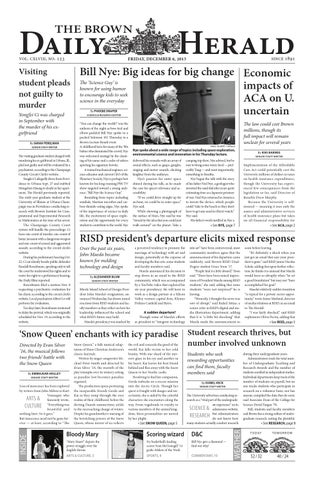
Daily
Herald
THE BROWN
vol. cxlviii, no. 123
Visiting student pleads not guilty to murder Yongfei Ci was charged in September with the murder of his exgirlfriend
since 1891
FRIDAY, DECEMBER 6, 2013
Bill Nye: Big ideas for big change Economic The ‘Science Guy’ is impacts of known for using humor to encourage kids to seek ACA on U. science in the everyday uncertain By PHOEBE DRAPER
SCIENCE & RESEARCH EDITOR
By SARAH PERELMAN SENIOR STAFF WRITER
The visiting graduate student charged with murdering his ex-girlfriend in Urbana, Ill., pled not guilty and will be evaluated by a psychiatrist, according to the Champaign County Circuit Clerk’s website. Yongfei Ci allegedly drove from Providence to Urbana Sept. 27 and stabbed Mengchen Huang to death in her apartment, The Herald previously reported. The sixth-year graduate student at the University of Illinois at Urbana-Champaign was in Providence conducting research with Brown’s Institute for Computational and Experimental Research in Mathematics at the time of his arrest. The Champaign County Court system will handle the proceedings. Ci faces one count of murder, one count of home invasion with a dangerous weapon and one count of armed and aggravated assault, according to the circuit clerk’s website. During his preliminary hearing Oct. 22, Ci sat silently beside public defender Randall Rosenbaum, speaking only to tell the court he understood his rights and to waive his right to a preliminary hearing, the Daily Illini reported. Rosenbaum filed a motion Nov. 8 requesting a psychiatric evaluation for his client, according to the circuit clerk’s website. Local psychiatrist Albert Lo will perform the evaluation. Ten days later, Rosenbaum motioned to delay the pretrial, which was originally scheduled for Nov. 19, according to the website.
“You can change the world!” was the anthem of the night as bow-tied and elbow-padded Bill Nye spoke to a packed Salomon 101 Thursday in a Brown Lecture Board event. A childhood hero for many of the ’90s babies who dominated the crowd, Nye was welcomed onstage by the chanting of his name and a cadre of ushers sporting his signature bowtie. A trained mechanical engineer, science educator and current CEO of the Planetary Society, Nye is perhaps best known for his long-running PBS TV show targeted toward a young audience, “Bill Nye the Science Guy.” Bounding from topics including sundials, Martian microbes and carbon-dioxide-eating algae, Nye spoke of the importance of science in daily life, the excitement of space exploration and the opportunity for every student to contribute to the world. Nye
EMILY GILBERT / HERALD
Nye spoke about a wide range of topics including space exploration, environmental science and innovation in his Thursday lecture. delivered his remarks with an array of sound effects, such as gasps, gurgles, singing and motor sounds, eliciting laughter from the audience. Nye’s passion for outer space shined during his talk, as he made the case for space’s relevance and accessibility. “If we could drive straight up for an hour, we could be in outer space,” Nye said. While showing a photograph of the surface of Mars, Nye said he was “struck by the idea that you could just walk around” on the planet. Take a
camping trip there, Nye advised, but be sure to bring some water, food — preferably Tang — and most importantly, something to breathe. Nye began the talk with the story of his father Ned Nye, a geologist who invented the sand dial after years spent estimating time as a Japanese prisoner of war. Ned Nye returned to America to invent the device, which people could “take to the beach so they don’t have to get any sand in (their) watch,” Nye said. His father’s work instilled in Nye a » See NYE, page 7
The law could cost Brown millions, though its full impact will remain unclear for several years By KIKI BARNES SENIOR STAFF WRITER
Implementation of the Affordable Care Act could potentially cost the University millions of dollars in taxes on health insurance expenditures, though the University has experienced few consequences from the legislation so far, said Director of Benefits Drew Murphy. Because the University is selfinsured — meaning it uses only the names and administrative services of health insurance plans but takes on all financial responsibility for » See ACA, page 2
RISD president’s departure elicits mixed response Over the past six years, John Maeda became known for melding technology and design By ALEXANDER BLUM SENIOR STAFF WRITER
Rhode Island School of Design President John Maeda’s resignation, announced Wednesday, has drawn mixed reactions from RISD students and faculty members as they reflect on how his leadership influenced the school and what RISD’s future may hold. Maeda’s presidency was marked by
a perceived tendency to promote the marriage of technology with art and design, potentially at the expense of developing the fine arts, some students and faculty members said. Maeda announced his decision to step down in an email to the RISD community, which was accompanied by a YouTube video that explored his six-year presidency. He will leave to work as a design partner at a Silicon Valley venture capital firm, Kleiner Perkins Caufield and Byers. A sudden departure? Though some of Maeda’s efforts as president to “integrate technology
into art” have been controversial, most community members agree that the announcement of his departure came suddenly, said Brown-RISD DualDegree student Grace Yoon ’17. “People find it a little absurd,” Yoon said. “There have been mixed impressions of President Maeda among RISD students,” she said, adding that some students “were not surprised” he is leaving. “Honestly, I thought the news was sort of abrupt,” said Rafael Attias, a senior critic in RISD’s digital and media illustration department, adding that it is “a little bit shocking” that Maeda made the announcement so
soon before leaving. “It’s definitely a shock when you just get an email that says your president is gone,” said RISD junior Nicolas Scholz, adding that upon further reflection, he thinks it is unusual that Maeda would leave so abruptly when “he set a good foundation” but may not “have accomplished his goal.” Maeda’s relatively sudden transition “is typical for a private sector opportunity,” wrote Jaime Marland, director of media relations at RISD, in an email to The Herald. “I was fairly shocked,” said RISD sophomore Olivia Pecini, adding that » See RISD, page 3
‘Snow Queen’ enchants with icy paradise Student research thrives, but
By EMMAJEAN HOLLEY SENIOR STAFF WRITER
Loss of innocence has been explored by writers from John Milton to Kurt Vonnegut, who famously wrote, “Everything was beautiful and nothing hurt. So it goes.” But innocence need not be gone forever — at least, according to “The
inside
ARTS & CULTURE
Snow Queen,” a folk musical adaptation of Hans Christian Andersen’s classic fairytale. Written by singer-songwriter Michael Peter Smith and directed by Evan Silver ’16, the warmth of the play triumphs over its wintery setting as paradise lost becomes paradise regained. The production opens portraying the inseparable friends Gerda and Kai as they romp through the rosy realms of their childhood, before the fleeting Danish summertime yields to the encroaching change of winter. Despite his grandmother’s warning of the bewitching powers of the Snow Queen, whose mirror of ice reflects
the evil and conceals the good of the world, Kai falls victim to her cold beauty. With one shard of the mirror’s glass in his eye and another in his heart, Kai leaves his best friend behind and flies away with the Snow Queen to her Nordic castle. Resolving to find her companion, Gerda embarks on a rescue mission into the Arctic Circle. Though her quest is fraught with danger and uncertainty, she is aided by the colorful characters she encounters along the way. From vagabonds to royalty to various members of the animal kingdom, these personalities are moved by her plight. » See SNOW QUEEN, page 5
number involved unknown
Students who seek rewarding opportunities can find them, faculty members said By ISOBEL HECK SENIOR STAFF WRITER
The University advertises conducting research as a “vital part of the undergraduate experience” on its admissions website, but administrators do not know how many students actually conduct research
SCIENCE & RESEARCH
Bloody Mary
Scoring wizard
D&C
‘‘Mary Stuart” depicts the power struggle over the English throne
Ivy basketball’s leading scorer Sean McGonagill ’14 grabs Athlete of the Week
Bill Nye gets a diamond — find out why!
ARTS & CULTURE, 3
SPORTS, 9
COMMENTARY, 10
weather
Directed by Evan Silver ’16, the musical follows two friends’ battle with the Snow Queen
during their undergraduate years. Administrators track the total number of Undergraduate Teaching and Research Awards and the number of students enrolled in independent studies. Individual departments keep track of the number of students on payroll, but no one tracks students who participate in research on a volunteer basis, nor has anyone compiled the data that do exist, said Associate Dean of the College for Science David Targan ’78. Still, students and faculty members said Brown has a strong culture of undergraduate research, noting the plentiful, » See RESEARCH, page 8 t o d ay
tomorrow
52 / 32
40 / 24
2 university news calendar TODAY
DECEMBER 6
6:30 P.M.
TOMORROW
DECEMBER 7
7 P.M.
Chat with Reddit Co-Founder
Snowflake Ball
MacMillan 117 11 P.M.
Alumnae Hall 8 P.M.
IMPROVidence show
Out of Bounds Comedy Show
MacMillan 117
MacMillan 117
menu SHARPE REFECTORY
VERNEY-WOOLLEY
LUNCH Orange Beef Pad Thai, Braised Leeks Provencale, Roast Pork on Bulkie Roll, Cauliflower Florettes, Pumpkin Ravioli
Breaded Chicken Fingers, Vegan Lentil Stew, German Sausage Chowder, Sticky Rice
DINNER Tequila Lime Chicken, Orange Chipotle Glazed Tofu, Bok Choy Grilled with Sesame Oil and Garlic
Grilled Turkey Burger, Couscous Croquettes, Creole Mayo, Corn Cobettes, Cajun Chicken Pasta
sudoku
crossword
THE BROWN DAILY HERALD FRIDAY, DECEMBER 6, 2013
Service funding board to identify chair The spot could be filled via an appointments process or a campus-wide or internal election By MAXINE JOSELOW SENIOR STAFF WRITER
With the newly created Service Group Funding Board nearing one semester of existence, leaders of the Undergraduate Council of Students are grappling with how to elect the next chair of the board. Council leaders are deciding whether to fill the position this spring — through an appointments process or campus-wide election — or next fall, through an internal election, said Todd Harris ’14.5, UCS president. “All of the options are on the table,” said Sam Gilman ’15, UCS vice president. The chair is responsible for overseeing the activities of the board, which allocates $200 of baseline funding to service groups that successfully apply for it. The position entails reaching out to service group leaders, reviewing funding requests and selecting board members, said Noelle Spencer ’14, the current chair of the board. Spencer was elected last spring through an appointments process, in which the UCS Appointments Committee interviewed candidates and made a recommendation to the Council, which voted to approve the recommendation. Harris said Spencer was a “logical choice” because she had “a lot of knowledge about service groups and their needs,” given her experience as
» ACA, from page 1 insurance claims itself — not all fees the ACA has enacted thus far have affected Brown, he said. “Overall, the impact (on the University) has been less than for most employers,” Murphy said. Before the ACA enacted a 2011 reform allowing young people to stay on their parents’ insurance plans until the age of 26, the University let students opt out of its plans and continue under their parents’ coverage through age 25, Murphy said. He added that the rule — which extends coverage Brown offers by a year — has cost the University roughly $75,000 annually, a small addition to the $30 million spent on health insurance each year. Though the ACA has also prohibited providers from denying insurance to people with preexisting health conditions, that change did not affect Brown, since the University never denied people coverage for that reason, Murphy said. But most policies the ACA outlined have yet to take effect, making future consequences for Brown uncertain, said Karen Davis, director of human resources. One such consequence is referred to as the “pay or play tax,” Murphy said. The tax would require employers to provide access to health insurance — whether affordable or not — to 95 percent of full-time employees, a term still ambiguously defined in
both a member of the UCS Student Activities committee and as president of the service group Brown University Sexual Health. An appointment could be the “ideal solution” if another candidate emerges with a very strong understanding of service group funding, Harris said. The position could also be filled through an internal election at a UCS general body meeting next fall, in which interested UCS members would make speeches and then the Council would vote on the candidates. Though only UCS members would be eligible to run in an internal election, “all interested individuals would have the chance to step forward, even if they were not on the Council,” Gilman said, citing the policy that any student can join UCS by collecting enough signatures. The chair could also be selected through a campus-wide election this spring, in which the entire student body could participate. “If the board ends up being as institutionalized as (the Undergraduate Finance Board) in the coming years, I can see that definitely necessitating a campus-wide election,” Harris said, noting that a campus-wide election is used to pick the UFB chair. Several leaders of service groups that received funding from the board expressed support for a campus-wide election. “It would be great if the whole student body could be part of this process, since service groups really affect the whole community,” said Julia Lynford ’14, co-president of Active Minds, a group that aims to
reduce the stigma surrounding mental health conditions. “Taking into account the whole student population, you have a broader spectrum of people, and you can make sure you find a high quality person who understands and cares about service groups,” said Faisal Khurshid ’16, a coordinator of Interfaith Exchange, a group that aims to foster dialogue about faith with Providence high school students. “But I have confidence someone from UCS would be able to do a good job,” Khurshid added. To hold a campus-wide election, UCS would have to change its code to include the chair of the board, said Ryan Lessing ’17, UCS parliamentarian. Though two-thirds of the Council would have to vote to approve the code change, Lessing said he did not foresee the vote being contentious. “I would not anticipate it being a long and drawn-out process or a controversial decision,” he said. “Something like this would be pretty routine.” Looking ahead, UCS leaders will discuss how to fill the position with representatives from UFB, the Student Activities Office and the Swearer Center for Public Service, Harris said, adding that they will likely “settle on a plan” next semester. Council leaders will also consider how to promote the board’s “sustainability” as an institution, given that it has only existed for one year, Harris said. “Before we create a method for electing someone to the position, we want to make sure the board is sustainable and has long-term support from the University.”
the law. Should a full-time employee go to his or her state health exchange to purchase insurance and the employer be found to have violated this requirement, the employer would be taxed $2,000 for each full-time employee, Murphy said. That tax would cost the University $7.5 million, he said. “They call it the sledgehammer tax.” Murphy added that if the employer complied with the rule but the health insurance options were not affordable for employees, the employer would be taxed $3,000 for each full-time employee who went to the state health exchange to purchase affordable insurance. The pay or play tax will not take effect until January 2015, Murphy said. One of the most important potential effects of the ACA is the “Cadillac Tax,” said Kenneth Chay, professor of economics. The policy would tax health insurance plans that provide coverage above a certain dollar amount, he said, adding that the tax acts much like the Federal Income Tax with higher tax rates for higher incomes. The University would have to transfer additional costs to employees or change their health plans to avoid the 40 percent tax on the excess money included in the plan, Murphy said. “Most employers will change their plans” as a result, he said. “We essentially provide too good
of a health plan,” Chay said. But Murphy said the University is not concerned about the Cadillac Tax, because it is currently not slated to take effect until January 2018. The politics surrounding the ACA are still changing, and by 2018 a new president will be in office, Davis said. “There is no way to predict what will happen between now and then.” The University “will keep an eye on it,” Murphy said. “Brown may not be affected at all in the first year,” Murphy added, though inflation rates and the rising cost of health care could make the effects of the Cadillac Tax “catastrophic” by 2021. “The state also has its own taxes that are increasing,” Davis said. “It’s not getting any cheaper.” Rhode Island has been a leader on health issues for the past few years, Davis said. But the state health exchange, HealthSource RI, has used mostly federal funds and may not be self-sustaining in the future, she said. Ira Wilson, professor and chair of the department of health services, policy and practice, wrote in an email to The Herald, “The ACA is solving some problems and creating some new ones, but the problems with our health care system have been 100 years in the making.” “Students and employees should be worried about the underlying problems in the health care system, not just the ACA,” he wrote.
university news 3
THE BROWN DAILY HERALD FRIDAY, DECEMBER 6, 2013
Queens play out cerebral game of thrones Sock and Buskin’s ‘Mary Stuart,’ directed by Emma Johnson ’14, reigns in Leeds this weekend By ANDREW SMYTH SENIOR STAFF WRITER
The abstract expressionist painter Mark Rothko would seem an unexpected interlocutor in the court politics of Elizabethan England. Not so in Sock and Buskin’s production of “Mary Stuart” — an enormous reproduction of his work in red, black and gold hangs above the stage. The allusion to post-war America’s preeminent colorist — who once claimed his interest in “expressing basic human emotions — tragedy, ecstasy, doom” — is a deft inclusion in a play equally obsessed with these themes. Written by Friedrich Schiller, presented in a new translation by Peter Oswald and directed by Emma Johnson ’14, “Mary Stuart” is a portrait of two women struggling to maintain authority and humanity in a world dominated by men. Despite the preeminence of the ruling women, a bona fide parade of bearded advisors constitutes the bulk of the cast. “The play is about power,” Johnson said. “The way women wield power when they have it and how they fight for power when they don’t have it.”
ARTS & CULTURE
The drama centers on Elizabeth I’s precarious grasp on the English throne, a claim destabilized by the threat of her cousin Mary Stuart, whom she has imprisoned on charges of conspiracy to regicide. Both Elizabeth’s attempts to preserve her crown and Mary’s desperate ploys to escape execution are complicated by the duplicitous male attendants who carry out their orders. Sensitive and agile, Sarah Gage ’15 is a veritable force of nature as the titular Queen of Scots. Her muscular wit and sinewy composure befits the royal body. Patrick Madden ’15 is a formidable opponent as Elizabeth. Johnson’s decision to cast the Tudor Queen as a man in drag boldly upends the complex gender dynamics at work in Elizabeth’s self-presentation as the “female king.” “And so they show me that they think of me not as a man, and a king as I have ruled them, so I believed, but simply as a woman,” Elizabeth declares in frustration. Madden reigns with poise and ferocity. He moves with elegance and authority, annunciates with precision and energy. His careful negotiation of Elizabeth’s ill-fated romantic encounters are devastating. “I believe in the neutral-bodied actor,” Madden said. “Playing this character is just a matter of figuring out how she ticks and what she’s like, where she’s been and what she’s been through.” But “Mary Stuart” is much more than an exercise in identity politics. Fast-paced, loquacious and cerebral, it anatomizes the exchange of monarchical
DAVID DECKEY / HERALD
The ad hoc group was created in October 2012 and tasked with identifying initiatives in digital technology the University should pursue.
Ad hoc digital technology group will likely dissolve The group may join the Advisory Council on Computing and Information Technology By MICHAEL DUBIN SENIOR STAFF WRITER
The ad hoc working group on digital technology formed last October has not met this semester, Provost Mark Schlissel P’15 wrote in an email to The Herald. Vice President for Public Affairs and University Relations Marisa Quinn told The Herald in September that the working group would “review potential next steps” with Vice President for Computing and Information Services and Chief Information Officer Ravi Pendse, who had just filled the previously vacant post. But it now seems unnecessary to reconvene the ad hoc committee, Quinn wrote in an email to The Herald. Pendse said that as he familiarized
himself with the University’s various technology committees after assuming the post in September, he suggested the ad hoc working group be incorporated into the Advisory Council on Computing and Information Technology. The ACCIT could focus more on issues that would have been part of the ad hoc committee’s original mandate, he said. No final decisions have been made, but the possibility of incorporating the ad hoc group will be discussed at the ACCIT’s meeting in the spring, which will take place in either February or March, Pendse said. Pendse said he has approached a few members of the ad hoc group about the possibility of joining the ACCIT and has received positive responses. He added that there is already some overlap between the memberships of the two bodies, noting that the chair of the ACCIT, Corporation member Eileen Rudden ’72 P’03 P’07 P’11, also served on the ad hoc committee.
authority in a shifting geopolitical and religious landscape. Staged atop an octagonal wooden platform, the set is eerily reminiscent of a prison cell. Incarceration serves as a fitting model for women who are constantly being shouted at, looked upon, flattered and dissected. Johnson has created an echo chamber wherein power, desire and identity collide in a series of explosive encounters. Schiller’s interpretation of events is a story of early modern England as originally written by a German philosopher in the wake of the French Revolution, according to dramaturg Anna Rotman ’14.5. Accordingly, anxieties about freedom, human dignity and injustice are in constant circulation on stage. Johnson complicates this framing with a host of inventive contemporary flourishes. The costumes are Elizabethan silhouettes punctuated by punk accents. The narrative is animated by swells of repetitive string figures a la Phillip Glass. And then there’s the Rothko, installed above the fray, bearing witness. The climactic confrontation between Mary and Elizabeth, which historically never happened, is a collision between two women who have never met but are both intimately acquainted with the emotional isolation of female rule. Elizabeth’s inevitable triumph extinguishes her only peer. Viewers are left with a woman on her throne — in control but utterly alone. “Mary Stuart” runs Dec. 6 and 7 at 8 p.m. and Dec. 8 at 2 p.m. in Leeds Theater.
» RISD, from page 1 the news was disappointing because he was “a very forward-thinking president.” Mixed criticism The idea that Maeda “put too much focus on design at the cost of fine art,” is “the biggest criticism of Maeda,” Yoon said. “RISD has a bit of an identity crisis,” Attias said, explaining that Maeda’s presidency highlighted tension surrounding the fundamental question of what a 21st-century arts school should look like. “John might have been viewed as being very one-sided,” Attias said, but his position is “a hard role” to have, given the conflict between “old guard art professors” and those who embrace Maeda’s perceived emphasis on technology design. Maeda has been an influential figure who sought to keep society from forgetting about art and design, students and faculty members said. He coined the term STEAM — science, technology, engineering, art and design, and mathematics — as an adaptation of the commonly used term STEM to emphasize the importance of art and design in modern society. But such initiatives were sometimes perceived as counter to RISD’s “traditional” curriculum founded in fine arts, Scholz said. Some students find his efforts to strengthen the design curriculum “a bit excessive,” Yoon said. “RISD is a bit like an old ship — a bit conservative actually,” Attias said, noting the “rigidity” of the school’s curriculum.
The tensions between Maeda’s initiatives as a leader and the school’s more traditional culture were exemplified by a March 2011 no-confidence vote in Maeda, which passed the faculty by a margin of 147 to 32, The Herald reported at the time. Looking to the future Despite controversy surrounding Maeda’s priorities, students praised his friendly and sociable disposition and said they hope future presidents will be similarly personable. “I liked Maeda a lot,” Scholz said. But he noted that RISD has been “a really traditional school, and he’s been the one pushing for tech,” resulting in support from some faculty members and opposition from others. “From my perspective, he was doing a good job,” Pecini said. RISD’s Board of Trustees is “determining a plan to ensure a smooth leadership transition,” Marland wrote. RISD community members said they think it is difficult to determine which qualities should define the next president, but several students said they hope Maeda’s initiatives are not forgotten or undone. The next president should “definitely (be) someone who is still willing to advocate for technology and art,” Pecini said. Yoon also said she hopes Maeda’s successor continues the work that he has championed. “Whoever it is is going to have a tough job,” Attias said, adding that the culture in a community of artists does not always take kindly to figures of authority. The next president should be “someone with thick skin,” he said.
4 feature
THE BROWN DAILY HERALD FRIDAY, DECEMBER 6, 2013
Two of a kind: Twins descend on College Hill in tandem For twins that come to Brown together, navigating college poses unique challenges By MAGGIE LIVINGSTONE SENIOR STAFF WRITER
During her first week at Brown, Sarah Goddard ’14 was waved at by a fellow first-year. She had no idea who he was. The student, it turned out, thought Sarah was her identical twin sister, Lisa. “When I explained that I wasn’t her and we were twins, he said, ‘you are literally blowing my mind right now,’” said Sarah, a former Herald contributing writer. A case of mistaken identity is part of the daily routine for the Goddards and many of the other twins populating Brown’s campus. For the small cohort of twins who choose to descend on College Hill in tandem, the benefits and blunders of attending college are doubly magnified. We go together Twins are often a package deal at Brown. If the two have similar credentials when applying, their admission result is usually the same, wrote Dean of Admission Jim Miller ’73 in an email to The Herald. In rare cases — like when one twin is a significantly stronger candidate than the other — only one of a pair applying will be admitted, Miller added. For many of the twins who attend Brown together, being a twosome was not their original college plan. Uday Agrawal ’15 opted to apply early decision to Brown. Right before the November deadline, his twin sister Shubh took the same early decision leap, much to his ambivalence, Uday said. “We knew that we’d have to both get in or both be rejected,” Shubh said. Jessi Haddad ’16.5 and Nikki Haddad ’16, identical twin sisters, said they purposefully kept each other in the dark during the application process, hoping each would make a decision independently of the other.
They were both accepted to the Program in Liberal Medical Education, an opportunity too excellent to refuse, Jessi said. “She got in first, and my Internet wasn’t working, so I was not happy for her at all when she found out,” Jessi said. “But then when we both got in, we were crying and jumping up and down and hugging each other.” Nikita and Nimita Uberoi ’15 said they always figured they would end up at the same university because they hoped to be recruited as doubles partners in tennis. “I don’t remember thinking twice about it,” Nimita said. “We did everything together.” But some twins at Brown come without their siblings. Stephen Munzer ’17 said he and his twin sister had different academic goals, so he expected they would not continue their studies together after high school. Emma Schrager ’16 and her twin brother never wanted to attend the same university. Being apart for college, she said, actually brought them closer. “I think our relationship has matured more, especially now that we don’t see each other all the time,” she said. “We both ended up in places that suit our differences.” Double trouble Of the twins who attend Brown together, many hoped college would allow them to cultivate distinct identities, rather than living with a “twin label.” An irksome, sometimes amusing struggle faced by campus twins is the constant comparison of and, at times, even confusion over their identities. Just last month, Sarah Goddard was walking down the street when one of Lisa’s good friends yelled “Lisa!” to her. “He shouted it 6 times, and when I didn’t respond, he finally realized I was Sarah,” she said. Jessi Haddad said the confusion comes mostly during her walks between classes, when students she has never seen before wave at her. “People will talk to me, and I won’t
know who they are,” Jessi said, adding that this happens once or twice per day. “I’ll never know if I met them drunkenly at a party and forgot, or if they think I’m Nikki.” Twin confusion is not unique to campus acquaintances — it even arises at the administrative level. Nikita Uberoi applied for singlegender, substance-free housing for her first year, while Nimita Uberoi did not indicate any housing preferences. But they may have fallen victim to a Residential Life swap. “I think they actually switched us up,” Nimita said, laughing. She was placed in Keeney Quadrangle, while her sister lived on a single-gender floor in Andrews Hall. Though Shubh and Uday Agrawal may not have to worry about being mistaken for one another, they are cautious of when peers don’t realize they are related. Last year, during a rehearsal for Brown Badmaash Dance Company — of which both Agrawals are members — a teammate complained to Uday about Shubh’s choreographing abilities. “And I’d be like, yeah, Shubh’s totally terrible,” Uday said. “It was really funny that this girl didn’t realize we were twins. And then I’d go and tell Shubh.” Sometimes being compared to one another has its detriments. “The bad thing to being viewed as a group is constantly being compared,” Nikki Haddad said. “This person’s face is longer, this person is a little bit shorter. People don’t realize they’re being offensive.” Winsome twosome Though they often have different academic interests and friends, many twins still participate in the same extracurricular activities. The Brown dance community includes multiple pairs of twins: both Agrawals participate in Badmaash and the Goddards belong to What’s On Tap?, the tap-dancing squad. Lisa and Sarah have even earned the nickname “the twins of tap.” On the sports side, the Uberois competed together for three tennis matches
HERALD / RYAN WALSH
Jessi and Nikki Haddad ‘16, both PLME students, are among the pairs of twins who attend Brown together. before their coaches split them up. But the twins found a shared academic focus, with both interested in environmental science. Even for twins whose counterparts are not at Brown, some healthy competition may still exist. Eric Robb ’14 is a member of the men’s water polo team, while his twin brother Jason plays on Connecticut College’s squad. Twin rivalry reaches its peak just before the schools play each other, when Eric’s teammates especially hype up the games. “The week leading up to it, I get goodnatured ribbing from my teammates,” Robb said. “For such a violent sport, we keep it relatively civil during the games, though.” It takes two Though double the trouble is not always to their advantage, most twins agreed that having a bit of home with them has elevated their collegiate experiences. The Goddards said they were able to get meals together when they arrived on campus during their first year, avoiding
the “dining alone” fears many face. For the Agrawals, being at Brown together has doubled their friendships and allowed them to share a love of dance. The clearest benefit of twin-hood comes when one of the pair is under the weather or feeling homesick. “Whenever I’m sick or super stressed, I can have someone to rely on,” Uday said. Though they did not originally plan on attending college together, the Haddads said they now couldn’t imagine Brown without each other. “The main benefit is if you’re ever having a really bad day,” Nikki said. “It feels a little bit like home when you’re talking to your twin.” And that old twin telepathy theory? Most said it is not entirely misguided, but their connections are more rooted in emotional readings. “I know when she’s stressed or nervous or shy in front of someone, like an acute sense of emotional intelligence,” Nimita said. “At the end of the day, it’s the person that knows you the most,” Nikita agreed. “So it’s nice to know that you have that support and love on campus.”
Graduate Student Council’s new executive board reveals platform The board aims to push for grad students’ priorities under Paxson’s strategic plan By CAROLYNN CONG STAFF WRITER
The new Graduate Student Council executive board, elected Nov. 6 to take office next semester, articulated a platform that emphasizes improving outreach to the graduate student body and advocating for their constituents’ priorities related to the rollout of President Christina Paxson’s strategic plan. Stephen Zins GS, who will serve as GSC president, initially declared his candidacy for vice president at last month’s elections but switched races when no one stepped up to vie for the presidency. Lakshmi Padmanabhan GS was elected vice president once Zins left her the only candidate in the race. Zins said he considered running for both positions and felt that he could be as effective a leader as president as he
could be as vice president. The new executive board will look “to help the University administration and the Graduate School administration figure out what the details of the strategic plan look like as they relate to graduate students,” said John Mulligan GS, currently GSC secretary and communications director. The strategic plan, approved by the Corporation in October, proposes growing the number of master’s degree students over the next decade, an idea GSC leaders praised. Zins served on a GSC committee that drafted a resolution expressing graduate students’ concerns and thoughts about the strategic plan, The Herald previously reported. “We feel the graduate student body is extremely important, especially master’s students, and we don’t want them to get lost in the shuffle,” Zins said. “We have to increase master’s programs to keep up with the tide of career changes,” said current GSC President Keila Davis GS, voicing support for continuing educational innovation at
the graduate level. Zins said he will work as president to maintain GSC leaders’ strong relations with University administrators to address graduate students’ priorities. “The back and forth with the administration has been positive so far, and we would like to see that continue,” Zins said. Though both Zins and Padmanabhan ran unopposed for their positions, current GSC officers said they are not concerned by the low number of candidates for top posts in last month’s elections. “People are naturally a bit reticent” to run for executive officer positions due to the large time commitment, Mulligan said. Between holding jobs as teaching assistants, conducting their own research and writing dissertations or theses, many graduate students think holding a GSC executive board officer position would be too much, said David Stout GS, GSC treasurer. “Because graduate students are so spread out, it’s hard to market positions
really well,” Davis said, adding that the council will work to improve marketing its executive board elections to graduate students, citing limited outreach efforts as another factor leading to the scarcity of contenders. The low number of candidates was “pretty much expected” and in line with past years’ elections, Stout said. Mulligan said the vastly different sizes of the undergraduate and graduate student bodies drives the differing rates of participation in student government. Graduate students also have less time to commit to other responsibilities than do undergraduates, he said, adding that GSC committee positions draw more interest than do executive board posts. “All these people are standing up to spend a good deal of time trying to advocate on (the GSC’s) behalf,” Mulligan said. “We are sort of the central gathering point for grad students and we do have a high participation rate.” Davis said the GSC continues to work to build a sense of community among graduate students. “We try to do large and small-scale
events,” Davis said, citing social events like this Friday’s Winter Ball, which GSC members are co-sponsoring with the Medical Student Senate and the Rhode Island School of Design’s Graduate Student Alliance. In the upcoming year, the new executive board will aim to increase the number of small-scale campus events and expand GSC outreach with department representatives, Zins said. “We’ve been looking at the possibility of starting some sort of graduate student parallel to the Departmental Undergraduate Groups” to help graduate students create groups on the departmental level, Mulligan said. GSC officers said the council works to integrate multidisciplinary perspectives to effectively represent graduate students. Mulligan said the GSC plays a constructive role in mediating between graduate students and administrators. “The University needs to help with making a (stronger) grad student community, and the avenue to do that is through the GSC,” Stout said.
arts & culture 5
THE BROWN DAILY HERALD FRIDAY, DECEMBER 6, 2013
At talk, playwright discusses Native-American theatrical representation William S. Yellow Robe read from his first play ‘Sneaky’ and other essays he referred to as ‘spam rants’ By ASHNA MUKHI STAFF WRITER
Theater and playwriting can foster dialogue and construct “a bridge of communication” between disconnected communities, argued William S Yellow Robe, professor of English at the University of Maine and a member of the Assiniboine Tribe of the Fort Peck Reservation, in a lecture Thursday night. In his talk, which drew a small group of students and faculty members in Smith-Buonanno Hall 106, Yellow Robe described his experience as a native playwright working to develop
theatrical programs across the country. Yellow Robe touched upon the issues of misrepresentation and lack of awareness of native culture and history in his lecture, which featured readings from his first play “Sneaky” as well as from essays he called “spam rants.” Naming the “rants” — which highlight the mistreatment of American Indians — after the canned processed meat that was historically rationed to Native peoples underscores the oppression they faced over the years, Yellow Robe said. Outlining a narrative of oppression, he described misconceptions of native reality that at times implied “native people aren’t human.”
» SNOW QUEEN, from page 1 consistent vibrato of raw talent. The play feels like the illustrations of a picture book brought to life, largely due to much of the narrative arc unfolding through the omnipresent Storyteller, played by Annie Kocher ’14. Kocher’s angelic soprano gently urges the action along with sweetly sung maternal guidance that transports the audience back to a simpler time. But because the play is primarily driven by character rather than plot, the dramatic tension between good and evil can be underwhelming and somewhat sugarcoated. Ursula Raasted’s ’14 icy rendition of the Snow Queen is well-done but all too brief, especially considering she plays the title character. Without a reprise of her performance, the play’s amplified good and minimized evil presents an interesting reversal of the image found in the Snow Queen’s mirror but is not entirely true to life. Becca Millstein ’16 nails her performance as Gerda, endearing herself to the audience from the moment she first bounds onstage in a bright burst of energy. Her voice conveys the buoyancy and resilience of youth — not only can she carry a tune even when hauled up and lurched around on a chair, but she also makes doing so look effortless. In her moments portraying the doubt and despair that creep into Gerda’s determined front, Millstein is at her most powerful, her voice velvety and undulating with the
Simon Henriques ’15 brings a unique comedic flair to each of his multiple roles — the most memorable of which include a member of an impish Wooden Soldier duo and a Lapp Woman with an affinity for fish that borders on fetishism — with each performance more shamelessly absurd than the last. Despite the limited production space, Silver makes the most of the trio of friendly ravens accompanying Gerda through the first legs of her journey. They serve as helpful human props, representing Gerda’s physical transportation by embodying the dynamism of a river or galloping horse. The live band accompaniment, directed by Marty Strauss ’16, propels the timeworn fairytale to a relatable, contemporary context. The powerful expression of violinist Ryan Segur ’17 evokes an acoustic nostalgia in contrast to the primarily electric ensemble, creating a bridge with the past and grounding the story in its traditional origins. Ultimately, “The Snow Queen” allows the audience to re-enter the realm of once upon a time, where everything is beautiful and nothing hurts — except for the biting Arctic wind, of course. The show opens tonight in the Downspace of the Production Workshop at 8 p.m. It will also run Saturday at 8 p.m. and 11 p.m. and Sunday through Tuesday at 8 p.m. Admission is free.
ASHLEY SO / HERALD
Becca Millstein ’16, right, is a musical highlight as Gerda, a character desperate to rescue her friend from the Snow Queen.
This talk was the first in a three-day series called “Indigenous Performance in the Americas: Native American Tribal Theatre.” Sponsored by the donors to the Barbara Greenwald Memorial Arts Program, the conference will feature presentations from nine scholars and practitioners of indigenous performance working in theater, poetry, music, film and politics. Through this conference, coordinators Assistant Professor of Anthropology Paja Faudree and Assistant Professor of Music Joshua Tucker hope to create a space for conversation among those interested in the expression of race, ethnicity and culture through performance, Faudree said. This is the first event of its kind to take place at Brown, Faudree said. She
added that while smaller conferences featuring scholars of indigenous performances have been held on campus in the past, this one “casts the net broadly,” including not only scholars, but also performers and practitioners working across the Americas. The conference was planned so that each participant could “bring something distinct and different to the conversation,” Faudree said, adding that the conference is divided into panels to allow participants to reflect on both the similarities between various American Indians’ outlooks and the differences based on geographic and national backgrounds. “The idea is to bring together issues that don’t often get talked about in the same forum,” Turner said.
Participants emphasized the importance of art forms in portraying such issues and conflicts. Theater, Yellow Robe said, is a “peaceful means to bring about change for native people that doesn’t involve bloodshed.” Murielle Borst-Tarrant, another conference participant, said she uses theater and storytelling as a means of “fighting for indigenous culture rights” by weaving together art, politics and history. Faudree said she hopes the conference will encourage students to pay attention to issues of “expressive culture,” which are too often dismissed as unimportant. “I hope this is part of an ongoing conversation to make this more visible at Brown.”
BMP to host biannual premiere The featured student films include ‘Marvin,’ ‘Parlor,’ ‘Two Bikers,’ ‘Dream Girl’ and ‘Abimor’ By CAROLINE KELLY STAFF WRITER
Brown Motion Pictures, formerly Brown Student Television, will host its biannual film launch premiere tonight in Salomon 101. The premiere will feature five films written, directed, produced and performed by undergraduates. The group, which adopted its new
name to more accurately reflect its current role on campus, used to predominately produce television episodes. It has now made a formal transition to focus on short films under the leadership of Managing Director Dorothy Thurston ’14 and former Outreach Coordinator Alexis Aurgemma ’13, said Managing Director Susan Chen ’15. “It’s the first time we’re promoting Brown Motion Pictures as a brand name to the Brown community,” she said of the event. But the group’s mission to serve as a forum for creativity and instruction has not changed. “In one sense, it’s a
pre-professional organization like many others that you find in college, so it is about learning how to make short films, how to work together, what are the different parts of the crew,” said Yotam Tubul ’14, director of the film “Marvin.” “But its dual mission is also (as) an educational group,” Tubul added. “So you want to make your short film, but you also want to teach other people how to make a short film. It’s both collaborative and a lot of learning.” Following a screenwriting competition this summer, BMP’s executive board and screenplay coordinators selected five » See BMP, page 8
6 science & research
THE BROWN DAILY HERALD FRIDAY, DECEMBER 6, 2013
On World AIDS Day, researchers work toward goal of ‘zero new infections’ Recent advances helped slow the transmission rate and improved quality of life for patients By EMILY DOGLIO CONTRIBUTING WRITER
While World AIDS Day on Dec. 1 brings HIV/AIDS to the forefront of public attention, many University researchers are working to understand and combat HIV/AIDS every day of the year. The Brown University AIDS Program, which includes more than 30 faculty members, works to address intersecting issues such as policies regarding vulnerable populations and access to healthcare. BRUNAP faculty members work in labs and training centers in regions affected by AIDS, according to the program’s website. Clinical research plays an important role in offering the best therapy, said Timothy Flanigan, professor of medicine and BRUNAP faculty member. New findings, such as the suppression of HIV viral loads — the amount of the virus in the blood— and antiretroviral therapy developments have both contributed to a reduction in rates of transmission, Flanigan said. The combination of substance abuse, particularly methamphetamine and cocaine, multiple sex partners and
other high risk behaviors, often disproportionately affecting gay and bisexual men, is “the new face of the epidemic,” Flanigan said. The internet facilitates engagement in multiple partnerships, which has helped HIV go “viral,” he added. Research is providing new approaches to combat the epidemic. Recent research efforts include the development of new technologies involving testing and treatment programs, research in prisons and jails and research into prevention of transmission in women, Flanigan said. Flanigan added that Brown faculty and students have partnered with HIV/ AIDS treatment programs in nations such as Kenya, Ukraine and India. Such global health work is “looking at innovations that have worked in places like Africa and applying them in this country,” Flanigan said. HIV through a social political lens Assistant Professor of Social Sciences Caroline Kuo primarily focuses on vulnerable populations that bear the burden of disproportionately high rates of HIV infection. Kuo started much of her research in South Africa, working with children orphaned or made vulnerable by AIDS as well as their caregivers. Kuo’s research in South Africa is portrayed in her documentary
“Manguzi: Raising Children in Rural South Africa,” which depicts families composed of many orphaned children and sick or disabled adults. Many groups most vulnerable to HIV are susceptible to other diseases which can increase infection potential, such as sexually transmitted infections and tuberculosis, Kuo said. She also collaborated with colleagues at Brown and Oxford University to research HIV in incarcerated women, sex workers and men who have sex with men. “HIV is not just a virus. I think it is a virus that almost tends to act as a social and political lens,” Kuo said. She added that the history of stigma and discrimination associated with the disease and political obstacles, such as medicine patent rights, complicate the issue. A cure is “something that the HIV world is really hoping for,” she said, adding that “we can’t forget that that’s only one piece of what needs to be done.” Broader work must also be done to address socioeconomic disparities of HIV/AIDS, Kuo said. Research should focus on the whole spectrum of HIV/ AIDS— prevention, treatment, and longterm effects of the virus.
women in Sub-Saharan Africa, specifically South Africa. Harrison said she is interested in the social factors that cause gender differences in rates of infection. Women exposed to trauma such as relationship violence and women in relationships with older men are more likely to be exposed to the virus, she said. “It touches on almost every aspect of society and people’s lives,” Harrison said, adding that different disciplines of research have different focuses. While an immunologist’s perspective might lean toward finding a cure, there are other issues to tackle while waiting for biomedical solutions, Harrison said. She said prevention options may involve behavioral strategies, especially for women. Other prevention strategies involve products formulated from some of the same medications as HIV drugs that are used before exposure to the virus, Harrison said, citing pre-exposure prophylaxis and microbicides as examples. “Zero new infections,” was a theme of this year’s World AIDS Day, Harrison said. “That’s a huge change from where the field stood even five years ago,” she added.
Exploring gender disparity Assistant Professor of Behavioral and Social Sciences Abigail Harrison focuses on HIV’s prevalence among in
Understanding social context On a social justice level, HIV/AIDS is “a compelling signal of how social inequality exists,” said Associate Professor
Alzheimer’s-linked gene affects babies’ brains Researchers found differences in myelination rates in the brains of infants carrying the gene By RILEY DAVIS STAFF WRITER
Brains of infants carrying a gene associated with Alzheimer’s disease develop differently than those of non-carriers, according to a recent study published by researchers at Brown and Banner Al-
zheimer’s Institute in Phoenix. The study, published Nov. 25 in the journal JAMA Neurology, details the differences in brain development between children who carry the APOE epsilon-4 gene variant linked to lateonset Alzheimer’s and children who are non-carriers. “This gene is influencing brain development early on, and these differences may confer some type of risk later in life that eventually leads to Alzheimer’s or other disorders,” said study co-author Douglas Dean III GS. But, he added, the
differences in brain development associated with the gene are not diagnostic. “By no means are we saying these kids are going to develop Alzheimer’s.” The APOE gene is linked to several different bodily functions, including lipid maintenance and the development of cholesterol, Dean said. Dean worked with Assistant Professor of Engineering Sean Deoni, who oversees Brown’s Advanced Baby Imaging Lab, to test the subjects’ DNA for the APOE epsilon-4 gene. Sixty of the 162 2 to 25 month-old subjects carried the ε4 variant of the APOE gene. Researchers found the rate of the developing myelin, a lipid-rich substance that protects nerve fibers, differed between carriers and non-carriers of the gene variant. “We found that the carriers had more myelin earlier on, but they developed at a slower rate,” Dean said. “Although the non-carriers had less myelin, they eventually caught up and surpassed the carriers.” The researchers also found that carriers tended to have decreased growth in the middle and back parts of their brains, which have been found to be affected by Alzheimer’s in elderly subjects, according to a University press release. It was difficult to work with so many young subjects, Dean said, but Brown’s Advanced Baby Imaging Lab has developed a reduced-sound brain imaging technique that lets children be scanned while sleeping without the aid of medication. “While these findings are statistically significant, they are not clinically significant,” said Eric Reiman, CEO of Banner Research. Researchers hope to conduct a longitudinal study to determine how the subjects’ brains develop over time, he said. “We think there’s an opportunity here to begin to understand how a range of inherited genes can influence the changes that occur during development.”
of Social and Behavioral Sciences Don Operario. The disease “has a way of pointing its finger at sources of inequality,” such as gender-based oppression, sexual identity, sexual behavioral stigma and socially and politically disadvantaged groups, he added. Operario studies the social factors affecting the HIV/AIDS endemic. He said he focuses on populations most at risk, such as men who have sex with men, young men, sex workers, communities of color and transgender populations. His research is based primarily in San Francisco and in other nations, but Operario said he hopes to do more work in Providence. “We consider the multiple layers of social context and community context that may determine factors related to HIV risk,” he added. “We’ve had some really exciting successes in basic science around biomedical strategies for prevention and for treatment,” Operario said, adding that science has made major contributions to the quality of life of people living with HIV/AIDS. In the past five or six years, life with an HIV diagnosis has become longer, healthierand more satisfying, he said. He said he hopes there will be greater integration of the biomedical with social and structural analysis, so that in the future the two fields of research “not only talk to each other, but work together.”
Exclusive: Bill Nye sits down with The Herald Bill Nye, best known for his PBS educational science show targeted toward youth called “Bill Nye the Science Guy” gave a lecture last night to a packed Salomon 101. Prior to the lecture, the “science guy” sat down with The Herald to talk about science education, his time on television and some of the biggest questions in science today. The Herald: If you were an element on the periodic table, what would you be and why? Nye: I probably wouldn’t be a single element. I’d be water if I could be a compound ... But otherwise it would be hydrogen, I guess. You know, common, diatomic, most of the universe. Sometimes an acid, sometimes a metal. If you could move to another planet, which one would you pick and why? It is reasonable maybe to move to Europa, the moon of Jupiter. It seems to have salt water, which would be a good start. But it’s extraordinarily cold, so it’s not as easy as it sounds. What is your favorite obscure scientific fact? I’m charmed by the idea that not only does the Earth’s gravity pull dust down onto bookshelves, but that dust is pulling the Earth up. That’s compelling to me. And what’s your favorite step in the scientific method? Oh observation, for sure.
What are the greatest challenges in teaching science? The biggest problem right now is that we don’t start early enough. You really have to get people excited about science when they are in pre-school. What do you think are the biggest science questions we face as a society today? The biggest question is what are you going to do about climate change. ... Along that line, the universe is accelerating in its expansion, and nobody knows why. You’ve got to think if you could figure that out there would be some astonishing insight into the nature of nature — like relativity was discovered in my father’s youth. There could be a whole new physics that no one’s ever chanced upon. That would, dare I say it, change the world. If there is one thing you want Brown students to take from your lecture tonight, what would you hope that message would be? We want them to feel that they can change the world. ... Each person has a role in a better tomorrow for all humankind. Is that a big deal? … You asked earlier, if you couldn’t be on Earth, what planet would you want to go to. I mean, there is really no other place for us. This is it man, this is where we make our stand. — By Phoebe Draper
THE BROWN DAILY HERALD FRIDAY, DECEMBER 6, 2013
» NYE, from page 1 passion for discovery and an avid interest in sundials, Nye said. He showed photographs of the three sundials he worked to install on Martian rovers to help “reckon time on another world.” With the rover project’s price tag nearing $3 billion, Nye wryly noted that none of the rovers on the moon are locked. “I don’t know what they were thinking,” he added. At his current day job at the Planetary Society, Nye is a part of a group of scientists developing a fleet of “laser bees” to deflect asteroids heading toward Earth. The drones would be propelled by solar power and “zap the surface of the asteroid” to divert its trajectory away from the planet, he said. Nye also described another “crazy idea” the Planetary Society plans to put into action next year — a spacecraft “pushed through space by light,” Nye said. He cited the mass-energy equivalence equation — more commonly known as “E=mc^2” — as the fundamental theory behind the project. Nye also addressed global warming, adding that the rapid “rate at which the
science & research 7 world is getting warmer” is especially concerning. Between the “astonishing thinness of the Earth’s atmosphere and the extraordinary number of humans burning it and breathing it,” global warming is an issue requiring drastic action, Nye said. “We aren’t going to be able to change things in small steps,” he said. “You guys are going to live through a time where we are going to have to have big ideas. So we can — dare I say — change the world.” He cited crops reflecting sunlight into space, artificial trees and ships fertilizing oceanic algae as the caliber of creative innovations that the current climate state demands. “None of these ideas is the whole answer, but you all as voters and taxpayers are going to have to figure some of this stuff out,” he said. Nye highlighted alternative energy sources as promising avenues to combat mounting atmospheric carbon levels, personalizing the pitch with photos of the solar panels on his house and his solar-powered hot water system. “It’s just plumbing. It’s not rocket building,” Nye said of his water heater. “If you could develop (more efficient) solar panels, you could change the world.”
Nye also expressed confidence in wind power and proposed addressing challenges in storing energy by using a system of electric vehicles, racks of liquid metal batteries, a smart grid and nanotube power lines. “This is where the electron has a dream,” he said. Nye ended the talk with a description of his third-grade existential crisis on the beaches of New Jersey, when his teacher remarked there were more stars in the sky than grains of sand on the beach. “I’m really no different from these grains of sand,” Nye recalled thinking. “They are just little specks on the beach. Bill is just another speck. The earth is just another speck. … I’m a speck on a speck orbiting a speck in the middle of specklessness. I am nothing.” But science empowers us to help people realize their “place in space,” Nye said. “With your brain, you can, dare I say it my friends, change the world,” Nye shouted with a fist pump to close the lecture. The crowd, including one student sporting laboratory goggles and a full-length white coat, responded with a standing ovation. Rob Rozansky ’14 said science often
becomes “bogged down” in the way it is taught, but that Nye left him thinking “science is cool.” The lecture engaged science and nonscience majors alike and was “easy for anyone to understand,” said Christian Ackmann ’16. When one student announced it was her birthday during the question and answer session, Nye burst into verse, singing, “happy orbit-around-the-sun to you.” “You’ve gone a whole other half billion kilometers, yes! That’s a long way around,” Nye said with enthusiasm. Other students asked Nye to speak to the value of comedy in teaching scientific concepts and the gender gap in science, technology, engineering and math fields. “You are empowered when you do science,” Nye said. “As an educator and a citizen of the earth,” the best way to reduce exorbitant population growth on Earth is to raise the standards of living of women through education, Nye said. “Stick with it, seriously, you are going to have to find your own way.” Another student asked Nye about what he hopes space programs accomplish in the near future.
“I want humans to walk on Mars,” Nye said. “When you have an active space program, you raise the expectation of your society” and foster collective hope, Nye said. “Space exploration is inherently optimistic.” At the lecture’s close, Nye dialed Neil deGrasse Tyson, current director of the Hayden Planetarium and astrophysics research associate at the American Museum of Natural History. With Tyson on speakerphone, Will Palmer ’15 asked the final question of the night, asking Nye and Tyson their opinions on whether science degrees today seem like a “transaction” instead of an endeavor motivated by a zeal for discovery. Tyson noted the role of space exploration to instill a societal passion for science. With missions such as touring the backside of the moon or ice fishing on Mars, science is intrinsically appealing. “When you lay that out as a vision statement, everyone wants to participate. You don’t need incentives to get people into science,” Tyson said. Marguerite Suozzo-Gole ’15.5 said Nye left her wondering if she could squeeze in an engineering degree in the two years she has left at Brown.
As e-cigarette use increases, experts investigate health risks Tests show e-cigarettes to be less harmful than tobacco, but minimal long-term research has been conducted By KIAN IVEY CONTRIBUTING WRITER
Despite widespread stigmatization of smoking cigarettes, the use of electronic cigarettes is on the rise nationwide. Electronic cigarettes, better known as e-cigarettes, simulate smoking by vaporizing a liquid solution containing nicotine and often added flavors. “There’s emerging research that they’re much less risky than cigarettes,” said David Abrams, executive director of the Schroeder Institute for Tobacco Research and Policy Studies at the Johns Hopkins Bloomberg School of Public Health. This is because e-cigarettes don’t burn the tobacco, and thus produce less of the major carcinogens present in conventional cigarettes, he said. Both Abrams and Belinda Borrelli, professor of psychiatry and director of the Program in Nicotine and Tobacco at Alpert Medical School and the Miriam Hospital, stressed that there is not enough long-term research to determine exactly how safe e-cigarettes are. “The fluid and the other chemicals (in e-cigarettes) are the problems (because of their toxicity), like the metals in the fluid, but right now we don’t really know,” Borrelli said. “The jury is still out in terms of the long-term effects,” Borrelli said. “While we don’t really know the long-term impact of inhalation, logic would suggest and some preliminary studies would suggest that it’s going to be less harmful than combusted tobacco in any form, mainly cigarettes or hookah,” Abrams said. He added that there is almost no secondhand smoke from e-cigarettes, making them much safer for non-smokers. Though he said that there is not much research on e-cigarettes, Abrams said the studies he has seen “put e-cigarettes in the category of somewhere between nicotine replacement therapy, which is pharmacy-grade nicotine from a pharmacy, and smokeless tobacco products, which are not harmless but are also much less harmful than cigarettes.” He said that in terms of risk, he
would slot e-cigarettes between snus — a type of powdered tobacco — and dissolvable nicotine products. Both Borrelli and Abrams discussed the rapid increase in popularity of ecigarettes in recent years. Abrams said it can be difficult to tell exactly how many people use them because “part of what we’re seeing is initial curiosity and experimentation rather than long-term use.” “They’re getting pretty popular,” Borrelli said. “In 2009, it was 0.6 percent of the U.S., in 2010 2.7 percent, and now it’s 6.2 percent, and the people who use e-cigarettes tend to be younger and in higher education.” Abrams said potential for abuse is critical to understand, especially if people use them as a loophole for air restrictions and as a way to deal with cravings. E-cigarette use may make quitting traditional cigarettes more difficult, he added. If people exclusively used e-cigarettes and did not burn tobacco in any form, it could have “dramatic public health benefits because it’s clearly harm-reducing.” “There is not a general consensus” on whether or not e-cigarettes may help in quitting smoking, Borrelli said. She added that though e-cigarettes are “probably safer than cigarettes,” the health risks are not entirely known. They may contribute to a destigmatization of smoking conventional cigarettes and an increase in use by children “given the interesting flavors that are being marketed,” she wrote in an email to The Herald. Because of the lack of long-term research on e-cigarettes, Abrams cautioned against aggressively regulating them. He said he believes no product “containing nicotine in any form should be sold to kids under 18, and we should strictly enforce restrictions to minors in all places, like convenience stores and over the Internet.” But he added that he has mixed feelings on the regulation of e-cigarettes in public places. “Given that I don’t think the data
show that they have a whole lot of particulate matter in the air, there may not be a legal reason for banning them,” he said. Because the number of carcinogenic substances can vary with the quality of the product, Abrams said he sees the situation as “more an issue of product regulation and quality control than heavily restricting them.”
He added there should be standards for manufacturing and the chemicals that compose the vaporized fluid. The Food and Drug Administration is in the process of claiming jurisdiction over e-cigarettes, so producers and manufacturers are not permitted to “claim harm reduction or smoking cessation,” Abrams said. Tomasz Komendzinski ’16 said he
has used e-cigarettes before to see how they compare to traditional cigarettes but never purchased one himself. He added that he knows e-cigarettes are healthier and said that he thinks people perceive e-cigarettes as less harmful than conventional cigarettes. “They’re definitely less annoying, especially to non-smokers, because there’s no smoke,” he said.
8 sports friday
THE BROWN DAILY HERALD FRIDAY, DECEMBER 6, 2013
M. ICE HOCKEY
Heading into winter break, Bruno faces uphill climb Since beating defending national champion Yale early in the season, the Bears have only won once By ANDREW FLAX SPORTS STAFF WRITER
After opening the season with wins over two Ivy foes, including No. 8 Yale, the Bears have won only one of their last eight games and sit second to last in the ECAC with a 1-4-1 conference record and a 3-6-1 overall record. Bruno defeated defending national champion Yale in its second game, generating optimism about the team’s season and even receiving votes to be nationally ranked. But since beginning official conference play, the Bears have only won one game: a 6-3 triumph over Princeton. With only three points — two from their lone win and one from the tie — the Bears are 11th in the 12-team conference. They have played two fewer games than the two teams immediately ahead of them in the standings, Harvard and Princeton,
» RESEARCH, from page 1 mutually beneficial opportunities available both on and off campus. Brown’s image The University has “an unusually good set of opportunities for undergraduates to get involved in,” said Barry Connors, professor and chair of the department of neuroscience. Research is a major part of the undergraduate experience because the number of graduate students is relatively low compared to the number of undergraduates, Targan said. At other universities, biology faculty members are associated more with their respective medical schools than with undergraduates, Connors said. But at Brown, the large majority of biology faculty members is on the main campus and the majority of their teaching is for undergraduates, he added. During the 2012-2013 school year, 363 students undertook directed research projects and 125 students conducted research in biology through funding from UTRAs, Royce Fellowships, the Brown International Scholars Program and the Howard Hughes Medical Institute, according to a report compiled by Marjorie Thompson, associate dean of biological sciences and adjunct associate professor of biology. David Gonzalez ’14 and Kasia Sierzputowska ’13.5 said that the University’s reputation as a place that supports undergraduate student research is the primary reason why they came to Brown. “It’s cookie-cutter, and it’s what everyone says, but it’s true. Brown is phenomenal at this,” Gonzalez said of the University’s research culture. From infants to bats to molecules Undergraduates are involved in a wide range of research projects, engaging with infants, bats and molecules among other subjects. Some students have gotten involved in research by reaching out to professors of their classes. Adam Horowitz ’16, who works in Professor of Biology
KATIE LIEBOWITZ / HERALD
Matt Lorito ’15 is leading the team in goals scored for the second year in a row but is complimented by team point leader Mark Naclerio ‘16. so a win in either of their next two matches could vault them into a tie for ninth. The duo of Matt Lorito ’15 and Mark Naclerio ’16 has powered the team’s offense. Lorito leads the team
with six goals, while Naclerio has five goals and eight assists to lead the team with a total of 13 points. The Bears’ offense averages 2.70 goals per game, a figure good enough to put them just ninth in the ECAC.
Stephen Helfand’s lab, which focuses on aging in fruit flies, said he began working in the lab after taking Helfand’s first-year seminar and emailing him. Michael DeBerardine ’15 also started working in the lab of one of his first professors.“The mentorship relationship is worth a lot more than just going to a lecture,” he said of his experience in the lab. Corey Holman ’16 said she knew the University had a bat lab before she even arrived on campus and had always wanted to work in it. She fulfilled her dream this semester and is now working with the bats. Other students have sought opportunities off campus in labs associated with the Alpert Medical School. Gonzalez has been working in labs associated with the Med School since his sophomore year. Working in a lab is like a job, Gonzalez said, noting that he goes to the lab every day and works around 25-30 hours per week. “Sometimes it feels like I’m leading two lives,” he said. “I have my work-professional life downtown and my academic career.” “I absolutely love what I do,” Gonzalez added. “I’m very lucky in that (my supervisor) has treated me less like an undergraduate slave and more like a researcher.” Most students said they found it easy to get involved in University research, but Mary O’Connor ’16 stressed that professors “don’t hand it out to you.” If students actively seek out opportunities, they will be able to get a position, she said. Gonzalez said that unlike in the classroom, working in a lab provides a creative outlet. “In class, they teach the black and white and equations,” Holman said. “In the lab, you get to discover things that are being pioneered right there in front of you.” Sierzputowska said lab work is also useful for life outside of the classroom, especially now that she is applying and interviewing for jobs. She has worked in Professor of Biology Robert Reenan’s
genetics lab since she was a first-year. “I love the lab, I live in the lab. The lab has always been a priority of mine,” she said, adding that talking about her lab work is helpful in interviews. Targan said doing research is “a better experience because you’re living it,” particularly for students who struggle to demonstrate their knowledge on exams. Professor perspectives Connors said he usually has two or three undergraduates working in his lab throughout the year. Connors added that undergraduates start to get involved by coming to lab meetings once a week to get an idea of his research. The “trick” of having undergraduates in the lab is to pair them with a graduate mentor, Connors said. “It’s important for (post-doctoral and graduate students) who will go on to be teachers to get experience mentoring other students. It’s something they only learn by doing.” Wayne Bowen, professor of biology and chair of the department of molecular pharmacology, physiology and biotechnology, said he usually has around three undergraduates in his lab each year and that they “bring a lot of enthusiasm.” Usually, undergraduates have never worked in a lab before, Bowen said. After they are trained, students get their own individual projects — “something they can call their own,” Bowen said. A large part of working in a lab is learning to deal with disappointment, which is an important experience for undergraduates, Bowen said. Unlike in lab classes, “you’re discovering new things and don’t know what’s supposed to happen or how it will turn out.” Professor of Chemistry Richard Stratt has three undergraduate students working in his lab this semester, adding that they have the same responsibilities as do the graduate students. Professor of Chemistry and Biochemistry David Cane said undergraduate research gives students an opportunity to experiment and get “a long drink of a lot of different beverages,”
The picture is somewhat brighter on the other side of the ice. Bruno is eighth in the conference in goals allowed per game at 2.88, but goalie Marco De Filippo ’14 is third in the ECAC with a save percentage of .925. He is 10th in the conference with a goals against average of 2.72, but that owes in large part to the defense in front of him, which subjects him to the most shots per game of any ECAC goalie. The Bears’ biggest problem may be their power play offense. With a man advantage, Bruno scores just 14.3 percent of the time, statistically 11th in the conference. Despite giving up so many shots, the team’s penalty killing unit is relatively strong, preventing opponents from scoring 80.4 percent of the time to rank fifth in the conference. Though they stumbled out of the gate, hope remains for the Bears. The win over Yale and narrow loss against Clarkson University, both of which are tied for the third-best winning percentages in the ECAC, show the team’s potential. With 16 conference games left to play, the team will have
adding that this is important because as people progress further along in their careers, it becomes harder to “get out of the path you committed yourself to.” Bowen said there are faculty members who do not like to work with undergraduates due to the training they must give them or because their work is too long-term for undergrads, but that this is the exception rather than the rule. Eleven of the 13 neuroscience faculty members have undergraduates doing research in their labs, Bowen wrote in an email to The Herald. Overall, Connors said professors would not choose to work with undergraduates if it were not mutually beneficial. “There are undergrads who have become better than grads,” Connors said. And they do research while “doing 16 other things like a typical Brown undergrad.” Potential improvements Brown is strong in undergraduate research, Stratt said, but it doesn’t do as much as it should or could. “It’s not set up that (students) may be a valuable part of the community outside of the (academic) term,” Stratt said. Housing students for a short period before or after terms could help to rectify this, he said. Stratt also suggested that the University create a forum for people who are involved in doing research with undergraduates “to get together and support each other.” The development of a mentorship program between students doing research and those who want to find opportunities could be helpful because “a lot of people don’t know how to get started,” Sierzputowska said. DeBerardine said the University could help to “catalyze” relationships between students and professors more in the future. The University does a great job supporting undergraduate research and advertising itself this way, but the contribution of undergraduate students to research “is not always as celebrated as it should be,” Sierzputowska said.
ample opportunity to return to its winning ways. But without significant changes on both offense and defense, the Bears will stay mired in the bottom of the ECAC all season. Key upcoming games This weekend’s homestand against Harvard and Dartmouth, two of the weakest teams in the conference, offers a huge opportunity for the Bears. Two wins would give them seven points in eight games and a winning percentage of .438, which would be good for eighth in the conference right now and perhaps seventh next week if St. Lawrence University struggles this weekend. Bruno will face Clarkson Jan. 17 and St. Lawrence Jan. 18. The Bears came close to beating both teams — which lead them in the ECAC standings — when they visited Providence during the first weekend in November. Bruno lost to Clarkson 4-3 on a goal with less than two minutes left, and blew a 2-1 lead to tie St. Lawrence. These games will be big litmus tests for the team after three straight nonconference games to start January.
»BMP, from page 5 original screenplays. The screenplays were then assigned to directors and teams to produce films for the premiere, following hours of shooting and editing. The selection of films for the evening includes comedies “Marvin” and “Dream Girl,” black comedy “Parlor,” drama “Two Bikers” and horror movie “Abimor.” Screenwriters have much to anticipate before the premiere: Many have yet to view the final products. “I spoke with the directors really briefly at the beginning of the process,” said Dylan Felt ’16, writer of “Marvin.” “I got to talk to my director, my producer a little bit, same with the actors and the rest of the team,” he added. “After that, I sort of stepped back … I wanted to see what happens when I write something and give it to somebody else to turn into a real thing.” But this hands-off dynamic can be stressful. “From afar, it seems like the process has been difficult,” said Ian Garrity ’16, writer of “Two Bikers.” Beyond sharing an interest in screenwriting, Garrity and Felt live together at Brown. “All summer long we were sending various drafts of our scripts back and forth to each other and editing them for each other,” Felt said. “I love the fact that there are all these different films going on in it at the same time so that each one is kind of its own separate unit but all part of the same organization together,” said “Dream Girl” Director Hannah Pullen-Blasnik ’16. “It’s been great talking to some of the other directors,” she added. “We’re all kind of doing our own thing, but at the same time … it provides a really nice community for people.” Thurston said she is impressed by students’ dedication. “It takes an extraordinary amount of time to make these projects come together and you really have to be on top of everything. It’s a huge amount of coordination on everybody’s part and a lot of working together,” she said.
THE BROWN DAILY HERALD FRIDAY, DECEMBER 6, 2013
Dear Santa: a football fan’s Christmas wishlist Ridley please hold on to the football for once? MIKE FIRN I want a miraculous return to sports columnist health for Vince Wilfork and his ailing Achilles heel. Can Aqib Talib’s hip, Danny Amendola’s groin and Shane Yep, it’s that time of year again. Vereen’s wrist all hold up over the rest Thanksgiving has come and gone, of the season? More importantly, I and the holiday season is right around don’t want Rob Gronkowski’s forearm the corner. But as ABC Family starts to suffer even another scratch. its “25 Days of Christmas” countI want a Patriots vs. Broncos redown, I eagerly watch the clock tick match in the AFC Championship toward the upcoming NFL playoffs. I game. Let’s see that classic blank look understand that Santa’s elves are pretty on Manning’s face once again when busy in the workshop by now, so I’m the Pats take him down. Give me a not asking for any material goods this victory so exciting and convincing year. Instead, with the regular season that it prompts emotional displays winding down, I ask simply for a few even from the perpetually stoic Bill little Christmas miracles. Belichick. I want to witness something inI want the referees to hold on to credible on the gridiron — preferably their yellow flags for once and let the something that has never been done football players play some football. before. I want a game I can tell my No more quarterbacks flopping to grandchildren about again and again the ground after a linebacker grazes without ever losing a hint of enthusi- his knee. Except Tom Brady, that is. asm. I want to see the inconceivable I want New England to return to — the impossible. its 2007 offensive form and its 2004 Let’s have Peyton Manning shatter defensive form en route to another Drew Brees’s record for single-season Super Bowl victory. Not that it needs passing yards but fall short of Tom cementing, but I don’t want anyone Brady’s touchdown mark. I want to questioning the legacy of Belichick or see Calvin Johnson out-jump every Brady. Brusque (okay, rude) dealings defensive back. Give me Adrian Pe- with the media are forgotten during terson shedding every tackle, breaking a dynasty. Man Uggs are perfectly loose on every carry. I want the high- acceptable if they’re worn alongside light reels to be full of jukes, stiff-arms four championship rings. and one-handed grabs. I’m glad the 1972 Miami Dolphins I want every single player on have already broken out their annual both of my fantasy football teams to celebratory champagne, but the 2007 light up the box scores the next three Patriots should be having a few drinks weeks. Please let Ray Rice remember of their own. I want redemption for how to run and Roddy White remem- Super Bowl XLII, reparation for XLVI ber how to catch. Jimmy Graham can and a brand-new shiny Lombardi trokeep doing what he’s doing. Give phy for 2014. perfect health to all of my players. I I don’t want any more concuswant to trash talk my way to two more sions. No more high-profile incidents fantasy football crowns. of suicidal, depressed or dementiaI want to see every meaningful stricken retirees. Stiffer penalties for game broadcast on CBS or NBC, not blows to the head, a miraculous new FOX. Inferior teams can play on the protective helmet — whatever the inferior network. And as for the pre- solution, I want football head injuries game shows, I want Terry Bradshaw to to disappear, because I want the NFL shut his mouth every once in a while. to exist in 20 years. Show me a touchdown celebration I’m not sure how much pull Santa so outrageous that it draws a $1 billion Claus has with the football gods, but dollar fine from the NFL. And no, I really hope he’s a Patriots fan. Every that isn’t a call for Terrell Owens or year the NFL playoffs provide me and Chad Ochocinco to return to football fellow football diehards with plenty relevance. of drama. The intensity of January I want Jonathan Martin to find football is almost tangible. But this some mental peace and Richie In- year I want something even more specognito to get some mental help. cial. I want to witness football history. No more locker room drama, DUIs, Yes, I hope above all else that the Pats suspensions or referee controversies. emerge as Super Bowl champions. But Mike Tomlin needs to strap himself regardless of which team ultimately to the Steeler’s bench. Throughout triumphs, it’s the excitement of the December, January and that glorious journey that validates my fandom, first weekend in February, I want the justifies the countless hours I’ve spent headlines to be all about football. watching grown men chase after a I want to see more than enough ball. So please, Santa, donate the maovertime nail biters around the league terial gifts to some soccer fan this year. to keep even my mom glued to the Just give me the wildest, craziest, most television. Is it too much to ask for a unbelievable playoff stretch the NFL playoff race so suspenseful and spec- has ever seen. tacular that I forget all about my upcoming finals? I want to lose my voice Mike Firn ’16 doesn’t know whethevery Sunday afternoon screaming er to leave Santa cookies and milk or as the Patriots keep on cruising to burgers and beer. Help him out at mithat division title. And can Stevan chael_firn@brown.edu.
sports friday 9 ATHLETE OF THE WEEK
McGonagill ’14 shines in Bruno win The guard was an All-Ivy First-Teamer last year and dropped 18 points in Saturday’s win over CCSU
McGonagill is looking to guide the Bears to a conference title this season. For his impressive performance, McGonagill is named The Herald’s Athlete of the Week.
By ALEXANDRA CONWAY
When did you start playing basketball? I’ve been playing since I was really little. My dad taught me when I was around 5, so I’ve been playing my whole life.
SPORTS STAFF WRITER
Sean McGonagill ’14 has already made the record books in Brown basketball history, and he still has one season left to finish on an even higher note. The guard has racked up 1,113 career points, ranking him 19th in Brown history, and he was a preseason AllIvy selection. Last year he was named to the First-Team All-Ivy and ranked fourth in conference scoring with 14 points per game. Over Thanksgiving break, McGonagill scored a team-high 18 points to lead the Bears to a 72-61 win over Central Connecticut State University and improve Bruno’s record to 5-2. The team will not face any Ivy foes until mid January. As the team’s leading scorer,
What is your routine before a game? Just listening to music and focusing and thinking about the opponent. Do you have any role models? My dad is one of my biggest role models, but I also look up to a couple of professional athletes like Tony Parker and Michael Jordan. What are your goals for the team and yourself this season? As a team, we’re just going into
every game just thinking we can win any game and beat every team we play. So I think it’s important to go into every game playing confident. Individually, it’s pretty much the same as the team goal, but also it’s my last year, so I’d like to win an Ivy League Championship if we can. Do you have any post-graduation plans or do you want to continue playing basketball? I’m going to try to play basketball after college … hopefully play in Europe if I can. Is there anything that you wish you had known as a first year? Just enjoy every second of college, because it goes by so fast. Everyone hears it, but I think it’s just really good advice to remember. What is your favorite way to celebrate post-game? Hanging out with my team and enjoying what we just did … enjoying the win.
comics A & B | MJ Esquivel
School Daze | Christina Tapiero
Follow Sports! twitter.com/bdh_sports
10 commentary
THE BROWN DAILY HERALD FRIDAY, DECEMBER 6, 2013
DIAMONDS & COAL A diamond to the Office of Residential Life for assigning one student to single-gender housing in Andrews Hall, while placing her twin sister — who requested such housing — in Keeney Quadrangle. This sounds like the premise for a very promising Mary Kate and Ashley movie. Cubic zirconia to Governor Lincoln Chafee ’75 P’14 P’17 who said of the controversy over the naming of the state’s Christmas tree, “This presumably happy event became a focal point for too much anger.” We feel you, Governor. That’s how our Thanksgivings go every year once Aunt Trudy hits beer number six. Coal to the researcher who said of a study about marijuana-users’ genes and impulsivity, “It was fully controlled. … We actually made sure that they did not smoke any marijuana before they came in.” That’s what the Spring Weekend security team claims to do as well, and we all know how that goes. A diamond to Bill Nye, who sang “Happy Orbit Around the Sun to You” to a student who said it was her birthday during the question-and-answer portion of his lecture Thursday night. Move over, Taylor Swift’s “22” — we’ve found our new birthday anthem.
A N G E L IA WA N G
Coal to the transfer student who said, “Orientation was well-structured and slightly awkward, but they didn’t make you feel like babies.” What a shame. Then you have no excuse for pooping everywhere. Cubic zirconia to the sophomore who said of New York University Psychologist Karen Adolf ’s lecture, “I definitely enjoyed watching the videos of the babies.” Just avoid that first one called “Journey Through the Vaginal Canal.” Coal to Jameel Jaffer, deputy legal director of the American Civil Liberties Union, who said of surveillance, “These programs do not target anyone. They target everyone.” Oh good. Now we feel better. A diamond to the senior who stayed an extra semester to study Bruce Springsteen’s songwriting and play another season with the rugby team. We hear it was because he knew he was “Born to Run.” Cubic zirconia to the sophomore who said she hopes to be married with children by age 30, adding, “I’m very afraid that all my good eggs are drying out.” And you don’t want your uterus to be filled with bad eggs — it will smell like your backyard two weeks after Easter. A diamond to the senior who said he is very lucky that his research mentor “has treated me less like an undergraduate slave and more like a researcher.” We are also glad he’s following the Thirteenth Amendment. And finally, a diamond to you, dear reader. We know you’ll miss our witty criticism almost as much as we’ll miss you.
E D I T O R’ S N O T E Today’s issue marks the final Herald of the semester and the last produced under the 123rd Editorial Board. The Herald will publish breaking news updates online over winter break, and regular publication will resume Jan. 22.
Q U O T E O F T H E D AY
“I’m a speck on a speck orbiting a speck in the middle of specklessness.” — Bill Nye, Science Guy
Thank you for reading.
See NYE, page 1.
Editors’ notes are written by The Herald’s editors-in-chief. Editorial Leadership
Sections
Visuals & Production
Business
Editors-in-Chief Lucy Feldman Shefali Luthra
Arts & Culture Editors Hannah Abelow Maddie Berg
Head Photo Editor Emily Gilbert
General Managers Julia Kuwahara Samuel Plotner
Managing Editors Elizabeth Carr Jordan Hendricks
City & State Editors Sona Mkrttchian Adam Toobin
Senior Editors Aparna Bansal Alexa Pugh
Features Editors Jennifer Kaplan Elizabeth Koh
Strategic Director Greg Jordan-Detamore
Science & Research Editors Phoebe Draper Kate Nussenbaum
BLOG DAILY HERALD Editor-in-Chief Meredith Bilski
Sports Editors James Blum Connor Grealy
Managing Editor David Oyer
University News Editors David Chung Mathias Heller Eli Okun
POST- MAGAZINE
Editorial Page Editor Rachel Occhiogrosso
Editor-in-Chief Ben Resnik
Opinions Editors Gabbie Corvese Garret Johnson Maggie Tennis
Photo Editors Brittany Comunale David Deckey Samuel Kase Sports Photo Editor Jesse Schwimmer Video Editors Henry Chaisson Assistant: Danny Garfield Data Science Editor Andersen Chen Web Producer Joseph Stein Design Editors Kyle McNamara Mie Morikubo Julia Shube Assistant: Sandra Yan
facebook.com/browndailyherald
@the_herald
browndailyherald.com
Directors Sales: Eliza Coogan Finance: Nicole Shimer Alumni Relations: Emily Chu Business Dev.: Justin Lee
Location: 195 Angell St., Providence, R.I. www.browndailyherald.com
Office Manager Shawn Reilly
Corrections: The Brown Daily Herald is committed to providing the Brown University community with the most accurate information possible. Corrections may be submitted up to seven calendar days after publication.
Sales Managers Regional: Jennifer Aitken Regional: Jaqueline Chang Regional: Leslie Chen Regional: Wenli Shao Regional: Carolyn Stichnoth Student Group: Anisa Holmes Finance Managers Collections: Sameer Sarkar Collections: Timothy Sharng Operations: Sarah Levine
Copy Desk Chief Sara Palasits
Alumni Relations Manager Engagement: Alison Pruzan
Illustrations Editor Angelia Wang
Business Dev. Managers Project Leader: Melody Cao Project Leader: Kaden Lee
Editorial contact: 401-351-3372 herald@browndailyherald.com
Business contact: 401-351-3260 gm@browndailyherald.com
Commentary: The editorial is the majority opinion of the editorial page board of The Brown Daily Herald. The editorial viewpoint does not necessarily reflect the views of The Brown Daily Herald, Inc. Columns, letters and comics reflect the opinions of their authors only. Letters to the Editor: Send letters to letters@browndailyherald.com. Include a telephone number with all letters. The Herald reserves the right to edit all letters for length and clarity and cannot assure the publication of any letter. Please limit letters to 250 words. Under special circumstances writers may request anonymity, but no letter will be printed if the author’s identity is unknown to the editors. Announcements of events will not be printed. Advertising: The Brown Daily Herald, Inc. reserves the right to accept or decline any advertisement at its discretion. The Brown Daily Herald (USPS 067.740) is an independent newspaper serving the Brown University community daily since 1891. It is published Monday through Friday during the academic year, excluding vacations, once during Commencement and once during Orientation by The Brown Daily Herald, Inc. Single copy free for each member of the community. Subscription prices: $280 one year daily, $140 one semester daily. Copyright 2013 by The Brown Daily Herald, Inc. All rights reserved. Periodicals postage paid at Providence, R.I. Postmaster: Please send corrections to P.O. Box 2538, Providence, RI 02906.
commentary 11
THE BROWN DAILY HERALD FRIDAY, DECEMBER 6, 2013
A cold welcome ANDREW FELDMAN opinions columnist
As the weather gets colder, it brings a constant reminder that winter is here. With winter comes the Winter Olympics, and in 2014, the games will be hosted in a country that many consider to be the definition of cold. But this year, in the midst of Russia’s anti-gay legislation, the Olympics will be especially cold. As of June 2013, it is illegal to be openly gay or support homosexuality whatsoever in Russia. The purpose of the law is to prevent the dissemination of information about homosexuality from reaching minors. Even speaking positively about homosexuality can be casue for arrest, and straight people are just as capable of breaking the law. Foreigners breaking this law can be arrested and held for two weeks before being expelled from the country. Not only did Russia grant asylum to National Security Agency leaker Edward Snowden, but it also has legislation in place that morally of-
fends many Americans and can lead to their arrests on Russian soil if they are open about being gay. Seeing that the United States and Russia aren’t exactly on the best of terms, it really wouldn’t be a complete surprise if America boycotted the winter games. But boycotting the games is the exact opposite of how the country should respond. In 1936, amidst the rise of the Nazi Party and its ideal of an Aryan race, the United States participated in the Berlin games. This was a time period in which black athletes faced an abundant amount of racism and discrimination. But that didn’t stop American track and field athlete Jesse Owens from competing. He took the discrimination in stride en route to winning four gold medals. Boycotting Olympics held in Russia isn’t a new concept, either. In 1980, the United States boycotted the Summer Olympics in response to the Soviet invasion of Afghanistan. Four years later, the Soviets boycotted the Olympics held in Los Angeles. But are Cold War policies really the best option for these upcoming Winter Olympics? Choosing not to participate in the
Olympics really doesn’t hurt Russia. BTQ equality. The games will go on — other counIt is quite plausible that there will tries will gladly fill in for the absent be at least one fan from America or American athletes. The government another country arrested for propacan refuse to acknowledge the Olym- gating homosexuality in some fashpics or put an asterisk next to other ion, whether or not that person is athletes’ success, but all this does is protesting or gay. A simple act like hurt Ameriholding can athletes hands in who have public with trained and “Especially on the Olympic s o m e o n e dreamed for of the same stage, sports are a medium g e n d e r a chance to compete. for people from all over the can lead People ofa fine or world to interact and learn to ten underestieven befrom each other.” mate the powing held er of sports. for 15 days Sports tranbefore descend relip or t at i on gion and politics. Especially on the from the country. But that arrest will Olympic stage, they are a medium last a maximum of about two weeks. for people from all over the world The spreading of ideas about accepto interact and learn from each oth- tance of different sexual orientations er. The Olympics are a reminder that could catalyze an entire social revowhile national pride rises, so does lution. A gay American couple could the universality of sports. Regardless open up a different culture just by of who invented a sport, these events walking around and showing people are shared games that can be played their sexual orientation doesn’t make across the globe. America needs to them different. utilize this platform, not hide from It is still unclear how strict Rusthe opportunity to advocate for LG- sian authorities will be. Russian Pres-
ident Vladimir Putin pledged that the country “will do everything to make sure that athletes, fans and guests feel comfortable at the Olympic Games regardless of their ethnicity, race or sexual orientation.” While the sincerity of this statement is debatable considering the anti-gay legislation, this at least indicates that Russia will not deny gay athletes visas. Gay athletes not only from America but also the entire world need to participate and succeed in the Olympics. What better way to show Russian policy makers the fallacy of this law than by having openly gay athletes perform better than their own? Show Russian lawmakers that those of the sexual orientation they are discriminating against not only have the courage to enter Russia but also to bring home medals. These medals would signify more than athletic prowess — they would symbolize the ability to stand up in the face of opposition and just be one’s self.
It’s cool, Russia, I can’t afford the plane ticket anyway. You’ll have to contact me at andrew_feldman@brown.edu
What happened to savings? OLIVER HUDSON opinions columnist
We have all heard the saying, “a penny saved is a penny earned,” but today, nobody believes it’s true. Recent statistics about spending and saving habits in America tell the story. According to the Huffington Post, three quarters of Americans do not have enough savings to cover six months of expenses, and 76 percent of Americans live paycheck to paycheck, according to a report released by Bankrate.com. The U.S. savings rate of disposable income has dropped from above 8 percent in 1959 to just above 2 percent today. Young adults in particular seem to lack the drive to save. In 2012, college students from the so-called “millennial generation” spent on average $780 per month on discretionary items, even while 94 percent of college students graduate with student-loan debt. Our generation’s lack of good saving habits will harm our future.
College students are discouraged stant gratification” generation. Many from saving today for two main rea- think millennials are unwilling to sons. First, government policy has sacrifice some present value for made the return from savings very more future value. Fad phrases, such low. Since the 2008 financial crisis, as “YOLO,” promote ignoring the futhe Federal Reserve System has kept ture and living in the moment. The interest rates extremely low — at recent bubble in the housing marabout .25 percent — under the the- ket advanced the idea that living in a ory that this will promote econom- house you can’t afford is just part of ic growth. Whether or not this the- the American dream. Many celebriory is correct, one consequence of ties today flaunt profligate lifestyles. the policy has been All of this has influthat historically reenced college stuliable interest indents today, sugcome from sav“Fad phrases, such gesting that savings accounts has ing is an overrated nearly vanished. as ‘YOLO,’ promote habit. When money loses The media also ignoring the future more value to inbears some responand living in the flation than it gains sibility for our lack moment.” through interest inof saving. News come, there is very outlets largely relittle incentive to port that consumer save. Unfortunatespending drives the ly, college-age students growing up economy. While spending might give in a time of low interest rates may the impression of greater economic be less willing to save when interest activity in the short-term, spendrates rise. ing is clearly not a path to improvCulture has also discouraged sav- ing standards of living. Increases in ing among college-aged students. the standard of living require money Millennials are known as the “in- being set aside for future productive
purposes in lieu of consumption today. Because the media is practically unanimous in the belief that consumer spending drives the economy, it has more or less been accepted as fact. Without saving, college-aged students are less likely to achieve financial stability later in life. According to a report from the University of Kansas, children who had experience with savings accounts typically made better financial decisions later in life than those who had none. Investment company T. Rowe Price has reported that one’s savings rate is a key part of increasing the probability of a better retirement. Saving may be a major component of happiness. According to a study from Ally Bank, 85 percent of Americans say saving makes them feel good. About 89 percent claim saving makes them feel proud, and 84 percent say saving makes them feel independent. Most significantly, the study also found that higher amounts of savings are correlated with a greater likelihood of feeling very happy. I am not arguing that savings is an end goal. The purpose of saving
is to be able to consume a greater amount in the future. There would be no point to saving if it were simply about accumulating more savings. Similarly, while exercise can boost longevity, nobody spends time running on a treadmill in order to be able to spend more time exercising. While saving may be more difficult today than it has been in the past, the principle that saving can lead to greater consumption in the future still holds true. A challenge for college-aged students today will be to find creative ways to save and generate income for themselves. There was once a time when saving was considered a virtue. Benjamin Franklin wrote in his autobiography of the power of habits, including frugality. Each of us has the opportunity to make saving a goal in our own lives. We just have to make the decision to do so.
Oliver Hudson ’14 wishes a penny was still worth what it was worth one hundred years ago. He may be contacted at oliver_hudson@brown.edu
daily herald sports friday THE BROWN
FRIDAY, DECEMBER 6, 2013
The path ahead: a look at Bruno’s winter play Compiled by Hannah Camhi, Andrew Flax, Lainie Rowland and Alex Wainger Designed by Greg Jordan-Detamore and Tiffany Mendoza
After taking a break from competition for exams, Bruno will return to action during winter break. Take a look ahead at some of the battles the basketball and ice hockey squads will face before most students return to campus. This graphic also examines strengths and weaknesses that will be important in the teams’ December and January campaigns.
Women’s basketball
men’s basketball
BALL SECURITY
12.6 turnovers per game
SEAN MCGONAGILL ’14
PERIMETER DEFENSE
9.4 steals per game
LONG-RANGE GAME
Team shoots better outside the arc than inside
SOPHIE BIKOFSKY ’15
60.4 percent from 3-point range
NORMAN HOBBIE ’17
60.9 percent on 3 pointers and Rookie of the Week honors (Nov. 18)
Ivy League leading scorer with 19.4 points per game
LELAND KING ’17
Rookie of the Week honors (Nov. 25)
CONTROLLING THE BOARDS
WEAKNESSES
Rafael Maia ’15 (8.7 rebounds per game) and Cedric Kuakumensah ’16 (7.9 rebounds per game)
Rebounding and blocking shots
Keys to improvement:
Keys to improvement:
• More interior presence: Sophie Beutel ’14 needs to be worked more into the lineup. • More consistency from young guards: Rebecca Musgrove ’17 and Jordin Alexander ’16 need to provide stronger defense and mid-range shooting.
• Give first-years more court time: More experience will translate into stronger play later in the Ivy season. • Confident play: More decisive action will help the Bears take advantage of scoring opportunities.
basketball timeline Feb. 28: NBC Sports Network televised game @ Penn March 8: Last game of season vs. Harvard
Jan. 18: Ivy Opener @ Yale Dec. 22: Big 10 matchup @ Northwestern
Feb. 22: NBC Sports Network televised game @ Cornell
MEN WOMEN Dec. 29-30: Georgia Tech Christmas Invitational
Jan. 17: Ivy Opener @ Yale
March 8: Last game of the season @ Harvard
Feb. 7: Harvard @ home
Women’s ice hockey
men’s ice hockey
Player statistics
Player statistics
player
statistic
ecac rank
Aubree Moore ’14
Save percentage: 0.924
5
Aubree Moore ’14
Minutes played: 677:51
Erin Conway ’17
Points: 7 (leads team)
Sarah Robson ’15
Shots: 30 (leads team)
57
player
statistic
ecac rank
Marco De Filippo ’14
Goals against: 16
4
5
Marco De Filippo ‘14
Save percentage: 0.925
T-2
53
Mark Naclerio ‘16
Points: 13 (leads team)
20
Matt Lorito ‘15
Goals: 6 (leads team)
18
Team statistics statistic
Team statistics ecac rank
statistic
ecac rank
Conference record: 0-5-1
12
Goals per game: 2.70
Power play percentage: 8.6
11
Goals-against average: 2.88
8
Goals per game: 1.45
10
Power-play percentage: 14.3
11
Penalty kill percentage: 80.4
5
“Our team works hard, they give it everything they have. But we need to be more disciplined in certain situations.” — Head Coach Amy Bourbeau
9
See page 8 for more coverage of the men’s ice hockey season.