Daily
THE BROWN
vol. cxlviii, no. 118
U. carbon emissions down 30.6 percent The U. has exceeded its benchmark of a 22 percent drop, according to a recent report By HANNAH KERMAN
Herald
since 1891
MONDAY, NOVEMBER 25, 2013
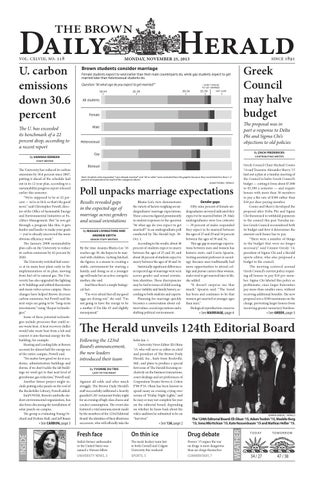
Brown students consider marriage
Greek Council may halve budget
Female students expect to wed earlier than their male counterparts do, while gay students expect to get married later than heterosexual students do. Question: “At what age do you expect to get married?” 18-24
25-29
30-34
I DON’T INTEND TO GET MARRIED NOT SURE 35-39
All students
Female
The proposal was in part a response to Delta Phi and Sigma Chi’s objections to old policies
Male
Heterosexual
By ZACH FREDERICKS
Gay
CONTRIBUTING WRITER
STAFF WRITER
Bisexual Note: Students who responded “I am already married” and “40 or older” were excluded from the graphic because they constituted less than 1.5 percent of respondents for each of the categories above. ADAM TOOBIN / HERALD
Poll unpacks marriage expectations Results revealed gaps in the expected age of marriage across genders and sexual orientations By MAGGIE LIVINGSTONE AND ANDREW SMYTH SENIOR STAFF WRITERS
By the time Ananya Bhatia-Lin ’16 reaches age 30, she hopes to be married with children. Getting hitched, she figures, is a means to creating a stable, environment for starting a family, and doing so at a younger age will make her an active, energetic mother, she said. And then there’s a simple biological fact. “I’m very afraid that all my good eggs are drying out,” she said. “I’m not going to have the energy to be a mother if I’m like 45 and slightly menopausal.”
Bhatia-Lin’s view demonstrates the variety of factors weighing on undergraduates’ marriage expectations. These concerns figured prominently in student responses to the question “At what age do you expect to get married?” in an undergraduate poll conducted by The Herald Sept. 30Oct. 1. According to the results, about 48 percent of students expect to marry between the ages of 25 and 29, and about 28 percent of students expect to marry between the ages of 30 and 34. Statistically significant differences in expected age of marriage were seen across gender and sexual orientation identities. These discrepancies may be tied to issues of child rearing, career viability and family history, according to both students and experts. Planning for marriage quickly becomes a conversation about cultural values, social expectations and a shifting political environment.
Gender gaps Fifty-nine percent of female undergraduates surveyed indicated they expect to be married before 29. Male undergraduates were less cohesive — 39 percent of males responded they expect to be married between the ages of 25 and 29 and 34 percent between the ages of 30 and 34. This age gap in marriage expectations between men and women has historic roots, said Carrie Spearin, visiting assistant professor in sociology. Because men traditionally had more opportunities to attend college and pursue careers than women, males tend to get married later in life, she added. “It doesn’t surprise me that much,” Spearin said. “The trend has been and continues to be that women get married at younger ages than men.” Biological reproduction concerns » See MARRIAGE, page 4
Greek Council Chair Michael Coates ’14 and Treasurer Alexander Sherry ’15 laid out a plan at a Sunday meeting of the Council to halve Greek Council’s budget — cutting it from about $7,000 to $3,300 a semester — and require houses with more than 30 members to pay a flat rate of $300 rather than $10 per dues-paying member. Coates and Sherry developed the proposal after Delta Phi and Sigma Chi threatened to withhold payments to the council this past Tuesday unless Greek Council reconsidered both its budget and how it determines the amount each house has to pay. “There were a number of things in the budget that were no longer necessary,” said Connor Grealy ’14, president of Sigma Chi and a Herald sports editor, who also proposed a budget to the council. The meeting centered around Greek Council’s current policy requiring all houses to pay $10 per member. Sigma Chi labeled this policy as problematic, since larger fraternities pay more than smaller ones, without receiving additional benefits. The new proposal sets a $300 maximum on the charge, preventing larger houses from incurring greater monetary burdens. » See GREEK, page 3
The Herald unveils 124th Editorial Board Following the 123rd Board’s announcement, the new leaders introduced their team By YVONNE DU TRIS LADY OF THE NIGHT
Against all odds and after much struggle, The Brown Daily Herald’s staff successfully infiltrated a heavily guarded CAV restaurant Friday night for an evening of high-class cheese and cracker consumption. The event also featured a vital announcement made by the members of the 123rd Editorial Board: the identities of their illustrious successors, who will officially take the
helm Jan. 1. University News Editor Eli Okun ’15, who will serve as editor-in-chief and president of The Brown Daily Herald, Inc., hails from Rockville, Md., and plans to produce a special first issue of The Herald focusing exclusively on the business transactions, court dealings and art preferences of Corporation Trustee Steven A. Cohen P’08 P’16. Okun has been known to spend many an evening crying over reruns of “Friday Night Lights,” and he may or may not complete his year on the editorial board, depending on whether he hears back about the video audition he submitted to be on “Survivor.” » See 124, page 2
APARNA BANSAL / HERALD
The 124th Editorial Board: Eli Okun ’15, Adam Toobin ’15, Maddie Berg ’15, Sona Mkrttchian ’15, Kate Nussenbaum ’15 and Mathias Heller ’15.
Fresh face
On thin ice
Drug debate
India’s former ambassador to the United States was named a Watson fellow
The men’s hockey team lost to both Cornell and Colgate University this weekend
Powers ’15 argues the war on drugs is more dangerous than are drugs themselves
UNIVERSITY NEWS, 3
SPORTS, 5
COMMENTARY, 7
weather
inside
The University has reduced its carbon emissions by 30.6 percent since 2007, putting it ahead of the schedule laid out in its 12-year plan, according to a sustainability progress report released earlier this semester. “We’re supposed to be at 22 percent — we’re at 30.6, so that’s the good news,” said Christopher Powell, director of the Office of Sustainable Energy and Environmental Initiatives at Facilities Management. But “as you get through a program like this, it gets harder and harder to make your goals — you’ve already uncovered the more obvious efficiency work.” The January 2008 sustainability plan calls on the University to reduce its carbon emissions by 42 percent by 2020. The University switched fuel sources at its main heat plant early in the implementation of its plan, moving from fuel oil to natural gas. The University has also upgraded the lighting in 91 buildings and refitted thermostats and steam valves across campus. These changes have helped Brown decrease carbon emissions, but Powell said the next steps are going to be “long-term investments,” using “deeper technologies.” Some of these potential technologies include processes that could reuse waste heat. A heat recovery chiller would take waste heat from a lab and convert it into thermal energy for the building, for example. Heating and cooling labs at Brown account for almost half the energy use of the entire campus, Powell said. “No matter how good we do at academic, administration buildings and dorms, if we don’t tackle the lab buildings we won’t get to that next level of greenhouse gas reduction,” Powell said. Another future project might include putting solar panels on the roof of the Rockefeller Library, Powell added. EmPOWER, Brown’s umbrella student environmental organization, has also been discussing the installation of solar panels on campus. The group is evaluating Young Orchard and Perkins Hall, said Jeff Baum » See CARBON, page 3
t o d ay
tomorrow
34 / 27
47 / 38
2 feature » 124, from page 1
calendar TODAY
NOVEMBER 25
8 P.M.
TOMORROW
NOVEMBER 26
12 P.M. Discussion on De-Extinction
Brown Bag Series in Archaeology
Wilson Hall 205 8 P.M.
Rhode Island Hall 108 7:15 P.M.
Speed Dating & Fast Friending
Project Dance Dance Fitness
Petteruti Lounge
Brown RISD Hillel
menu SHARPE REFECTORY
VERNEY-WOOLLEY
LUNCH Gnocchi with Cabernet Marinara, Korean Style Marinated Beef, Baked Acorn Squash, Swiss Fudge Cookies
Chicken Fajitas, Mexican Succotash, Vegan Black Bean Taco, Vegan Chana Masala, Snickerdoodle Cookies
DINNER Macaroni and Cheese with Avocado and Tomato, St. Louis Fire Braised Pork Ribs, Fresh Collard Greens
Italian Meatballs with Sauce, Stir-fried Tofu, Pizza Rustica with Spinach, Saigon Beef and Ham with Vegetables
sudoku
crossword Actually...
THE BROWN DAILY HERALD MONDAY, NOVEMBER 25, 2013
By Ian Everbach ’17
ACROSS 1 32-card game 5 Make law 10 Gear-cutting machine 13 2.54 centimeters 14 ___ the Riveter 15 No more than 16 “Actually…” 19 “Actually…” 20 Driver’s licenses or passports, e.g. 21 In a wise way 22 Shaking 25 Estimated time of arrival, for short 28 ___ and penates, protectors of the home 29 Batman actor Christian 30 Crew member? 32 Theatrical surroundings 33 What 16-, 19, 47-, and 53- Across are 34 The ___ Mahal 37 Javan ensemble 38 Dry and arid 11/25/13 39 T.S. Eliot : The 49 New York-based Waste Land :: 7 Tennis great 35 “___ you oil company ____ : The Raven Arthur interested?” 42 Mom’s husband 8 103, to the 36 Purim celebrator 50 One of the Great Lakes 43 Nail alternative Romans 37 Clay automatons 51 Scotland’s oldest 44 Opposite of 9 Camping shelters 38 Backs (of the royal burgh small-g, in 10 Playboy founder neck) quantum physics Hugh 39 State, in Spanish 52 Ozone-destroying chem. 46 Gold: prefix 11 Yellow-and-black 40 Author of My 54 Body for U.S./E.U. 47 “Actually…” bird Michael economic 53 “Actually…” 12 Cultural icons 41 Macao money cooperation 55 MS Word files Boop and Crocker 43 Troll through 56 Amber for stringed 15 Medieval webpages For solutions, contact: instruments enchantress 45 Providence crosswords@ 57 Piccolo for a _____ le Fay nightclub military band 17 In apple-pie order 46 Egyptian suns browndailyherald.com. 58 Grandmaster, in 18 Eucalyptus-eating 48 Paneled go marsupials convertible 59 Locations of 22 Football capts, Solution to last Monday’s puzzle: church altars usually 60 1960s civil rights 23 Abu Dhabi’s org. country: abbr. 24 Computer key DOWN next to ‘control’ 1 Bracketed 25 Dog-____ (as a word for quoted book) mistakes 26 ____ ____ la 2 Door handle 27 President of Syria 3 Corporation in 30 Measure Looney Tunes of electrical 4 Similar things, resistance colloquially 31 Bathroom label 5 Kipling’s “Thin red 33 Spanish riceline of ____” seafood dish 6 Kid’s punishment, 34 Rub (on perhaps prescriptions)
Adam Toobin ’15, of New York City, will bring his experience as a City & State Editor back up College Hill to serve as managing editor and vice president. As his first act, Toobin will return vending machines to 195 Angell St. and use the subsequent influx of Diet Coke and processed foods to fuel intense, hourslong policy debates and, occasionally, help put out the newspaper. Known for arriving to the newsroom caked in mud, Toobin will expect his staffers to similarly sacrifice anything — including cleanliness — for the sake of a good story. University News Editor Mathias Heller ’15, of Alexandria, Va., is widely known in the Washington, D.C., area for both his encyclopedic knowledge of past and present American political leaders and his tear-inducing dance moves. As managing editor, he will spearhead the effort to supplant frozen yogurt with Ben & Jerry’s ice cream as The Herald’s late night dessert of choice — and will stand for justice when staff members receive less than their scoop-worth. Sona Mkrttchian ’15, who hails from Egg Harbor Township, N.J., will reluctantly release her hold on the City & State section after four semesters to take the position of managing editor. After years of covering Providence’s pension crisis and the antics of former Red Sox player Curt Schilling, Mkrttchian sees the move to University News as an opportunity to report on a more fiscally-sound entity. Mkrttchian, despite popular belief, is not Russian, and she will seize this opportunity to build a fort in her corner of the office where she does not have to interact with humans and can instead watch videos of babies. Arts & Culture Editor Maddie Berg ’15, of Westchester County, N.Y., will serve as a senior editor. Berg, who began her career with an in-depth investigation of spoiled products sold at Brown eateries, has pledged to fight to replace all Brown Dining Services food with granola bars. As a senior editor, Berg plans to remodel The Herald’s office to include space for both her fabulous wardrobe and the men’s crew team. Hailing from Newton, Mass., Kate Nussenbaum ’15 will also serve as a senior editor, mainly so that she can spend her Thursday nights writing The Herald’s weekly Diamonds & Coal column. Nussenbaum, currently a Science & Research editor, often travels to New Haven, Conn., where she donates her time offering wisdom and counsel to lesser campus publications. Nussenbaum will dedicate her tenure to
installing Justin Bieber’s “Baby” as The Herald’s official theme song. The 124th board will be supported by a strong slew of section editors and editorial leaders. Kiki Barnes ’16, Michael Dubin ’16, Maxine Joselow ’16 and Tonya Riley ’15 will plug into the campus gossip as the University News Editor team. The formidable Barnes, of Manhasset, N.Y., has pledged to pass on the dogged reporting skills she’s developed, which have been known to cause professors to flee at the sight of her. Dubin, of New York City, will divide his time between analyzing the policies coming out of University Hall, pontificating about the various quality levels of AMC dramas and doing his best Ottolenghi impression. Joselow, of Manchester, N.H., cried a little when notified she could no longer lead The Herald’s investigations into the goings on of the Undergraduate Council of Students, but has since accepted her editorial destiny. Riley, originally from Union Bridge, Md., and currently studying in Russia, rejected an offer from Vladimir Putin to lead the country’s public relations efforts in order to take her rightful place with The Herald’s news desk. As the new City & State editors, Kate “Not Katherine” Kiernan ’16 and Katie “Kajillion” Rose Lamb ’16 will look to return the section to its former glory as the newsroom’s baking leadership after a lackluster year from its current editors. Kiernan, of Washington, D.C., will bring her experience covering the changing Thayer Street landscape and the University’s finances, as well as her love of policy, to her new role. Lamb, of Portland, Ore., is rumored to be on Gov. Lincoln Chafee’s ’75 P’14 P’17 speed dial after one semester on the City & State beat and looks to dive deeper into state and local politics next year. In an upset selection, Katie Cusumano ’15 and Andrew Smyth ’16 were named The Herald’s new Arts & Culture editors. Cusumano, hailing from Hamilton, Bermuda, New York City and, most recently, Paris, will grace The Herald with her return to the States to serve as a croissant tester and style editor. She plans to investigate the dearth of boulangeries in Providence. Smyth, of New Fairfield, Conn., will use his expert knowledge of Beyonce’s discography to inform The Herald’s music coverage. His first act as an editor will be to buy the office a stack of dictionaries so other staffers can get on his level, and he has sworn not to leave his post before getting a Q&A (and another hug) from Oprah. The Features section will be led by the demure and understated duo of Sabrina Imbler ’16 and Maggie Livingstone
’16, of Hillsborough, Calif., and Pelham Manor, N.Y., respectively. The two plan to quietly draw on Imbler’s improv experience and Livingstone’s expertise in video production to produce a series of ironic comedy shorts, which they will play on loop in The Herald’s office. While the pair pursues this project, Imbler’s cat, Boots, will assume the post of assistant features editor. Isobel Heck ’16 and Sarah Perelman ’15 will pair up to research the effect of extreme niceness on the Science & Research section. Heck, of Boston, Mass., will draw inspiration from the Red Sox to redesign The Herald’s official kickball uniform. Perelman, of Cheltenham, Penn., will offer to resuscitate any members of The Herald shocked into a stupor by the glory of her gluten-free baked goods. Now stepping up to the Sports editor plate, Caleb Miller ’16 and Dante O’Connell ’16 spent this semester enwrapped in the world of Brown football. Miller, of Vermillion, S.D., is best known for his burgeoning political career, as well as his tendency to arrive fashionably late. O’Connell, who hails from Uniontown, Penn., both writes and speaks with majestic flair. The two were recently spotted studying the art of mustachioed editing, under the mentorship of their predecessors, over milkshakes at Spats Restaurant & Pub. Features Editor Elizabeth Koh ’15, of La Mirada, Calif., will head The Herald’s new Enterprise project. As she pioneers the position, Koh intends to “explore strange new worlds, to seek out new life and new civilizations, to boldly go where no man has gone before” — with more style and grace than Kirk and Spock. Returning from their sojourns abroad, Brisa Bodell ’15 and Einat Brenner ’15 will sassily reclaim leadership over The Herald’s aesthetic as design editors. Joined by Assistant Design Editors Carlie Peters ’16, Taylor Schwartz ’16 and Sean Simonson ’16, they will resume their long-standing battles over printing finals first, winning the title of “Best Office DJ” and composing the most heavily hashtagged tweets. The quintessential quartet of Andersen Chen ’14, Avery Crits-Cristoph ’16, Greg Jordan-Detamore ’14 and Jillian Lanney ’16 will serve as graphics editors. Chen, of Brookline, Mass., is famous for introducing data science to The Herald’s repertoire and will grace the newspaper with his steely cool presence for one final semester before dissolving in a pool of tears at the prospect of departing. CritsCristoph, of Rosemont, Penn., comes to the graphics team from the design desk, » See 124, page 4
university news 3
THE BROWN DAILY HERALD MONDAY, NOVEMBER 25, 2013
» GREEK, from page 1 “We plan on agreeing with the proposal,” Grealy told The Herald. In past years, Greek Council’s budget has been used for inter-Greek events, philanthropy and Greek Week, among other things. The new budget would maintain funding for these events. “We had a lot of room for creativity and outside events,” Coates said of the previous budget. “We found ways to save money and still throw the best events possible.” Halloween on Wriston, an event in which the council sends buses to bring underprivileged children from Providence to trick-or-treat on Wriston Quad, will still receive funding in the new budget. The council has also budgeted
» CARBON, from page 1 COURTESY OF NIRUPAMA RAO
Nirupama Rao is the third recipient of the Meera and Vikram Gandhi Fellowship, which was created with a gift to the Brown-India Initiative.
Former Indian ambassador to U.S. joins Watson Institute Nirupama Rao plans to write a book on the role of public diplomacy in Indian foreign policy By WING SZE HO CONTRIBUTING WRITER
Nirupama Rao, who finished her tenure as India’s ambassador to the United States earlier this month, has been appointed a visiting fellow at the Watson Institute for International Studies for 2014, the University announced last week. Rao is the third recipient of the Meera and Vikram Gandhi Fellowship and the first full-year fellow, said Ashutosh Varshney, director of the Brown-India Initiative and professor of international studies and social sciences. “I bring greetings from India, a strategic partner and genuine friend of the United States,” Rao wrote in an email to the Herald. Rao added that she is “deeply thrilled about the prospect of a year at Brown.” She hopes to “translate (her) experience in diplomacy into academic work (that) would benefit students and scholars of India” and to “engage in serious research and academic work in a world-class university like Brown,” she wrote. Meera and Vikram Gandhi created the fellowship in 2011 through a gift to the Brown-India Initiative, Varshney said. The fellowship is meant to bring Indian policymakers, reporters and public intellectuals to campus. Previous fellows include Yogendra Yadav, a professor of political science at the Centre for the Study of Developing Societies in India, and journalist Barkha Dutt. Rao’s appointment is jointly funded by the Meera and Vikram Gandhi Fellowship and the Watson Institute, Varshney said. Varshney said Rao is “essentially free” to organize any activity that
“advances the purposes of the fellowship.” Rao will hold office hours and may recruit students as research assistants, Varshney added. “One or two students (may get) the opportunity to work closely with her,” Varshney said. Rao wrote that she plans to write a book about “the use of public diplomacy in managing key foreign policy relationships for India.” Rao, who holds undergraduate and master’s degrees in English literature, has previously published a collection of poetry, “Rain Rising.” In her email, she described poetry as “a mirror of your deepest emotions and sensibilities.” Rao has previously visited Brown twice — she attended the inauguration of the Brown-India Initiative in 2012, and this February, she presented a lecture on India and the American “pivot” to Asia. Rao wrote that she “was struck … by the intellectual energy and dynamism of the environment at Brown.” She also described “the historic feel of Providence and the architecture of the place.” Rao’s lecture was chaired by President Christina Paxson and attended by Provost Mark Schlissel P’15. “During that visit … it became clear that (Rao) might be interested” in coming to Brown after her ambassadorship ended, Varshney said. The Brown-India Initiative’s steering committee nominated Rao, and the administration approved it earlier this semester, Varshney said. Rao was a fellow at the Weatherhead Center for International Affairs at Harvard during the 1992-1993 school year. Sonia Feigenbaum, associate provost for international affairs, said the Office of International Affairs supports “faculty, staff and all of the departments” to recruit more “scholars and lecturers from (an) international background.”
’15, a member of EmPOWER’s steering committee. These buildings have “pretty flat roofs and get tons of sun exposure,” Baum said. But both Baum and Powell said technology alone will not solve the problem. Along with new technology, community involvement is necessary to improve energy efficiency, Powell said. “When you talk to a lot of the climate scientists, they’re saying technology
» FOOTBALL, from page 8 carrying the pigskin. Spooney’s 186 total yards and 6.8 yards per carry Saturday were a major sparkplug for the offense’s domination of the Lions’ defense. Bruno fans now expect this type of performance, as the speedy tailback leads the Ivy League in rushing and surpassed 100 yards rushing in each of his last five contests. True to form, Spooney started the offense on the right foot in the Bears’ third possession, breaking two tackles and motoring 45 yards into the end zone. The next time Bruno got the ball, Donnelly connected on a 32-yard strike to Lundevall and a 13-yard touchdown to Evans. After two early touchdowns, Bruno’s energy opened the floodgates. “We came out with a lot of punch,” Estes said. He added that the combination of playing the last game and recently having lost two close games powered the seniors’ strong play. Before the game, defensive end and co-captain Michael Yules ’14 predicted the offense would get an early lead and the defense would use it to play aggressively and go after the quarterback. Yules could not have been more correct. It was an uncomfortable day for Lions quarterback Trevor McDonagh. Bruno sacked McDonagh twice and pressured him to finish with a dismal 32 percent completion rate and three interceptions. The Columbia running game fared even worse. Ball-carriers were planted before the line of scrimmage five times and totaled just 57 yards all game long. Linebacker Ade Oyalowo ’14 notched 11 tackles, three of them for loss, and one sack. The defensive success was a product of aggression after an early lead and disguised looks that confused the young quarterback, Estes said.
some funds for impromptu charitable actions, like the Hurricane Sandy relief fund founded last year. Fraternity presidents reacted positively to the budget proposal. Delta Phi, one of the largest fraternities on campus, was especially supportive of the plan. Last year, Delta Phi paid $1,750 to the council, much more than the $600 it would pay for two semesters under the new plan. Delta Tau was also satisfied with the cuts, which will reduce the dues it pays to the council by 50 percent. “The purpose of Greek Council is to promote inter-Greek relationships and provide an independent outlet for disciplinary concerns. In my opinion, these roles can be fulfilled without an unnecessarily large budget,” said Salaar Khan ’15, president of Delta
Phi. “I feel that Coates and Sherry did an excellent job. Delta Phi is in favor of the budget cuts.” Smaller fraternities were also pleased with the plan. “I’m really happy about it, because we never got to take advantage of the co-sponsored funding with Greek Council,” said Harry Ramsamooj ’14, president of Phi Kappa Psi, a fraternity with 23 members. Phi Psi was on social suspension this past semester and as a result could only apply for co-sponsorship funds if the event was taking place outside of the fraternity house. If the presidents of campus fraternities and sororities approve the proposal this semester, houses that have already paid more than $300 in dues to Greek Council will be refunded.
by itself can’t get you there. We have to change people’s behaviors.” The Office of Sustainable Energy has initiated programs aimed at helping students understand how their actions impact carbon emissions, including a Main Green demonstration of how to turn down radiators, Powell said. “The radiators work now,” he said, so it is possible to control the temperature from inside instead of letting heat out through the window. “I don’t think EmPOWER is involved with the last 12 percent — it’s
high-level engineering stuff,” Baum said. But the group remains focused on community outreach and engaging the student body. “You can engineer all you want — if people aren’t going to be smart about the way they use energy, that won’t make a difference,” because previous gains could be erased, he said. Brown has the lowest energy use per square foot of any Ivy League school, Powell said, but Brown started its program of energy improvements earlier than peer institutions.
Bruno’s 10-0 second quarter witnessed several highlights: a one-yard touchdown pass from Donnelly to Spooney and a 23-yard field goal by Alexander Norocea ’14 that capped a long, 81-yard scoring drive. The rout was on in the third quarter as Donnelly connected with both Lundevall for a 40-yard score and tight end Andrew Marks ’14 for a 21-yard touchdown. Norocea added another field goal, this one 29 yards, and Bruno entered the
final quarter with a 41-7 lead. Jordan Reisner ’14 capped the blowout with a 31-yard scamper to pay dirt. Estes said he was happy the squad built such a large lead early because it allowed all 26 seniors to get valuable playing time in their last game. The big day for leaders like Donnelly, Lundevall, Spooney and Oyalowo marks the end of a strong season for several veterans on the team, which filled 19 of its 22 starting positions with seniors.
4 university news » 124, from page 2 where she once made Herald history by printing all the finals before 10:30 p.m. Jordan-Detamore, a Philadelphia native concentrating in geological sciences and urban studies, looks forward to a final semester of making maps, measuring picas and telling everyone in the newsroom not to “cry-cry.” Lanney, who hails from Concord, N.H., plans to split her time between directing The Herald’s graphics content and serving as New Hampshire Gov. Maggie Hassan’s ’80 P’15 right-hand woman. Angelia Wang ’15 will continue as illustrations editor next semester. Wang intends to draw on her love of Cyanide and Happiness to introduce a webcomic-inspired aesthetic to The Herald’s cartoons and will institute mandatory ballroom dance classes for all cartoonists and comic writers. Brittany Comunale ’16, David Deckey ’15, Emily Gilbert ’14 and Sam Kase ’15 will stay on next semester as photo editors. Comunale harbors a deep love of maps and is known for venturing to the depths of campus for photos of lecturers, snow fights and babies. Deckey, who has been likened to a modern-day Ansel Adams, will spearhead a campaign to caption all of The Herald’s photography in Spanish. Between writing pages of her thesis, Gilbert will occasionally crawl out of the stacks of the Sciences Library to snap photos for sports games and breaking news. When he is not taking photos, Kase intends to draw on his experiences
» MARRIAGE, from page 1 for women could also explain this age gap, many students said. “For me, I would expect to be married before 29 or else I wouldn’t be married,” said Enejda Senko ’15. “It’s the biological clock.” “Thinking about evolutionary theory, men are going to want someone who is more fertile, so they are going to look for someone who’s younger,” Spearin said. “These are deeply ingrained in us. We don’t think about them, but they’re there.” Other students said marriage signals the establishment of a family unit — with many citing 30 as the age at which they want to begin that process. Mac Woodburn ’17 said he ideally hopes to marry by 30 because he would “be ready to start a family.” Claire Walker ’16 plans to marry in her late 20s after completing medical school but before her residency program commences. “I would probably say 27 or 28 or something before residency gets too hectic,” she said. “I think there’s a difference between getting married and having kids, too. … I want to get married a couple years before I have kids.” Marriage markets Americans of all gender identities are marrying at older ages, Spearin said. In 2010, the median age for marriage was 28.2 for men and 26.1 for women, according to a 2010 Time Magazine article. The median age of marriage for both genders has increased by approximately one year every decade since the 1960s, according to the article. Spearin teaches SOC 0170: “The Family,” which examines how families function across cultures and the gender roles within them. Matrimony should be understood through the lense of a “marriage market,” which classifies
in Class Coordinating Board to sponsor office-wide heavy petting. Claire Postman ’15 will return from a semester in South Africa to serve as copy desk chief. She hates Oxford commas. Palasits will be joined by current copy desk chief, Sara Palasits ’15, who will serve as assistant. Rachel Occhiogrosso ’14 of Armonk, N.Y., will continue as editorial page editor, joined by Matt Brundage ’15 of Montclair, Va. Occhiogrosso loves universities, colleges and university-colleges and plans to write a series of editorials consisting entirely of quotes from “The West Wing.” Brundage, who spent this semester studying in New Delhi, India, intends to replace The Herald’s semesterly kickball showdown against the College Hill Independent with cricket matches and tea. Joe Stein ’16, of Woodbridge, Conn., will stay on as web producer. Stein, who plans to use his technological prowess to help The Herald conquer the Internet, still maintains that the cake is a lie. The Herald also proudly announces its newest staff writers so far this semester: Hannah Camhi ’16, Cormac Cummiskey ’17, Andrew Flax ’17, Adam Hoffman ’14, Emma Jerzyk ’17, Christine Rush ’15, Khin Su ’16, Marcus Sudac ’17, Alex Wainger ’16, Drew Williams ’17 and Joseph Zappa ’17. Ben Resnik ’15 will remain in place as Post- magazine’s editor-in-chief. A master of TweetDeck and a fan of filibustering, Resnik intends to boost the magazine’s rate of fried Oreo consumption by a factor of 10.
marriage as an exchange of qualities and resources, she said. “You see much more marital homogamy now,” Spearin said, referring to the tendency of those with similar cultural, educational and economic backgrounds to marry one another. A couple’s earning potential has become “imperative” in the current state of the economy, she added. “So in the past you were seeing doctors marrying nurses, but now we see doctors marrying doctors. It’s not the way it was when you had that one person who could make that family income.” Spearin said marriage is now a “capstone” event for modern, collegeeducated women — a milestone that comes after earning a degree and securing a well-paying job. For Lindsey Hassinger ’16, tying the knot must be organized around her plans to attend nursing school, she said. “My career is definitely important to me, so I’d like to have that solidified before settling down and getting married,” she added. Spearin said peer expectations have a significant impact on the age a person chooses to marry. “You hit your late 20s and early 30s and you’ll go to a gazillion weddings in those years,” she said. “You kind of do what everybody else is doing. We’re very influenced by our connectedness.” Queerly beloved Poll results also revealed an age gap in marriage expectations across sexual orientations. Respondents who identified as gay were more likely to answer with an older age than were heterosexual respondents. Just over half of heterosexual respondents expected to marry between ages 25 and 29, while only 27 percent of gay students responded the same. Approximately 27 percent of heterosexual students responded between the ages
THE BROWN DAILY HERALD MONDAY, NOVEMBER 25, 2013
JESSE SCHWIMMER / HERALD
The outgoing 123rd Editorial Board — Jordan Hendricks ’14, Shefali Luthra ’14, Lucy Feldman ’14, Alexa Pugh ’14, Aparna Bansal ’14 and Elizabeth Carr ’14 — offered its farewell. Will Janover ’15, of New York City, will return from Argentina to assume the role of BlogDailyHerald’s editorin-chief. Janover, known for his prowess in crafting Blog polls and covering Main Green protests, hopes the people of Argentina don’t cry for him upon his departure. David Oyer ’16, of Palo Alto, Calif., allegedly turned down an offer to manage the Oakland A’s to be managing editor of BlogDailyHerald. In order to secure the position, he rescinded his comments on the Nora Ephron classic, “When Harry Met Sally” and acknowledged that it is, in fact, one of the
greatest movies of all time. Georgia Tollin ’15, of Los Angeles, Calif., will return from her European adventures to be managing editor of BlogDailyHerald. A culinary savant, Tollin will sniff out the scoop on the latest Providence eateries and on-campus offerings. On the business side, Nicole Shimer ’16, of Chappaqua, N.Y., will serve as general manager and treasurer. Shimer, known for her cheerful demeanor and glowing tresses, intends to prove to The Herald that gingers do in fact have souls. She plans to introduce mandatory bubble wrap-popping sessions at the weekly
business staff meetings. Jen Aitken ’15, of Manhasset, N.Y., will serve as general manager and secretary. Aitken was promoted almost purely because of her prowess at kickball, which helped The Herald clinch another victory over the College Hill Independent this semester. Alison Pruzan ’15 will assume the post of Alumni Relations Director. Sarah Levine ’16 and Sameer Sarkar ’16 will jointly serve as Finance Directors, and Winnie Shao ’16 will serve as Sales Director. Melody Cao ’16 will spearhead new business ventures as Business Development Director.
30 and 34, while 40.5 percent of gay students chose that age bracket. The delay in marriage plans among gay respondents may be attributed to the fact that same-sex marriage is a relatively new legal option in American society, said John D’Emilio, a professor of history and women’s and gender studies at the University of Illinois at Chicago. “(Same-sex marriage has) only really been dramatically and significantly in the public eye and American culture in the last five years or so,” D’Emilio said. “By contrast, the heterosexual students, as early as they can remember, have been aware of marriage as something a man and a woman (do).” Tori James GS, who identifies as heterosexual, said she feels most straight women she knows hope to marry in their 20s. But the gay adults she knows do not necessarily plan on doing the same, she added. “My brother is 31 and gay and still doesn’t want to get married for another five years,” James said. Keil Oberlander ’15 identifies as gay and is from South Dakota, where same-sex marriage is not legal. He said he has only considered marriage as a serious option in light of the increase in the number of state legalizing samesex marriage. This age gap between heterosexual and gay respondents could also be explained by a largely heteronormative high school dating culture, D’Emilio said, adding that most heterosexual students “have lived around and participated in dating and going out for several years” by the time they are in college. “(Gay students) have not had nearly the opportunity to socialize and date as heterosexual students have,” he said. “The raw material for marriage is more likely to come to them after they have become adults.” D’Emilio said the biological
restrictions many heterosexual couples face when planning a family are less concerning for same-sex couples, and because of this, gay couples can choose to marry at older ages. “The so-called biological clock might lead to a somewhat earlier age for marriage for heterosexuals,” D’Emilio said. For some queer students, marriage is part of a larger conversation about defecting from traditional narratives of the family, and tying the knot may not be the final, monogamous engagement in their romantic lives. Adam Bennett ’16, who identifies as gay, said he wants to be married multiple times, adding that he hopes his last marriage will be the one that produces children, ideally before he is 35.
get divorced and keep the kid and live my life like that. I think I would be a better parent by myself.” Bhatia-Lin said her views on parenthood and marriage were shaped by her own active, involved parents, particularly her mother. “She spent a lot of her time being my mother and a lot creative energy being my mother,” she said. “I think that’s definitely something that’s important to me — to create that space for my kids.” Spearin said no single influence dominates the age at which a person marries. Rather, an “intersectionality” of “loading factors” determines marital decisions, she said. “(It’s) this idea that race, class and gender are these three components that we really can’t tease out,” Spearin said. “In terms of marriage, we can look at men versus women, but these things are all kind of intertwined.”
All in the family Most survey respondents agreed that their parents’ experiences with marriage partly shaped their views on family planning. A child’s household environment — particularly if it includes divorced parents — “will certainly affect whether or when you get married,” Spearin said. Rachel Stern ’16 said she plans on dating her partner for “at least 10 years” before marrying to ensure her marriage will not end in divorce like her parents’ did. “I’ve seen (marriage) not work out too many times,” Stern said. “I want to only get married once and have kids.” Bennett agreed that his plan to marry multiple times is partially influenced by his divorced parents, who are both on their second marriage but “don’t regret their first.” Ria Vaidya ’16, whose parents had an arranged marriage, is wary of the institution, she said. “I just see it as very systematic and weird,” she said. “I think that I’m probably going to get married, have a child,
Not interested A minority of students did not express a desire to tie the knot — about 3 percent of respondents do not intend to marry at all. “I don’t necessarily want to get married,” said Cellie Pardoe ’16. “I was never obsessed with planning my wedding and reading magazines when I was younger like I know some people were.” “I do think the majority of people in general would get married as a romantic goal,” said Kwang Choi ’17. “But I’m not likely to get married.” For other students, the decision remains up in the air at this point— nearly 15 percent said they were unsure at what age they expected to marry. Meeting that special someone, they figure, is not something that can be precisely coordinated. “I wouldn’t be opposed to marriage,” Oberlander said. “It depends on if you find the right person.”
sports monday 5
THE BROWN DAILY HERALD MONDAY, NOVEMBER 25, 2013
WRESTLING
M. HOCKEY
Bruno loses to Cornell, Bears land in middle of pack in Md. Placing seventh in a field Colgate on the road of 14, Bruno saw a strong Despite returning three top players from injuries, Bruno continues to struggle on offense and special teams By DANTE O’CONNELL SENIOR STAFF WRITER
The men’s hockey team fell to two Eastern Collegiate Athletic Conference foes on the road this weekend, losing to No. 18 Cornell 5-1 Friday and Colgate University 3-1 Saturday. Bruno has sunk to 11th place in the conference, having lost each of its last three games and four of its last five. The Bears (3-5-1, 1-4-1 ECAC) started off strong against the Big Red (6-3-1, 4-3-1) with a penalty shot goal from Matt Lorito ’15 early in the first period, but the momentum quickly shifted and the team gave up the next five goals. A power play goal by Joe Prescott ’16 against Colgate (7-7-1, 5-3-0) marked the only Bruno score Saturday. Brown committed six penalties against Colgate and ten against Cornell and went a total of 1-for-7 on power plays over the course of the two games. “We had some penalty trouble early in both games,” Lorito said. “That’s been one of our biggest problems this year. It’s tough to get any kind of momentum when you’re killing a penalty all the time.” In one of the weekend’s few positive signs, Nick Lappin ’16, Brandon Pfeil ’16 and Joey de Concilys ’15 all returned to play from injuries. “They’re three guys we rely on,” said Massimo Lamacchia ’15. “It was a boost for us, and we all played hard, but things just aren’t going our way right now.” Cornell 5, Brown 1 Despite finding the back of the net first, Bruno could not sustain any offensive momentum, while Cornell lit up the scoreboard. “We came out pretty strong,” Lamacchia said. “We played well in the first, but the penalty trouble in the second didn’t allow us to do the things we wanted offensively. We were playing from behind for most of the game.” The Bears found themselves on the power play less than three minutes into the game, when Cornell’s Rodger Craig took a roughing penalty. A few seconds after the power play expired, Cornell forward Eric Freschi was penalized for covering the puck in the crease, giving Brown a penalty shot. Lorito took the shot, firing past Cornell goalie Andy Iles to give Bruno a 1-0 lead. “I came in with a lot of speed,” Lorito said. “The biggest thing for me on penalty shots is to have confidence in what I’m doing. When I got to the circle, I had a feeling I was going to score. I was looking to the low blocker side. I placed it there, and luckily it went in.” The Big Red responded midway through the first period with a Matt Buckles power play goal that tied the score at one. Cole Bardreau struck next for Cornell midway through the second
period, beating goalie Tyler Steel ’17, who turned aside 23 of 27 shots, on a rebound from near the right faceoff circle. Five minutes later, Freschi redeemed his first-period blunder by sneaking a quick shot past Steel to give the Big Red a two-goal lead. Lappin and Matt Wahl ’14 both had scoring opportunities in the third period, but Iles shut the door on Bruno’s comeback efforts. Reece Willcox added an empty-netter for Cornell, and Freschi scored again with less than a minute to play, bringing the final score to 5-1. Colgate 3, Brown 1 As with the Cornell matchup, the Bears could not generate enough offense Saturday to stay in the game. Goalie Marco De Filippo ’14 turned away 26 of 28 shots on goal for the Bears. After killing three penalties in the game’s first seven minutes, the Bears went on the power play with just over six minutes left in the first period. But a turnover in the neutral zone led to a shorthanded goal from Colgate’s Kyle Baun, giving the Raiders a 1-0 advantage. “We got off to a really slow start,” Lorito said. “We need to get our power play going. If we score on more than one of the power plays we had, it’s a tie game and maybe a different outcome.” Two minutes later, Prescott responded for Bruno, scoring on the power play after another Colgate penalty. Garnet Hathaway ’14 took control of the puck and fed it to Matt Harlow ’15, who hit Prescott in front of the cage for the goal. The Raiders responded a minute later with a Mike Borkowski goal over De Filippo’s shoulder to put Colgate up 2-1 heading into the first intermission. Despite outshooting Colgate 1310 in the second frame, Bruno failed to get on the board. The Bears had to kill a two-minute Colgate five-onthree when captain Dennis Robertson ’14 and Wahl took penalties almost simultaneously midway through the period. Bruno extinguished the threat, keeping the score at 2-1 heading into the third period. Despite scoring chances for Lamacchia and Pfeil late in the third, Colgate goalie Charlie Finn kept Brown off the board on his way to a stellar 38-save performance. “Lorito centered the puck in front of the net, and the puck was just lying in the crease,” Lamacchia said of his opportunity. “I tried to shovel it in, but (Finn) made a pretty good save.” Colgate forward Darcy Murphy added an empty-netter with just over a minute of time left on the clock to bring the final score to 3-1. The Bears will face Providence College (10-2-1, 6-2-0 HEA) Saturday in the 28th edition of the Mayor’s Cup. “It’s a big game for us,” Lorito said. “I always circle it on my calendar. We weren’t able to win it last year, but it’s a new year, and we’re really looking forward to it.” “Any time we play for a trophy during the season, it’s big,” Lamacchia said. “We just need to bring our Agame to get out of this little rut we’re in. If we do that, we should be fine.”
performance from Ophir Bernstein ’15 By CORMAC CUMMISKEY SPORTS STAFF WRITER
The wrestling team competed in the Navy Classic at the U.S. Naval Academy this Saturday. The event marked Brown’s second tournament under the direction of first-year Head Coach Todd Beckerman. The Bears finished seventh overall in a field of 14 teams, which included the No. 26 University of Wisconsin Badgers. Their place in the tournament put the Bears ahead of Eastern Intercollegiate Wrestling Association foe Bucknell but behind Ivy rival Princeton. Riding off a strong season-opener at the East Stroudsburg University Open, highlighted by a first-place finish in
» BASKETBALL, from page 8 her hands and keep her away from the basket.” Musgrove had an off night from the field, shooting 0-7 and collecting her three points on free throws. But her main focus was slowing Minato down. “I’m not making excuses, I didn’t shoot the ball well,” Musgrove said. “But I knew I could count on my teammates — we have great shooters with a lot of experience in (Clarke) and (Bikofsky), so I knew I didn’t have to do as much on offense as long as I stopped the ball on defense.” Clarke and Bikofsky lived up to Musgrove’s expectations, as they exploded for 25 of the Bears’ 34 second-half points, including a five-minute stretch in which the duo scored 13 points in a row for Bruno to cut the Black Knights’ lead to eight.
the 125-pound class by Billy Watterson ’15, a former Herald contributing writer, the Bears’ solid team showing at the Navy Classic rested on the shoulders of captain Ophir Bernstein ’15. Bernstein bulldozed his way through five challengers to claim victory in the 184-pound division — his first weightclass title in a college tournament. Bernstein dominated his first four opponents, with his strongest performance coming in the third round, when he trounced Navy’s Stout Watson 12-2. The final bout against the University of Wisconsin’s Jackson Hein proved to be more of a struggle, but Bernstein ultimately triumphed 3-2. Bernstein said he was “very happy” with his title but added that he still sees room for improvement. “After a tournament, even if you get first place, there are still corrections to be made,” Bernstein said. “There’s no such thing as a perfect wrestler.” Two other Bears, Anthony
Finnochiaro ’16 and Justin Staudenmayer ’17, made notable contributions to the team’s score. Finnochiaro finished fourth in the 133-pound division, while Staudenmeyer took fifth at 157 pounds. Applauding the underclassman performances, Bernstein said the future of Brown’s program looks bright. “Those two guys showed a lot of grit going out there, just grinding out matches against some really tough wrestlers,” Bernstein said. Finnochiaro and Staudenmayer, he added, “could definitely lead the way in upcoming years.” Bruno will return to competition Dec. 6 at the Cliff Keen Invitational in Las Vegas, Nev. Bernstein said this tournament, which will feature topnotch opponents, should help the team prepare to reach its ultimate objectives. “Our goal is to put 10 guys into the national finals in March,” Bernstein said. “Every tournament leading up to that is basically just practice.”
“My teammates always find me in the right spot,” said Bikofsky, who finished with 16 points and shot 4-5 from three-point land. “They put me in good positions to shoot the ball. We’ve been shooting really well from three as a team, which has allowed us to score points in bunches.” Bruno stayed aggressive and kept attacking, cutting the lead to just two points. With just 1:49 left in the game, Bikofsky hit a three to give the Bears their first lead of the afternoon at 64-63. After both sides traded free-throw attempts, the game was tied when Musgrove took a jumper with 21 ticks remaining. Musgrove’s shot was off, leading to a Minato rebound and an immediate Army timeout. Coming out of the timeout, Minato carried the ball up court and pulled up from inside the arc. Her shot missed, but Hazlett came crashing down the
lane, collected the offensive rebound and dropped in the game-winning layup with just one second left on the clock. “All five players need to be focused on grabbing loose balls and rebounds,” Musgrove said. “We’re a very undersized team, so most teams will out-rebound us pretty easily. We have to stay focused and keep the opposition boxed out.” “We don’t have one big player who’s going to collect 10 rebounds a game,” Bikofsky said. “It doesn’t matter who ends up getting the board, as long as everyone is crashing and boxing out and giving a full effort. We got lazy for one play, and it cost us the game.” The team will try to shake off the heartbreaking loss with a team Thanksgiving dinner at Clarke’s house before heading down to Annapolis, Md., to take on the Naval Academy and the University of Maryland, Baltimore County in the Navy Classic Nov. 29-30.
comic Let’s Talk | Nava Winkler and Regine Rosas
6 commentary
THE BROWN DAILY HERALD MONDAY, NOVEMBER 25, 2013
EDITORIAL
What we’re thankful for Bagels, Brown University Shuttle OnCall, the Creperie, Alice, the 124th Editorial Board, Juan Tien T. Juan, Phelan Huan Twanteetoo, Sven Twintee, Helen Gurley Brown, Trader Joe’s, Taylor Swift, Beyonce and Groverina. “Mean Girls,” Blue State, popcorn, pumpkin, Meeting Street Cafe, sports editors, Stephen Foley, Henry the vacuum cleaner, fond memories of the upstairs library, soup, warm coats, Banquet, Herald Happy Hour, Taboo and goat food. Pop-Tarts, the Kabob and Curry appetizer deal, Marisa Quinn, Never Have I Ever, Connie Britton, AS220, pancakes, Beer 30, Shawn, poetry night and Zooma Trattoria. Spreads, pre-webbing, blindfolded picnics in India Point Park, being in the weekend, homemade cheesecake in the Herald refrigerator, kale, humanities-centered robots, robots that make pie, Yankee Spirits, Grantland, Shakespeare, boxed wine, “Clue” and initials. “Ignition,” Adam Brody’s impending nuptials, 5 a.m. Loui’s, midnight Grad Center Bar trips, infographics, senior staff writers, data science, Nate Silver, frat tanks, kickball victories, the College Hill ’Dependent, listservs and Grad Center D 330/Young Orchard 2 340. Bollywood mashups, dependent clauses in headlines, comma headlines, em-dashes, design editors and staffers, Songza, Greg Jordan-Detamore ’14, impromptu polls, Google Alerts, breaking news, sample cups and search committees. Cross-continent Google Hangouts, Nora Ephron, Jell-O shots, Asana, Google Drive, Levain Bakery, Haiku, free discourse, tasteful nudes, the editorial decisions of Post- Magazine, 299 Governor St. and James Egan. Journalism conferences, Richard Holbrooke ’62, girls on top, the Blue Room door, the mailroom, wildcards, Cormac (the novelist and the laptop), red pens, wet-erase and the yardstick. Bound volumes, icebreakers, copy editors, new staff writers, Josh Schwartz, photographers, champagne toasts, social media skills, F8, prewriting, 16-page newspapers, cats, Mama Gail, Nikhil, sports editors exiting retirement, web updates, our families, Jonathan Ellis ’06 and friends making it in journalism. Studying biology, iMessage, secret bakers, Sam’s Club, back rubs, flexible layout and dynamic content, puns, post-4 a.m. delirium, props and you. The Herald’s 123rd Editorial Board has a lot to be thankful for. Thanks for reading.
I VA N A L C A N TA R A
LETTERS TO THE EDITOR
Kelly committee seeks ‘dispassionate’ review To the Editor: Oftentimes an event that generates debates and concerns is an opportunity for reflection and positive action. The events surrounding New York Police Commissioner Ray Kelly’s visit allow us to have one such moment here at Brown. Last week, as part of that process of reflection, President Christina Paxson appointed a committee with the following charges: • To provide a full accounting of the circumstances that led to the protest; • To review broadly the climate on campus around issues of free expression and dialogue and to make a set of recommendations about this climate. The committee has begun its work focusing on the first aspect of its charge. We will (a) gather materials related to the organization and marketing of the event and (b) meet with the event organizers, students and administrators who attended the lecture and those who participated in the protest. In all of this we will be guided by a single concern: to find out in as accurate and dispassionate a way as possible the
Cartoon reflected poor taste
CORRECTION To the Editor: Due to an editing error, summary deck published in Friday’s Herald (“Lecture links biotechnology to capitalism,” Nov. 22) incorrectly stated that Nanyang Technological University Assistant Professor Hallam Stevens’ talk was the first in the Science and Capitalism speaker series sponsored by the Program in Science and Technology Studies. In fact, his talk was the second in the series. The Herald regrets the error.
circumstances culminating in the protest of Kelly’s visit. We are not collecting evidence for possible action against any student, and therefore in our report the names of anyone interviewed, including the students, will remain anonymous. Our objective is solely to investigate the circumstances leading up to and surrounding the event to ascertain those factors that contributed to its outcome and not to single out any individual. The committee hopes to engage the Brown community in its work, particularly in addressing our second charge. We recognize that there are forums and other activities planned to address these issues, and we welcome them. This is a crucial matter for the entire University community, and it needs as much debate and discussion as possible to produce a way forward that continues the distinctive strengths of this great university. Anthony Bogues Committee chair, professor of Africana studies and director of the Center for the Study of Slavery and Justice Lyn Crost Professor of social sciences and critical theory
The cartoon “Devastation comes in many forms,” which ran in Friday’s Herald, was deeply troubling. While the cartoon might have been poking fun at students exaggerating the magnitude of their academic difficulties, it was hard to read past the overwhelming impression that
the artist was making a cheap joke out of a Category 5 typhoon that has claimed at least 5,200 lives and affected at least 11 million people. Even if The Herald is starved for decent cartoonists, there is no excuse for the sheer lack of editorial oversight that allowed this cartoon to make it to print. Andrew Leber ’12
Q U O T E O F T H E D AY C L A R I F I C AT I O N
“I’m very afraid that all my good eggs are drying out. I’m not going to have the energy to be a mother if I’m like 45 and slightly menopausal.” — Ananya Bhatia-Lin ’16
An article in Thursday’s Herald (“Blogger talks inequality, privilege,” Nov. 21) did not specify the context of a quote from Black Girl Dangerous creator Mia McKenzie. Though McKenzie said, “You know what I love — when people don’t see race,” her words were meant ironically.
See marriage, page 1.
Editorial Leadership
Sections
Visuals & Production
Business
Editors-in-Chief Lucy Feldman Shefali Luthra
Arts & Culture Editors Hannah Abelow Maddie Berg
Head Photo Editor Emily Gilbert
General Managers Julia Kuwahara Samuel Plotner
Managing Editors Elizabeth Carr Jordan Hendricks
City & State Editors Sona Mkrttchian Adam Toobin
Senior Editors Aparna Bansal Alexa Pugh
Features Editors Jennifer Kaplan Elizabeth Koh
Strategic Director Greg Jordan-Detamore
Science & Research Editors Phoebe Draper Kate Nussenbaum
BLOG DAILY HERALD Editor-in-Chief Meredith Bilski
Sports Editors James Blum Connor Grealy
Managing Editor David Oyer
University News Editors David Chung Mathias Heller Eli Okun
POST- MAGAZINE
Editorial Page Editor Rachel Occhiogrosso
Editor-in-Chief Ben Resnik
Opinions Editors Gabbie Corvese Garret Johnson Maggie Tennis
Photo Editors Brittany Comunale David Deckey Samuel Kase Sports Photo Editor Jesse Schwimmer Video Editors Henry Chaisson Assistant: Danny Garfield Data Science Editor Andersen Chen Web Producer Joseph Stein Design Editors Kyle McNamara Mie Morikubo Julia Shube Assistant: Sandra Yan
facebook.com/browndailyherald
@the_herald
browndailyherald.com
Directors Sales: Eliza Coogan Finance: Nicole Shimer Alumni Relations: Emily Chu Business Dev.: Justin Lee
Location: 195 Angell St., Providence, R.I. www.browndailyherald.com
Office Manager Shawn Reilly
Corrections: The Brown Daily Herald is committed to providing the Brown University community with the most accurate information possible. Corrections may be submitted up to seven calendar days after publication.
Sales Managers Regional: Jennifer Aitken Regional: Jaqueline Chang Regional: Leslie Chen Regional: Wenli Shao Regional: Carolyn Stichnoth Student Group: Anisa Holmes Finance Managers Collections: Sameer Sarkar Collections: Timothy Sharng Operations: Sarah Levine
Copy Desk Chief Sara Palasits
Alumni Relations Manager Engagement: Alison Pruzan
Illustrations Editor Angelia Wang
Business Dev. Managers Project Leader: Melody Cao Project Leader: Kaden Lee
Editorial contact: 401-351-3372 herald@browndailyherald.com
Business contact: 401-351-3260 gm@browndailyherald.com
Commentary: The editorial is the majority opinion of the editorial page board of The Brown Daily Herald. The editorial viewpoint does not necessarily reflect the views of The Brown Daily Herald, Inc. Columns, letters and comics reflect the opinions of their authors only. Letters to the Editor: Send letters to letters@browndailyherald.com. Include a telephone number with all letters. The Herald reserves the right to edit all letters for length and clarity and cannot assure the publication of any letter. Please limit letters to 250 words. Under special circumstances writers may request anonymity, but no letter will be printed if the author’s identity is unknown to the editors. Announcements of events will not be printed. Advertising: The Brown Daily Herald, Inc. reserves the right to accept or decline any advertisement at its discretion. The Brown Daily Herald (USPS 067.740) is an independent newspaper serving the Brown University community daily since 1891. It is published Monday through Friday during the academic year, excluding vacations, once during Commencement and once during Orientation by The Brown Daily Herald, Inc. Single copy free for each member of the community. Subscription prices: $280 one year daily, $140 one semester daily. Copyright 2013 by The Brown Daily Herald, Inc. All rights reserved. Periodicals postage paid at Providence, R.I. Postmaster: Please send corrections to P.O. Box 2538, Providence, RI 02906.
commentary 7
THE BROWN DAILY HERALD MONDAY, NOVEMBER 25, 2013
Legalize all drugs ANDREW POWERS opinions columnist
In April, possession of small amounts of marijuana was decriminalized in Rhode Island. Some might wonder what motivated the state government to loosen restrictions on a substance that causes such apparent mental impairment. How could this possibly benefit the state? At the start of any given weekend on College Hill, many students prepare to drink, smoke, roll, trip and partake in other illegal drug-related activities. A Herald poll conducted last semester found that during the previous year, 85 percent of students had consumed alcohol, 49 percent had used marijuana, 9 percent had used ecstasy — also known as MDMA — and at least 7 percent had used some psychedelic agent (“Poll: White, older students more likely to use substances,” Apr. 17). Many would say that, for the most part, the University turns a blind eye to this debauchery — a policy generally supported by the student body. But why does an institution of higher learning seemingly under-
mine — or, at best, minimally support — the efforts of the exorbitant drug war being waged by the U.S. federal government? Brown is known for its almost obnoxious commitment to social justice, and I believe that the end of drug prohibition would better society in ways so tangible that they would trump all other considerations. There is no need to justify drug legalization on the basis of some supposedly inalienable rights. Rights are those entities that are more significant than the consequences precipitated by actions that would violate them. For example, we would allow a talented cancer researcher to quit his job and take up professional gambling because his right to selfdetermination takes precedence over the utility he could have for society. But as I said before, we need not resort to any consideration of rights, as the consequences of drug legalization engender massive societal benefits. So what are legalization’s benefits? It seems counterintuitive that allowing the use of mind-altering substances that decrease one’s ability to think rationally could have benefits for society. And it may be true that for the average individual, the overall cost of using drugs outweighs the utility. Few would deny
the overt detriments of abuse and drug use is wholly eclipsed by undependence. avoidable increases in crime, as seen But most drugs rarely make the during Prohibition. user a more dangerous member of During my senior year of high society — particularly when there school, I volunteered at a small lois no driving involved. It is not the cal hospital and worked alongside a drug users but black man in the drug war his mid-20s. that makes our “It is not the drug users He came from society more a bad neighbut the drug war that dangerous. borhood, and As was makes our society more I was always shown by the morbidly fasdangerous.” inelasticity of cinated by the demand of his depiction alcoholics and of his envirecreational drinkers during Prohi- ronment and the role drug crimes bition, artificially reducing the sup- played in it. He once showed me a loply of drugs makes dealing a highly cal news video of a man’s throat beprofitable criminal enterprise. In- ing slit in a rundown bar. I saw him tense competition between dealers, calmly sitting in the background, combined with a lack of government sipping his drink. He told me he was enforcement of property rights, is upset that they stopped the music the perfect incentive for the rampant when the ambulance came. Just the violent crime necessary to succeed circle of life, right? in a “might makes right” market. In The profits of drug crime afford the 1920s, the United States saw the the perpetrators social status, makrise of gangsters like Al Capone and ing them role models that younger Bugs Moran, along with a bloom of members of their communities ascriminal activity that lasted until the pire to emulate. I can only imagine end of Prohibition in 1933. the seductive contrast of success by It’s difficult to keep drugs out of drug dealing in the depressing momaximum-security prisons. It’s vir- rass that is west Philadelphia. This tually impossible to keep them off anecdotal evidence does not prove the streets. And the extremely mar- my point, but it serves as a modernginal success of efforts to prohibit day illustration of the type of al-
luring drug culture fostered by the drug war. So what would happen if we were to legalize drug use today? Like the end of alcohol prohibition in the United States, the decriminalization of drug use in other countries has led to undeniable benefits. In the five years since Portugal decriminalized drugs, drug-related deaths and transmission of HIV have decreased by over 25 and 75 percent, respectively. Estimates place the annual cost of the drug war in America at anywhere from $50 to 150 billion. Given the fiscal state of the nation, this seems as strong a motivation as any to do away with this inefficacious policy. I understand the desire to regulate drugs, but similar to the motivation to regulate guns, the end goal is simply unrealistic. Our choice is not between a world with drugs and a world without drugs. Our choice is between a world with drugs and a world with drugs, violent drug crime, more drug-related deaths and the massive economic costs of an ineffective drug war.
Andrew Powers ’15 can be reached at andrew_powers@brown.edu and will respond to all questions and comments.
Fifty shades of gray-zone sex LAUREN SUKIN opinions columnist
A lot of sex happens in gray areas. That is, sex happens without the safety of a solid “yes.” Consent is a lot easier to determine when one partner asks directly for permission — and though that should always be encouraged, in reality it does not always occur. As a result, it is important to supplement movements encouraging men to ask for explicit consent with efforts to encourage women to actively say no when they are uncomfortable. Sex education about consent focuses on two messages: asking for consent and teaching that no means no. People are increasingly receptive to both messages, but the second has in general gained more traction. But without the dual influence of asking for consent, “no means no” has also changed how people interact with their partners. Men who would immediately stop if asked might take silence as a yes or use hesitancy as an opportunity to convince. One method for avoiding this problem is for men to ask for consent. But if that doesn’t happen, silence and hesitancy can be dangerous. Sometimes the male figure in this situation might know that he is doing something wrong, but in
a few of these cases, he might not everyone you know is a potential even have a full recognition of the rapist, or you have the potential to consequences of his actions. That know one of the rare rapists. Either alone is dangerous because it allows way, rapists are the kind of people for repetition. Sex becomes more you know in real life, who sit next to common and more expected, and you in class and in the library. That though most girls know that they familiarity makes it all too easy to can say no, not all of them actually give in to pressure. Just the act of do when they might want to. This knowing someone can make someagain only makes the problem more thing you would otherwise not depersistent. On college campuses es- sire feel like a friendly obligation pecially, this is one of the most com- or feel safe when it is not. It’s this mon scenarios for rape: a man vio- pressure that can contribute to the lating a woman reluctance to just due to silence. say no. “The more we rely There are Whether we solely on men to two leading like it or not, sex theories on the guarantee our sexual is often emotioncause of rape: al, and it is all too safety, the more the predator theory easy to get hurt narrative of female and rape culture by staying silent. theory. Rape victimization is going Part of the soluculture theory tion is to promote to become ineffective.” a culture where indicates that rape is so norsilence is not conmalized in our society that even a sent, where sexual action of any man who would never identify as a kind requires an explicit yes. The rapist has those desires and can’t tell other half of the solution, though, is when rape is wrong. Predator theo- a safety net — a simultaneous narry identifies rapists as a small sub- rative where we empower women set of our culture and says that most and tell them not just that saying no rapes are committed by a small means something, but that it is okay number of serial rapists who target to say it. acquaintances and people that they While men should always ask for know. consent, they do not always do so. Both theories explain why the This sort of education should conmyth of the hooded rapist hiding tinue, but nuance is needed. The behind a tree and leaping out from more we rely solely on men to guarthe darkness is not real — either antee our sexual safety, the more the
narrative of female victimization is going to become ineffective. It is a call for men to protect us, to catch us when we faint and always ask if we are okay. When conversations about sexual violence are always framed around females as victims, they cast women as helpless figures in a world full of predators. In reality, a message of female strength could supplement that of male responsibility and help teach women that they have not just a right but a responsibility to stand up and insist — for whatever reason — on what they do or do not want. There’s an influx of feel-good messages out there for young girls talking about individuality and selfadvocacy. The core of any of these is the ability for girls to speak up and ask for what they want — Sheryl Sandberg-style. This is not just a lesson for business meetings. Unfortunately, the other part of Sandberg’s message is that saying no can be difficult. And even teaching women to say it — difficult as that in itself would be — is not a complete solution. Many cases of abuse occur after a women has refused sex, or while she is under conditions that would make refusal impossible. Not all sexual abuse occurs heterosexually, and even when it does, the male figure is not always the perpetrator. These are just some of the significant variations that can occur. In these cases, teaching
women to say no might not even be a helpful suggestion, much less a solution. The other problem with this argument is that it focuses on the victims, not the perpetrators. Education for men is extremely important, and it is crucial to remember that it is never the victim’s fault and that silence is not consent, even if it can be misinterpreted. Nevertheless, this philosophy is a precaution, an attempt — maybe in vain — to deal with the unfortunate realities of the status quo. So I say this to women who may find themselves approaching that situation: Say no. And if necessary, say it again. The only guarantee is self-advocacy. I wish I could say that doing so were easy, but I cannot. I wish I could say that if all women said no when they were not sure, it would solve the problem of rape. But this is a step in the right direction, not a solution. Men will not always listen, and saying no is not even always an option. But the idea that sex should be expected or required is symptomatic of a culture of silence, and reemphasizing a responsibility for women to advocate individually for themselves — at least while we wait for men to catch up to standards of decency — is always good policy.
Lauren Sukin ’16 is a literary arts and political science concentrator.
daily herald sports monday THE BROWN
MONDAY, NOVEMBER 25, 2013
FOOTBALL
48
vs.
7
6-4, 3-4
0-10, 0-7
Harvard 34 Yale 7
Brown 48 Columbia 7
Penn 41
Dartmouth 28 Princeton 24
IVY FOOTBALL SCOREBOARD Cornell 42
FINAL STANDINGS 1. Harvard (9-1, 6-1) 1. Princeton (8-2, 6-1) 3. Dartmouth (6-4, 5-2) 4. Brown (6-4, 3-4)
4. Yale (5-5, 3-4) 4. Penn (4-6, 3-4) 7. Cornell (3-7, 2-5) 8. Columbia (0-10, 0-7)
Bears unstoppable in season’s final game Bruno’s 26 seniors all got playing time in the Bears’ 48-7 victory against Columbia Saturday By CALEB MILLER SENIOR STAFF WRITER
After consecutive close losses in conference play the last two weekends, the football team unleashed some pent-up frustration at Columbia, racking up 627 yards of total offense and drumming the Lions 48-7. The slaughter of winless Columbia (0-10, 0-7 Ivy) wraps up a sixth consecutive winning season for Bruno and secures the Bears (6-4, 3-4) a fourthplace tie in the Ivy League.
“A nice way to end the season — a dominating win,” said Head Coach Phil Estes. The box score tells the story best. Bruno had three times as many first downs and six times as many takeaway turnovers as the Lions. Quarterback and co-captain Patrick Donnelly ’13.5 led the charge, throwing for 301 yards and four touchdowns without an interception. On the receiving end of Donnelly’s big day were his two biggest targets all season long: Tellef Lundevall ’13.5 and Jordan Evans ’14, who combined for 14 receptions, 242 yards and two touchdowns. Not to be overshadowed by Donnelly, star running back John Spooney ’14 turned in another stellar performance » See FOOTBALL, page 3
EMILY GILBERT / HERALD
Co-captain and quarterback Patrick Donnelly ’13.5 made four touchdowns in his final game as a Brown Bear.
SQUASH
W. BASKETBALL
Bruno undone by buzzer-beater Women win two,
men split matches
The team rallied from a 17-point deficit to take the lead, only to fall to Army in the final second
The women’s team made The Herald, said she was happy with way her teammates took care of short work of Mt. Holyoke the business. “I think everyone played really and Tufts, with 8-1 and clean, competitive squash,” she said. Despite his team’s resounding win 9-0 wins this weekend
By ALEX WAINGER SPORTS STAFF WRITER
The women’s basketball team lost to Army in dramatic fashion Saturday, allowing a putback layup with just one second left on the clock. Sophie Bikofsky ’15 heaved a prayer as time expired but could not complete what would have been a 17-point comeback for the Bears. Army escaped Bruno’s late rally, clinching a victory with a final score of 67-65. “It was a disappointing end, but this game showed that we have a lot of potential,” Bikofsky said. “We can come back from anything — this was the second time we were down by a significant number of points, and we were able to fight back and put ourselves in a position to win.” Army (4-1) pressured Bruno (2-2) from the beginning, opening up a double-digit lead less than 10 minutes into the game. The two star players for the Black Knights, Kelsey Minato and Jen Hazlett, lit up the Bears’ defense, collectively scoring 17 of Army’s 36 points in the first half. “We definitely focused our defensive efforts on (Minato) and (Hazlett),” Bikofsky said. “We had to make some in-game adjustments after they started so hot. We tried not to help off of them, and we switched onto them quickly on
By ANDREW FLAX SPORTS STAFF WRITER
KATIE LIEBOWITZ / HERALD
Captain Lauren Clarke ’14 scored seven points for the Bears and had two rebounds and a steal in Saturday’s game against Army Saturday. picks and screens to try to contain them.” Carly Wellington ’14 kept Bruno in the game, scoring 10 of the team’s first 14 points, including two shots from beyond the arc. Captain Lauren Clarke ’14 also had a strong first half, posting seven points, two rebounds and a steal. The Bears managed to claw back into the game, heading into halftime down by just five points.
At the start of the second half, Minato again came out strong, leading Army on a 17-5 run over the course of 10 minutes. “I had the job of guarding (Minato),” said starting point guard Rebecca Musgrove ’17. “We knew she was a very capable playmaker who was going to run the offense for them. I tried my best to get around screens, get the ball out of » See BASKETBALL, page 5
The ninth-ranked women’s squash team won both matches of its season-opening double header against Mount Holyoke College and Tufts UniversitySaturday, while the 16th-ranked men fell narrowly to Navy before beating Tufts in its first competitions of the year. The women dispensed with both of their opponents easily — they won eight of nine matches against Mt. Holyoke (1-2) and all nine against Tufts (24). Against the Jumbos, no Bear lost a single first-to-11 game, and Bruno won each of the nine matches three games to none. The men did not fare quite as well, falling 5-4 to No. 15 Navy (9-0) before dominating Tufts (1-7). The Bears won 3-0 in each of the eight games they played against Tufts, but the Jumbos brought only eight players, so they forfeited the ninth match, bringing the final score to 9-0. “We were a tiny bit rusty, because it’s one of the first matches of the season, but I think both squads prepared very well and were ready to play — played hard and played well,” said Head Coach Stuart leGassick. Dori Rahbar ’14, a Staff Writer for
over Tufts, Foster Hoff ’16.5 was more focused on the loss to Navy. “We lost a tough one,” he said. “Sometimes the opponent just plays a little bit better.” “We just came up short in two or three matches,” leGassick said. “It could have gone either way, but I think they just played slightly better than we did.” With their first two matches of the season in the books, the teams now turn their attention to the rest of the year. The top-ten women “want to retain their … position” in the rankings, leGassick said. Rahbar was optimistic, saying she expected the team to “do really well.” “We have a pretty young team, and a very deep team,” she said. For the men’s part, the loss to Navy means they will face an uphill battle this year. “It’s a bit tougher having lost to Navy … but the season’s very young. There’s still room for upsets on our part,” leGassick said. Hoff said he saw the loss as just another reason to keep working. “Today was a tough loss to a team that was ranked just one ahead of us, but I think with this loss, we’ll be really motivated to do better going forward,” he said. The men return to the court Dec. 6 against the University of Western Ontario (7-0), while the women will play again Dec. 7 against Drexel (2-2).