Daily
Herald
THE BROWN
vol. cxlviii, no. 114
since 1891
TUESDAY, NOVEMBER 19, 2013
R.I. to Underground explosion leaves no damage to U. uphold ACA A National Grid spokesman attributed the compliance incident to a smoldering electrical cable standards
By KATHERINE LAMB SENIOR STAFF WRITER
Rhode Island will require all residents to have health insurance that complies with the standards outlined in the Affordable Care Act by March 31, despite President Obama’s decision Thursday that anyone on canceled individual or small business insurance plans can keep their coverage for another year, announced Rhode Island Health Insurance Commissioner Kathleen Hittner and HealthSource RI Director Christine Ferguson Friday. Millions of Americans have received letters from their insurance providers in recent weeks informing them that their plans do not meet the ACA’s standards and will be canceled, though Obama originally insisted that under the new law those who preferred their current coverage could keep it. Obama announced the option for some to extend their plans in response to bipartisan backlash to the planned cancellations. “After reviewing the president’s announcement, we have decided to continue in the direction we are going and therefore will not be adopting the option made available to us by the president,” Hittner and Ferguson announced in a joint press release Friday. All plans available in Rhode Island in 2014 through the HealthSource RI marketplace have already been reviewed and “designed to meet the standards set forth in the (ACA),” wrote Dara Chadwick, chief of strategic communications and media relations at HealthSource RI, in an email to The Herald. The federal reprieve was meant to ease the implementation process, but it also required insurers to inform consumers about alternative options and explain why their plans did not meet the requirements outlined in the ACA, according to National Public Radio. The state’s decision to opt out of the federal reprieve was motivated in part by the fact that the exchange will be most effective if all Rhode Islanders participate, said Ira Wilson, professor of health services, policy and practice. Many of those who » See HEALTH CARE, page 3
inside
CITY & STATE
By ALEXANDER BLUM SENIOR STAFF WRITER
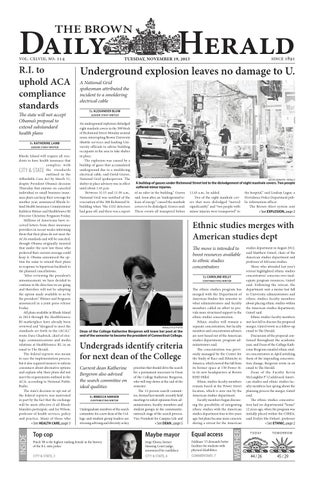
An underground explosion dislodged eight manhole covers in the 300 block of Richmond Street Monday around noon, interrupting Brown University Shuttle services and leading University officials to advise building occupants in the area to take shelter in place. The explosion was caused by a buildup of gases that accumulated underground due to a smoldering electrical cable, said David Graves, National Grid spokesperson. The shelter in place advisory was in effect until about 1:45 p.m. Between 11:15 and 11:30 a.m., National Grid was notified of the evacuation of the 300 Richmond St. building when “the CO2 detectors had gone off, and there was a report
ARJUN NARAYEN / HERALD
A buildup of gasses under Richmond Street led to the dislodgement of eight manhole covers. Two people suffered minor injuries. of an odor in the building,” Graves said. Soon after, an “underground release of energy” caused the manhole covers to be dislodged, Graves said. These events all transpired before
11:45 a.m., he added. Two of the eight manhole covers that were dislodged “moved significantly,” and “two people with minor injuries were transported” to
the hospital,” said Lindsay Lague, a Providence Police Department public information officer. The Brown Alert system sent » See EXPLOSION, page 2
Ethnic studies merges with American studies dept The move is intended to boost resources available to ethnic studies concentrators By CAROLINE KELLY CONTRIBUTING WRITER
HERALD FILE PHOTO
Dean of the College Katherine Bergeron will leave her post at the end of the semester to become the president of Connecticut College.
Undergrads identify criteria for next dean of the College Current dean Katherine Bergeron also advised the search committee on ideal qualities By REBECCA HANSEN CONTRIBUTING WRITER
Undergraduate members of the search committee for a new dean of the College and student group leaders are stressing advising and diversity as key
priorities that should drive the search for a permanent successor to Dean of the College Katherine Bergeron, who will step down at the end of the semester. The 13-person search committee, formed last month, recently held meetings to solicit opinions from administrators, faculty members and student groups in the communityoutreach stage of the search process. Vice President for Campus Life and » See DEAN , page 5
The ethnic studies program has merged with the Department of American Studies this semester in what administrators and faculty members called an effort to provide more structured support to the ethnic studies concentration. Ethnic studies will remain a separate concentration, but faculty members and concentration advisers are now based out of the American studies department, program administrators said. The concentration was previously managed by the Center for the Study of Race and Ethnicity in America, which moved this fall from its former space at 150 Power St. to its new headquarters at Brown RISD Hillel. Ethnic studies faculty members remain based at the Power Street location, which is now run by the American studies department. Faculty members began discussing the possibility of integrating ethnic studies with the American studies department four to five years ago, but plans became more concrete during a retreat for the American
Top cop
Maybe mayor
Equal access
Pinch ’88 is the highest ranking female in the history of the R.I. state police
Jorge Elorza, former Housing Court judge, announced his candidacy
Feldman ’15 demands better facilities for students with physical disabilities
CITY & STATE, 3
CITY & STATE, 4
COMMENTARY, 7
weather
The state will not accept Obama’s proposal to extend substandard health plans
studies department in August 2012, said Matthew Guterl, chair of the American studies department and professor of Africana studies. Those who attended last year’s retreat highlighted ethnic studies concentrators’ concerns over inadequate program resources, Guterl said. Following the retreat, the department sent a memo last fall to University administrators and ethnic studies faculty members about placing ethnic studies within the American studies department, Guterl said. Ethnic studies faculty members met last fall to discuss the proposed merger, Guterl wrote in a follow-up email to The Herald. Discussion of the proposal continued throughout the academic year, and Dean of the College Katherine Bergeron emailed ethnic studies concentrators in April notifying them of the impending concentration change, Bergeron wrote in an email to The Herald. Dean of the Faculty Kevin McLaughlin P’12 addressed American studies and ethnic studies faculty members last spring about the planning process the merger, Guterl said. The ethnic studies concentration had no departmental “home” 12 years ago, when the program was initially placed within the CSREA, said Evelyn Hu-Dehart, professor » See ETHNIC, page 2 t o d ay
tomorrow
44 / 26
45 / 29
2 university news calendar TODAY
NOVEMBER 19
7:15 P.M.
TOMORROW
NOVEMBER 20
SENIOR STAFF WRITER
Dance Fitness Class
Ivy Film Festival: Inside Llewyn Davis
Hillel
Providence Place Mall
8 P.M.
8 P.M.
Comedy and Disability Screening
Solo Piano Recital by J. Kamitsuka
Petteruti Lounge
Grant Rectial Hall
VERNEY-WOOLLEY
LUNCH Pasta E Fagioli, Cajun Turkey Cutlet, Herb and Cheese Bread, Oreo Chocolate Chip Fudge Bar
Chinese Chicken Wings, Vegetarian Sweet and Sour Tofu, Sticky Rice, Oreo Chocolate Chip Fudge Bar
DINNER Steak and Pepper Fajitas, Artichoke and Red Pepper Frittata, Curry Chicken Saute, Oatmeal Apple Crisp
MAIN CAMPUS GEORGE
IN MA Office of Continuing Education, Admission Office
Ship Street Square
SHIP
WA TE
R
Alpert Medical School
Laboratories for Molecular Medicine 233 Richmond St. lost power
DY
of American studies and history and director of the ethnic studies concentration. The CSREA faced a difficult balancing act in running the ethnic studies concentration while conducting research, Hu-Dehart said, a tension that partially motivated the decision to house the concentration in the American studies department. “We wanted to take the (CSREA), and invest in it as a research center, a public space for public discussion about race and ethnicity, and take the concentration that was underneath it and put it into American studies,” McLaughlin said. Most ethnic studies faculty members were already working out of the American studies department, McLaughlin said. “We thought that by moving the concentration into the department, it would be better supported by more faculty and by more staff,” while the
An underground fire Monday in the Jewelry District led to explosions that blew eight manhole covers. The University advised occupants of nearby buildings to shelter in place.
ED
» ETHNIC, from page 1
Underground explosions in the Jewelry District
DYER
crossword
out an email alert advising building occupants to shelter in place at 12:09 p.m., and an email about the shuttle service’s adjusted route — which avoided the streets closed by the police department’s perimeter around the manholes — was sent at 12:19 p.m. “We found no presence of natural gas anywhere,” Graves said. He added that both gas and electric crews reported to the scene and immediately conducted air tests of the outside air and in the 300 Richmond Street building and adjoining buildings. Upon further investigation, the crews found a smoldering electrical cable. It is likely that “the force of this gas dislodged the manhole covers,” Graves said, adding that “there may have been an underground ignition” if the electrical cable briefly caught fire. This scenario would be consistent with reports of “a flash of flame coming from one of the manholes,” he said. The cause of cable combustion was likely wear, Graves said. Given the high amount of voltage handled by large cables, the heat associated with such quantities of energy can burn through insulation, he said. A notification that the shuttle service would resume its regular route was sent at 3:39 p.m. “There’s no lingering danger to the University people down there,” said
Upon further investigation, the lieutenant determined that the backpack had been stolen from the vehicle. The charge is a misdemeanor offense that could result in up to a year of jail time and up to $1,000 in fines. Pench had a previous warrant out for his arrest from the Johnston Police Department.
S.
sudoku
» EXPLOSION, from page 1
with receiving stolen goods after a DPS lieutenant found him walking away from a vehicle with shattered windows on the corner of Hope and Cushing streets. At about 2:30 p.m., a lieutenant saw Jason Pench, 38, walking away from the car with a backpack. The officer apprehended Pench at the intersection of Brook and Cushing streets.
THAYER
Seafood Cavatelli, Mediterranean Orzo, Vegetable Stuffed Red Peppers, Broccoli Rabe, Oatmeal Apple Crisp
The following is an account of the crime event that took place this weekend, reported to The Herald by Deputy Chief of Police for the Department of Public Safety Paul Shanley: Friday afternoon A Providence resident was charged
menu SHARPE REFECTORY
Weekend crime update: Nov. 15-17 By JILLIAN LANNEY
7 P.M.
THE BROWN DAILY HERALD TUESDAY, NOVEMBER 19, 2013
Eight manhole covers blew in the area near 300 Richmond St.
INT
PO
GREG JORDAN-DETAMORE / HERALD
Mark Nickel, interim director of news and communications, adding that 233 Richmond Street, which houses University administrative offices, does not have power. The Alpert Medical School maintained “all of its normal
activities,” and only a small number of medical students were affected by the shuttle’s adjusted route, Nickel said. Nickel said the incident will not affect the University’s future development plans for the Jewelry District.
CSREA would be freed up to pursue its research programs, McLaughlin said. Though administrators and faculty members said the integration has proceeded smoothly, some students voiced concerns. Guterl said several ethnic studies concentrators met with him and McLaughlin last spring to express their “candid and frank” concerns about the concentration being “absorbed” by the American studies department. Students also voiced their desire to be included in discussions over the merger, Guterl said, adding that administrators revised the memo detailing the transition in response to student input. “When we first heard about this merger ... we didn’t like the changes that were happening because they were being done without our input,” said Mariela Martinez ’14, an ethnic studies concentrator who attended the meeting last spring with Guterl and McLaughlin. Martinez expressed hope that the
concentration eventually becomes based in its own department to ensure the program receives sufficient support from the University. But some faculty members said placing the concentration within the American studies department could benefit both ethnic studies and the American studies concentrations. “Mostly what I’ve been struck by is the commitment on the part of American studies to ethnic studies,” said Leticia Alvarado, assistant professor of American studies and an ethnic studies concentration adviser. The American studies department has hired five new ethnic studies scholars, including Alvarado, who said the new hires are part of the department’s engagement with the ethnic studies concentration. “To me, that’s an incredible commitment on the part of American studies to transform the department to make the questions of ethnic studies central to the study of the Americas,” Alvarado said.
Thanks for reading!
THE BROWN DAILY HERALD TUESDAY, NOVEMBER 19, 2013
Alum becomes third in state police command Karen Pinch ’88 occupies the highest position a woman has ever held in the R.I. state police By JILLIAN LANNEY SENIOR STAFF WRITER
Karen DeLucia Pinch ’88 was promoted to Lieutenant Colonel of the Rhode Island State Police earlier this month, making her third in command of the force and the highest ranking woman in the organization’s history. In her new role as Commanding Officer of the Department of Public Safety and Training, Pinch — a Rhode Island native who grew up in Jamestown — is responsible for overseeing the various divisions and agencies that “fall under the umbrella of public safety,” she said. This includes the E-911 emergency telephone service, the state fire marshal, the state police training academy and central public safety offices. Colonel Steven O’Donnell, state police superintendent, said Pinch’s promotion “is based on her longstanding commitment to leadership within Rhode Island State Police.” Pinch said she has been “amazed” by the support she received in the wake of her promotion. Gov. Lincoln Chafee ’75 P’14 P’17, General Treasurer Gina Raimondo and former and current state police force members all offered their congratulations, she added. Though she spent the past 21 years rising through the ranks, Pinch said she never anticipated a career in police work as an undergraduate. “It wasn’t really anything I had grown up thinking I would do.” After graduating from Brown — where she studied both psychology and organizational behavior and management — Pinch took a job in sales but soon realized she was not following the right path, she said. Around the same time, the state police were conducting “pretty significant recruitment for women and minorities,” Pinch said. Attending informational sessions and speaking to current officers captured her interest, and she began the lengthy application process for the Rhode Island State Police Training Academy. Pinch was accepted as one of few females in a group of 35 recruits, but she said her experience as a woman was not very different from that of a male recruit. “If you can do what everyone else can do, you earn respect from your peers.” Pinch “has always shown a consistent and steady leadership style since she was a young recruit,” O’Donnell said. In the years following graduation from the program, Pinch worked as a trooper on patrol in each of Rhode Island’s six barracks. Each unit had “different personalities” and challenges, she said. A few years later, Pinch applied to
teach at the training academy, a job she said some of her fellow officers told her she was unlikely to get due to her limited experience. But she was selected to teach the 1994 session and has returned as a teacher several times since. Pinch switched between patrol and teaching for several years before joining an administrative unit, Traffic Planning and Research, in 1999 following the birth of her second child. She worked there until 2006, when she returned to the barracks to become an assistant patrol commander. Pinch was promoted to lieutenant for Technology and Communications, another administrative unit, in 2008. “I’d like to think that it makes me more prepared for my new role that I’ve had exposure to all of these different things,” she said. Pinch was promoted to captain in January 2012, at the time the highest rank ever reached by a woman and the first time a woman served on the police command staff. She was promoted to major in January, and O’Donnell announced her most recent promotion to Lieutenant Colonel in a press release Oct. 29. Though no other woman has served at the same level as her in the state police, Pinch said being a woman in the force has not defined her experience in the traditionally male-dominated field. She always had the same types of duties, responsibilities and expectations as her male counterparts, she said. While O’Donnell called Pinch’s new position “a milestone for her and her gender,” he added that her promotion came due to “her capabilities and outstanding service” and his confidence that she is the best candidate for the job. Pinch’s promotion may be unprecedented, but she said she has always had a role model — her mother. Lenore D’Onofrio DeLucia ’58 AM’61 PHD’63 P’88 was vice president for administration and finance at Rhode Island College, and Clement DeLucia ’63 P’88, her father, was a professor of psychology at the University. “For a woman to be a vice president in a college in those days … it didn’t happen every day,” Pinch said. Pinch, who has two children with her husband, said balancing work and family life became easier once she stepped into administrative positions with more standard schedules. But while she was working in the barracks, the unpredictability of her schedule made spending time with family more difficult, sometimes forcing her to miss holidays or special occasions. “There have been times when it’s been sort of a bummer,” she said, but “they’re proud enough of me that they don’t let it bother them.” Pinch replaces Wilfred Hill, who resigned in mid-October due to allegations of an inappropriate relationship with a former state police candidate, the Providence Journal reported Oct. 28.
@the_herald
city & state 3 » HEALTH CARE, from page 1 would choose to stay on lower-cost individual or small business plans for an extra year are actually lowrisk patients, who are important in balancing the exchange, he said. Blue Cross and Blue Shield, the only insurer in the state’s individual market, never planned to issue cancellation notices, opting instead to take a “low-key and practical approach” by shifting consumers to similar plans that comply with the ACA, Wilson said. “The president’s decision puts pressure on plans to basically reverse
something they’ve been thinking about and planning for several years,” Wilson said. “It’s not a simple way to solve the problem,” he added. While California, Colorado, Florida, South Carolina, Ohio and Oregon said they would honor the one-year reprieve, Washington and Vermont — two other states running state-based insurance exchanges — have joined Rhode Island in opting out, Reuters reported. Many states, including Massachusetts, remain unsure about how to proceed, and the initial range of reactions to the overhaul did not run along states’ political lines,
according to a Monday Politico article. Many states are hesitant to add another dimension to already complex regulations, and some are concerned that a one-year extension on existing plans could drive up premiums for new coverage options, Politico reported. Though Rhode Island’s technology and enrollment process “is working beautifully,” anyone whose premiums might increase due to the new, stricter standards might be disappointed with the state’s decision not to adopt the federal fix, Wilson said.
O o
4 city & state
THE BROWN DAILY HERALD TUESDAY, NOVEMBER 19, 2013
Former Housing Court judge declares mayoral candidacy Jorge Elorza, who as a judge has emphasized homelessness and crime, entered the race Monday By ALON GALOR CONTRIBUTING WRITER
Jorge Elorza, a former Housing Court judge, formally announced his mayoral candidacy Monday morning in a short speech to about 75 supporters outside his childhood home in Providence’s West End. Elorza spoke of his experiences growing up in Providence, his career and his focus on creating an environment to spur economic growth. “I’m running for mayor for one reason,” Elorza said in the opening of his speech — “to make Providence a place where every person can succeed and the middle class will thrive.” In the race to succeed current Mayor Angel Taveras, Elorza will face State House lobbyist and former Chair of the Providence Water Supply Board Brett Smiley and Lorne Adrain, a managing director at Ballentine Partners and former chairman of the Rhode Island Board of Governors for Higher Education. In arguing about current opportunity for change in Providence, Elorza
ended his speech with a quote from the movie “The Princess Bride” : He spoke of a pivotal scene in the film where the two main characters reach a dangerous crossing. In the film, one says to the other, “We’ll never make it,” and the other replies: “Nonsense — you’re only saying that because no one ever has.” City Council President Michael Solomon and state Rep. John Lombardi, D-Providence, who lost to Taveras in the 2010 race, are expected to run but have not announced their candidacies, the Providence Journal reported. Elorza was raised by immigrant parents in Providence and participated in Head Start — a pre-kindergarten program for children from low-income families — before attending Harvard, following the same trajectory as Taveras. He returned to Providence after graduation to work as an attorney and then as a judge in the Providence Housing Court, where he worked to prevent vandalism, theft and homelessness in neighborhoods with high rates of abandoned properties. “Elorza is a phenomenal leader with a great vision,” said John Kelly, Elorza’s campaign finance chair. “I believe that he is the best man to bring the city out of its economic downturn.”
COURTESY OF JORGE ELORZA
Raised by immigrant parents in a low-income family, Jorge Elorza graduated from Harvard before serving as a judge in the Providence Housing Court.
EQUESTRIAN
Bruno bucks rivals, trots into fifth The team cited its cohesiveness as key to its performance in the season’s final ride By CHRISTINE RUSH CONTRIBUTING WRITER
The equestrian team wrapped up its fall season Saturday, trotting to fifth place at the Mystic Valley Hunt Club in Glades Ferry, Conn., where 20 riders competed for Bruno. Co-captain Amanda Picciotto ’15 competed on both open fences and open flat. The former entails a horse completing a series of jumps alone in the ring, while the latter consists of a group of five to eight riders walking, trotting and cantering to the center of the ring. Picciotto finished third in fences and was not pointed. She was pointed on flat, she said, but with a “less than favorable time,” placing fifth. Elena Buchsbaum ’16, who usually competes in both the intermediate fences and the novice flat categories, did not jump Saturday, but she placed second in her flat class. Buchsbaum said Saturday was full of great individual rides — in particular, those by Ariadne Ellsworth ’17, who won her flat and fences classes. Ellsworth was reserve high point rider for the day, scoring the secondbest results in the region.
www.browndailyherald.com
Another strong performance came from Erika Lopez Garcia ’14, one of the newest walk trot riders. Buchsbaum said Garcia represents a “classic example of what college riding means,” as she had not ridden horses before coming to Brown. “She rode beautifully,” Buchsbaum said. Though the day was full of strong individual performances, Picciotto emphasized the sport’s team component as a key strength. She recalled a friend once telling her that a team of 38 girls is bound to have an array of problems. Picciotto said she looked at her friend “like she had six heads,” and said their team doesn’t have such issues. “Everyone is behind you,” Picciotto said. When someone performs poorly, she added, the rider is disappointed because of its negative effect on the team score and not because of how it affects her individual score. As one of the walk-trot riders finished Saturday, Picciotto said the team gathered ringside. Everyone was crying, and “we did our little huddle even after the longest day,” she added. Though the team did not end where it wanted to in the standings, Buchsbaum said, the riders will continue to lift and practice during their off-season and hope to “come back strong in the spring.”
sports tuesday 5
THE BROWN DAILY HERALD TUESDAY, NOVEMBER 19, 2013
FENCING
Bruno sweeps field in season opener The men’s squad beat Sacred Heart for the first time in four years to cap off the first competition By ALEX WAINGER SPORTS STAFF WRITER
Both the men’s and women’s fencing teams swept their first official conference meet of the season Saturday, with the men taking 88 of 108 bouts for a 4-0 record and the women winning 106 out of 135 total, going 5-0. The women’s team beat Wellesley College 23-4, the University of Massachusetts 22-5, the University of New Hampshire 23-4, Boston University 24-3 and Sacred Heart University 1413. The team was carried by the saber squad, led by Caitlin Taylor ’14 and Christine Whalen ’15, who both posted 8-0 records for the meet. Foil fencers Audrey Lee ’16 and women’s captain Kathryn Hawrot ’14 finished with records of 8-1 and 10-0, respectively. Yoojin Cha ’16 and Laney Caldwell ’14 combined for 17 wins for the epee squad. On the men’s side, saber again led the way, with Alex Palabrica ’17 and Denis Dukhvalov ’16 dominating the opposition with 12-0 and 11-1 marks. Simon Jones ’16 and James Yoon ’17 headed the epee squad, and men’s cocaptain Barrett Weiss ’15 fenced well in the foil division. The men’s team defeated its first three opponents handily, trouncing UMass 26-1, UNH 25-2 and BU 22-5. “The team really showed up this weekend,” Dukhvalov said. “It looks like this year the team is going to be really strong,” adding that he thinks the team could win its conference and fare better against other Ivies. “I felt a little inconsistent early on,”
» VOLLEYBALL, from page 8 Lucenti said. Coming out of the break, Brown zoomed to a 5-0 lead, with four of the points coming from kills by Lord and Payton Smith ’17. The tides turned from the second set when Bruno marched out to a 16-5 lead and finished the set, limiting Penn to only 16 points. Brown’s relentless and successful attacks resulted in a .444 hitting percentage, the team’s highest percentage in any single set all Ivy season. Bruno continued to keep the pressure on Penn to close out the match, grinding their way to another 5-0 lead in the fourth set. Penn made a strong effort to reverse the Bears’ momentum but ultimately fell behind, with Alexandra Reickoff ’14 hitting the setwinning kill to end the game 25-22. Bruno pushed out to an 8-5 lead in the fifth. But Penn did not give up and came back to tie the score 10-10. These efforts proved futile, as a kill by Lord clinched the match in style, leading the Bears to win the fifth 15-13. Bruno’s four-match Ivy League winning streak was broken later in the weekend with a shutout by Princeton (10-14, 6-8). “They were playing really well and
Weiss said. “As the season goes on, I’ll become more consistent, and I thought that when I got on a roll, I was fencing very well.” After coasting through the three opening matches, the men’s team turned to the main attraction of the afternoon: Sacred Heart. The Pioneers topped the Bears each of the past four years by the same narrow margin of a single bout. “They’re one of the best teams in the NFC,” Dukhvalov said. “Brown has a very well-rounded team, so when we fence other schools, we can usually pick up all the bouts in one of their weaker weapons.” But Sacred Heart doesn’t have a clear weakness, Dukhvalov added. “Each squad has to be on their game and win as many bouts as possible, because the score is always close.” After a number of grueling contests, the men took down Sacred Heart, ultimately finishing the match out ahead with a tally of 15-12. “It sets the stage for the rest of the season to be a good one,” Weiss said. “The loss last year was heartbreaking, so it felt so good to finally beat them.” Alex Palabrica ’17 contributed significantly in his first official college tournament. “He’s a great addition to the team,” Dukhvalov said. “We lost a senior saber fencer who was very strong, so it is nice to have someone come in and try to fill the void.” Players also attributed some of their early success to new Assistant Coach Ervin Szucs. “Our head coach’s strength is saber, and while he’s good at all the weapons, our assistant coach is more oriented toward foil and epee,” Weiss said. “Our team is going to be extremely wellrounded because of him.” The team will have time off before traveling to Waltham, Mass., to compete in the Brandeis Invitational Dec. 8. it was their senior night so they were definitely fired up,” Lucenti said. The Bears’ offense was shaky, with no players reaching double-digit kills. Lord led the team with the team high of nine kills. While Brown’s offense seemed off, the defense yielded three players with double-digit digs, including Lucenti, who finished the night with a double-double of 20 assists and 14 digs. Brown had more errors and fewer kills than Princeton, which did not bode well for Bruno. Although Brown’s hitting percentage was significantly lower than its foe’s, the sets were surprisingly close. The Bears’ best chance at winning a set came in the second when they were trailing 23-22, but a couple of tough shots by Princeton allowed the Tigers to edge out the set. It was “a bittersweet way to end, but we had a really great season and we haven’t had one in a really long time,” Lucenti said. Brown finishes the Ivy season tied for third with Penn. This is the team’s best result since 2005, when Bruno also placed third. “What helped us a lot this year was we had a lot of upperclassmen with good experience that culminated in a strong presence,” Vanden Bos said.
» DEAN, from page 1 Student Services Margaret Klawunn will serve as interim dean until the University names Bergeron’s permanent successor. Provost Mark Schlissel P’15, who chairs the committee, said he has emailed faculty members and students asking for nominations, adding that faculty members can nominate themselves or their colleagues. The committee has already received several responses and begun to compile applications, he said. The committee plans to review applications next month and select six to eight candidates to interview, he said. Three candidates will be presented to President Christina Paxson for a final decision. Administrators hope the final candidate will be selected by spring and take over the position by next summer, Schlissel said. The Undergraduate Council of Students held an open application process last month to select three undergraduate representatives — Amelia Armitage ’15, Abishek Kulshreshtha ’15 and Emma Dickson ’16 — for the committee. These undergraduates have acted as liaisons for the student body, said UCS President Todd Harris ’14.5, adding that he is confident that they are working to represent students’ views. The committee held a focus group at a UCS meeting last week to gather more thoughts from students on qualities undergraduates would like to see in the next dean of the College, Harris said. Multiple student group leaders told The Herald they believe the next dean of the College should value advising. Kayla Rosen ’14, a member of the
Meiklejohn Leadership Committee, said she wants Bergeron’s successor to “reinvigorate” the advising program. “Advising has made incredible strides in the last six years, but there’s still room to grow,” Rosen said. Committee members have not yet directly consulted Meiklejohn leaders, she said, but she added that she is confident that Kulshreshtha, who also serves on the Meiklejohn Leadership Committee, is committed to addressing and prioritizing advising. Kulshreshtha, a physics concentrator, said the next dean of the College should emphasize advising and work to increase diversity among students in the sciences, technology, engineering and mathematics fields. Kulshreshtha said he is also looking for a dean who has innovative ideas, including a willingness to expand programs such as the “flipped classroom” model, in which students watch lectures for homework and do problem sets in class. Outreach to interest groups on campus “has been really useful in evolving my opinion and giving me new perspectives” on the search process, Dickson said, adding that she does not have exact criteria for the next dean of the College. The committee does not currently plan to hold a community forum on the search process, having already received “a fair amount of input,” Schlissel said. But he said he would be open to holding such a forum if UCS supported doing so. “The most important things we hear again and again (are) things like advising, communication, cultural sensitivity” and comfort with “an environment full of social activism,” Schlissel said.
comics Class Notes | Philip Trammell
Let’s Talk | Nava Winkler and Regine Rosas
The committee has already met several times to discuss the search process, Schlissel said. Members have finalized the job description detailing the role of and necessary qualifications for the dean of the College, he said. Administrators have advertised the position using several internal and external platforms, as it is open to be filled by faculty members at both Brown and other institutions, Schlissel said. The committee gathered input over the past few weeks from constituency groups within the Brown community, including administrators, faculty members, staff members and students. Bergeron and Klawunn met with the committee to provide feedback on the qualities they said should be considered in potential candidates, but they are not allowed to offer input on individual candidates, committee members said. Associate deans of the College also advised on the search process in a recent meeting with committee members, Armitage said. Feedback from other employees in the Office of the Dean of the College was particularly helpful because many staff members have worked with multiple deans of the College, Armitage said. Associate deans of the College described “what some of the more successful (deans of the College) had in common … and what kinds of things would be helpful,” she said. Committee members cannot ask the community for feedback on specific candidates, said Andrew Foster, professor of economics and a committee member. But the diversity of groups represented on the committee will ensure that multiple views are accounted for when a final decision is made, he said.
6 commentary
THE BROWN DAILY HERALD TUESDAY, NOVEMBER 19, 2013
EDITORIAL
Give the Common App a chance This year, the Common Application — an organization that standardizes the college admission process for Brown and over 500 schools — introduced its new system, CA4. Unfortunately, this rollout has been characterized by technical difficulties, leaving frustrated students struggling to meet admission deadlines. Dealing with the consequences has been a “nightmare,” Jason C. Locke, a vice provost at Cornell, told the New York Times. Since August, when the new system premiered, students have faced numerous problems: New questions have been added, essays have been unable to upload and some parents have been forced to pay admissions fees multiple times because they received no confirmation. While we sympathize with affected students and encourage the University to provide allowances for Common App-related delays, we believe that a standardized application benefits not only Brown but also the high school applicants. One of the first schools to use the Common Application, Colgate University, aimed to “reaffirm what was important in admissions,” Mary F. Hill, a former dean of admissions at Colgate, said in a Chronicle of Higher Education article. The benefits were immediately obvious: Colleges could get more information from prospective students, and applicants could use the same form to apply to several institutions. Its most explosive growth happened from 2001 to 2012, when applications done via the Common App quadrupled and the number of colleges accepting the Common App doubled. It was during this period that many schools, including Brown, moved from having distinctive applications to adopting the Common App in order to reach a wider variety of students. In 2007, the University of Chicago, a famous abstainer, switched to the standardized form under the leadership of president Robert Zimmer, a former Brown provost. As the last remaining elite institutions began to accept this standardized form, many decried a ‘one-size-fits-all’ college admissions culture that would remove the individual character of each institution. Despite its flaws, the Common App helps institutions with a key metric — attracting diverse and talented students who are less versed in the nuances of the college admissions process. Students who are the first in their families to go to college or who come from schools that offer limited guidance, are less likely to be able to handle completing multiple sets of confusing applications. At its best, the Common Application reduces the workload of applying, streamlining what would otherwise be an overwhelming and off-putting process. A reversion to the previous system would certainly preference students with the resources — often including private counselors — to manage time-consuming concurrent applications. Instead, a streamlined Common Application gives Brown and other highly selective schools a chance to attract disadvantaged students who may have been discouraged by the cumbersome paperwork. We hope that students and institutions give the new Common App sufficient time to fix its obvious deficiencies, given its potential to level the playing field of college admissions to some degree. But we would like to see this leveling go further. By the time disadvantaged students reach their senior years of high school, they have already missed opportunities that would enable them to gain access to elite and sometimes life-altering institutions. The Common App has enormous influence in the landscape of higher education, and we would urge the organization to work collaboratively with both high schools and colleges to identify promising but underprivileged students as early as possible, perhaps providing basic information early on about how to become an attractive applicant. The Common App, when used appropriately, can be an equalizing force, and we would like to see this extended to level the playing field in college admissions.
Generated by CamScanner from intsig.com
Q U O T E O F T H E D AY
“I love it here — great school, great campus, great community.” — Todd Beckerman, head coach of the wrestling team
Editorials are written by The Herald’s editorial page board: its editor, Rachel Occhiogrosso, and its members, Daniel Jeon, Hannah Loewentheil and Thomas Nath. Send comments to editorials@browndailyherald.com.
See wrestling, page 8.
Editorial Leadership
Sections
Visuals & Production
Business
Editors-in-Chief Lucy Feldman Shefali Luthra
Arts & Culture Editors Hannah Abelow Maddie Berg
Head Photo Editor Emily Gilbert
General Managers Julia Kuwahara Samuel Plotner
Managing Editors Elizabeth Carr Jordan Hendricks
City & State Editors Sona Mkrttchian Adam Toobin
Senior Editors Aparna Bansal Alexa Pugh
Features Editors Jennifer Kaplan Elizabeth Koh
Strategic Director Greg Jordan-Detamore
Science & Research Editors Phoebe Draper Kate Nussenbaum
BLOG DAILY HERALD Editor-in-Chief Meredith Bilski
Sports Editors James Blum Connor Grealy
Managing Editor David Oyer
University News Editors David Chung Mathias Heller Eli Okun
POST- MAGAZINE
Editorial Page Editor Rachel Occhiogrosso
Editor-in-Chief Ben Resnik
Opinions Editors Gabbie Corvese Garret Johnson Maggie Tennis
Photo Editors Brittany Comunale David Deckey Samuel Kase Sports Photo Editor Jesse Schwimmer Video Editors Henry Chaisson Assistant: Danny Garfield Data Science Editor Andersen Chen Web Producer Joseph Stein Design Editors Kyle McNamara Mie Morikubo Julia Shube Assistant: Sandra Yan
A A N C HA L S A R A F
facebook.com/browndailyherald
@the_herald
browndailyherald.com
Directors Sales: Eliza Coogan Finance: Nicole Shimer Alumni Relations: Emily Chu Business Dev.: Justin Lee
Location: 195 Angell St., Providence, R.I. www.browndailyherald.com
Office Manager Shawn Reilly
Corrections: The Brown Daily Herald is committed to providing the Brown University community with the most accurate information possible. Corrections may be submitted up to seven calendar days after publication.
Sales Managers Regional: Jennifer Aitken Regional: Jaqueline Chang Regional: Leslie Chen Regional: Wenli Shao Regional: Carolyn Stichnoth Student Group: Anisa Holmes Finance Managers Collections: Sameer Sarkar Collections: Timothy Sharng Operations: Sarah Levine
Copy Desk Chief Sara Palasits
Alumni Relations Manager Engagement: Alison Pruzan
Illustrations Editor Angelia Wang
Business Dev. Managers Project Leader: Melody Cao Project Leader: Kaden Lee
Editorial contact: 401-351-3372 herald@browndailyherald.com
Business contact: 401-351-3260 gm@browndailyherald.com
Commentary: The editorial is the majority opinion of the editorial page board of The Brown Daily Herald. The editorial viewpoint does not necessarily reflect the views of The Brown Daily Herald, Inc. Columns, letters and comics reflect the opinions of their authors only. Letters to the Editor: Send letters to letters@browndailyherald.com. Include a telephone number with all letters. The Herald reserves the right to edit all letters for length and clarity and cannot assure the publication of any letter. Please limit letters to 250 words. Under special circumstances writers may request anonymity, but no letter will be printed if the author’s identity is unknown to the editors. Announcements of events will not be printed. Advertising: The Brown Daily Herald, Inc. reserves the right to accept or decline any advertisement at its discretion. The Brown Daily Herald (USPS 067.740) is an independent newspaper serving the Brown University community daily since 1891. It is published Monday through Friday during the academic year, excluding vacations, once during Commencement and once during Orientation by The Brown Daily Herald, Inc. Single copy free for each member of the community. Subscription prices: $280 one year daily, $140 one semester daily. Copyright 2013 by The Brown Daily Herald, Inc. All rights reserved. Periodicals postage paid at Providence, R.I. Postmaster: Please send corrections to P.O. Box 2538, Providence, RI 02906.
commentary 7
THE BROWN DAILY HERALD TUESDAY, NOVEMBER 19, 2013
Being independent OLIVER HUDSON opinions columnist
Success literature has largely remained unchanged for hundreds of years. From the New Testament to Napoleon Hill’s “Think and Grow Rich,” pundits have called thrift, discipline and hard work the foundations of a good life. These values remain necessary for those seeking success today. But they do not guarantee success. Today’s world demands that a person not simply embrace thrift, discipline and hard work, but also become independent. Independence means different things to different people. Some define it as freedom to do as one pleases. Some call it reliance on oneself. I consider an independent person to be someone not controlled by others in matters of opinion or conduct, thinking or acting for oneself, a definition adapted slightly from an entry on Dictionary.com. Thrift, discipline and hard work are components of independence, but independence is larger. It is possible to be thrifty, disciplined and hardworking and not independent. For instance, one may be all of these things and yet still be emotionally dependent on the approval of another. Independence is setting goals one wants for oneself and executing plans to achieve them. Unfortunately, independence is often criticized as unrealistic. Critics claim that independence means regarding people as isolated beings that shouldn’t cooperate with one another. This is not what independence means. Independent people seek out and cooperate with others who bring value to
their lives. The challenges of today’s world are a great incentive to develop the goal of independence. Young adults — even those with degrees from Brown — face economic and philosophical obstacles today. Economically, the United States is in poor shape. Until only recently, the U.S. unemployment rate had been above 7.5 percent for the longest period of time in the Bureau of Labor Statistics records. College students today graduate with an average of $26,600 in student-loan debt. According to a study published earlier this year, 128.8 million people — about 41 percent of the U.S. population — are enrolled in at least one government program. Unfortunately, the future is not getting any easier. Social safety net programs, such as Social Security and Medicare, continue to draw money out of younger adults’ paychecks but may not exist when those adults become seniors. These programs are part of an estimated $87 trillion in government unfunded liabilities. What’s more, our politicians don’t seem up to the task of reining in these spending excesses. A recent Rasmussen poll found that 37 percent of Americans believe that zombies would do a better job of running the country than the federal government does. The economic situation is not good, but the philosophical one is worse. The dominant philosophy today is that society is responsible for the future of individuals. We have a president who says, “If you’ve got a business — you didn’t build that.” In other words, individual effort is due to society’s efforts. We have accepted the idea that government spying on every American is necessary for the protection of soci-
ety. Concerns over individual privacy The ability to think independently are an afterthought. Unsurprisingly, we is not just a trait of literary characters. have a feeling of malaise in the coun- It exists in real people who have used try. A Rasmussen poll taken in August it to lead successful lives. Thomas Edishowed that only 29 percent of Ameri- son is a clear example. Edison acquired cans believe the United States is head- 1,093 patents during his lifetime. He ing in the right direction. persevered through hundreds of failed With this said, attempts to create an there is plenty of incandescent light “Independence opportunity to sucbulb. He was not and its two ceed in today’s world. limited by his lack With the growth of of formal education. components, the Internet, access In fact, writer Mark confidence in to information has McCormack once the mind and a become easier than said, “If Thomas ever. The importance high sense of self- Edison had gone to of formal education business school, we esteem, are the is declining as fields would all be reading such as computer by larger candles.” foundations of a engineering demand is a reminder good life in today’s Edison more on-the-job that cultivating one’s world.” learning. Social meown mind is vastly dia hampers govmore important than ernment’s ability to control the news. pursuing formal education. These factors all reduce barriers to selfThought is not the only component education and self-improvement. of independence. Positive self-esteem Taking advantage of today’s oppor- is also critically important to success. tunities in the world will require the Psychologist Nathaniel Branden deability to think independently. Without fined and explained self-esteem as one’s thinking for oneself, how can one rec- own evaluation about oneself, which ognize something, evaluate it and act cannot be given to someone. Healthy on it? For this reason, independence self-esteem must be cultivated by actis a confidence in one’s own mind. It is ing in a manner that increases self-rereliance on oneself to think. The abil- spect. ity to love, learn, listen or commit any Branden’s idea has immense releother act are all derived from the de- vance to the world today. Today, most gree of confidence in one’s own ability of society tells us emotional health to understand reality. These ideas are comes from giving to or serving others. not mine. Credit is due to Ayn Rand, While helping others can be a worthnovelist and philosopher. I encourage while goal, it is dangerous to make it everyone to read “The Fountainhead,” the sole goal. Ultimately, to live for which for me was the greatest expres- someone else is not a virtue but an act sion of the connection between inde- lacking in courage. pendent thinking and a good life that I Mental and emotional indepenhave ever encountered. dence allow a person to reap rewards
many years down the road in life. Steve Jobs captured this in his famous 2005 commencement address at Stanford University. Jobs told the audience how he dropped out of Reed College after six months but continued to take classes there in what interested him. He also talked about how important it was to his biological mother that he attend college. Jobs’ drive to continue learning at Reed, even after he dropped out, demonstrated a confidence in his own ability to think. His decision to drop out despite the importance his biological mother placed on a college education demonstrated high self-esteem independent of others’ thoughts. Jobs called his decision to drop out “one of the best he ever made.” His decision reaped great rewards later in his life. Jobs credited the Mac’s typography to a calligraphy class he audited at Reed. His decision to drop out — a decision that ended up being a great one — was supported by his mental and emotional independence. Without these two qualities, he might never have created Apple. Not everyone should drop out of college. But everyone should make decisions with mental and emotional independence. Independence and its two components, confidence in the mind and a high sense of self-esteem, are the foundations of a good life in today’s world. Each of us should take the time to consider whether our daily actions are an advance toward or a retreat from independence.
Oliver Hudson ’14 may be contacted at oliver_hudson@brown.edu
A school without boundaries ANDREW FELDMAN opinions columnist
There are many factors that limit where people can attend college: finances, location and academic programs all play major roles in choosing an appropriate college. Disabilities should not play a factor. Certain schools do not do well in accommodating people with physical disabilities. Unfortunately, it seems Brown has joined their ranks. Brown is a university filled with opportunities for many people. But for some, these opportunities are severely limited if the path getting to those opportunities is blocked by a staircase. Keeney Quadrangle is a perfect example. The complex that houses the largest number of first-years on campus only just got an elevator this year. Incoming first-years who cannot climb stairs were until this year limited in their abilities to make friends based on whether or not they lived above the first floor. Though Keeney has made the necessary change, many building are still far from it. It is appalling to think that buildings that house large numbers of students, such as the Graduate Center, still have no elevators. The first floors of several academic buildings are also only accessible by taking steps. Slat-
er Hall, one of the most desired hous- of these areas. If students are willing to ing locations on campus, is just one of go through the paperwork, SEAS offers many dormitories in which you have an on-call shuttle to help students get to walk up steps directly upon entering around campus, and students can also the building. With some of these build- apply for better accessible housing. But ings, the problem is their age. Slater was the larger part of this issue is not that built in 1879. But just because these SEAS is not doing a good enough job, places predate certain building codes, it is that the University should be doing that that doesn’t mean thesy don’t have a better job. to conform to them. Wilson Hall, as it currently stands, It is easy to say that if people have is a disgrace to Brown’s campus. Wilphysical disabilities, they should just son lacks any ramps or elevators, makchoose dorms that can appropriately ing it inaccessible to those who cannot accommodate them, walk up steps. While but that is unfair to tearing Wilson down “Are we really those students. Stuisn’t necessary, the going to require dents shouldn’t miss building should be out on being able to immediately renopeople to walk choose their housing vated. This expanoutside in the because they physision would be excold of winter to cally wouldn’t be able pensive and limit the to get to their rooms. use the bathroom building’s use during Restricting the housthe construction pewhen they already riod, but it is a neing of students with physical disabilities cessity. If the school would have is further aggravated waste money on difficulty getting to can because these locaa speaker who never a bathroom on the spoke, Brown can aftions might not be conducive to the stuford to make necessame floor?” dent’s needs. If somesary changes to Unione can’t walk and is given specific versity buildings. Wilson also isn’t just housing that has elevators on Pembroke any building — it’s located at the focal campus, how is he supposed to eat on point of campus, right in the center of weekends? the Main Green. Considering all of the Student and Employee Accessibil- club meetings and course sections that ity Services does a good job in a couple occur there, it is surprising that an el-
evator wasn’t installed years ago. The building should be renovated over the summer when it’s not at its peak usage. Even buildings as modern as List Art Center need further accommodations. Currently, there is an accessible entrance to the building that can be unlocked by calling a Department of Public Safety officer, but that is not enough. As it stands, a person with a physical disability has to exit the accessible entrance and reenter the building through the main entrance to reach an elevator that goes to a restroom. Are we really going to require people to walk outside in the cold of winter to use the bathroom when they already would have difficulty getting to a bathroom on the same floor? Adding an elevator to an older building or an additional ramp to a newer building may be expensive, but most accommodations for people with physical disabilities are extremely affordable. Two thirds of accommodations cost less than $500, and many of them are free. There are also tax incentives that support private institutions’ abilities to afford changes. Part of the issue is that there is no way to always know if or when someone will have a physical disability. Injuries, whether through sports or just walking around and tripping, happen all of the time and can lead to someone losing the ability to walk for an extend-
ed period of time. And when someone breaks legs, even if they would be driven to their classroom door, those students still have to worry about how to make it to their seats in cramped classes. Squeezing in between aisles and into a seat in MacMillan Hall 117 or Barus and Holley 168 isn’t easy to do on two legs, let alone one. Classes can be moved if a student with disabilities is unable to access the building, but this is primarily done at the beginning of the year. Hopefully, this prevents students from avoiding courses because they cannot enter the building. But that doesn’t help those students who sustain injuries during the year. Even temporarily losing the ability to walk is difficult enough without the University adding to the struggle. The purpose of creating accommodations for people with disabilities is not to give anyone a special privilege — it is to give everyone equal opportunities. In a University that has so much to offer to both its students and the world, aren’t equal opportunities something that should be encouraged?
Unfortunately, Andrew Feldman ’15 is only accessible to positive commentary and can be reached at andrew_feldman@brown.edu
daily herald sports tuesday THE BROWN
TUESDAY, NOVEMBER 19, 2013
SWIMMING & DIVING
Bruno maintains spotless record with victory against U. Maine The men and women will head next to the Princeton Invitational to begin Ivy League play By ANDREW FLAX SPORTS STAFF WRITER
In the second meet of the year for both teams, the men’s and women’s swimming and diving teams handily defeated the University of Maine Saturday to maintain their unblemished records as they prepare to open their Ivy League schedules. The men marked their second straight blowout win with a 226-55 margin over the Black Bears this weekend. Bruno claimed first place in each of the 15 races, and took the top three spots in 10 events. Brown’s two divers claimed first and second in both diving events as well. The Bears are now 2-0 after trumping the University of Massachusetts Amherst 201-93 last weekend. The women won by a similar margin, taking Maine down 198-97. Brown swimmers won 14 of the 15 races,
sweeping the podium in four races. Maine divers won both women’s diving events, but Brown placed the next three divers in each competition. With wins last weekend over Northeastern University and UMass-Amherst, the women’s team is 3-0. Head Coach Peter Brown said he was happy to see his teams gain experience and learn more about themselves. “Once you get a couple of meets under your belt, you start to evolve. … We saw some good things,” Brown said. Brown said the team improved its overall depth, a shift certainly on display as Bruno collectively won 29 of 30 races. “Both swimming- and diving-wise, we’re covering our bases pretty well,” he said. The swimmers agreed with their coach’s assessment. Men’s Captain Brian Barr ’15 said the meet was “a step in the right direction,” adding, “We got done what we needed to get done.” “The win definitely keeps our motivation and momentum going,” said Women’s Captain Ellen Sellinger ’14. A few performances stood out from the rest. Brown said his divers did “a really nice job” after struggling in the
previous meet. Barr highlighted the strong performance from Connor Lohman ’17, who won the 400-yard individual medley and 100-yard breaststroke, in addition to being a member of a first-place 200yard medley relay team. For the women, Megan Viohl ’17 and Leigh Holmes ’14 each won two individual events. Up next for the Bears is the Princeton Invitational, which will be the first time this season either squad faces Ivy League competition. “We’ll have a better sense of where we’re headed after the Princeton meet,” Brown said. “We need that next barometer.” The swimmers are ready to take on the next level of competition, aided by the additional rest period the team will have before the Dec. 6 meet, the captains said. “It’s going to be the first meet we rest a little bit for,” Barr said. “We’re rested and excited to race.” Sellinger said he was looking forward to the time off and how it might help the team prepare. “We’ve been training harder than we’ve ever been before.”
COURTESY OF BROWN ATHLETICS
The men’s swimming and diving team swept all of its events en route to a lopsided victory over the University of Maine, 226-55. Overall, team members said they “We’re going to have some tests and looked forward to finally facing their we’re going to be ready for them,” Brown rivals. “There’s a lot more hype and said. excitement before Ivy League meets,” The Princeton Invitational takes Barr said. place at Princeton Dec. 6 to 8.
WRESTLING
Bruno jumps to a quick start at ESU This tournament marks the first for the team’s Head Coach Todd Beckerman By GEORGE SANCHEZ SPORTS STAFF WRITER
KATIE LIEBOWITZ / HERALD
Thea Derrough ’14 totaled 19 kills in the final two matches of her collegiate volleyball career. The third place Ivy finish is the team’s best since 2005.
VOLLEYBALL
Lord ’15 champions comeback in final weekend The Bears’ comeback win against Penn was followed by a disheartening loss to Princeton By HANNAH CAMHI SPORTS STAFF WRITER
The Bears finished their fall season last weekend with a pair of Ivy matches , beating Penn and falling to Princeton. Bruno (12-13, 8-6 Ivy) conquered the Quakers (14-11, 8-6) Friday in a match riddled with drama and suspense — the Bears faced a quick 2-0 set deficit only to come back to take the match 3-2. Excellent play from Maddie Lord ’15 — who had the match-high doubledouble of 16 kills and 13 digs — helped the Bears edge past Penn. Besides Lord, six other Brown competitors reached double digits in digs, assists or kills. Bruno controlled most of the first set, leading 15-14 when four unfortunate attack errors by Brown allowed Penn to gain momentum. The Bears battled back to a 23-22 lead, with set point in sight, before Penn answered with two kills and
a service ace to seize the first set. “(Penn) is definitely a good team — they have one of the better offenses in the Ivy League,” said Sarah Lucenti ’17. In the second, Penn established a 15-6 lead and held off the Bears for the rest of the set to win 25-17. Bruno struggled to create plays to set up their main attackers. Over half of Brown’s points resulted from Penn’s ball handling, service and attack errors. “(Penn) having two sets on us made us realize that we really needed to pick up our effort and focus in order to win,” said Maryl Vanden Bos ’15. At the match’s start Penn elected to take a 10-minute break between the second and third set— a right allowed to the home team. The break slowed the Quakers’ momentum and gave Brown ample time to regroup. With the possibility of a shutout looming, Bruno had to go big or go home. The Bears played a nearly flawless third set, recording a match high of 18 kills while limiting errors to only two shots. “We went out with confidence and played like we had nothing to lose,” » See VOLLEYBALL, page 5
The Bears opened their season this weekend at the 47th annual East Stroudsburg University Open Wrestling Tournament hosted by East Stroudsburg University in eastern Pennsylvania. Eight members of the team placed in the competition, four of whom placed in the top three in their respective weight classes. “The attitude is very different on the team this year. Everyone is really positive and hungry for success,” said Ophir Bernstein ’15. “We are motivated for practice and tournaments — we want to show everyone that we can compete at the top level.” “I’m just excited to see these guys compete,” said Head Coach Todd Beckerman. “They have been putting in lots of hours practicing — I can’t wait to see what’s in store.” Billy Watterson ’15, a former Herald contributing writer, started the tournament strong for the Bears with a 10-0 decision over ESU’s Anthony Marino, continuing on to win the rest of his matches. Watterson finished 5-0 and took home a firstplace finish at 125 pounds, ending the day as Brown’s lone champion. Co-captain Cortlandt Choate ’14 took home second at 149 pounds after defeating four opponents, but lost his only match against the Delaware Valley College Aggies’ Vincent Fava in a 3-1 sudden victory. At the 157-pound weight class,
Justin Staudenmayer ’17 finished second in his first tournament as a Bear. Staudenmeyer defeated five of his opponents for the day, but received his sole loss of the tournament in his class’ championship match against the Penn Quakers’ Raamiah Bethea in a 4-1 deficit. In a third-place finish, co-captain Bernstein defeated his first three opponents of the tournament before suffering his only loss of the tournament against Penn’s Lorenzo Thomas in a 10-6 decision. Bernstein responded with a pin against the College of New Jersey’s Brian Broderick after one minute of match time to take third. This season marks Beckerman’s inaugural campaign after being named head wrestling coach this past June. Before coming to Brown, he spent eight seasons as the head assistant coach and recruiting coordinator for University of Maryland. During his time at College Park, Beckerman helped the Terrapins to four Atlantic Coast Conference Championships in the past eight years. Two Maryland wrestlers have been named ACC Wrestler of the Year and another 38 wrestlers have received All-ACC honors since 2006. As a student-athlete at the University of Nebraska, Beckerman received back-to-back All-American honors in 2000 and 2001. As a senior, he was named team captain, and he was named Nebraska Male Athlete of the Year and Husker Power Lifter of the Year during his last season as a Husker. Brown “is a special place — I want to help these wrestlers be successful on and off the mat,”
Beckerman said. “I love it here — great school, great campus (and) great community.” Earlier this month, Beckerman named Bernstein, Choate and Ricky McDonald ’15 as captains for the season. This past summer, Bernstein competed at the FILA Junior World Wrestling Championships in Sofia, Bulgaria, where he represented Israel and finished with a silver medal. Last season, Bernstein finished 26-10, and he placed third at the Eastern Intercollegiate Wrestling Association Championships. “I spent over one month training in Israel,” Bernstein said. “I was able to place second in the world championships. It was the highlight of my summer.” Choate looks to take on a captain role after a junior year season that included a major decision victory at the EIWA Championships. McDonald looks to build on his strong performances against Sacred Heart and Boston University from last season, and help the team achieve its best this season. Bruno returns to action this Saturday, when the team travels to Annapolis, Md., to compete in the Navy Classic hosted by the Navy Midshipmen. “We will look at what we did wrong, and how we could improve,” Bernstein said. “We will only get better, as long as we put in the time and learn from our mistakes, everything will take care of itself.” “You learn from every week — there are lots of technical areas that need work,” Beckerman said. “This week we will get into those areas and refine those techniques.”
Follow us on Twitter! @bdh_sports