Daily
Herald
THE BROWN
vol. cxlviii, no. 107
since 1891
FRIDAY, NOVEMBER 8, 2013
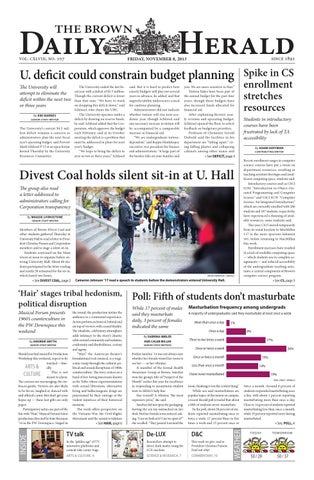
U. deficit could constrain budget planning Spike in CS The University ended the last fisThe University will cal year with a deficit of $5.5 million. attempt to eliminate the Though the current deficit is lower deficit within the next two than that sum, “We have to work on dropping this deficit down,” said or three years By KIKI BARNES SENIOR STAFF WRITER
The University’s current $4.3 million deficit remains a concern as administrators plan the next fiscal year’s operating budget, said Provost Mark Schlissel P’15 at an open forum hosted Thursday by the University Resources Committee.
Schlissel, who chairs the URC. The University operates under a deficit by drawing on reserve funds, he said. Schlissel added that the Corporation, which approves the budget each February, said at its October meeting the deficit is a problem that must be addressed in plans for next year’s budget. “We hope to bring the deficit to zero in two or three years,” Schlissel
said. But it is hard to predict how exactly budgets will play out several years in advance, he added, and that unpredictability underscores a need for cautious planning. Administrators did not indicate whether tuition will rise next academic year, though Schlissel said any necessary increase in tuition will be accompanied by a comparable increase in financial aid. “We are undergraduate tuitiondependent,” said Beppie Huidekoper, executive vice president for finance and administration. “A large part of the burden falls on your families and
you. We are more sensitive to that.” Tuition hikes have been part of the annual budget for the past four years, though those budgets have also increased funds allocated for financial aid. After explaining Brown’s yearly revenue and operating budget, Schlissel opened the floor to solicit feedback on budgetary priorities. Professor of Chemistry Gerald Diebold said the facilities in his department are “falling apart,” citing falling plaster and collapsing cabinets among other issues and » See DEFICIT, page 3
Divest Coal holds silent sit-in at U. Hall The group also read a letter addressed to administrators calling for Corporation transparency By MAGGIE LIVINGSTONE SENIOR STAFF WRITER
ARJUN NARAYEN / HERALD
Cameron Johnson ’17 read a speech to students before the demonstrators entered University Hall.
‘Hair’ stages tribal hedonism, political disruption Musical Forum presents 1960’s counterculture in the PW Downspace this weekend By ANDREW SMYTH SENIOR STAFF WRITER
Should you find yourself at Production Workshop this weekend, expect to be touched — literally. This is not meant to alarm. The caresses are encouraging, the embraces gentle. Viewers are also likely to be hit on, laughed at, danced with and offered a joint. But don’t get your hopes up — these last gifts are only paper. Participatory antics are part of the fun with “Hair,” Musical Forum’s latest production directed by Kate Brennan ’14 in the PW Downspace. Staged in
inside
ARTS & CULTURE
the round, the production invites the audience to a communal experience. Actors perform in front of, behind and on top of viewers with casual fluidity. The ritualistic, celebratory atmosphere adds intimacy to the story’s chaotic orbit around community and isolation, conformity and disobedience, ecstasy and agony. “Hair,” the American theater’s foundational rock musical, is a tragicomic romp through the cultural, political and sexual disruptions of 1960s counterculture. The story centers on a band of free-loving miscreants known as the Tribe, whose experimentations with sexual liberation, alternative living and hallucinogenic drugs are punctuated by their outrage at the violent injustices of their historical moment. The work offers perspective on the Vietnam War, the Civil Rights Movement and the sexual revolution » See HAIR, page 6
Students in introductory courses have been frustrated by lack of TA accessibility By ADAM HOFFMAN CONTRIBUTING WRITER
Recent enrollment surges in computer science courses have put a strain on department resources, resulting in teaching assistant shortages and insufficient computing space, students said. Introductory courses such as CSCI 0150: “Introduction to Object-Oriented Programming and Computer Science” and CSCI 0170: “Computer Science: An Integrated Introduction,” which are currently enrolled with 266 students and 167 students, respectively, have experienced a thinning of available resources, some students said. This year, CS15 moved temporarily from its usual location in MacMillan 117 to the more spacious Salomon 101, before returning to MacMillan this week. Enrollment increases have resulted in a lack of available computing space — which students use to complete assignments — and reduced accessibility of the undergraduate teaching assistants, a central component of Brown’s computer science program. » See CS, page 3
Poll: Fifth of students don’t masturbate While 17 percent of males said they masturbate daily, 3 percent of females indicated the same By SABRINA IMBLER AND CALEB MILLER SENIOR STAFF WRITERS
Evelyn Sanchez ’14 was not always sure whether her friends visited her room to see her — or her vibrator. A member of the Sexual Health Awareness Group at Brown, Sanchez won the group’s title of “Sexpert of the Month” earlier this year for excellence in responding to anonymous student texts to SHAG’s help line. Her reward? A vibrator, “the most expensive prize,” she said. Sanchez did not open the packaging, leaving the sex toy untouched on her desk. But her friends soon noticed, asking, “Can we look at it? Can we open it?” she recalled. “They passed it around the
Masturbation frequency among undergrads A majority of undergraduates said they masturbate at least once a week. More than once a day
1%
Once a day
8%
Three to five times a week
17%
Once or twice a week
26%
Once or twice a month
15%
Less than once a month
14%
I have never masturbated
19% NEEL VIRDY / HERALD
room, thinking it was the coolest thing.” While sex and masturbation are popular topics of discussion on campus, a recent Herald poll revealed that about a fifth of students never masturbate. In the poll, about 26 percent of students reported masturbating once or twice a week, 17 percent three to five times a week and 15 percent once or
TV talk
De-LUX
D&C
In the “golden age” of TV, innovative platforms and content take center stage
Researchers attempt to detect dark matter using the LUX machine
This week we give coal to President Christina Paxson. Find out why!
ARTS & CULTURE, 4
SCIENCE & RESEARCH, 7
COMMENTARY, 10
weather
Members of Brown Divest Coal and other students gathered Thursday in University Hall to read a letter to President Christina Paxson and Corporation members and to stage a silent sit-in. Students convened on the Main Green at noon to organize before entering University Hall. About 60 students participated in the letter-reading and nearly 20 remained for the sit-in, which lasted two hours. » See DIVEST COAL, page 2
enrollment stretches resources
twice a month. Around 8 percent of students responded masturbating once a day, with about 1 percent reporting masturbating more than once a day. Close to 14 percent of students reported masturbating less than once a month, while 19 percent reported never having masturbated. » See, POLL, 4 t o d ay
tomorrow
50 / 29
50 / 37
2 university news
THE BROWN DAILY HERALD FRIDAY, NOVEMBER 8, 2013
calendar TODAY
NOVEMBER 8
2 P.M.
TOMORROW
NOVEMBER 9
10 A.M.
Book Signing: Nathan Schneider
Urban Vintage Bazaar
Brown Bookstore 6:30 P.M.
Kasper Multipurpose Room 8 P.M.
MEDLIFE Variety Show
Risk! Storytelling Performance
List 120
MacMillan 117
menu SHARPE REFECTORY
VERNEY-WOOLLEY
LUNCH Spicy Black Bean Veggie Patty, Onion Rings, Broccoli Florettes, Potato Salad, Tuna Noodle Casserole
German Sausage Chowder, Breaded Chicken Nuggets, Vegan Malibu Grilled Patty, Peanut Butter Bar
DINNER Grilled Chicken Cilantro, Lemon Rice, Corn Mexicane, Black Back Flounder, Green Beans with Roasted Tomato
Vegetarian Chili Cheese Soup, Spinach Pie Casserole, Corn Cobbettes, Vegan Lentil Stew, Tortellini Italiano
sudoku
MAGGIE LIVINGSTONE / HERALD
About 60 students delivered a letter addressed to President Christina Paxson and Corporation members calling for greater administrative transparency.
crossword ARJUN NARAYEN / HERALD
On a drizzly afternoon, members of Brown Divest Coal and other students gathered on the Main Green to organize before their sit-in in University Hall.
» DIVEST COAL, from page 1 “Our consideration of divestiture is not over,” said Cameron Johnson ’17 on the steps outside of the Stephen Robert ’62 Campus Center before the group’s sit-in. Though Paxson and administration members “consider the conversation over,” he told the crowd, the students gathering “have come to tell them that our voices will not be silenced.” Students entered University Hall around 12:25 p.m., and David Katzevich ’16 read a letter composed by Brown Divest Coal members, while other students listened in silence. “We will continue to champion our arguments for divestment, but today we protest in silence because we feel the administration has silenced the conversation,” he said, reading the letter. The letter requested greater transparency from the Corporation, the University’s highest governing body.
The letter presented by Brown Divest Coal asked the Corporation to include at minimum one student, faculty and staff member in its body, make its meeting minutes public, deem the University’s Advisory Committee on Corporate Responsibility in Investment Policies a voting body and require Corporation members with conflictsof-interest to recuse themselves from voting. ACCRIP recommended in April that the University divest its endowment from 15 of the largest coal companies. The letter also called for the allowance of community members to propose items for the Corporation’s meeting agenda and the creation of a committee that would vet potential new Corporation members. After the letter was read, 20 students remained in University Hall and sat holding hands in a circle, with a sign reading “Accountability, Transparency,
Community” in the middle of their circle. They remained in silence for two hours. Three Department of Public Safety Officers arrived at the scene at approximately 12:35 p.m. The officers left 15 minutes later because they told Brown Divest Coal member Rachel Bishop ’13 that they did not “want to give us more publicity,” she said. Kimberly Roskiewicz, assistant to the President, declined to comment on the actions of the students or the letter and told the Herald that Paxson was unavailable for comment. Various Brown Divest Coal members also said the divestment movement is now linked with a campuswide demand that administrators and Corporation members listen to student voices. “It is bigger than Brown Divest Coal,” Bishop said. “The Corporation does not have adequate representation of the Brown community voice.”
university news 3
THE BROWN DAILY HERALD FRIDAY, NOVEMBER 8, 2013
» DEFICIT, from page 1
» CS, from page 1
displaying photos for Schlissel and forum attendees. “The only people who can make these (improvements) happen are you,” he said. Diebold later asked whether the University should focus on “striving for excellence” with its current population and facilities rather than growth. Current goals outlined in President Christina Paxson’s strategic plan include expanding facilities downtown and increasing both the student and faculty populations. “The University would die” if it did not expand, Schlissel said, adding that a place of higher learning like Brown must prioritize bringing in new ideas to “enrich the community.” But Schlissel added, “If we could eliminate academic tenure, we wouldn’t have to grow,” because the University could replenish the faculty with new hires to generate fresh ideas. “This isn’t an enriching place to be a faculty member,” Diebold told The Herald. Students at the forum voiced questions about how the budget deficit will affect financial aid. Schlissel said long-term financial aid is heavily influenced by earmarked donations to the University endowment. Roughly 30 percent of financial aid comes out of the University’s endowment, so making these donations is important to ensure the University can maintain its needblind admission policy, he said. Currently, the need-blind policy applies to domestic first-year applicants. Paxson’s plan mentions universal need-blind admission as a long-term goal, though it does not place a timetable on implementing such a policy. One male undergraduate student asked how Brown’s 250th anniversary celebration would affect the budget deficit. Schlissel said the anniversary events are “not being paid out of the budget.” Instead, the University will use the anniversary as a major fundraising opportunity. John Mulligan GS, secretary of the Graduate Student Council, said many graduate students, especially those in the humanities and social sciences, have to pay “substantial outof-pocket expenses” for research and travel. “If it’s for professional purposes, you shouldn’t have to pay out-ofpocket,” Schlissel responded. He added that more competitive graduate stipends are one of the priorities for the University going forward. Kevin Carty ’15, a general body member of the Undergraduate Council of Students and a sexual assault peer advisor, said a position that administrators referred to as a “men’s health coordinator” should be prioritized in next year’s budget. Carty, a former Herald opinions columnist, said the coordinator would work toward combating issues he views as perpetuated by many male social groups on campus, including binge drinking and sexual assault. The position, which was conceived after conversations with the Greek Council and other groups, has been overlooked for a couple of years, Carty told The Herald.
“We consider the UTA program to be extremely important,” said Thomas Doeppner, vice chair of the department and director of undergraduate studies. “Roughly 60 percent of undergrads are TA’s at least once.” The two main computing areas are the Sunlab and the MSLab, which have about 80 computer work stations total, said Mackenzie Clark ’14, a leader of the Computer Science Departmental Undergraduate Group. “You could in theory do the work remotely on your computer, but it is a huge inconvenience, especially for students new to the department,” Clark said. Having a large number of people share the computers at once slows down processing speed, she added. The growth in enrollment has also spurred a shortage of TAs, especially for introductory classes. Traditionally, the department has maintained a ratio of 10 students per TA. Each TA is available for 2 hours per week, and the demand for TA hours often spikes as project deadlines draw closer, Clark said. Due to time constraints, each student can only spend roughly 15 minutes with a TA at a time, said Aisha Ferrazares ’14, one of two Meta TAs who oversee the UTA program. Despite time restrictions, students often must wait a significant amount of time to see a TA during office hours. “I’ve waited three or four hours to talk to a TA, despite there being 30 TAs, which is ridiculous and shouldn’t happen,” said Ruby Goldberg ’17, a student in CS15. “The intro classes clearly do not have enough TAs,” Clark said. And while the number of TAs has increased, there is a lack of room availability to hold office hours. “TAs want to hold extra hours, but we are unable to accommodate them,” said Eric Caruso ’14, the other Meta TA. Increased enrollment has generated new budgetary concerns, as the department looks to find money to pay for new TAs. “As enrollments have increased, the TA budget has not,” Caruso said. The department has recognized the strain on resources and is working to address them, Doeppner said. Within the next 15 months, Computing and Information Services will move out of the first and second floors of the Watson Center for Information Technology, which will make space for 30 to 50 new computers and additional workspace, Doeppner said. If the program continues to grow at the current rate, it may exceed the capacity of the CIT within the next
ASHLEY SO / HERALD
Students in introductory computer science courses said they have been frustrated by a shortage of TAs, which sometimes causes long wait times for help during TA hours.
ALAN SHAN / HERALD
The CIT’ s two main computer clusters have a total of 80 work stations, though more than 400 students are enrolled in introductory courses. The department has allowed students to work from personal computers. five to 10 years, he added. In order to lighten the load on departmental resources, some students have requested that CS15 and CS17 also be offered in the spring. But the faculty members for these classes only teach in the fall, so the department would have to find new course instructors for the spring, Clark said. The computer science department
has also crafted a new introductory course, CSCI 0080: “A First Byte of Computer Science,” which will be offered this spring. This new course could help reduce overall enrollment in CS15 and CS17 and help students decide if they want to pursue computer science, Clark said. The surge in enrollment has boosted the proportion of women
in computer science classes, providing more gender parity in a historically imbalanced field. The department is now made up of about 25 percent women, Doeppner said. “We are proactive about trying to get more women into the program.” “There seems to be a lot more women in the department, especially in the intro classes,” Clark agreed.
Did you know enrollment in introductory computer science courses has increased 130 percent since 2008? Learn more: thebdh.org/compsci
4 university news » POLL, from page 1
not identify a reason for the poll results that found about a fifth of students do not masturbate. “I was hoping Brown students would be more open about it,” said Frances Aquino ’16, a member of SHAG. “It says a lot about how sex is perceived by men versus women and the connotation of men enjoying sex versus women enjoying sex,” April said. Diego Arene-Morley ’16 was surprised masturbation was not discussed more on campus. “It’s definitely more taboo than you would think for Brown,” he said. “Maybe that’s just because there’s nothing to address and no controversy.” He added that if it came up as a gender or sexuality issue, the campus dialogue might open up. “The way I see people interacting with the topic has a lot to do with their upbringing and their values on sexual behavior,” Ninneman said. “Which may not play out in whether they masturbate or not but shapes their values on it.”
Sex ed Students interviewed expressed little surprise with the results, with a few exceptions. “The only thing I reacted to was the 8 percent” figure referring to students who masturbate once daily, said April, a sophomore whose name has been changed to maintain confidentiality. “How does anyone have time for that?” “But good for them,” she added with a laugh. “For blocking out that much of their day.” Brown Health Educator Naomi Ninneman said these percentages and trends seem consistent with national averages among college students, noting that a person’s twenties mark a “masturbation peak,” a period in which individuals are most likely to masturbate. “We’ve moved from a dialectic about masturbation that shames it,” Ninneman said. “While those messages remain, they don’t dominate.” Ann, a sophomore whose name has been changed to maintain confidentialMythsturbation ity, said she has never masturbated and Though she said she started masdoes not feel comfortable speaking to turbating in ninth grade, April said she her friends about the did not become truly issue. “It’s definitely more comfortable with sex But she said she and her body until taboo than you considers Brown a she came to Brown. “very, very sex-pos“I’d like to think would think for itive” environment. I was a sex-positive Brown.” “It’s a combination person in high school, of institutions that but it was still such a Diego Arene-Morley ’16 Brown has in place foreign concept to and the kind of peome. I didn’t feel like I ple it attracts who continue to form that had the resources to be comfortable with environment,” she said. it at the time, but now I do,” she said. Sanchez noted events and instituTom, a sophomore whose name has tions such as Nudity in the Upspace, been changed to maintain confidentialFemSex, sex week and SHAG’s mastur- ity, has masturbated since high school bation workshops as examples of how but never talked to anybody on campus Brown students spread knowledge of about it and is “completely blind” to sex-related issues. what his peers’ habits are. Of the students who completed the “There’s never been a reason for me poll, about 10 percent left the masturba- to bring it up around my friends,” he tion question blank. said. “But I feel Brown has resources if “It’s a shocking thing to throw at I had questions.” someone, more so in the context of the Ninneman said she frequently meets other questions” on the poll, Ann said. one-on-one with students who have isSome community members could sues or questions regarding their sexual
health, including masturbation. She said the question of whether a student’s individual masturbation habits are normal often comes up during these conferences, adding that she helps students understand there is “a wide range of what is normal.” Aquino said she used to view masturbation as solely meant for sexual pleasure. “But when I joined SHAG, I realized you can use masturbation as a tool to understand yourself. To figure out what kind of lubes, condoms and positions you like.” Donna, a sophomore whose name has been changed to maintain confidentiality, started masturbating at 9 years old, though she did not realize it at the time. Donna described her high school as conservative and heavily Catholic, saying she did not actively explore masturbation until the end of high school when she was in a relationship. But she still did not feel comfortable speaking about these issues — masturbation or her sexual activity — at the time. “For the longest time, I’ve wanted to be open about my sexuality,” Donna said. “Here, I wasn’t going to be judged. I’m actually praised for it.” Sexspecifics Distinct variations between gender and frequency of masturbation surfaced in the poll, with 30 percent of females responding that they never have masturbated, as opposed to 6 percent of males. Similarly, 3 percent of females reported that they masturbate at least once daily, compared to 17 percent of males. Arene-Morley said he thought the subject was more easily discussed by men because it comes up as part of “guy talk,” which he said often centers around sexual experiences. Masturbation can be brought into the conversation, he said. “I’m in a frat, so I hear it in the context of that,” he said. “Being in an environment like that makes it more acceptable or more comfortable.” Though he said he has never spoken to his female friends about it, Tom said he believed masturbation “was just easier for (men).” He added that “things like that maybe would cause men to
THE BROWN DAILY HERALD FRIDAY, NOVEMBER 8, 2013
Differences in masturbation frequency While a majority of undergraduates said they masturbate at least once per week, there were differences across subgroups. Males, juniors, seniors, non-athletes, bisexuals and homosexuals reported masturbating more frequently than other students. AT LEAST ONCE A DAY
All students 10%
ONE TO FIVE TIMES A WEEK
LESS THAN ONCE A WEEK
NEVER
43%
29%
19%
Males Females First-years Sophomores Juniors Seniors Varsity athletes Non-athletes Heterosexuals Bisexuals Homosexuals
50% of students NEEL VIRDY / HERALD
experiment earlier.” Poll results also showed a correlation between probability of having masturbated and class year, with 27 percent of first-years having never masturbated, compared to 13 percent of juniors and seniors. Because he started masturbating before coming to Brown, Arene-Morley said he did not think being on campus impacted his habits. But he added that “just being on your own for the first time” might make people more willing to experiment. Others said they were encouraged to experiment with masturbation through sexual education from groups on campus.
During her sophomore year, Leslie, whose name has been changed to maintain confidentiality, was the only student of 20 in her FemSex section who admitted to never having masturbated. “It was almost shameful to admit that I hadn’t,” she said. Though Leslie was curious about experimenting with masturbation, she said she had no idea where to start. “I could point at a diagram and probably teach a sex-ed class,” Leslie said, “but I didn’t know my own body.” Leslie, who has been in a relationship for over two years now, said she now masturbates both with and without her partner. “It’s a power to give yourself pleasure.”
arts & culture 5
THE BROWN DAILY HERALD FRIDAY, NOVEMBER 8, 2013
Q&A: Alum author discusses prize-winning novel Wolitzer ’81 discussed how her time at Brown influenced her development as a novelist By EMILY DUPUIS CONTRIBUTING WRITER
Last April, New York Times best selling author Meg Wolitzer ’81 published her ninth novel, “The Interestings,” which won Amazon Best Book of the Month. The book follows the lives of an artistically talented group that meets as teenagers at summer camp, where they face the challenges of pursuing their talents in the real world. The Herald spoke with Wolitzer about the book, her time at Brown and her writing process. The Herald: Did you draw inspiration from your days here? Are some of the characters based on people you met during your time at Brown? Meg Wolitzer: Nobody is based on anybody from Brown or anybody, really. I really love making up characters — it’s one of my favorite parts of writing. The creative environment at Brown is not dissimilar to the kind of environment I imagined for these kids, but it’s closer really to my own time at summer camp when I was young. How did your time at Brown affect your writing style? I was in a wonderful writing workshop with (Professor) John Hawkes. He was an experimental writer, a very different kind of writer from most of the students in the class, and he was always so respectful of everyone’s work and the different styles we all did. I think we all felt really appreciated by him. As I was struggling to figure out how to write, I tried different things, and my writing became freer probably during my time there.
Did you always know you were going to be a writer? Pretty much. My mother is a writer, and when I was really young, she would always be incredibly encouraging, and I would show her stories. I have a moment in the novel that I drew from life: A woman stood up during the ‘Q and A’ (of) a talk I gave and said her daughter wanted to be playwright. She didn’t know what to tell her, since she knows how hard it is for someone to make it, and I basically inquired whether her daughter was really talented and whether her daughter needed to do this, and the answer was yes. I said I thought the world would probably whittle her daughter down, and the mother shouldn’t. My mother didn’t, and I think that was important to me when I was young.
What are your creative process and work habits like? I work all the time. That is sort of my thing, I guess — I just love to work. I think that writing, for a lot of people, myself included, is very hard. It’s hard to solve the problems you create for yourself. ... It’s a way in which you’re free of the trivia and anxieties of the real world that I love so much. ... When I’m writing a book, I try to give it precedence over everything else. … If you can keep your writing inviolable and have a time when people can’t reach you, that really works. What was your concentration, and have you found what you learned relevant to your life after Brown? It was English, and reading is so important. What you take in as a writer is so essential to what you put out. If you haven’t read great things, how can you write? Not that you’ll necessarily write something great yourself, but you have to remember why you’re doing this. I think reading wonderful fiction allows you to remember that there are moments of great and
profound beauty in literature.
What advice would you have for anyone interested in being a writer? Taking classes is really great, because you do find a world of other people who are doing this, too. It’s really hard for beginning writers, or at least it was for me, to recognize when something’s good and not good. Sometimes you need an outside eye to look and tell you. ... Often it’s just a friend who likes books, who likes to talk about fiction with you, whose taste you like. Give them something that you’re writing, maybe just a paragraph, and see what they think about it. What inspired this particular novel, and how is it similar to or different from your other ones? I had gone to this summer camp in the summer of 1974 when (President Richard) Nixon resigned. I was from the suburbs, and many of the kids I met were from New York City. They seemed more sophisticated than me, some of them were taking themselves so seriously about different art things. …What interested me was following what happened to talent over time, following it for a very long time. I couldn’t have written it when I was young, because it would have been only a small slice of life. I was really looking at what happens to people, talents, friendships, and I realized I was interested in writing about envy, the kind of quiet envy you can feel for people you really care about where you feel you don’t measure up in some way. ... I was also influenced, in part, by “7 Up” (and) “28 Up.” It’s a British filmmaker who (films the same) group every seven years, starting when they were 7-year-old (British school children). The most recent film was called “56 Up.” It was incredible to see the trajectory of how people change and also the ways in which their selves
Kincaid explores narrative style in reading The author discussed her new novel ‘See Now Then’ as part of the Writers on Writing series By MARCUS SUDAC STAFF WRITER
“Life — real life — as the way life enfolds, is never as you imagine it,” award-winning author Jamaica Kincaid told a packed auditorium in the Perry and Marty Granoff Center for the Creative Arts. “And all that must come must contain right now.” Kincaid spoke Thursday on topics ranging from the relevance of the “moment” to the power of narrative and read excerpts from her most recent novel, “See Now Then,” which tackles themes of time and domesticity. Kincaid, a renowned writer of fiction and nonfiction who originally hails from Antigua, was a featured author in the Department of Literary Arts’ Writers on Writing Reading Series. Professors of Literary Arts Joanna Howard and Renee Gladman chose Kincaid for “her
significant body of work, and because she has published a new novel,” Howard wrote in an email to The Herald. This was Kincaid’s third visit to Brown but her first as part of the series. Kincaid read excerpts from “See Now Then” she felt best represented the “beginning, middle and end” of a piece that, in her words, “really has no beginning middle and end.” The novel follows the Sweets, a family of four living in New England, whose mundane domesticity is brought to life by the toll of time. This is the first of her works to deeply explore time and its affectations, she told the American Reader. In her past works, Kincaid has delved into themes including colonialism, imperialism and racism. “See Now Then” is Kincaid’s first published novel in over 10 years. “The theme itself is about the passage of time and time itself, and what a human being might think that the things within time mean,” Kincaid said shortly before the reading Thursday. Kincaid delivered her messages with humor and honesty. After reading,
Kincaid opened the floor to questions, which included inquiries about her Antiguan background and the influence of Greek mythology in her work. Others asked about the use of repetition in her narrative, a technique she credited to the King James Bible, which she called a personal literary influence. The audience, which comprised students, faculty members and a large community turnout, chuckled occasionally at Kincaid’s remarks and remained engaged throughout the reading. “She’s so funny but so elegant even in her humor. Hearing her speech was so amazing — she puts such life to her words. Even though I’ve never read her before, I’m inspired to read her work,” said Georgia Wright ’17. Kincaid’s reading was co-sponsored by the Department of Africana Studies, Sarah Doyle Women’s Center, Third World Center, Graduate International Colloquium Fund and the Office of the President, Howard wrote. After the reading, Kincaid met with fans, who joined her outside for a reception.
For more Arts & Culture coverage, see browndailyherald.com/arts
COURTESTY OF NINA SUBIN
Wolitzer’s “The Interestings” traces the lives of a group of teens, from their initial meeting at summer camp through their journeys into adulthood. were there when they were 7. How did you accrue the awards for Amazon Best Book of the Month and New York Times bestselling author, and how do you feel about getting them? They’re not actually awards — they’re designations of some sort. But I was very happy about the book being appreciated. The thing with being a writer is that there isn’t a lot of instant gratification. A lot of things are done quietly and alone. … If you’re lucky, when a book comes out there’ll be a little noise — and that’s few and far between because you’re writing for years. As a fiction writer, we live in a very nonfiction era where people think about what’s true, and they
don’t know that fiction, really, when it’s good, can contain what’s true. It’s up to writers to remind them of that through their work. When you have something that seems to penetrate … it’s very gratifying. Anything else you’d like to add? I think very fondly on my time at Brown. … It gave me the freedom to write while at school. I was back there, actually, a summer before last, because my son was in a summer program at Brown. I remember I felt a strong wave of nostalgia, which is not dissimilar from what I’m describing in the book in terms of the camp. I felt I remembered myself being younger and carrying books across campus, which was a very good feeling.
6 arts & culture
THE BROWN DAILY HERALD FRIDAY, NOVEMBER 8, 2013
» HAIR, from page 1
SHIRLEY LEUNG / HERALD
The Internet, video-sharing platforms and crowd-sourced funding have largely changed the way consumers engage with television.
TV in the Golden Age: A Conversation The shifting media industry has changed how the community engages with television By ANDREW SMYTH
ously reported. “TV is kind of where it’s at right now,” said Henry Chaisson ’15, a director of Brown Motion Pictures and Herald video editor, who took the class. “It can tell more complex stories than you could ever tell in a single film.”
SENIOR STAFF WRITER
The red glow of Netflix is a familiar greeting to procrastinators seeking refuge in the warm embrace of “30 Rock.” Online content on demand with no commercial interruptions— this is the model of television consumption that has loomed large in public discourse about media over the last year. But the arrival of streaming services as both producers and purveyors of content is just one in a series of structural changes in the industry. There are more platforms for generating and viewing TV than ever before, and the stories the programs are telling meet new standards of production value and narrative complexity. Cue the critical claim that TV has entered a golden age: As students, faculty members and alums interested in film and television navigate a shifting media landscape, TV has become an attractive option for telling intersecting, longform narratives in a commercially viable package. TV and the Academy The critical study of television in its own right — instead of as an offshoot of film or cultural studies — is a fairly recent phenomenon in university settings, said Associate Professor of Modern Culture and Media Lynne Joyrich, who will teach an introductory course in television studies this spring. “When I first started doing TV studies, it was seen as sort of silly,” she said. “Now I think it is more respected as a medium and as a form of study, as something important to study in academia.” Television not only orders routines and broadcasts information, but it also structures the way pepole, through narrative formations, process everyday experience, Joyrich said. “The same reason that people think it’s funny to study television is because it seems like studying the air we breathe,” she added. “But in the same way that in fact we do study the air we breathe, it’s important to study TV.” Many students were introduced to the academic study of television last semester with the course COLT 1440A: “Storytelling in The Wire” taught by Assistant Professor of Comparative Literature Peter Saval. The class studied the program’s innovative engagement with contemporary social problems, the urban environment and narrative form, The Herald previ-
Evaluating the ‘Golden Age’ Much of the critical attention surrounding the announcement of a “golden age” in television has focused on cinematic dramas. “The Sopranos,” “Mad Men” and, especially as of late, “Breaking Bad,” a triumvirate of high-production-value series, follow morally ambiguous male protagonists as they navigate a series of complex, intersecting narratives. The growing prestige of this particular kind of series has altered professional outlooks among alums interested in breaking into the industry. “Being a regular on a critically acclaimed TV show is kind of the dream job at this point,” said Madeleine Heil ’13, who is currently pursuing a career in acting in Los Angeles. Nonetheless, assigning value to a certain category of television programs can be problematic. “We also want to think about what sort of gender, race, class dynamics are at play in labeling something quality or as part of the golden age,” said Hunter Hargraves GS, a PhD candidate in the Department of Modern Culture and Media. “‘Breaking Bad,’ ‘The Sopranos,’ ‘Mad Men,’ ‘The Wire’ — they are by and large programs that take a very masculinist posture.” Furthermore, the techniques for which many of the great millennial dramas are celebrated, such as interwoven storylines and complex characters, were not invented for the HBO toolkit. “When people (say) ‘The Sopranos’ or ‘The Wire,’ ‘Mad Men,’ it’s so great unlike that trash on TV,” Joyrich said. “Well I’ll say actually they’re soap operas … which for me is not a bad word. For me, it describes a form of ongoing, intersecting, multiple narrative form.” Distribution and consumption The Internet, video sharing and crowd-sourced funding have democratized creative forays into TV production and filmmaking, students and community members said. “Just go and make a movie with your family and friends,” said Maggie Hire ’15, one of the industry coordinators of the Ivy Film Festival. “Put it up online. Get funding through Indiegogo, or whatever you want to do for it. If you have the idea then I think it’s really obtainable.” Online interaction and social media also affords viewers more power to influ-
ence a show’s reception. “The way that people share things with each other is having a huge impact on which television shows are dispersed and made popular,” said Michael Chiboucas ’13.5, who is also pursuing a career in screen acting. “In today’s convergence culture … I would say (the Internet) has actually lead to the growth of TV,” Joyrich said. “If anything with multimedia, I think TV is getting bigger and bigger.” New viewing platforms also encourage previously unseen habits of consumption, such as “binge-consumption,” in which viewers can watch an entire series in a weekend. “The whole idea of television is that … you can stream horizontally and go through a program’s commercial breaks, but also vertically and flip through channels and get breakage that way,” Hire said. “So by doing something like Netflix, you’re essentially eliminating both of those breaks.” TV and film fluidity The perceived superiority of film as an art form — the belief that “television has always been the sort of bad object of popular culture,” as Hargraves put it — might be eroding. “Television has always been the pathway into film,” Chiasson said. “It’s not quite inverting, but it’s evening out.” The much-talked-about example of Lena Dunham, whose film “Tiny Furniture” was influential in securing her HBO contract for the popular TV series “Girls,” points to this changing paradigm, Hire said. Aesthetic gestures traditionally associated with the cinema, such as filming on multiple set locations, expensive cinematography and high definition video quality, are increasingly cropping up in network, cable and streaming television, Chaisson said. Some players, like director David Fincher, who won an Emmy for his involvement with the Netflix original series “House of Cards,” seem to be thriving across both media. “TV’s just kind of becoming much more cinematic, much more film-like. They’re just putting a lot more money into it,” Heil said. It is difficult to locate precisely where TV stands on campus and in the culture at large, but it seems to be changing and changing fast. “You can’t make any simple pronouncements about television,” Joyrich said. “It’s good! It’s bad! It’s the downfall of our culture! No, it’s like the common media language that brings us together! It’s not one or the other. It’s in a complex relation between and across all those things.”
through the Tribe’s personal experiences with draft dodging, protesting and general acting out. It is a portrait of a youth in revolt — a generation grappling with their place in a morally-suspect establishment. Brennan’s decision to stage the show in the round makes for an immersive, visceral work of theater. The audience is not only invited to the party but also complicit in the violence, implicated in the injustice. Her efforts are aided by Skylar Fox’s ’15 exquisite set design. The drama unfolds in a bohemian den atop a rug-adorned platform and textile-draped scaffolding, surrounded by a portion of the audience sitting on blankets and pillows — it is as if Spectrum India exploded in the Downspace. Lighting design by Jared Rosa ’14 — particularly the makeshift chandelier at center stage — lends the proceedings warmth and intimacy. Flashing color bulbs intensify a communal hallucination. The cohesive ensemble’s irresistible tribal verve is the production’s great achievement. Actors are clearly enjoying themselves, and the audience will feel privileged to take part in their raucous powwow. Movement director Jacqueline Braslow ’14 deserves a firm handshake. In repose or high on assorted hallucinogenic drugs, the actors maintain a cohesive gestural vocabulary of flailing limbs. With eclectic costuming by Sofia Kadieva ’16, Sophia Washburn ’16 and Alex Lee ’14, they look the part — and naturally, there are some great wigs. Vocally speaking, music director Simon Goldring ’15 runs a tight ship. There is a long score of music to get through, and Goldring thankfully maintains a brisk pace. Though harmonies are consistently precise and energetic even through tricky passages of music, one is nevertheless left with a general lack of tenor.
Indeed, the men are outshined in this production. Jesse Weil ’16 interprets the pivotal role of Claude sensitively, and Brian Semel ’16 is consistently hilarious in a number of gags, but most of the rest seem somewhat interchangeable. Peter Bowden ’16 is a tad overzealous as cult leader Berger — one can only take so much gyrating — but he charges the cast with so much energy that some of his more overwrought flailing is forgivable. The women of “Hair” are the show’s vocal and emotional nexus. From the moment she intones the show opener “Aquarius,” Emma Chasen ’14 is the Tribe’s indisputable mother goddess — keep your eyes peeled for the girl with the green hair in the purple romper. Katherine Doherty ’16 delivers the vocal highlight as Crissy in the ballad “Frank Mills,” and high-wire soprano yips from Hannah Margolin ’16 add a delightful texture to group numbers. Emily Kassie ’14 exudes a pregnant glow as expectant mother Jeanie, and resident belter Elise Harmon ’17 lends an especially full-throated rendition of “Let the Sun Shine In.” “Hair” is a hefty two-act endeavor, and the show loses some of its momentum in the second act. Despite creative staging efforts, the cast gets lost in the labyrinth of Claude’s bad trip. Luckily, the moments of genuine revelation, joy, desperation and pain do not suffer for it. The finale is sheer spine-tingling goodness. First performed in 1967, “Hair” is a distinct product of its cultural moment. But take one look at last week’s controversy over New York City Police Commissioner Ray Kelly, and it is obvious that the conversations the work provokes about race, civil disobedience and institutional violence are hardly over. The chief virtue of Brennan’s production is that it acquaints audience members intimately with young people who are just as outraged, ecstatic, vulnerable and confused.
DANIELLE PERELMAN / HERALD
The cast of “Hair” uses the PW Downspace to engage interactively with audience members.
DANIELLE PERELMAN / HERALD
Katherine Doherty ’16 plays Crissy and delivers a vocally stirring performance of “Frank Mills” in the show.
THE BROWN DAILY HERALD FRIDAY, NOVEMBER 8, 2013
science & research 7 R.I. signs electric vehicle initiative The plan includes incentives that make the state more amenable to electric cars By CAROLYNN CONG CONTRIBUTING WRITER
COURTESY OF MATT KAPUST
The Large Underground Xenon, or LUX, is the liquid-xenon-filled machine the research team uses to look for dark matter deep in the ground.
Project digs deep for dark matter
Dark matter may make up most of the universe’s mass, but researchers have yet to find it By JASON NADBOY CONTRIBUTING WRITER
A research experiment taking place one mile below Earth’s surface is on track to discovering dark matter, largely thanks to Brown researchers. Though dark matter has yet to be detected by researchers, it is believed to constitute 85 percent of the universe’s total matter, said Richard Gaitskell, professor of physics and one of the experiment’s lead researchers. Dark matter is the “dominant component” of matter in the universe, but “because it doesn’t interact with light,” it’s difficult to detect, Gaitskell said. Scientists know dark matter exists because of the way gravity has been shown to act on structures in outer space, Gaitskell said. The Large Underground Xenon, known as LUX, is a multi-institutional effort to try to detect the elusive matter. The experiment’s development and execution has been five years in the making, Gaitskell said. “The design of LUX is bigger and more sensitive than any previous
experiment,” Gaitskell said. “If you’re looking for very rare particles, then size is important.” Developing a machine sensitive enough to detect dark matter is especially difficult. “It is like being at the Super Bowl with 75,000 people clapping, and they’re trying to hear if a person is breathing. That’s the difficulty of extracting the signal they do,” said Savvas Koushiappas, assistant professor of physics. Koushiappas was not involved in the LUX experiment. Located in an old mine shaft in South Dakota, the LUX contains about one third of a ton of liquid Xenon in a core bath. When particles in the LUX interact with the Xenon bath, the collisions produce flashes of light. Photomultiplier tubes moniter these flashes of light and convert them into electronic signals that can be recorded, Gaitskell said. Dark matter particles interact with the Xenon bath in a unique way, facilitating the possibility of detecting the presence of the evasive particles. The results of the LUX experiment also prove early findings claiming to have discovered dark matter false, said Jeremy Chapman GS, who works with Gaitskell and was involved with the LUX experiment. “It’s hard to convey to people that
having a null result like we had is as important as having a positive result,” said David Malling GS, who also works on the LUX project. “You learn as much from it. We have no clue what dark matter is or is not, so finding what it is not is equally as valid as finding what it is.” People have been trying for 30 years to figure out what dark matter is, and by showing that some of these theories are wrong, the findings allow researchers to focus on the theories that may actually be right, Malling added. “Over the next couple years, we will continue to improve the LUX, make it even better, make it run longer,” Gaitskell said. By 2016, the researchers hope to run a machine 20 times as big, he added. The project was a three-month pilot, Malling said. Following the findings, the team will run a subsequent year-long LUX experiment. The experiment is funded primarily by the U.S. Department of Energy and the National Sciences Foundation but has also received substantial funding from Brown, the state of South Dakota and a private donor, Gaitskell said. When it comes to dark matter, “there’s no bigger slice of the pie to be digging into,” said Chapman. “It’s one of the remaining mysteries of the universe.”
Rhode Island became one of eight states to sign an initiative promoting the use of electric vehicles in the pursuit of greener transportation and cleaner air Oct. 24. The initiative includes adding more charging stations and creating incentives for consumers to purchase electric cars, such as carpool lane access, lower road tolls and better parking spots for users of electric cars, according to the federal memorandum the states signed. The states hope a total of 3.3 million non-emitting vehicles will be in use by 2025, according to the memorandum. “The initiative is a real sign of confidence in electric vehicles and consumer interest,” said Albert Dahlberg, director of state and community relations at Brown and founder of the Rhode Island chapter of Project Get Ready, a non-profit initiative that aims to prepare cities for the introduction of electric vehicles. “It is a bold initiative that will help reduce pollution, greenhouse gases and improve our energy security and economy,” he added. Last year, Dahlberg teamed up with National Grid and Chargepoint to install 50 new electric vehicle charging stations in Rhode Island, two of which are located on Brown’s campus. Electric vehicles use a battery and electric motor unit as their main source of power instead of gas, said Christopher Bull, senior research engineer and senior lecturer at the School of Engineering, who has designed and developed electric vehicle prototypes in the past. Charging stations provide alternating currents so that the battery can charge, he said. Creating a network of charging stations has proved to be a major challenge in making electric car ownership widespread. “For electric vehicles to be widely accepted, charging has to be widely available,” Bull said. “Any new technology takes time to catch on with consumers, and we’re
already seeing higher rates of electric vehicle adoption than we saw with hybrid vehicle adoption 15 years ago,” Dahlberg said, adding that an interest in electric cars will in part be spread by word-of-mouth. But electric vehicles are not necessarily a silver bullet, because the production of electricity on which they run emits carbon gases. In order to determine the net benefit of widespread use of electric vehicles compared to gasoline-powered ones, the original sources of electricity and general carbon footprint must also be factored in, Bull said. “If the electricity is being generated using coal, then the net change in reducing emissions is not big,” he said. The widespread adoption of electric vehicles would put significant demands on current electrical generation systems, meaning that the people who have to live next to the coal fire power plants suffer the consequences, said Bull. “There are winners and losers in that equation, and there could be arguments made that it’s not an equitable way to do things.” “We couldn’t just magically give everybody electric vehicles and have the system work,” he said. But Dahlberg said electricity is getting cleaner all the time, as economic factors coupled with rates set by the Environmental Protection Agency force coal plants to close. “As electricity is getting cleaner, gasoline is getting dirtier,” and “the gulf is just increasing overtime,” he said. Public transportation vehicles may be an especially effective target sector and “an easier way to get more electric vehicles on the road in a fairly controlled manner,” Bull said. “There are lots of dimensions that need to be approached at the same time” to promote the use of electric vehicles, said Bull. “Putting in charging stations makes sense, supporting development of renewable energy resources makes sense, better public transportation options makes sense.” Bull said the charging stations on the Brown campus are a good way to expand electric car use by making people more aware of them as an option. When it comes to electric cars, “people have to see it and see people using it so that the mystery disappears and it becomes routine, commonplace,” he said.
Follow us on Instagram @bdhphoto!
Use #bdhphoto for a chance to be our reader photo of the week featured on our website.
8 sports friday
THE BROWN DAILY HERALD FRIDAY, NOVEMBER 8, 2013
Spoiled by Duck Boat celebrations ETHAN MCCOY sports columnist
HERALD FILE PHOTO
Sean McGonagill ’14 ranked fourth in the Ivy League last season with 14.0 points per game. He has racked up 1,113 career points, which is the 19th best mark in Brown history.
M. BASKETBALL
Young Bears to test their mettle Maia ’15, McGonagill ’14 and Kuakumensah ’16 will provide leadership for the squad By SAM RUBINROIT SPORTS STAFF WRITER
As Head Coach Mike Martin ’04 enters his second season, his inexperienced team may prove a coaching challenge. In his inaugural year with the squad, Martin helped the Bears jump from seventh to fourth place in the Ivy League standings — marking the first time Brown placed in the top half of the league since 2008 — and was named a finalist for the Joe B. Hall award given to the nation’s top first-year coach. But this season, Martin is facing a roster heavy with young players. “It’s a brand new team,” Martin said. “We have so many young guys who are still learning what it takes to be successful at this level. Last year, even though it was my first year, we had experience with Matt (Sullivan) ’13, Stephen (Albrecht) ’13, Tyler (Ponticelli) ’13 and Tucker (Halpern) ’13.5 who at least knew what Division I basketball was all about.” Sullivan’s and Halpern’s departures leave the Bears without two of last year’s top four scorers. Much of the offensive burden will fall to first team All-Ivy selection Sean McGonagill ’14, whose 14.0 points per game last season ranked fourth in the Ivy League. McGonagill’s 1,113 career points are 19th best in Brown history, and his 413 career assists are fourth in the Brown record book. Martin will seek to bolster
McGonagill’s offensive production by shifting the senior away from the pointguard position to reduce McGonagill’s responsibilities as a facilitator. “It’ll alleviate some of the wear and tear of bringing the ball up against pressure for 40 minutes,” Martin said. “But at the end of the day, Sean is a first team all-league player. We’re going to put the ball in his hands as much as we possibly can.” First-year Tavon Blackmon ’17 from Upper Marlboro, MD, will likely fill the vacated pointguard position. Though Blackmon said he feels the pressure of starting his first career Division I basketball game with the offense running through him, he said McGonagill has played a pivotal role in his development. “It’s not too bad because I have (McGonagill), so I can follow his lead,” Blackmon said. “He’s a first team All-Ivy player, so he knows what to do at the pointguard position and he’s walked me through it.” Likely joining Blackmon in the starting line-up is fellow first-year Steven Spieth ’17 from Dallas, TX. Martin said he could relate to his first-years, having been a four-year starter at Brown himself as part of the winningest class in Bruno basketball history. “I remember going out there my freshman year and I just played as hard as I could,” Martin said. “But I wasn’t prepared to be successful at this level. Eventually you learn, but it’s a big adjustment.” Rounding out the Bears’ starting frontcourt is center Rafael Maia ’15 and forward Cedric Kuakumensah ’16. Maia, after being deemed
ineligible his first year due to an NCAA technicality, burst onto the scene last season to lead the Ivy League with 7.5 rebounds per game. Kuakumensah ranked second in the Ivy League with 7.4 rebounds per game and amassed an astounding 66 blocked shots, the most by a first-year player in league history and a Brown school record. Aggressive defense is something Coach Martin has emphasized since coming to Brown in hopes of realizing dividends on the other end of the court. “He stresses it every single day,” Kuakumensah said. “He says defense is what leads our offense, and it has thus far.” But Kuakumensah recognizes it is going to be a team effort to replace the offensive production from last year’s departures. “It takes five people to fill that void,” he said. “A lot of people need to step up, and I think everyone is realizing that.” The Bears open their season at home against Binghamton University Sunday, before facing cross-town rival Providence College Wednesday at the Dunkin Donuts Center. Bruno stunned Providence at home last year with a 69-68 victory on a gamewinning three-pointer from Halpern with less than eight seconds remaining, making Wednesday’s rematch a highly anticipated showdown. But for now Coach Martin said he is only concerned with continuing to prepare his young roster. “We have a lot of improvement ahead of us,” he said. “We’re all part of a bigger thing here ... It’s about all of us doing things to make our program as good as it can be.”
The tattooed, scrappy and enigmatic beardsmen of the Boston Red Sox glided through the streets of Boston aboard the city’s unique amphibious vehicles known as duck boats last Saturday, leaving in their wake a trail of confetti, popped corks and delirious fans. It’s a scene and feeling that Boston has become all too familiar with — and that those from elsewhere are all too tired of hearing about — since the turn of the millennium. After all, this was the eighth time in the past dozen years that the Hub has had a champagne bath and sent out the order to “cue the duck boats.” A run of eight championships in the four major American sports leagues in only 12 years (the Red Sox in 2004, 2007 and 2013; the Patriots in 2000, 2003 and 2004; the Celtics in 2008 and the Bruins in 2011) is downright absurd for a single city. I’ve just been lucky enough to be along for the ride. These 12 years have overlapped with the years of my youth. Growing up in Massachusetts, I’ve been raised in a fantasy world of sports fandom that has turned into a reality. In this way, despite my parents’ best intentions, I’ve been a child and young adult who’s been spoiled silly. Many sports fans wait years, often even a lifetime, to see their teams win it all. Some never do. My father was raised a Phillies addict. Many of his fondest childhood memories come from afternoons spent at Connie Mack Stadium. He had to wait until he was 31, watching on TV from far away in Texas, to see his Phillies lift their first World Series trophy in 1980. To me, 31 years is an eternity. In the sports universe, 31 years is nothing. Take Cleveland, for example. (Sorry, Cleveland.) The city has not celebrated a sports championship in 49 years, not since the Browns won the NFL Championship in 1964, before the the Super Bowl was created in 1970 and the NFL’s modern era began. Since then, the Indians blew a late-inning World Series Game Seven lead in 1997, the Cavaliers made only one NBA finals appearance and lost (soon thereafter losing Lebron James, as well) and those same Browns have failed to make it to the Super Bowl and had 12 losing records in their past 14 seasons. Then there are the diehard fans of individual teams. The Chicago Cubs have not won a World Series since 1908 and have not made it to the series since 1945. In hockey-crazed Toronto, the Maple Leafs — a member of the NHL’s “Original Six” teams — have never lifted the Stanley Cup in the league’s 96-year history. In the NBA, 13 franchises have never won a title. I don’t mean to rub salt in wounds or brag here. But upon reflection, I realize I in many ways have no idea what it really means to be a sports fan, to have to stick with a team through thick and thin. There was full-on panic in the streets last season when the Red Sox finished with a losing season (their
first in 14 years), and the city — myself included — called for the players and manager to get the axe. But in Pittsburgh, this was the norm for the Pirates, until this season brought their first winning record and playoff appearance in two decades — roughly the span of my lifetime. The Cardinals ousted the Pirates in the NLDS, but that could do little to diminish the joy that season brought to the club’s fan base. But I’ve been conditioned to think that anything less than a championship is a disappointment. The Patriots haven’t won a Super Bowl since 2004, but since then have had winning records in every season, won their division seven times, reached the AFC championship four times and gone to the Super Bowl twice. After the Super Bowl loss in 2011, I posted (much to my regret) a melodramatic Facebook status about the demise of the Belichickian formula, how Tom Brady again came up small in a big game and how the team needed to shake things up in the off-season. The division titles, the records, the playoff runs every year didn’t mean anything. I lay in bed staring at the ceiling until 4 a.m. that night, all because the Patriots hadn’t won the game to earn their first title since 2004. I have no idea what it’s like to root for a team that hasn’t been competitive in my lifetime. I have no idea what it was like in my own city before this era of dominance. The Red Sox famously hadn’t won a World Series since 1918. Until 2000, the Patriots hadn’t won an NFL championship or even an AFL title when they were the Boston Patriots in the 1960s. The Bruins hadn’t had their names on the Stanley Cup since 1972. Many Boston fans went their entire lives without seeing their teams win, and the city I’ve been lucky enough to be raised in would seem to them like some sort of utopian dreamland. I like to think that I could have stuck with my teams through the down years had they had them, but who knows? Maybe I’ll be put to the test in the coming years. The Celtics have finally entered rebuilding mode and look terrible so far in the young NBA season. Tom Brady is now 36 years old and (much to my sadness) will not be able to play forever. An aging Belichick with little left to add to his resume might move along with him. I am constantly elated by my city’s successes, by how every season I can go in believing that my team has a genuine chance to be the best. But I am cognizant of how spoiled I am. Of how this is not a normal fan experience. Of how fans from Cleveland, San Diego and Buffalo hate my guts. Of how my father didn’t have this as a child and how my children likely won’t either. I am the kid who is given everything he wants while the child next door is not. But I’m just going to keep enjoying it while it lasts.
Ethan McCoy ’14 offers his apologies to the cities of Cleveland, Chicago and Toronto. Send him hate mail at ethan_mccoy@brown.edu.
sports friday 9
THE BROWN DAILY HERALD FRIDAY, NOVEMBER 8, 2013
ATHLETE OF THE WEEK
Caldwell ’14 claims 11th overall at Ivy championship race The co-captain has placed first for the Bears in every race she has competed in during her final season By ANDREW FLAX SPORTS STAFF WRITER
With her cross country career drawing to a close, Heidi Caldwell ’14 wasn’t about to go quietly. In last weekend’s Ivy League Heptagonal Outdoor Track and Field Championships — the race that determines the conference champion — Caldwell was first among the last-place Bears and snagged 11th overall. Co-captain Caldwell has led the Bears on and off the course this season, placing first on the team in every race. She finished 10th overall at the Dartmouth invitational, 31st at the Paul Short Invitational and second at the Rothenberg Invitational. For her leadership and success, Caldwell has been named The Herald’s Athlete of the Week. The Herald: What was it like to run at your fourth and final Ivy League championship meet? Caldwell: It was really sentimental.
The Ivy League meet is kind of like — I don’t even know how to describe it. It’s a really special meet where all the Ivies come together, and it just means … basically it was really sentimental, and it meant a lot, and it’s my favorite meet of the year. I love it more than track. … Everyone goes out there and gives it their all, and there’s such a rivalry between all the Ivy Leagues, and everyone goes balls to the wall, and it’s really fun. With only the NCAA Championships left, are you starting to get nostalgic about your career at Brown? Yes, I was actually just talking to my friend about that. It’s really sad. Cross country has been my favorite sport since high school, and the team has been such a big part of my college experience, so I’m really sad. I’m just trying to make the most of the final few weeks and do my best in our last meet. What are your hopes and expectations for NCAA regionals? I really want our team to do well, first of all. A top-ten finish would be a really big deal. I don’t think we did what we could have done at our Ivy League meet, so I think we’re all pumped and ready to do better. And personally, I don’t know.
I don’t really like setting tangible goals. I just want to hopefully keep improving over the next two weeks and do the best I can and hopefully finish better than I ever have at regionals. When did you start running competitively? My freshman year of high school. Why did you choose Brown, and has your experience lived up to your expectations? Yes, it has lived up to my expectations. I don’t know why I chose Brown. I went on different recruiting trips to different schools. I think it all sort of came down to the team atmosphere, and I loved everyone I met on and off the team on my visit. It just seemed like the perfect fit, and it was fun, really fun. Could you say a little about why you chose environmental studies as a concentration? I’m from New Hampshire, and I’ve always loved the outdoors, so I think I just decided that all those classes were the most interesting to me. And with running, we’re always outside and in nature, and I was like, “You know what? This is perfect.” So I went with that.
Bruno looks to build on School Daze | Christina Tapiero experience and chemistry
By BRUNO ZUCCOLO SPORTS STAFF WRITER
The Bears will launch their season 1 p.m. Sunday when they play against Lafayette College in the Pizzitola Center. Bruno hopes to improve on last season’s losing record (9-19, Ivy 3-11) which left the team in seventh for the conference. Head Coach Jean Marie Burr said the main goal for the season will be to “bring our seventh championship back to College Hill.” The last time Bruno took home the title was in 2006. “Right now we’re kind of the underdogs in the Ivy League, so we have a lot to build up,” said Natalie Ball ’16. “But I think right now we’re in a strong position to do really well this year.” The Bears lost three seniors from last season, who together scored just over 30 percent of the season’s total points. “We did lose a few seniors last year, and even though they’re going to be hard to replace, we’ve really grown a lot as a team throughout the preseason,” said Jordin Alexander ’16. “We have the potential to do big things this season.” To make up for the loss, three new players were recruited over the summer. “We really were very selective with what we needed to bring in,” Burr said. The Bears will also have a more experienced team this year, with five seniors on the squad. Co-captain Lauren Clarke ’14 said this will improve the squad’s chemistry. “We’re definitely looking to use our experience to our
advantage as an older team now,” she said. Alexander said team-building skills were an important part of preseason. “One of our main focuses (is) just to get everyone on the same page,” she said. “One of our biggest (goals) is to play as a team, and not win games just individually,” Ball said. She said rebound success is another element of the Bear’s game where there is room for improvement in the upcoming season. Last season they averaged a rebound margin of -5.4 per game. Burr said she hopes increased team depth will benefit the Bears this season, since last year they suffered from several injuries. “I think we have more of an uptempo team,” Burr said, “as well as more depth to keep that going.” Bruno’s biggest point threats are Clarke and Sophie Bikofsky ’15, who scored 366 and 245 points respectively last season. Clarke, who has racked up an impressive 859 points in her Brown career, said reaching 1000 is “a milestone that (she) would like to get to.” “She’s a prolific scorer, she has the ability to shoot the three, charge for the basket or set up other people,” Burr said. The team has been practicing since Oct. 1, but physical conditioning started in September. “We have a really long preseason,” Alexander said. “Lots of conditioning, lots of individual work.” “We’ve just been practicing, preparing for this upcoming weekend,” Clarke said. “So yeah, we’re excited to finally play … and kind of see how all this work is going to pay off, and just see where we are right now, in the beginning of the season, and where we can go from there.”
What are your plans for next year? Oh, great question. I’m very undecided at the moment. I think eventually I want to go into teaching and coaching
comics
WOMEN’S BASKETBALL
Co-captains Clarke and Bikofsky scored 366 and 245 points, respectively, for the Bears last season
JESSE SCHWIMMER / HERALD
Heidi Caldwell ’14 said she wants to go into teaching and coaching at the high school level at some point after graduating from Brown.
A & B | MJ Esquivel
for high school, but I don’t know if I’m going to do that right away. Maybe something environmental, maybe something totally random.
10 commentary
THE BROWN DAILY HERALD FRIDAY, NOVEMBER 8, 2013
DIAMONDS & COAL Cubic zirconia to the student athlete who said, “We are a mature team now because a lot of the players are older.” Good to know Benjamin Button isn’t playing on the Brown volleyball team. Coal to President Christina Paxson for reminding us that “we live in a more uncertain world than we did 12 years ago.” Tell us about it — that whole puberty thing turned everything topsy-turvy. A diamond to Lecturer in Biology Richard Bungiro, who gets a flu shot in front of his immunology class every year. It’s not every professor who will shoot up in front of his students. A diamond to the student who said of Paxson’s creation of a committee to address the events of Oct. 29, “How many committees is Paxson going to create? There are so many.” Probably one for each day of the week, ya know, like the underwear. Cubic zirconia to Elizabeth McQuaid, research associate professor of psychiatry and human behavior at the Alpert Medical School and a staff psychologist at Hasbro Children’s Hospital, who created a software to help children with allergies learn to avoid dangerous situations and said, “We hope it sparks a conversation between parents and children.” Well, that’s one thing educational allergy software and those magazines under our mattress have in common. Coal to Nick Bibby, the artist who created Indomitable, a new life-size kodiak bear sculpture on Ittleson Quadrangle, who said he wanted to avoid creating a “couch-potato zoo bear.” Maybe, but it sounds to us like you just found a million dollar idea for a neat new show on Nickelodeon. Cubic zirconia to gubernatorial candidate Ken Block, who said, “My 100 percent focus is educational and economic issues as they pertain to the state of Rhode Island.” Well, at least they don’t pertain to Narnia. A diamond to the junior who said the new sticker system for marking “party houses” reminds her of “The Scarlet Letter.” We would totally go shot for shot with Hester Prynne. Coal to the sophomore who said of the need to use standardized testing in public schools, “We cannot go back to the dark ages anymore.” And here we found the feudal system so promising.
K I M B E R LY S A LT Z
LETTER TO THE EDITOR
Committee will review all details surrounding Kelly event To the Editor: I am writing to clarify the specific charge and responsibilities of the Committee on the Events of October 29th and to provide information about the process by which members will be selected. The Herald’s Nov. 7 article, “U. to create committee in wake of Kelly protest,” is inaccurate in stating that the group “is charged with determining whether the protesters will face disciplinary action.” An important distinction is that in phase one of its charge, the committee will review the totality of the situation leading up to and including the lecture. With the facts in hand and overall context more fully understood, the administration — not the committee — will determine whether disciplinary action is warranted and, if so, which of the several methods for handling conduct violations would be followed. Options include mediation, a conduct warning, a dean’s hearing or referral to the Student Conduct Board. All cases and proceedings are confidential. As President Christina Paxson’s Nov. 6 letter to the community states, the second phase of the committee’s work “will address the broader issues of campus climate, free expression and dialogue across difference that have been the context for much of the discussion and activity of the last
week. Specifically, the committee will make recommendations regarding how the University community can maintain an inclusive environment while upholding our deep commitment to the free exchange of ideas.” Once a committee is formed, it will offer a timeframe for accomplishing both phases of the charge. While we hope for expediency, particularly with regard to phase one of the work, it is also essential that the committee has the requisite time to conduct a thorough and thoughtful review. Committee membership, which will consist of five faculty members, two undergraduates and one graduate student, will be determined in consultation with the relevant internal governance bodies. Specifically, the Faculty Executive Committee, the Graduate Student Council and the Undergraduate Council of Students will be directly involved in making recommendations and considering suggestions. To ensure a full, fair and objective review of the events, individuals (either faculty or students) who attended the event will not be eligible to serve on this committee.
Mark Schlissel P’15 Provost
Q U O T E O F T H E D AY
“It’s good! It’s bad! It’s the downfall of our culture!” — Lynne Joyrich, associate professor of Modern Culture and Media See TV, page 4. Editorial Leadership
Sections
Visuals & Production
Business
Editors-in-Chief Lucy Feldman Shefali Luthra
Arts & Culture Editors Hannah Abelow Maddie Berg
Head Photo Editor Emily Gilbert
General Managers Julia Kuwahara Samuel Plotner
Managing Editors Elizabeth Carr Jordan Hendricks
City & State Editors Sona Mkrttchian Adam Toobin
Senior Editors Aparna Bansal Alexa Pugh
Features Editors Jennifer Kaplan Elizabeth Koh
Strategic Director Greg Jordan-Detamore
Science & Research Editors Phoebe Draper Kate Nussenbaum
BLOG DAILY HERALD Editor-in-Chief Meredith Bilski
Sports Editors James Blum Connor Grealy
Managing Editor David Oyer
University News Editors David Chung Mathias Heller Eli Okun
POST- MAGAZINE
Editorial Page Editor Rachel Occhiogrosso
Editor-in-Chief Ben Resnik
Opinions Editors Gabbie Corvese Garret Johnson Maggie Tennis
Photo Editors Brittany Comunale David Deckey Samuel Kase Sports Photo Editor Jesse Schwimmer Video Editors Henry Chaisson Assistant: Danny Garfield Data Science Editor Andersen Chen Web Producer Joseph Stein Design Editors Kyle McNamara Mie Morikubo Julia Shube Assistant: Sandra Yan
facebook.com/browndailyherald
@the_herald
browndailyherald.com
Directors Sales: Eliza Coogan Finance: Nicole Shimer Alumni Relations: Emily Chu Business Dev.: Justin Lee
Location: 195 Angell St., Providence, R.I. www.browndailyherald.com
Office Manager Shawn Reilly
Corrections: The Brown Daily Herald is committed to providing the Brown University community with the most accurate information possible. Corrections may be submitted up to seven calendar days after publication.
Sales Managers Regional: Jennifer Aitken Regional: Jaqueline Chang Regional: Leslie Chen Regional: Wenli Shao Regional: Carolyn Stichnoth Student Group: Anisa Holmes Finance Managers Collections: Sameer Sarkar Collections: Timothy Sharng Operations: Sarah Levine
Copy Desk Chief Sara Palasits
Alumni Relations Manager Engagement: Alison Pruzan
Illustrations Editor Angelia Wang
Business Dev. Managers Project Leader: Melody Cao Project Leader: Kaden Lee
Editorial contact: 401-351-3372 herald@browndailyherald.com
Business contact: 401-351-3260 gm@browndailyherald.com
Commentary: The editorial is the majority opinion of the editorial page board of The Brown Daily Herald. The editorial viewpoint does not necessarily reflect the views of The Brown Daily Herald, Inc. Columns, letters and comics reflect the opinions of their authors only. Letters to the Editor: Send letters to letters@browndailyherald.com. Include a telephone number with all letters. The Herald reserves the right to edit all letters for length and clarity and cannot assure the publication of any letter. Please limit letters to 250 words. Under special circumstances writers may request anonymity, but no letter will be printed if the author’s identity is unknown to the editors. Announcements of events will not be printed. Advertising: The Brown Daily Herald, Inc. reserves the right to accept or decline any advertisement at its discretion. The Brown Daily Herald (USPS 067.740) is an independent newspaper serving the Brown University community daily since 1891. It is published Monday through Friday during the academic year, excluding vacations, once during Commencement and once during Orientation by The Brown Daily Herald, Inc. Single copy free for each member of the community. Subscription prices: $280 one year daily, $140 one semester daily. Copyright 2013 by The Brown Daily Herald, Inc. All rights reserved. Periodicals postage paid at Providence, R.I. Postmaster: Please send corrections to P.O. Box 2538, Providence, RI 02906.
commentary 11
THE BROWN DAILY HERALD FRIDAY, NOVEMBER 8, 2013
Enough with the committees, already GABRIELLA CORVESE opinions editor
The month of October saw events that shook Brown to its core. Between the Corporation’s decision to not divest the endowment from holdings in major coal companies to the protests against New York Police Commissioner Ray Kelly’s lecture, the Brown community grew polarized, and beliefs from all sides were challenged. Students responded by protesting and making their opinions heard. President Christina Paxson created committees. First conceived last semester, the Environmental Change Task Force was established in response to the fight for coal divestment to “supplement the work of our standing committee on campus sustainability,” Paxson wrote. And after protesters rallied against “stop-and-frisk” policing policies inside and outside of List Art Center — ultimately shutting down his lecture — Paxson proposed the Committee on the Events of October 29th to suggest ways that Brown can “maintain an inclu-
sive and supportive environment for all of our students while upholding our deep commitment to the free exchange of ideas.” There is nothing wrong with wanting to take more action on controversial issues. But these committees ignore the effort and accomplishments of student groups themselves. Are student voices so inferior that they are not valid until they bear the official University seal? Even more disconcerting is the fact that these committees arose only after the student body attempted to thwart the status quo. Climate change has always been a reality, but it wasn’t until the angry letters and protesters arrived that the administration sprung into action. And though the community forum on October 30th allowed students to voice thoughts on racial profiling, administrators’ thoughts quickly bounced back to discipline and disappointment. Establishing administrative committees for each and every issue at Brown suggests that the only way to achieve change is through compliance and bureaucracy. While it may appear as a supportive response to controversy, it ruthlessly strips legitimacy from existing student groups. These student groups can continue
their work, but the committees, hap- fects underrepresented minorities. pily speckled with faculty members These students succeeded in their and just a handful of students, will goal of having the lecture canceled take “official” action. and opened a campus-wide disCertainly much of Brown’s insti- course on a variety of widespread istutional significance is due to our sues. distinguished faculty. But an equal, But why bother with discussion if not greater, when there part of it beare conduct “Are student voices so longs to our violations? inferior that they are not Leave it to The passionate students. Committee! valid until they bear the On the enI am espeofficial University seal?” vironmental cially baffled front, Brown by the memDivest Coal fought to raise aware- ber selection process for this comness of coal’s harm, both on campus mittee, which will occur “in conand in the community. Other student sultation with the Faculty Execugroups such as EcoReps, the Sustain- tive Committee and relevant student able Food Initiative and Beyond the groups.” It seems ironic that a comBottle, just to name a few, work on mittee designed to address issues different environmental issues to of social justice would employ such promote campus sustainability. elitism — elitism that can fracture But these groups can step aside existing groups on campus. now, since Brown has created The Not selected to be a member? Committee! Keep on working with other stuLast week, students protested dents, but remember — you are not Kelly’s lecture. They fought against part of The Committee! the Taubman Center for Public PolOnly time will tell whether or not icy and American Institution’s deci- these committees are more than an sion to provide a speaking platform administrative publicity stunt in reto the champion of stop-and-frisk sponse to controversial issues. Per— a policy that contributes to racial haps mine is a cynical view, and perprofiling and disproportionately af- haps these committees actually will
lead to progress at Brown. But my concerns about their fates remain. Who determines whether or not an issue deserves a committee? What impact will a committee have when there is another pressing conflict that grabs attention instead? How much will these committees matter weeks, months and years from now when October’s events fade from the public eye? The administration’s approach to recent issues is well-intentioned but misguided. These committees imply there is something wrong with how Brown students already mobilize their passion. Regardless of the outcome of Brown Divest Coal’s efforts or those who protested against Kelly, they both make one thing clear: students don’t need committees to make our voices heard. It should not be students’ responsibility to join what administrators consider to be an appropriate committee. The faculty and administration should join us.
Gabriella Corvese ’15 is developing the Committee on Column Commentary and can be reached at gabriella_corvese@brown.edu.
A task for the Environmental Change Task Force DANIEL CARRIGG opinions columnist
This week, Provost Mark Schlissel P’15 announced the launch of an Environmental Change Task Force at Brown. He described the group as “charged with recommending actions that members of the Brown community might take, beyond campus-based sustainability efforts and discussion of divestiture, to work toward mitigating the consequences of environmental change.” If the community decides it wants to work towards mitigating the consequences of environmental change, then it’s time to roll up our sleeves and get to work. There is no shortage of local actions that we as a community, city and state could take. Rhode Island is already taking many serious steps toward sustainability. The Department of Environmental Management regulates carbon dioxide emissions, and our state is part of a regional greenhouse gas cap-and-trade initiative. We have a state law that requires electric and gas utilities to purchase all available cost-effective energy efficiency technologies — such as providing
incentives for insulation and effi- ture for electrical transmission to cient heating and lighting — before be capable of providing a minimum buying additional energy from pow- 5.5 gigawatts of wind from northern er plants. The state has signed on to New England and an additional 1.5 the most stringent vehicle emissions gigawatts of Canadian hydropower standards in the country, and re- to the region by 2030. But we need cently, Gov. Linto be ready, coln Chafee ’75 willing and able “If the community P’14 P’17 signed to purchase the a multi-state decides it wants to work power before pact to increase such investtowards mitigating production of ments can take the consequences of zero-emission place. vehicles. Finally, There are environmental change, we have a host many more inthen it’s time to roll up novative ideas of incentives and standards to proour sleeves and get to that we could mote renewable take up as a work.” energy. state or a reBut there is gion. As an exever more to do. The New England ample, New York Gov. Andrew CuoGovernors and Eastern Canadian mo P’17 just announced the creation Premiers have adopted a goal of an of a “Green Bank” in New York this 80 percent reduction in greenhouse fall. The idea behind the concept is gas emissions by 2050, and they re- to mature financial markets for encommitted to these goals in Montre- ergy efficiency and renewable energy al in September. But still, there are products so that significant private no reduction goals expressedly set by capital can be deployed for these state statute. State law mandates that purposes. In New York, the state gov16 percent of energy purchases come ernment plans to use public money from renewable sources by 2019. But to seed the bank with about 16 perthe vision after 2019 remains foggy. cent of its total investment. The fund New England’s Independent System will eventually become 100 percent Operator is planning on infrastruc- private. There are few reasons why
loans for clean energy projects that could provide a positive return on investment should be more difficult to get than are loans for automobiles and heavy equipment that rapidly depreciates. Such a mechanism should be watched, studied and potentially implemented here. Since 2006, our state has had some of the country’s most robust incentives for energy efficiency. But these incentives only go to homes that heat with natural gas and electricity. Nearly 40 percent of homes in Rhode Island heat with oil or propane. These fuels are not regulated, so there are few existing mechanisms the state can use to incentivize efficiency in homes that heat with them. This is true even if spending money on generic insulation would save money and provide a net economic gain over spending money on additional heating oil. Developing policies to incentivize energy efficiency in homes and businesses that heat with fuel oil and propane would go a long way toward reducing greenhouse gas emissions here at home. There are additional areas where market incentives do not align with climate change goals. As any
browndailyherald.com/opinions
Brown student who has rented an old, drafty, un-insulated Providence apartment knows, landlords do not often have much incentive to make their properties energy efficient. When tenants pay the heating and electric bills, landlords do not see much return on investment for taking energy efficiency measures. And even if tenants would see benefits in reduced utility bills, they are unlikely to want to spend the capital to improve a landlord’s home. These are not insurmountable problems. But they are problems to which we may give thought and propose solutions. The prudence of involving ourselves in state and local affairs is questionable at best. But if the new Environmental Change Task Force truly seeks to mitigate the consequences of environmental change beyond campus sustainability efforts and divestment, then working out concrete proposals for new state and local initiatives to cost-effectively reduce greenhouse gas emissions is a reasonable thing to do.
Daniel Carrigg GS thinks this task force could make a real difference. He may be reached at daniel_carrigg@brown.edu.
daily herald sports friday THE BROWN
FRIDAY, NOVEMBER 8, 2013
FOOTBALL
Bears look to keep rolling in New Haven Two top league rushing attacks will face off as Bruno aims to build on a blowout against Penn
HOME GAMES THIS WEEKEND FRIDAY
Volleyball vs. Cornell 7 p.m. @ Pizzitola Center W. Ice Hockey vs. Quinnipiac
7 p.m. @ Meehan Aud. SATURDAY
Swimming and Diving 12 p.m. @ Aquatic Center W. Ice Hockey vs. Princeton 4 p.m. @ Meehan Aud. Volleyball vs. Columbia 5 p.m. @ Pizzitola Center SUNDAY
W. Basketball vs. Lafayette 1 p.m. @ Pizzitola Center W. Soccer vs. Yale 1 p.m. @ Stevenson Field M. Basketball vs. Binghamton
3:30 p.m. @ Pizzitola Center
By CALEB MILLER SENIOR STAFF WRITER
With its season back on track after two consecutive Ivy League wins, Bruno eyes its first winning conference record, an outcome that hinges on defeating Yale Saturday. A 27-0 thumping of the defending Ivy champion Penn (4-3, Ivy 3-1) last weekend proved Bruno (5-2, 2-2) has moved past its early struggles fighting the Ancient Eight. With three games remaining, an undefeated streak would put the Bears in the mix for a conference title. “You hope the wins carry some momentum. I think they have some confidence,” said Head Coach Phil Estes. Standing in their way is a Bulldog team that is trending in the opposite direction of the Bears. Yale (4-3, 2-2) stomped the winless Columbia last week, but lost three in a row prior. Estes called injuries driving forces behind the Elis’ mid-season struggles. “They have some tools … that are as good as anybody in the league,” Estes said. “When those guys are together, they are a very potent offense, but they have been hurt.” Fans at the Yale Bowl will be treated
to a duel between two of the Ivy League’s top running attacks. Against the Quakers last weekend, John Spooney ’14 was nothing short of astounding in his 232-yard performance, featuring touchdown runs of 93 and 94 yards. Spooney put the offense on his back using game-changing speed, proving he had overcome an injury that sidelined him for a game and a half. But Spooney will not be the only explosive tailback on the field. Yale’s Kahlil Keys also broke a 94-yard touchdown run last week, and he is not even at the top of the Bulldog depth chart. Tyler Varga leads the team in carries and averages over 120 rushing yards per game. Varga broke the century mark in a losing effort at Brown Stadium last season but is questionable for Saturday as he nurses a foot injury that has caused him to miss two games. Countering the Bulldogs’ powerful backfield is a run defense for Brown that ranks third in the conference in yards allowed per game and held Penn to only 86 yards in last weekend’s shutout. Defensive end and co-captain Michael Yules ’14 sees the shutout as a source of momentum the team will need against a tough Yale ground attack. “Even without Varga, they have continued to have success,” Yules said, adding the defense is looking to “build on last week when we had success because we played fast and attacked fronts.” Bruno might find an advantage through the air, where quarterback
EMILY GILBERT / HERALD
Co-captain Michael Yules ’14 said he hopes Bruno can sustain momentum after a 27-0 thrashing of Penn last week. Patrick Donnelly ’13.5 averages 228 yards at practice was to avoid resting on team per game — 60 yards more than Yale laurels, adding that offense still had probstarter Henry Furman. Bruno’s pass de- lems to work out. fense was a big reason the Bears shut out “Other than those two big runs, I Yale 20-0 last season, as they held Bulldog don’t think offensively we played our quarterbacks to just four completions best game,” Estes said. “We need to unand two intercepted passes in the game. derstand that we can’t count on Spooney Despite a dominating performance to make all these great runs. We have a last weekend, Estes stressed that the focus lot that we need to correct.”