Daily
Herald
THE BROWN
vol. cxlviii, no. 100
since 1891
WEDNESDAY, OCTOBER 30, 2013
Ray Kelly lecture canceled amidst community protest The event was canceled half an hour in, following heated remarks by audience members By CAROLYNN CONG AND JILLIAN LANNEY CONTRIBUTING WRITER AND SENIOR STAFF WRITER
GREG JORDAN-DETAMORE / HERALD
More than 100 students and community members protested the scheduled lecture by New York City Police Commissioner Raymond Kelly, resulting in the event’s cancelation.
A lecture by New York City Police Department Commissioner Raymond Kelly scheduled for Tuesday afternoon was canceled after protesters halted Kelly’s speech and would not yield the floor. Controversy preceded the talk — titled, “Proactive Policing in America’s Biggest City” — due to its speaker’s staunch support for the
contentious stop-and-frisk policy. The event was presented by the Taubman Center for Public Policy and American Institutions as part of the Noah Krieger ’93 Memorial Lecture series. Student protest actions leading up to the event included creating a petition and holding a vigil in honor of victims of racial profiling, The Herald previously reported. After administrators rejected demands laid out in the petition, protest efforts expanded, according to a press release distributed by the event’s protesters. Around 100 students and community members gathered outside List Art Center about an hour before the lecture was scheduled to start, chanting phrases such as, “Ray Kelly, you » See KELLY, page 7
BrainGate researchers win major prize for neuro technology U. scientists will use the $1 million prize to defray the costs of the neural electrode technology By ANDREW JONES STAFF WRITER
The $1 million Moshe Mirilashvili Memorial Fund Breakthrough Research and Innovation in Neurotechnology Prize was awarded to BrainGate researchers for their creation of a brain-computer interface that could aid people with paralysis. Israeli President Shimon Peres presented the award to Professor of Neuroscience John Donoghue PhD ’79 and Professor of Engineering Arto Nurmikko at a technology conference Oct. 15 in Tel Aviv.
SCIENCE & RESEARCH
The interface is composed of a small patch of electrodes that receives and transmits neural signals to a computer that interprets patterns and sends commands to operative assistive devices. Most famously, in May 2012, the team released a video of a woman with severe paralysis grabbing and drinking from a bottle with a robotic arm simply by thinking about moving her arm. BrainGate is a “team of physicians, scientists and engineers working together to study the brain and develop neurotechnologies for people with neurologic disease, injury, or limb loss,” according to the group’s website. While based at Brown, the team also collaborates with the Providence Department of Veterans Affairs, Massachusetts General Hospital, Stanford University and Case Western Reserve University. The prize came as a surprise to » See BRAIN, page 2
COURTESY OF CHEN GALILI
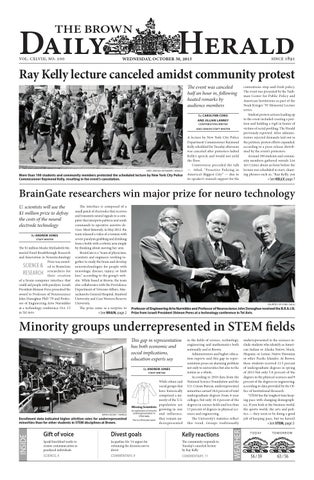
Professor of Engineering Arto Nurmikko and Professor of Neuroscience John Donoghue received the B.R.A.I.N. Prize from Israeli President Shimon Peres at a technology conference in Tel Aviv.
Minority groups underrepresented in STEM fields By ANDREW JONES STAFF WRITER
DAVID DECKEY / HERALD
inside
Enrollment data indicated higher attrition rates for underrepresented minorities than for other students in STEM disciplines at Brown.
While ethnic and racial groups that have historically comprised a minority of the U.S. population are Missing Scientists growing in size An exploration of minority underrepresentation in and influence, STEM fields they remain unFirst in a three-part series derrepresented
in the fields of science, technology, engineering and mathematics both nationally and at Brown. Administrators and higher education experts said this gap in representation poses an alarming problem not only to universities but also to the nation as a whole. According to 2010 data from the National Science Foundation and the U.S. Census Bureau, underrepresented minorities earned 18.6 percent of total undergraduate degrees from 4-year colleges, but only 16.4 percent of the degrees in science fields and less than 13 percent of degrees in physical sciences and engineering. The University’s statistics reflect this trend. Groups traditionally
Gift of voice
Divest goals
Kelly reactions
SpeakYourMind works to restore communication to paralyzed individuals
Jacqueline Ho ’14 argues for reframing the decision not to divest
The community responds to Tuesday’s canceled lecture by Ray Kelly
SCIENCE, 4
COMMENTARY, 9
COMMENTARY, 11
weather
This gap in representation has both economic and social implications, education experts say
underrepresented in the sciences include students who identify as American Indian or Alaska Native, black, Hispanic or Latino, Native Hawaiian or other Pacific Islander. At Brown, these students received 13.5 percent of undergraduate degrees in spring of 2013 but only 5.6 percent of the degrees in the physical sciences and 9 percent of the degrees in engineering, according to data provided by the Office of Institutional Research. “STEM has the toughest time keeping pace with changing demographics. If you look at the business world, the sports world, the arts and politics — they seem to be doing a good job of keeping pace, but we haven’t » See STEM, page 3 t o d ay
tomorrow
56 / 39
63 / 56
2 science & research » BRAIN, from page 1
calendar TODAY
OCTOBER 30
12 P.M.
TOMORROW
OCTOBER 31
1:30 P.M.
Big Transparency for the NSA
SHAG Halloween
Taubman Center, Seminar Room 4 P.M.
Petteruti Lounge, Campus Center 11:55 P.M.
Pumpkin Carving Contest
Midnight Halloween Organ Concert
Sharpe Refectory
Sayles Hall Auditorium
menu SHARPE REFECTORY
VERNEY-WOOLLEY
LUNCH Spiced Chicken Wings, BBQ Chicken Sandwich, Sundried Tomato Calzone, Texas BBQ Baked Beans
Mediterranean Eggplant Saute, Shaved Steak Sandwich, Falafel, Potato Salad, Italian Meatballs
DINNER Chicken Pot Pie, Pork Loin with Apple Dressing and Apple Sauce, Black Bean and Sweet Potato Rogout
Savory Chicken Stew, Mexican Cornbread Casserole, Egg Noodles with Olive Oil, Frosted Cupcakes
sudoku
RELEASE DATE– Wednesday, October 30, 2013
Los Angeles Times Puzzle c r o sDaily s w oCrossword rd Edited by Rich Norris and Joyce Nichols Lewis
ACROSS 1 Big name in big trucks 5 Gunk 9 TV’s Dick Van __ 13 When doubled, a Northwest city 14 Give a makeover 15 Line holder 16 Home sound system 18 Texts: Abbr. 19 Decline from disuse 20 Some Beethoven works 22 “Veni, vidi, vici” man 23 Memorable “Rocky” line 26 Little Leaguer, say 27 Automated intro? 29 __ del Fuego 30 Stay a step ahead of 32 Many millennia 33 Eloquent 38 “__ baby!” 39 Zapped 40 Rapper who played Left Ear in “The Italian Job” 43 Software test version 44 Agnus __ 47 Reason to pile onto the team bus 49 Promoting 51 Botanist’s study 52 Nostalgic souvenir 53 River in a 1957 Best Picture title 55 Hero whose catchphrase begins 16-, 23-, 33- and 47Across 57 Work on, as a popsicle 58 Q.E.D. part 59 Levels 60 Tiny arachnid 61 “Gadzooks!” 62 Puts the kibosh on
DOWN 1 Fruity cocktail 2 Butler in the Batcave 3 Awards for ads 4 “How Life Imitates Chess” author Garry 5 Earl with a tea 6 Above, to Keats 7 Start of some Keats titles 8 Having little talent for 9 H.G. Wells’ island physiologist 10 “Darn tootin’!” 11 Small cask 12 Golf star Ernie 13 Off, in mobspeak 17 Royal seat 21 Exiled Amin 23 Google-owned video site 24 Yank since 2004 25 Bert Bobbsey’s sis 28 Hot-sounding European capital 31 Elbow
33 Tuck away 34 “I’ve got proof!” 35 Elegantly feminine 36 Infernal 37 Greeting from Down Under 38 Physicians’ org. 41 Id controller 42 Chris of “Tommy Boy” 44 Dented
45 Keys in 46 Stravinsky and Sikorsky 48 Native New Zealander 50 Enclose, as pigs 52 Parcel (out) 53 Airline to Amsterdam 54 Xbox 360 competitor 56 Quick snooze
xwordeditor@aol.com
10/30/13
ANSWER TO PREVIOUS PUZZLE:
By Jeff Chen (c)2013 Tribune Content Agency, LLC
10/30/13
the researchers, Donoghue said. He recalled his disbelief just before Peres announced the winners. “Just then I said, ‘What if he says it’s us?’” Donoghue said. The prize money will help ease the burden of cost associated with the interface development. “Medical devices cost $100, $150 million to develop, so this is a very important piece to help accelerate that development,” Donoghue said. Fellow team members expressed similar excitement about the award. “I’m extremely happy for John and Arto. … This is a remarkable project spanning many years, and it promises to advance our understanding of the brain while bringing new therapies to people with impaired movement,” wrote Michael Black, professor of
computer science, in an email to The Herald. Black contributed to the project by decoding the neural signals. In February 2013, the team revealed a wireless version of the interface that would grant users greater mobility and freedom. The team hopes to eventually create a version of the device that is fully implantable in a human body, Donoghue said. “Our goal is to take the whole cart of electronics and put it inside of something the size of a smartphone. … We want to see this through so that it actually gets out to help people in the real world,” Donoghue said. The brain-computer interface can also be used to study brain activity “at a level that’s never been done before,” said Donoghue. The interface may eventually be used to detect potential seizures before they occur. The implanted device
THE BROWN DAILY HERALD WEDNESDAY, OCTOBER 30, 2013
would warn the patient of an oncoming seizure and then automatically inject him or her with a drug that would prevent the seizure. This treatment could be applied to depression and other psychiatric disorders, Donoghue said. Though the award specifically recognized Donoghue, Nurmikko and Leigh Hochberg ’90, associate professor of engineering, as world leaders in the development of neurotechnology, BrainGate is a collaboration among many more faculty members and students, Donoghue said. “The prize recognizes the collection of an extraordinary group of Brown University scientists across multiple disciplines which I have been privileged to be associated with,” Nurmikko said in an Oct. 15 University press release. “We work as a team unlike any other place I know.”
THE BROWN DAILY HERALD WEDNESDAY, OCTOBER 30, 2013
science & research 3 Racial disparities in STEM disciplines The disparity in the racial and ethnic degree completion rates varies between STEM disciplines, with underrepresentation occurring in the physical sciences and engineering. Underrepresented minorities Other students
20 % of total degrees awarded
15
10
DAVID DECKEY / HERALD
Members of minority ethnic and racial groups can contribute crucial insights to various STEM fields, in part because they may bring unique sensitivities to certain demographics and political issues, Charles Lu said.
5
» STEM, from page 1
Los Angeles. that necessitates University action. “You see those inequities in soci“Historically people from my backseen that kind of change,” said An- ety reinforced in part because ... the ground don’t go into science a lot,” drew Campbell, asmembers of those said Jesus Leyva ’16, a student from sociate professor of communities ... Mexico concentrating in applied math “You have a medical science and aren’t entering these and biology. We should “encourage big change in program director of fields that can either students to keep going with the field demographics, yet Brown’s Initiative to help them or prevent they were in,” he said. Maximize Student our people of color them from being exDevelopment. ploited,” he said. Leaving the field are not getting Science relies Attrition from STEM disciplines into STEM fields, Reinforcing on individuals with during students’ undergraduate years inequity diverse perspectives accounts for some of the disparities in or they’re getting The disproporworking together, Lu STEM fields. pushed out.” tional representation said. Many students Nationally, underrepresented miof certain minorities in STEM disciplines norities who initially pursue STEM Charles Lu in science disciplines aspire to careers in degrees are about 40 percent less likely DIRECTOR OF ACADEMIC ADgrows increasingly medicine, which to complete them than are their white VANCEMENT AND INNOVATION AT require empathy for and Asian-American counterparts, p r o b l e m at i c a s U. OF TEXAS AUSTIN greater portions of a wide array of pa- Chang said. the country become tients. The University also sees higher “majority minority,” said Charles Lu, If the underrepresentation of mi- attrition rates in underrepresented director of academic advancement nority groups in STEM fields perpetu- minority student populations in STEM and innovation at the University of ates, “We’re not going to have scientists fields. A 2007 report released by the Texas at Austin. and medical practitioners who are re- Undergraduate Science Education “You have a big change in demo- sponsive to those Committee at Brown graphics, yet our people of color are demographics,” Lu “Simply put, there found the University’s not getting into STEM fields, or they’re said. undergraduate retenaren’t enough getting pushed out. And that poses a The dispartion rate for underrepbig problem, not only for the educa- ity in STEM fields underrepresented resented students in tion system but also down the road,” also has economic concentrations students in STEM STEM Lu said. implications, Lu to be 56 percent, while fields.” Racial minorities may be cognizant said. “We’re going the overall retention of particular societal, health and po- to have to keep rate in STEM fields litical issues that the majority of STEM outsourcing more was 64 percent. Abi Kulshreshtha ’15 students would not normally consider, and more jobs, so This gap grew even said Mitchell Chang, a professor of our economy is going to suffer.” more pronounced in the physical scihigher education and organizational Students tended to agree that the ences, which include chemistry and change at the University of California representation gap is a serious problem physics. While the overall retention
Missing Scientists An exploration of minority underrepresentation in STEM fields A three-part series
This series will investigate the underrepresentation of certain racial minorities in science, technology, engineering and math (STEM) disciplines, probing the cause, breadth and ramifications of the disparity, as well as its impact on individual students and University efforts to combat the problem. Read it online at: thebdh.org/ms. Today: Part one analyzes the scope of STEM underrepresentation of certain racial minorities on the national and University levels, honing in on the broad social and economic consequences. Tomorrow: Part two explores the personal experience of underrepresented minority students in STEM fields, highlighting lack of high school preparation, stereotyping and academic support issues as major contributors to the gap. Friday: Part three critically examines current efforts and future plans of University administrators to address the underrepresentation of certain minorities in STEM fields.
Physical Sciences
Engineering
Life Sciences
For example, 4 percent of underrepresented minorities are awarded degrees in the physical sciences, while 12 percent of other students are awarded degrees in the field. (Data include 2009 through 2013.) Data source: Office of Institutional Research
HAILY TRAN / HERALD
rate was found to be 51 percent, only education experts agreed. 31 percent of students from underIncreasing the number of role represented groups who began to pur- models for minority students, exsue degrees in these fields completed panding opportunities for research them. experience and ensuring adequate While it used to be the case that high school preparation would help fewer underrepto alleviate the current resented minority “What we’re seeing disparities in STEM students entered disciplines, profesnow is almost the sors, administrators college intending to pursue STEM same proportion of and students noted. degrees, “that programs underrepresented existThough gap has closed in to help underrepminorites the last 20 years,” resented minority stuChang said. “What dents succeed in the interested in we’re seeing now sciences, students, facpuruing those is almost the same ulty members and adproportion of undegrees as entering ministrators expressed derrepresented mithe problem of college freshman as that norities interested underrepresentation whites and Asians.” still deserves more in pursuing those degrees as entering attention. college freshmen as “Simply put, there Mitchell Chang whites and Asians,” aren’t enough underHIGHER ED EXPERT AT UCLA Chang said. represented students Liza Cariaga-Lo, associate provost in STEM fields,” said Abi Kulshreshtha for academic development and di- ’15, an Indian-American student conversity, said not all attrition should centrating in physics and economics. necessarily be viewed negatively. “The ethos at Brown is that we are “There is nothing wrong with at- a community of scholars who engage trition if the attrition has to do with one another in ... these ways that bring where people decide to pursue their different perspectives to the table,” life goals, but it is an issue if we’re not Cariaga-Lo said. STEM fields “can providing the support and resources benefit more fully from the talents of they need if they do want to stay in these underrepresented students who the sciences,” Cariaga-Lo said. we may not really be tapping for work in the sciences.” What’s needed at Brown Tomorrow’s story will explore Closing the gap in the ethnic the experience of underrepresented and racial composition of students minority students in STEM classes, in STEM disciplines is an arduous featuring first-hand accounts of the but manageable and necessary task, challenges they have faced at Brown.
Interested in learning more about STEM education at Brown? Check out our spring series “STEM 0010: An examination of introductory science courses at Brown” at thebdh.org/stem.
4 science & research
THE BROWN DAILY HERALD WEDNESDAY, OCTOBER 30, 2013
SpeakYourMind creates low-cost aids for communication disabilities Volunteers from the U. and RISD develop personalized communication prototypes for paralyzed clients By JASON NADBOY CONTRIBUTING WRITER
Paralyzed individuals who feel trapped in their bodies may soon have the opportunity to communicate more easily, thanks to a new non-profit organization inspired by University research. The organization SpeakYourMind was founded earlier this year by Dan Bacher, a researcher on the University’s BrainGate team that also works to restore communication to paralyzed individuals. Paralyzed individuals “all had the same fundamental problem,” said Bacher, who is also SpeakYourMind’s executive director. “They couldn’t communicate. ... They couldn’t express themselves.” Current communication devices designed for paralyzed individuals are prohibitively expensive, and the
companies that make them don’t provide substantial customer support, Bacher said. Bacher said he recognized the need for cheaper and more efficient communication devices through working as a BrainGate researcher for the past decade. The BrainGate team is currently investigating communication devices controlled by neural signals, but that technology is not yet widely available. Bacher said he wanted to create something that incorporated technology already available. “I started building low cost prototypes,” he said. He would develop them on an individual basis for the specific client, working to “ultra-personalize” each solution, he said. “SpeakYourMind is just a scaled up version of that” process, he said, adding that the organization relies
on volunteers who create individual solutions for each client. SpeakYourMind uses off-the-shelf hardware such as tablets and inexpensive cameras to build products, Bacher said. This makes them very cheap compared to traditional devices, which can cost around $15,000. One of the devices the organization created enables people who could only move their eyes to type. The device consists of a small, inexpensive camera attached to a cheap pair of glasses, Bacher said. The camera sends information about eye movements into a computer program, enabling people’s eyes to act like a finger on a touch-screen. Many Brown and RISD students, in addition to corporate professionals who want to make a difference, currently volunteer for SpeakYourMind, Bacher said. “I got involved with developing technologies to help people communicate when I was still an undergraduate
at Brown,” said Anish Sarma ’12, lead engineer for SpeakYourMind. “And that was probably the most educational experience of my time at Brown.” Having Brown students work at SpeakYourMind is enriching because it shows them how to organize and structure a non-profit, said Brendan McNally, president and board member of SpeakYourMind and associate director of the C.V. Starr Program in Business, Entrepreneurship and Organizations. It teaches students how to collaborate in teams, find funding and work with volunteers, he added. Brown students also enjoy seeing the “immediate real world impact” of their work, Bacher said. Elizabeth Weber ’14 chose to work for SpeakYourMind as her senior capstone project for her Business, Entrepreneurship and Organizations concentration. “It’s neat to be in the action when this company is just starting up,” Weber said, adding that she is gaining
firsthand business experience as she works on crowd-funding campaigns for the company. “These are the sort of puzzles that make science interesting,” said Mark St. Louis ’15, referring to the problems and design challenges he works on. Right now, the organization is still in its early start-up phase, serving only a small number of eager clients, Bacher said. In the future, members of the company hope to acquire more funding and reach out to more people, he said. Their long-term goal is to “build a huge network and organization around personalized technology creation and support” that could serve people all over the country, Bacher added. “Figuring out how to build this scalable model is our challenge,” he said. “But the success we’ve had from a few of our clients is really promising, and we know if we can do this right, it’s going to grow and help a lot of people.”
T R I C K S A N D T R E AT S O N CO L L E G E H I L L
SOPHIE PUTKA / HERALD
Eli Sharf ’16 and other members of the fraternity Alpha Epsilon Pi played musical chairs with local children as part of the annual Halloween on Wriston.
SOPHIE PUTKA / HERALD
Trick-or-treaters from William D’Abate Elementary School walked through Wriston Quad in search of candy Tuesday.
THE BROWN DAILY HERALD WEDNESDAY, OCTOBER 30, 2013
science & research 5
Lecture explores potential cure for blindness through prosthetic devices Research could benefit more than 2 million people with advanced stage blindness By EMILY WOOLDRIDGE CONTRIBUTING WRITER
When neuroscientist Sheila Nirenberg received a call from a mysterious number a month ago, she did not expect to hear from the MacArthur Foundation, announcing she’d won the prestigious $625,000 MacArthur Fellowship. “I thought the call was from a guy I’d gone on a date with,” said Nirenberg, a professor at the Weill Medical College of Cornell. Nirenberg’s past work on neural coding has led to the creation of prosthetics that have helped blind mice see and could potentially treat blindness in humans. Yesterday Nirenberg explained her past and current research in this field at a lecture hosted by the Center for Vision Research at the Brown Institute for Brain Science.
Students, faculty and community members filled Marcuvitz Auditorium in Sidney Frank Hall to hear Nirenberg speak. Nirenberg said her research could benefit more than 2 million people in America with advanced-stage blindness and others from around the world suffering from retinal diseases such as macular degeneration and retinitis pigmentosa. Current treatments, such as drug therapy, only help a small fraction of the population and current prosthetics offer nothing close to normal vision. The current technology provides blind people with very limited perception — they are able to see bright lights and high contrast edges but are unable to distinguish faces or landscapes, Nirenberg said. In contrast, Nirenberg’s prosthetic device creates nearly normal vision and allows for the perception of detail. The prosthetic accomplishes this by translating visual information from the outside world into a language the brain can understand. In normal eyes, visual signals are translated into electrical pulses that
SOPHIE PUTKA / HERALD
At the lecture, hosted by the Center for Vision Research at the Brown Institute for Brain Science, students discussed Sheila Nirenberg’s research and her devices’ ability to create nearly normal vision in blind mice. serve as a code that the brain interprets. In many cases of blindness the ganglion cells — the cells that communicate the visual information from
the retina to the brain — remain intact. The circuitry that provides these cells with input, however, is rendered non-functional. Because the ganglion
cells do not receive any signals, the brain receives no visual information. The prosthetic device created by » See BLINDNESS, page 8
6 university news
THE BROWN DAILY HERALD WEDNESDAY, OCTOBER 30, 2013
GREG JORDAN-DETAMORE / HERALD
During the opening of Kelly’s lecture in List 120, a succession of individual audience members stood up and interrupted the speakers.
GREG JORDAN-DETAMORE / HERALD
Margaret Klawunn, vice president for campus life and student services, warned the lecture would be canceled if protests continued.
Got something to say? Leave a comment online! Visit browndailyherald.com to comment on any content.
THE BROWN DAILY HERALD WEDNESDAY, OCTOBER 30, 2013
university news 7
» KELLY, from page 1
color and that Kelly did not deserve a platform at Brown. can’t hide, we charge you with homi“I have never seen in my 15 years cide” and holding signs reading “Stop at Brown the inability to have a diapolice brutality,” “Systemic Racism,” logue,” Quinn said as she attempted “Brown is complicit” and “Ray(cist) to quiet the auditorium and resume. Kelly,” among others. After about a half-hour of atThe event took place in a packed tempts to continue the lecture, adList 120, forcing some to watch from ministrators decided to cancel the an overflow room in List 110. event. Marion Orr, director of the TaubMany individuals involved in the man Center, introduced Kelly and protest said they were pleased with acknowledged the the turnout and the protesters’ presresults. “Presenting him ence. He said that “Our goal was in this place of while “protest is a for the lecture to be necessary and accanceled from the honor is not just ceptable means of beginning,” said upsetting, but demonstration at Irene Rojas-Carroll frustrating and Brown University,” ’15, one of the mointerrupting the lecbilizers behind the angering.” ture would be inapprotest. Rojas-Carpropriate because it Camila Pacheco-Flores ’14 roll previously told would hinder othThe Herald she felt ers’ ability to listen there was no format and engage with Kelly. in which Kelly would be an appropriProtesters reacted vocally to ate speaker at Brown. mentions of Kelly and his policies Among the protesters were memthroughout Orr’s introduction. When bers of organizations in the greater Kelly himself took the stage, protest- Providence community, including Diers’ boos mixed with applause. As rect Action for Right and Equality, a soon as he began to speak, many group that seeks social, economic and protesters stood with their fists in political justice for people of color. the air and began shouting in unison, As the protest filtered into the after which neither Kelly nor Vice building, some re-enacted a 2006 President for Campus Life and Stu- demonstration by the now-defunct dent Services Margaret Klawunn and Coalition for Police AccountabilVice President for Public Affairs and ity and Institutional Transparency, University Relations Marisa Quinn — which had been formed in response two administrators present — could to allegations of institutionalized racregain control of the auditorium. ism and abuse by the Department “People felt very passionately and of Public Safety and the Providence they wanted to share those stories,” Police Department. Protestors read said Esteban Ronancio ’15, who was emotionally charged accounts of ranot present in the auditorium but cial discrimination by police officers, participated in the broader protest. which were originally shared at the Protesters shouted various chants, 2006 rally. including, “No justice, no peace, no After the event, protesters gathracist police.” Others shouted that ered in front of List and gave speeches Kelly’s policies have been responsible in celebration and commitment to for suppressing the voices of people of continuing efforts against racial
JUSTINA LEE / HERALD
Following the cancelation of Kelly’s lecture, protesters gathered in front of the List Art Center and gave speeches against racial profiling. profiling. “I think it was very clear that a huge number of students support” the protest, Rojas-Carroll said. Protesters voiced concerns that the event, and in extension the Taubman Center and the University, had condoned racial profiling. “Presenting him in this place of honor is not just upsetting, but frustrating and angering,” said Camila Pacheco-Fores ’14, who attended the event in protest. Many other students expressed frustration that Kelly was denied the opportunity to speak. “It would have been more effective to take part in a discussion rather than flat out refuse to have him speak,” said Denise Yoon ’17. At one point during the disruption, Chris Piette ’14 stood up to counter the protesters and was quickly interrupted.
GREG JORDAN-DETAMORE / HERALD
Protesters continued demonstrating outside the building after the auditorium was cleared.
“You’re angry for a good reason,” Various University officials and he said, “but your volume and your administrators expressed surprise inability to listen is quieting my and disappointment with the lecture’s voice.” cancellation. Piette later told The Herald that “I don’t recall in my years here though he identifies as a racial mi- a time when a lecture was stopped nority and is “no stranger to racial based on the crowd disrupting the discrimination,” the way to reach speaker,” said Mark Porter, chief of progress is not through anger. police for DPS. T h e prot e s t Deputy Chief of ers “were too loud Police for DPS Paul “It would have and angry to realize Shanley added that their voices were not been more effective though DPS was the only ones that there to make sure to take part in a matter,” Piette said. protest did not discussion rather the Jamelle Watsonget out of control, than flat our refuse the shutdown was Daniels ’15 said she has found a lack of to have him speak.” not for fear of a acceptance for oppublic safety risk. posing perspectives DPS does not “take Denise Yoon ’17 at Brown. She arsides,” he said. rived at the lecture “The conduct of in protest after hearing about it at a disruptive members of the audience Black Student Union meeting but said is indefensible and an affront both she felt the protest’s organizers had to civil democratic society and to misrepresented the event to make the the University’s core values of diaTaubman Center seem completely un- logue and the free exchange of views,” responsive to student concerns about President Christina Paxson wrote in the “racial implications” of Kelly’s a statement. policies. In an email to the community, She said she was surprised to learn Paxson wrote that she has asked the lecture would have a question- Klawunn to organize a forum to and-answer portion that would allow “discuss our values and expectations students to engage with Kelly. as a community.” Paxson also wrote “Open-mindedness runs both that she would reach out to Kelly “to ways. You have to be able to hear both convey (her) deepest regret for the sides of the coin. It’s disappointing if manner in which he was treated.” we can’t, and then we can’t have a diaKlawunn said the University does logue,” said Torin Collier-Mark ’17. not plan to pursue disciplinary action Orr said the Taubman Center had against the students who disrupted made efforts to respond to student the lecture. concerns about lack of dialogue by Following the cancelation, Quinn creating an expanded time period said the University might have to refor audience members to ask the view its policy of allowing all memcommissioner questions. Kelly was bers of the community, as opposed slated to speak for around 20 to 25 to only individuals with Brown IDs, minutes and spend the rest of his time into the event. responding to questions. Orr said it is unclear at this time “I think it’s a crying shame that what, if any, impact this event will people didn’t get to hear Raymond have on future lectures at Brown. Kelly respond to his critics,” said Ross Cheit, a professor of political science — With reporting by Mathias and public policy at the Taubman Heller, Emmajean Holley, Elizabeth Center. Koh and Andrew Smyth
Check thebdh.org/kelly for a video and photo gallery.
8 science & research » BLINDNESS, from page 5 Nirenberg and her team stands in for this dysfunctional circuitry in a blind eye. The prosthetic has two parts: an encoder and a transducer. The encoder is a chip implemented with a set of equations that translate visual information from the outside world into patterns of electrical impulses similar to those produced by a normal retina. The transducer then drives ganglion cells to fire as the code dictates, relaying information to the brain. In this way, the prosthetic has been used to produce nearly normal vision in blind mice. Mice with the prosthetics could discern facial features and visually track images, according to a previous study conducted by Nirenberg. The prosthetic was also tested on monkeys with induced blindness and achieved the same result. The human version of the prosthetic would consist of a pair of glasses serving as the encoder and a channelrhodopsin virus injected in the eye serving as the transducer. Nirenberg warns that the glasses are not slim and fashionable like her lecture graphic suggests, “they are more
like ski goggles.” There are a lot of hoops, such as Food and Drug Administration approval, that Nirenberg has to jump through before her human-based research can launch and prosthetics are made available to the public, she said. She predicts clinical trials on humans will begin in two years. Nirenberg’s research also opens other doors. Increased understanding of the neural code may help address dysfunction within the motor and auditory system as well, she said. Though Nirenberg is now a recipient of a “Genius” award, Senior Lecturer in Neuroscience John Stein described Nirenberg’s modesty while introducing at the beginning of the lecture. Ivana Petrovic GS, a student from Siberia who studies applied math, said she was willing to skip an important class to attend the talk. When Nirenberg is not conducting research, she has dinner at fancy restaurants in New York City with possible investors, she said. There may never be a cure for blindness and it may take time for prosthetics to become readily available, but Nirenberg has already found a cure for sadness — watching movies on Netflix.
comics Let’s Talk | Nava Winkler and Regine Rosas
Eric & Eliot | Willa Tracy
THE BROWN DAILY HERALD WEDNESDAY, OCTOBER 30, 2013
commentary 9
THE BROWN DAILY HERALD WEDNESDAY, OCTOBER 30, 2013
Students respond to coal divestment decision To the Editor:
DY L A N P L AT T A N D R IC HA R D W H I T E H E A D
Reframing the divestment decision ment to this is that divestment is meant to be symbolic rather than instrumental. Divestment is an ethical choice, an opportunity for guest columnist the University to stand against oppressive structures and to call for Within half an hour after Presi- the morals of our society to be redent Christina Paxson announced aligned. the Corporation’s decision not to But that realignment is already divest from coal on Sunday, my happening. Divest or not, few Facebook News Feed was overrun Americans today would argue that with criticisms of Paxson’s letter. the coal industry is not environDespite rallying alongside mentally and socially destructive. more than 100 other student ac- Yet still the barriers to building the tivists last Friday in support of energy system we desire are enordivestment, I did not “like” any mous. Building a just energy sysof these Facebook posts. While tem is as much an economic, techI agree that, as the School for In- nical, political and legal project as ternational Training’s Christian it is a moral one. Divestment is but Parenti said, it is “morally uncon- one — as yet unproven — method scionable and irof contributing responsible for to this project. “Building a just Brown to vote no If divestment to divestment,” I energy system is as is not a provam uncomfortable much an economic, en strategy for with the way stuclitechnical, political addressing dents framed the mate change, decision not to di- and legal project as then there are vest. I find it probit is a moral one.” two ways we can lematic that sturead the Cordents equate it with the Univer- poration’s decision. Arguing that sity refusing to take action on cli- the Corporation has aligned itself mate change and ignoring student with corporate interests over stuopinion. The premises underlying dent opinion is one. The other, less that logic are, first, that divestment popular but equally plausible, is is an effective strategy for tackling that Paxson and the Corporation climate change, and second, that have listened to students’ proposthe University is not taking other al that the University divest from steps to address climate change. coal as a means of addressing cliThe first premise is questionable, mate change and have determined and the second is false. it is not the most effective or reConsider the best-case sce- sponsible strategy. Simply assumnario: The Corporation votes to ing the validity of the former withdivest. The Huffington Post and out leaving room to consider the the Nation congratulate Brown on latter further widens the divide taking a courageous stance against between students and administraone of the most polluting indus- tors. tries in the world. Brown is held I urge students to see the Corup as the first Ivy League institu- poration’s decision as merely one tion to divest, leading the way for outcome of the campaign that by Cornell and Harvard to revoke no means takes away from evtheir earlier decisions not to di- erything that Brown Divest Coal vest. And then what? The coal achieved to date. Amongst other industry continues to profit until tremendous successes, BDC has the day that the U.S. Environmen- amassed over 3,000 signatures, tal Protection Agency succeeds in spoken at a meeting with the Corenforcing carbon limits on coal poration and most importantly, plants and until the technical and galvanized a vast group of stufinancial barriers to integrating dents to strive for the moral virenewable energy into the grid are sion of a just energy system. Stulowered. Transitioning away from dents do have power — power coal has been made only margin- that should be leveraged not just ally easier as a result of universi- to protest the Corporation’s decities’ divestment decisions. sion, but more importantly, to furThe obvious counter-argu- ther other University strategies for
JACQUELINE HO
addressing climate change. Rather than view divestment as the priority strategy for addressing climate change, recognize that there is a whole suite of other strategies that Brown can employ. Rather than cast the Corporation’s decision as an attack on student power, respect the conversation space that has been created as a result of the campaign: the Provost’s Task Force on Brown’s Response to Climate Change. This conversation will not be as sexy as campaigning for divestment. It will not make national headlines. It will look like Brown’s equivalent of corporate greenwashing. But it is a conversation the administration is willing to have and a leverage point for students to hold Paxson to her promise to “identify bold and aggressive ways that Brown … can contribute to the societal response to climate change.” A set of recommendations needs to be presented to the task force — anything from funding more climate change-related internships, to reexamining the possibility of hiring tenured environmental studies faculty members, to asking that the president host an open forum to discuss how the divestment decision was reached. The results that emerge may deliver more concrete impacts than singularly demanding divestment from coal. I find it deeply troubling that all the letters to the editor in Monday’s edition of The Herald assumed the “common sense” that not divesting is the equivalent of ignoring student opinion and sidelining action on climate change. I cannot emphasize enough how important I think it is for us to reexamine the assumptions underlying our rhetorical arguments. Failing to do so will cripple us from having respectful and productive conversations about the multiple roles that Brown can play in tackling climate and environmental injustice. Jacqueline Ho ’14 would never want to be a university administrator. She invites you to help her get a better understanding of either side of the debate at jacqueline_ho@brown.edu.
In the wake of the coal divestment dispute, it is important to remember the history of coal. Coal, for all the destruction it brings, is what propelled the industrial revolution. In fact, without the aid of coal, many of us would not be here. Many of our families, peasant farmers and tradesmen for generations, were only allowed forward by the choking scent of burnt coal. In exchange for economic fuel, coal destroyed landscapes across Britain and the United States. This is an old story, not a new one. And while many Americans are no longer forced to subsist among plumes of fly ash, the mainland Chinese are only now being brought into this narrative of industrialization. They too have made this deal and are emblematic of the dual nature of coal: From it many former peasants may derive employment and wealth, but they are also infected with lung problems, poisoned water and watery eyes. It is in this context that I support the decision not to divest from coal. I believe it is imperative to look at the big picture. All industries have both benefits and harms. Coal mining and burning is not inherently more harmful than most other industries. Let one look at the technology industry, which tends to have a clean, cool image. Not only is most production of technological goods like mobile phones and tablet
To the Editor: I am so incredibly ashamed of the University’s decision this past weekend. The Corporation took on the responsibility of deciding about this deeply unethical investment after going directly over the heads of the Advisory Committee on Corporate Responsibility in Investment Policies, an organization that was established for the sole reason of assessing the ethicality of the investments of Brown’s endowment.
computers fueled by coal, but it also relies on the destructive extraction of rare earth metals. These goods, once produced, leave behind trails of “ewaste” in developing countries like the P.R. China, poisoning water, soil and air. Yet, no one seems to be calling for divestment from any companies that either produce or use these devices, nor does anyone call for the abandonment of the use of the devices themselves. Coal is an easy, dirty target. One can argue the Corporation made its decision only because of the its members’ “interests” and “privileges.” But the fact of the matter is that no industry is free of harm. Whether it is intensive agriculture, coal mining, textile production or whatever else, there will always be harm. Unless the Corporation was to divest from all industry, divesting from coal would be hypocritical and pointless. Of course, if that were done, there would be no University of which to speak. Our world runs on industry, whether one wants it to or not. We can change industries, we can make them less harmful and we can nationalize them to ensure that they run for public gain rather than profit. However, we cannot eliminate them. Given this circumstance, the politicization of coal divestment makes very little sense. Let us save the power of divestment for meaningful moments, as was previously done with regard to South African interests during Apartheid. Max Guerrera-Sapone ’14
ACCRIP even submitted a follow-up letter showing incredible support for divestment, something the University decided to ignore. With a majority of the student body in favor of divestment, it is equally apparent the University has absolutely no regard for the views of the student body of which it governs. It turns out that Brown might not be the progressive institution that cares deeply about its student body that I thought it was. Samuel Sander Effron ’17
CORRECTION An article in Monday’s Herald (“Alum duo releases first original album,” Oct. 28, 2013) incorrectly listed the opening track of Nicolas Jaar ’12 and David Harrington’s ’09 album “Psychic” as “Green Arrow.” In fact, the title of the track is “Golden Arrow.” The Herald regrets the error.
C L A R I F I C AT I O N An article in Tuesday’s Herald (“Kelly lecture spurs student, community backlash,” Oct. 29, 2013) implied that Sophie Soloway ’14.5 said the format of the Ray Kelly lecture sponsored by the Taubman Center for Public Policy and American Institutions should have allowed for debate. Soloway said she believes future lectures featuring controversial speakers should be structured as debates but that the Kelly event would not have benefited from a debate format.
Q U O T E O F T H E D AY
“I thought the call was from a guy I’d gone on a date with.” — Sheila Niremberg See blindness, page 8.
10 commentary
Tea Party on the left
EDITORIAL
Silencing the wrong voices Yesterday, as almost the entire community is aware, New York City Police Commissioner Ray Kelly was scheduled to give the Noah Krieger ’93 Memorial Lecture — a privately funded lecture sponsored by the Taubman Center for Public Policy and American Institutions. The lecture was abruptly cancelled after students and community members would not yield the floor, even after pleas by students in the audience and University administrators. The speech was cancelled, while students of all backgrounds were denied the opportunity to question Ray Kelly. While student organizers pat themselves on the back, voices were silenced yesterday — and it’s not the voices they think. Virtually everyone at Brown thinks stop-and-frisk is an absurd, racist and certainly illegal policy. We were heartened when federal judge Shira Sheindlin ruled the policy unconstitutional, and there were students who looked forward to challenging Kelly on these grounds. The summer ruling was a profound embarrassment for Kelly and for New York City Mayor Michael Bloomberg, and pointed questioning would have quickly revealed the extent of the city’s loss in this court ruling. Unfortunately, while Kelly walked away satisfied that he tried his best to engage in civil discourse, he was not rigorously questioned on the merits of his tried-and-proven-illegal policy. Every now and then, we have a campus-wide discussion about the diversity and strength of campus debate. It is evident at this point that there is an incredibly vocal minority of students who feel compelled to shut off all streams of debate with which they disagree. There is perhaps a majority of students who find themselves frustrated with with the narrow scope of debate that occurs in person or now, more than ever, on forums like Facebook. There are students — students from diverse backgrounds — who are afraid to state their opinion, and that is a profound loss for this campus. We have heard from students who identified as students of color, who wished to question Kelly directly but were denied this opportunity. These students deserve an apology from organizers who apparently felt that they knew what was best for them, and we hope that these students are given the forum to express their opinion. We have heard from students of Jewish descent who felt personally hurt by posters that superimposed New York City Police Department badges with the image of a swastika, but these concerns were brushed off by protest organizers who dismissed the action as done by students “unaffiliated with their official protest”— though, of course, this protest was far from official. Evidently, discrimination against minority students is only worthy of their concern if it focuses on particular groups. In an email to the community, President Christina Paxson called this “a sad day for the Brown community” and “simply unacceptable.” We agree that the tone with which this protest was held was inappropriate, and ultimately fruitless. Specifically, we urge students to focus on her argument that “members of our community were denied their right to challenge (Kelly).” This is the strongest possible condemnation of today’s actions. We can argue for free speech or civility or the importance of intellectual discourse. We have in the past, and we will continue to do so in the future. But the voices of students — particularly of students of color — that were silenced deserve a voice. We hope that all students who are so moved will continue to write in to The Herald, where we can continue a debate that was unfortunately shut down yesterday. Editorials are written by The Herald’s editorial page board: its editor, Rachel Occhiogrosso, and its members, Daniel Jeon, Hannah Loewentheil and Thomas Nath. Send comments to editorials@browndailyherald.com.
browndailyherald.com/opinions
ADAM KATZ guest columnist
In 2012, 55 percent of those stopped and frisked were black, 32 percent were Hispanic and only 10 percent were white. In the same year, 89 percent of stops and frisks involved citizens not guilty of any crime. It would take significant convincing to demonstrate to me that this type of policy does not do social harm. That said, stop-and-frisk has supporters — not only among political extremities, but among mainstream voices. New York City Mayor Michael Bloomberg is an outspoken advocate for the policy. Bloomberg and others argue the policy has reduced crime, though the causal link between stop-andfrisk and crime reduction is tenuous, as crime rates were dropping prior to Bloomberg’s tenure. Revulsion among Brown students does not reflect the political landscape at large, and preventing New York City Police Commissioner Ray Kelly from speaking on campus exacerbated the problem it aimed to solve. Debates are more productive than echo chambers. In academic writing, weak concession paragraphs often draw into question the strength of the thesis, sometimes likened to “dueling a straw man.” Kelly is no straw man, and his “defeat” would have been a more powerful gesture than his exclusion. I hope to offer several arguments on behalf of allowing speakers like Ray Kelly to come to Brown’s campus, not to encourage their policies, but to most effectively oppose them. Inversion Scenario: Imagine we were on a campus that believed unanimously that stop-and-frisk is a good policy. Would it be advisable to prohibit someone to speak against stop-and-frisk? The fact that people have the ability to be convinced that they know with certainty that something is the correct answer even when it may not be underscores the idea that
Editorial Leadership
Sections
Visuals & Production
Business
Editors-in-Chief Lucy Feldman Shefali Luthra
Arts & Culture Editors Hannah Abelow Maddie Berg
Head Photo Editor Emily Gilbert
General Managers Julia Kuwahara Samuel Plotner
Managing Editors Elizabeth Carr Jordan Hendricks
City & State Editors Sona Mkrttchian Adam Toobin
Senior Editors Aparna Bansal Alexa Pugh
Features Editors Jennifer Kaplan Elizabeth Koh
Strategic Director Greg Jordan-Detamore
Science & Research Editors Phoebe Draper Kate Nussenbaum
BLOG DAILY HERALD Editor-in-Chief Meredith Bilski
Sports Editors James Blum Connor Grealy
Managing Editor David Oyer
University News Editors David Chung Mathias Heller Eli Okun
POST- MAGAZINE
Editorial Page Editor Rachel Occhiogrosso
Editor-in-Chief Ben Resnik
Opinions Editors Gabby Corvese Garret Johnson Maggie Tennis
Photo Editors Brittany Comunale David Deckey Samuel Kase Sports Photo Editor Jesse Schwimmer Video Editors Henry Chaisson Assistant: Danny Garfield Data Science Editor Andersen Chen Web Producer Joseph Stein Design Editors Kyle McNamara Mie Morikubo Julia Shube Assistant: Sandra Yan
THE BROWN DAILY HERALD WEDNESDAY, OCTOBER 30, 2013
the world’s complexity renders ev- for equating Kelly with a KKK erything debatable. member. Kelly’s talk falls in the Morality of Intention vs. Mo- same category as many others — a rality of Outcome: If we ask Ray universally sought goal, crime reKelly whether his agenda is racist, duction, with a polarizing methhe will likely say he is only trying od. An actual member of a hate to do what is best for NYC. Im- group might not only have contromoral outcome does not prove versial policy suggestions with obimmoral intent. jectionable goals. Stop-and-Frisk is Up for De“Giving Kelly a platform sugbate: Some have made the claim gests that the University condones that Ray Kelly’s bigotry and prac- his behavior.” tices of policing are not up for deArguing that listening implies bate. The obvious pushback is that agreement undercuts the entire if this were not a debate, Kelly’s idea of discourse. Part of being an policies would not exist. intelligent adult and a basic tenet The Larger Debate: It should of liberalism is respecting the right not be surprising that we are not of others to hold views that depart allowed to engage in a direct de- from your own. Giving Kelly a bate with a speaker as high-profile platform does not suggest agreeas Kelly. Instead it ment. It suggests is advantageous “Did your success maturity. to consider Kel“White people in derailing Kelly’s have no right to ly’s talk as part of the “larger debate” participate in the talk on campus — that is, the naon Kelly.” advance your goals debate tionwide discusImagine you of opposition to sion on stop-andhave two policy frisk. In allowing options concernstop and frisk?” Kelly to speak, we ing the betterment are hearing the other side make its of a minority community: The case. first is suggested by an individuMoral Relativism: The post- al who is white, the second by an ers depicting Kelly with a Ku individual of color. Suspend disKlux Klan member and swastika belief and assume that we can say were disrespectful and lazy sym- with certainty that the first polibolism — a simplistic attempt to cy will have a more positive effect smear through absurd exaggera- than the latter. Which policy do tion and fabrication. If I called you choose? George W. Bush a jabroni, you Marginalized groups may be might not disagree, but my resort closer to several issues and betto such a childish critique would ter equipped to make contribudraw into question the merits of tions in many cases, but it is unmy argument. If students needed productive to assume that people to take advantage of the sonic re- from other backgrounds cannot semblance of Ray to “Ray-cist” in be valuable partners. order to make the point that he So, to those who opposed Kelshouldn’t speak, then I am left to ly’s presence: Did derailing Kelwonder how strong the case for his ly’s talk on campus advance your exclusion really was. goals of opposition to stop-andIt is also worth acknowledging, frisk? Or, like in the case of the Tea and responding to, some of the Party in the recent government most prevalent arguments circu- shutdown, will your demonization lating campus as to why Kelly was of discourse be the lasting echo of not entitled to speak: your efforts? “Do we draw the line somewhere? Would it be permissible to allow a KKK spokesman?” Adam Katz ’14 would be happy to Stop-and-frisk has dispropor- discuss one or several of these artionate racial effects, but this is a guments and can be reached at laughably unrestrictive criterion adam_katz@brown.edu.
facebook.com/browndailyherald
@the_herald
browndailyherald.com
Directors Sales: Eliza Coogan Finance: Nicole Shimer Alumni Relations: Emily Chu Business Dev.: Justin Lee
Location: 195 Angell St., Providence, R.I. www.browndailyherald.com
Office Manager Shawn Reilly
Corrections: The Brown Daily Herald is committed to providing the Brown University community with the most accurate information possible. Corrections may be submitted up to seven calendar days after publication.
Sales Managers Regional: Jennifer Aitken Regional: Jaqueline Chang Regional: Leslie Chen Regional: Wenli Shao Regional: Carolyn Stichnoth Student Group: Anisa Holmes Finance Managers Collections: Sameer Sarkar Collections: Timothy Sharng Operations: Sarah Levine
Copy Desk Chief Sara Palasits
Alumni Relations Manager Engagement: Alison Pruzan
Illustrations Editor Angelia Wang
Business Dev. Managers Project Leader: Melody Cao Project Leader: Kaden Lee
Editorial contact: 401-351-3372 herald@browndailyherald.com
Business contact: 401-351-3260 gm@browndailyherald.com
Commentary: The editorial is the majority opinion of the editorial page board of The Brown Daily Herald. The editorial viewpoint does not necessarily reflect the views of The Brown Daily Herald, Inc. Columns, letters and comics reflect the opinions of their authors only. Letters to the Editor: Send letters to letters@browndailyherald.com. Include a telephone number with all letters. The Herald reserves the right to edit all letters for length and clarity and cannot assure the publication of any letter. Please limit letters to 250 words. Under special circumstances writers may request anonymity, but no letter will be printed if the author’s identity is unknown to the editors. Announcements of events will not be printed. Advertising: The Brown Daily Herald, Inc. reserves the right to accept or decline any advertisement at its discretion. The Brown Daily Herald (USPS 067.740) is an independent newspaper serving the Brown University community daily since 1891. It is published Monday through Friday during the academic year, excluding vacations, once during Commencement and once during Orientation by The Brown Daily Herald, Inc. Single copy free for each member of the community. Subscription prices: $280 one year daily, $140 one semester daily. Copyright 2013 by The Brown Daily Herald, Inc. All rights reserved. Periodicals postage paid at Providence, R.I. Postmaster: Please send corrections to P.O. Box 2538, Providence, RI 02906.
letters 11
THE BROWN DAILY HERALD WEDNESDAY, OCTOBER 30, 2013
Community weighs in on protest, cancellation of Ray Kelly lecture I don’t understand what denying Ray Kelly the ability to speak accomplishes, besides denying fellow students the right to hear him. Was it just an attempt by the protesters to stroke their own egos by shouting down someone they disagree with — someone big and powerful, someone more successful than them? Or do they believe their fellow students are so juvenile and impressionable that they can’t listen critically and form their own opinions? Are they afraid Kelly might somehow be so convincing and trick us all into supporting racial profiling? My classmates and I are intelligent enough to make up our own minds. I don’t need to simply buy into what one side tells me. I have the right to form my own educated opinions based on multiple perspectives. I realize that because I’m white some might deem my opinion invalid. I am Jewish though, and if a neo-Nazi came to speak, while I would certainly protest against his beliefs, I would never infringe on his right to speak. I know what freedom means. It’s ironic that some of these so called fighters for it don’t. Zachary Fredman ’17
Since coming to Brown last fall, I have attended countless lectures and presentations on a range of issues. Some I agreed with, and some I did not. But for me, this opportunity has been the core of my education at Brown, offering exposure and the opportunity to learn more — the possibility of challenging my way of thinking. I thought this was the campus I was choosing to engage with. Today, that engagement was shut down. There was no dialogue or conversation. There was no chance to learn the thoughts of another person. I strongly believe every story has multiple sides — it is important to be open-minded and to not only hear, but to listen. What is the harm in hearing a story through and then questioning what it is worth? What is the value of intentionally shutting off ideas? By shutting down Ray Kelly’s lecture today, protesters engaged in a “silencing” of their own. The few prevented the many students who wanted to hear from absorbing. Where is the civil disobedience in that? I had always thought two wrongs don’t make a right. Jason Ginsberg ’16
In response to the protest of Ray Kelly’s lecture, there will be an outcry from academic purists — as well as folks involved in the Political Theory Project — about how we need to engage with all voices and perspectives at Brown. This is a played-out argument, and here is why it doesn’t make sense. The reason to maintain rigor in an academic environment is to eliminate bias and make sure no one perspective achieves such dominance that it is unchallengeable. We know that when this happens, freedom of speech is compromised, ideas are stifled and our conclusions become fallacious as a result. This is exactly what the students protesting Kelly’s lecture were trying to preserve (among other things). The system Kelly promotes actively disenfranchises people of color. It makes them afraid to be in certain neighborhoods, to wear certain clothes, to be too close to the authorities. It breeds distrust and anger and, most importantly, is antithetical to a free and just society. Racism is not a valid viewpoint. This much is written directly into Brown law. While racism is certainly wrong, it is also unrigorous. It makes assumptions without evidence. It does not need to be respected, valued or allowed, much like any other perspective which makes assumptions without evidence. In this case, two wrongs do make a right, much like two negatives make a positive. It is the definition of tolerance to be intolerant of intolerance. As an alum, I am proud to be part of the community that booed Kelly offstage. Nobody needs to entertain arguments that assert this in any way prevents open discourse. Chris Norris-LeBlanc ’13
The goal of a liberal education is to give students access to a range of views on topics of the day. It is especially important to expose students to a range of different beliefs. Giving students exposure to different beliefs gives them a chance to make informed decisions about what they themselves believe. The people who silenced Ray Kelly at Tuesday’s lecture appear to be arguing it is wrong to let someone with whom you disagree speak. Censorship does not suggest moral authority to me so much as it does fear: a fear that letting an opposing viewpoint speak might make that viewpoint seem I find the use of free speech to deny more understandable. The protesters who others the opportunity to speak offensive sought to defeat Kelly’s ideas by silencand unconscionable anywhere, but par- ing him achieved the opposite of their ticularly on a university campus. I came to intended goal: Their unintellectual agBrown almost 45 years ago because Brown gression merely magnified the idea that was a place where people were able to he had something meaningful to say. listen to others and respected their rights. Elisha Anderson ’98 Maurice Glicksman Associate Director of College Professor and Provost Emeritus Admission The positive reactions from several students to the cancelation of the lecture are unwarranted. While I have seen many students express pride in the student body for having their voices heard and for raising the voices of the oppressed, those students are mistaken in what message was primarily portrayed this afternoon. The message delivered in List was not only dictated by what was shouted, but by the shouting itself. Through the uncivil and disrespectful manner in which this group of students chose to communicate with Ray Kelly, Vice President for Campus Life and Student Services Margaret Klawunn, Vice President for Public Affairs and University Relations Marisa Quinn, and Taubman Center Director Marion Orr, the message that Kelly’s policies are racially charged was overshadowed by the message that a population of Brown students are unable to, at the very least, listen to views that do not correspond with their own. The most upsetting aspect of this situation is the fact that I agree with the messages, in relation to Kelly, that these students wished to present. But the methods with which they were communicated were ineffective and immature. If we as Brown students wish to be regarded as an intellectual community, then we must express our opinions in a manner in which we will be perceived as such. What occurred today only moved us further away from that goal. Duane Barksdale ’17
The protestors succeeded in displaying close-mindedness and suppression of free speech. The Taubman Center invited Ray Kelly to speak about a controversial public policy issue. Brown prides itself on providing an open environment conducive to free speech and diverse perspectives. Whether or not people agree with Kelly’s policies, the proper forum for voicing opinions would have been in the question-and-answer session or by protesting outside the building. Disrupting his lecture resulted in the following: A) Preventing students seeking to learn from Kelly’s lecture from doing so. B) Precluding a factual presentation from a knowledgeable source on the topic. C) Contradicting Brown’s mission to support diversity in perspective. This issue has made me embarrassed to be a Brown student. Daniel Boulanger ’17
The Taubman Center’s full name is “The Taubman Center for Public Policy and American Institutions.” It follows that invited speaker Ray Kelly is indeed a high-profile individual working directly on public policy in an American political institution (shocker!). Therefore, it makes me uncomfortable that so many students participated in preventing Kelly from speaking and thus prevented this usually eloquent community from “lighting the fire under his unconstitutional ass with tough questions,” so to speak. This would have been a more peaceful, more constructive way to engage in discourse in the spirit of free inquiry. As a highly liberal, LGBTQ woman of color who has spent more than enough time living in New York City to get a taste of the unsavory effects of Kelly’s policies, the whole incident underscores something bigger that I haven’t been able to adequately express. Yes, Kelly’s policies blatantly violate the Fourth Amendment. But the discourse on campus claiming that because the oppressed are never given adequate opportunities to speak, it is okay to belligerently prevent voices who challenge their so-called oppression
an equally valid chance to speak is unacceptable. This instance has made it clear we need to stop engaging in radical, bipolar discourse that pits a homogenous, “privileged” group against a homogenous, “oppressed” group. The “identities” and “histories” of individuals who do not fit the description of a stereotypical white male status quo comprise a multitude of experiences, and feeling unrecognized by the larger political and social bodies in our world is no excuse for bullying someone with opposing views into silence. I have never felt compelled to write anything of this nature before because, while I certainly don’t fit into the heterosexual, white male status quo, I also don’t feel comfortable aligning myself with a constructed, unified group of individuals who differ from the majority due to various identity characteristics that may include, race, gender and sexual orientation, amongst other things. Let it be known that there are more than two voices at stake here. Until we acknowledge that, we cannot have productive discourse about anything on this campus. Sheila Sitaram ’15
The behavior of Brown students during Ray Kelly’s address was in very poor taste. Brown students of my generation were respectful of all guests invited to speak, even when it was George Lincoln Rockwell. Freedom of speech means freedom to speak! How embarrassing to our great university. Steve Liebmann ’60 The student body and administration should be embarrassed by the behavior of the intolerant goons who prevented the speech. They should also be disappointed the administration tolerated such boorish behavior. Despite all the proclamations of the liberal Brown University as a place of tolerance and diversity, modern liberalism rears its ugly head of truth: It only tolerates those who think “correctly.” It amazes me that conservatives are called intolerant, yet one never hears of liberal speakers being overrun by conservative hecklers. The reverse seems standard. Jonathan Bastian ’89
You could excuse an observer to the spectacle at Ray Kelly’s talk this afternoon for confusing it with a Tea Party rally. For a university that claims to hold sacrosanct the values of free speech, open dialogue and exchange of opposing ideas, we put on a display which left the distinct impression that those are little more than hollow talking points masking an unwillingness to hear out anyone who holds a different opinion. But more than that, this afternoon was a supreme showing of disrespect — primarily for our administration (members of whom were repeatedly shouted down), the large numbers of Providence police officers (who no doubt were interested in hearing from a leading officer in their field) and Kelly’s right to speak. I disagree with his stop-and-frisk policy. But he is unquestionably one of the most influential and important people in the country, and I would have very much liked to hear him express his thoughts. Surely a liberal education must include engaging meaningfully and civilly with those whose views differ from yours, and surely being open-minded means more than only interacting with ideas in accordance with your own. Nihaal Mehta ’14
There is a great deal of shame circulating through the student body: shame for silencing Ray Kelly, shame for silencing the University’s right wing, shame for failing to recognize the importance of dialogue. These feelings are not unwarranted. Today marked another tragic moment in that oft-bemoaned history of Brown’s coercively left-leaning discourse. But this is not the matter at hand. To make Kelly’s talk a matter of intrauniversity discourse is an immensely arrogant error. I agree with the critics: I would have loved to hear how Kelly would have defended himself. But this
desire — to engage in a dialogue, to appreciate the full range spectrum of opinions — is a privilege, fundamentally failing to recognize the real, tangible horrors of Kelly’s stop-and-frisk policy. If we believe in the terror of stop-andfrisk, then we have to evaluate critically the best way for the students at this university to fight against it. Discourse aside, there is no doubt that today’s lecture shut-down was the most effective way to speak out against stop-and-frisk. As a result of today’s protest, the opposition to stop-and-frisk has been bullhorned to an exponential degree: Media outlets from
the Wall Street Journal to the New York Times are paying attention, the Taubman center is certainly paying attention and administrators have been forced to confront a real, active student voice. The counterargument here is valid: The anger with which the protest fought today was not particularly conducive to convincing “undecideds”— let alone Kelly himself — to end stop-and-frisk. But the politics of disruption is not civil, and it does not abide by traditional rules of respect — for people’s time, for people’s emotional comfort and certainly for the University’s finances. Ray Kelly
was never going to walk away from his question-and-answer session thinking, “Well my gosh, those students are really sumthin.’ Better pony up and ditch that Stop-and-Frisk policy!” Today, students participated in real civil disobedience in support of a real cause of justice. This is not a matter of principle. When we confront issues of hatred, discrimination, violence and evil, we must engage in a strategic politics above all. Today was a small tragedy for discourse, to be sure. But it was a big victory for justice. David Adler ’14
I transferred to Brown two years ago in order to find an open-minded and vibrant intellectual community. Unfortunately, I have instead found far too often an overwhelming homogeneity of opinion in campus discourse and, more troubling, demagoguery of the worst kind by a minority of radical thinkers. I recognize many of our students are proudly progressive and gravely concerned with questions of social identity and equity. But when students — in the name of creating a “safe space” — deem some voices so outside the bounds of accepted discourse that they cannot even be heard, our community ceases to be one of ideas. After what happened to Ray Kelly, which other speakers of an even remotely non-leftist stripe would ever consider coming to Brown? Instead, we are creating an echo chamber in which we only host thinkers espousing our own narrow set of accepted views on politics, gender identity, race and social equality. I wish I could say this intolerance did not represent student conduct here, but unfortunately I think we all know it is not. I am profoundly embarrassed to attend this institution. Ross Lerner ’14
I was disappointed to learn a public forum at Brown was canceled because some students opposed the ideas they expected would be expressed. Muscling opposing views, even reprehensible ones, into silence is coercive and intimidating. A basic commitment of principled liberalism is tolerating the expression of unpopular or disliked views. To those who decided to use your vocal and numerical superiority to stifle expression: No one was asking you to host Ray Kelly in your home. We’re talking about a private entity, using its own resources, sponsoring expression it wanted to sponsor. If you only believe in freedom of speech with respect to your own beliefs, you don’t believe in it at all. In the future, do not complain if others silence you. By your conduct, you endorse the legitimacy of such silencing. Bradley Silverman ’13
daily herald science & research THE BROWN
WEDNESDAY, OCTOBER 30, 2013
SCIENCE & RESEARCH ROUNDUP BY PHOEBE DRAPER, SCIENCE & RESEARCH EDITOR
Link between HIV and HPV risk confirmed in men While the link between human papillomavirus infection and human immunodeficiency virus has been studied in females in the past, a new study by University researchers in the Department of Epidemiology has found this link in males as well. Examining data on 2,519 circumcised and uncircumcised men, researchers found HPV infection was associated with increased risk of HIV infection in males. Men who had recently had an HPV infection, or had persistent HPV infection, were at higher risk of HIV. Circumcision status was not found to have an effect. The findings suggest that HPV should be an integral component of future HIV prevention measures, highlighting the need for future research into the specific mechanism by which HPV augments HIV risk, according to the study’s abstract.
Liver metabolism molecule uncovered COURTESY OF BROWN UNIVERSITY
The study, published in the journal Nature Neuroscience, demonstrated similar capabilities among rats in responding to error.
Study links rat and human brain functioning Researchers at Brown and Yale revealed corresponding cognitive patterns between species By ZACH FREDERICKS CONTRIBUTING WRITER
Humans and rats have cognitive similarities when reacting to their own errors, according to new research conducted at Brown and Yale. The findings could help further research aiming to treat problems involving a brain mechanism known as adaptive control, the authors wrote in the study, published in the journal Nature Neuroscience Oct. 20. To investigate how people and rats respond to errors, the researchers had both species estimate time intervals — the 12 humans in the study h ad to estimate intervals of 1.4 seconds, while the six rats had to estimate intervals of one second. Both species received feedback about their performance on half of the trials before trying to estimate the time interval again. Researchers measured the electrical signals of the brain of both species after they had correctly and incorrectly estimated the intervals. The study found that when reacting to errors, both rodents and humans exhibit brain activity in the medial frontal cortex, a region in the front part of the brain. When this part of the was brain turned on in humans and rats, the researchers witnessed
low frequency oscillations. “When we saw the qualitative similarities it was really just jaw dropping,” said James Cavanagh, a former postdoctoral associate at Brown who is now an assistant professor psychology at the University of New Mexico. The cross-species cognitive similarities the study uncovered “give us the opportunity of taking things we’re observing in humans and (moving) down the evolutionary chain,” Cavanagh said. He said it is now more reasonable to test some hypotheses about human adaptive control in rats. Medical research in rats only yields beneficial results to humans if the rodent model accurately resembles human brain activity. With the knowledge that humans and rats show similar neural responses to errors, researchers who aspire to treat mental illness in the medial frontal cortex now have the ability to test novel drugs and “mechanistically understand them in the rats,” Cavanagh said. Diseases that affect adaptive control include attention deficit hyperactivity disorder, obsessive compulsive disorder, Parkinson’s disease and schizophrenia, the authors wrote in the study. Existing literature already shows that the medial frontal cortex is responsible for adaptive control in both rodents and humans, but no prior research had quantitatively compared the neural responses of both species. “Results coming from different
species have not always aligned very well, and it has not been clear whether this is because of differences in experimental methods or real neurobiological differences between species,” said Matthew Botvinick, a professor of neuroscience at Princeton. “In this sense, the ... paper represents a very satisfying demonstration that parallels can be drawn between species,” he added. Obtaining the data was not easy, Cavanagh said. “There was a big problem in translational cognitive neuroscience,” he said, adding that the rodents and humans did not respond the same way physically to the experiment so those involved in the observations had to make sure they were only examining the signals related to adaptive control. “We know a lot about the properties of these oscillations in human prefrontal cortex in cognitive tasks, but there’s also a lot we don’t know about their causal involvement in regulating adaptive behavior,” wrote Michael Frank, a senior author of the study and an associate professor of cognitive, linguistic and psychological sciences, in an email to The Herald. “The rat studies allowed us to investigate not only whether the same neural signals are present in that species, but to more carefully assess the mechanisms by which these oscillations operate,” he added. “It’s the first step of many in a very promising scientific approach,” Cavanagh said.
University researchers recently gained insight into the role of mTORC2 — an important molecular complex found to help regulate liver metabolism. Studying the molecule’s effect on mice, the researchers concluded that mTORC2 regulates metabolism by communicating between cells and changing how genes are expressed, according to a University press release. The molecule mTORC2 is of particular interest to the research team because it is the target of a commonly-used cancer drug called rapacmycin, an “FDA-approved anti-cancer agent and immunosuppressant,” according to the release. Rapamycin suppresses the function of mTORC2, and based on the team’s research, affects liver metabolism. The research, conducted by Professor of Pediatrics Philip Grupposo and Professors of Molecular Biology, Cellular Biology and Biochemistry Arthur Salomon and Nicola Neretti, presents a deeper understanding of the mechanism and consequences of rapamycin inhibiting mTORC2.
Living with Tourette’s Adults with Tourette’s Syndrome — a neurological condition that causes sufferers to have chronic tics — are better off not restricting their general daily activities and social involvement due to their tics, researchers at the University and Alpert Medical School found in a recent study. Regardless of tic severity, adults with TS who did not restrict their general or social activity due to tics had better quality of life, according to the study’s abstract, published Oct. 21 in PubMed. Participants who restricted their general and social activity levels due to their tics had lower quality of life.
TO B E 3 D
BRITTANY COMMUNALE / HERALD
Director of Science and Technology Studies at UC Davis Joseph Dumit spoke on using virtual realities in scientific research.