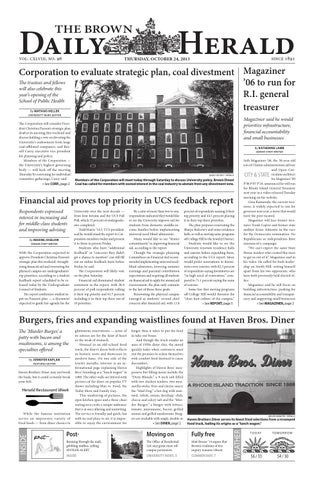
Daily
THE BROWN
vol. cxlviii, no. 96
Herald
since 1891
THURSDAY, OCTOBER 24, 2013
Corporation to evaluate strategic plan, coal divestment Magaziner The trustees and fellows ’06 to run for will also celebrate this year’s opening of the R.I. general School of Public Health treasurer By MATHIAS HELLER
UNIVERSITY NEWS EDITOR
The Corporation will consider President Christina Paxson’s strategic plan draft at its meeting this weekend and discuss holding a vote on divesting the University’s endowment from large coal-affiliated companies, said Russell Carey, executive vice president for planning and policy. Members of the Corporation — the University’s highest governing body — will kick off the meeting Thursday by convening for individual committee gatherings, Carey said. » See CORP., page 2
Magaziner said he would prioritize infrastructure, financial accountability and small businesses By KATHERINE LAMB SENIOR STAFF WRITER
DAVID DECKEY / HERALD
Members of the Corporation will meet today through Saturday to discuss University policy. Brown Divest Coal has called for members with vested interest in the coal industry to abstain from any divestment vote.
Financial aid proves top priority in UCS feedback report Respondents expressed interest in increasing aid for middle-class students and improving advising By MAXINE JOSELOW SENIOR STAFF WRITER
With the Corporation expected to approve President Christina Paxson’s strategic plan this weekend, strengthening financial aid and renovating the physical campus are undergraduates’ top priorities, according to a student feedback report scheduled to be released today by the Undergraduate Council of Students. The report synthesizes student input on Paxson’s plan — a document expected to guide her agenda for the
University over the next decade — from four forums and the UCS Fall Poll, which 33 percent of undergraduates completed. Todd Harris ’14.5, UCS president, said he would email the report to Corporation members today and present it to them in person Friday. Students who have “additional feedback” or “concerns they didn’t get a chance to mention” can still fill out an online feedback form before Friday, he said. The Corporation will likely vote on the plan Saturday. Financial aid dominated student sentiment in the report, with 38.4 percent of poll respondents calling it their top priority and 61.7 percent including it in their top three out of 10 priorities.
By a ratio of more than two to one, respondents indicated they would like to see the University improve aid for students from domestic middle-income families before implementing universal need-blind admissions. Many would like to see “firmer commitments” to improving financial aid, according to the report. Though the strategic planning Committeee on Financial Aid recommended implementing universal needblind admission, lowering summer earnings and parental contribution expectations and requiring all students on financial aid to apply for annual aid reassessment, the plan only commits to the last of those three goals. Renovating the physical campus emerged as students’ second chief concern after financial aid, with 13.8
percent of respondents naming it their top priority and 44.1 percent placing it in their top three priorities. The plan proposes renovating the Sharpe Refectory and some residence halls, as well as moving some programs off College Hill to the Jewelry District. Students would like to see the University renovate residence halls and eateries before expanding them, according to the UCS report. More would prefer renovations to dormitories over eateries, with 82.3 percent of respondents saying dormitories are “in high need of renovation,” compared to 71.1 percent saying the same of eateries. Some fear that moving programs off College Hill would threaten the “close-knit culture of the campus,” » See REPORT, page 5
Seth Magaziner ’06, the 30-year-old son of Clinton administration adviser and Open Curriculum architect Ira Magaziner ’69 P’06 P’07 P’10, announced he will run for Rhode Island General Treasurer next year in a video released Tuesday morning on his website. Gina Raimondo, the current treasurer, is widely expected to run for governor next year, a move that would leave the post vacated. Magaziner will face former treasurer Frank Caprio and former state auditor Ernie Almonte in the race for the Democratic nomination. No Republicans or independents have announced a campaign. “We can’t expect the same State House insiders who created this mess to get us out of it,” Magaziner said in his video. He called for fresh leadership on Smith Hill, setting himself apart from his two opponents, who have both previously held elected office. Magaziner said he will focus on building infrastructure, pushing for financial accountability and transparency and supporting small businesses » See MAGAZINER, page 2
CITY & STATE
Burgers, fries and expanding waistlines found at Haven Bros. Diner
By JENNIFER KAPLAN FEATURES EDITOR
Haven Brothers Diner may not break the bank, but it could certainly break your belt.
inside
While the famous institution serves an impressive variety of fried foods — from diner classics to
gluttonous innovations — none of its entrees are for the faint of heart or the weak of stomach. Housed in an old-school food truck, the diner’s decor both reflects its historic roots and showcases its modern fame. On one side of the truck’s metallic interior is an informational page explaining Haven Bros’ founding as a “lunch wagon” in 1888. The other walls are littered with pictures of the diner on popular TV shows including Man vs. Food, the Today Show and Family Guy. This smattering of pictures, the open kitchen space and a three-chair seating area create a unique ambiance that is at once alluring and uninviting. The service is friendly and quick, but with no real place to sit, it is impossible to enjoy the environment for
longer than it takes to put the food in take-out boxes. And though the truck exudes an aura of 1950s diner chic, the mood quickly fades when customers must exit the premises to sicken themselves with comfort food destined to cause discomfort. Highlights of Haven Bros’ inexpensive but filling menu include the “Dirty Blonde,” a 9-inch sub filled with two chicken tenders, two mozzarella sticks, fries and cheese sauce; the “Mad Dog,” a hot dog with mustard, relish, onion, ketchup, chili, cheese and celery salt and the “Murder Burger,” a burger with lettuce, tomato, mayonnaise, bacon, grilled onions and grilled mushrooms. Burgers are available with single, double or » See DINER, page 2
ARJUN NARAYEN / HERALD
Haven Brothers Diner serves its finest fried selections from a revamped food truck, hailing its origins as a “lunch wagon.”
Post-
Moving on
Fully free
Running through the mall, gobbling muffins, yelling SPOILER ALERT
The Office of Residential Life may grant more offcampus permission
Matt Breuer ’14 argues that Brown’s tradition of free inquiry remains vibrant
INSIDE
UNIVERSITY NEWS, 3
COMMENTARY, 7
weather
The ‘Murder Burger,’ a patty with bacon and mushrooms, is among the specialties offered
t o d ay
tomorrow
56 / 33
54 / 30
2 university news » CORP., from page 1
calendar TODAY
OCTOBER 24
7 P.M.
TOMORROW
OCTOBER 25
2 P.M. Free Cider with Safewalk
The YES March
Sciences Library Lobby 8 P.M.
Main Green 8 P.M.
An Evening with Governor Chafee
Brown University Chorus Concert
Wilson 102
30 Fenner Street
menu SHARPE REFECTORY
VERNEY-WOOLLEY
LUNCH Black Bean and Spinach Soft Taco, Baked Potato Bar, Spicy Herb Baked Chicken, Assorted Frosted Cupcakes
Vegetable Stuffed Red Peppers, Beef Stew, Steak Fries, Italian Vegetable Saute, Mediterranean Bar
DINNER Vegetarian Sub, Spiced Chicken Wings, Bacon Ranch Chicken Sandwich, Garbanzo Bean Salad
Tequila Lime Chicken, Butternut Squash Formato, Curried Shrimp Stir-Fry, Cajun Apple Cake
sudoku
The Corporation will take up its formal business of the weekend at its meeting Saturday morning, when all votes — likely including a vote on the strategic plan — will be conducted, Carey said. Corporation members will also discuss the tenets of the strategic plan, “Building on Distinction,” during their committee meetings, Carey said. Carey said members have been “engaged in discussion throughout the past year” and even earlier about the plan’s areas of focus and recommendations. “It’s been an ongoing process,” he said. Paxson publicly released the draft of the plan Sept. 18, and Brown community members have participated over the past month in a public comment period on the plan’s proposals. The strategic plan contains a host of priorities, including expanding the size of the faculty and student body, growing the University’s presence in the Jewelry District and bolstering graduate education programs, The Herald previously reported. Carey said he could not anticipate “the shape or substance of the discussion” this weekend on the strategic plan, but added that Corporation members held a special session in
» MAGAZINER, from page 1
RELEASE DATE– Thursday, October 24, 2013
Los Angeles Times Daily Crossword Puzzle c rNorris o s sandwJoyce o rNichols d Lewis Edited by Rich 66 Sprinter’s asset 67 Stinky
49 USAF E-6’s 50 Question before “Yeah, you!” 52 ’Vette roof option 53 Pear remnant 54 “Yay, me!” 55 Neck and neck 56 Hole on the green 57 Static jolt 58 Skater Midori 59 Swig
ANSWER TO PREVIOUS PUZZLE:
his campaign website. During his time at Brown, Magaziner, a history concentrator, was president of the Brown Democrats and served on the University Steering Committee on Slavery and Justice, the group that ultimately produced the Slavery and Justice report. At the time, Magaziner said he was unsure about whether he wanted to pursue politics after graduation despite his family’s legacy of public service, according to the Brown Alumni Magazine. After graduation, Magaziner taught literacy and social studies at a Louisiana elementary school for Teach for America before entering
the Master of Business Administration program at Yale in 2008, according to the Providence Journal. He joined Trillium in 2010, where he now oversees more than $1 billion in investments, according to Rhode Island Public Radio. Magaziner “seems like the kind of person progressives would like to see run for public office,” wrote Bob Plain, editor and publisher of Rhode Island’s Future, in reaction to the announcement. Information about Magaziner’s campaign funds is not yet public, as his first fundraising report is due Oct. 31, the Journal reported.
N WATERMA
L
RIA
O EM
M
Chancellor Thomas Tisch ’76 monitors the policy’s enforcement among the Corporation, Carey said, adding that Corporation members are aware of the policy’s guidelines. The weekend will also feature an event Friday evening at the School of Public Health’s building to commemorate the School’s launch this year, Carey said. The event will be “more of an informal social gathering” rather than an official building dedication, and it will be a chance for faculty members, staffers and community members to celebrate the school, he added. The Corporation approved the creation of a separate School of Public Health in February, The Herald previously reported. Public notifications about largescale financial gifts to the University typically coincide with the Corporation’s meetings, but Carey said he could not comment on whether such gifts will be part of the meeting this weekend. Corporation Trustee Steven Cohen P’08 P’16 has been charged by U.S. prosecutors in a civil suit related to a federal investigation of Cohen’s hedge fund, SAC Capital Advisors, but Carey said he could not comment on whether the Corporation will admonish Cohen for any alleged wrongdoing.
GEORGE
BROWN CAMPUS
THAYER
KENNEDY PLAZA S. IN MA
DOWN 1 Pitch indicator 2 Get back on one’s feet 3 “You are __ much trouble!” 4 Supervillain with a whip 5 Pounds a beat 6 Sheer nonsense 7 Hick 8 Disable the security system for, say 9 Lightweight umbrella 10 Domineering 11 Maui strings 12 Tough spot 13 Tina of “Date Night” 21 Abbr. for the nameless? 22 Shipping route 25 Patronize 26 Jet legend 27 Danish seaport 28 Moseys 29 Compass point? 30 Venezia’s land
31 Innocents 32 Foil kin 35 Deli slicing request 39 Old salt 41 More than suspected 42 Colony residents 43 Sat (down) ungracefully 44 Hang out in the hammock
August to discuss the strategic planning process. Corporation members will discuss whether to vote on withdrawing endowment funds from large coalaffiliated companies, Carey said. But he said he could not guess whether the body would take any formal action on the issue. The question of divesting from companies that profit from coal has spurred debate on campus after the student group Brown Divest Coal launched a campaign requesting the University divest from the 15 largest coal companies in the United States. The Advisory Committee on Corporate Responsibility in Investment Practices recommended in April that the University divest from coal, The Herald previously reported. Following ACCRIP’s vote, Paxson convened a review committee in April to study the impact of divestment and to report its findings to the Corporation, The Herald previously reported. Though Brown Divest Coal has called for Corporation members with financial interests in the coal industry to recuse themselves from a vote on divestment, Carey said he had no specifics on whether any members will do so for a potential vote. All individuals involved in Brown’s governance abide by the University’s conflict of interest policy, and
xwordeditor@aol.com
10/24/13
Haven Brothers Diner Dorrance St. and Fulton St.
DYER
POWER
HAILY TRAN / HERALD
E
» DINER, from page 1
PIN
ACROSS 1 Like much Oscar-night attire 5 Under-the-sink installation 10 Take a shine to? 14 Jazz singer Horne 15 Island near Curaçao 16 1930s migrant to California 17 Far __ 18 River where Romulus and Remus were abandoned 19 Hot 20 *Garden display 23 Oklahoma tribe 24 Sends regrets 28 Crazed Muppet drummer 31 Bright light 33 Bamboozled 34 *Paper fastener 36 Where Andy Capp ’angs ’is ’at 37 Noggin 38 Go in haste 39 Stretch 40 Med. lab letters 41 *Feature of some kilts 45 Actor Wallach 46 Creatures of habit? 47 Unfancy to the max? 48 Ready to be served 50 Three French horns, in a Prokofiev classic 51 Electrician’s covers, and a hint to the ends of the answers to starred clues 57 Take a verbal shot at 60 Small porch 61 Sitarist Shankar 62 Busy 63 Mel-Tones frontman 64 Place for the first 42-Down? 65 Opens, as a car trunk
and entrepreneurs, according to his campaign website. “I understand our obligation to foster a system in which hardworking folks can create opportunities for their families,” Magaziner said in his video. Magaziner grew up in Bristol, R.I., graduated from Brown in 2006 and currently serves as the vice president of Trillium Asset Management, an investment firm that aims to promote social responsibility. He also serves on the boards of Crossroads Rhode Island, a homeless services provider, and Serve Rhode Island, according to
THE BROWN DAILY HERALD THURSDAY, OCTOBER 24, 2013
By Marti DuGuay-Carpenter and Jerome Gunderson (c)2013 Tribune Content Agency, LLC
10/24/13
triple meat patties, and daring diners may attempt the dish consumed by the host of Man vs. Food when he visited Haven Bros on the show — a triple “Murder Burger” with a fried egg on top. But diners be warned — the excess grease on the mozzarella sticks and burgers weighed down already superfluously rich dishes. Simpler diner fare also abounds with chicken tenders to rival Brown’s
on-campus Friday favorite, though fans of crunchier coated pieces may be disappointed. The fries are soft and perfectly salted, pairing neatly with milkshakes that come in a variety of unique flavors, including strawberry Oreo. If you’re looking for a light meal, this isn’t your destination. But for the more health-conscious, the most nutritious option on the menu is a turkey sandwich with thickly cut meat that looks and tastes delicious, if a bit dry.
Haven Bros is open until 3 a.m. most nights and 4 a.m. on Fridays and Saturdays. It is inadvisable to eat Haven Bros’ greasy masterpieces for dinner without leaving at least a few hours for digestion. But the diner is a perfect destination for lessthan-sober patrons seeking to satisfy late-night cravings after a downtown social event. The regret of a greasy late-night snack can be tempered with the satisfaction of having visited a historical monument in old Providence.
university news 3
THE BROWN DAILY HERALD THURSDAY, OCTOBER 24, 2013
Rupee value may hurt international students
Financial aid packages for international students will not change, despite the declining Indian currency By STEPHEN ARK SENIOR STAFF WRITER
As some students express concern over the falling value of the Indian rupee relative to the U.S. dollar, the University will continue its efforts to attract prospective Indian students as planned, said Dean of Admission Jim Miller ’73. Emerging market currencies such as the rupee have been declining in value relative to the dollar since June, when the Federal Reserve announced it would phase out its quantitative easing program meant to stimulate the economy. Aashay Sheth ’16, who transferred this semester from New York University, expected the cost of living to be lower in Providence. But with his home currency in India losing value, he has found Providence to be more expensive.
“It’s only when you add the money on a day-to-day basis that you realize how much dearer the money has gotten,” he said. The University currently admits international students on a needaware basis. Starting in 2018, the Financial Aid Office will review need on an annual basis for international students, which Director of Financial Aid Jim Tilton said should incorporate a consideration of the possible fluctuations in exchange rates. “So far we haven’t heard very much,” Tilton said. “But as we come closer to early decision and regular decision, we might start having more in-depth conversations.” Financial aid packages for current students would remain at their original value. “Although we aren’t able to change their financial aid awards, we (would) work with the student and the family to think of alternatives they might be able to take advantage of,” he added. Sheth said the alternatives, such as outside scholarships, are a “hassle” because it is difficult to prove change in need over time, since currency
value changes can be temporary. The Herald previously reported that the number of international students from India has increased following an effort to increase the University’s engagement with the country. Miller said the Admission Office does not plan to modify any of its recruitment efforts directed at students in emerging market countries. “Currency fluctuations aren’t unusual, and currency markets can be pretty volatile,” Miller said. “So it’s hard for us to tell when falling or rising currency values will begin or end.” He added that though it is too early to tell what effect the market will have on applications from abroad, the University remains committed to meeting financial aid needs, “whatever that need may be.” “My parents occasionally send my tuition from their savings account in India,” said Deesha Misra, a student from the Rhode Island School of Design whose family’s assets are split between India and Bahrain. “But they wouldn’t think of doing that, assuming the current value of the rupee.”
www.browndailyherald.com
4 university news
THE BROWN DAILY HERALD THURSDAY, OCTOBER 24, 2013
U. may offer more off-campus housing privileges to juniors The new policy would account for an expanding student body, as proposed in the strategic plan By ABIGAIL SAVITCH-LEW STAFF WRITER
The University may increase the number of rising juniors awarded off-campus housing permission to accommodate growth in the student body in the coming years, administrators said. President Christina Paxson’s strategic plan, “Building on Distinction,” released last month, outlines a goal of growing the student body, and Paxson has voiced support for growing the undergraduate population by 1 percent annually over the next decade, The Herald reported earlier this month. But because discussions over expanding the number of undergraduates are ongoing, the University cannot quantify how many additional rising juniors may receive off-campus permission, said Richard Bova, senior associate dean of residential life and dining services. An average of about 1,000 rising seniors and 275 rising juniors have received off-campus permission each year for the past five years, Bova said. Administrators are also considering whether to expand residential facilities in light of the potential student body growth, said Margaret Klawunn, vice president of campus life and student services. “We’ll be looking at all of these things in terms of what the campus should be and what we want to preserve,” Klawunn said. Restricted access Off-campus housing privileges are a “rising senior-driven process,” and rising seniors who apply as individuals for off-campus permission by a mid-December deadline are
guaranteed approval, according to the Office of Residential Life website. The University requires students to live on campus for six semesters unless they receive permission to move off-campus, Bova said, adding that about 300 to 500 rising juniors apply each year for off-campus permission. This rate of applications means that anywhere between 25 to 225 rising juniors who apply each year do not receive permission. Administrators limit the number of juniors who receive off-campus permission because living on campus is an important part of the Brown experience, Klawunn said. The University depends on residential fees as a source of revenue and must fill all of its 4,854 beds, she said, adding that administrators work to accommodate any student who desires to live on campus. To determine how many students should be awarded off-campus housing each year, the University uses an “enrollment management model” that measures how many students are taking courses on campus, studying abroad, taking leaves of absence and transferring to and from Brown, Bova said. ResLife aims to award off-campus permission to a total of 1,275 rising seniors and rising juniors this year, but that number is subject to change based on fluctuating enrollment figures, he added. After seniors receive off-campus permission, ResLife uses a lottery system to grant the remaining permission slots to rising juniors and rising seniors who do not immediately receive permission, according to ResLife’s website. Students who do not initially receive permission are placed on a waitlist and have the opportunity to obtain permission if those who have been granted offcampus privileges change their plans and decide to live in residence halls, Bova said.
DAVID DECKEY / HERALD
This year, the Office of Residential Life will likely award around 1,275 rising juniors and seniors off-campus permission, but that amount may change in response to shifting enrollment numbers. Mixed reviews Some juniors said they were frustrated with the process of gaining permission to live off campus and expressed support for revising ResLife’s policy. Jessica Cherness ’15 said she applied to live off campus for financial reasons and because she wanted to live in a convenient location. She said she felt “cramped” for space when she lived in Minden Hall and wanted to avoid the stress of the housing lottery. Though ResLife cautions students not to sign leases before receiving off-campus permission, Cherness said she had to sign a lease on a private residence to secure the apartment before she had received permission from the University. But after signing the lease, Cherness learned she had been placed on the waitlist, she said. Cherness said she wrote a letter of appeal to ResLife and wrote several emails to Associate Director of Residential Life Richard Hilton, but received no response until her parents wrote a letter on her behalf. Cherness said she received off-campus permission in June. ResLife should consider moving the application process earlier in the year so students do not have to
choose between losing access to offcampus houses and taking the risk of not gaining permission, Cherness said, adding that ResLife should also be more responsive to students’ concerns and directly inform applicants of their option to appeal. Students who had been placed on the waitlist said they sometimes write letters of appeal to explain why their situations merit special consideration. “In some very tough cases, students are moved off the waitlist for serious reasons,” Bova wrote in an email to The Herald. “Sometimes folks who appeal do not receive permission and remain on the waitlist.” Family situations, financial conditions and health issues are some of the reasons students appeal ResLife’s decision to place them on the waitlist, Bova wrote. A female junior who requested anonymity for privacy reasons said she wanted to live off campus this year because she felt depressed living in the Graduate Center and believed living off campus would improve her mental health. After ResLife placed her on the waitlist, she sent two letters of appeal, but her case was not taken seriously because she had not yet been formally diagnosed with
depression, she said. She was formally diagnosed this summer, and Hilton told her she should obtain help from Student and Employee Accessibility Services, she said. The junior said she filled out the necessary paperwork with SEAS, but a SEAS staffer told her she had applied for assistance too late and could not qualify for living off-campus. “I used to think Brown was a school that cared for its students, but they didn’t do anything for me,” she said, adding that students should have more freedom to decide where they want to live. Ryan Brown ’15 said he applied to live off campus because seniors on his frisbee team invited him to live with them in a private residence and because most of his friends in the class of 2015 were planning to go abroad. He said he received approval without difficulty, but added that he sometimes misses living closer to campus. If the University decides to increase the number of off-campus permission slots available to rising juniors, administrators should provide students with more guidance about signing leases and other aspects of off-campus living, Brown said.
university news 5
THE BROWN DAILY HERALD THURSDAY, OCTOBER 24, 2013
UCS discusses Paxson’s plan to increase size of student body, campus Expanding the virtual campus and preserving the undergraduate experience were debated By MAXINE JOSELOW SENIOR STAFF WRITER
With the Corporation arriving on campus this weekend for its October meeting, young alumni trustee Alison Cohen ’09 — the youngest Corporation member — discussed growing the student body, alumni engagement and the undergraduate experience at the Undergraduate Council of Students general body meeting Wednesday. The Corporation, the University’s highest governing body, is expected to vote this weekend on whether to approve President Christina Paxson’s draft of her strategic plan, “Building on Distinction,” a document expected to guide her agenda for the University over the next decade. Paxson’s proposed growth of the student body by 1 percent per year emerged as a topic of concern. Malikah Williams ’16, chair of the UCS Campus Life Committee, said she was worried that “growing the size of the student body would change Brown a lot.” “This conversation about growing the size of Brown has happened every five or 10 years,” Cohen said. “And every time, people have said it’s already the perfect size.” Still, the University must be mindful of physical space needs as it grows the student body, Cohen said. The plan’s suggestion to foster more alumni engagement also drove
» REPORT, from page 1 according to the report. Many indicated hope that administrators would solicit student feedback before changing the physical campus. Out of 10 options, respondents selected “renovating and improving the physical campus” as the goal most in need of student input after “experimentation in classroom teaching.” Internship programs also earned
discussion. Abby Braiman ’15, UCS Student Athlete Advisory Committee liaison, asked Cohen how alums could connect to the campus, given her “unique take” as a recent alum and Corporation member. “The challenge is figuring out what forms alumni involvement can take, whether it’s interviewing applicants to Brown, which would take about three hours a year, or whether it’s a more substantive involvement,” Cohen said. The Council also discussed whether the plan’s proposed expansion of graduate programs would come at the expense of the undergraduate experience. Alex Drechsler ’15, UCS Student Activities chair, said he was worried that the plan’s “emphasis on graduate programs and research” would “detract from the undergraduate experience.” Cohen responded that she does not “see it as a zero-sum game” in which if graduate students get more attention, undergraduates get less. “We need to figure out opportunities for synergy, in which both undergraduates and graduate students can benefit,” Cohen added, citing graduate student counterparts for Department Undergraduate Groups as an chance for graduate students to interact with and mentor undergrads. The Council also debated the importance of the plan’s proposal to build the virtual campus. “I’d love to hear more current student perspectives” about the virtual campus, Cohen said. “I don’t want the University to be spending its resources on the virtual campus, given that there are other more important areas,” Drechsler said.
precedence among students, with 13.4 percent of respondents calling them their top priority and 49.1 percent counting them in their top three priorities. Many expressed hope that alums would serve as a “community of mentors that strengthens the current internship search process,” according to the report. The plan proposes strengthening the alumni internship and career advising
DAVID DECKEY / HERALD
UCS discussed President Christina Paxson’s plan to increase the student population, enhance graduate programs and renovate the University’s facilities. The Corporation is expected to vote on the plan this weekend. He added that the UCS student feedback report — a compilation of student sentiment about the plan, which was scheduled to be released today — confirms that most students feel the virtual campus should not be a top priority. The Corporation’s consideration of ethical issues also fostered concern. The Corporation is expected to discuss this weekend whether the University should divest from the 15 largest companies in the country that profit substantially from coal.
Last spring, the Advisory Committee on Corporate Responsibility in Investment Policies recommended divestment from these companies to Paxson, The Herald reported at the time. Amara Berry ’16, who is not a Council member, said Brown Students for Justice in Palestine has not been as successful as Brown Divest Coal at attracting the Corporation’s consideration. “Is there any advice I could pass on to BSJP members about how to get the Corporation’s attention?” she asked.
Group members could reach out to student representatives on ACCRIP, said UCS President Todd Harris ’14.5. The Council also appointed Edwin Portugal ’17 to review the efficacy of Banner and Advising Sidekick on the Computer Advisory Board Subcommittee on Academic Technology, and Benjamin Davidson ’14 to evaluate the behavior of Department of Public Safety officers on the Officer Conduct Review Board. Michael D’Ortenzio ’15 was appointed to the Parking Violations Appeals Board.
network, as well as giving students on financial aid additional funding to allow them to accept unpaid summer internships. Advising also figured at the forefront of student concern, with 35.7 percent of respondents calling improving the advising experience “very important,” and 27.5 percent calling it “extremely important.” Paxson did not originally include advising in the draft of the plan. In
response to community-wide concern about the plan’s lack of advising, she vowed to add a section on the subject. The plan’s focuses on issues of sustainability, experimentation in teaching, sophomore seminars, international programs, graduate programs, the virtual campus and courses in STEM fields — science, technology, engineering and mathematics — emerged as less prominent priorities for students. Altogether, about a third of students named one of
these issues a top priority. After many worried in the week after the plan’s release that the proposed expansion of graduate programs could detract from the undergraduate experience, only 1.5 percent of respondents called graduate programs a top priority. Despite advances in online teaching — with the University offering its first for-credit online course this past summer — only 1.2 percent of respondents called the virtual campus a top priority.
comics Cat Ears | Najatee’ McNeil
A Horse of Any Other Name | Zach Silberberg
6 commentary
THE BROWN DAILY HERALD THURSDAY, OCTOBER 24, 2013
EDITORIAL
Students should choose paths that fit their needs At universities such as Brown, students often report a pressure to remain on a prescribed path: graduating from college in four years and transitioning straight to a career or graduate school. These expectations — both external and internal — can make it seem impossible to deviate from the prescribed norm. Students at Brown can be overwhelmed by the pressures of graduating on time or choosing post-college plans. But such a perception is problematic at best and damaging at worst. We encourage students to break away from this understanding and to recognize that seeking time off — whether a semester or a year — can often prove a valid and valuable pursuit. Charting a new path that does not adhere to the supposed norm can be frightening. Often, students have arrived at Brown after 13 consecutive years of schooling. It can seem as if the goal of our time here is to graduate and enter the real world as quickly as possible. After four years of being compared to our high school cohorts, it is easy to get the impression that we are constantly being compared to our college classmates. But eventually, we will all begin to take different paths. For many of us, the first deviation may happen at Brown. At some point, we realize we must stop living in relation to our classmates and begin to choose the paths that will best serve us in pursuing our individual goals. For some, this means a study abroad experience or a different major than planned. For others, it might be best to take a semester or a year off. Such a break can provide much-needed perspective to those who may need a change. Students who think this might be a good choice for them should research their options and not be afraid to act in their own best interests. Students who take time off discover their Brown experiences are enhanced by what they learn in the “real world.” There are plenty of work or travel opportunities that can give a student distance for a few months but ultimately contribute to his or her overall education. Ultimately, time off or other options can both help those who seek a change from the Brown campus and provide insight that will enhance their experiences once they return.
K I M B E R LY S A LT Z
Editorials are written by The Herald’s editorial page board: its editor, Rachel Occhiogrosso, and its members, Daniel Jeon, Hannah Loewentheil and Thomas Nath. Send comments to editorials@browndailyherald.com.
Q U O T E O F T H E D AY
“We can’t expect the same State House insiders who created this mess to get us out of it.” — Seth Magaziner ’06 See magaziner, page 1. Editorial Leadership
Sections
Visuals & Production
Business
Editors-in-Chief Lucy Feldman Shefali Luthra
Arts & Culture Editors Hannah Abelow Maddie Berg
Head Photo Editor Emily Gilbert
General Managers Julia Kuwahara Samuel Plotner
Managing Editors Elizabeth Carr Jordan Hendricks
City & State Editors Sona Mkrttchian Adam Toobin
Senior Editors Aparna Bansal Alexa Pugh
Features Editors Jennifer Kaplan Elizabeth Koh
Strategic Director Greg Jordan-Detamore
Science & Research Editors Phoebe Draper Kate Nussenbaum
BLOG DAILY HERALD Editor-in-Chief Meredith Bilski
Sports Editors James Blum Connor Grealy
Managing Editor David Oyer
University News Editors David Chung Mathias Heller Eli Okun
POST- MAGAZINE
Editorial Page Editor Rachel Occhiogrosso
Editor-in-Chief Ben Resnik
Opinions Editors Gabbie Corvese Garret Johnson Maggie Tennis
Photo Editors Brittany Comunale David Deckey Samuel Kase Sports Photo Editor Jesse Schwimmer Video Editors Henry Chaisson Assistant: Danny Garfield Data Science Editor Andersen Chen Web Producer Joseph Stein Design Editors Kyle McNamara Mie Morikubo Julia Shube Assistant: Sandra Yan
facebook.com/browndailyherald
@the_herald
browndailyherald.com
Directors Sales: Eliza Coogan Finance: Nicole Shimer Alumni Relations: Emily Chu Business Dev.: Justin Lee
Location: 195 Angell St., Providence, R.I. www.browndailyherald.com
Office Manager Shawn Reilly
Corrections: The Brown Daily Herald is committed to providing the Brown University community with the most accurate information possible. Corrections may be submitted up to seven calendar days after publication.
Sales Managers Regional: Jennifer Aitken Regional: Jaqueline Chang Regional: Leslie Chen Regional: Wenli Shao Regional: Carolyn Stichnoth Student Group: Anisa Holmes Finance Managers Collections: Sameer Sarkar Collections: Timothy Sharng Operations: Sarah Levine
Copy Desk Chief Sara Palasits
Alumni Relations Manager Engagement: Alison Pruzan
Illustrations Editor Angelia Wang
Business Dev. Managers Project Leader: Melody Cao Project Leader: Kaden Lee
Editorial contact: 401-351-3372 herald@browndailyherald.com
Business contact: 401-351-3260 gm@browndailyherald.com
Commentary: The editorial is the majority opinion of the editorial page board of The Brown Daily Herald. The editorial viewpoint does not necessarily reflect the views of The Brown Daily Herald, Inc. Columns, letters and comics reflect the opinions of their authors only. Letters to the Editor: Send letters to letters@browndailyherald.com. Include a telephone number with all letters. The Herald reserves the right to edit all letters for length and clarity and cannot assure the publication of any letter. Please limit letters to 250 words. Under special circumstances writers may request anonymity, but no letter will be printed if the author’s identity is unknown to the editors. Announcements of events will not be printed. Advertising: The Brown Daily Herald, Inc. reserves the right to accept or decline any advertisement at its discretion. The Brown Daily Herald (USPS 067.740) is an independent newspaper serving the Brown University community daily since 1891. It is published Monday through Friday during the academic year, excluding vacations, once during Commencement and once during Orientation by The Brown Daily Herald, Inc. Single copy free for each member of the community. Subscription prices: $280 one year daily, $140 one semester daily. Copyright 2013 by The Brown Daily Herald, Inc. All rights reserved. Periodicals postage paid at Providence, R.I. Postmaster: Please send corrections to P.O. Box 2538, Providence, RI 02906.
THE BROWN DAILY HERALD THURSDAY, OCTOBER 24, 2013
Clearing the air: Inquiry at Brown is alive and well ally under attack? Do conservatives feel unsafe at Brown because they are conservative? Or are they just upset that some guest columnist people won’t take their ideas seriously? This is no small disI recently had the pleasure of tinction. reading Zach Ingber’s ’15 opinThis distinction is imporion piece in which he suggest- tant because when it is not ed that the bias against minor- made, we get articles like Ingity groups at Brown — partic- ber’s, which escalate the rhetoularly against political conser- ric unnecessarily by claiming vatives — threatens the spirit our freedom of speech is beof free inquiry embedded in ing threatened. But freedom the University’s mission (“Free of speech at Brown is perfectly speech at Brown?” Oct. 20). alive. I’ll give you some examWhile Ingber makes a good ples. Members of Brown Divest point that students at Brown Coal bombarded the official might not be as accepting of University Facebook page with controversial opinions as they messages urging divestment, could be, he shrouds it in a sen- and Brown didn’t take them sationalist assertion that free down. President Christina Paxinquiry, which is at the very son holds woefully underutifoundation of Brown’s culture, lized office hours every month is under threat. where students I’ll start with can voice any “Where I think the good stuff. opinions on Ingber’s thesis is Ingber makes their minds, the case that and I know flawed is in his Brown students experinaive definitions from don’t accept or ence that she of free speech respect conactually listens. servative opinStudents who and censorship. ions, and I tend feel their freeto agree. It’s a Freedom of speech dom of speech problem, and provides the author is being threatit’s been docuened can pubof an unpopular mented extenlish columns opinion safety and in The Herald, sively in other Herald columns security. It doesn’t and other stuwhere an insertdents will read mean anyone has and respond to minority-opinion-holder-here those views. to agree or even calls for more It’s too bad listen.” discourse and that conservaopen-mindtives at Brown edness around said minority feel lonely or underappreciopinion. Smart people should ated, but that is the nature of listen to smart ideas no mat- attending an overwhelmingly ter where they come from. But liberal university. If it’s a probI think smart people already lem for you that your friends know that, so I don’t think I won’t respect your ideology, need to make the case again maybe you should find new here. friends or a new ideology. But Where I think Ingber’s the- claiming that Brown’s consersis is flawed is in his naive defi- vatives are being censored and nitions of free speech and cen- aren’t being granted freedom sorship. Freedom of speech of speech is either a Limbaughprovides the author of an un- esque tactic to stir up a contropopular opinion safety and versy or a poor interpretation security. It doesn’t mean any- of our fundamental freedoms. one has to agree or even listen. In any case, it only serves to Censorship is an authoritarian embarrass the otherwise retactic to control flows of infor- spectable aspects of conservamation. It’s a word to describe tive politics. things like the shutdown of the Syrian internet and not one to be thrown around lightly to Matt Breuer ’14 thinks there describe a panel selection that is a fire in your movie theater was perceived to be unfair. and can be reached at Is our freedom of speech re- matthew_breuer@brown.edu.
MATT BREUER
commentary 7 A deepening divide in the Democratic party DANIEL CARRIGG opinions columnist
In the wake of last week’s end to the government shutdown, a slew of national commentary has focused on an apparent rift forming between the Tea Party and mainstream Republicans. But here in Rhode Island, a local political rift appears to be brewing in the Democratic Party. Disagreements over the Rhode Island Retirement Security Act of 2011 may dominate the conversation as State Treasurer Gina Raimondo and Providence Mayor Angel Taveras raise money for what looks like it will be an expensive and bruising 2014 Democratic gubernatorial primary. The act is projected to cut state and local public worker retirement benefits by about $4 billion over 20 years, according to its champion and presumptive 2014 gubernatorial candidate, Raimondo. It does this through cutting benefits for both current and future retirees. Democratic advocates for the plan say the pension fund was far too underfunded to deliver the benefits it promised and that by saving taxpayers $4 billion that would otherwise pay for public employees’ retirements, it frees up revenue to be used for other important state purposes. Democratic opponents of the plan, including most labor groups, say it broke a contractual agreement the state made with public workers and that the state chose to cut taxes instead of making required contributions to the fund. They contend the savings will not actually materialize because pension fund investments have been shifted to high-fee hedge funds. Some Rhode Island Democrats appear to see the law as a necessary, proper and inevitable reduction of benefits to public workers to save taxpayers’ money. Other Rhode Island Democrats see it as a Wall Street money-grab that takes retirement funds away from middleclass workers and hands them to upper class, out-of-state hedge fund owners and to the in-state rich who have seen their state income tax rates plummet from 9.9 percent to 5.99 percent as of 2011. At its heart, this disagreement is a common one, familiar to anyone who follows national politics. A fundamental tenet of economic conservatism is that tax cuts for the wealthy and re-
tirement benefit cuts for the coming months. middle class will increase comLabor, long a mainstay of petitiveness and spur economic Democratic politics, has all but growth. The economic liberal declared open war on a preargument is that tax cuts for the sumptive Democratic candidate wealthy starve the government for governor. This may be unof revenue, which makes ben- precedented. And to drive the efit cuts for the poor and mid- point home, Council 94 of the dle class appear necessary and American Federation of State, therefore exacerbates wealth in- County and Municipal Emequality and hurts economic de- ployees hired Edward “Ted” Semand. idel, a former Securities and ExRecently, the controversy change Commission employee surrounding the Rhode Island and Forbes online commentapension bill has tor, to write a regone national. “Cutting retirement port that is someMatt Taibbi of where between benefits and top- a forensic invesRolling Stone, famous for his tigation of the bracket taxes scathing comstate’s pension both locally and mentary about fund and a righnationally is the financial inteous condemnadustry, wrote tion of Raimonpopular among an article about do. some of the the Ocean State In the end, called “LootDemocratic rank- Sirota and Taibbi ing the Pension be correct and-file. It is heresy may Funds.” Progresthat Rhode Island to others.” sive commentawas a test case tor David Sirota for further pubsimultaneously authored com- lic worker pension cuts. John panion columns in Salon and a Arnold has funded similar cuts study entitled “The Plot Against in Kentucky and is gearing up Pensions” for the Institute for to fund a similar movement in America’s Future. In his ar- California right now. But they ticle, Sirota claims “conserva- might not have been correct in tive activists are manufacturing highlighting John Arnold’s conthe perception of a public pen- nections to Republicans, as he sion crisis in order to both slash donated heavily to President modest retiree benefits and pre- Obama, Raimondo, the Demserve expensive corporate subsi- ocratic Senatorial Campaign dies and tax breaks.” Sirota and Committee and a host of other Taibbi’s main argument con- Democrats. Rahm Emmanuel, tends that former Enron trader Democratic mayor of Chicago, and billionaire John Arnold is supports a similar plan for Illibankrolling studies, politicians, nois. In 2011, Engage RI offered “dark-money” organizations the Brown Democrats a chance and movements to slash public to win a free iPad if they made pension funds in states across posters promoting pension cuts the country, and that Rhode Is- and showed up at the General land’s pension act was a sort of Assembly. The Brown Demoproof-of-concept for a larger na- crats took them up on the oftion-wide movement. fer and showed up in support of John Arnold’s foundation pension cuts. And I doubt that did provide a seed donation of many Brown Democrats think somewhere between $100,000 of themselves as conservatives. and $500,000 to Engage RI, a Cutting retirement benefits now defunct organization that and top-bracket taxes both lowas dedicated to cutting pen- cally and nationally is popular sions in our state. But Sirota and among some of the DemocratTaibbi are missing a big part of ic rank-and-file. It is heresy to the story. It was not the Republi- others. In the national media, can Party that cut pension bene- the conversation may be about fits or top-rate taxes in Rhode Is- rifts within the GOP. But here land, though the GOP may have in Rhode Island, I think we will supported doing so. It was, in find the conversation turning to fact, the Democratic Party that a divide in the Democratic Party did these things. And the di- that may prove just as deep and vide over this legislation points contentious. to a seldom-discussed rift in the Democratic Party base between economic conservatives and Daniel Carrigg GS loves this economic liberals. This rift has little state he has made his the potential to dominate the home. He may be reached at Democratic gubernatorial pridaniel_carrigg@brown.edu. mary in Rhode Island over the
Leave a comment at browndailyherald.com/opinions
daily herald university news THE BROWN
THURSDAY, OCTOBER 24, 2013
THIS WEEK IN HIGHER ED
BY DAVID CHUNG, UNIVERSITY NEWS EDITOR
GWU admits to inaccurate portrayal of admission policy
EMILY GILBERT / HERALD
Steam began to surge from a pipe around 7:30 a.m. Wednesday, leading to a flood on the first floor of J. Walter Wilson. Facilities Management turned off a hot water valve, affecting several buildings south of Waterman Street.
J. Walter Wilson closes following steam leak Administrators had to relocate about 60 classes and close University Mail Services for the day By SARAH PERELMAN SENIOR STAFF WRITER
J. Walter Wilson closed Wednesday after a steam leak, as Facilities Management worked to restore water and clean up damage in the building, wrote Marisa Quinn, vice president for public affairs and University relations, in an email to The Herald. Because of the leak, administrative offices and University Mail Services suspended service for the day, Russell Carey, executive vice president for planning and policy, wrote in a campus-wide email. The building and all services are open again today, Carey wrote in a follow-up campus-wide email Wednesday evening. Heat likely will not have fully returned to J. Walter Wilson by Thursday,
Carey wrote, but he added that, “given the forecast we expect it will be reasonably comfortable.” Fire alarms began to screech as steam gushed from a pipe in the building Wednesday at 7:30 a.m., Quinn wrote. As the first floor started to flood, Facilities Management “shut off the high temperature hot water valve to address the issue,” Quinn wrote. When Facilities Management shut off the valve, buildings south of Waterman Street — including the Sharpe Refectory, research buildings and residence halls — were affected, Quinn wrote. Facilities Management activated supplemental boilers to ensure all of the buildings were able to function normally. Psychological Services was temporarily relocated to Health Services, and the Registrar’s Office arranged for nearly 60 classes to meet at different buildings on campus, Quinn wrote. “I was notified of the room change through email by Russell Carey …
around 10:30 a.m.,” wrote Qifan Ding, visiting lecturer in Chinese, in an email to The Herald. Ding, whose class was scheduled to meet in J. Walter Wilson, added that the majority of students had no trouble finding out about the change in location and arrived on time to class. “I’m impressed by the speed with which the people managing this situation came up with classrooms,” wrote Marc Redfield, professor of English and comparative literature, in an email to The Herald. Redfield’s class was also relocated yesterday. “As for notifying students, they did a really good job,” said Samantha Gross ’15, adding that her whole class showed up to the correct location on time. “The system affected in J. Walter Wilson is relatively new … while substantial efforts and investments are made to ensure the integrity of our facilities, there is the potential of issues like this arising,” Quinn wrote, adding that the University has a system to regularly assess and maintain facilities.
After years of telling prospective students the university was need-blind in its admission decisions, George Washington University admitted Friday that it has always considered financial need during the process. Laurie Koehler, the university’s senior associate provost for enrollment management, revealed to the GW Hatchet that applicants who otherwise meet admission standards might be placed on the waitlist because of their financial need, with upward of 10 percent of the 22,000-applicant pool being affected each year. Less than 1 percent of the applicants on the waitlist were eventually offered admission in 2012, according to the Hatchet. Though financial need is not considered in the initial stages of the application review process, the university takes need into account before finalizing decisions. “By being need-aware, GW is better able to stay within its aid budget allotment as well as provide better aid packages for those students with financial need,” Dan Small, the university’s associate vice president for financial assistance, told the Hatchet. The admission website now contains updated information on its need-aware policy, though it had previously advertised a need-blind stance. “It’s still the same process,” university spokesperson Candace Smith told the Hatchet, “but it’s a matter of one person defining it one way and one person defining it another way.” This relevation comes less than a year after the university made headlines for submitting inaccurate admission data to U.S. News and World Report.
Former U. president to explore costcutting in Ohio colleges After a few months away from Ohio’s higher education arena, former Brown President E. Gordon Gee will head a state committee formed by Ohio Gov. John Kasich. In his new capacity, he will search for a way to lower college costs while improving education quality in Ohio — a dilemma he called “the question of our times,” Inside Higher Ed reported. Gee retired from his post as president at Ohio State University on July 1 after making controversial remarks about the University of Notre Dame. Kasich has called for “better quality at lower prices” across Ohio’s state education system, which supports 14 universities, 23 community colleges and 24 branch campuses. During a speech Monday at Columbus State Community College in Columbus, Ohio, Kasich suggested measures including privatization as potential strategies, pointing to the commercialization of intellectual property at Harvard, Stanford University and the Massachusetts Institute of Technology as examples to be emulated. Though he said online education offers financial benefits, he called “hanging out at the university ... part of growing up and part of life.” Gee told Inside Higher Ed he believes the focus on education quality should depend less on funding, though he added that the Bill and Melinda Gates Foundation has expressed interest in these educational reforms.
Thanks for reading!