Daily
Herald
THE BROWN
vol. cxlviii, no. 92
since 1891
FRIDAY, OCTOBER 18, 2013
With new director, Watson Institute paves way for future Locke said he plans to expand the faculty and pursue interdisciplinary collaboration By EMILY DUPOIS CONTRIBUTING WRITER
Faculty members and administrators said they expect to see a reinvigorated and inclusive Watson Institute for International Studies under the leadership of its new director, Richard Locke, who began his position in July. The institute faced a turbulent past decade, its leadership changing hands seven times in nine years and struggling to define its mission and central focus. Locke said he hopes to grow Watson by focusing on three core
areas of international studies — security, governance and economic, political and human development — while further integrating Watson’s programs into other departments and institutes on campus as well as growing research and the number of faculty members. “Watson has always had a tremendous amount of potential, but it hadn’t fulfilled its promise,” Locke said. The institute “didn’t have the presence it should have had in academic and policy circles, and it was seen as a strange insiders’ club on campus. It just didn’t have the kind of energy you’d expect for a center whose mission is to promote a peaceful and just world,” he added. Locke was hired last spring after an extended search to find a permanent successor to Michael Kennedy, who left his post as the institute’s
director in spring 2011. In spring 2012, the University chose not to hire any of the three finalists being considered to head Watson. Peter Andreas, currently a professor of political science and international studies, served as the institute’s interim director last year. Provost Mark Schlissel P’15 praised Locke’s plans for the institute. “He’s modernized the agenda of the institute in a very attractive way,” Schlissel said. Schlissel said he expects Watson to become one of the University’s “shining stars,” adding that both he and President Christina Paxson were excited about Locke’s leadership. Locke’s previous positions as chair of the Massachusetts Institute of Technology’s political science department and deputy dean of its Sloan School of Management at
taught him “how the culture of promoting excellence is so important,” he said, adding that he would like to replicate that at Brown. Locke said he plans to emphasize interdisciplinary collaboration, working with sectors like the School of Public Health, the Alpert Medical School, the environmental science program, the computer science and math departments and various humanities programs to address the institute’s three core focuses. Since Locke’s arrival as director, Watson has hired new faculty members, grown the faculty fellows program and built up the postdoctoral program, he said. “We’re building up our human capital so that we can actually deliver on what we say we want to do,” Locke said. » See WATSON, page 5
FOOTBALL
Bruno looks to tackle Tigers under the lights The game pits the league’s top defenses against each other in the first of a series of Ivy matchups By DANTE O’CONNELL SENIOR STAFF WRITER
After establishing dominance in Rhode Island with wins over the University of Rhode Island and Bryant University, the football team will return to action Saturday against Princeton in its first of six consecutive Ivy League matchups. The game will be played at Brown Stadium at 6 p.m. and broadcast on Fox College Sports. “We have to focus on keeping up
our mentality and energy as a team,” said co-captain and quarterback Patrick Donnelly ’13.5. “These six Ivy games to end the season will determine how it’s going to end up.” The matchup will pit the Ivy League’s top two defenses against each other. Bruno (3-1, 0-1 Ivy) has allowed 322.5 yards per game, and Princeton (3-1, 1-0) has yielded 348.2. While these statistics might foreshadow a lowscoring game, the Tigers’ defense will face perhaps its toughest test so far this season against Bruno’s passing attack. “Just as much as we have to contend with their defense, they have to contend with our offense,” said Head Coach Phil Estes. » See FOOTBALL, page 7
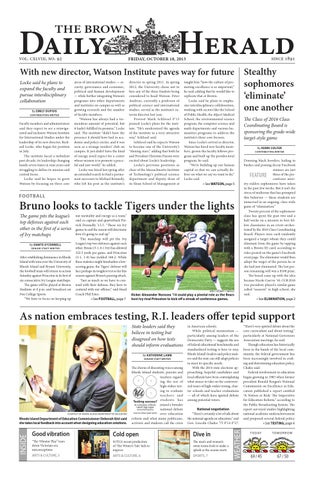
EMILY GILBERT / HERALD
Kicker Alexander Norocea ’14 could play a pivotal role as the Bears host Ivy rival Princeton to kick off a streak of conference games.
Stealthy sophomores ‘eliminate’ one another
The Class of 2016 Class Coordinating Board is sponsoring the grade-wide target-style game By KERRI COLFER CONTRIBUTING WRITER
Donning black hoodies, hiding in bushes and posting decoy Facebook statuses are just three of the precautions anxiety-ridden sophomores have taken in the past few weeks. But it isn’t the stress of midterms that has prompted this behavior — these students are immersed in an ongoing, class-wide game of “elimination.” Twenty percent of the sophomore class has spent the past two and a half weeks on a mission to best fellow classmates in an event orchestrated by the 2016 Class Coordinating Board. Players were each randomly assigned a target whom they could eliminate from the game by tapping with a Brown ID card, according to rules posted on the game’s Facebook event page. The eliminator would then adopt the target of the person he or she had just eliminated. The last person remaining will win a $100 prize. The board came up with the idea because Nicole Cuervo ’16, CCB 2016 vice president, played a similar game called “assassin” in high school, she said. » See ELIMINATION, page 2
FEATURE
As nation embraces testing, R.I. leaders offer tepid support
By KATHERINE LAMB SENIOR STAFF WRITER
COURTESY OF RHODE ISLAND DEPARTMENT OF EDUCATION
inside
Rhode Island Department of Education Commissioner Deborah Gist said she takes local feedback into account when designing education solutions.
The chorus of dissenting voices among Rhode Island students, parents and teachers regardA B ing the use of high-stakes testing to evaluate D teachers and Testing success? students has joined a broader An evaluation of Rhode Island’s high stakes national debate assessment policy Last in a four-part series over education reform and what many politicans, activists and students call the crisis
in American schools. While political momentum — particularly among leaders of the Democratic Party — suggests the use of federal educational benchmarks and standardized testing is here to stay, Rhode Island’s leaders and policy makers said the state can still adapt policies to meet its specific needs. With the 2014 state elections approaching, hopeful candidates and local officials have been contemplating what stance to take on the controversial issues of high-stakes testing, charter schools and teacher evaluations — all of which have ignited debate among potential voters. National negotiation “There’s certainly a lot of talk about the national agenda on education,” said Gov. Lincoln Chafee ’75 P’14 P’17.
Good vibration
Cold open
Dive in
“The Vibrator Play” tears down Victorian-era misconceptions
SOTG’s recent production of ‘The Winter’s Tale’ fails to impress
The men’s and women’s swim teams look to make a splash as the season starts
ARTS & CULTURE, 5
ARTS & CULTURE, 6
SPORTS, 7
weather
State leaders said they believe in testing but disagreed on how tests should inform evaluations
“There’s very spirited debate about the core curriculum and about testing,” particularly at National Governors Association meetings, he said. Though education has historically been in the hands of the local community, the federal government has been increasingly involved in crafting and determining education policy, Chafee said. Federal involvement in education began growing in 1983 when former president Ronald Reagan’s National Commission on Excellence in Education published a report entitled “A Nation at Risk: The Imperative for Education Reform,” according to the Public Broadcasting System. The report surveyed studies highlighting national academic underachievement and proposed several federal policy » See TESTING, page 4 t o d ay
tomorrow
69 / 45
67 / 50
2 university news calendar TODAY
OCTOBER 18
10 A.M.
TOMORROW
OCTOBER 19
11:30 A.M.
Brown is Green Energy Showcase
Digital Magic in Ancient Egypt
Wriston Quad 8 P.M.
Manning Hall 8 P.M.
Family Weekend Dance Concert
Brown Derbies Concert
Ashamu Dance Studio
Sayles Hall
menu SHARPE REFECTORY
VERNEY-WOOLLEY
LUNCH Vegetarian Cajun Pasta, Nacho Bar, Tuna Salad, Grilled Montreal Chicken, Cheese Ravioli Salad With Lemon
German Sausage Chowder, Breaded Chicken Fingers, Zucchini, Carrot and Garlic Medley, Baked Beans
DINNER Zesty Lemon Chicken Thigh, Vegetable Frittata, Stir-Fried Carrots With Fresh Herbs, Creamy Rosemary Polenta
Tilapia With Provencale, Cavatelli Primavera, Orange Beef Pad Thai, Caribbean Rum Cake
sudoku
NPR host dissects media polarization Tom Ashbrook discussed how to convey meaningful stories in the midst of media’s rapid evolution By ALEXANDRA SAALI CONTRIBUTING WRITER
“What happens (to storytelling) in your generation?” Tom Ashbrook, host of Boston National Public Radio station WBUR’s “On Point,” asked in the first installment of the Swearer Center for Public Service Storytelling Speaker Series Thursday night. The award-winning journalist’s audience filled the seats of SmithBuonanno Hall 106 to capacity and spilled into the aisles to hear him speak. “We are now in a storytelling age where all of you can podcast tonight and become my competition,” Ashbrook said. Before the popularization of online media, large news organizations had power to shape a national narrative, Ashbrook said. But with the increasing number of news sources available online, stories run by big media institutions are “disempowered,” he said. Though there remain “dominant stories about who we are, where we
» ELIMINATION, from page 1
RELEASE DATE– Friday, October 18, 2013
Los Angeles Times Puzzle c r o sDaily s w oCrossword rd Edited by Rich Norris and Joyce Nichols Lewis
ACROSS 1 Hardly hardy 6 Wind instrument 10 Minute Rice instruction 14 Caused 15 Title lover in a 1920s Broadway hit 16 Cartoonist Peter 17 Camp Granada chronicler Sherman 18 Hipsters who prefer old-school programming languages? 20 Minute Rice instruction 21 “Knots Landing” actress __ Park Lincoln 22 Mythical transport 23 Tiny Timex? 26 Challenger, for one 27 NFL gains 28 One was written to Billie Joe 29 Bolted, say 31 Not ’neath 32 Shot 33 It’s inspired 34 British bombshell Diana 35 Golf club used as a dance pole? 38 Literary __ 40 Hikes 41 Scam 42 Pack animal 43 Friday is one: Abbr. 44 Boxers’ org.? 45 Memphis-toMobile dir. 48 Register button 50 Furrier’s assessment? 53 Latin catchall 55 Garden tool 56 __ bene 57 R2D2’s bar order? 59 Kind of acid 60 Mime 61 Part of Q.E.D. 62 “A Horrible Experience of Unbearable Length” author 63 “We should!”
64 Mates 65 Two-part curves
DOWN 1 Carrying extra weight 2 Another round, perhaps 3 Goes off script 4 2006 World Cup champion 5 Colleague of Boris 6 Get out 7 Options above “none of the above” 8 Pointed end 9 Org. created by the 1964 Civil Rights Act 10 Iliac lead-in 11 Magician’s way out, maybe 12 Whole number 13 Team lists 19 Fill the hold 21 Aphid predator 24 Type of malware 25 Bristle 30 Slow flow 32 Western star makeup 33 Pop-ups, e.g. 34 Cozy retreat
35 Had to wear the winning team’s jersey, say 36 Decides 37 Viva __ 38 Like some files 39 Carbon-14, e.g. 43 Narrow cut 44 Scrubs 45 Puts away 46 Ricky Gervais’ forte 47 Demands, as payment
49 “Zut __!”: French exclamation 51 In front 52 Hoity-toity types 54 “Great Expectations” convict Magwitch 58 Stat for Clayton Kershaw 59 Busy one that has made its mark in this puzzle’s five longest answers
ANSWER TO PREVIOUS PUZZLE:
xwordeditor@aol.com
10/18/13
THE BROWN DAILY HERALD FRIDAY, OCTOBER 18, 2013
The game has given students a reason to sharpen their networking skills. “I’ve heard a lot of people asking if they know so-and-so” to try to locate their targets, said Katherine Pollock ’16, who chose not to participate. “The first person I had lived off campus,” said Holly Gildea ’16, who is still in the game. “I basically creepily followed him. I felt a little bit sketchy.” When a friend of hers found out he was Gildea’s next target, he used his knowledge of her schedule to avoid detection, she said. Eventually, Gildea skipped a commitment and snuck up on him unaware, she said. Other players have been similarly surprised. “I was at the Blue Room the other night and the person that I was with, their assassin went over to kill them and she screamed and left without her phone or wallet,” said William Gregory ’16, CCB 2016 president. Students said Facebook played a vital role in locating targets. “One of my friends changed his Facebook name and picture on his profile and then immediately got out after that because someone down the
go,” Ashbrook said the “national storyline” has become divided and ignited panic in the United States. He cited the recent federal government shutdown as the result of multiple “battling stories about what this country must become,” which vary among political factions. “I’m really freaked out by the degree of polarization in this country,” Ashbrook said, referring to partisan political disputes. But on his show, he said, “we are trying to model American citizenship” by discussing multiple perspectives rather than one polarized view. “We are trying to embody and personify and model that respectful community … of respect and love for one another,” he said. Ashbrook said he is “lucky to be able to finish (his) career in the remains of big institutions” such as National Public Radio. WBUR’s resources allow Ashbrook to “support a staff of producers to help (him) perform deep, really informed journalism,” he said. Ashbrook said he believed the landscape of radio has transitioned from a primary audience who listens to physical radios, such as a car radio, to one that listens online. For this reason, he is trying to grow his Internet following, he said.
Ashbrook said storytellers should write often and “really listen” because listeners will know if the storyteller does not. He said he works to find the “most edifying and illuminating” facts in his interviews and added that he does not use scripted questions on his show. Corinne Cathcart ’14 and Liza Yeager ’17, who participate in the Storytellers for Good program at the Swearer Center, said they were thrilled by the turnout event generated and by the audience’s enthusiasm. “People had a lot of questions for Tom, and it seemed like they were really excited he was there,” Yeager said. “He was really honest” and admitted that he does not know what the future of radio will be, said Cathcart, a former Herald staff writer. Cathcart said she was particularly happy that Ashbrook addressed that “storytelling doesn’t come in one specific form,” noting that his principal method of storytelling is through interviewing. The Storytelling Speaker Series focuses on “the art of creating a consistently powerful, honest, and resonant radio program that connects with listeners in an age of digital distractions,” according to the Brown event calendar.
hall had him — he was the first one out of the game,” Gildea said. CCB 2016 Community Outreach Officer Christine Mullen ’16 said she was chased down a street because she was the only mutual friend between one student and that student’s target. Some participants have come up with creative ways to eliminate their targets, while others have focused more on avoiding elimination. Dedicated players have even been sneaking into their targets’ rooms while they are asleep, Mullen said. “I went into Marcy and there was a girl scaling the wall,” Mullen said. Students have been taking the game very seriously, enjoying the “James Bond” experience, Gildea said. “I’m on my guard. One of my friends, every time he sees me, pulls his ID card out to make me think he’s going to get me. The first time he did it I jumped into a bush,” she added. Though students are vulnerable to elimination in most places around campus, there are certain safe zones, such as bathrooms and absolute quiet areas in libraries, according to the posted game rules. Students are also safe during classtime and while working a job. “It doesn’t interfere with studying
too much because absolute quiet places like the library are off limits, so it actually kept me out of social spaces last week when I had exams,” Gildea said. But many students still opted out of playing because they believed the game would add to their daily stress levels, said Meredith Heckman ’16, secretary of CCB 2016. The game “was just one more thing” to add to her already busy schedule, Pollock said. Out of the 311 people who originally signed up to play, 134 have yet to be eliminated. The game is expected to end before Thanksgiving, Heckman said. CCB 2016 leaders said the game has been a great success. “More people have participated in this event than any of our other events,” Mullen said. “There has even been talk of repeating it next year as a sophomore event,” Gregory said, adding that the event may eventually become an annual sophomore tradition. “CCB is all about building a sense of community.” Heckman said. “Although ‘elimination’ is an antagonistic game we still like that it’s producing an idea that we’re all in it together.”
www.browndailyherald.com
By Jack McInturff (c)2013 Tribune Content Agency, LLC
10/18/13
THE BROWN DAILY HERALD FRIDAY, OCTOBER 18, 2013
science & research 3
Model simulates blood disorders Developed using groups of 10 atoms, the model gives a fuller picture of hematological disorders By ELAINA WANG CONTRIBUTING WRITER
ALEXANDRA URBAN / HERALD
The workshop combined the arts and sciences by sharing a variety of scientific illustrations from the John Hay Library’s Special Collection.
Workshop spotlights biological drawings ‘Visual biology’ event featured medical and botanical illustrations from the 1500s and 1600s By JASON NADBOY CONTRIBUTING WRITER
A urine classification chart, a Renaissance-era classroom dissection and a pediatric skeleton walking upright along a grassy field were all images featured at the “Making Visual Biology” workshop held Thursday evening. The event, which united art and biology, was co-hosted by the John Hay Library and the student group STEAM, which aims to combine art and science, technology, engineering and math fields. Held in the Digital Scholarship Lab at the Rockefeller Library, the workshop displayed centuries-old books depicting the medicine and botany of their times. Richard Noble, rare materials cataloguer at the Hay and one of the event’s organizers, launched the workshop by presenting selected pages from the texts. Next, scientific illustrator and muralist Amy Bartlett Wright engaged the audience in a drawing exercise. Wright, a continuing education faculty member at the Rhode Island School of Design, reviewed the process of drawing natural art. The process involves outlining with ink, adding and subtracting colors, layering colors over one another and using different shading techniques, Wright told workshop participants. At the end of her presentation, Wright taught the participants how to draw a seashell. The primary purpose of the event was to give people an understanding of “why it’s important to know the science behind making drawings of anatomy,” said Gabe Filsinger ’14, co-vice president of STEAM. Scientific illustrations must be precise, Filsinger said. “If you’re drawing something that is real, and you want to use it to actually learn from, then you can’t fuzz around,” he said. The event’s second purpose was to discuss how the old drawings and books were made, with special attention to making biological drawings “as accurate
as possible,” Filsinger said. The event’s organizers invited Wright to present at the workshop because “an artist will teach people how to actually do it themselves,” he added. The medical and botanical illustrations on display came from the 1500s and 1600s. When creating the images, the illustrator would collaborate very closely with the physician, said Michelle Site ’14, co-president of STEAM. “The thing that’s illustrated (in these drawings) is the degree to which medicine as a discipline is always looking for ways to convey visual information,” Noble said. In the days before photography, people could only interpret anatomy with the naked eye. After the drawing was created, copying and distrubuting the work posed additional challenges, Noble added. Noble said the featured drawings possess a humanist dimension. For example, a skinless corpse is depicted holding his skin in one hand while standing upright in a grassy field. These drawings matter to biologists and physicians because they depict “the human historical side of their knowledge,” Noble said. The images give context to current scientists and doctors, giving them insight into how their predecessors understood the human body, he said, adding that looking back on this imagery broadens current physicians’ perspectives. “If one can understand the history, they more fiercely protect it, which is a good thing,” he said. The event’s organizers hoped to bridge the fields of science and art through imagery accessible to both disciplines. “Visualization is another tool that can be applied to anything,” Site said. STEAM is “trying to make science more creative and interdisciplinary,” Filsinger said, adding that the student group is not just throwing art and science together. Students can access the books and resources displayed at the event if they set up a viewing appointment with the Hay, said Ann Morgan Dodge, readers services librarian and an event organizer from the Hay.
A new model to represent blood circulation may offer a valuable tool in examining different hematological diseases’ effect on bloodflow. The model, developed by Professor of Applied Mathematics George Karniadakis and collaborators, sheds light on the details of blood disorders at the cellular level and is a step toward visualizing the blood of individual patients to make clinical projections. The technique uses computational modeling to create visual representations of different blood disorders, Karniadakis said. To give the full picture of blood, Karniadakis had to represent its various components, such as plasma and red blood cells. He then modeled these individual blood componenets in greater molecular detail. “The bad news is that this takes several weeks to do one simulation like this, on a super computer. This involves millions, perhaps billions, of particles,” Karniadakis said. To solve this problem, the model was created by sorting atoms and molecules into groups of ten. This “particle method” allowed Karniadakis to represent the blood
in great detail, he said. The strategy let him “construct plasma” along with realistic red blood cells, hemoglobin and other blood components, he said. In employing the model, “you capture correctly the various phenomena” in “extreme cases” such as disease, he said. Since its development, the model has been applied to various diseases such as sickle cell anemia, in which abnormally shaped red blood cells impede blood flow. “Researchers and hematologists have long observed that the stiff, sickled red cells interact with the less stiff, but more adhesive, nonsickled red cells during episodes of microvascular occlusion, which are the hallmarks of this dreaded disease,” wrote Wilbur Lam, assisant professor in Emory University’s Department of Pediatrics, in an email to The Herald. “The simulations in this study give us a reasonable explanation and valuable insight into how these interactions actually occur.” “In traditional approaches, modelers have either performed largescale simulation, or focused on highly localized phenomena,” wrote Roger Kamm, professor of biological and mechanical engineering at the Massachusetts Institute of Technology, in an email to The Herald. Using Karniadakis’ approach, “you can locally model what happens at scales down to single molecules, but embed those details in calculations performed at the macro-scale, encompassing complete
arteries.” “The calculations are only as good as the way we have to visualize them,” Kamm added. Representing blood on both a circulatory and particle level requires working with multiple scales. “The main challenges are the amount of data we might have and a large range of different space and time scales,” wrote Dmitry Fedosov, Karniadakis’ former PhD student, in an email to The Herald. “The involved lengths are from several nanometers to several centimeters, while time may vary from a sub-second to days,” he wrote. Anaylzing blood from multiple scales may help researchers to simulate bloodflow “in real time,” he added. Real time simulation may make the model more patient-specific, Karniadakis said. Doctors could utilize this model to not only visualize the patient’s current blood condition, but also to monitor and predict the disease’s future trajectory, Karniadakis told American Scientist in a Sept. 30 article titled ‘Blood in Motion’ describing his work. “This is a very nice step forward in the right direction,” said Paulo Arratia, assistant professor in Penn’s Department of Mechnical Engineering and Applied Mechanics. “We have to continue to improve this model through experimentation. Once we have everything worked together, then we can go to the next step — real applications.”
4 city & state
COURTESY OF RHODE ISLAND DEPARTMENT OF EDUCATION
Mayor Angel Taveras has disagreed with Commissioner Deborah Gist, pictured above, on the role of the NECAP as a graduation requirement.
» TESTING, from page 1 recommendations, including setting higher national standards for achievement. A Republican U.S. Senator in 2001, Chafee was part of what he called a “lopsided” bipartisan vote in favor of the No Child Left Behind Act, which bolstered the national movement toward standards-based education, he said. The act, signed into law by former president George W. Bush in January 2002, requires states to administer standardized tests to receive federal funding. In another step toward a national standard, 46 states have adopted the Common Core, a national education initiative to align curriculum standards across states.
A
B D
Testing success? An evaluation of Rhode Island’s high stakes assessment policy
A four-part series
But pushback has emerged against education reform, “as the federal government gets more and more involved,” Chafee said. The question may not be whether the federal government will continue to track student progress through assessments, but rather how they do so and at what cost, Tyler added. “Given the amount of dollars going into the public education system, I don’t think we’re going to go back to a system where we aren’t trying to measure as best we can the outcomes,” Tyler said. There is an economic incentive to test students to ensure they meet a meaningful skill level for employers, as well as a social incentive to ensure that “the people that are walking around
THE BROWN DAILY HERALD FRIDAY, OCTOBER 18, 2013
with a high school degree have the level of skills and knowledge that we would want in an educated citizenry,” Tyler said. Steve Brown, executive director of the Rhode Island American Civil Liberties Union, said the nation’s reliance on high-stakes testing is “misguided” because of the assessments’ severe repercussions for individual students. “Debates may always abound. What matters is what happens on the ground that affects the lives of kids and teachers and parents in our society,” Tyler said.
affect state policy, state solutions can also influence national debate. In March, Providence won a $5 million grant from New York City Mayor Michael Bloomberg to continue a program Taveras spearheaded that aims to expose underprivileged children to more words early in their development to strengthen long-term literacy. “We have the opportunity to lead the way for the rest of the nation,” Taveras wrote in a statement to The Herald. “What we’re doing to turn around failing schools in our cities could be replicated across the country.”
A state solution Rhode Island shares similar educational challenges with many other states, including teaching a large number of English language learners in the state’s urban core. An August report from the Latino Policy Institute at Roger Williams University found the state’s English as a Second Language program is in crisis and the educational achievement gap between Latinos and white students in Rhode Island is among the 10 worst in the country. But the state has unique advantages in terms of effecting reform, Chafee said, pointing to the benefits of having “a galaxy of superb higher education institutions” that can work with local schools. Last year, the Rhode Island General Assembly combined the Board of Regents for Elementary and Secondary Education with the Board of Governors for Higher Education into an 11-member Rhode Island Board of Education, with the aim of fostering collaboration and consolidating oversight of education from kindergarten through college, Chafee said. Though the consolidation has not worked perfectly, “the goal is to try to see what we can do with our higher education — especially our public higher education,” he said. The state’s smaller population can be an advantage in tailoring new national standards to fit communities’ needs, said Seth Yurdin, Providence City Council majority leader. “The system is smaller and more knowable, and I think it could be easier to effect change by pushing ideas into the system or pulling from the schools into the administration,” Yurdin said. Chafee said state leaders must stay involved in national debates over education reform if they hope to find state-level solutions. But Rhode Island Board of Education Commissioner Deborah Gist said the national debate is not always relevant to the particular needs of the state. “If we take what’s happening nationally, most of the time it’s not consistent with what we’ve designed. We have taken local lessons learned and local feedback,” she said. Providence Mayor Angel Taveras said that while national trends can
The NECAP trap The newly implemented requirement that students either score at least “partially proficient” on the New England Common Assessment Program test or demonstrate improvement in later attempts to qualify for a diploma came under heavy criticism after the results of the first test showed around 4,000 students scored below the necessary threshold. “When the fear was attached to high-stakes testing and graduation, that elevated the criticism,” Chafee said. While most of Rhode Island’s political leaders say they believe standardized testing has some merit, some argue the state has gone too far. “Testing is more useful for trying to evaluate systems than it is to evaluate individual students,” Yurdin said. Jorge Elorza, a likely candidate in the Providence 2014 mayoral election, signed up to take the NECAP with the Providence Student Union — a group of students and organizers who oppose the graduation requirement. “You really scratch your head and ask yourself, ‘How is the material on this test part of the basic material that we think every high school graduate should have mastered?’” he said. “I have no philosophical (objection to) standardized tests, but I’m convinced that the NECAP is the wrong test.” In a letter to Chafee and Gist last May, Taveras wrote that standardized testing can help measure and evaluate education. But in that same letter, Taveras voiced opposition to using the NECAP as a graduation requirement, writing that “the test was not designed to say whether students achieved mastery of a body of knowledge.” State leaders face a distinct challenge — using the test to bolster achievement levels without denying students education, Chafee said. To achieve this balance, Rhode Island will follow the example of neighboring Massachusetts, which began mandating benchmark scores on the Massachusetts Comprehensive Assessment System 10 years ago, he said. “Having these standardized tests as a diagnostic is an extremely effective tool so we can direct resources where they’re most needed,” Elorza said. But, he added, if the policy incentivizes teachers to teach only to tests, students will not develop analytical skills or gain valuable experience with group projects, gym and the arts. “Preserving the time they have for these experiences is critical,” he added.
This series will explore the debate over Rhode Island’s implementation of a standardized testing requirement for high school graduation, with a focus on history, policy and implementation since the creation of the NECAP. Read it online at: thebdh.org/testing. Tuesday: Following the passage of No Child Left Behind in 2002, standardized testing benchmarks have gained increasing importance in Rhode Island’s public schools. In 2012, the Rhode Island Department of Education tied performance on the state’s NECAP exam to graduation eligibility. Wednesday: Increasing pressure for high performance on standardized tests has shifted classroom dynamics and forced some teachers to alter curricula. Thursday: Tying testing performance to graduation eligibility has had a range of effects on students at Providence’s highly differentiated high schools. Today: As Rhode Island moves toward implementing the Common Core Standards, policymakers and politicians are reevaluating the standardized testing graduation requirement.
Testing teachers The national Race to the Top contest, announced in 2009 by President Obama and Secretary of Education Arne Duncan, provided financial incentives for states to expand their usess of teacher evaluations and charter schools. Complying with Common
Core standards, lifting caps on charter schools and implementing performance-based standards for teachers helped Rhode Island become one of 18 states and the District of Columbia to win the contest. Rhode Island received $75 million from the federal government to advance these reforms. “Teacher evaluation as one tool of education reform is one of the biggest pieces of education reform in the nation today. It’s certainly playing out in Rhode Island,” Tyler said. Evaluations have revealed a wide range of teacher effectiveness — mostly within schools rather than between schools — and have brought to the fore “exactly how important” teachers are for a system of education, he added. “Teacher evaluations are a very, very difficult area to be fair on,” Chafee said. “Every year, the same teacher in the same school will have a different class with different abilities,” he said. It can also be difficult to enforce fairness when “the temptation might be there by administrators to penalize union activity under an evaluation,” he added. Policymakers “have to be careful not to let that happen,” Chafee said. Implementing the teacher evaluation portion of Race to the Top remains a work in progress, Chafee said, referencing Gist’s decision this summer to delay their use for another year. Reshuffling responsibility As the 2014 elections approach, both elected officials and aspiring candidates are promising to take responsibility for issues such as standardized testing, charter schools and teacher evaluations. “This whole issue of high-stakes testing should be a topic of discussion and debate in the upcoming elections — for governor, certainly, and then perhaps for other offices,” Brown, of the ACLU, said. While ultimately the decision is in the hands of the Board of Education, the governor can influence appointed officials, he said. Chafee, who has announced his decision not to seek reelection next year, said he hopes the next administration will “continue to make a commitment to higher education and be wary of the charter school movement.” Increasing resources for schools requires collecting more revenue through taxes and fees, which is generally unpopular with voters, Chafee said. Putting resources into schools, both K-12 and higher education “has been a priority and commitment of my administration in my time as governor,” he said. “I put the resources toward schools at my own peril.” If elected mayor, Elorza said he would like to continue Taveras’ legacy of investing in early childhood learning and literacy. If elected, he would also give “more autonomy to schools” and “invest in professional development for principals” in an effort to create a “culture of excellence in every one of the 39 schools in the district,” he said. The City Council will aim to push for collaboration between teachers’ unions and the administration and avoid relying solely on standardized tests, Yurdin said. Entering the next election cycle, the controversy surrounding high stakes testing shows no signs of abating. And future policymakers will face tough decisions about high-stakes testing, graduation requirements and other education reform policies in Rhode Island.
arts & culture 5
THE BROWN DAILY HERALD FRIDAY, OCTOBER 18, 2013
‘Vibrator Play’ presents uncensored peek into female sexuality The play, written by an alum and directed by a senior, examines Victorian conventions By EMMAJEAN HOLLEY SENIOR STAFF WRITER
Welcome to the operating theater. When you’re finished undressing, please lie down on the table and open your legs. In a matter of minutes, you will experience one of the miracles of modern science. For the characters of “In the Next Room, or the Vibrator Play,” written by Sarah Ruhl ’97 MFA ’01 and directed by Karin Nilo ’14, this cold, clinical setting catapults its patients out of the confines of Victorian society. In an age when sexuality meant a woman’s conjugal duty to her husband, hysteria served as a catchall diagnosis for symptoms of female distress. In the play, Mr. Givings, a devoted apostle of Thomas Edison, becomes one of the first doctors to employ an experimental treatment for hysteria: the application of a large vibration machine which, when applied liberally for several minutes, induces a muscle-contracting, deity-invoking “paroxysm.” The operating theater, often ascribed the Victorian euphemism of “the next room,” is boxed off from the rest of the set design by a screen. “I didn’t want (these) to be cliches of what people think an orgasm is supposed to be like,” Nilo said, adding that she conducted “intimacy exercises” with the actors to familiarize them with typical bodily shapes and breathing patterns. “You have to remember that this was a time before pornography shaped these stereotypes, so these women’s reactions would have been very natural and organic,” she said. Though the patients’ paroxysms are at times pivotal turning points for
» WATSON, from page 1 The institute recently solicited proposals from faculty members for initiatives focusing on the three core areas, Locke said. Locke said he would ultimately like to build a program in international and public affairs with both an undergraduate and a master’s program, adding that he believes the center should focus on developing a new approach to researching international security. “When you look carefully at other major security programs, they are primarily focused on traditional security concerns,” Locke said. But Brown should avoid investing in those areas because exploration of traditional security concerns is already a “crowded space,” he said. Faculty members and administrators interviewed said they had been impressed with Locke’s leadership. “(Locke) has already infused the Watson Institute with energy and purpose, and his commitment to transparency, professionalism and broad consultation is, frankly, inspiring,” Keith Brown, professor of international studies, wrote in an email to
characters, in other contexts they seem unnecessary for plot and character development. The excess of treatment sessions interrupts and distracts from the otherwise powerful narrative arc. While Mr. Givings’ device is wildly successful, his systematic approach to matters of the heart causes friction in his marriage with the more romantic and irrational Mrs. Givings. Frustrated by her husband’s refusal to discuss the treatment, she befriends Mrs. Daldry, one of his patients. Together, they seek to unravel the source and meaning of these mysterious and intense sensations. Mrs. Givings’ inability to produce enough milk to feed her newborn — and her jealousy toward the wet nurse she hires — overwhelm her with a sense of inadequacy, adding to her tension with her husband. “She has nothing to do that’s productive or challenging. The only thing she has to lose herself in is nurturing her child, and she’s incompetent even at that,” said Natalie McDonald ’14, who plays Mrs. Givings. “Chronic boredom makes you very aware of your body while your brain suffocates under the weight of it all.” “This revolves around what it means to be a woman and what it means to be a mother,” Nilo said. She added that while the play imbeds this duality in a historical setting, the associations between these roles are grounded in social constructs still evident today — such as the cultural taboo surrounding the “perceived indecency” of breastfeeding. The theme of female sexuality is heavy, especially through the lens of such an oppressive historical context. But the play refuses to be weighed down, construing most of its social commentary through nuanced and intelligently executed satire. Some of the play’s most satisfying
The Herald. “(Locke) has taken an organization that was working under interim leadership for several years and has given it a shot of energy and focus that has uplifted everybody,” Schlissel said, adding that he “couldn’t have hoped for a better start.” Andreas called Locke a “burst of adrenaline for the place, which has been much needed and long overdue,” adding that Locke is an “engaging, collaborative and supportive colleague.” Andreas said he also appreciated Locke’s plans to expand Watson’s faculty. “That’s urgently needed because we’ve actually been shrinking in size over the last number of years,” Andreas said. “He’s brought an exciting vision that’s clear and involves a lot of buy-in from faculty and units across campus. I think it’s something that a lot of people from different disciplines and so on can get enthused about,” Andreas said. “The real rewards have been that the students are amazing,” Locke said. “It’s a great interdisciplinary culture — the Open Curriculum percolates throughout the whole university.”
Thanks for reading!
moments are in these understated details — the way Mr. Givings pulls out his pocket watch in amazement at a patient’s lengthy orgasm, the misogynist Mr. Daldry’s snicker at his own transparent innuendo, Mrs. Givings’ pained facial expression when she realizes her social faux pas. But the pathos of the play, doled out with almost economic precision, grounds the comedy in realism. The gradual exposure of the characters’ vulnerabilities complicates their assumed roles of mother, doctor and invalid. As a result, they become more resonant and human over the course of the play as their
personal challenges ultimately transcend the specificity of the era. Nilo said the screen segregating “the next room” was illuminated with a device called a scrim, which allows for manipulation of the light, shadows and opacity of the screen. This subtly blurs the reality of what exactly transpires in the next room. Aside from a neat theatrical trick, the detachment and obscurity provided by the screen reflects the estranged relationship between the characters and their sexualities. But while Nilo said “the next room” is deliberately “hazy and unclear,” she
added that the permeability of the set design is meant to convey an “all-encompassing” integration of these two realms. “Even today, people feel awkward about things that are just part of human nature,” Nilo said. “Part of the reason why I’m doing this is to show that sexuality is just another aspect of ourselves.” So step into the next room. Make yourself at home. You might just feel something you’ve never felt before. The play opens tonight at 8 p.m. in the Downspace of the Production Workshop and has additional shows Oct. 19 at 8 p.m. and 11 p.m. and Oct. 20-21 at 8 p.m.
6 arts & culture
THE BROWN DAILY HERALD FRIDAY, OCTOBER 18, 2013
U. forms collaboration with local art community The ‘I’m with the Band’ initiative gives students access to Providence’s performing arts scene By EMILY WOOLDRIDGE CONTRIBUTING WRITER
SHIRLEY LEUNG / HERALD
Marcus Sudac ’17 plays King Leontes of Sicily who is convinced that his wife, played by Laura Neill GS, is pregnant with the child of his best friend. This jealousy ultimately leads to the destruction of his family life.
‘The Winter’s Tale’ meets chilly reception Shakespeare on the Green’s performance was hobbled by a small set and inexperienced actors By SABRINA IMBLER SENIOR STAFF WRITER
Amorphous shadows waltz upon the gossamer backdrop, billowing ever so slightly in the secluded courtyard. The occasional autumnal leaf flutters down to rest upon the stage, where the doomed Antigonus stands alone. One shadow grows larger, then larger, then — suddenly — could it be? A bear erupts through the cloth, dispatching with one stroke both the set and Antigonus’ life. At once tragic, folksy and absurd, Shakespeare on the Green’s production of “The Winter’s Tale,” which opened Thursday night, explores man’s constant struggle between faith, wonder and disbelief. The five acts of this quintessential tragicomedy first recount the familial undoing of King Leontes of Sicily before revealing his atonement. Though a few cast members shine, much of the performance underwhelms — staging choices make the play hard to follow, and several performances are unconvincing. The play starts by introducing King Leontes of Sicily, played by Marcus Sudac ’17, a Herald contributing writer, who is convinced beyond all doubt that his pregnant wife, Hermione, played by Laura Neill GS, carries the child of his best friend. Leontes’ misguided conviction evolves into jealous tyranny as the monarch destroys his marriage, family and a lifelong friendship. Yet within the heartbreak, there is bawdy humor, magic and Shakespeare’s infamous stage direction — “Exit, pursued by bear.” Sudac plays Leontes’ pyrrhic
paranoia to perfection. With each precise twitch of his fingers or trembling of his hands, another facet of the monarch’s brooding nihilism bubbles up to the surface. Spite drips from his voice like honey as he accuses his wife of adultery. In this scene, Hermione stands encircled by her ladies and her husband’s men, but she has never felt more alone, and the nearby crickets act as both an unintentional audience and a soundtrack to her solitude. But Neill’s performance falls flat, and she lacks emotion as she clasps her hands over her now-flat stomach, a reminder of the child her husband abandoned to the elements. Performed in nature — or just about as close as you can come to it on campus, in the Modern Culture and Media courtyard — the adaptation explores and uses the natural elements of the stage. A child hears a bedtime story upon the ivy-covered steps of the stage. During a musical interlude, a clown shakes a tree, sending a shower of leaf confetti upon the dancers below. But the courtyard is small, angular and constrictive, a location decision director Austen Hyde ’14 said he made consciously to manipulate this idea of scope. And indeed, as the play continues, parts of the set are stripped away by various characters, bear included, to reflect the total loss the characters feel after the child’s abandonment. But in its minimalism, the set feels haphazard. It is often unsettled by both the onstage and off-stage movements by the actors, many of whom tripped over one particular cord, and backstage props became visible as the show progressed. In part, Hyde deconstructs the traditional boundaries separating actor and audience, stage and theater and on-stage and off-stage worlds. A drunk, whose cup overflows with
wine, interrupts the usual introductory speech given in Brown productions. In several nautical scenes that take place in a BB — Before Bear — time scale, entire scenes operate behind the gauzy scrim, the darkened silhouettes of actors slipping in and out of focus as they struggle to illuminate Hermione’s innocence. But this move fails, as the veil of cloth muffles the dialogue and makes character distinction nearly impossible. The charm of the play arrives in the final comedic acts, when sheep, Irish accents and clowns in mismatched plaid collide in a campy Bohemia. In one moment, a clown leaves the stage to engage in pleasures of the flesh with two women — one of whom is a garishly cross-dressed man in a full-length, emboidered denim dress and kitten heels — with the classic line, “Wenches, I’ll buy for you both.” The wenches turn to leave, their behinds clasped firmly in the fingers of the clown. Among the ensemble, the jovial Dana Schwartz ’15 stands out with both her swagger and quivering brow as Old Shepherd and First Lady, respectively. Yet for all its heart, the adaptation runs about two hours — too long for comfort, particularly on a cold night. The mechanics of an outside show make transitions difficult and dialogue hard to hear. The supporting cast varies in acting strength and stage presence, with most of them delivering flat and staccato dialogue. But the moments of magic do, to some extent, counteract the foibles of the show, the messages of which remain universal and affecting. Nestled in the Providence fauna with this little taste of the absurd, viewers may glimpse Bohemia, but they will not be transported. “The Winter’s Tale” runs Oct. 17-19 at 8 p.m., and Oct. 19-20 at 2 p.m. in the MCM courtyard.
Starting this month, a Brown student ID can swipe holders into much more than just Chicken Finger Friday — it can provide access to a myriad of arts events downtown. Local performing arts venues, including Trinity Repertory Company and AS220’s 95 Empire have collaborated with the University to make their programming more affordable for students through the “I’m With the Band” initiative. The initiative gives Brown students free admission to any of AS220’s 95 Empire performances. 95 Empire, located on Empire Street in downtown Providence, comprises a black box, dance studio and two multipurpose spaces. The venue showcases local and original performing arts events including film screenings, plays, dance performances, concerts, spoken word, literary events and improv comedy. Upcoming events include a literary festival, Improv Jones, Magic Lantern’s Experimental Gothic Screening and BB Roulette No. 2, a participatory performance where audience members read passages from a diary. “Every week there is going to be something weird,” said Ric Royer, the 95 Empire program director. The venue may host more experimental works, but there 95 Empire puts on a diverse set of events that offer something for everyone, Royer said. Student attendance has already increased since the initiative went into effect Oct. 1, Royer said. He said he sees no end in sight for the program — it will continue to grow and perhaps include access to dance studio classes, the print-making studio and other AS220 venues, Royer said. “I hope Brown students will see it as an opportunity to not only see shows, but as a place for work,” Royer said. “They can test out skills they have been
developing, put theories into practice.” Brown students and faculty have taken advantage of 95 Empire as a community space in the past. Assistant Professor of Theatre Arts and Performance Studies Kym Moore put on a play at 95 Empire with a cast of predominantly Brown students. “It’s surprisingly simple,” Royer said. “You have a show you want to do, you get in touch with me and we set up a time.” As part of the initiative and in celebration of its 50th season, Trinity Rep will reserve two complimentary pairs of tickets for Brown students for each company performance. Tickets must be claimed in person at the box office with a student ID between noon and 5 p.m. on show days. Students may try to claim any unsold Brown tickets until curtain, but ticket availability is not guaranteed after 5 p.m., when the tickets are released into the general pool. The initiative kicked off with Trinity’s first show of the season, “Grapes of Wrath,” which was well-attended by Brown students as well as by other students from around the state, said Public Relations and Advertising Manager Myah Shein. The rest of the season will include the world premiere of “Veronica Meadows,” “Oliver!” directed and choreographed by Richard and Sharon Jenkins, and an encore of the 2013 Tony Award-winning “Vanya and Sonia and Masha and Spike.” “I’m With the Band” will strengthen the relationship between Trinity Rep and Brown established through existing Masters of Fine Arts programs, Shein said, adding that it will give students who do not regularly attend the theater the opportunity to do so. Trinity Rep will continue to reserve several tickets for Brown students until June 29, 2014. The program affirms the University’s connection to the community, said Vice President of Public Affairs and University Relations Marisa Quinn. She added that she hopes it will encourage other arts organizations in the area to partner with the University and make their offerings available to students. “This is only the beginning,” she said.
COURTESY OF MYAH SHEIN
Trinity Rep will reserve two complimentary pairs of tickets for Brown students for each company performance until June 29, 2014.
sports friday 7
THE BROWN DAILY HERALD FRIDAY, OCTOBER 18, 2013
SWIMMING
Coming off strong season, Bruno looks to build on momentum swims and broke into Brown’s allA strong recruiting time, top-25 charts. The tight-knit class will augment the team, coming off of its first season returners’ momentum this competing and training in the Katherine Moran Coleman Aquatics Center, season
Buoyed with new recruits attracted by state-of-the-art facilities, boasting a team spirit that cannot be duplicated and armed with the will to improve, the Brown Swimming and Diving program aims for a season that is both fast and fun. “It’s fun to go fast,” said Peter Brown, swimming and diving head coach, adding that “the goal is to get better, perform better, train better, just to get better.” Last year, the men’s and women’s teams both finished seventh at the Ivy League Championships and multiple individuals achieved lifetime best
looks to maintain this momentum and continue to improve, said women’s co-captain Kate Dillione ’15. “The more fun we have, the faster we’ll be,” Dillione said. “The biggest strength of the swim team has to be how tight we are as a team. In and out of the pool, we’re always together. … We got each others’ backs,” said men’s co-captain Brian Barr ’15. This camaraderie is important for recruitment and defines the team’s identity, said Brown. “When you come to our meets you can tell how much we actually care about each swim and who’s swimming. We’re always cheering, no matter if you’re not the fastest swimmer or you’re the fastest swimmer. Everyone matters and counts,” said co-captain
>> FOOTBALL, from page 1
MEN’S SOCCER
By LAINIE ROWLAND CONTRIBUTING WRITER
Against Bryant (3-3, 1-0), Donnelly led the Bears’ offensive efforts with 339 passing yards and four touchdowns. Tellef Lundevall ’13.5 and Jordan Evans ’14 each tallied more than 100 yards through the air. Placekicker Alex Norocea ’14 converted two field goals and a five extra points in the blowout and was named Ivy League Special Teams Player of the Week for his performance. Norocea has been perfect on both field goal and extra point attempts this year, and he leads the Ancient Eight in kick-scoring with eight points per game. “He’s what we thought he’d be,” Estes said. “Each year he’s gotten better and better. It’s gotten to the point where we take it for granted that he’s going to go out there and hit the field goal.” Estes said Alex Jette ’17 will be back on the punt return this week after recovering from an undisclosed injury. In the season opener against Georgetown University, Jette racked up 82 yards on four punt returns. On the opposite sideline, Princeton’s offense has centered on a three-headed rushing attack featuring Di Andre Atwater, Brian Mills and Quinn Epperly. All three have averaged more than 40 yards per game, giving Princeton the league’s most potent run offense in terms of rushing yards per game. In the Oct. 5 53-7 drubbing of Columbia (0-3, 0-1), Princeton’s Connor Kelley led the team with 35 receiving yards, while Atwater added 40 yards rushing. In addition to facing a formidable conference opponent, Princeton will aim to end a run of nine consecutive years without a victory at Brown Stadium. Last year, the Bears lost 19-0 to Princeton, kicking off a difficult late October that included a narrow defeat to Penn. Donnelly hopes to avoid making the same mistakes this year. “It was a stretch we didn’t do too well with last year,” Donnelly said. “It took us until the last few games to really get back on track.”
@the_herald
Leigh Holmes ’14. This approach seems to have worked, as the appeal of both the new facilities and team spirit brought in a freshman class that promises to be competitive, Dillione said. “We have super fast freshmen on both the men’s and women’s side,” Dillione said. The first-years will join standouts already on the team, including Dillione who broke Brown’s 200-meter freestyle record at the 2013 Ivy Championships. Tommy Glenn ’14 is another accomplished returning swimmer — ranking third nationally in the 100 butterfly in March and competing in both the 2013 Olympic Trials and 2013 NCAA Division I Swimming and Diving Championships. But the team expects everyone to contribute in its quest to improve, Holmes said. “You want everyone to swim as fast as they’ve ever swum,” Brown said.
DAVE SILVERMAN / HERALD
The men’s and women’s teams, both of which finished seventh at last year’s Ivy League Championships, hope to improve their positions this year.
Bruno looks to kickstart offense against Ivy rival The Crimson is two spots ahead of the Bears despite averaging less than a goal a game this season By SAM WICKHAM SPORTS STAFF WRITER
The men’s soccer team continues its Ivy League schedule Saturday against rival Harvard in a game under the lights in Cambridge. Bruno (3-5-3, 0-0-2 Ivy) is searching for its first Ivy League victory against a streaking Crimson (2-6-2, 1-1-0) fresh off a dramatic win against Cornell (6-3-3, 0-2-0). The Bears currently sit sixth in the league, two spots behind the Crimson, with five games to play.
“We’ve been working on creating more chances in the attack,” said Head Coach Patrick Laughlin. “We’ve also been working on our general team shape and development, so that we can be a more offensive group.” The squad will look to reenergize its offense against the Crimson, said co-captain Jack Kuntz ’14. The Bears have only netted two goals in their last three games. “In the past couple of games we’ve been struggling to score,” Kuntz said. “We’ve been practicing well, and moving the ball well so hopefully against Harvard that will show.” The striker partnership of Pepe Salama ’14 and Voltaire Escalona ’14 has been productive for the Bears, with each forward netting two goals
apiece so far in Brown’s campaign. Leading scorer Tariq Akeel ’16 will also be called on to make plays in the offensive third. Defensively, Bruno will continue to rely on backline leaders Alex Markes ’15 and Tim Whalen ’16 to stifle Harvard’s attack. The Crimson have struggled to net goals this season, averaging less than a goal a game. “It will be a battle of the boxes,” Laughlin said. “Whoever can win … that battle inside the 18 (yard box) will win the game.” The Bears midfield has been strong this season and will need to continue performing to challenge the Crimson, Kuntz said. “If we can win the battle in the midfield, I think we’ll put ourselves
in a really good position to get a win,” Kuntz said. “If we can continue to dominate in that area of the field, that will lead to creating more chances and getting a few more goals.” Harvard’s record does not represent its quality, Laughlin said. “They’re a very competitive group this year,” he added. “(Harvard’s) record might not be the greatest, but they won an Ivy League game on the road already this year, and I think that they’re peaking at the right time, so we expect it to be a very difficult game.” Laughlin said he expects his team to maintain intensity and focus for the entire 90 minutes. “If we can score first, that will give us a boost,” Kuntz said. “That will be key to getting a win against Harvard.”
8 sports friday
THE BROWN DAILY HERALD FRIDAY, OCTOBER 18, 2013
WOMEN’S ICE HOCKEY
Bruno laces up for new season with fresh talent two,” Bourbeau said. “The players really A new assistant coach stand behind (Moore) and (Nedow), headlines a series of and they’ve done a terrific job so far.” changes for the team that Along with Moore and Nedow, five finished 6-20-1 last season other seniors bring experience to the By ALEX WAINGER CONTRIBUTING WRITER
The women’s ice hockey team will see a top-to-bottom shift this season, with a new coach, a crop of promising freshman and new in-game strategies, as they challenge for a playoff spot in the competitive ECAC, said Head Coach Amy Bourbeau. Jillian Kirchner, a former captain for the women’s ice hockey team at Boston University, was announced as an assistant coach for the Bears this year, joining Bourbeau and Assistant Coach Andy McPhee. “Having played in a national championship and a pair of Frozen Four tournaments, I think I bring player experience to Brown,” Kirchner said. “I will work well with a staff that has so much experience and this group of bright girls with a lot of talent.” “(Kirchner’s) personality is what excites me most,” Bourbeau said. “Although she’s young, she really understands the game and she’s got a lot of positive energy. I can tell the girls like that about her.” Co-captain and starting goaltender Aubree Moore ’14 said Kirchner has made a big effort to acquaint herself with each member of the team. “She is also very organized and helps keep the team organized as a result. I’m glad that she is a part of the Brown Hockey family,” Moore said. Moore and defender Jennifer Nedow ’14 will provide leadership for the rest of the team as co-captains. “The players and the coaches voted for captains, and we all agreed on these
team. “There’s certainly been an abundance of senior leadership” Bourbeau said. “No disrespect to (Nedow) and (Moore), but all of the seniors are showing incredible leadership and are stepping up to lead the team, which is what’s making the preseason so enjoyable.” The seniors will be integral in welcoming the team’s rookies to the collegiate level. The team will feature four freshmen this year after losing five seniors. “We have some impact players as far as freshman go,” Bourbeau said. “Right now, there is a ton of energy on the ice, and the freshmen have definitely been a part of that.” Bourbeau has also brought change to the team in the form of new on-ice strategies. The team will employ aggressive forechecking, a tactic of pressuring the opposing team in their defensive zone in an effort to win the puck in an advantageous position, Bourbeau said. The team will also look to create quick breakaways and move the puck down the ice as fast as possible. Above all, the team is going into the season with a strong mindset and good team chemistry. “Everyone seems to have a little extra spring in their step,” Moore said. “People have been working well together on the ice and there seems to be fluidity on the ice that hasn’t been there in past years.” The team will get a taste of league competition when it scrimmages Princeton this weekend, before playing its first official match Oct. 25 against Rochester Institute of Technology (2-3).
COURTESY OF BROWN ATHLETICS
Miller ’15 shot a first-round 79 and finished nine strokes behind Bruno’s low scorer. His 73 in round two earned him 23rd place individually. His improved second round was typical of the squad.
GOLF
Consistency boosts women’s squad Hsieh ’15 and Hargrove ’13.5 both finished sixth individually in their tournaments By ANDREW FLAX CONTRIBUTING WRITER
Uneven play has been the bane of both golf teams so far this season, but this past weekend the women’s team finally hit its stride. Meanwhile, the men’s squad still hasn’t found its swing. Women’s Golf The women’s team played one of its most consistent tournaments of the season at the Harvard Invitational last Sunday and Monday, shooting identical cumulative scores for both rounds and finishing fourth of five teams. Harvard won the tournament with a 17 over 585, finishing 17 strokes ahead of second-place Penn. The Bears ended the tournament just one shot behind third-place Dartmouth, 58 strokes above par compared to Dartmouth’s 57. “I thought we played well,” said Head Coach Danielle Griffiths. She praised her team’s consistency and said she believes the key to her team’s success was that they “felt less pressure.” “Once the pressure eased up … they were able to play more like themselves,” Griffiths said. Griffiths stopped short of praising her players completely, saying that “we can definitely play better.” But she said she was “happy with the weekend.” Stephanie Hsieh ’15 said she felt the same way. “I think our team played well,” she said. Hsieh finished sixth individually, shooting 74-76 and coming in at eight strokes over par. She emphasized a changed team mentality from before as the reason for her teammates’ improved performance. “Everyone had a really positive attitude,” Hsieh said. After a last place finish at the Windy City Invitational at the start of October against some of the country’s top teams,
during which Bruno was missing two competing golfers, Hsieh said it was nice to “play (with) six girls as opposed to four.” Hsieh said she was relieved to no longer be facing such an intimidating field, adding that she focused on improving her “mental game” after the team’s previous tournament. “I felt a lot more confident and … mentally calm and stable,” she said. The team’s second-lowest scorer was Rosanna Lederhausen ’17, who was 15th individually and eight strokes behind Hsieh. Lederhausen missed the team’s last-place finish in Chicago due to a concussion and said it was “great being out there” after her injury. She expressed less happiness with her play than Hsieh did, despite a low score in her return to action. “I actually didn’t play very well, but I scrambled very well. I wasn’t hitting shots at all,” Lederhausen said. “I have a lot of practice to do.” While the Bears were mostly satisfied with their play at the Harvard Invitational, Lederhausen and Hsieh said they have an eye on future improvement. “We can all do a lot better,” Lederhausen said. “In golf, there’s always something in which one can improve,” Hsieh said. The Bears will compete next in their final tournament of the fall in the Delaware Invitational Oct. 26 and 27. Men’s Golf The men’s team struggled in the first round again, but their much-improved second round was not enough to drag them out of a tie for last place in the Big Five Invitational last weekend — the Bears tied for 16th in the 17-team field. The University of Hartford won the tournament by shooting 282-280, only two strokes over par. Bruno’s Ivy League rivals Harvard, Penn, Princeton, Cornell and Dartmouth finished 4th, 8th, 10th, 13th and 14th, respectively. The Bears shot 318 on the first day, putting them in last by four strokes, but shot the 10th-best round on day two
with a 298. But that was only enough to lift them into a tie for last with Fordham University. The players and coach were not pleased with their play. “The first day was just bad,” said Head Coach Michael Hughes. “It was a tough first round again,” said Justin Miller ’15. “I know we’re all capable of shooting better,” added Nelson Hargrove ’13.5. Hargrove was the team’s main bright spot, carding a three-over 143 to finish sixth individually. He shot 74 in the first round, but was one of only six players to break par with a 69 in round two. “I think it was my best collegiate tournament,” Hargrove said. Miller was Bruno’s second-best performer, finishing nine strokes behind Hargrove despite a first-round 79. He was 23rd individually in round two, turning in a 73. “I was just kind of off on all cylinders the first day,” Miller said. Brought down by one tough round for the third straight tournament, the Bears expressed frustration. “It’s kind of a complicated thing,” Hughes said. “I wish there were a secret formula,” Hargrove said, suggesting that a solution might be “having the right mentality going forward.” Despite their troubles this week, Hargrove said the team is confident heading into their final fall tournament, the Ivy League Match Play Championship. Hargrove said one of the team’s problems was “making too many big numbers,” which he explained would not be a problem in match play. Players compete to win individual holes, so a larger number of strokes on one would be irrelevant. “We should be pretty effective at the match play,” Hargrove said. Hughes supported his player, saying, “I don’t think anyone wants to play us.” “The main thing is that we’re going to stay with everyone we compete against,” Miller said. The championship will take place in Bedminister, N.J. Oct. 19 and 20.
sports friday 9
THE BROWN DAILY HERALD FRIDAY, OCTOBER 18, 2013
ATHLETE OF THE WEEK
Angus ’17 secures big upset over nationally ranked Louisville Angus’ goal resulted in Bruno’s first victory against a nationally ranked team in 20 years By BRUNO ZUCCOLO SPORTS STAFF WRITER
Katarina Angus ’17 scored the game-winning goal for the women’s field hockey in overtime Sunday against No. 14 Louisville University. Angus’ late goal secured the Bears’ first victory against a nationally ranked opponent in over nine years, the last being against No. 20 Harvard in 2005. Angus, born in British Columbia, had scored one goal in her first 10 games playing for Bruno as a defender. For her decisiveness in capturing a historical win for women’s field hockey, Angus has been chosen as The Herald’s Athlete of the Week. Herald: When did you first start playing field hockey? Angus: I started when I was 6 years old. I played with a bunch of friends — it was something we did for fun. I guess it was something I really grew to love. What is your most memorable
moment while playing? Probably this past summer. I was on a BC provincial team and we won the (U-18 Canadian National Championship). And also just being part of this team, I’ve had so many amazing moments … especially last weekend. Scoring a game-winning goal against Louisville is something I’ll probably never forget. What’s the feeling of scoring the game-winning goal in such an intense match? It’s just really awesome because in that moment you realize all your hard work has really paid off. It was a really great win for the team, and I’m just happy I could have executed on the goal. Does anything special go through your mind before you take that shot? I was just hoping to get a decent shot on net, and right afterwards, I just remember getting pounced on by all my teammates and it was like a big dog pile, which is really cool. So far, how have you balanced school and sport? It was hard to start, especially coming to Brown — it’s a new school and
VOLLEYBALL
Brown digs deep to split Ivy opponents The Bears snapped a 12-game losing streak to Princeton with a nailbiting, five-set victory By HANNAH CAMHI CONTRIBUTING WRITER
The Bears continued Ivy play last weekend facing the Princeton Tigers and Penn Quakers. In a dramatic five-set match Bruno defeated the Tigers — ending a 12-match losing streak against the Ivy foe. In a back-and-forth match, the Bears led in hitting percentage, blocks and digs. “Everyone contributed a lot and everyone played really well,” said Amanda Nickel ’14. The all-around effort yielded four players with double-digit kills and five players with double-digit blocks. Though Bruno lost a decisive first set 25-17, trailing for the entire set after an early 3-1 lead, the team was not discouraged because “we had fans come and it picked up our energy,” said Thea Derrough ’14. With this newfound energy, Brown rebounded to take the second set 25-19. By the end of the second set, Derrough said she had a strong feeling the team was going to win. Bruno continued to rack up points as they cruised to a third-set victory, 25-18. In the fourth set, the Bears led 24-22 and secured two match points,
giving the team the opportunity to clinch the set. But a resilient Princeton battled off both match points and went on to win the set 26-24 — taking the match to a decisive fifth set. In the fifth, the Bears found themselves in an early hole, down 11-7. Nickel said the team was extremely determined to win the fifth game, especially after falling behind. “In previous years we have lost five (set matches) and it was really on the older girls in the team to pull us through,” Nickel said. A couple of important kills by the Bears pulled them back into the set to win 16-14. “Even if the score was tight, we had energy, and we knew we were going to win,” Derrough said. Bruno’s three-match Ivy winning streak, however, was broken later in the weekend when a strong Quaker squad defeated the Bears. Penn controlled most of the match, only giving up the lead three times. In each of the sets the Bears fought to close the gap, but Penn came up with a couple big points to maintain its lead. “We struggled with serves,” Nickel said. “We would start off with a bad pass and give an easier shot over to them.” “(Penn) played very well, we had a lot of trouble getting kills against them,” said Taylor Bantle ’15. The Bears only had 33 kills compared to the Quakers 41. The Bears hit the road to take on Columbia and Cornell this weekend.
everything. I think I’ve gotten a lot better. It’s just trying to find the right balance between getting good grades and studying for school and then field hockey. … I think you just have to stay on top of everything. It’s worked for me so far, and I think I’m getting better. What do you most like about Brown? I love everything — it’s really started to feel like home for me. The team is amazing, and so are the coaches, and I love all my classes, so it’s really helped. Do you have any pregame superstitions or rituals? Not really, no. Pregame I just kind of listen to music a lot and hang out in the locker room. Our team does like a really strange version of volleyball in the locker room before we go out and play, and that gets everyone pumped up. But that’s about it. What are your goals for the rest of the year? This season is just finish off strong, and hopefully end with a winning record this season. Other than that just make the most out of my freshman year here and just enjoy Brown.
DAVE DECKEY / HERALD
Katarina Angus ‘17 is making an impact in her first year on the field hockey team. Last weekend, she scored the goal to defeat Louisville University.
WOMEN’S CREW
Bruno rows to bittersweet season start The team kicked off its season at the Housatonic race with four boats placing in the top eight By CHRSITINE RUSH CONTRIBUTING WRITER
Women’s crew manned four eight-seat boats at the Head of the Housatonic race in New Haven, Conn. last Saturday in its first race of the year. The top two varsity boats finished second and third — within six seconds of each other — with the other two squads finishing sixth and eighth of 22 boats. Head Coach John Murphy wrote in an email to The Herald that the women had a solid start, and the “crews raced
hard and as a team demonstrated good, all-around depth.” “The depth of our team is very strong,” said co-captain Camilla Polakoff ’14. The women come into the season as a young team, after graduating three seniors last year, Polakoff said. “We are building off where we left off,” said co-captain Susannah Green ’14. Green said excitment is palpable at practice and people are stepping up. “We are a team that wants to win,” she said. “There is a team tradition of always putting our heart out on race day,” Polakoff said. With such a strong start to the season, Polakoff said the team aspires
comics Cat Ears | Najatee’ McNeil
Culture Shock | Chloe Hequet
to win the NCAA Championship in the spring. But first, the team must win the Ivy League. “The Ivy League will be a good test for us,” Green said. The Bears will compete this Saturday at the Head of the Charles Regatta in Cambridge and head to Massachusetts with “Butter the cat” — who passed away last weekend — on their minds. The boathouse adopted Butter, a stray cat, many years ago, Green said. She added that the cat seemed to have nine lives, surviving with only one eye at the end. Butter’s death was hard for everyone, Green said, adding that he was the “best mascot a team could ever have.”
10 commentary
THE BROWN DAILY HERALD FRIDAY, OCTOBER 18, 2013
DIAMONDS & COAL A diamond to the student director of “The Vibrator Play,” who said, “This was a time before pornography shaped these stereotypes, so these women’s reactions would have been very natural and organic.” We also like our orgasms cage-free, farm-raised and grass-fed. Cubic zirconia to Geoffrey Canada, president and CEO of the Harlem Children’s Zone, who said, “I daresay if we put 20 young people from this college in a room, they would come up with ideas,” he said. Well theoretically, that’s the idea behind what we call “class.” Coal to Eva Mancuso, chairwoman of the state Board of Education, who said, “I’m not going to get involved with sideshows with 16 year olds.” Yeah, that’s what we said before the “Teen Mom” marathon came on. A diamond to Ann Hoffman, director of administration and human resources for Brown Dining Services, who said the addition of credit card machines to dining halls was born of “a desire to enable alumni and guests coming to campus for Commencement to use credit cards here.” We’re still trying to calculate how many Blue Room muffins they’ll have to sell to catch up to Harvard’s endowment. Coal to the sophomore who said of the ongoing class-wide elimination game, “I went into Marcy and there was a girl scaling the wall.” We think this girl may have bigger worries than being eliminated. Namely, being chased by the Green Goblin. Coal to the students and professors who attributed increasing interest in the Middle East Studies Initiative to the political climate and tumult of the region. So the growth of the program just happened to coincide with five 2012 Emmy wins for “Homeland”? We think not.
A N G E L IA WA N G
Cubic zirconia to the women’s soccer captain, who said, Princeton’s “center back was on me, but there wasn’t a lot of space — so I nutmegged the first defender.” And then, she ate her with whipped cream. A diamond to Maia Weinstock ’99, who said she reconnected with her concentration adviser via Twitter. At least it wasn’t Tinder.
Q U O T E O F T H E D AY
“I went into Marcy and there was a girl scaling the wall.” — Christine Mullen ’16 See elimination, page 1. Editorial Leadership
Sections
Visuals & Production
Business
Editors-in-Chief Lucy Feldman Shefali Luthra
Arts & Culture Editors Hannah Abelow Maddie Berg
Head Photo Editor Emily Gilbert
General Managers Julia Kuwahara Samuel Plotner
Managing Editors Elizabeth Carr Jordan Hendricks
City & State Editors Sona Mkrttchian Adam Toobin
Senior Editors Aparna Bansal Alexa Pugh
Features Editors Jennifer Kaplan Elizabeth Koh
Strategic Director Greg Jordan-Detamore
Science & Research Editors Phoebe Draper Kate Nussenbaum
BLOG DAILY HERALD Editor-in-Chief Meredith Bilski
Sports Editors James Blum Connor Grealy
Managing Editor David Oyer
University News Editors David Chung Mathias Heller Eli Okun
POST- MAGAZINE
Editorial Page Editor Rachel Occhiogrosso
Editor-in-Chief Ben Resnik
Opinions Editors Gabby Corvese Garret Johnson Maggie Tennis
Photo Editors Brittany Comunale David Deckey Samuel Kase Sports Photo Editor Jesse Schwimmer Video Editors Henry Chaisson Assistant: Danny Garfield Data Science Editor Andersen Chen Web Producer Joseph Stein Design Editors Kyle McNamara Mie Morikubo Julia Shube Assistant: Sandra Yan
facebook.com/browndailyherald
@the_herald
browndailyherald.com
Directors Sales: Eliza Coogan Finance: Nicole Shimer Alumni Relations: Emily Chu Business Dev.: Justin Lee
Location: 195 Angell St., Providence, R.I. www.browndailyherald.com
Office Manager Shawn Reilly
Corrections: The Brown Daily Herald is committed to providing the Brown University community with the most accurate information possible. Corrections may be submitted up to seven calendar days after publication.
Sales Managers Regional: Jennifer Aitken Regional: Jaqueline Chang Regional: Leslie Chen Regional: Wenli Shao Regional: Carolyn Stichnoth Student Group: Anisa Holmes Finance Managers Collections: Sameer Sarkar Collections: Timothy Sharng Operations: Sarah Levine
Copy Desk Chief Sara Palasits
Alumni Relations Manager Engagement: Alison Pruzan
Illustrations Editor Angelia Wang
Business Dev. Managers Project Leader: Melody Cao Project Leader: Kaden Lee
Editorial contact: 401-351-3372 herald@browndailyherald.com
Business contact: 401-351-3260 gm@browndailyherald.com
Commentary: The editorial is the majority opinion of the editorial page board of The Brown Daily Herald. The editorial viewpoint does not necessarily reflect the views of The Brown Daily Herald, Inc. Columns, letters and comics reflect the opinions of their authors only. Letters to the Editor: Send letters to letters@browndailyherald.com. Include a telephone number with all letters. The Herald reserves the right to edit all letters for length and clarity and cannot assure the publication of any letter. Please limit letters to 250 words. Under special circumstances writers may request anonymity, but no letter will be printed if the author’s identity is unknown to the editors. Announcements of events will not be printed. Advertising: The Brown Daily Herald, Inc. reserves the right to accept or decline any advertisement at its discretion. The Brown Daily Herald (USPS 067.740) is an independent newspaper serving the Brown University community daily since 1891. It is published Monday through Friday during the academic year, excluding vacations, once during Commencement and once during Orientation by The Brown Daily Herald, Inc. Single copy free for each member of the community. Subscription prices: $280 one year daily, $140 one semester daily. Copyright 2013 by The Brown Daily Herald, Inc. All rights reserved. Periodicals postage paid at Providence, R.I. Postmaster: Please send corrections to P.O. Box 2538, Providence, RI 02906.
commentary 11
THE BROWN DAILY HERALD FRIDAY, OCTOBER 18, 2013
Tonight, Islam comes to church SUZANNE ENZERINK opinions columnist
It has been almost nine years since Dutch film director Theo van Gogh was murdered while biking to work in Amsterdam. DutchMoroccan terrorist Mohammed Bouyeri shot Van Gogh while he begged for mercy, slit his throat and used a dagger to pin a warning message to “America, Europe, the Netherlands and infidels” on his lifeless body. But the letter’s main target was Ayaan Hirsi Ali, a Dutch member of parliament. She worked with Van Gogh on a short film called “Submission,” which critiqued the treatment of women under Islam, motivated by her own experiences growing up as a girl in Somalia where she was subjected to genital mutilation before escaping a forced marriage. Hirsi Ali describes herself as a classical liberal and an atheist, but her political writings denouncing Islam have made her a favorite among religious, right-wing Republicans in the United States. She joined the conservative think tank American Enterprise Institute when she moved to the United States in 2007 and is currently a fellow at Harvard, where her husband Niall Ferguson is a professor of history. Tonight, Hirsi Ali will speak
at Central Congregational Church on Angell Street, a poorly chosen location for someone with the ideological views — the Christianity vs. Islam, West vs. rest divide — that she will address in her talk. Hirsi Ali has been living under a fatwa, a death sentence imposed on her by Islamists. As a Dutch member of parliament, she proposed a bill that allowed employers to screen Muslims based on their ideological convictions, a move she acknowledged was at odds with the Dutch constitution. She has famously called for the defeat of Islam in numerous publications. When asked by an interviewer for Reason, a libertarian magazine, whether she meant a defeat of specifically radical Islam she responded, “No. Islam, period.” Nicholas Kristof wrote in the New York Times that the ferocity with which she denounces the religion could “potentially feed religious bigotry.” For the purpose of this column, I am not appraising these statements. Let’s consider them not for whether we agree with them, but for what they signify in combination with the church as the location of Hirsi Ali’s speech. I am all for freedom of religion. I am all for freedom of expression. Hirsi Ali has the right to speak, and she has an experience and intimate knowledge that very few scholars can match. This is not about content. This is about a form
of implication by association. Why a variation of that. In other words, a church? Whether one agrees the danger here is exactly this lack with her views or not, and while of knowledge. People living in her views are too complex to boil the United States may not know down to a singular catchphrase, who she is, just as those reading Hirsi Ali talks about religion and about the lecture abroad may not politics. The location of her speech know the Central Congregational conflates the narrative and the Church is just one of many churchsurroundings too much. Holding es and has hosted this lecture seher speech at a church introduces ries on religion and politics for 10 Christianity into a years now. Just as a lecture that could mosque represents “There is no otherwise have Islam for many fairly straightfor- question that Hirsi non-Muslims, a wardly engaged Ali should give this church represents with why the poto talk. The fact that Christianity litical incarnations non-Christians. the event is taking Internet forums of Islam — think jihad and sharia place in a church is are already rife law, though neiwith dispute over what bothers me, Hirsi Ali’s lecture. ther defines the world’s 1.6 billion Again, there is as this once again Muslims — are at no question that reinforces the split Hirsi Ali should odds with Western values and culture. between ‘Islam’ and give this talk. The But because fact that the event ‘the rest.’” Hirsi Ali is speakis taking place in ing at a church, her a church is what message automatibothers me, as this cally comes to carry the stamp of once again reinforces the split bereligion. It seems to be delivered tween “Islam” and “the rest.” with the approval of a Christian inThe church should not be codstitution, transforming the discus- ed as an anti-Islamic institution. sion into a clash of religions. But this is exactly the message it I’m not saying this is what Hirsi sends by hosting an event that Ali or the organizers have in mind gives a platform to perhaps today’s — but it is what it looks like. I asked best-known critic of Islam, espemy classmates whether they knew cially given that Hirsi Ali does not who Hirsi Ali is. Three did not differentiate between the radical know, and five said “anti-Islam” or Islam that results in heinous acts of
terrorism and the Islam that millions practice peacefully every day. Clarity is especially important in a time when religious violence reigns supreme. The recent events in Nairobi, where dozens of shoppers were killed by Islamic militant gunmen, or in Nigeria, where 40 students were massacred in their dorms for receiving “Western-style education,” or in Myanmar, where five Muslims were killed and many fled after Buddhist-Muslim tensions rose to peak levels, all underline the fact that acts of unimaginable horror committed in God’s name are as much part of today’s world as they were of the crusades. I’ll be there tonight. I am eager to hear what Hirsi Ali has to say. I have great respect for the way in which she has refused to compromise her beliefs, even after Van Gogh’s murder. I think it’s fantastic that Rhode Islanders will have the opportunity to hear her speak as part of this annual lecture series. But I know I will be uncomfortable seeing Hirsi Ali address an audience enveloped by a dome with a giant cross painted on it as she speaks about Islam. The double othering of Islam on a visual and narrative level will not do anyone any favors. Suzanne Enzerink GS encourages everyone to attend Ayaan Hirsi Ali’s lecture tonight.
An honest vote on divestment BROWN DIVEST COAL guest columnist
In one week, the University’s Corporation will meet, discussing and likely voting on whether the University should continue to profit from any of the 15 largest coal companies it’s currently invested in. This decision is critical: for those suffering in communities impacted by mountaintop removal, for the millions who will be hit by hurricanes and natural disasters worse than Katrina and Sandy and for the global community that will have to respond to the damages that will be wrought because we have changed the temperature and composition of our atmosphere. This decision will also have implications for our community’s trust in Brown to reflect our values. Will the statements from our faculty members, researchers, University committees, student groups and petition signatories be heard? Will we take this opportunity to act seriously, or will we be another Harvard, too committed to the status quo to take action against the worst environmental disaster humanity has ever faced? Are we “Bold-
ly Brown” — or something else? eral members of the CorporaWith such an important vote, tion who have clear connections the integrity of the Corporation’s to some of the 15 coal compadecision-making nies considered process must be “According to this for divestment respected. As the should recuse policy, several Brown Universithemselves from ty Conflict of Inany “debate, votmembers of the terest and Coming or other deciCorporation mitment Policy sion-making prowho have clear reads, “All decicess” concerning sions and actions divestment from connections taken by memcoal. These memto the fifteen bers of the Brown bers are: community in the Brian Moynicoal companies conduct of Unihan ’81 P’14: considered for versity business Moynihan is on divestment should the University’s shall be made in a manner that prorecuse themselves Board of Trustmotes the best inees and is presifrom any ‘debate, dent and CEO of terests of Brown University. MemBank of America, voting, or other bers of the Brown as of Aug. decision-making which community have 14 has $1 billion an obligation to process’ concerning worth of holdaddress both the divestment from ings in 14 of the substance and 15 companies in coal.” the appearance of question. conflicts of interRichard Friedest and commitman ’79: Friedment and, if they arise, to dis- man is on the Corporation’s close them to the appropriate Board of Fellows and is head of University representative and the Merchant Banking Division withdraw from debate, voting or at Goldman Sachs, which as of other decision-making process Aug. 14 has $1.1 billion invested where a conflict of interest exists in 14 of the 15 companies that or might arise.” Brown is considering for divestAccording to this policy, sev- ment.
Steven Cohen P’08 P’16: Cohen is on the Board of Trustees, and is the founder and hedge fund manager of SAC Capital, which as of Aug. 14 has $33,597,000 in holdings in 11 of the 15 coal companies. Theresia Gouw ’90: Gouw is a member of the Board of Fellows and a partner at Accel Partners. Accel-KKR, a partnership between Accel Partners and KKR, is a cofounder of globalCOAL, a global coal trading platform. Licensed users of globalCoal include Arch Coal, Peabody Energy and Cloud Peak, all companies targeted for divestment. Todd Fisher ’87 P’17: Fisher is on the Board of Trustees and is KKR & Co. L.P.’s global chief administrative officer. AccelKKR is a cofounder of globalCOAL. We recognize these five members may not be the only Corporation members with ties to the 15 coal companies — there may be other connections we are currently unaware of. This vote is of utmost importance to our community. It is a statement of who we are as a university and what our values are, and thus we ask that any Corporation member with ties to these 15 coal companies make a public statement of recusal from all decision-mak-
ing processes hereafter concerning divestment from coal — including voting. Because the minutes from Corporation meetings are only released 25 years after the fact, a public statement is the only way the community will know that the vote on divestment has been made with Brown’s best interests in mind. If public statements of recusal are not made — and the Corporation votes against divestment behind closed doors with personal and company profits at stake — any notion that the Corporation can be trusted to make decisions on behalf of our community will be lost. Our university is more important than company profits and personal gain, and we ask that the members of the Corporation respect that. Moynihan, Friedman, Cohen, Gouw, Fisher and any other Corporation members with ties to these companies: We’re waiting for your statements of recusal. The Brown Divest Coal Campaign is asking Brown University to divest from any holdings it has in the 15 largest coal companies in America and is hopeful for a yes vote on divestment this October.
daily herald sports friday THE BROWN
FRIDAY, OCTOBER 18, 2013
Firn ’16: The unfair demands of a glaring spotlight MIKE FIRN sports columnist
When I tell people Tiger Woods is my favorite athlete, I invariably receive either a quip about the irrelevance of golf or a quibble about Woods’ infamous marital problems. Either way, I seem to be pretty alone in my opinion — Woods currently ranks as the third-most hated athlete in America. Woods’ prominently publicized infidelity represents an unsettling trend in professional sports: As media coverage increases, the spotlight spills into the personal lives of America’s athletes. In the age of social media, barriers between fans and athletes have never been so thin and relationships between them never so unstable. Tiger Woods, Michael Vick and Kobe Bryant are just three examples of once revered stars who are now reviled due to off-field incidents. Such is the nature of stardom in the 21st century — athletes in the spotlight expect to have their private lives dissected and scrutinized. As the arrests and scandals mount, fans are shocked and repulsed that their demi-god favorite athletes are in fact human and actually make mistakes. They
grumble that certain stars aren’t worthy of fame and fortune. But are these judgments fair? Are athletes really responsible for serving as America’s role models? In 2009, Tiger Woods was flying high. Having just become the first athlete to ever surpass the $1 billion mark in career earnings, Woods was named “Athlete of the Decade” by the Associated Press after winning 14 major championships in 13 years. Woods was dominating his opponents on the golf course and building a wholesome image of philanthropy, humility and professionalism off the green. But on Nov. 25, 2009, news of Woods’ numerous infidelities leaked to the media. The scandal initiated a downward spiral in Woods’s personal life that culminated in a messy public divorce and a six-month hiatus from professional golf. In a matter of weeks, Woods plummeted from one of America’s most beloved athletes to one of its most despised. On a personal level, I believe criticism of Woods’ actions is justified. In principle, I believe marital infidelity is wrong. My admiration for Woods is often met with incredulity and accusations that I condone his indiscretion. In truth, I simply don’t care. Tiger Woods is my favorite athlete, not my favorite person. Who am I to judge the personal choices he makes? Woods
is in the limelight for his athletic ability, and this is the barometer by which I judge him. Sure, Woods has made some questionable choices in his personal life. Should that fact preclude me from appreciating his awe-inspiring physical and mental dominance within his professional arena? Before the scandal, I was drawn to Woods because of his single-minded drive to be the best. None of that changed after 2009, so why should my appraisal of him? Just as the fact that President Obama smoked some weed in college has no bearing on his ability to lead the nation, Woods’ mistakes are irrelevant to me. Frankly, they’re also none of my business. Americans decry Woods for his infidelity, but many of them admit to cheating on their own spouses. This hypocrisy is often reconciled with the logic that admittance to the lofty status of the American athletic platform comes with the responsibility to embody virtuous qualities and positively influence young, impressionable minds. But Woods joined the PGA Tour to play golf, not to serve as a role model. Michael Vick plays professional football because he is good at what he does, not because he wants a podium from which to preach. These men deal with the consequences of their own actions. Every day of Vick’s two-year prison sen-
tence for operating an illegal dogfighting ring was deserved. But the legal system is designed so that the punishment fits the crime. Upon his release, Vick’s debt to society had been paid. He has every right to earn a living, no matter the nature of his profession. Vick’s return to competitive football is a testament to his will and devotion, and on the football field, he commands my respect. Far worse to me are players like Ndomukong Suh, Lance Armstrong and Alex Rodriguez. Whether through dirty play, illegal performance enhancement or constant “me-first” drama, these athletes have tainted their legacies by disrespecting the honor of their respective sports. Sports stars are renowned as athletes, and I evaluate them by their performance and antics in the athletic arena. What weight does my unqualified judgment of their personal choices carry? As a society, we project our ideals and aspirations onto our cultural icons. But this investment doesn’t entitle us to a boundless voyeuristic interest in the private matters of public figures. In the wake of his winless 2013 season, former world No. 1 golfer Rory McIlory was bombarded with questions about whether his relationship with tennis player Caroline Wozniacki was the distraction responsible for his
struggles — McIlroy bristled at the suggestion. Speaking to reporters before a tournament in South Korea, McIlroy brusquely stated, “My private life is private and I would like to keep it that way.” Unfortunately, that’s no longer the case. But athletes like McIlroy shouldn’t have to answer to fans about their personal choices. Tiger Woods is my favorite athlete. He is not my role model. He has no responsibility to me, and I have no personal judgments of him. I’m not going to ask Woods for relationship advice anytime soon, but I will watch him tee it up in the environment where he thrives and entertains. By joining the PGA Tour, Tiger accepts the fact that he will be on television when he plays golf. Pundits will dissect the state of his game and debate his place among the upper echelon of golf ’s all-time legends. Nowhere in his job description is he required to serve as a role model and submit to the constant probing in his personal life. What Tiger Woods does outside the ropes is his business. My eyes are fixed on the course. Yours should be, too. Mike Firn ’16 wishes ESPN would just stick to sports coverage. Contact him at michael_firn@brown.edu.