Daily
Herald
THE BROWN
vol. cxlviii, no. 91
since 1891
THURSDAY, OCTOBER 17, 2013
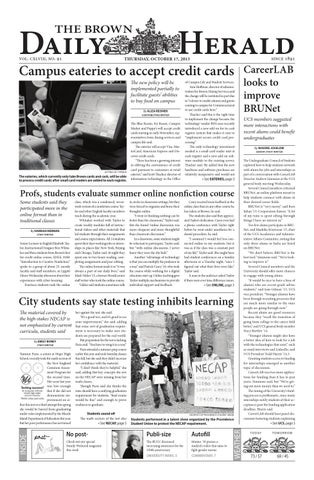
Campus eateries to accept credit cards CareerLAB The new policy will be implemented partially to facilitate guests’ abilities to buy food on campus By ALIZA REISNER CONTRIBUTING WRITER
JUSTINA LEE / HERALD
The eateries, which currently only take Brown cards and cash, will be able to process credit cards after small card readers are added to each register.
The Blue Room, Ivy Room, Campus Market and Poppy’s will accept credit cards starting in early November, representatives from dining services and campus life said. The eateries will accept Visa, MasterCard, American Express and Discover credit cards. “There has been a growing interest in offering the convenience of credit card payment to customers at retail eateries,” said Scott Thacher, director of information technology in the Office
of Campus Life and Student Services. Ann Hoffman, director of administration for Brown Dining Services,said the change will be instituted in part due to “a desire to enable alumni and guests coming to campus for Commencement to use credit cards here.” Thacher said this is the right time to implement the change because the technology vendor BDS uses recently introduced a new add-on for its cash register system that makes it easy to “implement secure credit card processing.” The only technology investment needed is a small card reader unit at each register and a new add-on software module to the existing server, Thacher said. He added that the new hardware and software purchases are relatively inexpensive and would not » See EATERIES, page 3
Profs, students evaluate summer online nonfiction course Some students said they participated more in the online format than in traditional classes By HANNAH KERMAN STAFF WRITER
Senior Lecturer in English Elizabeth Taylor, Instructional Designer Ren Whitaker and three students from Brown’s first for-credit online course, ENGL 0180: “Introduction to Creative Nonfiction,” spoke to a group of about 25, mostly faculty and staff members, in Lippitt House Wednesday afternoon about their experiences with cyber-learning. Fourteen students took the online
class, which was a condensed, sevenweek version of a nonfiction course Taylor and other English faculty members teach during the academic year. Whitaker worked with Taylor to create weekly modules full of instructional videos and other materials that led students through their assignments and course expectations. All 14 students spent their days working jobs or internships in places like New York, Beijing and Chicago, Taylor said. At night they spent one to two hours reading, completing assignments and peer editing. The online format made it so “it was always a part of our daily lives,” said Mark Valdez ’15, a former Herald senior staff writer who took the online course. Valdez said students sometimes talk
in circles in classroom settings, but they were forced to organize and hone their thoughts online. “I went in thinking nothing can be better than the classroom,” Taylor said. But she found “online discussion was more eloquent and more thoughtful than classroom discussion.” In a classroom, some students might be reluctant to participate, Taylor said, but “with online discussion, I never knew they were the shy kids.” Another “advantage of technology is that you can multiply the professor in a way,” said Patrick Carey ’16, who took the course while working for a digital education start-up. Online teaching gave Taylor multiple mechanisms to provide individual support and feedback.
Carey received more feedback in the online class than in any other course he has taken at Brown, he said. The students also said they appreciated Taylor’s dedication. Carey even had a phone conference with Taylor right before he went under anesthesia for a dental procedure, he said. “I assumed I would feel less connected online to my students, but it was as if the class was a constant part of my life,” Taylor said. She might have had student conferences on a Sunday afternoon or a Tuesday night, “once I figured out what their lives were like,” Taylor said. A man in the audience asked Taylor if there were ever time difference issues. » See ONLINE, page 3
City students say state testing inhibits learning
By EMILY BONEY STAFF WRITER
inside
Tammie Paris, a senior at Hope High School, recently took the math section of the New England A Common AssessB ment Program for the second time. D Her score last year Testing success? was low enough An evaluation of Rhode that if she did not Island’s high stakes assessment policy demonstrate imThird in a four-part series provement on either this test or a third attempt this spring she would be barred from graduating under rules implemented by the Rhode Island Department of Education this year. But her poor performance has not turned
her against the test, she said. “It’s a good test, and it’s good to see your improvement,” she said, adding that some sort of graduation requirement is necessary to make sure students are prepared for the real world. But preparation for the test is lacking, Paris said. “You have to wing it in a way.” Paris attended a summer prep course earlier this year and took Saturday classes this fall, but she said they didn’t increase her confidence with the material. “I don’t think they’re helpful,” she said, adding that key concepts she saw on the NECAP were missing from her math classes. Though Paris said she thinks the state should have a unifying graduation requirement for students, “final exams would be fine” and enough to prove readiness to graduate. Students sound off The math section of the test also » See NECAP, page 5
COURTESY OF PROVIDENCE STUDENT UNION
Students performed in a talent show organized by the Providence Student Union to protest the NECAP requirement.
No post-
Publi-size
Autofill
Check out our special Family Weekend magazine this week
The BUCC discussed increasing awareness for the 250th anniversary
Montes ’16 praises a student’s video that aims to fight gender norms
UNIVERSITY NEWS, 3
COMMENTARY, 7
weather
The material covered by the high-stakes NECAP is not emphasized by current curricula, students said
looks to improve BRUNet
UCS members suggested more interactions with recent alums could benefit undergraduates By MAXINE JOSELOW SENIOR STAFF WRITER
The Undergraduate Council of Students explored how to help students network with alums for jobs and internships as part of a conversation with CareerLAB Director Andrew Simmons at the UCS general body meeting Wednesday. Several Council members criticized BRUNet, an online platform meant to help students connect with alums in their desired career fields. BRUNet is “very messy,” said Ross Julian ’15, Corporation liaison. “A lot of my time is spent sifting through things I have no interest in.” Too few alums participate in BRUNet, said Maahika Srinivasan ’15, chair of the UCS Academics and Administrative Affairs Committee, noting that only three alums in India are listed on BRUNet. “We don’t believe BRUNet is the best tool,” Simmons said. “We’re looking to improve it.” Several Council members said the University should offer more chances to engage with young alums. “It would be nice to have a base of alumni who are recent grads advise students,” said Sam Gilman ’15, UCS vice president. “Younger alumni have been through recruiting processes that are much more similar to the ones people are going through now.” Recent alums are good resources because they “recall the transition of going from college to the career field better,” said UCS general body member Stacy Bartlett ’14. “Younger alumni might also have a better idea of how to look for a job with the technologies that exist,” such as email interviews and LinkedIn, said UCS President Todd Harris ’14.5. Granting students access to funding for internships emerged as another topic of discussion. CareerLAB recevies more applications for funding than it has in past years, Simmons said, but “We’re giving out more money than we used to.” The timing of the University’s funding process is problematic, since many internships notify students of their acceptances past the funding application deadline, Harris said. CareerLAB should host panel discussions featuring students explaining » See UCS, page 3 t o d ay
tomorrow
73 / 57
69 / 45
2 university news
THIS WEEK IN HIGHER ED
calendar TODAY
OCTOBER 17
5 P.M.
TOMORROW
OCTOBER 18
7 P.M. Middle East Studies Lecture
You Do You Showcase
Watson Institute
Faunce Underground
7:30 P.M.
9:30 P.M.
Janus Fellows: The Shutdown
Stand Up Comics
Wilson 309
MacMillan 117
menu SHARPE REFECTORY
VERNEY-WOOLLEY
LUNCH Chicken and Broccoli Alfredo Pasta, Tortellini Provencale, Chocolate Chip Cookies
Gourmet Turkey Sandwich with Cranberry Mayo, Eggplant Parmesan Grinder, Nacho Bar
DINNER Vegan BBQ Tempeh, Pirate Ship Pork Loin, Au Gratin Potatoes with Herbs, Zucchini, Squash and Tomato Stir-Fry
THE BROWN DAILY HERALD THURSDAY, OCTOBER 17, 2013
Pot Roast Jardiniere, Orange Chipotle Glazed Tofu, Fried Rice Bowl with Ham, Buttermilk Cornbread
sudoku
BY ELI OKUN, UNIVERSITY NEWS EDITOR
Poll finds skepticism about online education A Gallup poll released Tuesday shows a mixture of opinions on online education among the American public, including significant skepticism about its pedagogical potential. The poll, conducted earlier this month, found low overall approval ratings for online learning: Thirty-four percent of respondents rated fully online college programs as “excellent” or “good,” compared to 68 percent who said the same for traditional four-year institutions and 64 percent for community colleges. Respondents also compared online education to traditional classroom-based learning in several different categories. They favored online education for providing broad curricular options and good financial value. But in-person learning was seen as preferable for individually tailoring instruction, fostering student success and providing strong teaching, among other categories. The category that saw the greatest differential between the two forms of learning was appeal to future employers: Forty-nine percent of respondents said a classroom-based degree would be more attractive in the job search, while just 13 percent thought an online degree would be viewed more positively. The poll also showed that 5 percent of American adults are currently enrolled in an online course of any sort, but the bulk of online students are in the traditional college or graduate school age range. In a separate question, roughly half of poll respondents said obtaining the knowledge or skill set necessary for a specific job is more important than obtaining a college degree, but non-white respondents were significantly more likely than white respondents to choose a college degree as more important.
Survey finds negative climate for some Cornell minority students A student survey examining Cornell’s campus climate found that racial and sexual minorities feel considerably less safe on campus than their white and straight peers, the Cornell Daily Sun reported Tuesday. Among respondents identifying as queer, 73 percent said they had felt threatened or insulted based on their identities at least “occasionally.” That proportion dropped to 50 percent among gay, lesbian and bisexual students and to 24 percent among straight students. Nearly half of black students — 45 percent — responded that they had felt threatened or insulted based on their identities, compared to 20 percent of white students, 29 percent of Hispanics and 32 percent of Asians, the Sun reported. The survey, conducted by the university’s Institutional Research and Planning Office and its University Diversity Council, found that students in racial or sexual minority groups were much more likely to perceive a moderately or very disrespectful campus climate for people in their groups, the Sun reported. They were also more likely to self-report making personal efforts to learn about diversity.
RELEASE DATE– Thursday, October 17, 2013
Los Angeles Times Daily Crossword Puzzle c rNorris o s sandwJoyce o rNichols d Lewis Edited by Rich
ACROSS 1 Fur tycoon 6 “Due Date” costar Galifianakis 10 Rock blasters 14 Conveyed 15 Bassoon cousin 16 Wreak havoc in the streets 17 *Victor at Little Bighorn 20 Zilch 21 Fantasy game brute 22 Latin lesson word 23 New Year’s ___ 24 *2006 “Survivor” setting 28 Attacked 30 November honoree 31 “I’m an idiot!” 32 Abs strengthener 33 Leave port 35 Apportioning word 36 *Nursed, in a way 39 Gp. that houses strays 42 Bowlers and trilbies 43 Millionaire’s retreat 47 Strudel ___ mode 48 Jon Hamm’s “Mad Men” role __ Draper 49 Vocation 50 *All-in-one appliance 54 Dye holder 55 Classy 56 Fish you can smoke 57 Ricky portrayer 58 Handy person suggested by the starts of the answers to starred clues 62 Nebraska native 63 Like Iago, say 64 Rice/Lloyd Webber musical 65 Trees used to make longbows 66 Attends to one’s whistle? 67 Unreactive gas DOWN 1 Sawyer employer
48 Style of a historic 34 Ctrl-__-Delete 2 “Same here!” Miami Beach 35 Correct 3 Poseidon’s staff district 37 Superhero with a 4 __ Day vitamins 49 Get gooey hammer 5 Authority on a 51 Outdoor outings 38 Even once field 52 Bright again 6 Masked hero who 39 Chain __ 53 Argues 40 Give a sop to debuted in the ineffectively 41 Moneymaker 1919 story “The 57 Comic Chappelle 44 Not vacant Curse of 45 Charge for using, 58 Almond __ Capistrano” 59 Select group? as an apartment 7 Stunned way to 46 Potter or jeweler, 60 Roman salutation be taken 61 T. __ e.g. 8 Member of the fam ANSWER TO PREVIOUS PUZZLE: 9 Casual greeting 10 Cookie shop enticement 11 Ferdinand’s love in “The Tempest” 12 Ph.D.’s further studies 13 Jeanne d’Arc, for one: Abbr. 18 Old geezer 19 “Come no closer!” 24 Consiglieri’s boss 25 Penn et al. 26 Contained opening? 27 “Too noisy!” 29 Big band instrument 33 Defensive effort 10/17/13 xwordeditor@aol.com
By Julian Lim (c)2013 Tribune Content Agency, LLC
10/17/13
THE BROWN DAILY HERALD THURSDAY, OCTOBER 17, 2013
At BUCC, admins talk 250th, ombuds expansion The U. may try to promote the celebration through social media and student partnerships By MAGGIE LIVINGSTONE SENIOR STAFF WRITER
Planning for the University’s 250th anniversary and recent expansion to the Ombuds Office surfaced as dominant discussion topics at the Brown University Community Council meeting Wednesday. Eve Ornstedt, executive director for the newly created Office of the 250th Anniversary, spoke on how to integrate the greater community into the celebration, how technology will be used to enhance events and how to brand the anniversary to reach the widest possible audience. The celebration will start March 7, 2014 and last through May 24, 2015, Ornstedt said. Ornstedt said she and a committee including President Christina Paxson, Vice President for Public Affairs and University Relations Marisa Quinn and Executive Vice President for Planning and Policy Russell Carey ’91 MA’06 have met to establish goals for the anniversary. A priority for the celebration is to collaborate with students, faculty members, alums and community members to tell “the many stories of Brown,” she said. Ornstedt said the 250th office has worked for the past year on initiatives to brand the celebration, such as launching a website with information and related media. The soft launch for the website will be in January, she added. “From a technology perspective, this (website) model is something that the University could benefit from going forward,” Ornstedt said. The 250th office is also considering advertising at T.F. Green Airport,
» ONLINE, from page 1 Jingwei Wu ’14, who took the course from Beijing, laughed and said it wasn’t so bad. The concept of “flow time” — being allowed to turn assignments in within a day or so, depending on when the day ends — provided enough time for reading and completing assignments with care, Wu said. The class met in person the first weekend of the semester. Whitaker and Taylor attended, and the group had cookies and discussed what worked and what did not. “We have all this rich fodder to improve the next round, be it summer or spring,” Whitaker said. “I thought the class was such a
running a social media campaign and collaborating with undergraduate and graduate student organizations to publicize the celebration, Ornstedt said. She added that a grant program has been established to fund student groups looking to run programs or workshops during the 250th, but undergraduate interest has been low. Todd Harris ’14.5, president of the Undergraduate Council of Students, suggested recruiting student club ambassadors to promote the grant program. Graduate student representatives suggested Ornstedt speak to the Graduate Student Council to boost awareness. About 300 middle school students from the state will be invited to opening day of the 250th celebration for “a day of academic discovery and education,” Ornstedt said. A graduate student attending the meeting recommended pairing the middle school students with Brown students to better integrate campus members with the local community. Ruth Rosenberg, the University ombudsperson, spoke about the adjustments she has made since the Ombuds Office began serving staff and graduate students Aug. 1. Previously, the office only served faculty members and postdoctoral students. “I sit outside the administration,” she said, adding that she acts as a confidential, neutral mediator and adviser. “It’s a safe, quiet space where you can come talk about anything.” Rosenberg said since the office expanded, she has had more visitors but still experiences difficulties in attracting postdocs. A graduate student suggested Rosenberg introduce herself and her role to postdocs when they are first hired. Paxson said she invited Rosenberg to speak at the meeting to boost awareness about the office, which she said she hopes will be used more frequently in the future.
university news 3 » EATERIES, from page 1 lead to large annual fees, since the system adds on to existing hardware. Students on meal plan said the change would not significantly affect their dining habits. For instance, Carly Risman ’17 said the new policy would only matter to her if she ran out of points later in the semester. But students not on meal plan expressed enthusiasm about the change, adding that they believe the new policy could alter their eating habits. “I never carry cash around campus
» UCS, from page 1 how they funded past internships, said Sazzy Gourley ’16, chair of the UCS Academics and Administrative Affairs Committee. The Council also explored how to boost attendance at student events with the creators of an online events calendar called Ventfull, Pete Simpson ’14 and Joe Stein ’16, a Herald web producer. When campaigning for the vice presidency last spring, Gilman called streamlining the events calendar to increase attendance a key priority, The Herald reported at the time. Ventfull is meant to be a “student portal to hook onto the school’s
and I’m no longer on meal plan so I rarely eat on campus,” said Perri Gould ’14. “I’m super excited that on-campus eateries will be accepting credit cards, because now I’ll be able to eat at the Blue Room in between classes.” Students said the ability to use credit cards will mostly affect lunchtime habits. Pa Vue ’14, the unit manager of the Ivy Room, said she believes this change will be more useful “when the Ivy Room is opened in the afternoons, since there tend to be faculty and other professionals — who don’t have the convenience
of a meal plan on their cards — who have lunch there at that time.” She added that the ability to use a credit card in the Ivy Room may also be useful since there are “no ATM machines in the building.” Hoffman and Thacher both said it is unclear if the change will cause an increase in the number of purchases made at dining facilities. “That would be great, but we’re really not sure — volume is hard to predict,” Thacher said. “The project is primarily about enhancing customer convenience.”
existing system” of Morning Mail, Simpson said. Students can use Ventfill to filter events by category, including social, organization, performance, music, sports and academic, Simpson said. Students can also “upvote” events to give them a higher “excitement” ranking and sign up for notifications about events that relate to their interests, he said. Ventfull will ideally be released next semester, Simpson said. Gilman praised Ventfull as “one of the best platforms I’ve heard of.” Sam Rubinstein ’17, UCS general body member, said he was worried that “the upvoting process will make more people go to events that are
already big on campus and decrease turnout in smaller events.” “My concern is adding another source of information,” said Elena Saltzman ’16, another UCS general body member. “We already have so many.” The Council confirmed Harris and Gilman in their leadership positions in its semiannual vote of confidence. Harris said the annual UCS Fall Poll had the highest respondent rate in recent years, with 2,109 students completing the poll and 2,704 students answering some questions. About 750 fewer students took the poll last year, and around 1,000 fewer in 2011, Harris said.
success,” Taylor said. “But when I asked the group if they would take an online class back at Brown, 100 percent said no. They said, ‘It’s not the Brown experience’” to take an online course while on campus. Taylor is working with Whitaker to incorporate the lessons from the summer into a hybrid class for the spring semester. “I’m trying to rethink how I set up the discussions,” Taylor said. Her plan is to have one class conducted online each week and one that takes place in a classroom — but she hopes the structure will be meaningful rather than formulaic. “I want it to be that online will be most effective for whatever we’re doing on Tuesday,” Taylor said.
www.browndailyherald.com
4 city & state
THE BROWN DAILY HERALD THURSDAY, OCTOBER 17, 2013
R.I. health exchange continues to enroll Thousands have created accounts to get insurance after initial issues with the exchange were fixed By MARCUS SUDAC CONTRIBUTING WRITER
Though the federal health insurance exchange — a marketplace created by the Affordable Care Act for people to purchase health care insurance — continues to face technical problems, the Rhode Island exchange has overcome some initial glitches, with advocates expressing optimism about its future. The state exchange opened Oct. 1 in an effort to facilitate buying affordable health care, since the ACA also requires all Americans to purchase health insurance by Jan. 1 or incur a fee. The federal government created exchanges for states whose governors declined to create local marketplaces. Rhode Island is one of 18 states plus the District of Columbia to have adopted a state-based marketplace and has had roughly 5,700 accounts created, with around 800 of those users having completed their health insurance applications, said Dara Chadwick, chief of strategic communications and media relations at HealthSource RI, Rhode Island’s marketplace provider. HealthSource RI has a goal of receiving 70,000 to 100,000 completed applications by the end of 2014, Chadwick said. “We’re very pleased with the level of interest,” Chadwick said. “People are very excited.” Angela Sherwin, program director of the University’s Executive Healthcare Leadership Program, echoed Chadwick’s sentiment. “There is more interest than anticipated, and this has put (HealthSource) on a trajectory for higher participation,” she said. But the Rhode Island Center for Freedom and Prosperity, a conservative think tank, has suggested the exchange will not in fact draw many consumers. The center has “documented both the financial disincentives created by the ACA when it comes to purchasing insurance and identified and quantified the groups of people who are likely to remain uninsured, perhaps up to 97,000 Rhode Islanders,” the group wrote in a statement on its website. “As a result, Rhode Island should be prepared to see enrollment through the Rhode Island Health Benefits Exchange that is significantly below current expectations,” the center wrote in a report on the ACA. Rhode Island’s exchange offers 28 health insurance plans, Chadwick said, and the process of selection is “personal, and something different for each
individual.” While HealthSource RI has led the creation of the exchange, the Rhode Island Office of the Health Care Commissioner reviews all the offered plans as well as the insurers included on the exchange to make sure they comply with federal law, said Kathleen Hittner, the state health insurance commissioner. Rhode Island’s exchange includes plans offered by UnitedHealthcare, Neighborhood Health Plan and Blue Cross Blue Shield. Though those three providers already have strong presences in the state, Hittner said she thinks insurers from out of state may also enter the marketplace. HealthSource RI has targeted primarily small businesses as well as families, Sherwin said. Hittner added that she particularly expects young people to sign up for the exchange. Nationwide, insurance reform efforts have tried to persuade young, healthier people to purchase coverage, since including them in the insurance pool can drive down the cost of premiums. The size of the state changes the dynamic of health reform, Sherwin said. “One of the nice things about Rhode Island as a state is that everybody knows everybody,” she said. “The exchange can facilitate conversations between hospitals, insurers and companies in no way that could be done before.” Technical issues have plagued the establishment of marketplaces on both the federal and state levels. Nationally, the federal exchange suffered significant problems — many were unable to purchase insurance on the site’s launch date, and technical concerns have persisted over the past two weeks. That same day, Rhode Island’s exchange temporarily crashed. But HealthSource RI quickly added new servers, Chadwick said, and it has not faced similar issues since. Though these issues may highlight the unanticipated level of interest, other potential problems lie within the statefederal health insurance partnership. “There has been a problem connecting to the government,” Hittner said, though she added that those issues were unrelated to the government shutdown. Sherwin said Rhode Island’s marketplace launch went more smoothly than the federal government’s in part because of the state’s size. “Rhode Island is smaller,” she said. “The federal government took on 34 states all at the same time. For them, it’s like the big bang.” Sherwin and Chadwick also said the rollout of the exchange has been largely unaffected by the government shutdown.
city & state 5
THE BROWN DAILY HERALD THURSDAY, OCTOBER 17, 2013
A
B D
Testing success? An evaluation of Rhode Island’s high stakes assessment policy
A four-part series
This series will explore the debate over Rhode Island’s implementation of a standardized testing requirement for high school graduation, with a focus on history, policy and implementation since the creation of the NECAP. Read it online at: thebdh.org/testing. Tuesday: Following the passage of No Child Left Behind in 2002, standardized testing benchmarks have gained increasing importance in Rhode Island’s public schools. In 2012, the Rhode Island Department of Education tied performance on the state’s NECAP exam to graduation eligibility.
Disparities in NECAP scores Statewide average test scores mask the stark differences between schools such as Providence’s Classical and Mt. Pleasant high schools. 2009-10
2010-11
2011-12
2012-13
70%
Math
Yesterday: Increasing pressure for high performance on standardized tests has shifted classroom dynamics and forced some teachers to alter curricula.
60
Percent of 11th grade students proficient
Today: Tying testing performance to graduation eligibility has had a range of effects on students at Providence’s highly differentiated high schools.
50
Tomorrow: As Rhode Island moves toward implementing the Common Core Standards through the new PARCC exam, policymakers and politicians are reevaluating the graduation requirement.
40
» NECAP, from page 1 proved difficult for Asia Ochoa, a junior at Hope High School, who said that when taking the test she asked herself, “Did I even learn that?” “Teachers are saying, ‘It’s what you should know,”’ Ochoa said of the content on the NECAP. Though she said her classes prepared her for most of the test, “there were things I was missing.” Classical High School senior Kate Gasper passed all the required NECAP tests her junior year. “English was very easy, and the math wasn’t too difficult,” she said, adding that her classes prepared her for those sections but not the science section, which is not a graduation requirement. Despite her success on the tests, Gasper said she supports “the antiNECAP movement.” “There should be a test, but because NECAP wasn’t created as a graduation requirement, I don’t think it’s a good idea,” Gasper said. She added that there should be some way to hold Rhode Island students to national standards but the NECAP should not be tied to graduation. Hideki Tani, a sophomore at Classical High School, said the NECAP was “unfair because if you’re having a bad day, it could determine whether you graduate or not.” He added that there were “a lot of factors” besides intelligence and material retention that could affect test performance. When asked if he was nervous for the test next year, he said “a little, because I struggle in math.” “It’ll depend on my teacher. If they’re good, then they’ll prepare you for NECAP,” Tani said, adding that he thought some teachers would not prepare him well enough to pass the test. The silent majority? State Education Commissioner Deborah Gist, who spearheaded the move to make the NECAP a graduation requirement, has acknowledged student opposition but said “it’s important to recognize that an organized group of students in one community doesn’t necessarily speak for every student in the state.” “I meet with students all the time. I meet with student groups. I meet with individual students. I meet with individual students and families. I meet with people when I go out in the community and visit schools, so I am very regularly in communication with students and parents,” she said. Some students are less concerned about the requirement than others, she added. “I’ve definitely talked to students who have told me that they’re not sure what all the reaction is about,” Gist said. “I’ve heard a variety of opinions from students that are not all one voice.” At a press conference following the board’s vote to uphold the requirement, Chairwoman of the Board of Education Eva Mancuso, who has provided key support for Gist, said, “The time for discussion is over. … We are using the NECAP as a graduation requirement, period.” “I’m not going to get involved with sideshows with 16 year olds,” Mancuso said.
A students’ union A talent show in front of the Rhode Island Department of Education building drew a crowd of students, teachers and supporters of the agenda of the Providence Student Union, a group of students and organizers that has orchestrated numerous events across the state in an attempt to do away with NECAP testing. Student performances at the rally ranged from rapping to playing the violin to performances by dance groups and vocalists. Sam Foer, a junior at the MET School, said he “doesn’t agree with highstakes tests at all.” “Even at the MET” — which boasts a distinct educational philosophy based on hands-on learning — “our education is put toward prep for the NECAP,” he said. “I really struggled in middle school” Foer said, and “would have dropped out” had he not transferred to the MET. Foer has been “taken out of classes” to get extra NECAP prep time. “It puts a roadblock in front of education,” he said, “because the stuff on the NECAP is stuff you’ll never use.” Foer said he felt confident taking the reading and writing sections earlier this year after studying. “I was very nervous (about NECAP) my freshman year, but I’ve done what they wanted me to do — I studied.” But he said he was still nervous about the math section. “I don’t know if I will be proficient.” “Lots of kids break down in the middle of the test, because their whole life is on the line,” he said. Cheyanne McLaychlan, one of the event’s coordinators and a PSU member, said the NECAP is “just a test” that does not allow students to showcase their potential effectively. Its narrow approach to subjects is “unfair,” she said. “Schools can support and encourage us to do better, instead of just telling us,” McLaychlan said, adding that she would like to see more after-school programs and tutoring for struggling students. The NECAP is “set up to make students fail,” said Bryan Varela, a Providence high school student and member of the PSU, who added that the test was not covered in the curriculum. In place of the NECAP, Varela proposed “something more career oriented” and specific to student interests, proposing computer simulations, engineering projects or group work as possible substitues for the test. “It would show what the student needs to know and would be better for the student,” he said. Justin Farmer, a sophomore at the Jacqueline M. Walsh School for the Performing and Visual Arts, said standardized tests in general are not “preparation for the real world.” When asked how he feels about taking the NECAP next year, he said he is “kind of nervous.” “Some kids are just not good at standardized tests, and they’re forced to suffer,” he said, adding that high school graduation should be based upon “grades and personal interviews,” which would determine whether the student was ready for the next step.
Brown students reflect A large majority of Brown students said they believe standardized test results should play at least “a small role” in high school graduation requirements. A poll conducted by The Herald found that only about 12 percent of students believe standardized test scores should play no role in graduation requirements for public high schools. About 40 percent of students said they believe scores should account for a small role, 41 percent said they should play a moderate role and 5 percent said they should play a large role. Students at Brown generally found state standardized tests “pretty easy,” said Jacob Kirschenbaum ’17, or “not something to complain about,” said Melitzi Torres ’15. Kirschenbaum, who attended Scarsdale Senior High School, said he took the New York Regents standardized test and is “definitely against it.” “It was the easiest test we took all year, and it counted a lot because the teachers knew we’d all get high scores,” he said. Torres said that as one of the top students in her class at Shea Senior High
30 20 10 0
R.I. Average
Classical HS
100%
Mt. Pleasant HS Reading
90
Percent of 11th grade students proficient
80 70 60 50 40 30 20 10 0
R.I. Average
Classical HS
Source: Rhode Island Department of Education
in Providence, she was not as “stressed” about the NECAP as many of her classmates, though the test did not yet constitute a graduation requirement. “I don’t think it’s fair,” Torres said. “My high school was notoriously poorperforming.” Changes to the curriculum “got rid
Mt. Pleasant HS ASHLEY SO / HERALD
of freshman biology and replaced it with Integrated Science, which was basically prep for the NECAP math,” she said. In place of the NECAP, Torres suggested students create portfolios of their work, which would “show how they’ve improved” over the four years they spent in high school.
6 commentary
THE BROWN DAILY HERALD THURSDAY, OCTOBER 17, 2013
EDITORIAL
For-profit education poses problematic model Earlier this month, Kamala Harris, California’s attorney general, filed a lawsuit against Corinthian Colleges Inc., a for-profit company that specializes in selling one product: education. In this instance, the company was accused of distorting job placement rate figures, providing false and deceitful advertising and even illegally using the official U.S. military seals in order to attract veterans. Unfortunately, situations like the case of Corinthian Colleges Inc. are not unique. The puppeteers behind the for-profit industry have established an economic sector for the sole sake of rent-seeking. Such development is problematic, and we condemn the for-profit education sector as a whole. On free-market and arguably moral terms, the idea of a for-profit college can make sense. More people have come to realize the value an education brings to their employment prospects, but they may not have the resources or abilities to attend nonprofit or public colleges. This is when for-profit colleges can enter the labor market — offering what many, especially those from low-income brackets, desire and demand. Based solely on these premises, for-profit colleges could also be seen as a moral force, supplying education to those who may appreciate their inherent monetary value the most. But the for-profit college industry has not only ignored the only principles that give it legitimacy, but has also completely reversed them. Instead of filling a sorely needed gap in educational attainment, these companies allocate a huge portion of their budgets toward advertising and marketing — often at the direct expense of efforts toward improving the quality of education. Consequently, advertising frequently overstates the value of for-profit education, resulting in consumers overpaying for a service that does not deliver. But instead of criticizing what the for-profit institution has now become, perhaps we should focus on how to provide a meaningful and rewarding college education to anyone who desires one. Education is a long-term investment whose values are realized through its effects on a society’s growth. If we commodify education in such a reductive way, quality will also suffer. After all, the industry in question has one principal concern: generating profit. Education determines much of a person’s livelihood. It is meant to help the individual advance in all aspects of life. An entrepreneur or businessman can certainly fail at a business and still not compromise his values, wealth or even desire to create more businesses. But many of the students who have been tricked into attending these schools may lose not only the money they spent, but also something just as, if not more, important: the belief that education is valuable.
K I M B E R LY S A LT Z
Editorials are written by The Herald’s editorial page board: its editor, Rachel Occhiogrosso, and its members, Daniel Jeon, Hannah Loewentheil and Thomas Nath. Send comments to editorials@browndailyherald.com.
Q U O T E O F T H E D AY
“I’m not going to get involved with sideshows with 16 year olds.” — Eva Mancuso, chairwoman of the R.I. Board of Education See necap, page 1. Editorial Leadership
Sections
Visuals & Production
Business
Editors-in-Chief Lucy Feldman Shefali Luthra
Arts & Culture Editors Hannah Abelow Maddie Berg
Head Photo Editor Emily Gilbert
General Managers Julia Kuwahara Samuel Plotner
Managing Editors Elizabeth Carr Jordan Hendricks
City & State Editors Sona Mkrttchian Adam Toobin
Senior Editors Aparna Bansal Alexa Pugh
Features Editors Jennifer Kaplan Elizabeth Koh
Strategic Director Greg Jordan-Detamore
Science & Research Editors Phoebe Draper Kate Nussenbaum
BLOG DAILY HERALD Editor-in-Chief Meredith Bilski
Sports Editors James Blum Connor Grealy
Managing Editor David Oyer
University News Editors David Chung Mathias Heller Eli Okun
POST- MAGAZINE
Editorial Page Editor Rachel Occhiogrosso
Editor-in-Chief Ben Resnik
Opinions Editors Gabby Corvese Garret Johnson Maggie Tennis
Photo Editors Brittany Comunale David Deckey Samuel Kase Sports Photo Editor Jesse Schwimmer Video Editors Henry Chaisson Assistant: Danny Garfield Data Science Editor Andersen Chen Web Producer Joseph Stein Design Editors Kyle McNamara Mie Morikubo Julia Shube Assistant: Sandra Yan
facebook.com/browndailyherald
@the_herald
browndailyherald.com
Directors Sales: Eliza Coogan Finance: Nicole Shimer Alumni Relations: Emily Chu Business Dev.: Justin Lee
Location: 195 Angell St., Providence, R.I. www.browndailyherald.com
Office Manager Shawn Reilly
Corrections: The Brown Daily Herald is committed to providing the Brown University community with the most accurate information possible. Corrections may be submitted up to seven calendar days after publication.
Sales Managers Regional: Jennifer Aitken Regional: Jaqueline Chang Regional: Leslie Chen Regional: Wenli Shao Regional: Carolyn Stichnoth Student Group: Anisa Holmes Finance Managers Collections: Sameer Sarkar Collections: Timothy Sharng Operations: Sarah Levine
Copy Desk Chief Sara Palasits
Alumni Relations Manager Engagement: Alison Pruzan
Illustrations Editor Angelia Wang
Business Dev. Managers Project Leader: Melody Cao Project Leader: Kaden Lee
Editorial contact: 401-351-3372 herald@browndailyherald.com
Business contact: 401-351-3260 gm@browndailyherald.com
Commentary: The editorial is the majority opinion of the editorial page board of The Brown Daily Herald. The editorial viewpoint does not necessarily reflect the views of The Brown Daily Herald, Inc. Columns, letters and comics reflect the opinions of their authors only. Letters to the Editor: Send letters to letters@browndailyherald.com. Include a telephone number with all letters. The Herald reserves the right to edit all letters for length and clarity and cannot assure the publication of any letter. Please limit letters to 250 words. Under special circumstances writers may request anonymity, but no letter will be printed if the author’s identity is unknown to the editors. Announcements of events will not be printed. Advertising: The Brown Daily Herald, Inc. reserves the right to accept or decline any advertisement at its discretion. The Brown Daily Herald (USPS 067.740) is an independent newspaper serving the Brown University community daily since 1891. It is published Monday through Friday during the academic year, excluding vacations, once during Commencement and once during Orientation by The Brown Daily Herald, Inc. Single copy free for each member of the community. Subscription prices: $280 one year daily, $140 one semester daily. Copyright 2013 by The Brown Daily Herald, Inc. All rights reserved. Periodicals postage paid at Providence, R.I. Postmaster: Please send corrections to P.O. Box 2538, Providence, RI 02906.
commentary 7
THE BROWN DAILY HERALD THURSDAY, OCTOBER 17, 2013
Let’s talk facts about guns ANDREW POWERS opinions columnist
It seems to be almost a constant background fixture of national debate — periodically taking to center stage in the aftermath of horrific tragedy. Just last month, Nico Enriquez ’16 wrote a column calling for stronger firearms regulation (“The blind gun,” Sept. 20) in which he made many points that, to me, seemed at best misleading and at worst either factually inaccurate or logically fallacious. Enriquez began with a purely emotional appeal derived from anecdotal evidence and supported by rhetoric. Among other selected stories, he presents the example of Megan Bookstaver: “A college student … dead because of an unregistered gun. No criminal charges are being filed.” Given the contextual tone and lack of details, one could easily misinterpret this case as an instance of lax regulatory policy directly precipitating the murder of an innocent woman and allowing her killer to get away scot-free. In reality, Bookstaver was accidentally killed when her boyfriend was cleaning one of her family’s many firearms. The gun, a long gun, was not registered because
registration of long guns is not legally required. No criminal charges were filed because no crime was ever committed. Bookstaver’s father steadfastly continues to support gun rights. Of course, the only thing gun control advocates like bringing up more than individual victims of gun violence is multiple victims of gun violence. For instance, Enriquez writes that “Thirteen people were gunned down … in the middle of Chicago.” But “gunned down” may be a bit of a strong term — given that there were zero fatalities in that case. Additionally, Enriquez failed to mention that the firearm used to perpetrate the crime was illegal, so it seems unlikely that more stringent legal restrictions could have prevented this incident. When repeatedly bringing up cases like these, the purpose is never to present some new and convincing logical argument, but rather to get people riled up. It is obviously true firearms can be used to perpetrate appalling crimes — no one is on the other side of that argument. But it’s not logically inconsistent to agree with that point while simultaneously supporting gun rights. Let’s quit it with the demagoguery and stick to substance. If you ever watch Michael Moore’s film “Bowling for Colum-
bine,” you’ll notice that he never lation in one industry doesn’t lead actually conducts any sort of cost- me to believe that the same success benefit analysis on his proposed will necessarily be had through inchanges in firearms policy. It’s tak- creasing regulation in an altogethen for granted that since people die er different industry. Moreover, because of guns, it would be crazy the analogy is simply unnecessary. not to ban guns. And Moore is by Why bother looking at driving fano means alone in tality data with rethis view. Invari“Let’s quit it with spect to automoably, when a multive policy when the demagoguery we could just look tiple-victim shooting occurs, media at firearm fatality and stick to frenzy is sure to data with respect substance.” follow — immeto firearms policy? diately condemnMedia personing conservatives as murderers by alities relish pointing out that the proxy. Enriquez’s column is just a United States has by far the highdrop in this ocean of hair-trigger est gun death rate. Moore’s film emotionalism. features a montage of countries’ The one empirical argument in names with their respective statisEnriquez’s column makes a compa- tics. Ironically, Moore essentially rision to driving fatalities. Decades admitted the fallacious nature of ago, automobile-related deaths making such comparisons by notwere more prevalent than they are ing the inexplicable crime differtoday. Enriquez points out that au- ences between Canada and the tomotive regulations were initially United States even though they resisted by a “well-financed indus- have similar gun laws. try lobby,” and that when restricIt is more instructive to examtions finally were passed, deaths ine the temporal changes in gun declined. Similarly, organizations crime rates over a period durlike the National Rifle Association ing which firearms regulation resist proposed firearms regula- changed. During the 1970s and tions in today’s world. 80s, both Washington, D.C. and I completely agree with these Chicago instituted gun bans and points as matters of fact, but I dis- saw massive increases in crime, agree that the conclusion is that we both of which went away as soon as should more heavily regulate guns. the bans were lifted. Island nations Success through increasing regu- with strict border controls — such
Autofill: A Gender Study JESSICA MONTES opinions columnist
Last week, Emma Hall ’16 created the short film “Autofill: A Gender Study.” This 4 minute and 41 second video focuses on societal microaggressions that have become “norms” and stereotypes of gender and feminism revealed through Google searches, including oneline statements such as “rape victims should take blame” and “feminists are ugly.” After only 24 hours on YouTube, the video had gained more than 1,000 views and was repeatedly shared on mutiple social media platforms. At press time, the video had over 3,400 views. Simple in its creation and truthful in its words, “autofill: a gender study” manages to rip open the societal shield that we all live behind. It was made quickly. Hall conceived of it on a Wednesday, filmed it that Saturday and Sunday, edited it on Monday and Tuesday, and uploaded it Tuesday night. But it has been subconsciously brewing in her mind for quite a while. She wanted to create something that would speak for her and force others to listen. The result is a video that also speaks for countless others who feel silenced in today’s society. Hall, like many, was tired of baseless complaints against “feminist beliefs” toward oppression and sexism. These same beliefs pinpoint problems in our current society that
have been continuously ignored so a women’s issue, this is a people’s ismuch they have become “norms.” sue,” she said. This video was a chance to unmask It is a people’s issue. After watchthese microaggressions and display ing this video, I realized that statethem for what they really are. ments I’ve heard throughout my All of the Google searches and life and brushed off as ignorant are verbal microagactually the most gressions in the searched phrases “Simple in its video come from on Google. On the creation and Hall’s own experione hand, I know ences as a woman. that people could truthful in its These are things just be searching words, ‘autofill: she has seen and these microaga gender study’ heard — things gressions to gain you’ve probably insight into their manages to rip heard, too. She mehistories or oriopen the societal gins. But there is ticulously aligned each statement so no denying that a shield we all live that phrases such good proportion behind.” as “women should of these Google be dominated” searchers really do were placed alongside assertions believe that “men should be able to like “women shouldn’t vote” to em- hit women” or that “women need to phasize the ridiculousness of both. know their place.” Her video served as a platform on Not only does her video make which every type of microaggres- me aware of this societal issue, but sion could be voiced. it also makes me want to do someBut this project is not only di- thing. Simply ignoring people who rected towards women. The video use microaggressions will get us noincludes derogatory societal norms where. In a way, ignoring the proband statements commonly di- lem is just as bad as supporting it. rected towards men, as well, while By ignoring it, we allow this type of also acknowledging that “gender is thought to thrive, letting the numnot a binary.” Hall also notes that ber of Google searches increase and the term “rape victim” can refer to expanding the number of silenced anyone, and that “any person, re- voices. gardless of gender, sexual identity, It’s time to be vocal and stop this sexual orientation, race, ethnicity verbal violence. This is our chance or economic background, can be a to change — not only society, but victim of or affected by sexual as- also ourselves. sault.” When I spoke to her, she emphasized that the microaggressions the video is combatting can Jessica Montes ’16 can be reached be directed at anyone. “This is not at jessica_montes@brown.edu.
as Ireland and Jamaica — experienced similar effects. The intuition behind these findings is that banning guns disarms law-abiding citizens while having little effect upon criminals, encouraging crime. The empirical findings corroborate this understanding. Enriquez also raised concerns that firearms manufacturers create “interfaces that allow children to shoot themselves.” As is the case with mass shootings, accidental gun deaths are extremely rare events that garner disproportionate media coverage. Each year, more children drown in buckets than shoot themselves or other children. And don’t get me started on the real killer — bathtubs. This is a laughably weak basis for criticism, but it does make for a nice soundbite on the news. Toward the end of his column, Enriquez proposed policies that demonstrated a real dearth of understanding of firearms technology and the related politicized terminology. But maybe gun control advocates like Enriquez are right about something. Maybe 30,000 people don’t have to die every year. Tell your Congressman. Deregulate. Andrew Powers ’15 can be reached at andrew_powers@brown.edu.