Daily
THE BROWN
vol. cxlviii, no. 90
Herald
since 1891
WEDNESDAY, OCTOBER 16, 2013
Middle East Studies grows under new leadership The program has seen a boost in its number of events, professors and concentrators By MEGHAN FRIEDMANN CONTRIBUTING WRITER
A well-attended teach-in, a student paper series and a packed panel about IsraelPalestine are just three of many events put on by the newly expanded Middle East Studies Initiative. The initiative has doubled in size since last year’s appointment of Beshara Doumani as the program’s new director. “(The initiative) has grown because we have wonderful faculty and students,”
said Doumani, who is also a professor of history. Through the numbers There were only 14 to 16 Middle East Studies concentrators upon Doumani’s arrival at Brown in July 2012, but by the end of the last academic year that number had grown to 38 students, he said. This semester 28 students are concentrating in Middle East Studies. Though 80 percent of Middle East Studies concentrators also concentrated in another subject last year, now at least 60 percent concentrate in Middle East Studies alone, Doumani said, adding that the difference could be attributed to the initiative’s growing strength. » See MIDDLE EAST, page 3
Students apathetic toward Paxson Most polled reported not knowing enough about the president’s strategic plan to form an opinion
DAN ZHANG / HERALD
The Middle East Studies program sponsored a Sept. 9 teach-in on Syria. Herald file photo.
Speakers call on youth to spur economic reform The talk emphasized today’s budget policy and its consequences for the next generation By SARAH PERELMAN SENIOR STAFF WRITER
BRITTANY COMUNALE / HERALD
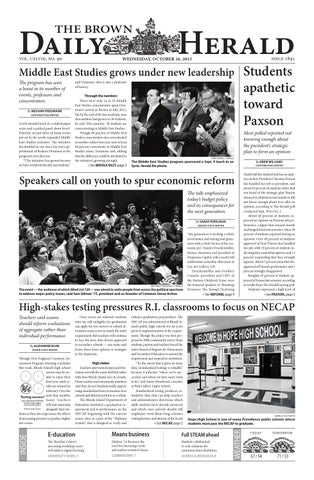
The event — the audience of which filled List 120 — was aimed to unite people from across the political spectrum to address major policy issues, said Sam Gilman ’15, president and co-founder of Common Sense Action.
“My generation is stealing a whole lot of money and leaving your generation with a whole lot less of the economic pie,” Stanley Druckenmiller, former chairman and president of Duquesne Capital, told a nearly full auditorium yesterday afternoon in List Art Gallery 120. Druckenmiller and Geoffrey Canada, president and CEO of the Harlem Children’s Zone, were the featured speakers at “Breaking Promises: The Young’s Declining » See REFORM, page 4
By DREW WILLIAMS CONTRIBUTING WRITER
Nearly half the student body has no opinion on how President Christina Paxson has handled her job as president, and about 65 percent of students either had not heard of the strategic plan Paxson released in draft form last month or did not know enough about it to offer an opinion, according to The Herald poll conducted Sept. 30 to Oct. 1. About 48 percent of students expressed no opinion on Paxson’s job performance, a figure that remains mostly unchanged from last semester, when 49 percent of students reported having no opinion. Over 40 percent of students approved of how Paxson has handled her job, with 32 percent of students indicating they somewhat approve and 11 percent responding that they strongly approve. About 7 percent somewhat disapproved of Paxson’s performance and 1 percent strongly disapproved. Roughly 45 percent of students approved of Paxson last semester, according to results from The Herald’s spring poll. Students expressed a high level of » See PAXSON, page 2
High-stakes testing pressures R.I. classrooms to focus on NECAP
By ALEXANDER BLUM SENIOR STAFF WRITER
inside
Though New England Common Assessment Program retesting concludes this week, Rhode Island’s high school seniors may be unA B able to enjoy their final year until results are released in D February. Over the next four months, Testing success? An evaluation of Rhode many teachers Island’s high stakes will wait anxiously assessment policy A four-part series alongside their students as they also experience the effects of increasing pressure to produce higher test scores.
Once scores are released, students who are still ineligible for graduation can apply for test waivers or submit alternative exam scores to satisfy the state’s requirement. But teachers will continue to face the new, data-driven approach in secondary schools — one many said leaves them fewer options or strategies in the classroom. High stakes Teachers interviewed expressed frustration not with the exam itself but rather with how Rhode Island uses its results. Many teachers and community members said they do not fundamentally oppose using standardized tests to measure how schools and districts perform as a whole. The Rhode Island Department of Education instituted a graduation requirement tied to performance on the NECAP beginning with the current senior class as a part of the “Diploma System,” that is designed to verify and
enhance graduation preparedness. The NECAP was administered in Rhode Island’s public high schools for six years prior to implementation of the requirement. Though the policy was first proposed in 2008, community outcry from students, parents and teachers forced the state’s Board of Regents for Elementary and Secondary Education to amend the requirement and suspend its institution. “To the extent that it gives us more data, (standardized testing) is valuable” because it indicates “where we’ve succeeded, and where we have more work to do,” said Aaron Woodward, a teacher at Paul Cuffee’s Upper School. Standardized testing produces cumulative data that can help teachers and administrators determine which skills students have already mastered and which ones schools should still emphasize, wrote Brian Fong, a former visiting lecturer and director of the Social » See NECAP, page 5
HERALD FILE PHOTO
Hope High School is one of many Providence public schools whose students must pass the NECAP to graduate.
E-ducation
Means business
Full STEAM ahead
The Sheridan Center’s upcoming workshop series will address digital learning
Hudson ’14 discusses the need for internship credit and market-oriented classes
Students collaborated to seek solutions for communication disabilities
UNIVERSITY NEWS, 3
COMMENTARY, 7
SCIENCE & RESEARCH, 8
weather
Teachers said exams should inform evaluations of aggregate rather than individual performance
t o d ay
tomorrow
67 / 54
71 / 53
2 university news » PAXSON, from page 1
calendar TODAY
OCTOBER 16
12:30 P.M.
TOMORROW
OCTOBER 17
12 P.M.
Lunchtime Meditation Sit
Perception Action Seminar Series
Manning Chapel
Metcalf, Room 305
5 P.M.
8 P.M. Photography Exhibition
Fall Fest 2013
Brown RISD Hillel
Ruth J. Simmons Quadrangle
menu SHARPE REFECTORY
VERNEY-WOOLLEY
LUNCH Chicken Fingers, Grilled Montreal Chicken, Vegan Malibu Grilled Patties, Whoopie Pie Pumpkin Cake
Egg Drop and Chicken Soup, Vegetarian Spinach Strudel, Italian Sausage and Pepper Sandwich
DINNER Shrimp with Asian Noodles, Crispy Thai Tofu with Fresh Lime, Red Thai Chicken, South Pacific Coconut Rice
Chopped Sirloin with Mushroom Sauce, Pastito, Butternut Squash and Leek Risotto, Washington Apple Cake
sudoku
RELEASE DATE– Wednesday, October 16, 2013
Los Angeles Times Puzzle c r o sDaily s w oCrossword rd Edited by Rich Norris and Joyce Nichols Lewis
ACROSS 1 Tower site 6 “That last piece of cake is mine!” 10 Hemingway nickname 14 Once __ time ... 15 Shield border, in heraldry 16 Skunk’s defense 17 Roulette choices 18 Roulette, for one 19 Baltic native 20 Some boxing wins 23 Not bare 24 Large expanse 25 Cause a stir 31 Bath accessory 33 TV talk pioneer 34 March composer 35 Destructive Greek god 37 Like May through August, literally 40 Bar order 41 Use Comet on 43 Rejection from the top 45 RMN was his vice president 46 Sitcom security device that often defeated its own purpose 50 Bread, at times 51 Salad cheese 52 Where to find the starts of 20-, 25- and 46Across 59 Winter coat 60 Michigan city or college 61 __ Janeiro 62 Part of a plot 63 Pleased 64 Navel phenomenon 65 Tools for Wolfgang Puck 66 Italian noble family 67 Fancy moldings DOWN 1 Burger King supply 2 For each one
3 Recipe instruction 4 Supplement nutritionally 5 Race ender 6 Outcome of successful negotiations 7 Camaro __-Z 8 A bit down 9 Dojo instructor 10 Game divided into chukkers 11 Arabian Peninsula seaport 12 Tools for Wolfgang Puck 13 Gallery showing 21 Senegal’s capital 22 Swimmers Crocker and Thorpe 25 Rudder’s locale 26 Coin-tossing attraction 27 Gooey lump 28 Upholsterer’s choice 29 Previously owned 30 Cut the skin from
31 Like “padre,” e.g.: Abbr. 32 BP subsidiary 36 Drag to court 38 Like some millionaires 39 Expensive 42 Pear variety 44 Lake on the New York border 47 Silo filler
48 Hogwarts castings 49 Thoughtful 52 Cuzco native 53 Muffin grain 54 Flock females 55 Latin I verb 56 Single 57 “Garfield” canine 58 “Cheers” actor Roger 59 Maple yield
ANSWER TO PREVIOUS PUZZLE:
xwordeditor@aol.com
By Pam Amick Klawitter (c)2013 Tribune Content Agency, LLC
10/16/13
10/16/13
apathy toward Paxson’s draft of her strategic plan, “Building on Distinction,” which was released Sept. 18. About 49 percent of students responded that they were aware of the plan but did not know enough about it to offer an opinion, while roughly 16 percent said they had not heard of the plan. Nearly 21 percent of students somewhat approved of the plan, and about 5 percent indicated they strongly approved. Roughly 7 percent responded that they somewhat disapproved of the strategic plan, and about 2 percent strongly disapproved. Many students likely did not report an opinion of Paxson’s job performance because she is still relatively new to campus, said Todd Harris ’14.5, president of the Undergraduate Council of Students. “Students and President Paxson are still working to get to know each other,” Harris said. But he added that he believes Paxson has done a good job reaching out to the student body. “She has been incredibly receptive to student input and student opinions in her forums,” Harris said, adding that this approach is vital to cultivating closer ties with students. That a majority of students expressed no opinion of the strategic plan does not reflect a lack of accessibility to the plan’s details, said UCS Vice President Sam Gilman ’15. “Students have the opportunity to engage with the information if they want,” he said, adding that UCS hosted an open forum with Paxson earlier this month to give students the opportunity to provide feedback on the strategic plan.
THE BROWN DAILY HERALD WEDNESDAY, OCTOBER 16, 2013
Student opinion on Paxson Almost half of undergraduates polled expressed no opinion when asked: “Do you approve or disapprove of the way Christina Paxson is handling her job as president of the University?” Of those who expressed an opinion, most approved.
48%
50%
40 32% 30
20 11% 10
8% 1%
0
Strongly Somewhat disapprove disapprove
No opinion
Somewhat Strongly approve approve GREG JORDAN-DETAMORE / HERALD
At the meeting, UCS members and other undergraduates expressed opinions on issues such as the plan’s treatment of advising, financial aid and the role of undergraduate education, The Herald reported at the time. UCS also hosted meetings with student group leaders to get their opinions on the plan, Gilman said. Apathy about the strategic plan correlated with a lack of opinion on Paxson’s job performance. About 74 percent of students who had not heard of the strategic plan offered no opinion of Paxson’s
performance, while 59 percent of students who said they had heard of the plan but did not know enough about its details to have an opinion also said they had no opinion of Paxson’s performance. Approval of Paxson diverged by class year. Seniors were the least likely to offer no opinion of Paxson, with about 44 percent responding that they had no opinion. Roughly 52 percent of juniors — the highest portion of any class year — offered no opinion on Paxson, while about 51 percent of first-years and 45 percent of sophomores responded that they had no opinion of Paxson’s job performance. Harris linked the plan’s “broad nature” to student apathy. “(The plan) leaves out goals for the future of Brown, so I think that if there were more specifics, there would be stronger reactions on both sides,” Harris said. Some students said they do not believe there was enough readily accessible information about the plan. “I feel like there aren’t enough venues to find out about it,” said Kieran Berry ’16. Other students said the University has provided ways for students to learn about the plan but noted they have not taken advantage of these opportunities. “I just haven’t taken the time to read about it,” said Kyle Yamada ’17. Madalyn Metz ’14.5 said emails have been a constructive way for administrators to spread awareness about the plan, but she added that she still does not know a lot about the plan’s details. Some students said they want the plan to emphasize improved advising services and universal need-blind financial aid as key priorities. Metz said the plan should devote more focus to advising for students, an area she said needs enhancement. Collins Cheruiyot ’16 said he approves of Paxson’s support for increasing financial aid, adding that he is glad the plan endorses continued efforts to move to a universal need-blind admission policy. The plan does not lay out a specific timeline for adopting a need-blind policy, but the draft stated the University will “work towards” this goal, The Herald previously reported. Patrick Loftus ’16, said he does not know much about Paxson’s daily work as president, but he added that he is aware there is a lot of “change happening really quickly” at the University.
university news 3
THE BROWN DAILY HERALD WEDNESDAY, OCTOBER 16, 2013
» MIDDLE EAST, from page 1 The program has also sponsored more events than it did previously. Last year, the initiative sponsored more than 70 events and activities, Doumani said. This year, it will facilitate eight conferences and numerous events, including a film series, a distinguished visiting lecturer series, a student paper series and various luncheon seminars, he added. Something new “Brown University is a great place to build something new,” Doumani said. Middle East Studies grew under the provision of resources allotted by the dean of the faculty and the provost, he added. Along with new funding, new hires such as Associate Director Anthony Watson and Program Manager Barbara Oberkoetter have been central to the initiative’s growth. Doumani headed a search for a new assistant professor of history, which led to Faiz Ahmed joining the program. Ahmed is an “expert” in general Middle East history, with a special focus on Afghanistan, and speaks several languages, including Arabic, Urdu, Turkish and Farsi, Doumani said. Doumani also had the opportunity to add two “fantastic” postdoctoral fellows who are “very popular with their students,” he said. One is Sa’ed Atshan, who has a PhD from Harvard and curates the initiative’s film series, Doumani said. Next semester, Iranian pop singer Mohsen Namjoo, a political advocate who puts his own twist on traditional Persian music, will be a visiting professor, said Nasim Azizgolshani ’14.
Doumani said the singer will be here for a year and will teach two courses and give three concerts. Namjoo is one of Doumani’s favorite artists and has a large following among young people in Iran, he said. Political inspiration Students and faculty members expressed different opinions on whether the political climate of the Middle East has contributed to the initiative’s increased popularity. “If you care about peace and you care about prosperity in the world, you’ve got to really understand the Middle East,” said Richard Locke, director of the Watson Institute for International Studies. He added that upheavals in the region have piqued student interest, and Azizgolshani called the Middle East the “new hot, sexy topic.” But Doumani disagreed. “The conflicts in the Middle East that have dominated headlines … and that concern many Americans — whether it’s the Palestinian-Israeli conflict, or the Gulf Wars or Iran — … they’ve been going on for a long time,” he said, indicating that these events are not responsible for the recent growth of Middle East Studies. Instead, Doumani cited student and faculty commitment as the reason for the initiative’s success. Locke attributed much of the program’s growth to Doumani, whom he called an “extremely talented scholar” and a “gifted and creative administrator.” Azizgolshani, a Middle East Studies concentrator, described the program as “Beshara’s baby.” Azizgolshani founded the Middle East Studies student departmental undergraduate group and is now
a student organizer. The DUG had its second event last week, she said. Growing excitement When she arrived at Brown, the Middle East Studies program was “really small” and “lackluster,” Azizgolshani said. “Suddenly by junior year … it was an explosion of … events and classes and professors and all these new opportunities,” she said, adding that it became “exactly what (she) wanted.” Azizgolshani added that she likes the enthusiasm of those involved with the initiative and concentrators’ high levels of extracurricular involvement. Since coming to Brown, Azizgolshani said she has seen an increase in the variety of Middle East Studies classes offered. For example, classes on IsraelPalestine were previously very “limited” and only offered by the Department of Judaic Studies, but now they show a more “diverse perspective,” Azizgolshani said. There were also no classes about Iran, but now there are professors like Shiva Balaghi, visiting professor of Iranian Studies, whose classes fill up every semester, she said. Reva Dhingra ’14, who serves as a student assistant for the Middle East Studies Initiative, said the program is much more “serious” and “organized” than it was her freshman year. The program’s events are also more “visible” and “exciting,” she said. For students, the program provides “a lot more mentorship and a lot more guidance,” Dhingra added. Azizgolshani said of Middle East Studies and its growth, “This was like my dream come true.”
Sheridan Center offers new digital workshops The Sheridan Center’s series The workshop series will accompanies the University’s conexplore teaching methods tinued focus on increased digital for both online and offline learning experiences. The Sheridan Center created the workshops applications By MADELEINE MATSUI CONTRIBUTING WRITER
The Sheridan Center for Teaching and Learning will host a series of new digital teaching workshops over the coming weeks to address technology’s growing role in students’ learning experiences, center administrators said. Three hour-long workshops held today, Oct. 29 and Nov. 12 are open to faculty members and graduate students and will focus on designing effective digital assignments, facilitating online discussions among students and course instructors and using online peer grading, according to the Sheridan Center’s website. The workshops mark the first time the Sheridan Center has conducted a multi-session series focused on digital learning. They are intended to provide course instructors and teaching assistants with the broad skills needed for online teaching, said Sheridan Center Executive Director Kathy Takayama. Forty-five individuals have signed up for the workshops so far, Takayama added.
in response to increased reliance on online teaching, said Andrew Campbell, chair of the Sheridan Center advisory board and associate professor of molecular microbiology and immunology. “Since (online education) is something we want to look at and incorporate at Brown, it made sense to create a workshop for those who are involved in teaching,” Campbell said. The University introduced three massive open online courses, or MOOCs, via the learning platform Coursera this summer. But Takayama said the workshops go beyond improving teaching for MOOCs. “We call them digital pedagogy workshops because they’re not restricted to being applicable only to MOOCs or online learning, but we see these as ways to think about ways of creating student interactions and learning communities,” Takayama said. Neal Fox GS said he has registered for the series and has found past Sheridan Center workshops to be instructive. “What’s exciting about the Sheridan Center is the » See SHERIDAN, page 4
4 university news » REFORM, from page 1 Share of the Economic Pie,” an event hosted by Common Sense Action Brown University and the Office of the President, with co-sponsors from various political action groups across the political spectrum. The Republican and Democrat teamed up to present statistics about the portion of the national budget allotted to entitlements for senior citizens and called the youth of the audience to put pressure on politicians to change funding policy. In the past 40 years, transfer payments — government distributions of money, including social security — have jumped from 28 percent of government expenditures to 68 percent, Druckenmiller said. “If you look at the budget for the United States … what you will find is that government spending is set to grow $1 trillion,” Druckenmiller said.
Though there will be an $875 billion increase in spending on programs geared toward the elderly or poor — Social Security, Medicare and Medicaid — the amount budgeted for children will only increase by $6 million. Canada, whose organization seeks to give children in Harlem opportunities to attend college and “live the American dream,” said he was appalled to discover that national fiscal policy might make this dream impossible for them. “My generation set out to leave this (country) a better place than we found it,” Canada said. “In the end, (the next generation is) going to get ripped off. This is something to me that’s un-American, and I felt that we need to do something about it.” “The one group in America you don’t have to worry about being taken advantage of are the seniors,” he added, noting that AARP has successfully elicited national support for entitlements
THE BROWN DAILY HERALD WEDNESDAY, OCTOBER 16, 2013
and is set to maintain its influence. The youth, who “don’t really vote and don’t really have a lot of financial power,” have been overlooked in terms of budget policy, Druckenmiller said. Lack of government transparency about revenue and debt allows the issue to be buried, he added. The $17 trillion national debt jumps to $205 trillion when the calculation includes promised future payments on Social Security and Medicare, he said. “The only company I know that does their books like the (United States) is Enron.” The crisis point might be more than a decade away, but “if you wait, the cost of fixing the problem (rises) exponentially over time” as interest on outstanding loans accumulates, Druckenmiller said, presenting several hypothetical scenarios to illustrate the problem of the country’s growing debt. Though a 55 percent tax hike could pay off all debt this year, a 65 percent increase would be needed if the country waits 20 years. In 30 years, taxes would have to increase by 72 percent to cover all debts, he said. Young people have great power to spur large-scale change, Druckenmiller said. “Even though your generation doesn’t vote as much as mine,” young people’s advocacy has impacted President Obama’s environmental policy, and “we have gay marriage pretty much cascading throughout the country
now,” he said. “You guys need to put pressure on both parties,” he told the audience of students and professors. This way, one of the parties will see the issue of entitlement spending matters to voters and take measures to effect change, he said. “We have time to address this, and we need to address it now,” he said. The speeches were followed by a question-and-answer session, in which Druckenmiller and Canada addressed the issue of health care. Though health care policy must be “worked out in the political area,” Druckenmiller said he believes the country should “get consumer choice back into the healthcare system” through direct customer payments, which would hold providers more accountable for prices. Canada said he supports universal health care but still thinks the Affordable Care Act is fraught with problems. “But I daresay if we put 20 young people from this college in a room, they would come up with ideas,” he said, adding that giving young adults more input in the future of health care is important because their generation will fund whatever plan is implemented. Some audience members raised concerns that prioritizing youth could take needed money away from seniors. “It’s really about equity, not about
whether or not we should have entitlements,” which are necessary in some form, Canada said. The event’s objective — which mirrors CSA’s overall goals — was to bring “Democrats, Republicans, students for liberty … and all other relevant political groups” together to discuss important issues, said Sam Gilman ’15, president and co-founder of CSA. “We all realize that our generation needs to start a conversation and take action on these issues” to avoid the long-term consequences, he added. CSA will discuss entitlement reform at its weekly meeting today, said Oliver Lyman ’15, director of policy for CSA. This discussion, as well as discussions about other current political issues, will be used to create an advocacy agenda for Brown CSA. Students who attended the lecture said they appreciated the focus on numbers and facts rather than more generally biased statements. Groups co-sponsoring the event included the Political Science Department Undergraduate Group, College Democrats of Rhode Island, College Republican Federation of Rhode Island, Brown Democrats, Brown Republicans, the Janus Forum, Brown Political Review, the Brown Political Forum, Brown University Students for Liberty and Brown Socially Responsible Investment Fund.
» SHERIDAN, from page 3
with faculty members. Sheridan Center Instructional Designer John Melson said the workshops are also designed to facilitate wider conversations about online teaching among course instructors and graduate students. “We want to keep the workshops general enough that they can be of use for a variety of people,” Melson said. President Christina Paxson’s strategic plan, released last month, called for “aggressive experimentation in new modes of education,” highlighting the Sheridan Center as a venue
for online teaching innovations in the coming years. The plan’s endorsement of more experimental online learning was coupled with a commitment to devoting more attention to improving the teaching skills of students pursuing doctoral degrees. Takayama said administrators have not finalized the details for the Sheridan Center’s role in implementing the strategic plan. But the Sheridan Center will emphasize “reflective teaching practices” in which course instructors should focus on better engagement with students, she added.
interdisciplinary dialogue it encourages and the professional development opportunities that don’t exist at any other peer universities,” he said. The Sheridan Center does not aim to focus on digital teaching just “for the sake of working with technology,” but rather targets its efforts on developing the best teaching practices, Takayama said. She added that the Sheridan Center conducts its own research on various teaching methods’ efficacy in order to best work
city & state 5
THE BROWN DAILY HERALD WEDNESDAY, OCTOBER 16, 2013
» NECAP, from page 1 Studies/History MAT program, in an email to The Herald. “I believe in assessing our students,” Fong wrote. “Without assessing what our students are able to do, you really don’t know what’s going on (in) schools.” But teachers and advocates said problems arise when standardized tests are used to evaluate individual students. “The NECAP was never supposed to be a marker for individual students,” said Diane Schulze ’16, a program coordinator of the Rhode Island Urban Debate League, adding that the test “fails to recognize different types of intelligence.” “We really don’t think any high-stakes test should be a high-stakes test,” said Anne Mulready, a lawyer at the Rhode Island Disability Law Center, calling it unfair to make graduation contingent on a student’s performance on a single test. “To tie it to graduation is insane,” said Nancy Krahe, a social worker at the Providence School Department, adding “I’ve never seen students so frustrated. I’ve never seen staff so stressed.” “It’s supposed to be used as a diagnostic,” said Anna Kuperman, an English teacher at Classical High School, adding that high-stakes testing “is not good in theory, it’s not good in practice.” “One test does not make the individual,” said Rep. John Lombardi, DProvidence. “Let the teachers teach.” Lack of preparation? RIDE’s increased commitment to high-stakes testing is the wrong approach, said Aaron Regunberg, staff member of the Providence Student Union, a student activism group that regularly protests the NECAP graduation requirement. Regunberg compared the requirement to the Massachusetts Comprehensive Assessment System created by the 1993 Massachusetts Education Reform Act. Massachusetts only began mandating benchmark MCAS scores in 2003, he said — after 10 years of devoting extensive resources to improving the quality of education in their public schools. Massachusetts invested over $2 billion in its public education system over a seven-year period before tying MCAS to graduation, according to a release from the Massachusetts Department of Elementary and Secondary Education. This increase in resources allowed Massachusetts students to perform well on their state’s test, Regunberg said. But Rhode Island made no such prior investment, he added. “We didn’t do any of that prep work, and we haven’t put in the resources,” he said. Many Providence students have scored low, Mulready said, adding that these results have been misinterpreted and used as evidence that the state should in fact add more testing. Some expressed concern that highstakes testing leads teachers to neglect subjects not tested on the NECAP. Attaching such weight to individual exam scores results in “more teaching to the test, more curriculum narrowing,” Regunberg said, adding that it encourages “a reduction in the kinds of learning and techniques that are most engaging.” Classroom dynamics The extent to which the requirements affect teachers “depends on where you are,” said Woodward, who teaches English and history, adding that teachers feel the most pressure in schools where student performance on the NECAP is strikingly low. For that reason, curriculum
reductions and other negative effects most often appear in already struggling schools, he said. Kuperman said she has not devoted more time to test preparation in her classroom since the graduation requirement was passed — she said focusing on testing “doesn’t mean (students) are getting a better education.” Teaching students how to “fill in bubbles” is not meaningful for their development, she added. But Kuperman said her beliefs are not necessarily those of the average teacher. “People are definitely spending time on (test prep),” she said. The NECAP requirement has not only affected teachers of subjects being tested. Though social studies is not tested on the exam, Orah Bilmes MAT ’89, a social studies teacher at Alvarez High School, said the test nonetheless influences her classroom and teaching. Administering the test “takes up a lot of days” during which she cannot as effectively teach students who have been “very demoralized and stressed” by the test, she said. Students who work with “caring educators” and make significant academic progress despite structural obstacles — such as a lack of English language skills — may still not be able to graduate, given the NECAP requirement, Fong wrote. This situation both concerns and disheartens teachers, he added. Outsourcing education Hiring top school administrators from outside the district can result in leadership approaches that do not respond to the school’s actual needs, many said. And some of the problems associated with the NECAP stem from the exclusion of teacher voices when the state crafted such assessments, advocates said. “We need to change the leadership at the top,” Lombardi said, adding that it is crucial to reinvest in the educational system and “utilize the people from within.” Hiring outside administrators reinforces the notion that the average teacher cannot move up within the system and also means those in charge lack familiarity with the district or school’s unique problems. “Education is a really localized issue that should be solved in localized ways,” Woodward said. Having educational policy experts involved in curricular development is valuable, but to have those driving educational reform divorced from the teachers who work in the classrooms poses problems, he added. Teachers were completely removed from the development of the tests currently used to evaluate students, wrote Carole Marshall, a retired teacher from Hope High School, in an excerpt released to The Herald from her book “Stubborn Hope: Memoir of an Urban Teacher.” The book is scheduled to be published this winter. They had “no part in test creation, no professional development, no role in scoring, no voice whatsoever,” she wrote. Testing teachers or students? Though the initial Rhode Island Department of Education policy outlined a system of teacher evaluations, Education Commissioner Deborah Gist announced this summer the program will not be implemented for the 2013-2014 academic year. The teacher evaluation policy — set to be implemented next year — has been criticized for being linked to student performance on the NECAP. “When a lawyer loses a case, he
doesn’t lose his right to practice law,” said Krahe, adding that teachers should not necessarily be punished for poor student performance on standardized tests. Test results are affected by several factors outside the quality of classroom instruction, and it is unfair to hold teachers accountable for variables completely out of their control, she said. Federal policies like the No Child Left Behind Act, made clear to school administrators that they needed to improve test scores or face the consequences, Marshall wrote. “(Administrators) were under enormous pressure and they brought it right back to us,” she wrote. Teachers were required to do much more work outside of the classroom, limiting time for lesson planning and leaving teachers “utterly overwhelmed by red tape.” “Meetings with administrators became a tense interchange about the data,” Marshall wrote. In schools where the majority of students do not have access to the same resources as wealthier students, “teachers can be disproportionately penalized” for the poor progress their students make on tests, Fong wrote. When students do not prioritize standardized testing because they are facing “poverty, homelessness, abusive
A
B D
Testing success? An evaluation of Rhode Island’s high stakes assessment policy
A four-part series
families, etc.,” teachers should not have their careers jeopardized “for that student’s situation,” Fong wrote. Meanwhile, Krahe said, “Good teachers are rethinking why they’re in the field” because of these dynamics. Disordered priorities Some expressed concern that politics and financial incentives play too large a role in determining the direction of education reform. “It really violates what we’re trying to do here,” said Greg Davis, a teacher at Mount Pleasant High School, adding that he fears current educational reform is driven by perverse corporate incentives. Recent developments have made education “all about testing,” he said. “It’s just not fair to screw (students) that way.” “It’s really an assault on public education,” Krahe said. The quantity of resources being paid to outside organizations to manage education in Providence schools “is really horrendous,” she said, adding, “it’s all about privatization.” The implementation of curricula designed by large-scale education companies was very frustrating, Marshall wrote. “I was being forced to teach canned curriculum purchased for millions of dollars from textbook publishers who
A & B | MJ Esquivel
Racing in the wrong direction The passage of Race to the Top legislation under President Obama’s administration has reinforced emphasis on standardized testing in classrooms. “There is no chance that these tests are going to do anything for us,” Kuperman said, adding that the graduation requirement “is part of the move across the country to get data.” Race to the Top is centered on quantifiable results, she said, and it gives the impression that “we have to be testing more” because that will improve student performance. “Unfortunately, it just doesn’t work like that,” Kuperman said. “The test is a symptom of the broader philosophy behind modern education reform,” Woodward said. The approaches to education “swing pole to pole,” he said — and “right now, the solution is sort of this data-driven, teacher-free” approach to education. But high-stakes testing has not only affected teachers. Tomorrow’s story will analyze student performance on the NECAP, student experiences with the exam across the state and student activism against high-stakes standardized testing.
This series will explore the debate over Rhode Island’s implementation of a standardized testing requirement for high school graduation, with a focus on history, policy and implementation since the creation of the NECAP. Read it online at: thebdh.org/testing. Yesterday: Following the passage of No Child Left Behind in 2002, standardized testing benchmarks have gained increasing importance in Rhode Island’s public schools. In 2012, the Rhode Island Department of Education tied performance on the state’s NECAP exam to graduation eligibility. Today: Increasing pressure for high performance on standardized tests has shifted classroom dynamics and forced some teachers to alter curricula. Tomorrow: Tying testing performance to graduation eligibility has had a range of effects on students at Providence’s highly differentiated high schools. Friday: As Rhode Island moves toward implementing the Common Core Standards through the new PARCC exam, policymakers and politicians are reevaluating the graduation requirement.
comic Eric & Eliot | Willa Tracy
knew nothing about urban teaching,” she wrote.
6 commentary
THE BROWN DAILY HERALD WEDNESDAY, OCTOBER 16, 2013
EDITORIAL
One of the boys Last week, President Obama announced he would nominate Janet Yellen ’67 to be chair of the Federal Reserve Board of Governors. We commend this well-considered choice, made after months of confusion and national speculation. The move has seen widespread approval, with the Washington Post, for example, noting Yellen’s “unusually strong credentials for the job.” The Post, like almost every other news outlet that reported the announcement, continued to characterize the moment as a triumph for all “women in economics” — “cracking the ultimate glass ceiling in the field.” The example Yellen has set throughout her career has been one of continued achievement and competence. We are inspired by her appointment and hope to see her nomination swiftly approved by the Senate. Yellen’s nomination marks a break from a male-dominated, insiderfocused ethos in national politics. The move follows widespread speculation that President Obama had planned on picking Lawrence Summers, former president of Harvard, to head the Federal Reserve. Summers is a longtime Obama economic confidant but attracted negative attention from many liberal senators for his policies during the Clinton administration, where he worked at the Treasury Department and finally as Secretary of the Treasury. Summers championed deregulatory policy that ultimately proved catastrophic and has long been known for his abrasive and thoughtless comments. Many students here, particularly female students, may remember him best as the Harvard president who resigned for, among other reasons, suggesting that the underrepresentation of women in science, technology, engineering and mathematics could be explained by “issues of intrinsic aptitude.” Summers was the presumptive nominee before he announced in midSeptember that he was withdrawing his name from consideration following protests from Senate liberals. Though we believe Summers should not have been so abandoned by the Obama administration, we contend he never should have been first in line for the position. Yellen, as the current Fed vice chair, should have been the presumptive nominee for the top spot all along. She was the former president of the Federal Reserve Bank of San Francisco and a noted economics professor at University of California, Berkeley. She has proven prescient on many occasions, including when she warned 10 years ago about the potential for a bubble in housing prices and more recent statements predicting a slow economic recovery. As the New York Times noted, “Yellen has spent more than half of the last 20 years as a top Fed official.” The deep irony of this situation, of course, is that Yellen is and has this whole time been more qualified for the position. If she had been passed over in favor of Larry Summers, as many thought she would be, it would have been for a fundamentally unscientific reason — that President Obama has worked with Summers for years and knows him personally. The conditions surrounding Yellen’s appointment may have been messy, but they only emphasize the significance and value of having women — particularly ones as unquestionably qualified as Yellen — in senior positions. Shattering the glass ceiling may leave a few shards, but it also paves the way for the next generation of women. Editorials are written by The Herald’s editorial page board: its editor, Rachel Occhiogrosso, and its members, Daniel Jeon, Hannah Loewentheil and Thomas Nath. Send comments to editorials@browndailyherald.com.
A N G E L IA WA N G
LETTER TO THE EDITOR
CS department should reexamine intro courses To the Editor: The Herald editorial acknowledging the beneficiary growth in computer science (“Undergraduates benefit from studying computer science,” Oct. 15) is a positive statement to Brown students’ desire to be educated in our current age of technology and information. The department leaders at the Center for Information Technology, however, should not be complacent with numbers. I challenge them to reassess the introductory computer science pedagogy as the rest of the science, technology, engineering and math departments at Brown reevaluate their teaching techniques. If computer science has become a necessary skill along with mathematics and literacy in our age, it should be taught in an inclusive way. Having taken CSCI
0170: “Computer Science: An Integrated Introduction,” I have seen the clear knowledge gap between those who had prior experience and those who are completely new to the terminal. Suddenly, those large reported time commitments indicate the privilege of prior education in the field. Those who feel born and raised on computers zoom through work at a fraction of the time their peers spend agonizing over code. That is not a difference in intelligence — that is a difference in understanding how to “think” through computer science problems. I am sure that the leaders in computer science dream of a world where all people create programs to help in their daily life. That dream is a grand goal, but it begins with teaching introductory courses to all types of students. Joseph DiZoglio ’15
CORRECTION An article in Tuesday’s Herald (“Hoping to fulfill graduation requirement, thousands take NECAP retest,” Oct. 15) incorrectly stated that 80 percent of Hope High School’s student body is retesting this month to try to qualify for graduation. In fact, 80 percent of the school’s senior class is retesting. The Herald regrets the error.
Q U O T E O F T H E D AY
“The only company I know that does their books like the U.S. is Enron.” — Stanley Drukenmiller, former chairman and president of Duquesne Capital See reform, page 1. Editorial Leadership
Sections
Visuals & Production
Business
Editors-in-Chief Lucy Feldman Shefali Luthra
Arts & Culture Editors Hannah Abelow Maddie Berg
Head Photo Editor Emily Gilbert
General Managers Julia Kuwahara Samuel Plotner
Managing Editors Elizabeth Carr Jordan Hendricks
City & State Editors Sona Mkrttchian Adam Toobin
Senior Editors Aparna Bansal Alexa Pugh
Features Editors Jennifer Kaplan Elizabeth Koh
Strategic Director Greg Jordan-Detamore
Science & Research Editors Phoebe Draper Kate Nussenbaum
BLOG DAILY HERALD Editor-in-Chief Meredith Bilski
Sports Editors James Blum Connor Grealy
Managing Editor David Oyer
University News Editors David Chung Mathias Heller Eli Okun
POST- MAGAZINE
Editorial Page Editor Rachel Occhiogrosso
Editor-in-Chief Ben Resnik
Opinions Editors Gabby Corvese Garret Johnson Maggie Tennis
Photo Editors Brittany Comunale David Deckey Samuel Kase Sports Photo Editor Jesse Schwimmer Video Editors Henry Chaisson Assistant: Danny Garfield Data Science Editor Andersen Chen Web Producer Joseph Stein Design Editors Kyle McNamara Mie Morikubo Julia Shube Assistant: Sandra Yan
facebook.com/browndailyherald
@the_herald
browndailyherald.com
Directors Sales: Eliza Coogan Finance: Nicole Shimer Alumni Relations: Emily Chu Business Dev.: Justin Lee
Location: 195 Angell St., Providence, R.I. www.browndailyherald.com
Office Manager Shawn Reilly
Corrections: The Brown Daily Herald is committed to providing the Brown University community with the most accurate information possible. Corrections may be submitted up to seven calendar days after publication.
Sales Managers Regional: Jennifer Aitken Regional: Jaqueline Chang Regional: Leslie Chen Regional: Wenli Shao Regional: Carolyn Stichnoth Student Group: Anisa Holmes Finance Managers Collections: Sameer Sarkar Collections: Timothy Sharng Operations: Sarah Levine
Copy Desk Chief Sara Palasits
Alumni Relations Manager Engagement: Alison Pruzan
Illustrations Editor Angelia Wang
Business Dev. Managers Project Leader: Melody Cao Project Leader: Kaden Lee
Editorial contact: 401-351-3372 herald@browndailyherald.com
Business contact: 401-351-3260 gm@browndailyherald.com
Commentary: The editorial is the majority opinion of the editorial page board of The Brown Daily Herald. The editorial viewpoint does not necessarily reflect the views of The Brown Daily Herald, Inc. Columns, letters and comics reflect the opinions of their authors only. Letters to the Editor: Send letters to letters@browndailyherald.com. Include a telephone number with all letters. The Herald reserves the right to edit all letters for length and clarity and cannot assure the publication of any letter. Please limit letters to 250 words. Under special circumstances writers may request anonymity, but no letter will be printed if the author’s identity is unknown to the editors. Announcements of events will not be printed. Advertising: The Brown Daily Herald, Inc. reserves the right to accept or decline any advertisement at its discretion. The Brown Daily Herald (USPS 067.740) is an independent newspaper serving the Brown University community daily since 1891. It is published Monday through Friday during the academic year, excluding vacations, once during Commencement and once during Orientation by The Brown Daily Herald, Inc. Single copy free for each member of the community. Subscription prices: $280 one year daily, $140 one semester daily. Copyright 2013 by The Brown Daily Herald, Inc. All rights reserved. Periodicals postage paid at Providence, R.I. Postmaster: Please send corrections to P.O. Box 2538, Providence, RI 02906.
commentary 7
THE BROWN DAILY HERALD WEDNESDAY, OCTOBER 16, 2013
Student startups: a sense of reality JAY UPADYHAY opinions columnist
A quarter of all startup businesses will fail within a year of inception. After five years, over half of all small businesses will have failed. In fact, research released last year by Shikhar Ghosh, a professor at Harvard Business School, concluded that three out of four startup companies don’t return investors’ capital. Why, then, does the on-campus sentiment at Brown surrounding newly formed companies seem so rosy? From Brown’s popular entrepreneurial engineering classes, new business competitions or seed funding through the University, there seems to be a zeal for creating new businesses. I believe this is nothing more than the famed “irrational exuberance” that surrounded the Internet bubble years ago. Starting a small business doesn’t require much. To the extent you have a product or service you want to sell, you can do so without much legal work. Once you’ve sorted out your operating costs and revenue streams, the bulk of the job is done. The final step is to raise
capital. You can approach family and friends, go to venture capital firms and angel investors or take out a loan. Once you’ve raised sufficient funds, you can begin selling. After all, watching “The Social Network” makes it seem like all it takes is an idea and some friends to be on your way to a $104 billion initial public offering. But in reality, maintaining and growing a company requires much more. For a startup to succeed, you need a viable, scalable business model, careful capital budgeting, efficient cost structure, adept management, organic growth, risk management and durability. In most cases, you also rely on favorable macroeconomic trends that are out of your control. To make matters more difficult, unforeseeable circumstances such as new market entrants, forecasts that deviate from reality and inability to adapt to changing market forces inhibit a company’s success. In short, there’s more to it than just having an idea and selling or pitching it. Starting a business requires an understanding of corporate finance, decisionmaking and business experience which a majority of Brown students frankly lack. Sure, there are classes here
where you learn how to read not save a company in the cold, business cases, analyze the rele- impersonal marketplace. So invant issues and prescribe possi- stead of getting too vested in a ble solutions. There are lectures revolutionary idea or beginning given by alums that seem to serve to plan the launch of your inas guidance for aspiring student novative right away, I propose entrepreneurs. But the reality is a more refined approach. Take Brown isn’t an an accounting undergraduate class to under“Building up your business school stand all three human capital and doesn’t have financial statean undergraduments, how they and establishing ate business delink together and requisite gree. The rehow to synthesize knowledge will sources available and analyze the at Brown are no important parts. decrease your substitute for a Enroll in an inchances of rigorous managetroductory ecoment or finance nomics course to regressing to the course. If you how market “startup mean” — learn pushed many of mechanisms opwhich is failure.” the starry-eyed, erate, how to alentrepreneurlocate resources ial Brown students to describe efficiently and how different facthe trade-offs between financing tors can influence the price and via debt or equity, how to deter- quantity of goods and services. mine what proportion of their Audit a corporate finance seccapital is risk-bearing or even tion and discover how to value how to thoroughly analyze and assets, project and discount cash synthesize free cash flows and flows, and how businesses quancapital expenditures, I would titatively make decisions. Buildguess they’d be stumped. Unless ing up your human capital and they’ve taken advanced econom- establishing requisite knowledge ics courses or done serious inde- will decrease your chances of rependent studying, they haven’t gressing to the “startup mean” — been exposed to this type of which is failure. If nothing else, quantitative finance. you’ll have applicable knowledge But pleading ignorance will throughout most areas in busi-
ness and finance. To be clear, I’m not discouraging the growth of new businesses or student innovation. Startups can provide employment in a struggling economy. They can alter the way we think, experience and interact. They’re also an excellent way to make a social difference, whether it’s delivering meals to students in developing nations or establishing microfinance for the impoverished. But college is a time to compile information and hone critical thinking skills. Operating a thriving business is a complex task and should not be taken lightly by virtue of brief case studies or glorified anecdotal evidence. Before jumping into the next business idea, I caution students to temper their expectations, gather relevant skills and approach their venture carefully. Otherwise, like the dot-com boom of decades ago, their bubble will burst. Jay Upadhyay ’15 appreciates the role entrepreneurs play and wants to see Brown students interested in starting new businesses succeed. He can be reached at Jay_Upadhyay@Brown.edu.
Internships for concentration credit OLIVER HUDSON opinions columnist
President Calvin Coolidge once said, “the chief business of the American people is business.” Indeed, to many, America is the land of entrepreneurs. Plenty has changed since 1925, but entrepreneurship remains popular today. College-age students especially are drawn to join or found startups, having seen the successes of companies such as Facebook and Instagram. Brown students have the intelligence and drive to become successful entrepreneurs. But unfortunately, the University does not support much of a program in business education. We have ENGN 0090: “Management of Industrial and Nonprofit Organizations,” the Brown Entrepreneurship Program and student business groups. But classes don’t teach the nuts and bolts of business. We don’t have courses on marketing, operations or corporate law. To remedy the gap in offered classes, the University should update the Open Curriculum to include a form of applied business education. In addition to allowing academic departments to offer credit for internships, Brown
should have departments give coursework at Brown, students students the option of having could make presentations or internships that are undetak- submit reports about their inen during a semester influence ternship work during the semeswhat kind of degree students ul- ter. This academic side of the intimately receive. ternship would be a new form of Individual departments interdisciplinary learning. could establish relationships The nature of the job marwith businesses, negotiating po- ket limits my proposal. Organisitions for student interns. Stu- zations may not make as many dents could then find intern- internships available as students ships tied to a would like, and it concentration in may be difficult “Summer an academic deto find interninternships give partment. ships related to In the Brown students real-world particular fields spirit of choice, of study. But the experience that each academprogram doesn’t can’t be found in a have to work for ic department could make everyone to benclassroom.” the decision of efit some. whether to ofIn fact, a small fer credit for internships, how version of this already exists at much credit and what type of in- Brown. The applied math-comternship could count for credit. puter science concentration has Semester internships give an optional “professional track.” students real-world experience Students who complete industhat can’t be found in a class- try work related to applied math room. And paying $42,808 in or computer science and write tuition while facing a 7.3 per- a report about it are eligible to cent unemployment rate makes add the “professional track” despractical business education all ignation to their diploma. The the more important to future internship program would be graduates. Classroom education a way of offering the “profesis without a doubt essential to a sional track” to more students degree. But to many, the mar- across different concentrations ginal benefit of an extra class or for work during a semester. two might be less than the benThe work experience and efit of a relevant internship. practical skills learned from a To integrate internships with semester internship give stu-
dents an edge in the job market. In a series of 100 interviews of Generation Y adults, a career advisor writing for Fox News found that the “hallmark of someone who had found career success after graduation from college turned out to be early internships” — and not simply summer internships, but rather, “sustained experience throughout the year.” Semester business internships also offer an opportunity to improve advising at Brown. Many students think advising needs improvement. In addition to a form of career advising, the internship program would provide concentration advising, giving students a better sense of what to study. Indeed, the study of 100 Generation Y adults found that internships influenced students’ course selection in college. Many will question the need for this program, especially if students can already complete internships during the summer. But the need for internships keeps increasing. The working world today is perhaps less certain than it has ever been. According to Future Workplace, an executive development firm, 91 percent of millennials — those born between 1977 and 1997 — expect to stay at one job for fewer than three years. That means
millennials will have between 15 and 20 jobs during their working lives. The skills demanded in the workplace are also rapidly changing. With the explosion in the availability of data and the increasing ease of communication, employees will have to adapt to changing technology. Such an internship program would offer an opportunity to keep the Open Curriculum alive. To continue, the Open Curriculum has to stay current with advances in the world. Otherwise, students and faculty members will begin to wonder if imposing requirements might be better than allowing choice of outdated material. The Open Curriculum can last only as long as students believe that the course offerings are worthwhile. Keeping the Open Curriculum alive and well means continually experimenting with new courses. That way, through trial and error, the Open Curriculum will evolve to suit the times. Semester internships for concentration credit would build students’ practical skills, improve advising and support our unique curriculum. Oliver Hudson ’14 may be contacted at oliver_hudson@brown.edu.
daily herald science & research THE BROWN
WEDNESDAY, OCTOBER 16, 2013
Arts, science merge in STEAM tech project A workshop aimed to create technology for those with communication disabilities By VI MAI CONTRIBUTING WRITER
About 20 students worked to design assistive technologies for people with communication disabilities during the “Speak Your Mind” workshop Thursday night in List 110. The event was hosted by STEAM, a student group formed last academic year that seeks to merge art with traditional STEM disciplines — science, technology, engineering and mathematics. The workshop was led by Dan Bacher, a senior research and development engineer on the BrainGate research team and the executive director of the Speak Your Mind Foundation, a nonprofit organization intended “to create assistive technologies for those with communication limitations due to neurological disease or injury,” he said. Bacher first presented the profiles of four Speak Your Mind clients. He then divided the participants into four groups and asked them to come up with technologies that would meet the clients’ needs. Bacher ensured there were people with different interests in each group, mixing people who study computer science with
those who focus more on art. The participants expressed interest in designing technologies that would allow their clients to overcome their communication impairments. They considered the advantages and disadvantages of the technologies by putting themselves into their clients’ shoes. The groups intended to create something not only theoretically functional but also applicable to everyday life. One of the clients, Kathy, was paralyzed and could only move her head. She communicated by using a device that enabled her to select words on a computer screen by moving her head. But the interface sometimes malfunctioned and could make her dizzy. One group of students participating in the workshop worked to improve the design of Kathy’s interface, re-imagining its structure and layout. One of the participants, Julieta Cardenas ’14, a history of art and architecture concentrator, said she enjoyed the workshop. “I came because I’m interested in integrating haptic technology into art galleries,” she said, adding that she would like to make art and gallery spaces that react to and record peoples’ touch. Another workshop participant, Eshe Hawash ’17, an engineering concentrator, said that she attended because she wants to develop a more interdisciplinary manner of thinking
by integrating art and STEM. STEAM’s purpose is to enable students to approach science in a more interdisciplinary manner, said Hannah McPhee ’14, STEAM’s copresident. STEAM originated at RISD as an art advocacy movement. McPhee and other group leaders learned of the RISD group and decided to bring it to Brown last year, where it became “a student initiative under the umbrella of the Creative Mind Initiative and the Brown Science Center that focused on combining art and STEM through workshops, lectures and field trips,” McPhee said. Michelle Site ’14, the group’s other co-president said, “STEAM’s purpose is to bridge the gap between different concentrations by providing discussion groups for those with different interests, as well as networks to professors and professionals of different fields.” McPhee and Gabe Filsinger ’14, the group’s co-vice president, both said the group’s goal for the future is to create a STEAM toolkit that will serve as an educational platform enabling others to apply interdisciplinary approaches to teaching in classrooms across the country. e is to create a STEAM toolkit that will serve as an educational platform enabling others to apply interdisciplinary approaches to teaching in classrooms across the country.
Pembroke Center celebrates Lovelace Day Students created and fleshed out Wikipedia articles to commemorate female scientists By ALEX CONSTANTINO STAFF WRITER
A University celebration of women in science started with a tweet and culminated in a five-hour website “edita-thon” hosted Tuesday afternoonin the Pembroke Center. Months ago, Maia Weinstock ’99 posted a message on Twitter directed at Anne Fausto-Sterling, a professor of biology and Weinstock’s former concentration adviser — an exchange Fausto-Sterling said sparked a reunion between the two women. Fausto-Sterling, knowing Weinstock prolifically edited the free online encyclopedia Wikipedia, asked her former student to turn the tables and give her a “private lesson” on editing the site’s pages. Displeased by the encyclopedia’s small entry on science historian Margaret Rossiter — the article was a “stub,” a Wikipedia term for a short or incomplete piece — Fausto-Sterling set out to address the representation of female scientists in Wikipedia. The two women’s project resulted in their organizing Tuesday’s event, which drew around 30 students and community members, as a part of the international Ada Lovelace Day, a celebration intended to boost the profile of women scientists. The event’s namesake, Ada Lovelace, lived in England in the 19th century and is considered to be the
first computer programmer, Weinstock said. Lovelace was close friends with the mathematician Charles Babbage, who designed the first device that could be considered a programmable computer, Weinstock said. But it was Lovelace — not Babbage — who wrote the device’s first program, she added. Lovelace is a “great example” of a woman who contributed to science or technology without receiving proper credit, Weinstock said. She added that she has celebrated Ada Lovelace Day since its inception in 2009. Weinstock has made over 600 edits to Wikipedia, including those of lesser-known female scientists like Carolyn Porco, Joan Feynman and Chien-shing Wu, she said. Joan Feynman, who studied the Northern Lights, was overshadowed by her brother, the famous physicist Richard Feynman, Weinstock said. Consequently, few people know she was also a scientist, “much less that she was a very accomplished scientist.” Chien-Shiung Wu was a physicist who designed the experiment “to overturn a fundamental law of nature,” Weinstock said. Her male colleagues won a Nobel prize for the discovery, while Wu did not, Weinstock added. The event, co-sponsored by the Pembroke Center, the Brown Science Center, Wikimedia New England and the Science and Technology Studies Program, also aimed to increase the number of women Wikipedia editors, Weinstock said, citing surveys showing that less than 20 percent of Wikipedia editors are women. Weinstock kicked off the event with a lesson on Wikipedia editing,
after which students filtered in and out of Pembroke Center 305, quietly creating and altering Wikipedia entries from their own computers based on a list the event’s organizers had posted. Fausto-Sterling said she hopes training people to edit Wikipedia will create a “ripple effect,” in which people then train others, ultimately increasing the diversity of the site’s editors. “Wikipedia is not very inviting all the time,” she said, recalling a cold email she once received from a more experienced editor. Only later, she said, did she discover the tone of the email did not reflect the editor’s real personality. People might also be put off by the technical aspects of editing Wikipedia, which could also contribute to its small number of female editors, though “in reality learning Wikipedia” code does not take that much time, Fausto-Sterling said. Eliza Cohen ’15, who attended the event, said she was drawn to it because it was hosted by Fausto-Sterling. She worked on expanding the page of Susan Gerbi, a professor of biology and biochemistry who previously served as president of the American Society for Cell Biology. Gerbi’s page was created earlier in the day as part of the event. By the end of the event, editors had expanded over 20 articles and created 12 others, including pages about Ann McKee, a neuropathologist who was recently featured in a Frontline documentary about brain injuries from contact sports, and Virginia Grace, an archaeologist who won the Gold Medal for Archaeological Achievement in 1989.
SCIENCE & RESEARCH ROUNDUP BY PHOEBE DRAPER, SCIENCE & RESEARCH EDITOR
Sudden Cardiac Arrest The Rhode Island Hospital received a $7.36-million grant from the National Institutes of Health last week to fund research on sudden cardiac arrest, according to an Alpert Medical School press release. During sudden cardiac arrest the heart ceases to beat, and blood flow to the brain and organs stops. An estimated 300,000 Americans suffer sudden cardiac arrest annually — most dying within minutes, according to the release. The hospital’s Cardiovascular Research Center, one of the largest programs of its kind, will collaborate with Brown and peer institutions to bring the newly-funded project, “A Multi-Scale Approach to Cardiac Arrythmia: from the Molecule to the Organ,” to fruition. Researchers will focus on developing methods to measure cardiac arrest risk factors such as genetic and environmental influences. They will also seek to develop potential measures to prevent sudden cardiac arrest, according to the release.
Costs of War The United States’ war in Afghanistan has cost the country $1.6 trillion, according to the Watson Institute’s Costs of War project. With October marking the war’s twelfth year, the project shared its updated estimates of the war’s economic and human costs. The $1.6 trillion includes wartime spending as well as future estimated costs of veteran health care. The project reported that an additional $3 trillion may accumulate through 2053 as the nation pays interest on the loans it took out to finance the war. The project also focused on lives lost, estimating that 330,000 people have been killed directly in the wars against Afghanistan, Iraq and Pakistan since 2001. The wars have collectively displaced 7.4 million people, a cohort equivalent to the combined populations of Oregon and Connecticut, according to the project’s release.
Rally for Research Four Brown-affiliated faculty members and students rallied Congress last month to raise awareness about the need for nationally-funded medical research. The team’s efforts were part of a larger initiative led by the Association of American Medical Colleges. The coordinated intercollegiate effort to rally Capitol Hill intended to draw attention to medical research as a national funding priority, according to a University press release. Medical research should be a funding priority for public officials because it benefits “the entirety of America and the world,” Arkady Rasin MD said in the press release, adding that research satiates our “constant need for discovery and advancement.” The University’s team used examples from its own lab work to personalize the pitch it gave to Rhode Island Congress members. Rasin said in the release that the legislators were generally “very receptive” to the team’s message.
A S H OT I N T H E A R M
ASHLEY SO / HERALD
Students in BIOL 0530: “Principles of Immunology” receive flu shots in class, which ties in with the course’s focus on the immune system.