Daily
Herald
THE BROWN
vol. cxlviii, no. 79
since 1891
MONDAY, SEPTEMBER 30, 2013
Faculty members reflect on Coursera Visiting student Students from about 150 participated in arrested for murder countries online courses offered by Yongfei Ci allegedly drove from Providence to Illinois and killed his exgirlfriend in her home By SARAH PERELMAN SENIOR STAFF WRITER
Yongfei Ci, a visitor-in-residence graduate student at the University, was arrested for allegedly stabbing his ex-girlfriend to death in her Urbana, Ill., home Friday, the Chicago Tribune reported Saturday. He is currently being held on a $10
million bond and is expected to face formal charges Monday, reported the News-Gazette, a local newspaper. Ci — a PhD student in mathematics at the University of Illinois at Urbana-Champaign — is one of several graduate students visiting from University of Illinois for the fall semester with Brown’s Institute for Computational and Experimental Research in Mathematics, wrote Marisa Quinn, vice president for public affairs and University relations, in an email to The Herald. The victim, Mengchen Huang, was » See MURDER, page 3
Center Kathy Takayama. The town hall meetings were hosted by the Sheridan Center in Petteruti Lounge and the Sheridan Center. About 20 faculty members and graduate students attended each meeting. Both panels included Arnold Weinstein, professor of comparative literature, and Sue Alcock, professor of archaeology and classics, along with three of her teaching assistants. Phillip Klein, professor of computer science, also participated in Wednesday’s panel.
University professors
By MOLLY SCHULSON SENIOR STAFF WRITER
Faculty members who taught the University’s first three massive open online courses on Coursera this summer shared their experiences in two town hall meetings held Sept. 25 and Sept. 27. “We recognized that there was a lot of curiosity around the courses,” said John Melson, instructional designer at the Sheridan Center for Teaching and Learning, who organized the event with Executive Director of the Sheridan
Student stats While 193,577 students registered for Brown’s three courses, only 101,639 were active students — students who logged in at least once and performed an action such as watching a video,
submitting a quiz or completing an assignment, Melson said. “We had kids from 8 years old to 80 doing it and people from all continents. That diversity and richness — you can’t do that in a classroom,” Alcock said. The active students were from about 150 countries, with a majority of them from the United States, Brazil, India and Russia, Melson said. The largest age category represented was 25 to 35 years old, he said. Coursera gave statements of accomplishment, reports signed by the instructors indicating successful completion, to 6,662 students total, about 3 to 13 percent of the active students, depending on the course, Melson said. The professors on the panel noted » See COURSERA, page 3
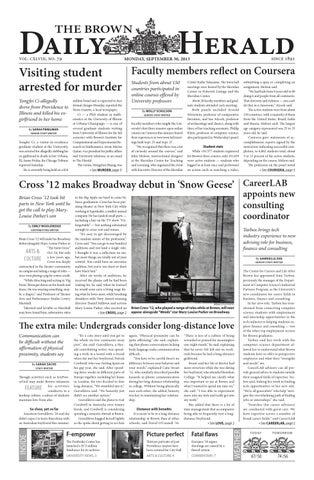
Cross ’12 makes Broadway debut in ‘Snow Geese’ CareerLAB Brian Cross ’12 took bit parts in New York until he got the call to play MaryLouise Parker’s son By EMILY WOOLDRIDGE CONTRIBUTING WRITER
Brian Cross ’12 will make his Broadway debut alongside Mary-Louise Parker in “The Snow Geese” Oct. 24, but only a few years ago, Cross was deeply entrenched in the theater community on campus and taking a range of roles — once even playing a pig for course credit. “While directing and acting in ‘Pig Farm,’ Brian got down on his hands and knees. He was wearing something, maybe a diaper,” said Professor of Theater Arts and Performance Studies Lowry Marshall. Talented and lovable as Marshall may have found him, substantive roles
ARTS & CULTURE
in the Big Apple are hard to come by. Since graduation, Cross has been pursuing theater in New York City while working at Squishable, a stuffed-animal company. He has landed small parts — including a line on the TV show “Unforgettable” — but nothing substantial enough to cover rent and ramen. “It’s easy to get discouraged by the random nature of the profession,” Cross said. “You can go to one hundred auditions and not land a single role. I thought it was a reflection on me, but most things are totally out of your control. You could have an awesome audition, but you’re too short or don’t have black hair.” After six weeks of auditions, he received the phone call he had been waiting for, he said, when he learned he would soon earn a living wage doing what he loves most, while brushing shoulders with Tony Award-winning director Daniel Sullivan and actress Mary-Louise Parker, who received an » See CROSS, page 2
appoints new consulting coordinator Tarbox brings tech industry experience to new advising role for business, finance and consulting By GABRIELLE DEE SENIOR STAFF WRITER
HERALD FILE PHOTO
Brian Cross ’12, who played a range of roles while at Brown, will next appear alongside “Weeds” star Mary-Louise Parker on Broadway.
The extra mile: Undergrads consider long-distance love
By SARAH SACHS STAFF WRITER
Though activities such as SexPowerGod may make Brown infamous for activities conducive to a hookup culture, a subset of students maintain love from afar.
FEATURE
inside
So close, yet so far Anastasia Gorodilova ’16 said she didn’t expect to leave Barcelona with an Australian boyfriend this summer.
“It’s a cute story until you get to the whole we live continents away part,” she said. Gorodilova, a Herald contributing writer, was spending a week in a hostel with a friend when she met her boyfriend, Patrick Cordwell, who was visiting Spain on his gap year, she said. After spending three weeks in different parts of Europe together, including her home in London, the two decided to date long-distance. “We stumbled into it,” Gorodilova said. “We honestly just didn’t see another option.” Gorodilova said she plans to visit Cordwell in Australia over winter break, and Cordwell is considering spending a semester abroad at Brown. Gorodilova hugged herself tightly as she spoke about getting to see him
again. “Physical proximity can be quite affirming,” she said, explaining that phone conversations lacking body language make communication difficult. “You have to be careful there’s no difference between your behavior and your words,” explained Catie Straut ’11, who similarly described possible hazards in phone communication during her long-distance relationship in college. Without being physically near each other, she added, honesty was key to maintaining her relationship. Distance with benefits It is easier to be in a long-distance relationship at Brown than at other schools, said David O’Connell ’16.
“There is less of a culture of being rewarded or praised for meaningless one-night stands,” he said, explaining that he never felt left out on weekends because he had a long-distance girlfriend. Straut said her life at Brown had more structure while she was dating her boyfriend, who attended Bowdoin College. “It helped me clarify what was important to me at Brown and what I wanted to spend my time on,” she said. “I was able to experiment more into my style and really get into my work.” She added that there is a lot of time management that accompanies being able to frequently visit a longdistance boyfriend. » See LOVE, page 2
F-empower
Picture perfect
Fatal flaws
The Pembroke Center has launched a $3.5 million fundraiser for its archives
Thirteen portraits of past Providence mayors have been restored for City Hall
Enriquez ’16 argues shootings are caused by a flawed system
UNIVERSITY NEWS, 3
ARTS & CULTURE, 4
COMMENTARY, 7
weather
Communication can be difficult without the affirmation of physical proximity, students say
The Center for Careers and Life After Brown has appointed Amy Tarbox, previously the manager of the Department of Computer Science’s Industrial Partners Program, as the University’s new coordinator for career fields in business, finance and consulting. In her new role, Tarbox has transitioned from connecting computer science students with employment and internship opportunities in the tech industry to helping students explore finance and consulting — two of the other top employment sectors for Brown graduates. Tarbox said her work with the computer science department allowed her to understand what Brown students have to offer to prospective employers and what their “strengths and needs” are. CareerLAB advisors can all provide general advice to students outside their assigned fields of expertise, Tarbox said, linking her work in finding tech opportunities to her new role. “We’re all generalists” who help “navigate the overwhelming path of finding jobs or internships,” she said. “Searches (for career advisors) are conducted with great care. We have expertise across a number of broad career fields,” said CareerLAB » See CAREERLAB, page 2 t o d ay
tomorrow
67/ 50
74 /56
2 university news » CAREERLAB, from page 1
calendar TODAY
SEPTEMBER 30
7 P.M.
TOMORROW
OCTOBER 1
7 P.M. Zero LRA
Meet the Media
Salomon 001 8 P.M.
CarrerLAB 7 P.M.
Nudity in the Upspace
Back to the Future Double Feature
TF Green
Leung Gallery
menu SHARPE REFECTORY
VERNEY-WOOLLEY
LUNCH Rosemary Portobello Sandwich, Gnocchi with Cabernet Marinara, Green Beans with Marinara Sauce
Chicken Fajitas, Vegan Black Bean Taco, Vegan Chana Masala, Mexican Succotash
DINNER Macaroni and Cheese with Avocado and Tomato, St. Louis Fire-Braised Pork Ribs, Baked Sweet Potatoes
Meatballs with Sauce, Pizza Rustica, Saigon Beef and Ham with Vegetables, Hot Fudge Pudding Cake
sudoku
Director Andrew Simmons. Tarbox is a “great addition to the staff ” because she knows how to link firm recruiters with students, Simmons said. Tarbox highlighted her experience in her newly assigned sectors, adding that she holds a business and consulting degree from Bentley University in Waltham, Mass. Tarbox said she also has experience working with investors, Wall Street executives and public relations at a biotech firm. This job allowed her to bridge the gap between the finance and tech industries by connecting high-level businessmen with science researchers, she said. Under the IPP program, Tarbox connected students to companies, helped them polish their resumes and held regular office hours, she said. As a career advisor, Tarbox organizes sessions and workshops for students and holds advising appointments. Some students who worked with Tarbox said they were pleased with the professional guidance she provided them in her previous role with the computer science department. “Amy was an incredible resource,” said Daniel Hoffman ’15, adding that he worked closely with Tarbox on improving his job-seeking skills. Tarbox made sure students emphasized the parts of their resumes pertinent to the jobs they applied to, Hoffman said. One weakness that Tarbox had while working with the computer science
» CROSS, from page 1
crossword
Emmy as the star of the hit TV show “Weeds.” “I couldn’t ask for a better group of people to work with, especially off stage,” Cross said. “They are all very sweet, supportive and fun to watch.” Cross is the youngest cast member, but he said this has not discouraged him. Instead, he has become as avid an observer as a performer. “I’m always watching what people are doing — it’s like a master class,” Cross said. The play’s excellent script also drew Cross to the project, he said. “The Snow Geese,” a family drama, takes place in upstate New York during World War I. Cross plays Mary-Louise Parker’s 18-year-old son. He said he does not want to reveal too much about the character, but said “he’s young, very competent and much of a realist after the death of his father.”
»LOVE, from page 1 Long-range pain “You have to be committed that it’s going to work,” said Colin Schofield ’14, who has been dating his high school girlfriend long-distance for almost four years. While Schofield said he sometimes feels like he is missing out on activities with his fraternity, he looks forward to traveling to see his girlfriend in New Hampshire every month. But it is difficult not always knowing her friends and all of the people in her life, he said. O’Connell had trouble during his first year at Brown, when he dated his girlfriend who was still in high school, he said. “In the beginning of the year, it made me less extroverted,” because he knew he already had a girlfriend and a stable life at home, he explained. O’Connell said he felt overwhelmed
THE BROWN DAILY HERALD MONDAY, SEPTEMBER 30, 2013
department was her lack of familiarity with some of the technical terms on computer science students’ resumes, Hoffman said. “She was very much a human resources person” rather than a computer science expert, he added. Hoffman said Tarbox’s move to the CareerLAB was a positive development for her career because she will be able to expand her professional scope of responsibilities. “She was doing the same thing every year — you don’t grow as much just doing the CS resumes,” he said. Lauren Clarke, the computer science department’s faculty and student affairs manager, replaced Tarbox as the department’s employment advisor. Berfu Negiz ’14 said that as an international student, she has difficulty searching for jobs in the United States. Negiz found CareerLAB’s walk-in hours and career advisors to be helpful, especially because she is a psychology and economics major looking for a job in finance or consulting, she said. But Negiz added she has friends in other concentrations, such as architectural studies, who have had to find jobs through their respective departments rather than through the CareerLAB. Hoffman said he believes the Career Lab focuses more on careers in business, finance and consulting than in many other fields. Jobs related to biology and chemistry can be “very
lucrative, but I don’t see anything for them” at the CareerLAB, he said, adding that fields such as journalism and politics also go largely unnoticed. Young-Rae Kim ’17 said he has been to CareerLAB to seek help in organizing his class schedule. Kim said he wished the CareerLAB provided more resources for first-years and sophomores who want to “get a head start” on the job and internship search. “It’s like they’re telling us to wait until it’s too late,” he added. Simmons said the CareerLAB’s staff works to connect students with opportunities in any field of work. The advisers are the “first stop” where students can go to be referred to other resources, Simmons said.
Cross added that he bears some similarities to his character. “We’re both kind of stubborn and a bit of a bother,” Cross said. “The more you’re with a character, the more you realize you’re similar.” Cross said he is excited to see the 622-seat Samuel J. Friedman Theater come alive on opening night, adding that the audience will be the largest he has ever acted in front of. “An audience gives you feedback,” Cross said. “They laugh and cry, leave and cough, or their cell phones go off, and that adds a completely new element to everything.” Cross’ success comes as no surprise to those who know him, according to those interviewed. During his time at the University, Cross sang in the Jabberwocks and acted in many productions, including “Gross Indecency: The Three Trials of Oscar Wilde,” which he worked on with Assistant Professor of
Theatre Arts and Performance Studies Kym Moore. But Cross did not always plan to be a professional actor. An economics concentrator, “I assumed I would do something else. I did acting on the side with my friends,” he said. During his junior year, Cross was inspired by Moore’s introductory theater course to change his trajectory. “She taught me how to do something deeper,” Cross said. “Brian has multilayered intelligence: intellectual, emotional and physical,” Moore wrote in an email to The Herald. “This makes him a force to be reckoned with on stage because it makes him almost omnipresent.” Cross gave one of his limited complimentary opening night seats to Moore. He also thanks her in the program, Moore wrote. “I’m moved nearly to tears and couldn’t be happier or prouder to have been his ‘teacher,’” she also wrote.
maintaining his relationship during the second semester of his first year. While taking a heavy course load and pledging a fraternity, he was “at a peak stress mode and just needed to take a step back,” he said. O’Connell broke up with his girlfriend over spring break that year. He doubts he will ever be in a longdistance relationship again, he said. “It will probably cause you more pain than good,” he added. “I’ve learned that, for me, it’s really hard when there’s not the frequent (in-person) interaction.”
games, she added. But she agreed that Skyping can get boring and will never be the same as physical proximity. “It just isn’t the same as sitting with my head against his shoulder,” she said. Eric Wittgrove ’15 said he and his high school girlfriend decided to break up before their first year of college to try being independent, but the two decided to try dating long-distance the following summer. “Our feelings didn’t just magically disappear,” he said. Wittgrove’s favorite part about dating his girlfriend is reuniting with her, he added. He paused, closed his eyes and smiled to himself before describing their reunions as “warm … just so very warm.” He recounted that his favorite part is “simply getting to hold her hand again.” “It’s definitely not the ideal situation,” Schofield explained, “but I can’t think of a reason why I would rather be apart from her than with her.”
Distance makes the heart grow fonder Jessica Fisher ’16 has managed to find different ways to keep things interesting with her long-distance boyfriend, she said. She and her boyfriend often Skype each other and will watch movies together or even play card
COURTESY OF BROWN UNIVERSITY
Tarbox will be a career coordinator for finance and consulting.
university news 3
THE BROWN DAILY HERALD MONDAY, SEPTEMBER 30, 2013
» COURSERA, from page 1 that many of their students did not intend to receive a certificate of completion when they enrolled. “These are remarkably fruitful opportunities for enrichment for the larger public,” Weinstein said. Many of the students taking his course, “The Fiction of Relationship,” had “no interest or no need for getting credit” and often did not complete writing assignments, he said. Connecting through computers The panelists expressed mostly positive opinions about their experiences, emphasizing their discoveries of the value of online dialogue and the variety of participants their courses drew. Teaching a MOOC was a “valuable, exciting experience,” Weinstein said. “The discussion forum floored me,” he added. “I was stunned to find that they not only rivaled but in many cases surpassed anything that I’ve seen in a Brown classroom,” he said. Klein, who taught “Coding the Matrix: Linear Algebra through Computer Science Applications,” told the audience that after the course ended, he met up with some students in the Boston area for drinks. “I love teaching Brown students, but this was a real eye-opener to reach such a wide range of people,” Klein said. “They were so appreciative of our efforts to make this information available to them. It was really satisfying.” Klein said his students “really clicked” with how he presented material in his online course. “Doing something on a computer is like having your hands on it — it’s tangible,” he said. “You can manipulate objects that were formally abstract. You can see what is going on much more clearly, and that really worked for a lot of people.” Alcock, who taught “Archaeology’s Dirty Little Secrets,” wore a necklace given to her by a “MOOC-er” to the Wednesday meeting. Highlights of Alcock’s course, such as witnessing her students “explaining to other people what a Twinkie is” and having “families taking courses together, people being extremely kind and supportive of each other,” made the hard work worth it, she said. Online obstacles Each professor said he or she faced unique challenges in teaching through Coursera. Weinstein said Coursera’s peer assessments, which included evaluations of students’ work by their classmates, were “problematic.” With such a wide array of participants, a high school student could end up providing feedback to a PhD student, Wendy Drexler, director of online development at the Office of Continuing Education, told The Herald. “I am a little less pessimistic than (Weinstein),” Alcock said, adding, “Peer assessment is tricky, we ended up being lucky that people … were very supportive.” Teaching a MOOC requires a lot of effort, but future teachers can benefit from this first group’s lessons, she said. Working with the platform was a challenge for Alcock. “There were some bad moments, in what we call ‘word count-gate,’” Alcock said,
referring to a problem with assignment word counts that she and her teaching assistants encountered. One mistake Klein made was “not being clear enough in the prerequisites,” he said. It was stated that students enrolled had to have “some programming experience,” but Coursera does not have a means of checking whether students meet requirements, so many were not qualified, he said. All three professors are contractually obligated to teach their MOOCs at least once more, Alcock said. “Each faculty member put in a great deal of work to get these courses out there. Each one of them has ideas on how to make it better,” said Drexler, who participated in Wednesday’s meeting and played a role supporting the faculty teaching MOOCs this summer. Fear of the future Melson dedicated the last half hour of each town hall to audience questions and comments, many of which reflected apprehension toward online teaching. “A lot of questions being asked are very provocative. There’s a lot of fear, uncertainty and doubt around MOOCs and what kind of implications they’ll have on higher education,” Drexler told The Herald. Many attendees, including Richard Bungiro, lecturer in biology, voiced concerns about where online education is headed. “I have to admit I am quite skeptical about what the ultimate motivations are for Coursera and Brown,” he said. “I’m not afraid of this — I love technology — but I am also a realist, and I see that money drives most decisions,” he added. Audience members brought up complex questions that didn’t necessarily have one-size-fits-all answers, Melson told The Herald. “I think it’s natural to be concerned,” he said. “I’m glad there’s skepticism.” But there are many different forms of online learning, and some work better than others, Drexler said. “This model doesn’t define online learning, and I see a lot of confusion and misconception, especially with people who haven’t experienced this before,” Drexler said. “We have to understand there are different models.” Both meetings had discussions about the possibility of MOOCs leading to a decrease in faculty jobs. Sarah Horkel GS, who is receiving her master’s degree in education, asked if computers will replace teachers and if her school district job is in jeopardy. “This is so new that I think schools are still trying to figure out how to use (MOOCs) — because they will be used,” Weinstein said in response. “One of the major threats to the guild is the amount of information that is out there,” said Jesse Schreier, instructional designer for Continuing Education. “We have to understand that people can learn a lot without a professor,” he said, adding that this was not the case years ago. Despite her concerns, Horkel compared services like Coursera to public libraries and praised them for allowing anyone to enroll. “I think that’s so tremendous that my kids can have access to information they never have been able to access before,” she said.
DAVID DECKEY / HERALD
The Pembroke Center holds a large collection of papers and oral histories from leading feminist scholars.
$3.5 million campaign planned for Pembroke Center The fund, which has already received $1 million, will help digitize a feminist archive By EMILY PASSARELLI STAFF WRITER
The Pembroke Center is in the midst of a $3.5 million fundraising drive to support the growth and accessibility of its two archives: the Christine Dunlap Farnham Archive and the Feminist Theory Archive. Pembroke Center Associates Council Chair Nancy Buc ’65 LLD ’94, a former member of the Corporation’s Board of Fellows and Board of Trustees, kickstarted the campaign with a $1 million contribution last April, though the campaign has been in progress since last year, wrote Pembroke Center Director and Professor of Anthropology Kay Warren in an email to The Herald. “The archives are and will be an incredible academic and intellectual resource,” Buc said, adding that growing the endowment will allow the center’s archivist and director to have sufficient funds for any number of priorities. These goals include the expansion and digitization of the archives, the instatement of a full-time archivist at the center and the use of the archives in research by students and scholars, Buc said. “One of the main purposes of the endowment is to allow us to grow the archival collections,” said Christy Law Blanchard, Pembroke Center director
» MURDER, from page 1 a fellow Urbana-Champaign student, the News-Gazette reported. Huang was Ci’s ex-girlfriend, Huang’s friend Xue Yang testified in a bail hearing at Champaign County Court Saturday morning, the News-Gazette reported. Ci drove from Providence to Urbana to confront Huang because he suspected she was cheating, Assistant Champaign County State’s Attorney Tim Sullivan said at the hearing, the News-Gazette reported.
of program outreach and development. Funds raised by the capital campaign will support the ongoing digitization of Farnham Archive oral histories and will finance the compilation and digitization of other archive materials. “There’s a lot of work to make it a more rich experience for the user to visit the (archives’) website,” Blanchard said. The Feminist Theory Archive — a collection of papers and documents from leading feminist scholars — will also be improved from the endowment, Warren said. Because the Feminist Theory Archive’s documents span multiple generations, they take various forms — from original manuscripts with handwritten edits to complete hard drives. The endowment would help current archivist Wendy Korwin-Pawlowski “develop the expertise in how to handle all these materials and process them,” Blanchard said. Korwin-Pawlowski was selected from a national search three years ago to oversee the two Pembroke Center archives because of her “specific fit with Brown,” Warren said. KorwinPawlowski currently works part-time, but the endowment will pay her to work full-time and will provide funding for the hiring of assistants, Warren said. As archivist, she will continue to help make each archive more accessible and will propose questions to connect ideas related to both archives, Warren said. While improving the archival materials’ accessibility and organization,
the endowment will also provide funds to pay scholars to do work, to allow students to assist them and to fund undergraduates’ senior theses, Warren said. “Archives are living material,” Warren said, adding that because the archives keep expanding, the digitization project will only continue. The capital campaign’s public phase has no set end date, Warren said, adding that she gives lectures to groups of Brown alums, who she said have been receptive to the campaign. Warren said as part of her push for the campaign, she highlights the benefits of the archives’ growth for current students. With the digitization of the archives, students will be able to more readily access historical memory and be part of a larger world project, she said. Students “will begin to write the history,” she said. Since her gift to the endowment, Buc has also met with prospective supporters of the capital campaign, she said. “The response has been good — it just takes time,” Buc said, adding that she hopes the campaign will meet its $3.5 million goal by this spring but is uncertain this target date will be met. Buc was an undergraduate at the University when Pembroke College was still separate from Brown, she said. “We knew that a lot of our opportunities weren’t the same as the men’s,” she said. “I would hope that scholarship at the Pembroke Center provides insights and context and knowledge about (today’s) world and mine.”
After arriving around 11 a.m. Friday, Ci allegedly forced his way into Huang’s apartment and used duct tape to cover Huang’s and Yang’s mouths. Yang testified that Ci shut Yang in a bathroom as he attacked Huang in the living room, the News-Gazette reported. As Ci stabbed Huang at least three times, Yang was able to escape through a bathroom window and call the police. The Urbana police collaborated with Urbana-Champaign police and established Ci as a suspect less than an hour after Yang identified him as a visiting
Brown student. Using cellphone technology, the police found Ci at a nearby motel. When he heard sirens blaring outside, Ci called the police and agreed to surrender. He exited the motel room and turned himself over to the police at approximately 1:20 p.m. without incident, the NewsGazette reported. Sullivan argued for a high bail at the Saturday hearing, saying that because Ci recently traveled to his home country, China, he poses a flight risk, the NewsGazette reported.
4 arts & culture
THE BROWN DAILY HERALD MONDAY, SEPTEMBER 30, 2013
Leaves, pumpkin farms fall into place
Students take advantage in Providence, but I know a lot of who go here haven’t been out of New England traditions people of downtown or to the other cities in like apple picking and Rhode Island.” New England fall activities are not haunted houses By SOPHIE YAN STAFF WRITER
COURTESY OF PROVIDENCE CITY ARCHIVIST PAUL CAMPBELL
Fundraising, private donations and grants have enabled the restoration of this comprehensive collection, which offers a chronology not only of Providence mayors but also of prominent artists living in the city.
Thirteen mayors rejuvenated on canvas The extensive collection of portraits was restored by a 1959 RISD alum and will hang in City Hall By CORINNE SEJOURNE STAFF WRITER
From Samuel Bridgham 1794 to Joseph Paolino, Providence mayors are part of a long tradition of mayoral portraits. Money raised through fundraising, private donations and grants over the past year have allowed for the restoration of 13 of these portraits, completing the collection of 32 artworks now on public display in City Hall. Paul Campbell, Providence city archivist, said when he arrived in June 2010, one of the high priorities was to conserve and display these paintings so people could “enjoy and appreciate” them. He added that the collection is one of the most complete, continuous collections of any city in America, and the restoration has quickly picked up public interest. The paintings date as far back as the mid-1800s, but the two most recent mayors, Angel Taveras and John Lombardi, have not yet had their portraits made. The restoration was completed by Alice Miles, a 1959 Rhode Island School of Design alum who has about 30 years experience in conserving paintings, Campbell said. She worked on the portraits in a temporary studio set up on the fifth floor of City Hall,
which allowed people to come in and see the works in progress, ask questions and interact with the process, he said. The conditions of the paintings varied, with some only needing light cleaning and others more extensive repair, Campbell said. The Elisha Dyer portrait, for example, had several large tears — “one story I heard was that a ladder had fallen through the canvas and severely damaged it,” he said. The portrait of Edwin McGuinness also underwent a significant transformation, Campbell said. Miles said the experience of restoring the portraits was unique because the paintings were “so large.” The process began with an initial cleaning using a mild detergent to get the dirt off, followed by the use of a stronger element to remove the varnish. After a painting is clean, a layer of varnish is placed to separate the new touch-up painting from the original. The repairing of patchwork is done behind the painting. “The canvas has a memory,” Miles said, and if the painting has been torn for a long time, it will be warped. She said one of the most challenging portraits was one in which the eye was poked out, and both the canvas and the eye had to be replaced with careful attention paid to matching the undamaged eye. Mayors would often choose local artists to make their portraits, Miles said. “All these paintings were just beautifully painted,” she said. The portrait collection “not only
tells us a little bit about the men themselves who’ve served as mayor, but it also gives a chronology of some of the prominent artists who lived in the city and produced works,” Campbell said. He added that it “gives us an appreciation of the artists and their workmanship over nearly two centuries here in Providence.” Campbell is currently working on producing small biographical sketches of each mayor to be placed adjacent to each painting, he said. “Realistic portraits of significant leaders date all the way back to classic times,” said Douglas Nickel, professor of history of art and architecture. Before the 19th century, portraiture was reserved for aristocratic people, he said, and in the earlier part of the 19th century, the attention remained focused on the sitter and not on the artist. But in the late 1800s and early 1900s, society’s attitudes toward artists began to change, Nickel said, adding that they came to be seen as “interesting, expressive, special people themselves.” Around that time, there also developed a greater interest in the person being painted, and rather than just trying to capture what they looked like, portraitists would try to capture some of their “personality, character,” he said, adding that Providence was one of the major art capitals in the 19th century. Councilman Terrence Hassett said the project was a “huge success” and described the archives as “one of the most sophisticated in the country.”
As summer turns to fall and the temperature outside takes its yearly dip into sweater weather, many people’s first instinct may be to retreat to the warmth of their dorms and apartments. But autumn is also the season when New England comes alive with distinctive cultural attractions. From scenic drives to corn mazes to apple and pumpkin farms, there is always something to do. “The force is strong with the fall traditions around here,” said Patrick Lynch ’16, who comes from rural Connecticut. During autumn, agriculture becomes a major attraction in New England, with a special emphasis on pumpkins, gourds and corn, he added. Lynch said he has also been apple picking in Rhode Island. “(It’s) pretty awesome,” he said. “You have to make sure there’s good weather outside, because it’s more of a nature walk than anything.” “It’s a chance to get out and do something you remember doing as a little kid,” Lynch added. “I think it’s a really good way to bond,” said Yee Jung Kim ’16, who has lived in Rhode Island for most of her life. Kim said her earliest memories of apple picking were with her parents as a fun weekend activity. “(Apple picking), being active and doing something meaningful with my family, it’s a great way of staying close to home and having fun,” she said. She added that many of the farms offer not only pick-your-own orchards, but also activities such as apple cider making and apple pie baking. But many students on campus rarely take the time to go off campus to enjoy the autumn attractions. “I feel like apple picking isn’t the ideal activity for most people on, say, a Saturday night,” Kim noted. “There are a lot of farms that offer cool attractions
limited to tame, family-friendly apple farms and corn mazes. Ray Aubin is the general manager of Confreda Greenhouses and Farms, a local company that manages not only a fall festival, but also the Scary Acres Haunted Cornfield and Hayride. “(The attraction) began about ten years ago,” Aubin said. “It started out as pretty much a walking tour through a haunted maze, and then it morphed into a haunted trail with several different sets.” This attraction, which opens Sept. 27, takes place every weekend for a month and capitalizes on the popularity of Halloween. Each year, Scary Acres is set up differently with different spooks and scares. “I can’t give away the promotion this year,” Aubin said. “But I can suggest that there’s a strong zombie theme.” Kim, who has been to the haunted hayride and corn maze, conceded that it was frightening. “At first it was kind of boring because we were just sitting on a tractor, and since I like horror movies I’m not easily scared,” she said. “But when things started chasing us in the dark, it started to get scary. It was really dark, and I feel like if you’re in the mood to be scared and anything, even a cat, (chasing) you in the dark like that, it would freak you out.” Whether you enjoy Halloween or Thanksgiving or just autumn in general, this season promises many great attractions. Kim said that in the past, she has been to festivals, county fairs and even a jack-o-lantern festival. “I think autumn is so popular around here because the weather is the most pleasant,” she said. “It’s not too hot, but it’s not time for snow yet.” “I think it’s the whole change of weather and all the attractions and welcoming guests to the farm (that I enjoy about fall),” Aubin said. “We really see how excited they get about the experience.”
‘Brown Unheard’ puts campus musicians in the spotlight The organization aims to offer artists and groups the opportunities to collaborate and promote their music By JACOB DOUGLAS CONTRIBUTING WRITER
A clear voice echoed through the dimly lit room as a crowd of students sat with all eyes on the spotlit performer alone on the stage. One absorbed audience member tapped his foot along to the rhythmic acoustic chords. Brown Unheard, a student music organization, held its first official event of the year — a featured artists night — last Thursday in the Underground at Faunce House. At the informal concert, 10 acts preformed a mix of original music and covers before a crowd of around 30 to 40 people. The student band We Should Worry, the only group performance and a highlight of the concert, opened the night, featuring Post- Magazine
Editor-in-Chief Ben Resnik ’15, Bennett Knox ’15, Eric Foreman ’15, William Van Deren ’15, Sydney Island ’15.5 and Patrick Carey ’16. The group describes itself on its Facebook page as sounding like “Mumford & Sons got jiggy with Neutral Milk Hotel after a blind date set up by The Mountain Goats” — an accurate description. The band debuted a new song, “Progress,” a good representation of its overall sound, which is sprinted, folky and upbeat. Their style is largely defined by their interesting choice of instruments, including both a mandolin and an accordion. Another highlight of the night was a set by Abby Perreault ’16 , who played three original songs, with one dating back to her first year of high school, she said at the show. Making use of her distinctive voice, she gave an animated and
intense performance for a rapt audience. Equally impressive was Michael Weinstein ’15, one of the co-leaders of Brown Unheard and a contributing writer for The Herald, who played two Bob Dylan-esque songs — an influence also displayed on the shirt he wore, which had an image of the artist. Michael also debuted a new song, “Drag Me Home,” a long, fingerpicked track with powerful and atmospheric lyrics telling the story of leaving home with the “wind whistling through” his bones. Following Weinstein was an energetic performance by Alfie Subiotto ’16, debuting material so new he could not remember the name of a song until halfway through, when he sang the eponymous line. Offering another acoustic guitar set, his songs were dynamic, jumping from quiet to loud to quiet again. Dora Chu ’16, another co-leader of Brown Unheard and staff writer for The
Herald, finished the night with audience participation, asking everyone to sing along to the chorus of her song, a catchy original track. Formed last year, Brown Unheard is designed to create a community for Brown musicians and venues for them to perform their music, said Lizzie Davis ’15, a co-leader of the group. While ostensibly a platform for students to play music for other students, it also includes an outreach aspect in which musicians play at hospitals and schools, she added. Davis said a main goal for the semester is to try “to develop (their) web and media team,” as well as to give “people tools to promote their music.” The Thursday concert was the beginning of this process, as there was a professional sound engineer recording the entire show. Unheard hopes to add this recorded music to its website for the public to see and hear, Davis said. Another exciting addition to the
program is a larger focus on collaboration, as the program looks to unite student musicians and filmmakers to create music videos with the hope that creativity will spark on both sides, Davis said. Unheard also operates a database of Brown and RISD bands and plans to produce a music publication this year, she said. Abby Sessions ’16, who performed acoustic originals Thursday, said music is “mostly a hobby” for her at school. She highlighted Unheard as “really a great group because it’s very open to new people,” as opposed to more exclusive a cappella programs, she said. She added that though Unheard currently does not offer much in the way of exposure, she thinks the group’s goal of increasing its online presence through its website and social media will expand its influence. Brown Unheard will host shows once a month and additional nights dedicated to two or three student bands.
sports monday 5
THE BROWN DAILY HERALD MONDAY, SEPTEMBER 30, 2013
VOLLEYBALL
Bulldogs defeat Bears in straights Coach Short said the team struggled with passing but came out strong in the final set By HANNAH CAMHI CONTRIBUTING WRITER
DAVE SILVERMAN / HERALD
Meghan O’Donnell ’15 said Bruno’s strong start against Dartmouth Saturday represented progress for the field hockey team.
FIELD HOCKEY
Big Green snatches victory from Bears’ jaws In close game, Dartmouth surged back in the final minutes to beat Brown by one goal By CORMAC CUMMISKEY CONTRIBUTING WRITER
A protracted struggle against Dartmouth (2-4, 1-1 Ivy) ended unfavorably for the field hockey team Saturday, as the Big Green rallied in the second half to win 4-3. Riding high after last Sunday’s victory over Colgate University, Brown (3-4, 0-2) entered the game looking to notch its first conference win of the season. The team viewed the game as a chance to improve upon weaknesses in prior matches. “We’ve had some errors in our previous games by playing apart,” said Head Coach Jill Reeve. “We knew we had to play together, and we did.” Bruno got off to a good start in the first half, setting up fast breaks and netting goals. Meghan O’Donnell ’15 said this represented progress for the team. “We came out hard, which has been an issue for us,” O’Donnell said. “We’ve come out a little bit flat (in the past).” Co-captain Avery Burns ’14 capitalized on the team’s tight passing to score unassisted in the 13th minute. Shortly afterwards, Clayton Christus ’15 bolstered the Bears’ lead by scoring
off a penalty corner. The Big Green refused to go down without a fight, as Dartmouth regained momentum following Christus’ goal. The visitors recorded a pair of goals in rapid succession, equalizing the score. O’Donnell — whose speed Coach Reeve described as Brown’s “secret weapon” — retaliated in the closing minutes of the period. The forward chipped the ball past Dartmouth’s goalie with a diving shot. The Bears left the field with a 3-2 lead at halftime. But during the second half, Brown found itself on the wrong end of a comeback. Dartmouth’s forwards stepped up their level of intensity, stretching Bruno’s defense beyond its limits. The Big Green recorded twice as many shots as the Bears during the second half, forcing two goals. Despite pulling goaltender Shannon McSweeney ’15 after the go-ahead score, Brown failed to find the back of the net with the additional offense. Reeve remained upbeat after the game, reflecting favorably on her team’s style of play. “This was a fight!” Reeve said. “At the end of the game, I wouldn’t have made any changes tactically.” O’Donnell also seemed unphased by the loss. “I thought we were the better team,” she said. “They got very lucky in the end, and I think that if we play them another 10 times, we’re winning nine out of ten.”
The women’s volleyball team fell to the Yale Bulldogs in three decisive sets Saturday. The Bears were outmatched by a strong and successful Bulldog offense. Statistically, Yale’s solid .239 kill percentage outnumbered Bruno’s .027. The Bulldogs also led in blocks, digs and aces, making them unstoppable. The Bears’ best chance at clinching a set was in the first, when they were only trailing by two points (22-24) before Yale secured the set. Yale blistered past the Bears in the second set to win it 25-13. Head Coach Diane Short attributed the loss to the Bears having “a lot of trouble passing the ball, which had an effect on everything else they did.” In the third set, the Bears rushed out to a 5-2 lead, which they held until leading 9-8, but ultimately fell short by losing the set, 25-19. “After the break we came out strong in the third set but we just couldn’t finish it,” Short said. She added that a few questionable calls were made that might have caused a momentum shift in the match. Short came away with some positives for the weekend. She said she was happy that the team “fought hard” and “came out with good energy.”
» FOOTBALL, from page 8 momentum in the first quarter, the Bears lost it in the second with a series of turnovers. After Crimson quarterback Connor Hempel led a scoring drive with 26 rushing yards and a touchdown run, Nnamdi Obukwelu recovered a Spooney fumble, leading to another Harvard touchdown in just two plays. Bruno squandered an opportunity to respond, which became a recurring theme for the rest of the game. On the next drive, Donnelly’s interception gave Harvard its first lead of the game, which
HERALD FILE PHOTO
Coach Short said a few questionable calls shifted momentum throughout the match Saturday, but she is optimistic about next weekend. She complemented Thea Derrough ’14 and Payton Smith ’17 for playing well and said “Taylor (Bantle ’15) had one of her best matches of the year.” Derrough, Smith and Bantle each completed stellar performances, racking up the three highest kill percentages
on the team. Short said she is “optimistic about next weekend,” and the team is “working to improve everyday.” The Bears now face the University of Rhode Island in a nonconference match Wednesday.
it did not relinquish. Earlier in the second quarter, Bruno had missed an opportunity to extend a drive and potentially add to its lead after a third down conversion was nullified by an illegal formation penalty. Down 38-20 early in the fourth quarter, Bruno failed to score a touchdown after having first-and-goal on Harvard’s two — ending any hope of a comeback. In addition, Estes noted a lack of protection from Brown’s offensive line and missed tackles as contributing factors for the loss, adding that the team needs to work on these areas in practice next week. Bruno will have to focus on
these two categories to remain in the Ivy League hunt. While the overwhelming sentiment after the game was disappointment, the Bears’ running game and special teams performed well. Spooney followed up his return to football with a second consecutive 100-yard game. He finished as the game’s leading rusher with 110 yards, including a 34-yard touchdown run. Even without a big return from Alex Jette ’17 this week, the special teams performed well, recovering both the onside kick and a fourth quarter punt that careened off a Harvard player.
comics A & B | MJ Esquivel
School Daze | Christina Tapiero
6 commentary
THE BROWN DAILY HERALD MONDAY, SEPTEMBER 30, 2013
EDITORIAL
The death of the university-college This past week, a defining piece of the University’s identity changed. President Christina Paxson told students at a campus forum that Brown is no longer a “university-college” in the model first established by former President Henry Wriston, though she added that the principle remains “in spirit.” Functionally, this change will have little immediate impact on the daily lives of Brown students, and any observer of the University will recognize that this trend has been developing for quite some time. But it is worthwhile to recognize the profundity of the changes that have taken place over the past decade and ask whether there is still a need, or a place, for the primarily undergraduate-focused model Brown has embraced for so many years. Brown can continue to expand its campus and graduate programs while remaining committed to not only reinforcing the University’s undergraduate strength but also encouraging innovative and increased focus on the undergraduate body. This will only be possible if the administration recognizes and commits to the need to balance online education, lucrative master’s programs and graduate education with in-person undergraduate teaching. Though the shift in language may be largely cosmetic, it is still notable given how recently the University has been affirming its commitment to its identity as a university-college. In fact, the mission statement on Brown’s website maintains that the school is a “partnership of students and teachers in a unified community known as a university-college.” When Paxson was appointed, she restated a commitment to this model, with her undergraduate experience at Swarthmore College in mind, and indicated that her vision for the University was for “Brown … to continue to grow as a first-class research institute” while maintaining its undergraduate focus. Furthermore, in an interview with The Herald immediately following her appointment, Paxson specifically stated that “the university-college model” is “important to keep… as part of what Brown aspires to do.” While former President Ruth Simmons spearheaded initiatives that greatly expanded Brown’s graduate programs, she included provisions for “Brown’s future as an university-college,” even as she argued that this legacy “cannot be assured by just being a college.” Wriston’s vision of the university-college neither provided for graduate schools, nor included a focus on the sciences. The ideals of a university-college can be updated, and it is by no means necessary for the term to recede into the past. It is possible to combine a greater focus on research and graduate work with continued emphasis on undergraduate excellence, but the administration must continue to reward and prioritize undergraduate teaching alongside graduate research. This is possible in the humanities as well as the sciences — for example, the recently designed BIOL 0190R: “Phage Hunters,” a class in high demand, now gives first-years hands-on experience with DNA and viruses. If the University is going to continue developing its use of online courses, it must balance that course by continuing to reward this type of innovation in the classroom, as well. Paxson indicated that part of the rationale for the changed language was that “off campus,” most people do not know the meaning of the term. But we see this as an opportunity more than a reason to admit defeat. If we seek only to emulate research-focused universities like Columbia or Harvard, we will not succeed. They have been pursuing the research university model for much longer and have endowments to support that purpose. What is more, Brown should not seek to follow patterns set by other schools — it should focus on what makes it distinct. Brown will only be excellent if it remains a college for students who want a more engaged undergraduate experience, a place where their growth and opinions are respected and valued. Instead of shedding our identity as a university-college, we should reaffirm our commitment to its principles and rely on it to explain what makes Brown unique.
A N G E L IA WA N G
Q U O T E O F T H E D AY
“I was stunned to find that they not only rivaled but in many cases surpassed anything that I’ve seen in a Brown classroom.” — Arnold Weinstein, professor of comparative literature See coursera, page 1.
Editorials are written by The Herald’s editorial page board: its editor, Rachel Occhiogrosso, and its members, Daniel Jeon, Hannah Loewentheil and Thomas Nath. Send comments to editorials@browndailyherald.com. Editorial Leadership
Sections
Visuals & Production
Business
Editors-in-Chief Lucy Feldman Shefali Luthra
Arts & Culture Editors Hannah Abelow Maddie Berg
Head Photo Editor Emily Gilbert
General Managers Julia Kuwahara Samuel Plotner
Managing Editors Elizabeth Carr Jordan Hendricks
City & State Editors Sona Mkrttchian Adam Toobin
Senior Editors Aparna Bansal Alexa Pugh
Features Editors Jennifer Kaplan Elizabeth Koh
Strategic Director Greg Jordan-Detamore
Science & Research Editors Phoebe Draper Kate Nussenbaum
BLOG DAILY HERALD Editor-in-Chief Meredith Bilski
Sports Editors James Blum Connor Grealy
Managing Editor David Oyer
University News Editors David Chung Mathias Heller Eli Okun
POST- MAGAZINE
Editorial Page Editor Rachel Occhiogrosso
Editor-in-Chief Ben Resnik
Opinions Editors Gabby Corvese Garret Johnson Maggie Tennis
Photo Editors Brittany Comunale David Deckey Samuel Kase Sports Photo Editor Jesse Schwimmer Video Editors Henry Chaisson Assistant: Danny Garfield Data Science Editor Andersen Chen Web Producer Joseph Stein Design Editors Kyle McNamara Mie Morikubo Julia Shube Assistant: Sandra Yan
facebook.com/browndailyherald
@the_herald
browndailyherald.com
Directors Sales: Eliza Coogan Finance: Nicole Shimer Alumni Relations: Emily Chu Business Dev.: Justin Lee
Location: 195 Angell St., Providence, R.I. www.browndailyherald.com
Office Manager Shawn Reilly
Corrections: The Brown Daily Herald is committed to providing the Brown University community with the most accurate information possible. Corrections may be submitted up to seven calendar days after publication.
Sales Managers Regional: Jennifer Aitken Regional: Jaqueline Chang Regional: Leslie Chen Regional: Wenli Shao Regional: Carolyn Stichnoth Student Group: Anisa Holmes Finance Managers Collections: Sameer Sarkar Collections: Timothy Sharng Operations: Sarah Levine
Copy Desk Chief Sara Palasits
Alumni Relations Manager Engagement: Alison Pruzan
Illustrations Editor Angelia Wang
Business Dev. Managers Project Leader: Melody Cao Project Leader: Kaden Lee
Editorial contact: 401-351-3372 herald@browndailyherald.com
Business contact: 401-351-3260 gm@browndailyherald.com
Commentary: The editorial is the majority opinion of the editorial page board of The Brown Daily Herald. The editorial viewpoint does not necessarily reflect the views of The Brown Daily Herald, Inc. Columns, letters and comics reflect the opinions of their authors only. Letters to the Editor: Send letters to letters@browndailyherald.com. Include a telephone number with all letters. The Herald reserves the right to edit all letters for length and clarity and cannot assure the publication of any letter. Please limit letters to 250 words. Under special circumstances writers may request anonymity, but no letter will be printed if the author’s identity is unknown to the editors. Announcements of events will not be printed. Advertising: The Brown Daily Herald, Inc. reserves the right to accept or decline any advertisement at its discretion. The Brown Daily Herald (USPS 067.740) is an independent newspaper serving the Brown University community daily since 1891. It is published Monday through Friday during the academic year, excluding vacations, once during Commencement and once during Orientation by The Brown Daily Herald, Inc. Single copy free for each member of the community. Subscription prices: $280 one year daily, $140 one semester daily. Copyright 2013 by The Brown Daily Herald, Inc. All rights reserved. Periodicals postage paid at Providence, R.I. Postmaster: Please send corrections to P.O. Box 2538, Providence, RI 02906.
THE BROWN DAILY HERALD MONDAY, SEPTEMBER 30, 2013
commentary 7 The blind gun
NICO ENRIQUEZ opinions columnist
“They shot my baby, my baby,” said the mother of 7-year-old Desirae Macias. That child is now brain-dead. Probably more than 80 years of life, joy, sadness, regret, love, hope, all erased by a gun in an angry man’s hand. At 92 years strong, Cornelius Swinton was shot as he drove his taxi. He is in critical condition. More than 80 years of productive, compassionate life rewarded with stray bullets. Keep the change. Megan Bookstaver, 23, a college student — one of us — dead because of an unregistered gun. No criminal charges are being filed. Thirteen people were gunned down by “a military-grade weapon” last Thursday in the middle of Chicago. As of June, about 24,000 people had died by gun since the events in Newtown, Conn. Remind me again why untraceable guns are sold online and at gun shows without so much as a background check? Remind me why many states say former felons can’t vote, but the right to a gun is unquestioned? Remind me why 13 people are dead in a Navy Yard because a psychiatric patient who heard voices and had several gunrelated offenses on his record was allowed to legally purchase guns? Remind me what happened in Newtown? The second amendment gives us all the right to bear arms. It was written as a “physical protection of liberty clause” in case our government did not live up to the bargain of democracy. But allowing criminals and mass murderers to purchase guns doesn’t seem like a good way to defend liberty. So why do we
make this allowance and use this 62 million to 210 million. clause as a bedrock of support The general consensus is for our idiocy? that government regulations — The common refrain from the through their targeted attacks National Rifle Association is that on drunk, distracted and inexwe can’t regulate our way out of perienced teenage drivers, as this bloodbath. It even goes so well as seatbelt use and the tirefar as to say that further regula- less effort of the National Hightions would be more dangerous. way Traffic Safety AdministraMaybe the NRA should tell tion to push automakers to make that to the wonsafer products derful people in “Think of how much — have caused Iowa who are this decline. safer we would be now in mortal The governperil because if gunmakers were ment targeted blind people can the two areas, actually legally legally own and against a well-fipublicly carry concerned with what nanced industry guns. It’s not their weapons were lobby, that were like you need causing the maused for — maybe any sort of skill jority of deaths: or precise aim they wouldn’t try to irresponsible or to shoot moder ience d sell guns to kids or inexp ern guns nowausers and dancrazy people.” days, am I right? gerous equipHow about ment. we take a look at the other feaWe should target the same arture of American life that causes eas with guns. more than 30,000 unnecessary It’s true guns don’t kill peotragedies a year: driving fatali- ple. People with guns kill people ties. — specifically, inexperienced or Both guns and cars are pow- unstable people. Giving them erful and important parts of high-magazine combat-grade American liberty. The difference guns doesn’t help. It is easier to is we heavily regulate the use teach someone how to use a gun and production of cars, and we than it is to save him when he’s leave the gun locker open. When shot himself. Isn’t it weird, then, the government began to discuss that there are 43 states in which regulations for the automotive you can legally buy a gun withindustry in the ’70s, automakers out any sort of permit or licenslobbied heavily against any new ing? laws. There was the same refrain In dozens of these states, you we hear now in the gun debate: don’t even have to register your The tool isn’t what kills people, gun. You could be blind, psythe user is. chotic, incompetent, suicidal or Over the following decades, a criminal. Imagine if the govhowever, Uncle Sam still passed ernment just handed drivers liincreasingly strict safety regula- censes to everyone. Now imagtions on cars, drivers and high- ine that cars were designed to way conditions. The result? Au- kill. tomotive fatalities have fallen The training and licensmassively. Specifically, 54,589 ing process should be as, if not people died from automotive ac- more, extensive than new drivcidents in 1972. In 2011, it was er licensing. Twenty hours minjust over 32,000. That decline imum of training, a written occurred even though the num- exam, a mental health test and ber of drivers skyrocketed from an extensive “road test” to dem-
Follow us on Twitter @the_herald
onstrate an owner can safely use his or her gun. No one should be able to buy a gun through any public market unless every member of his household is licensed or he buys a certified gun locker that he will, under penalty of law, use to keep guns out of the reach of non-certified residents. There should be graduated classes of gun licenses based on caliber and number of rounds and guns owned. Large magazine guns and other massdeath weapons should be regulated out of the market. The question of ensuring there is safer equipment is more tricky. Even as gun deaths rise, we are regressing in our policies. With a strong push from the NRA, Congress passed The Protection of Lawful Commerce in Arms Act in 2005. According to Time Magazine, the PLCAA essentially “shields the gun industry even when it makes guns that are unnecessarily dangerous and sells them recklessly.” Because of this law, no plaintiff can win a malpractice case against gunmakers. Instead of incentivizing the production of safe guns, we have opened the doors for gunmakers to sell higher margin mass-destruction guns. More power, higher price, more bullets sold.
Even if someone came forward against Smith & Wesson because its products were to blame in an accidental or mass shooting, no one could sue the manufacturer. It seems weird that people can sue McDonalds or a family restaurant because their coffee is too hot or their sidewalk is wet and someone falls, but we can’t sue gunmakers for facilitating mass shootings or making interfaces that allow children to shoot themselves. You may say that facilitation is not the same thing as pulling the trigger, and I agree. But it really doesn’t seem right that because the gun lobby spent a little extra money on lobbyists, they receive the get-out-of-jailfree card that a small business cannot. And think of how much safer we would be if gunmakers were actually legally concerned with what their weapons were used for — maybe they wouldn’t try to sell guns to kids or crazy people. Maybe 30,000 people don’t have to die every year. Tell your congressman. Nico Enriquez ’16 is a diehard moderate. He can be reached at nenriquez3@gmail.com.
daily herald sports monday THE BROWN
IVY FOOTBALL SCOREBOARD
1-1 0-1 Ivy
MONDAY, SEPTEMBER 30, 2013
Yale 38 Cornell 23
Princeton 50 Georgetown 22
Holy Cross 31 Dartmouth 28
Monmouth 37 Columbia 14
Villanova 35 Penn 6
Harvard 41 Brown 23
23
vs.
NEXT WEEKEND’S GAMES: Colgate @ Cornell Dartmouth @ Penn Harvard @ Holy Cross Yale @ Cal Poly Columbia @ Princeton URI @ Brown
2-0 1-0 Ivy
41
FOOTBALL
Bears bested by Ivy foe Harvard
Crimson overcomes Bruno in collision
Bears start strong, fail to sustain momentum
After an early lead, the football team fell to Harvard in the second half with a score of 41-23
lead, but turnovers and a quick-strike Harvard offense made for a second quarter the Brown faithful would like to soon forget. Four unanswered touchdowns swung the game severely in Harvard’s favor. “We got off to a little bit of a slugBy CALEB MILLER gish start,” said Harvard Head Coach SENIOR STAFF WRITER Tim Murphy. “We got behind the Despite owning the first quarter of eight-ball ... but once again, I thought its Ivy League opener — played at our kids showed a little bit of resiliency Harvard Stadium — the football team and character, and we just hung in was on the wrong end of a 28-0 second there and fought back.” quarter, which vaulted Harvard to a Hempel’s running game powered lead it would not relinquish in the the Crimson to its first score early 41-23 decision. in the second quarter. From there, “For a quarter, we were a pretty the Bears were done in by turnovers. good football team,” said Head Coach Spooney lost a fumble at the Brown 27 Phil Estes. “After that … it turned the yard line, setting up a two-play drive momentum their way and when that for the home team to take its first lead happened, we didn’t really have an of the day 14-13. answer for it.” In the next possession, Bruno The Crimson (2-0, 1-0 Ivy) looked receiver Jordan Evans ’14 let a pass good early, holding the Bears (1-1, 0-1) bounce off his hands and into the to a three-and-out and driving down waiting arms of Harvard safety Jathe field in their first possession. But ron Wilson. Wilson weaved his way Xavier Russo ’15 sparked Bruno by through the Bruno offense and dove undercutting Harvard quarterback into the end zone for the third CrimConnor Hempel’s pass to snare his son touchdown. Harvard capped the first interception of the year. monster quarter with a five-play, 63With newfound fire, the Bruno yard drive that took just 79 seconds offense marched 78 yards for the first late in the half to push the lead to 15 score of the day. The Bears converted at the break. three third downs including a wild The up-tempo, no-huddle offense scramble by quarterback Patrick Don- of Harvard gave Bruno fits all game as nelly ’13.5 to convert a third and five in Hempel was able to pass for 296 yards Harvard territory. Running back John and the Crimson racked up 451 total Spooney ’14, hero of last weekend’s yards — despite possessing the ball game, sprinted around the right edge for less time than Brown. for a 10-yard touchdown run. “They picked up the tempo,” EsEstes did not tes said. “We didn’t waste any time “It’s a big game, but block well, we didn’t putting Harvard tackle well and we it’s just one game.” certainly didn’t finback on its heels, as Bruno executed an ish very well.” Phil Estes onside kick after its Bruno looked FOOTBALL HEAD COACH first touchdown to to be mounting a retain possession. comeback in the Four plays later, the Bears celebrated middle of the third quarter when another touchdown. This time, re- Spooney — whose 110-yard, twoceiver Brian Strachan ’14 was able touchdown effort was the lone bright to battle two defenders as well as the spot in the Bear’s attack — broke loose sideline to grab a 22-yard loft into the for a 34-yard touchdown run to cut the corner from Donnelly. lead to 31-20. But a Crimson dagger The first quarter ended with Bruno came on the next possession in the riding momentum with a13-point form of a 63-yard touchdown strike
Four turnovers and missed opportunities led to the team’s third loss against Harvard By DANTE O’CONNELL SENIOR STAFF WRITER
EMILY GILBERT / HERALD
Running back John Spooney ’14 followed his 110-yard two-touchdown effort with a 34-yard touchdown, but Harvard held strong. from Hempel to receiver Ricky Zorn. Zorn was able to get behind the defense because of a blitz by his defender, cornerback Emory Polley ’14. Zorn said Polley disguised his blitz well, but Hempel read it just in time to float the ball up for his receiver. A last gasp came for the Bears early in the fourth quarter as they recovered a muffed punt and drove to the one yard-line, but the Harvard defensive front held strong, forcing Brown to settle for a field goal. The Bears’ attempts to crawl back into the game were stifled by a dominant Harvard defensive line led by All-Ivy defensive end Zach Hodges. “We like the fight,” Hodges said, adding that the team didn’t panic after the early deficit. “We know what we need to do and we’re ready to do it.” “Zach Hodges is just a beast, and we didn’t have too many answers for
(him),” Estes said. “When you can put pressure on the quarterback with a three-man rush … and you can drop eight behind it, there are not many holes back there.” Harvard iced it in the fourth quarter, scoring on kicker David Mothander’s second field goal of the day to drive the lead up to its final tally at 41-23. With the victory, the Crimson increased its winning streak at Harvard Stadium to 13 games, dating back to 2010, and took their third in a row from the Bears. “It’s a big game, but it’s just one game,” Estes said, adding that the team just needs to focus on next week. Bruno welcomes the University of Rhode Island to Brown Stadium next week, looking to retain the Governor’s Cup in the 98th installment of the rivalry.
At practice during preparation for the Harvard matchup, Head Coach Phil Estes stressed that the key to victory would be executing Bruno’s game plan. In a 41-23 defeat marked by turnovers, missed tackles and missed opportunities, execution was the one thing Brown did not do. Even this early in the season, the loss is a blow to Brown’s Ivy League Championship hopes, and another conference defeat would likely extinguish them. Harvard has now won 12 of the last 14 meetings between the two teams. About 17,000 spectators attended the game at Harvard Stadium Saturday. In a fashion similar to last year’s meeting, the Bears (1-1, Ivy 0-1) jumped to an early lead, scoring on their second and third drives and controlling the ball throughout the half. The Bears came out of the locker room with enthusiasm, and Estes complemented the spirit with bold decisions early on. After a 13-play, 78-yard drive culminated in John Spooney ’14 scoring, the Bears unsuccessfully went for two on a fake extra point. Undeterred by the previous play, Estes called for an onside kick, and the Bears caught the Crimson (2-0, Ivy 1-0) off guard with a recovery by Will Quigley ’16. These two plays showed Estes’ willingness to deviate from typical play in order to seize an advantage. Bruno utilized its momentum in another scoring drive immediately following the onside kick. By the end of the first quarter, the offense had been on the field for 10:44, dominating time of possesion and wearing down the Harvard defense. But just as quickly as they built » See FOOTBALL, page 5