Daily
Herald
THE BROWN
vol. cxlviii, no. 75
since 1891
TUESDAY, SEPTEMBER 24, 2013
College debt weighs on students, sparking national action R.I. college students cope with debt in a depressed economy Students across the state balance their academic pursuits in college with the future prospect of debt By SANDRA YAN STAFF WRITER
Though Rhode Island is the smallest state in the country, around a dozen colleges call it home, and more than two-thirds of the state’s students will graduate with debt, according to a 2012 study by the Project for Student Debt. The schools’ financial aid policies vary widely, but their students face the same challenges: rising tuition rates, uncertain job prospects and the pressures of student loan repayment. Cashing out for college The question of affordability emerges early for prospective college students. Many said it influenced which school they ultimately chose to attend. Renee Lafond, a junior majoring in theater, said the cost of tuition and the prospect of paying back student debt
influenced her decision to attend Rhode Island College, where tuition is $7,602 annually. Lafond said she anticipates being around $8,000 to $10,000 in debt by the time she graduates and took out loans to qualify for a line of credit at the school bookstore. “I could’ve easily opted to go to a dramatic academy in New York that would’ve cost me ($80,0000) a year,” said Lafond. “I tend to feel almost a little bad, because I decided to stay in-state and not go to an Ivy League, which a lot of my friends go to,” she added. Marisa Landry, a sophomore at the University of Rhode Island, said her choice to attend the university depended in part on the financial aid package she was offered. She is receiving an athletic scholarship that covers much of her outof-state tuition. Tuition hikes often complicate students’ financial plans. Catherine Cabral, a junior at Salve Regina University, said she remembers being taken aback by a $1,000 increase in tuition at the end of last semester. “(I) didn’t see the need for that,” she said, » See DEBT, page 4
HERALD FILE PHOTO
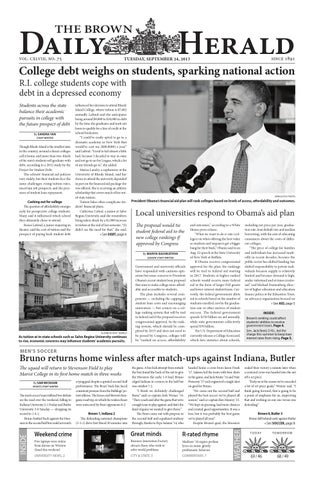
President Obama’s financial aid plan will rank colleges based on levels of access, affordability and outcomes.
Local universities respond to Obama’s aid plan The proposal would tie student federal aid to the new college rankings if approved by Congress By MARIYA BASHKATOVA SENIOR STAFF WRITER
ELIZABETH KOH / HERALD
As tuition at in-state schools such as Salve Regina University continues to rise, economic concerns may influence students’ academic pursuits.
Government and university officials have responded with cautious optimism but some concern to President Obama’s recent student loan proposal that aims to make college more affordable and accessible to students. The plan includes several components — including the capping of student loan costs and encouraging innovation — but centers on a college ranking system that will be tied to federal aid if the proposal receives congressional approval. In the ranking system, which should be completed by 2015 and does not need to be passed by Congress, colleges will be “ranked on access, affordability
and outcomes,” according to a White House press release. “What we want to do is rate (colleges) on who’s offering the best value so students and taxpayers get a bigger bang for their buck,” Obama said in an Aug. 22 speech at the State University of New York at Buffalo. If Obama receives congressional approval for the plan, the rankings will be tied to federal aid starting in 2017. Students at higher-ranked schools would receive more federal aid in the form of larger Pell grants and lower-interest student loans. Currently, the federal government allots aid to schools based on the number of students enrolled, not by the graduation rate or other metrics of student success. The federal government spends $150 billion on aid annually, while state governments collectively spend $70 billion. The U.S. Department of Education currently releases a College Scorecard, which lists statistics about schools,
including net price per year, graduation rate, loan default rate and median borrowing, with the aim of educating consumers about the costs of different colleges. “The price of college for families and individuals has increased markedly in recent decades, because the public sector has shifted funding, has shifted responsibility to private individuals because supply is relatively limited and because demand is high, under-informed and at times irrational,” said Michael Dannenberg, director of higher education and education finance policy at the Education Trust, an advocacy organization focused on » See AID, page 5 INSIDE: Brown’s ranking could affect students’ abilities to receive government loans. Page 4. Sen. Jack Reed, D-R.I., led the charge this summer to keep loan interest rates from rising. Page 5.
MEN’S SOCCER
Bruno returns home winless after match-ups against Indiana, Butler By SAM WICKHAM SPORTS STAFF WRITER
inside
The men’s soccer team suffered two defeats on the road over the weekend, falling to Indiana University 2-1 Friday and Butler University 3-0 Sunday — dropping its record to 1-4-1. Bruno battled back against the Hoosiers in the second half but could not notch
a tying goal despite a spirited second-half performance. The Bears’ back line faced consistent pressure from the Bulldogs’ potent offense. The losses end Brown’s fourgame road trip, on which the winless Bears were outscored by their opponents 8-2. Brown 1, Indiana 2 The defending national champions (3-3-1) drew first blood 30 minutes into
the game. A free kick attempt from outside the box found the back of the net to give the Hoosiers the early 1-0 lead. Bruno edged Indiana in corners in the half but was outshot 7-2. “I think we definitely challenged them,” said co-captain Josh Weiner ’14. “Their coach said after the game that we’re a tough team to play against, and that’s the kind of game we wanted to give them.” The Bears came out with purpose in the second half and equalized midway through, thanks to Pepe Salama ’14, who
headed home a cross from Jason Pesek ’17. Salama led the team with four shots in the game, and Jack Kuntz ’14 and Nate Pomeroy ’17 each registered a single shot on goal for Bruno. “We came out the second half and played the best soccer we’ve played all season,” said co-captain Ben Maurey ’15. “We kept on pressing, had more chances and created good opportunities. It was a loss, but it was probably the best game we’ve played all year.” Despite Bruno’s goal, the Hoosiers
Weekend crime
Great minds
R-rated rhyme
Five laptops were stolen from dorms on Wriston Quad this weekend
Business Innovation Factory attracts those who wish to solve world problems
Madison ’16 argues profane lyrics in music glorify problematic behavior
UNIVERSITY NEWS, 2
CITY & STATE, 3
COMMENTARY, 7
weather
The squad will return to Stevenson Field to play Marist College in its first home match in three weeks
sealed their victory a minute later when a centered cross was headed into the net off a set piece. “Early on in the season we’ve conceded a lot of set piece goals,” Weiner said. “I think going forward, that is going to be a point of emphasis for us, improving that and working on our one versus one defending.” Brown 0, Butler 3 Bruno fell behind early against Butler » See SOCCER, page 8 t o d ay
tomorrow
69 / 46
68 / 49
2 university news calendar TODAY
SEPTEMBER 24
11:30 A.M.
TOMORROW
SEPTEMBER 25
Heavy Petting
Oslo Peace Accords Anniversary Salomon 101 7:30 P.M.
Strategic Plan Campus Forum
Screening of “Blood Brother”
List 120
Metcalf 101
menu SHARPE REFECTORY
VERNEY-WOOLLEY
LUNCH Linguini with Tomato Basil, Sauteed Sliced Mushrooms, Meatball Grinder, Grilled Tuna Sandwich with Cheese
Autumn Bisque, Pulled Pork Sandwich, Vegan Quinoa Stuffed Portobello, Vegan Brownies
DINNER Cajun Fettucini, Szechuan Spicy Tofu Stir-Fry, Cajun Baked Fish, Okra and Tomato, Saffron Rice Pilaf
Safety Paul Shanley:
SENIOR STAFF WRITER
Main Green 12 P.M.
Weekend crime update: Sept. 20-22 By JILLIAN LANNEY
4 P.M.
THE BROWN DAILY HERALD TUESDAY, SEPTEMBER 24, 2013
BBQ Chicken Quarters, Jamaican Pork and Apricot Stir-Fry, Pumpkin Cheesecake Roll
sudoku
crossword
The following is an account of crime events that took place this weekend, reported to The Herald by Deputy Chief of Police for the Department of Public
Friday evening DPS officers responded to two thefts from unlocked dorm rooms in Goddard House, one occurring sometime between 4:30 p.m. and midnight and
the other between 9 p.m. and midnight. In both cases, MacBook laptops were stolen. This type of theft “seems to be definitely on the rise,” Shanley said. Last weekend, there were two reported incidences of theft from unlocked dorm rooms, The Herald previously reported. Saturday evening Three MacBook Pro laptops were stolen from three unlocked rooms in Buxton House between 11 p.m. and 2 a.m. Other personal belongings were also stolen from two of the rooms. Some students reported suspiciouslooking individuals in the area around the time of the thefts. DPS detectives are in contact with these students as they continue their investigations.
city & state 3
THE BROWN DAILY HERALD TUESDAY, SEPTEMBER 24, 2013
Minds ‘collide’ at Business Innovation Factory Modeled after the TED format, the conference included short talks by leaders and innovators By GADI COHEN STAFF WRITER
During the ninth annual Business Innovation Factory Summit held last Wednesday and Thursday at the Trinity Repertory Company, innovators gathered from around the country to meet, network and learn from each other — in the words of the group’s founder and conference organizer, Saul Kaplan, to “collide.” “How many rooms do we hang out in where the people in the room have 8,000 reasons for why we can’t do things?” Kaplan said in his opening speech. “We think of the 8,000 reasons why it can happen — and, more importantly, we don’t stop ’til it does,” he said of the conference’s participants. Kaplan founded BIF in 2005 as a “laboratory” for innovators to collaborate on solutions to problems in unique, often business-based ways. Similar to the popular model employed by the Technology, Entertainment, Design conferences, BIF’s organizers invite speakers to present their stories in short installments, with each presentation lasting around 20 minutes. Kaplan and the conference organizers chose this style to inspire the audience more powerfully, he said in his speech. In fact, everything about the conference
— from the choice of speakers to the long breaks before and after presentations — was designed to encourage the attendees to find system-level solutions to the world’s challenges. “Listen, in the 21st century, we’re not going to fix the big problems with tweaks,” Kaplan said. “We need to learn how to transform stuff. We need to learn together how to do more transformational things.” Speakers ranged from the Coca-Cola Company’s vice president of innovation to a 17-year-old who has developed a prosthetic arm that is lighter and cheaper than many of the models currently on the market. Doug Ulman ’99, president and CEO of the Livestrong Foundation, jumpstarted the conference’s first day, praising the value of community and speaking fondly of his childhood and undergraduate years. When he was diagnosed with cancer during his time at Brown, Ulman said, he wanted to find a stronger community and joined Livestrong in 2001. With the spread of the organization’s famous yellow wristband, Ulman said he found his community. “It’s created connections that we never dreamt possible,” Ulman said of the wristband. “The other thing that this did is it democratized philanthropy.” Another speaker, with a multimedia piece playing behind her, recounted how she also had found a purpose in serving a community she belongs to — the veteran community. “The minute I could serve something
bigger than myself, I found that I had purpose again,” said Stacy Pearsall, a former combat photographer. After being wounded twice while serving in Iraq, Pearsall retired from the Air Force at the age of 27. But away from the front lines, Pearsall said, she found other battles to fight at home. She was struggling to heal from her injuries, which included post-traumatic stress disorder and a traumatic brain injury, as well as trying to fit back into daily life as a female veteran. Pearsall now runs a photography studio with her husband, works as a spokeswoman for the Real Warriors Campaign and heads the Veterans Portrait Project, photographing veterans and composing photo essays about their struggles. Other speakers discussed their work helping various communities in need. Rosanne Haggerty spoke about Common Ground, the organization she founded to provide housing to homeless people around the country. After she worked to restore an old, dilapidated hotel into affordable housing for homeless people who had been living on the streets around Times Square in New York City, Haggerty said, she realized she could affect large-scale change with bold goals and the right tools. “We have this whole energized workforce who never had the right insights, the right tools, the right collaboration to get anywhere,” Haggerty said. “I wonder if the lesson is that pride in our most recent innovation is the obstacle to see what our next could be.”
GADI COHEN / HERALD
Speakers ranging from the vice president of Coca-Cola to war veterans sought to inspire attendees to collaborate in solving everyday problems. Viveka Hulyalkar ’15, who attended the conference for the third year in a row, said BIF has taught her how to connect with people in a way other experiences have not. “You just meet people who are involved in so many different things, and they teach you how to make an impact,” Hulyalkar said. “It’s a great experience just being in a room full of really accomplished people. It’s totally expected to just go up to people and just kind of accost them.” Hulyalkar said she was most affected by a speech given by James Doty, a clinical professor of neurosurgery at Stanford University, who discussed his research on the neuroscience of compassion and the effects societal restrictions have on
health. “Over the last three decades, neuroscientists learned ... that when somebody is authentic, when somebody is who they really are, that is when they are their best, when they thrive, when they get every benefit,” Doty said in his speech. Doty’s speech drew from his research findings and childhood experiences, as well as from his brother’s death from AIDS. Compassion toward others, especially in widespread forms like gender equality, will help make humanity happier and more successful, he said. “When one steps out of what society (and) culture (have) defined as the normal paradigm, what it does is it unleashes us to be who we are, and therefore flourish and thrive,” he said.
4 student loan debt
THE BROWN DAILY HERALD TUESDAY, SEPTEMBER 24, 2013
Admins react hesitantly to federal college ranking system The University may lobby the government if the rankings’ measurement criteria elicit concern BY ABIGAIL SAVITCH-LEW STAFF WRITER
University administrators said they are awaiting further details on President Obama’s plan for a new college ranking system that would be based on a wide range of affordability and performance metrics. The rankings — to be released by the U.S. Department of Education before the 2015-2016 school year — would compare colleges to their peer institutions according to measurements of students’ outcomes, though the exact formula is yet to be determined, the White House announced Aug. 22. Potential criteria include graduation rates, graduate earnings, the percentage of students receiving Pell grants, average net tuition costs and other information about students’ costs, according to a White House press release. Provost Mark Schlissel P’15 said he commends Obama for his efforts to help families access more information about college affordability but added that the University and other schools still need to learn more about the system. “The devil’s in the details,” he said. The ranking proposal follows the launch last February of the White House College Scorecard, a website that provides basic information about U.S. colleges, including graduates’ loan default rates and median borrowing amounts. Administrators have not yet heard
» DEBT, from page 1 adding that Salve Regina “(does not) provide enough financial aid.” Cabral said she is already “around $30,000 to $40,000 in debt” and anticipates staying at Salve Regina for another year. She said she predicts she will be around $80,000 to $100,000 in debt when she graduates. “Student debt is a concern to all institutions,” said Dan Egan, president of the Association of Independent Colleges and Universities of Rhode Island. “(Students) are very concerned” about financing their education, said Matthew Brady, a sophomore at Salve Regina who took out loans last year to help pay for his education. “If it was stable, I think kids would be okay,” he said, but tuition has continued to increase. Practical pursuits Some students have also decided what to study in part due to their financial situations. Cabral said she inititally wanted to study chemistry but ultimately decided to major in social work because she believes she will have more job
from the U.S. Department of Education Obama has urged Congress to pass about how Brown can participate in cre- legislation that would tie federal aid for ating the rating system, Schlissel said, students to their ranking performances adding that the University may choose by 2018, according to the press release. to lobby the federal government if it has The federal government currently disconcerns over the ranking system’s mea- tributes $150 billion in annual financial surements. One potential concern could aid to higher education institutions based arise if the system subtracted students on the size of their student bodies, rather who transfer out of Brown but gradu- than on performance metrics like graduate at another school within four years ation rates, according to the press release. from the University’s graduation rate, While Schlissel said he recognizes the Schlissel said. importance of funneling federal dollars to The University would also be con- the most effective schools, he expressed cerned if the rating concern that such a system measured “The devil’s in the set-up would disadaffordability solely vantage struggling details.” based on how many colleges that are workstudents receive Pell ing to make progress Mark Schlissel P’15 grants, said Direcon delivering positive PROVOST tor of Financial Aid outcomes for students. Jim Tilton, because “I think it’s very Brown has about 1,700 students who challenging to rely on rankings because receive University scholarships but not it may lock in schools that aren’t as good Pell grants. that might be otherwise able to improve,” Administrators also expressed skepti- he said. cism about using graduate earnings as a metric for the University’s performance. Peer to peer Measurements of graduates’ earnings are Brown for Financial Aid President limited by reliance on data pulled from Alex Mechanick ’15 said he hopes the voluntary surveys with recent graduates, rating system will not reward Ivy League said Director of Government Relations institutions for their generous aid policies and Community Affairs Amy Carroll. while defunding poorer schools that are Obama’s ranking plan does not yet doing their best with limited resources. have enough details to determine which Mechanick said the University schools are considered the University’s provides substantial aid compared to peer institutions, Schlissel said, adding many schools nationwide but should that he believes Brown will be considered be compared in the rankings to other a high-performing school whether it is elite universities. The University has the classified as a liberal arts school or a re- second-highest net tuition cost in the Ivy search university. “We stack up very well League, according to a “college scorecard” by all those different definitions, so that’s the Department of Education released not one of my biggest anxieties,” he said. in March.
The University requires students with annual family incomes over $100,000 to take out loans capped at $5,000 a year, Schlissel said, noting that some of the University’s peer institutions with larger endowments are able to provide loan-free aid packages to their students. But Mechanick said the University’s comparatively smaller endowment does not excuse placing financial burdens on students. “It’s not the size of the endowment — it’s how you use it,” he said.
opportunities after graduation. She has also had to think twice about studying abroad in the summer because it would create more debt, she said. After graduating, Cabral said she wants a job that will provide her with a comfortable salary and allow her to pay off her loans in a timely fashion, she said. “I don’t want to be 30 years old and still paying off my debt,” she added. Alexis Jelenik, a first-year at Salve Regina who is on financial aid and has also taken out loans, said she is majoring in nursing and wants to pursue a career as a nurse anesthetist. “I chose that because they make a pretty decent salary,” she said. Some students pursue additional majors to make the most of their college tuition, they said. Brady said he knows a number of other students double-majoring in education and a subject they want to teach. Students believe “their education has to be worth it,” Brady said, adding that he plans on double majoring in administration and justice — Salve Regina’s pre-law track — as well as religious and theological studies. “I’d rather major in both and then
Landry also said she chose a major that aligned with her interests, adding that she would not want to study an unappealing subject that promised to lead to a lucrative career. Landry said her parents support her decision to major in nutrition and have encouraged her to follow her passion rather than a paycheck. But Landry acknowledged that other students might not make the same choice. “I’m guessing there are people majoring in engineering because they want a higher-paying job,” she said. “Theater is not a very practical thing to study,” said Lafond, a junior at RIC. “It’s a little bit of a struggle, but for me, I decided I would do what I love rather than do something more practical,” she added. “Not everyone has the luxury of choosing.”
figure out what I want to do after, knowing that I have plenty of opportunities,” he said. Finding a field But other students are gambling that studying subjects they are passionate about will be more fulfilling. Balancing the desire to pursue one’s passion with the difficulty of obtaining a job in today’s economy is a “Catch-22,” said Bennet Koffa, a senior at URI. Koffa, who receives financial aid from URI through the university’s Talent Development Program — an initiative geared toward in-state students who demonstrate academic merit and financial need — also takes out around $14,000 in student loans annually, he said. He expects to be about $40,000 to $50,000 in debt by the time he graduates, Koffa added. Koffa said he chose his majors — communications and journalism — based on his interests rather than potential job prospects. “We don’t look at price of education, but we look at what we want to do because that’s going to matter — that’s what’s going to pay off after,” he said.
Incentivizing innovation Obama’s plan also proposes awarding bonuses to colleges based on the number of Pell grant recipients who graduate and requiring federal grant recipients to complete a portion of their coursework before they qualify for continued federal aid, according to the White House press release. These policy changes require Congressional approval before they can be enacted. Tying scholarships to student performance would be advantageous to the University because Brown students with large financial needs graduate at high rates, Schlissel said. Obama has also proposed capping student loan repayments at 10 percent of borrowers’ monthly incomes, as well as dispersing Pell grant money over the course of semesters rather than at the start of each semester to prevent wasting federal aid on students who drop out. The plan touts Obama’s intentions to provide financial incentives for innovative practices in higher education such as online course offerings and awarding credit to students with previous educational experience, according to the press release.
When it comes to money, mum’s the word Though many students rely on loans and financial aid to pay for college, few discuss their financial situations publicly. Talking about loans “doesn’t translate over to day-to-day conversation,” Brady said. “It’s more something that we worry
Schlissel expressed concern about the plan’s innovation incentives. “Once you start defining the kinds of things that the government will consider as innovative, and attaching money incentives to it, than you can expect what’s going to happen,” he said, adding that schools would overly standardize their practices to conform to government expectations. Students’ take Many students said they do not know the details of Obama’s proposed ranking system and expressed mixed views on its potential benefits. Obama has “already done some great work to make colleges affordable for people,” said Akshaya Avril-Tucker ’15, adding that she thinks a ranking system might be useful to high school seniors and their families. But she said she is worried a rating system based on graduates’ earnings would fail to accurately measure a school’s performance. A ranking system would only work if families understood its methodology, said John Brewer ’17. “I think it would be good as long as the criteria on which it was ranked was transparent,” he said. Jeff Compton ’15, who learned of the proposal this summer, said he is concerned a college rating system would encourage schools to focus their resources on developing their science, technology, engineering and mathematics programs. “It could cause colleges to let in certain types of students or make it hard to switch majors,” Compton said. He said he is also worried Obama’s proposal to link federal aid to the ranking system by 2018 would not give struggling colleges enough time to make reforms. about with our families.” But the topic does sometimes come up around dining hall tables, Jelenik said. “I know that sometimes at dinner, we have a group of friends, and we talk about how much financial aid we got or what our scholarships were,” she said. “I don’t know anyone who doesn’t have a loan taken out,” added Salve Regina first-year Brooke Hobson. While he said he believes student debt does not directly impact students’ undergraduate experiences, he added that loan debt is still an important issue. “There are many efforts underway to focus on costs and make college as affordable as possible for as many as possible,” Egan said. Both Jelenik and Hobson said they plan on going to graduate school but are wary of the additional debt they would have to assume. “I think if I want to go to grad school, I would want to find a job that would pay for me to go to grad school,” Hobson said. “It would make it a lot easier, especially with the end of college and having to pay my student loans — I don’t want to add more to it.”
Student loan debt across Rhode Island The federal government launched a system meant to help students and their families better understand the financial decisions involved with higher eduction. The system evaluates schools based on variables including cost, student debt and loan repayment.
Avg. net cost after financial aid $22,743
Graduation rate (within 6 years) 95.2 %
Enrollment 6,380
Rhode Island College
$8,274
44.2 %
Salve Regina College
$28,852
University of Rhode Island
$14,667
Brown University
Source: White House College Scoreboard
Federal loan default rate 1.5 %
Median borrowing/month $181.01
7,762
7.9 %
$149.60
72.6 %
2,028
4.2 %
$284.95
63.1 %
13,219
5.5 %
$228.72 JILLIAN LANNEY / HERALD
THE BROWN DAILY HERALD TUESDAY, SEPTEMBER 24, 2013
student loan debt 5
R.I. senator works to manage interest rates on student loans The bill comes after a 2012 plan by Sen. Jack Reed, D-R.I., to freeze interest rates for a year By KATHERINE LAMB SENIOR STAFF WRITER
After interest rates on federal student loans temporarily doubled from 3.4 to 6.8 percent in July, the U.S. House and Senate voted to pass a bipartisan bill tying student loan interest rates to market rates, rejecting a plan proposed by Sen. Jack Reed, D-R.I., that would have frozen the rate at 3.4 percent for another year. Though undergraduate loan interest rates are currently at 3.86 percent, they are projected to rise with the market environment, potentially reaching the law’s prescribed caps — set at 8.25 percent for undergraduates, 9.5 percent for graduate students and 10.5 percent for parents. Reed said he worries that if the rates on federal student loans approach the caps established by current legislation, the effects for students and their families in the short-term, as well as for society in the long-term, could be devastating. Looking for legislation Interest rates were set to double to 6.8 percent from 3.4 percent last year as well, but Reed led a coalition that successfully passed legislation to freeze the interest rate at 3.4 percent for the year. “The fix was worthwhile in exactly that degree — a year’s worth,” said Alex Mechanick ’15, president of Brown for Financial Aid. When that temporary fix expired July 1, the interest rate for federally subsidized Stafford loans, designed for students with demonstrated financial need, doubled to 6.8 percent, affecting seven million students nationally and more than 47,000 Rhode Islanders, according to a July 10 press release from Reed’s office. Following the rate increase, Reed joined with Sen. Elizabeth Warren, DMass., and Sen. Kay Hagan, D-N.C., to fight for reauthorization of his Keep Student Loans Affordable Act. Reed and Warren called their piece of legislation a “two-pronged approach” in a Politico opinion piece they co-authored. The first part of the bill was meant to combat the impending doubling of the interest rate by using a “one-year patch” to freeze rates at 3.4 percent. The legislation also laid out principles to guide long-term reform in the student loan system, including
» AID, from page 1 academic success, particularly for lowincome and underrepresented students. The college rating system is an important step toward making college more affordable because it gives consumers easy access to facts about college costs, but it is only one stage in a series of steps the government is taking to make college more accessible and should be considered in that framework, he added. A successful ranking system “should look at the college’s success with respect to access by low income and historically underrepresented demographics, affordability to those students and
“eliminating profits from student loans, locking in lower caps — 6.8 percent for stemming the rising cost of college and undergraduate and graduate loans and alleviating the burden of student debt 7.9 percent for Parent Loan for Underon existing borrowers through refinanc- graduate Students — but it was defeated. ing and better consumer protection,” “Every indication shows that rates they wrote. will go up,” Reed said. “I think (reaching “We were proposing to freeze the the cap) would be the worst situation rate at 3.4 percent so we could make right now.” some structural improvements to the “It’s exceedingly unlikely” the rates program, but we were not successful,” will reach the caps near 10 percent, beReed told The Herald. cause “it would take The Senate reroaring economic “We were jected the Keep Stugrowth,” Lardaro dent Loans Afford- proposing to freeze said. “My impresable Act 51-49 July sion is that although the interest rate 10 — failing to reach it’s unfortunate our at 3.4 percent ... the 60-vote threshold Senator’s motion but we were not needed to overcome a went down, I don’t filibuster. think interest rates successful.” Though it wasn’t are ready to spike successful, Reed’s anytime soon,” he Jack Reed proposal was imporsaid. U.S. SENATOR tant in a time when But even if the the prevailing attirates reaching the tude in Congress is “that the govern- cap is a “mute issue,” it is still a “quesment is always bad, and you have to tion of fairness,” Lardaro said. Though rely on the private sector,” said Leonard a market-based system might be more Lardaro, professor of economics at Uni- efficient, a fixed-rate system like the versity of Rhode Island. one proposed by Senator Reed reduces the risk that interest rates will make it Hitting the cap difficult for low-income students to pay In place of Reed’s proposal, the Sen- back their loans, he said. ate passed the Bipartisan Student Loan Certainty Act of 2013, a variable rate The efficiency-equity tradeoff system that tied student loan interest “The legislation raises questions not rates to market rates and allowed them just about our economic future but the to increase or decrease based on eco- kind of people that we are,” Lardaro nomic indicators. Though the bill low- said. “I think that the market-based ered interest rates to about 3.86 percent system will certainly be more efficient and retroactively lowered the rates on but the problem is that it won’t necesloans that had temporarily doubled to sarily be equitable or fair.” 6.8 percent, the rates are expected to “There’s a much more fundamenrise in this market environment, Reed’s tal issue (than efficiency) and that is staff said. the value of education, not just to the When President Obama signed the individual, but to society,” Reed said. legislation, he called it a “common- “Markets don’t quantify social benefits sense approach to keeping student very well. That’s why the government interest rates at a reasonable level,” the steps in and provides subsidies or incenProvidence Journal reported. tives,” he added. Though the market-based loan rate “Education is not like typical govsystem in place from 1992 to 2006 kept ernment spending. It’s investment-orirates reasonably low, market-based sys- ented spending that can actually allow tems rely heavily on a reasonable cap the government to generate more tax to protect borrowers in high interest revenue in the future,” Lardaro said. rate environments, and the caps in the For example, the big boom after World legislation passed this summer are too War II can be attributed to the GI Bill high, according to Reed’s staff. that subsidized higher education for “As a result, the financial pain for millions of veterans, he added. students and middle-class families is According to projections, the curessentially back-loaded to kick in later, rent legislation will enable the federal with some rates projected to be above government to “turn a profit on the the current rate of 6.8 percent as soon student loan,” Mechanick said. as 2015, and rates for undergrads to rise “What we have to do is make a judgabove seven percent as soon as 2017,” ment about whether or not the federal according to a July 24 press release from government should be making money Reed’s office. off of student loans,” Reed said. One An amendment from Reed, War- argument is that the government should ren and 17 Senate colleagues proposed be “lending at the lowest possible rate
based on the cost,” Reed said. Another temperature of the economy and preargument is that “in order to encourage dict what the rates will be,” McClean higher education, we should actually said. “Before, it wasn’t connected to think about subsidizing it.” the outside world.” “The important question is not NASFAA views the current legislaabout the structure of the program, tion as a “strong piece of legislation that but how much we should be investing is good for all borrowers,” McClean in students,” Mechanick said. “If we did said. more, would we be benefiting everyone While past legislation, including the in a way that would make it worth it?” one-year freeze of interest rates at 3.4 Roughly half of the jobs in the percent last year, protected only StafUnited States currently require a col- ford loans, the new legislation “made lege degree, and predictions show that the rates more affordable for everyone, within a decade that proportion will not just the subsidized loan borrowers,” increase significantly, Reed said. But she said. Data shows that 80 percent of while the demand for college degree NASFAA’s subsidized borrowers also has increased, so has the cost of tuition, borrow unsubsidized loans, McClean he said. added. “We have to get under control the Though student loans go to indicost of college education. The increase viduals regardless of where they attend has been staggering,” Reed said. “Col- school, the burdens for different educaleges have to step up, and we have to tional institutions will vary greatly, aclook at ways to encourage them to,” cording to Reed’s staff. Universities with he added. more students who are reliant on loans “The reason that we’re a productive could start to see less tuition revenue economy today, and a more civil society, and lower enrollment as rates increase, is because we’ve for hundreds of years whereas independently wealthy institusupported education,” Reed said. tions won’t face the same problems. The most recent rankings of country “I would assume that Brown is in a performance in education, published considerably better position than most,” by the Economist Intelligence Unit in Mechanick said. “That said, I think it’s a November 2012, show that the United useless comparison. I think we should States has been surpassed in education always be comparing ourselves to what performance by 16 other nations and we could be doing,” he added. currently ranks 17th in the Global Index of Where do we loan “The legislation Cognitive Skills and from here? raises questions Educational AttainThe caps are in ment. not just about our place as a “safety net,” “Other countries McClean said, but if economic future have recognized rates reached them, but the kind of investment in edu“Congress might cation as the path people that we are.” again look at interest to prosperity and rates and see if there progress,” Reed said. is something else we Leonard Lardaro “In this complicated could do.” UNIVERSITY OF RHODE ISLAND global age, we’re goChanges might be PROFESSOR OF ECONOMICS ing to have to have made even by the end more college graduof the year in the proates.” cess of reauthorization for the Higher Education Act of 1965, which will exBorrower burdens pire at the end of 2013, McClean said. As student loan rates increase, “it “That’s a process where lots of difincreases the burden on a part of the ferent aspects of higher education and population that’s already bearing an student aid are considered,” she said. incredible burden,” Mechanick said. Part of the current legislation has For now though, it’s manageable, also required the U.S. Government AcLardaro said. “It’s certainly workable. countability Office to produce a report We can live with it.” analyzing the costs and market instruA market-tied system also has ben- ments for student loans. The report has efits for students and parents because the potential to spark more ideas for student loan rates “are more predictable long-term reform, according to Reed’s and understandable,” said Megan Mc- staff. Clean, director of policy and federal Though Reed’s and Warren’s amendrelations at the National Association of ment proposing to cap the rate at 6.8 Student Financial Aid Administrators. percent was defeated, “once it gets past “If you have a broader sense of 6.8 percent we’re going to be down there what’s going on, you can take the reminding people,” Reed said.
others overall and its success with those students and all students,” Dannenberg said. He added that it is too soon to evaluate the specifics of Obama’s proposal because it does not include enough information about the new ranking system. Tying federal aid to college value can be appropriate if instituted properly, said Daniel Egan, president of the Association of Independent Colleges and Universities of Rhode Island. “The question is how do you establish the rankings to accurately gauge and compare apples to oranges and bananas?” he added. But there is some concern that the three tenets of Obama’s plan — access,
AICU Rhode Island aims to work with Obama to make sure the rankings are fair and take into account all three of the president’s proposed goals and is already expressing concerns to congressional delegations, Egan said. The Rhode Island Office of Higher Education supports Obama’s efforts to promote college affordability, though crafting an appropriate college ranking system that captures college value accurately will likely be difficult, wrote Michael Trainor, special assistant to the commissioner of the R.I. Board of Governors of Higher Education, in an email to The Herald. University of Rhode Island, Rhode Island College and Rhode Island Community College
affordability and outcomes — would not receive equal emphasis in the new ratings system, Egan said. Focusing on outcomes like graduate earnings could disadvantage schools that concentrate on fields that offer lower average salaries like public service or the humanities, he added. Colleges that are accessible to highrisk students may also have lower graduation rates, decreasing the schools’ rankings, Egan said. A representative from Sen. Jack Reed’s, D-R.I., office said he shares the concern that students who can only afford to go to schools with lower graduation rates may be disadvantaged by the rankings.
have instituted a tuition freeze this year in an effort to keep college affordable, he added. Johnson and Wales University is evaluating how Obama’s proposal will affect financial aid for the school, wrote Lisa Pelosi, director of the office of communications and media relations for JWU, in an email to The Herald. Representatives from Roger Williams University, Providence College, Bryant University, Rhode Island College and Salve Regina University could not be reached for comment on Obama’s proposal. — With reporting by Katherine Lamb and Abigail Savitch-Lew
6 commentary
THE BROWN DAILY HERALD TUESDAY, SEPTEMBER 24, 2013
EDITORIAL
Legalizing marijuana would benefit Rhode Island Though Rhode Island decriminalized marijuana in April of last year, more drastic state action could be the on the horizon. The Marijuana Policy Project, an organization set on working state by state to progressively change marijuana laws, is leading the cause, and Karen O’Keefe, the organization’s director of state policies, recently identified Rhode Island as one of the 10 new states where it will attempt to have marijuana legalized. We wholeheartedly support this endeavor, as legalization would certainly help ameliorate Rhode Island’s flagging economy. Rhode Island is already projected to be one of the next states to legalize marijuana, and it is clear the policy has support in the state. The question of legalization has arisen in the past three sessions of the state General Assembly, championed in particular by House Rep. Edith Ajello D-Providence, chair of the judiciary committee. In addition, a poll from last January found that 52 percent of respondents support legalization. Though such a measure has not yet passed, we believe the history and context surrounding this policy render the state ripe for a renewed effort to legalize marijuana. At the state level, advocates understand legalizing marijuana would go a long way toward reviving Rhode Island’s struggling economy. While the state currently spends resources attempting to prevent illegal marijuana traffic and use, it earns no income from taxation. The proposed legalization bill calls for a “$50 per ounce excise tax at the wholesale level, as well as a sales tax that would increase the state’s revenue.” Rhode Island’s economy is consistently ranked among the worst in the nation. Simultaneously, consumer demand for marijuana is high: The state has the nation’s highest rate of illicit drug and marijuana use. Rather than continue to fruitlessly fight marijuana use, the state should tax the sale of the drug so that it may use the revenue to bolster important but underfunded programs, such as public education. Legalizing marijuana would boost Rhode Island’s suffering economy, both freeing and creating valuable resources the state could devote to worthwhile endeavors. As residents of the state, Brown students should understand the value of legalizing marijuana and add their voices to the chorus calling for such reform. We strongly hope the Rhode Island state legislature examines the benefits of legalization, and we urge lawmakers to implement this progressive policy.
A A N C HA L S A R A F
Editorials are written by The Herald’s editorial page board: its editor, Rachel Occhiogrosso, and its members, Daniel Jeon, Hannah Loewentheil and Thomas Nath. Send comments to editorials@browndailyherald.com.
CORRECTION An article in Monday’s Herald (“Student comedians stage fake centennial anniversary,” Sept. 23) reported that Adam Abeshouse ’14 asked in his stand-up routine, “Oh, what would Grandma say if I took Africana Studies?” In fact, Abeshouse said, “This one looks great, but Grandma would have something to say if I took Africana Studies.” Additionally, the article reported Abeshouse was joking about “shopping period and the search for the elusive fourth course.” Abeshouse’s joke about shopping period was in the context of a comparison between looking for courses and choosing a spouse. The Herald regrets the errors.
Q U O T E O F T H E D AY
“I don’t know anyone who doesn’t have a loan taken out.” — Brooke Hudson, Salve Regina first-year See debt, page 1. Editorial Leadership
Sections
Visuals & Production
Business
Editors-in-Chief Lucy Feldman Shefali Luthra
Arts & Culture Editors Hannah Abelow Maddie Berg
Head Photo Editor Emily Gilbert
General Managers Julia Kuwahara Samuel Plotner
Managing Editors Elizabeth Carr Jordan Hendricks
City & State Editors Sona Mkrttchian Adam Toobin
Senior Editors Aparna Bansal Alexa Pugh
Features Editors Jennifer Kaplan Elizabeth Koh
Strategic Director Greg Jordan-Detamore
Science & Research Editors Phoebe Draper Kate Nussenbaum
BLOG DAILY HERALD Editor-in-Chief Meredith Bilski
Sports Editors James Blum Connor Grealy
Managing Editor David Oyer
University News Editors David Chung Mathias Heller Eli Okun
POST- MAGAZINE
Editorial Page Editor Rachel Occhiogrosso
Editor-in-Chief Ben Resnik
Opinions Editors Gabby Corvese Garret Johnson Maggie Tennis
Photo Editors Brittany Comunale David Deckey Samuel Kase Sports Photo Editor Jesse Schwimmer Video Editors Henry Chaisson Assistant: Danny Garfield Data Science Editor Andersen Chen Web Producer Joseph Stein Design Editors Kyle McNamara Mie Morikubo Julia Shube Assistant: Sandra Yan
facebook.com/browndailyherald
@the_herald
browndailyherald.com
Directors Sales: Eliza Coogan Finance: Nicole Shimer Alumni Relations: Emily Chu Business Dev.: Justin Lee
Location: 195 Angell St., Providence, R.I. www.browndailyherald.com
Office Manager Shawn Reilly
Corrections: The Brown Daily Herald is committed to providing the Brown University community with the most accurate information possible. Corrections may be submitted up to seven calendar days after publication.
Sales Managers Regional: Jennifer Aitken Regional: Jaqueline Chang Regional: Leslie Chen Regional: Wenli Shao Regional: Carolyn Stichnoth Student Group: Anisa Holmes Finance Managers Collections: Sameer Sarkar Collections: Timothy Sharng Operations: Sarah Levine
Copy Desk Chief Sara Palasits
Alumni Relations Manager Engagement: Alison Pruzan
Illustrations Editor Angelia Wang
Business Dev. Managers Project Leader: Melody Cao Project Leader: Kaden Lee
Editorial contact: 401-351-3372 herald@browndailyherald.com
Business contact: 401-351-3260 gm@browndailyherald.com
Commentary: The editorial is the majority opinion of the editorial page board of The Brown Daily Herald. The editorial viewpoint does not necessarily reflect the views of The Brown Daily Herald, Inc. Columns, letters and comics reflect the opinions of their authors only. Letters to the Editor: Send letters to letters@browndailyherald.com. Include a telephone number with all letters. The Herald reserves the right to edit all letters for length and clarity and cannot assure the publication of any letter. Please limit letters to 250 words. Under special circumstances writers may request anonymity, but no letter will be printed if the author’s identity is unknown to the editors. Announcements of events will not be printed. Advertising: The Brown Daily Herald, Inc. reserves the right to accept or decline any advertisement at its discretion. The Brown Daily Herald (USPS 067.740) is an independent newspaper serving the Brown University community daily since 1891. It is published Monday through Friday during the academic year, excluding vacations, once during Commencement and once during Orientation by The Brown Daily Herald, Inc. Single copy free for each member of the community. Subscription prices: $280 one year daily, $140 one semester daily. Copyright 2013 by The Brown Daily Herald, Inc. All rights reserved. Periodicals postage paid at Providence, R.I. Postmaster: Please send corrections to P.O. Box 2538, Providence, RI 02906.
THE BROWN DAILY HERALD TUESDAY, SEPTEMBER 24, 2013
Drop the beat ... and the ignorance etition ingrains not just words but also ideas and messages in your mind. That verse you love to recite when that song comes opinions columnist on — like the verse about how much money Jay-Z has or how Music is the soundtrack to life, many “hot (witches)” Kanye and it makes life more vibrant, West owns or how a woman is more creative and more enjoy- likened to “an animal” by Robable. If music is perceived to be in Thicke — is not just a verse a part of our personalities, and if that sits there in your mind unit can affect our moods, our ac- til you’re ready to pull it out at a tions and our interests, can it ac- party and sing along. It is playtually affect our perspectives? I ing a part in how you perceive believe that lyrics — and the val- things. ues they communicate to the lisMusic is a form of media, and tener — have effects larger than any message, through repetiperceived on how we think and tion, takes root in its consumact. er’s mind. The line that divides Many — maybe most — pop- things we hear but don’t buy ular songs one can think of con- into, and those that we hear and tain, in some context, some ref- believe, becomes increasingly erence to materialism, violence, blurred with repetition and conracial, sexual and other slurs or stant exposure. engagement in immoral actions. Youth are especially suscepHonestly, many songs I listen to tible to being affected by the on a regular basis contain sever- messages of music with negative al of these problematic features. lyrics and portrayals, especialWhen I think ly because they about it, I rechave not grown “Could you ognize how the to realize that dance to a song messages in muthese claims may sic can — and do be wildly inacthat contains — affect myself Rick Ross offensive material curate. and others, withis probably leasor perpetuates out our awareing that Bugatti ness. that he’s using in ignorance?” A 2008 report his video, Drake from the Archives of Pediat- probably hasn’t actually “made rics and Adolescent Medicine $2 million since last Wednesfound that “one in three popu- day” and illegal activities such lar songs contains explicit refer- as selling drugs or gang violence ences to drug or alcohol use.” A are more likely to get you in jail 2005 study from the University or in a grave than in a mansion. of Pittsburgh School of Medi- Many of these artists who procine found that “the average ad- mote certain acts have not acolescent is exposed to approxi- tually engaged in the activities mately 84 references to explicit they glorify. Equally likely is the substance use per day and 591 possibility that these musicians references per week, or 30,732 do lead the dangerous lives they references per year.” The same claim, and their lives may acstudy found that “9 percent of tually serve as cautionary tales pop songs had lyrics relating to once one looks beyond their drugs or alcohol … 14 percent fabricated, glossy celebrity imfor rock songs, 20 percent for ages. We may not be “youth” any R&B and hip-hop songs, 36 per- longer, but we still are not imcent for country songs and 77 mune to some of these subtle inpercent for rap songs.” fluences. This is based off the 279 most It is important for us all to popular songs from 2005, which think about what that song that were determined by Billboard we’re dancing to is really saymagazine, a measure of popu- ing. Could you dance to a song lar music. It also found that only that contains offensive matearound “4 percent of the songs rial or perpetuates ignorance? contained ‘anti’-drug and alco- If it’s catchy, maybe that doesn’t hol messages.” matter to you. But while you’re Even today, one need not dancing, just think about what search long to find lyrics that forms of ignorance that song’s promote sexism or racism, liken lyrics may be perpetuating or women to gold-diggers or pro- what immoral ideas and actions mote the chase for quick, easy the song may encourage, and money. As Brown students, we render those words powerless may think ourselves above this. in your mind. Do not let your We may think that listening to mind be imprisoned by negativmusic with negative messages ity and ignorance. on our headphones or dancing to such music at parties doesn’t affect us. Armani Madison ’16 is primarFor one thing, we’re not ily a fan of rap music, especially even really listening to the lyrwhen the music has a positive ics, right? And if so, we’re not message. He can be reached at thinking about them. But reparmani_madison@brown.edu.
ARMANI MADISON
commentary 7 History matters for Rhode Island education General Assembly authorized
our neighbors. Charter schools, standardized testing, performance metrics and Race to the ply a classroom held at the State Top grants do not take into acopinions columnist House, while no free school- count land use and settlement ing throughout Providence ex- patterns. They certainly don’t Today, the people of Rhode Is- isted. In 1768, the city held a take into account the historland find themselves in a sim- vote on instituting free public ical-political development of mering education debate, and schools, but the proposal was education systems. Even the this is nothing new. Through- defeated. Over 120 years after best-intentioned education reout history, the Ocean State has Massachusetts had compelled form efforts will not be successhad a rocky relationship with towns to provide free taxpayer- ful if they cannot correctly dipublic education. But rarely is funded public schooling, such a agnose the problem they are atthe long history of public edu- school system was voted down tempting to fix. cation in Rhode Island taken in Providence. Meanwhile, in Education reforms have into account when discussing Barrington — which was then largely ignored long-term statethe future. part of Swansea, Mass. — a free wide planning, land use and Unlike Massachusetts and school was established in 1673. municipal development. This is Connecticut, Rhode Island was Barrington puba mistake, parnot quick to embrace public ed- lic schools reticularly given “Even the bestucation. Boston Latin School main among the Rhode Island’s intentioned is the oldest public school in best in the state history. The borAmerica and was founded April today. education reform ders of Rhode Is23, 1635. Seven years later, MasIn the end, municipaliefforts will not be land sachusetts passed a law mandat- it was not until ties were drawn successful if they without a mind ing that parents and guardians 1828 that a free must educate their children. By system of public to education, the cannot correctly 1647, the Massachusetts Gen- education came demographics of diagnose the eral Court passed laws compel- to Providence. students or a tax ling towns of at least 50 people And it took until problem they are base to support to set up schools. Ninety years 1883 for Rhode attempting to fix.” them. later, Horace Mann 1819 be- Island to instiWith a longcame secretary of education for tute statewide term plan, conMassachusetts. By 1852, thanks free and compulsory educa- sistent long-term investment to Mann’s reforms, Massachu- tion, 31 years after Massachu- and constructive input from setts established the first state- setts had done it. In short, Little the community, we could atone wide compulsory education Rhody has a long history of be- for some of the sins of the past. system in the United States. ing New England’s public edu- A more rational and less hapIn Rhode Island, things cation laggard. hazard system could be built happened much differently. Why might this matter? for future generations. This is a Though state founder Rog- What does this have to do with worthwhile discussion to start er Williams was a teacher to today? Communities grew over having within our communimany, the colony of Rhode Is- the time in which Rhode Is- ties. We could spend some efland never established a system land debated public education. fort now studying the comparof common schools. Newport Municipalities formed. Town ative land use, demographic was the first town to try hav- and city borders ossified. In and tax revenue issues between ing a public school. But schools Massachusetts and Connecti- school districts in Rhode Island there came in fits and starts. As cut, communities grew around and our neighboring states. At early as 1640, there was some schools. In Rhode Island, com- the very least, it would be usemention of schooling. And as munities formed without them. ful to know to what extent the early as 1685, there was talk The town and city borders of political development of public of a school building. But this this state were drawn without education in Rhode Island puts building had fallen down by schools in mind. And educa- this state in a unique position. 1700, and it took until 1739 to tion is now the single largest That way, we might just find sofinish erecting a new school — expenditure for municipalities lutions specifically tailored for which was then destroyed by in the state. the Ocean State. fire in 1774. For 50 years after Given the historical evothe fire, no physical school ex- lution of public education in isted in Newport. Rhode Island, it is doubtful Daniel Carrigg GS loves this Providence was even slow- that the short-term fixes we little state he has made his er to take to the idea of public so often focus on will be suffihome. He can be reached at education. In 1663, the State cient to help us to catch up to daniel_carrigg@brown.edu.
DANIEL a grant of land for a school. CARRIGG But as of 1725, there was sim-
browndailyherald.com/opinions
daily herald sports tuesday THE BROWN
TUESDAY, SEPTEMBER 24, 2013
FIELD HOCKEY
Bears mauled by Lions, defeat Raiders
After a tough conference loss, Bruno returned to unselfish play to seal win over Colgate By CORMAC CUMMISKEY CONTRIBUTING WRITER
The field hockey team won the second of two games this weekend due to renewed emphasis on team-focused play. After falling to Columbia (3-3, Ivy 1-0) Friday, Bruno (3-3, 0-1) bounced back Sunday to fend off Colgate University (1-7).
COURTESY OF BROWN ATHLETICS
Sam Fife ’14 and the men’s tennis team gauged what the upcoming season will bring as they faced most of their Ivy foes in the Ivy Plus Tournament.
M. TENNIS
Bruno builds experience in Ivy play The squad hopes to continue with strong wins against Ivy teams at the Penn Invitational By ALEX WAINGER CONTRIBUTING WRITER
The men’s tennis team traveled to New Haven, Conn. last weekend to compete in the Ivy Plus Tournament and came away with strong wins and valuable experience, said co-captain David Neff ’14. Bruno competed against all other Ivy League teams — with the exception of Princeton — as well as against several non-league opponents. The Bears also had an impressive showing the weekend before at the Brown Invitational, where the squad won one doubles title as well as three singles titles. The Bears were led by Eli Whittle ’17 and Lucas DaSilveira ’16, who both reached the semifinals of their flights before being knocked off by players from Penn and Harvard, respectively. Whittle is one of two firstyears on the team, the other being Greg Garcia ’17. DaSilveira and Whittle also paired up for doubles play, as DaSilveira’s usual partner, Justin To ’15, did not travel to the tournament. The duo knocked off a pair from Dartmouth 8-5 in the quarterfinals and then beat a Crimson team 8-7 before falling to a freshman-senior team from Penn in the finals. “I didn’t feel like that I was that sharp this weekend,” DaSilveria said.
“I’ve been playing much better (in practice) than I did this weekend, which is frustrating, but it was good to see what our competition will be like in the Ivy League this year.” Neff also made a strong showing at the tournament, reaching the semifinals of his singles flight as well as the consolation final for one of the doubles flights. In the latter, he was accompanied by partner Ivan Kravtchenko ’16. “We played together a little bit last year, so it was nice to continue to build a level of comfort with each other,” Neff said. “Obviously, playing with someone you’re familiar with is a huge advantage.” Garcia competed in both singles and doubles play, picking up a win in the first round of the singles draw against a Dartmouth player. Gsrcia then battled a player from Cornell in the quarterfinal and took an early lead, winning the first set 6-2, but he ultimately fell in a threeset match. The past two tournaments indicate the impact Garcia and Whittle could have on the team this year. “That’s what makes these fall tournaments so critical and so important is that (Garcia and Whittle) start to see not only the new level of play but also how teams interact in college,” Neff said. “It’s very different from the junior level where you’re so focused on yourself. They’re both great players, and over time, they’ll become accustomed to playing for the team.” The Bears will next compete at the Penn Invitational this upcoming weekend in Philadelphia.
Columbia 4, Brown 1 Despite not having beaten the Lions since 2006, the Bears entered Friday’s game with high hopes. “We went into the game really thinking that it was a good match-up,” said Torie Stearns ’14. “I think individually the teams did stack up pretty well.” But Columbia established an offensive advantage from the first whistle. The Lions bombarded the Bears with a barrage of shots before halftime, netting three goals. In response, Bruno recorded only one goal, scored by forward Meghan O’Donnell ’15 in the 29th minute of play off an assist from Clayton Christus ’15. The second half did not unfold any better for the Bears. A strong effort by goalkeeper Shannon McSweeney ’15 — who logged 10 saves for the game — was not enough to break the tide of scoring by the Lions. Columbia added a fourth goal in the 44th minute to complete its lopsided victory. Stearns said a breakdown in teambased mentality was to blame for the outcome. “We usually play as a team, but it was a little more of an individual effort (in the game),” Stearns said. Brown 4, Colgate 3 The mood of the team was somewhat “defeated” following Friday’s loss,
JESSE SCHWIMMER / HERALD
Avery Burns ’14 helped lock down a surging, second-half Colgate offense en route to the Bears’ lone victory of the weekend. Stearns said. But the Bears redeemed themselves two days later against Colgate. Stearns scored the first goal of the game — her first of the season — 30 seconds into the first half. Following this blow, the Raiders swiftly retaliated. Colgate senior Halle Biggar notched two goals before the half, stealing Brown’s lead. Seven minutes into the second half, Colgate first-year Whitney Jones contributed another point to the Raiders’ tally. Captain Maggie Brady ’14 said composure was key to staying engaged in the game. “We stayed very calm. … It was almost like a switch flipped,” she said. At that time, “we realized that we had the potential to come back.” And the Bears roared back from their brief hibernation. The team struck in the closing minutes of the second half, scoring three goals in roughly 10 minutes.
The three points came from three different players, as Christus pushed in the game-winning goal with less than two minutes left on the clock. Brady said the match reflected the Bears’ ability to excel as a unit. “The Colgate game was the culmination of our individual efforts into a cohesive team effort,” Brady said. Up next The team will host its next match at home against Dartmouth Sept. 28. Last year, the Bears lost to their conference rivals 3-2 on the road, but the players said they remain optimistic as the rematch approaches. “They’re definitely going to come back and try to beat us,” said Alexis Miller ’16, who scored one goal in the Colgate game. “Playing with small passes, causing corners and doing the things that we’re good at will help us come out on top.”
» SOCCER, from page 1
JESSE SCHWIMMER / HERALD
Pepe Salama ’14 led the Bears with four shots against Indiana University, but ultimately the team fell short in both games this weekend.
(5-1-1), conceding the first goal 19 minutes in. Butler’s offense pressured Bruno’s back four the whole half, ripping five shots and forcing three saves from Weiner. “It was definitely difficult going into that game playing a fresh team,” Weiner said. “But we were able to keep ourselves in the game, so that was promising throughout the first half.” The Bulldogs picked up where they left off in the second half and struck again in the 52nd minute. A pass across the 6-yard box was finished to increase their lead to 2-0. The final goal came just 12 minutes later off a header to seal the 3-0 victory for the home team. “Even when we were down, we had some players step up and play well,” Maurey said. “That was promising stuff, and some good individual play, but as a team we can do better.” Bruno returns home to Stevenson Field Friday to take on Marist College (1-6) under the lights. “We take pride in playing at Stevenson,” Maurey said. “We always seem to play some of our best soccer there. … Hopefully, we get a good crowd and can feed off their energy so we can turn things around.”