Daily
Herald
THE BROWN
vol. cxlviii, no. 72
since 1891
THURSDAY, SEPTEMBER 19, 2013
In strategic plan, first glimpses of U.’s future Campus The draft emphasizes curricular innovation, graduate programs and growth downtown
By DAVID CHUNG, MATHIAS HELLER AND ELI OKUN UNIVERSITY NEWS EDITORS
President Christina Paxson offered a framework for the University’s trajectory over the next decade with Wednesday’s release of a long-term strategic plan, “Building on Distinction.” If approved by the Corporation — which is set to review the 11-page document at its October meeting — the plan would orient Brown toward an era highlighting interdisciplinary
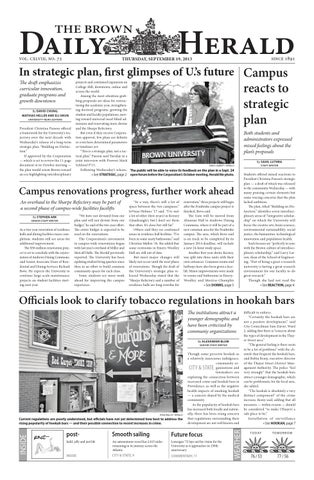
projects and continued expansion on College Hill, downtown, online and across the world. Among the most attention-grabbing proposals are ideas for restructuring the academic year, strengthening doctoral programs, growing the student and faculty populations, moving toward universal need-blind admission and renovating more dorms and the Sharpe Refectory. But even if they receive Corporation approval, few plans are definite or even have determined parameters or timelines yet. “This is a strategic plan, not a tactical plan,” Paxson said Tuesday in a joint interview with Provost Mark Schlissel P’15. EMILY GILBERT / HERALD Following Wednesday’s release, The public will be able to voice its feedback on the plan in a Sept. 24 » See STRATEGIC, page 2 open forum before the Corporation’s October meeting. Herald file photo.
Campus renovations progress, further work ahead An overhaul to the Sharpe Refectory may be part of a second phase of campus-wide facilities facelifts By STEPHEN ARK SENIOR STAFF WRITER
As a two-year renovation of residence halls and dining facilities nears completion, students still see areas for additional improvement. The $56 million renovation project is set to conclude with the rejuvenation of Andrews Dining Commons, said Senior Associate Dean of Residential and Dining Services Richard Bova. He expects the University to continue large-scale maintenance projects on student facilities starting next year.
“We have not deviated from our plan and will not deviate from our budget,” he said of the two-year effort. The entire budget is expected to be used on the renovations. The Corporation’s investment in campus-wide renovations began with last year’s overhaul of Miller and Metcalf Halls, The Herald previously reported. The University has been updating student living quarters since then in an effort to build common community spaces for each class. Some students see more work ahead for improving the campus experience.
“In a way, there’s still a lot of space between the two campuses,” JoVaun Holmes ’17 said. “I’ve met a lot of other (first-years) in Keeney (Quadrangle), but I don’t see them that often. It’s close but still far.” Others said they see continued issues in residence hall facilities. “I’ve been in some nasty bathrooms,” said Christine Mullen ’16. She added that some restrooms in Emery-Woolley Hall are still out of date. But most major changes will likely not occur until the next phase of renovations. Though the draft of the University’s strategic plan released Wednesday stated that the “Sharpe Refectory and a number of residence halls are long overdue for
renovation,” these projects will begin after the Pembroke campus project is finished, Bova said. The Gate will be moved from Alumnae Hall to Andrews Dining Commons, where it will be part of a new common area for the Pembroke campus. The area, which Bova said is on track to be completed by its January 2014 deadline, will include a new 24-hour study space. Another first-year dorm, Keeney, was split into three units with their own entrances. Common rooms and hallways have also been given a facelift. Minor improvements were made to rooms and bathrooms in EmeryWoolley and Morriss-Champlin » See DORMS, page 5
reacts to strategic plan Both students and administrators expressed mixed feelings about the plan’s proposals By SAHIL LUTHRA STAFF WRITER
Students offered mixed reactions to President Christina Paxson’s strategic plan — a draft of which was released to the community Wednesday — with many praising certain elements but some voicing concerns that the plan lacked ambition. The plan, titled “Building on Distinction,” identifies seven interdisciplinary areas of “integrative scholarship” on which the University will focus: the creative arts, brain sciences, environmental sustainability, social justice, the humanities, technological innovation and population health. Such focuses are “perfectly in sync with the Brown culture of interdisciplinary scholarship,” said Larry Larson, dean of the School of Engineering. “Part of being a great a research university is having a great research environment for our faculty to do great research.” Though she had not read the » See REACTION, page 4
Officials look to clarify tobacco regulations in hookah bars The institutions attract a younger demographic and have been criticized by communiy organizations By ALEXANDER BLUM SENIOR STAFF WRITER
Though some perceive hookah as a relatively innocuous indulgence, community organizations and lawmakers are exploring the connection between increased crime and hookah bars in Providence, as well as the negative health impacts of smoking hookah — a concern shared by the medical community. As the popularity of hookah bars has increased both locally and nationally, there has been rising concern that regulations surrounding their development are not well known and
RYAN WALSH / HERALD
inside
Current regulations are poorly understood, but officials have not yet determined how best to address the rising popularity of hookah bars — and their possible connection to recent increases in crime.
post-
Smooth sailing
Future focus
Judd, jelly and just life
An autonomous vessel has 2,615 miles remaining in its journey across the Atlantic
Lonergan ’72 lays out his vision for the University as it approaches its 250th anniversary
INSIDE
CITY & STATE, 9
COMMENTARY, 11
weather
CITY & STATE
difficult to enforce. “Certainly the hookah bars are not a positive development,” said City Councilman Sam Zurier, Ward 2, adding that there is “concern about the types of development in the Thayer Street area.” “The general feeling is there seem to be a lot of problems” with the clientele that frequent the hookah bars, said Robin Remy, executive director of the Thayer Street District Management Authority. The police “feel very strongly” that the hookah bars attract a younger demographic, which can be problematic for the local area, she added. “The hookah is absolutely a very distinct component” of the crime increase, Remy said, adding that all measures — within reason — should be considered “to make (Thayer) a safe place to be.” Installation of sur veillance » See HOOKAH, page 7 t o d ay
tomorrow
76 / 53
77 / 56
2 university news » STRATEGIC, from page 1
calendar TOMORROW
SEPTEMBER 19
UNTIL 11:59 P.M.
TOMORROW
SEPTEMBER 20
4 P.M. Last Day of
Brown +1 Info Session
Shopping Period 8:30 P.M.
JWW 440 9 P.M.
Brown Pre-Med Meeting
Brown Stand Up Comics Show
MacMillan 117
Salomon 001
menu SHARPE REFECTORY
VERNEY-WOOLLEY
LUNCH Grilled Vegetables Calzone, Toasted Ravioli with Italian Salsa, Hot Baked Ham on Bulky Roll, Tex-Mex Chili
Eggplant Parmesan Grinder, Gourmet Turkey Sandwich, Vegan Chili, Ham and Bean Soup, M&M Cookies
DINNER Mediterranean Orzo, Chicken Helene, Vegan Butternut Squash Soup, “Bake My Day” Special Desserts
Orange Chipotle Glazed Tofu, Fried Rice with Ham, Corn, Baked Tomatoes, Cranberry Apple Crisp
sudoku
crossword
THE BROWN DAILY HERALD THURSDAY, SEPTEMBER 19, 2013
The plan urges increased support Susan Harvey, professor of relifor data literacy across disciplines gious studies and co-chair of the strathe University will sponsor a com- among students, faculty members and tegic planning Committee on Finanmunity-wide forum for feedback Sept. staff members, though Patricia Ybar- cial Aid, said the plan’s nature lends 24 and solicit responses through the ra, associate professor of theater arts itself to ideals rather than details. Undergraduate Council of Students, and performance studies and co-chair “It is not the work of this plan to Faculty Executive Committee and of the strategic planning Committee put forward the exact steps of how other bodies. Though input will likely on Educational Innovation, said that to get from here to there,” she said, not change the draft of the plan itself, recommendation would not result in adding that it would be up to the comPaxson said input received could in- a curricular requirement. munity to realize that goal. fluence the Corporation’s discussion. Beyond College Hill, the plan enThe plan calls for making Brown Paxson and Schlissel will discuss visions a set of “Brown in the World” more affordable for middle-class stuthe plan with UCS members at the courses that would connect on-cam- dents, introducing annual financial Council’s general body meeting Oct. pus classes with abroad experiences. aid reassessments for international 2, said UCS President Todd Harris These would fall under the umbrella students, increasing financial summer ’14.5, adding that the meeting will of the Program in Engaged Scholar- support for low-income students and be open to all students. ship, which combines coursework bolstering outreach to underrepreThe University will engage with with internships, Undergraduate sented groups such as veterans. the city and state, but most outreach Teaching and Research Awards and Starting with the class of 2018, efforts will be targeted at the Brown other off-campus opportunities. international students who receive community, Paxson said. The plan also calls for expanding financial aid will have their demonPaxson added that costs for many the student body, as well as increasing strated need annually reassessed, said of the plan’s recommendations remain the size of the faculty to maintain stu- Director of Financial Aid Jim Tilton, unclear and will be dent-to-faculty ra- who chaired the Committee on Financontingent on the “This is a strategic tios and class sizes. cial Aid. The University will intensify national economy. “Brown will be efforts to reduce out-of-pocket conplan, not a tactical better if it’s a little tributions for families, particularly She said of the plan, “if we didn’t think bit bigger,” Pax- those with incomes between $100,000 plan.” this was in the son said, though and $150,000, Tilton said. realm of feasibility she added that the Christina Paxson though, we certainly growth would be Graduate education PRESIDENT wouldn’t be putting “modest to modPaxson’s strategic plan proposes it out.” erate” over many an imprecise yet extensive framework After voting, the Corporation is years. under which the University will aim expected to discuss a future capital A shake-up of the academic year to expand and enhance graduate campaign to fund the plan’s proposed could also be in the cards. Though offerings, making them more cominitiatives. administrators are still brainstorming, petitive for recruitment and career Paxson said changes could include placement. Curricular changes altering scheduling to have larger The plan calls to “increase draThe plan identifies seven “inte- course blocks, lengthening winter matically the fraction of doctoral grative” areas of academic focus. The break so students can take full courses programs that are ranked in the top section recommends developing hubs and creating a new summer session. tier,” a metric Paxson said would be of interdisciplinary scholarship and Schlissel and Paxson said none assessed internally. focusing funding on creative expres- of these changes would be definite Schlissel said the University’s sion, brain sciences, environment and or immediate, and the community graduate programs could be comhuman society, peace- and justice- will be able to contribute to further pared to those at other institutions by oriented international studies, the discussions. analyzing acceptance and yield rates humanities, new technology and and the students’ success in obtaining population health and disease. Financial aid jobs, especially academic positions at Some of these — such as brain On one of the most high-profile elite institutions of higher learning. science — have been priorities for topics of campus debate — adopting “What is a tier? Is it the top 20 years, and most will make use of ex- a need-blind policy for international, percent? 30 percent? It’s hard to tell,” isting institutions. But Paxson said transfer and Resumed Undergradu- said Bernard Reginster, co-chair of the administration would “seriously ate Education applicants — the plan the Committee on Doctoral Educaconsider” creating a new environmen- is noncommittal, and tion and profestal institute for the environment and the University will sor of philosophy. “Brown will be human society hub. “work toward” the “The way to read better if it’s a little this is that we “What I did notice from these goal, according to seven areas is that they were broad the draft. want to just work bit bigger.” in really covering the spectrum of But Paxson, who harder at making research areas that are going on,” said described herself as our doctoral proPaxson Professor of Engineering Iris Bahar, a “huge advocate” of grams better.” who co-chaired the Committee on universal need-blind To distinguish Reimagining the Brown Campus and admission, said the change is a matter the University’s postgraduate offerCommunity. of when, not whether. ings, the plan proposes an incentive The plan includes a number of “I’m sure that we can reach it,” system under which high-performing undergraduate-specific curricular she said. But “we’re in a world now, a programs and students would receive reforms. For instance, the University financial world, where we can’t make increased support through stipends intends to revamp science, technol- promises to do anything — whether and fellowships. ogy, engineering and math courses to it’s going need-blind or building a The plan calls for increased attenemphasize hands-on problem-solving. new building — until we’re sure that tion on developing doctoral students New sophomore seminars would fo- we can do it in a financially respon- as teachers. Most doctoral students cus on issues of diversity and equity. sible way.” pursue academic careers, Reginster said, but recent nationwide studies have revealed that doctoral students are well prepared as researchers but not instructors. The Sheridan Center for Teaching and Learning already provides opportunities for graduate students to hone teaching skills and has boosted its efforts in this area in recent years, he said. But the center is considering further expanding its offerings dedicated to teaching, he added. Under the plan, the postgraduate student body would grow as the number of master’s degree and medical school students increase. The » See STRATEGIC, page 3
THE BROWN DAILY HERALD THURSDAY, SEPTEMBER 19, 2013
university news 3
» STRATEGIC, from page 2
in College Hill while further developing the Jewelry District. University would look to expand exThough the plan states that “Colisting master’s programs and consider lege Hill will remain the core of unestablishing new ones, Paxson said, dergraduate education and faculty though the specific details remain to research,” the Jewelry District takes be seen. a prominent place in the campus deAcademic quality and excellence velopment strategy. remain the priorities behind these Administrators hope to preserve programs, Paxson said, but she added College Hill’s “walkable, intimate that new master’s campus,” Paxson programs could “What is a tier? Is it said, adding that serve as an additionthe Jewelry District the top 20 percent? will be used for more al source of revenue for the University. research-intensive 30 percent? It’s Though there is programs, especially hard to tell.” room for improvebiomedical research. m e nt , d o c t o r a l Along with shiftBernard Reginster programs must be ing research proPROFESSOR OF PHILOSOPHY developed through grams, the Univer“careful, focused insity aims to integrate vestments,” she said. residential facilities “We have to make sure the ones for medical and graduate students, that are already in existence have what administrative offices and retail space they need and can excel,” Reginster into the Jewelry District, according to said. the plan. College Hill would remain devoted to “undergraduate-focused Faculty incentives departments and programs,” accordThe plan highlights three facul- ing to the plan. ty-related goals: furthering research The Admission Office’s move to the programs, incentivizing outside-the- Jewelry District — which allowed the classroom scholarships and diversify- office’s former location at 45 Prospect ing the faculty ranks. Administra- Street to house the Department of tors aim to build a “pipeline of young Philosophy — was one such effort scholars” from diverse backgrounds, toward transitioning offices “that the plan stated. are nonessential to undergraduate Recruiting a diverse range of education classrooms” downtown, postdoctoral fellows and other young Bahar said. scholars will move the University in College Hill will remain the base “the right direction,” said Bahar, who teaching undergrads and grad stuis also the current chair of the Faculty dents, Bahar said. Executive Committee. Collaboration with the private secTo make the University’s sabbatical tor will be necessary to achieve the policy more competitive with other University’s vision for Jewelry District elite institutions, administrators will growth, the plan states. consider changes to course scheduling Administrators will work to impleand the academic calendar to increase ment a “comprehensive transporta“blocks of time” for faculty members tion plan” to improve transit between to conduct research, according to the College Hill and the Jewelry District, plan. while administrators will aim to use A new sabbatical policy would give technological innovations in and out recently tenure associate professors of the classroom to better connect the 100 percent of their salaries while they campus with the global community, conduct research during their semes- according to the plan. ters out of the classroom, said Dean of The University will create a new the Faculty Kevin McLaughlin P’12, technological education office — to be who chaired the Committee on Fac- called the Laboratory for Educational ulty Recruitment, Strategic Develop- Innovation — within the Sheridan ment and Retention. Tenured faculty Center for Teaching and Learning, members on sabbatical currently earn the plan stated. 75 percent of their salaries while away, Expanding online learning “unMcLaughlin said. tethers people from Though the “College Hill will campus,” Paxson plan incentivizes a said, adding that remain the core stronger research digital course mateenvironment, of undergraduate rial provides more McLaughlin said he flexibility to study education and saw “no distinction” abroad. faculty research.” between support for Though the Uniboth teaching and versity is in the final research in the plan. “Building on Distinction” stages of a two-year, “The document $56 million dorm is very good about renovation project, this because it focuses on integration” Paxson highlighted a future overhaul of both duties, he added. of the Ratty — which she called “long Bahar said she believed most fac- overdue” — and continued renovaulty members will view the plan as a tions to residential halls. document that values both enhancing Administrators have not finalized teaching and promoting research. which residence halls will be renovated or the specific changes that will be ‘Reimagining the Campus and made to the Ratty, Bahar said. But she Community’ said this part of the plan is a “nearerThe plan lays out campus develop- term goal” that will likely be comment plans that emphasize investing pleted in the next two or three years.
Looking to read more coverage of the strategic planning process? thebdh.org/plan
Strategic plan recommendations Academic development: ▶▶ Seven interdisciplinary themes for scholarship ▶▶ Continued development of pre-medical and STEM education ▶▶ Increasing accessibility of STEM courses to non-concentrators ▶▶ Encouraging undergraduates to learn to use data ▶▶ Sophomore seminars focusing on issues of justice, equity and identity ▶▶ Incorporating new technologies into teaching and learning ▶▶ Expanding global academic opportunities ▶▶ Strengthening and expanding postgraduate offerings, including master’s programs ▶▶ Improving resources for faculty research
Community development: ▶▶ Increasing the size of undergraduate and graduate student body ▶▶ Continuing efforts to increase faculty diversity ▶▶ Maintaining a goal of universal need-blind admission
Campus development: ▶▶ Developing the University’s presence in the Jewelry District ▶▶ Maintaining College Hill as the hub of the undergraduate experience ▶▶ Fostering the development of a virtual community ▶▶ Renovations to dorms and the Sharpe Refectory
What’s next? Sept. 18 President Christina Paxson releases a draft of her strategic plan, a document expected to shape her tenure at Brown.
Sept. 24 Administrators will hold a campus-wide forum to solicit community input about the plan.
Oct. 2 Paxson and Provost Mark Schlissel P’15 will speak about the plan and take questions at a meeting of the Undergraduate Council of Students.
Oct. 24-26 The Corporation will hold its October meeting, at which it is expected to vote on the plan.
4 university news
THE BROWN DAILY HERALD THURSDAY, SEPTEMBER 19, 2013
» REACTION, from page 1
Mulligan GS wrote in an email to The Herald that this merit-based system report, Miriam Langmoen ’17 ex- stood out to him at first glance. pressed support for the inclusion of “There is an emphasis on rewardthe creative arts as one of the major ing perceived excellence over increasfocus areas. “There’s obviously a wish ing broad-based support, which is among students to do performing potentially incongruous with the arts,” Langmoen said, citing the high sense of intellectual community this ratio of a cappella groups to students University is known for,” Mulligan on campus. wrote. The report specifically identifies The Building on Distinction plan the goal of improving space for the also describes a commitment to new creative and performing arts, a move teaching strategies and programs in that Daniel Ramirez Montero ’16, who the Brown undergraduate curriculum, also had not read the plan, said he a focus Dean of the College Kathersupports. ine Bergeron called “a very good sign “The orchestra performs in Sayles, for the future.” Bergeron chaired the but the acoustics there are not the Committee on Educational Innovabest,” he said. tion, one of six committees whose Though she interim reports also had not read “As a strategic plan, it’s and research the plan, Solveig helped develop not very strategic, and the strategic Xia ’17 said she likes the proit’s not much of a plan.” plan. posal to develop A m o n g new technolothe changes Alex Mechanick ’15 gies. “Technology prop osed is PRESIDENT, definitely is a field revamping BROWN FOR FINANCIAL AID that is creating a courses in scinew paradigm of ence, technolohow we’re learning and teaching,” gy, engineering and math, collectively Xia said. known as STEM fields, and making Beyond the seven areas of integra- them more hands-on, particularly at tive scholarship, the report also iden- the introductory level. Though he had tifies graduate studies as an area that not read the plan, Eric Han ’16 said he needs significantly more support and appreciates this initiative, as many of suggests expanding career services his friends found their introductory for graduate students and develop- math courses difficult. ing a merit-based stipend system for Marguerite Joutz ’15, a leader of high-performing students. the Brown Conversation, a group Though he said he has not yet that aims to promote dialogue about reviewed the plan in detail, Gradu- Brown and the Open Curriculum, said ate Student Council Secretary John she supports the proposal to prioritize
EMILY GILBERT / HERALD
President Christina Paxson’s strategic plan includes proposals for new classes in STEM fields, as well as sophomore-only seminars on diversity-related topics. Herald file photo. STEM education. “There could be a lot more resources for first-year students coming into Brown who don’t have a strong background coming into STEM but are nevertheless passionate about STEM,” she said. The University will also launch a Laboratory for Educational Innovation through the Sheridan Center for Teaching and Learning to explore new methods of pedagogy and determine which forms are most effective.
While it is important to devote resources to educational innovation, doing so is “not radically going to change the face of campus,” Joutz said. “But it could incrementally change the way professors teach here, or even the conversation about teaching on campus.” The report also suggests creating sophomore seminars focused on diversity, an idea Ramirez Montero said he finds exciting. As a sophomore, he said taking classes with juniors and seniors can feel “a little bit intimidating.” Right now, “there are a lot of cool classes for first-years, and a lot for juniors and seniors. The classes for sophomores are the lamest ones,” he said. Reaffirming a long-standing goal of Paxson’s, the plan emphasizes the importance of global education, which Daniel Chiou ’16 said he appreciates. “The world is becoming more worldoriented, and we should become more world-oriented,” Chiou said. The report includes plans to develop “Brown in the World” courses, which would allow students to pursue independent learning experiences away from College Hill. Chiou said he is hesitant about these courses, adding that he would personally find it difficult to learn the skills needed for a global project while on the job. The report also reaffirms the University’s commitment to collaborating with the city and state. Laurie White, president of the Providence Chamber of Commerce, said she is pleased by the University’s goal of continuing to working with the city and particularly excited about the emphasis on expanding neuroscience research. But some students said they were disappointed by the plan on a broad level, calling the proposals incremental and not innovative. “It just seemed like a march ahead as opposed to a new chapter in Brown’s narrative,” Joutz said, adding that many other members of the Brown Conversation shared her viewpoint. “Someone texted me the hashtag ‘unimpressed.’” Brown for Financial Aid President Alex Mechanick ’15 said he was struck by the “lack of any substantive commitment” to increasing financial aid, calling it “an incredible dereliction of
duty.” The report suggests the University “work toward Brown’s longstanding goal of becoming fully needblind” but does not propose a specific timeline. The strategic plan also calls for annually re-evaluating the financial situations of international students, a move Mechanick called “a nobrainer.” Langmoen and Xia, both Norwegian international students, said they supported the move. As a Norwegian international student, Langmoen said she receives financial support from the Norwegian government, though support is mostly in the form of loans. While parents in the United States often save up money to send their children to college, it is “not normal” for families in Norway to do the same, Xia added. Mechanick said he is disappointed the University did not identify financial aid as one of the major components of the strategic plan, adding that Brown is squandering an opportunity by not making a strong commitment in advance of the capital campaign designed to raise funds to implement the plan. Making such a commitment now would result in “an incredibly effusive outpouring of support” from alums, Mechanick said. Though the plan calls for an expansion of summer support for students, it does not commit to a reduction of the summer earnings expectation, a change that Brown for Financial Aid has been advocating since January. “Plans usually commit to action,” Mechanik said. “As a strategic plan, it’s not very strategic, and it’s not much of a plan.” But Joutz said she was not surprised by the report’s treatment of financial aid. “It’s quite clear that Brown simply does not have the financial resources to support complete need-blind admissions without making some serious sacrifices,” she said. “That’s something Paxson wants to accomplish by the time she leaves Brown, but that’s highly dependent on the University’s ability to increase revenue and donations.” — With additional reporting by Mathias Heller, Maxine Joselow, Eli Okun and Adam Toobin
THE BROWN DAILY HERALD THURSDAY, SEPTEMBER 19, 2013
university news 5
THIS WEEK IN HIGHER ED
BY ELI OKUN, UNIVERSITY NEWS EDITOR
University of Virginia to study school’s connection to slavery The University of Virginia announced last Thursday the formation of a new Commission on Slavery and the University to investigate the school’s historical ties to the slave trade and the role of slave labor in constructing important university sites and buildings. UVA President Teresa Sullivan created the commission — which includes 27 faculty members, staff members, students and community members — to further “the effort of many members of our university community who have worked to raise awareness of the university’s relationship with slavery and to commemorate the role of enslaved persons in appropriate ways,” she said in a UVA press release. In addition to unearthing the past, the commission is tasked with creating a framework to educate members of the UVA community about the school’s ties to slavery. Its formation comes after a report last year from the school’s Office for Diversity and Equity that compiled various initiatives and attempts to engage with the university’s history regarding slavery. Among the slavery-related revelations in recent years was the discovery last fall of a site next to the UVA cemetery that contained 67 unidentified grave shafts, which are thought to have been for slaves. Brown was at the vanguard of a wave of universities confronting their past ties to slavery when former President Ruth Simmons appointed a Steering Committee on Slavery and Justice in 2003. Many of the committee’s report’s recommendations, released in 2006, lingered in limbo for years until Professor of Africana Studies Anthony Bogues was named director of the Center for the Study of Slavery and Justice in May 2012.
At Alabama, anger erupts over sororities’ refusal to integrate The University of Alabama became a center of controversy last week when the Crimson White, the school’s student newspaper, reported Sept. 11 that alums had forced several traditionally white sororities to reject an otherwise qualified applicant because she was black. None of the white sororities have offered a bid to an applicant of color since 2003, the New York Times reported. Melanie Gotz, a member of the Alpha Delta Gamma sorority, openly questioned her chapter’s decision at a meeting when members who expected to vote on several applicants were told that round’s cuts were already finished. “Are we really not going to talk about the black girl?” she asked, according to the Crimson White article. Members of multiple other sororities anonymously told the Crimson White that alums or rush advisers had forced students not to consider the candidate in question, with a source from one sorority telling the newspaper that alums threatened to cut funding to the chapter if they accepted the black student. The ensuing fracas reached state government, with Gov. Robert Bentley, a University of Alabama alum, publicly criticizing the Greek system’s lack of integration, the Times reported.
BROCK LOWNES / HERALD
“In a way, there’s still a lot of space between the two campuses,” said JoVaun Holmes ’17. “I’ve met a lot of other (first-years) in Keeney (Quadrangle), but I don’t see them that often. It’s close but still far.”
» DORMS, from page 1 Halls. Some sophomore and upperclassmen dorms were also refreshed. Rooms in Hope College were given a fresh coat of paint, and new appliances and cabinets were installed in
the basement kitchen. Partial or full bathroom renovations were completed in Minden Hall, according to an Office of Residential Life document Bova gave to The Herald. Emma Funk ’16 said she hopes future improvement plans will include more suites and singles for
underclassmen and a large-scale revamp of Perkins Hall and Graduate Center. “Everyone hates to live in Perkins,” she said. Further details about a second installment of residence hall renovations will be released after the Corporation meets at the end of October, Bova said.
CAREER PEERS
BROCK LOWNES / HERALD
Students congregated in their business casual attire on the Main Green to learn about job and internship opportunities and meet potential employers at the Fall Career Fair yesterday.
Advertise here Email advertising@browndailyherald.com
6 university news
THE BROWN DAILY HERALD THURSDAY, SEPTEMBER 19, 2013
Pre-orientation programs see increase in student interest, funds Program attendees said their experiences influenced both their academic and social paths at Brown By EMILY PASSARELLI STAFF WRITER
Three out of Brown’s five pre-orientation programs — Excellence at Brown, The Third World Transition Program and Catalyst — saw increases in the number of applicants this year. While 80 students enrolled in Excellence at Brown four years ago, 135 out of the 200 freshmen who applied enrolled this year. TWTP had a waiting list of students this year after 205 were chosen to participate, compared to the 198 freshman who applied and were accepted in 2011. A larger number of students also applied to Catalyst, though program directors did not provide specific numbers. Directors of the University Community Academic Advising Partnership did not report an increase in the number of applicants. Why apply? “I’m not sure why so many people are attracted because it is an intense program,” said Douglas Brown, director of writing support programs and founder of Excellence at Brown. Students attend academic classes and have to write an essay each day with feedback from Writing Fellows. Excellence received its endowment two years ago from an anonymous donor, which is put toward buying food and paying participating faculty members. Hannah Braun ’14 — one of the co-coordinators of Excellence this year — said she chose to participate in the program as a first-year because,
while she felt her writing was strong in comparison to her high school peers, it wasn’t strong enough for Brown. For Alaska native Sirena Turner ’17, pre-orientation posed a chance to come early to campus and adjust to life at Brown. She applied to Excellence more for the chance to settle in than for the opportunity to learn to write, she said. David Hernandez ’16 said he chose to apply to Catalyst to ease his transition into taking science classes at Brown. “I wanted to be prepared for them,” he added. Joseph Browne, director of the new science program, said that increased interest in Catalyst may be a result of changes in the program’s structure — Catalyst originally focused on student-faculty mentoring and on developing skills students would use in STEM classes, but it has grown to include academic lectures and an online portion for students to complete before arriving on campus. TWTP became a fully endowed program in 2012 with help from a $100,000 fundraising campaign led by Jason Sperber ’98 and his wife Michelle Quiogue ’96 MD’00 as part of the Alumni of Color Initiative. Another $50,000 was contributed this year, and the Alumni of Color Initiative has pledged to raise another $40,000 for the program in the current fiscal year in celebration of the 40th anniversary of the Minority Peer Counselor Program.
COURTESY OF SHANE LOYD
Already Brown’s largest pre-orientation program, the Third World Transition Program accepted 205 applicants and had a wait list of students hoping to participate this year. Takeru Nagayoshi ’14, co-coordinator and former attendee of TWTP, said the connection between topics students address during the program and recent world news could have sparked increased student interest in TWTP. Topics of discussion range from rape culture and social class distinctions to marriage equality laws, he said. Shane Lloyd MPH’11, assistant director for first- and second-year programs, added that social networking might have also played a role in TWTP’s popularity this year. TWTP was highly discussed on the class of 2017 Facebook page over the summer, he said.
COURTESY OF SHANE LLOYD
Both Excellence at Brown and the Third World Transition Program have received increased funding in recent years, Excellence from an anonymous donor and TWTP from fundraising campaigns.
“TWTP felt like a very safe environment — one that I liked,” said Julia Watson ’17. Taylor Michael ’17 said that she chose to participate because TWTP offered a network where she could talk about sensitive, difficult issues. Director of Advising and Community Collaborations Alan Flam said there are “no neon signs” advertising UCAAP — the program attracts enough first-years who want to incorporate their service interests into their academics to fill the 50 spots available. The Swearer Center allows the program a “pretty modest budget” annually, Flam wrote in an email to The Herald. Entering Brown as a varsity athlete, Sazzy Gourley ’16 said he applied to UCAAP because he expected he wouldn’t have a lot of time to explore areas outside his sport and his classes once his schedule was set. “I wanted to have the chance to expose myself to a lot of Brown communities and see where I wanted to get involved,” he said. Peak participation Students who participated in pre-orientation programs said their experiences were rewarding both academically and socially in the short and long term. Turner said she only thought she could write before attending Excellence. Braun said students develop an understanding of their strengths and weaknesses as writers while in the program and typically return to the Writing Center throughout their
Brown career. “I personally still use the Writing Center all the time,” Braun said. Braun said she also met her best friend, who is now the program’s other co-coordinator, as a first-year in the program. Turner said she was grateful for the chance to make a close group of friends before her whole class arrived. “I would have felt so alone if I had come when everyone else came,” she said. Now a senior, Nagayoshi is still close with friends he made as a firstyear in TWTP. He said the discussions he had with other participants during pre-orientation activities influenced the courses he took at Brown, his choice of concentration and his decision to be involved with the Third World Center throughout his four years on campus. “Catalyst made me aware of the mentoring and resources available to me,” Hernandez said, adding that his participation was crucial in connecting him to the people he needed to know in order to participate in summer research at Brown as a rising sophomore. UCAAP participant Danielle Phan ’16 said she came to Brown expecting to be more involved in Providence than on campus, and UCAAP provided her the resources to do so. She started work with the Brown Refugee Youth Tutoring and Enrichment program. “I ended up putting all of my time into an organization that I had never even heard of,” she said. “I think UCAAP was a very significant factor in what I decided to do here.”
city & state 7
THE BROWN DAILY HERALD THURSDAY, SEPTEMBER 19, 2013
R.I. legislators to consider marijuana legalization bill The bill, which would legalize the sale and use of marijuana in the state, has strong support in the state By EMMA JERZYK CONTRIBUTING WRITER
The Marijuana Policy Project, an organization focusing on drug policy reform, has set its sights on legalization in 10 new states including Rhode Island, following major victories in Colorado and Washington during the 2012 election. The MPP hopes Rhode Island will legalize marijuana through its legislature, said Karen O’Keefe, the group’s director of state policies, in a Washington Post article. Legalization in Colorado and Washington passed through popular vote. A marijuana legalization bill has been introduced during the last three sessions in the Rhode Island General Assembly, with the most recent introduced in the 2013 session. Though the legislature adjourned before voting on the bill, the legislation could have legalized the sale and consumption of
» HOOKAH, from page 1 cameras on Thayer Street was a “high priority item” at Tuesday’s TSDMA board meeting, Remy said, adding that the College Hill Neighborhood Association and local police support the measure. Allison Spooner, president of the College Hill Neighborhood Association, said the group supports the proposal because their “concern is public safety on College Hill.” But not all members of the community perceive hookah bars negatively. “It doesn’t seem shady from the outside,” said Kate Robards ’15, adding that though she has never been to a hookah bar, she would be indifferent to stricter regulations for them. “I don’t really have any negative perceptions,” said Victor Vergil ’14. “I’ve been to (a hookah bar) and I had a pretty good experience,” he said, adding “it wasn’t shady — people were cool.” Regardless of how they feel about hookah bars, few people are clear on the existing regulations. “I do not know the specific regulations,” Zurier said, but Remy said the opacity of the regulations is one of the barriers the TSDMA faces. Very little is known “about what licenses are required (to sell hookah),” Remy said. “That’s actually one of the things we are trying to figure out.” “I think people are confused about it,” said Arthur Salisbury, president of the Jewelry District Association. “We’d like to see some clarity in regulation,” Spooner said. “There should be an effort to educate people about local laws,” said Ryan Paine ’17, adding that he thinks the lack of understanding is problematic. “Whatever laws are currently in effect should be enforced,” Paine added. Despite the confusion, clarity can be found in the 2004 Smoke Free Work Places Act, which bans smoking
marijuana. The proposed bill included regulations on the sale of marijuana for adults ages 21 and over. “There just seems to be a great coalition of support and a lot of momentum in the legislature,” O’Keefe told the Post. The bill is supported in the House by the chair of the Judiciary Committee, Rep. Edith Ajello, D-Providence, and about 50 percent of the committee supports marijuana legalization, said Robert Capecchi, deputy director of state policies at MPP. Capecchi said the state already has a good medical marijuana program in place, and the decriminalization law that went into effect in April 2013 makes Rhode Island a good candidate for marijuana legalization. Rhode Island became the 15th state to decriminalize marijuana when the legislation passed last year. Under current law, possession of one ounce of marijuana by adults 18 or over
will result in a $150 ticket. Before the decriminalization bill was passed, offenders faced a $500 fine and up to one year in prison. Popular support for marijuana legalization among state residents matches its support in the legislature. According to a January 2012 survey by Public Policy Polling, 52 percent of Rhode Island citizens support taxing and regulating marijuana like alcohol. This number is comparable to national statistics — a Pew Research Center poll found that 52 percent of Americans support marijuana legalization. The bill that decriminalized marijuana passed with the support of 65 percent of Rhode Islanders, according to the PPP. Capecchi said that the path to marijuana legalization in Rhode Island will be different from those in Washington and Colorado, adding that lawmakers’ focus will be on constituent support. Many of the bill’s supporters point to the possible economic benefits of marijuana legalization. Rhode Island currently spends money to enforce
in restaurants and other public places, but exempts smoking bars — including hookah bars. Such bars are considered legal under the condition that “revenue generated from the serving of tobacco products is greater than the total combined revenue generated by the serving of beverages and food,” the law says. “Checking that the law is being adhered to would require an audit,” said Karina Wood, policy director for the American Lung Association of Rhode Island. To find out whether the majority of a hookah bar’s revenue is actually from tobacco sales, bars would “have to be audited on a regular basis,” said Wood, adding that this is not a practical option. Unlike liquor laws that can be easily enforced by police officers checking identification, audits are not simple or convenient, which discourages the enforcement of the existing law, Wood said. “The American Lung Association would like to see a smoke free workplace act with no loopholes,” Wood said, adding that it is important to have clear laws with regulations that can be easily enforced. Some states have reformed their tobacco laws to include fewer exemptions for hookah bars. Michigan and North Carolina have prohibited the smoking of hookah in any establishment that serves liquor or food, according to a study published by the American Lung Association. Boston and Maine have changed their laws to prohibit the smoking of hookah indoors, the study said. In comparison to New York and New Jersey, where establishments are exempt from smoking bans if only 10 percent and 15 percent of their sales respectively comes from tobacco products, Rhode Island’s 50 percent benchmark is seemingly high. Hookah is a “novelty that is proliferating,” Wood said. “A hookah bar is offering something that seems exotic
and different to people.” There is a general misconception — especially among young people — that hookah is less harmful than smoking cigarettes, she added. “That is not true at all,” she said, estimating that though variable, a half-hour session of smoking hookah could be roughly equivalent to smoking ten cigarettes. “Hookah carries the same health risks as cigarettes,” and there are other negative health effects associated with the charcoal, Wood said. Sharing water pipes with multiple users carries its own set of risks, namely the spread of “infectious diseases such as tuberculosis, herpes, influenza and hepatitis,” according to the ALA study. “We would like to see hookah bars disappear,” said Wood. She said the first step toward decreasing their popularity is educating people about the risks associated with smoking hookah because “once people learn how harmful it is to your lungs,” it will “take the allure away.” Remy said that the TSDMA is interested in better understanding and verifying a correlation between hookah bars and crime rates, as well as their legal regulation. “We have to respect the rights of the businesses,” Remy said, adding that though there seem to be a lot of unknown variables surrounding hookah bars, it is important to study the issues at hand. For now, changes in hookah bar regulation do not seem likely. New tobacco laws are scheduled to go into effect in Providence Jan. 3, Zurier said. “The ordinance targeted flavored tobacco products” that were being marketed toward youth, he added. The city’s website says the laws ban “flavored tobacco products and the redemption of tobacco industry coupons and multi-pack discounts.” Hookah bars and smoking bars are exempt from the new laws.
marijuana prohibition yet does not reap the tax benefits of its sale and consumption, Capecchi said, adding that the decriminalization bill helped to decrease the cost of enforcement but did not eliminate it. The legalization bill proposed a $50 per ounce excise tax at the wholesale level, as well as a sales tax that would increase the state’s revenue. Marijuana legalization could also build up an industry and create jobs, which would generate more income taxes. Capecchi said the overall economic benefits would be “varied and positive.” On the other hand, Smart Approaches to Marijuana, a project within a drug policy consulting company that opposes the legalization of marijuana, claims legalization would only create another “Big” industry, similar to “Big Tobacco” or “Big Alcohol.” But Capecchi said that regulating a legal marijuana industry, even if it is a big industry, is still better than giving business to criminals, adding that the current bill would only allot a fixed number of wholesale licenses.
www.browndailyherald.com
“I think that fear is blown out of proportion,” Capecchi said. “Let’s not forget there’s still a federal prohibition.” Three weeks ago, the U.S. Department of Justice allowed Colorado and Washington to implement their marijuana legalization laws. Though the department’s memo maintains the illegality of marijuana at the federal level, it sets out priorities for the DOJ in states that have legalized recreational marijuana. These include restrictions on sales to minors and on inter-state distribution, as well as measures to prevent violence in the cultivation and distribution of marijuana. Federal legalization of marijuana is unlikely given the strict provisions set out in the 1961 United Nations treaty, Single Convention on Narcotic Drugs. Despite this, the Obama administration has previously stated that it will not send DEA agents to states that have legalized marijuana as long as those states maintain a “tightly regulated market,” according to an article on Slate.com.
Attend writer training: Saturday, Sept. 21 @ 1 p.m. Learn about computer science opportunities: Sunday, Sept. 22 @ 2:30 p.m. 195 Angell St. (between Thayer and Brook)
city & state 9
THE BROWN DAILY HERALD THURSDAY, SEPTEMBER 19, 2013
Developers send solar-powered boat on attempted transatlantic trek ‘Scout,’ the RI-native, completely computer-operated machine heads for Spain at record-breaking speed By DREW WILLIAMS CONTRIBUTING WRITER
The autonomous vessel Scout is currently in transit across the Atlantic Ocean, leaving its seven creators from Tiverton, R.I. waiting to see if it will break world records. Scout, a 12-foot-long boat lined with solar panels to power its voyage, is currently 798 miles off the coast of Rhode Island — 2,615 miles away from Sanlucar de Barrameda, Spain — with the goal of becoming the first autonomous surface vehicle to complete a trans-Atlantic crossing. That Scout is autonomous means “we literally have no control” over the vessel’s voyage, Flanigan said. The crew receives email updates every
20 minutes but cannot change the vessel’s course, which is determined by a computer program on the ship. Team members Dylan Rodriguez, Ryan Muller and David Pimental built the program that keeps Scout on track. Solar panels power Scout’s motor, storing energy in a 40-Ampere battery so the boat can run at night as well. What would soon become a world record attempt began in 2010 when Max Kramers, leaving to study in Spain for a year, joked to Rodriguez and five other childhood sailing friends that sending a boat back and forth with a message would be easier than using a bottle. The group of engineering and computer science students decided to give it a shot,
Prohibited from unionizing, hotel workers protest Protesters demanded better employee treatment and ending tax breaks for the Renaissance Hotel By KATHERINE LAMB SENIOR STAFF WRITER
At least 30 hotel workers, labor allies and community organizers gathered yesterday at the Renaissance Hotel, chanting, drumming and shaking pebble-filled water bottles in loud protest of the hotel’s mistreatment of its employees. “There are two different fights — one for no more tax breaks, and one for better treatment of workers,” said Andrew Tillet-Saks, an organizer from Unite Here Local 217. Over 75 percent of the current Renaissance staff signed a petition to unionize, but the company refused to allow it, he said. “Our rights are not guaranteed if there is no union,” said Auro Rodriguez, a Renaissance Hotel worker, through a translator. Unionizing would allow people from all different levels of employment — from housekeepers to maintenance people to management — to negotiate on “equal footing” with the owners, said Stephanie Medina ’14, a member of the Brown Student Labor Alliance. Santa Brito, a housekeeper at the Renaissance Hotel, said, through a translator, she “started fighting because less than a year ago the company fired (her) right after (she) gave birth,” adding that she had worked right up until the birth of her son. “Nobody else in this hotel should have to go through what I went through,” Brito said. She chanted on the megaphone, “Escucha, escucha! Estamos en la lucha,” which translates to “Listen, Listen! We’re in the fight.” When some Renaissance hotel workers came to campus to talk to members of the SLA, “one worker came and told us that the chemicals in
the cleaning supplies she used while working at the hotel caused health problems and caused her to have a miscarriage,” said Mariela Martinez ’14, an SLA member. Because the hotel is in such close proximity to the University, “it’s our responsibility,” Martinez added. The Renaissance currently receives a tax exemption from the city, which over the next 12 to 14 years could be valued between $8 and $10 million, the Providence Journal reported. The 10-year-old agreement was made to assist a previous owner, Sage Hospitality Resources, convert the Masonic Temple, which had been vacant for some 70 years, into a luxury hotel. When The Procaccianti Group purchased the hotel in 2012, the tax breaks carried over. “It was very powerful to hear directly from the hotel workers about the abuses they’d experienced,” said Shelby Mack ’14, an SLA member. “I don’t think the Procaccianti Group deserves that tax break.” Shelby Maldonado, a candidate for City Council, said, “These are people I know, maybe not directly, but through their experience and where they’re coming from.” As the protest grew, Tillet-Saks began to encourage people to move the picket line closer to the hotel. “At the first picket we tried to confront hotel management but they refused to meet us,” Martinez said, adding that the management asked the police to supervise the protest in what she called an intimidation tactic, but “we’re in our legal right.” Chris Cook, an employee of the nearby Omni Hotel, said he supports reform for the employees, whether or not it is through union organization. Cook said he is concerned that conditions at the Renaissance could set a dangerous standard for the city’s hotels. Jobs with Justice Rhode Island sponsors a picket of the Renaissance on the third Wednesday of every month to raise awareness about the issue, Tillet-Saks said.
working until 3 or 4 a.m. most nights over the summer after getting off of work to prepare their ship for launch. Dan Flanigan, one of the mission’s engineers, said the success of Scout could “have a big effect on the environmental industry.” Scout is laden with sensors picking up data, and Flanigan envisions “10 of these boats motoring around an oil spill taking samples” as a cheap alternative to current manned expeditions. Flanigan estimated the mission cost between “$6,000 and $7,000, all through donations.” The crew does not currently have an expected date of arrival for Scout, as the progress of the boat varies due to weather, sunlight exposure, sea debris, shipping traffic and the ship’s potential to flip. “Once she’s out there, she’s out there, so you roll the dice,” Flanigan said. The crew programmed Scout’s
course by giving it GPS points across the Atlantic, providing it with a route to Spain. Spectators can view Scout’s progress on a live tracking application on the team’s website. As a result of a programming glitch that has the ship skipping checkpoints — leaving the next one 1,000 miles away — the tracker often appears to show the vessel veering off course, Flanigan said. “However, it hasn’t swung more than 20 or 40 miles off its run line, so we’re incredibly happy.” Scout is the team’s fourth vessel created to traverse the Atlantic. The group holds the motto “failure is the mother of all success,” which can be found on a fortune cookie stored inside Scout’s hull. The launch date was delayed twice this summer — due first to fog and then to a motor failure — before it successfully embarked Aug. 24.
“The biggest challenge of a project like this is just failure over and over and over again,” said Flanigan. “(Until you are successful) it’s hard to know if it’s ever going to work.” Other groups have previously attempted this feat, but Scout has already beaten the Pinta’s 61 mile record for a truly autonomous surface vessel. The Pinta’s 2010 launch was the work of students of computer programming at Aberystwyth University in Wales. If the endeavor is successful, the team promises to fly out to “Spain, Portugal or really anywhere across the Atlantic” to celebrate, Flanigan said, before shipping Scout home. Scout has inspired “conversations about starting a business or working in this industry” among the group members, but the fact that some are still in school has placed future plans on hold, Flanigan said.
Looking for more City & State coverage? thebdh.org/city
10 commentary
THE BROWN DAILY HERALD THURSDAY, SEPTEMBER 19, 2013
EDITORIAL
A new plan for a new era Yesterday, President Christina Paxson emailed the community with the proposed strategic plan that, if approved, will guide Brown’s trajectory for the next decade. We urge all who are interested in the University’s future to read the plan in its entirety and to attend upcoming community forums in which students can share their thoughts. We, too, will offer significant coverage in the coming weeks and months, detailing and deconstructing the plan. Paxson’s plan presents much to discuss and digest, but we hope the discussion that surrounds it reinforces and builds upon one of Brown’s key principles: commitment to undergraduates and an appreciation for the university-college. This plan will inevitably be compared to its predecessor, the ambitious Plan for Academic Excellence, which, accompanied by the Campaign for Academic Enrichment, brought in significant capital that provided the resources to grow the endowment, fund significant faculty growth, and transition to need-blind admissions for domestic first-year students. These goals were specifically outlined in the original plan. Its ambitious
fundraising campaign produced record donations that funded a new medical school, a new campus center and a new athletic center. Applications to the University skyrocketed, and the PAE was widely seen as having raised the University’s overall stature. In contrast, the new plan, titled “Building on Distinction,” appears to be more cautious and certainly more vague. The PAE included firmer language, promising that students “will benefit from a faculty which is significantly larger in size” and that “will be, across the board, better supported in terms of salaries and startup packages that are truly competitive with our peers.” In contrast, the new plan offers precious few firm commitments. Memorably, the previous plan included a commitment that “students who attend Brown 15 years from now will be better supported financially as well. Brown will offer need-blind admission for all undergraduates,” — a promise that, with the exception of transfer, international and Resumed Undergraduate Education students, came to fruition. While the student
group Brown for Financial Aid gained significant traction on campus last year, pushing for full need-blind admission, many students will be disheartened to see that there are no concrete plans to accomplish this goal in the immediate future. It is likely this plan will feed the perception of Paxson as a careful steward of the University’s wealth and stature. We are in a very different economic climate than we were 10 years ago, and federal funding and prodigious fundraising are less certain. As many Brown students and their families struggle with the aftermath of the economic downturn, it seems appropriate to forgo flashy expenditures in favor of a focus on sustained economic stability. Indeed, the renewed commitment to master’s programs, along with a moderate increase in the student body, and the plan’s suggested emphasis on online learning seem targeted toward increasing University revenue. While more ambitious projects are also included — such as a commitment to expansion into the Jewelry District — the potential for private partnerships could render
these projects less of a financial burden on the University itself. It is important to remember that though the Plan for Academic Enrichment was itself controversial for its emphasis on growing Brown and expanding its graduate programs, it declared that “Brown’s self-definition as a university-college must be a continuing feature of all plans to improve Brown.” Brown’s commitment to undergraduate teaching through its status as a university-college has always been one of its defining features as well as one of its major selling points. This phrase is not mentioned at all throughout the new plan, and its absence is conspicuous. Though the plan suggests many initiatives aimed at undergraduates — specifically, the creation of sophomore seminars, renovations to the Sharpe Refectory, and an expansion of undergraduate research — most of the plan appears to be focused on improving graduate programs and improving conditions for faculty. The complete absence of the term “university-college” in the new plan begs the question of whether our administration is transitioning away from this status into a more
typical university mold. While increased expenditures on the graduate program and faculty research of course affect undergraduates, we are concerned with the notion that expanded online courses could eventually become a substitute for in-person faculty-student interaction, or at least prove to be a major distraction. Though Brown is a famously progressive institution, it remains conservative in key aspects — specifically, in its historic commitment to undergraduate education. As we look forward to upcoming discussions about the strategic plan and the future of the University, we wish to reiterate that the heart of the University has always been its focus on undergraduate teaching. We hope that any expansions to other facets of the University will remain mindful of its literal and figurative center — the undergraduates on College Hill. Editorials are written by The Herald’s editorial page board: its editor, Rachel Occhiogrosso, and its members, Daniel Jeon, Hannah Loewentheil and Thomas Nath. Send comments to editorials@browndailyherald.com.
LETTER TO THE EDITOR
Strategic plan draft places insufficient emphasis on reforming financial aid To the Editor: The strategic plan released yesterday by President Christina Paxson is woefully inadequate. While committing to freely spend on yet more master’s programs and building renovations, the report does not make a single commitment to increase financial aid. The plan only commits to “maintain need-blind admission” for first-year domestic applicants. What a relief — Brown will continue to only discriminate against some students on the basis of insufficient affluence. These students, who have qualifications
exceeding their richer peers, would strengthen the Brown community. A commitment to prioritize financial aid would increase the caliber of Brown students and the prestige of our university, improve the quality of education for all students and galvanize alumni giving. Last year, the strategic planning Committee on Financial Aid spent a year of intense work exploring this issue and reached an agreement between administrators, faculty members and students. That committee called for need-blind admission for all, lowering the summer earnings expectation by at least $1,000 per year and capping expected parental contributions.
We call upon administrators to respect the process that they themselves created. If the Corporation is asked to vote on this plan without substantive changes, it should reject the plan without hesitation. And if our current president is unable to recognize that one of the best investments Brown could be making is expanding financial aid, then the Corporation will be obligated to find a president who can better lead this university. Alex Mechanick ’15 President, Brown for Financial Aid
Q U O T E O F T H E D AY
“I’ve been in some nasty bathrooms.” — Christine Mullen ’16 See renovations, page 1. Editorial Leadership
Sections
Visuals & Production
Business
Editors-in-Chief Lucy Feldman Shefali Luthra
Arts & Culture Editors Hannah Abelow Maddie Berg
Head Photo Editor Emily Gilbert
General Managers Julia Kuwahara Samuel Plotner
Managing Editors Elizabeth Carr Jordan Hendricks
City & State Editors Sona Mkrttchian Adam Toobin
Senior Editors Aparna Bansal Alexa Pugh
Features Editors Jennifer Kaplan Elizabeth Koh
Strategic Director Greg Jordan-Detamore
Science & Research Editors Phoebe Draper Kate Nussenbaum
BLOG DAILY HERALD Editor-in-Chief Meredith Bilski
Sports Editors James Blum Connor Grealy
Managing Editor David Oyer
University News Editors David Chung Mathias Heller Eli Okun
POST- MAGAZINE
Editorial Page Editor Rachel Occhiogrosso
Editor-in-Chief Ben Resnik
Opinions Editors Gabby Corvese Garret Johnson Maggie Tennis
Photo Editors Brittany Comunale David Deckey Samuel Kase Sports Photo Editor Jesse Schwimmer Video Editors Henry Chaisson Assistant: Danny Garfield Data Science Editor Andersen Chen Web Producer Joseph Stein Design Editors Kyle McNamara Mie Morikubo Julia Shube Assistant: Sandra Yan
facebook.com/browndailyherald
@the_herald
browndailyherald.com
Directors Sales: Eliza Coogan Finance: Nicole Shimer Alumni Relations: Emily Chu Business Dev.: Justin Lee
Location: 195 Angell St., Providence, R.I. www.browndailyherald.com
Office Manager Shawn Reilly
Corrections: The Brown Daily Herald is committed to providing the Brown University community with the most accurate information possible. Corrections may be submitted up to seven calendar days after publication.
Sales Managers Regional: Jennifer Aitken Regional: Jaqueline Chang Regional: Leslie Chen Regional: Wenli Shao Regional: Carolyn Stichnoth Student Group: Anisa Holmes Finance Managers Collections: Sameer Sarkar Collections: Timothy Sharng Operations: Sarah Levine
Copy Desk Chief Sara Palasits
Alumni Relations Manager Engagement: Alison Pruzan
Illustrations Editor Angelia Wang
Business Dev. Manager Human Resources: Melody Cao
Editorial contact: 401-351-3372 herald@browndailyherald.com
Business contact: 401-351-3260 gm@browndailyherald.com
Commentary: The editorial is the majority opinion of the editorial page board of The Brown Daily Herald. The editorial viewpoint does not necessarily reflect the views of The Brown Daily Herald, Inc. Columns, letters and comics reflect the opinions of their authors only. Letters to the Editor: Send letters to letters@browndailyherald.com. Include a telephone number with all letters. The Herald reserves the right to edit all letters for length and clarity and cannot assure the publication of any letter. Please limit letters to 250 words. Under special circumstances writers may request anonymity, but no letter will be printed if the author’s identity is unknown to the editors. Announcements of events will not be printed. Advertising: The Brown Daily Herald, Inc. reserves the right to accept or decline any advertisement at its discretion. The Brown Daily Herald (USPS 067.740) is an independent newspaper serving the Brown University community daily since 1891. It is published Monday through Friday during the academic year, excluding vacations, once during Commencement and once during Orientation by The Brown Daily Herald, Inc. Single copy free for each member of the community. Subscription prices: $280 one year daily, $140 one semester daily. Copyright 2013 by The Brown Daily Herald, Inc. All rights reserved. Periodicals postage paid at Providence, R.I. Postmaster: Please send corrections to P.O. Box 2538, Providence, RI 02906.
commentary 11
THE BROWN DAILY HERALD THURSDAY, SEPTEMBER 19, 2013
How Brown can survive Thoughts from a scared sophomore JESSICA and thrive over next 250 MONTES To the Office of Admission: Why didn’t Albert Einstein go to Brown? Brown had no way of finding him as a potential student. And Einstein guest columnist had probably never considered or heard of Brown. What if Brown were Brown has made tremendous strides able to choose from tens of millions in the past 50 years, moving near of brilliant minds from around the the top of the Ivy League ranks in world? What if Brown had a series undergraduate and graduate edu- of “farm teams” along a learning and cation. Powered by the reforms of class spectrum that gave visibility to the 1969 Magaziner-Maxwell re- these outstanding students, be they port, Brown chose a new direction, in the slums of Calcutta or the favewhich has differentiated it from oth- las in Rio de Janeiro? Just as we need er top universities. I believe the Uni- to flip teaching, we also need to flip versity now has the opportunity to admissions. lead changes in education that are Brown is not getting the best dramatic and far-reaching, requir- students, globally, to apply. Unforing an effort far more revolutionary tunately, only a bit more than 50 than what Magaziner-Maxwell en- percent who receive admission to visioned. As a Brown and Harvard Brown decide to matriculate here. Business School alum, Silicon Valley Just for comparison, Stanford Unientrepreneur and founder of over 10 versity’s rate is 70 percent. companies, I’d like to share a new Why is there only a binary of vision of the fuprice options for ture of our unithose wanting versity with you, “The University now has a Brown educathe students, faction — free or ulty, administra- the opportunity to lead very expensive? tors and alums of changes in education Students can fly Brown. Providence, that are dramatic and to A new vision study for several for Brown in the far-reaching, requiring years, and leave next 250 years with a sheepskin an effort far more starts with three after expending first steps. First, revolutionary than what $250,000 and the University Magaziner-Maxwell four years of opshould find and portunity cost. envisioned.” admit potential Or they can take Albert Einsteins massive open from the whole world, not just the online courses — MOOCs — from 30,000 who apply to Brown. The so- Brown, Massachussetts Institute of called yield rate — the percent of Technology and other top univerthose matriculating after acceptance sities. There’s no degree at the end, — is irrelevant. Find the best and the but it’s universally available and free. brightest from 7 billion people, not Brown can and should offer a spec30,000. trum of learning, from MOOCs for Next, expand on Brown’s impor- tens of millions of people, to testtant qualities of close student-pro- ing and certificates of attendance, to fessor interaction by intensifying the massive online collaboration, to tuexperience and further improving tored and professor-supported onthe learning process. Brown should line learning. compare its education to the finest Both Brown students and proinstitutions in the world — includ- fessors should be able to come from ing corporations like Google and anywhere in the world and still be Apple — not just the Ivy League. part of the Brown universe. By exThird, Brown should offer a spec- tending the types of education trum of opportunities to tens of mil- Brown offers, Brown both extends lions of students to benefit from a its reputation and reaches out to find Brown education — well beyond budding Albert Einsteins — and the few thousand who are residents Mahatma Gandhis, Mother Teresas of the College Hill campus. The and Martin Luther Kings. University’s students should be of With total U.S. student debt of all ages, all educational levels and over $1.2 trillion, students across across all borders. This would both the country are taking on debt that expand Brown’s “brand” and broad- is unsustainable. Other institutions, en its revenue sources. and not just universities, are rushing Brown is doing well, but compla- ahead — in many cases, the best edcency is a real threat. ucation is being offered in the corpoOne of the factors that convinced rate environment. The high opporme to choose Brown was the de- tunity cost and direct out-of-pocket gree of interaction between profes- costs of matriculating at Brown for a sors and undergraduate students — few years is driving many with talent far better than at larger Ivy League to reconsider their options. schools. The centuries-old method Brown deserves to survive and of lectures in classes large and small thrive over the next 250 years. now obstructs one-on-one and small group interactions between teachers John Lonergan ’72 is the managand students. New methods, like the ing member of MachLabs, LLC in Khan Academy model — used for Redwood City, Calif. He encourages K-12 — can help to flip this relationyou to engage with these issues at ship and reserve professors’ time for www.brownnext250years.com and richer interaction while enhancing can be reached at learning. lonergan.john@gmail.com.
JOHN LONERGAN
opinions columnist
Coming into sophomore year, I expected to feel a bit of what everyone calls the sophomore slump. But I had no idea what this phrase actually meant. All I knew is that it would hit me hard and fast, a lot like the common cold or stomach flu. I also knew that it would pass, or at least I thought it would — and still think it will. Now, in my second week of shopping period, the slump has taken over my mind and those of many sophomores around me. I caught it as I shopped my first class and introduced myself to everyone as Jessica, the sophomore. I had unknowingly stepped into the portion of my undergraduate career in which I had to decide on a concentration that would then probably define the rest of my life. No pressure. That is when the endless thoughts took over my mind: Am I making the right concentration choice? Does this class count as a requirement? What kind of jobs are going to become available to me? Do I want to go to graduate school? Do I have an unknown passion in a department in which I haven’t taken a class yet? Why am I not in the Program for Liberal Medical Education? I don’t just hear these questions in my head, I hear them all around me from friends. People are changing from computer science to English, or pre-med to economics. We are all lost and scared, desperately trying to decide what we want to base our undergraduate educations on. This is the sophomore slump. It is the realization we are not anxiety-free first-years, the fear of failing to discover a fascinating field, the pressure to
plan out your life. This is it. you. College in general is overwhelmDuring these long two weeks I’ve ing. It is a place where we are expectbeen here, I have desperately searched ed to become adults, a place where we for someone to talk to. I just need are expected to learn what we want to someone to help me through what I do for the rest of our lives. This is why am supposed to do this year, help me advising must be effective, especially figure out requirements and help me here. organize my life. My adviser from last When I changed my concentrayear is missing in action, and hon- tion preferences on Advising Sideestly, I don’t think he could help me kick, I should have immediately been much anyways. He is in a different matched with a new adviser. Instead, I department and am forced to remain wouldn’t be able “Just because I’m no with the same one to answer a few because I didn’t belonger a first-year simple questions, come close enough let alone talk doesn’t mean I don’t to a professor in me through my my department that need direction.” sophomore year. I could switch to. It’s hard to believe When my adviser that last year at this time, I was a first- realized I had not been to his office in year encouraged to take absolutely months, he should have emailed me. anything I wanted. This year is differ- When I started school this semester, ent. This year I have to worry. someone should have reached out to With no advising support, I have me. Just because I’m no longer a firstfrantically searched around Brown year doesn’t mean I don’t need direcfor someone to talk to. I went to the tion. deans, who are helpful in some areas Not everyone feels this way. There but completely unhelpful in others. I are people here who know exactly then went looking into my prospec- what they want to do and how they are tive concentration for those labeled going to do it. There are also people online as “undergraduate advisers,” here with wonderful advisers, ready to but found that many were busy or not tackle any questions they have. And knowledgeable enough to tell me if while I do have a vague idea of how to my classes this semester fulfilled any plan my next three years at Brown, it of my requirements. would just be nice to talk it out with This all happened within the first someone and received guidance. I few days of shopping period. It was not know I’ll probably have a great adviser until recently that I met with someone once I declare my concentration, but who finally was able to answer every what am I supposed to do now? I am question I had clearly. It was not until not saying that I need an adviser to totwo weeks into shopping period, after tally depend on. All I’m saying is that desperate searching, that I was able to sophomore year is a wake-up call, one find her. that I found I was not ready to tackle I am not the only one with an ad- alone. But it seems that I will have to. vising problem. I have talked to many students who have the same questions Jessica Montes ’16 is a stressed I have and who need guidance. The sophomore thinking about Open Curriculum — the main reason concentrating in everything and can I came to Brown — is liberating, but it be reached at can also be intimidating. It can engulf jessica_montes@brown.edu.
LETTER TO THE EDITOR
Online housing lottery would improve system To the Editor: I understand that liking or disliking the housing lottery is a matter of personal choice. I also think that most students, myself included, detest the housing lottery just like they detest when there are long lines at Mail Services, that the Blue Room doesn’t always take meal credits and when the stapler at the Rockefeller
Library is broken. The housing lottery as it is now could be seen as a “necessary evil,” as a Sept. 12 editorial states (“Save the Housing Lottery”), but not a “magical moment in the academic year when students gather together to learn from the past, relish in the present and prepare for the future.” At best, the event is chaotic. At worst, it can end friendships and reduce
people to tears on the steps of Sayles Hall. Any step toward better organizing or streamlining that process should be lauded. Finally, if students truly hold the “tradition” dear, then Residential Life should hold the lottery as usual with the option to pick housing online and see if anyone shows up. I won’t see you there.
Letters, please! letters@browndailyherald.com
Walker Mills ’15
daily herald THE BROWN
THURSDAY, SEPTEMBER 19, 2013
feature
Author of first readings assignment speaks on courage Eyal Press ’92, author of “Beautiful Souls,” discusses his book with students at a series of events held on campus By CORINNE SEJOURNE STAFF WRITER
A Swiss police commander, a gutsy financial adviser, a Serbian civilian who lies to save lives and an Israeli solider are four individuals all incoming firstyears became acquainted with this summer as part of the first readings assignment, “Beautiful Souls.” Students had the opportunity to make another acquaintance — the author Eyal Press ’92 — at a series of events held on campus Tuesday and Wednesday. “My theme is defiance and moral courage and taking a stand,” Press said at a lecture Tuesday in Salomon 101. Press also participated in a classroom visit and a Faculty Advising Fellows lunch with students as part of his two-day visit. At the lecture, Dean of the College Katherine Bergeron introduced Press as a New York-based journalist born in Jerusalem and raised in Buffalo, NY. His book, which he referred to throughout the lecture, centered around the stories of four separate real-life individuals who chose to defy convention, laws and expectations through acts of moral conscience. Press said his conception of courage has evolved over the 25 years since he was a first-year at Brown. At the age of 18, he thought courage relied on the physical qualities of being tough and fearless, “idealized and uncomplicated,” he said. This is the courage society most commonly praises, Press told The Herald. But
Press wanted to write about a different kind of courage, one he said he found “more remarkable and admirable” — moral courage. Resistance is complex, and all people encounter situations in which they must face “conflicting voices,” he said. During his visit, Press said a student approached him on the Main Green to ask, “Would you do it?” — referring to defying convention. In his lecture, Press said perhaps the more relevant and challenging question is “How would you react if someone else did?” Press told The Herald his goal in writing “Beautiful Souls” was to write a “compelling” book on a subject that is too often written about in ways that are “sanctimonious,” “honey-coated” and “rose-tinted.” Rather than portray the players as heroes, he said he wanted to show their gripping stories were complicated. The title of the book embodies the complexity of this concept, Press said. He sees “Beautiful Souls” as another translation of the Israeli phrase, “yafeh nafesh,” which roughly means “bleeding heart” and often holds a negative connotation indicating excessive and simplistic naivete. “It is precisely because it carries negative and complicated connotations that I chose it,” Press said. Press subscribes to a self-proclaimed “arduous” writing process, based on the idea that “writing is rewriting.” The challenge, he told The Herald, was to write in a way that would “take
BRITTANY COMUNALE / HERALD
Visiting campus allowed Eyal Press ‘92 to engage with first-year students, who were assigned to read his book, “Beautiful Souls,” this summer before arriving on campus. the reader on a journey” with him — one that bridged cultures, continents, eras and values. He said compared to his journalistic work, he enjoyed the process of writing novels because in the end, “a book is really yours.” Press said he had “no idea” he would become a writer when he arrived at Brown as a first-year. It was when a professor first lauded his work in an anthropology seminar in his first semester that he began to consider the possibility of writing. “Do something you’re passionate about rather than something at which you’re incredibly gifted,” he advised students. Press said it is hard to believe how many years it has been since he was a student at Brown. The opportunity to come back as a
first-readings author, he said, was especially exciting given the opportunity to interact with students. The first readings program is designed to help orient incoming first-years to class discussion at the university level, said Associate Dean of the College Ann Gaylin. The program requires first-years to read an assigned book and then write letters to their advisers and meet in seminars to discuss the book with other students when they arrive on campus, she said. She added that the chosen book is intended to be both “relevant and thought-provoking” and that they seek books whose authors are willing to visit Brown in order to provide students the opportunity to engage with them.
Jeff Ball ’17 said though he didn’t plan to go to the events, he appreciated the first readings program as a strong introduction to the academic process of discussion at Brown. “‘Beautiful Souls’ gave us a lot to think about in terms of heavy issues and served as a good way to evaluate ourselves and the way we think,” he added. Danielle Alvarez ’17 said she would have gone to the events if she had been free, as “it is a very different experience to hear what the author has to say.” She added that she appreciated “the broad perspective of issues” the book introduced. The goal of the program, Gaylin said, is “to get people thinking — to get people talking.”
UCS, UFB appoint new members in first general body meeting The council has also chosen five student finalists for the Dean of the College search committee By MAXINE JOSELOW SENIOR STAFF WRITER
The Undergraduate Council of Students kicked off the year by electing new members to its executive board — some of whom will help solicit student feedback on the recently released draft of President Christina Paxson’s strategic plan — at its first general body meeting Wednesday. The council elected Alex Sherry ’15 vice chair of the Undergraduate Finance Board — a position that was vacant because no candidates ran for it during last spring’s external elections — over competitors Abeba Cherinet ’15 and Jonathan Padmore ’14. Sherry ran for chair of the board last spring and lost to current UFB Chair Leila Veerasamy ’15. Sherry said in his speech to the Council that if elected UFB vice chair, he would work to address the “breakdown of communication” between UFB representatives and student group leaders.
UNIVERSITY NEWS
UCS President Todd Harris ’14.5 also announced that he and UCS Vice President Sam Gilman ’15 had chosen five finalists out of a pool of 30 to serve as student representatives on the Dean of the College Search Committee — the committee tasked with finding a replacement for Dean of the College Katherine Bergeron. UCS will recommend the finalists to Provost Mark Schlissel P’15, who will select two or three student representatives and two or three alternates to serve on the committee. The finalists include Paul Tran ’14, Amelia Armitage ’15, Abi Kulshreshta ’15, Krishan Aghi ’15 and Emma Dickson ’16. Harris did not say if there was a clear timeline yet for when a new dean will be named. Bergeron will leave the University at the end of December. The Council elected Kiera Peltz ’16, a Herald staff writer, to serve as communications chair. Peltz will be responsible for facilitating communication between the Council and the student body. Peltz said in her speech to the Council that she wants to sponsor “events that link UCS with the student body” this year, such as volleyball on the Main Green and dance parties in the Sciences Library during reading period. Gilman — who ser ved as
RYAN WALSH / HERALD
Alex Sherry ’15 was elected vice-chair of the Undergraduate Finance Board after losing the election for chair to Leila Veerasamy ’15 last semester. He plans to increase communication between UFB and student groups. communications chair when he was a first-year — said Peltz would be tasked with gathering students’ input on the draft of the strategic plan, a document expected to shape Paxson’s agenda for the University over the next decade. Gilman added that Ross Julian ’15, who was elected Corporation liaison, would also have the duty of presenting students’ feedback on the draft at the October Corporation meeting.
The Council also selected Thomas Sudac ’16 to facilitate communication between the Council and UFB as UCSUFB liaison and Jeff Salvador ’16 to appoint undergraduates to University committees as appointments chair. Luke Camre ’16 will work to connect alums with current undergraduates as alumni liaison. The role of alumni liaison may carry more weight this year, since Harris has named creating
alumni-student partnerships as one of his top priorities, The Herald previously reported. The council also elected Thomas Abebe ’16, Raisa Cramer ’16, Sameer Sarkar ’16 and Cherinet as UFB representatives, Andrea Wistuba-Behrens ’16 as secretary, Ryan Lessing ’16 as parliamentarian pro tempore and Natalie Palaychuk ’16 and Luke Camery ‘16 as webmasters.