Daily
Herald
THE BROWN
vol. cxlviii, no. 68
since 1891
FRIDAY, SEPTEMBER 13, 2013
Third World Center likely to receive new name U. looks According to a fall 2012 UCS poll, 46 percent of students approved of a name change By DANTE O’CONNELL SENIOR STAFF WRITER
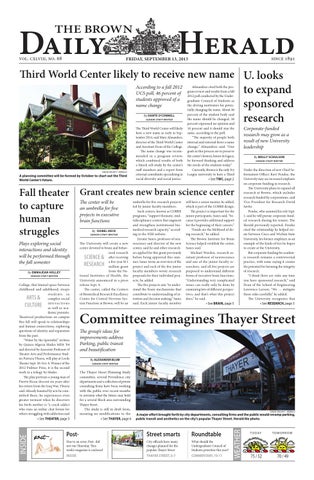
DAVID DECKEY / HERALD
A planning committee will be formed by October to chart out the Third World Center’s future.
The Third World Center will likely have a new name as early as September 2014, said Mary Almandrez, director of the Third World Center and Assistant Dean of the College. The name change was recommended in a program review, which combined results of both a March self-study by the center’s staff members and a report from external consultants specializing in racial diversity and social justice.
Almandrez cited both the program review and results from a fall 2012 poll conducted by the Undergraduate Council of Students as the driving motivators for potentially changing the name. About 46 percent of the student body said the name should be changed, 38 percent expressed no opinion and 16 percent said it should stay the same, according to the poll. “The majority of people both internal and external favor a name change,” Almandrez said. “Our goals in this process are to preserve the center’s history, honor its legacy, be forward thinking and address the needs of the students today.” Currently, Brown is the only Ivy League university to have a Third » See TWC, page 2
Fall theater Grant creates new brain science center The center will be to capture an umbrella for five projects in executive human brain functions struggles By ISOBEL HECK
SENIOR STAFF WRITER
By EMMAJEAN HOLLEY SENIOR STAFF WRITER
College, that liminal space between childhood and adulthood, steeps s t u d e nt s i n complex social interactions as well as academic pursuits. Theatrical productions on campus this fall will speak to relationships and human connections, exploring questions of identity and separation from the past. “Water by the Spoonful,” written by Quiara Algeria Hudes MFA ’04 and directed by Associate Professor of Theatre Arts and Performance Studies Patricia Ybarra, will play at Leeds Theater Sept. 26-Oct. 6. Winner of the 2012 Pulitzer Prize, it is the second work in a trilogy by Hudes. The play portrays a young man of Puerto Rican descent six years after his return from the Iraq War, Ybarra said. Already haunted by acts he committed there, he experiences even greater torment when he discovers his birth mother is “a crack addict who runs an online chat forum for others struggling with addiction and » See THEATER, page 3
inside
ARTS & CULTURE
The University will create a new center devoted to brain and behavioral research after receiving a five-year $11 million grant from the National Institutes of Health, the University announced in a press release Sept. 4. The center, called the Centers of Biomedical Research Excellence Center for Central Nervous System Function at Brown, will be an
SCIENCE & RESEARCH
will have a senior mentor, he added, which is part of the COBRE design. The project is important for the junior participants, Sanes said, “because it provides additional support for the beginning of their careers.” “Funds are the lifeblood of doing research,” he added. The Brown Institute for Brain Science helped establish the center, Sanes said. Michael Worden, research assistant professor of neuroscience and one of the junior faculty researchers, said all five projects are purposed to understand different forms of executive brain functions. “Understanding very complicated issues can really only be done by examining lots of different perspectives, and that’s what this project does,” he said. » See BRAIN, page 5
Corporate-funded research may grow as a result of new University leadership By MOLLY SCHULSON SENIOR STAFF WRITER
Under the direction of new Chief Information Officer Ravi Pendse, the University may see increased emphasis on corporate funding in research. The University plans to expand all research at Brown, which includes research funded by corporations, said Vice President for Research David Savitz. Pendse, who assumed his role Sept. 1, said he will pursue corporate-funded research during his tenure, The Herald previously reported. Pendse cited the relationship he helped create between Cisco and Wichita State University, his former employer, as an example of the kinds of ties he hopes to create at the University. But corporate funding for academic research remains a controversial practice, with some saying it creates the potential for harming the integrity of research. “I think there are risks any time you have sponsored research,” said Dean of the School of Engineering Lawrence Larson. “We … mitigate those risks carefully,” he added. The University recognizes that » See RESEARCH, page 3
Committee reimagines Thayer Street The group’s ideas for improvements address Parking, public transit and beautification By ALEXANDER BLUM SENIOR STAFF WRITER
The Thayer Street Planning Study committee, several Providence city departments and a collection of private consulting firms have been working with the public over recent months to envision what the future may hold for a several-block area surrounding Thayer Street. The study is still in draft form, meaning no modifications to the » See THAYER, page 6
DAVID DECKEY / HERALD
A major effort brought forth by city departments, consulting firms and the public would revamp parking, public transit and aesthetics on the city’s popular Thayer Street. Herald file photo.
Post-
Street smarts
Roundtable
Due to an error, Post- did not run Thursday. This week’s magazine is enclosed
City officials have many changes planned for the popular Thayer Street
What should the Undergraduate Council of Students prioritize this year?
INSIDE
THAYER STREET, 6-7
COMMENTARY, 10-11
weather
Plays exploring social interactions and identity will be performed through the fall semester
umbrella for five research projects led by junior faculty members. Such centers, known as COBRE programs, “support thematic, multidisciplinary centers that augment and strengthen institutional biomedical research capacity,” according to the NIH website. Jerome Sanes, professor of neuroscience and director of the new center, said he and other researchers applied for this grant previously before being approved this summer. Sanes wrote an overview of the project and each of the five junior faculty members wrote research proposals for their individual projects, he added. The five projects aim “to understand the brain mechanisms that contribute to understanding of attention and decision making,” Sanes said. Each junior faculty member
to expand sponsored research
t o d ay
tomorrow
75 / 52
70 / 49
2 university news calendar FRIDAY
SEPTEMBER 13
12:30 P.M.
SATURDAY
SEPTEMBER 14
6 P.M. Farm Visits
TWTP Open Mic Night
Wriston Quad 8 P.M.
List 120 8 P.M.
Triple Threat Concert
Tech House: Improv Night
Salomon 101
Harkness House
menu SHARPE REFECTORY
VERNEY-WOOLLEY
LUNCH Fried Fish Sandwich, Vegan Black Bean Stew, Vegan Tofu Hot Dogs, Fire-Braised Pork Shoulder Sandwich
Manhattan Clam Chowder, Breaded Chicken Fingers, Vegan Nuggets, Vegan Lentil Stew, Blondie Bars
DINNER Italian Chicken Parmesan, Gnocchi w/ Bolognese Sauce, Mashed Red Bliss Potatoes with Garlic, Bread Pudding
Roasted Corn Chowder, Grilled Turkey Burger, Spinach Pie Casserole, Couscous Croquettes
sudoku
School of Public Health granted $1.9 million The funds will be used for a research collaboration with the University of Cape Town By SARAH PERELMAN SENIOR STAFF WRITER
The University’s School of Public Health received a $1.9 million grant to launch a teaching and research collaboration with the University of Cape Town in South Africa to explore innovative ways to manage the HIV epidemic, said Mark Lurie, assistant professor of epidemiology and coprincipal investigator for the grant. The project’s chief goal is to strengthen the ways the two universities teach and mentor students interested in tackling the HIV epidemic from a social science perspective, allowing the University to help the University of Cape Town augment its classroom teaching skills while
» TWC, from page 1
crossword
THE BROWN DAILY HERALD FRIDAY, SEPTEMBER 13, 2013
World Center. In 2002, Princeton renamed its Third World Center to the Carl A. Fields Center for Equality and Cultural Understanding, according to the university’s website. Almandrez said no potential names have been determined so far, but any name including the word “multicultural” has been ruled out because students have approached her opposing the use of the term in the center’s name. “No matter what we choose for the name — it could be the most radical, it could be the most edgy, the most black, whatever — we’re not going to get 100 percent of people happy,” Almandrez said. “What I can guarantee, though, is not your happiness (with the name) but that your voice is valued and that we want it as part of the discussion.” The TWC has had the same name since its founding in 1976. According to the center’s website, “Third World” “is not to be confused with the economic definition of the term used commonly in our society today, but understood as a term that celebrates diverse cultures.” Today, the TWC is arguably among the most influential institutions on campus. It coordinates the Third World Transition Program, the University’s largest pre-orientation program, with about 200 participants each year. The center also coordinates the Minority
bolstering Brown’s research capabilities in the field, Lurie said. “One of the things I have always appreciated about Brown is its focus on teaching,” said Christopher Colvin, senior research officer in HIV/AIDS, TB and STIs at the Univesrity of Cape Town and co-principal investigator of the grant. In most of the world, “We generally don’t train college professors to teach, we train them to do research,” he added. “Because of Brown’s emphasis on excellence in teaching, we can contribute in a relevant way to the University of Cape Town,” Lurie said. Through the grant, faculty members from Brown’s Harriet W. Sheridan Center for Teaching and Learning will lead teaching and mentoring workshops for University of Cape Town professors. Some training will likely be through video conference, but the grant also provides funds for Sheridan Center faculty members to travel to South Africa, he said.
The grant focuses primarily on teaching junior faculty members classroom and digital skills, said Abigail Harrison, assistant professor of behavioral and social sciences, who is helping organize the project. “The idea is to develop a cadre of younger scholars both on the research side and especially in teaching,” she added. Brown faculty members will also help the University of Cape Town expand social science studies within the university’s School of Public Health and Family Medicine, Colvin said, adding that most of the classes currently focus on quantitative or clinical skills. Though the grant is framed as a “training grant,” part of the money will go toward collaborative research projects conducted by faculty members and students at both universities, Lurie said. University of Cape Town professors will head research collaborations » See HEALTH, page 5
Peer Counseling program, which is in its 40th year. In the UCS poll data, about 94 percent of students stated they had heard of the MPC program, making it the most known TWC program surveyed. “The naming process is about more than just one person,” said Shane Lloyd MPH ’11, who helps coordinate TWTP and serves as assistant director for firstyear and sophomore programs at the TWC. “Whatever the community thinks the name should be, I think that should be what it is.” Almandrez said the TWC will consider the recent name change at Princeton and look to emulate other “great centers” from the Ivy League and New England as it moves forward. Though a plurality of students support the name change, the idea has met some controversy. The March review stated the UCS polling “elicited emotional responses from (TWC) staffers.” “There are people saying, ‘I don’t know what you’re doing trying to change the name,’ and there are people saying, ‘Why haven’t we changed the name sooner?’” Almandrez said. “The name change is likely going to happen because that was recommended by the consultants, and the community said that.” Many students said they are ambivalent or oppose a potential name change. “I don’t care if they change the
name or not,” said Isaac Lima ’16. “I’m from Brazil, which you might consider a Third World country, but I don’t mind the name.” “They shouldn’t change the name,” said Jessica Kenny ’17. “I can see how people might be offended given the term’s Cold War origins, but the name isn’t meant to be offensive. Once people know what it means, it’s all right.” The TWC is meant to “serve as a source of support for American minorities and international students” and to “build a sense of community and University ownership among incoming students,” according to its website. Almandrez said a strategic planning committee to chart out the center’s future will be formed by October. “We have to ask ourselves, ‘What would we like the center to look like in 37 years?’” Lloyd said. Almandrez said she hopes the center will become more involved with institutional diversity, while Lloyd said he looks forward to “strengthening our community partnerships with the larger Providence community.” The center’s name was just one of six recommendations to come out of the TWC self-study. Others included “rebranding the center to highlight scholarly experiences,” “developing reciprocal partnerships” with other groups on campus and preserving and honoring the TWC’s history, according to the report.
university news 3
THE BROWN DAILY HERALD FRIDAY, SEPTEMBER 13, 2013
» THEATER, from page 1 recovery,” she said. She added that the play illustrates the plight of people battling addiction and seeking families in unorthodox places “with humor and compassion.” The story begins by weaving back and forth between the virtual reality of the online chat room and the physicality of real life, Ybarra said, adding that as the two worlds converge, “surprising connections” between the characters are revealed. “Sink,” which will run Sept. 20-23 in the Production Workshop Upspace, also deals with unconventional connections between permeable realms. “It drifts in and out of a world that isn’t quite like ours and plays by its own rules,” said writer and director Ursula Raasted ’14. “This has to do with notions of dreams and the deep collective unconscious and raises the question of whether we’re one or many.” The story is about “a capsizing relationship between a sailor and siren and how we make or miss connections in life,” Raasted said, citing the often illusory perception of “meaningful
coincidences.” The play departs from a traditional chronological arc and instead introduces its themes through the lenses of interrelated vignettes, Raasted said, adding that it is also partially “devised,” or movement-based. Though the play draws from philosophical influences, Raasted said it is sprinkled with light comedy and is “far from being heavy and didactic.” Shakespeare on the Green’s production of “The Winter’s Tale,” directed by Austen Hyde ’14, will run Oct. 17-20. Hyde said the play is unique because the first half is a tragedy and the second a comedy. This binary, along with the “unexpected turn and winds” of the plot, provides the show with “broad-reaching and diverse appeals,” Hyde said. The tragic portion follows the downfall of King Leontes, who “becomes obsessed with paranoid jealousy when he believes that his wife, Hermione, has cheated on him with his best friend,” Hyde said. But when the story jumps 16 years into the future, circumstances start to turn around, he added. “It’s really profound and really silly
U. restocks Chobani yogurt after recall Eighty-nine people across the country fell victim to a mold contamination at a company plant in Idaho By GADI COHEN STAFF WRITER
After Chobani announced a voluntary recall of products made in its Twin Falls, Idaho plant earlier this month due to a mold contamination, Brown Dining Services pulled all cups of the Greek yogurt from its eateries, only to put them back on its shelves yesterday. At least 89 people across the country have fallen ill after consuming Chobani products, according to the Food and Drug Administration. Whether the yogurt was responsible is unknown, since the FDA does not consider mold species found in the Chobani products a foodborne pathogen, according to the company website. Though the Chobani products in Brown eateries were not made in the Idaho plant, Dining Services decided to pull Chobani anyway, wrote Ann Hoffman, director of administration at Dining Services in an email to The Herald. “It is our usual protocol to pull a product when we learn it has been recalled,” Hoffman wrote. “Given our experience with recalls, we knew this one could expand in scope.”
The most recent recall that resulted in the removal of a product from Dining Services facilities occurred in 2009, when products that contained peanuts or pistachios were suspected of salmonella contamination. In that case, the FDA’s list of contaminated products kept growing on a daily basis, and all products containing peanuts were removed from University dining establishments, The Herald reported at the time. The Rhode Island Department of Health has yet to encounter any reported cases of illness from moldy Chobani products, said Erica Collins, a department spokeswoman. If Chobani-related illnesses begin to occur, the department has a set of guidelines in place to respond to the recall. “There’s a variety of ways we make sure the public remains safe in a situation like that,” Collins said. “We send press releases to alert the media in case they hadn’t picked up any press releases issued by the manufacturer, we shoot emails to affected restaurants, we place calls to restaurants, we send food inspectors to inspect the situation. It all depends on the situation and the severity of the threat.” Before Dining Services reinstated Chobani, Hoffman wrote that Dining Services would seek to make another brand of Greek yogurt available if the recall persisted for longer than was expected.
and really uplifting at the same time,” he said. “Things get crazy and wacky, but it ultimately deals with very deep things like faith, truth and human goodness.” In Tennessee Williams’ “A Streetcar Named Desire,” which will be staged at the Stuart Theatre Oct. 31 - Nov. 10, the complex dynamics of love and marriage are explored through the plight of Blanche DuBois, a faded Southern belle fallen on desperate times. Blanche arrives on the doorstop of her sister and brother-in-law’s home in bustling New Orleans, and though she tries to keep her sordid past separate from her new life, the close quarters of their living situation make that impossible. “On one level, it’s about three people living together between two rooms — the too-closeness, the claustrophobia and invasion of privacy,” said Professor of Theater, Speech and Dance Lowry Marshall, the play’s director. “But above all, it’s about the desires that drive us through life — love and loneliness, passion and violence, and the pursuit of anything to make you feel safe. It raises the question: Can we really not be alone?”
The play also speaks to social tensions that remain “remarkably contemporary,” Marshall said, citing as examples the complexities of relationships between men and women, domestic abuse, the intermingling of ethnic groups and the struggle of “coming out of a past we hope we’re not still part of.” “In the Next Room, or the Vibrator Play,” written by Sarah Ruhl and directed by Karen Nilo ’14, also problematizes traditional roles of gender and sexuality. The play will run Oct. 18-21 at the Production Workshop. The story centers on Mrs. Givings, a young woman during the Victorian era whose husband invents a revolutionary cure for female hysteria — the vibrator, Nilo said. Mrs. Givings and one of her husband’s patients quickly forge a friendship and together they explore “their identities as women and how this relates to sexuality, intimacy and love,” Nilo said. The play focuses primarily on themes of female sexuality in the context of its “historical creation as a pathology and a disease,” Nilo said, though she added that male characters also drive the plot in pivotal ways.
Despite its setting of an era known for its stuffiness and sexual repression, audiences can “immediately connect to the material because it’s presented in such a lighthearted, funny way rather than taking a super serious approach,” Nilo said. She added that a healthy dose of sex jokes makes the play feel more modern and relatable while “bringing together the crazy-intellectual theories Brown students love to talk about.” “Hair!,” the Musical Forum’s fall show, will play Nov. 8-11 at the Production Workshop. The musical follows a tribe of young people in New York City during the 1960s who grow out their hair to make a statement. “It doesn’t have much of a plot, but it examines a lot of the social, cultural and political movements of late ’60s from the Vietnam War to the free love movement,” director Kate Brennan ’14 said, adding that a sense of “national emergency” remains prevalent in today’s society. While the show is known as “colorful, energetic and loud at some moments,” Brennan said the show also aims to capture “reflective, more somber moments.”
» CORPORATE, from page 1
The University also makes sure faculty members disclose conflicts of interest, Larson said. But working with industries is always challenging for universities, said Allan Bower, professor of engineering and co-director of the General Motors/ Brown Collaborative Research Laboratory on Computational Materials Research, a University lab that has been sponsored by General Motors for over a decade. For a corporation offering funds, the “bottom line is always trying to make money, and we have to find common ground,” Bower said. Academics are interested in the scientific inquiry, while corporate sponsors seek projects with broader benefits, he said. A university could have a “world-leading group,” but the researchers will only be successful if an industry is interested in funding their work, he said. “All scientific research we do in school is designed to have some applications in the real world,” Larson said, citing the creation of better cars, cell phones and medical equipment. The engineering school has also had a partnership with Medtronic, Inc., a developer of medical device technology in Minneapolis, for about four years, Larson said.
Funding aside, faculty members and graduate students can reap rewards from corporate-sponsored research opportunities, Savitz wrote. “When the key elements are in place for accepting corporate sponsorship, there can be side benefits in exposing faculty in the practical implications of their research and providing opportunities for interested students to consider future employment,” he wrote. With the reduction of in-house research programs, companies look to universities in an attempt to access the “pipeline for recruiting well-trained, promising graduates,” Savitz said. Corporate funding will continue to play a role in research as long as it doesn’t “compromise the basic values of academic research” and faculty members don’t “deviate from those research goals,” he said. But Savitz said the University does not want to rely solely on corporations for funding. “(With) the dismal state of federal funding … there is more interest in finding other sources, not just corporations, but foundations or agencies that Brown has worked with in the past that we’d be interested in working with,” he said.
private sponsors are interested in making a profit, Savitz said. “We need to be watchful to make sure that the work we’re engaging in ... doesn’t compromise the basic values of academic research,” he said. A 2001 study conducted by former Professor of Psychiatry and Human Behavior Martin Keller and funded by the pharmaceutical company GlaxoSmithKline was found fraudulent after it was revealed that Keller had minimized the dangerous effects of the drug being studied. Keller endorsed antidepressant Paxil without fully exposing the risk of suicide in adolescent users, The Herald reported in 2012, at the time of the University’s internal investigation of the case. The University takes precautions to minimize the risk of corporate interference, Savitz said. Researchers have the final say in how they conduct their work, Savitz said. “There are a number of safeguards protecting the freedom to publish in the open literature and prohibitions against sponsor interference with the research activity,” he wrote in an email to The Herald.
Follow @the_herald
Read The Herald!
4 feature
THE BROWN DAILY HERALD FRIDAY, SEPTEMBER 13, 2013
After renovation, John Hay collections to be more accessible The John Hay Library includes 200 named collections and houses more than 3 million items By ISABELLE THENOR-LOUIS STAFF WRITER
Though it lacks the broad sciences or humanities stock of the moretrafficked Sciences Library and John D. Rockefeller Library, the John Hay Library has gained a reputation for its elegant architecture and the more than three million items it houses from antiquity to the present. But the class of 2017 will have to wait until next year to explore the Hay’s treasures. This year, the Hay is undergoing major renovations which will modify the library’s main reading room and are aimed to make the imposing edifice more welcoming to the public. From soldiers to science The Hay houses more than 200 named collections ranging from the history of science to children’s literature. Many of these extensive collections came to the library as gifts. “Individuals who have been collecting these pieces throughout their lives look to pass it on to a repository where they know it will be used, appreciated and taken care of,” said Thomas Horrocks, director of Special Collections and the John Hay Library. The Lincoln Collection, which consists of more than 30,000 items about President Abraham Lincoln, was purchased for the University by John D. Rockefeller, Jr., Horrocks said. Rockefeller continued to purchase
Lincoln-related material, donating these pieces to Brown and funding the creation of the Hay’s Lincoln Room, Horrocks added. In addition to the Lincoln Collection, the Hay also houses the Anne S. K. Brown Military Collection, composed of military iconography. One of the largest of its kind, the collection contains printed books, sketch books, scrapbooks and a set of 5,000 miniature lead soldiers, among other items. “It is unusual to see a woman was collecting military history — most of the collectors were men. But she was a pioneer and assembled a great collection,” Horrocks said. The Hay is also home to the Lownes Collection, which consists of historical works in the sciences. It includes a rare edition of Audubon’s “Birds of America,” which is often brought out when students or visitors stop by the Hay. “It is one of the premier history of science collections, and we continue to add to it,” Horrocks said. At other special libraries, materials are usually used mainly by graduate students and scholars around the world, Horrocks said. But the Hay is heavily used by undergraduates. “We have three seminar rooms within the Hay that are used almost every day of the week and meet several times during the day,” said University Librarian Harriette Hemmasi. “Faculty ask that materials are brought so that students can touch and see the real thing.” Keeping the old, in with the new Since the 1930s, the reading room on the first floor of the library has been divided into three sections. The center
section was mainly used by students for reading special collection materials, while staff used the other two sections. But the current renovations will change this division. The new floor plan for the reading room will open up the entire space for the public and serve as an area for “general reading,” Hemmasi said. “The feature of the renovation is to open up this space and make it available to students,” Hemmasi added. Other areas of renovation include turning the room that originally stored the University archives into a second state-of-the-art special collections reading room. Changes will also include adding a small seminar room, a student lounge and more exhibit space. An accessible entrance is also being added to the building. The University has hired specialists with previous experience renovating museums and special libraries, Barbara Schulz, head of library facilities, said. “We’ve designed lighting fixtures for this grand reading room that are similar to the ones that are depicted in original photos,” Shulz added. “They’ll be LED lights ... so you get the Old World look with current technology.” To protect materials during the renovations, some of the collections have been moved to a library shelving facility in Cranston, R.I., though most remain in non-renovated sections of the library, Hemmasi said. For students interested in accessing the collections during the renovations, many of the materials can be found online, Hemmasi added. Library staff members hope these new changes will help increase foot traffic through the library so staff can
BRITTANY COMUNALE / HERALD
The library’s reading room has been divided into sections since the 1930s. The new floor plan will open up the space to have a general reading area. inform more visitors about exhibits, library materials and upcoming lectures, Horrocks said. Staff members are also considering
Thanks for reading!
www.browndailyherald.com
extending library hours when the building reopens, Hemmasi said. Construction is expected to end in the fall of 2014.
university news 5
THE BROWN DAILY HERALD FRIDAY, SEPTEMBER 13, 2013
» BRAIN, from page 1 In addition to Worden, junior faculty members include Wael Asaad, assistant professor of neurosurgery, Eric Morrow, assistant professor of molecular biology, cell biology and biochemistry, and Joo-Hyun Song and Dima Amso, assistant professors of cognitive, linguistic and psychological sciences. Worden said his research examines “stimuli that are strongly associated with a particular behavioral response.” For example, stimuli such as traffic lights correspond with particular actions, such as pressing the acceleration or brake pedal, he said. The “work is particularly interested in the concept of the stimulus response conflict,” he said, which occurs when two or more simultaneous stimuli prompt different reactions. After such a conflict occurs, the brain makes an adjustment to be less affected by the conflict in the future, he said, adding that his research focuses on where and how the brain makes this adjustment. Research has shown this adjustment is made in higher-level brain processing, Worden said, but a “considerable amount of research” suggests this may also occur in lowerlevel processing. Song said her research focuses on the motor system, more specifically on “decision making for visual actions.” Her research focuses on whether the prefrontal cortex is the only part of the brain involved in motor decision making or whether there is more overlap in lower level processing, Song said. “In a hierarchical system, there is only information (about decision making) in the prefrontal cortex, but I am testing if there are high-level signals in the motor areas,” she said. Both Song and Worden said they felt the project has large implications for the future. Song said her work with motor control could be used to aid
paraplegics with movement through the use of human-computer interactions. For example, if someone did not have an arm, a robot arm could be programmed to read brain signals and produce the desired movement, she said. Worden said his work could apply to the design of products used in everyday life. “All kinds of things we interact with are often designed by people with knowledge of how people process information. The better we understand how people actually process information and adjust the process, the more useful the design will be,” he said. The new center’s research could lead to insight about decision-making disorders, Sanes said. “It can contribute to national health,” he said, adding that he thinks the project is important for the University as a whole. “Brown wants its junior faculty and senior faculty to succeed,” Sanes added, saying the project is important because he thinks it will attract both undergraduate and graduate students to the University. Research of this scope can also be “an amazing opportunity for undergraduate students,” Sanes said. “The notion that research is geared only toward graduate students is not true. There is enough opportunity for everyone.” Because COBRE is a national program, Sanes said there is potential to collaborate with other COBRE centers. Though Brown’s COBRE Center is not currently interacting with other counterpart centers, he said he looks “forward to exploring opportunities.” Worden said he first found out he and the other researchers received the grant in August, about two weeks before the grant was awarded, and that he is now involved in “preliminary set-up work.” “(We) are hitting the ground running” he said.
» HEALTH, from page 2 about the social science and public health issues surrounding HIV, Lurie said. There will be two cycles of five to eight projects, each lasting two years, he said, with faculty members and students from both universities working on each project. University of Cape Town faculty members will take the lead on the research because “we’re by definition based at Brown,” Lurie said. “Local people with local knowledge are going to be the people who really understand the situation.” The research will focus on three crucial topics to HIV research: antiretroviral treatment, gender and prevention, he said. Now that many worldwide organizations have taken an interest in ameliorating South Africa’s HIV epidemic, treatment programs have
quickly emerged. But after this burst of activism, it is important to examine how to make antiretroviral policies sustainable, Colvin said. Gender research is key because issues of masculinity cause “persistent and unsolved” problems contributing to the spread of HIV/AIDS. Studies have shown that in the name of masculinity men will have multiple sexual partners or refuse to seek treatment once they have contracted HIV. And now that the public has wider access to treatment — thanks to increased activism surrounding the issue — it is important to refocus on prevention, Lurie said. Faculty members will have the opportunity to submit research proposals around February, and the strongest proposals will be selected around March or April, Lurie said. Both undergraduate and graduate students will have opportunities
to become involved in research projects funded by the grant, Lurie said. Though long-term commitment is ideal, undergraduates could potentially spend the summer in South Africa and help with one of the projects, he said. “A lot of these relationships are often one-sided and driven by northern institutions,” Colvin said, adding that he views this endeavor as an “authentic collaboration.” This sort of “bi-directional exchange” — by which both universities enrich each other — makes this collaboration stand out, Harrison said. “Many new collaborations that we haven’t even begun to think of are likely to emerge just from the meeting of (University of Cape Town and Brown faculty),” Lurie said, adding that he hopes the research and partnerships funded by this grant will provide springboards for longer term projects.
www.browndailyherald.com
6 thayer street
THE BROWN DAILY HERALD FRIDAY, SEPTEMBER 13, 2013
The planning process Spring 1
Focus groups gather ideas and input NBBJ absorbs input and creates study draft June 26
2
NBBJ incorporates comments from public meeting
ALAN SHAN / HERALD
The current parking situation “obviously isn’t working,” said Robin Remy, executive director of the Thayer Street District Management Authority. The Planning Study is currently in the process of resolving the parking issues.
Thayer to receive parking improvements Many of the inconsistent parking areas and parking rules will be changed in future proposals By ALEXANDER BLUM AND KATE KIERNAN SENIOR STAFF WRITERS
As plans for a variety of changes to Thayer Street continue to develop, stakeholder members of the Thayer Street Planning Study committee have a range of ideas for the issues surrounding parking and transportation to increase access and bring more business to the area. Most community organizations involved in planning changes have said that improvements to parking and transportation need to be addressed as soon as possible to revitalize the area. “If we really want to market the area, we have to make it accessible,” said Robin Remy, executive director of the Thayer Street District Management Authority. The current parking situation “obviously isn’t working,” Remy said, and “if we don’t have parking in that area, a lot of the marketing stuff won’t really matter.” Focusing efforts on improving parking will maximize the success of future improvements to marketing and commercial interests, she said. There are “a lot of inconsistent parking areas,” Remy said, adding that some parking rules do not make sense and some of the parking lines do not match the parking signs. Future proposals will aim to “make the parking more understandable and visible” by identifying problem areas, clarifying and acting on
» THAYER, from page 1 area’s infrastructure are scheduled for the immediate future, said Robin Remy, executive director of the Thayer Street District Management Authority. But measures to improve security on Thayer have already been taken and may soon be accompanied by other alterations, like furthering parking accommodations, improving public transportation services and revamping the aesthetics and culture of the area. Last spring, NBBJ — a planning and design firm collaborating with other consulting firms to create a comprehensive set of recommendations for the
these issues and then educating the public, she said. Those who do not believe the Thayer Street area needs more parking are those who want “to dampen” its development, said Ed Bishop ’54 P’87 P’91, chair of the District Management Authority and a board member of the College Hill Neighborhood Association. Thayer suffers from a lack of parking spaces, which will not be solved by making people pay for parking, Bishop said. Improvements to public transportation could be just as important as parking improvements, said Alan Mountjoy, principal at NBBJ, the planning and design firm helping craft the recommendations for the area. “Right now, it’s a little bit complicated to get there,” Remy said. Plans to build a streetcar line servicing Thayer Street would facilitate travel to the area and help develop positive perceptions of the area, Montjoy said. The Rhode Island Public Transit Authority is currently drafting an evaluation projecting the streetcar project’s impact on pollution, natural resources and other environmental concerns in compliance with federal regulations under National Environmental Policy Act, said Amy Pettine, special project manager for RIPTA. The assessment is the next step in moving the streetcar project forward and will be submitted this fall. RIPTA is still collaborating with the city on additional avenues of funding for the streetcar project, Pettine said. The city applied for a Transportation Investment Generating Economic Recovery grant for the streetcar project but was not among the cities awarded federal
funds, according to an announcement from the U.S. Department of Transportation’s website. Enhancements to the tunnel and Thayer Street bus stop, which is one of the most popular stops in the state, aim to make it both safer for passengers and provide the foundation for a future streetcar, said Amy Pettine, RIPTA’s director of planning and marketing. RIPTA has funds for renovating the bus tunnel and expects that essential improvements, such as a new drainage system, will commence this year, Pettine said. Designs for the outside of the tunnel will be drafted this year in anticipation of beginning construction next summer or fall, Pettine said. RIPTA intends to build a structure for waiting passengers so they are not standing in the street but wants to “make it look cool and funky” and hopes meetings with RISD, Brown and other community members will spur designs that complement other aspects of the streetscape. The proposed renovations to the bus stop and the creation of the streetcar line aim to make the area around Thayer Street and Fones Alley “a transit hub,” Nickerson said. Mountjoy said it is also important to improve pedestrian access, adding that though the entire length of the street cannot feasibly be physically expanded, “there are a couple of strategic locations where we could extend the sidewalks to accommodate critical pedestrian infrastructure.” “I feel like the sidewalks do need to be expanded,” said Harrison Liftman ’16, adding, “It’s pretty crowded when you’re walking down the street.”
area — began gathering input to identify issues of particular interest to the Thayer Street community, said Alan Mountjoy, principal at NBBJ. NBBJ held several focus group sessions over the summer to allow interested parties to voice their opinions on the recommendations, Mountjoy said. The College Hill Neighborhood Association hosted a public meeting June 26 to review a draft study prepared by the consultant team. The discussion provided an opportunity to “test the community’s comfort level” with potential changes, Mountjoy said. “There seemed to be a fair level of comfort” with changing the area, though
there also seemed to be reluctance to see its appearance completely transformed, he said. “There was surprisingly a lot of interest in changing the uses around Thayer Street” and community members expressed a willingness to explore diversifying the area’s offerings, he added. NBBJ has worked to incorporate the comments and ideas from the June meeting into the plan over the past couple months, and Mountjoy said the new plan will include more concrete proposals. The updated version is currently under review by the Providence Department of Planning and Development, but it will be released to the stakeholder
Study draft presented at public meeting
Mid-September 3
Updated draft released to stakeholders Stakeholders generate individual comments Early October
4
Stakeholders meet and reconcile differences in comments NBBJ incorporates collective comments from stakeholders Late October
5
Updated draft presented at public meeting NBBJ incorporates comments from public meeting November/December
6
Final study published GRAPHIC BY JILLIAN LANNEY / HERALD TEXT BY ALEXANDER BLUM / HERALD
members of the Thayer Street Planning Study committee in the near future, said Karen Jessup, interim director of the Providence Preservation Society. The stakeholders will have about two weeks to discuss the plan individually and will generate comments by Sept. 26, Jessup said. Then representatives from those groups will meet in early October to try to reconcile their reactions before sending collective stakeholder feedback to the consultants, Jessup said. “Everybody around that table is not going to agree about the consultant report recommendations,” but discussion to reconcile differences in stakeholder visions provides an opportunity to improve the
plan, she added. The stakeholders’ collective comments will then be incorporated into the NBBJ study, Mountjoy said. From there, it will be presented to the public for reactions and comments that NBBJ will consider before releasing the finalized study, he added. When the final version of the plan is released, “it doesn’t become law immediately,” Mountjoy said — instead, it should provide “a coordinated roadmap” for future development of the area. The study “is a way for all the players to coordinate their individual efforts” and aims to encourage collaboration among the stakeholders, Mountjoy said.
thayer street 7
THE BROWN DAILY HERALD FRIDAY, SEPTEMBER 13, 2013
Initiatives aimed to up safety on Thayer TSDMA considering installation of surveillance cameras amid evidence of gang activity By ALEXANDER BLUM SENIOR STAFF WRITER
EMILY GILBERT / HERALD
New landscaping and greater variation of businesses including a hotel are among the changes Thayer Street stakeholders are considering in their effort to spruce up the well-known street.
Construction may bring hotel, landscaping Attendants of planning meeting stressed more variation of businesses on Thayer By ALEXANDER BLUM AND KATE KIERNAN SENIOR STAFF WRITERS
LLOYD
BOWEN
PE
STUDY AREA
HO
MEETING
ANGELL
N
BROOK
the area. It has “been acknowledged as something that is wanted” by members of the community, said Ed Bishop ’54 P’86 P’91, chair of the Thayer Street District Management Authority and board member of the College Hill Neighborhood Association. Bishop owns properties in the area and is spearheading the luxury hotel project. The hotel was incorporated in earlier planning proposals as a potential addition to the area, but the plan must receive more commentary from stakeholders and individuals at the public meeting before it can receive final approval, Bishop said. This project, as well as the other proposals for redeveloping Thayer Street, are progressing but are “in limbo,” Bishop said. The first of the “seasonal parklets” — small greenspaces adjacent to sidewalks — proposed by the TSDMA and its design consultants are slated to be placed in front of the Brown Bookstore later this fall or in the spring, Nickerson said. The streetside parks are among other proposed aesthetic changes to the area, such as planting trees and adding new trash receptacles, Kish said. Though previous proposals identified maintaining the historic architecture of Thayer Street as a priority to bolster the area’s appeal, the Providence Preservation Society does not have much information about the history of Thayer Street architecture. The group would need to conduct an architectural survey in which a historian goes building by building to generate notes on defining features, ownership history and streetscape, said Karen Jessup, interim director of the Providence Preservation Society. All of these landscaping recommendations are part of the process of readying Thayer Street to potentially have more high-end stores and make it more of a destination for residents and visitors to “shop and stroll.” The TSDMA is also open to bringing events like farmers’ markets or festivals to attract consumers to Thayer, Remy said. Incorporating newer retail and commercial options into the future of the area is still being considered by stakeholders on the steering committee, said President of the College Hill Neighborhood Association Allison Spooner. The College Hill Neighborhood Association is “pleased with the process at this point” and is preparing to review the proposals at the next meeting, Spooner said.
THAYER
Under new proposals, Thayer Street could receive a facelift featuring new building guidelines, a hotel and beautification projects as stakeholders consider a variety of proposals to reinvigorate the area’s landscape and culture while preserving its character. Attendees of a public meeting held in June to review the Thayer Street Planning Study expressed an interest in introducing a greater variety of businesses to the area, said Bonnie Nickerson, deputy director of the Department of Planning and Development. Concerns from stakeholders that the development at 257 Thayer St. — where Gilbane Development Company began building a luxury apartment complex for students earlier this year — commenced without sufficient input led the city to have “a more proactive approach” to this planning study, said Emily Kish, principal planner for the department. As the city begins the process of revising its zoning codes, the department is considering how “to incorporate those guidelines” into new designs for the study area, Nickerson said. Plans for restricting building heights, defining features of building facades and specifying floor dimensions for street-level shops and restaurants will take into account the possibility of new retail and commercial establishments coming to the area, as well as the need to retain “the character of the surrounding area,” Kish said. Several stakeholders — including the Thayer Street District Management Authority and the Providence Preservation Society — named maintaining Thayer Street’s legacy as a mixed-use residential space a critical goal. Robin Remy, executive director of the TSDMA, said board members are under the impression that people “want (Thayer Street) to be pretty much what it’s always been – a mixed-use space.” Previous proposals included adding significant amounts of office space, but Remy said the group has since “determined that there isn’t a huge need for that” because there is so much nearby.
Thayer has “trended towards being a giant food court,” Remy said, but solving this problem is “a big nut to crack.” The group must first understand what led the “food court” to develop before surveying what people want and then acting accordingly, Remy said. “All of these things take a lot of time and money,” she added. Economic incentives may be one factor contributing to the development of so many restaurants on Thayer Street, Remy said — venues with food or liquor licenses tend to pay higher rents and are therefore more desirable than retail stores. The University would like to see “successful and diverse retail” on Thayer Street, said Marisa Quinn, vice president for public affairs and Univeristy relations. Though “Brown is already a significant property owner on Thayer Street,” the University is interested in supporting the “character development” of the area, Quinn said. She did not elaborate on whether Brown is actively trying to obtain more property. The University will soon hold a campus-wide forum to gather input from students and faculty to ensure that the entire Brown community’s views are represented at the stakeholder meeting. “Renovations are definitely something that I would look forward to,” said Kevin Argueta ’17, adding that “college students would definitely appreciate” a broader diversity of commercial offerings. “(The area’s) identity would grow,” Argueta said. “I want to see more diversity,” said Ziwei Tang ’16, but she noted that Thayer Street “(does) have a lot of great food.” The introduction of new shops “could help the economy as a whole” and may “attract a different consumer base and maybe a different demographic,” said Harrison Liftman ’16. But Shelley Gresko ’14 said she “(sees) nothing wrong with it the way it is” and is indifferent to the introduction of different commercial offerings. “I don’t think (having so many restaurants on Thayer Street is) a good or a bad thing,” Gresko said, adding that the University’s proximity to Providence Place Mall makes shops on Thayer Street unnecessary. The construction of a hotel on Brook Street will also be considered as part of an effort to broaden the appeal of the Thayer Street area by bringing higherend retail businesses and consumers to
Though the study to determine the future of Thayer Street’s infrastructure is still being developed, other changes centering around security and regulation in the area are now or may soon be in effect. The Thayer Street District Management Authority held a meeting in June attended by many safety officers, including representatives from the Department of Public Safety and Providence Police, said Robin Remy, the group’s executive director. Statistically, trends reveal a spike in crime-related incidents during the summer and early fall months, she said, and “the Providence Police absolutely agreed there is a crime increase.” Recently, there has been evidence of gang activity on Thayer, Remy said, citing incidents of gang-related graffiti. Safety concerns surrounding the summer and early fall months were raised again at the TSDMA’s July meeting, Remy said. Consequently, the police agreed to increase their presence in the area, and the TSDMA hired a two-man police detail to patrol every Thursday, Friday and Saturday evening through the end of September, Remy said. They began these patrols on the first weekend of August, and there are not currently plans to extend this protocol past the end of September due to budgetary restrictions, she added. To improve security in the future, the TSDMA is considering installing surveillance cameras on Thayer Street. They are “really helpful in determining who did what” when investigating an incident, Remy said. If installed, these cameras would be publicized to “create a more visible presence,” she said, adding that the TSDMA also wants to encourage local entities to do a better job of self-monitoring. The TSDMA is also exploring partnering with a company that would
provide ambassadors to provide an extra sense of security on Thayer, Remy said. Generally, ambassadors “are not supposed to be security people,” Remy said. The Downtown Providence District Management Authority currently contracts ambassadors on a much larger scale but for similar purposes. “They are on the street if anything happens” but are not trained or meant to use force, Remy said. They provide “an extra set of eyes on the street” and develop relationships with local police to help potentially provide “quicker response(s),” Remy said, noting that their primary purpose is to be friendly people to provide “concierge-like service” to those who are “looking for help, assistance, directions.” Shelley Gresko ’14 called the proposal to hire ambassadors “unnecessary,” adding that funding for such resources could be invested in more productive ways. “I don’t think I need (ambassadors), but maybe some people need that,” she said. “I feel very safe on Thayer Street,” Gresko said, adding, “The way it is works for students.” Kevin Argueta ’17 said he “can’t see any downsides” to the idea of having ambassadors on the street, but he added he is not comfortable with the idea of having security cameras installed on Thayer Street, citing privacy concerns. “I wouldn’t necessarily feel safer, because (cameras) only help you after the fact,” Argueta said. Harrison Liftman ’16 also said he is uneasy with having security cameras, adding, “It’s overdoing it at that point.” Though the original presentation proposed introducing new regulations and stepping up enforcement of existing regulations — including those focused on liquor licenses, late-night operating hours and outdoor seating — Remy said safety on Thayer Street could be improved by more thoroughly enforcing existing codes regarding issues like space capacities and sidewalk use. “Violations of (codes) can all be enforced by police officers,” Remy said, adding that the increased police presence in the area could help with this issue.
WATERMA
GREG JORDAN-DETAMORE / HERALD
8 arts & culture Bell Gallery searches for new curator Current curator Russell will stay on for two more projects and as assistant professor of visual art By PALAK WALIA CONTRIBUTING WRITER
With the recent departure of curator Ian Alden Russell, the David Winton Bell Gallery in List Art Center has embarked on a search for a new curator to select and maintain pieces for the gallery. Gallery Director Jo-Ann Conklin is spearheading the search. In the past, curators have stayed on the job for varying lengths of time, with Russell holding the position for two years. Conklin said that while the position often serves as a stepping stone to other jobs with more responsibilities, she hopes the new curator will stay for at least five years. The search typically takes four to six months, said Conklin, who hopes to make a decision within the next month. She added that she learned of Russell’s departure in May. The qualifications listed in the position’s advertisement include at least five years of museum experience, as well as a master’s degree in art history or a related field with a specialty in contemporary art. “I look for a lot of flexibility ... someone whose interests mesh with mine but (are) not the same as mine, so we can get a broader view of contemporary art,” Conklin said. Ideally, the new curator will have a sense for the difference between the Bell Gallery and a public gallery, Conklin said. The Bell does not have a registrar, leaving the curator
responsible for keeping records of the art, as well as for handling insurance and shipping matters. The curator of the Bell, who has an unusual amount of freedom, also has the opportunity to teach informally at Brown or RISD. “In a university gallery, generally because they are smaller, you (have) more autonomy to decide on the programs you want to do,” Conklin said. “There’s not a constant pressure to bring people to the door so you can do things more esoteric and more daring.” Russell said he appreciates the freedom and support he received from the gallery. “The position afforded me to the opportunity to start projects that I would normally not be able to achieve without the infrastructure and community behind me,” he added. Coming to Brown as a post doctoral fellow in public art and cultural heritage in 2010, Russell previously worked as an art technician at Douglas High Gallery in Dublin, Ireland. This position acted as a “hybrid practice between academic research and curatorial work,” he said. Russell said he faced challenges in transitioning from independent curator to institutional curator but appreciated the resources available to make projects happen. “Every single project I do, I love, as in I tried really hard to find magic or value in every project I do,” Russell said, reflecting on his past projects at the gallery. “If I’m not doing something with immediate utilitarian value, then it has to be something I believe in.” “I could put any art in here, so why this art? One of the things I professionally found challenging
was coming up with good decisions that I could ethically defend. … While this was a challenge, it was also very rewarding,” Russell said. Another challenge working at the gallery was “finding ways to make ‘amazing’ happen with a limited budget,” he added. One project Russell said he holds dear to his heart is the project he completed with Shanghai-based artist Jin Shan. At the time of the collaboration, Shan was at a key point in his rising career, and the gallery gave him a chance to show an unusual one-piece installation, which Russell considered a “risky but really wonderful” project to take on. Russell will stay on as a guest curator for a program in October and another in the spring. In October, artist Vincent Valdez, with whom Russell worked for a year and a half, will open a project. “It would have broken my heart not to keep working with him,” Russell said. The spring project is for the University’s 250th anniversary and will include a series of solo shows by alums. The new curator may help with these two programs or start working on later programs, depending upon his or her start date, Conklin said. “The first year here is a lot about learning the institution and learning the collection. So even if they aren’t mounting an exhibition, there will be plenty of things for them to do,” Conklin said. Russell will continue as an assistant professor teaching contemporary art, curation and cultural heritage at Koc University in Istanbul, Turkey, where he will both pursue his own research and work with students.
THE BROWN DAILY HERALD FRIDAY, SEPTEMBER 13, 2013
Join The Herald! Info sessions at 195 Angell St. (between Brook and Thayer):
Saturday, September 14 @ 1 p.m. Monday, September 16 @ 5:30 p.m. Tuesday, September 17 @ 8:30 p.m. Multimedia Info Session:
Saturday, September 14 @12:30 p.m. Design, reporting, photography, business, opinions and more!
Professor chronicles the history of vodka in book The ‘odorless, colorless and tasteless liquid’ is popular in both United States and Russia By SORA PARK CONTRIBUTING WRITER
When it comes to vodka, there is more to know than if you prefer it on the rocks or with cranberry juice. The Herald recently interviewed Professor Emerita of History Patricia Herlihy to discuss the contents of and thought process behind her latest book, “Vodka: A Global History.” Q: What is the history behind vodka? Where did it originate, and how did it find its way to the United States? A: Both the Polish and the Russians contend that they invented vodka, but there is no definitive answer to that question. Its origin is largely unknown to this day. Vodka was exclusive to Russian culture for at least six centuries before it eventually made its way to the United States and to the rest of the world. ... The alcoholic beverage became popular in the United States after the release of the 1962 James Bond film “Dr.
No,” in which Bond famously asks for a “shaken not stirred” vodka martini. By 1975, Americans were consuming more vodka than bourbon, our own native drink. From the States, vodka made its way to Europe and then to the developing countries. Q: What position does vodka have in our culture now? A: Vodka is odorless, colorless and tasteless — it is nothing in particular, nondescript you might say. Because of this nature, it has the advantage of flexibility, so there is now a proliferation of flavors and bottles of vodka throughout the United States. Sellers COURTESY OF BROWN UNIVERSITY of the alcoholic beverage target certain Professor Emerita of History Patricia Herlihy first became interested in the history of vodka when she taught niches in the market. For example, a course called “The Social History of Alcoholism in Russia.” there is vodka specifically marketed for women — the “Little Black Dress” straight from shot glasses. The Rus- A: I am originally a historian of Rus- other foods such as apples, cheese vodka. (There is) gluten-free vodka, sians also do not consider anything sia. I taught a course called the Social and even hot dogs. kosher vodka and many types of fla- distilled from ingredients outside of History of Alcoholism in Russia and vored vodka. In this way, the drink grains, potatoes or sugar molasses as shortly later wrote a book called “The Q: What is your personal view can appeal to all demographics. real vodka. Americans, on the other Alcoholic Empire: Vodka and Poli- on vodka? Do you have a favorite hand, make vodka out of a variety of tics in Late Imperial Russia,” which vodka drink? Q: How does vodka’s position in ingredients including, but not limited analyzed the rise of temperance so- A: I prefer the Russian way of drinkour culture differ from its position to, oranges, grapes and even maple cieties. The ideas of alcoholism, the ing vodka — straight from the shot in Russia’s culture? syrup. America is definitely more use of alcohol to maximize revenue glass in a neat fashion. However, I do A: Russia is also exposed to a wide experimental in terms of what they and temperance were all central to not smile nor frown upon the drink. variety of vodka flavors and bottles, put in and mix with vodka. my work, so I naturally ran into the I want to stress that I am a historian although not to the same extent as in subject of vodka. Eventually my pub- — I’m not advocating for anything. ... the United States. In Russia, vodka is Q: How did you become inter- lisher asked to write a book about I see vodka as a prism through which drunk in the traditional fashion — ested in vodka, and why did you vodka as part of a series — “The Edible I can look at the economy, society and not mixed in cocktails, but instead decide to write about it? Series” — that included books about politics of a country.
science & research 9
THE BROWN DAILY HERALD FRIDAY, SEPTEMBER 13, 2013
MEN’S SOCCER
State registry to enhance autism research
No. 25 Bears aim to beat Comprehensive information on patients down No. 10 Huskies will improve awareness In the team’s last matchup, Bruno earned a 4-3 victory with three goals in the second period By ALEXANDRA CONWAY SPORTS STAFF WRITER
The men’s soccer team will face off against the University of Washington Huskies tonight at 7 p.m. on Stevenson Field in what will be a titanic battle between two nationally ranked teams. No. 25 Brown (1-0-1) opened up the season strong with a 1-0 win over Bryant University (1-3) at the Ocean State Classic where they were named co-champions with Providence College (4-0-1) after a 1-1 tie with the Friars. The No. 10 Huskies (3-0-1) most recently played No. 3 University of Connecticut (2-0-1) in a resilient defensive match that ended with a scoreless draw. “Washington is a really good team — they’re ranked in the top 10 for a reason,” Head Coach Patrick Laughlin said. “We’re expecting a massive challenge … it’s the toughest match that we have right now and we’re focusing on that.” The Bears will look for Tariq Akeel ’16, who was named Co-Most Outstanding Player of the Ocean State Classic, Mike Leone ’17, Jack Gorab ’16 and Jose Salama ’14, who were all named to the All-Tournament Team, to lead the charge. Ben Maurey ’15, one of last season’s leading scorers, will also be returning to play and will help lead the offensive effort. “Everyone is really excited for the game and the chance to test ourselves against such a good (Pacific-12 Conference) opponent,” goalkeeper Josh Weiner ’14 said. “We know that it is going to be a battle and it is going to take a complete performance, so the focus is going to have to be on defending and finishing our opportunities when we get them.” With three returning seniors and a fifth-year transfer, Washington looks to be a national contender for the NCAA Division I championship this season. Last year, the Huskies went 13-5-2 and made it to the second round of the
SPORTS
NCAA tournament before falling to No. 1 Creighton University (3-0-0) 4-2. Senior Taylor Peay leads the Huskies defense, while senior Michael Harris heads the midfield. Sophomore Ryan Herman will take over in goal for the Huskies since senior goalkeeper and four-year starter Spencer Richey is out for the season after suffering a broken leg in the match against UConn. Richey was expected to be one of the nation’s top goalkeepers this season. He was a preseason All-America candidate and was named a Herman Trophy Candidate, which is given to the top player in collegiate soccer and considered the Heisman of soccer. “We came into this season with, in our opinion, two of the top 10 goalkeepers in the country,” Washington Head Coach Jamie Clark wrote in an email to The Herald. “Not many programs have youth national team keepers as back ups, so we feel like we are still in a great position.” Last September, the Bears surprised the Huskies on their home turf with a 4-3 overtime victory. Brown scored three goals in the second period and Maurey scored the game-winner to lead the Bears to victory. The Huskies are well aware the Bears know how to kick it into high gear in the second half. “Brown is always very good at the back so finding ways to create chances will likely be a challenge,” Clark wrote. “That said, we’d be foolish to ignore their ability to score as they rung up four on us last year which was more than any other team.” The Bears also know Washington will be one of their toughest opponents. “I expect Washington is really going to come after us tomorrow and try to do what we did to them last year,” Maurey said. Maurey said a major focus for the team this week was working on “set pieces,” which return the ball to play and will be “key to the game.” “One point of focus will be defending Washington’s free kicks and long throwins which are both strong points for them,” said defender Tim Whalen ’16. The Bears do not doubt that tonight will be a battle but “with a strong defensive effort and a loud Stevenson crowd we can come out on top,” Weiner said.
HOME GAMES THIS WEEKEND
and treatment availability By ANDREW JONES STAFF WRITER
University scientists are key players in a new program aiming to advance autism research by creating a statewide registry of patients who have been diagnosed as on the spectrum. Spearheaded by the Rhode Island Consortium of Autism Research and Treatment, also known as RI-CART, the program gained funding through a variety of sources, including two recent grants totaling over $1 million. RI-CART’s mission is to “improve the lives of Rhode Islanders with autism spectrum disorders by promoting collaborative, cutting-edge research, improving health care and support services and providing data-driven education and advocacy,” according to the organization’s website. The 14-member organization, including Brown University and Bradley Hospital, comprise an interdisciplinary group of researchers, physicians and educators. RI-CART currently has its sights set on creating a statewide registry of autism
SATURDAY
M. Water Polo vs. MIT 5 p.m. @ Aquatic Center SUNDAY
M. Water Polo vs. Pacific 12:15 p.m. @ Aquatic Center
next 10 years, she added. Although this project provides a hopeful outlook for the future of autism research, it is still in its infancy with only about 50 patients registered so far, Sheinkopf said. The continuation and completion of the registry will require further funding, said Joanne Quinn, director of The Autism Project, an autism education and advocacy organization that serves communities in and around RI and MA. “Autism remains one of the lowest funded areas of research,” she added. Autism rates in children have risen in recent years, which means “the adult system is going to be hit by a tsunami wave that they’re not ready for,” Quinn said. “RI-CART will also serve as an intellectual meeting space to exchange ideas and to foster collaboration,” Sheinkopf wrote in an email to The Herald. In addition to the Simons Foundation grant, RI-CART received a $53,000 grant from the Rhode Island Foundation. Additional seed funding comes from the Brown Institute for Brain Sciences, the Norman Prince Neuroscience Institute, Bradley Hospital, the Brown Department of Psychiatry and Human Behavior and the Women and Infants Hospital Department of Pediatrics, Sheinkopf said.
Med students treat patients at tourist spot Because there are no specialists on Block Island, medical students treat a variety of ailments By STEVEN MICHAEL SENIOR STAFF WRITER
When Jen Nykiel ’10 MD ’14 examined seriously ill patients over the summer on Block Island, she made sure not to only check their vital signs but also the weather forecast. Nykiel was one of 12 Alpert Medical School students and medical residents from affiliated hospitals to work at Block Island Medical Center during the island’s tourist season, said Janice Miller, a family practice physician and the island’s only full-time doctor. Block Island is an isolated island off the coast of Rhode Island with a full-time population of fewer than 1,000 residents that swells with 10,000 to 15,000 daily visitors during the tourist season from June to October, said Miller. On the island, practitioners can deal with unusual factors when evaluating patients: In Nykiel’s case, weather could be of concern because under foggy conditions, airplanes and helicopters cannot land, so patients must leave by boat. Compared to those treated during Nykiel’s rotation at Rhode Island
Hospital, patients on Block Island provided different types of cases. Among tourists, moped injuries and ear infections stemming from swimmer’s ear were common occurrences, Nykiel said. Full-time residents tended to experience more trauma injuries and Lyme disease, she added. In addition to Miller, Block Island Medical Center’s clinical staff includes a nurse and nurse practitioner. Without any medical specialists on Block Island, medical students and residents handle a greater variety of injuries, Miller said. “Lacerations I see all the time at Rhode Island Hospital, but fishhooks — that was new,” Nykiel said. At an academic hospital, a hand surgeon will repair a laceration, but on Block Island, a primary care doctor will repair the hand, she said. In cases of severe illness or injury, patients are evacuated via boat, airplane or helicopter, Nykiel said. Transportation on the ferry to the mainland takes about one hour, while transportation by air takes only 11 to 13 minutes, she said. With no pharmacy on the island, Block Island Medical Center stockpiles common medications and receives all others from the mainland, Nykiel added. Nykiel said she plans to apply to a residency program in emergency medicine. Though she never previously
comic
FRIDAY
M. Soccer vs. Washington 7 p.m. @ Stevenson Field
patients which researchers could use to learn more about the neurologic disorder, said Stephen Sheinkopf, co-director of RI-CART and assistant professor of psychiatry and human behavior and pediatrics. The registry will include patients’ demographic information, medical history, official diagnosis, severity of symptoms and even information biological samples, said Sheinkopf, whose research focuses on the early identification of autism in children. “What this is going to allow us to do is to match up patients with this condition to relevant research studies,” Sheinkopf said. Rhode Island offers a unique platform for this kind of statewide registry because of its small size, Sheinkopf said. But the state’s size also makes it difficult to create a registry representative of the nation as a whole, he added. An April grant of $1.2 million from the Simons Foundation, along with seed funding from a variety of other sources, will provide the infrastructure to register the first 2,000 patients, said Beth Jerskey, research coordinator for RI-CART and assistant professor of psychiatry and human behavior. RI-CART’s ultimate goal is to register all of Rhode Island’s approximately 10,000 autism patientswithin the
A & B | MJ Esquivel
considered working in a small town, her time on Block Island led her to consider the option. By contrast, Neil Jackson MD ’14 said he knew he wanted to practice medicine in a small town before working on Block Island this past July. After graduating from college, Jackson taught English in Malaysia on a Fulbright Scholarship and worked on a farm in rural Nicaragua. Working on Block Island confirmed his desire to practice family medicine, he said. On an average day, Jackson would see 15 to 20 patients, a “heavy workload” more typical of a third-year resident than a medical student, he said. Both Jackson and Nykiel stressed the creativity required for practicing medicine in a rural setting. “Most of medical education is spent with academic doctors within the realm of hospitals,” Jackson said. “Real world medicine is more of a delicate dance between doctor and patient.” The program placing medical students and residents on Block Island dates back to the early 1980s and was already in place when Miller arrived on the island 12 years ago, she said. The program allows medical students and residents the opportunity to see more cases while giving Miller the opportunity to teach, she added.
10 commentary
Engage the input of the student body
DIAMONDS & COAL A diamond to Dean of the Faculty Kevin McLaughin P’12, who said of administrative turnover, “to a certain extent it’s part of an organic regeneration of the senior ranks.” That’s why when we cut off Dean of the College Katherine Bergeron’s leg, she just grew a new one! Coal to the recent alum who said of participating in Teach for America, “How I’m feeling right now, to be honest, it is extremely hard.” Oh, stop bragging. A diamond to Professor of History of Art and Architecture Dietrich Neumann, who said the windows of the Perry and Marty Granoff Center for the Creative Arts give the structure the appearance that its “skin has been pulled together to let you look in.” We never knew Granoff had so much in common with Michael Jackson’s face. Cubic zirconia to the senior who said, “A lot of cultural events are often centered around food.” A lot of … all of the events we attend are centered around food. Coal to Stephen Pierson ’98, candidate for the Brooklyn City Council, who said he decided to pursue a political career because he “didn’t want to be one of those people that just sits around and complains.” But whyyyyyyyyy. Cubic zirconia to vodka expert Patricia Herlihy, professor emerita of history, who said, “I see vodka as a prism through which I can look at the economy, society and politics of a country.” Careful — we’ve discovered it’s a prism that makes everything funnier and more attractive. Cubic zirconia to the medical student who said, “real world medicine is more of a delicate dance between doctor and patient.” Stay tuned for Block Island Medical Center’s staff performance of Swan Lake. Coal to TWC Assistant Director Shane Lloyd MPH ’11, who said of the center’s likely renaming,“Whatever the community thinks the name should be, I think that should be what it is.” Be warned — that’s how our little brother got the name CaptainSuperMcAwesomeFace. Cubic zirconia to “Streetcar Named Desire” director Lowry Marshall, professor of theater, speech and dance, who said, “On one level, it’s about three people living together between two rooms — the too-closeness, the claustrophobia and invasion of privacy.” The play will be shown in first-year dorms. A diamond to Russell Carey ’91 MA’06 for pointing out that on our urban campus, “we’re not in a remote rural area — we’re not behind a wall.” But we are IN A GLASS CASE OF EMOTION.
THE BROWN DAILY HERALD FRIDAY, SEPTEMBER 13, 2013
TODD HARRIS guest columnist ucs president
The Undergraduate Council of Students has a responsibility to ensure that undergraduates’ voices are heard by administrators and Corporation members. This year, fulfilling this duty is more important than ever. President Christina Paxson will present a draft of her strategic plan — an outline of the future plans for the University — to campus later this month. In October, it will be presented to the Corporation, Brown’s governing body, for approval. Students will have one month to share their opinions about Brown’s priorities for the next decade. It is important not only that students speak with administrators but also that student opinions be communicated directly to the Corporation. To ensure that these ideas be communicated cohesively and coherently, and to present student input on a united front, UCS will compile all student feedback into a single report, which we will subsequently present to the Corporation. Students will have a number of opportunities to speak their minds. There will be numerous campus forums for students
to attend. UCS will host Paxson at our general body meeting the night of Oct. 2, during which all students are invited to speak with her directly. And from Oct. 7 to 11, UCS will conduct a campuswide poll with questions regarding the content of the strategic plan. All this feedback will be synthesized into our report. Last year, students participated in campus-wide student government elections at a higher
“We have already begun to pursue specific improvements to student life and academics at Brown, based on student feedback.” rate than in many years past, and we must continue that trend of student engagement in order to make a substantive impact. The people who know Brown students best — Brown students — should determine the future of the Brown undergraduate education. The more participants, the more representative and impactful our feedback to the Corporation will be.
While we are working to incorporate student opinion into the strategic planning process, we have already begun to pursue specific improvements to student life and academics at Brown, based on student feedback. We’ve heard many students’ concerns, and we plan to improve advising by partnering with faculty advisors, administrators and the Meiklejohn Program. We’re looking to create more opportunities for students to interact with alums and use Brown’s strong alumni network, not only as graduates, but also as current students. We want to improve the accessibility of the Office of Financial Aid and find new ways to reach out to low-income prospective students. And this is merely a small sample of the projects that we have already begun. We will communicate our progress and encourage students to get involved through campuswide updates and social media, as well as many in-person outreach campaigns. We’re dedicated to accomplishing the goals we have set and ensuring that all undergraduates know we are always looking to take on new initiatives on behalf of the student body. Todd Harris ’14.5 is President of UCS. He can be contacted at todd_harris@brown.edu.
Q U O T E O F T H E D AY
“It could be the most radical, it could be the most edgy, the most black, whatever.” — Mary Almandrez, director of the TWC See TWC, page 1. Editorial Leadership
Sections
Visuals & Production
Business
Editors-in-Chief Lucy Feldman Shefali Luthra
Arts & Culture Editors Hannah Abelow Maddie Berg
Head Photo Editor Emily Gilbert
General Managers Julia Kuwahara Samuel Plotner
Managing Editors Elizabeth Carr Jordan Hendricks
City & State Editors Sona Mkrttchian Adam Toobin
Senior Editors Aparna Bansal Alexa Pugh
Features Editors Jennifer Kaplan Elizabeth Koh
Strategic Director Greg Jordan-Detamore
Science & Research Editors Phoebe Draper Kate Nussenbaum
BLOG DAILY HERALD Editor-in-Chief Meredith Bilski
Sports Editors James Blum Connor Grealy
Managing Editor David Oyer
University News Editors David Chung Mathias Heller Eli Okun
POST- MAGAZINE
Editorial Page Editor Rachel Occhiogrosso
Editor-in-Chief Ben Resnik
Opinions Editors Gabby Corvese Garret Johnson Maggie Tennis
Photo Editors Brittany Comunale David Deckey Samuel Kase Sports Photo Editor Jesse Schwimmer Video Editors Henry Chaisson Assistant: Danny Garfield Data Science Editor Andersen Chen Web Producer Joseph Stein Design Editors Kyle McNamara Mie Morikubo Julia Shube Assistant: Sandra Yan
facebook.com/browndailyherald
@the_herald
browndailyherald.com
Directors Sales: Eliza Coogan Finance: Nicole Shimer Alumni Relations: Emily Chu Business Dev.: Justin Lee
Location: 195 Angell St., Providence, R.I. www.browndailyherald.com
Office Manager Shawn Reilly
Corrections: The Brown Daily Herald is committed to providing the Brown University community with the most accurate information possible. Corrections may be submitted up to seven calendar days after publication.
Sales Managers Regional: Jennifer Aitken Regional: Jaqueline Chang Regional: Leslie Chen Regional: Wenli Shao Regional: Carolyn Stichnoth Student Group: Anisa Holmes Finance Managers Collections: Sameer Sarkar Collections: Timothy Sharng Operations: Sarah Levine
Copy Desk Chief Sara Palasits
Alumni Relations Manager Engagement: Alison Pruzan
Illustrations Editor Angelia Wang
Business Dev. Manager Human Resources: Melody Cao
Editorial contact: 401-351-3372 herald@browndailyherald.com
Business contact: 401-351-3260 gm@browndailyherald.com
Commentary: The editorial is the majority opinion of the editorial page board of The Brown Daily Herald. The editorial viewpoint does not necessarily reflect the views of The Brown Daily Herald, Inc. Columns, letters and comics reflect the opinions of their authors only. Letters to the Editor: Send letters to letters@browndailyherald.com. Include a telephone number with all letters. The Herald reserves the right to edit all letters for length and clarity and cannot assure the publication of any letter. Please limit letters to 250 words. Under special circumstances writers may request anonymity, but no letter will be printed if the author’s identity is unknown to the editors. Announcements of events will not be printed. Advertising: The Brown Daily Herald, Inc. reserves the right to accept or decline any advertisement at its discretion. The Brown Daily Herald (USPS 067.740) is an independent newspaper serving the Brown University community daily since 1891. It is published Monday through Friday during the academic year, excluding vacations, once during Commencement and once during Orientation by The Brown Daily Herald, Inc. Single copy free for each member of the community. Subscription prices: $280 one year daily, $140 one semester daily. Copyright 2013 by The Brown Daily Herald, Inc. All rights reserved. Periodicals postage paid at Providence, R.I. Postmaster: Please send corrections to P.O. Box 2538, Providence, RI 02906.
commentary 11
THE BROWN DAILY HERALD FRIDAY, SEPTEMBER 13, 2013
Bring students together MARGUERITE JOUTZ guest columnist brown conversation
The 2013-14 academic year is an extraordinarily exciting time to be at Brown. President Christina Paxson has completed her first year and is about to release her strategic planning report after months of consultation with various stakeholders. Dean of the College Katherine Bergeron’s departure is a loss for the community, but the search committee for the next visionary chief academic officer is being formed as we speak. To top it all off, the 18-month-long celebration of Brown’s 250th anniversary begins March 2014. During this period of both transition and reflection, UCS should focus on elevating the voice of students. UCS is only one
piece of the puzzle. As a group representative of the entire undergraduate body, it is uniquely positioned to organize collaborative partnerships between various student organizations. UCS should step out of its comfort zone and work together with other communities on campus, such as the Brown Conversation, The Herald, the Curricular Resource Center, the Meiklejohn Program, the Swearer Center for Public Service and the Third World Center, among others. Targeted meetings by UCS, instead of blanket invitations to the Petteruti Lounge, actually give organizations a reason to come together, start a dialogue about the future of the University and contribute to the overall narrative of this 250-year-old institution of higher education. It’s not enough for UCS to host an open forum with University administrators, unless members hand out hundreds of Duck
& Bunny cupcakes. Few Brown students take an hour out of their days to have breakfast, let alone to go listen to people from University Hall talk about some strategic plan they may or may not have ever heard about. The strategic planning report will shape both our remain-
“During this exciting period of both transition and reflection, UCS should focus on elevating the voice of students.”
ing time as undergraduates and the future of the University as a whole. While the plan will define core values and ideas, it will leave
a number of questions about how to effectively implement these ideas. UCS has the power to ensure that students are truly an integral part of this process. But how do you unite 6,000 undergraduates with 6,000 different sets of interests? A network of established relationships between partner organizations would provide a real foundation for the exchange of ideas. By convening multiple organizations, UCS can tackle issues of mutual interest, identify problems and develop strategies to enact change. The diversity of voices will better inform the entire undergraduate population as it tries to address issues such as fostering deeper connections amongst current students and alums, community engagement in the greater Providence area and the University’s policy on financial aid. So why shouldn’t UCS focus
primarily on getting bigger cups at the Ratty or on “fixing advising”? I’m not arguing that these are unimportant, but UCS too frequently relies on these shortterm initiatives to demonstrate impact or attract student attention. UCS does an admirable job of tackling administrative issues that affect the daily lives of undergraduates, but it is easy to get lost in the minutiae. The conversations that occur between the faculty, administrators in University Hall and the Fellows and Trustees of the Corporation are too important for students to ignore — because the outcomes of these discussions affect the future value of a Brown degree. Marguerite Joutz ’15 is a member of The Brown Conversation. You can contact her at marguerite_ joutz@brown.edu or brownconversation@gmail.com
R O U N D TA B L E
What should the Undergraduate Council of Students prioritize this year? What do you do?
Disband
events for us? Are human sacrifices involved? After doing some research, I learned that Todd Harris ’14.5 is president of opinions editor this bizarre, secretive assembly. Was he elected democratically, or has his famIn preparation for this special feature ily ruled over UCS for generations? Is on the Undergraduate Council of Stu- he in charge of funding student groups? dents, I was told to brainstorm ideas for Does he, like President Obama, have a what UCS should focus on this semester. list of enemies that can be taken out by I went through pages and pages of note- drones at any time? Does he have Secret book paper, working on outlining my Service protection? ideas in order to craft a As I investigated UCS cohesive column. The more and more, I realhours passed. My trash ized that perhaps the first can overflowed with thing it should focus on is the discarded versions answering the question: of my column that just “I realized I have What do you do? Because weren’t good enough. as of now, most Brown no idea what UCS students have no idea. I I stayed up night after night, knowing that my understand that UCS has does.” piece could very well some sort of leadership impact the coming year role on campus. But are its at Brown. members kind leaders or And then I realized I cruel tyrants like the edihave no idea what UCS tors-in-chief of The Herdoes. ald? Perhaps we will never I realized that part know. of why I had struggled Legend has it several to come up with a column of sugges- outsiders have accidentally stumbled tions for our student government is into a UCS meeting. But none has ever that I was completely unaware of the lived to tell about it. group’s purpose. What, on a day-to-day basis, does UCS do? It seems to have a large number of meetings throughout If anything happens to Garret Johnson the school year. What do members dis’14 after the publication of this article, cuss at these meetings? Do they man- assume that the Council’s people got to age some kind of budget? Do they plan him before he could flee the country.
ics facilities, high tuition, neglect of the humanities and a generally poisonous attitude toward running a university with a supposed social mission. opinions columnist Which is why giving administrators advice doesn’t work. The only way to fight The Undergraduate Council of Students is soaring tuition is to mobilize students. And a well-meaning organization. Sadly, its very we’ve tried — student groups not named existence makes no sense. If UCS members UCS have been trying to deal with the believe in their mission, they should dis- things that matter for a long time. But UCS band the Council and encourage the cre- is worse than useless. It purports to repreation of a student union that could truly sent an “official” student voice while being build student power. designed to keep students UCS is set up to provide out. It takes major effort “They should administrators with friendly to win a UCS position disband the advice. The accomplishments that carries little power UCS touts — creating an “adand substantial resume Council and visee handbook,” overseeing cachet. The end product encourage the the implementation of Bearof this hierarchy is a dozcreation of a Bucks, getting larger bowls en-odd-member council in dining halls — are all well student union that of student government and good. But this isn’t a kids content to cozy up to could truly build administration. summer camp. It’s a multibillion-dollar operation, the acIn New England, student power.” tions of which have real contowns with populations sequences for thousands of larger than the underpeople. There are serious issues at stake: our graduate student body run themselves academic mission, tuition and financial aid, through democratic town meetings, with student housing, worker pay and our rela- every citizen eligible to take full part. There tionship with Providence. These are the is- is no reason for UCS to exist beyond its sues that matter, and UCS has shown itself members’ resumes. If the members of UCS to be incapable of dealing with them. want to do some good — and I believe they The reason is simple: When it comes to genuinely do — they should join those of us these issues, University administrators are trying to actually organize. consistently in the wrong. Their guiding ethos is one that seeks to appease big business and attract wealthy students. This ethos Daniel Moraff ’14 can be reached at expresses itself in luxury dorms and athletdaniel_moraff@brown.edu
GARRET JOHNSON
DANIEL MORAFF
daily herald sports friday THE BROWN
FRIDAY, SEPTEMBER 13, 2013
ATHLETE OF THE WEEK
O’Donnell’s ‘aggresive’ play leads to winning goal Three goals in two games, including one gamewinner, earns O’Donnell Athlete of the Week By CALEB MILLER SENIOR STAFF WRITER
Meghan O’Donnell ’15 brought the heat in the field hockey team’s opening weekend, pouring in three goals — including a game-winner against Rider University — to leave the team 1-1. Fans have come to expect this type of performance from the talented junior, who has notched the go-ahead goal in four of the team’s last five victories, dating back to last season. This weekend’s trio also vaulted O’Donnell into 10th all-time on the career scoring list at Brown. With just under two seasons ahead of her, O’Donnell has a shot to break the all-time mark and catapult Bruno to its first winning season since 2006. For her strong performance this weekend, The Herald has named O’Donnell Athlete of the Week. The Herald: How did you get into field hockey? O’Donnell: I went to a prep school right near Harvard, and you had to play three sports: a fall, winter and spring sport. I had always played ice hockey
growing up and soccer was my fall sport. I was pretty sick of soccer, so I thought I’d try field hockey and then I made varsity my freshman year and it was just history from there. Did you know early on that you wanted to play field hockey in college? I didn’t. My whole plan from the beginning was to play ice hockey, then I was going to try to go to a (Division III school) and play both field hockey and ice hockey. I started getting contacted by (Division I)schools, and I wasn’t really enjoying ice hockey as much, so I started focusing more of my time and attention on field hockey. Then I started talking to Brown and fell in love with Brown. I picked the school first. Then it just happened that field hockey worked out really well too. What has been your favorite moment in your Brown career? There is a weekend that absolutely stands out. It was last October, we played Cornell — we had a rocky freshman season and we had a new coach. We beat Cornell in double overtime and that was our first Ivy win. That was the greatest moment in sports history for me. We had worked really hard — we had lost a couple Ivy games by one goal— so it was really nice to finally come out on the right side in that game.
You are currently 10th on the career scoring list at Brown and on pace to set a new scoring record. Does that ever cross your mind? People have mentioned it to me before, but our team really has a team-first mentality. We don’t really play individually. If I play well, score some goals and beat the record that’d be great, but my first goal is to help the team win. So if we can do that, and I break the record while I’m doing it — awesome. You also have a knack for scoring game-winning goals. What makes you so successful in late-game situations? I’m a super competitive person. You can ask my friends — it’s kind of a running joke that I’m really aggressive and competitive. So we will be in a tie game or down a goal and that just lights a fire under me. So maybe I’m just more aggressive in close games and just throw my body in front of people and balls and it works out. Do you have any rituals or superstitions when you play? Not really, except that I always put my left side stuff on first. My dad started that with me in ice hockey when we used to tie my skates. I always drink blue Powerade Zero, and my friends get really annoyed when they have to go to CVS with me before every game.
COURTEST OF BROWN ATHLETIC OFFICE
Meghan O’Donnell ’15, who became Brown’s 10th all-time field hockey scorer this weekend, helped bring Bruno a victory against Rider University.