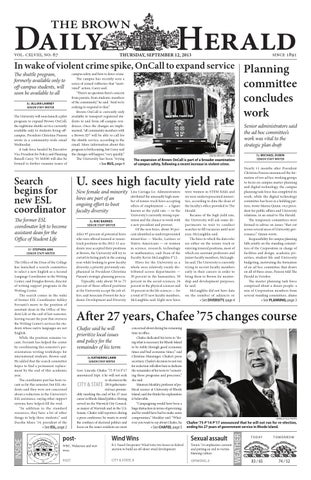
Daily
Herald
THE BROWN
vol. cxlviii, no. 67
since 1891
THURSDAY, SEPTEMBER 12, 2013
In wake of violent crime spike, OnCall to expand service
By JILLIAN LANNEY SENIOR STAFF WRITER
The University will soon launch a pilot program to expand Brown OnCall, the nighttime shuttle service currently available only to students living offcampus, President Christina Paxson wrote in a community-wide email Wednesday. A task force headed by Executive Vice President for Policy and Planning Russell Carey ’91 MA’06 will also be formed to further examine issues of
campus safety and how to deter crime. The campus has recently seen a series of armed robberies that “motivated” action, Carey said. “There’s no question there’s concern from parents, from students, members of the community,” he said. “And we’re seeking to respond to that.” Brown OnCall is currently only available to transport registered students to and from off-campus residences. Once the changes are implemented, “all community members with a Brown ID” will be able to call for the shuttle service, according to the email. More information about this program is forthcoming, but Carey said the changes will happen “very quickly.” The University has been “trying » See BUS, page 4
Search begins for new ESL coordinator
The former ESL coordinator left to become assistant dean for the Office of Student Life BY STEPHEN ARK SENIOR STAFF WRITER
inside
The Office of the Dean of the College has launched a search committee to select a new English as a Second Language Coordinator in the Writing Center, said Douglas Brown, director of writing support programs in the Writing Center. The search comes in the wake of former ESL Coordinator Ashley Ferranti’s move to the position of assistant dean in the Office of Student Life at the end of last semester, leaving vacant the post that oversees the Writing Center’s services for students whose native languages are not English. While the position remains vacant, Ferranti has helped the center by coordinating this semester’s preorientation writing workshops for international students, Brown said. He added that the search committee hopes to find a permanent replacement by the end of this academic year. The coordinator post has been vacant so far this semester, but ESL students said they were not concerned about a reduction in the University’s ESL assistance, saying other support systems have helped fill the void. “In addition to the standard resources, they have a lot of other things to help these students,” said Deesha Misra ’14, president of the » See ESL, page 2
DAVID DECKEY / HERALD
The expansion of Brown OnCall is part of a broader examination of campus safety, following a recent increase in violent crime.
U. sees high faculty yield rate New female and minority Liza Cariaga-Lo. Administrators attributed the unusually high numhires are part of an ber of tenure-track hires accepting ongoing effort to boot offers of employment — a figure known as the yield rate — to the faculty diversity By KIKI BARNES SENIOR STAFF WRITER
After 97 percent of potential hires who were offered tenured or tenuretrack positions in the 2012-13 academic year accepted their positions at Brown, the University will try to curtail its hiring push in the coming year while looking to grow faculty diversity, a priority previously emphasized in President Christina Paxson’s strategic planning process. Typically, only about 50 to 75 percent of those offered positions at the University accept the job offers, said Associate Provost for Academic Development and Diversity
Planning committee concludes work Senior administrators said the ad hoc committee’s work was vital to the strategic plan draft
University’s currently strong reputation and the chance to work with a new president and provost. Of the new hires, about 30 percent identified as underrepresented minorities — blacks, Latinos or Native Americans — or women in science, research, technology or mathematics, said Dean of the Faculty Kevin McLaughlin P’12. Hires for the University as a whole were relatively evenly distributed across departments — 30 percent in the humanities, 30 percent in the social sciences, 24 percent in the physical sciences and 16 percent in the life sciences — for a total of 55 new faculty members, McLaughlin said. Eight new hires
were women in STEM fields and six were underrepresented minorities, according to data the dean of the faculty’s office provided to The Herald. Because of the high yield rate, the University will ask some departments to wait to conduct searches to fill vacancies until next year, McLaughlin said. The hires to which the data refer are either on the tenure track or entering tenured positions, most of which are assistant professors and junior faculty members, McLaughlin said. The University is currently trying to recruit faculty members early in their careers in order to bring them to Brown for mentorship and development purposes, he said. McLaughlin did not have data on the number of adjuncts or » See DIVERSITY, page 4
By MICHAEL DUBIN SENIOR STAFF WRITER
Nearly 11 months after President Christina Paxson announced the formation of two ad hoc working groups to focus on campus master planning and digital technology, the campus planning task force has completed its work, while the digital technology committee has been in a holding pattern, wrote Marisa Quinn, vice president for public affairs and University relations, in an email to The Herald. The temporary committees were formed to advise on issues “that cut across several areas of University governance,” Quinn wrote. Responsibility for campus planning falls jointly on the standing committees of the Corporation in charge of facilities and design, academic priorities, student life and University budgeting, motivating the formation of an ad hoc committee that draws on all of these areas, Paxson told The Herald in October. The master planning task force comprised about a dozen people: a mix of Corporation members from several standing committees, alums » See PLANNING, page 3
After 27 years, Chafee ’75 changes course Chafee said he will prioritize local issues and policy for the remainder of his term By KATHERINE LAMB SENIOR STAFF WRITER
Gov. Lincoln Chafee ’75 P’14 P’17 announced Sept. 4 he will not seek re-election in the 2014 gubernatorial race, presumably marking the end of his 27-year career in Rhode Island politics. Having served on the Warwick City Council, as mayor of Warwick and in the U.S. Senate, Chafee told reporters during a press conference he wants to avoid the confines of electoral politics and focus on the issues residents are most
CITY & STATE
concerned about during his remaining time in office. Chafee dedicated his term to “doing what is necessary for Rhode Island to be stable through good economic times and bad economic times,” said Christine Hunsinger, Chafee’s press secretary. Chafee’s decision to not run for reelection will allow him to dedicate the remainder of his term to “cementing those programs and processes,” she said. Maureen Moakley, professor of political science at University of Rhode Island, said she thinks his explanation is believable. “Campaigning would have been a huge distraction in terms of governing, and he would have had to make some compromises,” Moakley said. “Whatever you want to say about Chafee, he » See CHAFEE, page 5
HERALD FILE PHOTO
Chafee ‘75 P’14 P’17 announced that he will not run for re-election, ending his 27 years of government service in Rhode Island.
post-
Wind Wins
Sexual assault
WBC, Wakarusa and wuv woes
R.I.-based Deepwater Wind wins two leases in federal auction to build an off-shore wind development
Tennis ’14 emphasizes consent and putting an end to victimblaming culture
POST
CITY & STATE, 8
OPINIONS, 8
weather
The shuttle program, formerly available only to off-campus students, will soon be available to all
t o d ay
tomorrow
83 / 65
74 / 52
2 university news » ESL, from page 1
calendar TODAY
SEPTEMBER 12
4 P.M
TOMORROW
SEPTEMBER 13
12:30 P.M. Thinking Proof
Farm Animal Visits
Kassar Auditorium
Wriston Quad
5 P.M.
8 P.M. Janus Forum: Freshmen Only
Triple Threat Concert
Wilson 204
Salomon 101
menu SHARPE REFECTORY
VERNEY-WOOLLEY
LUNCH Toasted Ravioli with Italian Salsa, Artichoke and Red Pepper Frittata, Creamy Smashed Sweet Potatoes
Vegetarian Carrot Ginger Soup, BBQ Beef Sandwich, Summer Squash, Seasoned Curly Fries
DINNER Build Your Own Burgers, Pesto Tortellini Salad, Vegetarian Squash Bisque, Cajun Apple Cake
Cajun Chicken Pasta, Tofu Parmesan, Antipasto Bar, String Bean LaBelle, Cajun Apple Cake
sudoku
crossword
THE BROWN DAILY HERALD THURSDAY, SEPTEMBER 12, 2013
Brown International Organization. The International Mentoring Program — a partnership between the DOC office and students to provide academic support to international students — is one such additional resource, she said. BRIO works to connect ESL students with peer mentors and hosts events and a lecture series, according to the MyGroups student organization website. Many ESL students also join cultural groups upon entering the University, and these groups provide support for starting the process of writing and speaking in intensive classes taught in English, said BRIO Secretary Sama El-Saket ’15. Some international students said they felt their peers — rather than more formal support structures — were the best resource for ESL assistance. “We’ve seen students come in through BRIO, and within six months, their English has improved,” El-Saket said. “It really comes down to the student to utilize these (programs) as much as they need to.” “The best way to pick up a language is by speaking in it every day,” said Misra, who said she speaks six languages. Though Misra said she was generally satisfied with the University’s resources for ESL students, she noted that there is potential for improvement through more collaboration among students. “It could be nice to have a program
HERALD FILE PHOTO
The Writing Center, which houses writing support programs, is currently looking for a new English as a Second Language coordinator. where we could pair up a student whose second language is English but first language is Spanish, for example, so there could be a two-way exchange,” she said, adding that such an exchange would benefit both sides of the language divide. In her time at the Writing Center, Ferranti produced a written record of ESL students’ needs and worked
with faculty members to provide additional support to students struggling with writing, according to a Writing Center internal memo Brown provided to The Herald. “When it comes to writing resources, Brown kills just about everyone,” Brown said. “There are huge resources for student support when it comes to writing.”
THE BROWN DAILY HERALD THURSDAY, SEPTEMBER 12, 2013
THE DAY AFTER, 12 YEARS LATER BY DANTE O’CONNELL, SENIOR STAFF WRITER
Twelve years ago today, students, faculty members, administrators and staff members were reeling from the aftermath of the 9/11 attacks. Below are some of their reactions. “We need to be enormously open to each other, and good to each other, and not traffic in stereotypes.” — University Chaplain Janet Cooper Nelson in remarks at a campus-wide silent prayer service “There are regions of the world that we understand not.” — Former President Ruth Simmons in a speech to the community “Yesterday was our shot heard ’round the world, our Pearl Harbor, our Kennedy assassination.” — an editorial published by The Herald “Yesterday night, I was incredibly stressed about shopping for classes. Today those worries seem foolish. I am reminded, we are all reminded, that what really matters is our common humanity.” — Joshua Marcus ’04 in a letter to the editor “We Brown students are taught to become active leaders and attempt to make a difference in this world. Yes, it is a time of sadness for everyone in America, but we can indeed do something to aid the suffering of thousands and make a difference by taking active roles in our lives and also showing unwavering support for our fellow man.” — Adam Greenwood ’03 in a letter to the editor
university news 3 » PLANNING, from page 1 and “friends of the University,” Carey said. The committee convened for several conference calls over the course of the last year, as well as a full-day meeting around February’s Corporation meeting, he said, adding that Paxson was present for each conversation. The ad hoc committee discussed and issued recommendations on topics similar to those considered by its campus counterpart, the Committee on Reimagining the Brown Campus and Community, one of the six strategic planning committees composed of administrators, faculty members and students, Carey said. Among the topics deliberated and resolved by the master planning working group last year was the decision to locate the School of Engineering expansion on College Hill rather than in the Jewelry District, Carey said. The master planning task force also advised Paxson on whether and how to proceed with a potential renovation of Dynamo House, a vacant former power plant near the Alpert Medical
School, Provost Mark Schlissel P’15 wrote in an email to The Herald. Discussions also focused on outlining “principles and priorities for academic space needs,” Carey said. Sasaki Associates, a Boston planning and design firm, delivered presentations to the ad hoc master planning task force on how best to use campus space, Schlissel wrote. Quinn wrote that the master planning task force was “instrumental” in advancing the campus planning component of the University’s strategic planning process. Carey said the committee “contributed a great deal” to “many of the things that are reflected in the draft of the strategic plan … around campus planning, campus development and physical needs of the campus.” The ad hoc committee’s work also played a role in the decision at May’s Corporation meeting to rename the Committee on Facilities and Design as the Committee on Facilities and Campus Planning and to broaden its mission, Carey wrote in a follow-up email to The Herald. A Subcommittee
on Design Review was also established to help with oversight of major capital projects and the selection of architects. “These changes were influenced by the work of the ad hoc committee and the planning process last year” but were also “part of a periodic review” of the Corporation, its committees and their charges, Carey wrote. The ad hoc working group on digital technology came together for two phone calls and advised on the search for a new chief information officer, Quinn wrote. The committee considered areas where the University should invest in technology, particularly with regard to online education and campus information technology services, Schlissel wrote. The digital technology task force decided to defer further work until a new chief information officer was hired, Quinn wrote. With new Vice President for Computing and Information Services and Chief Information Officer Ravi Pendse now in the fold, “the committee will review potential next steps.”
4 university news »BUS, from page 1 to really balance convenience and transportation needs with safety and security for a long period of time,” Carey said. Brown OnCall is one of a variety of shuttle services the University provides. The Brown University Shuttle replaced SafeRide this summer, following the University’s switch to service provider First Transit Inc. from University Shuttle LLC, which owned the rights to the “SafeRide” name, The Herald previously reported. The Undergraduate Council of Students had input in deciding the new name, but it was ultimately chosen by administrators of the shuttle service, Carey said. The Brown OnCall expansion will be an investment, and the University will “make assessments about the kind of resources necessary to support a more robust program going forward,” said Marisa Quinn, vice president of public affairs and University relations. Additional changes to the shuttle program discussed by the task force could include increasing and expanding BUS shuttle routes, he said. Other possible areas of interest for the task force will include increasing community awareness of safety issues, bolstering campus surveillance and developing “tighter integration between Brown Shuttle, Brown OnCall and the Safewalk Program,” according to the email. The Department of Public Safety has increased its presence on campus recently and has been making efforts to decrease crime in other ways.
There will be more “yellow jacket” security officers who stand guard at “highly visible fixed posts around campus,” according to the email. The security officers are not armed and do not have powers of arrest, said Chief of Police for DPS Mark Porter. Beginning Thursday evening, the number of these guards around campus will increase, Carey said. DPS has also placed more detectives on evening shifts, Porter said. Providence Police Department officers have also stepped up their presence in the Thayer Street area, the Providence Journal reported Aug. 29. In addition to the “six or seven uniformed police officers” normally patrolling Districts 8 and 9, the area that encompasses Thayer, two additional plainclothes officers have been added for Thursday, Friday and Saturday evenings, Deputy Police Chief Thomas F. Oates III told the Journal. They will be covering the East Side neighborhood from 11 p.m. to 3 a.m. those days. DPS collaborates significantly with Providence Police in patrolling the area around campus, Porter said. In addition to joint patrol teams with an officer from each department, representatives of the two meet weekly to discuss crime trends and strategies, and the departments share a joint substation in the Jewelry District and sometimes train together. The challenges of an urban campus make eliminating crime impossible, Carey said. “We’re not in a remote rural area — we’re not behind a wall,” he said. Both Porter and Carey said that
awareness and education are crucial in reducing crime. “Keeping the students well-informed and engaged about their safety is a top priority for DPS,” Porter wrote in a follow-up email to The Herald. Students can avoid becoming “easy targets” by staying aware of their surroundings, Carey said. He and Porter also encouraged students to take advantage of services like BUS and Safewalk, which will resume full service on Sunday with its normal hours of 9 p.m. to 2:15 a.m. Students are aware of the current crime trends on campus, and some expressed concerns about their safety in the wake of recent incidents. “I’ve heard more about violence in the past few months than way back to my freshman year — it’s gotten more serious,” said Trevor Young ’15. Some students said they practice certain habits to feel safer when walking around campus at night, such as walking in groups or not using their cell phones. Young said he no longer wears headphones when walking at night. Paulina Tarrant ’16 said she would not walk alone in certain areas after dark, but she added that she generally feels safe near the Main Green and has noticed the increase in DPS personnel. Many students said they’d still like to see the University respond more seriously to crime around campus. “We shouldn’t have to feel we can’t walk home by ourselves from the library at night,” said Nicole Salvador ’15. — With additional reporting by Maggie Livingstone
THE BROWN DAILY HERALD THURSDAY, SEPTEMBER 12, 2013
» DIVERSITY, from page 1 non-tenure track hires in the past year. The ideology of recruiting predoctorate and post-doctorate candidates may contribute to increased diversity among the University’s faculty, McLaughlin said. In an interim report released January, the Committee on Faculty Recruitment, Career Development and Retention — one of six strategic planning committees convened to help influence Paxson’s agenda — called on the University to increase the level of faculty diversity. CariagaLo and McLaughlin, who chaired the committee, called the push for faculty diversity an extension of efforts started by former President Ruth Simmons. “We may be doing more of that in the coming years,” McLaughlin said of recruiting both pre- and post-doctorate hires. “It’s not a new phenomenon — all of our peers are doing this.” He added that Paxson’s strategic plan, which will be unveiled in draft form later this month, might emphasize this recruiting method. The 14 new women in STEM and minority hires denote “modest progress that we can be justly proud of,” Cariaga-Lo said. “I was very happy to see the data,” said Iris Bahar, chair of the Faculty Executive Committee and professor of engineering. “It’s certainly a step in the right direction.” The diversity of Brown’s faculty has grown over the last decade, though in 2011 about two-thirds of the faculty identified as male and about four-fifths identified at white, The Herald reported at the time. Since the 2002-03 academic year, the number of women in the life sciences has grown by 27 percent, and the number of minorities in the life sciences has grown by 125 percent, according to data from the Dean of the Faculty website.
By the numbers How the number of female and minority faculty members has changed between the 2002-03 academic year and the 2012-13 academic year
9 percent
increase in the number of female professors in the humanities
6 percent increase in the number of minority professors in the humanities
27 percent increase in the number of female professors in the life sciences
125 percent increase in the number of minority professors in the life sciences
114 percent
increase in the number of female professors in the physical sciences
100 percent increase in the number of minority professors in the physical sciences
69 percent increase in the number of female professors in the social sciences
42 percent increase in the number of minority professors in the social sciences Numbers from the Dean of the Faculty website
city & state 5
THE BROWN DAILY HERALD THURSDAY, SEPTEMBER 12, 2013
Lincoln Chafee’s political career 1985: Served as a delegate to Rhode Island’s constitutional convention
1992: Elected mayor of Warwick
1986: Elected to the Warwick City Council
» CHAFEE, from page 1 is a very principled, somewhat quirky, but very principled individual.” Chafee’s term as governor was particularly difficult due to Rhode Island’s financial struggles, Hunsinger said. “The size of the hole that this administration had to dig out of was significantly larger than anyone could have known,” she added. Chafee struggled with the state constitution’s “mismatch of power” between the legislature and the governor’s office, Hunsinger said. Since the legislature often has the authority to overpower the weaker governor’s office, Chafee had trouble pushing his own agenda, she added. Though governors generally tend to lose influence with the legislature at the end of their tenures due to their impending exit from politics, Chafee might be less affected by the phenomenon because
1999: Appointed to the U.S. Senate by then-Gov. Lincoln Almond, to fill the seat vacated by his late father the position of governor in Rhode Island already has very little power, Moakley said. Chafee said in his announcement he will submit a piece of legislation for the 2014 state ballot asking Rhode Islanders to call a new constitutional convention to reevaluate the balance of power between the legislature and the governor. Rhode Island’s last constitutional convention was held in 1986, and Chafee’s first elected position was as a delegate to that convention. The governor’s decision not to seek a second term was also partially strategic, said Marion Orr, director of the University’s Taubman Center for Public Policy. “My thought would be that his chances of winning re-election were so slim that he decided to bow out and not face losing re-election,” Orr said. After Chafee joined the Democratic Party in May, analysts speculated he was
2010: Elected governor of Rhode Island
2006: Lost Senate seat to Sheldon Whitehouse, D-R.I.
positioning himself to run for reelection in a three-way Democratic primary against Providence Mayor Angel Taveras and General Treasurer Gina Raimondo. “It is not odd that he would be a Democrat, but at the same time I think the decision was made in a very strategic context,” Orr said, as a more crowded primary race could allow Chafee to win without the majority of the vote. Chafee began his career as a member of the Republican Party but announced an Independent affiliation in 2007, after losing his Senate seat to Sen. Sheldon Whitehouse, D-R.I. During his tenure as a Republican senator, Chafee was vocal about his disapproval of Republican President George W. Bush and many of the policies and actions taken during Bush’s tenure. In both the 2008 and 2012 presidential elections, Chafee was a strong supporter of President Obama. When Chafee lost his seat in
F R E S H F R O M T H E FA R M
2007: Left the Republican Party and assumes an independent affiliation Congress, his approval rating stood over 60 percent, according to exit polls conducted by CNN in 2006. In the most recent poll on Rhode Island politics published by the Taubman Center in February, Chafee’s approval rating came in at 25.5 percent, significantly lower than those of potential opponents Taveras and Raimondo, who had approval ratings of 63.7 percent and 56 percent, respectively. Chafee’s low approval ratings were due in part to the timing of the economic downturn and high level of unemployment in the state, Orr said. “He also pushed ideas that never really caught on with the public,” like his proposal to raise taxes on meals and beverages, Orr said. He received negative press after calling the decorated spruce in the State House in December a “holiday tree” instead of a Christmas tree, though he was continuing the policy of former Gov. Donald Carcieri.
2013: Joined the Democratic party and announces he will not run for re-election
“I suspect we’ve probably seen the last of Chafee in terms of an elected official” in the state, Orr said, but added that there has been speculation about Chafee receiving an appointment to a federal position due to his strong relationship with President Obama. Chafee was the only non-Democrat to speak at the Democratic National Convention in August 2012 when Obama was named the Democratic Party’s nominee for the presidency. “An ambassadorship may in fact be possible,” Orr said. Some of Chafee’s central accomplishments have included developing infrastructure and changing the way transportation is funded in Rhode Island, Hunsinger said, along with his continued focus on fiscal responsibility and the environment. “Those are lifetime accomplishments that are felt by the taxpayer directly,” Hunsinger said.
B E AT I N G T H E H E AT
DAVID DECKEY / HERALD
With temperatures peaking around 90 degrees Fahrenheit yesterday, students sought comfort from the unusually hot weather by sitting under the shade of the trees on the Main Green.
W H E N L I F E H A N D S YO U L E M O N S ...
DAVID DECKEY / HERALD
Local farmers came to Wriston Quad to offer seasonal fruits and vegetables to those relishing in the flavors of the end of summer. DAVID DECKEY / HERALD
Patrons stopped to quench their thirsts with frozen lemonade at the New England Frozen Lemonade Stand while out and about in the high temperatures.
comic Eric & Elliot | Willa Tracy
6 commentary
THE BROWN DAILY HERALD THURSDAY, SEPTEMBER 12, 2013
EDITORIAL
Save the housing lottery
There is one magical moment in the academic year when students gather together to learn from the past, relish in the present and prepare for the future. Though the answer — the housing lottery — should be obvious to all, the night’s magic seems to have been forgotten by administrators and the Residential Council. Starting this year, the housing lottery could potentially move from its traditional location in Sayles Hall to an online registration system, The Herald reported last week. While the move is certainly a logical one that will likely garner support among those who value maximum efficiency, the potential change threatens other Brown traditions we must strive to preserve. For first-year students who may never experience an in-person housing lottery, the principle is simple: The lottery is divided over two days. Upperclassmen attend the first day, and rising sophomores duke it out on the second. Though the lottery process seems logical enough, the experience and atmosphere surrounding the event make the housing lottery a truly special collegiate phenomenon. Consider another University move that exemplifies the triumph of efficiency over tradition: the elimination of the first pick competition. As many more senior students will remember, groups of students used to produce humorous videos that would qualify them for the first pick at the housing lottery. But in spring of 2010, the winning group was accused of bribing students to vote for them. The next year, the contest was unceremoniously cancelled in favor of a raffle, which ResCouncil officials said would encourage students to attend a housing fair. The circumstances behind this particular incident were less than ideal, but they still speak to a broader truth: We should not remove our quirky traditions in favor of a path that is more sanitized, safer and ultimately less fun. By doing so, we risk losing those individual distinctions — whether they be the first pick competition or the housing lottery — and fading into the crowd. This May, when the members of the class of 2014 gather for Commencement in the First Baptist Church in America, they will hear these Latin words delivered by President Christina Paxson: “Auctoritate mihi commissa vos ad gradum Baccalaueri admitto, omniaque jura ac privilegia ad hunc gradum pertinentia, vobis concedo. In huius rei testimonium diplomata vestris conlegis in Collegii Gramine tradam.” Undecipherable to many, the words have been said in the name of tradition, and they have been words that those depicted in every single portrait around the walls of Sayles Hall have once said or heard in his or her time at Brown. Many of us still value traditions over anything else. These can decline in their utility, but even if they are not the most advanced, that does not mean they should be thrown away. It is true, the complete digitization of the housing lottery would do an adequate job of replacing the current one from a pragmatic standpoint. It is no secret that problems caused by overcrowding and time commitments can significantly impede the entire process. But many of us students hold the housing lottery dear to our hearts, and we expect it to be a constant staple of not only our own Brunonian experiences but also those of all future classes. While we understand the University’s proposal for an online system, we ask administrators to consider all aspects of the move before one of our traditions is lost.
A N G E L IA WA N G
Q U O T E O F T H E D AY
www.browndailyherald.com
“We shouldn’t have to feel like we can’t walk home by ourselves from the library at night.” — Nicole Salvador ’15 See BUS, page 1.
Editorial Leadership
Sections
Visuals & Production
Business
Editors-in-Chief Lucy Feldman Shefali Luthra
Arts & Culture Editors Hannah Abelow Maddie Berg
Head Photo Editor Emily Gilbert
General Managers Julia Kuwahara Samuel Plotner
Managing Editors Elizabeth Carr Jordan Hendricks
City & State Editors Sona Mkrttchian Adam Toobin
Senior Editors Aparna Bansal Alexa Pugh
Features Editors Jennifer Kaplan Elizabeth Koh
Strategic Director Greg Jordan-Detamore
Science & Research Editors Phoebe Draper Kate Nussenbaum
BLOG DAILY HERALD Editor-in-Chief Meredith Bilski
Sports Editors James Blum Connor Grealy
Managing Editor David Oyer
University News Editors David Chung Mathias Heller Eli Okun
POST- MAGAZINE
Editorial Page Editor Rachel Occhiogrosso
Editor-in-Chief Ben Resnik
Opinions Editors Gabby Corvese Garret Johnson Maggie Tennis
Photo Editors Brittany Comunale David Deckey Samuel Kase Sports Photo Editor Jesse Schwimmer Video Editors Henry Chaisson Assistant: Danny Garfield Data Science Editor Andersen Chen Web Producer Joseph Stein Design Editors Kyle McNamara Mie Morikubo Julia Shube Assistant: Sandra Yan
facebook.com/browndailyherald
@the_herald
browndailyherald.com
Directors Sales: Eliza Coogan Finance: Nicole Shimer Alumni Relations: Emily Chu Business Dev.: Justin Lee
Location: 195 Angell St., Providence, R.I. www.browndailyherald.com
Office Manager Shawn Reilly
Corrections: The Brown Daily Herald is committed to providing the Brown University community with the most accurate information possible. Corrections may be submitted up to seven calendar days after publication.
Sales Managers Regional: Jennifer Aitken Regional: Jaqueline Chang Regional: Leslie Chen Regional: Wenli Shao Regional: Carolyn Stichnoth Student Group: Anisa Holmes Finance Managers Collections: Sameer Sarkar Collections: Timothy Sharng Operations: Sarah Levine
Copy Desk Chief Sara Palasits
Alumni Relations Manager Engagement: Alison Pruzan
Illustrations Editor Angelia Wang
Business Dev. Manager Human Resources: Melody Cao
Editorial contact: 401-351-3372 herald@browndailyherald.com
Business contact: 401-351-3260 gm@browndailyherald.com
Commentary: The editorial is the majority opinion of the editorial page board of The Brown Daily Herald. The editorial viewpoint does not necessarily reflect the views of The Brown Daily Herald, Inc. Columns, letters and comics reflect the opinions of their authors only. Letters to the Editor: Send letters to letters@browndailyherald.com. Include a telephone number with all letters. The Herald reserves the right to edit all letters for length and clarity and cannot assure the publication of any letter. Please limit letters to 250 words. Under special circumstances writers may request anonymity, but no letter will be printed if the author’s identity is unknown to the editors. Announcements of events will not be printed. Advertising: The Brown Daily Herald, Inc. reserves the right to accept or decline any advertisement at its discretion. The Brown Daily Herald (USPS 067.740) is an independent newspaper serving the Brown University community daily since 1891. It is published Monday through Friday during the academic year, excluding vacations, once during Commencement and once during Orientation by The Brown Daily Herald, Inc. Single copy free for each member of the community. Subscription prices: $280 one year daily, $140 one semester daily. Copyright 2013 by The Brown Daily Herald, Inc. All rights reserved. Periodicals postage paid at Providence, R.I. Postmaster: Please send corrections to P.O. Box 2538, Providence, RI 02906.
commentary 7
THE BROWN DAILY HERALD THURSDAY, SEPTEMBER 12, 2013
Rape and the intoxicated victim MAGGIE TENNIS opinions editor
Campus rape has been in the news frequently in recent years. This rise in media attention is not because campus rape is anything new, but it rather reflects a decline in the societal stigma that prevented coverage of the topic in the past. Sexual assault is and has been a part of campus culture for a long time. But as it becomes a more prominent subject of public discourse, it increasingly includes the alarming practice — to varying degrees of subtlety — of victim-blaming. Some high-profile allegations of sexual assault over the past five years include those in 2008 and 2012 at the Naval Academy, 2012 in Steubenville, Ohio and, more recently and only now gaining nationwide attention, the videotaped sexual assault of a Vanderbilt University student by four football players this past June. The first two, at the Naval Academy, involved one victim who passed out and awoke to find she was in the process of being raped, and another who blacked out — also from too much alcohol — and discovered that she had been sexually assaulted after hearing rumors and seeing social media posts. The third incident, in Steubenville, involved high school athletes who undressed, transported, photographed and finally sexually assaulted a drunken teenage girl when she was both semi- and fully unconscious from over-intoxication. The
most recent high-profile case of campus rape involved Vanderbilt football players transporting a passed-out classmate from a bar to a dorm room, and then proceeding to assault her. They also photographed and videotaped the act before sending the recordings to friends. These cases have one crucial aspect in common: In each incident, the victim was heavily intoxicated to the point of unconsciousness. It’s not a coincidence. These victims were targeted precisely because of their level of intoxication. The idea exists in our culture that if you allow yourself to get so drunk that you black out or pass out, then you are, in fact, inviting inappropriate conduct upon yourself, or that you are even complicit in your own rape. A perpetrator of sexual assault seizes advantage of an unfortunate presumption that a drunken individual has somehow consented to a sexual act simply by becoming black-out drunk. Or even that, by reaching such a state, the drunken individual has forfeited any right to give consent entirely. Armed with this reasoning, the perpetrator concludes that sexual advances on this person would not be considered rape. Even more disturbingly, this idea is subtly introduced to young people as they mature. Kids — especially girls — are warned from a young age to be vigilant around alcohol and potential sexual predators. By their teen years, they are “supposed” to be aware of these dangers. So if they find themselves in situations where they are severely
inebriated, certain elements of of consent. Or even worse, persociety rule that whatever con- petrators cease to see their vicsequences befall them are their tims as human beings at all. own fault simply because they CNN reporter Poppy Harwere not more careful or self- low echoed this disregard for aware. the intoxicated victim when One example of this view- she bemoaned the effect of the point is a comSteubenville rape ment made by incident on the “What we don’t athlete Serena once “promising discuss is the Williams confutures” of the cerning the vicconvicted rapists. potential of tim of the Steuthe very least, persistent disregard At benville rape the fact that a and disrespect case. Williams public uproar folsaid, “Why was for an intoxicated lowed her comshe that drunk ment shows that victim to actually we’ve made some where she doesn’t remember? It perpetuate rape.” progress in spotcould have been ting distorted much worse. … perspectives. She shouldn’t have put herself in But this event showed that that position.” our discussion of victim-blamFurthermore, during the ing has been limited to simply course of the Steubenville trial, focusing on the necessity of not thousands used victim-blaming holding a victim of rape responlanguage on twitter. Such tweets sible. What we don’t discuss is included: “Be responsible for the potential of persistent disreyour actions ladies before your gard and disrespect for an intoxdrunken decisions ruin inno- icated victim to actually perpetcent lives,” “So you got drunk at uate rape. Potential perpetrators a party and two people take ad- of sexual assault may, in fact, be vantage of you, that’s not rape able to rationalize their actions you’re just a loose drunk slut” based on society’s willingness and “…not saying she asked for to discount a rape victim’s vicit, but why did she consume so timhood if he or she was severemuch alcohol in the first place?” ly drunk at the time of the asThis form of victim-blaming, sault. in which intoxicated individuals are deemed responsible for what happens to them, enables sexual assault of drunk and especially unconscious victims to occur. Perpetrators of rape permit themselves to see drunk and unconscious individuals as inviting exploitation. It is as if allowing oneself to become that out-ofcontrol drunk can actually be viewed as an implicit statement
This idea deserves more consideration. We need to widen our discussion to include the idea that victim-blaming is itself a cause of continued sexual assault. And then we need to work harder to end all forms of blaming and de-humanizing the victim, both on our campuses and in greater society. Ultimately, increased education and awareness about the dangers of alcohol or the wrongness of rape is unlikely to end sexual assault on college campuses. And neither should it be the duty of potential victims to dress a certain way or be “careful” at parties and around alcohol. And, unfortunately, simply continuing to instruct students to respect consent will not be enough. What we also need is universal recognition that sexually touching — or photographing or filming — of another person without their conscious and enthusiastic consent is unquestionably and indubitably wrong. Maggie Tennis ’14 wishes to emphasize that, despite what Robin Thicke’s lyrics might imply, getting “blasted” does not mean that you “want it.” She challenges you to promote and celebrate consent.
daily herald city & state THE BROWN
THURSDAY, SEPTEMBER 12, 2013
R.I. company to develop offshore wind farm The Deepwater Wind Energy Center will have about 200 turbines and produce 1000 megawatts
BY DAVID CHUNG, UNIVERSITY NEWS EDITOR
Michigan State relieves professor of teaching duties after politically charged comments A creative writing professor at Michigan State University
BY MARIYA BASHKATOVA
was suspended from his teaching responsibilities after making
SENIOR STAFF WRITER
Rhode Island-based renewable energy company Deepwater Wind won the first federal auction for offshore wind development, paying $3.8 million for 164,000 acres of ocean on the Atlantic seaboard between Rhode Island and Massachusetts. The lease for the Deepwater Wind Energy Center has not been officially signed but will be completed in the next few weeks, said Jeff Grybowski ’93, CEO of Deepwater Wind. Deepwater Wind plans to build a utility-scale wind farm, which will consist of roughly 200 turbines and produce approximately 1,000 megawatts of energy, Grybowski said. The 600-foot-tall turbines will be situated at one-mile increments on the outer continental shelf of the seaboard, he added. The site and project plans will undergo environmental reviews from late 2013 to 2016 as Deepwater Wind seeks to obtain state and federal environmental permits, Grybowski said. The wind farm could potentially be up and running by 2018, he said. The federal auction is part of the Department of the Interior’s “Smart from the Start” offshore wind power initiative. Launched in 2010, the program created a set of rules and guidelines for licensing, permitting, finding sites suitable for and constructing new offshore wind projects, according to a DOI press release. The Coastal Resources Management Council and the R.I. Department of Environmental Management created the Ocean Special Area Management Plan in 2008. As a part of the plan, the University of Rhode Island performed testing to determine the possible impact of wind farming on the area’s commercial fishing, navigation and tourism, as well as the environmental impact on avian, mammal and fish species and habitats, said Chris Kearns, chief of program development at the R.I. Office of Energy Resources. This work played a role in helping the federal government determine ocean areas suitable for wind
THIS WEEK IN HIGHER ED
controversial statements on the first day of class. A student captured the remarks on a video that was then posted online and seen by university officials. William Penn, a professor in the university’s English department, criticized Republicans and wealthy individuals while discussing taxation and black voter suppression, claiming Republicans “raped this country.” Penn later acknowledged that his actions may have “negatively affected the learning environment,” said Kent Cassella, assistant vice president for media communications at Michigan State, in a public statement. Though Penn has been relieved of his teaching duties, he remains a paid faculty member at the university.
COURTESY OF THE BUREAU OF OCEAN ENERGY MANAGEMENT
The wind farm will be located in federal waters between Rhode Island and Massachusetts, as depicted by the shaded area above. farming, he added. The offshore area auctioned off in July was identified by the DOI as a Wind Energy Area, meaning it did not pose a significant commercial or environmental threat. Deepwater Wind’s energy center will provide the state with a secure source of clean energy, Grybowski said. Wind power use “will displace an equivalent amount of fossil fuel” in the region, leading to less air pollution from particulates and carbon dioxide, he added. Deepwater has considered plans to harvest and sell energy from the center to neighboring New England states, according to the company’s website, though no final decisions have yet been made. “Offshore wind is the largest renewable energy source in the northeast because we are so constrained with respect to land,” Grybowski said. But some critics cite environmental effects, economic cost and aesthetic concerns as issues for offshore wind projects. “Offshore wind is not economically viable without a huge amount of subsidies and tax credits, and ideally
there would be investments in (research and development) that would drive down those costs,” said Audra Parker ’84, president and CEO of the Alliance to Protect Nantucket Sound, a Massachusetts organization that campaigns against the proposed Cape Wind project in Nantucket Sound. While the organization does not oppose offshore wind power, it opposes the location of wind turbines in the “environmentally sensitive” sound. Since the Deepwater Wind proposal is located in a government-approved area and requires environmental oversight, it may not pose the same controversies as the Cape Wind project, including threats to fisheries, animals and navigation safety, she added. But until technologies improve, the project will continue to face economic obstacles, she said. Deepwater Wind is also currently working on a small proof-of-concept wind farm to pilot the Deepwater plan three miles southeast of Block Island, Grybowski said. This five-turbine project will compete with Cape Wind to be the first offshore wind farm in the U.S. It is slated for construction in 2014 and will be in operation by 2015, he said.
Rochester professor starts course with a prank On the first day of class, students in Chemistry 131 at the University of Rochester were told by the instructor that 55 percent of students had failed the class the previous year. They were also told that cell phones and laptops could not be used in class and that violators would see consequences in their grades. They were not aware that they were being pranked and that the instructor in front of the class was not in fact their professor. After being approached by Chamber Boys, a student radio show, Benjamin Hafensteiner, chemistry professor at the University of Rochester, agreed to pull a prank on his students on the first day of class. Hafensteiner wrote in an email to Inside Higher Ed, “The first class is always tough to get through, and I thought this would be an ice breaker to beat all ice breakers. It set a pretty high energy tone that I hope I can carry through the rest of the semester.” In fact, only 12 percent of students in the class last year received a C- or lower.
Yale to focus career services on industry-specific events Yale’s Undergraduate Career Services will no longer hold an annual career fair in the fall, instead opting for smaller events tailored to specific industries and career fields. The university’s UCS organized six pilot industry-specific events last year and received positive feedback both from students and from employers. “The smaller events are so much more of an asset,” said UCS Director Jeanine Dames. Student response to the announcement has been mixed, with some expecting the job search to be more efficient and focused and others commenting on the potential inconvenience.
Solar farm construction begins on top of re-purposed landfill The solar panel field is expected to produce enough electricity for hundreds of R.I. homes By EMILY BONEY CITY & STATE STAFF WRITER
Construction began on the state’s first capped-landfill solar field last month, the result of more than three years of planning. The former Forbes Street Landfill, which was in use from 1969 to 1979, will now house 13,000 solar panels and generate 3.7 megawatts of electricity — enough to power nearly 500 homes at one time. The field should be fully functional
and connected to National Grid, the state’s primary electricity provider, by October or November, said Chris Kearns, chief of program development for the Rhode Island Office of Energy Resources. OER provided a $100,000 grant to help get the project started. The East Providence City Council began the planning process for the project in 2010, bringing in CME-OCI Solar Power LLC, which had been involved in several closed-landfill solar projects in the past. There were “a lot of variables” at play during the planning and approval process, Kearns said, adding that the project’s specific permits, licenses and environmental considerations were “new territory” for Rhode Island. Though
Massachusetts and Connecticut have paved the way for capped-landfill solar development, Rhode Island has a “learning curve” to navigate, Kearns said. Besides creating clean energy for the state, the field could boost the local economy. National Grid has agreed to pay the city 23.9 cents for each kilowatthour of energy as part of the 15-year contract awarded to the municipality in April. The city will also make nearly $5 million in revenue from leasing the land for the next 25 years. The solar field should be operational for at least 30 years, according to East Providence’s Solar Project Summary. The project it is only one of the state’s proposed solar energy projects,
Kearns said. “We’ve seen solar projects proposed in 25 of the 39 cities in the state over the last two years,” he said. “This one certainly won’t be the first or last.” OER “plays an oversight role” in the construction and operation of renewable energy projects like the Forbes Street Solar Field, Kearns said. The organization works closely with National Grid, which must integrate the new energy into the existing electrical system. Construction of the energy field was a collaboration among many different groups, including the R.I. Department of Transportation. The department saved the project $1 million through the donation of 250,000 cubic yards
of clean dirt reclaimed from the I-195 reconstruction project. An additional grant of over $200,000 came from the Renewable Energy Fund, and the city’s Department of Public Works worked on the landfill using a bulldozer donated by the East Providence Police Department. CME Solar estimates the total cost of production will range between $40 million to $50 million. There are plans for eventual expansion into the site’s remaining acreage, which could hold enough panels to produce more than five additional megawatts of electricity. “It’s an exciting project,” Kearns said. “We look forward to seeing the final product.”