Daily
Herald
THE BROWN
vol. cxlviii, no. 61
since 1891
WEDNESDAY, SEPTEMBER 4, 2013
Yield rate Housing lottery to potentially move online proposal is meant to up for fifth The reduce student stress and consecutive allow them more time to select their rooms year By BRITTANY NIEVES
The University has seen a yield increase of about 5 percent in the past five admission cycles
SENIOR STAFF WRITER
By MAGGIE LIVINGSTONE SENIOR STAFF WRITER
Despite University intentions to create a 1,500-member class, the class of 2017 — which includes 1,537 members — continued the trend of increasing numbers of admitted students choosing to matriculate at Brown, said James Miller ’73, dean of admission. The percentage of admitted students enrolling, known as the yield rate, has climbed from 53 percent to 58 percent between the classes of 2013 and 2017. Because of the trend, admissions officers will have to be “very conservative” in admitting students to the class of 2018, Miller said. “The trajectory is upward,” Miller said. “So we will probably be more cautious next year in terms of the number of admission offers we’ll make.” How many to admit Admission officers aim to have 1,500 first-year students enroll each year, Miller said, adding that the number of students the Admission Office admits is largely derived from looking at the previous year’s yield rate. After 1,541 students enrolled in the class of 2016, the office admitted 100 » See ADMISSION, page 2
The housing lottery may move out of Sayles Hall and onto the Internet later this academic year. The proposal for this change is under review by Richard Bova, senior associate dean of residential and dining services, and Margaret Klawunn, vice president for campus life and student services. A decision is expected by the end of the month, said Richard Hilton, associate director of residential life. The website’s construction began in March and members of Residential
Council reviewed the new online system in April, Hilton said. “(The Office of Residential Life) and the lottery chair told us that they had the technological capacity to just do the whole thing online,” said Olivia Conetta ’14, ResCouncil member and former Herald copy desk chief. “We discussed it for a while and decided we’d like to go through with it.” Focus groups consisting of 20 randomly selected students will test the new housing lottery process and provide input. As part of the online lottery system, students will have designated time slots over the course of several days in which they can go online and select their desired rooms. “(Students) will have a three-minute window verses 30 seconds at the podium,” Hilton said. “It’ll also allow » See LOTTERY, page 3
EMILY GILBERT / HERALD
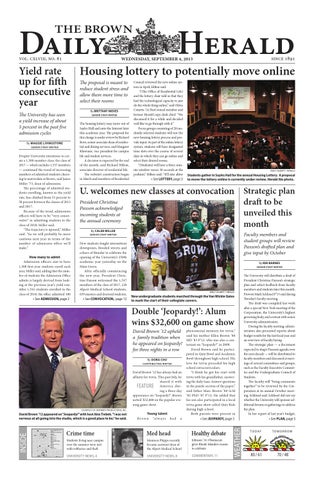
Students gather in Sayles Hall for the annual Housing Lottery. A proposal to move the lottery online is currently under review. Herald file photo.
U. welcomes new classes at convocation Strategic plan President Christina draft to be Paxson acknowledged unveiled this incoming students at the annual ceremony month By CALEB MILLER
Faculty members and student groups will review Paxson’s drafted plan and give input by October
SENIOR STAFF WRITER
New students fought intermittent downpours, flooded streets and echoes of thunder to celebrate the opening of the University’s 250th academic year yesterday on the Main Green. After officially commencing the new year, President Christina Paxson welcomed the 1,537 members of the class of 2017, 120 Alpert Medical School students, 639 masters and doctoral students, » See CONVOCATION, page 12
By KIKI BARNES SENIOR STAFF WRITER
EMILY GILBERT / HERALD
New undergraduate students marched through the Van Wickle Gates to mark the start of their collegiate careers.
Double ‘Jeopardy!’: Alum wins $32,600 on game show David Brown ’12 upheld a family tradition when he appeared on Jeopardy! for three nights in a row By DORA CHU CONTRIBUTING WRITER
David Brown ’12 has always had an affinity for trivia. This past July, he shared it with America during a three-day appearance on “Jeopardy!”. Brown netted $32,600 on the popular evening game show.
FEATURE
COURTESY OF JEOPARDY PRODUCTIONS, INC.
David Brown ’12 appeared on “Jeopardy!” with host Alex Trebek. “I was not nervous at all going into the studio, which is a good place to be,” he said.
Young talent B r o w n “a l w a y s h a d
a
phenomenal memory for trivia,” said his mother Ellen Brown ’80 MD ’83 P’12, who was also a contestant on “Jeopardy!” in 2009. David Brown said he participated in Quiz Bowl and Academic Bowl throughout high school. His love for trivia preceded his high school extracurriculars. “I think he got his start with trivia with his grandfather, answering the daily Isaac Asimov questions in the puzzle section of the paper,” said father Marc Brown ’80 ScM ’82 PhD ’87 P’12. He added that his son also participated in a local trivia game show called Quiz Kids during high school. Both parents were present in » See JEOPARDY, page 3
The University will distribute a draft of President Christina Paxson’s strategic plan and solicit feedback from faculty members and students later this month, Provost Mark Schlissel P’15 said during Tuesday’s faculty meeting. The draft was compiled last week after a special New York meeting of the Corporation, the University’s highest governing body, and a retreat with senior University administrators. During the faculty meeting, administrators also presented reports about budget results for the last fiscal year and an overview of faculty hiring. The strategic plan — a document expected to shape Paxson’s agenda over the next decade — will be distributed to faculty members and discussed at meetings of several committees and groups, such as the Faculty Executive Committee and the Undergraduate Council of Students. The faculty will “bring comments together” to be reviewed by the Corporation at its annual October meeting, Schlissel said. Schlissel did not say whether the University will sponsor additional forums or gatherings to address the plan. In her report of last year’s budget, » See PLAN, page 5
Summer crime events on campus
LLOYD
4
CUSHING
MEETING
ANGELL
BROWN
THAYER
3
WATERMAN
PROSPECT
inside
5 BOWEN
6
1. Between May 27 & June 10: Larceny 2. Between June 16 & June 20: Larceny 3. June 24: Armed robbery 4. July 1: Armed robbery 5. July 1: Armed robbery 6. Between July 3 & July 4: Larceny 7. July 5: Breaking and entering 8. July 11: Larceny 9. Aug. 16: Armed robbery GEORGE
1
8
CHARLESFIELD
2
BROWN
POWER
HOPE
9
Med head
Students living near campus over the summer were met with robberies and theft
Maureen Phipps recently became assistant dean of the Alpert Medical School
Johnson ’14: Obamacare gives Rhode Islanders reason to celebrate
UNIVERSITY NEWS, 4
UNIVERSITY NEWS, 8
COMMENTARY, 11
BENEVOLENT
7
Healthy debate
Crime time
weather
The Department of Public Safety responded to several incidents over the summer around campus. This map highlights nine locations where crimes occurred.
t o d ay
tomorrow
80 / 61
70 / 48
2 university news » ADMISSION, from page 1
calendar TODAY
SEPTEMBER 4
ALL DAY
TOMORROW
SEPTEMBER 5
4 P.M. First day of classes
Brown in Japan Info Session JWW 440
6:30 P.M.
5:30 P.M. Rosh Hashanah Services
Gap Year Student Dinner
Brown RISD Hillel
Campus Center 229
menu SHARPE REFECTORY
VERNEY-WOOLLEY
LUNCH Vegan Jamaican Jerk Tempeh, Zucchini, Squash and Tomato StirFry, Cajun Baked Fish
Shaved Steak Sandwich, Falafel, Vegan Spanish Lentils, Mediterranean Eggplant Saute, Steak Fries
DINNER Vegan Puttanesca Pasta Saute, Sauteed Spinach with Cherry Tomatoes, Bruschetta Mozzarella
Mexican Cornbread Casserole, Grilled Cilantro Chicken, Caesar Salad, Spinach Stuffed Tomatoes
sudoku
fewer students to the class of 2017 in an effort to reach the 1,500 student goal, Miller said. But the class of 2017 remains about 50 students over the target class size of 1,500. Anticipated yield rate is one of the largest factors in determining the number of students admitted each year, Miller said, though he added that financial and political considerations are made as well. Aid and outreach The University’s yield has increased over the last five years, even while the number of admitted students has decreased or stayed the same, Miller said. Miller attributed the growth to the University’s expanding financial aid offerings, beginning with former President Ruth Simmons’ introduction of a need-blind admission policy for first-year domestic applicants in 2003. With more aid available, the University can better compete for students with peer institutions, he said. Miller said outreach efforts made after students have learned of their acceptances also help increase yield. Events like A Day on College Hill and minority student call-out days have made Brown more attractive to admitted students, he said.
THE BROWN DAILY HERALD WEDNESDAY, SEPTEMBER 4, 2013
A reason to apply? Yield usually does not influence whether a student applies to an institution, said Michele Hernandez, a college consultant and former assistant director of admissions at Dartmouth. But Hernandez said she believes yield matters in the overall scope of a college’s reported figures. “If you’re an admissions person, it’s flattering if the yield is higher,” Hernandez said. “That means they’re doing a good job attracting kids.” But Neilly Tan, a high school senior applying early decision for the class of 2018, said she felt the prestige associated with Brown’s yield rate negatively affected her decision to apply. “What sold me on Brown was the campus vibe,” said Tan, who attends Rancho Solano Preparatory School in Scottsdale, Ariz. “The selectivity and high yield actually make me more apprehensive to apply.” Yield was a consideration but not a deciding factor for Courtney Ko, a senior at Olympian High School in Chula Vista, Calif., in her choice to apply early decision to the class of 2018, she said. Ultimately, she has elected to apply because of the Open Curriculum and Brown’s liberal environment. The early decision effect But yield rates can be misleading, especially if more students apply through binding early decision
programs. Universities can partially control yield rates through such programs, because 100 percent of students admitted early will enroll, possibly skewing the overall yield rate. At the end of the college admission cycle, that year’s statistics are reported to a school’s board of trustees and president, and then released to the public, Hernandez said. Admission officers aim to maintain or increase numbers in “specific target areas” such as minority student and legacy enrollments, as well as average SAT scores, she said. Early decision programs allow admission officers to ensure those target areas do not decrease, she said. Approximately 49 percent of Penn’s class of 2017 is composed of early decision admits, driving the yield to around 64 percent, the Daily Pennsylvanian reported. “At Penn, sure, their yield went up, but that’s also because they’re controlling the yield through early decision,” Hernandez said. “Yield can be manipulated.” But Brown’s approximate 5 percent increase in yield over the last five admission cycles reflects an increase not dependent upon the early decision process. The class of 2017 includes approximately 2 percentage points fewer early admits than the class of 2015, but its yield rate remains higher — at around 58 percent, compared to around 55 for the class of 2015.
crossword
facebook.com/browndailyherald
university news 3
THE BROWN DAILY HERALD WEDNESDAY, SEPTEMBER 4, 2013
» JEOPARDY, from page 1 the audience during the taping of the shows on which their son appeared, and both said they were proud of him. During the taping, host Alex Trebek referred several times to Brown’s mother’s appearance on the show. “The tag line for the commercial for the show that week was ‘will David manage to restore the family honor?’ referring to me not doing so well,” Ellen Brown said. She was disqualified from the final round during her appearance on the show and cited issues with the buzzer as one of the factors leading to her loss. Though she wished her experience had had a different outcome, “my whole ‘Jeopardy!’ experience was a good one, made even better by having David do so well four years later,” Ellen Brown said. Going through the rounds To land a spot on the show, potential contestants must pass several written tests, including an initial online test. If successful, they are invited to an in-person audition where they play a computer-simulated version of “Jeopardy!”, “Jeopardy!” Contestant Producer Maggie Speak said. The selection process also includes an interview to get a feel for the contestant’s personality, she said. After Brown’s audition in March 2013, “he was called for the taping within days,” Marc Brown said. David Brown said he didn’t believe the phone call that informed him he was going to be a contestant on “Jeopardy!” and thought it was a prank call. But his father said he was not surprised by David Brown’s selection. “They appreciated his persona
and stage presence, not to mention his brilliance,” Marc Brown said. To prepare, David Brown began to watch the show daily and to visit the online “Jeopardy!” archive. He practiced buzzing in using a wooden spoon as the buzzer because “the handle would be sort of the same size as the buzzer,” he said. Brown also used the lists he acquired from high school Quiz Bowl and Academic Bowl competitions to aid him in memorizing various topics, he added. “I think what helped the most was being really familiar with the show and with the kind of questions and with the buzzer,” Brown said. Brown said drawing from his mother’s experiences on the show served as a calming agent. “I was not nervous at all going into the studio, which is a good place to be,” he said. It’s showtime Most of the other contestants on “Jeopardy!” wanted to “have a good time,” Brown said. “There were probably ... one or two who you could tell were very competitive. They were trying to psych you out... But I think for the most part that was the minority,” Brown said. During the first game, Brown buzzed in to answer questions quickly, sweeping two categories, “Within Limitations” and “Bard ‘M’en,” finishing with the most money at the end of the show. Answering all the questions in both categories was his proudest moment from the first show, he said. Brown’s second game was a rockier showing, though he said he scraped out a win in the last round “only because (one of my opponents) wagered too much at Final ‘Jeopardy!’,” he said. “It definitely wasn’t
Thanks for reading!
the way I wanted to win but I’m still happy I won,” Brown added. But the third show was Brown’s last. “I lost by a lot. It was a much harder game than the first two in my opinion, and the two people I was playing against were incredible. I felt like I played a very good game,” Brown said. “It basically went ... easy, medium, hard in terms of first game, second game and third game,” Brown said, adding that the third game consisted of unfamiliar topics like “old TV hosts.” ‘An incredible time’ Reactions to Brown’s performance were largely positive. “He was so well-rounded ... It was fun to watch him play because he had so much fun playing the game,” Speak said. She added that Brown’s personality was “one big selling package” as a contestant. “He’s one of the most delightful contestants I’ve worked with in a very long time,” Speak added. The social media world also took notice of Brown’s appearance on “Jeopardy!” and during the show’s airing, Vine videos and Twitter mentions of Brown appeared on the Internet. “It was totally unexpected ... literally hundreds if not thousands of people were tweeting specifically about me,” Brown said. He gave examples of tweets, including “Oh my God, this gay ‘Jeopardy!’ contestant is giving me life!” and “I love how
sassy he is!” “I just started retweeting everything,” Brown said. “I love attention, good or bad, so it was just funny for me to see these people giving it to me,” he laughed. “It felt very exciting and surreal that all these strangers were talking about my close friend,” Pattie Umali ’12, a friend of Brown’s, said. “The majority of the tweets were very supportive of David and many named him as their new favorite ‘Jeopardy!’ champ,” Umali said. Drew Kunas ’12, a friend of Brown’s who appeared on “Who Wants To Be A Millionaire?” in March 2013, said he was impressed by Brown’s performance. “My first reaction was, ‘Who is this duck voice coming out of David, and why is it so good at ‘Jeopardy!’?’” Kunas joked. But Kunas said the two shows required different qualities. “My game show is a show that requires you to be lucky a few times,” he said. “David’s is one that required knowledge, skill, stamina, apparently a duck voice and cool.” Brown said “the fact that I don’t take anything too seriously” helped make his “Jeopardy!” experience enjoyable. “Having a good time is so important to me,” he said. “Even getting second or third place on a show like ‘Jeopardy!’, I still would have had an incredible time.” Brown said he is not positive what he is going to do with his winnings, but he added that he is thinking about getting a hybrid car.
» LOTTERY, from page 1 students to log in wherever they are into the system. So they can do it in the privacy of their rooms, they can do it in the coffee shop, they can be studying abroad and be able to go into the system and choose. They won’t have to have a proxy anymore.” By moving the housing lottery online, ResLife hopes to make the room selection process less stressful for students, Hilton said. The online format will provide a less chaotic environment, so students can select rooms without “having to make that split second decision when they get up to the board and the group before them just picked the room they wanted,” Hilton said. “I think it would be less stressful because many people end up using their computers to follow the live updates in Sayles, and it would be much easier to just open a second window on the computer to enter housing selections,” said Rudy Chen ’15, a ResCouncil member. But some students lament the loss of a campus custom. “I feel like it’s a tradition at Brown to have the housing lottery — everyone there, the wild stuff — it’s part of the Brown thing,” Arturo Cardenas ’15 said. “Also, Brown hasn’t ever been good at any online thing.” The designated time slots are intended to avoid system crashes, Hilton said, which have been an issue with other online processes such as class registration and Spring Weekend ticket sales. “It’s not going to be hundreds of students going into the system at one time,” Hilton said. “We can really coordinate the amount of traffic.”
4 university news Campus afflicted by summer crime THE BROWN DAILY HERALD WEDNESDAY, SEPTEMBER 4, 2013
Students faced armed robberies and theft on campus throughout the summer months By JILLIAN LANNEY SENIOR STAFF WRITER
Summer crime events on campus
The Department of Public Safety responded to several incidents over the summer around campus. This map highlights nine locations where crimes occurred.
LLOYD
5 BOWEN
4
CUSHING
MEETING
BROWN
ANGELL
3
THAYER
N WATERMA
PROSPECT
6
1. Between May 27 & June 10: Larceny 2. Between June 16 & June 20: Larceny 3. June 24: Armed robbery 4. July 1: Armed robbery 5. July 1: Armed robbery 6. Between July 3 & July 4: Larceny 7. July 5: Breaking and entering 8. July 11: Larceny 9. Aug. 16: Armed robbery GEORGE
1
8 NT
BENEVOLE
7 LD
CHARLESFIE
2
BROWN
9
POWER
HOPE
Four armed robberies took place on campus this summer, leaving one student injured, according to Department of Public Safety crime alerts. Two students were robbed together by a male with dark skin armed with a knife on Waterman Street around 11 p.m. on June 24. One student was robbed at gunpoint by a male on Cushing Street around 9:30 p.m. on July 1, and another was robbed at gunpoint the same evening around 11:15 p.m. by two men near the intersection of Brown and Lloyd streets. The July 1 incidents do not appear to be related, said Deputy Chief of Police Paul Shanley. A fourth student was robbed and assaulted with a knife by three male assailants at the intersection of Power and Brown streets at approximately 2:00 a.m. on Aug. 16, according to the alerts. In all cases, the students were robbed of money and personal belongings. DPS is working with the Providence Police Department to coordinate the investigation of these cases, Shanley said. Of the four armed robbery victims, only the Aug. 16 victim was physically assaulted, according to the alerts. “We haven’t seen that level of
violence associated with a robbery in a while,” Shanley said. Texting and talking on the phone while walking at night can make people more vulnerable to attack, he said, adding that the Brown University Shuttle and SafeWalk are valuable resources. If confronted by a robber, the safest thing to do is comply and give him or her your personal belongings, he said. “Those items can be replaced — but you can’t be.” There were three reported instances of bike theft this summer, all involving bikes secured with cable locks, according to DPS incident summaries. Cable locks are “a great deterrent” to theft, Shanley said, but they can be broken using bolt cutters. Residence halls also saw theft. Bins were stolen from a common area in Sears House between May 27 and June 10, and a laptop and charger were stolen from a summer student’s unlocked Diman House room on July 5, according to incident reports. A parking permit was also stolen from inside an unlocked vehicle in Lot 80 at 110 Elm Street July 3. The Facilities and Operations manager for Athletics reported on July 16 that numerous pull boxes and wires in Brown Stadium had been “tampered with,” according to an incident summary report. DPS detectives are investigating the case. DPS will increase its presence on campus “to hopefully help the community feel safer and get the freshman class acclimated” as the semester begins, Shanley said. DPS has hired more contract security guards this fall to serve as “additional eyes and ears.”
JILLIAN LANNEY / HERALD
www.browndailyherald.com
THE BROWN DAILY HERALD WEDNESDAY, SEPTEMBER 4, 2013
university news 5
ROSH HASHANAH CLASS CANCELLATIONS Several courses will not meet this week due to Rosh Hashanah, the Jewish new year. The following classes will not meet on the days listed.
Wednesday, September 4 BIOL 1290: “Cancer Biology” COLT 1430I: “Poetry of Europe: Montale, Celan, Hill” HIST 1974A: “Modern Mexico” HMAN 2970L: “History and Theories of Catastrophes” MATH 1060: “Differential Geometry” POLS 1823M: “Democracy Among the Ruins” TAPS 0220: “Persuasive Communication”
Thursday, September 5 ANTH 1900: “History of Anthropology: Anthropological Theories” BIOL 0190P: “Development of Scientific Theories: Context and the Individual” BIOL 1270: “Advanced Biochemistry” BIOL 2270: “Advanced Biochemistry” CSCI 1450: “Introduction to Probability and Computing” CSCI 2820: “Medical Bioinformatics” CLPS 1480B: “Cognitive Aging and Dementia” ECON 1560: “Economic Growth” EDUC 1450: “The Psychology of Teaching and Learning” ENGN 1010 (S1): “The Entrepreneurial Process: Innovation in Practice” GNSS 1710: “Sex and the Law: Strange Bedfellows” JUDS 0100: “Elementary Hebrew” JUDS 0300: “Intermediate Hebrew”
JUDS 0500: “Writing and Speaking Hebrew” JUDS 1712: “History of Zionism and the Birth of the State of Israel” MATH 0070: “Calculus with Applications to Social Science” MATH 0520 (S2): “Linear Algebra” PHIL 0050: “Philosophy of Art: Art and Morality” PHP 1320: “Survey Research in Health Care” POLS 0500: “Foundations of Political Analysis” POLS 2000: “Strategies of Inquiry and Research Design” POLS 2130: “Proseminar in International Relations”
Friday, September 6 CLPS 1200: “Thinking” ECON 0110: “Principles of Economics” ENGN 1570: “Linear System Analysis” EGYT 1310: “Introduction to Classical Hieroglyphic Egyptian Writing and Language” EGYT 1440: “History of Egypt II” JUDS 0050A: “Believers, Agnostics and Atheists in Contemporary Fiction” JUDS 0100: “Elementary Hebrew” JUDS 0300: “Intermediate Hebrew” JUDS 0820: “God and Poetry” JUDS 1611: “The Dead Sea Scrolls” MATH 1060: “Differential Geometry” MUSC 0010: “Introduction to Western Music” PHIL 1300: “Philosophy of Mathematics” PHYS 2050: “Quantum Mechanics” POLS 1500: “The International Law and Politics of Human Rights” RELS 0325: “Judaism, Christianity and the Bible”
» PLAN, from page 1 Paxson said the University raised $320 million and received a 12.6 percent return on investments — a yield she characterized as unusually high. “This was a good year,” she said. “We can’t expect this every year.” Paxson added that the budget deficit for 2013 was $5.5 million, a figure significantly lower than the expected $9 million. The University expects the deficit for fiscal year 2014 to be $4.3 million, though that number will likely increase due to “declines in external grants,” Paxson said. Dean of the Faculty Kevin McLaughlin P’12 gave an overview of faculty hiring for the 2012-13 academic year. The yield rate for faculty recruiting was a “surprising” 97 percent, he said. In the 2011-12 academic year, 73 percent of faculty members the University recruited chose to come to Brown, and in the 200708 academic year, 44 percent came. “The first reaction was glee, the second was fear,” McLaughlin said. He added that 30 percent of the new hires are either women in science, technology, engineering and math or faculty members who identify as underrepresented minorities. McLaughlin called the spike a result of efforts to increase racial and gender diversity among University faculty. According to data from 2011, about two-thirds of the faculty identified as male and about four-fifths identified as white. Some departments with vacancies will postpone recruitment to fill positions for one year in order to “balance out” the large faculty yield from this year, McLaughlin said.
6 university news
THE BROWN DAILY HERALD WEDNESDAY, SEPTEMBER 4, 2013
Revitalization may include Dynamo House renovation A proposed partnership with URI, RIC and a private developer would retool the vacant building By KATHERINE LAMB SENIOR STAFF WRITER
COURTESY OF TIM HIEBERT
Half of the Dynamo House may become home to University offices. Herald file photo.
The University may undertake an extensive renovation of the Dynamo House, a former power plant in the Jewelry District, in partnership with the nursing programs at the University of Rhode Island and Rhode Island College and a private developer, President Christina Paxson announced in a school-wide email June 27. As part of the project, Brown would lease half the space for administrative and educational offices and URI’s and RIC’s nursing programs would occupy the other half. A complementary proposed new building, located nearby in Davol Square, would offer apartment-style housing for 296 graduate, medical and nursing students, as well as retail and start-up space. A new parking garage would have a 600-car capacity, Providence Business News reported. The Dynamo House, which the Providence Preservation Society named among the city’s 10 most endangered properties in 2012, has been vacant since 1999. Plans to redevelop the space, officially named the South Street Power Station, as a museum
and hotel fell through in 2008 when the developer went bankrupt. “We have been very concerned about the building,” said Arthur Salisbury, president of the Jewelry District Association. “If (Dynamo House) had gone vacant and dark, it would be very hard to convince people that we have a vibrant Knowledge District,” said Colin Kane, former head of the I-195 Commission, referring to efforts by universities, the government, hospitals and start-ups to create a technology and innovation hub surrounding a high concentration of educational facilities. The project is slated to cost around $206 million. The University has already invested more than $200 million in Jewelry District development and renovation over the past decade. The Dynamo House renovation would further “enliven the neighborhood,” Paxson said in a University press release. In recent years, local universities have built and rehabilitated buildings in the area as part of a larger project to stimulate science and technology development in the area and build a knowledge-based economy. The University has received “consistent feedback from people in the Jewelry District that there’s not enough presence there,” said Russell Carey ’91 MA’06, executive vice president for planning and policy. It lacks “the activity and vibrancy that we see » See DYNAMO, page 7
university news 7
THE BROWN DAILY HERALD WEDNESDAY, SEPTEMBER 4, 2013
» DYNAMO, from page 6 on College Hill,” he added. “The types of uses being talked about bring people and energy,” Kane said. The building needs significant resources that only a big institution can provide, he added, and “absent this type of leadership, the building would have been left vacant.” Commonwealth Venture Properties, the private developer working with the University, would be able to tap into $28 million in state historic tax credits and $26 million in federal tax credits throughout the project because the Dynamo House has been placed on the National Register of Historic Places. In return, the remodel would “have to be done with a high degree of sensitivity to preservation,” Kane said. These standards would require the University to maintain the current exterior and windows, Carey said. “Preserving the appearance and the footprint is essential, and an attraction to us,” he said. “It is an iconic building that means a lot to the community.” Commonwealth would receive $16 million of city funding to build the parking structure. It would also pay taxes on the property to Providence after working out an agreement with the city, said Laurie White, president of the Greater Providence Chamber of Commerce. The project would advance the Alpert Medical School’s pursuit of inter-professional education by allowing nursing students and medical students to work in close proximity to one another, said Associate Dean
for Medical Education Philip Gruppuso. Students would share teaching facilities and have the option to live near each other, he noted. “It is something we’ve been working on for several years,” said Edward Wing, professor of medicine and former dean of medicine and biological sciences. Interdisciplinary education “is the future of medicine,” he said. The development would also help the University free up space on College Hill for other academic priorities, Carey said, much like the recent move of the Admission Office to allow the Department of Philosophy to expand. But further development into the Jewelry District will depend on the availability of space in the area and future planning. The project would be highly collaborative and require city and state leaders’ approval of the ideas and concept behind the redevelopment, Carey said. “A project of this magnitude that would have many hundreds of people working there is part of the process of revitalizing the city,” said Provost Mark Schlissel P’15. “We’re very optimistic, but it’s not a certainty yet. There are still a lot of moving parts,” he added. “Providence enthusiastically supports this project to redevelop the Dynamo House as a shared nursing, education, administration, student housing and retail center,” wrote Mayor Angel Taveras in a statement emailed to The Herald. “This project significantly advances our efforts to transform Providence’s Jewelry District.”
“I wasn’t excited about building a parking garage right on the waterfront,” Salisbury said, suggesting the University might consider a structure with a ground floor use. The Jewelry District Association will stay engaged in the planning process, he added. “They can’t get rid of us.” Brown, URI and RIC will need to negotiate long-term lease agreements with Commonwealth in the next steps of the project, Carey said. The leases for URI and RIC will need approval from the Rhode Island State Properties Committee and the General Assembly. Senate Finance Committee Chair Daniel DaPonte, D-East Providence and Pawtucket, indicated he would like to see some modifications to the plan before approving those leases, suggesting a cap on the rent charged to URI and RIC to ensure its affordability, the Associated Press reported. Then Commonwealth will need to facilitate financial deals with stakeholders and engage in discussions with National Grid to negotiate burying the “big, ugly wires” next door, Schlissel said. If all goes as planned, the University anticipates beginning construction in 2014 and completing the renovation in 2016, Paxson wrote. The General Assembly passed a joint resolution one week prior endorsing the plan, and Gov. Lincoln Chafee ’75 P’14 P’17 called the renovation “promising.” The project has also received a stamp of approval from the Corporation, the University’s highest governing body, Paxson wrote.
8 university news Med School selects new assistant dean Maureen Phipps was chosen to fill the vacant position following a twoyear long search
SCIENCE & RESEARCH ROUNDUP
BY KATE NUSSENBAUM, SCIENCE & RESEARCH EDITOR
Pregnant women’s smoking patterns vary with fetal attachment Pregnant women who feel stronger emotional connections to their fetuses may smoke less than those who report weaker connections, according to a new study led by Susannah Magee, assistant professor of family medicine at the Alpert Medical School. The study was published July in the online version of the Maternal and Child Health Journal. To conduct their research, Magee and co-author Laura Stroud, a research associate professor of psychiatry and human behavior at the Med School, examined data about women who were also participating in a larger study at several hospitals in Rhode Island, according to a University press release. Magee and Stroud specifically focused on close to 60 pregnant smokers, asking questions about the participants’ smoking histories and analyzing saliva to determine levels of a chemical associated with nicotine use, according to the press release. The researchers found that women who reported feeling less attachment to their fetuses had higher levels of the chemical in their saliva. “This study is building a case that maternal-fetal attachment, while it may be a more warm and fuzzy concept, actually has cold hard implications for health outcomes,” Stroud said in the press release.
By STEPHEN ARK SENIOR STAFF WRITER
Maureen Phipps assumed her role as assistant dean of the Warren Alpert Medical School and chair of the Department of Obstetrics and Gynecology last Sunday after her selection was announced last month. Phipps, who is known within the medical community for her work on women and newborn health, will also serve as chief of Obstetrics and Gynecology at Women and Infants Hospital of Rhode Island and executive chief of Obstetrics and Gynecology at the health care provider network Care New England. Phipps replaced Joanna Cain as chief of OB-GYN at Women and Infants Hospital following Cain’s resignation in January 2011, The Herald previously reported. Phipps said she plans to focus on improving consistency in research methods and on implementing evidence-based medicine. She will work out of her office at Women and Infants Hospital in Upper South Providence, Phipps added. Phipps filled in as the interim OBGYN chair prior to her promotion to the posts of assistant dean and permanent chair. She was chosen after a University committee conducted a two-year long national search to find Cain’s replacement, said Provost Mark Schlissel P’15. “We compared her to all the candidates around the country, and the search committee decided she was the strongest candidate to lead (a) big and important academic and clinical job,” Schlissel said. Phipps said she hopes to facilitate increased collaboration between the University and Women and Infants
THE BROWN DAILY HERALD WEDNESDAY, SEPTEMBER 4, 2013
Study finds cancer treatment has improved over time COURTESY OF BROWN UNIVERSITY
Phipps said she hopes to focus on augmenting research and making a bigger impact on women’s health issues in the Brown community. Hospital. She also said she played a pivotal role in winning the hospital recognition by the U.S. Department of Health and Human Services as a National Center of Excellence in Women’s Health. The designation by HHS led to a $9 million grant for the hospital, reinforcing a partnership that Phipps labeled a “stimulus for bringing women’s health to the forefront” of the Med School. As OB-GYN chief at Women and Infants Hospital, Phipps will oversee the training of new doctors and researchers. Women and Infants serves as a teaching center for the Med School and the hospitals tied to
the Care New England network. In her new role at Care New England, Phipps will work with a broader base of OB-GYN doctors. She said she sees this position as a “bigger platform for making an impact for women’s heath.” The three appointments signal a “continuing commitment” to a broad range of women’s health issues, Schlissel said. Committee members supported including a physician and researcher like Phipps in the Med School administration, he added, with jurisdiction over promoting “research and teaching on diseases that disproportionately affect women.”
Treatment of Burkitt lymphoma, an aggressive form of cancer, has improved over the last 11 years, according to research led by Jorge Castillo, assistant professor of medicine at the Alpert Medical School. The study was published last month in the journal Cancer. Castillo and his team of researchers examined the records of over 2,000 patients diagnosed with Burkitt lymphoma over an 11year period to determine how factors like age and race influence patient outcomes, according to a University press release. The researchers found that between 1998 and 2007, patients’ chances of survival increased. In 1998, the overall survival rate was below 35 percent. By 1997 that number climbed to 62 percent for younger adult patients and to 43 percent for patients over 60, according to the press release. The researchers also found that survival rates varied between racial groups, even after controlling for socioeconomic status, with Hispanic subjects showing the largest gains in survival rates, jumping from 22.7 percent survival in 1998 to 47.1 percent in 2007. The group with highest survival rate in 2007 was non-Hispanic white subjects, with 50.9 percent surviving Burkitt lymphoma. The patterns researchers identified will help doctors to better understand the benefits of different treatment regimens for different people, Castillo said in the press release.
Progeria researchers’ quest documented in film
Follow us on Twitter: @the_ herald
The work of Leslie Gordon, associate professor of pediatrics at the Alpert Medical School, and her husband Scott Berns, clinical professor of pediatrics at the Med School, to find a cure for progeria — a rare and fatal disease that causes early-onset aging in young children — has been chronicled in the new HBO documentary, “Life According to Sam.” The movie was shown at the Rhode Island Film Festival last month and will air on television in October, according to a University press release. The film focuses on the couple’s 16-year-old son, Sam, who was diagnosed with the disease when he was two years old. Upon learning of their son’s diagnosis, Gordon and Berns founded the Progeria Research Foundation, The Herald previously reported. Last year, Gordon led a clinical trial of a new drug to treat progeria and found that the vast majority of participants taking the drug showed health improvements, she previously told the Herald. The film received positive reviews when it premiered at Sundance last January. “When the entire audience stays after the film for the Q&A here at Sundance, it’s a sure sign that they loved the movie. Such was the diagnosis in this bittersweet, bracing documentary centering on Sam, a 12-year-old boy diagnosed with progeria, a rare and terminal disease,” a reviewer for the Hollywood Reporter wrote at the time.
city & state 9
THE BROWN DAILY HERALD WEDNESDAY, SEPTEMBER 4, 2013
Negotiations stymie proposed Jewelry District construction Conflicting stakeholder interests and environmental issues present challenges for the development project By EMILY PASSARELLI STAFF WRITER
A University construction project in the Jewelry District could be delayed as a consequence of ongoing negotiations with public utilities company National Grid and the discovery of unsafe soil under building sites. The project, slated to begin in 2014 and announced by President Christina Paxson in late June, would include renovating Dynamo House, edifying an apartment building in Davol Square and constructing a new parking garage on Point Street. Connected substation creates gridlock A National Grid substation that provides energy to nearby areas of Providence adjoins Dynamo House. The renovation project would bury power lines and move the substation to National Grid’s land just north of Dynamo House, said project developer Rich Galvin ’79 of Commonwealth Ventures. The substation blocks one row of Dynamo House’s windows, and the buildings’ proximity to one another practically prohibits residential use of Dynamo House, said Arthur Salisbury, president of the Jewelry District Association. Salisbury called the substation outdated, adding that National Grid has previously discussed building a new one. “It’s just a question of when,” he said. Though there are ongoing discussions with a number of parties interested in the area, no conclusion has yet been reached, said David Graves, National Grid’s lead media relations representative. “We understand the importance of the project for economic and academic reasons, but we have an obligation to meet the needs of our electric customers,” Graves said. Erecting new apartment buildings in an area previously lacking residential space could also create new demand for electricity, he added. National Grid is conducting a study investigating the long-term impacts of this construction on the city and the cost of moving the substation. Commonwealth Ventures had not approached National Grid prior to releasing its plans, but Graves said he was in contact with Galvin before the Dynamo House plans were proposed, the Providence Journal previously reported. The project is complicated because there are many different stakeholders involved, said Provost Mark
Schlissel P’15. “Everything changes on a day-to-day basis.” The 2014 deadline “came from all of us wanting to push this project along,” Galvin said. He is not sure how negotiations will affect the project’s timeline, he added, but they are “moving forward on all fronts.” Contaminated soil concern Hazardous contaminants in the soil of the building sites may add to the project’s potential delay. In the past, Dynamo House and the surrounding property was contaminated by the massive production of electricity that once took place there. A previous developer of the property began cleaning interior contamination but terminated the project, leaving the site an “open remediation project,” wrote Gail Mastrati, Rhode Island Department of Environmental Management spokeswoman, in an email to The Herald. There were problems with inorganic compounds in the soil of the site, petroleum staining and mercury in the basement, Mastrati wrote. The mercury contamination was cleared in 2007 and 2008, and a 2007 Environmental Land Use Restriction approved construction of a partially residential building without residences on the first floor on the property, where residential construction was previously prohibited. A piece of the property now used as a parking lot was found to have contaminated groundwater and soil, with soil contaminants including inorganic metals, petroleum, polycyclic aromatic hydrocarbons and, in some areas, urban fill, Mastrati wrote, but Galvin said these chemicals are not particularly concerning. Contaminated soil is expected in industrial New England zones, he said. “Sure, there’ll be problems, but sure there’ll be solutions,” he added. There are ways to safely proceed with construction on contaminated soil — soil removed from contaminated areas can be carted away or covered during construction, Salisbury said. As long as site workers wear the correct protective gear while on the site, “no toxic effects are expected to occur as a result of the development,” wrote Sophie O’Connell, interim public information officer at the Rhode Island Department of Health in an email to The Herald. Davol Square, the site of proposed apartment building construction, was once home to a rubber product factory. Though the Environmental Protection Agency ruled in 1995 that
comic Eric & Eliot | Willa Tracy
GREG JORDAN-DETAMORE / HERALD
“no remedial action was required,” DEM ruled that “the soil of the property should be left undisturbed,” the Journal reported. Most of the foundations for the buildings are already laid, so the soil would not be disturbed during the proposed construction, Galvin said. While Davol Square’s current owner has not yet submitted an ELUR and Soil Management Plan, DEM now sees no potential conflict with the use of the area for residential or commercial purposes if the construction accords with the ELUR and SMP, Mastrati wrote. The ‘ripple effect’ Whether the groundbreaking occurs as expected in 2014 or at a later date, partners of this $200 million project said they have high hopes for
the economic effects of the development. “Brown’s investment with the state speaks volumes about the validity of the project,” said Laurie White, president of the Greater Providence Chamber of Commerce. The old, empty property is
limiting the area’s potential for development, Salisbury said. After the construction, it is more likely that new industries will invest in the area and boost business and retail sales, and the initial stages of construction will create jobs for construction workers.
10 commentary
THE BROWN DAILY HERALD WEDNESDAY, SEPTEMBER 4, 2013
EDITORIAL
Violent crime necessitates expanded safety initiatives This summer saw several armed robberies on College Hill, causing serious safety concerns about areas directly around campus. Both the Department of Public Safety and the Providence Police Department have responded admirably, promoting shuttle services and increasing security presence. Yet gaps in the system remain, particularly for older students who travel to and from off-campus areas at night. Consequently, we urge the University to increase the scope and breadth of shuttle and SafeWalk services. This concern affects a significant portion of the student body: As much as between 70 and 80 percent of the senior class, and as many as 10 percent of juniors live off campus during any given year. Furthermore, other students may travel to and from off-campus residences for club meetings, group projects or social events. Many students use University buildings such as the Production Workshop and Machado House, both of which stand on the fringes of Brown’s campus. Several highly publicized crimes have even happened on the main campus itself, including one assault and robbery directly outside of the Gate last January. Even though violent crime reported to DPS actually dropped this past academic year, the highly publicized nature of certain incidents contributed to increased reported levels of student unease about walking alone at night. These concerns could and should serve as a catalyst for the better — an outcome of these upsetting incidents could be that a greater proportion of students avail themselves of campus safety resources. Since the spike in publicized incidents last year, DPS has repeatedly emailed the student body, urging undergraduates to use its services. Students on campus can call to request a SafeWalk anywhere within the bounds of the campus at night, and students living off campus can use Brown onCall (formerly known as SafeRide onCall) to travel from campus buildings to their registered off-campus addresses. In addition, the newly established Brown Evening Shuttle runs until 3 a.m. and provides service to distant on-campus locations including the Olney-Margolies Athletic Center, Young Orchard and Machado. These services are welcome, and the recent improvements are helpful, but holes remain that must be filled. OnCall usually takes about 15 minutes to arrive, but this wait can be delayed in certain high-use periods (for example, during rainstorms or finals). Furthermore, students using onCall must register for the shuttle and cannot board without making advance arrangements. The Brown Evening Shuttle rectifies these concerns, as it travels on a continual loop, but it does not go past Cooke Street, forgoing the areas around Governor Street that house many Brown students. Expanding the shuttle route just a few blocks, or designating one shuttle to go from a centralized on-campus location (say, the Sciences Library) on a loop of the East Side would help assuage student concerns. Jonathan Abrams ’15, who was robbed at gunpoint this past summer just a few blocks from campus, reported to The Herald that he was told by DPS not to walk around off-campus areas after 10 p.m. and to use one of the transportation services instead. We consider this to be sound advice, and we urge the University to increase campus shuttle services to make this option more feasible for students. Brown must ensure that students, workers and faculty members who live on and immediately around campus are given the resources to be safe and secure.
Join The Herald! Info sessions at 195 Angell St., between Brook and Thayer: Saturday, Sept. 7 at 12:30 p.m. Saturday, Sept. 14 at 1 p.m. Monday, Sept. 16 at 5:30 p.m. Tuesday, Sept. 18 at 8:30 p.m. Multimedia info session: Saturday, Sept. 14 at 12:30 p.m.
CORRECTION An article in Tuesday’s Herald (“Brown CubeSat team shoots for the stars with microsatellite,” Sept. 3) incorrectly stated a CubeSat is a 10-cubic-centimeter satellite. In fact, the satellite is 10 cm in length on each side, for a total of 1,000 cubic centimeters. The Herald regrets the error.
Q U O T E O F T H E D AY
“I think it’s pretty cool that, at Brown, you have a convocation speaker basically telling you to question everything, even what all of your professors say.” — Dan Rapuano ’17
Editorials are written by The Herald’s editorial page board: its editors, Daniel Jeon and Rachel Occhiogrosso, and its members, Hannah Loewentheil and Thomas Nath. Send comments to editorials@browndailyherald.com.
See convocation, page 1.
Editorial Leadership
Sections
Visuals & Production
Business
Editors-in-Chief Lucy Feldman Shefali Luthra
Arts & Culture Editors Hannah Abelow Maddie Berg
Head Photo Editor Emily Gilbert
General Managers Julia Kuwahara Samuel Plotner
Managing Editors Elizabeth Carr Jordan Hendricks
City & State Editors Sona Mkrttchian Adam Toobin
Senior Editors Aparna Bansal Alexa Pugh
Features Editors Jennifer Kaplan Elizabeth Koh
Strategic Director Greg Jordan-Detamore
Science & Research Editors Phoebe Draper Kate Nussenbaum
BLOG DAILY HERALD Editor-in-Chief Meredith Bilski Managing Editor David Oyer POST- MAGAZINE Editor-in-Chief Ben Resnik
Sports Editors James Blum Connor Grealy University News Editors David Chung Mathias Heller Eli Okun Editorial Page Editors Daniel Jeon Rachel Occhiogrosso Opinions Editors Gabby Corvese Garret Johnson Maggie Tennis
Photo Editors Brittany Comunale David Deckey Samuel Kase Sports Photo Editor Jesse Schwimmer Video Editors Henry Chaisson Assistant: Danny Garfield Data Science Editor Andersen Chen Web Producer Joseph Stein Design Editors Kyle McNamara Mie Morikubo Julia Shube Assistant: Sandra Yan
facebook.com/browndailyherald
@the_herald
browndailyherald.com
Directors Sales: Eliza Coogan Finance: Nicole Shimer Alumni Relations: Emily Chu Business Dev.: Justin Lee
Location: 195 Angell St., Providence, R.I. www.browndailyherald.com
Office Manager Shawn Reilly
Corrections: The Brown Daily Herald is committed to providing the Brown University community with the most accurate information possible. Corrections may be submitted up to seven calendar days after publication.
Sales Managers Regional: Jennifer Aitken Regional: Jaqueline Chang Regional: Leslie Chen Regional: Wenli Shao Regional: Carolyn Stichnoth Student Group: Anisa Holmes Finance Managers Collections: Sameer Sarkar Collections: Timothy Sharng Operations: Sarah Levine
Copy Desk Chief Sara Palasits
Alumni Relations Manager Engagement: Alison Pruzan
Illustrations Editor Angelia Wang
Business Dev. Manager Human Resources: Melody Cao
Editorial contact: 401-351-3372 herald@browndailyherald.com
Business contact: 401-351-3260 gm@browndailyherald.com
Commentary: The editorial is the majority opinion of the editorial page board of The Brown Daily Herald. The editorial viewpoint does not necessarily reflect the views of The Brown Daily Herald, Inc. Columns, letters and comics reflect the opinions of their authors only. Letters to the Editor: Send letters to letters@browndailyherald.com. Include a telephone number with all letters. The Herald reserves the right to edit all letters for length and clarity and cannot assure the publication of any letter. Please limit letters to 250 words. Under special circumstances writers may request anonymity, but no letter will be printed if the author’s identity is unknown to the editors. Announcements of events will not be printed. Advertising: The Brown Daily Herald, Inc. reserves the right to accept or decline any advertisement at its discretion. The Brown Daily Herald (USPS 067.740) is an independent newspaper serving the Brown University community daily since 1891. It is published Monday through Friday during the academic year, excluding vacations, once during Commencement and once during Orientation by The Brown Daily Herald, Inc. Single copy free for each member of the community. Subscription prices: $280 one year daily, $140 one semester daily. Copyright 2013 by The Brown Daily Herald, Inc. All rights reserved. Periodicals postage paid at Providence, R.I. Postmaster: Please send corrections to P.O. Box 2538, Providence, RI 02906.
THE BROWN DAILY HERALD WEDNESDAY, SEPTEMBER 4, 2013
commentary 11
Obamacare is coming to get you ... insured GARRET JOHNSON opinions editor
Get ready, Rhode Island. Open enrollment through the state’s health insurance exchange, HealthSource RI, begins Oct. 1, and boy are things looking scary! Starting next month, Rhode Islanders will be able to shop for a variety of private insurance plans through the exchange. Plans offered on the exchange will be required to meet certain criteria, such as providing free preventive care, not discriminating based on gender and not spending excessive money on non-medical services. Consumers will be able to compare plans side-by-side and determine what level of coverage best meets their needs. If you’ve listened to Republicans lately, you know Oct. 1 is a dark day indeed. We are ushering in a terrible new era in America, in which insurers can no longer deny care to kids with cancer and the health insurance market is actually somewhat transparent. Oh, how we will long for the days when three Americans died every hour due to lack of health care
coverage! Republicans used to talk about currently lack health care coverage. Starting in October, Rhode Is- “repealing and replacing” Obamacare. Most of the Republican proposals, like landers whose income is up to four But now, they’ve admitted that they allowing Medicaid recipients to opt times the federal poverty level will have no alternative to Obamacare and into private coverage of equal value be able to receive tax credits to help speak only of repealing the law. Even to their Medicaid plan, simply nibble pay for their health insurance. What former House Speaker Newt Gingrich, around the edges of the problems faccould be worse than receiving life- R-Ga., said that his fellow Republicans ing the American system. saving aid? have “zero answers” for what they will So perhaps the correct way to The truth is that Oct. 1 is not such replace Obamacare with. characterize it is that Republicans a scary date for Rhode Islanders. In In response, Republican policy have lots of solutions, just none that fact, for many it will fix the major probbe the start of a new lems of the Ameri“We are ushering in a terrible new era in future of health incan health care America, where insurers can no longer deny system. They will surance that is both comprehensive and care to kids with cancer and where the health continue to berate affordable. There the Affordable Care insurance market is actually somewhat certainly will be Act as a government transparent.” glitches with the takeover of your new system, as there health care, just as are with any new technology. And wonk and college dropout Karl Rove in the 1960s Ronald Reagan warned with every glitch, expect a chorus of penned an opinion piece for the Wall that Medicare would lead to a socialist fear-mongering and “I told you so” Street Journal claiming that Repub- dictatorship. from the extreme right. licans have plenty of ideas to replace Today, most of us know that But the truth is that Republicans Obamacare. He pointed to several Medicare did not lead to a socialist don’t oppose Obamacare because proposals by congressional Republi- dictatorship and that it in fact has they’re worried it will not expand cov- cans, some of which were good ideas. reduced poverty rates among the erage or attempt to lower the nation’s The problem with Rove’s argument elderly and given peace of mind to health cost curve. They oppose it be- is that none of the Republican pro- generations of American seniors. Uncause it is the signature achievement posals do what the Affordable Care surprisingly, today’s Tea Party leaders of a Democratic president, achieved Act does. For example, they have no are borrowing a page from their idol in the face of their continued howls credible solution to the greatest moral Ronald Reagan’s playbook. of opposition, and because they know shortcoming of our health care sysFortunately, Reagan lost his fight that the law will work. tem — the 50 million Americans who in the 1960s. Medicare was signed
into law and today, all Americans over 65 have guaranteed health insurance. Today’s Republicans have already lost the fight against Obamacare. The law was signed over three years ago and reaffirmed by the Supreme Court and by a presidential election. And next month, Rhode Islanders will begin to see the scary face of Obamacare for what it truly is— the most significant piece of social legislation since Medicare. Gov. Lincoln Chafee ’75 P’14 P’17 and his administration have done an excellent job of setting up the state’s insurance exchange and expect to be fully ready for open enrollment next month. When Oct. 1 comes, President Obama will not be at your grandmother’s nursing home to kill your grandma, as some Republicans have suggested. There will be no Sovietstyle uprisings, no government death squads determining your worthiness to receive care. Instead, there will be new hope for thousands of Rhode Islanders who never thought they would be able to afford health insurance. Garret Johnson ’14 is fleeing to Canada to avoid President Obama’s socialized medicine.
Make your Brown bucket list GABRIELLA CORVESE opinions editor
If you approach students across campus and ask why they chose to attend Brown, you will hear a multitude of responses. Some greeted the Open Curriculum with open arms. Some came for a particular department’s esteemed reputation. Others loved Providence. Whatever the reason for attending, Brown has a great deal to offer. Yet I fear many of my classmates do not take advantage of their surroundings. Of course, there are valid reasons for this: Classes get busy, social lives need attention and the job hunt steals many hours. But face the facts. Most of us only have four years here at Brown. Will you have the chance to do absolutely everything there is to do here? Probably not. That does not mean that you should let all of Brown’s offerings fall
to the wayside. might find a trip to the Haffenref- that balance between the distinctly There’s no right or wrong way to fer Museum of Anthropology dull personal and the boldly Brown if you attend Brown. But to me, the best and boring. You may look back after have not already. And seniors, please way involves balancing school with four years and realize you did not do do not get too stressed out trying to embracing what makes Brown our everything — and that is okay. What rush through your Brown bucket list home. Not every single day needs to is most important, though, is to take at the very last minute. be devoted to visiting another relic advantage of as many of Brown’s disThis suggestion comes in the age of Brunonian lore, yet making the tinctions as possible. Besides, without of “YOLO.” You only live once — a most of one’s Brown millennial carpe experience should diem. Both notions “Whether on paper or in your mind, all be carefully factored ultimately suggest Brown students should be conscious of into the grand colthat you fully seize lege plan. the opportunities what makes Brown so boldly Brown — Everyone needs to you. It opportunities that may be out of reach when provided a Brown bucket list. certainly is a polarwe graduate and step out of the Van Wickle izing phrase, but it Whether on paper or in your mind, is one that defines Gates.” all Brown students the opportunistic should be conscious of what makes the passion to embrace Brunonia’s philosophy. Brown may not be as life Brown so boldly Brown — opportu- boldness, why come to Brown in the and death as “you only live once,” but nities that may be out of reach when first place? you do only attend Brown once, so get we graduate and step out of the Van My advice applies to all Brown the most out of it that you can. Wickle Gates. From legendary profes- students, regardless of how long they It’s true that not everyone wants to sors to beautiful buildings, there are have been here. First-years, I hope seize the day. Some will probably shrug countless experiences to be had. you fully embrace all of Brown’s of- off my overbearing suggestion to take All Brown students have different ferings over the next few years. To all of Brown head-on, and some simply values. Some may not want to attend a those who have already spent a bit of do not have the time. Still, I ask that protest on the Main Green, and others time here, perhaps it is time to find these hopeful suggestions do not fall
on deaf ears. The carpe diem approach to Brown may seem excessively ideal, but it is one that, to me, makes for a richer and truer Brown experience. I hear a particular phrase around campus quite often: “That’s so Brown.” We often laugh this phrase off, attributing it to our unique vernacular and opinions. It may seem like just a silly inside joke, but joke or not, it truly defines Brown’s tight-knit culture and community. Next time you hear that remark, do not roll your eyes, but take it as inspiration to continue pursuing your Brown bucket list. So don’t wait until senior year to get your SexPowerGod tickets. During the first two weeks of classes, shop ’til you drop — metaphorically or literally, that’s up to you. And the VerneyWoolley Dining Hall may seem far for some, but where else will you find Chicken Finger Friday? Gabriella Corvese has two years too few left at this school and can be reached at gabriella_corvese@brown.edu.
daily herald convocation THE BROWN
WEDNESDAY, SEPTEMBER 4, 2013
EMILY GILBERT / HERALD
Seventy transfer students, 639 doctoral and masters students, 120 students from the Alpert Medical School, and nine Resumed Undergraduate Education students joined the Class of 2017 to celebrate convocation yesterday, hearing President Christina Paxson and Professor of History Omer Bartov speak about different aspects of education.
» CONVOCATION, from page 1 nine Resumed Undergraduate Education scholars and 70 transfer students. Paxson commended these students on the “great curiosity, creativity and determination that they bring to their work” and emphasized the diversity of the incoming first-year class. “Perhaps most important, each year we welcome a community of scholars with a great breadth of experience in a diversity of backgrounds,” she said.
Paxson called the collection of firstyears a “lively experiment,” referring to the creation of the state and the University as models of experiments in which diverse communities worked toward universal betterment. While the word “experiment” implies uncertainty of success, there is “not one chance” the the class of 2017 will fail, Paxson added. After Paxson spoke, Professor of History Omer Bartov took the stage to make his convocation address, titled
“Education, Power and Conformism.” Bartov’s speech explored the task of making the most of one’s time at Brown, and he asked the students how they will have changed by 2017. There is great power in education and the knowledge Brown offers, he said. “The role of education is first and foremost to teach us to question the very rules and regulations, conventions and unspoken assumptions upon which our society is based,” he said. Using historical examples from
around the world, Bartov warned against the evils of conformism and even the harms of inactive nonconformism, calling on the audience members to cultivate rebellious spirits. He added that in over a decade at Brown, he has worked with many intelligent and dedicated students, but the rebellious and inquisitive are harder to find. Many first-years said the energy of the speeches and the ceremonial walk through the Van Wickle gates excited them.
Dan Rapuano ’17 noted that Bartov’s message was different from that of most speeches he had heard. “I think it’s pretty cool that, at Brown, you have a convocation speaker basically telling you to question everything, even what he says and even what all of your professors say,” he said. The a capella group The Higher Keys opened the event with the national anthem and closed with the alma mater, and the Brown Opening Convocation Brass Ensemble also performed.