Daily
Herald
the Brown
vol. cxxii, no. 31
Friday, March 9, 2012
Since 1891
Debate examines U. contributions to the city Corp. By phoebe draper Senior Staff Writer
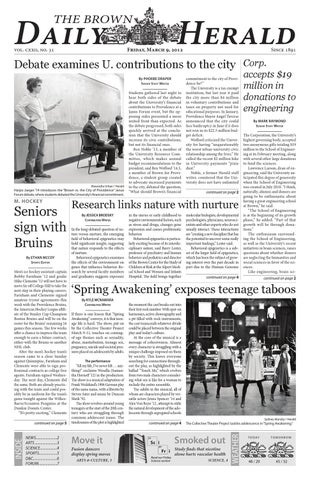
Alexandra Urban / Herald
Harpo Jaeger ‘14 introduces the “Brown vs. the City of Providence” Janus Forum debate, where students debated the University’s financial commitment.
Seniors sign with Bruins By ethan mccoy Sports Editor
Men’s ice hockey assistant captain Bobby Farnham ’12 and goalie Mike Clemente ’12 will not have to move far off College Hill to take the next step in their playing careers. Farnham and Clemente signed amateur tryout agreements this week with the Providence Bruins, the American Hockey League affiliate of the Stanley Cup Champion Boston Bruins and will be on the roster for the Bruins’ remaining 16 games this season. The few weeks offer a chance to impress the team enough to earn a future contract, either with the Bruins or another NHL club. After the men’s hockey team’s season came to a close Sunday against Quinnipiac, Farnham and Clemente were able to sign professional contracts as college free agents. Farnham signed Wednesday. The next day, Clemente did the same. Both are already practicing with the team and could possibly be in uniform for the team’s game tonight against the WilkesBarre/Scranton Penguins at the Dunkin Donuts Center. “It’s pretty exciting,” Clemente
inside
continued on page 5
news.........................2 Arts ..........................3 Science....................4 Sports.....................5 D&C............................6 Forum......................7
continued on page 2
Research links nature with nurture By Jessica Brodsky Contributing Writer
In the long-debated question of nature versus nurture, the emerging field of behavioral epigenetics may hold significant insight, suggesting that nature responds to the effects of nurture. Behavioral epigenetics examines the effects of the environment on genes that influence behavior. Research by several faculty members and graduates suggests exposure
in the uterus or early childhood to negative environmental factors, such as stress and drugs, changes gene expression and causes problematic behavior. Behavioral epigenetics is particularly exciting because of its interdisciplinary nature, said Barry Lester, professor of psychiatry and human behavior and pediatrics and director of the Brown Center for the Study of Children at Risk at the Alpert Medical School and Women and Infants Hospital. The field brings together
molecular biologists, developmental psychologists, physicians, neuroscientists and other experts who do not usually interact. These interactions are “creating a new discipline that has the potential to uncover some really important findings,” Lester said. Behavioral epigenetics is a subset of the larger field of epigenetics, which has been the subject of growing interest over the past decade in part due to the Human Genome
accepts $19 million in donations to engineering By mark raymond Senior Staff Writer
The Corporation, the University’s highest governing body, accepted two anonymous gifts totaling $19 million to the School of Engineering at its February meeting, along with several other large donations to fund the sciences. Lawrence Larson, dean of engineering, said the University anticipated this degree of generosity when the School of Engineering was created in July 2010. “I think, naturally, alumni and donors are going to be enthusiastic about having a great engineering school at Brown,” he said. “The School of Engineering is at the beginning of its growth phase,” he added. “Part of that growth will be through donations.” The enthusiasm surrounding the School of Engineering, as well as the University’s recent initiatives in brain sciences, raises questions about whether donors are neglecting the humanities and social sciences in favor of the sciences. Like engineering, brain sci-
continued on page 4
continued on page 2
‘Spring Awakening’ exposes teenage taboos By Kyle McNamara Contributing Writer
If there is one lesson that “Spring Awakening” conveys, it is that teenage life is hard. The show, put on by the Collective Theater Project March 9-11, touches on comingof-age themes such as sexuality, abuse, masturbation, teenage sex, pregnancy, suicide and societal pressures placed on adolescents by adults. The performance
“All my life, I’ve never felt … anything!” exclaims Wendla (Samantha Horneff ’12) in the production. The show is a musical adaptation of Frank Wedekind’s 1906 German play of the same name, with a libretto by Steven Sater and music by Duncan Sheik ’92. The show revolves around young teenagers at the start of the 20th century who are struggling through common adolescent issues. The timelessness of the plot is highlighted
Move it
Fusion dancers display spring moves Arts & culture, 3
the moment the cast breaks out into their first rock number. With spot-on harmonies, active choreography and a pit filled with rock instruments, the cast transcends whatever divide could be placed between the original play and today’s culture. At the core of the musical is a message of cohesiveness. Almost every character is struggling with a unique challenge imposed on them by society. This leaves everyone searching for connections throughout the play, as highlighted by the ballad “Touch Me,” which evolves from two male characters considering what sex is like for a woman to include the entire ensemble. The adults in the musical, all of whom are characters played by versatile actors Jenna Spencer ’14 and Alex Von Reyn ’12 , attempt to stifle the natural development of the adolescents through segregated schools continued on page 4
Sydney Mondry / Herald
The Collective Theater Project tackles adolescence in “Spring Awakening.”
Smoked out
Study finds that nicotine alone hurts vascular health Science, 4
weather
M. Hockey
Students gathered last night to hear both sides of the debate about the University’s financial contributions to Providence at a Janus Forum event, but the opposing sides presented a more united front than expected. As the debate progressed, both sides quickly arrived at the conclusion that the University should increase its civic contributions, but not its financial ones. Ben Noble ’13, a member of the University Resource Committee, which makes annual budget recommendations to the president, and Ben Wofford ’14.5, a member of Brown for Providence, a student group created to advocate increased payments to the city, debated the question, “What should Brown’s financial
commitment to the city of Providence be?” The University is a tax-exempt institution, but last year it paid the city more than $4 million in voluntary contributions and taxes on property not used for educational purposes. In January, Providence Mayor Angel Taveras announced that the city could face bankruptcy in June if it does not rein in its $22.5 million budget deficit. Wofford criticized the University for having “unquestionably the worst urban-university civic relationship among the Ivies.” He called the recent $2 million hike in University payments “pixie dust.” Noble, a former Herald staff writer, countered that the University does not have unlimited
t o d ay
tomorrow
48 / 29
45 / 32