Daily
Herald
the Brown
vol. cxxii, no. 21
Friday, February 24, 2012
Since 1891
Cable Car Social action program house approved says ‘salut’ to French film fest By AParaajit Sriram Senior Staff Writer
By Marshall katheder Contributing Writer
The world is going to end — and very soon. That is the problem Robinson, a French bathtub salesman, faces in the film “Les derniers jours du monde” (Happy Ends), which premiered Thursday night at the Cable Car Cinema. Robinson greets this looming global end with sexually ecstatic fury, leaving his wife and child to pursue a new lover in the hopes of achieving a sense of romantic fulfillment. With dreamy pacing, “Les derniers jours du monde” explores a somewhat tired movie trope — how to deal with the apocalypse — from a quirky, surreal angle. Directed by Arnaud and JeanMarie Larrieu, this 2009 film is one of 21 films to be shown at the Cable Car from now until March 4 as part of the annual French Film Festival. Since 1994, the French and Modern Culture and Media departments have teamed up with the Cable Car to bring films from French-speaking countries to select silver screens. “The goal is to bring French continued on page 2
The Office of Residential Life approved a proposal Wednesday to create a Social Action Program House in Diman House on Wriston Quadrangle. The house was approved after nearly three months of deliberation by ResLife and the student-comprised Residential Council. The program house will aim to bring together students who have a passion for social justice and service, said Ben Chesler ’15, who spearheaded the effort to create the house. Slated to open next semester, the creators of the proposal are currently recruiting students to fill the available spaces, Chesler said. Chesler proposed the new program house because he feels the social action community at Brown is “divided,” he said. Though there are many student groups involved in
various service projects, Chesler said there is “no real common hub” for them to engage in conversation with one another. He added that there are few opportunities for students who are not involved in projects to simply join the conversation about activism. “When you have a work space and a living space close together, stuff gets done,” Chesler said. “You could be sitting around at 2 in the morning and have a crazy idea for an organization, and you have the people there to make it happen.” The proposal for the house was drafted and brought to ResCouncil in November by a group of about 20 students, most of whom are first-years who participated in the University Community Academic Advising Program, Chesler said. The social action house will fill rooms left vacant after Interfaith House closed continued on page 4
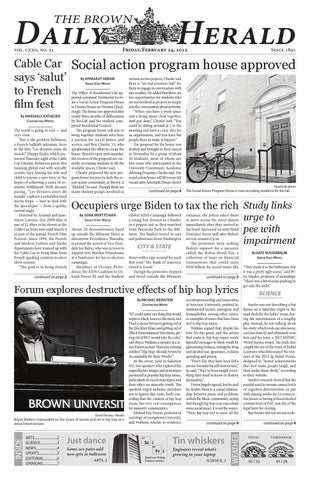
Herald file photo
The Social Action Program House is now recruiting residents for the fall.
Occupiers urge Biden to tax the rich Study links By Sona Mkrttchian Senior Staff Writer
About 20 demonstrators lined up outside the Biltmore Hotel in downtown Providence Thursday to protest the arrival of Vice President Joe Biden, who was in town to support Sen. Sheldon Whitehouse at a fundraiser for his re-election campaign. Members of Occupy Providence, the AIDS Coalition to Unleash Power RI and the Student
Global AIDS Campaign followed a young boy dressed as a banker in a puppet suit as they marched from Burnside Park to the Biltmore. The banker waved to cars and pedestrians down Washington
city & state Street with a sign around his neck that read “Mr. Bank of America: Greed is Good.” Though the protesters stopped and stood outside the Biltmore
entrance, the police asked them to move across the street almost immediately after they arrived at the hotel. Increased security lined Dorrance Street well after Biden’s arrival around 6 p.m. The protesters were seeking Biden’s support for a measure called the Robin Hood Tax, a collection of taxes on financial transactions that could raise $350 billion for social issues like continued on page 3
Forum explores destructive effects of hip hop lyrics
David Deckey / Herald
inside
Boyce Watkins expounded on the issues of racism and art in hip hop at a Janus Forum lecture.
Arts...........................2 Science....................3 News.........................4 Sports.....................5 editorial................6 Opinions.................7
Just dance Same-sex pairs add new spin to ballroom Arts, 2
“If I could name one thing that would improve black America the most, and I had a choice between getting rid of the (Ku Klux Klan) and getting rid of (Black Entertainment Television), getting rid of BET would take the cake,” said Boyce Watkins, a speaker at a Janus Forum lecture Thursday evening entitled “Hip Hop: Should Artists be Accountable for their Words?” At the event, held in Salomon 101, two speakers who explored the unproductive images and stereotypes portrayed in popular hip hop music, particularly its racial stereotypes and their effect on minority youth. The speakers urged audience members not to ignore this issue, both conceding that the content of hip hop music has very real consequences for minority communities. Michael Eric Dyson, professor of sociology at Georgetown University, and Watkins, scholar in residence
By Kate Nussenbaum Senior Staff Writer
“They made it to the bathroom, but it was a pretty ugly scene,” said Peter Snyder, professor of neurology. “There was a bit of some pushing to get into the stalls.”
science
in entrepreneurship and innovation at Syracuse University, pointed to institutional racism, misogyny and homophobia, among other issues, as examples of issues that have been tied to hip hop music. Watkins argued that, despite his love for the genre and the artists that make it, hip hop music sends harmful messages to black youth by glamorizing violence, misogyny, drug and alcohol use, ignorance, reckless spending and prison. “Every day, they have been fed a precise formula for self-destruction,” he said. “They’ve been taught everything they need to know to destroy themselves.” Dyson largely agreed, but he said he doubts there is a causal relationship between music and problems within the black community, saying that though hip hop may exacerbate some social issues, it is not the source. “Were hip hop not to exist, all the
Snyder was not describing a frat house on a Saturday night or the mad dash for the ladies’ room during the intermission of a lengthy play. Instead, he was talking about his study, which took one afternoon, cost less than $2 and ultimately won him and his team a 2012 MSNBC Weird Science award. The study also caught the eye of the team of Nobel Laureates who determined the winners of the 2011 Ig Nobel Prizes, designed to “honor achievements that first make people laugh, and then make them think,” according to their website. Snyder’s research showed that the painful need to urinate causes levels of cognitive deterioration on par with staying awake for 24 consecutive hours or having a blood alcohol content level of 0.05, just shy of the legal limit for driving. But Snyder did not set out to de-
continued on page 4
continued on page 4
Tin whiskers Engineers reveal what’s growing in your laptop
SCIENCE, 3
weather
By Michael Weinstein Contributing Writer
urge to pee with impairment
t o d ay
tomorrow
45 / 32
45 / 24